Students tell Exeter to cut ties with Chinese university

“The problem is that the partnership was all very much behind closed doors. There wasn’t an independent review process, there wasn’t any scope for the wider university community to input, there wasn’t any transparency about it until it was a fait accompli.”

Charlie Parker, Ben Ellery www.thetimes.co.uk

Exeter University is being urged to cut institutional ties with a Chinese university over its employment of academics considered the “ideological architects” of the oppression of Uighurs.

Students say Exeter may be “complicit in cultural genocide” over its decade-long relationship with Tsinghua University, President Xi’s alma mater.

Senior academics at Tsinghua, considered the “Oxbridge of China”, are said to have laid the ideological foundations of forced assimilation policies.

It has drawn criticism for facilitating the work of Hu Angang, an influential political economist, and Hu Lianhe, a counterterrorism researcher who became a senior Chinese Communist Party (CCP) official.

Hu Angang, director of the university’s Institute for Contemporary China Studies, has argued for the creation of a “unified race” in China and is understood to have significant influence among CCP politburos.

The two academics have written about the failure of multi-ethnic states in other countries and proposed government intervention to eradicate ethnic differences, making them “blend together” into a single “state-race”.

The CCP has adopted at least seven important policy reforms proposed by Hu Angang, according to the Jamestown Foundation, a think tank, suggesting that his ideas on ethnic policy reform are likely to have received “a serious hearing”.

A Freedom of Information request from students in Exeter revealed that one academic from its College of Humanities met Hu Angang in 2016 when giving a talk at Tsinghua.

Tsinghua has partnerships with other leading western universities, including Oxford, Cambridge, Imperial, Harvard and Yale. It was crowned the best university in Asia this year in the World University Rankings.

It is understood to have provided resources to Exeter worth tens of thousands of pounds.

Mark Goodwin, a deputy vice-chancellor at Exeter, and Richard Foord, the university’s acting head and lead on global partnerships, debated the issue with members of the university at a panel hearing last night.

Rahima Mahmut, a Uighur who fled China and is now the UK project director of the World Uighur Congress and an adviser to the Inter-Parliamentary Alliance on China, said all UK universities should review their relationships with Tsinghua, adding that the partnerships “make my blood boil”.

Exeter students associated with the Students For Uighurs campaign began to scrutinise the relationship their university had with Tsinghua this year after the two institutions announced a new joint chair post.

The Freedom of Information request revealed that the universities had signed and repeatedly renewed a memorandum of understanding in 2011 “to facilitate deeper research engagement across a large number of academic disciplines”.

As part of the agreement the universities collaborated in fields including leadership, engineering, data science and artificial intelligence.

Flo Marks, a politics student at Exeter, has led a student protest against the agreement which has won support across the campus as well as from hundreds online.

She is calling for more informal links between the two universities so that collaboration on important subjects could continue between specific scholars and departments while maintaining ethical standards.

One Exeter academic told The Times: “The problem is that the partnership was all very much behind closed doors. There wasn’t an independent review process, there wasn’t any scope for the wider university community to input, there wasn’t any transparency about it until it was a fait accompli.

“There is a reasonable argument that working with an institution that employs Hu Angang is just a red line. If push comes to shove I would probably agree with that.”

Hu Angang and Hu Lianhe took inspiration from the American “melting pot” model, claiming that creating a shared identity helps to maintain “national unity, development vitality and social order”. They described the “fusion” of ethnicities as a matter of national security.

After their paper was published they were met with strong opposition from other Chinese scholars of ethnic policy who argued the government should focus on reining in the heavy-handed policing and discrimination they believed was fuelling divisions.

However, violent incidents in the years that followed intensified calls for the adoption of more extreme measures. Xi became vocal in the debate after terrorist attacks in Beijing and in the southwest city of Kunming in 2014 that Chinese authorities said were carried out by Uighur separatists from Xinjiang.

The government in Xinjiang has since built “unity villages” where Han and minorities live side by side. It has also been increasing efforts to support marriages between Han and Uighurs.

In a written response to questions about the policies, Hu Angang told The Wall Street Journal that compared with other countries “China’s policies towards ethnic minorities and ethnic regions have all been the most successful”.

Charles Parton, a former British diplomat with two decades of experience working on issues in China, Hong Kong and Taiwan, said Hu Angang’s work may have given the CCP “direction” when making policies for ethnic minorities in Xinjiang.

“The specifics of implementation are nothing to do with Hu Angang — he might provide ideological justifications and suggestions,” he said. “He’s well known as an ideologue whom one wouldn’t want to shake hands with too closely.”

However, Parton called for caution over cutting all ties with Tsinghua. “We want relations with China, so there needs to be balance there. Keep Hu Angang at arm’s length to the extent that you can, don’t invite him to Exeter, but if he turns up to a meeting [in Tsinghua] then tolerate him.

“You may not agree with these people but it’s better to talk to them and understand where they’re coming from so that you are in a better place to argue against it.”

An Exeter University spokeswoman said: “No one at the university has collaborated with Hu Angang or Hu Lianhe. University researchers have not worked with Tsinghua researchers on questions of ethnicity, be that ethnicity in Xinjiang, in China or elsewhere.

“Before entering into any new collaboration, the University of Exeter employs robust due diligence processes and ensures that it is following the most up-to-date regulations and guidance from the UK government and Universities UK.

“To date, that advice has been that we should continue our connections with China, as a part of the UK’s extensive education and cultural links with the country. The University of Exeter is implementing recommendations set out in recent Universities UK guidance to all universities on ‘Managing risks in internationalisation: security related issues’.

“In common with other UK universities, the University of Exeter works with wide range of partner universities across the world — including Tsinghua University — on global challenges such as climate science and public health.”

Tsinghua, Hu Angang and Hu Lianhe did not respond to requests for comment.

Aye, No or Abstain? A tricky one for Tories.

Owl is hearing reports that a formal motion to rescind the so-called Leadsom amendment, which looked to establish a review of the MPs standards investigation process and delay Owen Paterson’s suspension for breaking lobbying rules, will now be debated and voted on possibly this afternoon.

Tomorrow Labour intends to table their own “clean up” motion.

It will be interesting to see how many Tory MPs reveal their “true colours” in the debate and subsequent vote – Aye, No, or Abstain?

Work to replace dated Exeter homes to start next year

With 92 new apartments built to Passivhaus standard.

There is a Passivhaus development in Seaton, are there any more in East Devon? – Owl

Anita Merritt www.devonlive.com

Next stage plans have been revealed for dated homes awaiting demolition in Exeter which have become an eyesore in the local area and have been targetted by intruders causing criminal damage.

In February 2020, plans were approved to replace the existing buildings of Whipton Barton House in Vaughan Road, Whipton, with 92 new apartments built to Passivhaus standard.

The new development – created by Exeter City Council-owned development company Exeter City Living – will be called The Gardens. Out of the new homes being built, 60 of the new homes will be affordable and retained as new Council housing, and 32 homes will be for market rent.

The apartments would be arranged in three and four-storey blocks around the perimeter of the site, with a communal garden and play area at its centre.

However, work is yet to commence on the new environmentally-friendly housing project which is currently surrounded by hoardings to keep the site secure.

Repairs to the hoardings were scheduled for installation last month. A main contractor will then start the construction of the new building in spring 2022.

Work is yet to begin at new housing development The Gardens in Vaughan Road, Exeter

Work is yet to begin at new housing development The Gardens in Vaughan Road, Exeter (Image: Exeter City Council)

A number of incidences of anti-social behaviour have been reported at the site, including trespassing and criminal damage.

Exeter City Living has stated on its website: “As a building site it presents a number of potential dangers, and we do not wish for anyone to get hurt.

“While we are keeping the site as secure as we can, any help from the community in identifying intruders will help to keep people safe and assist the police dealing with the situation.”

In the meantime, in a bid to improve the look of the site, colourful artwork has been created on the hoardings during workshops with artist Stuart Crewes, funded by Exeter City Living.

More than 50 pupils from Whipton Barton School and Willowbrook School, plus families at the Beacon Community Centre, participated in the workshops, drawing inspiration from nature and the built environment, and by thinking about what makes a vibrant and healthy place to live.

Cllr Ruth Williams, lead councillor for supporting people, who helped with the coordination of the community artwork, said: “These beautiful artworks are the culmination of a series of workshops with the artist and local community, and the result is fantastic.

Pupils from Whipton Barton School and Willowbrook School have helped to created artwork on the hoardings of The Gardens development site

Pupils from Whipton Barton School and Willowbrook School have helped to created artwork on the hoardings of The Gardens development site (Image: Exeter City Council)

“I know that the people of Whipton will enjoy the artwork and it will be there at the front of this wonderful development, where we will have 92 homes for local people, including 60 council socially-rented homes, and I so happy to see this.”

The site has previously been used to provide single-storey sheltered housing facilities.

The development is part of the council’s wider plans to create 500 new Passivhaus Council homes in Exeter over the next five years.

The Gardens in Vaughan Road, Exeter

The Gardens in Vaughan Road, Exeter (Image: Exeter City Council)

The homes are created to be healthier and more comfortable; where heat regulation costs are reduced and where climate emergency and fuel poverty are tackled head on.

The development will feature a biodiverse green space, built with community in mind. Private gardens, electric car club, electric vehicle hook ups and extensive cycle parking have also been included in the design of the development.

Sleaze – Tory true colours run deep

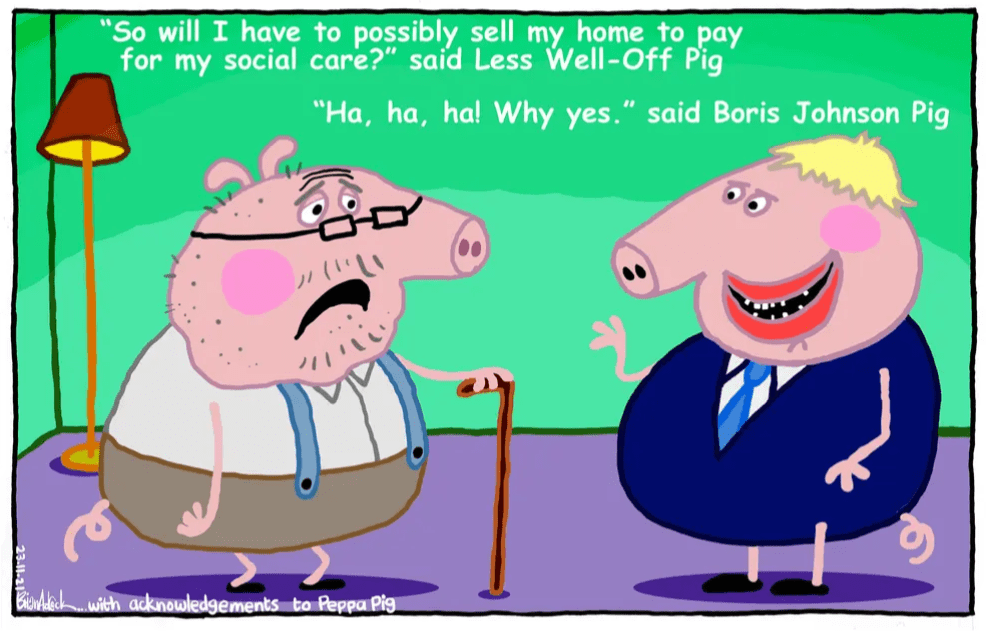
All it took was one Tory to holler “OBJECT” to block the attempt to reverse the “sleaze” vote. 

But was he taking his lead from the Prime Minister? 

After all, Boris Johnson has refused to apologise for the sleaze row and only admitted that he could have handled the matter better.

So the vote of two weeks ago to create a “kangaroo court”, stuffed with conservative MPs, to review standards still stands!  – Owl

PM fails to stifle sleaze scandal as ratification of Paterson report blocked

Aubrey Allegretti www.theguardian.com 

Boris Johnson’s attempt to draw a line under the sleaze scandal engulfing the Conservative party fell apart after a Tory MP blocked parliament endorsing a report that found a former colleague committed an egregious breach of lobbying rules.

The backbencher Christopher Chope was named by multiple sources as the person who objected to ratifying the findings about Owen Paterson’s behaviour which followed a two-year investigation by the Commons standards watchdog.

The government had tried to shunt the vote to the end of the day but put forward a motion that only one MP needed to object to in order for it to fail. In a deeply embarrassing move for the prime minister, one Tory cried out “object” late on Monday night – prolonging the resolution of the issue that has prompted some MPs to warn tensions are “frighteningly high” within the Conservative party.

Chris Bryant, a Labour MP and chair of the standards committee, said he had been assured the motion would be retabled on Tuesday with a one-hour debate to try again to endorse the Paterson report. Chope was contacted for comment.

Fury from Tories exploded at the issue being prolonged, with a minister telling the Guardian: “He has been for many year a Jurassic embarrassment – tonight he crossed a line. The man should retire and the executive are livid. If he comes into the team room tomorrow, colleagues would want to say two words to him and the second word would be ‘off’.”

A former minister said: “The fact we can’t deselect these people is baffling”, while a frontbencher called Chope “a selfish twat”. Backbenchers complained it would “make a bad situation even worse”, and expressed severe disappointment it was “handing Labour a freebie”.

Meanwhile, the shadow Commons leader, Thangam Debbonaire, said the “farce was of the Tories’ own making and serves Johnson right for trying to sneak a U-turn out at night rather than do the decent thing and come to the house to apologise”.

It came hours after Kwasi Kwarteng apologised to parliament’s standards commissioner for casting doubt on her future in the role earlier this month.

The business secretary wrote to Kathryn Stone saying he regretted his choice of words and recognised that ministers must adhere to high standards that treat others with consideration and respect.

“I did not mean to express doubt about your ability to discharge your role and I apologise for any upset or distress my choice of words may have caused,” he said.

Kwarteng made the comments in a broadcast interview as he was sent out to defend the government’s bid to overhaul the standards regime and spare Paterson a six-week Commons suspension.

He told Sky News: “I think it’s difficult to see what the future of the commissioner is, given the fact that we’re reviewing the process, and we’re overturning and trying to reform this whole process, but it’s up to the commissioner to decide her position.”

Just hours later, the government U-turned on its efforts to undermine the system that regulates the actions of MPs, as Johnson agreed to let the parliamentary standards committee come up with its own proposals for reform.

Tory MPs had already been whipped to vote in favour of reforming the system in a way that would let Paterson off the hook, but the government has since agreed to reverse that parliamentary decision.

After the motion narrowly passed on 3 November, ministers privately vented their fury and a public backlash forced the prime minister to U-turn.

Johnson promised to retract the motion that set up a new committee that would have been chaired by a Tory MP and reviewed the existing processes for investigating sleaze claims.

The humiliating climbdown led to Paterson resigning as MP for North Shropshire, and sparked a close examination of other lawmakers’ second jobs and outside interests.

In the nearly two weeks since, many in Johnson’s party have vented their frustration at yet another “unforced error” by Downing Street that has potentially cost them a lead in the polls and seen their faith in Johnson diminish further.

One former cabinet minister said there was still widespread unhappiness in the parliamentary party, with particular ire about the way the chief whip had been “hung out to dry” when the decision had ultimately been Johnson’s.

He said the preference of many Conservative MPs would have been to plea for leniency for Paterson, who has always denied wrongdoing, rather than letting him off altogether, but those MPs suggested that course had been ignored.

Planning applications validated by EDDC for week beginning 1 November

Covid: Biggest drop in cases since start of winter wave

covid.joinzoe.com 

According to ZOE COVID Study incidence figures, in total there are currently  72,546 new daily symptomatic cases of COVID in the UK on average, based on PCR and LFT test data from up to five days ago [*]. A decrease of 18% from 88,592 new daily cases last week. 

In the vaccinated population (at least two doses) cases are dropping more slowly and it’s estimated there are currently 24,766 new daily symptomatic cases in the UK. A decrease of 11.5% from 27,980 new daily cases last week (Graph 1). 

The UK R value is estimated to be around 0.9 and regional R values are; England, 0.9, Wales, 0.9, Scotland, 1.0 (Table 1). 

The ZOE incidence data is always a week ahead of the other surveillance surveys and continues to work as an early warning signal. The ZOE data has been reporting a downturn in cases for the past two weeks, the latest ONS figures are yet to reflect this trend. (Graph 5). 

In terms of prevalence, on average 1 in 58 people in the UK currently have symptomatic COVID. In the regions, England, 1 in 57. Wales,1 in 47. Scotland, 1 in 84. (Table 1). 

The number of daily new cases continues to show a steep decline in cases among 0-18 year olds, which is the driving group behind both the initial increases and the recent fall in overall case numbers. Cases in 20-29 year olds are still increasing but cases have started to fall in the 35-55 year age group. Cases among those over 55 are levelling off. (Graph 2).

In terms of prevalence, cases are highest in the Midlands, South East and North East but prevalence is falling in those areas (Graph 3). 

ZOE’s predicted Long COVID incidence rate currently estimates, at current case rates, 1,279 people a day will go on to experience symptoms for longer than 12 weeks. This number continues to fall in line with the overall incidence figures (Graph 4). 

The ZOE COVID Study incidence figures (new symptomatic cases) are based on reports from around 750,000 thousand weekly contributors and the proportion of newly symptomatic users who have received positive swab tests. The latest survey figures were based on data from 40,100 recent swab tests done between 23 October and 6 November 2021. 

Professor Tim Spector, lead scientist on the ZOE COVID Study app, comments on the latest data:

“This drop in cases is the largest weekly decline we’ve seen all year, and is being driven by a sustained fall in cases among children over the last two weeks. However, cases are still high and, worryingly, we’re still seeing high death rates as COVID takes up to 8% of hospital beds. 

As we head into the colder months, we’re seeing a lot of sickness in the population with widespread outbreaks of colds and still high levels of COVID. Knowing the difference between the two is harder than ever, as cases in the vaccinated are mild and include symptoms like sneezing, headache and a runny nose and can be easily transmitted to family members or work colleagues. To keep numbers down it’s crucial for everyone eligible to get their booster jabs, even if they have recently had a COVID infection, as we’ve shown natural infections do not always produce an immune response and protection. We know from our research that the vaccines (given in 3 doses) provide the greatest possible protection against contracting the virus, and being admitted to hospital with more serious symptoms.”

Graph 1. The ZOE COVID Study UK incidence figures results over time; total number of new cases and new cases in fully vaccinated

Graph 2. Incidence by age group 

Graph 3. Prevalence rate by region

Graph 4. Predicted Long COVID incidence over time

Please refer to the publication by Thompson at al. (2021) for details on how long covid rates in the population are modelled

Graph 5. A comparison of prevalence figures; ZOE COVID Study, and other COVID surveillance studies

Table 1. Incidence (daily new symptomatic cases)[*], R values and prevalence regional breakdown table 

Map of UK prevalence figures

NHS patients dying in back of ambulances stuck outside A&E, report says

People are dying in the back of ambulances and up to 160,000 more a year are coming to harm because they are stuck outside hospitals unable to be offloaded to A&E, a bombshell report has revealed.

Denis Campbell www.theguardian.com 

Patients are also dying soon after finally getting admitted to hospital after spending long periods in the back of an ambulance, while others still in their own homes are not being saved because paramedics are trapped at A&E and unable to answer 999 calls, said the report by NHS ambulance service bosses in England.

In addition, about 12,000 of the 160,000 are suffering “severe harm” such as a permanent setback to their health. These include people with life-threatening health emergencies such as chest pains, sepsis, heart problems, epilepsy and Covid-19 because growing numbers of paramedics are having to wait increasingly long times to hand over a patient to A&E staff.

Ambulance logjams outside hospitals have become a major problem in the NHS in recent years as A&E staff have struggled to find beds for patients they have decided to admit because the hospital has run out of beds as a result of Covid-19, their inability to discharge patients who are medically fit to leave and the record demand for care.

That has left A&E personnel having to limit the number of patients who can be in their unit at one time, which leads to sometimes long queues of ambulances outside. The problem has become much more serious in recent months as all NHS services have seen unprecedented demand for care.

Labour and the Liberal Democrats said the “staggering” extent of damage to patients’ health underlined the risks posed by the deepening crisis facing NHS ambulance services.

The report, seen by the Guardian, has been drawn up by the Association of Ambulance Chief Executives (AACE) and is based on official NHS figures, which until now were secret. AACE represents the chief executives of England’s 10 regional ambulance services, all of which have had to declare an alert in recent months after being faced with unprecedented demands for help.

It concludes that: “When very sick patients arrive at hospital and then have to wait an excessive time for handover to emergency department clinicians to receive assessment and definitive care, it is entirely predictable and almost inevitable that some level of harm will arise.

“This may take the form of a deteriorating medical or physical condition, or distress and anxiety, potentially affecting the outcome for patients and definitely creating a poor patient experience.”

It does not say how many patients a year die because so many ambulances are stuck at hospitals. But it adds: “We know that some patients have sadly died whilst waiting outside ED [emergency departments], or shortly after eventual admission to ED following a wait. Others have died while waiting for an ambulance response in the community.

“Regardless of whether a death may have been an inevitable outcome, this is not the level of care or experience we would wish for anyone in their last moments. Any form or level of harm is not acceptable.”

AACE studied all handover delays lasting more than an hour that occurred across the 10 ambulance trusts on 4 January, and the harm resulting. It used the data to estimate how many patients a year suffer a deterioration in their health, or need much more invasive treatment such as surgery, as a direct result of waiting a long time to be treated by doctors and nurses.

It concluded that: “If these results from 4 January 2021, which was not an atypical day, are extrapolated across all handover delays that occur every day, the cases of potential harm could be as high as 160,000 patients affected a year.

“Of those, approximately 12,000 patients could potentially experience severe harm as a result of delayed handovers.”

Daisy Cooper, the Liberal Democrats’ health spokesperson, said: “These staggering figures will shock people to their core. These are absolutely devastating findings, which reveal that there is a huge toll of harm and severe harm, including tragically patient deaths, as a direct result of the colossal number of ambulance handover delays we’re now seeing.”

Ambulances are meant to hand patients over to A&E staff within 15 minutes, with none waiting more than half an hour. However, queues of as many as 15 ambulances at a time have been building up outside hospitals in recent years because hard-pressed staff have been too busy to accept them.

Last month the West Midlands ambulance service admitted publicly that handover delays were causing “catastrophic” harm to patients. Mark Docherty, its nursing director, said that despite its best efforts “we know patients are coming to harm” and that some patients “are dying before we get to them”.

Pressure on its ambulances forced the service to raise the risk assessment of harm to patients from level 20 to level 25 – the highest ever. “The definition of 25 is that harm is almost certain – and it’s going to be catastrophic. I think we’re now at that place,” Docherty added.

Jonathan Ashworth, the shadow health secretary, said: “This is a devastating report. The scale of harm and severe harm being done to patients is a scandal.

“Ministers should be ashamed that colossal numbers of patients – thanks to years of Tory NHS neglect – are languishing in ambulances waiting for vital life-saving care at risk of, and indeed suffering, serious harm, permanent disability or loss of life.”

Hospitals are under such pressure that about 190,000 handovers a month – around half the total – now take longer than they should, AACE’s report said. Paramedics have been warning that patients whose health has collapsed in their home or another setting have also been put at risk because being trapped outside A&Es means they are not available to respond quickly to 999 calls.

A series of recent incidents illustrate the crisis confronting ambulance services:

A Department of Health and Social Care spokesperson said: “We are committed to supporting ambulance crews who work tirelessly responding to emergencies every day. NHS England and Improvement has given ambulance trusts an extra £55m to boost staff numbers for winter, helping them to bolster capacity in control rooms and on the frontline.

“We are supporting the NHS to meet the unprecedented pressures it is facing, with record investment this year including an extra £5.4bn over the next six months to support its response to Covid-19 and £36bn for health and care over the next three years.”

Builders and Developers “may be gaming the system”

Housebuilders may be “gaming the system” to avoid fire safety checks put in place after the Grenfell Tower fire, London Fire Brigade (LFB) has warned.

www.bbc.co.uk

Deputy Commissioner Paul Jennings said there are “hundreds if not thousands” of new buildings which may be “deliberately” designed to avoid rules.

They include blocks designed to be lower than an 18m (59ft) limit to be considered a high-rise building.

The building safety minister branded efforts to “cut corners” as “shocking”.

The Grenfell Tower fire in June 2017 led to the deaths of 72 people.

Speaking to BBC Newsnight, Mr Jennings, said: “We have got examples where we think people are deliberately designing and building their buildings below that 18 metre, six floor threshold, because they know if they reach that threshold they would have to put advanced and more intricate fire safety measures in.”

Mr Jennings described these new buildings in the capital as examples of “gaming the system”.

When asked how many new buildings in London were being constructed to avoid the rules, he said it was likely “hundreds, if not thousands”.

“We are seeing around 60% of the building consultations that come into the fire engineering team and others are ones where we are going backwards,” he said.

Two weeks ago, LFB said all but three of the recommendations made by the Grenfell Tower Inquiry will be in place by 2022.

On Monday, Michael Gove told the Housing, Communities and Local Government Committee: “We collectively – the department, some in local government, others in the private sector – failed people at Grenfell and there are people who were and still are in buildings where there is a significant risk.”

Well who would have guessed?

“The government has refused to confirm or deny reports that it will finally cancel plans for the HS2 link to Leeds this week, and instead fund a hodgepodge of disparate projects which favour Conservative constituencies and leave mysterious gaps in the rail network.”

www.theguardian.com 

Government to finally drop plan for HS2 link to Leeds – reports

MPs keep second job details secret – for years

MPs are keeping secret their employment agreements for second jobs worth up to £100,000 annually after quietly changing the rules on disclosure.

Jon Ungoed-Thomas www.theguardian.com 

The public had been entitled to inspect MPs’ contractual arrangements linked to their work in parliament. But the rules requiring MPs to deposit the agreements with the office of the parliamentary commissioner for standards were scrapped by parliament in 2015.

Campaigners are now calling for an urgent change in parliament’s code of conduct to force disclosure of the work involved in MPs’ advisory roles.

Boris Johnson also faces calls for a review of MPs’ outside interests and a ban on consultancies linked to politics after a public backlash over the extra earnings of many politicians.

An analysis of the MPs’ register has revealed more than a quarter of Tory MPs have second jobs, worth more than £4m a year. The interests they represent include the gambling industry, global investments firms and the energy sector.

Tom Brake, director of Unlock Democracy, a not-for-profit group which campaigns for democratic reforms, said new rules should be introduced urgently to require the publication of MPs’ employment agreements linked to their political activity. He said: “MPs should make this information available on a voluntary basis with immediate effect. It would help clear the air.”

Under a previous guide to the code of conduct, published in 2012, MPs were required to deposit any employment agreement connected to their work as an MP for public inspection. A new code, approved by the House of Commons, in March 2015 removed the obligation.

The office of the parliamentary commissioner for standards said last week that no MPs had deposited contractual agreements in the last six years. One official said: “The only such agreements we still hold are historical ones dating from the period before the 2015 election, and none of them are live contracts as the employment has ended.”

The row over the government U-turn on proposals to overhaul the House of Commons’ disciplinary system has focused public attention on MPs’ second jobs.

Former Conservative transport secretary Chris Grayling is one of the best-paid MPs, with a £100,000-a-year advisory role with Hutchison Ports Europe, which operates the ports of Felixstowe and Harwich and has its parent company in the Cayman Islands. He is paid about £270 an hour. Grayling was given the go-ahead for the role by the Advisory Committee on Business Appointments, but said he would not do work in areas where he may have “gleaned specific information” in his ministerial job.

Rishi Sunak, the chancellor, announced in March that Felixstowe and Harwich would be given freeport status, where normal tax and customs rules do not apply.

Former minister Andrew Percy, the Tory MP for Brigg and Goole, has disclosed in the MPs’ register of interest a signing-on bonus of £7,000 for the Canadian-based government relations firm Maple Leaf Strategies, which he worked for until last April. Percy also said he would receive commissions on any business referrals.

Percy also discloses in the latest MPs’ register that he has been paid £500 an hour for six hours’ work a month for Iogen Corporation (Canada), a world leader in the development of cellulosic ethanol, a renewable transport fuel. Percy has previously campaigned in parliament for the national rollout of E10 fuel, which contains 10% ethanol. He has also been a member of the all-party parliamentary group for British Bioethanol. He did not respond to a request for comment on his outside interests last week.

A report by the committee on standards in public life in July 2018 said the MPs’ code of conduct and guide to the rules should be changed to read: “MPs should not accept any paid work to provide services as a parliamentary strategist, adviser or consultant.” The recommendation was not adopted by the Commons.

Speaking at an event at University College London last week, Lord Evans, chair of the committee on standards in public life, said the controversy over MPs’ second jobs showed the public’s concern on conduct in public office. He said: “Ethical standards are important for making democracy work. The public does care about this.”

Time to stop the rot – Good Law Project

goodlawproject.org

The UK may be the only democracy in the world without a written constitution – a ‘higher’ law or code to which all others must conform.

Until now, we haven’t seen the need for binding rules. We’ve relied on self-restraint. We’ve trusted politicians to behave themselves. We’ve assumed that only ‘good chaps’ – as Lord Hennessy memorably put it – will rise to high office. And those good chaps won’t need to be told how to behave. Being good chaps, they will know what the rules are and they will obey them.

But what happens if the people running the show aren’t good chaps?

What you get is what we have. Bullying of regulators. Stacking of boards. Challenges to the independence of the media. Criminalising civil protest. Restricting the right to vote. Attacking the independence of MPs. Challenging the judiciary, curtailing its powers and reversing its decisions. Abandoning the Convention on Human Rights and Fundamental Freedoms. There are well-sourced rumours of political interference in operational policing decisions. And, let us not forget, we have a Prime Minister who unlawfully suspended Parliament.

All of this is before we start on the tidal wave of sleaze engulfing the Government: VIP lanes for the politically connected; vast payments to politically connected middle-men; procurement fraud going uninvestigated; failures to declare conflicts of interest by MPs; and the misleading of Parliament by the Prime Minister.

Sitting above all of this is a set of problems, arising not so much from how some politicians behave but from how the world now is. Our politics feels more divided. We seem to have less in common, and the idea we all want the same things for the country feels less secure.

The truth is, the world our rules were made for no longer exists.

What does this mean for the idea that Parliament is supreme – has absolute power? Is this conception of democracy consistent with a first-past-the-post system that can, and often does, give unconstrained power to a Government with a minority of the popular vote? And if MPs are coerced into voting with the Government, who gets to play the constitutional trump card of Parliamentary supremacy? MPs accountable to voters, or the Executive?

At the heart of all of this is a simple truth: you don’t need a constitution to protect you against good chaps because they’re good chaps, and a constitution that can’t protect you against bad chaps is no constitution at all.

Meanwhile, what remains withers and weakens. What is left is less and less able to command public confidence. Trust in politics – and ultimately in democracy – is the victim.

A responsible Government would respond with a process for a new British Bill of Rights. A smart Opposition would demand one.


Good Law Project only exists thanks to donations from ordinary people across the UK. If you’re in a position to support our work, you can do so here

After Cornish staycation summer, locals fear a winter of evictions

Rachel Stevenson www.theguardian.com 

This feature article describes, at some length, the parlous state of the “affordable” housing market in Cornwall. People are being evicted because their landlord either wants to turn their property into a holiday let or because they want to sell up because property prices are so high. There is no accommodation – and the situation is getting worse because of benefit cuts and rising energy bills. 

Simon Jupp recently asked Boris Johnson, in a parliamentary question, to meet him and colleagues across the South West to discuss this growing crisis.

Boris’ answer suggested that having legislated to introduce higher rates of stamp duty on second homes the problem had been solved.

No Boris – think again or are these problems below your pay grade?

See what Cornwall Council portfolio holder for housing needs:

Extract:

Olly Monk, Cornwall Council portfolio holder for housing, says the council is doing all it can to end the housing crisis. “We’ve got an immediate issue with families who are being threatened with homelessness. It must be absolutely terrifying for them,” he said.

The council is buying caravan parks as well as developments of modular homes that can be erected quickly. It is also buying new-build houses straight from developers, announcing last week the purchase of 130 new homes, 100 of which would otherwise have gone on the open market. “This shows our commitment to do whatever is necessary to provide homes that people in our communities can afford,” said Monk.

“We are building and buying up as much social housing as we can. But we need Westminster to give us more powers. We want every property’s primary use to be residential, and if there is any deviation from that, then the owners have to apply to us for permission. We want to close the loophole that allows second homes that are holiday lets to not pay rates. And we want the power to put a surcharge on council tax for second homes or holiday lets.”

He also wants landlords and estate agents to “think twice”. “They should look at their conscience, and look at their communities, and think about where their sons and daughters are going to live in the future.”

Martin Shaw: East Devon MPs are lobby fodder

www.midweekherald.co.uk

I am tempted to agree with Greta Thunberg that COP-26 was all ‘blah blah blah’.

When Boris Johnson flew back to London from Glasgow instead of taking the train, it was difficult to take his climate promises seriously.

There were certainly important agreements on methane and deforestation, and significant pledges by some leaders. But overall it seemed there was too little, too late, to address the disaster we threaten to hand on to our grandchildren. 

Johnson apparently flew back to plot, with former Daily Telegraph editor Charles Moore, how to save their mutual friend, the corrupt Conservative MP Owen Paterson, who was notorious for climate-change denial when he was environment secretary.

It was embarrassing to see Neil Parish MP voting for the brazen – and soon to be abandoned – device which Johnson concocted to get Paterson off the hook, while Simon Jupp MP could only abstain. 

It wasn’t as though Parish and Jupp didn’t know that Johnson might be stitching them up. Only ten days earlier, they had both allowed themselves to be used as lobby-fodder in a move to protect the privatised water companies who are dumping sewage in our waterways, including across East Devon, and threatening the safety of our beaches. They have now meekly supported a ‘compromise’ which still fails to commit the companies to a specific timetable for ending this. 

The extent of Conservative corruption is shocking. As Paul Arnott has reminded us, in East Devon we had advance warning – councillor Graham Brown had to resign in 2013 after being caught offering planning permission for cash; it was clear that he couldn’t have done it without accomplices but they were never caught. But now it goes right to the top. Johnson wanted to get rid of the Commissioner for Standards because she has had to investigate him more than any other MP.   

It is not just that this country is now sinking to a level which was previously unimaginable. Corruption also has dire effects on the delivery of services. Billions were squandered on pandemic contracts given to Tory mates through a special fast lane, some of them producing wholly useless PPE.

Dido Harding, a Tory peer, was made head of Test and Trace, one of the most inefficient and wasteful of all the new bodies. Her appointment is the subject of a legal challenge by the Good Law Project, whose director Jolyon Maugham QC argues: “For ministers or special advisers to choose their friends or close associates for these key roles is to exclude those who are more able, or better value. And ultimately it is the public interest that suffers.”

But who is the Government’s anti-corruption champion? Step forward Somerset MP John Penrose, Harding’s husband. 

Only last month we discovered that the Immensa testing laboratory, which was not properly accredited, had issued tens of thousands of fast negatives for PCR tests taken by people in the South West. Many people will have mixed with family, friends and colleagues, thinking they didn’t have Covid, and inadvertently spread the disease, probably causing hospitalisations and deaths.  

This must be one of the reasons that our region, long a low-Covid zone, now has almost the highest Covid rates in the UK. Devon’s NHS chiefs have been reduced to making desperate pleas for families to take their relatives home from hospital as soon as possible, to free up beds. It has been reported that not a single orthopaedic operation was performed in the RD&E during an eight-week period, such are the pressures on our hugely-stretched and underfunded NHS.  

But does the Government care? No need for Plan B, Johnson and Sajid Javid say. It’s probably a bonus from their point of view that more and more people with money will simply pay to jump the horrendous queues, thereby contributing to privatisation and undermining the very idea of a universal health service. 

‘How Johnson pledged help for my business to win my love’

Extraordinary details of how Boris Johnson allegedly overruled the advice of staff to promote the business interests of his former lover Jennifer Arcuri and win her affections are revealed in previously unpublished diary extracts by the US businesswoman.

Mark Townsend www.theguardian.com

According to one entry, the then London mayor even offered to be her “throttle” in an attempt to accelerate her business career, claims that may reopen the possibility of Johnson facing a potential criminal investigation into misconduct allegations.

The diary entries – which appear to have been written during Arcuri’s affair with Johnson and have been seen by the Observer – also suggest that he broke the rules governing ethical conduct in public office in his dealings with Arcuri.

The handwritten excerpts portray Johnson as desperate to offer help to her in promoting her fledgling business as he pursued a sexual relationship with the then 27-year-old.

One entry recalls how Johnson told her: “How can I be the thrust – the throttle – your mere footstep as you make your career? Tell me: how I can help you?”

Arcuri gave her diaries to the veteran journalist John Ware in 2019 after he made an ITV documentary on her relationship with Johnson.

At Ware’s request, Arcuri has now agreed to allow publication of some of the extracts following Johnson’s statements last week about public probity, including how MPs who break conduct rules “should be punished”.

Despite the prime minister’s comments last week, he never mentioned Arcuri in his declaration of interests when he was mayor, and after news of their alleged affair broke in 2019, he said there was no interest to declare.

The revelations will pile yet more pressure on the prime minister after 10 days of relentless allegations of sleaze and impropriety by Conservatives MPs, and growing anger inside the Tory party over Johnson’s own responsibility for, and handling of, the crisis.

The latest Opinium poll for the Observer today shows how the stream of damaging stories has hit Johnson and his party, with Labour now holding a lead over the Tories for the first time since January this year.

The poll puts Labour on 37% (up 1 point), the Conservatives on 36% (down 1), the Liberal Democrats on 9%, the Greens 7%, and the SNP 5%. Johnson’s personal approval ratings have sunk to another all time low of -21%. A fortnight ago the Conservatives held a five-point lead over Labour.

Responding to the latest Arcuri revelations, a government spokesperson said: “As mayor, Boris Johnson followed all the legal requirements in the Greater London Assembly’s [sic] code of conduct at the time.”

The diaries, however, indicate that Johnson pursued Arcuri, offering to advance her business interests in the apparent hope that this might lead to a sexual relationship with the woman who dubbed him “Alex the Great”.

One diary entry, from 2012, states that Johnson told her: “I can barely control myself whenever I see you. You make me too excited. Baby I couldn’t wait. All year I have been waiting for you. All year. You drove me nuts. I have thought about no woman as I have thought of you.”

Potentially more damaging are excerpts that allege Johnson bragged about ignoring advice from his staff who urged him not to help Arcuri promote her tech company Innotech.

After Johnson had agreed to Arcuri’s request to be the keynote speaker at the launch of Innotech, Arcuri states in a diary entry for 27 February 2013 that Johnson boasted to her how he’d rejected the advice of his staff not to attend. It states: “I just want you to know they came to me and I crushed them. They said: ‘You can’t do this Innotech in April.’ I said: ‘Yes, I can, I’ll be there.’ I only want to do this to make you happy. How I do wish to make you satisfied.”

Another diary entry, this time from November 2012, alleges that Johnson told Arcuri: “You are going to get me in so much trouble.” She also claims that her lover admitted he was aware of a conflict of interest when she asked him to “validate” her tech work publicly.

Members of the Greater London Authority oversight committee which is currently investigating allegations of conflict of interest during Johnson’s time as London mayor called the revelations “significant”.

Committee chair Caroline Pidgeon, speaking in her capacity as an assembly member, said Arcuri’s diary notes were of serious concern. She said: “This new material from Jennifer Arcuri is significant and the IOPC [Independent Office for Police Conduct] may wish to consider whether they need to reopen their investigation.”

Last year the IOPC said it would not be launching a criminal inquiry into whether Johnson abused his position as mayor to “benefit and reward” Arcuri. Arcuri received £126,000 of public money in the form of grants for her technology business and event sponsorship. In addition, she was given access to foreign trade missions led by Johnson. Arcuri insists that none of them were granted personally by Johnson and to date there remains no evidence that they were.

IOPC investigators never had access to Arcuri’s handwritten diary entries in which she made “verbatim” notes of the highlights of his telephone calls and their conversations.

For the IOPC to open a new inquiry into whether Johnson should be investigated for criminal misconduct it must receive a referral from the GLA monitoring officer – an ethics watchdog – to look into the fresh allegations made by Arcuri in her diary. A GLA spokesperson confirmed its monitoring officer would assess “any new significant evidence” into the relationship between Arcuri and Johnson.

Although the police decided no investigation was warranted, the IOPC found his failure to declare the conflict of interest may have breached the GLA 2012 code of conduct.

At the same time as pursuing Arcuri for sex in 2012, Johnson endorsed the code in which he undertook not to bring the GLA “into disrepute” by using his position to “improperly confer on or secure for themselves or any other person, an advantage or disadvantage.”

In December that year, Arcuri returned to the US with Arcuri writing that Johnson was continuing to offer: “How can I be your footstool to your career?” She added how he was “always trying to think of ways to please me.”

Arcuri says Johnson never explained that their relationship posed a head-on conflict with the Nolan principles – ethical standards expected of public office holders and which promote “selflessness, integrity, objectivity, and honesty” in public life. She says that she’d never heard of Nolan until after news broke about their relationship in the autumn of 2019.

Exmouth floodgates tested

As the COP climate summit approached its conclusion in Glasgow without a major declaration for protecting the planet, Exmouth has erred on the safe side and tested its new £12 million defence scheme.

Paul Nero www.radioexe.co.uk

Volunteers will operate the floodgates

The Environment Agency, which led the project, has declared it a “great success.”

This week volunteers tested the procedure for closing flood gates that have been installed along the seafront.

The gates will spend most of their lives open, and only need to be closed when flooding is predicted. More than 1,400 residential and 400 commercial properties now have a reduced risk from rising water. Closing the gates is said to take minutes.

Ben Johnstone Environment Agency area flood and coastal erosion manager thanked the volunteers who operate the gates.

He said: “We train all year round with our partner agencies to make sure we are equipped to respond to incidents, at this time of year with an increase in flood risk it’s vital we make sure we are prepared”.

Councillor Geoff Jung, East Devon District Council portfolio holder for coast, country and environment said: “With all the talk of global warming and rising sea levels, it is great to see this £12 million scheme operational which will protect many vulnerable properties and businesses in Exmouth. We are working on other schemes ourselves and with partners throughout the district to protect properties and businesses which are vulnerable from the sea level rise and increased storm events”  

Some bigger gates along the seafront, such as those that cross roads, require traffic management.  They will result in temporary road closures when flooding is expected. 

Journal letter: PM has contempt for government

Exmouth Journal: Letter from Katherine Wilcox

Five years ago the world watched with a growing sense of disbelief and alarm as President Trump dismantled the institutions and systems of American government which interfered with his agenda to have total control of government.

He used presidential privilege to pardon wrongdoers and ultimately attempted to interfere with the voting system in an attempt to secure a second term in office. When that failed he fomented an insurrection by his supporters who stormed Capitol Hill in January 2021 leading to the death of several people including one security officer who died trying to protect the elected members of the senate.

The Republican senators stood by and refused to act to stop his outrageous attack on the democratic systems of the USA. Even after the insurrection they would not support calls for his impeachment.

We have witnessed Boris Johnson abusing our system of government in a similar fashion. He does not think the rules apply to him; he excuses the inexcusable behaviour of his ministers and friends even after they have been found guilty by parliamentary standards committees of having breached the rules of conduct; he treats the judiciary with contempt if it stands in his way; he prorogued Parliament in October 2019 after the Supreme Court ruled that his first attempt was unlawful. This action had the effect of reducing the time available to debate the Brexit deal. Johnson finally presented the deal to Parliament on Christmas Eve 2019 so that there would be no time for proper debate or scrutiny by Parliament before it was signed off by the January 1st deadline.

Johnson has accused the EU of being obstructive because it is not acceding to all the changes he wants to make to the oven ready Brexit deal which his minister Lord Frost negotiated. The electorate are realising that they have been hoodwinked into voting for a deal which is costing Britain dear.

In two weeks he has outraged Parliament again by using the Chief Whip to get Tory MPs to stop legislation to make water companies clean up their act and now by trying to change the rules of the parliamentary standards watchdog to save Owen Patterson’s skin after he clearly broke the rules on lobbying. Those Tory MPs who have not voted against these outrageous actions need to ignore threats to withhold levelling up funding to their constituencies and resist this corrupt prime minister who is bringing our democracy into such disrepute. American citizens witnessed the near destruction of their democracy by allowing death by a thousand cuts by Trump to the judicial and government standards which are there to protect their democratic system of government. If Johnson is not stopped from treating our parliament and judiciary with the same contempt as Trump, then Britain is at risk of becoming a mafia state run by crooks whose only agenda is their personal enrichment and to hell with everyone else.

KATHERINE WILCOX

Exmouth

Open letter: East Devon MP should abandon his party

Exmouth Journal: Letter from Graham Hurley

This is an open letter to our MP, Simon Jupp. If it reads like a charge sheet, that’s probably because it is.

£37 billion spaffed on Track and Trace? One of the highest Covid death rates in Europe? Local farmers abandoned? Local fishermen sold down the river? Truck drivers a dying breed? Local government on its knees? International treaties torn up? Judicial review under attack? Ditto the BBC, Channel Four, and any other voice raised in protest? And now Downing Street’s blatant attempt to protect one of its own by changing the rules, only to toss him overboard when the going gets rough?

Simon, if you really love East Devon maybe now is the time to jump ship and cross the parliamentary aisle before the Fraud Squad – or the men in white coats – arrive outside the gates of Downing Street. For your sake, and ours, leave this bunch of chancers and incompetents to the fate they so richly deserve.

GRAHAM HURLEY

Electorate hate sleaze – Paul Arnott

I don’t think of myself as a “politician”, and neither do my colleagues in senior councillor roles at East Devon District Council.

Paul Arnott www.midweekherald.co.uk

None of us wish to climb the greasy pole, or line up jobs or consultancies as a result of our positions. Indeed, it’s highly unlikely these would be offered. We are not in the Conservative party. 

However, there is one “political” thing that does unite my senior councillors at East Devon, and that is a repeatedly stated and campaigned-on revulsion for corruption in any tier of government. My own pals at EDDC first came together under the umbrella of the Independent East Devon Alliance, in significant part because a Conservative councillor who had been the dominant figure in planning around here was caught in a sting by the Daily Telegraph and made the front page. 

He was recorded on video boasting that he was the man to come to for planning permission but that he didn’t “come cheap”, saying that if he was going to turn a field into a housing estate he’d need tens of thousands of pounds paid through his planning consultancy. 

The police took nearly two years to decide there was no case to answer and the council itself then immediately scrapped the promised enquiry through its own Scrutiny committee to look into the matter. In other words, with the Tories all powerful back then in 2015 when that appalling decision to stifle debate was made, there has been two years of long grass followed by a “nothing to see here/case closed”. 

Amazingly, and to the council’s shame, the argument was made that the whole matter had been “political”, smearing both the independent councillor Claire Wright and my pals at the East Devon Alliance, then just a rather lovely group of local campaigners chaired by an immaculately behaved retired judge. 

And here was the mistake, taken from the national Tory playbook. The result of that shabby little denial of any further debate was that by 2019 Claire Wright polled more than 20,000 votes in a general election and the Conservatives at East Devon were reduced to just 19 out of 60 councillors, losing power for the first time in the district’s history. In other words, voters across the world hate this stuff, and it is a truism now that the cover-up gets punished more than the original act. 

In my five minutes of spare time a week I am getting going on the research for my next book, which will be about the support for and seeds of British fascism in the aristocracy after WW1. Their funding and influence persisted well into my lifetime, and the emergence of the National Front in the 70s.  

But even these fascists would have hesitated before attempting Johnson’s plans; he wanted to close Parliament for his own ends, he wants to scrap judicial reviews, and now he has nearly succeeded in breaking the rules preventing corruption in the Commons.  

“He’s such a laugh” people used to say but he isn’t; he is as much a threat to democracy as Trump in America, and if our local MPs – who lacked the guts to vote against him last week – want to look themselves in the mirror again they should vote him out of his role and take Jacob Rees-Mogg with him. Our country is not safe in their hands. 

The price of freedom is eternal vigilance, it is often said, and as we showed in East Devon, there comes a point when the electorate just will not put up with any more of this stuff from the Conservatives locally. In the Commons this week they looked utterly shattered. If there was ever a time for a national opposition to unite to remove their power, as we have done in East Devon, it is now. 

PS It was these events in East Devon that stirred an “old” Owl to take wing “Keeping a close eye on our District” in 2014.

Devon MP claimed for 7 car trips but voted in person 3 times

Sir Geoffrey Cox is facing fresh questions over sleaze after claiming almost £1,500 in travel expenses for seven round trips to London in three months last year when he only voted in person on three days.

Carl Eve www.devonlive.com

On the other 18 days of voting in the House of Commons in that period, the Torridge and West Devon MP used an arrangement called a “proxy” to cast a vote without attending.

The Mirror’s investigation found that during the same three months, from October to December 2020, Mr Cox devoted 178 hours to four outside jobs which paid him a total of £143,625.

At the end of this spell, PM Boris Johnson gave Mr Cox a knighthood for his “parliamentary and political service”.

Sir Alistair Graham, former chairman of the committee on standards in public life, said: “At first sight of the evidence available, it appears that Sir Geoffrey has questions to answer. The appropriate authorities should look into this.”

The Mirror’s latest revelations comes after a week of stinging criticism for Westminster’s top-earning MP, who has pocketed almost £6million from legal work on the side since becoming member for Torridge and West Devon in 2005.

His work ethic has not impressed his constituents. Brian Eales, 75, a volunteer at Tavistock Food Bank, said: “I’ve never seen Geoffrey Cox at the food bank in support. At the moment it seems to be all self, feathering his own nest.”

Business owner Suzanne Weston, 53, said: “Geoffrey Cox should stand down. What’s he’s doing is disgusting. Nobody can do two full-time jobs at once.”

Angela Evans, 64, said: “I’m personally appalled by the situation. I would not want him to be returned to office.”

The Mirror examined Mr Cox’s record in the last quarter of 2020 and found no evidence he spoke in Parliament or asked written questions and he was not listed on any parliamentary committees.

He completed the 440-mile round trip by car from his constituency home in Tavistock, Devon, to London seven times in the three months and claimed £105.75 from the taxpayer each way.

Yet he voted in person in the House of Commons on just three days – October 21, November 25 and December 2. For 54 other Commons votes over 18 days of Parliamentary debate he used a proxy.

His register of interests shed light on what else he was doing during that time.

Khan Partnership Solicitors in London paid him £8,000 “for legal services provided between 12 November and 4 December 2020” totalling “12 hrs approx”. The firm paid him £8,875 “for legal services provided in November 2020” totalling “10 hrs approx”.

Khan paid him another “£9,750 for legal services provided in October 2020” totalling 12 hours “approx”.

At the end of September 2020, Mr Cox received the first quarterly payment of £117,000 from Withers LLP for “up to 48 hours a month”. He continues to receive a quarterly payment from the London firm.

Mr Cox did not respond to a request for comment.