NHS will need extra £38bn a year by 2030, thinktank warns

The NHS will need £38bn more a year than planned by the end of the next parliament in order to cut the care backlog and end long treatment delays, political parties have been warned.

Denis Campbell www.theguardian.com 

Labour and Conservative promises on NHS funding “fall well short” of what the beleaguered health service needs to recover from years of underinvestment, according to the Health Foundation.

Politicians are not being honest with the public about the money needed to revive an NHS that is grappling with record numbers awaiting care, inadequate access to GPs and a collapse in public satisfaction, it added.

The NHS will need such huge sums to cope with the rising demand for care that the next government will face “difficult trade-offs” in how it allocates scarce resources, the thinktank said. Failure to give the health service enough money in coming years would mean recent pledges to improve the NHS will not be fulfilled.

The Department of Health and Social Care’s budget will rise by £7.6bn to £196.9bn by 2029/30 under current spending plans. But it will have to increase by £38bn more than that to £235.4bn if whoever is in power after 4 July wants to see “sustained improvement” in its performance, Health Foundation modelling found.

“The health service is in crisis and the main political parties have said they want to fix it. Yet the funding they have so far promised falls well short of the level needed to make improvements,” said Anita Charlesworth, the director of the thinktank’s long-term economic analysis department.

The NHS will need to receive average annual budget rises of 3.8% over the next decade to keep up with the ageing, growing and increasingly sick population, the thinktank calculated.

That 3.8% is significantly above the projected rate of economic growth (1.9%) and planned rise in spending on public services (1.6%) over that time. It also goes well beyond the amount expected if ministers stuck to the Office for Budgetary Responsibility’s 0.8% projected rise in health spending, the thinktank added.

The analysis said: “Addressing the funding required to improve the NHS would mean facing up to difficult trade-offs with the funding needed by other public services and levels of taxation.

“Honesty about these trade-offs has so far been conspicuous by its absence from a general election debate that has been characterised by ‘a conspiracy of silence’ about the choices on public spending and taxation that will confront the next government.”

Whoever is prime minister on 5 July should “level with the public” about the true level of funding the NHS will need to once again deliver key waiting time targets, such as the 18-week wait for hospital care, as well as paying staff more and increasing capital investment.

NHS bosses endorsed the Health Foundation’s analysis. “Put simply, if a new government is going to fulfil campaign promises to tackle NHS backlogs and improve performance, then it will have to invest further,” said Dr Layla McCay, the NHS Confederation’s director of policy. The NHS will need “billions of extra funding”, she added.

Julian Hartley, the chief executive of hospitals group NHS Providers, said health trusts desperately need more capital funding to tackle the effects of “chronic underinvestment in buildings and facilities”, which has left some hospitals so decrepit that they “threaten patient and staff safety”.

Lib Dems hoping fair electoral wind will help blow down England’s ‘blue wall’

As an instant vignette highlighting just how much trouble the Conservatives might face in their English heartlands, Calum Miller’s 10 minutes or so of chats in the neat cul-de-sacs of Langford would be hard to beat.

Peter Walker www.theguardian.com 

Knocking on doors in the community on the fringes of Bicester, just north of Oxford, the Liberal Democrat candidate spoke to locals with all manner of political backstories and motivations, some who had previously voted Tory, Labour or neither, as well as those who had either backed Brexit or wished to remain.

All, however, had arrived at a common conclusion: this time they would vote for him, to try to defeat the Conservatives.

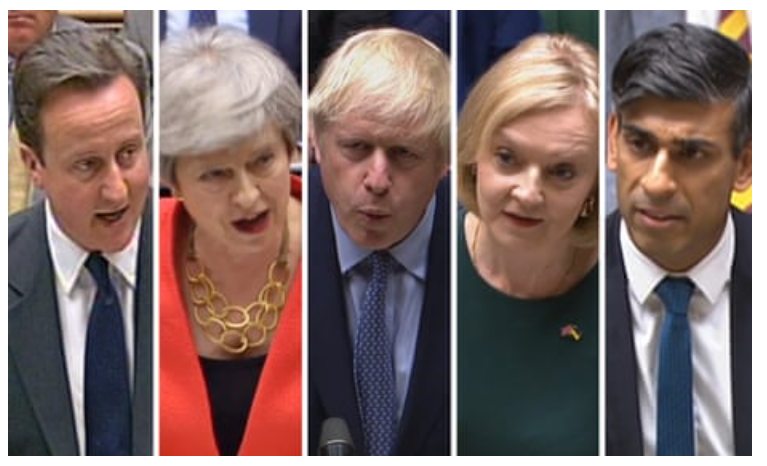
The idea of the “blue wall”, traditionally Conservative seats whose affluent, remain-minded populations were left aghast at the antics of Boris Johnson and Liz Truss, is not new. But on 4 July, a lot of Tory candidates could find out it is a bigger and politically broader phenomenon than anyone guessed.

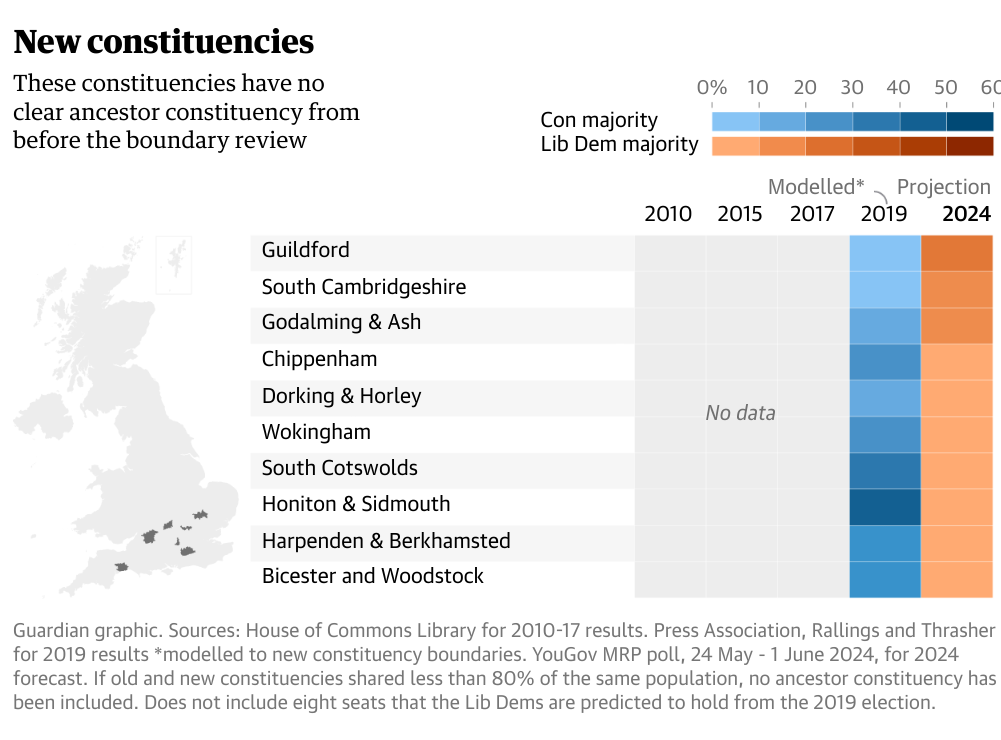
Miller’s intended seat, Bicester and Woodstock, newly created under the boundary review, would have had a notional Conservative majority of about 15,000 in the 2019 election. However, according to constituency-extrapolated polling, Miller should win it.

If he does, the Oxfordshire councillor and public policy academic, who only entered politics three years ago, would not be lacking in local company. While the Lib Dems are cautious in their predictions and finite in their campaign resources, with a fair electoral wind a swathe of nearby ultra-true blue seats could also turn yellow.

These could include both Witney and Henley, formerly held by David Cameron and Boris Johnson, respectively. There are hopes for the new seat of South Cotswolds, part-formed of the previous Cotswolds constituency, which had a 20,000-plus Tory majority in 2019. There is similar talk that Stratford-on-Avon, the former seat of Nadhim Zahawi, could be in play.

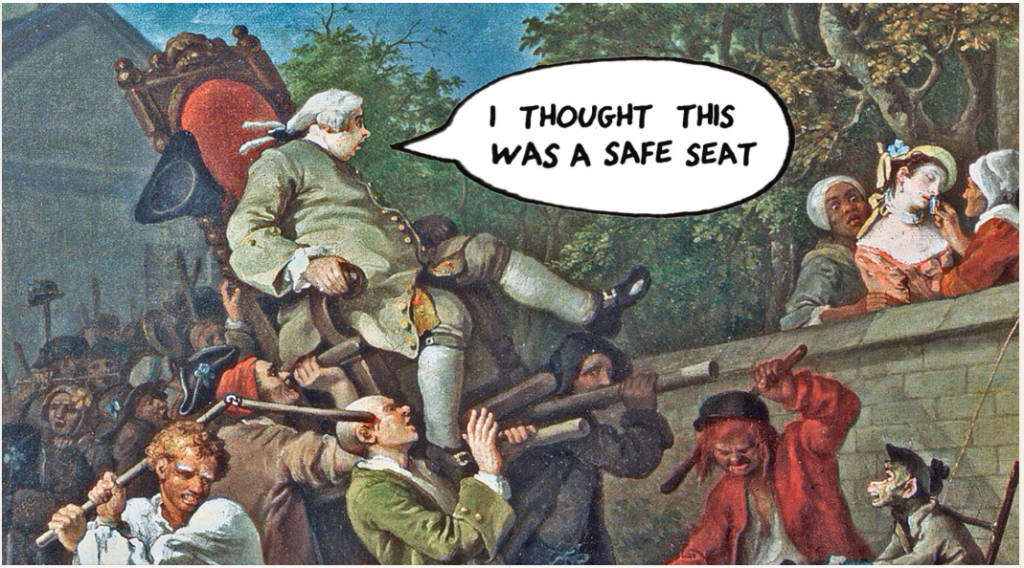
One very clear sign of Bicester and Woodstock’s Tory pedigree is the Conservative candidate chosen to fight it – Rupert Harrison, a former chief of staff to George Osborne, who is now a fund manager and financial commentator. Such people are usually put into safe seats – but for the Tories, it is now a fast-changing landscape.

Striding around the comfortable 1970s and 80s homes of Langford, Miller stresses that his chances remain in flux, not least because he begins many doorstep conversations by telling locals they are no longer in the Banbury constituency, where Labour are the main challengers.

That hurdle cleared, he says, former Conservatives often express disillusionment with the government that is generally connected to the decline of public services.

“I‘ve got voters who have been waiting years for appointments, children whose health has deteriorated while they’ve been on waiting lists, just really awful stories,” he says. “That is sufficiently widespread that is really affecting the confidence and feel about the government.”

There is also anger over the records of Johnson and Truss – and in a slight departure from the blue wall-remainer cliche, this can also be the case for people who voted for Brexit.

June Parry, 74, backed Brexit and then voted Conservative in 2019 in the hope Johnson would finish the job. “I’ll never vote for them again,” she tells Miller. “During Covid, someone was living a nice life at No 10, weren’t they?”

Having previously believed she was still in the Banbury constituency, Parry had planned to spoil her ballot paper in protest. After a chat with Miller, she promises to support him.

A couple of streets away, Roberto Garcia, a 62-year-old retired former car industry worker, recounts being visited by the Conservatives and assured that Labour were the main challengers. He was not fooled. “I’ve got a tactical voting app on my phone,” he says. “I actually felt a bit sorry for him because I hammered him on Brexit.”

A former Labour and Tory voter, Garcia is also backing Miller, or as he puts it: “At the moment I’m a Lib Dem.”

The sheer extent of shifts in voter loyalties in the post-Brexit era means that whatever the polls and door-knocks say, seats like Miller’s are very hard to predict with certainty. It is, however, difficult to escape the sense of a probable political mauling for the Conservatives.

Robert Hayward, the elections expert who is also a Conservative peer, says that anyone who is surprised by this trend has perhaps not been paying attention to a gradual shift in loyalties from about 2015 onwards, as shown by both a cull of Tory councillors in many such places and stagnating parliamentary majorities.

“These areas might be perceived as archetypically Tory, and might have been in yesteryear, but in the last decade they have been anything but,” he says. “They have continued to return Tories, but not with the increased majorities of some other parts of the county.”

One potential risk for the Lib Dems, Hayward warns, could be sheer logistical over-stretch, as they try to fight ever more blue wall-type seats while also battling in the south-west, their more traditional heartland.

Thus far, however, the party’s campaign has been disciplined and seemingly effective, with its leader, Ed Davey, cavorting through a series of fun photo opportunities on paddleboards and waterslides, but also emphasising policy areas like care and sewage.

With postal votes starting to go out this week, a lot of contests will depend on how effectively the party has pushed the tactical voting message, one Lib Dem strategist says.

“The thing we need to do to get it across the line is we need to persuade people that they now live in a Lib Dem-Tory marginal, not a Tory-Labour one,” they say. “That could be the difference between winning or losing a seat.”

Tory government ‘worst in postwar era’, claims expert study

Overall, it is hard to find a comparable period in history of the Conservatives which achieved so little, or which left the country at its conclusion in a more troubling state.

Tory government from 2010 to 2024 worse than any other in postwar history, says study by leading experts.

Andrew Sparrow www.theguardian.com 

As John Stevens reports in a story for the Daily Mirror today, Jeremy Hunt, the chancellor, was complaining at a private Tory dinner earlier this year about the electorate’s “total failure to appreciate our superb record since 2010”.

But just how good is the Conservative party’s record in government over the past 14 years? Thankfully, we now have what is as close as we’re going to get to the authoritative, official verdict. Sir Anthony Seldon, arguably Britain’s leading contemporary political historian, is publishing a collection of essays written by prominent academics and other experts and they have analysed the record of the Conservative government from 2010 to 2024, looking at what it has achieved in every area of policy.

It is called The Conservative Effect 2010-2014: 14 Wasted Years? and it is published by Cambridge University Press.

And its conclusion is damning. It describes this as the worst government in postwar history.

Here is the conclusion of the final chapter, written by Seldon and his co-editor Tom Egerton, which sums up the overall verdict.

“In comparison to the earlier four periods of one-party dominance post-1945, it is hard to see the years since 2010 as anything but disappointing. By 2024, Britain’s standing in the world was lower, the union was less strong, the country less equal, the population less well protected, growth more sluggish with the outlook poor, public services underperforming and largely unreformed, while respect for the institutions of the British state, including the civil service, judiciary and the police, was lower, as it was for external bodies, including the universities and the BBC, repeatedly attacked not least by government, ministers and right-wing commentators.

Do the unusually high number of external shocks to some extent let the governments off the hook? One above all – Brexit – was entirely of its own making and will be seen in history as the defining decision of these years. In 2024, the verdict on Brexit is almost entirely negative, with those who are suffering the most from it, as sceptics at the time predicted, the most vulnerable. The nation was certainly difficult to rule in these fourteen years, the Conservative party still more so. Longstanding problems certainly contributed to the difficulties the prime minister faced in providing clear strategic policy, including the 24-hour news cycle, the rise of social media and AI, and the frequency of scandals and crises. But it was the decision of the prime minister to choose to be distracted by the short term, rather than focusing on the strategic and the long term. The prime minister has agency: the incumbents often overlooked it.

Overall, it is hard to find a comparable period in history of the Conservatives which achieved so little, or which left the country at its conclusion in a more troubling state.

In their concluding essay, Seldon and Egerton argue that poor leadership was one of the main problems with the 14-year administration. They say that Boris Johnson and Liz Truss were “not up to the job” of being prime minister, and they have a low opinion of most of the other leading figures who have been in government. They say:

“Very few cabinet ministers from 2010 to 2024 could hold a candle to the team who served under Clement Attlee – which included Ernest Bevin, Nye Bevan, Stafford Cripps, Hugh Gaitskell and Herbert Morrison. Or the teams who served under Wilson, Thatcher or Blair. Michael Gove, Jeremy Hunt and Philip Hammond were rare examples of ministers of quality after 2010 …

A strong and capable prime minister is essential to governmental success in the British system. The earlier four periods saw two historic and landmark prime ministers, ie Churchill and Thatcher, with a succession of others who were capable if not agenda-changing PMs, including Macmillan, Wilson, Major and Blair. Since 2010, only Cameron came close to that level, with Sunak the best of the rest. Policy virtually stopped under May as Brexit consumed almost all the machine’s time, while serious policymaking ground to a halt under Johnson’s inept leadership, the worst in modern premiership, and the hapless Truss. Continuity of policy was not helped by each incoming prime minister despising their predecessor, with Truss’s admiration for Johnson the only exception. Thus they took next no time to understand what it was their predecessors were trying to do, and how to build on it rather than destroy it.”

Seldon’s first book, published 40 years ago, was about Churchill’s postwar administration, and he has been editing similar collections of essays studying the record of administrations since Margaret Thatcher’s. He is a fair judge, and not given to making criticisms like this lightly.

The book is officially being published next week, and I’m quoting from a proof copy. In this version, the subtitle still has a question mark after 14 Wasted Years? Judging by the conclusion, that does not seem necessary.

‘Radio Rishi’ was a masterclass in how not to do an election phone-in

Rishi Sunak had a rare nugget of good news as he arrived at the LBC studios for what was likely to be a tricky phone-in with listeners — inflation has fallen to 2 percent. But now for the hard part: Sunak had to spend a full hour fielding questions from callers, shepherded by veteran hack — and brutally effectively interviewer — Nick Ferrari. ……..(London playbook)

The verdict is now in:

A top politician needs two things to do a successful phone-in. One, convincing sympathy for voter9s who feel their lives are not going well. “I feel your pain,” Bill Clinton once said in a televised town hall meeting, showing other leaders how it is done. The other is a convincing plan for making people’s lives better. Rishi Sunak failed on both counts.

John Rentoul www.independent.co.uk

After four bruising weeks of a six-week election campaign, it seemed to be dawning on the prime minister during this morning’s hour-long radio phone-in that a lot of people dislike him. He tried to sound upbeat and sympathetic to the complaints about how hard life is in Tory Britain – but there was an air of resignation about several of his answers.

“I’m sorry you feel like that,” he said more than once to callers who were cross about his record. “I don’t suppose I will persuade you otherwise.”

Towards the end of the phone-in – presented by Nick Ferrari on LBCRishi Sunak said: “We are almost done with this interview and we haven’t talked about migration or security.” Ferrari immediately put Rachel from Bexley through, who wanted to complain that the Rwanda deportation scheme was a waste of money. Sunak wasn’t able to convince her, either.

With time running out the prime minister took a call from Sophie, who was furious about the growth in the number of food banks. His answer was that he wanted to encourage the creation of good jobs. Ferrari made a sceptical noise. Sunak demanded: “You’re sighing – but what do you expect me to say?”

He had, by then, tried several different ways of sounding sympathetic, some of which were less successful than others. His attempt to identify with the joy of home ownership, remembering when he got his first flat, went down badly with callers such as Sophie who told him twice that he was “richer than the King”.

Sunak describes ‘special feeling’ of buying his first home in phone-in grilling

Sunak chafed at questions from callers about “polls and process”, usually with Ferrari following up to press him. He was asked by one caller whether he would stay on as an MP if he was kicked out of No 10. “Of course I’ll do that.”

He was asked by another why he thought he could win a general election “when you couldn’t even win in your own party”. To which his answer was that he was proved right. “I was right in that Liz Truss election and I am right about the economy now.”

But the most revealing exchange was with Theresa from Ladbroke Grove, who said that the NHS had “gone from five stars to one star in 10 to 12 years”, and that she was afraid to go into hospital for her treatment for breast cancer. “If I had known how bad it was going to be, I would have gone private,” she said.

Sunak expressed sympathy, and even on this occasion managed to sound sincere when he said to her: “Stick on the line and we can get your details”, and promised to follow up her case.

But when Ferrari followed up by asking about the front-page story in The Daily Telegraph this morning – about cancer care in Britain being 20 years behind the rest of Europe – the prime minister simply played dumb: “I haven’t seen that.”

Ferrari didn’t let go. Surely someone had brought such an important study, from Macmillan Cancer Support, to his attention? “I haven’t seen the details,” Sunak clarified, and started to recite his standard briefing on cancer care.

Still Ferrari persisted, wanting to know how he responded to this specific report. “It makes me want to work harder to fix it,” Sunak said, reinforcing the impression of him as a bright, well-meaning technocrat whose response to something going wrong is to work harder rather than to solve the underlying problem.

There is the prime minister’s tragedy. Nothing to do with “polls and process”. It is a matter of a public service that was working well 14 years ago and now is not. Sunak had promised at the start of last year to get NHS waiting lists down, and they have continued to go up. He keeps trying to blame NHS staff for going on strike, but most voters think it is his job to settle the strikes and turn the NHS around.

A later caller was Olivia, a striking junior doctor in Newcastle, who pointed out that he hadn’t even definitively settled the dispute with the nurses. It was at this point that Sunak complained that he hadn’t been allowed to talk about migration – another subject on which the overwhelming majority of the voters think he has failed.

A top politician needs two things to do a successful phone-in. One, convincing sympathy for voters who feel their lives are not going well. “I feel your pain,” Bill Clinton once said in a televised town hall meeting, showing other leaders how it is done. The other is a convincing plan for making people’s lives better. Rishi Sunak failed on both counts.

Planning applications validated by EDDC for week beginning 3 June

Boris Johnson ‘to go on summer holiday’ rather than campaign for Tories

Boris Johnson is set to go on holiday rather than join the Conservative campaign trail ahead of the general election, according to Tory sources.

[On Tuesday he spent the day in two Devon seats with majorities of almost 15,000 and 23,000 at the last election]

www.independent.co.uk

The former prime minister, who turned 60 on Wednesday, is expected to go on his second summer holiday this year within the next few days and return on 3 July,The Times reported.

Despite endorsing 50 Tory candidates across the country, Johnson is no longer expected to join the Tories on the doorstep due to the party facing decimation in red wall seats he won in 2019.

It comes as a new poll found more than half of the UK public thinks Reform UK leader Nigel Farage would make a bad or terrible prime minister.

A YouGov survey found 55 per cent of Britons thought Mr Farage would make a bad (12 per cent) or terrible prime minister (43 per cent) a day after he unveiled his party’s manifesto.

Only 27 per cent thought he would make a great (nine per cent) or good (18 per cent) leader, with 65 per cent saying they did not believe Mr Farage would become prime minister in the next ten years.

Labour would use part of NHS budget to buy beds in care homes

NHS money will be used to buy thousands of beds in care homes under Labour plans to reduce overcrowding in England’s hospitals, long waits in A&E and patients becoming trapped in ambulances.

Denis Campbell www.theguardian.com

Wes Streeting, the shadow health secretary, said the move would tackle the huge human and financial “waste” of beds being occupied by patients fit to leave but stuck there because a lack of care outside the hospital. There are 13,000 beds in England – enough to fill 26 hospitals – being occupied by such patients.

If Labour wins the general election on 4 July it will funnel some of the NHS’s £165bn budget into the plan as one of a series of immediate changes intended to relieve the crisis in the health service.

Streeting made clear in a speech that a Labour government would expect hospitals across England to follow the example of Leeds teaching hospitals NHS trust, which spends £9m a year buying up care home beds in order to cut delayed discharges and free up beds.

That initiative – which it launched as a way of avoiding a “winter crisis” in 2022-23 – has freed up 165 beds, helped reduce the number of patients who are admitted avoidably and saved the trust between £17m and £23m, it has estimated.

“We will learn from the great innovations already happening in the health service like this, and take the best of the NHS to the rest of the NHS,” said Streeting, who cited the Leeds approach as a model to follow when speaking to members of the Medical Journalists’ Association.

“I went to St Mary’s hospital in Paddington [in London] this month, where a patient had been stuck in hospital for 60 days despite being well enough to leave, because the care wasn’t available. Not only is that a waste of that patient’s time and life, it is a waste of taxpayers’ money.

“The number of patients in hospital beds per day unable to be discharged because of a lack of care in the community could fill 26 hospitals. The price of that failure is £1.7bn a year.

“Labour will get more hospitals doing what Leeds teaching hospitals are already doing, investing in local social care beds to discharge patients faster – better for patients and less expensive for taxpayers.”

The 13,000 beds being occupied by patients who are fit to leave hospital represent one in seven of the health service’s entire bed stock.

However, speaking anonymously, one senior NHS figure questioned how the NHS in England could afford to buy care home beds to emulate what Leeds has done given that it is on track to end 2024-25 with a £3bn deficit.

A&E doctors welcomed the move. If the scheme is rolled out as Streeting hopes, it could unblock hospitals struggling with the sheer number of patients they are caring for and mean ambulances arrive more quickly after a 999 call and that people no longer end up stuck on trolleys or enduring “corridor care”, they said.

“We are supportive of the plan for NHS hospitals to buy up social care beds,” said Dr Adrian Boyle, the president of the Royal College of Emergency Medicine.

“About 13,000 people are currently in our acute hospitals awaiting some form of social care. Anything that can reduce this terrible total can only be a good thing, for patients and the running of our hospitals.

“If this works, this could be very helpful in tackling all of the problems in the urgent and emergency care pathway, from the first time someone calls 999, to them arriving at the hospital, being handed over to the emergency department and ending up in the main hospital.”

The Leeds trust estimates that the proportion of inpatients it was able to discharge in less than 27 days rose from 21% to 38% as a direct result of spending millions on care home beds.

Sally Warren, director of policy at the King’s Fund thinktank, said: “NHS and social care operate as part of one interconnected system. When one bit of the system is under pressure, the long waits can back up elsewhere.

“Perhaps the most visible example is when a lack of community or social care support stops people from being discharged out of hospital, which in turn means there is no space for new patients to be admitted to hospital, and we all see the results with long queues of ambulances at A&E each winter.

But, she added: “Let’s not confuse this approach [in Leeds] with a plan to solve all of the issues in social care. It’s primarily an initiative to improve patient flow through hospitals and will not solve the fundamental mismatch between demand for and supply of publicly funded social care in England.”

Streeting’s idea is not new. The Department of Health and Social Care and NHS England have made money available to health trusts in recent years to buy care home beds to head off the service’s annual “winter crisis”.

Dr Tim Cooksley, the immediate past president of the Society for Acute Medicine, said that while it was “pleasing that Wes Streeting is recognising this issue and considering solutions … the focus should be on ensuring high-quality community care beds with expert rehabilitation teams as that would be a valuable addition to the care for older people.

“Buying extra nursing home beds will, in isolation, not stop corridor care or improve outcomes for older people. Moving older people around the care system to the wrong place is simply like moving the deckchairs on the Titanic: it doesn’t help them and won’t stop the overcrowding that leaves so many languishing in emergency care corridors,” he added.

Nigel Farage and Lee Anderson set to win seats in new Ipsos MRP poll

Nigel Farage is set to win in his constituency of Clacton, Essex, according to fresh predictions from pollster Ipsos.

Alicja Hagopian www.independent.co.uk

The projections show Mr Farage at 52 per cent, far ahead of the next candidate, Labour’s Jovan Owusu-Nepaul at 24 per cent.

The model is the first research of its kind to be carried out entirely after Mr Farage announced that he would return to Reform UK as party leader, and run for candidate. Tory defector Lee Anderson is also estimated to hold his seat in Ashfield.

The model also projects that Jeremy Corbyn may lose his seat in Islington North after 41 years of being an MP. Labour is estimated at 54 per cent of the vote in the constituency, with candidate Praful Nargund, while Mr Corbyn may be at just 13 per cent.

Head of politics at Ipsos Gideon Skinner explained that projections can be affected by a variety of factors, and are riskier with high-profile candidates:

“Is it the question of Jeremy Corbyn losing, or is it more a question of just Labour holding off in Islington? It may be that there is identity with Labour there, even if there is also support for Jeremy Corbyn as an individual candidate.”

He added that the methodology he used “is good at making estimates based on the demographic characteristics of each individual constituency. But it’s not so good at picking up very unique political, local dynamics.”

“We make some efforts in areas where we know there are high-profile independents, we’ve made some changes to the approach to take that into account a bit more, but even so, that’s not going to pick up the full picture of everything.

This is the latest projection using multi-level regression and post-stratification (MRP) polling, a relatively new type of polling, to show that Labour will likely win a strong majority. Sir Keir Starmer’s party is on track to win an average of 453 seats, ranging between 439 and 462.

The projections suggest that Labour will see the most substantial leaps in Scotland and the North East, as well as winning seats in Wales thanks to the declining Tory vote.

Meanwhile, just 115 seats have been projected for the Tories; a loss of 225 constituencies for the party. This could go as low as 99 seats, or as high as just 123, with sharp drops in the East, South, and the Midlands.

The large-scale survey is of 19,000 people, and population data on local constituency levels.

Top Tory cabinet ministers are at high risk of losing their spots in parliament, with Grant Shapps, Penny Mordaunt and Jacob Rees-Mogg among those projected to lose on 4 July.

Meanwhile Jeremy Hunt, who has poured £100,000 of his own money into his fight for re-election, still faces an uncertain future. The former chancellor is just 1 point ahead (34 per cent) of the Lib Dems (33 per cent) in his newly-formed constituency of Godalming and Ash.

Reform is also leading by a small margin in North West Leicestershire, with candidate Noel Matthews projected at 35 per cent.

The Conservative majority in the constituency has crumbled since former Tory MP Andrew Bridgen was expelled last year, after comparing Covid to the Holocaust. Mr Bridgen then joined Reclaim Party, before quitting at the end of 2023.

The right-wing challenger party Reform is currently coming in second in 30 constituencies. At the highest end of the spectrum, Ipsos projects that the party could win up to 10 seats.

Around 1 in 5 seats (117 overall) have been deemed “too close to call”, with a projected winning margin of under 5 per cent. These include Salisbury, North Devon, and Torbay.

The Lib Dems are projected to win an average of 38 seats, which could increase to 48 seats on the highest estimates. This is s sharp increase from the 8 seats which they won in the 2019 general election. The party is set to gain at least 20 seats from the Tories.

Though the Green Party are looking to make headwinds, winning party leader Carla Denyer’s constituency of Bristol Central, Ipsos projects that they may lose their only existing seat in Brighton Pavilion where Caroline Lucas has been elected since 2010.

The current projections show musician Tom Gray leading by 17 points for Labour, at 54 per cent. However, there are more positives in sight for the party, which has historically struggled to translate national vote share into seats; the Greens are currently on track to win in North Herefordshire, and are neck-in-neck in Waveney.

Pro-proportional representation group Compass backs Richard Foord and Paul Arnott

Compass East Devon, a local group affiliated to the national cross-party campaigns group Compass, has come out in support of Richard Foord, Liberal Democrat candidate for Honiton & Sidmouth and Paul Arnott, Liberal Democrat candidate for Exmouth & Exeter East. 

https://seatonmatters.org/

The group says: “Crucial to these endorsements is that both candidates are public advocates for proportional representation (PR), a voting system where everyone’s vote counts equally, politics is fairer and Parliament reflects how we vote.

This decision is based on Compass East Devon’s close analysis of both seats which shows that these PR-supporting candidates are best placed to win with the help of a tactical voting campaign.

In a press release, the group also notes that the by-election points to Richard as the main contender in our constituency, and successful local election results in 2023 and 2024 point to a Liberal Democrat win in Exmouth & Exeter East, and that both constituencies are on Labour’s own ‘non-battleground seats’ list -suggesting it is not seriously contesting either seat.  

In other constituencies local groups are supporting parties other than the Liberal Democrats – for example, in Jacob Rees-Mogg’s North East Somerset seat the Compass local group is backing Dan Norris, the Labour candidate.

Compass, through the election-focused campaign Win As One, aims to facilitate collaboration between Labour, the Lib Dems and Greens in key seats to help a progressive government win power and change the voting system. 

Compass local groups aim to back the best-placed progressive candidates who support wholesale reform of our democracy – starting with replacing our First Past the Post (FPTP) voting system with PR.

This is because FPTP stifles productive debate, promotes short-termism, tribalism and timidity, and blocks us from pressing ahead with the bold and transformative solutions that our age of permacrisis demands.

At the next election, voters in these constituencies have an opportunity to elect two Members of Parliament that will fight to change the voting system so that every vote counts, at every election, and every vote can be genuine.

A spokesperson for Compass East Devon said: 

“Just a cursory glance at Westminster politics over the last few years shows our politics is quite clearly not fit for purpose. That’s why we need an entirely new system. To get one, we have to begin with electing people committed to reform – starting with proportional representation.

“With progressive MPs representing Exmouth & Exeter East and Honiton & Sidmouth, we can begin to build towards a new democratic politics where tactical voting is unnecessary, where our vote counts, and where our needs, as a county and country, finally come first.”

East Devon communities urged to create extreme weather plans

Communities in East Devon are being urged to create emergency response plans in case of extreme weather.

Bradley Gerrard www.exmouthjournal.co.uk 

Severe weather across the district in the past 18 months has caused several notable incidents, including the flash floods in the Otter Valley in May last year, followed by September’s heatwave and Storm Ciaran in November, which damaged Exmouth’s sea wall.

Matt Blythe, who helps oversee environment and climate change-related activities at East Devon District Council, told its scrutiny committee that Met Office data showed England recently experienced the wettest 18-month period since 1836.

This had contributed to some of the recent events in the district, and showed the need to be prepared.

“There’s a lot of unseen, back-office work required for these type of plans and we have had a couple of relatively large events,” he said.

“We had around 400 weather message warnings in the 2023/24 financial year, and we are trying to get those out to staff and officers so they are aware if they are out and about in the district.

“We also send them onto parish and town clerks, especially for amber warnings and above, to help ensure we’re communicating as widely as possible.”

Several councillors are involved in creating emergency plans in their own communities.

“Anything we can do to encourage communities that don’t have a plan like this to create one is worth doing,” said Cllr Geoff Jung (Liberal Democrat, Woodbury and Lympstone), portfolio holder for coast, country and environment.

“I run my own community resilience group in my village and I go to a lot of the meetings, and any community that could have problems with flooding really needs to have a group set up so it can react when a flood happens.”

He said if just one community suffered flooding because of hyper-localised weather, such that in May last year in Newton Poppleford and surrounding areas, emergency services may be able to help.

“But if there are 20 or 30 communities flooded, the fire brigade can’t get to everyone, so people have to work with what they have got and having a community resilience group with a plan, and people who know what to and when, really does work.”

It is thought that roughly 60 East Devon communities have such plans, but scrutiny committee vice chair Cllr Duncan Mackinder (Liberal Democrat, Yarty) proposed a motion that communities without resilience plans be encouraged to create them.

“It’s been pretty obvious from this debate how important they are,” he said.

The meeting heard how various groups existed to create a multi-agency approach for weather events, such as flooding.

Mr Blythe said that East Devon was involved during an unexploded bomb incident in Plymouth earlier this year, whereby the district could have been  housed some of the potentially thousands of people needing accommodation.

He added that in the case of the Otter Valley floods  last November, East Devon led the recovery effort because the flooding was so localised, even though Devon County Council usually handles flood work.

Cllr Vicky Johns (Independent, Ottery St Mary) asked whether the term ‘localised’ is defined when it relates to the aftermath of floods.

“There isn’t a rigid definition,” said Mr Blythe. “In the case of the Otter Valley floods, it was so obviously in East Devon we couldn’t argue. It’s important to say this is about the recovery element and not the initial response, but a later flood, which in numbers [of properties flooded] wasn’t a lot different, was spread over three districts, so the county took responsibility.”

The committee agreed Cllr Mackinder’s proposal to encourage the district’s communities to develop resilience plans.

Phase two of Exmouth’s seawall repairs approved

A further 150 metres of vulnerable seawall will be secured with a steel sheet pile wall in the second phase of repairs to Exmouth’s sea defences, planned for late September.

Authored by News Desk www.thedevondaily.co.uk 

Phase two is projected to cost £1.627million of the estimated full project cost of £3.312million. East Devon District Council (EDDC) has allocated £1.5million to the work, with £1.72million of additional funding from central government.

Since March 2024, engineers have been working hard to put in place permanent measures strengthening Exmouth’s sea defences. A steel sheet pile wall has been installed through the ground and the 90 metres of failed wall, through the nearly completed first phase. This section is where sand levels had dropped below the foundations, causing the wall to fall forward and crack.

After a serious failure to the seawall in 2023, EDDC with their contractors snapped into action with emergency temporary measures taken to protect the damaged wall. Thousands of tons of sand were transferred, and large concrete blocks were put in place only hours before an impending storm. These temporary barriers successfully absorbed the energy of the waves and prevented further much more serious damage. Following the storm, contractors raised sand levels by the seawall and put additional concrete blocks in place.

Minimising disruption to beach users during the busy summer season is important, so on-site engineering work has not been scheduled to take place during the school holidays. In the first phase, contractors have been working on Saturdays too, to complete the project more quickly.

Andrew Hancock, EDDC’s Assistant Director for Streetscene, said: “Strengthening Exmouth’s coastal defences for the next 100 years is vital, with increasingly frequent, more severe storms an unfortunate consequence of the climate crisis.”

“Securing the seawall ahead of the winter storm season is an urgent task. The council’s engineers are working incredibly hard to ensure the best options are chosen in terms of financial costs and environmental impacts too.”

“EDDC would like to thank visitors, residents, and local businesses for their patience whilst this important work continues.”

Phase two was agreed by EDDC’s cabinet on Wednesday, 5 June 2024. Cabinet also considered historic decisions and reasons why the seawall failed, an issue that will be investigated further by a future Scrutiny committee.

Residents will be consulted on the appearance of the wall. The cladding of the wall and the replacement of a slipway (with full planning permission to be requested in due course), will be the focus of the third phase.

Lib Dems are shaping up as the real opposition

Edward Lucas, Lib Dem candidate for the cities of Westminster and London www.thetimes.com 

Feed recent opinion polls into our quirky electoral system and extraordinary results can emerge. Combine the latest YouGov survey and the FT’s prediction model, for example, and Labour’s 37 per cent of the vote would garner it 447 seats, a majority of 122. The Conservatives’ 18 per cent would shrivel their tally to 30. Reform, overtaking the Tories with 19 per cent, would have 22 seats. And my party, the Liberal Democrats, with 14 per cent, would have a stonking 98, making us the official opposition.

Could it happen? Among Lib Dem bigwigs, caution reigns. We often get squeezed towards the end of general election campaigns as voters opt for the lesser of the two main evils. Other prediction outfits give different results: YouGov’s own model suggests a more modest 48 seats for the Lib Dems, 140 for the Tories. Electoral Calculus suggests 63 and 80. Other recent polls show less dramatic shifts, with Reform and the Lib Dems lagging. The Conservatives are using the prospect of a Labour landslide as a bogeyman, with messages such as “Keir Starmer needs you to vote Lib Dem”.

It is hard to see this saving Tory fortunes. Rishi Sunak’s penchant for tin-eared missteps seems ineradicable. My experience on the doorstep — I’m a Lib Dem candidate in central London — is that voters have simply stopped listening to the Conservatives’ message, be it pledges or scare stories.

Although Nigel Farage — by far the most effective campaigner since Boris Johnson’s departure — has yet to unleash his talents fully, Reform has already split the right-of-centre vote catastrophically. Jeremy Corbyn lost with 40 per cent of the vote in 2017. Starmer could win a landslide this time with less support.

Attention so far has focused on the incoming Labour government. But what kind of opposition will it face? Defeat will not end the Conservatives’ civil war. Their priority will be how to deal with Farage. Whether or not the Lib Dems are indeed the official opposition, the job of holding Starmer’s new government to account is theirs for the taking.

But by whom? Filling a shadow cabinet is an exciting prospect for a party that was last the official opposition in 1906. Lib Dems typically select local campaigners as candidates. In the outgoing parliamentary party, Layla Moran, the only MP with Palestinian heritage, has made a mark. So too has the deputy leader, Daisy Cooper. With the stars of the Nick Clegg era and the 2010-2015 coalition government mostly gone, such as Vince Cable and the pensions expert Steve Webb, only two of the party’s 15 outgoing MPs have ministerial experience: the leader, Sir Ed Davey, and Alistair Carmichael, a former Scotland secretary. A lot will rest on the newcomers’ shoulders.

A bigger question is about ideas. The party’s strategy for the past few years has been to cast the broadest net possible in the most promising seats. NHS woes? Fuming about sewage? Round here, only the Lib Dems can beat the Tories! If YouGov is right, that cautious, disciplined approach has paid off, confounding sceptics (including me). More exciting — and contentious — ideas such as getting back into Europe and land-value taxation have been soft-pedalled. The most distinctive Lib Dem policy is on social care, with an £8 billion package of pledges, promoted with personal conviction by the leader, a carer for his dying mother and disabled son.

Pushing the new government to fulfil promises on the NHS and social care will therefore be a priority in opposition. Unlike Labour, Lib Dems have not signed up to the Conservatives’ ludicrous and implausible fiscal straitjacket. Many agree that we must spend more on our creaking care system and must find the money willy-nilly. But outflanking Labour to the left on tax-and-spend has its limits. The bigger their presence in the next parliament, the more the Lib Dems will need a broader, strategic approach. Newly vacated swathes of the political spectrum offer abundant opportunities under big-state Labour and its public sector and corporatist cronies. Standing up for individual freedoms, for consumers and for real competition could pay off. Another is greenery. Starmer, notoriously, flip-flopped on Labour’s original, ambitious plans to spend £28 billion on the transition to net zero. Conservatives will want to slam on the brakes. Lib Dems can urge full speed ahead.

Another target is closer relations with the European Union. Hunting red wall voters, Starmer boxed himself in with red lines: no single market, no customs union, no freedom of movement. Lib Dems have no such hang-ups. Many Labour high-ups know that Britain’s security and prosperity depend on rebooting ties with the EU. Opposition pressure on that front may even be welcome.

The biggest push, however, should be on political reform. The government will need to pack the House of Lords with new members in order to get a working majority there, underlining the need for radical change and, eventually, an elected second chamber. Even more scandalous is the electoral system, the political lottery that looks set to exclude from parliament almost completely the Greens and probably Reform, to over-punish the Conservatives and to give Labour a colossal majority on under two fifths of the vote. The only other country in Europe to have such a system is Belarus. May 2024 be the last election in which we endure its uncertainty and unfairness — even if this year’s quirks benefit my party.

Labour and Tories would ‘both leave NHS worse off than under austerity’

Labour and the Conservatives would both leave the NHS with lower spending increases than during the years of Tory austerity, according to an independent analysis of their manifestos by a leading health thinktank.

Toby Helm www.theguardian.com 

The assessment by the respected Nuffield Trust of the costed NHS policies of both parties, announced in their manifestos last week, says the level of funding increases would leave them struggling to pay existing staff costs, let alone the bill for massive planned increases in doctors, nurses and other staff in the long-term workforce plan agreed last year.

The Nuffield Trust said that “the manifestos imply increases [in annual funding for the NHS] between 2024-25 and 2028-29 of 1.5% each year for the Liberal Democrats, 0.9% for the Conservatives and 1.1% for Labour.

“Both Conservative and Labour proposals would represent a lower level of funding increase than the period of ‘austerity’ between 2010-11 and 2014-15.

“This would be an unprecedented slowdown in NHS finances and it is inconceivable that it would accompany the dramatic recovery all are promising. This slowdown follows three years of particularly constrained finances.”

The trust added that the planned funding increases “would make the next few years the tightest period of funding in NHS history”.

Sally Gainsbury, senior policy ­analyst at the Nuffield Trust and a leading authority on NHS funding, said: “They will struggle to be able to pay the existing staff, let alone the additional staff set out in the workforce plan. It’s completely unrealistic.”

A Labour spokesperson, when asked about the Nuffield Trust’s analysis, said the party would “deliver the investment and reform the NHS needs”.

They added: “Our £2bn investment will deliver 40,000 extra appointments a week on evenings and weekends, double the number of scanners, 700,000 extra emergency dental appointments, 8,500 more mental health professionals, and mental health support in every school and community. We’ll pay for it by clamping down on tax dodgers, because working people can’t afford another tax rise.”

The state of the NHS has played a key role in the election so far. Rishi Sunak last year promised to bring down waiting lists from a record high of 7.2m but there are now 7.5 million people waiting for treatment – a figure that rose again last week.

Labour has promised an additional 2m appointments a year, but the NHS currently carries out an annual total of 92m appointments, tests and operations.

Labour plans to cut waiting list times with weekend clinics, using spare capacity in the private sector and doubling the number of scanners to deliver faster diagnoses. It says its plan will cost £1.3bn, paid for by a crackdown on tax avoidance, but it is a small proportion of the annual NHS budget for England of about £165bn.

The analysis will add to a growing sense that neither of the main parties is coming clean with voters about the true implications of their tax and spending policies.

Paul Johnson of the Institute for Fiscal Studies said that for Labour to deliver the change it is promising there would need to be more money on the table. “Labour’s manifesto offers no indication that there is a plan for where the money would come from to finance this,” he said.

The findings come as leading NHS figures call for a Labour government to get serious about reform and funding of the NHS within its first 100 days in office.

Former Tory MP and chair of the House of Commons health select committee Sarah Wollaston, who announced last week that she was quitting as chair of NHS Devon over attempts to impose more spending cuts, called for Labour to change rules on capital spending that punish trusts that overspend by slashing their capital budgets.

“It is particularly perverse that you punish people who need it the most and actually take away some of their capacity to get back on track,” Wollaston said. “Systems like Devon desperately need more capital to be more efficient.”

She said a Labour government also had to address public health issues and the need for more emphasis on prevention,which had been neglected by the Tories since 2010. “We can’t afford to wait,” she said.The row over NHS spending comes as fresh analysis shows that Labour and the Tories may be on course for their lowest combined vote share since the second world war.

The latest Opinium poll for the Observer also shows a shift away from the main parties. Labour has maintained a dominant 17-point lead over the Tories with less than three weeks to go until polling day. However, Reform and the Lib Dems are up 2 points each.

A Tory spokesperson said: “The Conservatives have taken bold action to cut waiting lists and secure the future of the NHS, with the total budget increasing by over a third in real terms since 2010 and our £2.4bn long-term workforce plan – the first of its kind – delivering record numbers of doctors and nurses.”

‘We offer the most ambitious change’: Ed Davey vows to push a Labour government for radical action

The Lib Dems will push a Labour ­government to adopt more radical policies on tax, welfare and bringing Britain closer to the EU, Ed Davey has said, amid growing expectations that his party is on course for a far bigger role in the next parliament.

Michael Savage www.theguardian.com 

In an interview with the Observer, the Lib Dem leader said that his ­party’s focus remained squarely on ousting Tory MPs via a tactical ­voting drive that he claimed could be the most successful ever seen.

However, with the Lib Dems rising in the polls and a cautious Labour party maintaining a double-digit lead, he said his party would use the next parliament to continue to fight for higher capital gains tax to pay for the NHS, a new youth mobility deal with Europe and an end to the two-child benefits limit – all of which Keir Starmer has rejected.

“We are a progressive, liberal party and we believe in investment in ­public services,” Davey said. “We believe in making taxes fairer, and we believe in really transformative environmental action. I think people who want to see that level of change in our country can vote Liberal Democrat knowing that we’ll have lots of Lib Dem MPs in the next parliament championing that.

“Frankly, if you want the change, I think we’re offering the most ambitious change. I even have Labour people saying that they’re really Labour people, but they hope we get lots of Liberal Democrat MPs in because they can hold the Labour party to account.”

It comes with the latest Opinium poll for the Observer showing that the Lib Dems have increased their vote share to 12%, with Labour down two points on 40% of the vote. Despite informal cooperation with Labour that has seen the parties steer clear of seats where the other is the stronger challenger to the Tories, Davey said his party would press a Labour ­government for more radical action once in power.

“I’ve been in opposition to a Labour government before and I’ve seen that we won the debate on many ­occasions,” he said. “That was great for a fairer society. Our manifesto is a ­programme we want to put in the next parliament. We’ll be ­campaigning on it, voting for it, developing it. If you are winning the argument, you can push the dial.

“On things like our relationship with Europe, the Liberal Democrats are passionately pro-European. It’s been a tragedy that we have seen the Conservatives poison that relationship with our closest friends and allies. Are we going to campaign for a better trade deal with Europe? Yes. Are we going to campaign for allowing young people to move across Europe with an agreement on youth mobility? Yes we are.”

Some projections have the Lib Dems on course to more than ­triple their current haul of 15 MPs, partly helped by voters backing them in order to remove the incumbent Tory. The grimmest recent Tory projections even narrowly have the Lib Dems as the official opposition. However, Davey said it would be a “historic mistake” to underestimate the Conservatives, despite some high-profile mishaps during their campaign.

“I just think people who want real change should be cautious about the polls,” Davey said. “The Conservatives are not going to give up. They’ve got more money than any other party. They’re going to spend it in the last few weeks on attack ads on social media. Get ready. I remember 2017 when everyone thought Theresa May was going to get a landslide. I thought she was going to get a landslide. I didn’t expect to get re-elected in 2017. Certainly, Liberal Democrats are not going to take voters for granted.”

Other senior party figures are concerned that the Tory warnings of a “supermajority” for Labour are aimed at winning back precisely the kinds of reluctant Tory voters that the Lib Dems had been trying to win over in southern seats, as well as those in the south-west. Davey said he believed his tactical voting plea was cutting through.

“We’re seeing tactical voting on a scale I can never remember, even back in 1997 and 2001,” he said. “We’re seeing it in the blue wall in the home counties, we’re seeing it in the West Country. It’s been phenomenal. This is very much an ABC election – Anyone But the Conservatives. The fact that we are the ones to beat the Conservatives in so many seats, I’m really grateful for people who are thinking about Labour, ­thinking of voting Green, [and] realising if they do, they’ll let the Conservatives in. It has a massive potential effect on the outcome.”

Davey has been enjoying a successful campaign, which has seen him combine policy announcements with increasingly bizarre stunts. This weekend, he is announcing a plan to cut cancer waiting times with a major expansion of radiotherapy treatment – part of his party’s pledge for urgent patients to start cancer treatment within 62 days. It is funded by an overhaul of both capital gains tax and tax breaks for banks amounting to £9bn.

“I lost my dad to cancer and my mum to cancer, so it’s been a huge part of my life,” Davey said. “Surely we should have the ambition to have among the best survival rates in the world. We’ve got some of the best ­scientists, it just needs to be prioritised.”

Tories and Labour on course for lowest share of the vote since 1945

Labour and the Tories are on course for their lowest combined vote share since the second world war, as the latest Opinium poll for the Observer shows a shift away from the main parties.

Michael Savage www.theguardian.com 

With all the parties having now unveiled their election manifestos, Labour has maintained a dominant 17-point lead over the Tories with less than three weeks to go until polling day. However, Reform and the Lib Dems are up two points each.

It is a reversal of the trend seen at the last election, when the main parties were able to squeeze the support of their smaller competitors. According to Opinium research, support for the smaller parties dropped 10 points between the first and last poll in the 2019 campaign. So far, the total vote share for smaller parties is up five points this time round.

“Voters are turning away from the two major parties in a huge break with the trend seen in the 2019 general election campaign, when the smaller parties’ votes were squeezed,” said James Crouch, head of policy and public affairs at Opinium. “The biggest surprise is that both major parties are being hit, with Labour and the Conservatives down to their lowest share of the vote since Liz Truss was in office.”

It comes alongside analysis that the election points to historically low support for the two major parties. Elections researcher Dylan Difford found that according to current polling, the main parties were on course for their lowest share of the vote since 1945. He said that the elections that took place in the wake of Brexit could actually be the exception, masking a longer-term fall in backing for the big two.

“After the Brexit polarisation seen in the last two elections allowed the smaller parties to get ‘squeezed’, this represents a return to the pre-2016 trend of growing multi-partyism among British voters,” he said. “Regardless of a belief that first past the post will always push voters back to the big two, the increasing anger, frustration and distrust voters feel towards mainstream politics is fuelling this fragmentation across western democracies – and Britain is simply not immune.”

The latest Opinium poll also revealed a big hit to Rishi Sunak’s approval ratings. He now has a net rating of -40, with 20% approving of his performance and 60% disapproving. Keir Starmer’s ratings have also slipped, though less severely, to -3 overall.

Voters regard the last week as the worst of the campaign for the Tories. Two-thirds (65%) thought it had gone badly for them, perhaps reflecting the fallout from Sunak’s decision to leave D-day commemorations early and a difficult Sky interview with Beth Rigby.

BBC uncovers 6,000 possible illegal sewage spills in one year

Every major English water company has reported data suggesting they’ve discharged raw sewage when the weather is dry – a practice which is potentially illegal.

Esme Stallard, Jonah Fisher and Sophie Woodcock, Becky Dale and Libby Rogers www.bbc.co.uk

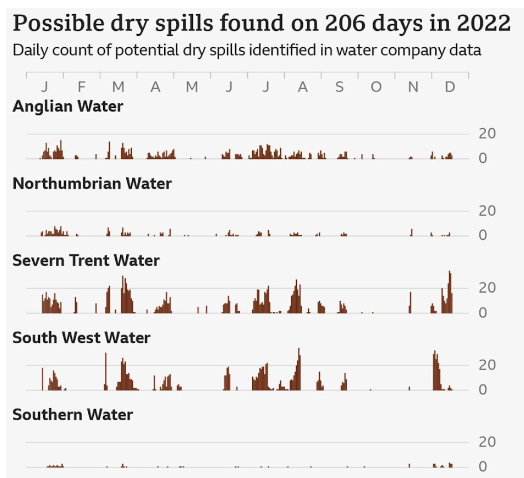
BBC News has analysed spills data from nine firms, which suggests sewage may have been discharged nearly 6,000 times when it had not been raining in 2022 – including during the country’s record heatwave.

Water companies can release untreated sewage into rivers and seas when it rains to prevent it flooding homes, but such spills are illegal when it’s dry.

The firms say they understand public concerns around dry spilling, but they disagree with the BBC’s findings.

They have said the spill data shared with the Environment Agency was “preliminary” and “unverified”, and also disagree with how the BBC defined a dry spill, which they say differs from the Environment Agency’s approach.

The latest findings follow a BBC investigation conducted last year which found 388 instances of possible dry spilling in 2022 by three water companies – Thames, Wessex and Southern – after they shared their data with the BBC.

The other six – Anglian Water, Northumbrian Water, Severn Trent, South West Water, United Utilities and Yorkshire Water – had refused to share data about when they might be spilling with the BBC. They said it could prejudice an ongoing criminal investigation by the Environment Agency, external (EA) and Ofwat into their activities, external.

The regulator – the Environment Agency – which had the data, disagreed, and in January handed it to the BBC.

Speaking to the BBC before the election, Helen Wakeham, head of water at the EA, said the whole point of monitoring was to increase transparency, and they wanted to make the data more publicly available.

Overflow points where sewage is discharged have monitors which record when spills start and stop.

The BBC cross-referenced the companies’ spill data from these overflow points with local Met Office rainfall data. Over 18 months we analysed data from nearly 10,000 monitors which had recorded more than 1.5 million hours of discharges.

BBC analysis suggests dry spills may have started on more than 200 days in 2022, lasting more than 29,000 hours – including during the record summer heatwave when people were cooling off in England’s rivers and seas.

“We are most concerned about those [spill] events happening in places where people are likely to go in the river,” said Professor Barbara Evans, chair in public health engineering at the University of Leeds.

Consumption of water contaminated with human or animal faeces exposes people to parasites and bacteria such as cryptosporidium and E.coli, which cause diarrhoea and vomiting, or viruses like hepatitis A which can lead to liver infection.

The six water companies who were subject of the latest investigation took issue with the BBC’s analysis, citing the data we used and the methodology.

Every year England’s water companies are required to submit an annual report to the EA summarising their discharges. This enables the EA to investigate potential cases of dry spills and to decide whether it will take any action.

The BBC has been analysing data behind the 2022 report, but in responding to our findings, the water companies argue that the datasets are unverified and contain errors.

Examples of potential dry spills in the data were presented to each water company. Anglian Water disagreed with all the examples presented and the remaining five companies disagreed with some.

The main reason the companies gave for disputing the examples was that their monitors malfunctioned and incorrectly recorded spills.

From 2025, all water companies have committed to publishing near real-time sewage maps for the public to increase transparency. They will use the data from these monitors to create the maps.

David Henderson, CEO of the industry body, Water UK, told the BBC: “We are the most transparent industry in the world when it comes to water. No other country in the world publishes this sort of data.”

In May, Anglian Water was found guilty of failing to provide data to the Environment Agency for their investigation – and it will be sentenced in July.

Regarding the BBC’s methodology, some of the water companies argue it did not take into account that some outlets have large catchment areas and it can take a few days for any rainfall to drain through their systems, i.e. sewage detected on a dry day may be the remnants from an earlier rainy day.

However, the BBC accounted for drain-down time by only considering a discharge a potential dry spill when there had been four consecutive days in the surrounding area without rain.

Helen Wakeham from the EA says the BBC’s methodology is, in fact, “more generous” to the companies than the EA’s.

Commenting on the results of the BBC’s investigation in general she said: “I’m not surprised, these networks haven’t been invested in for decades. That investment needs to take place.”

In May the UK’s top engineers and medical professionals warned in a public report the risk from human faecal matter in our rivers will increase without changes to the network and how we build our cities.

Dr David Butler, professor of water engineering at the University of Exeter, and co-author of the report, said investment from water companies has “not really been up to scratch”.

But he added that we must also rethink how we design our towns and cities.

“What we would like to see is reversing urban creep – that is well beyond the powers of a water company. You see it all the time, people concreting over their front garden,” Prof Butler explained.

“If you could unpick that it would help because that would reduce stormwater runoff and that would give us more capacity in our pipes.”

Reducing dry spilling would also help prevent excessive nutrients entering rivers from sewage discharging. The issue, which is also associated with agriculture, can cause excessive amounts of algae to grow, resulting in waterways becoming depleted of oxygen, killing off other animals like fish.

“[It] also can have knock-on health effects, because this algae can produce other toxic products which might be harmful to human health,” said Prof Evans of University of Leeds.

South West Water said: “We are clear that storm overflows must only be used when absolutely necessary to protect people’s homes and regard all unpermitted dry spills as unacceptable.”

Yorkshire Water and Northumbrian Water said they: “Do not believe the [BBC’s findings] are true reflection of dry discharge numbers.”

United Utilities said: “The information you have received from the Environment Agency reflects unvalidated, raw signals and not validated start/stop times.”

Anglian declined to provide a formal comment on the BBC analysis, but in correspondence to the BBC said that the monitor data was not enough to determine dry spills due to monitor malfunctions, and said the methodology was flawed.

The three companies investigated by the BBC last year also responded to our new findings.

A Thames Water spokesperson said: “There are a number of methodologies for defining and calculating why and how dry day spills occur.

“We regard all discharges of untreated sewage as unacceptable, and we have planned investment in our sewage treatment works to reduce the need for untreated discharges.”

A Wessex Water spokesperson said: “Naturally occurring groundwater can enter sewers, often from private pipes and in dry weather, which can cause overflows to operate for days or even months.

“We agree overflows are outdated so we’re investing £3 million a month to help reduce how often they automatically operate.”

A spokesperson for Southern Water said: “In areas with high levels of residual groundwater, spills can happen outside of periods of rainfall. Without these releases – made up almost entirely of groundwater – homes and communities would be flooded.

“Combatting these groundwater spills is a key part of our £1.5 billion Clean Rivers and Seas Plan, which is designed to drastically reduce all storm overflows across our region by 2030.”

Counting possible dry spills – methodology

Water and sewerage companies are responsible for outlets known as combined sewer overflows (CSOs), which release sewage from treatment works or the sewage network into the UK’s waterways.

The majority of CSOs record when they discharge.

For this analysis, the BBC took the start-stop times of individual discharges from the CSOs and converted them into the standard 12/24-hour counting blocks used by the EA to determine “spills”.

In the specific case of United Utilities, the BBC found that some of the discharge data provided to the EA did not correspond to their 2022 annual report summarising this data. For that reason, the BBC discounted data from more than one-third of United’s overflows.

The start times of the companies’ spills were matched to daily rainfall data from the Met Office, which is produced from a network of automatic rainfall gauges and observation stations.

This rainfall data is presented in gridded squares that cover the land area of the UK. Each grid cell is 1km sq.

Each overflow point is part of a larger network, or catchment area, and rain further away can take time to reach the overflow point.

The BBC considered the nine grid squares nearest to each spill site in the analysis. Individual catchment areas may be larger or smaller.

The EA defines a dry day as one during which there was less than 0.25mm of rain and less than 0.25mm of rain the previous day.

But the BBC took a conservative approach of four consecutive days without rain in all nine grid squares to allow for drain-down time.

The methodology was independently reviewed by three academic experts working in this field.

Methodology support from Dr Gemma Coxon, University of Bristol; Dr Nick Voulvoulis, Imperial College London; Dr Barnaby Dobson, Imperial College London

Massive progress as South West Water lifts “boil water” notices on 1% remaining households

Brixham boil water notices lifted for 21 households

Twenty-one households have been told they can stop boiling their drinking water after a parasite outbreak in Devon.

Jonathan Morris www.bbc.co.uk

South West Water (SWW) said it was still advising about 2,073 households in the wider Hillhead, upper Brixham and Kingswear areas to continue to boil their drinking water.

The lifting of the boil water notice for 21 households supplied off the Hillhead to Boohay main follows an announcement by SWW that it had progressed in cleaning and protecting its water network.

About 2,500 homes in Brixham and Kingswear were under notice after cryptosporidium, which can cause diarrhoea and sickness, was found in the water supply on 15 May.

Customers and businesses who no longer needed to boil their water before consuming it would be contacted directly, said SWW.

It said: “Our water quality scientists have been working closely with our analytical facilities and public health professionals, and the results of our water quality monitoring confirm that it is safe to lift the boil water notice in this part of the network.

“This means that customers supplied off that main can now return to using their tap water as normal.”

Remaining households were served by a separate system that “continues to be flushed and cleaned to ensure the water is safe to drink”, said SWW.

Laura Flowerdew, SWW chief customer and digital officer, thanked customers “for their continued patience while our teams work hard to clean the network and put interventions in place to prevent this from happening again”.

SWW said it was “working around the clock to lift the boil water notice for the remaining customers in the Hillhead, Upper Brixham and Kingswear area”.

“Cryptosporidium levels are reducing as a result of our work but we will only lift the notice further when we are completely sure it is safe to do so,” it said.

If any customers or businesses were unsure whether they remained under the boil water notice, they could check using South West Water’s postcode checker, external, it added.

John Curtice on Reform and Lib Dem gains

After showing little movement in the first two weeks of the campaign, the opinion polls are now showing some clear shifts.

“But Reform is not the only party advancing in the polls. Now, the Liberal Democrats, with a 12% rating, are also up a couple of points.”

Sir John Curtice www.bbc.co.uk

In seven polls conducted so far this week, support for the Conservatives stands on average at just 20% – that’s four points down on where they were at the beginning of the election campaign.

However, support for Labour has also fallen. They are averaging 41% in this week’s polls, three points down over the course of the campaign.

But, because both parties are down by similar amounts, Labour still enjoy a lead of 20 points or so.

So who has been gaining support?

One party that undoubtedly has done so is Reform UK. On average they are at 16% in this week’s polls – five points up on where they were when the election was called.

True, so far there have been rather more polls this week from companies that have tended to record relatively high figures for Reform, but they are probably at least on 15%.

One poll in particular has caught people’s attention.

A YouGov survey of more than 2,200 adults, external, conducted between 12 and 13 June, puts Reform at one point ahead of the Tories for the first time on 19%.

However, this is just one poll. We have had four others published in the last 24 hours, none of which have had Reform ahead and not even all of which had the party gaining ground.

On average, Reform is still four or five points behind the Conservatives.

But this is still bad news for the Tories.

The only way that Rishi Sunak could hope to even get to base camp in narrowing Labour’s large poll lead was to squeeze the Reform vote, virtually all of which is coming from those who voted Conservative in 2019.

In 2019, Reform’s predecessor, the Brexit Party, did not stand in Conservative-held constituencies, This time, Reform are standing virtually everywhere in England, Scotland and Wales.

This means Reform is likely to take most votes away from the Conservatives in seats that Rishi Sunak’s party is trying to defend.

Rather than the Tories making progress, things are actually going backwards, not least, of course, because of Nigel Farage’s decision to fight this campaign.

The former UKIP and Brexit Party leader previously said he would not stand in the election but on 3 June announced he would be Reform’s candidate in Clacton, as well as take over as the party’s leader.

Almost instantly this resulted in a three-point increase in the party’s poll support, an advance that now seem to be even a little higher.

But Reform is not the only party advancing in the polls.

Now, the Liberal Democrats, with a 12% rating, are also up a couple of points.

This may partly explain why Labour’s support is down.

So the campaign has now made a difference.

And perhaps in focusing their attacks on each other both the Conservatives and Labour have paid too little attention to the potential challenge from the smaller parties.

We will have to wait and see if that now changes.

You can find a full list of candidates for the Clacton constituency here.

John Curtice is Professor of Politics, University of Strathclyde, and Senior Fellow, National Centre for Social Research and ‘The UK in a Changing Europe’. He is also co-host of the Trendy podcast.