More parking spaces for Exmouth

Part of Exmouth’s estuary coach and lorry park near the railway station is to be converted into new car parking spaces. 

Will Goddard, local democracy reporter www.radioexe.co.uk

The adjacent estuary long-stay car park will get 86 new spaces, reducing places for lorries, buses and coaches from 16 to 12. 

It comes as many people report difficulties finding anywhere to leave their vehicles in the town because of the clashing parking schemes of two different councils. 

They are Devon County Council’s new residents’ parking zones in parts of Exmouth, including the nearby Colonies area, and East Devon District Council (EDDC)’s all-day £2 winter car park offer, which runs until the end of March. 

On average fewer than two people paid for parking each day at the estuary coach and lorry park between April and December last year.

Cllr Olly Davey (Green, Exmouth Town) told a meeting he thought 12 spaces for coaches and lorries would be “sufficient” and 86 new car parking spaces “would make a difference”.

He said: “I walk past [the coach and lorry park] on a regular basis. I’ve never seen more than six or seven vehicles in there, and that’s a busy day. 

“I did take a photograph recently, there wasn’t a single vehicle in that lorry car park.” 

But Cllr Brian Bailey (Conservative, Exmouth Littleham) disagreed, saying there would not be enough spaces for coaches. 

He said: “In the summer, there are as many as 14, 16 coaches a night, and they stay for a period of usually two weeks with foreign students.  

“This is a good income for Exmouth, and it’s been established with the English language school for many, many years, and these proposals would disrupt that entirely as far as I can see.” 

Cllr Geoff Jung (Lib Dem, Woodbury and Lympstone) thought the council should be “working really quickly” to provide more car parking spaces in the centre of Exmouth. 

He said: “There is a big issue with car parking spaces at Exmouth now and there are people saying that something needs to be sorted out immediately. 

“People were moaning on Facebook today that they can’t get into Exmouth to do their shopping. 

“We’ve got a coach park that is hardly used, a lorry park that is hardly used, and we’ve got people very concerned that they can’t find a parking space in Exmouth.  

“And I would have thought that we need to get something sorted very quickly for the residents and the traders of Exmouth before it’s too late.” 

The new spaces in the estuary long-stay car park are expected to cost EDDC around £55,000 to £65,000 to create. but are expected to bring in additional income. 

Devon County Council said last month that it introduced its Exmouth residents’ parking scheme “following a consultation and concerns raised by local residents” and that it “aims to remove all-day commuter parking in residential areas and ensures that residents have priority to park within their own area”.

Map of new spaces at estuary long-stay car park, Exmouth (Image courtesy: EDDC)

Suspected sewage leak closes Sidmouth rugby pitches

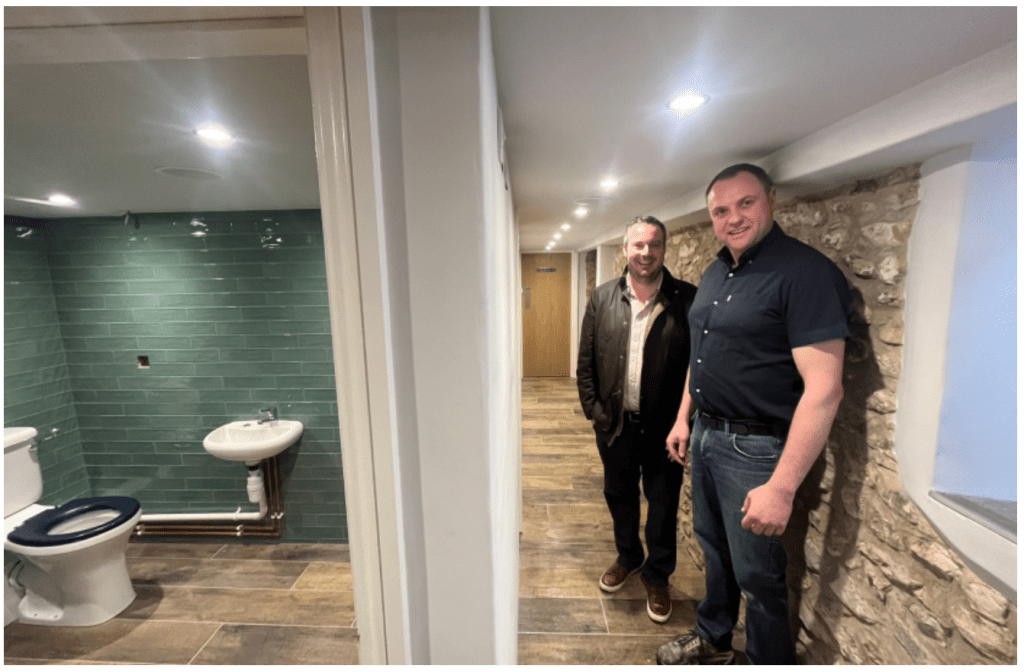
While Simon Jupp concentrates on opening toilets in the Sidmouth Arms in Upottery, Richard Foord’s constituency. 

(And now boozing in Sidbury).

Sidmouth is “Up in Arms” about sewage leaks affecting their rugby pitches.

Cheers!

Police tax rise seen as “necessary” for “poor value for money” rated force.

“You may have to forgo a Pot Noodle a month to pay it.”

Setting aside this lighthearted trivialisation of Hernandez’s latest tax hike, consider her record since being elected in 2016.

In December Owl reported that an in-depth inspection of all 43 police forces in England and Wales across eight criteria  in 2021/22 shows Devon and Cornwall the tenth worst force.

They scored particularly badly in responding to the public, and managing offenders and suspects, with a score of 1. It only got a 2 for investigating crime, and strategic planning and value for money

A year ago Owl reported that about a third of the new “Bozzer” recruits (Boris Johnson’s promise to add 20,000 to the force) she boasted about getting in 2019 (and we are paying for) are voting with their feet and leaving.

Last July her, newly recruited Chief Constable was suspended whilst under criminal investigation over serious allegations of sexual offences,

Finally, remember Hernandez spends 70% more of your Council Tax as EDDC does. (Council Tax is split: 73% DCC; 12% Police; 7% EDDC; 4% Fire; 4% Towns & Parishes)

Police tax rise seen as “necessary”

Alison Stephenson, local democracy reporter www.radioexe.co.uk

A 4.95 per cent increase in the police element of council tax which equates to around the cost of a Pot Noodle a month for an average household has been unanimously supported.

The dehydrated fast food beloved by students current costs about a pound.

Devon and Cornwall Police and Crime Panel agreed the rise of £12.96 a year which will mean an annual cost to a Band property of £274.50 for police services.

Police and crime commissioner Alison Hernandez, who has raised tax by just over £100 a year since she came to office in 2016, said this income from taxpayers combined with an increase in the central government grant and savings of £5.4 million, would allow officer numbers to be maintained at 3,610, the highest ever in the force, and improve public contact.

The commissioner said she had focused on the things the public told her mattered, like high numbers of visible police and investment in communities by reopening more front enquiry desks at police stations which were closed in the austerity years after 2010.

Desks will open at Exeter, Tavistock, Honiton and Liskeard, bringing the total of additional police stations open to the public to 18.

Ms Hernandez said public confidence in policing nationally was at an “all time low” because of police abusing power in “unimaginable ways”, the judicial system being riddled with delays, and officers distracted from things that really mattered. On top of this there is political uncertainty. It promises to be “a turbulent year” for policing.

But she added that on a local level there had been some great examples of robust policing, staff retention is good and performance is improving, with calls to the highly criticised 101 phone service now being dealt with within 11 minutes on average and a call back facility being well-used.

Presenting a balanced budget to the police and crime panel for 2024/25 she laid out her intentions to spend £9.6 million to help victims and maintain Devon and Cornwall as one of the safest police force areas in the country. This includes funding ‘Safer Streets’ projects and victim services, and improving road safety.

The panel was told that during 2022/23 nearly 30,000 victims of crime were referred to support services commissioned by Ms Hernandez.

Violent crime, which has increased by 12 per cent since 2019, will be a focus for the force, and in particular violence against women and girls. The commissioner said people had requested money be spent on this for the first time.

Police officers and support staff will get a three per cent pay rise next year and employee pension contributions will increase by just over four per cent to 35 per cent of pay, an increase in cost to Devon and Cornwall of around £7 million. Additional funding for this has been included in the police settlement from the government. Staff costs make up 85 per cent of the police budget.

Councillor Laura Wright (Lab, St Thomas, Exeter) said pay increases should be expected, claiming they had been frozen for many years.

She said students were exempt from paying council tax but there is a ot of student accommodation in Exeter and Plymouth and she questioned whether landlords could pay it as “they all benefit from police services.”

Members said the doubling of council tax on second homes, which many district councils in the county have agreed to come into force in 2025/26, would help the police budget in future.

Cllr Philip Hackett (Ind, Broadheath) said he agreed with the rise, but the public wanted to see more improvements and he wasn’t convinced the 101 services is working yet.

Cllr Sally Hayden (Lab, St Budeaux, Plymouth) said she supported the rise which was necessary to  ”keep the streets safe”.

“It is the cost of a Pot Noodle a week if you pay council tax over 10 months. It doesn’t sound a lot, but there are many people who are on the threshold of poverty and it’s a struggle so this could be a meal for them once a week.”

Acting chief constable Jim Colwell said this year would be more about “compassion, common sense and quality” and less about figures, widgets and managing demand.

“We took our eye off quality in my opinion so it became a game of numbers instead of focusing on outcomes for our victims of crime and communities.”

He said 24 new neighbourhood officers would be joining the force this year and that Devon and Cornwall had been the most successful of all forces in increasing their officer numbers during the government’s “uplift” programme with £3.4 million of funding.
 

When a Citizens Advice has to close despite demand being ‘off the scale’

In the end it was just £27,000. That was as much as the local district council said it could scrape together, but it was still a 50% cut in core grant funding and ultimately not enough to prevent Mansfield Citizens Advice service from becoming a casualty of the financial crisis raging through England’s local authorities.

Patrick Butler www.theguardian.com

Just over a week ago, when it became clear there was no more room for manoeuvre, the charity’s board of trustees took the decision to close for good, after 41 years serving the Nottinghamshire ex-mining town, one of the UK’s most deprived areas. “It’s devastating,” said its chair, Carmel Reilly. “There’s no other place for clients to go.”

Mansfield Citizens Advice’s prime task has been fighting poverty, its staff and volunteers providing practical help to a local community struggling with soaring debt, eviction and poverty. It was clear about its social justice mission: “People need someone on their side, who will do battle for them,” said Reilly.

Last year it provided expert financial advice to nearly 2,500 local people, helping them manage debts, apply for social security benefits, and resolve rent arrears. Times have been hard in recent years – industrial decline followed by austerity, pandemic and a cost of living crisis – and demand for its services have been off the scale.

Despite just a handful of staff and a budget of just £300,000, its return on investment was impressive last year: advisers got £800,000 of clients’ personal debts – on average £7,700 per person – written off. More than £1.1m in benefit entitlements was secured. By stopping tenants being evicted, it estimates it saved local landlords £268,000.

Its work had the additional benefit of shoring up people’s wellbeing, as well as their bank accounts, and preventing costly state interventions later on, said Reilly. The loss of the service, she reckons, will result in higher rates of stress and mental illness, and greater need at the GP surgery and the council’s homelessness department.

Mansfield district council’s grant to Citizens Advice was £55,000 – a so-called core costs payment that enabled the charity to pay staff and overheads. That base funding in turn allowed it to pull in project grants of about £250,000, a fragile economy of social investment that now looks about to collapse.

The council is struggling with a £5.4m deficit over the next three years. The local councillor Craig Whitby said the decision to cut funding was difficult, but made with the “utmost care and consideration”. An unsuccessful 11th hour attempt was made to scramble together a solution using cash earmarked for councillors’ allowances. Ultimately, he added, it was “essential for the financial health and stability of our council”.

Citizens Advice nationally estimates that local authorities collectively provide a third of its local branches’ funding. The risk is that these grants will be viewed as “discretionary” – and therefore expendable – by stricken councils seeking options to cut back to “basic minimum” levels of service. The current funding crisis was “deeply troubling”, said Citizens Advice’s chief executive, Dame Clare Moriarty.

In the leafy Surrey commuter town of Woking, the socio-demographic profile is very different to Mansfield, but its local Citizens Advice service too faces the prospect of closure from April after Woking borough council embarked on a drastic cuts programme, announced that it was scrapping its £180,000-a-year core costs grant.

Its chair, Laurence Oates, told the Guardian it helped 6,725 clients last year, providing help with universal credit and disability benefits, housing, family advice, and referrals to other local charities such as food banks. It estimates that every £1 invested in Woking Citizens Advice in 2022-23 saved the NHS and other public services £6, amounting to over £2m.

Woking council’s well-publicised bankruptcy last year, with debts of over £1bn, means it can no longer afford to invest in services it has no legal obligation to provide – even a vital community charity like Citizens Advice that saves it money in the long run and is at core of the local voluntary ecosystem.

“Our role is to protect vulnerable citizens in Woking – we are a lifeline,” said Oates. “For the people we serve, there will be a lot of unmet need, and we can’t see how that gap will be filled.”

South West Water faced EDDC Scrutiny Comittee on Wednesday 1 February

Ahead of the meeting EDDC posed 12 searching questions, see below.

The key strategic questions concern: whether or not sewage handling capacity (divided by SWW into “Hydraulic” and “Treatment”) is at, or near, capacity; and why SWW, a statutory consultee, never appears to object or raise concerns to planning applications that will clearly add to waste water flows within the network.

Cllr Geoff Jung revealed the existence of a report commissioned in 2010 jointly by Exeter, Teignbridge and East Devon councils providing an independent assessment of future strategic sewage needs. Remember that EDDC’s last strategic plan dates from 2013, after that report was published. 

Owl understands that this report indicated widespread capacity problems to the east of the Exe. This is something obviously crucial to development within the whole EDDC area.

This report is still a “live” planning document in Exeter, but not, it seems in EDDC.

[This raises the question: was someone asleep on their watch during the Tory “jobs led, policy on” build, build development strategy, the consequences of which, in terms of housing targets, we are still living with?]

This is something EDDC leader Cllr Paul Arnott said he wanted answers to.

It was a long meeting, recorded on the EDDC Youtube channel in three sections. Recordings of the question and answer sections of the meeting can be found here: Part 1 and Part 2. A third part records the subsequent discussion by councillors.

Owl’s instant takeaway is that SWW appeared evasive and seemed to think that their “Water Fit” reporting system (that excludes discharges into rivers) was the answer to many of the issues.

Councillors generally appeared dissatisfied with many of SWW responses.

Owl will report at greater length in due course.

Questions for South West Water (SWW)for East Devon DC Scrutiny Committee 1/2/24 

1) In 2023 there were ten non-permitted spills from SWW assets that affected East Devon Bathing Waters. Communication from SWW is highly inconsistent, with an apparent reliance on the Environment Agency (EA) to notify Environmental Health Colleagues due to shellfish beds. The notifications to the EA are often hours after the original incident and do not take into account the Council’s beach management function. Why is communication from SWW so inconsistent and how can you ensure you alert our beach safety officer immediately when there is a non-permitted spill affecting one of our bathing waters, rivers, or beaches? 

2) It was particularly disappointing to read in the media in reference to the spill on the 5th and 6th of January 2024 at Exmouth, that SWW were saying that advising the public of spills was the responsibility of beach managers. SWW had not notified EDDC that a second pipe burst had taken place or to work together to manage this issue. Why were we not informed of this occurrence? 

3) When there was a manhole ‘blow off’ and discharge at the Hamm, Sidmouth on 4/12/23, it was reported to the EA as being ‘minor with no significant release of effluent’. However the entire river walk some 100m long was full to knee deep with discharge? Please can you clarify SWW definitions of the levels of discharge. 

4) Have the uprated pumps installed in Exmouth resulted in more breaches/bursts (due to increased flow rates)? Is this an issue you recognise and is it related to aging infrastructure? If so what specifically are you doing about it? 

5) Is the combined system at its capacity? If not, why are we seeing more s pills (consented and unconsented) and what are you doing about this specifically?

 6) In the Water fit document you say that you are working towards no more than 20 permitted discharges per bathing water per year. In 2022 you claimed that good progress had been made in this regard. Why in 2023 was this progress lost? For example, Exmouth had 40 discharges in 2023 vs 19 in 2022. Was this related to 2023 being a ‘wetter’ year and if so are you reviewing your conclusion that progress is ‘being made’ as it seems reliant on the weather? 

7) Why have all EDDC bathing waters exceeded the ‘no more than 20 permitted discharges’target in 2023 (Sandy Bay 21, Exmouth 40, Budleigh 44, Sidmouth 28, Beer 32, Seaton 31). What specifically are you doing to reduce discharges at our beaches going forward? Will SWW be subject to any punitive measures for breaching this target?

 8) In regard of the updates issued by Beach Live/Water Fit what does it actually mean when an Event Duration Monitoring sensor is put in maintenance status? Given that many of these occur during the hours of darkness and high tide making it clear no actual maintenance is occurring?

9) SWW state that the discharges from combined sewer outfalls are not sewage but ‘stormwater’. Given that the any discharge from a sewer is by definition ‘sewage’ how do you justify this? Whilst the overflow may be due to storm water, it is mixed with sewage and will pick up contaminants from this. 

10) Can you explain why there have been spikes in E. Coli and Enterococci bacterial load at Exmouth following these ‘discharges of storm water’ ? data here Open WIMS data

11) We are concerned that SWW do not raise concerns with planning applications which will clearly add to wastewater flows within a network which clearly cannot cope. In relation to this: 

a. From previous Scrutiny meetings we understand that there are 12 SWW officers commenting on planning applications that affect SWW assets. What is the process for deciding which applications to comment on? 

b. How does SWW consider the cumulative effect of separate applications on the sewerage system? 

c. How does SWW take this information and plan for infra structure improvements and capacity building? 

d. What are your plans to stop spills and ensure there is capacity in the network for future property growth? Please note: Our Planning Committee have previously asked for information from SWW on connections capacity and network upgrades with no response. 

12) There were over 4000 tanker movements in Exmouth in 2023. Why are you tankering Sludge from Kilmington STW to Maer Lane STW Exmouth, rather than to the STW at Countess Weir which has significantly better road access?

‘I plan fewer outings’: Britons on the scarcity of public toilets

Urinating in public made the headlines this week with the news that at least two men have recently been fined for doing so in the Hertfordshire countryside. Dacorum council and many others class the act as a littering offence.

Clea Skopeliti www.theguardian.com 

A Royal Society for Public Health survey in 2019 found that three in four people in the UK reported a shortage of toilets in their area. A decline in the maintenance of public facilities over the years has left many, including older and disabled people and those with young children, having to plan carefully or being forced to rely on private businesses. It has also significantly affected gig economy workers and people sleeping rough.

Four people explain the impact the reduction in public toilets has had on their wellbeing.

‘Another thing that makes life with chronic illness harder’

Annie, 72, who has multiple sclerosis (MS) and related bladder problems, said the availability of accessible public facilities had worsened over the years in her area. “I used to know the location of pretty much every public toilet in Bolton town centre, but these are now fewer and not always easy to access,” she said, explaining she has mobility problems.

Annie has an MS card, which gives her access to hospitality venues’ facilities, and a Radar key to open locked public loos. “The M&S in the town centre, which was so handy, shut last year. It’s been an issue since well before the pandemic,” she said. Things may be changing, however, after Bolton council last year announced a £225,000 scheme to create more disabled toilets.

Progressive MS and concerns about accessing facilities mean Annie has moved much of her social life online to Zoom. “I plan fewer outings than I might otherwise do, and it limits where I can go. If I’m not going to have access to a toilet, I try to be home within an hour. Sometimes this proves too long, leading to ‘accidents’ which can be embarrassing and uncomfortable.”

She said she limits fluid intake if she has to go out for longer than an hour. “The lack of public toilets is just one more thing that makes life with a chronic illness harder than it needs to be.”

‘Children need the toilet very frequently’

For those with young children, a lack of public toilets can make planning a day out unnecessarily complicated. John Zhang, 40, said his visits into the central London with his partner and five-year-old daughter had become less frequent due to this. “It’s hard to find toilets, unless we pay £3.95 each for coffees or go to museums. I have to plan ahead where to take my child – children need to go to the toilet very frequently, they can’t hold it. And sometimes in small cafes, there’s not always a toilet [for customers]. It takes away the enjoyment of visiting.”

Zhang, a tour operator, has noticed this decline over the past decade, and believes it negatively affects tourism. “You see more people just peeing in the streets now – it’s not good for the city’s economy and small businesses. Tourists complain that they can’t find toilets. Sometimes, when there are public toilets, you have to use coins to pay – [but] not so many people carry cash and they often don’t give change. It’s not nice to see people peeing in the street, and if you gave them a choice they wouldn’t.”

‘It is a source of anxiety going anywhere new’

A shortage of facilities means Bob, 70, can struggle with going to unfamiliar places. “Like many men of my age, I have an enlarged prostate, meaning I need to urinate frequently and often at short notice. You need to have a constantly updated mental map of public toilets, which is possible for my local area but it is a source of anxiety going anywhere new.”

Bob, who is retired in East Sussex, said it had been a problem for years, including in Norwich and London, where he previously lived. “There aren’t enough public toilets where I live – many have been closed in recent years and not replaced.”

He sees the issue as part of a wider trend towards privatisation of public spaces and facilities. “I am concerned that the trend to close public toilets and rely on access to commercial facilities will continue until the very idea of ‘free’ public services disappears.”

‘There is evidence of soiling in public areas’

Others pointed to the degradation of the environment and their local area. Elspeth, a retired teacher in mid Wales, said she worried that local councils could close some toilets in the national parks where she enjoys spending time, with public health implications.

“There are still some public toilets in Pembrokeshire and the Brecon Beacons. [In places] where there are no toilets there is evidence of soiling within car parks and nearby hedgerows, which is revolting and unsafe,” Elspeth said. In Wales, the Public Health (Wales) Act 2017 requires each local authority to produce a local toilet strategy.

Elspeth drew a comparison with New Zealand, following a visit there. “I have been astounded by [their] quality and quantity of public toilets, even in the most remote locations. This investment in a public need has meant their countryside has remained pristine. Their toilets put us to shame.”

Water bills to rise above inflation in April

Water companies are forecasting an above-inflation rise in average household bills in April, drawing criticism from campaigners.

Kevin Peachey – Cost of living correspondent BBC

The average annual water and sewerage bill is expected to rise by 6% in England and Wales, up £27 to £473, says suppliers’ trade body Water UK.

In Scotland, water and waste charges will go up by 8.8%, a rise of £36.

Water firms have been facing intense scrutiny after the dumping of sewage into rivers.

“Next year will see record levels of investment from water companies to secure the security of our water supply in the future and significantly reduce the amount of sewage in rivers and seas,” said David Henderson, chief executive of Water UK.

He said companies in England and Wales would invest more than £14.4bn in the next financial year, the highest annual investment on record.

Bills can vary

The average expected bill is calculated by companies, and will be above the latest inflation rate of 4%, which charts general price rises. Actual individual bills can differ significantly owing to regional variations and usage levels for those on a meter.

In England and Wales, Wessex Water and Anglian Water are at the top end of the scale, with average bills set to increase to £548 and £529 respectively, while Northumbrian customers will see the lowest average bills of £422.

A host of companies were told by regulator Ofwat last year that they would have to limit rises owing to missing key targets on leakages, supply and reducing pollution.

The watchdog has also told suppliers that they must offer help to those who were struggling with bills.

“We are very aware, for those who are already struggling, this will be a real worry. As such, water companies must do all they can to protect those who are most in need of a helping hand,” said chief executive David Black.

More than a million households in England and Wales get cheaper bills through companies’ social tariff schemes, saving them an average of £151 last year. Around half of households in Scotland receive financial support with water charges.

Five water companies use some of their own profits to help fund social tariffs, with consumer groups are calling for others to join them.

Mike Keil, chief executive of the Consumer Council for Water (CCW), said: “Almost a fifth of households say they struggle to pay their water bill and these rises will heap even greater pressure on low-income customers.

“If water companies are serious about rebuilding trust in the sector they should use some of their profits to help people who cannot afford another bill rise.”

Separately, Ofwat is considering proposals by water companies in England and Wales to increase bills by £156 a year by 2030 to pay for upgrades and reduce sewage discharges.

The increase would allow infrastructure spending to almost double to £96bn, Water UK said.

However, there has been public anger at the amount of sewage being discharged into rivers and seas and continued cost of living pressures.

There is also an ongoing consultation into water charges in Northern Ireland.

Revealed: watchdogs and water bosses had dinner at private London club to discuss future

“While they schmooze over how to spin bad news as good, we the public are wading through the poisonous effluent of their combined malpractice and ineptitude.”  – James Wallace, the CEO of River Action UK

Water company bosses and the chairs of the regulator Ofwat and the Environment Agency went for dinner at an exclusive private members’ club to discuss how to quell public anger over bill rises and sewage spills, the Guardian can reveal.

Helena Horton www.theguardian.com

Campaigners have said the private meeting is an outrageous example of “regulatory capture” as Ofwat and the Environment Agency are supposed to hold water companies to account, rather than help with their public relations.

Iain Coucher, the chair of Ofwat, and Alan Lovell, who chairs the Environment Agency, met for dinner with Gill Rider, the chair of South West Water, Christine Hodgson, who runs Severn Trent, and Keith Lough, the chair of Southern Water. Heidi Mottram, the CEO of Northumbrian Water, was also invited but did not, it is understood, attend.

Emails between those who attended, revealed to the Guardian under freedom of information laws, indicate that the dinner was the third held in 2023 as part of continuing discussions about how to handle communications around sewage spills and bill rises. These issues have attracted huge public outcry because of the environmental destruction caused by the dumping of human waste in English waterways.

On this particular occasion, referred to as the “chair’s dinner” in the emails, the water bosses and government representatives met on the 25 September to eat in the opulent Segrave room, a private dining room in the Royal Automobile Club (RAC), Pall Mall. The menus for the restaurants at the RAC offer venison and wild mushroom pie for £26.75, a tasting menu at £90 a head, or a fish pie for £19.

The exclusive club is called “the palace in Pall Mall” and says on its website that it “boasts a dining experience for every occasion”, as well as 108 bedrooms, a business centre, a marble swimming pool and Turkish baths, four squash courts, a gym and treatment rooms. Annual membership of the club costs £2,230. It’s a favourite club of the royals, and is currently chaired by Prince Michael of Kent. The RAC is a haunt of businessmen, counting many millionaires among its members.

In the gilded dining room, the group were greeted with drinks at 6.30pm, and were served dinner at 7pm. The FoI emails reveal that the Ofwat and Environment Agency chiefs discussed topics including “navigating the coming months, particularly to manage perceptions”.

They discussed how to shape the conversation around bill rises when these are announced to the public, with emails revealing they asked: “Given the debate on bills/affordability how do we carefully message the increases?” and “How do we describe the ambition of the plans (national infrastructure improvements, storm overflow management etc), balancing between addressing heightened scrutiny and affordable and deliverable outcomes?”

The water quality campaigner and former Undertones frontman Feargal Sharkey said the private dinner was outrageous and an example of “regulatory capture”. He said: “In my view here we have a clear case of regulatory capture – industry and regulators, both of which are currently under enormous amounts of public scrutiny and criticism, acting in tandem trying to avoid anything remotely looking like transparency and/or accountability. This is pretty damned outrageous.” He also called for the chairs to resign.

James Wallace, the CEO of River Action UK, added: “It is outrageous that the government is holding private meetings – using taxpayers’ money – with water industry bosses on how to greenwash their dreadful performance on river and coastal pollution. One minute they threaten prosecution, the next they guzzle Château Margaux.

“While they schmooze over how to spin bad news as good, we the public are wading through the poisonous effluent of their combined malpractice and ineptitude.”

The 11 water suppliers in England and Wales will in the coming days publish their new household charges, which will take effect from April. In early February, the industry body Water UK will then announce how much bills have increased on average. Last year they went up by £31 to £448. The likely announcement of a price hike will anger the public after years of sewage dumping, high executive pay, debt levels and big dividends.

It is possible that this was discussed further at another recent dinner: an email from Lovell to the attenders confirms another meal to be held in January 2024, weeks before the bill hikes were to be announced.

He said the September 2023 dinner was a “productive discussion between attendees”, adding that he looked forward to the next. He also asked the water companies to release storm overflow – sewage pollution – data early, on 1 January 2024. They did not do this.

Another hot topic on the agenda at the dinner were the “events at Thames Water”. The beleaguered company has faced financial woes and auditors have warned that without a cash injection it could go under by April. Last year, it emerged that contingency plans for its collapse were being drawn up by the UK government, amid fears that Britain’s biggest water company would not survive because of its huge debt pile. Other water companies are thought to be facing similar, though less severe, financial pressures.

Severn Trent, Northumbrian Water, Southern Water and South West Water declined to comment on the record.

An Ofwat spokesperson said: “Ofwat remains focused on holding water companies to account on behalf of customers and has imposed fines and performance penalties worth £250m in the past few years. At this meeting we made clear to the chairs of water companies our dissatisfaction on progress in reducing pollution, the use of storm overflows, and concerns about the impact of proposed bill rises on customers, especially the most vulnerable.”

An Environment Agency spokesperson said: “It is not unusual for the Environment Agency chair to meet his counterparts at water companies. These are working meetings used to challenge companies on their performance and drive forward improvements that we, as a regulator, expect to see. To suggest otherwise would be highly inaccurate.

“At the September 2023 meeting, the EA chair made clear his disappointment with water company performance; reiterated the need for rapid investment and the sharing of good practice, and outlined actions he would be taking forward at the Environment Agency, including continued rigorous enforcement.

“We are continuing to robustly hold water companies to account, with strengthened regulation and £150m in fines secured through prosecutions since 2015.”

Collapse of local media leaves us all in the dark

What kind of impact does it have on local democracy? “We don’t know what we don’t know,” says Rasmus Nielsen, director of the Reuters Institute for the Study of Journalism. “We can’t say for sure it is having a corrosive effect, but there is every reason to be deeply concerned.”

Alexandra Topping www.theguardian.com

This week a damning review found that one of the highest-profile government-backed regeneration schemes in Britain, Teesworks in the north-east, had “a culture of excessive confidentiality” that meant it was hard to tell if it was providing value for money.

That anyone has heard about it at all is in large part down to the dogged reporting of Private Eye’s Richard Brooks, who published his first story about it in March 2022. But it should have been looked at – by a local newspaper – earlier than that, he reckons. “Local journalists should have been scrutinising the mayoral authority and development corporation years before,” he says. “But they don’t have the resources, and that turns into a lack of ability – and will – to scrutinise.”

As the Guardian Councils in Crisis project shows, there is no shortage of stories to be rooted out in the workings of local authorities – but there is a dearth of people to write them. According to the Charitable Journalism Project, there are probably fewer local newspapers in Britain now than at any time since the 18th century, and the number continues to decline: more than 320 local titles closed between 2009 and 2019 as advertising revenues fell by about 70%.

In the last 12 months alone, Reach, publisher of the Liverpool Echo and the Manchester Evening News as well as the Mirror and Express titles, has slashed 800 roles in several bruising rounds of cuts. Local newspaper barons are largely extinct, with much local news local in name only – an amalgamation of copy from news agencies, repurposed content from sister titles, press releases and letters.

What kind of impact does it have on local democracy? “We don’t know what we don’t know,” says Rasmus Nielsen, director of the Reuters Institute for the Study of Journalism. “We can’t say for sure it is having a corrosive effect, but there is every reason to be deeply concerned.”

Bob Neill MP, chair of the justice select committee, says he worries about the decline in local court reports too. “It’s all part of the same story,” he says. “Fixing it will be very difficult, but at least we have to start having a discussion.”

It’s not just the number of local journalists that has fallen off a cliff: the number of people actually caring about local news, at least as printed by traditional publications, has dropped too. In 2015, 22% of UK adults said they had got news from a local or regional newspaper in the past week; by 2023, the figure had dropped to 12%, according to the Reuters Institute’s annual digital news report survey. In 2020 it also asked those that do read local news if they’d miss it if it went out of business: only a quarter said they would “miss it a lot”.

But people who do follow local news are more likely to participate in political processes and engage in their local community, says Nielsen. It also helps keep local officials honest. “It reduces the risk of mismanagement and increases the chance that local officials vote in line with what their constituents want,” he says.

So, is there anything that can be done to halt the decline? There are small shoots of regrowth with the rise of small independent media like Mill Media and the Bristol Cable; the BBC funds journalists at other regional organisations through the local democracy reporting service.

Last year a cross-party group of MPs recommended that the government should set up an innovation fund, look at ways to make it easier for local news organisations to become charities and encourage more philanthropic funding of local news. They could go further: in Nordic countries, news outlets can apply for direct subsidies from the state.

But at the moment, nothing is being done on a governmental level – itself a political choice. With others unlikely to step into the breach, local news must be its own saviour, says Nielsen, as hard as it is for embattled local news providers to hear. “The harsh fact is news organisations are the ones with the clear and urgent interest in turning this around,” he says. For local democracy’s sake, everyone else must hope that they do.

‘Prison block’ plan for former Devon hotel wrecked by fire

“[The] design is undistinguished, off-the-peg, alien, like an urban institution with large side walls without windows… all out of keeping with the town and immediate area and failing to reflect the town’s vernacular.

“This prime historic parkland site needs something much, much better than this poorly designed and very damaging overdevelopment.” Objector Mike Temple

“..I thought it perhaps had been the same architect that designed the Bibby Stockholm because it looks about as interesting as that.” EDDC Cllr Ian Barlow.

Will Goddard www.devonlive.com

East Devon District Council’s former headquarters at Knowle in Sidmouth can’t be knocked down to make way for a care and retirement development. The old offices, which were also once a hotel, were severely damaged by fire in a suspected case of arson last March.

Retirement homes specialist McCarthy and Stone wanted to build a 70-bed care home, 53 assisted living apartments for the over-70s and 33 apartments for the over-60s on the site, as well as four semi-detached homes and a terrace of three townhouses which would not have been age-restricted.

A former caretaker’s building would also have been kept, and another purpose-built structure erected for bats.

But now planning permission has been turned down, with one councillor suggesting the plans reminded him of a prison.

The decision followed strong opposition by members of the public at an East Devon District Council (EDDC) meeting this week.

Objector Michael Temple said: “[The] design is undistinguished, off-the-peg, alien, like an urban institution with large side walls without windows… all out of keeping with the town and immediate area and failing to reflect the town’s vernacular.

“This prime historic parkland site needs something much, much better than this poorly designed and very damaging overdevelopment.”

Sidmouth Town Council supported the non-age-restricted houses, but not the care and retirement parts of the proposed development.

Its chair Cllr Chris Lockyear said: “We were opposed to the very large care home and retirement apartments. They are simply too big for that site. They are out of keeping with the area and architecturally very different.

“They will dominate the surrounding parkland and the surrounding houses. They will be visible from Peak Hill and from Salcombe Hill and therefore will change the appearance of Sidmouth both locally and from afar.”

But a spokesman for the developer addressed the potential benefits of the redevelopment. He said: “The council can’t demonstrate a five-year supply of housing and this obviously helps and contributes towards that overall provision.

“In addition, this is a job creation. There are jobs being provided in the care home and the extra care as well as retirement element.

The Knowle ablaze in March 2023 (Image: Copyright unknown)

“That type of accommodation, the mix of accommodation, you’ve got a variety there in terms of care, extra care, open-market housing, there is a balanced community there.

“Commonly, residents will have family, friends, or will be living within the local community. And this does provide them that opportunity to remain part of that. It enables the downsizing of properties.

“So people, worker residents, will be moving in there. Yes, there may be some from outside, but predominantly it will be from within the local area.”

EDDC planning officers had recommended councillors approve the plans, warning it could be difficult to defend an appeal.

A previous application for assisted living properties at the Knowle was allowed at appeal.

Councillors nevertheless voted to refuse the application on the grounds the design and shape of the two most southerly blocks would not have been acceptable and would have failed to recognise local distinctiveness. They said the scheme would lead to ‘overlooking’, been too overbearing and would have had an adverse impact on the local landscape.

Cllr Ian Barlow (Independent, Sidmouth Town), describing the proposed development as “monolithic”, said: “When I first saw [the design] I thought it perhaps had been the same architect that designed the Bibby Stockholm because it looks about as interesting as that.

“Do we not like our old people? Do we want them to live in what can be best described as a prison block?”

Caption needed for Simon Jupp’s latest photo op in Richard Foord’s constituency

“The Sidmouth Arms is a fantastic pub in Upottery run by a great team and its passionate landlord Martin, who’s from the area and lives locally.

I really enjoyed visiting the pub again and congratulating them on the completion of phase one of their renovation works which begins with brand new toilets.” Simon Jupp (MP for everywhere and nowhere).

Obviously Exmouth pubs aren’t good enough for him.

Paul Arnott: ‘Next month, we’ll conclude the John Humphries scandal’

Paul Arnott 

I’m not quite sure when this prosaic thought first occurred to me but for most of my adult life I have wondered if the definition of being sentient is to know the timeline of your own life.

That ability to name the year you went out with someone, the associated pop record or film, what work you were doing, the contemporary domestic and world events. Year after year.

Yet since the pandemic I constantly meet people who are not at all sure which often quite significant life events happened in the years between 2019 and 2022. When was that family holiday? Has it really been that long since we saw those great friends? What do you mean our town lost its bank five years ago? Surely it was last year.

However, in one area of my life, my memory has continued to receive engraved entries almost to the day, certainly to the week. That area is life as a district councillor, especially since I became Leader in May 2020 just after the pandemic began. Partly that is perhaps out of a sense of duty, but in truth I think it is because until very recently it has been a monumental struggle. And here more than anywhere, memory is important. Sometimes only Memory leads to Justice.

I’ll be very frank. One of the reasons I stood for election in 2019 was that I – and dozens of other candidates – had endured pretty poor treatment at the hands of East Devon District Council. To be specific about one aspect only, the multiple accounts that if you approached it with a sincere problem, and honestly contested an unsatisfactory reply, you would be treated with great discourtesy. Unless your face fitted, and you were close to the then ruling party. Then it seemed there were elements within the council which bent over backwards to help.

When I became Leader, I did all I could to try and courteously take up this cause, to see to it that the council dealt with its local citizens in a timely and courteous fashion in every department. And please don’t misunderstand me, the great majority of our officers, who’d always done their best, seemed to sense a change in culture. But not all, and not where it really could have the greatest effect. Wonderfully, our new senior officer team totally gets this, and it is being put front and centre of our new Council Plan, published soon.

In a few weeks time, I plan to use my Leader’s announcements slot at Full Council to tie up the definitive narrative around the scandal of former Cllr John Humphreys and the repulsive push back from his councillor allies and some former (ex-) officers who sought to impede us getting to the full and final truth of this two decade scandal.

At that speech’s conclusion I will say again that without the twenty-year courage of Humphreys’ victims in seeing his crimes into the court, where he received the longest sentence for historic child sex abuse in UK history – 21 years – he’d still be at liberty now, and East Devon District Council would not be doing what we are doing at Cabinet this week, making our Safeguarding policies fit for the modern world.

For all that we can thank one particular victim’s twenty-year memory. I’ll draw on my own day-by-day memories and notes of the attempts made to stop us getting to the truth. More next month.

Ask the families of Hillsborough, Windrush, Grenfell, the Post Office. To them, to me, Memory leads to Justice. The enemies of justice would have us forget.

Seaton Hospital made Asset of Community Value by EDDC

Also Richard Foord MP met with NHS property managers 31 Jan and will be pushing them to back this new status – see X posts below.

[NB EDDC would now have to approve of any demolition plans!]

seatonmatters.org 

East Devon District Council has declared Seaton Hospital an Asset of Community Value, which obliges its owners, NHS Property Services (NHSPS), to give the community first refusal in case of disposal.

NHSPS had opposed the move, but EDDC leader Paul Arnott (Lib Dem, Coly Valley), urged them to recognise local public opinion and refrain from appealing against the decision.

This is another step towards securing the whole of the hospital for continuing use as a centre for health and wellbeing.

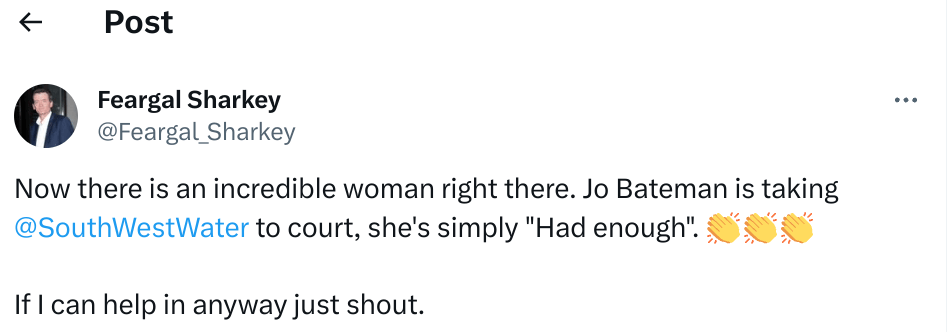
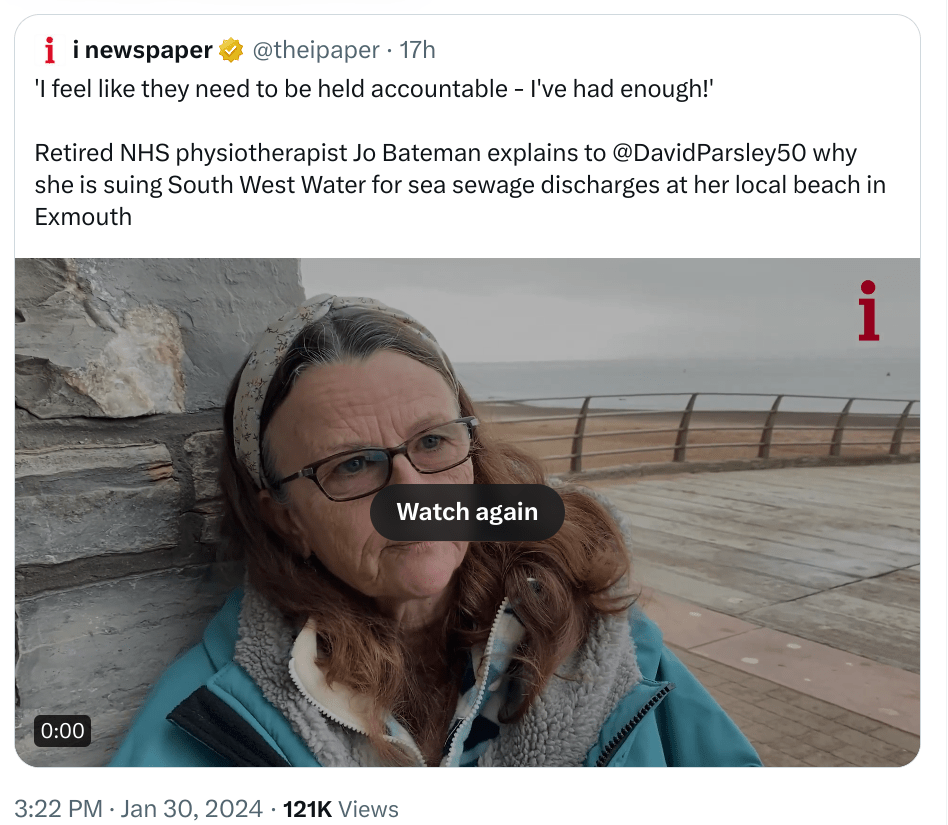
Ms Bateman vs South West Water: Feargal Sharkey offers help

Exmouth Swimmer suing over sewage leaks at Devon coast

A woman is taking South West Water to court over sea sewage discharges that she claims have harmed her health and prevented her from taking daily swims.

David Parsley inews.co.uk

Retired NHS physiotherapist Jo Bateman has submitted an action to the Small Claims Court alleging that illegal sewage spills into the sea at her local beach in Exmouth, Devon, have affected both her physical and mental wellbeing.

In her claim, Ms Bateman details 54 instances when she believes South West Water illegally dumped sewage into the sea during 2023.

“I could have claimed for many more spills,” Ms Bateman, 62, told i. “But I focussed on the spills that South West Water could not claim were legal and due to storm overflows.”

Ms Bateman is claiming South West Water’s pollution of the Exmouth sea has led to what is legally known as a loss of amenity, which mean she must prove she has been injured.

She claims her daily sea swims help with her depression.

“I make no secret of the fact that I am on anti-depressants,” she said. “But since I have been swimming in the sea every day, my doctor has reduced my dose by half.

“The swimming helps me in all sorts of ways, and I believe the sea is an amenity to anyone that wants to enjoy it.

“It belongs to all of us and South West Water’s actions have meant that amenity is not available to me, and everyone else, all of the time – which it should be.”

While Ms Bateman is claiming compensation, fees and costs of only £379.50. “It’s not a lot of money,” she said. “It’s about the principle that South West Water is polluting our seas and making something that should be available to everyone too dangerous to use.

“I believe I can win this. I know South West Water will probably put up a really expensive lawyer that costs thousands more than my claim, and I’m on my own because I can’t afford a lawyer,” she added.

“If I win my case then this could set a precedent that will open up South West Water to thousands and thousands of claims all around Devon and Cornwall.

“They are deliberately doing damage to our coastline, and they need to be held to account for that.”

Earlier this month, i revealed that millions of litres of sewage had been transported to what the Environment Agency called a “failed pumping station” just 200m from Exmouth’s sandy beach.

One campaigner described it as “willful pollution” by South West Water. The company confirmed one pump at the site had failed but denied untreated sewage was being discharged into the sea.

As well as taking legal action, Ms Bateman is also withholding the sewage element of her water bill and currently owes £64 to South West Water.

“I’m not paying for a service that they do not provide,” she said. “I’m not backing down, and I’m prepared to go to prison for it if they force me.

“I’m on an NHS pension and work part-time in a local bakery, but I don’t need much and I get by. I don’t care if I end up with a County Court Judgement as I don’t need to get a loan for anything.”

South West Water, which has until 12 February to file its defence, declined to comment on Ms Bateman’s claim.

A spokesman for the company said: “We take our responsibility to the environment very seriously and are investing record amounts to reduce the use of permitted storm overflows across the region, including circa £38m earmarked for Exmouth up to 2030.”

X link here

IMF warns Jeremy Hunt against tax cuts in budget

The International Monetary Fund has issued a strong warning to Jeremy Hunt against cutting taxes in his budget in March, stressing the need to boost key areas of public spending instead.

Larry Elliott www.theguardian.com 

In updated forecasts for the UK and the rest of the global economy, the Washington-based fund doubted whether the widely anticipated tax cuts would be possible without extra borrowing or post-election spending cuts.

The IMF said the chancellor should be focusing on repairing the public finances after the damage caused by the pandemic and the war in Ukraine in order to meet growing spending pressures.

An IMF spokesperson said: “Preserving high-quality public services and undertaking critical public investments to boost growth and achieve the net zero targets, will imply higher spending needs over the medium term than are currently reflected in the government’s budget plans.

“Accommodating these needs, while assuredly stabilising the debt/GDP ratio, will already require generating additional high-quality fiscal savings, including on the tax side.”

Hunt is expected to cut income tax in the budget, but the IMF called on the chancellor to increase carbon and property taxes, take steps to eliminate loopholes in the taxation of wealth and income, and overhaul the pensions triple lock. “It is in this context that [IMF] staff advises against further tax cuts,” the IMF said.

Hunt rejected the IMF’s call. “The IMF expect growth to strengthen over the next few years, supported by our introduction of the biggest capital investment tax reliefs anywhere in the world, alongside national insurance cuts to improve work incentives,” the chancellor said.

“It is too early to know whether further reductions in tax will be affordable in the budget, but we continue to believe that smart tax reductions can make a big difference in boosting growth.”

The IMF said it was forecasting UK growth of 0.5% in 2023 and 0.6% in 2024 – both unchanged from October – and with only Germany of the leading G7 industrialised economies expanding more weakly.

With lower inflation likely to boost consumer spending power, the IMF said it was pencilling in UK growth of 1.6% in 2025 – slower than forecast three months ago. “The markdown to growth in 2025 of 0.4 percentage points reflects reduced scope for growth to catch up in light of recent upward statistical revisions to the level of output through the pandemic period,” the IMF said.

Last year, the Office for National Statistics revised up its estimates of UK growth in 2020 and 2021 by 1.8 points in total across the two years.

The IMF said the global economy was gliding towards a “soft landing” after coping with the impact of tough central bank interest-rate action to reduce inflation.

Revising up its growth estimates for 2024, the IMF said a number of big economies – including the US, China, Russia and India – had posted stronger than expected performances in 2023 and it was surprised by the resilience shown.

Pierre-Olivier Gourinchas, the IMF’s economic counsellor said: “The clouds are beginning to part. The global economy begins the final descent toward a soft landing, with inflation declining steadily and growth holding up.”

Announcing details of the interim World Economic Outlook (WEO), Gourinchas said the IMF expected global growth to be 3.1% in 2023 and 2024, upward revisions of 0.1 and 0.2 percentage points respectively. But he stressed the pace of expansion – which compares with an average of 3.8% during the 2010s – remained slow and there was a risk of turbulence ahead.

The IMF said the likelihood of a hard landing had receded and risks to its forecasts were evenly balanced. Growth could be higher than expected if tumbling inflation allowed deeper cuts in interest rates, if governments facing elections boosted public spending or if artificial intelligence increased productivity.

However, the IMF warned of downside risks including the volatile situation in the Middle East; the possibility that inflation would prove stubborn and signs that investors were excessively optimistic about the scale of interest rate cuts from central banks this year.

Gourinchas said he had been particularly surprised by the rapid improvement in the supply side of the global economy, singling out higher labour force participation rates, the easing of supply chain bottlenecks and lower commodity and energy prices.

He warned that central banks “must avoid premature easing that would undo many hard-earned credibility gains and lead to a rebound in inflation”.

However, Gourinchas added: “Signs of strain are growing in interest rate-sensitive sectors, such as construction, and loan activity has declined markedly.

“It will be equally important to pivot toward monetary normalisation in time, as several emerging markets where inflation is well on the way down have started doing already. Not doing so would jeopardise growth and risk inflation falling below target.

“My sense is that the US, where inflation appears more demand-driven, needs to focus on risks in the first category, while the euro area, where the surge in energy prices has played a disproportionate role, needs to manage more the second risk. In both cases, staying on the path toward a soft landing may not be easy.”

The IMF produces two full versions of the WEO each year, in April and October, then updates its forecasts in January and July. The latest interim WEO revised up US growth for 2023 from 2.1% to 2.5%, China from 5% to 5.2%, India from 6.3% to 6.7% and Russia from 2.2% to 3%.

The eurozone, in contrast, performed less strongly in 2023 than previously forecast and its growth has been revised down by 0.2 percentage points to 0.5%.

UK perceived as more corrupt, falling to its lowest score on global index

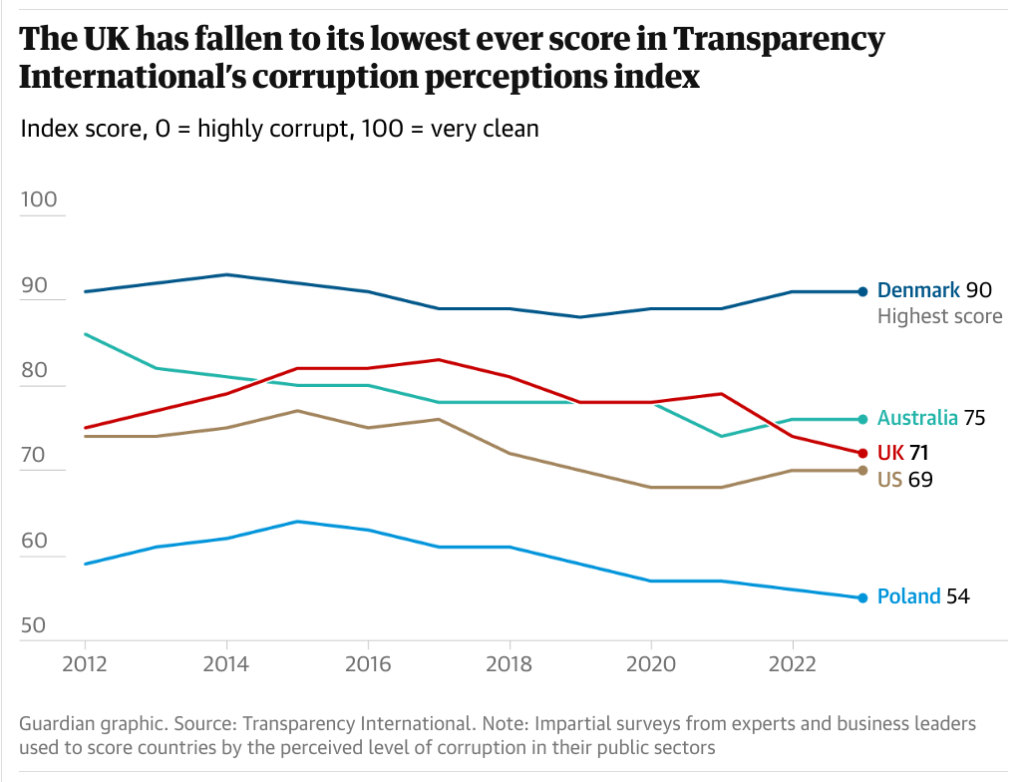
The UK has fallen to its lowest-ever position in Transparency International’s corruption perceptions index, which ranks countries by experts’ views of possible corruption in public services.

Rupert Neate www.theguardian.com 

The UK fell from 18th (out of 181 countries) in 2022 to 20th in 2023, its lowest position since the research was revamped in 2012. It means that, according to the research, Britain is seen as more corrupt than Uruguay and Hong Kong.

The lower ranking coincides with concerns about possible corruption in the awarding of PPE contracts during the pandemic, according to the research published on Tuesday and based on “impartial surveys from experts and business leaders”. The UK was ranked at between the eighth and 11th most transparent country in the world between 2012 and 2021. However, it fell to 18th in 2022, and then joint-20th in 2023.

Daniel Bruce, the chief executive of Transparency International UK, said the findings should act as “a wake-up call for government”.

“The continued fall in the UK’s score shows a country heading in the wrong direction. It’s clear that business leaders and other experts are more concerned than ever about political corruption and the abuse of public office in the UK,” Bruce said.

“We need urgent action from ministers – not just words – to restore much-needed confidence in the integrity of political and public life.”

The total corruption perceptions index score awarded to the UK was 71 out of 100 (where zero means a country is perceived as highly corrupt and to 100 means it is perceived as very clean). It is the lowest the UK has ever scored on the index, and a drop of two points on 2022 and nine on 2018. The UK has experienced the biggest five-year decline of any western European country, according to the research.

The score is based on data from eight independent sources, including the Economist Intelligence Unit and the World Economic Forum. “All surveyed experts and business executives for their views on abuses of public office for private gain and bribery in the UK,” Transparency International said.

The anti-corruption charity said the scandal around the awarding of PPE contracts during the pandemic and concern that “both the UK government’s anti-corruption champion and independent advisor on ministerial interests [had] resigned”.

It added: “The data shows that while perceptions of bribery generally are improving, there are growing concerns over cronyism and patronage in politics, and its effect on the management of public funds.”

Denmark is ranked as the least corrupt, followed by Finland and New Zealand. South Sudan, Syria, Venezuela and Somalia are at the bottom of the rankings, meaning they are seen as the most corrupt. The US is 24th.

2011 ‘Graph of Doom’ now looks prophetic

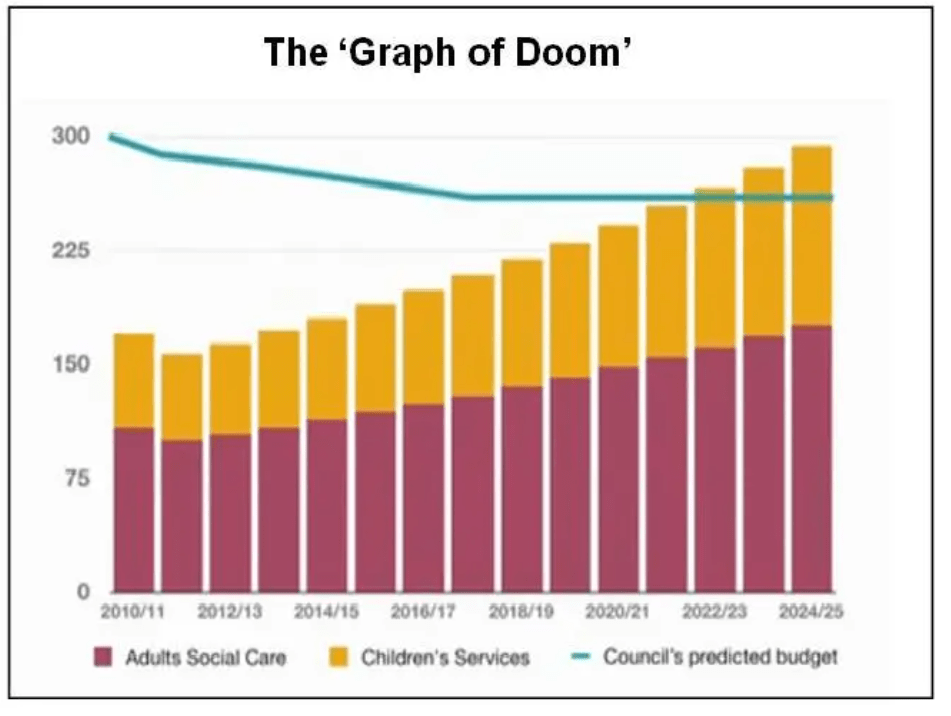
In 2011, two senior council managers in north London put together a PowerPoint graph that they felt might help kick off a useful discussion with colleagues about the future of local government. What would happen, they asked, if town hall funding flatlined, while demographic pressures continued to rise steadily?

Patrick Butler www.theguardian.com

The answer, they suggested, lay in what became known as the Barnet Graph of Doom. It indicated that the council would, within 20 years, expend all its available resources on meeting the needs for adult social care and children’s services. There would be simply be no cash left for libraries, parks, leisure centres or even bins.

The Graph of Doom became a kind of meme in policy circles, a bleak joke, reality check and austerity warning. The late former head of the civil service Bob Kerslake was known to feature it in presentations. Birmingham city council produced its own version in 2012, labelled the “Jaws of Doom”, which its former leader Sir Albert Bore suggested depicted the “end of local government as we know it”.

“We were trying to explain to colleagues that just as the party was over for bankers [post-crash], so the era of growth would be over for the public sector and there would be less money around,” recalls Nick Walkley, Barnet’s chief executive at the time. “It was not meant as a predictive model. We wanted people to start thinking through strategic priorities.”

Back then, though, austerity was in its infancy, and local government was still relatively brimming with confidence and resources. There was widespread disbelief that such a scenario could come to pass, and the graph would often be seen as a provocation, says Walkley: “Even at that time it seemed quite shocking that an authority would have to choose between libraries and adult social care.”

Thirteen years later, the graph of doom has not come to pass, at least not yet. But it has proved far more prescient an indicator of travel than its authors envisaged. Council funding has shrunk by roughly 40% over the period, demand for social care has continued to rise, and councils have made room for these growing costs by shutting down other services.

Top-tier local authorities’ remaining spending power is increasingly dominated by adults and child social care, for which they have defined legal and regulatory duties. The two services can take up as much as 70% of council budgets, at the expense of what have come to be known as “discretionary” services such as parks, leisure centres, arts, youth clubs, children’s centres, community buses, recycling and climate change.

But has even this endless squeezing reached its limit? Conservative-run Hampshire county council warned in October that it would face financial “meltdown” within the next 18 months without some kind of government intervention. It was no longer possible, it said, to meet the boundlessly growing cost of social care simply by continuing to reduce or close non-core services.

Some councils are starting to discuss a graph of doom-ish scenario, where the price of keeping statutory social care services in place is the abandonment of the rest of the council’s functions. Next year, Hampshire argues, either the government bails out councils, or it reduces their statutory burden to allow them to do less. “These are not problems we can fix on our own,” it says.

Looking back, Walkley says it was assumed the graph would never come to pass because the government would step in to solve the crisis in adult social care. It was an age of optimism for councils, and doing nothing did not seem to be an option. But ministers ducked the social care funding question, and the need for children’s services has exploded unchecked. “We never envisaged an un-solution,” says Walkley.

Devon homebuilders ‘must meet’ affordable housing levels

Another South Devon council has taken aim at developers who don’t meet their obligations to provide affordable housing for local families.

Guy Henderson – Local Democracy Reporter www.radioexe.co.uk 

Teignbridge councillors will soon vote on a motion which accuses developers of ‘deception’ around their commitments to build affordable homes and play areas.

Now their counterparts in the South Hams have fired their own salvo in the battle to make sure housing developments include enough sufficient affordable properties. 

Discussing their action plan for housing and homelessness, councillors underlined their existing policy for a minimum of 30 per cent of new South Hams’ homes to be affordable.

But developers often cite figures which show that it would be unviable for them to meet the 30 per cent threshold.

Cllr John Birch (Lib Dem, Totnes) said on one major local development for almost 200 homes, no affordable housing at all were constructed.

He said: “Because the financial viability study says they are only making £30million, they can’t afford to do it. This is totally unacceptable and we as a council need to resist this approach.

“There is evidence of us being too soft as a council when applying this policy.”

And Cllr Nicky Hopwood (Con, Woolwell) added: “I don’t give a damn if a developer can afford it or not. If they can’t afford it, don’t build the houses there.

“If we are ever going to solve the housing crisis in the South Hams we need to get the 30 per cent. We have a serious shortage.

“We need to say that we as a council will not accept developers saying they can’t afford anything.”

However, council leader Julian Brazil (Lib Dem, Stokenham) pointed out that when the council had turned down developments that failed to meet the threshold, government inspectors had overturned the decisions.

“Sometimes it is out of our hands,” he said. “But the mood of this council is absolutely right.

“We said 30 [per cent]. We mean 30. If you go outside of that you’ve got to have some damn good reasons.”

Planning applications validated by EDDC for week beginning 15 January

Angela Rayner: Tories’ council fund is cynical pre-election sticking plaster

Angela Rayner has accused the Conservatives of cynically applying a “sticking plaster” to council finances to get through the next election, as local authority leaders warn that more will go bust next year.

Rowena Mason www.theguardian.com

The shadow communities secretary said Labour was “under no illusions” about the financial mess it would inherit in local councils if it gained power, after the Tories “took a sledgehammer” to budgets for more than a decade.

The prime minister, Rishi Sunak, was forced to bail out councils in England last week with a £600m funding pot to prevent a rebellion of Tory MPs who fear losing their seats. But figures shared by the Institute for Government show it would take more than £7bn in extra cash to get local government funding up to the same levels as 2010.

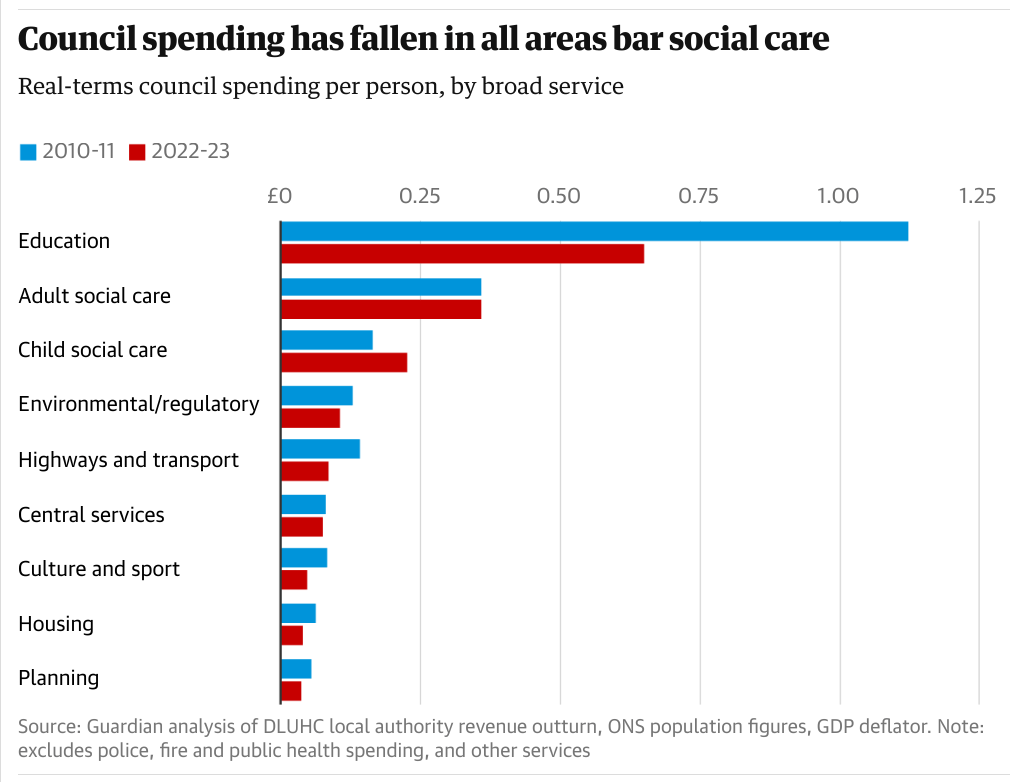
Analysis by the Guardian of 13 years of council spending data lays bare the scale of cuts to services. Between 2010-11 and 2022-23, real terms spending per head on cultural services was cut by 43%, on roads and transport by 40%, on housing by 35% and on planning and development by a third, with more cuts pencilled in for this year.

Council leaders from across the political divide told the Guardian the extra money announced this week was welcome but would not be enough to prevent further cuts in the coming years.

It is understood the government is exploring options for a fresh austerity drive in councils for after the next general election, after Michael Gove said his Department for Levelling Up, Housing and Communities would force councils to develop “productivity plans”.

The warnings from the levelling up secretary will add to Labour’s fears that the Conservatives are pursuing a scorched earth policy of underfunding public services in order to spend its spare cash on tax cuts to boost Sunak’s electoral prospects.

“It’s hard to see where productivity is coming from without it being a mask for further privatisation or reductions in services,” said James Lewis, the Labour leader of Leeds city council. “It feels like austerity is going further yet again.”

In an interview, Rayner said libraries, sports centres and youth provision were “not a garnish” and rejected calls from some Conservatives to reduce the types of services that councils had to offer.

“What’s very clear to me is that we are going to inherit a very difficult situation because the Tories have brought [councils] to the brink, offering them a very small amount of money now which cynically to me is about them trying to just get them over the line for a general election,” she said.

“But it’s not going to do anything about the long-term problems that we would inherit and we’re under no illusions about the scale of those problems.”

She said Labour would have to look at the overall state of public finances if it were to take power in the next year, but it would want to move to multi-year funding settlements to help councils plan better and make sure money was directed to the areas that needed it the most.

Asked about the risk of more council bankruptcies in the next few years, Rayner said: “Yes I’m absolutely worried about that. And I think councils up and down the country are worried about that. They’ve seen these added costs … temporary accommodation, children’s services and the pressures of the cost of living crisis that’s been created by the Tories – this real perfect storm for local authorities.”

Four local authorities fell into effective bankruptcy in 2023 – Birmingham, Nottingham, Woking in Surrey and Thurrock in Essex.

Roger Gough, the Conservative leader of Kent county council, said he had warned Sunak 15 months ago the government was “sleepwalking into financial disaster” amid dramatically escalating pressure on local authorities.

He said: “The fundamental situation is unchanged. The extra funding is welcome, and it’s important for us to not be too dog in the manger about this. But the fundamental pressures are still there. We are experiencing these as are other authorities across the country.

“We all know the cavalry is not going to be coming over the hill in terms of government funding, and that will be true frankly if there is a change of government. We all have to work within the world we’re living in.”

Stephen Houghton, the Labour leader of Barnsley council, who also chairs a group of 48 urban councils in the north of England, Midlands and south, said there was likely to be a “surge ofsection 114s next year” if more money was not provided – referring to the mechanism councils use to declare effective bankruptcy.

He said it “would be churlish” not to welcome the extra £600m but it would not be enough to match inflation and demand-led pressures on local authorities. “It won’t solve the problem. It will get us through to next year but what happens the year after that? Unless something substantial happens, we’re looking at a lot more councils struggling.”

In Birmingham, where the council has been placed in special measures by the government after its effective bankruptcy in September, officials plan to shrink the authority by 15% over the next two years. Others planning deep cuts include Bradford, Kent, Hampshire, Stoke-on-Trent and Somerset.

Tim Oliver, the Conservative leader of Surrey county council and chair of the County Councils Network, said he thanked the government for last week’s “highly unusual, if not unique” bailout package. “But I might say post general election we’ll be back.”

“The sector has been reasonably clear. With increased demand, there’s a funding gap of £2-3bn over the coming years.”

The former Conservative communities secretary Eric Pickles said local council funding should be overhauled altogether, including a review of business rates, revaluation of council tax at the point of property sales and an end to the government “topslicing” the central pool for council budgets.

“Whoever is the next government, if you did it the first year, you would begin to see some benefits from it by the fifth year,” he said. Pickles also backed three-year funding settlements for councils as “something I always wanted to do”.

Many Conservative MPs say privately that the £600m bailout is only a temporary solution. One senior Conservative MP said it was “a step in the right direction but the budget will need more to prevent council cuts due to the cost of energy and cost of living”.

Ben Bradley, the Conservative MP and leader of Nottinghamshire county council, said the cash increase was a “victory”, but that there were structural pressures authorities were facing. “There’s no political benefit of going into an election saying we’re shutting down your library and your youth centre. It’s not going to work. We do need to support and protect local services.”

A government spokesperson said: “We have recently announced an additional £600m support package for councils across England, increasing their overall proposed funding for next year to £64.7bn – a 7.5% increase in cash terms.”