“Labour demands Commons vote on ‘secret’ plan for NHS”

This is the most dangerous thing to happen to our NHS since the Health and Social Care Act 2012 paved the way for wholesale privatisation. Once this goes through (on the nod as it will with this government) our NHS ceases to exist.

Currently, money in the true NHS stays in it and recirculates. With ACOs first big salaries for ACO staff are creamed off, then boardroom and shareholder dividends of the companies concerned and then the NHS gets cut and rationed – with only high-profit interventions (usually things such as elective surgery which can be costed to the penny) made available.

“Party says ministers are trying to push through changes that could lead to greater privatisation and rationing of care

Denis Campbell Health policy editor

Labour is demanding that MPs be allowed to debate and vote on “secret” plans for the NHS that they claim could lead to greater rationing of care and privatisation of health services.

The party says ministers are trying to push through the creation of “accountable care organisations” (ACOs) without proper parliamentary scrutiny.

Jonathan Ashworth, the shadow health secretary, has written to Andrea Leadsom, the leader of the House of Commons, urging her not to let “the biggest change to our NHS in a decade” go ahead without MPs’ involvement.

NHS England’s chief executive, Simon Stevens, and the government see ACOs as central to far-reaching modernisation plans that they hope will improve patient care, reduce pressure on hospitals and help the NHS stick to its budget.

ACOs involve NHS hospital, mental health, ambulance and community services trusts working much more closely with local councils, using new organisational structures, to improve the health of the population of a wide area. The first ACOs are due to become operational in April in eight areas of England and cover almost 7 million people.

Labour has seized on the fact that the Department of Health plans to amend 10 separate sets of parliamentary regulations that relate to the NHS in order to pave the way legally for the eight ACOs.

In his letter, Ashworth demands that Leadsom grant a debate on the plans before the amended regulations acquire legal force in February.

“Accountable care organisations are potentially the biggest change which will be made to our NHS for a decade. Yet the government have been reluctant to put details of the new arrangements into the public domain. It’s essential that the decision around whether to introduce ACOs into the NHS is taken in public, with a full debate and vote in parliament,” he writes.

A number of “big, unanswered questons” about ACOs remain, despite their imminent arrival in the NHS, he adds. They include how the new organisations will be accountable to the public, what the role of private sector health firms will be and how they will affect NHS staff.

Ashworth also says “the unacceptable secrecy in which these ACOs have been conceived and are being pushed forward is totally contrary to the NHS’s duty to be open, transparent and accountable in its decision-making. The manner in which the government are approaching ACOs, as with sustainability and transformation plans before them, fails that test.”

Stevens’s determination to introduce ACOs has aroused suspicion because they are based on how healthcare is organised in the United States. They came in there in the wake of Obamacare as an attempt to integrate providers of different sorts of healthcare in order to keep patients healthier and avoid them spending time in hospital unnecessarily.

A Commons early day motion (EDM) on ACOs also being tabled by Labour on Thursday, signed by its leader, Jeremy Corbyn, and other frontbenchers, notes that “concerns have been raised that ACOs will encourage and facilitate further private sector involvement in the NHS”.

In his letter Ashworth adds: “There is widespread suspicion that the government are forcing these new changes through in order to fit NHS services to the shrinking budgets imposed from Whitehall.” The EDM also notes “concerns that ACOs could be used as a vehicle for greater rationing”.

The King’s Fund, an influential health thinktank, denied that ACOs would open up NHS services to privatisation. “This is not about privatisation; it is about integration,” said Prof Chris Ham, its chief executive.

“There is a groundswell of support among local health and care leaders for the principle of looking beyond individual services and focusing instead on whatever will have the biggest impact in enabling people to live long, healthy and fulfilling lives,” added Ham.

Dr Chaand Nagpaul, the chair of the British Medical Association, backed Labour’s call for greater transparency but said care services should be integrated.

However, he added: “ACOs will not in themselves address the desperate underfunding of the NHS and may divert more money into processes of reorganisation. Current procurement and competition regulations create the potential for ACOs to be opened up to global private providers within a fixed-term contract and with significant implications for patient services and staff.”

The Department of Health refused to say if MPs would be able to debate ACOs. “It is right that local NHS leaders and clinicians have the autonomy to decide the best solutions to improve care for the patients they know best – but significant local changes must always be subject to public consultation and due legal process.

“It is important to note that ACOs have nothing to do with funding – the NHS will always remain free at the point of use,” a spokesman said.”

https://www.theguardian.com/society/2017/dec/07/labour-demands-commons-vote-secret-plan-nhs

RDE rushes ahead with unaccountable “Accountable Care Organisation” plans

[By total coincidence, of course, Tiverton has the only local 24 bed PFI-funded community hospital which cannot therefore be closed].

NEWS RELEASE
Tuesday 5 December 2017

“Tiverton GP practice due to join hospital trust – pioneering the way for Devon’s first primary and secondary health care integration

On 2 January 2018, Tiverton’s Castle Place Practice and its 50 members of staff*, including GPs, plan to join the Royal Devon and Exeter NHS Foundation Trust (RD&E). This new venture will be the first of its kind in Devon and will provide locally-led seamless care for the Tiverton community
This move fits with the direction of the NHS Five Year Forward View and offers better integrated working by removing organisational barriers. Castle Place is already co-located with Tiverton Community Hospital and has an established close working relationship with the Trust’s community teams so it was a pragmatic option for the practice to approach the RD&E with the proposal to explore a fully integrated model. Whilst offering the opportunity to work differently for the benefit of all the local community, it will also help address some of the challenges faced by primary care, particularly the difficulty in recruiting new GP partners and balancing time for clinical care with the demands of running a business.

Dr James Squire, GP Partner at Castle Place, explains: “This is an exciting new venture for us and one in which our patients’ best interests are central to our rationale for pursuing this change. I’d like to reassure our patients that in the short-term there will be no changes to the services we offer and in the longer-term will only provide better care.

“The ever increasing challenges and pressures are resulting in necessary changes right across the healthcare system. Thankfully, due to our focus on person-centred, continuity of care we have managed to fare some of these challenges well but we know that to maintain this for our current patients and future generations we need to explore new ways of working. There are a number of different ways GPs could adapt but it was important for us that we secured a future which was true to our core values and principles. Joining the RD&E gives us an opportunity to concentrate our efforts on leading and providing excellent clinical care in a way that’s right for our community”.

“This is a bold step for us but the whole team here is motivated to test new ways of working, not only between the practice and the hospital but also with the community services for our population, and we are really keen to share our experiences and learning for the wider benefit.”

Suzanne Tracey, RD&E Chief Executive, said: “At the RD&E we are prioritising working more closely with local health and care partners to support a move towards ‘place-based care’. This is the future of healthcare and we want to help create the conditions which enable communities to take the lead. To achieve this, we envisage working with our partners in a number of exciting and different ways and this proposal initiated by the Castle Place Practice in Tiverton is a great opportunity to put this into practice.

“Whether in primary or secondary care, all of us want to do what’s right for the person and right for a community but sometimes competing demands, targets and finances can get in the way or slow the pace of change. The partnership with Castle Place Practice is a great opportunity for us to work together with GPs to develop more proactive care which keeps people well and independent in their own communities.”

Castle Place Practice’s 15,000 registered patients, which is around half of Tiverton’s population, will see no immediate changes. Staff will continue in their existing roles, patients’ named GP will not change and access to appointments and services will continue in exactly the same way. However, in the longer term it will enable and increase the opportunities for better management of long term conditions plus improve access to care at home and in the community.”

Health care privatisation – largest care home provider on brink of collapse

And who will end up bailing it out if debt restructure doesn’t happen …..?

Four Seasons on brink of collapse

“Four Seasons, Britain’s biggest private care home operator, is at risk of going into administration over a £26m interest payment due on its debts, and amid a dispute between its British owner and its main bondholder, American hedge fund H/2 Capital.

British private equity firm Terra Firma, which owns Four Seasons, has offered to hand over the operator’s 343 care homes to H/2 if the hedge fund created a creditors’ committee to “agree an orderly and responsible handover and to collectively agree with the other bondholders and creditors a new capital structure for the Four Seasons group, new equity ownership and new corporate governance”.

H/2 has not responded to the offer yet, and has previously put forward its own restructuring plan, as it is in dispute with Terra Firma over the ownership of 24 profitable homes.”

Source: The Daily Telegraph, Pages: 1, 3 The Times, Page: 40 The Guardian, Page: 23 Independent i, Page: 9 Financial Times, Page: 19 Evening Standard, Page: 46

A Christmas Carol for the NHS

Good king Jeremy Hunt looked out
so did Simon Stevens
healthcare crisis all about
they were disbelieving.
“There’s no problem on the wards
waiting times are super.
Moan too much, we’ll sell the lot
to our friends at Bupa.”
Long term sick and elderly
shoved where you can’t see’em,
care from cradle to the grave
now in a museum.

Trolleys for the dying poor,
posh wards for the wealthy
don’t expect an ambulance –
pray that you stay healthy.
Give us back our stolen wards,
two hundred beds and counting.
Give us back our hospitals:
hear the anger mounting
Pay our nurses what they’re worth,
cherish those who mend you:
Happy Christmas, NHS,
we’ll always defend you.

Swire fails to save another hospital

In August 2017 Swire spearheaded a campaign to keep heart services going at London’s Royal Brompton Hospital (having miserably failed to lead similar campaigns in East Devon, leaving Claire Wright to fight for us:

https://eastdevonwatch.org/2017/08/05/more-on-swire-saving-services-at-royal-brompton-hospital-london/

Well, his attempts in London don’t seem to have worked either:

“The world-leading Royal Brompton Hospital in London, recently ‘saved’ by NHS bosses, is being lined up for a billion pound sale to make way for luxury flats. …”

http://www.dailymail.co.uk/news/article-5140315/World-class-heart-hospital-make-way-luxury-flats.html

BBC: Save our Hospital Services Totnes demo “disrupted traffic and Christmas shoppers”

Well, now we know for sure where the BBC’s priorities lie!

“Hundreds of protestors disrupted traffic and Christmas shoppers as they marched through a town centre.

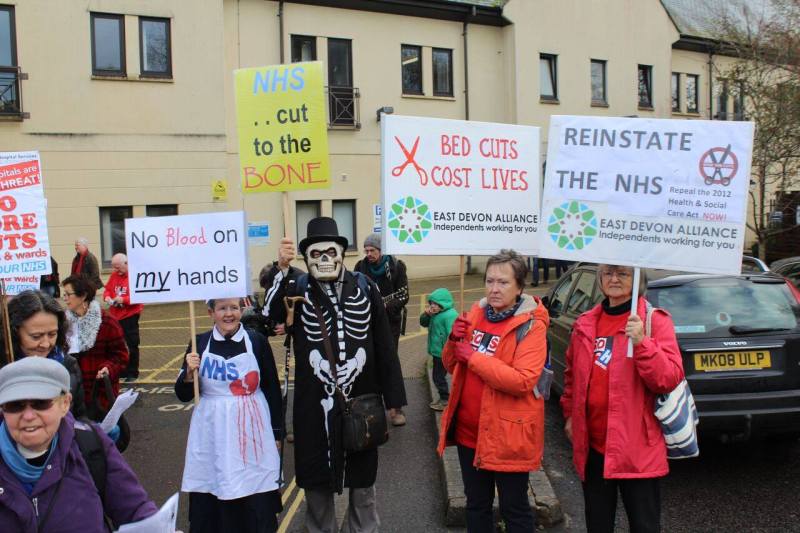
The protest in Totnes, Devon, was over the loss of two hundred hospital beds and four community hospitals – and the threat of further cuts.

Save Our Hospital Services campaigners wheeled a hospital bed and carried placards through streets on Saturday. …”

http://www.bbc.co.uk/news/uk-england-devon-42213994

“UK, Romania and Poland: fewest doctors in EU”

“The UK has the third-lowest number of hospital beds per person in the European Union as well as the third-lowest number of doctors, with only Romania and Poland worse off, a European Commission report has found.

The report, which compared the 28 EU countries, warned that hospitals will struggle to cope with the winter crisis predicted by many doctors and NHS managers as intensive care beds were full even during the summer.

It warned of the UK’s “limited capacity to absorb shocks”, adding: “Difficulties finding beds have introduced inefficiencies.”

Ian Eardley, vice-president of the Royal College of Surgeons, said Britain’s low ranking in the report should act as “a wake-up call for NHS leaders” and that the cuts have “now gone too far”.

He said: “Bed shortages lead to cancelled operations and patients waiting longer for treatment. Some will find themselves in pain for longer, possibly unable to go about their daily life. In the worst cases their condition may deteriorate while they wait.”

Last week doctors in intensive care units (ICUs) — where the sickest patients are given life support — said they were also nervous about the coming weeks.

Dr Christopher Bassford, a consultant in intensive care at University Hospitals Coventry and Warwickshire NHS Trust, said: “At our intensive care unit we have operated at 100% capacity or over for most of the summer. This winter we are anxious.”

Dr Gary Masterson, president of the Intensive Care Society, added: “It does feel as if we are on the cusp. This [bed occupancy at 100%] is the norm for many ICUs. It is right to worry about ability to cope should we have a busy winter.”

Bed occupancy runs at over 100% when more than one patient uses the bed during a 24-hour period.

Dr Nick Scriven, president of the Society for Acute Medicine, recently warned that doctors would need to make drips out of coat hangers this winter because of the anticipated shortage of beds and equipment.

While the number of doctors working in the NHS has increased, the report also found the UK still near the bottom of the EU league table. It said: “There have been steady increases in recent decades, despite which the number of doctors per 1,000 of the population was the third lowest in the EU.”

NHS England said: “These figures show our NHS is much more efficient than other countries such as France or Germany in helping patients avoid emergency hospitalisations, and we do so despite spending less and having fewer nurses and doctors than they do.”

Sunday Times (pay wall)

Who fights for our NHS? Independents fight for it!

Photos from demo in Totnes today with a few local faces you will probably recognise.

No Tories from East Devon then?

Thought not!

“David Cameron admits ‘we didn’t solve’ problem of funding social care for Britain’s ageing population”

Owl says: LOTS and LOTS of things Dave didn’t solve …..

“David Cameron has expressed regret he was unable to do more to deal with the “huge” challenge funding social care for Britain’s ageing population.

The former prime minister – who has since become president of Alzheimer’s Research UK – said a way had to be found to meet the “catastrophic” costs of caring for people with dementia.

“There is a huge social care funding challenge we have to answer, and I accept that we’ve made some steps forward, but we didn’t solve that problem,” Mr Cameron told the Financial Times.

“Everyone knows it’s a difficult conundrum. Lots of effort has been made to try and solve it but we haven’t got there yet.”

In office Mr Cameron sought to introduce a £72,000 cap on the costs an individual would have to pay towards care home charges with the state picking up any further bills.

Ministers had hoped insurance companies would develop products that would enable people to insure themselves against their care costs up to the £72,000 limit.

However the plans were put on hold in July 2015 after insurers proved reluctant to enter the market.

“The disappointment I had was I was hoping that a combination of the cap on care costs would help to deliver an insurer’s model, where a market would grow up where everyone could insure themselves against the cost of long-term care. And we just haven’t cracked that yet,” Mr Cameron said.

“I’m not in politics any more but we’ve got to find an answer. (Given) the catastrophic cost of care that people face from dementia, and I saw this with constituents, we’ve got to find a better answer there.”

http://www.independent.co.uk/news/uk/politics/david-cameron-regret-alzheimers-dementia-social-care-funding-a8088031.html

“Telegraph: Theresa May starts work on new DUP deal to stop Government collapsing in June 2019”

OUR money. To be spent on tourism in Northern Ireland and cushioning them from Brexit problems.

The first tranche of £1 billion earlier this year allowed Northern Ireland to increase its NHS spending by more than 5%.

Theresa May has started to work on a new deal worth hundreds of millions of pounds with the Democratic Unionist Party to stop her Government collapsing in just over 18 months’ time.

Mrs May’s Government will set out plans to cut Air Passenger Duty and VAT on hotels and restaurants in Northern Ireland in the new year.

The new cash will be on top of the £1billion which Mrs May agreed to spend in Northern Ireland after the DUP’s 10 MPs agree to support her minority administration.

The Treasury has promised to publish its response to the consultation at the next Budget in Autumn next year to allow the changes to be introduced in the 2019/20 tax year.

The talks were signalled in this week’s Budget Red Book, which said: “Early in 2018, the government will publish a call for evidence which will consider the impact of VAT and APD (air passenger duty) on tourism in Northern Ireland, to report at Budget 2018.”

http://www.telegraph.co.uk/news/2017/11/25/exclusive-theresa-may-starts-work-new-dup-deal-stop-government/

DCC Health Scrutiny Committee – not fit for purpose

The DCC Health Scrutiny Committee lurches from poor practice to bad practice to utter chaos under the continued Chairmanship of Sarah Randall-Johnson

Can you imagine saying you will vote against questioning NHS Property Services about their intentions on the future of community hospitals which they now own “because they might not come”! And Randall-Johnson saying she is “not aware of any threat to any community hospital!!!

[CCGs have been offered match funding from the government for any properties sold in their areas]
http://www.mirror.co.uk/news/politics/naylor-plan-outline-sell-nhs-10544577
http://www.property.nhs.uk/asset-management/

Claire Wright’s Blog:

NHS Property Services will be invited to attend the next Health and Adult Care Scrutiny Committee in January.

But my simple request prompted a debate lasting over half an hour, at Tuesday’s meeting (21 November).

The lengthy and baffling discussion gave a poor impression of the committee in my view, with some Conservative councillors claiming confusion and dismissing the proposal several times as “premature.”

It all started off with a presentation to the committee by Independent councillor, Martin Shaw, under the final work plan agenda item.

Cllr Shaw rightly pointed out how many people were concerned about the potential loss of the hospital buildings, that they had put their own money into them and still there was no clarity over their future, yet NEW Devon CCG were (or at least would very soon be) paying large sums of money in rent each year when previously they owned the buildings outright.

NHS Property Services, a private company wholly owned by the Secretary of State for Health, set up under the Health and Social Care Act 2012, acquired the ownership of 12 community hospitals in Eastern Devon at the beginning of this year.

Given that the NEW Devon CCG is one of three most financially challenged health trusts in the country and must make huge cuts to try and stem a deficit of over £400m by 2020, people’s concerns about the future of the hospitals are very valid.

Following my proposal to invite NHS Property Services to the January meeting, chair, Sara Randall Johnson said there was a full agenda for the next meeting so it may not be possible to include it. She said that she was not aware that there was a threat to any community hospital.

Liberal Democrat, Brian Greenslade said NHS PS had been invited previously but questions had been remained unanswered and so should be invited again.

Conservative, Phil Twiss, who represents Honiton which has lost its own hospital beds, claimed in a number of long statements that it was “premature” to invite the company because the future of the buildings had not yet been decided.

He later added that they wouldn’t come anyway.

I replied that waiting until the March meeting was far too long and could mean that decisions were already made. Surely we need to talk to NHS PS and the CCG before their decisions?

I attempted to explain again why it was important we invited the company to the January meeting.

But apparently confusion reigned.

Conservative members became very fixated with the legacy issue, even though I had made it clear that it was about questioning NHS PS and the CCG about their plans on the future of community hospitals and the legacy issue was only part of that.

Chair, Sara Randall Johnson, suggested holding a meeting first to agree some questions to ask NHS PS. I have not seen this approach in my four and a half years as a member of the committee.

I had to make my proposal numerous times, while one or two persistent Conservative members continued to challenge it.

There was an amendment by Liberal Democrat, Nick Way, who wanted a spotlight review into the issue as well.

Phil Twiss then changed his tack and claimed there was no point in asking the company to attend as they wouldn’t come. He was in favour of a spotlight review instead (spotlight reviews are held in private).

But when the vote finally was taken, it was on the spotlight review amendment and not my original proposal to invite NHS PS to the next meeting …

I tried to intervene. Fortunately, the officers corrected matters… and then the majority of the committee voted in favour of my proposal. Finally.

My proposal couldn’t have been more straightforward or uncomplicated. It was entirely within the committee’s remit.

It was also within a couple of hours of hearing the county solicitor’s presentation about how scrutiny should do its job properly. Or be culpable. See this blogpost here – http://www.claire-wright.org/index.php/post/devon_county_council_solicitor_tells_health_scrutiny_committee_you_have_a_v

Here’s the webcast. It is the final item on the agenda – https://devoncc.public-i.tv/core/portal/webcast_interactive/302658

Pic: Me exasperated!”

http://www.claire-wright.org/index.php/post/nhs_property_services_will_be_invited_to_next_devon_county_council_health_s

Some councillors on DCC scrutiny committee seem to have difficulty in grasping the concept of ………. scrutiny

Claire Wright’s blog:

Devon County Council’s solicitor, Jan Shadbolt, reminded the Health and Adult Care Scrutiny Committee of its legal responsibilities at Tuesday’s (21 November) meeting.

I had asked for this agenda item following a disastrous meeting in July where a referral to the Secretary of State for Health on the closure of 72 community hospital beds in Eastern Devon was thwarted by the Conservative members of the committee, resulting in over 20 complaints from members of the public.

Mrs Shadbolt read out a paragraph from the Mid Staffordshire NHS Foundation Trust Public Inquiry, led by Sir Robert Francis in 2013. Many people had tragically died there as a result of poor care.

The local council’s scrutiny committee was deemed to have failed in its duty to effectively scrutinise the local health trust and identify problems.

Mrs Shadbolt said it was the first time that non-executive members of a local authority were held to account because they were deemed to have failed in their duty.

New regulations were brought in afterwards to beef up the legal powers of health scrutiny committees. These were that health scrutiny committees can:
– Require a local officer to attend to answer questions
– Expect to be consulted by an NHS body or service provider on substantial developments (although there is no definition of substantial developments)
– Refer to the Secretary of State for Health (subject to a series of constraints)

The county solicitor told the committee that we had a “very powerful role to play within the community” and that we were “unique in scrutiny committees” on that basis.

Conservative, Phil Twiss wanted to know who “scrutinises the scrutineers.” The county solicitor replied that the ultimate scrutiny was being called to account over the failure of a service provider, but that generally speaking councillors were answerable to the community.

Cllr Twiss then wanted to know how the committee knew it was performing properly. Mrs Shadbolt said that the committee’s role was to ask pertinent questions, call any officer to present. She added that there are all sorts of bodies who can give information to help with this, such as Healthwatch.

Conservative councillor, Paul Crabbe, wanted to remind the committee that this agenda item had been added because “some members felt we failed to scrutinise correctly…” He went on to say that a “chap from south Devon was fizzing with excitement over the success and how about how wonderful his new system was” then they were later asked to vote that it was “rubbish.”

Cllr Crabbe said that this struck him as a nonsense then and still struck him as a nonsense and just because the committee voted against “someone’s particular view” it didn’t necessarily mean that the committee was not fulfilling its role.

Liberal Democrat, Cllr Brian Greenslade asked the county solicitor to remind councillors that scrutiny is not a normal committee of the council in that it is not supposed to be political. He said that he thought it was worth underlining this point…”

Here’s the webcast – https://devoncc.public-i.tv/core/portal/webcast_interactive/302658

Austerity to continue unabated for NHS and social care

Lord Porter, Chairman, Local Government Association:

… It is hugely disappointing that the Budget offered nothing to ease the financial crisis facing local services. Funding gaps and rising demand for our adult social care and children’s services are threatening the vital services which care for our elderly and disabled, protect children and support families. This is also having a huge knock-on effect on other services our communities rely on. Almost 60p in every £1 that people pay in council tax could have to be spent caring for children and adults by 2020, leaving increasingly less to fund other services, like fixing potholes, cleaning streets and running leisure centres and libraries.

“Adult social care services are essential to keeping people out of hospital and living independent, dignified lives at home and in the community and alleviating the pressure on the NHS. Simply investing more money into the NHS while not addressing the funding crisis in adult social care is not going to help our joint efforts to prevent people having to go into hospital in the first place.

“The money local government has to run services is running out fast and councils face an overall £5.8 billion funding gap in just two years. The Government needs to use the upcoming Local Government Finance Settlement to set out its plan for how it will fund local services both now and in the future. We remain clear that local government as a whole must be able to keep every penny of business rates collected to plug funding gaps while a fairer system of distributing funding between councils is needed.

“Only with fairer funding and greater freedom from central government to take decisions over vital services in their area can local government generate economic growth, build homes, strengthen communities, and protect vulnerable people in all parts of the country. … ”

Cllr Izzi Seccombe, Chairman of the Local Government Association’s Community Wellbeing Board:

“It is a completely false economy to put money into the NHS while not addressing the funding crisis in adult social care. This sends a message that if you need social care, you should go to hospital.

“If government wants to reduce the pressures on the health service and keep people out of hospital in the first place, then it needs to tackle the chronic underfunding of care and support services in the community, which are at a tipping point.

“In addition, central government’s cuts to councils’ public health budgets, which fund vital prevention work that improves the health of children, young people and adults, reducing the need for treatment later down the line and also easing the pressure on the NHS, need to be reversed.

“Adult social care needs to be placed on an equal footing to the NHS. It is clear that the public understands this, as adult social care was a central talking point in the recent general election. It is therefore deeply disappointing that government has today chosen not to capitalise on this momentum.

“While the announcement of a green paper next summer shows government recognises the need for long-term reform, this does nothing to address the immediate pressures older and disabled people are facing. Those who desperately rely on care and support on a daily basis cannot be left to make do while waiting for yet another review. They want action now.

“The £2 billion over three years announced in the Spring Budget was a step in the right direction, and councils have been effectively using this money, for example to reduce delayed transfers of care. However this was one-off funding and is not a long-term solution.

“Adult social care still faces an annual funding gap of £2.3 billion by the end of the decade. As a minimum government needs to plug this gap urgently to ensure services can keep on running and stop providers going bust, while we have the bigger conversation around how we secure a long-term sustainable future for social care.”

Grant Thornton (auditors)

““Continued investment into the NHS is necessary but the announcement today didn’t even cover the current deficit forecast until 2020.

Social care continues to be the main driver on demand in council spending and yet received no mention; a very obvious omission.

In 2011/12, social care accounted for around 28.9% of total service expenditure and rose to 30.16% in 2015/16, indicative of the growing demand that is not being met.

In particular, children’s services have faced challenging savings targets and very difficult decisions over a number of years and in 2015/16 73% of all councils overspent against their children’s social care services budget as they struggled to produce more with less.

By avoiding addressing this issue directly and continuing to invest elsewhere in the health and social care system the Chancellor is missing a valuable opportunity by choosing to invest in only the roof while the house around it is crumbling. …”

http://localgovernmentlawyer.co.uk/index.php

The Budget – no lifeline for NHS

“ … Chris Hopson, chief executive of NHS Providers, said: “It is disappointing that the government has not been able to give the NHS all that it needed to deal with rising demand.”

He said the NHS was “trying to live hand to mouth” and Hammond had directed extra revenue to acute hospital performance when “the pressures across the rest of the health service – community, mental health and ambulance services – are just as great”.

The funding in the Budget was “less than the NHS needed” but Hopson conceded was “more than was expected.” The Office of Budget Responsibility had warned the NHS faced a £20bn funding gap by the end of this parliament and a recent joint-report from the Kind’s Fund, Nuffield Trust and Health Foundation said the health service needed at least £4bn over the next year.

Niall Dickson, chief executive of the NHS Confederation, also said: “This is another missed opportunity and falls well short of what is needed to relieve the massive pressures facing the NHS today”.

Labour leader Jeremy Corbyn, in his response to the Budget statement, said that the chancellor’s commitments did not do enough for “under-paid, over-stressed, under-appreciated” NHS staff.”

http://www.publicfinance.co.uk/news/2017/11/nhs-disappointed-limited-budget-funding-boost

Independent EDA Councillor Shaw continues the fight for our local NHS

Thank goodness for (truly) independent councillors!

“PRESS RELEASE

Devon County Council’s Health and Adult Care Scrutiny Committee will ask both the NEW Devon and South Devon & Torbay Clinical Commissioning Groups, which commission services in community hospitals, and NHS Property Services, which now owns the hospitals, to its next meeting on 25 January to report on the future of the hospitals now that most of them have lost their in-patient beds.

The Scrutiny Committee decided to request the discussion at its meeting yesterday (21st) after concerns were raised by Cllr Martin Shaw, who represents Seaton and areas close to Honiton, both places where hospital beds closed this summer. Cllr Shaw is pressing for the contributions to community hospitals made by local communities and Leagues of Friends to be taken into account in planning their futures, and had presented a paper on the subject to the Committee’s September meeting.

Cllr Shaw raised particular concerns over the high rents to be charged by NHS Property Services, the fact that the CCG is committed to paying for space only until the end of the current financial year, and that the CCG has specifically said that existing outpatient services are not guaranteed to continue.

‘Many services can be delivered in community hospitals’, Cllr Shaw emphasised after the meeting. “We should be talking about increasing not reducing the provision close to where patients live. If most services are concentrated in the RD&E, patients will continue to face long journeys into Exeter. With deteriorating public transport many will have to drive in and contribute to the city’s ever-growing congestion. We need joined-up planning at Devon and local levels to make the best use of the hospitals, which are community assets whoever is the legal owner.’

The motion to invite the NHS organisations was proposed by Cllr Claire Wright (Independent) and seconded by Cllr Nick Way (Liberal Democrat).

Martin Shaw
Independent East Devon Alliance County Councillor for Seaton & Colyton”

South West Ambulance service employees: open letter to public

An apology from Ambulance staff to our families, friends and the community:
Have you ever wondered what goes on behind the scenes when you see an ambulance attending an incident what it might be like to work for the South Western Ambulance service?

Although we love what we do, behind the professional facade we portray to the public we are struggling to maintain a crumbling service deliberately being underfunded by the Government and made worse when those over pressured resources and stressed staff are then badly managed locally.

If you’re unfortunate enough to have to call us, please remember that although we will potentially often be the Deliverer of the First High Quality Care you receive in an accident or illness, we are not only not classified as an Emergency Service by the government but not appreciated or cared for by our employer.

We, as ambulance professionals, are trying to change that. Our Union, GMB, are trying to change that, but our employer and our Chief Executive are ignoring both our complaints and calls for change, so in order to explain to our families, friends and the public and even our employer SWAST we send out our heartfelt apologies:

TO THE PUBLIC:

We’re sorry for not getting to you or your loved ones quick enough because there are just not enough of us or we are called out to answer non-emergency calls.
We’re sorry for the patient and family members that have been left on the floor for hours as a consequence of not getting to you on time.
We’re sorry when you remain in the ambulance or in the hospital corridor for hours when we are stacked at A&E’s because we can’t complete our hand over.
We’re sorry that our employer is so poor in managing their resources that they are potentially putting your family at risk.
We’re sorry you sometimes feel the need to verbally abuse or physically threaten us while we treat your family and friends.
We’re sorry it appears that SWAST deployments and performance targets are more important than patient care.
We’re sorry if we arrive at your emergency at the end of a 12 hour shift and possible overrun if we are so tired we potentially fear making a wrong clinical decision.

TO OUR FAMILY AND FRIENDS:

We’re sorry for not being able to be there when you as family and friends need us.
We’re sorry for missing yet another family occasion.
We’re sorry we are refused annual leave when we want it meaning no family holiday once again.
We’re sorry yet another overrun has meant we are late home again.
We’re sorry kids that we couldn’t tuck you in and read you a story at bedtime.
We’re sorry for being so tired or stressed when we do finally get home.
We’re sorry for the occasions you’ll see us angry, frustrated, unhappy and sad.
We’re sorry when we witness yet another colleague’s relationship fail.
TO SWAST:
We’re sorry for feeling unsupported by you, our employer.
We’re sorry when we are stretched ever more thinly across a greater area of deployment that we don’t hit your targets for reaching critically ill patients in time.
We’re sorry for being sick in an environment and workplace that doesn’t allow it.
We’re sorry for what must be our annoying constant requests for annual leave and you having to take the time to respond and refuse them.
We’re sorry for our claims of PTSD.
We’re sorry for appearing ungrateful that your recent rota review has in fact destroyed our work life balance even more beyond acceptable limits.
We’re sorry for the inconvenience when injuries at work happen.
We’re sorry if we appear concerned that we will not reach retirement age as a result of physical or psychological injury.
We’re sorry for not agreeing with the Chief Executive, and his teams ‘my way or the highway’ attitude towards us as staff.

And finally in closing:

We’re sorry for saying sorry, time and time again to all of you because nothing ever changes.
We’re sorry for having to write this.
We’re sorry for asking, but it’s time for everyone to support our call for the Chief Executive to stand down.”

Save Our Hospital Services (SOHS) ‘Care Closer to Home’ survey now online

The survey has been designed with input from a large number of people, including several healthcare professionals. Our aim is to gather as much data on the Care Closer to Home model as possible. We want to know how the model is working based on the real-life experiences of the people of Devon.

The survey can be completed as the patient or as the spouse/partner/relative/friend of the patient.”

https://surveys.sohs.org.uk