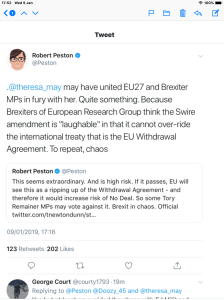
Robert Peston partly blames Swire for Brexit chaos!

“The global super-rich have taken advantage of the Brexit-induced decline in the value of sterling to buy up three times as many £10m-plus luxury homes as before the referendum vote.
Some 300 homes sold for more than £10m each in the tax year to April 2017 (the latest for which figures are available), an increase from 100 sold during the preceding 12-month period. The figures, released by HM Revenue and Customs on Wednesday following a freedom of information request, were rounded to the nearest 10 by HMRC. …”
“A powerful cross-party group of MPs today warns Theresa May that Brexit is “sucking the life” out of her government – as cabinet sources admit that the crisis is forcing vital domestic business off the government’s timetable.
With the deadlock over May’s Brexit deal unresolved, and a key vote in parliament postponed until mid-January, the chairpersons of six all-party select committees have signed a statement saying long-drawn-out arguments over Brexit are having a “serious detrimental effect” on wider domestic policy.
The MPs, who include the Tory chairs of the treasury and education select committees, Nicky Morgan and Robert Halfon, add that: “Rather than continuing to drag out the Brexit process for months more, we must bring it to a close if we are to prevent serious damage to our country”.
AdvertisementHide
Others who signed off on the statement are the chair of the work and pensions select committee, Frank Field; the Tory chair of the digital culture media and sport committee, Damian Collins; the Labour chair of the environmental audit select committee, Mary Creagh; and Norman Lamb, the Liberal Democrat chair of the science and technology committee.
While the six have very different views on Brexit they agree that the government is letting people down with its near-total preoccupation with the issue at a time of crisis in the NHS and social care, rising knife crime, failing public transport, chronic homelessness and environmental challenges. Labour members including Creagh say government austerity has made neglect of poorer communities by government even more shocking.
Their intervention follows news on Friday that chaos over Brexit has forced NHS leaders to postpone a new long-term plan for the NHS and put back, yet again, a long-awaited green paper on the future of social care until January. Both decisions dismayed MPs and organisations across the health and social care sectors.
Asked why the social care green paper had been delayed, a government source told the Observer the crisis over Brexit had “wiped the grid clean and meant we have had to push stuff back. So social care won’t be until January.”
Underlining the sense of national crisis, Church of England bishops said yesterday that they would pray this weekend for national unity and “courage, integrity and clarity for our politicians” after a week of turmoil.
Nadra Ahmed, chair of the National Care Association, which represents small and medium-sized care providers, said: “If the matter wasn’t serious it could be farcical. Clearly, the government recognised in 2017 that there was an ‘urgent’ need to review the funding of long-term care to ensure we can predict a sustainable service which will meet the needs of some of the most vulnerable members of our society. We have become used to the fact that creating solutions in the growing crisis in social care is not really that urgent after all.”
Field told the Observer he had been urging May for months to allow legislation to be brought forward by select committees or through private members bills if the government could not find the time itself. But he had had no response to his idea.
Other areas of policy that MPs say have been subject to Brexit-related delays include the fair funding review, intended to reform and improve how local government financing is organised, and a government strategy on internet safety. Labour says the results of government consultations on housing issues such as longer tenancies and consumer rights – which concluded months ago – have not materialised. The domestic abuse bill, championed personally by May, also has yet to be introduced. The Missing Persons Guardianship Act, which was meant to allow the families of people who have gone missing to take control of their affairs, has not yet come into force even though it became law over a year ago.
In their statement the six select committee chairs say: “Long-drawn-out arguments over Brexit and delays in reaching an agreement on our future relationship with the EU are having a serious detrimental effect on the conduct of wider domestic policy. MPs of all parties and ministers should be addressing the most urgent challenges facing our country: safeguarding our NHS, improving social care for the elderly; stepping up the fight against crime and knife crime; sorting out our benefits system; improving our public transport and safeguarding the environment for future generations. The Prime Minister should return to addressing burning social injustices which she insisted, on entering Downing Street, would be her main priority. Instead, Brexit is sucking the life out of government at a time when our towns, cities and citizens face serious spending restraints. Rather than continuing to drag out the Brexit process for months more, we must bring it to a close if we are to prevent serious damage to our country.”
Charities, too, expressed exasperation at the government’s failure to address domestic issues, pointing to the housing crisis and chaotic rollout of universal credit. Campbell Robb, chief executive of the Joseph Rowntree Foundation, says that low-income families that backed Leave in 2016 have since been hit by price rises, spiralling housing costs and tax credit reductions. He called on the government to “get a grip and deliver for people on low incomes”. “Failing to meet their expectations of a better life after Brexit would be costly for the political parties. We need a bold package of domestic reforms, not just favourable trade terms.”
Greg Beales, who campaign director at the housing charity Shelter, said vital reforms were still needed to tackle the housing crisis and bolster renters’ rights. “But too much is currently stuck in the mire while Brexit crowds out everything else.”
Yet another policy area that has been neglected is transport, as the government has struggled to address months of timetabling chaos and pushed back the electrification of railways in the north. Darren Shirley, who heads the Campaign for Better Transport, said that there was “a bandwidth problem across government” with key domestic issues “dropping down the agenda” because of Brexit.”
“Local authorities face a number of uncertainties due to Brexit but are focussed on building resilience in their areas to prepare.
Addressing the recent conference ‘Local Authorities – Implications for Local Authorities and their Areas,’ Jackie Maguire, Chair of the County and City Management Association (CCMA) said Brexit has been to the forefront of local authority considerations since the UK vote to leave the EU.
‘Preparing for the unknown is a huge challenge. In the local authority sector, our approach has been to consider all our plans and actions through the lens of Brexit, while maintaining close contact with Government and relevant departments throughout the negotiation period,’ she said.
The conference heard that as well as the potential impact on local business and economic development, there are a number of practical implications for local authorities, particularly in border regions.
Citing the current arrangement, where the Northern Irish Fire Service provides first response to call outs in parts of Donegal and giving the further example of an ongoing cross-border greenway project, she said:
‘While both the Republic and Northern Ireland have been members of the EU, we have been able to work collaboratively on shared infrastructure development and shared service provision. We now face into an unknown situation as to whether that can continue.’
The CCMA Chair also highlighted the impact Brexit may have on environmental standards, ‘Currently we apply relatively consistent environmental policies north and south; this is the best way to achieve results. The Water Framework Directive, for example, is implemented in both jurisdictions to manage river basins and improve water quality but rivers don’t stop at borders.’
‘Local authorities will do what we can to proactively mitigate against the worst impacts of Brexit and capitalise on any opportunities.’
‘This will involve not only our economic development and tourism teams but teams across our organisations – in planning, roads, housing, infrastructure and other areas. We will ensure efficient, responsive services and ambitious plans that will encourage enterprise, entice visitors and allow our areas to thrive.'”
Owl says: you can see why penalising local authorities for not getting enough new houses built just doesn’t work.
“… Simon Rubinsohn, Rics’ chief economist, said: “It is evident … that the ongoing uncertainties surrounding how the Brexit process plays out is taking its toll on the housing market. I can’t recall a previous survey when a single issue has been highlighted by quite so many contributors.
“Caution is visible among both buyers and vendors and where deals are being done they are taking longer to get over the line. The forward-looking indicators reflect the suspicion that the political machinations are unlikely to be resolved anytime soon.”
He said a weakening property market could prompt a slowdown in housebuilding: “The bigger risk is that this now spills over into development plans, making it even harder to secure the uplift in the building pipeline to address the housing crisis.” …”
He SO needs that Foreign Office job to take him off the back bench!
“… A spokesman for Sir Hugo said he would not be making any comment until after tonight’s secret ballot.”
https://www.exmouthjournal.co.uk/news/hugo-swire-leadership-vote-theresa-may-1-5815966
Swire and May… Swire and Rudd … Swire and … just about anyone who might get him out of the hell of being a backbench MP!
“… What the government wants
A crucial insight into Downing Street’s thinking lies in an amendment put forward to the “meaningful vote” by the Tory MP Sir Hugo Swire. The government’s fingerprints were all over it.
Beyond parliament directing the government on whether to seek an extension of the transition period to avoid the backstop, Swire more significantly proposed to place “a duty” on the government to agree a future relationship, or alternative arrangements, within one year of the Northern Ireland backstop coming into force.
It was essentially an attempt to give parliament a putative date by which the government would make all “best endeavours” to get out of the backstop, or have a very good reason for failing to do so.
The withdrawal agreement already says that the EU will make those “best endeavours” to have a free trade deal in place by 2020 – the end of the 21-month transition period. The government may well seek for the reiteration of that commitment, plus an additional statement of the EU’s intention to get out of the backstop by 2021. …”
Daily Express article today – heck that fence must be pretty uncomfortable!
“Under the terms of the deal Mrs May agreed with the EU that the UK will automatically fall into a ‘backstop’ EU customs union should the Government fail to agree a new trading relationship with Brussels during the transition period. The transition period is currently set at 21 months, though Mrs May has hinted it could be extended. Should the UK enter a customs union with Brussels it would struggle to sign comprehensive trade deals with third parties, and will still have to obey a significant proportion of EU legislation.
Tory loyalists Sir Hugo Swire and Richard Graham have tabled the amendment, which would give MPs a vote on whether the UK joins the customs union backstop or extends the transition period if a new trading relationship with the EU can’t be agreed.
It also requires the Government to push for “further assurances from the EU that the backstop would only be a temporary arrangement”.
Should the UK enter a customs union the amendment requires the Government to make plans to exit within a year.
Nikki da Costa, formerly the Prime Minister’s director of legislative affairs, suggested Ministers could be behind the move.
He told the Daily Mail: “I know a Government amendment when I see one”.
Multiple sightings of our esteemed MP lurking in the background – almost seeming to try to duck out of shot – of early TV news items featuring Amber Rudd spouting today’s riff on Brexit.
Swire has already been described as “a state sanctioned dissident” and Rudd is known to be quite prepared to do May’s dirty work:
https://eastdevonwatch.org/2018/12/07/swire-state-sanctioned-dissident/
So, are they dirty working today WITH May or AGAINST her?
Be careful Mrs May – keeping your friends close but your enemies even closer has its failings. And Owl thinks he has never forgiven you for ousting him from his “job” at the Foreign Office, cosying up to the sheiks of the Saudi Arabian peninsula and his favourite islands, The Maldives. Which he still does but in the very much less prestigious ‘job” of Chairman of the Conservative Middle East Council.
Owl loves the description of Swire!
“The plain fact is that the Brexiteers and the DUP are unbiddable, unshakeable and unpersuadeable. The usual tricks of last minute concessions just aren’t working. Last night was a case in point, as the new amendment to give Stormont and MPs a say over the customs ‘backstop’ was tabled by state-sanctioned dissidents Hugo Swire, Richard Graham and Bob Neill. …”
Source: WUgh Zone, Huffington Post
“Lord Michael Heseltine has warned MPs against voting to “make this country poorer” in the looming House of Commons vote on Theresa May’s Brexit deal.
In a rousing speech on Wednesday afternoon, the Tory former deputy prime minister told the House of Lords that if it votes for slower economic growth, lower tax revenues and lower public spending “those who will suffer most are those least able to bear the strain”.
“I tell you there are no solutions that help the fortunes of the least privileged in the most stressful circumstances,” said the famously pro-Europe politician.
“When the election comes, it will have been a Tory that led the referendum campaign,” Heseltine continued.
“It will have been a Tory government that perpetuated the frozen living standards.
“It will be a Tory government that is blamed for what we are talking about today.”
“I will have no part of it,” he added. …”
“An advice notice sent to all UK local authorities says they should set up a team to make risk assessments of how different outcomes for Brexit might affect food availability and supplies in their areas.”
https://www.bbc.co.uk/news/live/uk-england-devon-46370313
We know that EDDC has done nothing:
https://eastdevonwatch.org/2018/09/06/eddc-has-done-no-brexit-planning/
So let’s hope DCC is on the ball …. hhhmmm, get back to you on that!
And just what are councils supposed to do with no money and no resources?
“Up to 3m patients are expected to lose their GP surgery within a year because of a shortage of doctors.
More than 350 practices face closure in England alone over the next 12 months, according to a survey of doctors for the Royal College of General Practitioners.
Doctors’ leaders, patients’ groups and MPs expressed alarm and warned that general practice was at “serious risk” of collapse.
Rising numbers of GPs are retiring early, becoming locums in the private sector, changing career or moving abroad.
As well as pressure to work longer hours and see more patients, the closures are being driven by GPs deciding to stop work when their pension pots exceed £1m and attract heavy taxes. They are not being replaced by trainees despite intense regional NHS recruitment drives and £20,000 golden hellos. GPs earn £92,500 on average.
In an interview with The Sunday Times, Britain’s most senior GP said surgeries were “haemorrhaging doctors”. Professor Helen Stokes-Lampard, college chairwoman, said she was “gravely concerned” by the findings.”
Source: The Times (pay wall)
“… An analysis released this week by the property firm Savills spelled out just one of the reasons why [a downturn in property prices could be a bad thing].
A property downturn could, it estimated, reduce the number of affordable homes being built by a quarter. When prices fall, developers’ profits shrink and they retreat from the market. And when developers stop building, promises to stop future buyers being locked out of the market by building 300,000 new homes a year aren’t worth the manifestos they were written on.
What was striking about the former cabinet minister Oliver Letwin’s recent report on land banking – the much-hyped practice of developers buying up land and sitting on it while it rises in value – was that he found precious little evidence of it happening. What he did find was developers building on their sites painfully slowly, over the course of several years, because they won’t do anything that causes neighbourhood property prices to fall. A glut of for-sale boards going up all at once means buyers can take their pick and haggle hard over prices. This may be exactly what first-time buyers need but it’s what developers are primed to avoid.
The problem with relying on the market to provide is that the market works to ration the one thing voters hope mass housebuilding programmes will deliver. And that’s in good times; imagine what happens when everyone is scrabbling frantically to protect their investment in a downturn. …”
Parish unhappy with Brexit deal and will vote it, and May, down according to Sunday Telegraph today:
https://www.neilparish.co.uk/news/my-position-brexit-withdrawal-agreement
Swire firmly on his usual fence – no update since this post on his website:
https://www.hugoswire.org.uk/news/my-position-proposed-brexit-withdrawal-agreement
presumably waiting to see which of his Eton pals is going to offer him a nice job. Though perhaps not the Middle East (his usual choice).
Ambassador to the Maldives, perhaps?
“Britain’s housing crisis is not set to improve in the near future as official figures today revealed developers have slashed the rate at which they are building new houses ahead of Brexit.
Government figures revealed a bit more than 222,000 new homes were delivered in 2017/18, up just 2 per cent on the previous year and well below the government’s promised target of 300,000.
The rate of growth for residential construction meanwhile has halved, from 11.9 per cent in 2016/17 to 6.4 per cent in 2017/18.
… ‘Housebuilders and would be-buyers alike are nervous about what the fall-out from Brexit could be and that’s hit the number of net additional dwellings hard.’
Grainne Gilmore, head of UK residential research at Knight Frank, said warned that other data was already pointing to a further slowdown in housing completions to come.
‘Net additions are still around 26 per cent lower than the government’s 300,000 annual target while separate housing starts data, which captures information on new homes being started on site, shows a moderation in activity that could weigh on housing completions in 2020/21,’ she said.
Meanwhile a trading statement from Bovis Homes released this morning blamed ‘uncertainty surrounding Brexit’ for a fall in buyer interest.
It said: ‘Our sales rate per outlet per week for the year to date is 0.51, with pricing in line with our expectations. Whilst we have maintained our rate of sale, the uncertainty surrounding Brexit has impacted discretionary buyers.’
Taylor Wimpey has also said it expects flat sales growth next year due to Brexit uncertainty, but claimed there is potential for ‘significant growth’ after 2020.
It comes amid a slew of data pointing to a gloomy outlook for Britain’s housing market.
Earlier this week UK Finance, the trade body representing British banks, confirmed that mortgage lending in September was down on a year ago as people sit on their hands to see what happens with Brexit.
First-time buyer numbers have dropped 4.5 per cent since September 2017, households moving home fell 8.4 per cent over the same period and landlords purchasing properties slumped 18.8 per cent.
… Gilmore said today’s construction figures presented ‘a headache for policymakers’ in London particularly, with the net number of new dwellings in the capital falling by 20 per cent over the year.
‘Only 12 of the 33 boroughs in the capital reported a rise in the number of new homes provided in the year to March,’ she said. “
Guardian letters:
“Regarding Patrick Cosgrove’s letter (I don’t want to go blind due to Brexit, 29 October), I would like to make a similar case about type 1 diabetes.
Like Theresa May, I have type 1 diabetes and am insulin-dependent. I emailed Matt Hancock as I am concerned about how supplies of insulin will be ensured once we leave the EU. Diabetes patients may be interested in the response I received from the Department of Health and Social Care (and in knowing that Keith Vaz has emailed to say he will be taking my concerns further). The reply said the contingency plans include “precautionary stockpiling by suppliers, to ensure that the supply of insulin to patients is not disrupted”. This is worrying as insulin needs to be refrigerated and my understanding is that very little insulin is produced in this country. Perhaps Mrs May could give us some answers?
Lisa Parker
Nailsworth, Gloucestershire
• Patrick Cosgrove is not alone in trying, and failing, to find out about the availability of drugs on which he is dependent in the event of a no-deal Brexit. I am in a similar position. Over three months ago, I wrote to my MP (Julian Sturdy) and asked for “an informed comment on certainty of supply of pharmaceuticals in the event of a hard or ‘no deal’ Brexit”. Over six weeks later he replied, asking for details, which I supplied. Another six weeks have passed, 29 March looms, and I still have no information. I am coming to the frightening conclusion that no one actually has a clue about what will happen.
Steven Burkeman
York
• Patrick Cosgrove raises the pressing issue of medication availability post-Brexit. My own four daily doses are made variously in Austria, Germany, Spain and Slovenia. Without them I’m in trouble. But what about my son and all the other transplant patients who must have their anti-rejection meds? And those with diabetes? I await my MP’s advice, not very hopefully.
Any hope out there, anyone?
David Moore
Somerton, Somerset
• Like Patrick Cosgrove, I have hereditary glaucoma and have been prescribed Ganfort for many years. Three months ago my prescription was changed to preservative-free Ganfort. It is currently proving very difficult to obtain this due to the complexities of the pharmaceutical industry. Thanks to a diligent pharmacist, I’ve not been let down yet; my medicine has arrived monthly, but since the change in prescription it has been very delayed. I now need to order it earlier to ensure I am not left without. Last month it came via a Spanish source.
I don’t want to go blind for this “cause” either. To the government: open your eyes and see (unless you have glaucoma).
Gill Sellen
Corfe Castle, Dorset”
https://www.theguardian.com/politics/2018/nov/04/no-deal-fears-over-drug-supplies
A reduction from £100 per bet to £2 per bet, agreed by the government, has been postponed and the Minister for Sport has resigned saying vested interests were allowed to influence the decision. The current high rate is reckoned to lead to many suicides. It is thought the decision has been postponed to raise revenue for the government to assist with post-Brexit issues.
Sixteen MPs have declared hospitality received from the betting industry. Nine were Labour MPs, six Conservative and one SNP:
“Councils are being warned to prepare for three months of disruption in a no deal Brexit , a leaked briefing has revealed.
Town hall chiefs have been told to plan for “reasonable worst case scenarios” including runs on food, petrol and the banks.
They should prepare to report to central government every eight hours – and could have to cancel leave over Easter, it says.
The shock briefing, circulated to council chiefs and leaked to the Municipal Journal, is made up of minutes from a recent Local Resilience Forum meeting.
Dozens of LRFs, which bring together councils, emergency services and the NHS, are aiding Whitehall’s No Deal plan Operation Yellowhammer – which is led by the same officials who would deal with a flu pandemic.
The minutes say councils should prepare for “reasonable, worst case scenarios” but “without setting panic”.
Public bodies should base their plans on “a 12 week disruption period” lasting until the end of May 2019, they add.
And some supplies of medicine may be increased by six weeks on top of the existing four to six weeks’ stock, the minutes suggest.
Local ‘Tactical Co-ordinating Groups’ would have to update Whitehall at “8 hourly intervals” and “a decision on leave arrangements may be needed” over Easter, the minutes add.
The UK is leaving the EU on 29 March 2019 and Easter is on 21 April.
A local government source said: “Councils are doing what they can with the limited information they are being given. We’re feeling really nervous and really impatient.”
Shadow Local Government Secretary Andrew Gwynne claimed the instructions were “too little too late”.
He added: “It’s frankly shocking that the local government sector has been starved of resilience support that they now so desperately need.”
A spokesman for the Local Government Association, which represents councils, added: “We are working with Government and engaging with the expertise of local government to ensure we get these crucial negotiations right for local communities.”
A government spokeswoman said: “We remain confident that we will secure an agreement with the EU that works for the whole of the UK.
“Rightly, we are working with Local Resilience Forums across the country to ensure they are fully prepared.
“While it is the duty of responsible planners to consider the worst case scenarios, this is not a prediction of what is going to happen.”
https://www.mirror.co.uk/news/politics/councils-warned-no-deal-brexit-13513238
 East Devon Watch