“Tory-run Northamptonshire county council bailed out by government”

Owl says: just as well it is a Tory council that’s allowed to break the rules!

“Permission granted to spend £60m cash received from sale of HQ.

The government has in effect bailed out Tory-run Northamptonshire county council after giving it unprecedented permission to spend up to £60m of cash received from the sale of its HQ on funding day-to-day services.

The highly unusual move – accounting rules normally prevent councils using capital receipts in this way – means the crisis-hit authority is likely to escape falling into insolvency for the third time in less than a year.

Ministers gave the go-ahead for the bailout after commissioners sent in to run the council issued a stark warning that without a cash injection, Northamptonshire would be unable to meet its legal duties to run core services such as social care.

Opposition councillors called it a political move to save ministers from having to directly bail out the council. Labour group leader Mick Scrimshaw said: “It is clearly politics. The Conservative government did not want the political embarrassment and for that reason they have been allowed to use these capital receipts.”

Northamptonshire declared itself effectively bankrupt in February after it realised it could not balance its books. It declared insolvency again in July after a review revealed it had understated the extent of its financial problems. It must make good a £70m deficit by the end of March to avoid insolvency for a third time.

Although the council has already set in train a draconian cuts programme for the current financial year to try and overturn the £70m budget shortfall, the commissioners said this alone would not be enough to prevent insolvency.

In a report to the communities secretary, James Brokenshire, the commissioners Brian Roberts and Tony McArdle said the “extraordinary” scale of cuts to services needed in one year to fill the funding gap would breach councils’ legal obligations.

The report said: “Considered against the concomitant need to maintain the integrity of critical public service delivery, it is a challenge that is beyond being met in a single year. We are compelled to the view that the finding of an alternative mechanism for addressing this legacy will be unavoidable.”

The report notes that the council has been dysfunctional and that morale is poor among “long suffering” staff. It also criticises its “lack of credible leadership and direction over many years”, though it notes there have been some improvements in culture and management over the past few months.

The council’s leader, Matt Golby, said: “I am delighted the commissioners have been successful in their request for a capital dispensation. This will enable us to use our own resources to tackle the £35m deficit from 2017-18 and replenish our reserves to put us on a sustainable financial position.” The council is hoping to save a further a £35m this year from its cuts programme.

Rob Whiteman, the chief executive of the Chartered Institute of Public Finance and Accountancy, said the move was effectively a bail out for Northamptonshire. Although it went against accepted accountancy rules and practice, it could be justified on the grounds that the council was being abolished.

Northamptonshire is to be replaced by two unitary authorities under plans approved by ministers earlier this year after the inspectors’ report concluded that the council’s management and financial problems were so deep-rooted it could not be easily turned around.

Enabling the council to convert some of the £60m it received from the fire sale of its new state-of-the-art HQ earlier this year – just months after it moved in – will allow it to clear an underlying £35m revenue deficit, and removes the need for ministers to pump money into the council directly.

Ironically, a highly critical inspectors’ report in March was scathing of the council’s preparedness to compromise generally accepted accounting principles to present the councils’ finances in a better light. Earlier this month a task force was sent into oversee its failing child protection services.

Brokenshire said: “Clearly, the situation in Northamptonshire is very serious. I am grateful to the commissioners for uncovering the council’s true financial position and the robust steps they have taken to improve its financial management and governance.”

https://www.theguardian.com/society/2018/nov/29/tory-run-northamptonshire-county-council-bailed-out-by-government

“‘Councils and crooks must feel relaxed’: why the loss of local papers matters” [and why blogs have to fill the gap]

Owl says: the article DOESN’T mention those local newspapers (they know who they are) which simply print council press releases, only supportive articles and “good news only” items from councils that keep them afloat by giving them a monopoly on printing their official notices and job vacancy adverts….. becoming quasi-council newsletters.

“This month, with the announcement that Johnston Press, the third-biggest group in the local news industry, had gone into administration, this building in Hendon, along with hundreds of other empty newspaper offices across the country, became a monument to the fragile and shrinking world of regional reporting. More than 300 titles and 6,000 journalists have been lost in a decade, creating what many see as a democratic deficit, never mind a future dearth of trained reporters.

The Times, part of the Newsquest group, still exists, but these days there is just one edition and much of the action happens online. Its webpage invites readers to send in their own news and photos, and the phone number for the news team is harder to find than the GRU’s in Moscow. When I do get through to a reporter, he is silent when I ask where he is. “Do you still have a base you can use in the borough of Barnet?” I persist, at which point he tells me to email his editor.

Newsquest, like Johnston Press, is at the centre of big changes in local journalism, not all of them bad, and it is more than anyone’s job is worth to speak off the cuff to the press. But as Barry Brennan, former group editor of the Hendon Times and my old boss, confirms, all coverage of the boroughs of Barnet and Hertsmere is now run from Watford.

“Councillors and crooks must surely feel relaxed,” Brennan says, “now that so few weeklies have sufficient space or journalists to cover councils and courts. It may sound trite, but we really are missing out on big chunks of knowledge, and that’s bad for a community.”

More cheeringly, Times reporters do still get to some Barnet Council meetings, although not many, according to Labour councillor Claire Farrier: “We don’t see them much any more; maybe when there is a big planning story. They do their best, but they often repeat the press releases we put out fairly closely – which we quite like, of course.” …

Perhaps when the Cairncross report comes out next year it will propose something radical: something akin to a series of tax incentives launched in Canada last week. Over a decade, more than 250 Canadian news outlets have closed and since 2012 newspaper revenues are down by up to 40%. Now the federal government has stepped in, offering C$600m (£350m) in new tax credits to the media industry for the next five years.

Whatever Cairncross recommends, her committee must bear in mind that it will always be hard to show exactly how local reporting aids democracy. Because you can never find out exactly what people have got away with when no one was looking.”

https://www.theguardian.com/media/2018/nov/25/why-local-papers-loss-matters-councils-crooks-feel-relaxed

EDDC gagging orders: council in a hole and digging deeper!

Owl says: does anyone think this press release makes things BETTER for the council! They do them so the other party won’t take them to tribunals!

“Following an article published by an East Devon media outlet this week about settlement agreements between the district council and its employees, the council wants to bring a greater degree of clarity to the headline-grabbing story.

“The article ignores the actual reasons why the council has used settlement agreements from time to time and that these are common practice in both the public and private sector where employers wish to bring employment to an end.

“The council has used settlement agreements to terminate the contracts of 10 individuals since 2014 for a mixture of contractual, performance and sickness issues.

“The reason that any employer enters into these agreements is particularly in circumstances where it wishes to bring employment to an end quickly and pragmatically to avoid unnecessary costs and to protect itself from tribunal costs. The figures quoted include statutory and contractual payments such as holiday and notice periods.

“Such agreements are commonly used throughout the UK and the primary reason is that the individual is required to agree not to take their employer to court. The agreements also contain a confidentiality clause.

“To validly settle statutory employment claims, a settlement agreement must satisfy several conditions that must be met including that the individual must have received legal advice from a relevant independent adviser on the terms and effect of the proposed agreement; and its effect on their ability to pursue any rights before an employment tribunal. Only certain statutory claims can be settled by a settlement agreement such as unfair dismissal or discrimination.”

http://www.exmouthjournal.co.uk/news/council-explains-205-000-gagging-orders-205-000-1-5790143

“Universal credit: Urgent report calls on ministers to push back any votes over ‘major areas of concern’ “

“Major areas of concern remain with , a group of MPs warn today in an urgent report calling on ministers to push back any vote on the flagship welfare reform.

The Commons Work and Pensions Committee claims that getting “managed migration” – the process of transferring claimants from existing benefits to universal credit – wrong when it starts in mid-2019 could “plunge claimants into poverty and even leave them destitute”.

Despite money being allocated for universal credit at the Budget, the committee warns that “major areas of concern” about the welfare reform remain.

It adds that MPs in the Commons have not had a chance to scrutinise and report on the revised regulations brought forward by the government in November, and claims the indicative timetable suggests “there will be no opportunity for expert scrutiny”.

While a specific date has not yet been allocated for the vote by the government, the committee recommends that no vote take place until the Social Security Advisory Committee (SSAC) has been able to report on the regulations.

The report states: “These regulations have a profound effect on the lives of millions of people, including some of the most vulnerable in society. It is impossible to overstate the importance of getting them right.” …

https://www.independent.co.uk/news/uk/politics/universal-credit-vote-report-warns-major-areas-concern-government-ministers-a8645526.html

“Huge amount of taxpayers’ money’ used for gagging orders at East Devon council”

Owl says: 10 people with some very interesting stories we will never know ….. and which will never be scrutinised.

“Figures obtained using a Freedom of Information request show that East Devon District Council has spent more than £200,000 on gagging orders over the past four years.

A total of £205,074 has been spent by East Devon District Council on gagging orders for former members of staff since 2014, according to figures obtained by the Journal.

The information, obtained through a Freedom of Information request, reveals 10 settlement agreements, or gagging orders, were agreed by EDDC between 2014 and October 31, 2018.

Gagging orders are often referred to as confidentiality clauses and are usually agreed when an employee leaves an employer due to redundancy, a work place problem or a disagreement.

A number of opposition councillors have said they are shocked by the amount of money spent on gagging orders.

Independent group leader at EDDC, Ben Ingham, said: “When any one of us is thinking about how we can afford to pay our latest council tax bill, I do not believe we expect one penny to be spent on gagging orders.

“If we did, non payment may become a real expectancy. As Leader of EDDC Opposition, I can tell you at no time has the current leadership contacted me to discuss this issue at all.

“This is not acceptable, but to me not surprising. Merely another piece of evidence against an exhausted regime.”

A spokeswoman for EDDC said: “Settlement agreements are legally binding contracts that waive an individual’s rights to make a claim covered by the agreement to an employment tribunal or court.

“The agreement must be in writing. They usually include some form of payment to the employee and may often include a reference. They are voluntary and have therefore been entered into on that basis by the individuals.

“Part of the agreement is that they must seek independent advice from an employment lawyer.”

Exmouth district councillor Megan Armstrong said: “I am extremely concerned at the huge amount of taxpayers’ money, which should have been used to provide services for the people of East Devon, which has been spent on gagging orders.

“The council has a duty to be open and transparent; yet over £200,000 – a vast sum – has been spent on suppressing information. Exactly what is the Conservative administration trying to hide?”

http://www.exmouthjournal.co.uk/news/gagging-orders-at-east-devon-district-council-1-5785868

What has happened to our politics and politicians (of all three main parties)?

Letter in Independent”:

“Can any UK government get it right? Politicians appear unable to achieve good outcomes on the things that really matter. Only the most self-compromising and self-serving appear to get to the more senior positions and stay there – Gove, Hunt, Johnson, Grayling, Williamson et al. Most are able to add plain vicious or nasty to their approach.

Labour appears unable to pull a robust, costed, action plan together and are more tainted than most with the brush of incompetent fiscal policy and business/financial management. The Lib Dems are just irrelevant most of the time as their “good” policies are undeliverable.

Most government ministers engage in cynical fiscal and financial sleight of hand while smiling wolfishly and proclaiming, yet again, that we have, or will never have had it so good. (The latter may be true, but we need to feel good for it to ring true.)

We keep being promised good politics and yet it never seems even close. Even MPs are abandoning PMQs. The disgraceful budget fix on betting machines, promises of looking after hard-working people, of proper funding for everything from the NHS to schools and social care; building houses, roads, and railways; and dealing with drugs, street crime, hate crime, and illegal immigrants, all suffer from saying one thing and doing another to avoid or reduce the perceived benefit – or, simply, the truth.

Conning the public appears to be seen as acceptable practice. Under-promising and over-delivering appears to have been deemed a mugs game. Decades of this attitude and action has seen the public and public institutions respond in kind – becoming cynical, self-serving, immoral and quasi-criminal, if not actually so. Politics, while supposedly championing fair treatment, has become covertly immoral and promotes hatred instead of tolerance, extremism instead of compromise.

The politics of a UK-style Brexit, when compared to the calm, clear and firm EU approach, is symptomatic – we are combative and threatening when intelligent, cool, calm and pragmatic heads are needed.

I am a Remainer, but could be persuaded by sensible and reasoned argument to Leave (much as I would prefer the EU to change a bit) except for the bile spouted by the “just (expletive deleted) do it” Brexiteers. It’s the ignorance and seemingly blind self-serving stupidity of UK politics that exasperates me.

Our car industry and other industrial productivity is in decline (not wholly due to external strategic decisions in the case of Jaguar Land Rover) and the financial and services sector is going to be damaged by any deal, no matter how “good”.

We refuse to act with moral strength over any matter, citing financial necessity. Instead of acting to remove the stranglehold, we shrug and let it continue while that further degrades our standing. Nowhere can be far enough away to let these things slide in this modern world – you are either decent, or not.

We are told, authoritatively, that we have 12 years to act before millions suffer dreadfully from climate change, with hardly a comment from our leadership and the departments concerned. Same old kick-it-down-the-road, let-someone-else-deal-with-it “leadership”.

We are told that domestic energy prices will be capped, when poorer users just need some help to swap and the companies concerned are making reasonable margins, while the fossil fuel industry is allowed to fleece us and make record profits as the government freezes fuel tax again – enabling further profit to made, just as lifting stamp duty thresholds made no difference to house costs for buyers.

Fiscal policy should be promoting less profit in bad things and making good things worth doing. Throwing money at public institutions is not the answer I seek. Every part of society should be fairly treated against sensible outcomes, and efficiency and improvement rewarded. Taxes must rise, but as little as possible. Gold-plated public service packages and pensions have to go, along with private sector executive super-deals. Free market economics are good, but with sensible limits to provide a balanced reward system for everyone in profitable companies, and a decent safety net for those that need it.

Companies where principals take most of the cake without sharing can simply be taxed to avoid eight figure payouts. No one needs more than £10m over the life of a contract or period of employment without sharing.

On a positive note, politicians such as Tracey Crouch who treat their brief seriously and honourably are to be applauded. If more politicians and civil servants acted honourably we wouldn’t run out of good politicians and managers, we would develop better practices. You reap what you sow.

As the centenary of the First World War is played out it seems not much has changed in practice – the British people are being led by some of the most donkey-like and immoral leaders imaginable, while our “lions” are sacrificed for principles that are being overtaken by wiser countries, and we fail to deliver on our talk of global leadership.

Time for a change.

Michael Mann Shrewsbury”

“CIPFA moots steps to quell commercial property ‘craze’ “

The majority party at our council is also mooting – a move into the commercial property market.

“Forthcoming CIPFA guidance on councils borrowing to invest in commercial property could clarify the definitions of “borrowing in advance of need” and “proportionality”, according to the man drawing it up.

Last month, CIPFA announced it would produce more guidance to address the failure of the government’s revised investment code to curb some instances of councils borrowing to invest in commercial property.

Speaking at the CIPFA Treasury Management and Capital Conference in London this week, Don Peebles, the institute’s head of UK policy & technical, gave more clues as to what the guidance could contain.

Speaking to delegates, he said: “It may well be that we actually specify and think about what exactly is ‘borrowing in advance of need’.

Proportionality parameters

“We may set parameters of what proportionality looks like. We may give guidance on what the appropriate ratios are for commercial income associated with net service expenditure.”

When the guidance was announced last month, Peebles told Room151 that it would be likely to formally incorporate text from the commentary which was released alongside the Ministry of Housing, Communities and Local Government’s (MHCLG’s) revised investment code, which was adopted earlier this year.

On proportionality, that commentary says that each council should set its own “limits that cannot be exceeded for gross debt compared to net service expenditure, and for commercial income as a percentage of net service expenditure”.

However, Peebles’ comments were a hint that the guidance could go further by providing indications on what the appropriate ratios are.

Also speaking at the event, Duncan Whitfield, director of finance and corporate services at London Borough of Southwark, said that any definition of proportionality must take into account the needs of local authorities to properly finance services.

He said: “I am looking at my budget now and seeing how much of it is ring-fenced for social care.

“So are we talking about a proportion of our ring-fenced money in our revenue account or is it the total budget? In different parts of the country that varies wildly…”

Financial freedoms

And Richard Paver, treasurer of the Greater Manchester Combined Authority and chair of the CIPFA treasury and capital management panel, warned that the guidance should not reverse freedoms introduced under the prudential code introduced in 2004.

He said: “I can tell you it was a complete pain in the neck to run anything in the old days when you had annual limits on your capital spend, you could only spend a proportion of your capital receipts generated in any one year. You had to pool your capital receipts and pass them back. We need to remember where we are and protect that. The CIPFA guidance needs to give us the tools to do that.”

During a separate session of the conference, Peebles acknowledged the point, saying: “I am conscious that the guidance [should be] within the flexible framework we have all enjoyed and any steps to minimise that flexibility starts to take away from the 15 years of success of the prudential framework and operation of the prudential code.

“But in the current climate it seems additional guidance is certainly needed.”

Also speaking at the conference, Martin Easton, head of capital and treasury at Birmingham City Council, said that the term “borrowing in advance of need” was “unhelpful” and should be scrapped.

He said: “It originated years ago in the treasury management code in addressing treasury management investment activity which is about managing the cash flows of the authority. In that, there will be some times when the yield curve is such that you can borrow cheaply for a few years or in advance of your need for treasury purposes, and it was possible to reinvest it short term until it was needed for meeting the cash flow needs of the authority.”

He went on to say: “That expression doesn’t really work when you are investing in a community organisation, let’s say, to deliver social or service outcomes, or even when you are making an explicit decision to invest in commercial property.

Investment crazes

“I think you could drop the ‘in advance of need’ from that phrase – the key issue is: is it right or appropriate for your authority or ever for a local authority to borrow purely or mainly to make a financial gain? Is that really the role of local authorities?”

Easton also warned that the current increase in borrowing cheaply to invest in commercial property was another “craze” sweeping the sector, and compared it to investment in Icelandic banks, LOBOs and interest rate swaps.

He said: “What fundamentally might be a sound idea – like a limited proportion of your book could be in LOBOs because it manages risk in a different way and produces a good revenue result, or managing treasury risk through interest rate swaps – is good but doing it excessively is not.

“These things get overdone. They overtake the sector and then a wheel inevitably comes off at some local authority that has gone too far… And I fear that we are in the grip of another one of those crazes, which is called commercial property at the moment.”

Giving a private sector perspective, Howard Meaney, head of real estate UK at UBS Asset Management, said that the real estate market was “quite disparaging about some of the transactions [by local authorities] that have been undertaken recently.”

He said: “I think what the market is generally seeing is local authorities are almost, in some situations, a buyer of last resort.

“They are setting new market levels with some of the transactions and they are buying assets in what to a degree is a buy and hope – hope that tenant stays in your property and continues to pay your money and your rent so you can arbitrage that to increase your revenue and pay your coupon on your debt.”

Councils need to be prepared to invest in their commercial property assets in future in order to maintain rent levels, Meaney warned.

He asked: “Looking down the line, will local authorities have that money to invest into a property to continue to receive the revenue?”

http://www.room151.co.uk/treasury/cipfa-moots-steps-to-quell-commercial-property-craze/

Twiss gets his words into a twist – ANOTHER reason we need independent councillors!

This time from the blog of DCC EDA councillor Martin Shaw.

“Conservative County Councillor for Honiton, Phil Twiss told Devon County Council on 4th October that ‘Sonja Manton [Director of Strategy for the Devon Clinical Commissioning Groups] said at the Health and Adult Care Scrutiny Committee the other week that there no plans to close any community hospitals in our area. We were talking about Seaton, Honiton and Axminster at the time.’

I was surprised that he should give us this good news in passing, and that the CCG had made no announcement of something so obviously important. So eventually I watched the webcast of the Health Scrutiny meeting on September 20th. Although Sonja Manton spoke several times, I couldn’t find her saying anything like what Phil said – indeed anything about community hospitals at all.

So I emailed Sonja and she confirms she didn’t speak about the hospitals. As for the issue, all she would say was, ‘I can assure you that our continued focus remains on planning and commissioning services and support to meet the needs of the Devon population in the best possible way. We recognise how strongly communities feel about community hospital buildings and will continue to work with communities and stakeholders to modernise and evolve the way our services are delivered and where they are based to make sure we make best use of all our resources and public estate.‘

So was Sonja more forthcoming at another, presumably private, meeting, Phil? Or was what you said wishful thinking?”

@philtwiss’claim that @SonjaManton said ‘there are no plans to close any community hospitals in our area’, not backed up by @NEWDevonCCG. What’s the explanation, Phil?

Hospitals should not be used as “weapons”

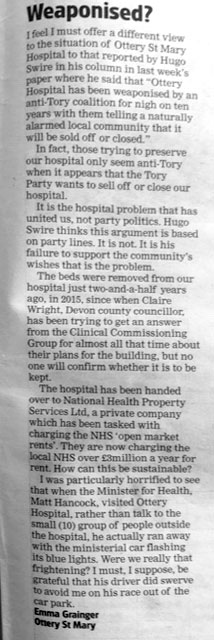
Here are some images of a few of the responses in the Sidmouth Herald to Hugo Swire after his claims that campaigners for Ottery St Mary Hospital are “anti-Tory” and have “weaponised” their campaign (click on images for better view):


(Another) self-serving own goal for our Local Enterprise Partnership?

Our LEP is padded with business people who have heavy direst, indirect and subtle links to the nuclear industries and housing development around Hinkley C, so the longer they can keep this white elephant limping along the better. Eggs … basket …. though if the eggs fall out of the basket WE will be clearing up the financial mess, of course.

“France has postponed a decision on whether to order more nuclear reactors in an indication that it may be losing faith in the technology it has sold to Britain.

François de Rugy, the ecology minister, rejected calls for the swift launch of the construction of new French-designed European pressurised reactors (EPRs).

He said no decision would be taken before 2021 and hinted that the authorities might rule out more EPRs altogether. “That is a question which remains open,” he said.

His comments were a blow for EDF, the mostly state-owned French electric group that is building two EPRs at Hinkley Point in Somerset at a cost of £19.5 billion.

Hinkley has faced continued criticism and calls have been made for the project to be halted because of its spiralling costs as well as fears over the technology.

EDF, which is struggling to build France’s first EPR at Flamanville, Normandy, hoped to have a second one up and running by 2030. That is now highly unlikely, given the reluctance of President Macron’s government to place an order. An internal French government document leaked to Agence France-Presse said ministers had told EDF to show that it could limit construction costs before a new order would be considered.

Doubts about the EPR programme have grown amid a series of setbacks at the five sites where they are under construction.

EDF says the one at Flamanville will not be operational before the end of next year.”

Source: The Times

Clinical Commissioning Group merger for Devon – good or bad?

Owl says: a bigger group fo DCC NOT to scrutinise – right….

“There are claims a planned merger between two NHS bodies in Devon will result in a less accountable system with no guarantee of improved healthcare for patients.

At present, there are two clinical commissioning groups – or CCGs – which plan and buy healthcare for local people. There’s one covering the North, West and the East of the county – NHS NEW Devon CCG – and the other covering Torbay and the South – NHS South Devon & Torbay CCG. Health bosses want them to merge into one big organisation, claiming this will save money and result in a stronger service. They say there’s already been benefits from the two organisations working more closely together.

But GPs in Torbay have voted against the move and local councillor in the Bay, Swithin Long, is also worried…”

https://www.bbc.co.uk/news/live/uk-england-devon-45865015

Swire accuses Ottery hospital campaigners of “weaponising” their cause

In an extraordinary rant – no cancel that, Swire seems to be ranting much of the time these days so it isn’t at all extraordinary! – Swire accuses those campaigning for the retention of beds (gone)and services (some) remaining of “weaponising” Ottery St Mary hospital. By implication, he appears to include his arch-enemy, Claire Wright in this “weaponisation” (aka peaceful campaigning).

In a recent Exmouth Journal article (which they will presumably allow campaigners to respond to as a right to reply) he says:

“Regrettably, Ottery Hospital has been weaponised by an anti-Tory coalition for nigh on ten years with them telling a naturally alarmed local community that it will be sold off or closed. I have spent 10 years trying to counter this scaremongering. … “

He then goes on to puff up his recent visit to Ottery – well what do tou call a hospital with no beds? – let’s say “closed community bed building” with the new Secretary of State for Health, when said Secretary refused to meet tireless campaigner Claire Wright and other local people who are keeping up the pressure on him and his mates – though rumour has it that Sarah Randall-Johnson was somewhere in his vicinity. You know, the woman who thinks her DCC committee has no need to scrutinise these changes.

SWIRE MAKES NO MENTION OF THE FACT THAT THE MINOR INJURIES UNIT AND ALL INPATIENT BEDS HAVE ALREADY BEEN CLOSED AT THE HOSPITAL DURING THIS SO-CALLED 10 YEARS!!!!!!!

He says we must look to the future not back at the past and see how our changing needs can be met.

Owl has a suggestion: with the ageing population in East Devon how about a Minor Injuries Unit and Community Hospital beds?

People with certain convictions to be barred from being councillors

“The government is to strengthen rules preventing people found guilty of serious crimes from serving on local councils, it has been announced.

Local Government Minister Rishi Sunak said the new rules would mean any person who is subject to an Anti-Social Behaviour Injunction, a Criminal Behaviour Order, a Sexual Risk Order or who is on the Sex Offenders’ Register, would no longer be able to stand for elected office in their community.

Current conditions make clear that anyone convicted of an offence carrying a prison sentence of more than three months is banned from serving as a local councillor.

The new measures will see the disqualification rules changed to include the alternatives to a prison sentence as a barrier to becoming a councillor.

They will require changes to primary legislation, in particular the Local Government Act 1972, the Local Democracy, Economic Development and Construction Act 2009, and the Greater London Authority Act 2009.

The government will “look to identify a suitable legislative opportunity to bring the changes into law”.

Once the rules are implemented, councils across England will have the power to prevent individuals from standing as a councillor or mayor at the point they trigger the revised disqualification criteria. These proposals will not apply retrospectively, the government said.

Sunak said: “Elected members play a crucial role in town halls across the country, and are the foundations of local democracy. They are community champions, and have a leading role to play in building a better society for everyone.

“With such an important role comes great responsibility, and these changes will protect residents while upholding the values and high standards of behaviour we all expect.”

The move follows a consultation. The government’s response can be found here.

https://www.gov.uk/government/consultations/disqualification-criteria-for-councillors-and-mayors

“Optum CEO resigns from top NHS Job, Optum partner replaces him”

“This is an everyday story of the sordid revolving door between US Health insurance company United Health and the NHS.

In the UK, United Health’s subsidiary Optum sells the NHS what it needs in order to morph into a version of United Health – the previous employer of NHS England’s boss Simon Stevens.

With NHS England’s blessing, Optum is all over the NHS, installing their technology & redesigning the NHS through its use.

Optum sells the NHS:

Commissioning support services
Scriptswitch decision support for GP prescribing (which United Health UK acquired in 2009) is in most GP surgeries.
Referral management services
GP Empower (accelerating large scale GP practices

Integrated Care Systems support: “Optum® brings practical hands-on experience having delivered integrated care for over 20 years in the US. Our tried and tested approach has helped systems deliver proven results.” This updates an earlier brochure on accountable care systems/organisations which is no longer available. However NHS For Sale quotes Optum’s now defunct webpage: “We currently operate 26 accountable care organisations in the U.S., and are supporting sustainability and transformation partnerships in the U.K. to manage population health risk and deliver care as an integrated group of providers.”

The overall aim is to control, sideline and override doctors’ treatment decisions – as we can see through NHS England’s consultation on stopping funding numerous elective care treatments and its mandatory Integrated Urgent Care Services specification. This removes patients’ direct access to clinicians and redirects them through NHS 111 to a clinical advisory service that works off the algorithms in a clinical decision support tool.

And now it has its finger firmly in the National Institute of Health and Care Excellence pie – the organisation responsible for providing evidence-based guidance and advice to the NHS.

The revolving door that connnects United Health, Optum and the National Institute of Health and Care Excellence

This concerns:

former United Health Director Andrew Witty
Lord Darzi (head of the Imperial College department which is partnered with OptumLabs, a United Health business); and
a new public-private partnership in the National Institute of Health and Care Excellence called the “Accelerated Access Collaborative“, that’s about pushing new technology and drugs through the NHS.
It puts Optum centre stage in the Accelerated Access Collaborative. Now there’s a surprise. Or not. If you have been following United Health’s relatively rapid takeover of the NHS.

As a result of these shenanigans, we would treat any new recommendation from NICE with a pinch of salt.

Here is a short Witty timeline:

March 2017 – Andrew Witty leaves CEO position at Glaxo Smith Kline
August 2017 – Witty joins UnitedHealth’s Board of Directors
November 2017 – Following the Accelerated Access Review, the Department of Health appoints Witty as head of the Accelerated Access Collaborative. The job is to fast track drugs & technology into the NHS, to start April 2018
March 2018 – United Health announces Witty to be new Optum CEO, to start July 2018
Andrew Witty must have been rumbled somewhere along the line as he graciously resigned from the Government position in March 2018, due to the enormous conflict of interest of him starting as Optum CEO in July 2018. Ignored of course was the huge conflict of interest in hiring Witty in the first place while he was a Director of UnitedHealth.

And who replaced him? Lord Darzi.

Who is Lord Darzi

I am tired of writing about Lord Darzi. He stalks the NHS like a zombie. He was behind the New Labour government’s massive, failed and costly privatisation of elective NHS services in the horrible Independent Sector Treatment Centres – one of which totally messed up my son’s broken wrist – twice, before an NHS hospital fixed it for him.

This is what his nasty scheme has come to now. Regardless, he has returned to push his idea a second time as Accountable Care – with the apparent support of the Labour Shadow Health Secretary Jon Ashworth. This time from his perch in the Institute of Global Health Innovation (IGHI) at Imperial College, London.

Which, surprise surprise, is an OptumLabs partner.

What is OptumLabs

OptumLabs (launched in 2013) is all about United Health number crunching and framing raw patient data for academics to play with to derive the “best treatments” for patients.

OptumLabs is desperate to pass itself off as pioneering and respectable in the academic research field. But reality of the profit motive and UnitedHealth’s track record of

“deception, manipulation of data and outright fraud”

(see the Ingenix case ) means their number crunching will most likely point to treatments that United Health finds most profitable, not what’s best for patients. And OptumLabs is useful cover to collect patient data.

We pointed out some time ago Optum’s invidious position as a provider of commissioning support services, able to direct Clinical Commissioning Groups to commission Optum products. Now they have their fingers in the NICE pie too.”

Optum CEO resigns from top NHS Job, Optum partner replaces him

UK fish quotas and the Carters of Greendale … anyone remember this

Wonder what the situation is now?

“In a small marina in Exmouth sits the Nina May. The 4.8m fibreglass boat is not much to look at, with just a small outboard motor it pales against the luxurious sailing boats that crowd the harbour.

The boat is something of a legend amongst fishermen in the south west. Many have heard about this mysterious, tiny vessel but few have ever seen it sail.

That is because the Nina May has a secret. The tiny boat holds a massive amount of FQA, the unit used to dole out the right to fish in the UK.

In fact the boat holds nearly a fifth of all fishing rights for the South West of England, and has much more quota than all but one of the much larger fishing boats in the area.

But those figures seem to defy logic. According to government records, that amount of FQA equates to around 1,500 tonnes of fish a year. That means the tiny boat would need to fish an average of four tonnes of fish a day!

Greenpeace spoke to Robin Carter, who runs F W S Carter Limited, the fishing company that owns the boat along with 12 other, much larger vessels.

Carter explained that he transferred the FQA licenses onto the tiny boat and then sends out his bigger boats to write off their catches against that allowance.

By doing that Carter’s fishermen can essentially fish without risking being penalised on quota should they be caught breaking the rules.

“Why it’s on the Nina May is that if you get an offence, a log book offence, or some silly little offence, the ministry would freeze your licence. You wouldn’t be allowed to sell your licence or sell your quota on it.

“We took the precaution – because we got caught once – of taking the fish off all the boats and just putting it one the one boat.

“It’s on there for no other reason than that licence will never get frozen because it just goes in and out of the river and hopefully never commits an offence.”

Local news reports from 2011 state that a Robin Carter was charged £4,040 in fines and costs after pleading guilty to setting an illegal net off the coast near Sidmouth.

The chairman of the magistrates court which ruled on the case said that Robin Carter was an ‘experienced fisherman’ and described his actions as ‘deliberate and reckless.’

The company made an operating profit of £2,628,000 last year.

“We fish about 90% of the quota we have and lease the rest. We use the Marine Management Organisations set rates or the landing price to guide us, but markets prices move. It’s all about supply and demand. Quota is a currency you can swap,” Carter added.

The Marine Management Organisation, the government body that oversees fishing allocation, told Unearthed there are no regulatory restrictions on the number of FQA units that can be held on a single licence.

It said it has significantly improved the transparency of FQAs making data available through the FQA register which also enables FQA holders to transfer their FQA units electronically subject to Quota Management Rules.

Griffin Carpenter from the New Economics Foundation researches the economics of European quota systems. He says this type of hoarding goes against the spirit of the system.

“FQAs were intended to correspond to the actual fishing activity of vessels, but the case of the Nina May highlights just how far we’ve moved from matching quota with fishing activity. This practice may not be illegal, but it’s also not fulfilling any objective of the quota system, especially as many vessels are desperately trying to get access more quota and the government is trying to ensure that all existing quota is used,” said Carpenter.

Carter does not think there is anything wrong with holding so much fishing rights on a tiny dinghy.

“It’s an asset we’ve invested in for the last 20 years,” he explains. “Others sold themselves out of the industry- some people sold it off to foreign nationals- or sold it to us. We saw this system coming and that’s why we invested in quota.”

Investigation: Why this tiny boat has more fishing rights than many trawlers

“Local government fraud cases rise”

“The number of cases of fraud committed against local authorities went up in 2017-18 and the value prevented is a little lower, CIPFA has revealed.

In its annual fraud tracker, out today, the institute showed this type of crime remains a “major financial threat” to councils with housing fraud being the most common type.

The total value of fraud prevented is down from last year’s CIPFA estimates – from £336m to £302m – while the prevalence of fraud has increased from 75,000 cases to 80,000 this year.

Housing fraud remained the most common type – 74.1% of total fraud reported – as it was last year.

The largest growing area of fraud is in business rates, which jumped from £4.3m in 2016-17 to £10.4m in 2017-18. It now accounts for 3.4% of all fraud reported by councils. …”

Source: Lical Government Lawyer website

Report: Accountability in Modern Government: recommendations for change

The report referred to in the post below deserves attentive reading:

Click to access Accountability_modern_government_WEB.pdf

Finally a way to publicly scrutinise Local Enterprise Partnerships and other quangos?

Owl says; But will the likes of Diviani (LEP) and Randall-Johnson (CCG) be in favour of more (or rather, any) scrutiny?

“Meg Hillier has told Public Finance that audit of local government spending needs to be more “transparent” for an increasingly “savvy” British public.

“I think the British public are much more savvy about things – they don’t trust the authority to spend things well,” she said to PF.

Since the Audit Commission was formally dissolved in 2015 “there isn’t the same level of transparency locally”, Hillier said.

Local authority finances “used to be well demonstrated,” she said, “so I think [making them more transparent again] is just something that we need to keep pushing on.”

Although she said it was “early days” and did not wish to say who she had been speaking to, she said she saw devolution as an opportunity to improve closer examination of how public money was spent.

“At metro mayor level or at a bigger regional level there is an opportunity for value for money audit and analysis because there are certain discreet pots of money coming down for very particular projects, so it’s easier to track it through from the day to day budget value for money,” she said.

Hillier was speaking to PF after the shadow communities secretary Andrew Gwynne told the Labour Party conference last month: “We will give local authorities public accounts committees to improve local government spending decisions.”

Local PACs was one of the Labour Party’s pledges in its 2015 manifesto so that “every pound spend by local bodies creates value for money for local taxpayers”.

Hillier said she was not able to give a clear view on what her vision for the extra layer of scrutiny of local government finances would be but did not believe local PACs were necessarily the answer as they would require “huge infrastructure”.

“I am not advocating we go out and set up lots of mini NAOs [National Audit Offices] – there is a bit of realism in this,” she added.

But Ed Hammond, director of Centre for Public Scrutiny, which has long been an advocate of local PACs, told PF that there is an “urgent need” for such bodies.

“Local PACs will be bodies led by elected councillors, empowered to follow the public pound across a local area, cutting across different organisations to get a real picture of the value for money of public services,” he suggested.

“In a world of increasingly complex decision making, and with greater pressure on finances, there is an urgent need for these bodies to give the public the assurance they need on the services they rely on.”

An Institute for Government report, out on Monday,

Click to access Accountability_modern_government_WEB.pdf

said that government should “review the case for setting up local Public Accounts Committees” to “provide new capacity to local government to scrutinise performance across the breadth of services offered in a region”.

These could initially be trialed in mayoral combined authorities, the IfG suggested.

Local PACs were discusssed in an IfG-led Twitter discussion on the report.

@ben_guerin
We also need to scrutinise links between local public services like health and social care: review case for setting up local PACs, initially in mayoral combined authorities #IfGaccountability

The Conservative mayor of Cambridgeshire and Peterborough Combined Authority James Palmer believed there was already enough local authority financial scrutiny in place.

Although, he suggested if more fiscal devolution was handed down to metro mayors then “that of course must come with the necessary level of local governance and scrutiny”.

“Whether that comes in the form of a local public accounts committee is of course a discussion that would need to be had as part of further devolved powers.”

Northern metro mayors recently called for post-Brexit EU replacement funding to go straight to the regions, bypassing Whitehall.

Chief executive of the Localis think-tank Jonathan Werran recently wrote a blog for PF on the future of fiscal devolution – see here:

https://www.publicfinance.co.uk/opinion/2018/10/running-out-road-time-change

https://www.publicfinance.co.uk/news/2018/10/pac-chair-seeking-ways-beef-local-government-spending-scrutinyq

What can WE do to save our NHS?

“Greetings, KONP supporters in the South West!
Important information from Keep Our NHS Public on…

Integrated Care Providers

The Government likes to bury its plans to defund, break-up and privatise the NHS in jargon. KONP are producing a series of videos to help you understand what’s going on…

NHS England is consulting on the contract for a new model of health and social care provision that threatens the break-up of the NHS into units run by less accountable ‘Integrated Care Providers’ – or ‘ICPs’. Each of these ‘business units’ would control spend and rationing of healthcare for populations of up to 500,000. These huge contracts will be eminently open to the private sector to compete for.

The ICPs will deliver the dangerous new restructuring plans of government which could see fragments of the NHS managed by non-NHS, non-statutory and therefore less accountable bodies. They are the embodiment of government plans to disperse the NHS and its staff, drive down public funding, promote private contracts and put cost limits and profit before patient safety.

Integrated Care Provider contracts:

Dis-integrate the NHS;
Give control to non-NHS bodies potentially beyond scrutiny;
Threaten public accountability;
Hand over control to these non-NHS bodies for 10-15 years;
Manage multi-billion-pound contracts for blocks of 500,000 population;
Open the door to private companies winning these contracts.

Please watch the video above and share on social media to help spread the word about the Government’s deliberate and insidious privatisation plans.

You can also visit our website:

https://keepournhspublic.com/privatisation/icps-what-are-they/

and our Facebook Page:

https://m.facebook.com/story.php?story_fbid=167804364127012&id=172710059485626&refsrc=https%3A%2F%2Fm.facebook.com%2Fkeepournhspublic%2Fvideos%2F167804364127012%2F&_rdr

for more information, videos and links.

For a written explanation of ICPs and what the represent for the NHS please read and share this briefing (broken link) by HCT co-chair and KONP campaigner Louise Irvine.

How can you help?
1. Along with our friends at We Own It

https://weownit.org.uk

and Health Campaigns Together

https://www.healthcampaignstogether.com

we have created a petition

https://weownit.org.uk/ICP-petition-NHS

calling on the Government to;
a) Abandon the Integrated Care Provider contract model:
b) Guarantee that any Integrated Care Provider organisations will be statutory organisations i.e. NHS bodies, not private providers.
c) Focus health improvement efforts on pressing the government for:

o Sufficient funding and staffing for health and social care.
o Social care to be brought into public provision, free at point of use
o Legislation to end the failed NHS contracting system and to renationalise the NHS: the only sound basis for service integration.

SIGN THE PETITION

https://weownit.org.uk/ICP-petition-NHS

2. NHS England have launched a 12 week consultation on contracting arrangements for Integrated Care Providers. You can read the full consultation document here

Click to access integrated_care_providers_consultation_document.pdf

Please let them know what you think by submitting a response before the consultation closes on the 26 October. You can do this online. HCT have created a document of a sample response

Click to access suggested.pdf

in case you wish to take some guidance from KONP and HCTs position.
You can also see a comprehensive written response:

Click to access Consultation_response_PeterRoderick_FINAL_01Oct18_1_.pdf

to the proposed changes from the JR4NHS team who, along with the late Stephen Hawking, took Jeremy Hunt and ACOs to Judicial Review this year.

3. Share the KONP video, HCT and KONP briefing and the JR4NHS response to the NHSE consulation around your networks and on social media.

Labour MP who voted NOT to investigate bullying to chair Commons Standards Committee because no-one else wanted the job

“A Labour MP who voted against a probe into allegations of bullying by Speaker John Bercow has been elected as chair of the Commons standards committee.

Kate Green was one of three MPs to oppose an inquiry by the Parliamentary Commissioner for Standards into claims against Mr Bercow, which he denies.

She was elected unopposed to the body after no other candidate came forward.” …

https://www.bbc.co.uk/news/uk-politics-45867687