Vote for (Tory) me and the kid gets it!

… Which well-known, long-serving Tory councillor was overheard suggesting to children at a youth club that a vote for him would be a vote for a skate park?

Presumably meaning votes by their parents – not even an EDDC Tory would be that thick? Er ….. moving on …

Naughty, naughty councillor – your card is marked …!

Guess which council is very picky where it (sort of) recruits new councillors?

Teignbridge District Council is actively promoting new councillor candidates via numerous events throughout the district.

When challenged, EDDC it seems is not – choosing instead to send CEO (and supposedly neutral civil servant) Mark Williams to selected events, only upon invitation. Like trueblue Budleigh Salterton.

It’s almost like they don’t want any new candidates signing up – thus allow the incumbents to romp back home without a contest thus maintaining (their trueblue) status quo…

Odd that …..

And maybe time to check that electoral roll again.

We don’t want to find ourselves with 6,000+ too few voters again do we, Mr Williams.

As Private Eye might say: Shom mistake shurely …

“Reining in the political ‘Wild West’: Why we need campaign rules for the 21st century”

Report here:

https://www.electoral-reform.org.uk/latest-news-and-research/publications/reining-in-the-political-wild-west-campaign-rules-for-the-21st-century/

Party discipline? Not in our party’s backyard!

A little bird tells Owl that an East Devon resident is having trouble making a complaint about a local councillor who represents a mainstream political party in East Devon.

The councillor’s party seems to want to wash its hands of any involvement by saying that, as it has no whip (smirk) at a local level, so its hands are tied, and suggests waiting out a Monitoring Officer complaint before even thinking about action within its own party at a higher regional or national level.

But, as we all know, Monitoring Officers can take months and months to investigate complaints.

How convenient then that waiting several months for a Monitoring Officer report would allow any councillor who is the subject of a serious complaint to stand for their party in the next district election in May 2019 – with voters unaware that a such complaint is being investigated …

Electoral Commission – unfit due to modern loopholes

“Craig Mackinlay, the Conservative MP who was cleared while a senior Conservative official was convicted over election expenses, has some very critical things to say about the Electoral Commission.

Writing for PoliticsHome after his acquittal, the Conservative MP said:

“It is their responsibility to interpret the law into understandable guidance for candidates and agents and have extra-statutory authority to produce guidance and rules to assist the electoral process. During the trial, the prosecution spent days considering the status of personalised and party generic Correx boards. Conservative Party guidance recommends a 4x potential use. If such plastic posters survive defacement or vandalism that characterises many election campaigns, they could last for many years. The Prosecution and Electoral Commission disputed that view, long held by the party. The Electoral Commission publishes not one word of guidance as to how to account for such boards, how to deal with criminal damage and replacements, relying on the vacuous phrase ‘honest assessment’. To face potential criminal conviction with life-changing consequences on the back of scant guidance cannot be right.”

That is but one of a range of details over which the Electoral Commission’s guidance is indeed unhelpful. Sometimes the Electoral Commission has played with being weirdly prescriptive. (I still remember the discussion I had with them about depreciation rules for party rosettes.) Often however it has also – as the above example illustrates – super-cautiously vague.

Part of the problem, I suspect, is that lack of detailed knowledge in the Electoral Commission, an absence of knowledge bizarrely illustrated by its mistakes over pencils:

https://www.markpack.org.uk/143476/indelible-pencils/

A much bigger problem, however, is one that MPs such as Craig Mackinlay share with the Electoral Commission. Even if no-one breaks the law, the rules limiting constituency expenditure have collapsed because so much can now be done that is charged against the much more generous national limit.

What used to be a tight limit on constituency expenditure set by the law is now in effect a massively generous limit set by the size of your bank account. See the full details here:

https://www.markpack.org.uk/130283/internet-speeds-up-the-killing-off-of-expense-controls-in-marginal-seats/

Neither MPs nor regulators have done anything so far other than sit on the sidelines, often apparently oblivious and always unresponsive to this collapse.”

https://www.markpack.org.uk/157315/craig-mackinlay-electoral-commission/

Want to change things in East Devon – become an independent councillor

You don’t have to do it alone – East Devon Alliance is happy to help those who want to help their communities, who have that necessary independent streak, and who are happy to adhere to the Nolan Principles of Public Life:

https://www.gov.uk/government/publications/the-7-principles-of-public-life/the-7-principles-of-public-life–2

Elections take place on 2 May 2019.

Young people, women, minorities and people with disabilities are particularly unrepresented on councils – there is a government fund for helping disabled people to become councillors:

https://www.gov.uk/government/news/cash-grants-to-help-disabled-people-in-standing-for-election-extended-for-another-year

If you are interested, you can attend the EDA AGM on Saturday 23 February 2019 at 11 am (Dissenters Hall, Sidmouth) where you can meet current councillors or you can contact EDA at:

secretaryeastdevonalliance@gmail.com

The more independent councillors there are, the sooner East Devon can be changed for the better. No following party lines, no party whip, no instructions from people who know nothing about your area and care only about party policies … what’s stopping you!

Will we ever be sure how some Tory MPs voted on May?

Take, say, Hugo Swire. He has not said how he would vote. Say Mrs May wins – he can say he voted for her but could have voted against her as the ballot is secret.

Or, if she loses he can say he voted against her to be in with a chance with a new Leader.

Although Parish says he voted for her, he can’t prove that either – he might have secretly voted against her!

Doesn’t matter what those declared and undeclared voters voted for – it can never be proved.

Transparent? Of course not!

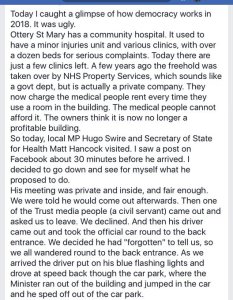
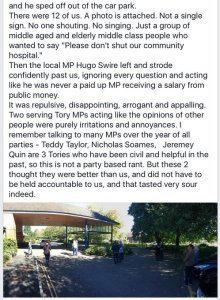
Report that Randall-Johnson was with Swire and Minister of Health at Ottery St Mary

“If you thought Health Secretary Matt Hancock was a safe pair of hands for the NHS after Jeremy Hunt think again. Comedy antics ensued when the Hancock turned up at Ottery hospital. First he hid, then he hurried.

Matt may well have been doing a favour for a rich mate, East Devon money-bags MP Hugo Swire, but at what price, making him appear a hapless lacky to East Devon’s Tory elite.

Hugo by-passed the Department of Health to take Matt hospital surfing. They went to Budleigh Salterton Hospital, before popping into in Ottery.

East Devon Councillor and Devon County Council Health and Adult Care Scrutiny Committee Councillor Claire Wright was on hand, along with some residents, to ask the Health Secretary some questions.

Unfortunately, he was holed up solely with a number of East Devon Tories, including Sara Randall Johnson, chair of the Health and Adult Care Scrutiny Committee. East Devon MP, Mr Swire and his aides were also present.

Have a read of Claire’s account. It certainly seems weird, so does the behaviour of the communication people of the NEW Devon Clinical Commissioning Group.

‘Why was he so frightened about talking to a dozen residents, and the local county councillor?’ asks Claire.

‘I had been quite encouraged that he was visiting the hospital and wanted to hear from him that he will protect Ottery’s and other hospitals. After all, Mr Hancock commands the NHS and also NHS Property Services, which now owns many hospital buildings in the area.

‘They are all at risk of possible closure and sell-off due to the lack of funding available to pay the enormous rents NHS Property Services demands.

‘But his cowardly escape bid simply gave the impression of a man who does not wish to be even remotely accountable.’

But that’s not all. Here’s the response of an East Devon constituent, as posted by Channel 5 News Health Correspondent Catherine Jones (check out the picture).

[There follow many hilarious comments on Swire’s justification for his actions and a You Tube video of Hancock doing a karaoke version of “Can’t Stop Me Now]

http://www.theprsd.co.uk/2018/09/27/first-he-hides-then-he-hurries-health-secretary-hancock-hot-foots-it-on-east-devon-hospital-visit/

“The Tories Have Accidentally Revealed The Personal Mobile Numbers Of Hundreds Of MPs And Journalists On Their Conference App”

These are the people charged with our Brexit it negotiations and keeping the UK safe!!!

“The Conservative party has accidentally allowed the personal mobile phone numbers of hundreds of MPs, journalists, and party members to be revealed to the public on its conference app.

A security flaw allowed anyone who downloaded the app to log in as any attendee to the party conference, which begins in Birmingham tomorrow, using only their email address. No password was required to view any attendee’s personal details, including their mobile phone number.

BuzzFeed News was able to access the personal mobile phone numbers of cabinet ministers, MPs, journalists, and Tory party members within seconds.

Users of the app are also able to change the privacy settings of other attendees using only their email address, allowing anyone else using the app to search their name and then view their mobile number.

An MP who had their personal phone number tweeted out told BuzzFeed News: “CCHQ genuinely can’t be trusted to do anything. This is a serious security breach and no laughing matter. Whoever is responsible needs to go.”

Labour MP Jon Trickett said: “How can we trust this Tory Government with our country’s security when they can’t even build a conference app that keeps the data of their members, MPs and others attending safe and secure?”

Journalist Dawn Foster reported being able to log in as Boris Johnson and then view his personal mobile number.”

https://www.buzzfeed.com/alexwickham/the-tories-have-accidentally-revealed-the-personal-mobile

Telegraph lists Swire’s East Devon as “marginal”

https://www.telegraph.co.uk/active/11527430/HTML-Constituency-Safe-Seats.html

* not updated recently but if anything it is more marginal!

Ottery St Mary continues its proud tradition of independence!

G Pratt, Ind. 715
J Sheaves. Con. 421
LibDem. 51
Green. 24
Labour. 20

“The government’s voter ID plans are ‘rearranging the deckchairs’ in the face of new threats to our democracy”

“On May 3rd 2018, 350 people were denied a vote in their local council elections. Their crime? Not possessing the right ID. The minister hailed these trials of mandatory voter ID as a ‘success’. The government must have a strange definition of success.

The scheme disenfranchised far more ordinary voters than potential wrongdoers: in a single day across the five councils, twice as many people didn’t vote due to having incorrect ID as have been accused of personation in eight years across the whole of the UK.

Out of 45 million votes last year, there were just 28 allegations of ‘personation’ (only one was solid enough to result in conviction). And yet the government seems determined to pursue voter ID, a policy we now know could cost up to £20 million per general election. This change to how we vote is a marked departure from the trust-based British way of running elections, and with little evidence to justify it.

It’s claimed that mandatory voter ID could boost faith in the democratic process. Yet according to academic research, 99 percent of election staff do not think fraud has occurred in their polling stations. Eighty-eight percent (88%) of the public say they think our polling stations are safe. And studies show that more accessible elections have greater electoral integrity – not the other way round.

The policy of mandatory strict ID presents a significant risk to democratic access and equality. Millions of people lack the strictest forms of required documentation. Documentation that is costly to acquire. It’s one of the reasons why organisations from the Runnymede Trust to the Salvation Army and Stonewall are concerned about these plans. The Windrush scandal earlier this year highlighted exactly the difficulties some legitimate voters could have in accessing identity documents – through no fault of their own.

If mandatory ID were to be rolled out nationally, it could potentially result in tens of thousands of voters being denied a say. And it would hit the already marginalised hardest: poorer C2DE social grade voters were half as likely to say they were aware of the ID requirements before the trials this May. And despite the costly publicity campaign this time, after election day, an average of around a quarter of residents were not aware of the pilots in four of the council areas – around four in 10 were not aware in Watford.

Imposing ID could have a significant impact on election outcomes, too. Thirteen seats were won at the 2017 Parliamentary election with a majority less than the number of people denied a vote in Bromley alone this May.

Yet still the government insists on running more trials of mandatory ID despite a broader commitment to improve democratic engagement and access. It is clear that much work needs to be done to remove barriers to voting, not to construct new ones. The most widespread problem poll staff have highlighted is voters turning up and not being on the register. Access for voters with disabilities is also a frequently cited problem.

We’ve learnt a lot this year, with our election and information regulators and parliamentarians highlighting the shocking state of the unregulated ‘wild west’ that is online campaigning. From the spread of disinformation, to secret political donations and ‘dark ads’, the real threats to our democracy are becoming clear.

In the face of these challenges, imposing voter ID is like rearranging the deckchairs of our democracy while we head towards an iceberg. The crucial task for government now is to focus on the real problems – we need to get to work solving them.”

Full report here:
https://www.electoral-reform.org.uk/latest-news-and-research/publications/a-sledgehammer-to-crack-a-nut-the-2018-voter-id-trials/

https://www.electoral-reform.org.uk/the-governments-voter-id-plans-are-rearranging-the-deckchairs-in-the-face-of-new-threats-to-our-democracy/

“Citizens’ Juries could become the core of a revived local democracy”

Owl says: a bit too radical for EDDC which is predicated on NOT listening to its citizens! It surely would have to be forced on the district with its current majority party!

“The Department of Digital, Culture Media and Sport has also now decided to pilot participatory democratic approaches in local authorities around England. Scotland and Wales are having their own discussions.

As with many innovations, the devil will be in the detail.

They will need to be representative of the area they are discussing. If half the residents are over 50, half the jury members should be too. They mustn’t be self-selecting: they can’t be yet another platform for the already engaged.

Both the Democracy Matters assembly on city regions and the Citizens’ Assembly on Brexit paid participants a token amount to reach ordinary citizens who wouldn’t normally volunteer.

In order for them to be Citizens’ Juries in more than just name, they need to have three equally important phases.

The first phase is learning about the options and how the process will work. Participants are guided through the current state of affairs and presented with the options for change.

Traditionally this has meant impartial experts preparing papers and delivering short lectures, which Ed Hammond correctly points out can get quite expensive. To combat this, we ran an experimental deliberative programme in the run-up to the EU referendum with recorded videos from academics from the ESRC’s UK in a Changing Europe project.

Following their briefing, participants then hear from campaigners, presenting their case for why the assembly should side with them. Members can question them armed with the knowledge they gained in the previous phase, and – if the assemblies I’ve attended are any measure – will rigorously scrutinise them.

The last phase is the deliberation itself. Breaking up into small groups and facilitated to ensure no one person dominates, they discuss amongst themselves everything they’ve heard, feeding back into the full assembly and eventually voting.

Citizens’ Juries are nothing like the fractious social media debate that tends to pass for political discussion today. All sides have a common pool of knowledge to draw from, and by discussing issues face-to-face, are far more likely to compromise.

They are also, in many ways, at the opposite end from the local councils they will be advising. Due to the voting system, local government in England is not representative of local political opinions, let alone local demographics.

It would be a shame if Citizens’ Juries became just another institution bolted on to deal with the unrepresentative nature of our local electoral system, rather than deal with the problem at the source. …”

https://www.electoral-reform.org.uk/citizens-juries-could-become-the-core-of-a-revived-local-democracy/

Labour councillor cautioned for voting twice in election

“Faisal Rana, a Labour councillor in Rochdale, has been cautioned by the police after admitting voting twice in May’s elections for the location council.

Cllr Rana has properties in two different wards and joined the electoral register at both addresses. The wards are in different Parliamentary constituencies but both within Rochdale council. Faisal Rana cast votes in both wards at the Rochdale council elections earlier this year.

It is legal to be registered in more than one place, such as students who can register both at home and at university if they have gone away for university. But it is illegal to vote more than once for the same body. One of those example students could, for example, vote in both places at council elections if they are for different local councils. They could only vote once in a general election.

Faisal Rana said:

I have accepted a police caution for an electoral offence, which relates to me casting separate votes for two different wards in two different Constituencies (Spotland and Falinge, and Norden Ward) in the local elections earlier this year.

I legally registered my votes by providing my genuine national insurance number, date of birth and addresses and when I received these through the post I thought it would have been OK and that is why they issued me two ballots for two constituencies.

I did not realise this was an offence and misinterpreted the rule that says it is possible to vote in two different electoral areas.

Cllr Rana had held the assistant finance portfolio in the ruling Labour group. He is now reported to have “stepped away” from the role.”

https://www.markpack.org.uk/155712/faisal-rana-rochdale-voting-twice/?goal=0_8f22492d8e-8327d54ac1-312639877

“Chief exec suspended over election failures leaves council by mutual consent”

Amongst other things, our CEO “misplaced” 6,000 voters by using inadequate means of registering them and had to explain himself (not terribly well in Owl’s opinion) to a Parliamentary committee:

https://eastdevonwatch.org/2014/10/14/official-transcript-of-eddc-ceo-evidence-to-parliamentary-committee-on-voter-engagement/

“A chief executive who was suspended over failures in the running of the 2017 general election process has left by mutual consent.

John Sellgren was suspended from his post at Newcastle-under-Lyme Borough Council in November 2017 after a review by Andrew Scallon, of the Association of Electoral Administrators, which found that more than 500 postal voters were disenfranchised, and close to 1,000 potential electors not included on the register.

A statement from the council on Sellgren’s departure said: “We would like to place on record our thanks for John’s efforts during his seven years with us. The council recently had its first all-out elections and the new administration has an ambitious manifesto and many significant projects to deliver in the years ahead.

“With this in mind the authority will now consider what management leadership arrangements to put in place to support this programme.”

Sellgren said: “I have enjoyed my time at Newcastle and send my best wishes to the dedicated team of staff and partners with whom it has been a pleasure to have worked.”

The council said it wanted to point out that there had been no additional payments made to Mr Sellgren.

Labour’s Paul Farrelly held the Newcastle-under-Lyme seat by 30 votes with 21,124 to his Conservative rival’s 21,094.

The Scallon report was commissioned shortly after the election when claims were made that some students at Keele University and postal voters were unable to vote despite following the correct procedures.
Some said they were turned away from polling stations despite having polling cards with them, and others who said they had registered to vote by the deadline were turned away for not having provided extra information required.

Scallon’s report said: “Human error and judgement and a lack of knowledge were responsible for the things that went wrong and led to the disenfranchisement of a significant number of people, raising questions about the mandate of the candidate declared elected as Newcastle-under-Lyme’s member of Parliament.”

He noted inadequate performance by Mr Sellgren (as acting returning officer/electoral registration officer) and consultants, worsened by a lack of experience among elections office staff and over-reliance on a software system, which was not properly managed.”

http://localgovernmentlawyer.co.uk/index.php?option=com_content&view=article&id=36393%3Achief-exec-suspended-over-election-failures-leaves-council-by-mutual-consent&catid=59&Itemid=27

So many problems worrying the Electoral Reform Society …

Why it’s time to shine a light on ‘dark ads’ online:
https://www.electoral-reform.org.uk/why-its-time-to-shine-a-light-on-dark-ads-online/

In these divided times, a new consensus is emerging around our broken election laws:
https://www.electoral-reform.org.uk/in-these-divided-times-a-new-consensus-is-emerging-around-our-broken-election-laws/

Our democracy faces many threats – but the government has picked the wrong priority:
https://www.electoral-reform.org.uk/our-democracy-faces-many-threats-but-the-government-has-picked-the-wrong-priority/

Campaign regulation is needed now before all trust is gone:
https://www.electoral-reform.org.uk/campaign-regulation-is-needed-now-before-all-trust-is-gone/

Voter registration for 2019 local elections begins

Owl says: keep an eye out for house-to-house canvassers for those who do not register. They have been few and far between in recent years, leading to around 6,000 eligible voters having been “missed”, leading to embarrassing questions (and answers) to EDDC’s Electoral Registration Officer (EDDC CEO Mark Williams, paid extra for this job) in Parliament:

http://data.parliament.uk/writtenevidence/committeeevidence.svc/evidencedocument/political-and-constitutional-reform-committee/voter-engagement-in-the-uk/oral/14118.html

“As part of East Devon’s annual voter registration canvass, households will soon be receiving a form asking residents to check whether the information that appears on the electoral register for those living at their address is correct.

The aim of the form is to ensure that the electoral register is up to date and to identify any residents who are not registered so that they can be encouraged to do so.

Local district, town and parish council elections are scheduled to take place in May 2019.”

http://www.exmouthjournal.co.uk/news/east-devon-district-council-reminder-to-register-to-vote-1-5622986

People are urged to take the opportunity to make sure that when the elections take place, they will easily be able to take part.

Any residents who have any questions can contact the electoral services team at electoralservices@eastdevon.gov.uk or on 01395 571529

New all-party push for proportional representation

This week is the first National Democracy Week – a rare moment to put the ‘nuts and bolts’ of democracy on the agenda.

The elections of the past year have shown that Westminster’s First Past the Post system is failing at the lowest democratic hurdle – allowing everyone to participate equally in our politics.

One in five people felt forced to ‘hold their nose’ and opt for a lesser evil rather than their preferred candidate in 2017’s General Election.

68% of votes had no impact on the result – going to either unsuccessful candidates or being ‘surplus to requirements’. Under the Westminster’s system, all that is required for victory is a majority of one.

And the system is exaggerating divisions in the UK – Labour secured 29% of the vote in the South East but got just 10% of seats, while the Conservatives won 34% of the North East vote but got just 9% of seats.

This isn’t some anomaly – this is built into a stone-age system where having one more cross in the box than the rest is all that counts: every other vote goes to waste.

But Westminster’s system can’t even do what it says on the tin – produce ‘strong’ single-party government. The Conservatives were required to make an agreement with the Democratic Unionist Party (DUP) to ensure it could govern with any degree of reliability.

These serious flaws in the Westminster system are why today, during the first National Democracy Week, we are marking the relaunch of the All Party Parliamentary Group for Proportional Representation.

This will see MPs from across the political spectrum meet to support a change in the voting system – to one which better matches seats in the House of Commons to how people actually voted.

It will be chaired by Labour MP Daniel Zeichner, joined by Martyn Day MP (SNP), Wera Hobhouse MP (Liberal Democrat), Jeremy Lefroy MP (Conservative), Caroline Lucas MP (Green), Lord Warner (Crossbench) and Hywel Williams MP (Plaid Cymru) as Vice-Chairs. This is a powerful cross-party coalition for change.

We know that while the existing Westminster system may be all that many voters in England have ever known, it is far from the only way. There are much better options.

Every new democratic institution created in the past two decades has, in fact, rejected First Past The Post. Voters in Wales, Scotland and Northern Ireland (and indeed, in most modern democracies) are all used to more proportional systems – seeing their voices properly and fairly reflected in the corridors of power, and with seats matching votes. (For more information on the alternatives see here)

Yet Westminster’s creaking voting system is stuck in the dark ages.

National Democracy Week has been launched with the noble intention that “regardless of who we are or where we are from, we must work together to ensure that every member of society has an equal chance to participate in our democracy and to have their say.”

Let us recognise that the ‘one-party-takes-all’ system does not achieve this. It was designed for another age – and doesn’t work today.

Let’s move towards a democratic system built for our time: where everyone’s voice is heard. That, surely, would be fitting progress to mark the first National Democracy Week.”

https://www.electoral-reform.org.uk/a-cross-party-group-of-mps-are-fighting-westminsters-broken-voting-system/

“Democracy Week” …. why it is undemocratic

Apparently, it’s “Democracy Week” …. Owl finds it hard to believe.

Here are 4 reasons from the Electoral Reform Society why it is anything but:

1. The first-past-the-post system of voting.

2. Inequality in the minimum voting age in England, Scotland, Wales and Northern Ireland.

3. “A House of Cronies” aka the gerrymandered House of Lords.

4. The political gender gap.

For more information, see:

https://www.electoral-reform.org.uk/four-ways-westminsters-politics-needs-fixing-this-democracy-week/

“UK democracy under threat and reform is urgent, says electoral regulator”

“The Electoral Commission has called for urgent reforms to electoral law after a series of online political campaign scandals, acknowledging concerns that British democracy “may be under threat”.

Following a series of revelations involving the likes of Cambridge Analytica, the elections regulator has asked Westminster and the devolved governments to change the law in order to combat misinformation, misuse of personal data and overseas interference in elections.

Among other recommendations, the Electoral Commission has called for:

A change in the law to require all digital political campaign material to state who paid for it, bringing online adverts in line with physical leaflets and adverts.

New legislation to make it clear that spending in UK elections and referendums by foreign organisations and individuals is not allowed.
An increase in the maximum fine, currently £20,000 per offence, that the Electoral Commission can impose on organisations and individuals who break the rules.

Tougher requirements for political campaigns to declare their spending soon after or during a campaign, rather than months later.

A requirement for all campaigners to provide more detailed paperwork on how they spent money online.

The intervention follows years of debate about the largely unregulated world of online political campaigning in the aftermath of the 2016 EU referendum and Donald Trump’s election as US president.

“Urgent action must be taken by the UK’s governments to ensure that the tools used to regulate political campaigning online continue to be fit for purpose in a digital age,” said Sir John Holmes, chair of the Electoral Commission.

“Implementing our package of recommendations will significantly increase transparency about who is seeking to influence voters online, and the money spent on this at UK elections and referendums.”

His organisation also backed proposals to publish a database of political advertisements that will enable the public “to see what adverts a campaigner has taken out and how much they paid”. Facebook is already due to launch such a facility for UK political adverts within the coming months.

The regulator, alluding to foreign governments such as Russia, also raised concerns that there is currently no explicit ban on overseas organisations buying online political ads aimed at a British audience. …

… A Cabinet Office spokesperson said: “The government is committed to increasing transparency in digital campaigning in order to maintain a fair and proportionate democratic process, and we will be consulting on proposals for new imprint requirements on electronic campaigning in due course.”

The Electoral Commission has also asked for the power to investigate individual political candidates if they have broken constituency spending limits in general elections. At the moment only the police can investigate such allegations, resulting in the long-running investigation into Tory candidates’ spending on battle buses, which was dropped by the Crown Prosecution Service due to insufficient evidence.

Other proposals include pushing political parties to count online advertising targeted at local constituencies within individual candidate spending limits – which can be as low as £10,000 – rather than as part of national campaigns which are allowed to spend up to £19.5m. During the 2017 general election the Conservatives were able to target Facebook ads regarding local issues at individuals in specific constituencies and count it as national spending – just so long as they didn’t mention the name of the local Tory candidate.

Both Labour and the Conservatives spent substantial sums of money on online promotions during the last general election, with digital spending accounting for more than 40% of all advertising spending by political parties in 2017. …”

https://www.theguardian.com/politics/2018/jun/26/uk-democracy-under-threat-and-reform-is-urgent-says-electoral-regulator