
https://www.devonlive.com/news/devon-news/changes-polling-stations-east-devon-1626995
Category Archives: Voting
Buying votes – Tories in the lead
“The Conservative Party accepted £4.7 million of donations in the first three months of 2018, new data shows.
Theresa May’s party received more than three times as much as Labour between January 1 and March 31.
Labour accepted £1.49 million in donations.
The Liberal Democrats received £564,135 and the Green Party just £1,800.
This is £2.4 million less than what was accepted during the same period last year (£9.3 million). …”
https://www.mirror.co.uk/news/politics/tories-rake-donations-almost-5million-12620324
Still time to register for the free East Devon Alliance conference in Honiton next week
“All across East Devon people are worried about their HEALTH, their HOMES and their JOBS. Never has it been more important to involve yourself with local democracy in your district..
YOU CAN MAKE THE DIFFERENCE
The EAST DEVON ALLIANCE is trying to help with all of this, an umbrella group of Independent people, who since 2015 have won 7 district council seats and 1 county seat. The EDA is free from the negative influence of national parties who – at East Devon District Council – have acquired the arrogant habits of a Conservative one-party state.
This conference is for YOU. Speakers will include County Councillors CLAIRE WRIGHT and MARTIN SHAW, and PAM BARRETT, Chair of the Independent Buckfastleigh Town Council and regional expert on transforming democracy from the bottom up.
In two sessions you will be able to hear our experience and then CONTRIBUTE your own personal views:
a) how did the democratic deficit in East Devon happen? Or – the problem.
b) what can we do about it through democracy in our parishes, towns and district. Or – the solution.
Please come. We are all volunteers but if we band together now to fight for hospitals, homes and jobs we have a chance to change how our local area is run.
Parking: nearest is Lace Walk. 2 minute walk. If full, New Street, 5 mins”
“These are the MPs who voted to keep government Windrush documents secret”
… Parish, Neil
… Swire, Hugo
DON’T do as I say! Political hypocrisy at its very best!
“Theresa May’s 2004 Question Time Exchange
Question: “Has the government lost control of its immigration policy?”
Theresa May: “Yes I think the government has lost control of its immigration and asylum policy. Frankly I think we see a degree of chaos in what is happening and what is perfectly clear from what has taken place and been admitted by the Government and by Beverley Hughes in particular at the beginning of this week is that we have in this Government Ministers who simply don’t know what is going on in their Department, we have Departments that deny the truth and have to have it dragged out of them.”
David Dimbleby: “What’s the political remedy?”
Theresa May: “I think there are two things. I do think Beverley should resign as Minister on this particular issue. And I find it absolutely extraordinary that she has said in front of the Select Committee and in the House of Commons she blamed officials in her Department for this particular decision having been taken.
“I find it extraordinary that a Minister isn’t willing just to step up to the plate and take responsibility and it seems to me that you don’t have to take a Ministerial job, you don’t have to take the care and the extra pay and so forth. But when you do there is responsibility that has to be taken with it. And I’m actually sick and tired of Government Ministers in this Labour government who simply blame other people when something goes wrong and are not willing to take responsibility for what is happening under this government and their decisions.”
When Hughes said she couldn’t be expected to manage the civil servants in her department, May responded: “But Beverley, you are the minister who is responsible for what happens in your department.”
The Home Office has also been unable to say how many Windrush Britons have been wrongly deported, blaming a mix-up in paperwork.
May has also faced criticism for failing to act sooner after Jeremy Corbyn raised the issue with May at Prime Minister’s Questions a month ago. …”
Lies, damned lies – and election leaflets!
Should you get one of these, feel free to ask a few questions!
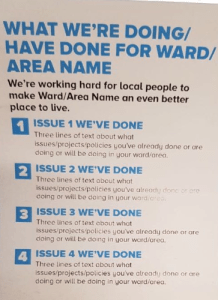
“Conservatives are standing for election in east London on their record of “ISSUES WE’VE DONE” for “AREA NAME”, according to their leaflet.
The leaflet, promoting the Tory candidate for Ilford Town, sets out in blue capitalised letters “WHAT WE’RE DOING/HAVE DONE FOR WARD/AREA NAME”.
Underneath, it lists issues one to four that “we’ve done” for Ilford. In what appears to be an embarrassing copy-and-paste error, the leaflet reads: “Three lines of text about what issues/projects/policies you’ve already done or are doing or will be doing in your ward/area name.”
The latest in a series of leaflet gaffes ahead of the local elections on Thursday, images of the leaflet quickly went viral on social media.”
MPs in power: “Reckless Opportunists”
Owl says: MPs as elites, out of touch and just in it for the glory – well, we know a lot about that in this part of the country!
(By the way, if your/our MPs have not been about much recently it is because they have been despatched to areas where the party in power might lose control in local elections tomorrow).
“[Amber] Rudd exemplifies a political class light on expertise and principle, yet heavy on careerism and happy to ruin lives. All the key traits are here. In a dizzying ascent, she went from rookie MP in 2010 to secretary of state for energy in 2015, before being put in charge of the Home Office the very next year. Lewis Hamilton would kill for such an accelerant, yet it leaves no time to master detail, such as your own department’s targets. Since 2014 Sajid Javid, Rudd’s replacement, has hopped from culture to business to local government, rarely staying in any post for more than a year. Margaret Thatcher kept her cabinet ministers at one department for most of a parliamentary term, but this stepping-stone culture turns urgent national problems – such as police funding and knife crime – into PR firefighting.
Another hallmark of Rudd exemplifies a political class light on expertise and principle, yet heavy on careerism and happy to ruin lives. All the key traits are here. In a dizzying ascent, she went from rookie MP in 2010 to secretary of state for energy in 2015, before being put in charge of the Home Office the very next year. Lewis Hamilton would kill for such an accelerant, yet it leaves no time to master detail, such as your own department’s targets. Since 2014 Sajid Javid, Rudd’s replacement, has hopped from culture to business to local government, rarely staying in any post for more than a year. Margaret Thatcher kept her cabinet ministers at one department for most of a parliamentary term, but this stepping-stone culture turns urgent national problems – such as police funding and knife crime – into PR firefighting.
Another hallmark of this set is the disposability of its values. Cameron hugs Arctic huskies, then orders aides to “get rid of all the green crap”. As for Rudd, the May cabinet’s big liberal vowed to force companies to reveal the numbers of their foreign staff, stoking the embers of racism in a tawdry bid to boost her standing with Tory activists. Praised by Osborne for her “human” touch, she was revealed this week privately moaning about “bed-blocking” in British detention centres.
And when things get sticky, you put your officials in the line of fire. During the Brexit referendum, Osborne revved up the Treasury to generate apocalyptic scenarios about the cost of leaving. While doomsday never came, his tactic caused incalculable damage both to the standing of economists and to the civil service’s reputation for impartiality. Rudd settled for trashing her own officials for their “appalling” treatment of Windrush-era migrants.
None of these traits are entirely new, nor are they the sole preserve of the blue team. At the fag end of Gordon Brown’s government, the sociologist Aeron Davis studied the 49 politicians on both frontbenches. They split readily into two types. An older lot had spent an average of 15 years in business or law or campaigning before going into parliament – then debated and amended and sat on select committees for another nine years before reaching the cabinet.
The younger bunch had pre-Westminster careers that typically came to little more than seven years, often spent at thinktanks or as ministerial advisers. They took a mere three years to vault into cabinet ranks. This isn’t “professionalisation”. It is nothing less than the creation of a new Westminster caste: a group of self-styled leaders with no proof of prowess and nothing in common with their voters. May’s team is stuffed full of them. …
Davis depicts a political and business elite that can’t be bothered about the collective good or even its own institutions – because it cannot see further than the next job opportunity. In this environment, you promise anything for poll ratings, even if it’s an impossible pledge to get net migration down to the tens of thousands.this set is the disposability of its values. Cameron hugs Arctic huskies, then orders aides to “get rid of all the green crap”. As for Rudd, the May cabinet’s big liberal vowed to force companies to reveal the numbers of their foreign staff, stoking the embers of racism in a tawdry bid to boost her standing with Tory activists. Praised by Osborne for her “human” touch, she was revealed this week privately moaning about “bed-blocking” in British detention centres.
And when things get sticky, you put your officials in the line of fire. During the Brexit referendum, Osborne revved up the Treasury to generate apocalyptic scenarios about the cost of leaving. While doomsday never came, his tactic caused incalculable damage both to the standing of economists and to the civil service’s reputation for impartiality. Rudd settled for trashing her own officials for their “appalling” treatment of Windrush-era migrants.
None of these traits are entirely new, nor are they the sole preserve of the blue team. At the fag end of Gordon Brown’s government, the sociologist Aeron Davis studied the 49 politicians on both frontbenches. They split readily into two types. An older lot had spent an average of 15 years in business or law or campaigning before going into parliament – then debated and amended and sat on select committees for another nine years before reaching the cabinet.
The younger bunch had pre-Westminster careers that typically came to little more than seven years, often spent at thinktanks or as ministerial advisers. They took a mere three years to vault into cabinet ranks. This isn’t “professionalisation”. It is nothing less than the creation of a new Westminster caste: a group of self-styled leaders with no proof of prowess and nothing in common with their voters. May’s team is stuffed full of them. After conducting more than 350 interviews with frontbench politicians, civil servants, FTSE chief executives and top financiers, Davis has collected his insights in a book. The argument is summed up in its title: Reckless Opportunists. …”
“Local Elections: Diverse voices are being drowned out by the undemocratic voting system in England and Wales”
” … Across England, local elections are non-proportionate i.e. the diverse way in which people vote is not accurately reflected in the results.
Many council wards elect multiple councillors – but the opportunity this presents to increase the level of proportionality isn’t being taken. Instead, councillors in such wards are generally elected in one of two ways: all-up or by thirds.
In Newham, East London, for example, the council elects all at the same time. There are 20 wards each electing three councillors. When voters there go to the polls, they can vote for up to three candidates. Parties will typically put forward three candidates each and the three candidates with the most votes win.
Electing councillors in this way can be even less proportionate than in single-member wards using the same ‘First Past the Post’ style system, because a ward may have, for instance, two bits that are supportive of one party and one bit that is supportive of another – and the two bits will always overpower the third.
Newham has seen one party (Labour) hold every single seat on the council since 2010, last time winning 60% of the vote. While this is clearly deserving of a majority, it should not be without opposition.
The other way councillors in multi-member wards are elected are in staggered ballots, which will take place in 107 councils this year. Typically, this sees a portion of members up for election, usually in three years out of every four. So a ward will often have councillors elected in different years.
This not only creates disproportionality, but the constant cycle of elections tends to reduce turnout, from a combination of electoral fatigue and because of the reduced power of the ballot box. If a council is say 85% controlled by one party, and a third of seats go up for election, then even if the opposition take every seat that party will still control 52% of seats.
The situation could not be more different North of Hadrian’s Wall, however. Until 2007 Scotland was very familiar with the problems of majoritarian voting in local government. Councils were distant and unaccountable. And there were one-party states with just a handful of opposition councillors, or none at all.
But a change to the Single Transferable Vote (STV) brought proportional representation to Scottish local government.
Overnight every council and ward in Scotland became competitive, forcing a renewal of local democracy.
Scottish local government is now not only more competitive, it is better functioning. In 2003 (before the reform) 52.3% of voters saw their vote elect their chosen candidate. By 2012 (after the reform) 76.7% saw their first preference elected.
Councils have since been governed by coalitions, minorities and parties with absolute control. And turnout in 2017 was strong by local council standards at 46.9% – which compares favourably to the 38.9% in the last locals in London.
There are now moves towards giving Welsh councils the chance to choose to change to the system.
So while the Electoral Reform Society and other civil society groups are rightly campaigning for people to cast their votes on May 3, it is also recognised that change is desperately needed to spread the use of a proportional system across the United Kingdom.
This democratic reform must be extended to England too so that its local government be revitalised in the same way. “
“Don’t let over 55s decide elections”
Owl says: With SO many over-55s in East Devon influencing voting, we certainly do need younger voices to be heard.
“Labour’s election campaign chief has expressed fears that Jeremy Corbyn’s army of young supporters may not turn out to vote in the local elections, meaning the party might fail to live up to high expectations.
Andrew Gwynne, who is also the shadow communities secretary, said there was a danger that the young voters who backed in Labour at the general election would stay at home.
“That’s why we’ve been trying to make the case that local councils have a big impact on young people’s lives,” he said. “It is so important for young people not to leave local elections just to the over-55s.” …
“Cambridge Analytica files spell out election tactics” – one of which was “persuade people NOT to vote”
The files were released by the UK’s Digital, Culture, Media and Sport Committee.
They detail some of the work undertaken by Cambridge Analytica and companies it has been linked with, including SCL Group, Global Science Research and Aggregate IQ.
“In one document, SCL said that encouraging people “not to vote” might be more effective than trying to motivate swing voters.
Describing its work in a Nigerian election, SCL Global said it had advised that “rather than trying to motivate swing voters to vote for our clients, a more effective strategy might be to persuade opposition voters not to vote at all”.
It said this had been achieved by “organising anti-election rallies on the day of polling in opposition strongholds” and using “local religious figures to maximise their appeal especially among the spiritual, rural communities”.
It boasted of devising a political graffiti campaign to create a youth “movement” in Trinidad and Tobago and of disseminating “campaign messages that, whilst ostensibly coming from the youth, were unattributable to any specific party”. It said as a result “a united youth movement was created”.
In Latvia, it said it had recognised that “unspoken ethnic tensions” were “at the heart of the election”.
“The locals secretly blamed the Russians for stealing their jobs… armed with this knowledge, SCL was able to reflect these real issues in its client’s messaging,” the document said.
The files spell out how SCL helped the UK’s Foreign and Commonwealth Office “in strategic planning to counter violent jihadism” in Pakistan.
“I wouldn’t only recommend them, I’d work with them again in an instant,” wrote an official, whose name has been redacted.”
How can you be trusted with the economy if you can’t get your election expenses right!
“Details of enforcement action relating to political parties
The Conservative Party, Green Party and the Labour Party are under investigation for submitting spending returns that were missing invoices and for submitting potentially inaccurate statements of payments made.
The Conservative Party and Liberal Democrats are under investigation for making multiple payments to suppliers where either the claim for payment was received past the 30 day deadline or it was paid after the 60 day deadline following the election. These deadlines are specified in law.
The Women’s Equality Party is under investigation for submitting a spending return that was inconsistent with its donation reports covering the same period.
Details of enforcement action relating to non-party campaigners:
Best for Britain is under investigation for submitting a spending return that was missing invoices. The campaigner is also under investigation for not returning a £25,000 donation from an impermissible donor within 30 days as required by PPERA.
The National Union for Teachers is under investigation for submitting a spending return that was missing an invoice.”
https://www.markpack.org.uk/154324/2017-general-election-expense-returns/
Independents gaining more and more council seats countrywide
Labour and Conservatives lising to Independents – even in their heartlands and, in one case, on a single issue problem. Take elections held yesterday:
Wollaton West (Nottingham): Labour GAIN from Conservative.
* Farnworth (Bolton): Farnworth & Kearsley First GAIN from Labour.
* Oakham South East (Rutland): Independent GAIN from Conservative.
Rochester West (Medway): Labour GAIN from Conservative.
Northchurch (Dacorum): Liberal Democrat GAIN from Conservative
Droylsden East (Tameside): Labour HOLD
* Petersfield Bell Hill (East Hampshire): Independent GAIN from Conservative
Little Parndon & Hare Street (Harlow): Labour HOLD
* = Independent victories
“The plan to cut MPs looks suspiciously like a power grab”
“Are we witnessing a power grab?
Six months ago, reports suggested that the Prime Minister had dropped plans to force through a cut in MPs, a cut linked with the ongoing review of constituency boundaries.
It turns out there has been a u-turn on the u-turn, with news emerging that the PM is set to reduce the number of MPs.
That’s despite the Public Administration and Constitutional Affairs Committee warning that moves to cut numbers to 600 are unlikely to secure the backing of MPs.
But why the fuss?
The issue comes down to a very ill-thought plan for new constituencies – alongside some clear democratic dangers when it comes to reducing voters’ representation.
The cut in MPs actually represents a cut in backbenchers if there are no plans to cap/cut the size of the executive or ‘payroll vote’ correspondingly.
Parliament will gain more powers after Brexit yet will have less capacity to scrutinise legislation. At the same time voters lose their representatives in Europe. That places a greater burden on the Commons and a lack of capacity poses significant risks.
The democratic dangers are clear. ERS research in 2016 showed that in a smaller, 600-seat Commons, nearly one in four (23%) MPs would be on the government payroll if the parties’ proportion of MPs – and the total number of ministers and whips – stayed the same – an all-time high, and up from the 21% at present (figures as of November 2016).
The more you look at it, the more cutting backbenchers at the same as bolstering the executive looks to many like a worrying power-grab.
But there’s another factor – the unelected Lords. It’s just common sense that the cut in democratically elected representatives cannot go ahead while the House of Lords remains the second largest chamber in the world, with around 800 members.
If the government are concerned about reducing the cost of politics, they would do well to deal with the over-sized second chamber.
Voters need real representation in the Commons to provide the essential scrutiny and capacity we need: both for now and when we gain new powers after Brexit.
But there are problems with the boundary changes regardless of the cut in MPs. For a start, the new boundaries will be based on highly incomplete as well as out of date data. For example, people who registered to vote for the EU referendum won’t be counted for the new boundaries – skewing representation.
At the same time, the government has set an arbitrary 5% maximum difference in the size of the new constituencies. That risks awkwardly splitting up communities or grafting very different towns/counties onto each other – just look at the controversial Devonwall proposals.
Finally, unregistered but eligible voters are not being considered when drawing up these constituency boundaries – even though they will still need support and representation from their MP. This disadvantages poorer constituencies – they end up with lower representation, often despite greater need.
Far from reducing political representation and weakening voters’ voices, the Prime Minister should cancel the proposed cut in MPs – and move forward with fair boundaries based on a properly resourced Commons.
Read the ERS’ full views on the boundary changes here:
https://www.electoral-reform.org.uk/campaigns/upgrading-our-democracy/fair-boundaries/ and here https://www.electoral-reform.org.uk/cutting-the-number-of-mps-will-have-consequences-lets-get-this-right/
No vote allowed on May’s “cash for votes” for DUP
“Theresa May will hand out the £1bn in her “cash for votes” deal with the Democratic Unionist Party without MPs’ prior approval, The Independent can reveal, putting the Government at risk of legal action.
The Commons will only vote after slices of the funds have been allocated to Northern Ireland, and will be denied a single vote on the overall £1bn – despite the Government conceding last year that Parliament’s “authorisation” is needed.
The decision has been condemned for leaving MPs “cut out of approving the deal”, which gives Northern Ireland a huge spending boost in return for Ms May being propped up in power.” …
“Male MPs ‘seat-blocking’ safe constituencies in the Commons, says new report”
East Devon has two safe(ish) seats (though getting less safe by the day)!
Hugo Swire and Neil Parish are male.
Claire Wright is Independent and female.
Just saying …
“Male MPs are effectively “seat-blocking” safe seats in the Commons and holding back gender progress, according to new research that calls for an overhaul in the way politicians are elected to Parliament.
The new study from the Electoral Reform Society (ERS) claims that hundreds of seats have effectively been “reserved” by male politicians – forcing women to contest in marginal constituencies in order to enter public life.
The research, published on Tuesday, shows that of the 212 currently-serving MPs first elected in 2005 or before, just 42 are women. …
Jess Garland, the director of policy and research at the ERS, added that while Britain has experienced progress in gender equality at recent elections, it is being “held back by Westminster’s broken voting system, which effectively ‘reserves’ seats for men”.
She continued: “Over 80 per cent of MPs first elected in 1997 or earlier are men, with the one-MP per seat one-person-takes-all nature of First Past the Post leaving few opportunities for women’s representation once a man has secured selection. Sitting MPs have a huge incumbency advantage, and since open selections are relatively rare, we face a real stumbling block in the path to fair representation. …
Fight for your country, pay taxes, marry – but you are too “immature and irresponsible” to vote says Tory Deputy Leader
“Young people aged 16 and 17 lack the “maturity and responsibility” needed to vote, the de facto deputy prime minister has said.
In a move likely to anger young people demanding the right to vote, David Lidington dismissed calls for the voting age to be lowered to 16.
The Cabinet Office minister and unofficial deputy prime minister was stepping in for Theresa May, who is in China, at Prime Minister’s Questions.
He was responding to a question from Emily Thornberry, standing in for Labour leader Jeremy Corbyn, about why the Government refuses to reduce the voting age to 16.
In response to his answer, Ms Thornberry accused the Government of being a “coalition of cavemen”. …”
“Electoral Commission clears Remain campaign over allegations from Conservative MP”
The complaint was made by ex-Tory Minister Priti Patel, who was fired from (sorry “resigned from”) Theresa May’s Cabinet for having had numerous unauthorised meetings with Israeli politicians while “on holiday” in the country.
“”Claims by Conservative MP and high-profile Leave campaigner Priti Patel that the Remain campaign broke the law during the European referendum have fallen apart under investigation from the Electoral Commission:
Former Cabinet minister and Brexiteer Priti Patel had … alleged that Britain Stronger in Europe failed to report joint spending with Labour, the Lib Dems and the Tories.
But the Electoral Commission said it did not have “reasonable grounds” to believe the official Britain Stronger in Europe (BSiE) group exceeded its spending limits and would not be opening an investigation.
In a letter to Ms Patel, the commission’s head of regulation Louise Edwards said: “Following examination we are satisfied that while liaison took place there is no evidence of joint spending as a result.
“The evidence indicates that the meetings were advisory in nature, focused on communications and did not involve or result in decisions on referendum spending, or the coordination of campaign activities across campaigners, as part of a common plan or other arrangement.” [Daily Mirror]
What has, however, stood up to scrutiny is a long list of rule breaking by anti-EU campaigners:
Nigel Farage fined half his salary
Brexit campaigners fined for sending 500,000 spam SMS
Record £12,000 fine for Brexit campaigner
Brexit campaigner fined £1,500
Two Brexit campaigners fined £1,000 each
11 anti-EU campaign groups struck off”
The full, very strongly worded letter from the Electoral Commission to Ms Patel is here:
https://www.markpack.org.uk/153854/priti-patel-remain-campaign/
Electoral Reform Society publishes four hard-hitting articles
There’s a lobbying scandal brewing in the House of Lords”
“As if the House of Lords did not already look like a private members’ club, an investigation by The Times has revealed that peers can continue to use the House of Lords’ subsidised dining rooms even after they retire.”
That means former politicians, who were not elected but selected for the role – are enjoying cheap food and drink thanks to taxpayers’ hard-earned cash. …”
https://www.electoral-reform.org.uk/theres-a-lobbying-scandal-brewing-in-the-house-of-lords/
Referendum spending is a murky world – when it should be crystal clear
“Negotiations on the UK’s exit from the European Union will dominate much of the political agenda this year. But 18 months on from the Brexit referendum, questions are still being asked about whether campaigners played by the rules when it came to spending. …”
Political parties are too reliant on big donors – and it has to change
“The Mirror today published research findings showing that 39% of all cash donations to the Conservative Party declared so far this year are from 64 individuals and their businesses.
The 64 in question are all members of an exclusive donor club with a £50,000 annual membership fee.
This grants them access to senior party figures via swanky dinner events. Ministers who have attended in the first half of this year include Theresa May, Boris Johnson, Philip Hammond and Jeremy Wright. …”
Ministers are ignoring the elephant in the room when it comes to boundaries
“Because of the current winner-takes-all voting system for electing Members of Parliament, 22 million votes were wasted at last year’s General Election – that’s 68% of the total votes cast.
So no matter what the size of your constituency is, most votes went into the black hole of our voting system.
That means 22 million people not just being under-represented – but not being represented at all in Parliament’s elected chamber.
Their votes are being thrown on the scrapheap – and the result is a highly distorted legislature that fails to represent the country. …”
DUP funding to stay secret
Owl says: What a surprise! Remind me – isn’t the DUP a fundamentalist “Christian” party? Oooohhhh … wait for the fire and brimstone – not.
“Labour has criticised an attempt by the government to allow the DUP to conceal details of past political donations, including during the EU referendum, despite a 2014 law that extended party transparency rules to Northern Ireland.
The government has announced it will bring into force new transparency rules for Northern Ireland’s political parties to allow the Electoral Commission to publish details of donations over £7,500.
The provision for the new rules, which will bring Northern Ireland in line with the rest of the UK, was first introduced in legislation in 2014, with the wide understanding it would be applied from that year.
However, the Northern Ireland secretary, James Brokenshire, said he intended the act to be applied from 1 July 2017, which would mean donations during the EU referendum in 2016 are not made public.
Campaigners have raised questions over the DUP’s spending on the EU referendum in June 2016 – including a £435,000 donation from a group called the Constitutional Research Council (CRC), chaired by Richard Cook, a former vice-chairman of the Scottish Conservative and Unionist party.
The source of the cash was revealed by the DUP after a series of articles published by OpenDemocracy, though details of the CRC’s source of income are still opaque. …”
https://www.theguardian.com/politics/2017/dec/19/labour-criticises-move-past-donations-dup-hidden
Every major (and some minor) party fined for election and/or referendum expense overspends or illegal payments
Owl says: with maximum fines being so low why should parties bother what they spend?
“Britain’s Electoral Commission said on Tuesday it has fined the Liberal Democrats party 18,000 pounds ($24,069) for breaching campaign finance rules in the 2016 European Union referendum.
The party was fined 17,000 pounds for failing to provide acceptable invoices or receipts and 1,000 pounds because some payments were reported in aggregate rather than as individual payments, the commission said in a statement.
“The reporting requirements for parties and campaigners at referendums and elections are clear, that’s why it is disappointing that the Liberal Democrats didn’t follow them correctly,” said Bob Posner, the Electoral Commission’s director of political finance.”
 East Devon Watch