‘We need better balance over second homes in East Devon’

“Some changes have been made. Higher rates of stamp duty on additional properties, closing tax loopholes and plans to let councils double council tax on vacant second homes. It’s a good start, but more action is needed.” Simon Jupp

(Amazing what a by-election can do to focus minds on local issues – Owl)

Simon Jupp www.sidmouthherald.co.uk

Short-term holiday lets are an important part of the economy of popular tourist destinations.

Many jobs in our communities depend upon visitors enjoying the variety and availability of accommodation options, who in turn spend money locally year after year.

Homeowners benefit from the flexibility offered by short-term lets, too. Listing a spare room or property takes only a matter of minutes.

It is an increasingly irresistible attraction. 

A recent survey of landlords by Capital Economics found 10% of UK landlords were ‘very likely’ or ‘fairly likely’ to offer short-term lets in the future in properties that are currently used for long-term tenancies.

But it is time to get a grip on what is going on. That survey data reveals up to 470,000 more properties could be unavailable for residents looking to rent.

My fellow Conservative Devon MPs and I met the PM earlier this week to discuss this growing problem. Homes to buy and for long-term rent are out of reach for many people who grew up in Devon, work locally, or need the support of family to look after a loved one.

Some changes have been made. Higher rates of stamp duty on additional properties, closing tax loopholes and plans to let councils double council tax on vacant second homes. It’s a good start, but more action is needed.

I welcome a new review into short-term tourist accommodation which will explore the impact and options for communities like ours.

Measures being considered include a registration kitemark scheme with spot checks for compliance with rules such as gas safety, and physical checks of premises to ensure regulations in areas including health and safety, noise, and anti-social behaviour are obeyed.

Short-term holiday lets bring visitors to the places we love. 

Landlords and second-home owners who see property as an investment opportunity also make it harder for local people to have a home of their own. 

We clearly need a better balance for communities in East Devon and the South West.

Keir Starmer has said Boris Johnson’s resignation is good news for the country.

 In a statement he said:

It is good news for the country that Boris Johnson has resigned as Prime Minister.

But it should have happened long ago.

He was always unfit for office.

He has been responsible for lies, scandal and fraud on an industrial scale.

And all those who have been complicit should be utterly ashamed.

The Tory Party have inflicted chaos upon the country during the worst cost of living crisis in decades.

And they cannot now pretend they are the ones to sort it out …

We don’t need to change the Tory at the top – we need a proper change of government.

We need a fresh start for Britain.

So what happens now?

There are various suggestions:

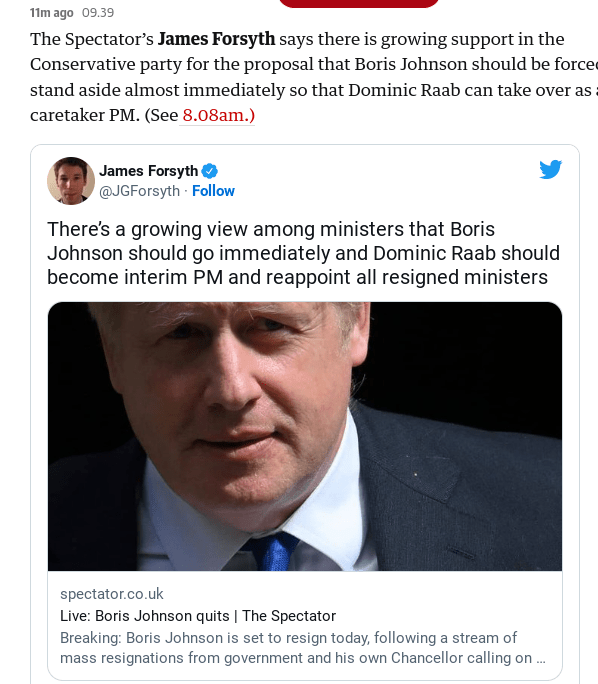
That Johnson stays until a new PM is selected in autumn (so we could be treated to more buffoonery).

What looks like the emerging line:

Though the Daily Mail considers Theresa May as ideally placed to lead an interim government.

Boris Johnson clings on in the face of Cabinet coup

“He has lost it and gone full ‘Hulk.’ 

He will be absolutely furious — because it has to be someone else’s fault,” a former government official who had also worked alongside the prime minister said. “It’s despotic.”

Annabelle Dickson www.politico.eu 

LONDON — The party’s over but Boris Johnson refuses to leave.

Despite more than 40 resignations from his government, an attempted coup by his top team and numerous calls to quit from his own Conservative backbenchers, the British prime minister was locked in No. 10 Downing Street with his closest aides on Wednesday night, trying to map out a way for him to retain power.

For him to do so would be unprecedented. Johnson’s government has been in crisis mode for months, first fending off criticism about coronavirus lockdown-busting parties and later over Johnson’s handling of allegations of abusive behavior by Conservative MPs.

But a defiant prime minister, who spent much of his day in public obliviously answering questions from MPs, insisted his general election mandate — which gave him a huge parliamentary majority just two and half years ago — took precedent over the concerns of colleagues. 

Early signs of a fightback were brutal, with Johnson firing one of his most senior ministers, his Brexit-supporting frenemy Michael Gove. It was Gove, who has held multiple senior roles in Johnson’s government, who went into No. 10 earlier in the day with the metaphorical bottle of whiskey and revolver, Tory MP Tim Loughton told Sky News: “Clearly Boris has downed the whiskey and turned the revolver on Michael Gove.”

Unless Johnson bows to the immense political pressure he is under, there is no immediate mechanism to remove him. Under the British political system — which relies largely on unwritten rules — convention dictates that a prime minister do the honorable thing and bow out voluntarily once they lose the confidence of their party.

“He’ll be dragged out on his chair with his heels dug in,” according to one official who has worked closely with the prime minister in recent months. 

“He has lost it and gone full ‘Hulk.’ He will be absolutely furious — because it has to be someone else’s fault,” a former government official who had also worked alongside the prime minister said. “It’s despotic.”

To survive, Johnson must first fill the many vacancies in his administration and rebuild his team even as more, including Welsh Secretary Simon Hart, announced they were quitting. Johnson could then eye an election as a way to reclaim a mandate to govern, something that is in the prime minister’s gift to initiate but a scenario he insisted he wouldn’t pursue. With the Tories trailing Labour in the polls, many in Johnson’s party are very keen to avoid a public vote.

Faced with the prime minister’s refusal to take a hint, the rest of his party must also calculate their next move.

Johnson narrowly survived a vote of confidence in his leadership by Tory MPs in June and under current Conservative Party rules, he is immune from another challenge for a year. But MPs are planning to change those rules and may mount another challenge next week.

Another mechanism to oust him would be for the opposition to call a confidence vote in the House of Commons. If enough Tory MPs sided with opposition parties to vote him down, Johnson would be required by parliamentary convention to resign — not that he has shown the least interest in following conventions.

Hanging on

Two of Johnson’s most senior Cabinet ministers, Chancellor Rishi Sunak and Health Secretary Sajid Javid, set off a domino effect Tuesday by resigning within 10 minutes of each other.

On Tuesday night, Johnson promptly replaced them, appointing Nadhim Zahawi as chancellor and Steve Barclay as health secretary. 

In a baptism of fire for Zahawi, he started his first day on the job with a 7 a.m. round speaking to the media. He insisted ministers were getting on with the job. Two members of Johnson’s government announced their resignations as he was speaking.

By the time Johnson entered the House of Commons at noon for his weekly prime minister’s questions session — his first public appearance since his government began falling apart — several more ministers including John Glen, the fourth in command at the Treasury, and Victoria Atkins, the prisons minister, had departed. Javid walked in just afterward and was met with a small cheer.

“Today is a big day,” Johnson began, drawing dark laughter from the chamber. But for the rest of the session, Tory MPs sat silent and stony-faced. Johnson faced hostile questions from MP Loughton — who asked sarcastically whether there were any circumstances in which he would resign — and David Davis, who repeated his call for the PM to quit. Most significantly, Gary Sambrook launched an emotional and excoriating attack on Johnson, accusing him of suggesting that victims of sexual assault had been drinking too much.

In response to a Labour MP who asked about a constituency issue, Johnson said he was already looking into it and urged him: “Hang on in there — that’s what I’m going to do.”

At a highly-charged briefing with journalists immediately afterward, Johnson’s press secretary insisted three times that he has the support of his parliamentary party and said he would contest a second confidence vote if one were held.

All the while, Javid was delivering a resignation speech — doubling up as a thinly veiled leadership pitch — in the Commons.

In the rest of the parliamentary estate, MPs, advisers and journalists were working up to a state of frenzy. In Portcullis House — the atrium at the heart of the parliamentary estate where all of Westminster congregates — Johnson’s Deputy Chief of Staff David Canzini sat in quiet congress with Conor Burns, one of the prime minister’s most long-standing allies. A book titled “Conundrum” lay on the table atop a pile of papers before them. 

By 2:30 p.m., Johnson had endured a record-making number of ministerial exits in 24 hours. As the resignations piled up, Johnson was grilled by the cross-party liaison committee of senior MPs, who worked their way through a succession of unrelated, administrative topics as dictated by their agenda.

Asked by one MP how his week was going, Johnson replied: “Terrific.” 

Darren Jones, a Labour MP, read out a quote that said when a regime has been in power for too long you can “rely on the leaders of that regime to act solely in the interests of self-preservation, and not in the interests of the electorate.” Asked if he could guess where this was from, Johnson asked sarcastically: “Cicero?” It was from one of Johnson’s own prior newspaper columns

As the conversation turned to the sustainability of the government’s fertilizer supply and delays with processing passports, a delegation of Cabinet ministers headed to No. 10 with the intention of telling Johnson that the game was up and it was time for him to resign. They included Zahawi, who had only been appointed chancellor the previous evening and who had defended the prime minister on the morning media round. 

When the committee broke the news of the imminent Cabinet coup to Johnson, he looked irritated. “You’re asking me to comment … I’m not going to give a running commentary on political events,” he responded — but insisted he was happy to discuss the cost of living or environmental issues. 

Bernard Jenkin, the senior Conservative backbencher chairing the committee, concluded by reflecting: “In the end, we’re all dispensable.”

“That is certainly true,” Johnson replied. “But my job is to get on and deliver the government’s aims, which is what I was elected to do … The welfare of the British people and the security of the nation are indispensable.”

Meanwhile just a few doors down the corridor, the 18-strong executive of the 1922 committee of Conservative backbenchers — which oversees the rules by which the party can oust Johnson — was also meeting. 

Some rebels had pushed for the committee to agree to an immediate change to its rules, in order to enable a fresh confidence vote in the prime minister immediately. They declined and instead agreed to hold their annual executive elections on Monday afternoon. And if the MPs elected to the committee support a rule change, a confidence vote could be triggered as soon as Tuesday. 

By 5 p.m., both meetings had ended and the prime minister dashed down the escalators to exit parliament and back to Downing Street, batting away questions from reporters on his way. 

Meanwhile, his deputy Dominic Raab headed to address another meeting of backbench Tory MPs.

One Conservative MP told POLITICO that in a room of 160 MPs, the “lone voice of support” came from Daniel Kawczynski, a staunch Brexiteer who last year was forced to apologize to the Commons for bullying parliamentary staff. 

Meanwhile, a former parliamentary staffer said, Conservative MPs were messaging their whips — responsible for party discipline and junior appointments — to say: “Don’t bother phoning me, I don’t want to serve [in Johnson’s government].”

Over in No. 10, a group of Cabinet ministers — Zahawi, Transport Secretary Grant Shapps, Education Secretary Michelle Donelan and Welsh Secretary Hart — had arrived to speak to Johnson. Within hours, Hart had quit and it emerged that Gove had been sacked.

The Times meanwhile reported that Home Secretary Priti Patel, previously a staunch defender of Johnson and one of his most senior ministers, had spoken to the Tory leader and sided with those urging him to go.

Not quite everyone had deserted Johnson by the end of Wednesday. Ultra-loyalist Culture Secretary Nadine Dorries insisted: “The PM’s priority is to stabilize the government, set a clear direction for the country and continue to deliver on the promises he made and the British public voted for.”

James Duddridge, another Johnson loyalist, told TV interviewers the prime minister was “buoyant” and “up for a fight.”  

The only certainty is that it is going to be a big one. 

LIst of Government Resignations so far

Wednesday:

– John Glen, financial services minister and a Member of Parliament (MP) since May 2010

– Victoria Atkins, a junior home office minister and an MP since May 2015

– Stuart Andrew, a junior housing minister and an MP since May 2010

– Jo Churchill, a junior minister in the Department for Environment, Food and Rural Affairs (DEFRA) and an MP since May 2015

– Will Quince, minister for children and families, and an MP since May 2015

– Robin Walker, minister of state for school standards and an MP since May 2010

– Felicity Buchan, Parliamentary Private Secretary (PPS) in the Department of Business, Energy and Industrial Strategy and an MP since December 2019

– Laura Trott, Parliamentary Private Secretary (PPS) to the Department of Transport and an MP since December 2019

– Selaine Saxby, PPS to DEFRA and an MP since December 2019

– Claire Coutinho, PPS to the Treasury and an MP since December 2019

– David Johnston, PPS to the Department of Education and an MP since December 2019

Tuesday:

– Rishi Sunak, Finance Minister and an MP since May 2015

– Sajid Javid, Health Secretary and an MP since May 2010

– Bim Afolami, Conservative Party Vice Chair and MP for Hitchin and Harpenden since June 2017

– Saqib Bhatti, PPS to Secretary of State for Health and Social Care and an MP since December 2019

– Jonathan Gullis, PPS to Secretary of State for Northern Ireland and an MP since December 2019

– Nicola Richards, PPS for Department of Transport and an MP since December 2019

– Alex Chalk, Solicitor General for England and Wales and an MP since May 2015

– Virginia Crosbie, PPS to the Wales Office and an MP since December 2019

– Theo Clarke, Trade Envoy to Kenya and an MP since December 2019

– Andrew Murrison, Trade Envoy to Morocco and an MP since June 2001

MP Selaine Saxby quits Government post over Boris Johnson chaos

(Inevitable as part of Rishi’s Treasury Team, she was his PPS) – Owl

‘Trust, truth and integrity are vital in our work as politicians and public servants’

Part of the seven Nolan principles and not discretionary, so what took you so long to work this out? – Owl

ByGuy HendersonChief Reporter www.devonlive.com

North Devon MP Selaine Saxby has become the 19th member of parliament to resign from positions in Government in a chaotic day for Prime Minister Boris Johnson. The exodus of Tory MPs was led last night by Chancellor Rishi Sunak and Health Secretary Sajid Javid.

More followed this morning, and still more after the Prime Minister faced his critics during a stormy Prime Minister’s Questions session in the Commons. The Prime Minister had apologised for appointing MP Chris Pincher to a government role after being told about a misconduct complaint, which Mr Pincher denies.

The PM admitted he had been told about the complaint in 2019 – but had made a “bad mistake” by not acting on it. The Pincher problem heaped more pressure on a Prime Minister already reeling from “Partygate” and other issues during his time in office.

In a Tweet this afternoon the North Devon Conservative MP said: “With much regret I can no longer continue in my present role as PPS.” She has been a Parliamentary Private Secretary at both DEFRA and more recently the Treasury.

Her resignation letter reads: “I have not spoken out sooner as I had not wanted to be a distraction in the recent Tiverton and Honiton by-election and divert attention from our excellent candidate and hard-working volunteers.

“Trust, truth and integrity are vital in our work as politicians and public servants, and I had hoped that the reset earlier in the year might have given us the chance for a different direction. However, the events of this week have shown that not to be the case.

Breaking: Simon Jupp breaks his silence

But is it too little, too late and has Boris Johnson really measured up to the challenges? – Owl

Devon Tory MP says it’s time for Boris to go

Guy Henderson www.devonlive.com 

East Devon Conservative MP Simon Jupp has called on Boris Johnson’s to resign on a day of chaos for the Prime Minister. He said he no longer had confidence in Mr Johnson and called on him to “do the decent thing and resign”.

By 2pm, nineteen Ministers and Government figures had resigned over the PM’s handling of the Chris Pincher affair. Some said it was just the latest in a series of misjudgements which had led them to question their faith in him.

This afternoon Mr Johnson faced his critics during a stormy Prime Minister’s Questions session in the Commons. The Prime Minister had apologised for appointing MP Chris Pincher to a government role after being told about a misconduct complaint, which Mr Pincher denies.

The Pincher problem heaped more pressure on a Prime Minister already reeling from “Partygate” and other issues during his time in office. North Devon Tory MP Selaine Saxby was among those to resign.

In an open letter to his East Devon constituents he wrote: “I wish to inform the people I am proud to represent that I no longer have confidence in the Prime Minister.

“Boris Johnson has faced many challenges. He has demonstrated admirable leadership on the international stage to support Ukraine. He went above and beyond to protect jobs at the height of the pandemic.

“However, too many of the challenges faced by the Prime Minister are a result of self-inflicted wounds. Leaders must demonstrate integrity, honesty, and set a high standard that we can all be proud of. The current situation is a grotesque distraction from the many challenges we face as a nation. I cannot tolerate this any longer and my constituents in East Devon expect better.

“I order to restore trust in the highest office of the land, the Prime Minister must do the decent thing and resign. If he does not, colleagues and I must consider how we can bring about a change in leadership at the earliest opportunity.

“It is the honour of my life to serve as the Member of Parliament for East Devon. I will never take that for granted.”

Boris on the brink 

One former aide to Johnson described his current mentality as “scorched earth policy” in which “you’re retreating and you burn everything to the ground as you go.” Lucky us!

Esther Webber www.politico.eu

BORIS ON THE BRINK: Boris Johnson faces the music today with not one but two high-profile public appearances in the wake of a shattering day for his premiership which saw his health secretary and his chancellor quit the Cabinet in quick succession. Tuesday unfolded with dizzying speed, beginning with former Foreign Office chief Simon McDonald accusing the PM of lying about what he knew of accusations against Chris Pincher and ending with 10 fewer people prepared to stick up for the government, as ministers, parliamentary aides and trade envoys rapidly abandoned ship. 

Watch this space: Johnson is digging in like never before, but there’s no escaping that he is materially weakened to the point where it’s hard to find (m)any of his own MPs who believe he can or should lead them into the next election. Playbook’s Eleni Courea has heard that more backbenchers from the 2019 intake are planning to put out letters today saying they’ve had enough. We hope you’re keen on popcorn, because there will be extra helpings today.

Popcorn starter: This morning it’s none other than the U.K.’s brand new chancellor, Nadhim Zahawi, on the broadcast round. There were reports of wrangling over the keys to No. 11 last night, with Downing Street deputy chief of staff David Canzini apparently making the case for Liz Truss, and Steve Barclay in the frame at one point, per the Telegraph’s Ben Riley-Smith. But Zahawi — former refugee, pollster, wheeler dealer and until yesterday, education secretary — won out. For a primer on the PM’s new righthand man it’s well worth revisiting this profile of him in his breakthrough role as vaccines minister, by POLITICO’s own Emilio Casalicchio. There’s already some extremely choice briefing about how Zahawi will differ from Sunak, more of which in a minute.

Popcorn main course: PMQs is at midday, so anyone hoping to steal the limelight and cross the floor before that had better get their skates on. Johnson must summon up a whole new reserve of energy to deliver something resembling a fightback, with all eyes on the benches behind him. Jonathan Gullis — whose loyalty, in Timothy Stanley’s memorable phrase, previously bordered on hooliganism — quit as Northern Ireland PPS yesterday. No announcement on who’s being shuffled into the role of head PMQs cheerleader has yet been made. 

**A message from Lloyds Banking Group: As part of our focus on helping Britain prosper, we’re helping businesses take their first steps to becoming greener. From helping them with electric vehicles, to providing Net Zero practical guides and tools to calculate potential energy savings at business premises, we’re supporting businesses on their journey to Net Zero. Find out more.**

Popcorn pudding: Johnson will appear in front of the Liaison Committee at 3 p.m. for a grilling by select committee chairs, with some unlikely to show mercy. Contributions from well-known Johnson antagonists William Wragg and Caroline Nokes should be particularly spicy on the subject of the thought processes leading to Chris Pincher’s appointment as deputy chief whip despite numerous concerns raised over his conduct. Reminder: Johnson apologized for the appointment yesterday, but it was hard to make out with the sound of so many things crashing down around him. One Tory MP on the liaison committee was succinct in their preview to Playbook: “He is toast.”

PM’s message: A senior government official conceded to Playbook it had been a “tough day” (understatement of the year, anyone?) but pledged the PM would go on “delivering on what the people put us here to do.” Asked if Johnson was daunted, the same official said “he has a mandate from 14 million people to deliver an ambitious agenda, transforming the country, driving economic growth, reforming key services and showing leadership in tough times.” They insisted “he’s got two years to go” and “what he needs is a team of people around him who are committed” and “not having endless self-destructive fights among themselves.” 

TLDR: The Times’ Steven Swinford has an anecdote which sums all that up nicely: “Boris Johnson was asked by an ally tonight if he was considering quitting. He responded: ‘Fuck that.’”

More on that: One former aide to Johnson described his current mentality as “scorched earth policy” in which “you’re retreating and you burn everything to the ground as you go.” Lucky us.

Housebuilders and community “sponsorship”

Baker Estates sponsoring defibrillators in Gittisham and elsewhere in East Devon:

https://www.bakerestatesltd.co.uk/news/article/third-defibrillator-installed-in-gittisham

also sponsoring Dartmouth Regatta:

https://www.bakerestatesltd.co.uk/news/article/baker-estates-named-as-a-headline-sponsor-for-the-port-of-dartmouth-royal-regatta-2022

and now Barratt Homes spinsoring rugby kit in Teignmouth:

https://www.devonlive.com/news/devon-news/teignbridge-trojans-scores-sponsorship-local-7292022

Watch your (open) spaces … !

Rishi Sunak’s and Sajid Javid’s resignation letters in full

The Chancellor of the Exchequer, Rishi Sunak, and the Secretary of State for Health, Sajid Javid, have resigned from Boris Johnson’s government. Here are their letters of resignation.

[Owl’s emphases]

BBC News www.bbc.co.uk

Sajid Javid’s resignation letter

It was a privilege to have been asked to come back into Government to serve as Secretary of State for Health and Social Care at such a critical time for our country. I have given every ounce of energy to this task, and am incredibly proud of what we have achieved.

The UK has led the world in learning to live with Covid. Thanks to the amazing rollout of our booster programme, investment in treatments, and innovations in the way we deliver healthcare, the British people have enjoyed months more freedom than other comparable countries.

We have also made important strides in the recovery and reform of the NHS and adult social care. The longest waiters are down by 70% and, as you know, I have been working hard on wider modernisation of the NHS. I have also developed radical new approaches to dementia, cancer and mental health, and prepared the Health Disparities White Paper which will set out plans to level up health outcomes for communities that have been left behind for too long.

Given the unprecedented scale of the challenges in health and social care, it has been my instinct to continue focusing on this important work. So it is with enormous regret that I must tell you that I can no longer, in good conscience, continue serving in this Government, I am instinctively a team player but the British people also rightly expect integrity from their Government.

The tone you set as leader, and the values you represent, reflect on your colleagues, your party, and ultimately the country. Conservatives at their best are seen as hard-headed decision-makers, guided by strong values. We may not always have been popular, but we have been competent in acting in the national interest. Sadly, in the current circumstances, the public are concluding that we are neither. The vote of confidence last month showed that a large number of our colleagues agree. It was a moment for humility, grip and new direction. I regret to say, however, that it is clear to me that this situation will not change under your leadership – and you have therefore lost my confidence too.

It is three years since you entered Downing Street. You will forever be credited with seeing off the threat of Corbynism, and breaking the deadlock on Brexit. You have shone a very welcome light on the regional disparities on our country, an agenda that will continue to define our politics. These are commendable legacies in unprecedented times. But the country needs a strong and principled Conservative Party, and the Party is bigger than any one individual. I served you loyally and as a friend, but we all serve the country first. When made to choose between those loyalties there can only be one answer.

Finally, I would like to put on record my thanks to ministerial and departmental colleagues, my admiration for NHS and social care staff, and my love for my family who have been immensely patient in these challenging times.

Short presentational grey line

Rishi Sunak’s resignation letter

It is with deep sadness that I am writing to you to resign from the Government.

It has been an enormous privilege to serve our country as Chancellor of the Exchequer and I will always be proud of how during the pandemic we protected people’s jobs and businesses through actions such as furlough.

To leave ministerial office is a serious matter at any time. For me to step down as Chancellor while the world is suffering the economic consequences of the pandemic, the war in Ukraine and other serious challenges is a decision that I have not taken lightly.

However, the public rightly expect government to be conducted properly, competently and seriously. I recognise this may be my last ministerial job, but I believe these standards are worth fighting for and that is why I am resigning.

I have been loyal to you. I backed you to become Leader of our Party and encouraged others to do so. I have served as your Chancellor with gratitude that you entrusted me with stewardship of the nation’s economy and finances. Above all, I have respected the powerful mandate given to you by the British people in 2019 and how under your leadership we broke the Brexit deadlock.

That is why I have always tried to compromise in order to deliver the things you want to achieve. On those occasions where I disagreed with you privately, I have supported you publicly. That is the nature of the collective government upon which our system relies and it is particularly important that the Prime Minister and Chancellor remain united in hard times such as those we are experiencing today.

Our country is facing immense challenges. We both want a low-tax, high-growth economy, and world class public services, but this can only be responsibly delivered if we are prepared to work hard, make sacrifices and take difficult decisions.

I firmly believe the public are ready to hear that truth. Our people know that if something is too good to be true then it’s not true. They need to know that whilst there is a path to a better future, it is not an easy one. In preparation for our proposed joint speech on the economy next week, it has become clear to me that our approaches are fundamentally too different.

I am sad to be leaving Government but I have reluctantly come to the conclusion that we cannot continue like this.

Short presentational grey line

Boris Johnson’s response to Sajid Javid

Thank you for your letter this evening tendering your resignation. I was very sorry to receive it.

You have served this Government, and the people of the United Kingdom, with distinction. Most recently, you have led the Department of Health and Social Care as we learn to live with Covid, forging ahead with plans to beat the Covid backlogs, recruit 50,000 nurses, build 40 new hospitals, and reform social care. These are the issues that matter to the people of this country, and the Government will continue to deliver on them.

You have held significant positions in Government for the past decade, and have served myself and former Prime Ministers admirably. You have used your personal experience to bring about change in government, from fixing the injustices of Windrush to setting out recently a plan to address suicide.

You will be greatly missed, and I look forward to your contributions from the backbenches.

Short presentational grey line

Boris Johnson’s response to Rishi Sunak

I was sorry to receive your letter resigning from the Government.

You have provided outstanding service to the country through the most challenging period for our economy in peacetime history.

In March 2020, weeks after your appointment as Chancellor, we introduced a national lockdown to protect people from the pandemic. You acted to safeguard the economy with the pace, creativity and commitment which has been the hallmark of your tenure.

The furlough scheme – conceived and implemented in a matter of weeks – supported 11.7 million jobs from 1.3 million employers. Through business loans and grants, you helped thousands of businesses to avoid insolvency. Emergency funding worth more than £140 billion, enabled the NHS and other critical public services to meet the enormous challenges we faced.

These efforts primed the economy for a rapid recovery once the immediate dangers of the pandemic receded. At the Spending Review last year, you put us on track to deliver our promises to the British people, including 20,000 police officers and 40 new hospitals. We also set a clear plan to rebuild our economy and public services, including an historic funding settlement for the NHS and delivering six million tutoring courses to help pupils catch up lost learning.

Through all of this, you have not shied from the tough decisions needed to repair our public finances whilst protecting public services and boosting economic growth. This has enabled us to provide support to households worth £37 billion, as we have faced global inflation pressures arising from Putin’s brutal invasion of Ukraine.

And we have begun to deliver tax cuts to families – including this week, a cut to National Insurance saving the average worker £330 a year.

I have enormously valued your advice and deep commitment to public service and will miss working with you in government.

‘Johnson on the brink’: what the papers said about Boris Johnson’s cabinet resignations

After limping along in the wake of the Partygate investigation, multiple sex scandals and successive policy failures, Boris Johnson is approaching the endgame of his time in Downing Street, according to the papers.

Don’t hold your breath – Owl

Graham Russell  www.theguardian.com 

“On the brink”, “hanging by a thread” and “Last chance saloon” are just some of the metaphors employed by the headline writers to describe the prime minister’s predicament on Wednesday morning after he was deserted by two of his most senior cabinet ministers.

“Finally” says the banner headline in the Mirror, adding that “after years of backing toxic PM, Sunak & Javid wield knife”.

The Sun has the headline “Last chance saloon” and also paints a bloody, Shakespearean scene by adding that “Boris knifed in day from hell”.

“Can even Boris the Greased Piglet wriggle out of this?”, asks the Mail, adding that their “excoriating” resignation letters damn the prime minister’s lack of “integrity” and “grip”.

The Telegraph clears its front page to cover the crisis in one huge story. Its headline is: “Johnson hanging by a thread as Sunak and Javid walk out” and publishes prominently scathing quotes from their resignation letters. It describes the PM as “scrambling” to shore up his cabinet.

The Times says “Johnson on the brink’” and highlights Rishi Sunak’s words in his resignation letter saying “I’ve been loyal… but we cannot continue like this”.

The Guardian front page says “PM on the brink as Javid and Sunak quit” on what it calls a day of “dramatic walkouts”.

The Financial Times goes with a similar line and what, for the pink ‘un, is the unusual treatment of spreading the story right across the front of the paper. “Johnson on brink as ministers quit”, it says.

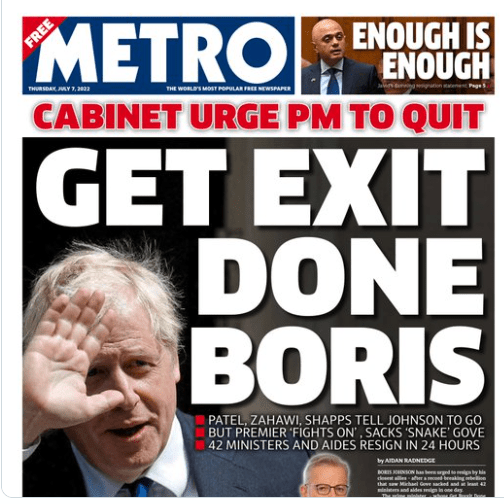
“Going! Going! Gone?” says the Metro, and it has the clever line that the prime minister has been caught in a “Pincher movement”.

“The whole rotten lot need to go” says the Record, while the Herald has “Johnson on the brink”.

It’s left to the ever-loyal Express to put a positive spin on the crisis, which it tries to paint as an opportunity for a “liberated” Johnson to lay out his “true blue Tory agenda”, perhaps hinting at past tensions with the former chancellor Sunak. It claims a coup has already failed. The headline: “Boris fights on! Declaring … I’m now free to cut taxes”.

Breaking: This morning I have written to the Parliamentary Commissioner for Standards….

…because No 10 keep changing their story and are still not telling the truth.

“I am conscious of the duty owed to the target of an investigation but I act out of the duty towards the victims. Mr Pincher deceived me and others in 2019. He cannot be allowed to use the confidentiality of the process three years ago to pursue his predatory behaviour in other contexts.” MacDonald of Salford

See tweet here

Planning applications validated by EDDC for week beginning 20 June

Stagecoach axes Exeter’s new night bus service

After being declared ‘not fit for purpose’, Exeter’s failing bus service has announced major timetable changes which include a reduction in some services, new routes and the loss of a newly the city’s recently launched night bus. Stagecoach says its new bus work is being implemented at the end of the month due to changes in peoples’ travel patterns following the Covid-19 pandemic.

Anita Merritt www.devonlive.com 

The bus service fire has come under vast criticism from dissatisfied passengers since the pandemic. Cancellations and reduced timetables have been blamed on a lack of drivers and a drop in passengers compared to pre-pandemic levels.

Exeter’s highways committee recently describing the city’s bus service as ‘not fit for purpose’. Devon County Council heard in April that it would only receive £14 million towards bus improvements as part of the government’s ‘bus back better’ programme – less than half the amount it originally bid for.

Today, July 4, Stagecoach has unveiled plans for what it calls a ‘more sustainable bus network’ to attract greater passenger numbers over the long term. The changes in Exeter, developed in consultation with Devon County Council, will be effective from July 31 and include the following:

  • Exeter Park & Ride services timing changes
  • Redesigned connections from the city centre to Exminster and Pinhoe / Science Park, affecting routes B/2B, L and K
  • Enhancement to services between Exeter and Cranbrook, with a redesigned service for journeys onto Honiton and Axminster, affecting routes 4/4A/4B. Changes will also take place beyond Seaton on and route 9A
  • Simplified services between Tiverton / Cullompton and Exeter, affecting routes 1/1A/1C
  • Exeter Night Buses will be withdrawn until the autumn with Devon County Council looking at the feasibility of an alternative solution
  • Some minor changes to the location of stand departures at Exeter Bus Station
  • A frequency change to Route 56 connecting the city centre to Exeter Airport

Stagecoach South West managing director Mike Watson said: “We have designed a new core package of services to provide a sustainable bus network now, so that we can grow services over the long term. In addition to this, with the current nationwide shortage of bus drivers, we need to concentrate our resource on the services where demand is greatest to ensure that vital journeys and connections are maintained and to provide a network that best meets the changing needs of the communities we serve.

“Buses remain fundamental to daily life in Britain. Looking ahead, they are also critical to helping achieve a green economic recovery, tackling climate change, ensuring cleaner air, and supporting connected communities.

“We will be working together with national and local government to attract more people out of their cars and onto more sustainable public transport. The more people who switch to bus, the stronger our networks will be. It can generate vital investment for more electric vehicles, helps keep fares low and ultimately will help us to expand the bus network to meet new demand.”

The changes in full can be found here

Boris Johnson was made aware of formal Chris Pincher complaint

Surprise, surprise, the story changes – Owl

Boris Johnson was made aware of a formal complaint about Chris Pincher’s “inappropriate behaviour” while Mr Pincher was a Foreign Office minister from 2019-20.

By Ione Wells www.bbc.co.uk

The complaint led to a disciplinary process which confirmed his misconduct.

BBC News understands the PM and the foreign secretary at the time – Dominic Raab – were told about the complaint.

The claim raises fresh questions about what the PM knew before making Mr Pincher deputy chief whip in February.

For days ministers have insisted Mr Johnson was not aware of specific allegations against Mr Pincher when he was appointed deputy chief whip – whose job it is to uphold discipline among fellow Tory MPs.

Mr Pincher, the MP for Tamworth, was suspended as a Conservative Party MP last week over allegations he groped two men at a private members’ club in London. He says he is seeking professional medical support and has no intention of resigning as an MP.

In the latest statement addressing what Mr Johnson knew, Downing Street said the prime minister was aware of media reports and some allegations about Mr Pincher’s misconduct that were “either resolved or did not progress to a formal complaint”.

He added: “It was in one way concluded in some form. These issues tend to be anonymous.”

Mr Pincher apologised after the disciplinary process concluded, BBC News has been told, but the MP has not responded to our request for comment.

The message from No 10 has developed since last Thursday when Mr Pincher first resigned. Since then, Mr Pincher has faced a number of historical claims, which he denies.

On Sunday and Monday morning, ministers continued to stress that Boris Johnson was not aware of specific allegations when he gave Mr Pincher his most recent government job.

But later on Monday, Downing Street conceded the prime minister was previously aware of “reports and speculation”, but nothing firmer than that.

The BBC has been told a formal complaint was made against Mr Pincher while he was serving as a Foreign Office minister from July 2019 to February 2020.

An official complaint was raised about Mr Pincher for “inappropriate behaviour” and it triggered a process, overseen by the Cabinet Office, which resulted in a report that confirmed misconduct.

Both the prime minister and Deputy Prime Minister Dominic Raab, the foreign secretary at the time, were made aware of the disciplinary process, the BBC has been told.

Mr Raab’s team have been approached for comment, and the Foreign Office said: “We have robust measures in place to respond to any allegations of inappropriate behaviour. It’s our long-standing policy not to comment on individual cases.”

On Monday evening, No 10 reiterated that the prime minister was not aware of any “specific allegations” being looked at, and that in the “absence of a formal complaint it would not be appropriate to stop the appointment”.

Mr Johnson’s allies have defended his handling of the situation, with Cabinet minister Jacob Rees-Mogg telling BBC Newsnight: “There’s always a lot of gossip going on in politics, there’s gossip about all sorts of politicians, an awful lot of which is untrue.

“You can’t hire and fire on the basis of rumour… There are rumours about so many people in politics in all parties.”

But opposition MPs have been critical, with Labour’s Daisy Cooper saying: “I think what we’ve seen time and time again with Boris Johnson is that he’s just prepared to carpet over things and try and hope they go away until they become a real problem.”

The prime minister’s official spokesman has previously said that before Mr Pincher was appointed a deputy chief whip, advice was sought from the government’s propriety and ethics team, part of the Cabinet Office, who did not advise against the move.

The spokesman declined to comment on a claim by the PM’s former chief aide Dominic Cummings that Mr Johnson had referred to the MP as “Pincher by name, pincher by nature”.

“I’m simply not going to comment on content of what was or wasn’t said in private conversations,” the spokesman said.