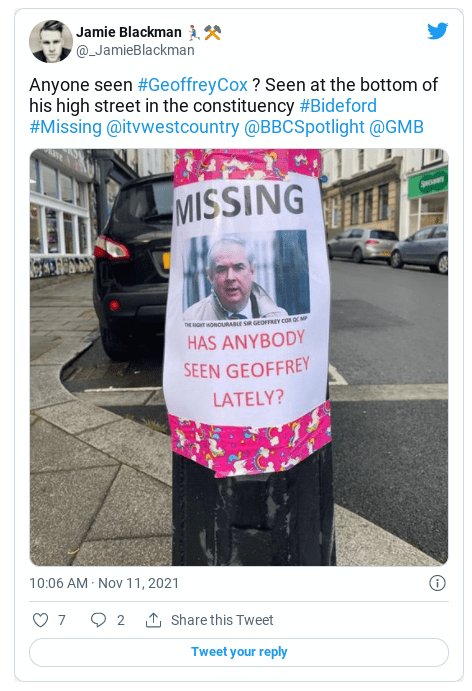
Rebel MPs told “they would lose funding for their constituency”

Today’s Politico newsletter:

The FT’s George Parker, Laura Hughes and Seb Payne reveal possible Tory rebels were told “they would lose funding for their constituency” if they voted against the amendment. A Tory veteran tells Jim Pickard: “Any MP who believed this deserves to have funding removed for being a thick gullible tw*t.” Labour’s Anneliese Dodds blasts: “Threatening to hold money back from voters and their communities, all to protect a Tory MP who broke the rules. If true this marks a new low for Johnson’s scandal-ridden Conservatives.”

UK Covid cases may have peaked for this year, study suggests

“A worrying trend was the rise in cases in older and much more vulnerable people”

Ian Sample www.theguardian.com 

Scientists on the Zoe Covid study believe UK cases of coronavirus may have peaked for the year, a suggestion that prompted some experts to warn that it was too soon to know how the epidemic would play out in the weeks ahead.

The study, which estimates the number of Covid cases in the community from the information that users log on an app, found a clear decline in cases in under-18s since mid-October, with infection rates levelling off in most other age groups though still climbing in 55- to 75-year-olds.

The trends are based on 42,359 swab tests taken between 16 and 30 October and point to 88,592 daily symptomatic cases, a decrease of 4.7% on the previous week’s Zoe data. The numbers equate to one in 53 people in the UK currently with symptomatic Covid infections.

“Young people have been driving the big numbers of cases, and the big numbers look from our data to have finished,” said Prof Tim Spector, the lead scientist on the Zoe study, at King’s College London. “There are multiple reasons behind it, but a lot is driven by the pattern we are seeing with kids, plus the history of the past waves.”

It comes as figures on Thursday showed that 37,269 people across the UK tested positive for Covid in the previous 24 hours, a small drop on the 41,299 seen the day before. However, the number of deaths within 28 days of a positive Covid test recorded over the same period – 214 – was almost the same as the 217 reported the previous day.

In the autumn term Covid infections have soared in secondary school children, a cohort largely unprotected because of the slow rollout of vaccines to the age group. The Office for National Statistics estimates that more than 9% of children in years seven to 11 were infected in the week ending 22 October.

But the sustained high rates of infection in schools have driven up levels of immunity to the virus and at some point, with help from vaccinations, cases are expected to fall back down. Outbreak modellers expect this to happen unevenly across the country, with hard-hit areas such as London among the first to see cases drop in the age group.

What is unclear is when infection rates at schools will peak. Scientists on the React study, at Imperial College, have reported similar evidence for a downturn in cases at the end of October, but warned that the decline could be temporary and driven by children being out of school for half-term.

Kevin McConway, an emeritus professor of applied statistics at the Open University, said cases had fallen for only a short time and what would happen next was highly uncertain. “While I very much hope personally that the decline continues, I really don’t think we can be anywhere near certain that it will,” he said.

He added that while the Zoe study provided some plausible reasons for cases to keep falling, a lot seemed to be “expressions of hope more than definite predictions”. McConway said: “We can hope that the peak for 2021 has been reached, but we still need to plan accordingly for what should be done if it hasn’t been reached.”

Mark Woolhouse, a professor of infectious disease epidemiology at Edinburgh University, said a worrying trend was the rise in cases in older and much more vulnerable people. “Even though the vaccines give very good protection against severe disease they do not give complete protection, and these age groups continue to dominate hospital cases. I would not want to conclude that the UK Covid-19 pandemic is in decline until it declines in older and more vulnerable age groups. That has not happened yet.”

Simon Jupp MP asks for a discussion on second home council tax relief at PMQs

But does does Boris care? – Owl

Simon Jupp Conservative, East Devon

House prices are rising in East Devon, with the dream of home ownership becoming out of reach for too many local people. New-build developments must be affordable, with protections in place to restrict the number of properties becoming second homes. The loophole that allows second-home owners to avoid paying council tax should be closed quickly to help local authorities. Will the Prime Minister meet me and colleagues from across the south-west to discuss this growing crisis across our region?

Boris Johnson The Prime Minister, Leader of the Conservative Party, The Prime Minister

I know how strongly my hon. Friend and other colleagues across the south-west feel about this issue. That is why we have legislated to introduce higher rates of stamp duty on second homes. We will ensure that only genuine holiday businesses can access small business rates relief, but I am certainly happy to meet colleagues to discuss what further we may do to ensure that local people get the homes that they need.

MPs receiving tens of thousands for consultancy work

MPs are being paid tens of thousands of pounds a year to act as consultants and advisers for a range of companies, with some receiving many times their parliamentary salary.

Christopher McKeon www.standard.co.uk

Analysis of the Register of Members’ Financial Interests shows 34 MPs listing payments for consultancy or advisory work.

They include Owen Paterson who was found by the Standards Committee to have engaged in “egregious” lobbying on behalf of two companies that paid him a combined total of more than £100,000 per year.

There are no rules against MPs being paid for advising external businesses, provided they record it in their register of interests, but they must not lobby the Government on behalf of those businesses.

Mr Paterson, who is employed by diagnostics company Randox and sausage-maker Lynn’s Country Foods, is one of two MPs to be paid more than £100,000 for consultancy or advisory work.

The highest paid is former international development secretary Andrew Mitchell, who receives £182,600 per year for 32.5 days working for firms including investment companies Investec, SouthBridge and Kingsley Capital Partners, along with accountants Ernst & Young and consultants Montrose Associates.

Other MPs paid more than £100,000 per year for consulting work include former cabinet minister Chris Grayling who is paid £100,000 annually by Hutchison Ports Europe, and Chief Whip Julian Smith who receives a total of £144,000 per year from three companies.

Mark Garnier, a former international trade minister, earned more than his £81,932 annual parliamentary salary for consultancy work. He is paid £90,000 by two companies in the space sector – Laser Light Communications and Shetland Space Centre.

Some MPs also operate their own consultancy firms. Sir Bob Neill is the sole director of RJMN Ltd, which advanced him an interest-free loan of £68,000 in the 2019/20 financial year, according to its most recent accounts.

Mark Pritchard also owns a consultancy firm, Mark Pritchard Advisory Ltd, which made profits of £27,299 in the 2020/21 financial year and paid dividends of £13,000.

Here is a list of MPs receiving payments for consultancy or advisory work. It does not include all second jobs listed by MPs, with some continuing to work as lawyers, doctors and nurses, while others are listed as directors of companies. The list is predominantly Tory MPs, apart from Lib Dem leader Sir Ed Davey.

Conor Burns

– Trant Engineering, £40,000pa for 120 hours

Sir Graham Brady

– Snowshill Allied Holdings Ltd, £10,000pa for 12 hours

Andrew Bridgen

– Mere Plantations Ltd, £12,000pa for 96 hours

Steve Brine

– Remedium Partners, £19,200pa for 96 hours

– Microlink PC (UK) Ltd, £19,200pa for 96 hours

– Sigma, £19,992pa for 96 hours

– Total £58,392pa for 288 hours

Alun Cairns

– BBI Group (life sciences), £15,000pa for 70 hours

– Veezu Holdings (private hire transport), £15,000pa for 70 hours

– Elite Partners Capital Pte Ltd (property investment), £30,000pa for 84 hours

– Total £60,000pa for 70 hours

Sir Ed Davey

– Herbert Smith Freehills, political issues and policy analysis, £60,000pa for 72 hours

– Next Energy Capital, member of advisory board, £18,000pa for 48 hours

– Total £78,000 for 120 hours – money used to benefit Sir Ed’s disabled son

Philip Davies

– National Pawnbroking Association, £12,000pa for 60-120 hours

David Davis

– THI Holdings GmbH (German investment company), £33,900pa for 16 hours

– Chairs supervisory board of Kohlgartenstrasse 15 Verwaltungs AG (German property company), £16,948pa for 168 hours

– Total £50,848 for 184 hours

Sir Iain Duncan Smith

– International advisory board of Tunstall Health Group, £20,000pa for 30 hours

– Byotrol Technology Ltd, £25,000pa for 144 hours

– Total £45,000pa for 174 hours

Ruth Edwards

– MHR International ltd (HR software), £60,000pa for 192 hours

Ben Everitt

– Institute of Chartered Accountants in England and Wales, £15,000pa for 60-80 hours

Richard Fuller

– Investcorp Securities director, £20,000pa for 48 hours (plus additional £29,900 for 19 hours in 2021 so far)

Mark Garnier

– Laser Light Communications (satellites), £60,000pa for 120 hours

– Shetland Space Centre, £30,000pa for 120 hours

– Total £90,000 for 240 hours

Chris Grayling

– Hutchison Ports Europe, £100,000pa for 84 hours

Damian Green

– Abellio Transport Holdings, on rail policy, £40,000 pa for 288 hours

Stephen Hammond

– Darwin Alternative Investments, £60,000pa for 50-100 hours

Sir John Hayes

– BB Energy Trading Ltd, £50,000pa for 80-90 hours

Daniel Kawczynski

– The Electrum Group, £36,000pa for 360 hours

Sir Greg Knight

– Cambridge and Counties Bank Ltd, £16,000pa for 108 hours

Andrew Lewer

– Penelope Thornton Hotels, £4,800pa for 48 hours

Tim Loughton

– Outcomes First Group, £37,000pa for 144 hours

Paul Maynard

– Link Scheme Ltd (cash machines), £6,250pa for 32 hours – money paid direct to charity

Andrew Mitchell

– Investec, £12,000pa for two days

– Montrose Associates, £36,000pa for 8 days

– Ernst & Young, £30,000pa for five days

– Arch Emerging Partners, £15,000pa for 2.5 days

– SouthBridge, adviser on African matters to Rwanda-based company, £39,600pa for 9 days

– Kingsley Capital Partners, £50,000pa for 8 days plus share options

– Total £182,600 for 34.5 days

Sir Robert Neill

– Weightmans LLP, £15,000pa for 72 hours

– Substantia Group, £12,000pa for 72 hours

– Masonic Charitable Foundation, £7,500 for 10 hours (one-off payment)

– Total £34,500 for 154 hours

Owen Paterson

– Randox Laboratories, £99,996pa for 192 hours

– Lynn’s Country Foods, £12,000pa for 24 hours

– Total £111,996 for 216 hours

Andrew Percy

– Iogen Corporation (Canada), a clean energy company, £36,000pa for 36 hours

Mark Pritchard

– Consumer Credit Association, £18,000pa for 96 hours (a client of Mark Pritchard Advisory)

John Redwood

– Epic Private Equity, £5,000pa for 12 hours

Laurence Robertson

– Betting and Gaming Council, £24,000pa for 120 hours

Dean Russell

– EPIFNY Consulting, £2,000 for 28 hours in 2021

Chris Skidmore

– Oxford International Education Group, £10,000pa for 48-96 hours

Julian Smith

– Ryse Hydrogen Ltd, £60,000pa for 20 hours

– Simply Blue Management (UK) Ltd, £24,000pa for 12-24 hours

– MJM Marine Ltd, £60,000pa for 30-40 hours

– Total £144,000pa for 62-84 hours

Royston Smith

– Barker Mill Estates, £18,000 for 90 hours since May 2020

Who did Boris Johnson choose to chair his review of Standards?

You couldn’t make this up:

The committee was to be chaired by the former culture secretary John Whittingdale. He was investigated by a previous parliamentary commissioner for standards over an undeclared trip to the MTV Europe awards in Amsterdam in 2013 with his then girlfriend, a dominatrix sex worker. The cost of the flights, hotel bill and entertainment, were covered by MTV.

www.theguardian.com

22 Tory MPs who were investigated or punished by Parliament’s watchdog joined the vote to overhaul it

Of course, they’re self interested Tories – Owl

Politico newsletter yesterday:

Insider’s Henry Dyer has done some excellent analysis and found 22 of the Tory MPs who voted for the Leadsom amendment are either under current investigation by the Parliamentary Commissioner for Standards or have had allegations upheld against them since the 2019 general election. Funnily enough there were not many declarations of interest on that front. The vote also saw the frankly ridiculous situation where Paterson was allowed to vote on his own case rather than recuse himself, which pretty much says it all.

The 19 Leadsom backers who have had complaints upheld against them:Adam AfriyieScott BentonCrispin Blunt Peter BoneMaria CaulfieldRobert CourtsRichard DraxDavid DuguidIain Duncan SmithMark FrancoisGeorge FreemanAdam HollowayKarl McCartneyNatalie ElphickeRoger GaleTheresa VilliersBob StewartChloe Smith … and Craig Tracey.

The 3 Leadsom backers currently under investigation: James Cleverly Daniel KawczynskiDavid Warburton. If these 22 MPs can’t see why it’s inappropriate for them to be voting to effectively get rid of the current standards process then Playbook can’t help them.

Sleaze will eventually sink the Tories

Andrew Rawnsley looking into his crystal ball in April.

Tories are wrong to think that they will never face a day of reckoning for sleaze.

www.theguardian.com (last two paragraphs)

What won’t fundamentally alter is the character of Mr Johnson’s government. If you’ve missed the latest sleaze story, don’t worry, another one will be along in a minute. As I like to remark from time to time, the personality of institutions is hugely influenced by the example set by the person at the top. When the prime minister is a man with a lifelong contempt for the norms of decent behaviour and a career history of behaving as if he can get away with anything, the government is going to reflect his amoral character. Never forget that Mr Cummings was not sacked when he went for his lockdown-busting excursions around Durham, an example of “one rule for them” that mightily cut through to the public. They only parted company months later when the svengali fell out with the prime minister’s fiancee.

A culture of impunity in which unethical behaviour, however outrageous, never goes punished, is pretty much a guarantee of even worse to come in the future. I cannot tell you how the Johnson government will end or when, but it will surely not be a happily ever after. Sleaze may not catch up with the Tories tomorrow or next week or next month or even next year, but there will be a day of reckoning. To paraphrase Ernest Hemingway, governments become bankrupt in the eyes of the voters gradually, then suddenly.

PM “leading his troops through the sewer” does another screeching U-Turn

Using Sir Keir Starmers’ description, as he accuses Boris Johnson of “corruption that goes to the very top”.

And we all know that under this Government, the sewer is not a good place to be.

“Stretching credulity” Commons watchdog’s responses to embattled politician’s claims

He convinced the government and some backbenchers, does he convince you? – Owl

Aubrey Allegretti www.theguardian.com 

At the final hour the Tory MP Owen Paterson escaped an immediate 30-day suspension from the House of Commons for an “egregious” breach of lobbying rules, and avoided a possible byelection.

He convinced the government and some fellow backbenchers to vote to spare him from the sanction, which was recommended by the standards committee watchdog, and to instead refer his case to a new committee chaired by a Conservative former cabinet minister, John Whittingdale.

Although Paterson, the MP for North Shropshire, protested his innocence, several of those who backed reform of the standards system still believe he broke the rules and should be punished. It will now be up to the new committee to assess the evidence and make recommendations about what should happen to him.

Here are the claims Paterson made, along with analysis of how they stack up.

Paterson’s claim: He made approaches to government bodies about two firms, Randox and Lynn’s Country Foods, which employed him as a consultant. The MP said he was acting as a whistleblower in raising concerns about milk and pork standards and that this meant he could claim an exemption from the rules regarding paid advocacy because he was raising a “serious wrong”.

Watchdog response: While this excuse would have been permissible for an initial approach, Patterson’s investigators said it did not cover his follow-up letters and meetings. “What might have been permissible in a single exceptional case, became Paterson’s standard practice,” said the standards commissioner, Kathryn Stone, adding that it “stretches credulity to suggest that 14 approaches to ministers and public officials were all attempts to avert a serious wrong rather than to favour Randox and Lynn’s, however much Paterson may have persuaded himself he is in the right.”

The committee agreed. It said Paterson’s follow-up approaches “sought to promote Randox products” by praising their “superior technology” and that he promoted other unrelated products from the company. “These were all attempts to confer a benefit on Randox, to whom he was a paid consultant,” it found. “At best, Paterson was relying on an exemption he thought probably existed but of whose terms he was unsure. At worst, Paterson was knowingly in breach of the lobbying rules.”

The committee also agreed that Paterson’s attempts to get one of Lynn’s Country Foods’ competitors to relabel their product so as not to compete with Lynn’s own nitrite-free goods, as well his asking for this to be promoted in the press, was not incidental.

Paterson was paid more than £100,000 for his work for Randox and Lynn’s, and the committee was clear. “The paid advocacy rule does not distinguish between lobbying for good causes and lobbying for bad causes. It only applies to lobbying for reward or consideration.” It added that Paterson “went beyond presenting evidence of a serious wrong” in his follow-up approaches to the Food Standards Agency about milk testing.

Paterson’s claim: Paterson said the investigation against him was biased because the commissioner did not interview 17 witnesses who wanted to defend him and provide testimony about what was discussed at various meetings.

Watchdog response: The 17 witnesses provided written statements, which the standards committee said they received and read. However, the committee said that they “do not see what further relevant information could usefully be gleaned by inviting oral evidence from the witnesses concerned”.

Paterson claimed the witnesses would testify that his intentions were good. But the committee said “subjective motivation is not the test under the lobbying rules” and that seven of the 14 approaches found to be in breach of paid advocacy rules were emails or letters from Paterson personally, meaning oral evidence from those who supported him was unlikely to materially alter its conclusions.

Paterson’s claim: His only admission of wrongdoing was having written two letters on Commons-headed taxpayer-funded notepaper. But the major misuse of facilities he denied was hosting meetings in his parliamentary office 16 times between October 2016 and February 2020. He admitted holding the meetings but said the use of his office was “occasional”, and whips told MPs to remain on the estate because parliamentary business at that time was unpredictable.

Watchdog response: It came down to a matter of interpretation but the committee said the number of meetings clearly “went beyond the latitude normally afforded under the rules”. Paterson claimed he “kept his commercial interests entirely separate from his parliamentary activities” but the committee said he should not have used his parliamentary office to conduct business meetings with his paying clients, and that it was trying to take a proportionate and consistent approach with previous rulings on similar issues.

Paterson’s claim: Paterson said the “manner” of the standards commissioner’s pursuit of the inquiry played a major role in driving his wife, Rose, to take her own life last summer at the age of 63.

Watchdog response: While this was his belief, the committee called it an “unsubstantiated, serious and personal” allegation against the integrity of the commissioner and her team, who were unable to respond publicly.

Sleaze – it’s more than just the Patterson case

Is worry over future inquiries driving PM to change watchdog?

Three times Boris Johnson has been investigated by the Commons’ standards watchdog, which is more than any other UK MP in the last three years.

Rowena Mason www.theguardian.com 

And now the prime minister is facing a fourth possible inquiry by Kathryn Stone, the parliamentary standards commissioner, this time over the funding of his Downing Street flat refurbishment.

With a decision on a fresh investigation due within a matter of weeks, some are raising eyebrows about the timing of Johnson’s move to undermine and overhaul the whole standards system. Others are saying that the system is ripe for reform but it it needs to be stricter or to outlaw lobbying by MPs altogether.

Ostensibly, the Tory plan which emerged this week to introduce a new body for MPs to challenge decisions by the standards committee is to save Owen Paterson’s bacon. The veteran backbencher was facing 30 days suspension from parliament for lobbying government bodies on behalf of firms which paid him more than £100,000 – as revealed by the Guardian two years ago.

No 10 argues that the plan is simply about trying to create a fair system which allows an MP the right of appeal.

But one Tory MP believed the motivation for a shake-up was worry in Downing Street about further standards investigations coming down the track – particularly potential inquiries into lobbying over the award of Covid contracts, and into the prime minister’s loans from a Tory donor for the redecoration of his flat at No 11 Downing Street.

For years there have been warnings that the government has been going in the wrong direction when it comes to tackling inappropriate lobbying and transparency standards, all issues associated with the whiff of corruption and “Tory sleaze”.

As recently as Monday a report by the committee on standards in public life, led by the former spy chief Jonathan Evans, argued that sweeping changes to the system were needed, particularly when it came to oversight of ministers’ behaviour and lobbying by those formerly in power.

The report did not make any recommendations on the standards system for MPs, which is widely seen as imperfect but relatively effective, even though some would like to see the rules tightened further to ban parliamentarians’ second jobs altogether.

Paid advocacy by MPs has been banned in some form or other since 1695, according to Chris Bryant, chair of the standards committee. The ban on direct lobbying was formalised after the cash for questions scandals of the 1990s. The standards commissioner and the standards committee of MPs and independent members, have repeatedly enforced those rules when breaches, such as in the case of Paterson, have been brought to their attention.

But even with the prohibition in place, MPs can legitimately have second jobs advising companies on politics and policy. As an example of the revolving door, Sajid Javid, now the health secretary, was paid £150,000 a year by the investment bank JP Morgan shortly after leaving office as chancellor of the exchequer.

The list of Tories, in particular, with second jobs in areas of their policy expertise is long, with many former ministers now working in the sectors they used to govern. Some advise hotel chains, investment companies, property developers; one link is with a gambling firm.

The fine print also allows some wriggle room. MPs can engage in lobbying if it is “six months after the reward or consideration was received”. They are not allowed to speak in the Commons, make approaches to ministers, vote, or initiate parliamentary proceedings, in return for direct payment in cash or kind.

However, they are allowed to participate in parliamentary proceedings and conversations with ministers that would financially benefit their client as long as they did not start the interaction, the interest is declared and is not for the sole benefit of their client.

Former ministers and public officials can also engage in lobbying just two years after leaving office, under the rules of the Advisory Committee on Business Appointments (Acoba). In practice, some are suspected of doing so under the radar before then, since the watchdog for enforcing lobbying prohibitions has no power to sanction them.

The Greensill scandal, in which the former prime minister David Cameron pestered senior ministers for favours on behalf of his new employer, the supply chain financier Greensill Capital, shows the extent to which intensive lobbying is still permitted. An official parliamentary inquiry found Cameron showed a “significant lack of judgment” but did not breach lobbying rules.

While scandals about lobbying and financial interests of politicians are nothing new, a number of experts, academics – and some MPs themselves – believe standards are being further eroded under the present government. Bryant warned that the public “will think we are the parliament that sanctioned cash for questions”.

Robert Barrington, professor at the Centre for the Study of Corruption, at the University of Sussex and a former government adviser, said on Wednesday that the Paterson case only “illustrates the crisis of standards that is currently undermining democracy in the UK”.

He concluded: “[It is] hard to avoid the conclusion that there is an effort to change the rules when it suits, with arguments based solely on party or tribal loyalty and not any basis of principles or standards. Perhaps that is the luxury of an 80-seat majority.”

Daniel Bruce, chief executive of Transparency International, also said the “direction of travel” had to change in light of recent cases where the prime minister and government had overridden decisions by standards bodies.

Bruce said: “Coming into this year we have a vacuum of oversight on the ministerial code after the Priti Patel [bullying] case when the independent adviser resigned. We’ve had the commission on the appointments to the upper house overruled by the prime minister when the commissioner took a view that a Conservative donor should not get a peerage. We’ve got this woefully inadequate picture of lobbying of the government. We’ve got a decade of decline in FoI [freedom of information] requests being granted in full. Those are four very concerning areas.

“And yet what do we have this week? We now have government-backed attempts to dismantle a system of oversight set up in the height of 1990s sleaze and further strengthened after the MPs expenses saga of 2009 … The very obvious timing of this proposed review to suspend a suspension suggests this is very partisan.”

Bruce said Transparency International had monitored suspected breaches of parliamentary conduct rules and the ministerial code, finding 30 breaches that were not investigated or where no action was taken in 2020.

“The number of cases where questionable behaviour goes un-investigated has intensified in the last few years under this current administration,” he said. “That is the concern, and I await with keen interest the government’s full response to the committee on standards report because as far as I am concerned there is no turning away from that.”

Rising sea levels would flood major towns

As global leaders discuss tackling climate change at the Cop26 summit in Glasgow, a map shows how rising sea levels could change the shape of Devon’s coastlines forever.

Edward Oldfield www.devonlive.com

The map produced by Climate Central using the latest sea level predictions shows the land which would be below the annual flood level in 2050.

The projections do not take into coast and river defences, which are designed to hold back the waters to protect homes and businesses.

The map shows how an expected increase in the sea level of up to 29cm (11 inches) over the next 30 years could see unprotected land underwater from flooding. It shows how the sea could inundate low-lying coastal areas, and the vital importance of defences to protect homes and businesses.

Low-lying areas of the Devon coast are particularly at risk from tidal flooding, and an increase in storms from climate change could also speed up erosion. Changing weather patterns are seeing more rainfall, which increases the flood risk from rivers.

Coastal features including Northam Burrows near Bideford, and Dawlish Warren, could be at risk from extreme weather, as both appear below the predicted annual flood level for 2050.

The government is funding a series of schemes across Devon as part of a new £5.2billion six-year programme of investment in flood and coastal defences announced in July to protect the most at-risk properties, doubling the amount spent in the previous six years.

Key flood defence schemes include a completed £32million scheme alongside the River Exe at Exeter, and plans for a flood wall along the seafront at Paignton and Preston on the south Devon coast. The effect of storms has already been widely seen, including a major breach of the railway line at Dawlish in 2014, and the main A379 road partly washed away at Slapton in 2018.

The government has set out a strategy to reach Net Zero by 2050 – the point when the output of greenhouse gases responsible for global warming like carbon dioxide is reduced and equals the measures to take them out of the atmosphere.

Around Devon, the Climate Centre map shows that along the coast and estuaries, the land including roads and beaches would be below the 2050 annual flood level.

The map uses the latest predictions of global future sea levels agreed by the Intergovernmental Panel on Climate Change (IPCC), the United Nations body for assessing the science related to climate change, released in August.

Totnes

The map shows land alongside the River Dart which would be below the annual flood level by 2050.

Slapton

The red area shows the land forecast to be below the annual flood level in 2050, including the stretch of the A379 coast road.

Dawlish and Exmouth

The red area includes most of Dawlish Warren, a sandy headland in the mouth of the River Exe, where a £14million beach management scheme to strengthen defences has been carried out. The map also shows the parts of Exmouth at risk from flooding, which have been protected by a recent £12million tidal defence scheme.

Exeter

Low-lying land alongside the River Exe and estuary is at risk, as is land alongside the River Clyst. Recent flood defence works have taken place to protect homes and businesses from river flooding at Exeter and Clyst St Mary. A tidal defence scheme is in development for Topsham, and repairs planned at Bowling Green Marsh.

Newton Abbot

Large areas of land alongside the River Teign are forecast to be at risk from flooding, including Newton Abbot racecourse.

Torquay

Torquay seafront already sees flooding at some high tides, particularly the low-lying land in front of Torre Abbey, and parts including Princess Gardens are on land reclaimed from the sea.

Paignton

Plans are being drawn up for a new sea wall to protect the low-lying town centre from predicted flooding due to rising sea levels.

Teignmouth

Sitting at the mouth of the River Teign, stretches of the estuaryside are predicted to be below the annual flood level by 2050.

Budleigh Salterton

Land alongside the River Otter experiences flooding, and a £15million project is underway to restore the flood plain, allowing the land to flood naturally.

Barnstaple and Bideford

The estuaries of the Taw and Torridge feature on the map where land is predicted to be below the 2050 annual flood level, including Northam Burrows, a sandy headland in the mouth of the estuary. A tidal flood scheme is in development at Bideford, and a defence scheme is being drawn up at Westward Ho!

Dartmouth

The River Dart is forecast to see riverside land below the annual flood level, including parts of the town centre nearest the water.

What is Cop26 Glasgow all about?

The UK Environment Agency says the impact of global warming and climate change is expected to result in the sea level rising by up to 29cm around the UK over the next 30 years, as polar ice melts and seas expand. It warns if temperatures rise by 2 degrees C, the rise would be 45cm (18 inches) by the 2080s, or 78cm (31 inches) if the world heats up by more.

Aerial photo of Dawlish Warren at the mouth of the Exe Estuary, opposite Exmouth

Aerial photo of Dawlish Warren at the mouth of the Exe Estuary, opposite Exmouth (Image: Environment Agency)

120 world leaders have gathered in Glasgow for the Cop26 summit , with the goal reducing greenhouse gases to limit global warming to 1.5C, or at worst 2C, by 2100. But there is a warning that we are on track for 2.7C which the UN says would result in “climate catastrophe”.

In Glasgow, UN Secretary-General Antonio Guterres told the Cop26 summit the world’s “addiction to fossil fuels is pushing humanity to the brink”. Pointing to melting glaciers, relentless extreme weather events, sea level rise and overheating oceans, he warned: “We are digging our own graves”.

Prime minister Boris Johnson warned of the dangers of rising temperatures, jeopardising food supplies for hundreds of millions of people, more wildfires and eventually the loss of whole cities such as Miami, Alexandria and Shanghai. “The longer we fail to act and the worse it gets and the higher the price when we are forced by catastrophe to act,” he said.

What does the Environment Agency say about climate change?

The Environment Agency says that adaptation – becoming resilient to the already inevitable effects of climate change – is just as important as actions to cut greenhouse gases.

It is a case of “adapt or die”, the Agency’s chairwoman Emma Howard Boyd said, warning that deadly events such as the flooding in Germany this summer would hit here if the country did not make itself resilient to the more violent weather the climate emergency was bringing.

In a report to the Government, the EA said climate change would exacerbate the pressure on England’s water environment, which is suffering from problems such as pollution and increased water demand, and make it harder to ensure clean and plentiful water.

The agency alone cannot protect everyone from increasing flood and coastal risks, and traditional flood defences will not be able to prevent all flooding and coastal erosion, the report said.

There will be more and worse environmental incidents, such as flooding, water shortages and pollution, regulation is not ready for climate change and the natural world cannot adapt as fast as the climate is changing, the EA said.

What is the government doing to build flood defences?

In July 2021, six months after the nation was battered by Storm Christoph, environment secretary George Eustice announced £5.2 billion of investment in a new six-year flood and coastal defence investment programme in England from for 2021 to 2027.

This will fund around 2,000 new defence schemes to better protect 336,000 properties. The investment is double the £2.6billion of the first six-year programme which ended in 2021, protecting more than 300,000 homes and businesses.

The programme includes 2,000 new defence projects, as well as maintaining existing schemes, and in total is predicted to avoid around £32billion of economic damage.

The report says: “The risks from flooding and coastal erosion are significant and continue to grow.”

It adds: “Flooding and coastal erosion can be devastating. As well as the potential for loss of life and damage to property, they can impact our businesses and livelihoods, and affect our health and wellbeing. The risks we face are significant and continue to grow.

“Climate change is leading to rising sea levels and warmer and wetter winters, together with an increase in the frequency and intensity of extreme events such as heavy rainfall, coastal erosion and landslips.”

Sleaze: How did your MP vote?

Before we get to that here is the Daily Mail comment:

Owen Paterson scandal is proof this overmighty government is content to twist rules www.dailymail.co.uk 

This where you can find how Simon Jupp MP and Neil Parish MP voted (one recorded no vote the other voted aye)

https://votes.parliament.uk/Votes/Commons/Division/1124#ayes

Here are their email addresses should you be inclined to give them your views on the subject.

simon.jupp.mp@parliament.uk

neil.parish.mp@parliament.uk

Sleazy does it

So we’re back in the Tory sleazy 90s. Remember Neil Hamilton?

His political downfall came in 1996, after the Guardian reported under the headlines “A liar and a cheat” that he had taken money in brown envelopes from Mohamed Al Fayed in the “cash-for-questions” scandal. His libel suit against the paper collapsed, leading to this infamous headline and his resignation from government. He went on to lose his Tatton seat to journalist Martin Bell in 1997’s general election.

Thirty years on:

5 Times MPs Angered The Public With Their ‘Sleazy’ Scandals

Kate Nicholson www.huffingtonpost.co.uk 

As Tories MPs have been accused of dragging politics back to the “worst of 1990s sleaze culture” with the latest controversy in parliament, here’s a glance back at some of the most jaw-dropping times MPs have breached the rules.

1. Paterson gets away with lobbying breach

Tory MP Owen Paterson divided Westminster after an inquiry found he had breached parliamentary lobby rules last week.

Paterson was accused of using his position as an MP to the benefit of two separate companies which paid him £100,000 a year to act as a consultant.

Paterson rejected the inquiry and said he was only mentioning safety benefits to other MPs – but the cross-party committee which organised the inquiry swept his protestations aside and claim there is a lot of evidence to suggest otherwise.

Then on Wednesday, MPs – most of whom were Tory – voted in parliament and rejected the committee’s suggestion he should be suspended for 30 days amid attempts to create a completely new watchdog for the MPs.

This has caused widespread controversy, with Labour calling it a return to the worst of the “sleaze” seen in the 90s.

2. Ongoing cronyism

Matt Hancock, then health secretary, was found to have acted unlawfully after of not disclosing the full details of the contracts signed during the Covid pandemic in 2020.

He also broke ministerial code by failing to declare that he had a stake in a family company which won a Covid contract.

Similarly, Michael Gove was found in 2021 to have acted unlawfully when he awarded a contract to a polling company run by one of his associates.

Neither minister left cabinet after such details were revealed.

Contracts worth close to £3.5 billion have been awarded firms with links to the Tory Party, according to Labour.

3. One rule for the public, another for us

Hancock did actually resign after The Sun published security camera photographs capturing the then health secretary kissing one of his married aides in an office in 2021.

While the affair alone stunned the public, it was actually the flouting of the social distancing rules which Hancock himself had advocated for which ground everyone’s gears. Even so, the prime minister did not fire Hancock – he stepped down on his own accord in June this year.

Boris Johnson has recently faced further accusations that he has not followed his own rules after it was claimed that his friend, Nimco Ali, spent Christmas with him last year when mixing was not permitted between households.

However, Downing Street defended the prime minister and said she was part of Johnson’s “childcare bubble”.

4. Expenses scandal

The expenses’ scandal of 2009 saw MPs claim money on a range of ridiculous items which stunned the nation, but many of them did lose their jobs when their claims were revealed.

Sir Peter Viggers, for instance, was paid more than £30,000 for gardening expenses across three years – he admitted claiming £1,645 for a ‘duck island’ alone alone and put in claims for 28 tonnes of manure.

He was told to step down when the revelations came to light.

Another Tory MP Anthony Steen also stood down after claiming the cost of a forestry specialist to inspect 500 trees on his estate.

Senior Tory MP Bill Cash claimed more than £15,000 in expenses to cover his daughter’s rent for her London flat while Labour MP Rosie Winterton tried to put in a triple-digit claim for soundproofing her bedroom – the list went on and on and left the country furious.

5. Robert Jenrick and the planning row

Former housing secretary Robert Jenrick faced calls to resign after he was found to have been involved in a controversial £1 billion development led by a Conservative Party donor.

Jenrick went against the recommendations of a planning inspector and approved the building of 1,500-home development in the Isle of Dogs –  even though the local council had also rejected the idea because it did not include enough affordable house.

He did not resign but was pushed out of the role in Boris Johnson’s recent cabinet reshuffle.

Boris Johnson to back bid to overturn Owen Paterson lobbying inquiry

Standards in Public life should be sacrosanct – not to be cherry picked to justify sleaze – Owl

According to the Guardian, Boris Johnson will back an unprecedented bid to overthrow an independent inquiry that found the former cabinet minister Owen Paterson committed an “egregious” breach of lobbying rules.

Tory MPs will be instructed by party whips on Wednesday to avoid imposing an immediate 30-day suspension on their colleague by backing a motion that argues the initial probe by the parliamentary standards commissioner was flawed. Instead, a new committee would be set up to review the evidence.

Whether the amendments are selected will be a matter for the Commons Speaker, Lindsay Hoyle. He will announce on Wednesday afternoon which – if any – will be voted on when MPs begin a 90-minute debate on the report into Paterson released last week.

Here are the Committee on Standards in Public Life conclusions that led to their recommended sanctions.

The Committee’s conclusions and recommended sanctions

The Committee commented that it does not doubt that Mr Paterson sincerely believes that he has acted properly. Mr Paterson is clearly convinced in his own mind that there could be no conflict between his private interest and the public interest in his actions in this case. But it is this same conviction that meant that Mr Paterson failed to establish the proper boundaries between his private commercial work and his parliamentary activities, as set out in the Guide to the Rules. The Committee concluded that being able to judge the difference between one’s private, personal interest and the public interest is at the very heart of public service and a senior member of the House with many years standing should be able to make that distinction more clearly.

In accordance with normal practice, before considering sanctions the Committee noted any aggravating or mitigating factors in the case. Aggravating factors included:

  • No previous case of paid advocacy has seen so many breaches or such a clear pattern of behaviour in failing to separate private and public interests.
  • Mr Paterson’s financial remuneration from Randox and Lynn’s amounted to nearly three times his annual parliamentary salary.
  • Mr Paterson’s actions demonstrate a failure to uphold the Seven Principles of Public Life.
  • Mr Paterson has made serious, personal, and unsubstantiated allegations against the integrity of the Commissioner and her team.
  • Mr Paterson is a former Minister, and an experienced long-serving Member of the House.

The Committee also noted mitigating factors, including:

  • Mr Paterson’s wife took her own life in June 2020. The Committee consider it very possible that grief and distress caused by this event has affected the way in which Mr Paterson approached the Commissioner’s investigation thereafter.
  • In respect of the breaches relating to use of his parliamentary office, Mr Paterson had suffered a period of ill health which made him less able easily to leave the parliamentary estate.
  • Regarding the breaches of paid advocacy rules, Mr Paterson has an evident passion for and expertise in food and farming matters which, in itself, is admirable, as long as it is channelled within the rules of the House.

The Committee determined that Mr Paterson’s actions, in particular those relating to paid advocacy, constitute a serious breach of the rules.

The Committee found that Mr Paterson’s actions were an egregious case of paid advocacy, that he repeatedly used his privileged position to benefit two companies for whom he was a paid consultant, and that this has brought the House into disrepute.

In line with previous cases of a similar severity, the Committee recommends that Mr Paterson be suspended from the service of the House for 30 sitting days.

As the Government Deputy Chief Whip confirmed on 9 September 2021, it is the usual practice for the relevant motions to be tabled by the Government and debated as soon as possible. The Committee recorded its expectation that this should be within five sitting days of the publication of the report.

Cash-strapped councils must sell off town halls and public toilets, warns minister

How is that going to help? 

Think of it in a local context. Would  EDDC get £10 million + inflation for their new HQ!

EDDC is already the buyer of last resort for failing leisure centres.

And who will buy public toilets – maybe get them sponsored but not by South West Water!

Perhaps, in extremis, Clinton Devon Estates would take back the car parks on Woodbury Common! – Owl

Patrick Butler www.theguardian.com 

Two struggling councils have been warned they face government intervention unless they selloff publicly-owned assets, including town halls, public toilets, leisure centres and libraries, and push ahead with further cuts to services.

The threat by local government minister, Kemi Badenoch, followed publication of reviews into the two councils’ finances which concluded both ran the risk of failing to balance their budget – effectively going bankrupt – without urgent action.

Badenoch told Peterborough city council, which is run by the Conservatives in alliance with independents, and Wirral council – run by a minority Labour administration – they must set out plans within 30 days to balance the books or face possible intervention.

“Any faltering in this area would be of considerable concern and could lead to a reconsideration as to whether a different approach might be appropriate to secure the improvements that are necessary,” she wrote.

The National Audit Office said this year that at least 25 councils in England were on the edge of bankruptcy after years of cuts, and amid soaring cost pressures. The pandemic has added more issues and both Slough and Croydon councils have declared effective bankruptcy in recent months.

Peterborough – whose leader warned that “difficult choices” lay ahead – was told by Badenoch it had still not “fully grasped” the scale of its financial challenges, while in a separate letter she told Wirral it “had not fully acknowledged or perhaps even understood the severity” of its position.

Both councils have made tens of millions of pounds of cuts in recent years, despite rising demand for services, particularly in adult social care and children’s services. Both have applied to government for financial support in recent months after concerns they would not be able to balance their budgets.

The review of Peterborough’s finances said it had lost nearly £100m in government funding over the past decade. The council told reviewers services were now at “dangerously low levels” after repeated cuts in recent years and had in some cases reached a basic legal minimum service.

However, the reviews insisted both councils had scope to make further cuts to services and should embark on a sale of assets. In Peterborough’s case this should include the sale of 3,000 acres of farmland, which currently bring in rent of £400,000 a year, the council town hall, and several office blocks.

The review of Wirral’s finances concluded that it should sell off a raft of council-owned assets including golf courses, youth clubs, libraries, leisure centres, community centres, public toilets and office buildings to raise cash to balance its budget.

The review criticised Wirral council’s apparent reluctance to make cuts or sack staff, saying it had a culture of avoiding “difficult financial decisions”. It said: “Until members and officers face up to the need to have to make difficult decisions … its financial sustainability remains uncertain.”

Wayne Fitzgerald, the leader of Peterborough council, said: “The report acknowledges the very significant challenges we have faced in the past but also recognises that Peterborough’s services perform well and are low cost.”

He added: “It is clear though that I as leader, including all other members, regardless of political party, must take on board the seriousness of these reports and set about implementing some of the recommendations which will mean that very difficult choices are ahead.

“Going forward I want to invest more in services for residents and see the city continue to prosper and grow, but we will need the finances to do so.”

Paul Satoor, chief executive of Wirral council, said: “We will take time to fully digest the findings and recommendations made in these reviews.”

‘Levelling-up’ funds awarded to local councils of Tory ministers

Two councils in England represented by Tory ministers have received money under the government’s flagship “levelling-up” fund despite being among the least deprived fifth of local authorities nationwide.

Niamh McIntyre www.theguardian.com 

The health secretary Sajid Javid’s constituency of Bromsgrove got £14.5m in the first announced tranche of cash under the scheme.

Central Bedfordshire, which received £26.7m in levelling-up funding for transport improvements and a community wellbeing hub, is partly represented by Nadine Dorries, the culture secretary.

Lewes council, which is represented by the Conservative MP Maria Caulfield, received the ninth-largest per capita award despite being among the least deprived 40% of local authorities. Lewes received funding for local seafood industries and will also benefit from an East Sussex bid for a new road bridge in Seaford.

A number of areas of high deprivation received large awards, including Burnley and Stoke-on-Trent, which got £19.9m and £56m respectively.

Alex Cunningham, the Labour MP for Stockton North, which includes an area that missed out on funding, said: “The Tories like to talk a good game on levelling up, but this is yet more proof that it is an empty slogan and that pork barrel politics is the name of the game.

“I think it’s high time that the prime minister, chancellor and levelling-up secretary come clean and explain to the people of Billingham, and other areas that have significant levels of deprivation but missed out on much needed funding, why they feel places like Yarm and Eaglescliffe in the Tees Valley, and Bromsgrove and Central Bedfordshire further afield, are more deserving of the levelling-up cash than they are.”

The government’s levelling-up fund is designed to combat regional inequality by investing in infrastructure that “brings pride to a local area”, according to the scheme’s prospectus.

Just under half of the 65 English local authorities that will benefit from funding announced in last week’s budget are among the country’s most deprived fifth. However, Bromsgrove, Central Bedfordshire and the Isles of Scilly – which is to receive funding for a ferry service – are among the country’s least deprived.

Although more Labour councils than Conservative-controlled ones received funding in this first tranche, Tory councils did better per capita at £93 per head of population compared with £65 per head for Labour councils. Councils with no overall control received £102 per head while the two Liberal Democrat areas announced thus far, Eastbourne and Hinckley and Bosworth, are in line to receive £183 per capita.

Where funding was originally allocated to a county council or city region, the Guardian analysis split the funding across the lower-tier councils that will benefit from a scheme.

The announced funding is part of the Conservative party’s broader “levelling-up agenda”. Other announcements have already been made under the towns fund and the future high streets fund while a further pot, the £220m community renewal fund, is yet to be announced.

The first tranche of the £4.8bn levelling-up fund announced last week included cultural regeneration funding for Liverpool’s waterfront and the reopening of the Whorlton Bridge over the River Tees.

A spokesperson for the Department for Levelling Up, Housing and Communities said: “This analysis is nonsense. The selection process for the levelling-up fund is transparent, robust and fair, and we publish the criteria on gov.uk.

“The first round of funding will help to ensure opportunity is spread more equally across the UK by empowering local leaders, improving public services and restoring pride in place.”

  • This article was amended on 2 November 2021. A Beatles-inspired attraction in Liverpool will not be funded by the levelling-up fund as an earlier version stated.

Exclusive: My letter inspired the Times story on sewage threat to the beavers, but there’s more.

Nicola Daniel has asked Owl to publish the following: 

In my email letter to the Times on Sunday which inspired Tom Ball’s article on the Otter wild beaver colony threatened by sewage (he phoned to discuss it with me). I made a further point, not picked up in the article.

South West Water’s contribution to the £15 million Lower Otter Restoration Project is to renew the original sewer pipe running along the shingle bar and under the river. This is in order that the Budleigh Salterton’s sewage holding tank under the Lime Kiln carpark can still discharge under the sea at the Otter ledge. (In 2020 this happened 60 times, 591 hours). I find this very disturbing that money is available to replace a pipe which will continue to discharge untreated excrement and not to seek to remove the excrement in an environmental friendly way. 

This excrement is just a small percentage of the sewage vented into the bay at Budleigh Salterton. The river is very contaminated and the beavers not only live in  Honiton’s sewage but overspills from all the settlements along the river. eg Newton Poppleford had 90 discharges, 442 hours in 2020. Surely SWW could sort out the sewage for a village of approximately 1,800?  This pours into the sea. 

In the last few years at least swimmers could consult a board indicating if it was safe to swim in the bay. Not anymore. It has not been repaired all during the summer.  

To my mind the only solution to this disgraceful saga is to cease all house building along the river Otter until our effluent is disposed of in a manner appropriate to the standards of a civilised society living in 2021. 

Footnote from Owl: Remember that the Pennon group, owners of South West Water which provides 83% of its profits, has aspirations to take a leading voice in how our local economy is run. It describes itself as: the leading UK infrastructure group behind the ‘Great South West’ Growth Charter. With this record of putting profits before pollution, this is scary!

Tipton St. John Primary School, Jimon Jupp asks for funding

Let’s hope he is successful for once! – Owl.

Photo of Simon JuppSimon Jupp Conservative, East Devon

The grounds of Tipton St John Primary School in East Devon have been flooded for the second time in a week. Previous flooding of the school led the Environment Agency and the Department for Education to warn of a risk to life. Earlier this year, plans to move the school to Ottery St Mary were rejected by local councillors. Will my hon. Friend please include flood risk in the criteria for the next phase of the school rebuilding programme?

Photo of Robin WalkerRobin Walker The Parliamentary Under-Secretary of State for Scotland, Minister of State (Education)

As one who represents a constituency where schools have been flooded, I am sympathetic to the issues my hon. Friend has raised. The Department is aware of the flood risk to the school, and is working with the relevant parties to find a solution. We have consulted on how to select schools for the next round of the school rebuilding programme, and we are currently considering the extent to which flood risk will be part of the selection criteria, alongside other condition and safety concerns.

Pollution threat to East Devon Beavers continues to run in National press

Yesterday the Times, today the Red Tops.

South West Water says it is “totally committed” to supporting beaver habitats.

[Releasing untreated sewage into the Otter, on average, two or three times a week from Honiton (more from elsewhere) seems a strange way to show this – Owl]

Any comment from Simon Jupp MP or Neil Parish MP?