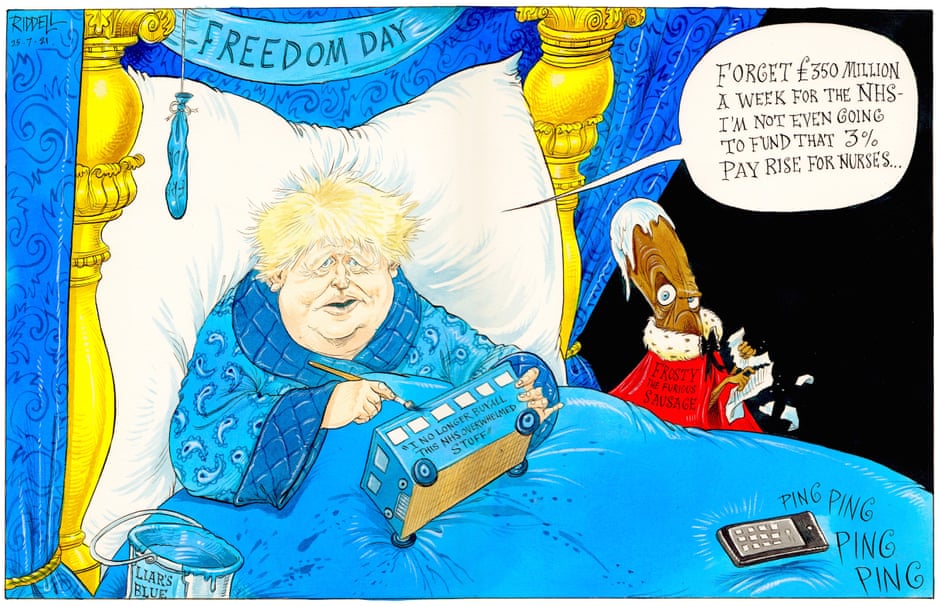
Boris and his Bus

“It is a once in a century chance on which our political establishment should capitalise, especially the Tory party, which represents nearly all the coastal constituencies it so shamefully neglects.”
Will Hutton www.theguardian.com
Britain’s coast is in desperate trouble. As more of us head for our beaches this summer than since the 1950s, spare a thought for the 3.5 million who live on the coast all year round – disproportionately poorer, iller, older, more mentally depressed, in low-paid temporary work, more overweight and more prone to suicide, drug abuse and self-harm than if they lived just a few miles inland. Levelling up is too often associated with derelict industrial Britain, but it is on our coast that the crisis over living standards, life expectancy and health is most acute. If the EU referendum was lost anywhere, it was lost here.
The story is hardly new, as the chief medical officer, Professor Chris Whitty, recognised in last week’s devastating report on the health and wellbeing of coastal communities. As he says, Blackpool has more in common with Hastings 255 miles distant, in its chronic ill health and poor public health services, than Preston just 15 miles inland. Even adjusting for deprivation and an elderly demographic, rates of mental illness and heart and kidney disease in coastal communities are roughly 10% higher than the national average – just one dimension of the “ shit-life syndrome” endemic on our coast. The quality of NHS care in response is enfeebled by major shortages of health and social care staff – 15% fewer postgraduate medical trainees, 15% fewer consultants and 7% fewer nurses per patient in coastal towns compared with the average inland. In any case, medical and public health services can only make so much progress in the teeth of the economic and social forces that create such a lack of wellbeing. Locked in a despairing vicious circle, coastal towns, often beautiful and with healthy sea air, are forgotten casualties because problems seem worse inland. There must be, declared Whitty, a national strategy to engage with this national wrong.
The underlying reasons are well known. The “blue economy” – fishing, shipping, shipbuilding, port traffic and tourism – has been hit hard by deep-seated trends. Industrial fishing has fatally wounded local fishing fleets; containerisation has killed small ports; shipbuilding has migrated to Asia; the British usually holiday abroad. The evaporation of a vibrant private sector with nothing spontaneously taking its place has seen wages, rents and local house prices suffer, on average over a quarter lower than a few miles inland, so that in general coastal towns have become poverty sinks. Neglect and deprivation beget still more, while teachers and doctors are reluctant to make their lives in these run-down places, exacerbating the decay.
What has given the decline its own special British twist is the way political and administrative centralisation, systemically denying local capability to raise taxes, borrow and spend, has interacted with a refusal to recognise that public and private are necessarily a symbiotic whole, more obvious on the coast than inland. Unless there is a vigorous public infrastructure of beautiful seaside fronts, promenades, well-tended beaches and amenities there cannot be successful coastal private enterprise. But that is impossible to create without sustained public resource and the accompanying structures.
Coastal communities in Holland, northern France, Denmark and Germany battle similar forces to our own, but their localities are afforded more chances to pull themselves up. Our coast’s decline is littered with examples of local energy and initiative running into difficulty for lack of any supportive, long-term framework, so that for every successful beachside art gallery or revived old port there is a parallel story of bankrupt pier companies and amusement parks. The doctrine in response is not to empower, but, rather, create Whitehall-controlled funds for which local communities bid against each for fixed pots of money. The root-and-branch overhaul in the way our towns and cities are governed, from which coastal towns would be prime beneficiaries, is abjured. The heroin addicts hanging out in the derelict seafront bandstand are umbilically linked to our pre-modern system of government.
The prime minister did not single out the plight of coastal communities in his recent speech on levelling up ten days ago – on the government website but surreally with no punctuation –, in which he simultaneously deplored so much spatial inequity in Britain while arguing that tall poppies should remain tall. Hence levelling up – not down. But importantly, he did call for more enabled local leaderships, the mayoral model to be extended to shires and counties, which could then put their plans to the centre. He envisages an extension of the existing model: more people to bid for these fixed pools of cash on which Whitehall would decide.
It can’t and won’t deliver what he wants. Yet for all the derision directed at his over-hyped speech so much of which was reheating pre-existing policies, at least he has put spatial inequality at the political forefront, while recognising any success must involve local leaders. It has created a unique moment that coincides with another break from the past. The working from home revolution prompted by Covid is creating the first mass re-engagement with our coast since the 19th century. Thus the Rightmove property network reports a 115% increase in inquiries this summer from city dwellers about buying property in seaside towns. House prices on the Cornish coast have exploded, while Scarborough is reinventing itself as “Zoomtown-on-sea”.
It is a once in a century chance on which our political establishment should capitalise, especially the Tory party, which represents nearly all the coastal constituencies it so shamefully neglects. Britain’s coast should become the spearhead of a green revolution, cementing the growing readiness of city dwellers to live there. There should be massive investment in beautifying our seafronts; in green energy for which the coast is so suited; in super-broadband; in upgrading housing stock; in quality attractions and creative quarters populated by a new generation of art and music colleges. St Ives, Hastings and Margate have shown what can be done with modern art – it can be universalised. All public sector workers in coastal communities should receive a coastal pay uplift. Coastal authorities should be allowed to experiment with spending, borrowing and tax freedoms.
The coast could and should become emblematic of health and vitality – a source of national pride. Chris Whitty is right. What has happened to our coast is shameful, not least as a public health disaster. It can and must be reversed.
I’m taking a spin on a go-kart track with a difference. It’s the old beauty hall of the Debenhams store in south-west London.
By Emma Simpson www.bbc.co.uk
The escalators are the only trace of the former department store which remain. All four floors are now being transformed into a high-tech entertainment venue.
As we filmed, shoppers stopped to take photos when the shutters briefly opened giving a glimpse of the flashing lights and builders beavering away inside.
“We’re creating a department store of fun,” says Michael Harrison, the co-founder of Gravity which is due to open on 1 August.
“We have three bars, two restaurants, go-karting, a bowling alley, huge screens to watch sporting events and adventure golf. This is the future of the High Street. It’s about experience,” he says.
Michael has no shortage of retail landlords now ringing him up offering him potential new locations.
They’re grappling with the need to rethink, or repurpose, empty shops. Latest figures suggest one in seven stores, on average, are lying vacant. And in some places the number is far higher.
The UK’s biggest property company, Landsec, owns the Southside shopping mall where Gravity is based. Its other centres include Bluewater in Kent and Trinity in Leeds.
Landsec boss Mark Allan thinks a quarter of what is currently retail space will need to be turned into something else.
“For me, it’s really difficult to think of an example where you have 25% of something that it exists in the UK that is no longer required. And so you’re not going to solve that sort of a problem by tinkering around the edges,” he says.
The pain won’t be evenly spread either, says Mr Allan: “Some places are going to be virtually empty and they are not going to survive as retail in any shape or form.
“Some are going to be absolutely fine – rents are lower, sales are lower and they’re worth less than they were but fundamentally they’ve got a role to play longer term and some places are going to be in the middle where they are going to survive but they need some investment.”
Some industry experts think the amount of redundant retail space is even higher. So how did we get here?
We’ve seen a huge proliferation of shops over the last 40 years. Retail has just been growing and growing, from out of town retail parks and shopping centres to so called clone towns dominated by chains, who were willing to pay higher rents.
That retail property boom is now over. Many of our town centres will have to find a new purpose.
We’ve been talking about how to save the High Street for more than a decade but the pandemic has turbo charged the problems now.
Mr Allan says it’s time to act. “Covid has been a tipping point. If we don’t tackle it over the next couple of years together then there’s a real risk some of this redundant retail property sits there for decades empty and that would be a disaster for the communities where that property is located.”
And he says there’s no single party that can solve the problem: “This needs people to come together. I think it’s a significant moment and a really big opportunity, particularly for those centres and high streets where there is no future for retail, for radical, bold, thinking. I think it could be exciting.”
Stockton-on Tees has one of the boldest plans to reshape its entire town centre. It has decided to demolish a large part of its high street.
The local council bought Stockton’s two shopping centres and plans to knock one of them down, creating a new riverside park to make the town a greener, nicer place.
The £37m project is largely being funded with money from the Tees Valley Combined Authority and the Government’s Future High Streets Fund.
The Castlegate mall was built in the 1970s, an era when local authorities were falling over themselves to attract big retail development.
media captionFormer staff reminisce about life at their town’s Debenhams branch
“Retail is still very important, but we now need to consolidate it to meet the demand,” says councillor Nigel Cooke, cabinet member for regeneration.
Businesses who want to stay will eventually move into the other shopping centre further up the street.
The scheme is part of a wider masterplan to market Stockton as an events town. The main high street, the widest in the UK, has been spruced up with new paving, lighting and a big water fountain. The council is also paying for the renovation of the town’s Grade II-listed art deco Globe Theatre.
“I think it is money well spent and I am convinced it’s the right thing to do. We need to get people back onto the high street either to live, to work or to enjoy themselves,” insists Mr Cooke.
“It would be easy to hide under my desk and say guys, we can’t do anything, let’s just wait for the good times to come back. But we have to do something.. nothing is risk free, it’s about managing the risk.”
But Stockton has now got a large, empty Debenhams to contend with, too.
Town centre regeneration is often complicated stuff, with a myriad of owners, stakeholders and issues to solve.
It’s taken Stockton 13 years to get this far and it’s only a third of the way through. But given the magnitude of the challenges now, doing nothing is no longer an option.
Remember: if you rent your second home out as a “furnished holiday let” for part of the year (it should be “available” for 140 days but needs to be let for only 70), you no longer have to pay council tax, but can register instead as a business ratepayer. Then you apply for 100% small business rates relief, cancelling the entire bill. So while every other kind of housing is taxed, second homes, if you play it right, are tax-free. Owl believes that these “reliefs” need to be cancelled nationally as a starter. It would, at least, ensure that second home owners paid their wack and might damp down the demand. Call it “levelling up” if you like. Unfortunately, many of the other schemes end up with “unintended consequences”.
Philip Churm, local democracy reporter www.radioexe.co.uk
A Devon council is hoping to introduce measures which would stop people from outside the area buying new properties as second homes.
South Hams District Council unanimously agreed an amendment to the neighbourhood plan for the picturesque town of Salcombe which would ensure that all newly built homes could only be used as a primary residence.
Average house prices in Salcombe exceed £750,000 with many selling for over £1 million. However salaries in the area are lower than the national average, making it increasingly difficult for young people to get onto the property ladder.
The amendment presented to the council would mean that a so-called Section 106 agreement would be applied to all newly built dwellings.
Many new-build properties have already been subject to a planning condition which stipulates that a house must be used as a primary residence but council leader Judy Pearce (Conservative, Salcombe and Thurlestone) said more robust measures are needed.
“We accept that a planning condition may usually be suitable to secure principal residency,” she said.
“But this does not allow for the exceptional circumstances encountered in Salcombe and the surrounding area where there’s a very high percentage of second homes. And many houses changing hands frequently between people who are prepared to pay – and do – almost anything to acquire them.”
Cllr Pearce explained that, over a number of years ordinary planning conditions tend to get lost or are overlooked when a house is resold; allowing them to quickly become second homes.
A Section 106 agreement, however, is registered against the property title and would therefore be easily seen by any potential buyer in the future.
The amendment to the Salcombe Neighbourhood Plan says: “New open market housing, excluding replacement dwellings, will only be supported where there is a Section 106 agreement to ensure its occupancy as a principal residence. This policy is as a result of impact upon the local housing market of second or holiday homes. This occupancy restriction will therefore require the imposition of a legal agreement. New unrestricted market homes will not be supported at any time.”
Before the amendment was agreed by all councillors Cllr Pearce added that a precedent had already been set in the neighbourhood plan for the village of Thurlestone, near Kingsbridge, which only allows a Section 106 agreement for any new properties attracting a principal residency requirement.
Although this has now been approved by SHDC the amendment still has to be approved by an independent examiner.
Taxpayers will be left facing “significant financial risk for decades to come” because of the levels of emergency government spending on the pandemic, totalling more than £370bn, a powerful committee of MPs says today.
(There was a time when Conservatives claimed to looked after taxpayers’ money! Owl)
Toby Helm www.theguardian.com
In two separate reports, the all-party public accounts committee (PAC) paints a daunting picture of the lasting financial strain caused by the first 16 months of combating Covid-19, and says the government must not wait until after the official inquiry to learn the lessons of what went wrong.
The MPs say that by this March the lifetime cost of the government’s rescue measures had reached £372bn, government-backed loans had soared, and taxpayers had been left “on the hook” for an estimated £26bn of credit and fraud losses from the bounce-back loan scheme for small- and medium-sized enterprises alone.
While Boris Johnson, has promised a public inquiry into the handling of Covid-19 it will not begin until next spring and will take years to complete, leaving the prime minister open to accusations that he wants to avoid the truth coming out before the next general election.
The PAC says, however, that the national interest demands understanding and recognition of the many shortcomings far sooner. The MPs say it is “clear that the government cannot wait for the review before learning important lessons”.
They expect ministers to “set out a fully costed plan for recovering from the pandemic” in the autumn spending review, alongside a comprehensive framework for managing the risks to public finances resulting from the Covid-19 response.
The committee also highlights worries about the government’s readiness to fight Covid-19 and other diseases in the future, saying it “remains concerned that, despite spending over £10bn on supplies, the PPE stockpile is not fit for purpose”.
Listing a catalogue of problems, the MPs found that up to this May 32 billion items of PPE were ordered by the Department of Health and Social Care (DHSC). But of these only 11 billion have so far been distributed, while 12.6 billion are stored in the UK as central stock, and 8.4 billion on order from other parts of the world have still not arrived in the UK.
The stockpile is costing the DHSC about £6.7m a week to store, the PAC says, with waste being “unacceptably high”. As of May, 10,000 shipping containers of PPE still had to be unpacked, having been ordered in 2020, and 2.1 billion items had been found unsuitable for use in medical settings.
Meg Hillier, chair of the PAC, said: “With eye-watering sums spent on Covid measures so far, the government needs to be clear, now, how this will be managed going forward, and over what period of time.
“The ongoing risk to the taxpayer will run for 20 years on things like arts and culture recovery loans, let alone the other new risks that departments across government must quickly learn to manage. As well as monitoring procurement and its effectiveness through the next few years, the PAC will be watching this spending and risk for decades to come. If coronavirus is with us for a long time, the financial hangover could leave future generations with a big headache.”
While examining the efficiency of the government response, the PAC highlights serious staffing problems inside the NHS, which have been brought into focus by the pandemic. The service was already struggling with 40,000 nursing and 9,000 medical staff vacancies before the first lockdown in March last year. By September, six months in, more than a third of remaining nurses were considering leaving.
The report warns that with the health and social care workforces “under constant pressure”, patient waiting times were continuing to increase and waiting lists for non-urgent treatment were growing significantly, storing up huge challenges for the future.
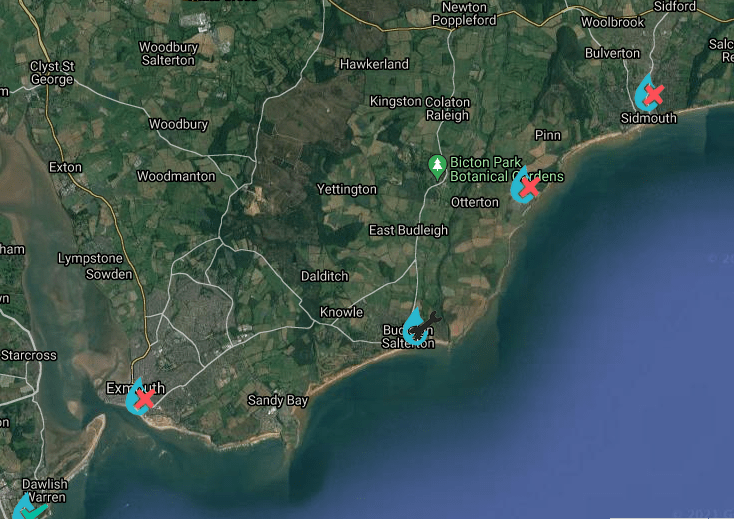
As the holiday season kicks off in earnest, there are widescale sewage alerts are in operation for East Devon beaches see https://www.sas.org.uk/map/ and the alert system at Budleigh Salterton seems to be out of action.
E.g: Sidmouth Town
“Pollution Alert: Storm sewage has been discharged from a sewer overflow in this location within the past 48 hours.
Rock pools to the west, overhanging cliffs to the east, Sidmouth Town beach compromises 900m of legally protected pebbles broken up by rock groynes and backed by a promenade and the town. Two sewer overflows are located at Sidmouth, one discharges through a long sea outfall some 600m out to sea while the other discharges into the River Sid, just under 400m to the east.”
In 2020 there were 1,919 pollution incidents, a decrease from 2,204 in 2019, but the second highest total since 2015. See this report.
“Southern Water and South West Water both performed significantly below target for pollution … Southern Water for the second year in a row and South West Water for the 10th year in a row,” the Environment Agency said. “Both companies’ performances have been consistently unacceptable.”
The impact of pollution from water companies can be seen in the poor quality of water in English rivers. Last year every river failed pollution tests. Pollution from raw sewage discharges by water companies directly into rivers, chemical discharges from industry and agricultural runoff are significant sources of pollution, according to the data.
Emma Howard Boyd, the chair of the Environment Agency, said on Tuesday: “The bottom line is, England’s rivers are too polluted.”
Nearly a third (32%) of rivers were failing to meet tests for good ecological status because of discharges from sewage treatment works. About 7% of rivers are polluted because of raw effluent flowing from storm overflows, the EA said.
(Southern Water has just been fined a record £90m for dumping billions of litres of raw sewage into the sea).
Exeter has joined forces with Torbay in a bid to become an internationally-recognised ‘City of Culture’.
The two UNESCO-designated areas have teamed up in their ambition to provide ‘significant financial, social, and cultural benefits to the region’.
If the bid is shortlisted into the final six, Exeter and Torbay will receive £40,000 to develop a programme to secure the status.
If successful, the next stage would see the cultural community fully consulted to develop the proposal.
Driving forces say that, even if unsuccessful, the joint bid will lead to future opportunities ‘to work together to capitalise on opportunities and ideas’ included in the City of Culture proposal.
The bid sees Torbay Council joining forces with Exeter City Council to become a world-renowned City of Culture in four years.
The designation is given to a city in the UK for a period of one year.
The aim of the initiative, which is administered by the Department for Digital, Culture, Media and Sport, is to build on the success of Liverpool’s year as European Capital of Culture 2008, which had significant social and economic benefits for the area.
The inaugural holder of the award was Derry in 2013. In 2017, Kingston upon Hull took over the title before Coventry hosted in 2021.
Torbay and Exeter’s bid links the City to the Sea and is inspired by the connections between Torquay, Paignton and Brixham to Devon’s capital.
The bid will look to showcase closely-connected coastal and city destinations; creating a ‘cultural corridor’ between the places.
It will also provide the opportunity to for other towns between Exeter and Torbay to play a major role in a focused programme of events.
Councillor Amal Ghusain, Exeter City Council’s lead for culture and communities, said: “Torbay and Exeter naturally complement and enhance each other, with firm roots in the natural environment, art, literature and learning, with shared aspirations about NetZero carbon targets and with recognised opportunities to learn from each other.”
In its submission, the bid says: “Both Torbay and Exeter provide a brilliant alternative to a one centre cultural prize, the partnership is determined to innovate and create, and present its cultural credentials set against a backdrop of rivers, moors, and market towns, which lend themselves to be front and centre of a cultural and creative programme.
“Our people are passionate about their green and pleasant land, they are fiercely proud of their surroundings, yet celebrate the opportunity to share and develop their cultural offer and their creative skills.
“Independent artists, music makers, crafters, designer makers, theatres, and creative industries find a home and a rhythm on the foundations of a Roman City, in a natural harbour, via UNESCO designations and within the finest natural environment.”
The bids that are successfully shortlisted by the Department for Digital, Culture, Media and Sport will be notified in September.
The recent drop in new daily reported Covid cases in the UK has led some scientists to hope that the country has reached the peak of this wave – but others say the dip could be something of a mirage.
Nicola Davis www.theguardian.com
According to the latest figures from the Office for National Statistics, based on swabs collected from randomly selected households, about 1 in 75 people in the community in England had Covid in the week ending 17 July, up from 1 in 95 the week before. The survey suggests infection levels have also risen in Wales and Northern Ireland, although the trend in Scotland was unclear.
However, case data, based on those coming forward for testing – often once they have symptoms – is painting a different picture. On Friday 36,389 new cases of Covid were reported in the UK, down from 39,906 the day before and the sixth day in a row that cases were below the 54,674 figure reported on 17 July.
The decline has led some to voice cautious optimism. Tweeting about Thursday’s figures, Prof Eric Topol, director of the Scripps Research Translational Institute in California, wrote: “This could turn out to be the best Covid news of the day,” adding along with the prayer hands emoji that new cases in the UK appeared to be starting a descent.
But as so often in this pandemic, it will take time for the situation to become clear.
Dr Mike Tildesley of the University of Warwick, a member of the Scientific Pandemic Influenza Group on Modelling (SPI-M), said it was impossible to tell whether the recent fall in cases meant the tide was starting to turn. “We really need to see a trend, and if this continues for the next week,” he said. “Right now it could be a blip.”
A key factor is that it will be two to three weeks before the impact of the relaxation of Covid restrictions on 19 July and the influence of school holidays begin to be seen in case figures. Many schools in England only broke up on Friday.
While the relaxation of restrictions is expected to boost the spread of Covid, school holidays may lead to reduced transmission – as well as testing. However, with the majority of children not eligible for vaccination, the return to school in September could fuel a further rise in cases.
And there are other factors including Euro 2020 – there are signs that mass gatherings for the matches may have fuelled an increase in infections.
“Given that the final was on 11 July, the peak – and then dip – around four days after that, does coincide with any such infections being reported in the next four or five days later,” said Prof Rowland Kao, an epidemiologist at the University of Edinburgh who also contributes to Spi-M. “If so, it could be that what we are seeing is a decline that is due to the passing of that possible [event] – and it may be followed by a more sustained rise.”
Another factor relates to immunity. While documents released by Spi-M on Friday dated to 14 July noted signs of a slowdown in growth in the north-west of England, something ONS data suggests has since turned into a decline, the group suggested there was no clear indication from observed local antibody prevalence data that herd immunity was causing the downward trend.
However, Kao said it is possible that factors with a more sustained impact than the football could be at play in the UK. “In particular, the proportion of individuals with either natural or vaccine-induced immunity is getting high, and if people are being more aware of the need for continued personal measures to control Covid than the modelling anticipated … then together that may be enough to signal a more sustained decline, at least in some areas of the country,” he told the Guardian.

“The number of new coronavirus cases confirmed across Devon and Cornwall in the last week has reached record levels – but new infections are starting to fall.”
However, there will be a lag of a couple of weeks before we see what the impact of “July 19 Freedom Day” really is. Uncontrolled exponential growth is inherently dangerous. – Owl
Number of new Covid cases at record levels
Daniel Clark www.devonlive.com
A total of 8,570 new cases were confirmed across the two counties for the second successive week – with the total since the start of the pandemic at 73,862– with some significant week-on-week rises.
It is the highest weekly total in terms of the number of new cases, up by around 25 per cent on last week’s total – but the number of new infections confirmed in the previous two days have both been significantly lower than the figure last week, showing early signs that the wave may have peaked.
While every single region saw a rise in the number of new cases, and infection rates are at record levels, the rise in the number of people in hospital was less steep and is significantly lower than the peak – and the number of deaths remains very low.
At the peak of the second wave, there were 403 patients in hospitals across Devon and Cornwall following a positive Covid-19 test, compared to the 72 at present.
And Plymouth hasn’t seen a death since March 1, while Devon saw one death this week on July 17, its first for two months, with three deaths in Cornwall.
Government stats show that 8,570 new cases have been confirmed across the region in the past seven days, to 6,560 new cases confirmed last week.
Since July 16, of the 8,570 new cases confirmed, 2322 were in Cornwall, 600 in East Devon, 549 in Exeter, 300 in Mid Devon, 497 in North Devon, 2192 in Plymouth, 338 in South Hams, 534 in Teignbridge, 891 in Torbay, 200 in Torridge and 147 in West Devon.
This compares to the 6560 cases confirmed between July 10-16, of which, 1589 were in Cornwall, with 491 in East Devon, 434 in Exeter, 275 in Mid Devon, 373 in North Devon, 1713 in Plymouth, 263 in South Hams, 479 in Teignbridge, 726 in Torbay, 125 in Torridge and 92 in West Devon.
Infection rates across Devon and Cornwall are highest in the 20-39s and then the 0-19s, followed by the 40-59s, 60-79s and 80+ in every region, and have risen in every region, but the infection rates for the over 80s in Devon and Torbay is lower this week than it was seven days ago, and by specimen date, no-one aged 80+ in West Devon has tested positive in the last week.
But despite the large spike in cases, and while there has been a rise of those going into hospital, the increase is not as large – although the numbers are growing.
The latest Government figures, which give the position as of Tuesday, July 20, show that across hospital trusts in the two counties, there are 72 patients currently in hospital in the two counties – up from 53.
Derriford Hospital has 23 patients – up from 15, with Exeter having 16, up from nine, Torbay 11, up from nine, and North Devon two, up from one, with seven patients in mechanical ventilation beds in Devon. In Cornwall, there were 20 patients in hospital, up one from 19 last week, with none in a mechanical ventilation bed.
The figures show how many patients are in hospital following a positive test for Covid-19, but not whether they were admitted for Covid-related reasons, whether they were infected inside the hospital, or whether their admission was entirely unrelated but they happened to have Covid at the same time.
In terms of the latest MSOA cluster maps, that cover the period of specimen dates between July 12-18, only the Isles of Scilly reported between 0-2 cases, with all 229 areas of Devon and Cornwall reporting three or more cases.
Millbay & Stonehouse, and Newquay East, both reported 120 cases, with Plymstock Hooe & Oreston seeing 117, St Budeaux 115, and Blatchcombe & Blagdon 102.
Braunton (98), Ham, Beacon Park & Pennycross (97), St Columb Minor & Porth (97), Derriford & Estover (93), Ford & Blockhouse Park (93), Cattedown & Prince Rock (92), Devonport, Mount Wise & Morice Town (91), Newquay West (91), and Chelston, Cockington & Livermead (90) also saw 90 or more cases.
Cranbrook, Broadclyst & Stoke Canon, and Exmouth Town (both 82), Pinhoe & Whipton North (72), Bradninch, Silverton & Thorverton (69), Woolwell & Lee Mill (40), Chudleigh & Bovey Tracey (56), Bideford South & East (52), and Tavistock (31) were the worst hit areas of the other districts respectively.
It comes as closing in on around 90 per cent of adults in Devon and Cornwall have had their first Covid-19 vaccine, with around seven per cent having had both doses.
Of the adult population, 85.5% in Cornwall, 89.2% in East Devon, 77.1% in Exeter, 88.1% in Mid Devon, 86.5% in North Devon, 82% in Plymouth, 87.3% in South Hams, 88.5% in Teignbridge, 84.7% in Torbay, 88.3% in Torridge, and 89% in West Devon, have had one dose.
And of the adult population, 69.6% in Cornwall, 74.2% in East Devon, 55.1% in Exeter, 71.4% in Mid Devon, 70.3% in North Devon, 62.6% in Plymouth, 72.2% in South Hams, 74.2% in Teignbridge, 71.7% in Torbay, 73.9% in Torridge and 76.6% in West Devon, have had a second dose.
Steve Brown, Director of Public Health Devon is urging residents to keep doing their bit to reduce the spread of coronavirus in Devon and to continue looking out for each other, particularly the most vulnerable, as we have done throughout the pandemic.
He said: “With most legal COVID-19 restrictions lifting this week, I want to say a huge heartfelt thank you to everyone in Devon for all they have done so far to keep each other safe.
“I want us to continue to be careful because positive cases in Devon are still rising, in fact at the moment we’ve got the highest rate of COVID-19 we’ve seen during the whole pandemic.
“While most people who catch COVID aren’t becoming seriously ill, due to the vaccination programme, there are some who do need medical care and unfortunately we are seeing hospital admission rise. There are plenty of people feeling the disruption of having to self-isolate with COVID-19 or because they have been identified as a close contact of a positive case.
“Over 38,000 people in Devon were identified as being Clinically Extremely Vulnerable and asked to shield from coronavirus. Many spent several months with little if any interaction outside of their households.
“And now as restrictions lift, these vulnerable people are once again being advised by the government about extra steps they may wish to take to protect themselves, such as making sure they have both does of a COVID-19 vaccine, meeting friends and family outside if possible and visiting shops and pharmacies at quieter times of day.
“But I strongly feel that it is up to all of us to carry on doing everything we can to continue keeping each other safe.
“Many people, particularly if they are Clinically Extremely Vulnerable, have dreaded the day legal restrictions lift for fear of catching coronavirus. I understand that you’re in a difficult position, and you may be feeling worried about the current situation.
“Although the legal restrictions have lifted, our responsibility to members of our family, friends and society has not changed. I urge everyone in Devon to choose to do the right thing and keep doing your bit to reduce the spread of coronavirus by respecting the personal space of those around you, wearing a face covering in crowded areas, getting tested regularly, having both doses of the vaccine and washing your hands properly.
“We have been good at looking out for each other and helping those in need so we need to respect those of us who will still be feeling anxious and behave in ways that protect them and ourselves from the risk of coronavirus.”
[Detailed data in online article]
“Greedy developers”; “Cheap Options”; “Whatever we do will be a disaster”; “Better to wait until we have future planning permissions”; “Let’s talk to the developers”. Under Jenrick’s new planning proposals will this sort of problem become less likely? – Owl
Fears over gridlock chaos in Devon
Lewis Clarke www.devonlive.com
Fears a busy area will become ‘completely and utterly’ gridlocked have been voiced as housing development continues in Sticklepath.
Devon County Council is looking at the possibility of revoking a bus gate at Gratton Way, which is operated by a rising bollard system, and introduce a new bus gate on Old Torrington Road to the north of the junction with Gratton Way, enforced with cameras.
Traffic would then be directed through Gratton Way to the new development, the crematorium and properties at the southern end of Old Torrington Road instead of from the A3125 on Bickington Road.
The council hopes this will help better manage traffic in the area and reduce congestion due to the new housing development at Larkbear, where permission has been granted for 200 homes with the potential for more.
During a consultation period, 224 responses were received, with 174 in favour and 47 objectors. The council also backed the move.


At the North Devon Highways and Transportation Orders Committee held on Wednesday, July 7, Councillor Caroline Leaver (Barnstaple South, Liberal Democrat) said: “The reason for the bus gate is the impact of the additional traffic that is being generated by those houses. It is something that has been fully considered and has been subject to public consultation.
“We found that the impact of another rat run at the Wrey Arms roundabout, and indeed on Rhododendron Way and Broadclose Road, would impact them significantly enough that planning permission would not be granted without it.
“The other issue is about getting to the crematorium. Once we get the bus gate, we can discuss restrictions; there is nothing to say a bus gate has to be 24-hours a day.
“This has been explored extensively; it’s trying to avoid a problem becoming even worse. It is not about trying to restrict people, so they are not able to move around, but to protect an area becoming so completely and utterly gridlocked that people can’t go about their normal daily lives.”

Early morning traffic congestion at the junction of the A3125 with the B3233 – This queue of traffic into Barnstaple occurs every weekday morning and further housing developments in Bickington, Fremington and Yelland are likely to exacerbate the situation. (Image: Roger A Smith / Geograph)
Councillor Ian Roome (Barnstaple North, Liberal Democrat) said people were currently using the bus gate on Gratton Way as there was no legal way of enforcing traffic there.
He said: “Everyone is using that bus gate now anyway, whether you like it or not. I was there the other day, and cars are going through it willy-nilly.”
Councillor David Knight, a committee member representing North Devon Council, added: “If we do nothing, we are rubber-stamping people using it as a rat run.
“Doing nothing doesn’t do anything for residents in Rhododendron Avenue and Broadclose Road who are suffering greatly from people shooting up that narrow road.”
Speaking to councillors, Michelle Ward, a resident of Tower View and a driving instructor, said the area had been plagued with issues.
“We used to be able to collect our students anytime and anywhere around the Barnstaple area,” she said.
“Over the last five years, it’s been a total nightmare. We no longer collect students from Fremington, Bickington, and Roundswell between 7.30 am, and 9.30 am due to the sluggish and stagnant traffic.
“We also get a lot of complaints from parents that their children are in lessons and sat in traffic.
“As a reputable company, this didn’t sit well with us at all. We don’t like complaints of any sort, especially when people are sat in traffic.
“My husband and I, along with 40 other driving instructors, find the traffic in Barnstaple so unpredictable and often gridlocked from Bickington through to the hospital. The bus gate move will alleviate the traffic issues on this side of town and will be life-changing for residents living in this area.
“The bus gate move will encourage drivers to use the A361 and the A39 circular routes which have been put there to avoid the town.”
However, some members called for a delay in the decision.
Councillor Paul Henderson (Conservative, Chulmleigh and Landkey) said: “It’s a very emotive subject. People on Old Torrington Road and further north will not want increased traffic flow, but people living south in the new estate with much longer journeys going around.
“Surely it’s better to leave the bus gate issue until we have future planning permissions, which will see the new site access and new homes being developed being required to manage traffic flows.”
“This was going to be a sensible development with access off the A361,” he explained. “It was going to link into the back of Petroc to take coaches off Old Torrington Road, and it was a win-win.
“Then the greedy developer has come along, saw it was going to cost a lot of money, and did the cheap option to come out on Old Torrington Road.”
He said it was now a ‘complete nightmare’.
“I think the sensible thing to do now is nothing,” he said. “People will take the fastest and shortest route, and we can take a look at where people start going.
“Whatever we do will be a disaster, and adding all these extra houses will make it a bigger problem. Let’s talk to the developers, bring it back for discussion as soon as we can, and get this as right as we possibly can.”
Councillor Pru Maskell (Braunton Rural, Conservative) added: “Why was that development given planning permission without the original proposal for access onto the A361?
“It seems this whole issue has been created by that fact, and it could have solved a huge amount of traffic issues if that had happened.”
The south-west of England will have the highest proportion of low-income workers affected by a £20-a-week cut later this year in universal credit payments, according to analysis by the TUC that illustrates the widespread culture of low pay from Cornwall to Gloucestershire.
Phillip Inman www.theguardian.com
More than four in 10 universal credit claimants in the south-west have a low-paid job that qualifies them for benefits, a larger percentage than any other region, said the trade union body.
The rate of claimants who had a job in May was 42.1% in the south-west compared with 41.2% in the east Midlands, the next worst affected, and 36.7% in the West Midlands.
The TUC general secretary, Frances O’Grady, said 2.3 million working families, as well as those who rely solely on benefits, would see their incomes drop by more than £1,000 a year if the government presses ahead with a planned £20-a-week cut in universal credit from October.
The report also highlights the impact on individual parliamentary constituencies, revealing that the prime minister’s west London Uxbridge and South Ruislip seat has 9,546 UC claimants of whom 3,665 are in work, 38.4% of the total.
In the chancellor Rishi Sunak’s Yorkshire constituency of Richmond nearly half, 48%, of people receiving universal credit are in work.
The TUC said: “It shows that even in wealthier parts of the UK the cut to universal credit will impact heavily on low-paid workers.”
About 6 million families claim UC and its predecessor, working families tax credit – twice the figure before the pandemic. More than 500,000 people were forced to file a claim during just nine days in March 2020 as the virus began to spread and the government announced the first lockdown.
In the same month, ministers agreed a £20 rise in universal credit and tax credits as a one-year measure to help new claimants adjust to the extra costs of the pandemic.
Estimates suggest it helped 700,000 people stay above the poverty line during the pandemic. Surveys have shown the public support it being made permanent.
Earlier this month Thérèse Coffey told MPs the government had honoured its commitment to extend the uplift for six months. Now the economy was opening up, she said, the focus of DWP support “should be strongly on getting people into work and jobs”.
Although there was no up-to-date robust data showing that claimants were coming off the benefit in significant numbers, Coffey said internal DWP figures suggested there were 2.1 million job seekers on universal credit, down from 2.5 million in March, and this number was reducing week by week.
Labour, welfare charities and some Tory MPs have criticised the move, saying that millions of people will still be in precarious jobs in October and unable to cope financially after a cut in benefits of more than £1,000 a year.
In a separate report, also timed to coincide with the summer parliamentary recess, the Joseph Rowntree Foundation said more than 500,000 people, including 200,000 children, will be plunged into poverty when the government pushes through what it called “the largest single cut to the basic rate of social security since the second world war”.
About 6 in 10 of all single-parent families will experience their income falling by the equivalent of £1,040 per year after the benefit cut, it said, imposing “the biggest overnight cut to the basic rate of social security since the foundation of the modern welfare state”.
Will the Treasury insist that the Track and Trace £8.7bn underspend is returned to them or could it be used to pay for the pay rise (many times over)? See NAO report for details of the underpend. – Owl
NHS told to find £1.5bn of savings to fund staff pay rise, despite fears of service cuts
The NHS has been told to find £1.5bn of savings from within existing budgets to fund the pay rise for staff announced on Wednesday, in a move branded “brutally unfair” by nurses’ representatives.
The chaotic announcement of the 3 per cent boost for 1 million workers prompted suspicions of a battle between chancellor Rishi Sunak and health secretary Sajid Javid over who pays the bill.
In the Commons, former health secretary Jeremy Hunt demanded a commitment that the £1.5bn cost would not mean “cuts” to wider health or care spending.
But Boris Johnson’s spokesperson said, shortly afterwards: “The pay uplift will be funded from within the NHS budget.”
He claimed the move would “not impact funding already earmarked for the NHS frontline”, but it was unclear how that could be avoided if savings are required.
Royal College of Nursing general secretary and chief executive Pat Cullen said: “This pay announcement is fast unravelling. Not only is the figure scandalously low but Downing Street has been forced to admit that the money isn’t new either.
“It is brutally unfair to force the NHS to do yet more with the same money. Ministers must be honest about the impact this would have on patient care.
“The government is failing to give the NHS the money it truly needs. This current game of smoke and mirrors is dangerous for patients and nursing staff who care for them.”
Labour’s shadow health secretary Jonathan Ashworth said it was clear that Mr Javid was “refusing to back up the pay settlement with the cash needed, instead expecting overstretched hospitals to find this extra money” at a time of summer crisis due to Covid and a backlog of cancelled operations.
“The NHS needs a fully funded plan to provide quality care, and bring ballooning waiting lists down,” said Mr Ashworth. “Alongside this, ministers must provide the NHS with the extra investment required to give staff a pay rise.”
Meanwhile, the British Medical Association (BMA) branded the government “callous and unjust”, as it emerged that tens of thousands of NHS doctors are being excluded from the 3 per cent hike despite advice from an independent pay review body that they should be included.
Mr Hunt, now the chair of the Commons health committee, also warned against diverting cash from the care sector, fearing it “once again loses out because of pressures in the NHS”.
Nadhim Zahawi also came under fire over the plan for “vaccine passports” to enter crowded venues, starting with nightclubs from the end of September.
The minister triggered suspicions that the government might swerve a vote it is in danger of losing, by saying: “We reserve the right to mandate its use in the future.”
But, under pressure from MPs on all sides demanding a vote first, Mr Zahawi conceded parliament would have an “appropriate say on the matter”.
The minister also lifted the lid on other “crowded venues” that might be included, if the crackdown goes ahead as threatened.
He namechecked “music venues”, “business events and festivals” and “spectator sport events” – with the Premier League already known to be considering the move.
“We’ve seen in other countries, whether it’s in Holland or in Italy, the opening of nightclubs and then having to reverse that decision rapidly,” he told MPs.
“So what we’re attempting to do – the reason we have the Covid vaccination pass in place – is to work with industry in this period, whilst we give people over the age of 18 the chance to become double-vaccinated.”
However, many believe it is a phantom threat, to browbeat young people to accept vaccination by September – as Mr Johnson allegedly acknowledged in a private briefing with Tory MPs
Mr Zahawi also came under fierce pressure to bring forward the 16 August date for exempting the double vaccinated from isolation rules, if identified as a close contact of a Covid case.
Mr Hunt urged the government to “listen to public opinion and scrap the 10-day isolation requirement immediately”, provided those people tested negative for Covid with a lab test.
“Otherwise we risk losing social consent for this very, very important weapon against the virus,” he warned Mr Zahawi.
But the minister said accelerating the change would “run the risk of infection rates running away with us”, over the next few weeks.
In the July 19th post: “Were we turning a corner when Boris hit the gas?” Owl wondered whether Tim Spector’s study had identified a turning point, as it has done before, or whether in this case it reflected a sampling problem.
It turns out to have been a sampling problem.

To make sure that our figures are as robust as possible, we’ve updated the way we calculate our COVID incidence figures. This means that you’ll see the numbers change.
Many people rely on information from the ZOE COVID Study to understand what’s going on with COVID in the UK, but the situation is changing fast as the Delta variant spreads and more people get vaccinated.
We’re constantly monitoring our data and reviewing our figures. When we looked closer at how the pandemic and people’s behaviour were influencing our estimate of new cases, we decided it was the right time to adjust our methodology.
As our ZOE app contributors and the wider population continue to take full advantage of the vaccine rollout to help tackle the pandemic, we’ve seen the number of unvaccinated people in our dataset steadily decline.
After thorough testing, we’ve developed an updated calculation method that will allow us to continue reporting on incidence figures in the UK with confidence.
As one of the UK’s leading studies into COVID-19, it’s our responsibility to constantly review how our survey works to keep pace with the changing situation on the ground.
Last week, we reported a plateau in new COVID cases based on our methods at the time, which relied on a small number of unvaccinated people in our dataset compared with the wider UK population. The number of daily new cases in the unvaccinated group appeared to be dropping which in turn resulted in our overall numbers trending down. This meant the figures were accurate to our dataset but didn’t represent the full picture in the UK.
Using our new methodology to adjust for this, the new estimates show that the number of daily cases in the UK is still on the rise in both vaccinated and unvaccinated groups (Graph 1).

Graph1 to show new figures for incidence in vaccinated and unvaccinated
As you see in the graph below, when we overlay our previous estimate (red line) and new adjusted estimate (orange line) in a single graph, we can see our updated methods align more closely to trends observed in government confirmed cases (blue line) (Graph 2).

Graph 2 to show new incidence figures, old incidence figures and official confirmed cases
Also, to help you see how the new incidence figures compare to the other COVID-19 surveillance studies, we’ve created the graph below, which shows us that the new figures are more closely aligned (Graph 3).

Graph 3 to show new and old estimates compared to other COVID-19 surveillance studies
The main adjustments we’ve made to our calculations are:
Changing the definition of ‘newly sick’
We use the term ‘newly sick’ to identify app contributors who could potentially be newly infected with COVID-19 based on their symptoms. We’re now broadening the criteria that defines a contributor as ‘newly sick’ so that more people, including those who report less frequently, also fall into this category, increasing our sample size. We’re also including data reported on behalf of others e.g. parents reporting for their children.
While a (now increased) sample of our data is used to calculate incidence, all data collected by the ZOE COVID Study is used in the research conducted by King’s College London and has contributed to the important discoveries including: vaccine after effects, vaccine effectiveness and post-vaccination infection symptoms.
Including lateral flow tests as well as PCR tests
Historically, we only included the results of PCR tests in the survey as they were the first tests to be available and being used for the majority of testing. However, since Lateral Flow Tests (LFT) have been made widely available in the UK, we’ve seen huge numbers of LFTs logged in our app. As a result, we’re now including the results of LFTs in our incidence estimates.
Currently, we see roughly half of all tests coming from PCR and the other half from LFTs.
Adjusting by both age and vaccination status
Back in May, we began taking people’s vaccination status into account in our incidence estimates. With the addition of LFTs and the updated definition of ‘newly sick’ we have increased the sample size and we can now include adjustments based on age group. This accounts for our high proportion of older app contributors and vaccinations in our data set and helps control for the fact younger people are more likely to be unvaccinated and be infected in the current environment.
The ZOE COVID Study will soon reach a point where the numbers of unvaccinated people of all age groups are so low we will not be able to report COVID incidence estimates for unvaccinated people. Based on the current rates of vaccination uptake, this could happen in the next few weeks. This is something that all the COVID-19 surveillance surveys will be experiencing soon as well.
It’s something we anticipated, and we’ve arrived at this point sooner than the wider population because our loyal contributors have been so keen to get their vaccines and report them in the app!
We’re keeping a close eye on our data as we move forward, and we’ll keep you updated when we make the decision that we are no longer able to estimate incidence in unvaccinated people.
The good news is, thanks to your amazing contributions, we have unrivalled data on the effectiveness of COVID-19 vaccinations in the real world. This means we’ll continue to be at the forefront of understanding how the pandemic is evolving in the UK and across the world.
Together with our research colleagues at King’s College London we’re looking at:
To help us answer these vital questions and more, all you need to do is use the ZOE COVID Study app and spend just one minute logging your health each day. Thank you.
Stay safe and keep logging.
The New Guard Still trying to sort out the legacy problems from this example of developer led town planning.
What chance Jenrick’s tree-lined streets, beautiful houses and open spaces – “Build back beautifully” – Owl
Joe Ives, local democracy reporter www.radioexe.co.uk
£40 million needed to build the town’s infrastructure
East Devon District Council’s strategic planning committee has agreed in principle that the local authority should borrow £40 million to help build Cranbrook’s infrastructure.
The money from the Public Works Loan Board, would be used as a ‘revolving’ infrastructure fund – essentially a loan that’s loaned out again. The council would lend the money to developers who might otherwise be put off by high-interest repayments if they sought loans independently. They would then invest in improving Cranbrook’s infrastructure as the town grows – whilst saving themselves around £8 million.
The motion was passed nine votes to three and will now go on to cabinet.
Council officers believe Cranbrook needs to quickly fund an additional primary school, and health and wellbeing provision as well as, potentially, a new special educational needs school and a highway upgrade works on London Road.
The council would then recoup the cash on a ‘roof tax’ basis, in essence getting money back for every new home sold as a result of the infrastructure. If the revolving infrastructure fund is successful the council would recover all the money it loans.
Officers consider the loan high risk but nonetheless recommended it to the committee to be considered in principle. It is feared that the risk of delaying new homes in Cranbrook through lack of infrastructure is greater than the risk of the loan.
Councillor Jess Bailey (Independent, West Hill and Aylesbeare) expressed concerns, describing the size of the loan as “eye-watering” and questioning why the committee had not received more information on the finer details.
She said: “I understand that developers may not want to take the risks associated with those very large costs, but do then do the taxpayers want to?”
Cllr Bailey did not believe the plans were ready to pass onto the next stages of the decision-making process, adding: “It’s like the train’s left the station and is on the tracks and I don’t think it’s ready to leave the station.”
Cllr Mike Allen (Conservative, Honiton St. Michael’s) also took against the decision, describing the report as “inadequate.”
For those in favour, the decision was simple: the council has to take out the loan if it is to meet its housing obligations.
Councillor Mike Howe (Conservative, Clyst Valley) said: “We don’t have a choice. We have to do it, or Cranbrook will once again stall.”
“This is fundamental to Cranbrook’s expansion and without that Cranbrook expansion our five-year land supply fails – pure and simple.”
Council leader Paul Arnott (Democratic Alliance Group) said: ”We have a moral and ethical duty to the people of Cranbrook to sort this out”, noting that further details of how the loan would work would be compiled before the matter goes to cabinet.
Councillor Kevin Blakely, an Independent who represents Cranbrook on the council in a grouping called Cranbrook Voice, backed the proposals. He said: “I honestly feel, as Councillor Howe said, that we don’t have a choice in this.” He recognised the risk but said he believed the council would see its money returned.
A more detailed report on the revolving infrastructure fund will now go to the cabinet. Any final decision would then have to go through full council.
Cranbrook currently has approximately 2.350 homes and 5,500 residents. This number would grow by more than 4,000 homes bringing a total of around 18,000 people if plans set out in East Devon local plan and the draft Cranbrook plan go ahead.
The Cranbrook plan is being examined by an inspector appointed by the secretary of state. A ruling is expected before the autumn.
The National and Local picture are both covered in this post.
First the Local data from www.devonlive.com
A Devon care home saw 33 deaths of residents related to Covid-19.
The figures cover the period of April 10, 2020 to March 31, 2021, and show that Primley Court care home in Paignton was the hardest hit of anywhere in Devon and Cornwall.
Barton Place Nursing Home in Exeter saw the second highest number of deaths of residents in Devon with 18, all of which occurred between April and June.
Furzehatt Residential and Nursing Home in Plymouth saw 15 deaths, with Greycliffe Manor in Torquay seeing 14, with 13 at both Lucerne House in Exeter and Fernhurst Nursing Home in Exmouth.
Other care homes in Devon which saw ten or more deaths were Belle Vue care home in Paignton, Culm Valley Care Centre in Cullompton, Knappe Cross Care Centre in Exmouth, Silverleigh in Axminster, Cadogan Court in Exeter, Coppelia House in Moretonhampstead, and Ilford Park Polish Home in Newton Abbot.
Parkland House in Exeter, The Old Rectory Nursing Home in Exeter, The Firs Residential Home in Budleigh Salterton, Ernstell House in Plymouth all saw nine deaths, while Pottles Court in Exminster, Deer Park Care Home in Holsworthy, Hembury Fort House in Awliscombe, Sunningdale House Care Home in Honiton, and Brandon House in Exmouth saw eight deaths.
The full list, in the publicly available dataset, can be seen here.
ONS data show that there have been a total of 456 deaths of care home residents in care homes in Devon since the pandemic began, where Covid-19 has been put on the death certificate.
Figures in the CQC data will be higher than the ONS data as the CQC data also includes deaths related to coronavirus that have occurred in hospitals and/or other settings of care home residents, rather than just in a care home, as ONS data records by place of death.
The National data Patrick Butler www.theguardian.com
Dozens of care homes in England lost at least 20 residents to Covid-19 during the pandemic, according to “highly sensitive” data published by the care regulator, with one home registering 44 deaths over the past year.
The Care Quality Commission (CQC) revealed that 6,765 homes across the country registered at least one death between 10 April 2020 and 31 March 2021, highlighting the devastating impact of the crisis on vulnerable residents.
At least 30 deaths were reported by 21 homes. There were 44 deaths at the Bedford care home in Wigan, owned by the large private care home operator Advinia, and 41 deaths registered by Calway House in Taunton, owned by Somerset Care, a not-for-profit operator.
The CQC had refused to publish the death rates data for almost a year, despite pressure from residents’ families and freedom of information requests from journalists, on the grounds that it would undermine confidence in the already fragile predominantly privately owned residential care home market.
In total, there were 39,017 care home deaths over the period, prompting renewed criticism of the government’s failure to stem the outbreak in the residential care sector, and its failure to tackle years of underfunding and understaffing.
The highest number of care home deaths over the period were registered in the south-east region of England (7,404), followed by the north-west (5,748) and the east of England (4,943). The fewest deaths were recorded in London (2,635).
“In considering this data, it is important to remember that every number represents a life lost – and families, friends and those who cared for them who are having to face the sadness and consequences of their death,” said Kate Terroni, the CQC’s chief inspector of adult social care.
In a statement, the CQC suggested its about-turn on publishing the data came partly following discussions with families who had lost loved ones to Covid. This “helped us shape our thinking around the highly sensitive issue of publishing information” around death notifications on a home-by-home basis.
“We have a duty to be transparent and to act in the public interest, and we made a commitment to publish data at this level, but only once we felt able to do so as accurately and safely as possible given the complexity and sensitivity of the data,” said Terroni.
However, the CQC warned the data should be treated with caution because they were not a reliable guide to care quality or safety at individual care homes. Homes are required to register the death of residents even if they died in hospital or contracted the virus elsewhere.
There are currently around 15,000 care homes inspected by the CQC. Other factors potentially leading to high death rates include the the prevalence of Covid infections in the local community, the availability of PPE, and the number of residents who were discharged from hospital to homes without being tested for the virus during the early phase of the pandemic.
Around 25,000 people were allowed to return to care homes without a Covid test between 17 March and 15 April last year despite a plea to the government from home providers to outlaw the practice. This is believed to have enabled the virus to spread rapidly through homes populated with older, vulnerable residents.
Care home owners were said to be unhappy about the publication of the data because of the danger of it being misinterpreted. Martin Green, chief executive of Care England, which represents care providers, said every death needed to be seen in context. “We do not believe that this data is a reflection of quality.”
A Department of Health and Social Care spokesperson insisted the government had done all it could to protect protect vulnerable people throughout the pandemic, saying: “We have provided billions of pounds to support the sector, including on infection and prevention control measures, free PPE, priority vaccinations and additional testing.”
James White, head of public affairs and campaigns at the Alzheimer’s Society, said the data showed the “devastating and tragic consequences” of the government’s failure to protect care homes at the start of the pandemic, and the damage caused by years of underfunding.
Hugh Alderwick, head of policy at the Health Foundation, said the CQC data showed how government support for social care during the pandemic was often “too little, too late”, particularly during the first wave. “The government’s claim of ‘a protective ring’ around care homes was not grounded in reality.”
Cuts over the past 10-15 years have meant an individual farm could expect to be inspected once every 236 years.
(And then you only get a slap on the wrist! – Owl)
Ben Webster, Environment Editor www.thetimes.co.uk
Ministers have announced plans to drive up water quality for wild swimming and wildlife by almost trebling the number of inspectors ordered to target farmers who pollute rivers.
They have ordered the Environment Agency to increase enforcement following an investigation last year by The Times which found the agency had cut farm inspections in England by two thirds since 2014-15 and was failing to enforce rules introduced in 2018 to stop farmers contaminating rivers with slurry and fertiliser.
The agency recorded 137 breaches of the rules but brought no prosecutions and issued no fines.
Slurry and fertiliser pollution from farms is the single biggest cause of poor water quality in England and Wales which results in 84 per cent of rivers failing to meet the government’s target for good ecological standards.
The agency is recruiting 50 staff to inspect farms in England for compliance with pollution legislation, raising the number of inspectors to 78.
The Rivers Trust, a conservation charity, welcomed the plans, saying that cuts over the past 10-15 years had meant an individual farm could expect to be inspected once every 236 years.
It said: “These new staff do not replace all those that have been lost over the years but the appointments are a very welcome reversal of a decline in enforcement of environmental legislation.”
It said the jobs would have 18-month employment contracts, pending further funding, and there were concerns that this might deter applicants and that it did not indicate a long term strategy by the government.
Mark Lloyd, chief executive of the Rivers Trust, added: “After years of writing letters, campaigning and presenting evidence to ministers, we are delighted that the government has at last decided to fund this vital work to drive compliance with legislation passed by parliament to protect the rest of society from farm pollution.
“As we enter a new era of public money for public goods, it is unthinkable that an industry benefitting from a multi-billion pound public subsidy scheme would not be properly regulated.”
The agency said last year that it had sent 14 warning letters in response to the 137 breaches and the rest had resulted in “advice and guidance”, which it claimed all the farms had heeded.
England may have just three weeks to avoid coronavirus restrictions being reimposed after Sage scientists urged ministers to take action if hospital admissions soar above expected levels.
By Jane MerrickPolicy Editor inews.co.uk
Scientific advisers have warned that Boris Johnson should be prepared to act in the first week of August to prevent the NHS becoming overwhelmed by the end of that month.
Modelling has suggested that the central case for UK daily hospitalisations at the peak of the third wave – expected at the end of August – could be between 1,000 and 2,000, with deaths predicted to be between 100 and 200 per day.
Yet latest figures show that in the middle of July, six weeks before the expected peak, there were 745 patients admitted to hospital in the UK in a day, and that figure continued to rise even before the 19 July relaxation of all restrictions on so-called “freedom day”.
Last week chief medical officer Professor Chris Whitty said hospitalisations were doubling roughly every three weeks.
This would suggest close to 1,500 admissions by the end of the first week of August, well above the trajectory for the central case scenario for the third wave. It would point to 3,000 at the peak by the end of that month, which would match the peak of the first wave in April 2020.
Insiders stressed there is a lot of uncertainty in the modelling, and the picture will change all the time depending on vaccine take-up and people’s behaviour after 19 July.
But if admissions are outstripping the central estimates, Sage scientists have advised that some non-pharmaceutical measures should be reintroduced, such as mandatory face masks and advice to work from home, in early August, halfway between the19 July unlocking and the predicted peak at the end of August.
This early intervention, they argue, would prevent the NHS becoming swamped in a late summer crisis.
On Tuesday there were 46,558 new coronavirus cases in the UK, while a further 96 people have died, the highest daily reported fatality rate since the middle of March.
Experts warned against predicting hospital admission rates two to three weeks in advance, but stressed that contingency plans should be in place to reintroduce measures at short notice.
Last week, when the Prime Minister gave the go-ahead for the fourth and final stage of the roadmap in England, he accepted that some restrictions may have to be reimposed if the situation worsened.
A source said what was needed was “less of an emergency brake and more of a gear change” in readiness to keep the third wave “under control”.
While mandatory face masks would be the “easiest” route to curb transmission, with minimal impact on the economy if it were kept to public transport and essential settings like supermarkets, this would have to be weighed against the “totemic” impact it would have on the public if they were ordered to cover up once again.
But others are arguing that the government should be prepared to take tougher action.
Professor Dominic Harrison, director of public health for Blackburn, said: “Any return to non pharmaceutical interventions (NPIs) to control spread would have to focus on those that give the biggest suppression effect.
“Essentially we might expect a reverse through the lockdown lifting steps with each ‘reverse step’ being introduced to match the scale of the surge in cases.”
Prof Harrison added that the rise in hospitalisations may be because the bar for admission is lower now, when there is less pressure on the NHS, than during the first wave in April 2020 and second wave in January this year.
He said: “The current rise in hospital cases is difficult to interpret clearly. It is likely some cases now hospitalised might not have met the threshold for hospital admissions in the last wave in January as the system is ‘adaptive’.
“Some cases now hospitalised may have been managed by care at home on ‘virtual COVID wards’ when the system was under highest pressure of cases in the last wave.
“However for anyone with significant symptoms, hospitalisation will give the best chance of high quality care and close monitoring of risk – so a lower (current) threshold of admission may be keeping mortality rates as low as possible.”
Fields 1. Homebuyers 0.
Plans for 22 new homes in Bovey Tracey have been refused for reasons including the impact on wildlife.
Ollie Heptinstall, local democracy reporter www.radioexe.co.uk
During an hour-long debate on the application near Indio House to the south of the town, some councillors raised concerns about building on two fields of ‘MG5 grassland.
Other reasons for refusal were parking concerns, the application’s eco-credentials and uncertainty about whether a cycle and pedestrian link would be successful.
According to Natural England, MG5 grassland is ‘unimproved natural grassland’ including hay meadows that was once ubiquitous in England lowlands but are in decline. Their briefing document on this type of land says: “MG5 grassland is a valuable resource that needs continued management, monitoring, research and protection for it to survive.”
The meeting heard from three public speakers, two of whom objected on ecological grounds, and a representative of the developer to support the scheme.
In 2018, the committee refused outline application for homes on the site, which had previously been allocated for development as part of the Teignbridge local plan. However in 2019, following an appeal by the developer, a planning inspector over-ruled that refusal.
Last month councillors deferred the application after deciding they needed more information and time to consider the implications, and a visit to the site.
Teignbridge’s local plan originally allocated 45 homes for the location, which was lowered to 30 in the outline planning permission and then down to 22 for the applicant’s more detailed application.
The homes were recommended for approval by planning officers, who said: “there is no reasonable grounds for refusal of this [application] relating ecology or loss / compensation of the MG5 grassland.”
They said that while “significant local concern has been raised regarding the loss of […] MG5 grassland, a priority habitat,” the officers explained that: “substantial weight has given to the outline application and the approved ecology survey that does not require any compensation to be delivered”.
In their report, they added how the outline permission had not been legally challenged by the council and said: “The access to the site, traffic generation and impact of this development on Indio House were all considered by the inspector who found these matters to be policy-compliant when approving the application.”
Addressing the committee, a planning officer said the scheme was: “the best that we’re going to get whilst making good use of the land and taking into account the allocation that we’ve got.”
Objecting to the plan, Councillor Avril Kerswell (Conservative, Bovey ward) said: “Once again I would like to remind this committee that Teignbridge District Council has declared a climate emergency, and therefore we should be putting biodiversity, ecology and all green issues to the fore of our decision making.
“The MG5 grasslands, which the applicant wishes to build upon, are so important for many reasons. One of them being that there must be an ecosystem within these two meadows which, if examined closely, would astound all of us.”
Cllr Kerswell also questioned why the planning report contained a letter from the applicant’s QC, who said it was okay to build on the land, but not one from the residents’ legal representative who disagreed.
However, chair of the committee, Councillor Mike Haines (Independent, Kerswell-with-Coombe) said the remaining grassland could still be managed and he saw “no reasons that have been presented today that would make me consider refusal” as he backed the recommendation for approval.
In response, Cllr Kerswell said that “most of the grassland will be built on, and that’s not what the people of Bovey Tracey want”.
Councillor Jackie Hook (Lib Dem, Bushell ward) added that while the application was “deeply unsatisfactory…. “us refusing this today, unfortunately, will not stop it happening because there is valid outline planning consent for 22 houses.”
“The refusal reasons I hear are unfortunately not ones that I will think will hold water and I think, therefore, sadly we will not achieve anything in particular by refusing this today.”
Councillor Janet Bradford (Newton Says No, College ward) also objected: “Because of the rare status of this site, I have lots and lots of concerns and I won’t be able to support this.”
The committee were tied on voting for an original motion for refusal, then rejected another motion to approve the scheme by nine votes to five. At the third vote, councillors refused it by the same tally.
The developer, KACH Developments, said they are discussing the next steps and are taking legal advice as to whether they will appeal the committee’s decision.
There’s more below the surface than we thought – something even worse than the water companies’ disgusting habit of filling our rivers with raw sewage. After a deep dive into the data, the team that made Rivercide last week discovered that while sewage now dominates our perceptions of river pollution, it’s not their major cause of death.
George Monbiot www.theguardian.com
On the border between Wales and England, we found a great river dying before our eyes. The Wye is covered by every possible conservation law, but in just a few years it has spiralled towards complete ecological collapse. The vast beds of water crowfoot, the long fluttering weed whose white and yellow flowers once bedecked the surface of the river, and which – like mangroves around tropical seas – provide the nurseries in which young fish and other animals grow and adults hide and breed, have almost vanished in recent years. Our own mapping suggests a loss of between 90% and 97%.
They have been suffocated. With increasing frequency, warm weather brings algal blooms. Water that should be crystal clear becomes a green or brown slop of diatoms (microscopic algae). The diatoms shut out the light the crowfoot needs; and at night, as they respire, they draw oxygen from the water, stressing and sometimes killing the remaining fish and insects. Any crowfoot that survives this onslaught may then be colonised by sewage fungus and green slime, which also smothers the fronds, preventing photosynthesis.
Similar things are happening across Britain. Scarcely a river in England and Wales is unaffected by plagues of algae or sewage fungus, caused by an excess of nutrients. But the main culprit is not human excrement.
So what is it? Farming. This is now the biggest cause of river pollution in the UK. There are various reasons, including soil erosion, fertilisers and pesticides, but the most intense and extreme cause, especially in the west of Britain, is industrial livestock units.
Over the 21st century, livestock units have consolidated into giant factories. Vast buildings now house hundreds of dairy cattle, thousands of pigs or tens of thousands of chickens. Regions now specialise in particular animals. The catchment of the River Wye is the UK’s chicken capital.
These factories gather nutrients from a wide area and concentrate them into a small one. The chicken units draw soya from huge tracts of Brazil and Argentina, with devastating consequences for rainforests and savannahs, and pour it into chickens housed along the Wye and its tributaries. The nutrients in the feed then come out in their dung.
Animal dung is high in water and low in value, so it can be shifted economically across only short distances. This means, if you are not to spend more on diesel than the manure is worth, spreading it in the catchment of the river. The soil soon saturates. The nutrients in the dung from then on wash into the river whenever it rains. It doesn’t matter whether farmers illegally pump the dung directly into the river or follow the rules to the letter in spreading it on their fields. Eventually the phosphate, nitrate and other pollutants it contains end up in the water.
So once a certain number of chicken, dairy or pig units have been built in a catchment, rivercide is inevitable. Even if there were effective government monitoring and enforcement, which there isn’t, it would make little difference.
The crucial decision point is the granting of planning permission for industrial livestock units. The local authorities granting it, and the regulators issuing environmental permits, sign the river’s death warrant. Astonishingly, from their responses to our questions, we discovered that neither the two county councils giving these permissions (Powys and Herefordshire), nor the Welsh and English regulators (Natural Resources Wales and the Environment Agency), appear to have any idea how many chickens are now housed in the catchment or even how many factories there are. This task was left, as so much crucial data gathering has been, to citizen scientists. Alison Caffyn, an academic researcher, and Christine Hugh-Jones, a retired GP, set out to map the factories, and estimated that they house, at any one time, 20 million chickens.
Because none of the authorities have kept score, they cannot assess the cumulative impact of these factories. In granting permission for new units, they treat each one as if it were built in isolation, with no attempt to determine what the extra increment of dung will do to an overloaded river. Worse still, in many cases no environmental decision is made at all, because below a very high threshold (40,000 chickens or 2,000 pigs) a livestock unit does not require an environmental permit. It’s a scandalous regulatory failure.
So the only way of saving many of our most beautiful rivers from this shitstorm appears to be to shut down many, perhaps most, of the industrial livestock units in their catchments. In our film, when I pressed the Welsh minister for rural affairs, Lesley Griffiths, on this matter, she appeared to commit to do so if necessary. Through campaigns such as River Action, we should hold her to it, and pressurise her English counterparts, who flatly refused to speak to us, to do the same.
In the meantime, our lovely rivers are being transformed by industrial livestock farms into stinking drains. Let’s stop taking this shit.
 East Devon Watch