Leak reveals possible harsher three-tier Covid plan for England

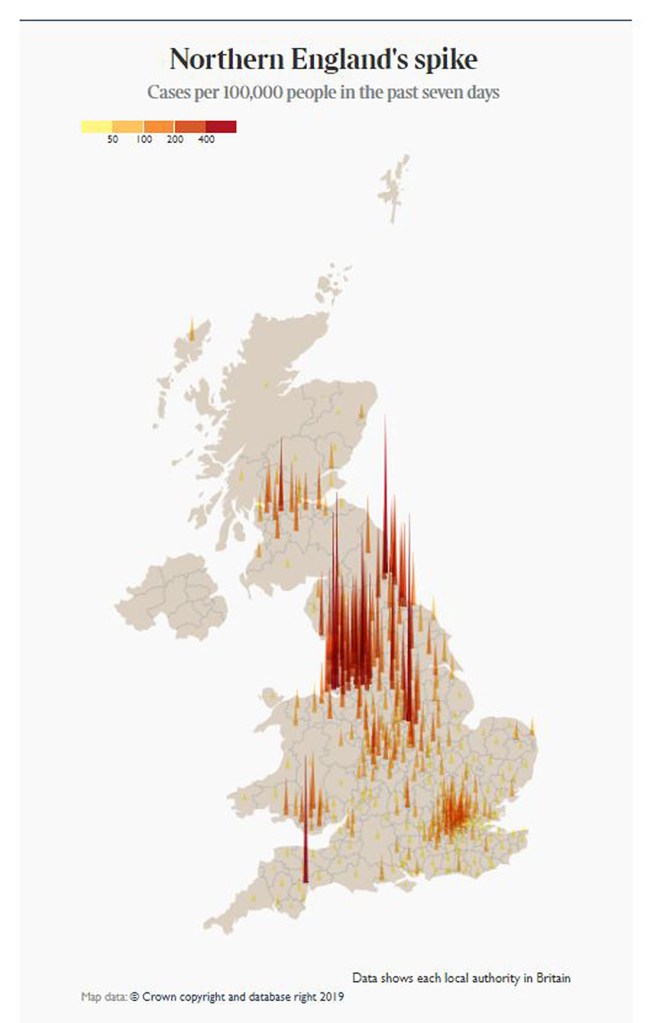
A new three-tier lockdown system is being planned for England, with leaked government documents paving the way for potential harsher restrictions including the closure of pubs and a ban on all social contact outside of household groups.

Heather Stewart http://www.theguardian.com 

The draft traffic-light-style plan, seen by the Guardian, is designed to simplify the current patchwork of localised restrictions, which apply to about a quarter of the UK. It also reveals tougher measures that could be imposed by the government locally or nationally if Covid cases are not brought under control.

On Sunday the number of cases jumped by 22,961 after it emerged that more than 15,000 test results had not previously been transferred on to computer systems, including for contact tracers.

Called the “Covid-19 Proposed Social Distancing Framework” and dated 30 September, it has not yet been signed off by No 10 and measures could still be watered down.

Alert level 3 – the most serious – contains tougher measures than any seen so far in local lockdowns since the start of the pandemic. They include:

  • Closure of hospitality and leisure businesses.
  • No social contact outside your household in any setting.
  • Restrictions on overnight stays away from home.
  • No organised non-professional sports permitted or other communal hobby groups and activities, such as social clubs in community centres.
  • Places of worship can remain open.

Schools are not mentioned in the draft. A government source said this was because Boris Johnson had made clear that classroom closures would be a last resort and the reopening of schools was considered within Whitehall to have been a relative success.

Any attempts to impose more stringent measures are expected to provoke renewed anger among Conservative backbenchers, who are likely to demand a vote in parliament should they come into force.

A government source said the measures in the draft document, particularly those under alert level 3, had not been finalised and the document still needed to be approved by ministers in the Covid-operations committee and by the prime minister.

Marked “official – sensitive”, it says the government’s Scientific Advisory Group for Emergencies (Sage) has advised that a package of measures, rather than single changes, will be most effective in controlling the spread of the virus.

“Preventing household mixing and closing businesses and venues in which there is close social interaction was recommended as the best way to reduce R,” it says, referring to the rate of infection that the government aims to keep below 1.

The three-tier system should improve compliance with the rules: “Research tells us that people would welcome a clearer and simpler structure to the advice and rules that they should follow,” it says, acknowledging that “many people do not have a clear understanding of the rules that apply to them”.

The document says that alert level 3 would be “triggered in geographical areas or nationally when alert level 2 measures have not contained the spread of the virus, or where there has been a significant rise in transmission”.

Under alert level 2, people must not meet others outside of their household in private dwellings or gardens, apart from their support bubble, or in pubs, restaurants or other settings. Level 2 will be “triggered in geographical areas or nationally when there has been a rise in transmission, which cannot be contained through local responses”.

Visiting care homes will only be allowed in exceptional circumstances and travel should be limited to essential purposes, though holidays are permitted within households.

People can continue to play organised team sports. Weddings are limited to 15 attendees and receptions would not be permitted, with funeral numbers also slashed from 30 to 15 attendees.

Alert level 1 contains restrictions currently in place across England, including the “rule of six” for gatherings indoor and out, the wearing of face-coverings, the 10pm curfew on hospitality businesses and numbers limited to 15 at weddings and 30 at funerals.

A Whitehall source said the levels were intended to be “minimum standards” and specific local circumstances would also be taken into account.

Downing Street declined to comment. A government source said it was an “early draft and proposals are still being considered by ministers”.

The shadow health secretary, Jon Ashworth, said Labour had long called for a simplification of the rules and said ministers must now make clear the criteria that would be applied to put areas into different alert levels.

“Vast swathes of the north of England and the Midlands are under a form of lockdown with a myriad of different rules applying,” Ashworth said. “In recent days, Boris Johnson got himself into an utter muddle over these rules, confirming that the ad hoc way in which decisions are made causes confusion.”

Johnson recently had to apologise for suggesting people could meet in pub gardens in north-east England after misinterpreting the rules – a mistake that a cabinet minister blamed on a “gotcha” question.

Ashworth said that the lockdowns meant “unanswered questions about the upcoming school half-term or Christmas” and said that families needed to know their area was being treated fairly and getting support.

“Keir Starmer has called for clear criteria to apply when an area goes into lockdown and how it escapes. Ministers are now admitting how confusing their approach has been,” he said.

A Department of Health spokesman said: “We are seeing coronavirus cases rise at a rapid rate across the country and, given how serious this virus is, it is vital everyone plays their part by following the rule of six, washing their hands, practising social distancing and wearing a mask in enclosed spaces.

“As we have shown, we are prepared to take action decisively when it is necessary, and it is of course right to look how we make sure everyone understands and complies with the restrictions that will keep us all safe.”

Ministers just vowed to plough ahead with a ‘dangerous’ change to elections

The ERS and groups representing elderly voters and BME communities are warning that mandatory voter ID risks pulling up the drawbridge to thousands of voters, after the government confirmed plans to impose the ‘show your papers’ policy.

Author: Electoral Reform Society www.electoral-reform.org.uk 

In the government’s response to the Electoral Commission’s reports on last year’s elections – out this week – Cabinet Office minister Chloe Smith confirmed she plans to push ahead with imposing mandatory voter ID, writing: “We are concentrating on the promises we made in our manifesto including to ensure electoral integrity by introducing voter ID and bringing forward changes to strengthen postal vote processes and to equalise constituencies amongst other changes.”

The report responds to a challenge from the Association of Electoral Administrators which argued that voter ID was unnecessarily ‘introducing more complexity’ to an ‘already creaking system’.

There was just one proven case of personation fraud, out of millions of votes cast in the UK last year, according to the Electoral Commission.

Today, we are urging the government to re-think the voter ID policy.

We know that the government’s voter-ID proposals will disproportionately hit older voters, people of colour, and those on low-incomes. Experience from the US shows that when there’s no universal ID scheme, these laws unfairly – and often deliberately – lock millions out of the ballot box, skewing the system and deepening political inequalities. We must not import US-style voter suppression to the UK.

Voting is a right and one you shouldn’t have to opt into. Rather than pulling up the drawbridge to large groups of voters, ministers should deal with bringing in the nine million people who are missing from the electoral register, and the dangerous loopholes in our analogue-age election laws.

Given the huge potential for disenfranchisement, it is deeply worrying that ministers see imposing voter ID as a priority – rather than reforming Westminster’s warped voting system or unelected House of Lords. When it comes to Britain’s democratic crisis, this isn’t just fiddling while Rome burns – it’s pouring petrol on the flames. It’s vital that ministers think again before driving another wedge into our already-unequal politics.

Dennis Reed, Director of Silver Voices, which represents people over-60s, told the news outlet Byline: “We fear this is a ‘Trumpian’ manoeuvre to limit voting by those who are not natural Government supporters – i.e. the most deprived members of communities, including senior citizens in poverty.”

Josh Bradlow, policy manager at Stonewall, added: “LGBT people – particularly those who are working-class, older, disabled, and people of colour – are more likely than the general population to live in poverty or experience homelessness, which can create significant obstacles to obtaining photo ID. Many trans and non-binary people also may not have ID matching their gender.”

Anti-racism group Hope Not Hate described mandatory voter ID as “a cure that is worse than the sickness.” 

A spokesperson for Liberty added: “The Government has given us plenty of reasons to be wary of its digital projects. Recent months have seen backtracks over the planned contract tracing app and exams algorithm, and only last year the Home Office had to apologise to EU nationals and Windrush citizens in the space of a week for data breaches.”

BME groups have also accused the government of importing US-style voter suppression.

Last year’s voter ID pilots in just a handful of council areas saw over 700 people turned away and not return – effectively being denied a vote.

The government may have also misled Parliament over the policy. A series of Freedom of Information requests revealed that government departments do not know who will be hardest hit by mandatory voter ID plans, despite ministers repeatedly claiming that “the evidence shows there is no impact on any particular demographic group.”

This policy risks turning thousands of election workers into bouncers at the ballot box – the government needs to re-think the voter ID policy.

Sign our petition to protect your right to vote

Home-working here to stay, new IoD figures suggest

Coronavirus looks set to have a lasting impact on office use, new figures from the Institute of Directors reveal.

Institute of Directors www.iod.com 

In a survey of close to a thousand company directors conducted last month, nearly three quarters (74%) said they would be keeping increased home-working after coronavirus. Furthermore, more than half of those polled said their organisation intended to reduce their long-term use of workplaces. More than one in five reported their usage would be significantly lower.

Among those who had been using their workplace less before the change in Government recommendation last month, more than four in ten said that working from home was proving more effective than their previous set-up.

Business leaders surveyed had been making a number of other adjustments during the pandemic that they intended to keep in place. 43% had embraced greater use of flexible working such as compressed hours, while over a fifth had moved a service they provided online.

The IoD warned that the prospect of increased home-working over the long-term could raise legal questions around employers’ responsibilities for staff outside the office. The Institute also argued that the Government should take a number of steps to help SMEs and the economy adapt to increased home-working:

  • Improve SME tax incentives, enabling more small firms to harness new digital technologies and bolster the productivity of home-working. This could be achieved by expanding the scope of R&D tax reliefs, as proposed in the 2019 Conservative Manifesto.
  • Improve access to leadership and management training, to reduce concerns around the potential impact of remote working on productivity and employee wellbeing. Boosting management skills could be one target of the National Skills Fund.
  • Lower employment costs, particularly Employers’ NICs to encourage job creation among businesses and help more firms retain staff. This could be done by increasing the Employment Allowance or raising the threshold for paying National Insurance Contributions. 

958 company directors were surveyed between 11-31 September.

Roger Barker, Director of Policy at the IoD, said:

“Remote working has been one of the most tangible impacts of coronavirus on the economy. For many, it could be here to stay.

“Working from doesn’t work for everyone, and directors must be alive to the downsides. Managing teams remotely can prove far from straightforward, and directors must make sure they are going out of their way to support employees’ mental wellbeing.

“The UK has long needed to up its game when it comes to management skills, and the pandemic has only made this more pressing. It’s crucial that the Government targets this key area, ensuring businesses and their people can make use of accessible courses that reflect their skills needs.

“Any remote-working set-up is only as good as the technology that enables it. Alongside continued investment in digital infrastructure, the Government should give small firms the headroom to invest in the latest equipment and software. The restrictions have spurred significant innovation, but low revenues and high costs could put a lid on this.

“The benefits of the office haven’t gone away. For many companies, bringing teams together in person proves more productive and enjoyable. Shared workspace often provides employees the opportunity for informal development and networking that is so crucial, particularly early on in a career.

“Looking ahead, it seems more and more companies will take a blended approach to where they work. Any transition can cause challenges, and the Government should look to ease this. In the long run, greater flexibility could benefit both business and worker alike. However, it’s crucial that the legal and economic implications of this change are grappled with from the start.”

Full survey results

958 respondents, conducted between 11-31 September 2020.

Relative to before the COVID-19 pandemic, which of the following best describes your organisation’s intended level of ‘workplace’ use in the long-term?

TotalOffice based (inc. ICT, financial services)
Significantly more2%1%
Slightly more4%3%
No change30%24%
Slightly less32%33%
Significantly less21%26%
Don’t know1%1%
NA10%10%

Have you made any of the following changes to your organisation due to the pandemic that you intend to now keep in place?

Increased working from home74%
Increased flexible working (e.g. flexitime/staggered hours/compressed hours)43%
Moved operations to digital platforms26%
Moved product/services to digital platforms21%
Created a new product/service21%
Other8%
Diversified supply chains7%
Onshored operations/supply chains2%

621 respondents, conducted 11-24 September:

Which of the following are the main reasons for the current reduced use of your workplace? 

Concerns around infection at workplaces65%
Working from home is proving more effective44%
Prospect for further waves/lockdown34%
Concern around use of public transport33%
Due to a reduction in operations17%
Issues around childcare15%
Cost of adjusting workplaces9%

Hilary Mantel on Budleigh Salterton

In today’s Observer Hilary Mantel answers famous admirers’ questions. One from David Hare, playright, asked:

Is Budleigh Salterton as enchanting as it seems to the casual visitor?

To which Hilary replies:

We are enchanting and enchanted. We are blessed by fresh air and sea foam. We have palm trees. We fish by moonlight. We live to the age of Methuselah – check out Fore Street any day. Our tones are clipped or hearty, our clothes quilted and khaki/sludge, but our souls are wearing silk. We are not at all smug. And it is just not true that we have a sign that says: “Budleigh welcomes you: no riff-raff.”

Hilary Mantel

No coronavirus lockdown for top Tory constituencies

Wealthy areas, including the chancellor Rishi Sunak’s parliamentary seat, are avoiding lockdown despite having higher Covid-19 rates than poorer areas that are subject to restrictions, according to leaked emails between health officials.

Gabriel Pogrund and Tom Calver www.thetimes.co.uk

The government is under growing pressure to explain why it has placed large parts of the north and Midlands under local lockdowns while overlooking areas with similar infection rates. Asked why the northwest is “treated differently” from areas such as his own seat of Uxbridge and South Ruislip in west London, Boris Johnson said on Friday: “I appreciate … people want to see an iron consistency applied across the whole country.”

Matt Hancock, the health secretary, decides which areas to place in lockdown during weekly “gold” meetings with advisers. Yesterday, 50 councils were subject to measures such as bans on household mixing. However, there is no official Covid-19 infection rate that triggers a local lockdown.

On Thursday, Professor Dominic Harrison, the director of public health for Blackburn with Darwen, the largest borough in the wider Lancashire area, wrote to Department of Health and Social Care (DHSC) officials, saying the measures were “avoidably increasing economic inequality”. He said: “There is now a different level of central control applied across local authorities, with some of the more economically challenged boroughs being placed into more restrictive control measures at an earlier point in their … case rate trajectory.

“This has the effect of exacerbating the economic inequality impacts of the virus in those areas. We urgently need consistency in the national strategy if the control system itself is not to add to inequality, giving an economic ‘double whammy’ to more challenged areas.”

His comments come amid a row between ministers and mayors over lockdown policy. Andy Preston, the Middlesbrough mayor, last week said he did “not accept” the latest measures and said local leaders could effectively “preserve jobs and wellbeing”. He has since U-turned.

Blackburn with Darwen is one of Britain’s poorest boroughs. Its Covid rate peaked at 212 weekly cases per 100,000 people. When officials first imposed lockdowns in the area in August, they intervened in wards where the weekly rate exceeded 60 new cases per 100,000. A similar benchmark has been used elsewhere.

However, Harrison produced figures last week to suggest that wealthier areas with similar or higher rates were avoiding lockdown. Richmondshire in North Yorkshire, which includes Sunak’s constituency and is one of the least deprived areas in Britain, has 73 new cases for every 100,000 people. Newark and Sherwood, represented by Robert Jenrick, the housing secretary, and Mark Spencer, the chief whip, stands at 84. Both areas have avoided lockdown.

In contrast, Wolverhampton, another poorer area, has 56 cases per 100,000 yet remains in lockdown. Chorley, at 72, Lancaster, at 66, and Oadby and Wigston, at 63, are also subject to lockdowns.

Several “red wall” seats that voted Tory at the last election have avoided lockdown, including Barrow-in-Furness (112) , Darlington (110) and Wakefield (73). Of all areas where infections exceed 70 but lockdown has been avoided, the majority are represented by Tory MPs.

Steve Reed, shadow housing secretary, said: “People living in the north and Midlands will be asking why they’re having to face restrictions when other parts of the country that have seen infections rise are not.” The DHSC said the incidence rate was only one criterion considered in deciding on lockdowns.

NO LOCKDOWN

Sheffield 110 cases per 100,000

Barrow-in-Furness 112

Darlington 110

Craven 109

Newark and Sherwood 84

IN LOCKDOWN

Chorley 73 cases per 100,000

Wyre 71

Lancaster 66

Oadby and Wigston 63

Wolverhampton 56

Coronavirus: can we shut the door on one fear?

Coronavirus: can I be infected by touching surfaces?

Tony Allen-Mills and Andrew Gregory www.thetimes.co.uk

The surprises keep on coming in the fight against the coronavirus. One of the most frightening things the world thought it knew about Covid-19 is turning out to be not very scary at all. New research into the infectious potential of contaminated surfaces has forced a downgrading of early concerns that people might fall ill by touching a door knob or a light switch. “The surface issue has essentially gone away,” a leading American specialist in infectious diseases declared.

Monica Gandhi, a professor of medicine at the University of California, San Francisco, told the US science website Nautilus that there had been “a lot of fear” at the beginning of the pandemic about transmission of the virus if people touched their faces after contact with metal, plastic or other contaminated surfaces, collectively known to scientists as fomites.

Yet the evidence suggests that the virus on most surfaces is not strong enough to make people ill. “It’s not through surfaces,” she added. “It’s from being close to someone spewing virus from their nose and mouth, without in most cases knowing they are doing so.”

Her remarks followed recent research by Emanuel Goldman, a US microbiologist, who examined several well-publicised laboratory studies that had found traces of the coronavirus lingering on surfaces for hours and in some cases for days.

Hospitals, corporations and public agencies have collectively spent billions of pounds on “deep cleaning” decontamination routines that are estimated to have cost the hotel industry alone at least £7bn.

Yet Goldman concluded that tests in laboratories bore “little resemblance to real-life scenarios”. He found that the traces involved were not “viably” infectious and described the risk of transmission through inanimate surfaces as “very small”.

In a comment to The Lancet, Italian researchers reported that their attempts to grow the virus from samples recovered from surfaces in a coronavirus hospital ward in Pavia, northern Italy, had proved unsuccessful. “Our findings … would support Goldman’s point that the transmission through inanimate surfaces is less frequent than hitherto recognised,” the researchers concluded.

Most doctors still recommend regular handwashing as a sensible precaution, but it may no longer be necessary to sing Happy Birthday twice, as the World Health Organisation originally recommended.

Why are young women targets now?

The disease that ravaged care homes and turned the elderly into hermits for much of the spring has taken aim at different targets this autumn. Public Health England’s most recent statistics show that the 20-29 age group has had the most new cases since the end of June, followed closely by the 30-39 age group. In both those groups, more women are being infected than men.

In a significant reversal of the trend earlier this year, the number of women admitted to hospital aged 20-40 has been increasing faster than for men in that age range. It was a symbol of the shifting menace of the virus that the health crisis enveloping the White House appears to have begun after Hope Hicks, 31, one of Donald Trump’s top advisers, tested positive last week.

The elderly remain overwhelmingly the most vulnerable to serious disease and risk of death, and there have long been concerns about the virus’s disproportionate impact on black and minority ethnic Britons from underprivileged backgrounds. But scientists are not yet sure why younger women are increasingly at risk.

Is it all about young people partying?

Many experts believe that whatever the economic benefits of reopening restaurants and other social venues and encouraging summer holidays abroad, the resulting surge in social activity has had troubling effects on the transmission of the virus.

“This all fits a picture that, on average, younger, wealthier, white people had more social contacts over the summer,” said Dr Daniel Lawson, a senior lecturer in statistical science at Bristol University.

The latest government survey period “included the relaxation of restrictions in pubs and restaurants … the take-home message is that total numbers of social contacts still need to be limited to control the virus”.

Women have long been known to have immune systems that are more effective than men’s at fighting disease, but the role of gender differences in responses to the coronavirus is still being studied.

Several explanations of varying scientific value have been advanced, from women being more likely to work in crowded indoor locations such as hospitals and restaurants, to younger women tending to socialise and holiday together on a wider scale than men.

Angela Merkel, Germany’s chancellor, has blamed a recent surge in outbreaks on “private parties”, and other reports have attributed rising infection rates elsewhere in Europe to a loosening of social distancing restraints encouraged by alcohol-fuelled outings. Having spent much of the summer urging Britons to “eat out to help out”, the government has since imposed a 10pm curfew, which some experts believe will merely make people drink faster and earlier — “leading to more disinhibition and thereby less distancing”, said Professor Susan Michie of University College London.

What else don’t we know?

Only recently have we begun to realise that infection and transmission are just part of the coronavirus challenge. The phenomenon of “long Covid” — illness that will not go away — is believed to be affecting hundreds of thousands of Britons dubbed the “forgotten victims” of the pandemic. Ayesha Sodha, a 36-year-old businesswoman from Edinburgh, used to pole-dance for exercise, but, six months after she contracted the virus, she is still suffering insomnia, fatigue, headaches, brain fog, muscle pain and sensitivity to light. “We don’t know if there really is an end in sight,” Sodha said.

The biggest unknown of all remains the effectiveness of any vaccine. There may be a jab ready by the end of the year, but how long will it take to reach us and how long will it protect us? If the virus has taught us anything, it is that more surprises are in store.

Another 11 Covid cases confirmed in East Devon – with 107 in Exeter

A further 11 coronavirus cases have been confirmed in East Devon in the past week – with the number in Exeter rocketing by 107.

About Author Daniel Clark eastdevonnews.co.uk

The city accounts for 60 per cent of fresh positive results recorded in the Devon County Council area in the past seven days.

Figures published yesterday (Friday, October 3), show a total 381 new Covid-19 cases have been confirmed across Devon and Cornwall in the past week.

This is compared to 365 in the previous seven days.

The data comes from both ‘pillar one’ data, from NHS tests, and ‘pillar two’ data from commercial partners.

Numbers in the Devon County Council area – which does not include Plymouth or Torbay – nearly doubled from 96 to 178.

One-hundred-and-seven of these have been in Exeter.

East Devon’s weekly total of 11 new cases is the same number as the previous seven days.

Plymouth saw a drop from 74 to 36 cases.

Torbay’s cases rose from 18 to 39, with this partially linked to a care home outbreak.

There were eight new cases in Mid Devon, 13 in North Devon, nine in the South Hams, 20 in Teignbridge, five in Torridge, and four in West Devon.

Cases in Cornwall have dropped from 179 to 132.

Exeter ‘clusters’

Five coronavirus ‘clusters’ – of three or more cases – have been identified in Exeter.

These are in the Pennsylvania and University (52 cases), St Leonard’s (four), central (five), St James Park and Hoopern (nine) and Middlemoor and Sowton (seven) areas.

The city’s increase has been linked to a rise in cases among university students.

It is understood that at least 60 households within the city are self-isolating and following public health advice.

There is no evidence at this stage of the virus spreading into the wider community, say public health chiefs.

With demand for tests is rising, the University of Exeter has invited the national Test and Trace scheme to set up a temporary centre on the Streatham campus dedicated to students and staff.

Asked whether there were any discussions around a ‘local lockdown’ for Exeter, a Devon County Council spokesman said: “A decision of a magnitude of a city-wide lockdown would be made at a national level.  At the moment, case numbers are not there.”

East Devon total hits 305

An overall total of 305 Covid-19 cases have now been confirmed in East Devon and 460 in Exeter.

The Plymouth total is 948 cases, Torbay 377, Teignbridge 272, Mid Devon 249, and North Devon 168.

There have been 151 in the South Hams, 87 in West Devon, and 76 in Torridge.

Cornwall and the Isles of Scilly have had 1,397 confirmed cases.

‘District areas still low’

Devon’s deputy director for public health Steve Brown said: “The latest numbers show another rise in the number of tests carried out in Devon, and we are hearing fewer reports of delay or having to travel distances to attend a test.

“Overall, the county is still comparably very low down the table for the number of confirmed coronavirus cases.

“We have the immediate increase in cases in Exeter for which there is no evidence of spread within the community, but confirmed cases in our seven other district areas are still low.

“Testing resources in the main are keeping up with demand in Devon, and I ask anyone who is showing symptoms – the high temperature, new and continuous cough, or change in their sense of taste or smell – to self-isolate immediately and book a test.”

Specimen dates

The Covid-19 cases are identified by taking specimens from people and sending these to laboratories around the UK to be tested. If positive, this is a referred to as a lab-confirmed case.

Confirmed positive cases are matched to Office for National Statistics geographical area codes using the home postcode of the person tested.

Of the 381 new cases confirmed in Devon and Cornwall, 280 have a specimen date between September 25 and October 1.

Ten of these were in East Devon and 72 in Exeter.

The majority of the other 101 cases occurred between September 21 and 24, although some date back to the start of the month.

Tory Cabinet League Table. The Prime Minister falls into negative territory.

As the Tory party conference begins. Good news for the Prime Minister from party members.

Their verdict on Boris Johnson: not quite as useless as Gavin Williamson! – Owl

www.conservativehome.com 

  • It’s not unprecedented for a Conservative Prime Minister to fall into negative territory in our monthly Cabinet League Table.  In April last year, Theresa May set a new record of scoring the lowest rating it has ever recorded – at -74. Compared to that, Boris Johnson’s -10.3 this month looks tame.
  • Nonetheless, it’s a rotten springboard from which to vault into Party Conference as it begins today.  As we wrote yesterday, it reflects weariness with curbs, frustration with what seem to be fluctuating and arbitrary rules, a sense that Ministers at the top of Government are divided – and a certain frustration with the Prime Minister himself.
  • Liz Truss up to second in the table, from 62 per cent to 70 per cent.  Dominic Raab and Michael Gove’s scores are both down but, with Steve Barclay and Truss, they are the only Cabinet Ministers to clear 50 per cent.  As recently as last December, the entire Cabinet was in the black, with 18 of its members above that 50 per cent rating.
  • Matt Hancock joins Gavin Williamson, Robert Jenrick and Johnson in negative territory. Amanda Milling clambers out of it (just about).  On a happier note, Douglas Ross more than doubles his rating from 26 per cent to 61 per cent: his aggression and energy in Scotland are getting noticed.
  • And finally: the Prime Minister has been low, though not nearly by this much, in the table before – shortly before he resigned as Foreign Secretary.  He bounced back then, and could do so again.  Once again, we make the point that this is much the same panel as gave him a 93 per cent rating after the last election.

Planning Applications validated by EDDC week beginning 21 September

100 new engineering jobs at Exeter Airport

A high-tech Irish company is coming to Exeter to regenerate the aviation industry following the collapse of Flybe earlier this year.

www.radioexe.co.uk

Dublin Aerospace Group is creating Exeter Aerospace at the former Flybe Maintenance Services area at Exeter Airport.

Conor McCarthy, chairman and CEO of Dublin Aerospace Group said: “We are thrilled to have made Exeter the home of our first UK MRO (Maintenance Repair and Overhaul) centre. The availability of the hangars and workshops there, combined with a phenomenal pool of local aviation and engineering talent, makes this a hugely attractive location for us.”

Dublin Aerospace’s facility in Dublin specialises in Boeing 737, Airbus A320, and A330 families. Exeter Aerospace will complement this range by specialising in the Embraer 170/190 Regional Jets, Bombardier Dash 8/Q400, and ATR 72 Turboprop families in Exeter.

“Already, we have acquired all of the tooling and equipment we require for these aircraft types and have taken possession of the modern and purpose-built Exeter Hangars and Workshops. We are now in the process of applying for UK CAA and EASA (EU Aviation Safety Authority) approvals for Exeter Aerospace and have already commenced hiring our initial group of aerospace engineers and technicians,” said McCarthy.

In time Exeter Aerospace plans six aircraft overhaul bays as well as support shops and test facilities. The company is now recruiting to fill 100 roles and over the next three to four years wants to have over 250 aviation professionals working at Exeter Aerospace. It will work with Exeter College on apprenticeships too.

The Times view on No 10’s handling of coronavirus: Failed Test

An investigation into the strains on the test and trace programme strengthens the case for a minister to take charge.

www.thetimes.co.uk

Three weeks ago the health secretary Matt Hancock said that the problems in the test and trace programme would be fixed within a fortnight. Two weeks ago he said they would be fixed “within weeks”. Yet here we are at the start of October and the problems are unfixed. An investigation by an undercover Times reporter who spent last week working at a large testing centre near Stoke reveals a system in trouble. Faced with a backlog of unprocessed tests at laboratories, the government has introduced strict new daily limits on testing. As a result, on one day this week a facility that just weeks ago was testing up to 500 people a day had tested only 100 by 5pm, a few hours before it closed. Staff were being told to turn away those with symptoms or who had been referred by their GPs unless they had made a booking online.

It does not seem likely that these problems will be resolved in anything like the timescale suggested by Mr Hancock. A new so-called Lighthouse laboratory near Loughborough, which is supposed to provide capacity for 50,000 more tests a day by the end of the year, was meant to come on stream at the end of last month. That has now been delayed by at least a month. Another lab in Newport, due to come on stream in August, has been delayed until November. The government insists the backlog reflects unexpectedly high demand for tests, though why a surge in demand as schools and universities reopened was not anticipated is not clear. A bigger problem appears to be a shortage of laboratory staff as students employed over the summer return to university. Again, it is hard to understand why this was not foreseen.

That is not to deny the impressive progress that has been made in building up Britain’s testing capacity over the past six months. From what was effectively a standing start in April, just under 265,000 tests were carried out on Thursday. That’s more per head of the population than almost any other country. Official data shows that NHS Test and Trace now has capacity for 1.8 million swab tests a week across five Lighthouse labs and NHS-run facilities. The government’s target is to hit 500,000 tests a day by the end of this month.

The problem is that too often this capacity is in the wrong places, or not available to those who need it, while the results themselves are taking too long to arrive. Many people are still having to travel long distances to take tests, if they can book one at all.

A Times data analysis which sought to book a test using 50 nearby postcodes every hour for 48 hours found that appointments were only available 17 per cent of the time. The result is that some people may be forced to isolate unnecessarily, while others who may be infected are continuing to spread the virus and their contacts are going untraced. Perhaps most troublingly, the promised weekly testing of NHS staff in hotspot areas is still not being delivered. That risks further disruption of non-Covid healthcare, longer waiting lists and increased deaths from other causes.

These latest disclosures only strengthen the case for Boris Johnson to appoint a minister with specific responsibility for the pandemic response. Too often the government’s reaction appears to be driven by the need to hit arbitrary political targets rather than a strategy to ensure tests are available where and when they are most needed. The pressures are likely only to intensify over the winter. Indeed the roll-out of a vaccine, should one materialise, will pose an even greater logistical challenge. Mr Hancock already has his hands full dealing with the NHS and tackling the crisis in social care. This challenge is too important to be left to an unelected figure such as Baroness Harding of Winscombe, the chief of NHS Test and Trace, who is also overseeing a Whitehall reorganisation. There is no greater priority facing the country. That requires a minister able to give it their full attention.

Improving local bus services in England outside London – National Audit Office (NAO)

www.nao.org.uk

Today’s report [2 October] from the National Audit Office (NAO) finds that, despite the Department for Transport’s long stated aim to increase bus use, passenger numbers have fallen. The Department will need greater clarity on what it wants to achieve and how it will measure success, if its forthcoming national strategy for improving bus services is to succeed.

Between 2010-11 and 2018-19 the number of bus journeys fell in 65 of 88 English local transport authorities outside London and by 10% overall.1 The COVID-19 pandemic led to a drastic reduction in bus travel across the country and created uncertainties about future travel habits. However, bus travel will likely remain the primary and essential mode of transport for many, especially the most disadvantaged.

The Department considers that good quality bus services support local economies, help ease congestion, reduce greenhouse gas emissions and better connect communities. In September 2019, it announced that it would develop the first National Bus Strategy for England and in February 2020 committed £5 billion over the next five years to promote buses, walking and cycling. Progress with the strategy has been delayed due to COVID-19. However, the Department told the NAO that during the pandemic it had been able to work with local authorities and operators to understand areas of critical need and target support.

In 2019 central and local government subsidies and support made up around 24% of bus operators’ revenue income from bus services. However, increasing congestion means bus operators need to put on more buses to maintain frequency, which, when combined with falls in paying passengers, puts pressure on operator profit. The Department pays a subsidy to operators to keep services running and fares down, but between 2010-11 and 2018-19, estimated operator revenue fell by 11% and bus fares increased by 18% on average.

Between 2010-11 and 2018-19, 72 local authorities reduced spending on those bus services which operators would otherwise see as not commercially viable (supported services) and which often serve rural and disadvantaged bus passengers. Of these, 42 reduced funding by over 50%. The Department does not know how passengers have been affected by the loss of supported bus services.

New powers for local authorities to partner with operators and improve services have made little difference as the wider funding pressures on local authorities have increased. The 2017 Bus Services Act (the Act) aimed to strengthen operator-local authority partnership working and gave authorities the power to take control of services under a franchising arrangement.2 However, since 2010-11, local authorities have reduced spending on local transport by around 40%, which is likely to have had an impact on their ability to work in partnership with local bus operators. It was not until April 2020 that the first partnership using the Act was agreed,3 and no local authority has yet agreed a franchising arrangement – the Greater Manchester Combined Authority has made the most progress.

The Department does not know if it is getting the best value from its short-term capital funding to local authorities and bus operators. Some funds are bus-specific, for example to support investment in zero emission vehicles or bus infrastructure. The Department’s evaluations show that it has funded schemes that have delivered valuable improvements, although some schemes go wider than bus improvements. However, local authorities told the NAO that the resources needed to bid and account for this funding can be too great. The Department is concerned about local authorities with potentially viable projects that are not accessing funding, because they do not have the resources.

“Despite the Department for Transport’s long-stated aim to increase bus use, passenger numbers have fallen since 2010. The Department has funded some valuable local enhancements to bus services but these do not constitute systemic improvement.”

“To meet the needs of local people, especially those in rural and disadvantaged communities, the Department’s future bus strategy should match the funding provided to its objectives, and better enable local authorities and operators to work together.”,

Gareth Davies, head of the NAO

  1. Government deregulated the local bus market in 1986. Today, more than 500 companies operate bus routes, ranging from small, family-run businesses to multi-national firms.
  2. Local partnerships are designed to help authorities work with operators to decide which arrangements will advance local bus services. Franchising is a more ambitious approach, involving local authorities taking on some of the financial risks and rewards of running local bus services, and allowing them to set route frequencies and running hours of bus services.
  3. It was not until April 2020 that the first Enhanced Bus Partnership using the 2017 Act was agreed between Hertfordshire County Council and over 20 local bus operators

Ottery St Mary Creative Writing Competition

The Ottery St Mary Writers’ Group were delighted at the excellent response they had received to their Creative Writing Competition. They received over 300 entries which came from all over Britain.  After considerable reflection, the judges thought that Helen Gaen’s poem skilfully tackled the distressing subject of dementia with a touch of humour. She was awarded first prize in the poetry category.

Helen is a former civil servant and editor. She is currently working on her own collection of poems and short stories, alongside  a children’s novel. She has previously has some of her work published in the small press. Helen is a young, very active retiree, who loves reading, the cinema, walking and swimming.

First Prize winner- Memory Tricks by Helen Gaen

Most of Boris Johnson’s promised 40 new hospitals will not be totally new

Ministers have set out more details of Boris Johnson’s much-scrutinised election promise to build 40 new hospitals in England, revealing that the bulk of the projects involve rebuilding or consolidation, and that only four have been started.

Denis Campbell www.theguardian.com 

The scheme comes with a promised spending package of £3.7bn. However, NHS Providers, which represents hospital trusts, said the real cost of building 40 new hospitals would be more like £20bn.

The plan for 40 hospitals to be built by 2030, first made by the health secretary, Matt Hancock, at last year’s Conservative party conference, and repeated many times by Johnson during the subsequent election campaign, was criticised at the time for being based more on aspiration than definite plans.

Experts said that the initial programme involved the bulk of money going to just six sites, with a much smaller pot of £100m set aside for seed funding among 34 hospitals, with few signs of how much money would be available overall.

The details set out on Friday by the health department list 40 projects due to be completed by 2030 under the government’s health infrastructure plan, with eight other sites invited to bid for funding.

Of the 40, 26 form part of the second phase of the infrastructure plan, due to take place between 2025 and 2030. Six more are planned under the first stage, by 2025. Of the other eight, four are already being built, and four more are awaiting final approval.

Additionally, more than half the projects are not new hospitals as such, but comprise rebuilding projects on existing sites, consolidations of other hospitals, or extra units.

The four already being built are in Sandwell in the West Midlands, north Cumbria, Liverpool and Brighton. Those awaiting approval are in London, Morpeth in Northumberland, Manchester and Nottingham.

Johnson said: “The dedication and tireless efforts of our nurses, doctors and all healthcare workers have kept the NHS open throughout this pandemic. But no matter what this virus throws at us we are determined to build back better and deliver the biggest hospital building programme in a generation.”

Saffron Cordery, deputy chief executive of NHS Providers, welcomed the announcement but warned that the 40 new hospitals would cost about £20bn, most of which would need to be found in the next few years: “Building a new, average mid-sized hospital costs around £500m, so this [£3.7bn] is just an initial downpayment.”

She added: “If the government wants these hospitals built in the time it is specifying, trusts will need the rest of the capital allocated as soon as possible.”

The announcement also lacked “any meaningful investment in our mental health estate”, she said.

Cordery said: “Any additional funding to address long-neglected infrastructure and facilities to ensure safe, high-quality care is welcome and a number of trusts have well-developed plans to get this important work under way.”

The shadow mental health minister, Rosena Allin-Khan, said the announcement was “a missed opportunity and extremely disappointing”.

She said: “It is an insult that mental health – which represents one-quarter of all health needs – has again lost out. The government must take mental health seriously and provide the resources and facilities it needs.”

Nigel Edwards, the chief executive of the Nuffield Trust health thinktank, said the £3.7bn reflected the “feast after famine” approach that recent governments had taken to NHS capital funding – the money it uses to build and modernise facilities and buy equipment such as scanners and IT – and which had made planning new projects difficult.

“This funding does not make up for the fact that the health service has not had a proper strategic view of capital investment for many years,” he said.

The Royal College of Nursing also warned that, however significant any spending on hospitals, this would not make up for a shortage of nursing staff. Donna Kinnair, its general secretary, said: “Whether hospitals are rebuilt or wholly new, they will struggle to provide safe patient care without enough nurses. Unfair salaries are pushing nursing staff out of jobs they love when England’s NHS is already missing tens of thousands.”

Care homes ‘left with empty rooms’ as families avoid them

Care homes across Devon are facing increasing numbers of empty rooms as families are reluctant to place relatives within them.

Daniel Clark www.devonlive.com 

Cllr Andrew Leadbetter, cabinet member for Adult Social Care, said at Thursday’s full council meeting there have not been any unplanned care home closures across Devon as a result of the pandemic, but concerns have been raised nationally around this potential.

He said that to support care homes in Devon, a number of elements have been put in place, including weekly monitoring via the care homes capacity tracker, voids being funded with PPE costs and additional staff costs covered, and funding to support client isolation costs for 14 days post placement.

Cllr Leadbetter confirmed that the policy across Devon for hospital discharges into care homes was that testing takes place, and the result is known prior to discharge, with care homes to receive funding to be able to put in place arrangement to support 14 days of isolation within care homes for new placements, if needed.

But we added: “What we are seeing in Devon is a rising numbers of voids as individuals and families are reluctant to place them into care homes.”

He had been asked to report by Cllr Martin Shaw on the Covid situation, especially outbreaks in care homes, and the measures taken, and in his report, Cllr Leadbetter said that Devon is one of the areas of the country so far least impacted by COVID-19 related cases and fatalities.

“Even relative to its low level of community-based transmission of COVID-19, Devon has experienced significantly fewer outbreaks and fatalities in its care homes than is typical elsewhere,” he added.

He continued: “National testing challenges continue, but work locally is taking place to support care homes, and the national testing strategy is that all care home staff (including bank and agency staff), including those without symptoms, should be tested every week.

“We are taking part in a Department of Health and Social Care COVID-19 testing pilot within Extra Care Housing (ECH) and Supported Living (SL) to inform future national testing requirements and testing strategy for people living in ECH and SL, of which there are 324 properties in Devon.

“People living in these properties, their homes, have a range of needs including mental health needs, physical disability needs, learning disability or autism needs. They also have a greater level of independence than people in care homes and subsequently can play a more active role in the community and therefore have different infection risks to manage, this can be challenging for those who have more risky behaviours and for the staff that support them.”

Cllr Leadbetter added: “To support care homes in Devon we have put a number of elements in place. These include weekly monitoring via the care homes capacity tracker enable is to have oversight of risks to business continuity and viability, and for those identified with 15 per cent voids to receive weekly phone calls providing the opportunity for care homes to raise concerns including viability concerns.

“There has been £3.9m additional and targeted funding to care homes, a £10.5m Infection Control Fund for Devon of £950 per bed and a second additional payment from unallocated funds, and funding to support client isolation costs for 14 days post placement.

“It is policy across Devon that testing takes place, and the result is known prior to discharge. Care homes receive funding to be able to put in place arrangement to support 14 days of isolation within care homes for new placements.”

Earlier this year, he Devon STP health and care organisations worked jointly in the recruitment, training and deployment of staff, which result in 209 extra people, who were employed in front-line healthcare assistant roles across the Devon STP health and care organisations

The majority were recruited into permanent roles, with 74 people employed in permanent care worker roles with adult social care providers, including 49 in domiciliary care and 25 in residential care in Devon County Council’s geographical area, with 17 people were employed on a temporary basis in Social Care Reablement and the Durrant Care Hotel, via Temp Solutions.

A new STP Proud to Care campaign in Autumn/Winter 2020 will attract new people to important health and care vacancies in Devon. The aim is to support winter pressures, to support recruitment in anticipation of a local or national resurgence of COVID-19, to fill vacant posts, to support hospital discharge and encourage people to remain independent at home, where possible, and residential homes, and to benefit from government’s Plan for Jobs including the Kickstart Scheme, apprenticeships (including nursing apprenticeships) and traineeships at a time of high unemployment.

Providing infection control guidance is followed, care homes can continue with their own visiting policies.

But Cllr Leadbetter added: “However, this situation is subject to an ongoing dynamic risk assessment and may change in the future, at which point care settings will be notified. Our priority is to ensure that everyone is as safe as possible, should we see an increase in local coronavirus cases.”

Coronavirus cases rise overall in Devon and fall in Cornwall

The total number of new coronavirus cases confirmed in the last seven days across Devon has risen – but with falls in Plymouth and Cornwall.

Daniel Clark www.devonlive.com 

Government statistics show that 381 new cases have been confirmed across the region in the past seven days in both pillar 1 data from tests carried out by the NHS and pillar 2 data from commercial partners, compared to 365 new cases confirmed last week.

The number of new cases confirmed in Cornwall has fallen, going from 179 to 132 in the latest seven days, while Plymouth has seen cases more than half, dropping from 74 to 36.

But in Torbay, cases have more than doubled, from 18 to 39 – partially linked to an outbreak at a care home. And in the Devon County Council area, they have nearly doubled, from 96 to 178, although 60 per cent of those cases are in Exeter, primarily linked to the University.

Of the 381 new cases, 132 were in Cornwall, with 11 in East Devon, 107 in Exeter, 8 in Mid Devon, 13 in North Devon, 36 in Plymouth, 9 in the South Hams, 20 in Teignbridge, 39 in Torbay, 5 in Torridge, and 4 in West Devon.

Cases in Cornwall, the South Hams, Plymouth have fallen compared to the previous week, with East Devon remaining the same

Of the 381 new cases confirmed, 280 of the cases have a specimen date of between September 25 and October 1, with the majority of the other 101 cases dated occurring between September 21 and 24, although some dated back to the start of the month.

Of the 303 of the cases had a specimen date of between September 25 and October 1, 91 of Cornwall cases occurred in that period, with 10 in East Devon, 72 in Exeter, 5 in Mid Devon, 12 in North Devon, 17 in the South Hams, 14 in Teignbridge, 31 in Plymouth, 32 in Torbay, 2 in Torridge, and 4 in West Devon.

By specimen date, the most recent case in Teignbridge is October 1, for Cornwall, Exeter, North Devon, Mid Devon, Plymouth, the South Hams, Torbay and West Devon is September 30, is September 29 for East Devon, and September 28 for Torridge.

While the number of cases in Devon have significantly risen, more than half of the cases are linked to students at the University of Exeter.

It is understood that at least 60 households within the City are self-isolating and following public health advice, and there is no evidence at this stage of the virus spreading into the wider community, say Public Health teams.

But as demand for tests is rising at the University, they have invited the national Test and Trace scheme to set up a temporary Testing Centre on the Streatham campus dedicated to Exeter students and staff, which will enable them to focus their Halo resources on some targeted testing, and to develop a process to enable staff family testing.

Of the cases with a specimen date of between September 22 to 28, there are currently 33 clusters where three of more cases have been confirmed in a Middle Super Output Area – seven in Devon, five in Torbay, five in Plymouth, and 16 in Cornwall.

There is a cluster of three cases in Ivybridge in the South Hams and four in Roundswell and Landkey in North Devon, with five clusters in Exeter – St Leonard’s with four, Central Exeter with five, St James Park and Hoopern with nine, Middlemoor and Sowton with seven, and 52 in Pennsylvania and University.

In Torbay, Shiphay & the Willows, Babbacombe & Plainmoor, Upton & Hele, Chelston, Cockington & Livermead and Clifton & Maidenway all have clusters of three.

In Plymouth, Mutley and Plymstock Elburton have a cluster of three, Honicknowle & Manadon four, Plymstock Hooe & Oreston five, and Keyham seven.

In Cornwall, there is a cluster of three in Newquay East and Penzance North, Penzance Quay, Bodmin North, Illogan & Portreath and St Columb Minor & Porth of four, Redruth North and St Agnes & Mount Hawke of five, Redruth South six, Camborne South of seven, Lanreath, Pelynt & Polraun of nine, Camborne West and Roche & Goss Moor of 11, Camborne East of 14, Kingsand, Antony & Maryfield of 16, and Pool & Illogan Highway of 26.

And while there has been a rise in cases across the region from previous figures, the number of people in hospital with coronavirus has continued to remain relatively low compared to the rest of the country, and has even fallen in the South West.

In the South West, there are currently 33 people in hospital and two on ventilation, compared to 34 and three respectively last Friday. There has not been a hospital death since September 20, and were only three deaths in the South West in hospital in September.

A person walks passed a COVID-19 test centre sign at a new walk-through testing centre (Image: Andrew Milligan/PA Wire)

The R Rate for the South West is now being estimated as between 1.1 and 1.4, the same figures as last week, with the ONS survey estimating that 0.08 per cent of the population in the South West would test positive at any one time, up from 0.07 per cent as of last week.

NHS 111 data for both Devon and Cornwall has fallen significantly in the past seven days, with the figures down 50 per cent on last Friday.

In total, Torridge has had 76 positive cases, West Devon 87, with 151 in the South Hams, 168 in North Devon, 249 in Mid Devon, 272 in Teignbridge, 305 in East Devon, 377 in Torbay, 460 in Exeter, 948 in Plymouth and 1397 in Cornwall and the Isles of Scilly.

The COVID-19 cases are identified by taking specimens from people and sending these specimens to laboratories around the UK to be tested. If the test is positive, this is a referred to as a lab-confirmed case.

Confirmed positive cases are matched to ONS geographical area codes using the home postcode of the person tested.

Cases received from laboratories by 12:30am are included in the counts published that day. While there may have been new cases of coronavirus confirmed or people having tested positive, those test results either yet to reach PHE for adding to the dataset or were not received in time for the latest daily figures to be published.

The latest available figures show that 10,900 tests (Pillar 2) were carried out in Devon during the week ending 25 September, a significant rise on the 7,600 test carried out during the previous week.

Steve Brown, the Deputy Director for Public Health Devon, said: “The latest numbers show another rise in the number of tests carried out in Devon, and we are hearing fewer reports of delay or having to travel distances to attend a test.

“Overall, the county is still comparably very low down the table for the number of confirmed coronavirus cases. We have the immediate increase in cases in Exeter for which there is no evidence of spread within the community, but confirmed cases in our seven other District areas are still low,

“Testing resources in the main are keeping up with demand in Devon, and I ask anyone who is showing symptoms – the high temperature, new and continuous cough, or change in their sense of taste or smell – to self-isolate immediately and book a test.”

NHS considering plans for 160 one-stop shop High Street cancer test centres

Patients needing a scan to diagnose conditions such as cancer will be able to get them on the high street under new plans being considered by the NHS.

Ryan Merrifield www.mirror.co.uk 

Health Service chiefs are drawing up plans for a reported 160 one-stop shops to provide routine checks and increase the likelihood of early diagnosis for cancer, heart disease and dementia.

They want to “radically overhaul” the way X-rays, MRI and CT scans are delivered with the innovative new set ups.

The hubs could also provide people with blood tests six days a week, lung function tests and endoscopy, without the need to go to hospital.

Bigger centres could offer mammograms, eye services, scans for pregnant women, hearing tests and gynaecological services.

CT scanning capacity would double in five years, while an extra 6,000 specialist imaging staff would be hired, reports the Sun.

The newspaper also reports figures for sick people facing long waits for diagnostic tests rose 20-fold in lockdown.

By June, there were 580,000 waiting, compared with just 30,000 in February.

In a report presented to NHS England, former cancer tsar Professor Sir Mike Richards set out how the hubs could work, particularly while the Covid-19 pandemic continues.

His study said patients may prefer to be treated away from hospitals “in a Covid-19 minimal hub”, with the centres set up on the high street or retail parks.

Children’s investigations could also be carried out in the community hubs as long as there was proper staff training, including blood tests, ultrasound, X-rays and heart monitoring.

Investigations for patients presenting with blood in the urine or who need tests for prostate cancer could also be undertaken in the hubs, the report said.

Staff working at the centres could be called upon to support the delivery of some tests (such as mobile X-rays) in patients’ homes or in care homes.

Sir Mike was commissioned by NHS chief executive Sir Simon Stevens to review diagnostic services as part of the NHS Long Term Plan.

The report said emergency diagnostic services in hospitals should be separated from planned services wherever possible to increase efficiency.

It added: “Acute diagnostic services (for A&E and inpatient care) should be improved so that patients who require CT scanning or ultrasound from A&E can be imaged without delay.

“Inpatients needing CT or MRI should be able to be scanned on the day of request.”

The study said that before the pandemic, “the need for radical improvement in diagnostic services was already clear-cut”, amid rising demand.

Diagnostic services in the NHS were already “reaching a tipping point”, with fewer people seen within NHS targets and more work being outsourced to private firms.

The study said: “The Covid-19 pandemic has exacerbated the pre-existing problems in diagnostics.

“The risk of infection to and from patients attending for diagnostic tests has slowed throughput in all aspects of diagnostics, but particularly in CT scanning and endoscopy.

“This is due to the need to deep clean equipment and facilities if a patient’s Covid-19 status is positive or unknown.

“The backlog of patients waiting more than six weeks for diagnostics has increased very significantly since the start of the pandemic and now needs to be tackled as quickly as possible.”

The report said that, to help this problem, community diagnostic hubs “should be rapidly established to provide Covid-19 minimal, highly productive elective diagnostic centres for cancer, cardiac, respiratory and other conditions”.

And it says CT scanning capacity should be expanded by 100% over the next five years “to meet increasing demand and to match other developed countries”.

Meanwhile, hospitals with an A&E should have access to a minimum of two CT scanners so patients known to be Covid-19 negative can be kept separate from those who are Covid-19 uncertain or Covid-19 positive.

This would help clear the screening backlog, while further demand is expected to come from patients recovering from Covid-19 with respiratory and cardiac problems.

To support the key plan, Sir Mike calls for a “major expansion” in the workforce, with an extra 2,000 radiologists and 4,000 radiographers as well as other support staff.

Sir Mike said: “The pandemic has brought into sharper focus the need to overhaul the way our diagnostic services are delivered.

“While these changes will take time and investment in facilities and more staff, it is the right moment to seize the opportunities to assist recovery and renewal of the NHS.

“Not only will these changes make services more accessible and convenient for patients but they will help improve outcomes for patients with cancer and other serious conditions.”

Health officials fear de-prioritising of Covid testing in care homes in England

Covid-19 testing in care homes in England could be de-prioritised to save scarce laboratory capacity for the NHS, public health officials fear.

Robert Booth www.theguardian.com 

The prioritisation of testing capacity to speed up results from hospitals has been raised in meetings between the NHS and local authorities, sources said. Delays in hospital testing are reportedly slowing down patient discharge and have caused some elective surgery to be postponed.

“There are moves afoot to keep testing capacity for the NHS,” one local health official said after meetings with NHS colleagues. “It has been mooted in our area that the NHS has to come first and it is having real difficulties.”

In an email seen by the Guardian, another senior local official urged colleagues to help head off a “concerning” proposal to prioritise NHS testing above care homes. They warned any reduction in care home testing could delay the identification of outbreaks. Concern about a potential move to switch test capacity away from care homes is said to have been raised by several local authorities in England.

Dido Harding, the head of the NHS test-and-trace programme and the newly created National Institute for Health Protection, set out her testing priorities two weeks ago. She told MPs the first priority for testing was hospital patients, followed by care home workers, care home residents and then NHS staff.

The Department of Health and Social Care denied any change was on the horizon. A spokesperson said: “There has been no change to our prioritisation of tests for care homes and there are no plans to change this in the future.”

It said the government was issuing more than 120,000 tests a day to care homes, prioritising outbreak areas.

However, concerns over the availability of testing in the NHS are growing. In a letter seen by the Guardian, one health authority warned that a shortage of reagent chemicals used to process tests meant some results were taking three days to come back in some hospital settings putting patient safety at risk.

Jeremy Hunt, the Commons health select committee chairman, said on Thursday that community testing – the type relied on by care homes – should be deployed to support the NHS.

“Some of those hospitals are trying really hard to test all their staff using their own laboratories, but to do that on a weekly basis they need support from NHS test and trace, they need additional reagents,” he told BBC Radio 4’s Today programme.

“What we really need is for the government to say, ‘You need to make this happen at least in areas where there is high prevalence and we will help you if you can’t do it yourself’.”

By the end of this month, the NHS is aiming to increase in-house testing capacity to 100,000 a day while NHS test and trace community testing is due to expand to 500,000 a day. In the week to 23 September, about 260,000 tests of all kinds were processed daily, latest figures show.

Care homes have been clamouring for more rapid testing for staff who are supposed to be tested weekly, but in thousands of cases the results are taking more than a week to come back. This leaves residents at risk of infection by potentially asymptomatic care workers and means more care workers having to self-isolate unnecessarily.

Portsmouth council this week complained it was not receiving a result for 30% of care home tests. The leader of the council, Gerald Vernon-Jackson, said it was an “impossible situation” for care managers.

Such is the concern at the national system that Care England, which represents the care home chains providers, is trialling private testing with the potential to deliver results in 45 minutes from nostril swabs. The hope is that it could be used before staff begin their shifts and enable the return of family visitors.

The devices are provided by VMD, a Leicester-based company, whose director, Anoop Maini, cautioned that trials were at an early stage.

The machines, obtained from a Californian supplier, operate using a direct test of virus genetic material (RNA) similar to the PCR tests relied on by care homes, Maini said. He wants to make the equipment widely available this winter.

UPDATE – DEVELOPMENT AT WINSLADE PARK, CLYST ST MARY

From a Correspondent:

AN EMOTIVE ISSUE

There is, no doubt, that such vast developmental proposals by Burrington Estates for live, work and leisure facilities at Winslade Park, Clyst St Mary will arouse impassioned feelings within this small, rural community. This is an opportunity to create a revered, innovative development that could be admired not only in the South West but nationwide – but there are serious elements attached to this development that are causing ‘a stumbling block’ and creating barriers restricting the development from moving forward.

Although there is much support from the community for sustainable employment numbers, for the renovation of the historic buildings, the introduction of cafes, bars, retail outlets and services, the reinstatement of the outdoor and indoor sports, leisure and fitness facilities and the swimming pool for use by the community – there are other plans for building on protected green fields (Zone A), on flood plain areas (Zone B & J) and incongruous three-storey 40 -apartment container-shipping design models (Zone D) overlooking existing residential areas and an historic Manor House, that are proving inappropriate and insupportable. This has resulted in 155 objections to the original submission and continuing growing numbers of objections (well over 200) to the recent amendments.

Local public trust was lost after Burringtons made major changes to the original planning application after the Public Consultation, which left residents with a sense of betrayal that what Burringtons had shown them differed so markedly to what they submitted to East Devon Planners. Their revised proposals contained elements that were detrimental to many in the community (e.g. replacing 14 traditional homes in Zone D with a three-storey 40 apartment block)!

The National Planning Policy Framework states that the planning system should be genuinely plan-led and should provide a positive vision for the future and a framework for addressing housing needs and other economic, social and environmental priorities. Local district development planning sets out the local authority’s policies relating to the development and use of land in their area and neighbourhood planning is where communities aspire to meet the needs of the present without compromising the needs of future generations within their communities. Therefore, it is very difficult for this community to accept proposals that do not conform to national, district and neighbourhood planning.

So it is no surprise that by planning unsustainable employment, creating an immense development which will pressurise existing oversubscribed infrastructure (particularly highways), building  on protected green fields and flood risk areas and designing obtrusive structures – all of which are contrary to countless policies in national, local and neighbourhood plans for the protection of communities on what is potentially one of the most  fantastic development sites in this area  – that this will result in differences of opinion!

Since April/May 2020, when the application was submitted, there have only been very few supporters (single digit numbers) for this development – but in the last 24/48 hrs there has suddenly been an influx of supporters which begs the question – who are they and why are they in support at this late stage after 5 months?

These last- minute supporters now include the Development Manager and the Management Accountant of Burrington Estates, the Group Managing Director and another Associate of the Coreus Group (the Construction Group for the Winslade Park proposed development), two former Exeter Chiefs rugby players (one who transferred to Burrington Estates Group as the Group Relationships Director, whose job is to encourage business  space uptake at Winslade Park) and other associated firms and personalities directly involved on this site. They appear to have collectively been summoned to support this application in a last-ditch attempt for Burringtons to gain some credibility. Many of their supporting posts appeared late yesterday on EDDC’s website as though they were all in the same room connected to the planning portal?

Burringtons will, no doubt, argue that many of the 200 objections from residents were in template-letter formats produced enmasse. The crucial and important difference is that each and every resident (some of whom felt their lives and homes would be impacted detrimentally by these proposals) asked for assistance to be able to submit an objection, the vast majority live in this village, added their names and addresses to their objection in an effort to achieve quality not quantity in the village that they have made their home.

Are Burrington Estates getting so desperate for support that they are now employing questionable tactics?

MP Simon Jupp responds to concerns over Sidmouth business closures

Struggling Sidmouth businesses are being urged to contact the East Devon MP.

We now know, thanks to certain secret diaries, that our previous MP, Sir Hugo Swire, was bosom pals with “Dave” (Cameron) and had ready access to the PM’s private phone – yet Owl cannot think of anything that Hugo did for East Devon. 

We also now know that the character Sasha Swire calls “Jumping Jupp Flash” who succeeded him, spent a large part of Tuesday in ear- bending distance of Bojo. Yet all he is promising to do is “to stay in touch” with Sidmouth businesses. Everyone in Sidmouth happy with that? – Owl  

Beth Sharp www.sidmouthherald.co.uk

Simon Jupp said he is doing all he can to stay in touch with the town’s businesses and asked residents in the town to continue to support Sidmouth, by shopping locally.

It comes after Sidmouth resident Dennis Barrington, 77, raised concerns over the number of businesses closing down on the town’s high street.

Speaking to the Herald, Mr Barrington said: “I was brought up in Sidmouth and have spent most of my life in Sidmouth and am most concerned about what is happening to this lovely little town.

“Something drastic needs to be done to stop the businesses closing down.

“Sidmouth used to be the most prosperous town in East Devon, nobody ever had to go to Exeter for anything because you could get it here.

“A cut in business rates is most essential, we have a newly elected MP, most people don’t know his name.

“He is the one that should be doing something about this…

“We now need incentives and something to kickstart the Sidmouth economy.

“I feel very sorry for young people, they have to have a future. I’ve argued until I’m blue in the face about online shopping.

“I’m most against these big online companies are ruining the high street, if we keep going like this, we will kill all our local trade.

“Sidmouth is becoming a cultural desert which will be tragic – we have some marvellous businesses, shops and people. If we don’t wake up now it will be too late.”

Mr Jupp said: “As a fellow Sidmouth resident, we all want to ensure our fantastic shops and high street get through the pandemic.

“The Government scrapped business rates for shops back in March and responded with extra funding to concerns I raised about access to business grants which helped open up support to more businesses across East Devon.

“I’ve held regular discussions with Sidmouth Chamber of Commerce and Sidmouth Town Council who are brilliant advocates for our town and I regularly visit local businesses too.

“I’d urge businesses who are struggling to get in touch with me and I’ll continue to raise their concerns directly with the government.

“Crucially, we must all play our part and continue to support our local shops to help secure jobs and protect our high streets.”