“Promised £8bn extra for NHS is not enough, says hospitals boss”

Theresa May will have to rip up the government’s financial plans for the NHS and commit more than the promised £8bn extra by 2020, a hospitals boss has said.

Chris Hopson, the chief executive of NHS Providers, said ministers must come up with a new plan to fix the health service’s crumbling finances or risk it becoming unable to function properly.

In a submission to the Treasury before next week’s autumn statement, NHS Providers, which represents 96% of NHS trusts in England, says a rethink is necessary because the calculations underlying the government’s £8bn pledge are flawed.

It says demand for care is rising faster than envisaged in the blueprint drawn up by NHS bosses in 2014, the Five-Year Forward View, and social care has deteriorated.

Hopson said: “Some of the key assumptions in the Five-Year Forward View, on which the current financial and NHS delivery plans for this parliament are based, have turned out to be wrong. There is now a clear and widening gap between what is being asked of the NHS and the funding available to deliver it.

“The NHS simply cannot do all that it is currently doing and is being asked to do in future on these funding levels.”

Andrew Lansley, the health secretary from 2010 to 2012 in the coalition government, recently said the NHS needed a “Brexit bonus” of £5bn on top of the £8bn already pledged, given the widespread public demand for higher NHS funding revealed by the EU referendum.

NHS Providers does not specify how much more it wants invested. But Hopson said more than £8bn was justified because “demand for care is a lot higher, social care is in a much worse state, general practice is turning out to be more unstable, and the starting point for the deficit among hospital, mental health, community and ambulance trusts has turned out to be much larger.”

He said the overall health budget would go up by only £4.5bn by 2020, not the £8bn ministers pledged last year, because money was being taken from key areas such as public health in order to give the NHS its promised increase. Independent experts agree £4.5bn is the true increase that healthcare will get.

The NHS’s inability to deliver the £22bn of savings it had promised to make by 2020 – a target that had always been “too ambitious” – further underlined the need for more money to be found before the end of this parliament, said Hopson.

May has been under pressure recently over her repeated claims that the government is giving the NHS £10bn more, and more than the NHS England chief executive, Simon Stevens, asked for in 2014. Sarah Wollaston, the Conservative chair of the Commons health select committee, and other members of the committee wrote to the chancellor Philip Hammond to say the claims were untrue. Labour has asked the UK Statistics Authority to rule on whether the £10bn claim is justified.

Jeremy Hunt, the health secretary, has subtly distanced himself from the £10bn figure and said the NHS will need a lot more money after 2020, at the end of its unprecedented decade-long budget squeeze.

Ministers have already told Stevens that the NHS will not receive a funding boost in the autumn statement. But NHS and local council leaders hope the chancellor may find some extra money to prop up the ailing social care system.

“NHS funding increases from next year onwards are not enough to maintain standards of care, meet rising demand from patients and deliver essential changes to services,” said Richard Murray, director of policy at the King’s Fund thinktank.

“If additional [NHS] funding is not forthcoming later in the parliament, the government will need to be honest with the public about the impact on quality of care and access to services.”

The Department of Health did not respond directly to Hopson’s comments. A spokesman said: “This government has taken tough economic decisions that have allowed us to invest in our NHS, which is meeting record patient demand whilst improving standards of care. We have prioritised funding for the NHS with £4bn extra this year.”
https://www.theguardian.com/society/2016/nov/17/promised-8bn-extra-for-nhs-is-not-enough-says-hospitals-boss

Franksy writes to East Devon Watch

See below the letter Franksy asked a correspondent to send to East Devon Watch:

To Tyrannosaurus Exe, also known as EDDC,

I marched with 386 others on Saturday to try and save Exmouth Seafront.

Did you not see us because your head is so high in the clouds filled with your own obstinate dreams of power?

Did you not hear us because you can only hear the sound of your own species? Maybe you cannot hear at all.

With your big and brutish attitude and your enormous footprint, you can barely see the ants you look down upon.

But ants are strong and resilient. They work hard, communicate and co-operate to achieve a common goal.

Important to note that ants are not extinct.

We hope this troubles you in your arrogance.”

Franksy.

More/fewer unaffordable/affordable homes

“Fewer affordable homes were built in the past year than any time in the past 24 years, while there was a 52% fall in the supply of new homes in just 12 months.

Builders put the finishing touches to 32,110 affordable homes in England in the year to the end of March 2016, compared with 66,600 over the previous year, according to figures from the Department for Communities and Local Government (DCLG).

Of those, just 6,550 – about 20% – were for social rent, which critics say is the only truly affordable housing tenure, with the rest made available to rent or buy at “affordable” rates of up to 80% of market value.

Critics said the figures were disastrous, and called on the government to do more to encourage housebuilding. They come as the proportion of households that own a property is at a 30-year low and rising house prices have driven the cost of buying a home to more than 10 times the average salary in a third of England and Wales.

“The Tories have made ‘affordable housing’ a meaningless term”

Neal Hudson, a property market analyst for Savills, said the fall came as no surprise after 2014/15’s figures were inflated by developers racing to use up funds as the government’s previous affordable housing programme came to an end. Funds for a new programme were initially much lower, until more cash was released in last year’s autumn statement, he said.”

https://www.theguardian.com/society/2016/nov/17/number-of-affordable-homes-built-in-england-slumps-24-year-low

Or, as George Osborne is alleged to have said: “Why should we build social and affordable homes? The people in them vote Labour”

Sidmouth meeting on NHS bed and services cuts – 9 December 2016 7.30 pm

OUR FUTURE CARE!

Sid Valley patients and carers invite all residents to a public meeting in the Parish Church, Sidmouth Church Street,
on Friday 9th December at 7.30 pm

The Consultation (ending 6th Jan)
“YOUR FUTURE CARE”
proposes closing 600 hospital beds all over Devon, including at Honiton, Okehampton, Seaton, Exmouth, Barnstaple, Exeter and Sidmouth.

Beds have already gone from Axminster, Ottery St Mary, Budleigh Salterton and Torrington – without consultation

Let us talk about this urgently with friends, family, clubs, churches, WI groups, etc. and bring ideas from all in our valley to the meeting on 9th December

For more information call 01395 519292

Health transformation “fantasy”: For Norfolk read Devon and the rest of the country

“… In Norfolk and Waveney, the latest Sustainability and Transformation Plan (STP), under guidance from NHS England, has only been seen by a small group of health chiefs.

It has been kept from MPs, councillors, NHS staff, GPs, unions and some hospital board members.

An initial version of the plan was published in June, which warned there would be a deficit of £440m by 2020 in the NHS and social care budget, if action was not taken.

The plan proposed keeping patients out of hospital by expanding community and social care, but little detail has been given so far about what that action might be or how they hope to save a proposed £160m.

The full STP plans have been published in several areas of the country, but Norfolk and Waveney STP is following NHS England guidance by not making their proposal public yet.

Managing director of Norfolk County Council Dr Wendy Thomson, who is leading on the STP, said their plan was “at an earlier stage in its development compared to many others around the country.”

““Plans are not yet at the point where they have clear messages about things the public want to know”
Dr Wendy Thomson, Norfolk County Council
“Plans are not yet at the point where they have clear messages about things the public want to know,” she said.

“As service plans are developed, EDP readers can be assured that changes will be subject to the right public engagement and statutory consultation.” The Norfolk and Waveney STP is expected to be published in late November, but it is understood there will still be little detail in the document about what health chiefs propose to do with Norfolk an Waveney’s health system to plug the financial blackhole.

North Norfolk MP and former health minister Norman Lamb said there would be little hope of the getting the public involved in the plans if they were presented as a “fait accompli”.

He said he supported the idea of saving money by having more people being cared for in the community and joining up health and social care, but said the idea that hundreds of millions of pounds could be saved through STPs was fanciful.

“It is in the realms of fantasy to imagine this is achievable,” he said. “I don’t think when it is published people will get that excited about it. It will not say anything significant in terms of detail of changes. What lies beyond that is much more disturbing for many.”

Jeff Keighley, Unison regional organiser, said STP leaders should have consulted the public “at the earliest possible opportunity”.

Although the union said it was not against “sustainable transformation”, Mr Keighley said he was concerned the proposals would not be sustainable.

“If they had found a wonderful way of saving this money by enhancing the services it would be amazing – and they would have not been keeping it a secret,” Mr Keighley said. …

… What’s happening in other areas

Some councils have objected so strongly to the lack of public involvement they have ignored NHS England’s demand to keep the documents private until a later stage and have published them on their websites.

The plans on how local NHS areas will move forward over the next five years focus on several key themes.

These include cutting costs, moving care closer to home, putting a greater emphasis on preventing people becoming ill in the first place and concentrating services in a smaller number of units or hospitals.

Some argue this will enable increased access to consultants around the clock and make the best use of specialist NHS staff and resources. There are also plans to streamline back-office functions.

So far, more than a dozen plans have been published or leaked. Here are details from some of the key ones:

•The plan for Durham, Darlington, Tees, Hambleton, Richmondshire and Whitby set out how either Darlington or North Tees could lose their emergency department, with one becoming a “specialist emergency hospital” and another becoming a “local hospital”.

The plan says this will drive up standards, ensure a seven-day consultant presence with at least 16 hours per day consultant specialist access. More than 75% of patients could be assessed by a specialist consultant on admission and 100% assessed within 12 hours by a consultant.

Consolidating these services, together with other departments, could save millions of pounds, the plan said.

•The south-west London document outlines plans to cut the number of acute hospitals on the patch from five to four. Currently there are five hospitals at Croydon, Epsom, St Helier, St George’s and Kingston.

The plan says: “The only site which we believe is a ‘fixed point’ is St George’s Hospital in Tooting since it provides hyperacute stroke, major trauma and other services which are serviced by highly-specialised equipment and estates, which would be very expensive to re-provide elsewhere in south-west London.”

The document says reduction in sites is necessary to provide seven-day services with enough doctors and consultants – one of Health Secretary Jeremy Hunt’s main aims.

“We are very unlikely to be able to deliver services that meet clinical quality standards across five acute hospital sites. In particular, clinicians do not believe that we will be able to recruit or pay for sufficient workforce to deliver seven-day services at five acute sites.”

•In Birmingham and Solihull, the plan states that by 2021 there could be a deficit of £712 million across the health and care sector if nothing is done to address issues in the local health economy.

It says it will establish a single “lead provider” for maternity care and look to “immediately” implement a shared service for back-office functions across its four main acute providers and create a centralised laboratory for routine pathology work.

There are currently two main providers of maternity care – Birmingham Women’s Foundation Trust and at the Heart of England.

Plans to merge Birmingham Women’s and Birmingham Children’s Hospitals by next year have already been announced while University Hospitals of Birmingham and Heart of England FT announced in September the intention to create a “single organisation”.

•North-west London’s draft STP, seen by the Health Service Journal (HSJ) last month, aims to “consolidate acute services on to five sites” from the current nine.

Two London councils – Ealing and Hammersmith and Fulham – have said they cannot agree to a plan that assumes Charing Cross Hospital will be downgraded.

Stephen Cowan, leader of Hammersmith and Fulham council, said: “At the heart of the STP is an acceptance that Charing Cross Hospital will be demolished and replaced with significantly downgraded facilities, with the capital receipts from the sale of much of the hospital’s land intrinsic to the delivery of the STP. 1/8We are 3/8 strongly opposed to this, and therefore the STP.”

•The Cheshire and Mersey plan includes the downgrade of at least one A&E department along with a major consolidation of elective care.

The A&E at Macclesfield hospital would become a minor injuries unit. According to the Health Service Journal (HSJ), there will be a formal “major service review” at Southport and Ormskirk Hospital Trust, and the document includes options that could reduce the number of 24-hour A&E departments across three acute trusts.

•The north central London document sees officials over the next year examining whether some key services “would benefit from consolidation or networking”.

These services include maternity, out-of-hours emergency surgery, orthopaedics, mental health crisis care and dermatology.

http://www.edp24.co.uk/news/health/bid_to_transform_nhs_in_norfolk_and_waveney_and_save_160m_in_realms_of_fantasy_1_4774673

National Trust objects to Exmouth Dinan Way development

Due to the effect on A la Ronde:

http://www.exmouthjournal.co.uk/news/national_trust_opposes_plan_for_exmouth_s_dinan_way_1_4779102

Is the “Success Regime” really that successful?

From a correspondent:

“I just took a look at the CCG document “Devon Pre-Consultation Business Case” and found the following:

This document says that NHS England has four tests for service reconfiguration, one of which is “Clear, clinical evidence base”. This seems to come from an NHS England document “Planning, assuring and delivering service change for patients” which says the same thing and says that they are “set out in the Government Mandate to NHS England” however I cannot find anything referring to this in “The Government’s mandate to NHS England for 2016-17” and I can’t find any other similar document.

So “Clear, clinical evidence base” seems to have been made up by NHS England, which does go on to say:

“Service reconfiguration must be evidence-based and this evidence should be publicly available during the consultation and decision making stages.

A clear clinical evidence base

This ensures service reconfiguration proposals are underpinned by clear clinical evidence and align with clinical guidance and best practice. Commissioners should oversee the development of the clinical case for change, as part of the outline case. Medical directors and heads of clinical services of any providers involved can help build the clinical evidence base.”

Indeed this document could be very useful as it is some sort of blueprint for what CCGs need to do – and therefore something we can compare the CCG’s plans to.

NEW Devon CCG’s “Clear, clinical evidence base” is the following:

“The clinical evidence is clear that prolonged hospital stay increases long term physical and psychological dependence”

“The clinical evidence is clear that prolonged hospital stay increases long term physical and psychological dependence” a second time

“The Case for Change sets out clearly the evidence on gaps in existing services which we aim to address through the proposed changes. As part of this diagnostic work clinicians have undertaken a detailed review of care models for four groups of high-impact patients, who currently use significant resources in the community. This is based on identifying good practice both nationally and locally. In particular, the development of services in North Devon following development of community health and social care teams to be a single point of co-ordination for people with complex needs and a reduction in community hospital facilities”

Whilst I have not read in detail the N Devon documents that have been circulated, as far as I can tell the N Devon experience cannot genuinely to be considered to be a positive reference, and in any case the evidence linked to in the CCG documents is not “clinical evidence” but is instead a subjective survey of patients asking them whether the administration of their home visits (i.e. bookings, turning up on time) was satisfactory and says NOTHING (and I mean that in absolute terms – nada, zilch, zero, absolutely nothing) about whether the treatment was clinically effective or indeed as clinically effective as hospital care.

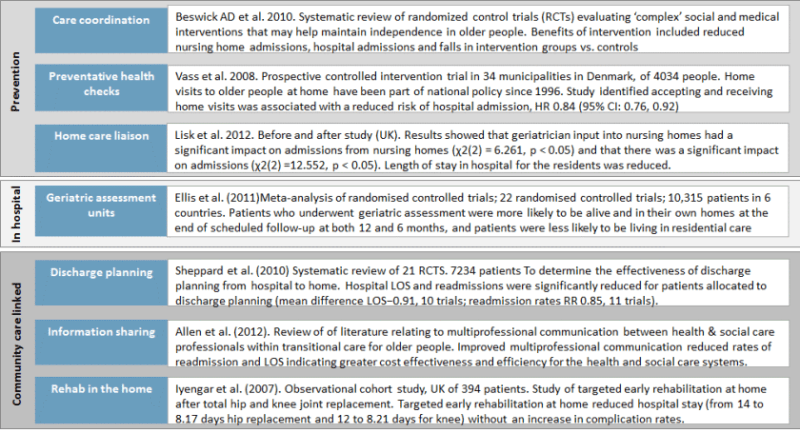
On page 89 there is a table which does provide some anecdotal clinical evidence, but there are no links to the underlying evidence (though we might be able to find it to verify that they have used it correctly if we search for it):

img_1340

However the only evidence above directly relevant to their home-care proposals relates only to one specific type medical condition (total hip and knee replacement), and they then seem to have made a leap of faith that they can apply this to every medical condition which currently results in a stay in hospital beyond the point that hospital medical care is needed.

So it would seem that one target for “consultation feedback” is whether the CCG has met the requirements set by NHS England for a “Clear, clinical evidence base” that shows that their proposals are 1) effective and safe when considered alone, and 2) are at least as effective and safe as hospital care.

Another target for “consultation feedback” is to look at all the other areas defined by NHS England that the CCG has to meet, and see whether they have in fact done so.”

Whatever happened to ….. EDDC councillor ” champions”?

A year or two ago, you couldn’t move for EDDC councillor “champions” – Tory councillors without cabinet portfolios but with “special responsibilities” for specific tasks. Now, without fanfare, they seem to have disappeared without trace.

Those recently memorable to Owl were Councillor Phil Twiss, who had special responsibility for broadband services in East Devon and a councillor who had “special responsibility” for tourism who seems never to have said anything meaningful about it – ever. And who could forget the councillor with “special responsibility” for construction design – whose legacy is … er … perhaps best not go there!

History tells us that at least two councillors in the past declined these “champion” roles, having been awarded championships without even being consulted, of what might be perceived as “poisoned chalices – “beaches and foreshores” (Councillor Wragg) and “affordable housing” (then EDDC councillor Claire Wright)

http://www.plymouthherald.co.uk/councillors-reject-role-champions/story-12682633-detail/story.html

And who could forget Councillor Philip Skinner being stripped of his role as “rural champion” by then EDDC leader Sarah Randall-Johnson when he sent her what she perceived to be offensive Christmas greetings:

http://www.cornwalllive.com/leader-sacks-rural-champion-christmas-card-message/story-11517317-detail/story.html

Oh, and finally, perhaps the “creme de la creme” of champions, disgraced ex- councillor Graham Brown who was excommunicated and stripped of his “business champion” role (and his Chairmanship of the notorious East Devon Business Forum”) after a Daily Telegraph front page sting in which he asserted:

“If I turn a green field into an estate, I’m not doing it for peanuts”

http://www.telegraph.co.uk/news/uknews/9921333/If-I-turn-a-green-field-into-an-estate-then-Im-not-doing-it-for-peanuts.html

Ah, perhaps Owl has accidentally solved its own conundrum!

£117.3m spent on tourism in East Devon

And does our Local Enterprise Partnership value tourism in its ” growth” agenda? Not on your life, unless you count trips around Somerset nuclear plants, perhaps! And does EDDC have a dynamic tourism strategy? Attempts to find a councillor “champion” for tourism on the EDDC website were fruitless.

“New figures have revealed that the value of tourism in East Devon is continuing to rise.

In 2015 alone, tourism contributed £3.5million more to the local economy than it did in 2014, rising to £252.5million.

“The figures come from a new report provided to Visit South Devon and the Devon Tourism Partnership, which analyses trends in tourism year-on-year.

The latest findings show that UK-originated and overseas trips to East Devon increased four per cent to 521,000 trips in 2015, compared to 502,000 trips 2014.

The average number of nights per East Devon trip rose by eight per cent, equivalent to 166,000 additional nights in the local area.

Associated spend by tourists visiting from outside the local area leapt by £7.6million to £117.3million in 2015.

However, income from day trips fell by £4.1million to just over £135million – equivalent to a three per cent drop.”

http://www.midweekherald.co.uk/news/figures_reveal_that_value_of_tourism_in_devon_is_rising_1_4779567

“Elderly failed by ‘shameful’ care system”

“Age UK and the Alzheimer’s Society criticised both the quality of care and the way it was rationed as they published fresh evidence on the state of the care sector.

It includes figures that suggest the number of older people not getting help has risen by nearly 50% since 2010. …

… three pieces of research showed:

There are now an estimated 1.2 million over-65s going without help for care – nearly one in eight of all older people

Some 300,000 of them have difficulty with three or more tasks, including dressing, bating and going to the toilet

Councils agreed to help under half the 1.3 million people who approached them for care last year

The BBC identified 11 councils that rejected more than 75% of applications
Where home care was provided “serious problems” were identified in the way dementia patients were treated

Staff said they had not been given enough training to cope with the complex needs people had

Families reported examples of poor care, including loved ones not being given medication, being left in dirty clothes for days and going missing after homes had not been properly secured

Caroline Abrahams, of Age UK, said she was “extremely worried” about the “shameful” state of the care system.

“The sad irony is that it would be far more effective as well as infinitely more humane to give older people the care and support they need,” she said. …

…Councillor Izzi Seccombe, of the Local Government Association, said: “Unless social care is properly funded, there remains a growing risk to the quality and safety of care, and the ability of services caring for our elderly and vulnerable to meet basic needs such as ensuring people are washed and dressed or helped out of bed.”

http://www.bbc.co.uk/news/health-37992488