“Growth”: 40% of jobs in East Devon could be lost to automation

Owl says: many people are only one robot away from Universal Credit …

“You could soon be replaced by a robot as data reveals two out of every five jobs in East Devon could be lost to automation.

The data, measured in 2017 by the Office for National Statistics (ONS), shows that 42,000 jobs in the area could be partially or totally replaced by machines over the coming years.

This equates to 44 per cent of occupations and of them, 9% of them are at high risk meaning they have a more than 70% chance of being replaced by machines.

The threat was medium for a further 60 per cent of jobs as the chances of automation are between 30 and 70 per cent.

East Devon was less vulnerable to the impact of automation in 2017 than six years earlier when 49 per cent of jobs were at risk of being replaced by machines.

The ONS analysed the jobs of 20 million people across England in 2017 and found that 7.4 per cent were at high risk of being replaced.

70 per cent of the roles at high risk of automation are currently held by women.

People aged 20 to 24 years old are most likely to be at risk of having their job replaced and low-skilled occupations, like waiting or shelf stacking, face the highest risk.

Jobs requiring higher qualifications, such as medical practitioners and higher education teachers, are less susceptible to computerisation.

An ONS spokesperson said: “The exact reasons for the decrease in the proportion of roles at risk of automation are unclear but it is possible that automation of some jobs has already happened.

“Additionally, while the overall number of jobs has increased, the majority of these are in occupations that are at low or medium risk suggesting that the labour market may be changing to jobs that require more complex and less routine skills.”

Felicity Burch, the CBI’s director of innovation and digital, said technology is predominantly putting jobs held by women and low-skilled occupations at risk.

She said: “The picture is complicated, as ONS’s own analysis shows that some of the roles most at risk of automation saw a boost in recent years.

“Furthermore, we know that the more businesses invest in new technology, the more likely they are to create new roles.”

https://www.midweekherald.co.uk/news/east-devon-jobs-robots-1-5973184

27 days to local elections – today’s picture


(photo: Camping and Caravan Club)

This is Ladram Bay Holiday Park – owned by the high-profile Carter family who also own Greendale Business Park (more on that in a later post).

The photograph was taken in 2015 since which it has grown more. Residents of Otterton are tearing their hair out at the heavy vehicle traffic using its roads to move large caravans and mobile homes on and off the site. DCC independent councillor Claire Wright has tried to help but one EDDC Tory councillor (Tom Wright) nearly sabotaged her latest attempt:

https://eastdevonwatch.org/2019/02/12/one-tory-councillor-nearly-sabotaged-a-highways-safety-project-in-otterton/

and planning policies for the destination are in tatters:

https://eastdevonwatch.org/2018/09/08/unrest-in-otterton-planning-policies-in-shambles/

Auditors should not be consultants [ *particularly to the council they audit!]

* after the big disgraced Tory councillor Graham Brown debacle, EDDC’s internal auditors (South West Audit Partnership) were given a consultancy contract to investigate his influence on planning decisions while running his own planning consultancy in East Devon. The report was wishy-washy to say the least, as reported by EDW here:

https://eastdevonwatch.org/2013/11/11/council-anti-corruption-report-slated-by-campaigners/

“Audit firms should be banned from carrying out consultancy services, according to a report of MPs.

The Business, Energy and Industrial Strategy Committee this week released a report into the future of audit, launched after recent accounting scandals at firms including Carillion and Patisserie Valerie.

Among a raft of conclusions, it said that audit firms currently face conflict of interests if they also carry out advisory services, leading to lower quality auditing.

Committee chair Rachel Reeves said: “For the big firms, audits seem too often to be the route to milking the cash-cow of consultancy business.

“The client relationship, and the conflicts of interest which abound, undermine the professional scepticism needed to deliver reliable, high-quality audits.

“Splitting audit from non-audit business would be a big step to boosting the culture of challenge needed to deliver high-quality audits.”

The report said that non-audit profits currently subsidise the pay of audit partners within firms.

“We do not think that this is a healthy state of affairs,” it said.

“Audit partners must not be or feel indebted to non-audit partners.

“That frame of mind can only lead to audit partners being mindful of the interests of the non-audit practice, when we expect them to serve the interests of the firm, its shareholders and the wider public.”

http://www.room151.co.uk/treasury/council-auditors-should-not-be-allowed-to-provide-advisory-services/

First thoughts on election candidates

Paul Diviani (former Tory Leader) still living in Yarty Ward but standing in Broadclyst. Very helpful if Cranbrook extension needs highly localised support.

Stuart Hughes (formerly Monster Raving Loony Party and Conservative (no – not the same thing) ) now standing as “Independent”. still has a few more parties to go through yet!

Disgraced Lib Dem ex-Mayor of Seaton Peter Burrows standing again for District for the same party, along with his wife and 6 other candidates including two East Devon Alliance.

Fair proportion of REAL independents but several suspiciously right-leaning ones who have always followed the Tory line in the past and who seem to easily get on to committees …..

Contested towns and parishes listed but not uncontested towns and parishes (eg Cranbrook, Seaton) whereas uncontested districts are listed.

East Devon Alliance has strong showing, including Chairman Paul Arnott in Colyton.

Flybe – leaving (or not) on a jet plane …..

Flybe has jet and propellor aircraft.
Flybe is now owned by Virgin Atlantic and Stobart Air.
Virgin is interested only in feeder traffic to its Manchester and Heathrow hubs.
Stobart has heavily invested in its Southend and Carlisle hubs.
Flybe is cutting all its jet flights from Exeter and several other regional airports in October 2019 and returning all jets to lease owners.
Flybe jet pilots will become redundant and Flybe’s Exeter airport traffic (and repair hub) will be decimated.
There is a worldwide shortage of jet pilots.
How many former Flybe jet pilots will later be employed by Virgin and Stobart on non-Flybe routes?

Would this scenario be an intended or unintended consequence of the decision?

Seaside towns: “reinvent or die”

The report can be found here:
https://www.parliament.uk/business/committees/committees-a-z/lords-select/regenerating-seaside-towns/news-parliament-2017/seaside-report-published/

ITV News summary:

“Seaside towns need to be reinvented to attract tourists and residents and become desirable places to live and visit, a parliament report has said.

The report called on improvements to education, housing and transport links, so seaside towns can “reinvent themselves with a long-term, place-based vision.”

In the Future of Seaside Town report, peers said poor transport links to seaside towns are “severely hindering” opportunities to improve tourism and attract funding.

They warned young people are at a disadvantage because of their limited access to education, especially post 16-education.

The report called on the government to improve digital connectivity, most notably high-speed broadband, saying doing so would provide an opportunity to “overcome the challenges of peripherality in coastal areas.”

Coastal towns which emerged as leisure and pleasure resorts in the 19th century have been neglected for “too long”.

The House of Lords select committee said these places should once again be “celebrated as places that can provide attractive environments for residents and visitors.”

The peers also called for ministers to set out how coastal areas will benefit from the UK Shared Prosperity Fund, which will replace EU funding after Brexit, and to increase resources for the Coastal Communities Fund.

What is needed is a package of strategic initiatives and interventions where national and local government work together to address issues such as transport, housing, post-school education and high-speed broadband.
Lord Bassam of Brighton
Places like Brighton and Bournemouth have shown that the seaside can successfully reinvent itself.

Lord Bassam of Brighton said: “The potential impact of Brexit on these towns, particularly the hospitality sector, also remains an open question.

“A single solution to their economic and social challenges doesn’t exist. What is needed is a package of strategic initiatives and interventions where national and local government work together to address issues such as transport, housing, post-school education and high-speed broadband.”

He added: “The committee is confident that if our recommendations are pursued, seaside towns can once again become prosperous and desirable places to live in and visit.”

A spokesman for the Ministry of Housing, Communities and Local Government said: “The Government is determined to ensure our economy works for everyone and every place.

“We are on track to invest £200 million in the Great British Coast by 2020 and recently announced a £36 million package of support to projects in coastal communities through our Coastal Communities Fund and Coastal Revival Fund.

“We have also made a commitment to support towns to harness their unique strengths to grow and prosper through the £1.6 billion Stronger Towns Fund.

“We recognise the challenges facing our seaside towns and will carefully consider the committee’s recommendations to build on the significant steps we have already taken to help coastal communities thrive.”

https://www.itv.com/news/2019-04-04/action-urged-to-reinvent-struggling-seaside-towns/

28 days until local elections – today’s picture

This is EDDC CEO and Electoral Officer (extra pay for that) piano playing with Streetscene workers on one of those “look at me I’m just like you” PR stunts.

You know, the bloke who “lost” 6,000 voters and hasn’t got the mechanism for online checking of where you should go to vote working. The one who was hauled before a parliamentary committee to explain himself:

https://eastdevonwatch.org/2014/10/13/highlights-of-mr-williams-audio-transcript-of-evidence-to-the-parliamentary-select-committee-on-voter-engagement/

Time for all sorts of changes to the status quo.

[Apologies for Owl’s poor maths -28 days to voting today – it needs to have a refresher course at Hogwarts]

“Inheritance tax loopholes allowing super-rich to pay lower rates”

“The UK’s super-rich pay half the rate of inheritance tax paid by the merely very rich, according to an analysis of HMRC data that throws fresh focus on how billionaires’ advisers use a “kitbag” of tricks to reduce heirs’ tax bills.

Estates worth £10m or more paid an average of 10% tax to the exchequer in the 2015-16 tax year compared with an average 20% tax paid by estates worth £2m-£3m, according to data released by HMRC following a freedom of information request by asset manager Canada Life.

The law states that estates should pay 40% tax on assets above £325,000 – or above £450,000 if the family home is given to children or grandchildren. But Neil Jones, the market development manager at Canada Life, said the richest of the rich often did not pay anywhere near that rate because they had access to “a myriad of potential solutions in an adviser’s kitbag to help mitigate IHT [inheritance tax]”.

“This difference in the net tax rates paid by estate isn’t always down to the value of the estate or the different type of assets held in an estate,” Jones said. “It’s often about a willingness to plan.”

The heirs of the late sixth Duke of Westminster paid no inheritance tax on the bulk of his £8.3bn family fortune following his death in 2016. Probate records show that Gerald Cavendish Grosvenor, who died aged 64 in August 2016, left a personal estate of £616,418,184 after payment of debts and liabilities.

The rest of his wealth had already been transferred to family trusts which largely passed on to his son Hugh, 28, without incurring inheritance tax. His son also inherited the title, becoming the seventh Duke of Westminster and the world’s 108th richest person with a £9.2bn fortune, according to estimates by Bloomberg Billionaires

The Resolution Foundation thinktank has been campaigning for a radical shakeup of the inheritance tax system to make it fairer for those inheriting smaller sums. Its research director, Laura Gardiner, said the findings showed that “inheritance tax is no longer fit for purpose”.

She said: “Inheritance tax has both a terrible record of raising revenue, despite record levels of wealth across Britain, while still being widely despised, even by people who are never likely to pay it. At the very minimum, there are billions of pounds of worth inheritance tax loopholes that need to be closed. But ultimately we should scrap inheritance tax altogether and replace it with a far fairer lifetime receipts tax [cumulative across a person’s life], which would be harder for the super-wealthy to avoid.”

https://www.theguardian.com/business/2019/apr/03/inheritance-tax-loopholes-allowing-super-rich-to-pay-lower-rates

More bad news on Flybe Exeter

“All Flybe jet flights are to end from Exeter Airport when its summer timetable finishes in October, airline bosses say.

The move, which is part of plans to cuts its fleet from 85 aircraft to between 70 and 75, will affect routes including Faro, Mallorca and Malaga.

The company apologised, blaming an industry-wide shortage of pilots for the delays, as well as its own pilots taking holidays.

The airline had also entered discussions over potential job losses, but it hoped to keep loyal employees “with Flybe”, airline chief executive Christine Ourmieres-Widener said.

She was speaking after the Exeter-based regional airline cancelled dozens of flights on Wednesday morning.”

https://www.bbc.co.uk/news/live/uk-england-devon-47708796

“Flybe confirms ‘base restructuring’ amidst rumours all Exeter flights could be scrapped”

Owl says: what the hell is happening? One minute we are told of new routes (including Flybe) and the next the talk is of all Flybe routes being cancelled! Would the airport (into which DCC and EDDC are pouring money into for infrastructure improvements) then be viable?

“Exeter-based airline Flybe has confirmed it is undertaking a ‘base restructuring’ after reports this morning that all jet-plane flights from Exeter, Cardiff and Doncaster are to be scrapped.

In a statement on the reason 27 Flybe flights were cancelled this morning the airline confirmed that ‘base restructuring’ is part of the reason.Pilots and cabin crews are believed to have been called into meetings since 4am this morning to be told the news, which has added to the delays.

According to UK Aviation News pilots have been told the decisions comes after a “critical review of the business performance”.

If true it means jet flights will cease operating from Exeter this summer, leaving the company to operate just Dash 8 Q400 planes – the type that makes shorter journeys such as Exeter to London.

Flybe this morning confirmed ‘base restructuring’ was under way, and said that is part of the reason a number of flights were cancelled on Wednesday.

UK Aviation News says the move could be ‘potentially devastating’ for Exeter Airport. …”

https://www.devonlive.com/news/devon-news/flybe-confirms-base-restructuring-could-2715437

To Flybe or not to Flybe, that is the question

“Regional airline Flybe has cancelled dozens of flights on Wednesday morning for what it describes as “operational reasons”.

Five flights from Belfast City Airport and four from Birmingham are among those affected, along with departures from Southampton, Aberdeen, Edinburgh and Newcastle.

Most of the flights are within the UK.

The airline said it would like to “sincerely apologise for any inconvenience caused”….

… On Monday, Flybe passengers on a new route were left with a six-hour coach journey when their aircraft was grounded.

The 18:40 service from Newquay to Heathrow could not take off on Sunday because of a “technical issue”.

Cornwall Airport Newquay said passengers were offered “rebooking for another flight or ground transport to London Heathrow”. …”

https://www.bbc.co.uk/news/business-47797738

30 days to local elections – today’s picture

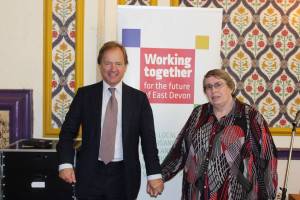
This is MP Hugo Swire with Jill Elson who has been a Tory councillor for FORTY years. She has been the Cabinet Member for Sustainable Homes and Communities at East Devon District Council and Chairman of Resources (Governor) of Exmouth Community College.

Sustainable homes? Communities? See this article from yesterday – you need 10 TIMES the average salary to buy a home in East Devon:

https://www.midweekherald.co.uk/news/east-devon-homes-cost-10-times-average-salary-1-5971058

Governor responsible for resources at a college that is asking donations of £15 per first child and £5 per subsequent child to make end meet!

Owl rests its case for the need for change!

Vote Independent!

Should Ottery have a lottery to repair its roads?

Owl says: isn’t that what road taxes and council payments from central government (also from out taxes) supposed to pay for?

https://www.sidmouthherald.co.uk/news/ottery-lottery-1-5964938

31 days to voting – today’s pictures

Which party (or Independent) do you think better represents you – and which one do you think has East Devon’s interests at heart locally?

Conservative?

Swire – always away, mostly in the Middle East, does not live in his constituency, prefers Mid-Devon:

Parish – prefers his farming and hunting friends around his farm on the Somerset/North Devon border:

or Independent Claire Wright, East Devon born and bred and always actively in and around her patch:

How did Swire and Parish vote this evening?

Swire voted against all options.

Parish voted against customs union, confirmatory referendum and parliamentary supremacy and abstained on Common Market 2.0.

“G4S stripped of contract to run HMP Birmingham as government takes violent jail back under public control”

“A privatised prison marred by riots, drugs, suicides, violence and “appalling” conditions has been taken back under permanent government control.

The Ministry of Justice cancelled G4S’s contract to run HMP Birmingham, months after seizing temporary charge of the jail following an “urgent notification”.

Officials denied the unprecedented move was a “public versus private sector issue”, but critics claimed years of warnings over outsourcing prisons had been vindicated. …”

https://www.independent.co.uk/news/uk/home-news/hmp-birmingham-g4s-contract-government-public-control-a8849751.html

“East Devon house prices are around £70k more than five years ago”

“The latest data from the Office of National Statistics shows that the average property in the area sold for £303,162 – significantly higher than the UK average of £228,147.

Across the South West, property prices have risen by 0.5 per cent in the last year, to £253,926. The region underperformed compared to the UK as a whole, which saw the average property value increase by 1.7 per cent.

The data comes from the House Price Index, which the ONS compiles using house sale information from the Land Registry, and the equivalent bodies in Scotland and Northern Ireland. …”

https://www.midweekherald.co.uk/news/east-devon-house-prices-1-5970301