Martin Shaw – My column in the local press has been cancelled

Where are the local media heading?

East Devon Watch continues! – Owl

seatonmatters.org /

My fortnightly column in the Midweek Herald, Sidmouth Herald and Exmouth Journal has been discontinued. The editors have told me that they have too many political columns – but regular contributions by three Conservative politicians, Simon Jupp MP, Cllr John Hart and police commissioner Alison Hernandez, will continue, while on the other side only Cllr Paul Arnott and occasionally Richard Foord MP remain.

I’m not complaining, but it seems to me that with a General Election approaching where the East Devon seats will be more closely fought than they have been for a generation, the press should be scrupulously maintaining political balance.

I’d like to thank all the readers who’ve given me such positive feedback over the last three years – it’s made it all worthwhile. My apologies to those who thought I wasn’t outspoken enough, and to the gentleman who told me last year that I was too anti-Tory – perhaps now you understand why!

Planning applications validated by EDDC for week beginning 1 May

Westminster forgot its promises to ‘coastal communities’, and left them to rot 

This article by John Harris starts from issues raised ten years ago.

Owl believes “official” recognition of the problem of coastal communities can be traced much further back.

Before reading the article below consider this conclusion from a Government and Local Communities Committee report of 2006 which featured a visit  to consult “Stakeholders” in Exmouth (Annex A). 

“Our analysis has identified a number of common characteristics shared by many coastal towns. These include: their physical isolation, deprivation levels, the inward migration of older people, the high levels of transience, the outward migration of young people, poor quality housing and the nature of the coastal economy. Excluding their physical location, none of these characteristics are unique to coastal towns. The combination of these characteristics, however, with the environmental challenges that coastal towns face, does lead to a conclusion that they are in need of focused, specific Government attention. 

We were particularly struck by the demography of many coastal towns, where there is a combination of trends occurring, including the outward movement of young people and the inward migration of older people. One of the impacts of this phenomenon is that there tends to be a high proportion of elderly in coastal towns, many of whom have moved away from family support resulting in a significant financial burden on the local public sector in these areas.”

[Those “Stakeholders” consulted included: Ms Jill Elson (EDDC Communities portfolio holder and Exmouth member) Mr Paul Diviani (EDDC Portfolio holder and Exmouth member) Cllr Eileen Wragg (Mayor of Exmouth Town Council)]. 

John Harris www.theguardian.com 

About a decade ago, politicians and journalists were suddenly confronted with an issue that had always festered at the edge of the national conversation: the dire state of England’s seaside towns, and their deep social problems.

The referendum that would pull us out of the EU was a couple of years away, but one of the key things that made it happen was already plain to see: the rise of the UK Independence party, and a surge of grievance and complaint that had particularly strong roots on the East coast. In 2014, the faded Essex resort of Clacton held the byelection that resulted in the Tory turncoat Douglas Carswell becoming the first of Ukip’s two elected MPs. His new party was doing equally brisk political business in coastal towns clustered in Norfolk and Lincolnshire.

When the vote for Brexit came, such places as Blackpool, Great Yarmouth, Canvey Island and Margate were among the leave side’s enthusiastic sources of support. As Nigel Farage and his friends endlessly said, many people in those towns were anxious and angry about immigration. But as I well knew from repeated reporting trips, what they tended to talk about most passionately was stuff that Ukip rarely mentioned: dreadful public transport, poor housing, nonexistent opportunities for young people, and local economies that effectively died for half the year.

In the wake of the result, politicians and journalists maintained a sort of guilt-stricken interest in the kind of “left-behind” places that looked out to sea. But then, as the 2019 election came into view, there was a shift. The most vivid political stories suddenly seemed to centre on the old coalfields and former factory towns grouped into the so-called “red wall”. That continuing story has since been joined by that of the supposed “blue wall”: Tory-held seats in the south of England where disgruntled remainers are looking to other parties. There have been a few rather laboured attempts to conceptualise a “sea wall” centred on coastal constituencies, but they have failed to catch on: the plight of seaside towns remains as clear as ever, but they have once again fallen back to the political margins.

Among plenty of others, this is one of the stories that runs through a brilliant new book titled The Seaside: England’s Love Affair, by the former Guardian writer Madeleine Bunting. It is a travelogue, an impressive work of social history, an affectionate celebration and much more besides. But a grim English irony burns through almost every page: the fact that the places many of us still associate with leisure, noisy enjoyment and the health-giving wonders of sea air are also full of isolation, misery and poor health.

Each chapter has a sobering passage that recounts basic facts. “Over 80% of the residents of Skegness and Mablethorpe live in areas categorised as the 20% most deprived in England. Around a third of residents have no or low qualifications … Scarborough’s quaint streets translate into a tragic set of health statistics on the diseases of despair: suicide in the town is 61% higher than the national average, and hospital admissions are 60% higher … Despite the success of Margate’s regeneration, parts of the centre of the town are still among the most deprived in the country; it has three areas in the top half per cent on the index of multiple deprivation.”

What all these numbers reflect is the reality of living on the edge, in every sense. Coastal towns are often not just distant from Westminster, but also on the periphery of local government districts, and therefore neglected even by their own councils. They tend not to have any institutions of higher education. And their public transport is largely terrible: this week’s story about the nationalisation of the failing train operator TransPennine Express, for example, is not only about Leeds, Sheffield and Manchester, but places where dire rail transport compounds glaring economic problems: Redcar, Scarborough, Cleethorpes, Hull, Grimsby.

Such are the results of a neglect that is evident even when people in positions of power are in a mood to help. One of the most telling features of last year’s levelling up white paper was a seemingly reflex tendency to fold coastal areas into generalised descriptions of places with problems – “Urban areas and coastal towns”, “former industrial centres and many coastal communities” – and thereby underplay their very specific issues. The same sense of condescension surrounds the government’s £229m coastal communities fund. As one of the most damning parts of Bunting’s book explains, it has been spread pathetically thinly: £1.6m to renovate the centre of Bognor Regis, £1.4m for “a visitor centre at Walton-on-the-Naze”, £1.2m for Hastings’ new “food court”.

And then there are the government’s much-hyped plans for so-called freeports, replete with promises of thousands of new jobs. These deregulated, low-tax zones – still shrouded in secrecy – are the cheapest kind of regeneration option, reflecting the old laissez-faire idea that if the state steps out of the way, it will somehow open the way to dynamism and innovation. But without huge improvements in transport, housing, training, education and all the rest, the kind of employers who might offer more than low-paid, precarious work will never pitch up. Besides, the plans are centred on a large handful of existing commercial ports, not coastal communities in general: even if their supposed miracles materialise, they will not touch most of the UK’s coastline.

Elsewhere, there are glimmers of hope. The annual £28bn the Labour party is still pledging to spend on new climate measures – which sits alongside other plans for government-led investment in deprived areas – will have clear benefits for coastal places, not least because of the centrality to the plans of offshore wind. Its promised “take back control” bill will at least increase the responsibilities of local councils, and thereby bring some decisions closer to the places they affect. But as ever, more radical thinking might be a good idea. Within central government, coastal communities should surely have their own dedicated minister. Clusters of seaside towns should perhaps be grouped into federations led by mayor-like figures, and given responsibility for collective regeneration plans, along with the kind of substantial spending power that Westminster politicians never like to talk about.

Last summer, I took a family holiday not far from Minehead, a coastal town on the edge of Somerset long associated with deprivation, scarce job opportunities and a sense of being woefully cut off. It is actually a gloriously located place, overlooked by a spectacular headland, with an elegantly wide main street and a lovely beach. It is 60 miles from Bristol and about 40 from Exeter: in the era of working from home, it could thrive.

But besides steam trains that slowly transport tourists across the nearby countryside, its 12,000 residents have no rail service: the town’s station closed in 1971. As with so many other places, choices were made in distant centres of power that condemned it to long years of stagnation and decay. Now, instead of fixating on coastal towns one day and forgetting them the next, could we not just give them what they need?

Thousands of pharmacies on brink of closure – just as Tories say we need them more

Thousands of pharmacies are on the brink of closure – just as the Tories seek to rely on them to bail out struggling GPs.

Mirror.co.uk

A report by the National Pharmacy Association predicts 3,000, almost one in four, could shut by next year following years of funding cuts.

The Government announced plans this week to let pharmacists give prescriptions for seven common ailments.

Tories hope the policy, starting in winter, will end the daily 8am scramble for GP appointments.

But pharmacists branded the move unachievable.

Anil Sharma, boss of nine ­pharmacies in Health Secretary Steve Barclay’s North East Cambridgeshire patch, said: “Our primary function – dispensing medicines – is underfunded. Pharmacies haven’t had a pay rise for eight years so we are really struggling financially.”

Mr Sharma, 49, in the business for 25 years, said the cuts are also causing a workforce shortage as staff tell him they can earn more at McDonald’s.

“Potholes ahead. Remove dentures. Fasten bra straps.” 

So read a sign recently erected by a farmer in Stockleigh, Mid Devon.

Cornwall seems to be experiencing the same problems as Devon.

There are also widespread reports across the country of people planting flowers in potholes. – Owl

Who filled Cornwall’s ‘biggest pothole’? No one’s telling the council

A phantom pothole filler has struck in the town of Lostwithiel after becoming fed up that the “biggest pothole in Cornwall” had not been fixed, even though the council closed the road for more than a month.

Will Humphries www.thetimes.co.uk

Highway officials are now calling for anyone with information about the identity of the unknown repairer to contact them.

The main route between Lostwithiel and Bodmin was closed by the council at the beginning of last month after residents complained for months about a 40cm deep pothole, measuring 2.5m by 3.2m.

Last Sunday someone filled it with concrete and reopened the road. Cornish Highways has since closed it again and says the hole will not be fixed until next month at the earliest, because of a backlog of potholes.

Geoff Barrett, 73, a retired journalist who lives locally, spotted someone with a pick-up truck parked by the closed road on Sunday afternoon. Four hours later the road was open. “It did surprise me that someone from the council would be working on a bank holiday weekend,” he said. “I didn’t realise it was someone taking things into their own hands.”

Kay Bevan, 78, who lives near the pothole, said her neighbours appeared to know who is responsible “but everyone is feigning ignorance”.

“Because it’s a B road it’s not a high priority for the council, but it’s a major road for locals getting to Bodmin,” she said.

Colin Martin, the Liberal Democrat councillor for the town, said the pothole filler represented the “shared frustration” of drivers across the country with the state of the nation’s crumbling road network. “The filled-in pothole isn’t perfect but it’s still better than most of the roads that the council are supposed to be maintaining at the moment,” he said.

Rishi Sunak promised a clampdown on potholes at the launch of the Conservative local election campaign last month, and posed for photographs on a crumbling road in Darlington, Co Durham. The prime minister said new powers would help to ensure firms repair roads properly after carrying out works, through more fines and inspections.

Martin said Cornwall had a good record of road maintenance until the Conservatives won control of the council two years ago and cut spending.

“A road maintenance inspector told me the other day they would normally be finding 300 potholes a week but now they are finding 1,000 a week,” Martin said.

“Previously if I reported a pothole within 24 hours the green paint would be painted around it and it would be filled in by the next day. We are now at the stage where green paint appears within 24 hours but the pothole stays there for weeks on end.”

A manager wrote: “If information regarding who carried out the works becomes known in the community, I would be grateful if details could be shared. At the present time, we have a significant backlog of pothole defects across the network and our resource is allocated to this as a priority over other planned works. The work at Tanhouse Road will be scheduled when the situation eases.”

Connor Donnithorne, the Conservative council portfolio holder for transport, told cabinet this week that the council had received an additional £5 million from the government towards its “pothole fund”. This is added to £12 million spent on mending potholes and other road repairs in Cornwall each year.

A council spokesman said: “There is an ongoing issue with drainage at this site which has led to the deterioration of the road surface. These drainage issues have meant that any surface repairs during the winter have been temporary.

“As we are now moving into warmer and drier weather, Cormac [the maintenance company] can programme in the permanent drainage and surfacing repairs needed at this site.”

Residents across the country have been taking action to draw attention to their deteriorating roads. Villagers fed up with a “nightmare” pothole in Blythe Bridge, Staffordshire, recently added rubber ducks to the crater after it flooded in rainfall.

A farmer in Stockleigh English, Devon, erected a sign last month warning motorists: “Potholes ahead. Remove dentures. Fasten bra straps.” Carol Perryman said: “I keep reporting it at Devon Highways but nothing gets done.”

Head of David Cameron’s legacy project paid £165,000 despite pay review pledge

The chief executive of David Cameron’s legacy project for young people has continued to be paid his £165,000 salary, despite committing to review his pay before the charity had more than 60 per cent of its funding cut.

David Cohen  www.independent.co.uk

Mark Gifford was appointed head of the National Citizen Service Trust in early 2020 when almost £160m of taxpayers’ money was lavished on the NCS by the Department of Culture, Media and Sport.

But a government review has since shrunk their budget to less than £60m a year following an investigation by The Independent that showed the charity was failing to provide value for money.

Mr Gifford had admitted that cuts were needed to make NCS pay for senior executives “better aligned to the third sector” and to “take into account market forces”.

His comments formed part of an investigation by The Independent that revealed that the senior NCS team were being handed six-figure salaries, despite dwindling youth participation in its activities and failing to meet government targets.

But Mr Gifford’s salary – which is set by the NCS Trust Remuneration Committee and on which a government representative sits with a veto – has remained at £150,000, or £165,000 including benefits. Other members of the senior leadership also do not appear to have had their salaries cut.

By way of comparison, the CEO of Oxfam received a salary of £120,000, £30,000 less than Mr Giffford, despite managing an annual income more than six times higher than the NCS and a staff of 3,886, 16 times that of the NCS.

Mr Gifford also earned more than Save the Children’s boss, who is on £143,000 and who manages a budget and staff four times larger. The Red Cross CEO earned more, and was paid £181,000, but that is to manage a budget four times the size of NCS and with a headcount 14 times the size.

The National Citizen Service was set up in 2011 by Cameron to run summer and autumn residential programmes for 16 and 17-year-olds to help them become better citizens.

The latest annual accounts reflect that no residentials were held during the year ending March 2022 and that the programme migrated online and to “non-residential face-to-face” experiences.

For the programmes that were held, the NCS failed to meet its basic “customer experience” target score of 55, achieving a disappointing “net promoter score” of 50, according to the annual accounts.

The Department of Culture, Media and Sport last year ripped up the NCS grant, cutting its budget to £57million a year for three years – less than one-third of its size when Cameron had “stuffed NCS’s mouth full of gold”, as one Whitehall whistleblower had put it.

The department criticised the scheme for being too middle-class and demanded it is more “cost-effective” and reach more young people from disadvantaged backgrounds. At the time, NCS swallowed up 90 per cent of the government’s youth budget.

A former board member had described the programme to The Independent as little more than “a holiday camp for mostly middle-class kids”.

But Mr Gifford’s salary has remained higher than that of the prime minister and of Lucy Frazer, the culture secretary responsible for the NCS grant, whose salary totals £121,326.

Five of the six other members of the NCS senior leadership team also have packages that exceed the minister’s, according to the latest annual accounts, with NCS public affairs advisor Miriam Jordan Keane on a hefty £155,000.

Her senior leader counterparts at charities such as Oxfam were on £98,000 to £100,000, showing just how excessive NCS senior team salaries are and raising questions as to whether the NCS Remuneration Committee is fit for purpose.

Brett Wigdortz, chair of the NCS Trust, defended their pay arrangements and pointed out that their CEO is responsible for [over] £50m of public money a year for delivering youth programmes.

He said: “We understand the challenges, skills and competencies needed to run NCS and we pay our brilliant CEO accordingly while offering the taxpayer outstanding value for money.”

A spokesperson for the NCS said: “The pay and reward policy of NCS Trust is set by the Remuneration Committee, which has a government representative on it with a veto. It was reviewed in May 2022 and November 2022 by senior HR officers.”

The Department of Culture, Media and Sport declined to address our questions as to whether NCS pay was value for taxpayers’ money but said it had robust processes in place to ensure salary decisions and changes “are proportionate and appropriate”. It added that the NCS has been “carrying out a cost optimisation strategy to reduce and reshape its cost base”.

Shadow culture secretary Lucy Powell MP said: “Ministers should not be playing favourites and the decision by DCMS to seemingly wave through remuneration packages despite reduced budgets without ensuring results and value for money is concerning.

“Ministers are fixating on one programme instead of ensuring the broad range of youth provision we need to open opportunity for young people everywhere.”

Mr Cameron, chair of the NCS Board of Patrons, failed to respond to our questions.

Simon Jupp is minding his pennies, but does he know who the real spendthrifts are?

Owl understands the need to watch the pennies.

Job security for Conservative MPs is not looking good.

In his last week’s media column under the title: ‘It’s been a difficult day for the conservatives’ Simon Jupp said of the local election result:

“It’s going to [be] an interesting time, I just want to make sure that our council is value for money. I pay my council tax to East Devon and I want to make sure every penny that I give to the council is spent wisely, so as one of the MPs, I’ll be scrutinising every penny.” 

Well Simon, you may pay your council tax to EDDC but they aren’t the big spenders.

For every pound you pay in your council tax, 73p are spent by Phil Twiss, cabinet member for finance, and the conservative controlled Devon County Council (DCC). 

DCC raised what they take from you by 5% this year but they are still teetering on the edge of bankruptcy.

Next up, 12 of your pennies are spent by the Crime and Police Commissioner, Alison Hernandez. She hiked her budget this year by a whopping 6% to help pay for the 20,000 “Boris Bobbies” Johnson vowed in 2019 would  reverse Tory police cuts.

The jury is out on this one, police numbers are still not keeping up with local population growth.

Only 7 of your pennies are spent by EDDC.

The coalition of last year was the only Devon council to balance its books without digging deep into reserves. It managed to do so by a serious overhaul of the budget, raising its part of your council tax by only 3%.

[4p in every pound goes to provide fire and rescue and another 4p to provide Town and Parish council amenities].

By all means scrutinise expenditure but do please keep a sense of proportion.

Good news or Bad news on Police numbers?

Devon and Cornwall Police announces record officer numbers

Devon and Cornwall Police has said it has a record number of officers following the biggest recruitment drive in its history.

By Ben Woolvin www.bbc.co.uk

The force announced it had 3,716 officers in May; an increase of 6% since austerity cuts in 2010.

However, there are fewer officers per member of the public than in 2012, due to an 8% population increase, the Police Federation has warned.

It said there was a “significant demand” on officers.

The number of Devon and Cornwall officers dropped after 2010 and slowly climbed back up from 2017 onwards, with the region losing and then regaining around 500 officers.

In May 2023, there were 225 more officers in the two counties than when the austerity cuts began.

But the latest Office of National Statistics (ONS) figures show the number of people living in Devon and Cornwall increased by 131,000 between 2010 and 2021.

‘Through the roof’

Jim Colwell, deputy chief constable, said: “We have been able to boost resources in a range of key teams and departments to help us keep people safe and bring dangerous offenders to justice”.

Richard Poole, deputy secretary and conduct lead for Devon and Cornwall Police Federation, which represents rank-and-file officers, told the BBC: “It’s really difficult now; the demand has gone through the roof.

“We’ve got around one police officer for every 444 members of the public in Devon and Cornwall… whereas back in 2012 there was one police officer for every 376 members of the public”.

“It’s a significant demand on our officers. The infrastructure hasn’t increased to support the increase in population.”

He added that in Devon and Cornwall, the population was increased by more visitors from within the UK than any other force area in the country.

Alison Hernandez, Conservative Police and Crime Commissioner for Devon and Cornwall, said: “This is the largest amount of police officers we have had on record since the inception and it’s thanks to the government and council tax-payers”.

Ms Hernandez said a campaign for an extra £17m to reflect the impact of summer visitors was still ongoing after the government turned down her request in 2020.

A Home Office spokesperson told the BBC: “We have delivered on the promise we made to the British people, which means more police on the beat…

“Progress is being made, with crime falling in England and Wales by 52% since 2010, excluding fraud and computer misuse.”

They added that officers were now “more representative of the communities they serve” which “offers a unique chance to deliver the highest standards and common sense policing expected by the public”.

Not a good time to pull the plug on flood protection.

Environment Agency pulls £50m scheme to protect homes in England from flooding

A £50m scheme to protect thousands of homes from flooding by the autumn has been pulled by the Environment Agency.

Sandra Laville www.theguardian.com 

Businesses that put together bids for the scheme to provide homes in England with flood defences including flood doors, non-return valves and waterproof floors, say they have spent tens of thousands preparing their bids.

But on Tuesday the EA said the tender process was being pulled. In an email to companies, the EA said: “Following careful consideration the Environment Agency has decided to discontinue the current procurement of a new property flood resilience (PFR) framework that was commenced earlier this year.

“We have written directly to the suppliers who have submitted bids to advise them of this decision and the grounds for this decision.”

The EA said they were pulling the scheme because they had not received enough competent tenders to provide value for money. But Simon Crowther, who runs one of the companies that bid for the work, said the EA had made the process so complicated and costly it had put people off bidding.

Crowther, a civil engineer and chartered water and environmental manager, said his company had spent tens of thousands of pounds over the past six weeks preparing its bid. He said the failure of the agency would impact on climate emergency resilience, and leave an increased number of communities exposed to flooding.

“I feel I have to speak out about this. The actions of the Environment Agency will delay the protection of thousands of homes. Flood victims do not have a voice and they will not know that these protections were coming or that they are now being delayed because of the actions of the EA. So I feel I need to raise awareness about this failure.”

Crowther, whose firm bid to carry out surveys of homes in the north-east, the Midlands, London and Kent as part of the scheme, said the timetable provided to the company showed the protections for homes could have been in place by the autumn. “That will now all be delayed,” he said.

Mary Dhonau OBE, who was awarded an OBE for work on reducing flood risk, said the companies bidding for the work were all small businesses who had spent thousands preparing their bids.

She said: “I know all those who tendered were proud with the high standard of the tenders they submitted. The Environment Agency has now discontinued the procurement process and intend to invite tenders for a new procurement shortly.

“The property flood resilience industry is expected to go through the whole process again. I have explained the state of the marketplace. Over the last few days, I’ve talked to quite a few companies. One of them has held a crisis meeting and wonder if it’s worth staying in the PFR industry, another isn’t going to bother again and is changing direction. All of the companies are reeling with shock and disbelief.”

Cancellation of the process came as areas of the south-west were hit by flash flooding after heavy rain this week. In Somerset homes were evacuated and a major incident was declared.

The EA has spent two years preparing for the scheme. In its email to companies the agency said it still intended intention to go ahead with the flood defence project and would be in touch with those interested “as soon as possible”.

The project was pulled by the EA as the Chartered Institution of Water and Environmental Management (CIWEM) revealed only a third of local authorities had enough staff to manage flash flood risks.

CIWEM said more than 5m households are reported to be at risk from this form of flooding and surface water management in England was not consistently coordinated, or funded to manage future flood risks.

An Environment Agency spokesperson said: “These claims are patently untrue. Not only is the Environment Agency continuing to work with partners to promote and deliver Property Flood Resilience solutions for many communities, we are also currently developing a new framework for suppliers which we aim to have awarded by the end of this year. As part of that process, we are focused on options to encourage more suppliers to submit bids, to drive competition and maximise value for money for the public.”

Richard Foord MP writes to Rebecca Pow for government help after flooding

DEVON MP Richard Foord has written to the Enviornment Minister Rebecca Pow calling on the government to do more to help flood-hit families in East Devon.

Adam Manning www.somersetcountygazette.co.uk

In his letter to Rebecca Pow MP, who is responsible for overseeing the Government’s response to flooding, Mr Foord has urged the Government to outline what additional support is being given to Devon County Council to help with the clean-up and repair work. 

He also called for clarity from the Government over what the protocol is for support being allocated to local authorities and communities in response to environmental events like flooding. 

Thunderstorms and heavy rainfall was particularly heavy along the banks of the River Otter in and around Newton Poppleford which caused roads closures and houses being flooded out.

The most affected parts of East Devon was in Tipton St John, whose school is currently partially closed after flood damage. Houses in Newton Poppleford, East Budleigh and Otterton were also flooded.

Lib Dem MP Richard Foord has recently spoken to community activists and a local district councillor, with many voicing concerns about the absence of support offered to help the community recover from the damage once the initial emergency response had been scrambled. 

Richard Foord MP said: “The impact of recent flooding along the River Otter has been damaging and disruptive, particularly for those living in villages like Newton Poppleford. 

“The work of both emergency service workers and the local community has been inspiring. Their swift response has seen us at our best and helped minimise the impact of the flooding. 

“However, now the focus turns to the clean-up operation and arduous task of repairing the damage caused by water, mud, and silt. 

“We must ensure that this work is properly supported, both by Devon County Council and the Conservative Government, both in the immediate aftermath – but also in the medium-term too. 

“That’s why I’ve urged the Flooding Minister to clarify what additional support Devon County Council will be getting from central Government to enable this work in relation to public spaces, and how communities affected by flooding in a future will be supported too.” 

Tory crime commissioner triggered two police investigations into political opponents during local elections bid

A well-connected Tory police and crime commissioner triggered two different police investigations into political opponents in recent weeks, Sky News can reveal. 

Aren’t crime commissioners supposed to be “neutral” and seen to be so? – Owl

Sam Coates news.sky.com 

Steve Turner, PCC for Cleveland, was attempting to become a Tory councillor in Redcar in the Tees Valley, in addition to his existing £73,300 role overseeing the area’s police service.

During the campaign, Mr Turner twice alleged crimes were committed and triggered investigations by his local force.

One complaint was about a Labour election leaflet in Tory blue colours – which he thought might break electoral rules – which he referred to Redcar council who forwarded it automatically to the police. The other complaint was about alleged harassment, which he alerted police to via the 101 hotline.

Mr Turner’s complaint about the Labour election leaflet led to an inquiry which lasted almost a week. It involved fraud officers making three home visits to see three different activists, where they were “interrogated” over the contents of their election literature.

Sky News has been told by one of those interviewed that the plain clothes policeman said they were investigating because an election leaflet had “upset Steve”. They added the police officers they were talking to “seemed a bit embarrassed to be dealing with it and said they’re normally fraud officers but were working the election”.

At the end of both investigations, police concluded there was no offence committed.

Mr Turner told Sky News he acted to address the “bile and abuse aimed at me and my wife simply for standing as candidates” in the recent local elections, and that “at no point did I ask or attempt to direct Cleveland Police to take action against the candidate, either as a member of the public or as PCC.”

His wife, Andrea Turner, insisted his actions were appropriate, saying: “My husband was a candidate in this race and he had every right the same as any other member of the public to report offences to the public.”

‘Abuse of power’

Nazir Afzal, former prosecutor and former chief executive of the Association of Police and Crime Commissioners, said Mr Turner appeared to have received special treatment by police.

“The perception is that he abused his power in this case,” he said.

“Nobody else would have got the level of attention that the police gave him and this allegation… and that clearly demonstrates that he had the power to make it happen. Whereas you and I would not have been able to do that.”

Cleveland Police will also face questions about the scale of the effort put into the investigations, at a time when resources are stretched and they are one of the worst performing forces in the country.

After the third and final home visit to Labour activists over the leaflet complaint, Cleveland Police telephoned Mr Turner to update him about their probe into his complaint – a level of engagement which Labour officials say is rare when they raise similar issues elsewhere.

In a statement, Cleveland Police said the force “received a complaint from local election candidates in Redcar and Cleveland regarding information relating to them, in a leaflet distributed to homes in Redcar”.

It added: “Routine enquiries were made to establish who had created and distributed the leaflet, and following a review of the circumstances it was concluded that no offence had been committed.”

Mr Turner said he was updated personally about both cases by the police but said he did not know the police had made home visits to his Labour opponents until he was contacted by Sky News.

After receiving the call about the election leaflet investigation, Mr Turner wrote on social media that the police had “confirmed” Labour leaflets contained “lies”.

On his “Steve4PCC” Facebook page, he wrote “it’s been confirmed by the police today last week’s Labour attack leaflet, that was made to look like Conservative campaign material and was intended to deceive voters, contained lies”.

The code of conduct for police and crime commissioners says they must “not use the resources of the elected local policing body improperly for political purposes (including party political purposes)”.

Mr Turner is a significant figure in North East politics. He works alongside Ben Houchen, the most prominent Tory mayor in Britain. He has been defended by Boris Johnson in broadcast interviews, worked in the office of ex-cabinet minister Simon Clarke and sits on the board of the Middlesbrough Development Corporation.

The officer ultimately accountable for the Labour activist probe, chief constable of Cleveland Police Mark Webster, also sits alongside Mr Turner on the Middlesbrough Development Corporation – which “funds, manages, and accelerates regeneration” in that part of the North East. He is listed as an “Associate Member”.

Referring to the complaint connected to the election leaflet, Mr Turner said in a statement: “Until your note today I had no idea any of those individuals had been visited by the police and my complaint about the leaflet was before I knew it was a Labour Party product.

“This initial complaint went into the monitoring officer as I believed it was election material without an imprint. The monitoring officer referred it to the Police election SPOC (‘special point of contact’ for elections) as per protocol.”

“My contact with Cleveland Police’s SPOC came when he contacted me to confirm there was an imprint but it was only 1mm high and that it was promoted by the Labour Party. As 1mm high is a 3pt font it is considered illegible on a printed product and therefore was clearly not meant to be identified which is misleading to the public.

“At no point did I ask or attempt to direct Cleveland Police to take action against the candidate, either as a member of the public or as PCC.”

In connection to the alleged harassment complaint, Mr Turner told Sky News: “My call to the police via 101 was regarding a completely separate individual and a threat he’d made against me via what’s app messages. The police dealt with this 101 call as they would any other and I received updates about the threats and that individual.”

Mr Turner is a controversial figure as police and crime commissioner after confirming in a BBC interview that he received a police caution for handling stolen goods. He says it was 22 years ago and the value was just £15.

Planning applications validated by EDDC for week beginning 24 April

Renewable energy projects worth billions stuck on hold

Why can’t the government deliver the investment necessary to provide the infrastructure to power green growth? – Owl

Billions of pounds’ worth of green energy projects are on hold because they cannot plug into the UK’s electricity system, BBC research shows.

By Esme Stallard & Justin Rowlatt www.bbc.co.uk

Some new solar and wind sites are waiting up to 10 to 15 years to be connected because of a lack of capacity in the system – known as the “grid”.

Renewable energy companies worry it could threaten UK climate targets.

National Grid, which manages the system, acknowledges the problem but says fundamental reform is needed.

The UK currently has a 2035 target for 100% of its electricity to be produced without carbon emissions.

But meeting the target will require a big increase in the number of renewable projects across the country. It is estimated as much as five times more solar and four times as much wind is needed.

The government and private investors have spent £198bn on renewable power infrastructure since 2010. But now energy companies are warning that significant delays to connect their green energy projects to the system will threaten their ability to bring more green power online.

A new wind farm or solar site can only start supplying energy to people’s homes once it has been plugged into the grid.

Energy companies like Octopus Energy, one of Europe’s largest investors in renewable energy, say they have been told by National Grid that they need to wait up to 15 years for some connections – far beyond the government’s 2035 target.

‘Longest grid queues in Europe’

There are currently more than £200bn worth of projects sitting in the connections queue, the BBC has calculated.

Around 40% of them face a connection wait of at least a year, according to National Grid’s own figures. That represents delayed investments worth tens of billions of pounds.

“We currently have one of the longest grid queues in Europe,” according to Zoisa North-Bond, chief executive of Octopus Energy Generation.

The problem is so many new renewable projects are applying for connections, the grid cannot keep up.

The system was built when just a few fossil fuel power plants were requesting a connection each year, but now there are 1,100 projects in the queue.

Torbay Council has been hit by the delays. The diggers are already clearing the ground for a 6-hectare solar plant it is building in Torquay. It is due to be finished next year.

The council plans to use money raised from selling the energy to help fund local services, but it has been told the plant will not be connected for five years.

And even that date is not certain. “Worryingly, there are some indications that that could slip into the mid 2030s”, said Alan Denby from Torbay Council. “That’s a real problem for the council in that we declared that we wanted to be carbon neutral by 2030.”

With projects unable to get connections, construction is either being paused or projects are being completed but are unable to produce any power.

Torbay Council’s solar site was due to finish in a year but will not be connected until 2028 at the earliest

National Grid, which is responsible for moving electricity across England and Wales, says it is tightening up the criteria for projects to apply so only the really promising ones join the queue.

But a huge new investment is also required to restructure the grid so it can deal with more power sources, says Roisin Quinn, director of customer connections.

“Fundamental reform is needed,” she told the BBC. “More infrastructure is needed. We are working very hard to design and build at a faster pace than we ever have done before.”

Energy Networks Association represents the UK’s network operators, such as DNOs, which connect people’s homes to the main system owned by National Grid. It says that the government needs to speed up the planning process so electricity infrastructure can be built more quickly.

A Department for Energy Security and Net Zero spokesperson said: “We have connected the second highest amount of renewable electricity in Europe since 2010 but we recognise the challenge of connection delays.”

The government is due to announce a new action plan for speeding up connections later this year.

The energy regulator, Ofgem, which oversees the operators, said that all stakeholders were playing catch-up with the government’s targets.

Rebecca Barnett, director of networks at Ofgem, said: “The targets have been increasing in the last two or three years dramatically and there is a long lead in investment time that is needed to commit, develop, and deliver these really big assets.

“I think that has caused a real problem; we definitely need to catch up. The incremental approach of the past is not fit for purpose.”

Ofgem says it has agreed to allow the National Grid to raise an additional £20bn over the next 40 years from customer bills to pay for the huge upgrades the grid needs.

Customers have seen household prices soar over the last year following the invasion of Ukraine by Russia and a run-on gas.

But Ms Barnett said this new investment will have a minimal impact on customers bills and will help shoulder the burden of some of the volatile energy prices.

“The future is for green, more secure and in fact cheaper energy. We know there is some investment cost needed to get us there, but in the long run it is going to be cheaper for us all,” she said.

Wanted: bat detectives

Owl fears that it is too late for the rare grey long-eared bats of East Budleigh. Owl received reports they disappeared along with their habitat when an old barn was demolished and developed despite the provision of a “bat house”.

Help protect our winged friends

We’re being invited to become ‘bat detectives’ in Devon as part of a major conservation study.

Radio Exe News www.radioexe.co.uk

The Devon Bat Survey returns this year with opportunities for nature lovers to get involved in one of the county’s biggest citizen science initiatives. 

The survey has run since 2016 and has clocked up millions of sound recordings of the flying mammals, contributing to conservationists’ knowledge of bats and their habits.

This vital information helps understanding about the health of Devon’s environment which can then be used to help protect the bats. All UK bats eat insects, so they need conditions in which insects thrive including clean rivers, wildflower rich meadows, healthy woodlands and hedgerows.

This year, the Devon Bat Survey is especially keen to hear from people in North Devon, Torridge and the Blackdown Hills – areas where it has fewest records.

Lindsay Mahon, Devon Bat Survey coordinator at Devon Wildlife Trust, said: “The feedback we get from our bat detectives is amazing – people enjoy being involved and discovering which bats are living near them.

“I am delighted that we have been able to open the survey more widely this year and offer more people an opportunity to get involved in helping these protected species.”

“We are looking for surveyors in Devon who have gardens or their own land in which they can safely put one of our digital bat detectors. The detectors themselves are small and come with full instructions. The survey is free to take part in, and people can sign up via the Devon Wildlife Trust website.

“Taking part in the survey involves borrowing one of our bat detectors for a few nights, setting it up outside and letting it do the rest. Participants then upload the digital sound recordings to an online system. This then tells them which bats have visited their garden.

“The survey is usually very popular, so my advice is to book early as the spaces fill up fast. We are extremely grateful to everyone who takes part, including the host centres which act as the collect and return points for the bat detectors.

“We simply couldn’t run a survey of this scale without our host centres and citizen scientists.”   

During its previous seven years the Devon Bat Survey has identified 13 different species of bat in Devon. Some of these are relatively common such as pipistrelles, but others, including greater horseshoe and barbastelle bats, are considered rare and under threat.  

Find out more about taking part in this year’s bat survey at: https://www.devonwildlifetrust.org/devon-bat-survey-2023.

The Devon Bat Survey runs from now until October 6.

‘Thank you to the residents of Sidmouth who voted for me’

A Letter from John John Loudoun Sidmouth Rural Ward Member. (Simon Jupp responds beneath)

www.sidmouthherald.co.uk

Firstly, through your pages I would like to extend my sincere thanks to the voters in the Sidmouth Rural Ward who in last week’s elections re-elected me with a 73% share of the vote. It is humbling to have so many people to place their faith in me and in what I expressed to them through my election communications. I intend to continue to represent them, and our wider Sidmouth and Sid Valley communities to the best of my ability.

Secondly, in light of the election campaign that our MP Simon Jupp spearheaded on behalf of the Conservatives, not just locally, but also across much of the District, and in response to his comments to the Herald immediately after the election results that “I think everyone should work together”, I wish to speak through these pages directly to him.

The Conservatives ran their District wide campaign based around a set of core issues. The majority of electors decided that these issues were not ones that they felt able to vote in favour of. However one cuts it, be it by total votes cast across the District, or the total number of seats won by each party or grouping across the District, the Conservatives came third behind Independents, such as me, and the Liberal Democrats.

I agree with Simon Jupp, and I have expressed this to him personally previously, that everyone should work together. The Democratic Alliance coalition, that I was part of and which ran the District Council for the past 3 years, is anticipating retaining control of the Council. Collectively we have the mandate from residents to do so. Over the past 3 years our grouping has tried hard to positively reach out to Simon, after all he is one of the MPs within the District.

Regretfully, Simon has not sought to foster a positive dialogue or relationship with the Democratic Alliance. Rather, and the latest election campaign typified this, he has constantly criticised us at every turn. If we had made such a hash of everything over the past 3 years, wasted money or, to quote Boris Johnson “spaffed it up the wall”, surely the voters at the latest elections would not have voted for any of us.

But the voters did vote predominately for Independents and Liberal Democrats to represent them for the next 4 years. So, my plea to our local MP is to respect the

voters’ decisions, respect our mandates and not to continue just criticising every single thing we do. The Democratic Alliance has proven that it is fiscally responsible, delivers quality services and has the support of professional and well-motivated officers and staff.

Therefore, I respectfully ask Simon Jupp to end his partisan party-political bashing of the District Council and those elected to serve the residents. If you disagree with something then sit down and explain to us why you think we should do something differently. Come and talk to us, don’t just criticise through social and mainstream media. You can be better than that and you have my telephone number. The residents of East Devon have decided and that must now be respected by you. As you say, let’s work together for our residents and where we live and work.

Yours sincerely John Loudoun.

In response to this letter from John Loudoun, Simon Jupp said: “I wanted to respond directly to the letter from Cllr John Loudoun who represents Sidmouth Rural Ward on East Devon District Council.

First of all, congratulations to Cllr Loudoun on his re-election. We clearly both share the same passion for Sidmouth and the Sid Valley and want to do the best for the residents we serve.

Sadly, Cllr Loudoun has decided to spend significant energy in this week’s paper saying that I am not fostering a positive dialogue with the coalition of independent and Liberal Democrat councillors running the show at the council.

I would like to remind Cllr Loudoun that I have spent much of the last few years working with his political administration – even though we do not share the same colour rosette.

I’ve worked with the council to secure much-needed leisure centre and swimming pool funding from the Budget. I’ve worked with the council to secure £15.7m from the Levelling Up Fund to build the Dinan Way extension and regenerate the area around Exmouth train station. And I’m working with the council on important issues like Cranbrook’s district heating network and Sidmouth’s beach management plan.

Cllr Loudoun’s energy may be better spent on writing about what he plans to deliver for his residents. I’ll continue to work constructively with him and the incoming administration on shared objectives. It’s a great a pity the last administration accepted my support in private but refused to acknowledge it publicly.

Simon Jupp MP – Member of Parliament for East Devon

‘The Tories deserved to lose the local elections last week’ – Martin Shaw

It was good to see East Devon roundly rejecting the Conservatives in the elections last week, with their leader losing his seat.

Martin Shaw www.exmouthjournal.co.uk

The Liberal Democrats did well, benefiting from the excellent work that Richard Foord has done in his first ten months as an MP. Most of the Independents who have been central to EDDC’s new start since 2020 were also returned, and with Labour and the Greens both winning seats, the stage is set for the continuation of the Democratic Alliance administration – with a stronger mandate.

The Tories deserved to lose, not only because of the mess they have made of the country, but also because of their attempt to block voters from exercising their democratic rights. We don’t know yet how many were turned away from local polling stations for not having the right ID, and the numbers may prove low. However others who didn’t have the right ID will just have decided to stay at home. No wonder the turnout seems to have been lower than usual.

This, for the Tories, was the point of the scheme. The list of acceptable ID was rigged against young people, because the whole idea is to deter people who are likely to vote against the Tories from voting. There have have been virtually no cases of people fraudulently attempting to vote in the UK, so it was a made-up problem. The scheme is deliberate ‘voter suppression’ as they call it in the US, where the idea was copied from.

Photo ID seems likely to have deterred some older people as well. One of my neighbours, a conscientious voter of over 90 years old, thought he wasn’t going to be able to vote because he’d returned his passport and driving licence. Fortunately his daughter reminded him that he had a postal vote and didn’t need ID for that – but if he’d been on his own, he probably would have lost his vote because of the confusion the scheme has created.

Even John Hart, Tory leader of Devon County Council, agrees that the Photo ID requirement is unnecessary. But not one Conservative candidate in East Devon was prepared to call out the Photo ID scandal.

What we really need are schemes to encourage people to vote. Thousands of people in East Devon, and millions nationally, are not even on the electoral register. We need automatic voter registration when people turn 18, when they get their national insurance number. That way every adult would get a polling card reminding them of each election. This, of course, is the last thing that Rishi Sunak’s Tory government is going to introduce. But why isn’t Keir Starmer putting it forward?

Another thing that would help is Proportional Representation. For a hundred years until Richard Foord’s election, non-Tory voters in East Devon wasted their votes in general elections (as Conservative voters did in safe Labour areas). Most of the time, everyone assumed that the result of the election was a foregone conclusion. No wonder many didn’t bother to vote.

It’s time to bring in a fair voting system in which everyone’s vote counts and all parties are represented proportionally to their support among voters, so that the government reflects what the majority of people want. The current far-right

Conservative government was elected with only 43 per cent of votes – 57 per cent voted for the other parties.

Fair votes is more democratic, guards against extremism, and involves people in the political system. Keir Starmer may end up being a good prime minister who improves people’s living standards and restores the NHS. But if he continues to set himself against Proportional Representation, he will be letting down the people of East Devon.

Newton Poppleford has ‘likely’ faced its worst flooding in 50 years, says the Enviroment Agency

The East Devon village of Newton Poppleford this week ‘likely’ faced its worst flooding in 50 years, according to the Environment Agency.

Becca Gliddon eastdevonnews.co.uk

Storm damage has caused road closures and the use of temporary traffic lights in areas of East Devon worst hit by flash flooding.

Devon County Council (DCC) said the clean-up operation on roads was ongoing following Tuesday’s storms (May 9), which caused flooding in a number of areas of the county.

The county council said parts of Exeter and East Devon – including Tipton St John, Metcombe and Newton Poppleford – were hardest hit by the torrential downpours.

Temporary traffic lights are in place on two sections of the A3052 at either end of Newton Poppleford. These are on Four Elms Hill, because of a collapse of the road and on Exeter Road, Newton Poppleford, due to edge subsidence and a dangerous private wall.

The council said road closures on Lower Way at Harpford and Hawkerland Road were the result of debris being cleared from Venn Ottery Road and Stoneyford, between Hawkerland Cross and Newton Poppleford.

An Environment Agency spokesperson said: “It is likely this is the worst flood experienced in Newton Poppleford for 50 years, exceeding the 2008 flood.”

Roads have been swept and highways teams are continuing to clear silt, mud and debris, ahead of the risk of further rain showers forecast for Thursday (May 11).

As water levels go down, bridges and structures are being inspected for any potential damage.

The county council said it is also working closely with the Environment Agency to assess the impact of the flooding in a number of communities, and how many properties have suffered floodwater damage.

Councillor Stuart Hughes, DCC cabinet member for highway management, said: “The deluge of rainfall in some parts of the county was extremely intense and it led to localised flash flooding in several communities.”

He said the council highway’s team was working to clear debris from flood-hit roads.

The Environment Agency has been monitoring river levels, checking flood gates, and clearing trash screens, said the county council.

Dorset’s River Lim declared ‘ecologically dead’ after sewage spills triple

Locals living alongside a once-idyllic Dorset river have declared it “ecologically dead” after the amount of human waste overflowing into it tripled in less than a year.

Will Humphries, Southwest Correspondent www.thetimes.co.uk 

The River Lim, which flows into the sea at Lyme Regis, used to be a thriving ecosystem with trout, eels and kingfishers living along its course.

But local residents and conservationists have reported “a layer of brown sludge” coating its surface 2,200 hours of sewage spills were discharged into the river by South West Water (SWW) in 2022, more than triple the amount in the previous year.

Tests found the waterway also has “shocking” levels of E.coli, prompting the local authorities to erect yellow warning signs advising the public to keep out of the water.

A retired freshwater ecologist carried out a recent survey which found there were “barely any” invertebrates in the river. Without mussels, larvae and snails, the bottom of the food chain is cut off, reducing the number of larger species that can survive. Data gathered by the River Trust showed a steep rise in human waste surging into the river from storage tanks at a nearby SWW treatment centre.

Graham Roberts, who worked as a freshwater ecologist for 40 years, described the Lim as “ecologically dead”. He joined the River Lim Action Group two years ago hoping to understand and fix the problem.

Roberts said: “The river is in an absolutely disgusting state. I carried out some baseline surveys to understand what was happening to the wildlife in the river. There were virtually no invertebrates at all in it. In a healthy river you would expect to find hundreds and thousands of shrimps in a three-minute survey. We weren’t finding any at all.

“It has a real knock-on effect on the rest of the animals in the area. There just won’t be enough food. We were lucky enough to have an otter move in recently but I worry that by ingesting the sewage it will become infertile or, in the worst-case scenario, it will die.”

Environment Agency data shows there were nearly 2,200 hours of sewage spills last year coming out of the six combined sewer overflows (CSOs) on the Lim. This compares with 680 hours in 2021 and 376 hours in 2020. Locals believe the increase is due to heavier rainfall and insufficient storage facilities nearby.

Vicki Elcoate, a member of the action group, said: “People who have lived here for decades talk about how they used to see the river full of trout and eels. Kingfishers used to be spotted flying up and down the river among the reeds. Now, there is a layer of brown sludge coating the top of the water and you’re lucky to ever see a fish in there at all.”

Laura Noel, 71, a retired NHS worker, said: “We monitor eight points along the River Lim every month and we keep track of different factors, such as phosphate levels. We started the group after lots of people started noticing horrible smells and the water not looking right.

“We contacted SWW and then the Environment Agency via a hotline to get a team looking into it. That was 18 months ago now. We discovered that SWW is one of the worst-performing water companies in England. Getting information out of them has been really hard, slowly being drip-fed and ultimately getting nowhere.

“There are things we can do to stop this. The main thing is for SWW to invest in a larger storage container at Uplyme. They have to do something — it is increasing so much.”

An Environment Agency report carried out in February analysed the levels of E. coli along the Lim. It said: “The high E. coli results for the surface water outfall at Woodmead Road Bridge confirmed that it was contaminated with faecal bacteria. The survey results clearly demonstrate that under baseflow conditions there is an increase in levels of E.coli in the River Lim as it flows through Lyme Regis.”

A South West Water spokeswoman said: “We are reducing the use of storm overflows and our plan is working but there is more to do. We want everyone to feel confident about water quality and to know that we are serious about reducing the use of storm overflows.

“We’ve installed 100 per cent monitoring on our storm overflows, ahead of target. We are investing significantly to reduce our impact on rivers by one-third by 2025, as we look to ensure we are not the reason for any river failing to meet ecological standards by 2030.”

SSW, which provides sewage services to Devon, Cornwall and small parts of Dorset and Somerset, is being investigated by the water regulator Ofwat, which called the number of storm overflows spilling sewage “shocking”.

The most recent official data on storm overflows discharges, for 2021, showed it was the only wastewater company to have more than 10 per cent of its overflows spilling more than 100 times a year. The figure for SSW was 10.4 per cent. United Utilities, which covers the northwest of England, was the only other company that came close, at 9.5 per cent.

The Times is demanding faster action to improve the country’s waterways. Find out more about the Clean It Up campaign.

Something stinks about water bosses’ bonuses — even my dog can smell it

Rejoice. Three water company chief executives will forgo their bonuses this year, having apparently noticed that their customers aren’t terribly keen on swimming with “brown dolphins”. Sorry. Just my little “poophemism”.

Carol Midgley www.thetimes.co.uk 

After public fury over sewage pollution, Sarah Bentley of Thames Water and Susan Davy of South West Water will waive their performance-related payout, which last year amounted to £496,00 and £522,000 respectively, and will somehow get by on their salaries of £2 million and £1.6 million.

And, good on them actually. This sets an example that might even shame other brazen muck-spreaders (sorry, “water company bosses”) into following suit, not simply doubling dividends to £1.4 billion as children paddle in E. coli and fish suffer death by sanitary towel. In fact by the end of yesterday it was already having an effect: Nicola Shaw of Yorkshire Water said she wouldn’t be taking hers either.

But I do have a few minor questions. Such as why were water company bosses in line for “performance” bonuses in the first place when they released raw sewage into rivers and seas in England for more than 1.75 million hours last year? The only thing many people think they should have been in line for is a prison van.

What’s that, water bosses? I suppose you’ll tell me this was a 19 per cent reduction on “spills” the previous year? Well, perhaps, but may I be frank? That’s still nothing to brag about. It’s still an awful lot of shit.

Besides, the Environment Agency said this was due to drier weather and not any action the water companies took. I’m reminded of a report by researchers from Hamburg Medical School this week that declared, quite reasonably, that there’s no such thing as a “beautiful scrotum” — “we must instead speak of the least ugly”. It’s the same with sewage spills, in my view. A reduction is fractionally less ugly but still absolutely hideous to behold (apologies to scrotums everywhere. No offence).

Still, if there is any money going spare from untaken bonuses, do chuck some my way. Because after my dog’s close encounter of the turd kind in a river, I’m out of pocket. The dog ran in the water gaily and splashed about. Then she emerged sheepishly in what can only be described as a sewage suit, a craply-coloured dreamcoat.

She stank like the colon of Satan. I’ve honestly never smelt anything like it. Lumps clung to her collar and harness like hell-baubles. Even she looked disgusted and she’s eaten fox poo. By the River Mersey I sat down and retched.

Cut to: having to bin her (expensive) collar, harness and lead. Then having to have the car cleaned. I’d had no choice but to drive her home, and it still stinks now. My husband had to help me to give the dog three baths while gagging and I shall never speak of the horror of what was left clogging my plughole.

All the while I couldn’t help thinking of the “chief customer officer” at Southern Water last year telling swimmers to “use your judgment on whether you feel it’s safe to go swimming or not” after a “release” (another poophemism! Add it to your file). The sea was “95 per cent rainwater,” she added. Well, that’s certainly reassuring. I’m sure she won’t mind if I serve her a cup of tea that’s “only 5 per cent faeces”. How she’ll laugh when I say it’s “Typoo”.

Local flooding – who cares?

February 2020:  John Hart says “you are on your own”. 

Following a week of flooding, the County Council Lib Dems had called for millions more to be spent on improved drainage. Council Leader, John Hart’s solution, however, is to encourage a modern day dad’s army of individuals, villages and Parish Councils, where they care, to do more for themselves. Self-help, he said, is going to be the order of the day.

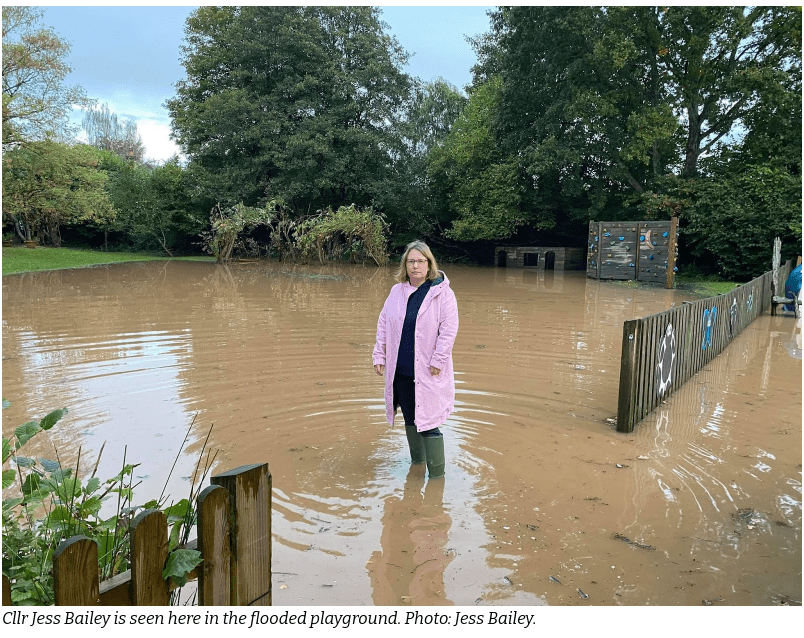
October 2021: Cllr Jess Bailey on flooding in Tipton St John Primary: “I saw myself first-hand the risks of flooding in October 2021 when after heavy rain the school was surrounded by lakes of water – and water was lapping at the doors of the buildings.

“I have witnessed children as young as four and five practising their escape drill with a rope across the road to prevent children being swept away in the rising waters.”