Two of Honiton’s sewage discharge pipes are currently polluting the River Otter – one has been running continuously for over 30 hours.
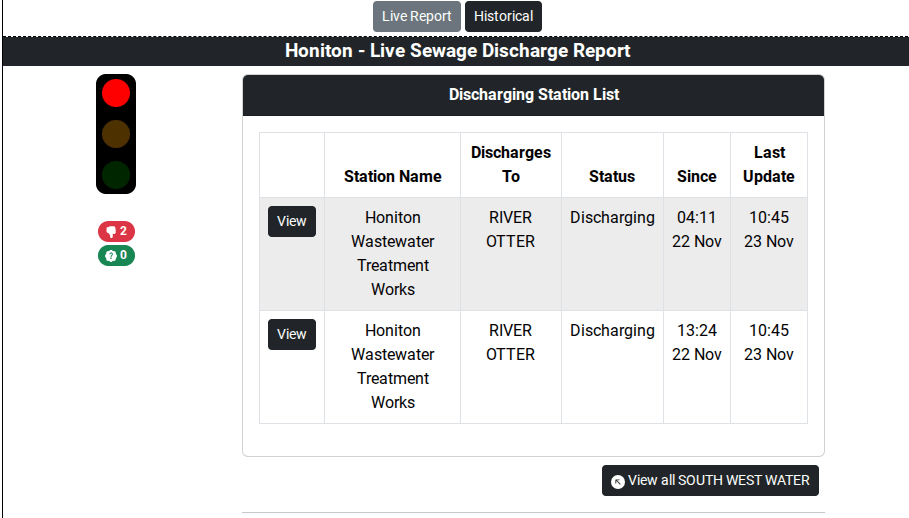

Two of Honiton’s sewage discharge pipes are currently polluting the River Otter – one has been running continuously for over 30 hours.
Peter Williams (Otter River Catchment Action – ORCA)
A £750,000 incentive for SWW to say ‘YES when council’s ask if they have available sewage treatment capacity for new housing developments: ORCA follows the money.
Along with many representatives of the local community, Ottery St Mary Town Council and @jessbailey, ORCA spoke at the Gerway Farm housing appeal hearing yesterday, asking the inspector to refuse planning permission for 140 new homes in the Ottery / Fluxton sewage works catchment.
As was made clear in East Devon District Council’s ‘Water Cycle Study’, the local sewage treatment works at Honiton, Fluxton and Feniton are all already well over their treatment capacity. This is evidenced by South West Water dumping untreated sewage into the river Otter for 8,500 hours up until end October (already exceeding 2025’s total), in spite of the region suffering severe drought. On top of that, high levels of phosphate discharged from SWWs treatment works are having a severe impact on the river environment.
In spite of this, SWW stated that they had spare capacity in their system to accept this major new housing development. So why might they say that? We follow the money..
Any developer has to pay connection and administration charges to SWW to connect mains water and wastewater connections to their infrastructure. In the case of 140 new homes, that charge is likely to at least £240k, and that’s based on the developer doing all of the ground works (source: New Connections and Developer Services 2026/27). On top of that, with average water bills of £700 per household, revenue over the first five years of occupation is likely around £490k.
So that’s a £750k reason why SWW might just say YES to new housing developments. SWW take the revenue, and the local community suffer the consequences! For this reason, it’s absolutely critical that East Devon District Council do not take SWW’s word – but instead implement a robust process to verify treatment capacity and impact on water quality on ALL new developments in the Honiton, Ottery and Feniton regions.

Homes could have water switched on and off in ‘rota system’ in drought-hit part of UK
This story hit the national news a couple of days ago in the Mirror, quoting extensively from Paul Arnott’s comments in a recent Devon County Council cabinet meeting.
Does Owl begin to detect certain bodies wriggling?
Read these extracts from the latest BBC report [in full below].
The Department for Environment, Food and Rural Affairs (Defra) said there were “no plans” for rationing and it did not anticipate “any impact on public water supplies”.
Defra and SWW, however, don’t seem to be on the same page.
South West Water: “Although these [rationing] measures will not be needed this winter, Defra requires us to have clear contingency plans in place as a last resort due to severe drought in the region.”
If there are no problems this winter, why, at the end of October, did South West Water request an immediate ban on non-essential water use for businesses in East Devon?
To add confusion, the environment secretary has written to mayors and council leaders asking them for proposals to set up regional water councils by the end of 2026. [See this post].
Not surprisingly, this plan has come under fire over concerns the councils will end up taking the blame for failures.
The good news is that, according to SWW:
Reduced water use [by long suffering customers], rainfall, fixing leaks and moving water around the network had been “making a difference”. [Owl hopes this is significant and positive but, true to form, SWW aren’t committing themselves]
BBC: Tap water rationing a last resort in drought – South West Water
Charlotte Cox, Jenny Kumah www.bbc.co.uk
Tap water rationing is among measures South West Water could take in the case of severe drought but “will not be needed” this winter, the firm has said.
The “contingency plan” was described by the utility as a “last resort” in case of the most severe category of drought, which the utility said it was not facing.
Julian Brazil, Liberal Democrat leader of Devon County Council, said he feared rationing could be a prospect in future, saying it could have a “massive knock-on effect” for businesses, schools and emergency services.
The Department for Environment, Food and Rural Affairs (Defra) said there were “no plans” for rationing and it did not anticipate “any impact on public water supplies”.
Parts of southern England, including areas in Devon and Cornwall, are officially in severe drought – and some are considered to be in a category three situation.
South West Water said reservoirs “remain low” after the hottest summer on record – but customers’ reduced water use, rainfall, fixing leaks and moving water around the network had been “making a difference”.
It would require a category four drought – when reservoirs reach a critically low level – to trigger the emergency measures, which were raised at a recent Devon County Council cabinet meeting.
According to South West Water’s draft drought plan, a level four response included rationing the availability of water.
The report outlines this would be implemented when Day Zero – when water supplies ran out – was 28 days away and “severe water rationing” was needed to maintain supplies “for as long a period as possible”.
Working ‘closely’
Brazil said this would mean no water for domestic properties: no baths, showers or toilet flush – while the council would be “left picking up the pieces” on the consequences for “care homes, schools and hospitals”.
While he said the utility would assist vulnerable people with water supplies, other logistical challenges would be left to the council.
“If the schools are closed, that is a disaster for our young people,” he added.
He said the government had “failed to include” the council in discussions around formulating the measures – despite the onus of delivery lying with the council.
However, South West Water said it met regularly with a Local Resilience Forum, including Devon County Council, to “discuss and develop” plans.
It said it would continue to “work closely” with other agencies on contingencies.
Among the lowest three reservoirs in the country is Wimbleball on Exmoor, which can hold more than 21 billion litres and provides drinking water to about 400,000 people across Devon, parts of Somerset and Dorset.
In October, it hit a record low of being 12.5% full. It is now at 20%, according to South West Water, external.
The Environment Agency has said about 120% of typical rainfall was needed by April 2027 for all areas to be considered out of drought.
The environment secretary has written to mayors and council leaders asking them for proposals to set up regional water councils by the end of 2026.
These would “give communities a say” in how water was managed in their area, Defra said, “so that water companies are made to face the people and communities they serve”.
However, this plan has come under fire over concerns the councils will end up taking the blame for failures.
Defra has said a strengthened Water Bill would remove limits on government share ownership in water companies, broadening scope for “future interventions”.
South West Water said: “Although these [rationing] measures will not be needed this winter, Defra requires us to have clear contingency plans in place as a last resort due to severe drought in the region.”
It added: “We will continue to work closely with local authorities and the emergency services on contingency planning and would like to thank our customers for using water wisely.”
South West Water provides water and sewerage services to about 1.8 million customers in Devon and Cornwall, the Isles of Scilly, plus parts of Dorset and Somerset.
Alison Hernandez does a screeching u-turn.
Devon and Cornwall Police chief constable recruitment moved up
Devon and Cornwall Police has brought recruitment for its chief constable role forward after a threat of legal action from a group representing senior officers.
Zhara Simpson www.bbc.co.uk
Police and Crime Commissioner Alison Hernandez received a letter from the Chief Police Officers’ Staff Association outlining its intention to pursue legal action regarding her decision to extend the contract of interim Chief Constable James Vaughan without running a recruitment process.
Hernandez has now said the recruitment process of a substantive chief constable, which was planned for 2028, would begin at the end of November.
She said: “I acknowledge this is a legitimate challenge to a decision that was made in good faith.”
Hernandez said: “Both Mr Vaughan and I are eager to avoid spending public funds on a lengthy legal battle.”
In September, the commissioner announced her decision to extend Vaughan’s contract to August 2028 to secure stable leadership.
Now recruitment is due to begin after an advert inviting applications for the role is published in the week commencing 30 November.
The police force said Vaughan would continue serving as interim head, pending the outcome of the process, which was likely to conclude in early 2027.
The commissioner said the recruitment came at a “challenging time” for the force and would “inevitably be a distraction”.
Hernandez added: “My office will now conduct an open process supported by the College of Policing.”
Our new 2026-2030 strategy is here
We’re going all in on ending sewage pollution
Water companies dump raw sewage into the UK’s seas, rivers and lakes more than a thousand times a day. People are getting seriously sick from using the water they love, and in England and Wales, the private companies responsible are profiting from this pollution.
For a long time, this felt like something that would never change. Now it can.
Public anger has reached a point no government can ignore. Water bosses now face criminal liability for covering up pollution, and new laws are on the table that could transform the broken privatised water industry for good. That didn’t happen by chance. It came from the fight we’ve waged together: every petition you signed, every paddle-out you joined and every email you sent a water company boss.
What we do with this moment matters. The decisions made in the next few years will decide whether our waters get cleaner or whether the industry is permitted to carry on as before. Moments like this don’t stay open for long, and we’re not going to let it pass.
So over the next four years, we’re putting everything we have into ending sewage pollution of the UK’s waters. Our strategy for 2026 to 2030 sets out how.
Our main focus is systemic reform of the broken water industry. The Clean Water Bill is due to make its way through parliament, and it could fundamentally shape how water in England and Wales is owned, regulated and policed for decades. We’ll be pushing to make sure it delivers a system that puts public health ahead of profit, a regulator with real teeth and penalties that polluters actually feel. The lessons from this fight will feed into our battles across all four corners of the UK.
Alongside that, we’re campaigning for more bathing waters and stronger protection for them, because designation is one of the few tools that legally forces polluters to clean up specific places. In Lyme Regis, local campaigners won back protection for Church Cliff Beach, and their water company is now locked into a clean-up plan. We want that to be possible for every community.
Focusing like this means stepping back from our plastic pollution campaigning for this strategy period. That wasn’t an easy decision, because of how urgent the plastic crisis is and the strength of our movement on plastic. Across the UK, the amazing SAS community has taken on single-use plastic in hundreds of towns, villages and cities, and brought thousands of local businesses with them. Tens of thousands of volunteers have picked, counted and logged every bottle and wrapper, and turned that data into Brand Audits that named the companies behind the problem. Supporters have also driven our national campaigning, holding government and industry to account, from years of pressure for a Deposit Return Scheme to calling for a strong Global Plastics Treaty. That was your work, and it made a real difference.
So we’re not stepping back because plastic stopped mattering, or because the work didn’t count. But for a charity our size, spreading ourselves across several fights means winning less of each one. With so much now within reach on sewage, this is where our full weight needs to be.
Evidence that holds power to account
Winning a new law is one thing. Making sure it actually cleans up our waters is another. So we’re investing more in data and evidence: expanding our citizen science, digging deeper into water company and regulator figures, and finding new ways to show what’s really happening. Million Mile Clean will continue too, growing into a broader way for communities to take on whatever threatens their local waters. All of that evidence will hold polluters to account, and government too, so the changes it makes deliver cleaner water rather than just good headlines.
Our Safer Seas & Rivers Service app is at the heart of this. Half a million people already use it to check the water before they get in. It will stay a vital public tool, and it’s becoming more than that: a way into the movement for new campaigners, and a source of hard data that makes our demands impossible to dismiss.
One movement
Until now, SAS supporters have been organised around individual campaigns, and together we’ve had some stunning successes. But when our community is split across different campaigns, our power is split too. Our decision to focus on one fight at a time means it’s time to bring everyone together into one connected movement. When we all move together, on the same fight at the same time, polluters and politicians will feel the full weight of it.
The next generation
Young people don’t need persuading that our waters are in trouble. Many are already angry, already organising and already online. And they have the most at stake: the decisions made in the next few years will shape the water they swim, surf and paddle in for the rest of their lives. Ending sewage pollution won’t happen overnight, and the young people who join us now will be the ones leading this fight in the years to come. They’ll also bring the fresh energy, ideas and skills our movement needs to grow.
So over the next four years, we’re doing much more to bring them into the SAS movement and the fight. One part of that is a new Youth Campaigner Initiative for 16 to 25 year olds, shaped by a paid Youth Advisory Panel who’ll have a real say in where it goes.
Every corner of the UK
England, Scotland, Wales and Northern Ireland each have their own water laws, ownership models and politics. Water is privately owned in England, primarily run on a not-for-profit basis in Wales, and publicly owned in Scotland and Northern Ireland. Every one of those systems is still letting sewage into our waters, and each needs a different fight to fix it. Over this strategy period, we’re stepping up our presence across all four nations, giving campaigners wherever they live the backing to win locally and pushing for change that fits their own system.
Some things aren’t changing. SAS’s uniquely fearless campaigning approach, our passion for the water and our fun-loving energy are at the centre of our new strategy, alongside our single-minded focus on winning this fight. We’ll continue to aim big and say things straight. We’ll be clear about what we’re fighting for. And we’ll keep having fun doing it, cutting polluters down to size with parody and pisstakes, and getting in the water, because we simply LOVE IT. A movement that enjoys itself is one that keeps going.
We’ll also stay independent. We don’t take money from polluters, and we never will.
What this means for you
It means a stronger, more focused SAS, more determined than ever, with everything we have going into ending sewage pollution. Every hour of campaigning, every pound you give and every action you take will be aimed at the fight where it can make the biggest difference.
It also means your voice counts for more. As we bring our community together into one movement, you’ll hear from us when it matters most, with clear asks and a real sense of what your action is achieving. Whether you sign petitions, paddle out, test your local water or clean your local beach, you’re part of the same fight.
By 2030 we want a Clean Water Act that works, a regulator polluters fear, more of our waters properly protected, and a movement bigger and stronger than ever. We can’t get there without you. Read the full strategy to see how, and bring someone with you.
The more of us there are, the louder we get, and together, we’ll uncrap our seas.
“It’s good Angela Eagle says communities will have influence over future decision-making but setting up these committees is maybe a year away and we won’t see what they can do in practice for perhaps two years. As ever I’m worried this will be fudged somehow which is why I intend to be like an eagle on this every step of the way.
“We simply cannot afford the devastating potential losses to tourism and our whole economy caused by pollution or the possibility of supplies being turned off.”
“South West Water has got to up their game right now on leakage. The way they plan their finances in five year chunks does not help when we are already in this situation.” – Paul Arnott
Plans to give communities more power over private water companies must be effective and enacted quickly say county leaders as Devon plans for more drought restrictions
Chris Collman www.devonairradio.com
County leaders are worried moves to exert more democratic control over private sector water companies will come too late to avert more pollution incidents and water supply crises causing huge environmental and economic damage to Devon.
Devon is already officially in serious drought and last week a joint letter from the Department for Environment, Food and Rural Affairs, the Environment Agency and industry regulator Ofwat revealed South West Water had been warned for seven years in a row it was endangering security of supply by missing its own forecasts on reducing leakage.
Environment Secretary Angela Eagle has now written to Devon County Council pledging local authorities and a possible future Mayor of Devon will be part of a regional committee with power to shape South West Water’s future investment decisions.
She wrote: “The current system has led to disjointed investment decisions, often poor value for money which do not meet the needs of communities. That must change.
“That’s why, for the first time since privatisation, investment decisions through the next investment period will be shaped much more directly by the priorities of local communities, regional leaders and those who understand the needs of places best.”
At a meeting of Devon County Council’s Cabinet on Tuesday, Deputy Council Leader Paul Arnott said: “South West Water has got to up their game right now on leakage. The way they plan their finances in five year chunks does not help when we are already in this situation.
“We are making decisions on planning and housing right now when we have real doubts whether the sewage and water supply infrastructure will be there or not.
“It’s good Angela Eagle says communities will have influence over future decision-making but setting up these committees is maybe a year away and we won’t see what they can do in practice for perhaps two years. As ever I’m worried this will be fudged somehow which is why I intend to be like an eagle on this every step of the way.
“We simply cannot afford the devastating potential losses to tourism and our whole economy caused by pollution or the possibility of supplies being turned off.”
Council Chief Executive Donna Manson revealed 60 organisations across Devon including district councils and emergency services have already been planning for the possibility of Stage 4 severe drought restrictions which could see water supplies to households and businesses cut off on a rota basis.
She has also attended Whitehall meetings with Ministers on emergency planning for the increased risk of drought and wildfires in areas most affected by climate change.
Cabinet member for Adults Services, County Councillor for Adults Services Richard Keeling said: “I have very real concerns about what planning for cut-offs would actually mean. I’m worried about all our care homes and the 33,000 vulnerable people we have in our care whom we would have to supply with water.”
At the Cabinet meeting, councillors agreed to promote water conservation measures and encourage vulnerable customers with medical or mobility needs to join South West Water’s Priority Services Register, which would ensure home deliveries of bottled water even if supplies of tap water were cut off by drought restrictions.
Context: SWW leakage has increased and the regulators are losing confidence. “Private” letter to South West Water from regulators revealed
It can’t even meet reporting deadlines let alone devise an effective action plan!
Chris Collman www.devonairradio.com
Following ongoing discussions and Exmouth Town Council’s efforts to secure a solution to the recent Post Office closure in TG Jones, it has been confirmed that an interim Post Office service will open later this month at 9 Chapel Street (the former HSBC building).
The exact opening date will be announced as soon as it’s confirmed.
The interim branch will offer a wide range of Post Office services, ensuring local residents can continue accessing services while plans progress for a PERMANENT BRANCH AT THE SAME LOCATION expected to be ready in January 2027.
This is a positive step for our community, and we welcome the commitment to maintaining essential Post Office services in the town centre.
Have your say: The Post Office is currently seeking feedback on the proposed service. You can share your views via the Consultation Hub:
Devon County Council’s response to Chief Medical Officer identifies challenges of providing care in the countryside as population ages.
Devon County Council has welcomed a major new report from England’s Chief Medical Officer which says the health challenges facing rural communities must be treated as a national, not simply a local, issue.
Professor Sir Chris Whitty’s annual report highlights the way that rural poverty can be hidden, while longer distances, limited public transport and difficulties accessing health services can deepen inequalities.
The report calls on government and the NHS to recognise these challenges as a national responsibility and support locally designed services.
The findings echo many of the issues Sir Chris heard about when he visited Devon in May, meeting Devon County Council’s public health team and professional partners before travelling to Buckfastleigh to hear directly from the community.
Devon features prominently in the report. More than 842,000 people live in the county and 26.3% are aged 65 or over, compared with 18.7% nationally.
The report also highlights Devon’s hidden pockets of rural deprivation, limited public transport, shortage of affordable housing and difficulties accessing services.
Devon County Council now is calling on government and the NHS to put rural need at the heart of funding and service planning, including better ways of measuring rural deprivation so that small pockets of need are not hidden by wider averages.
The report also recommends improving national measures of rural deprivation so public health resources reach those who need them most.
Councillor Cheryl Cottle-Hunkin, the council’s Cabinet Member for Rural Affairs, said:
“I want to thank Sir Chris Whitty for taking the time to come to Devon to see and hear first-hand some of the challenges our rural communities face.
“We are by no means unique in being a rural county, but Devon’s geography, our location in the South West peninsula and our older population bring particular challenges.
“Rurality brings additional costs that we do not believe are properly recognised in the funding we receive. Poorer transport links, housing pressures and long distances to services can make everyday life harder, while younger people can find there are fewer opportunities for education, training and good jobs close to home.
“There is a real concern here about the erosion of health services in rural areas due to inadequate funding. We are seeing services being increasingly centralised, including in North Devon where some services are being moved towards Exeter, meaning patients and their families are having to travel even further for care. That is simply not acceptable.
“Devon is a wonderful county, and we have so much to be proud of. But living in a rural community must not mean poorer access to the things that help people lead healthy lives.
“National decisionmakers must fully understand the lived reality of rural life, where distance, transport challenges and an ageing population can make access to healthcare far more difficult than in urban areas. Sir Chris Whitty’s report is an important step towards improving that understanding.
“We now need Government and the NHS to act on this report, recognise the true cost of delivering services in rural areas and make sure funding reflects the needs of counties like Devon.
“Rural communities deserve fair access to healthcare and other essential services, and that will only happen when funding and service planning properly reflect the realities of rural living.”
Steve Brown, Director of Public Health Devon, said:
“This report is important because it gives national recognition to the health challenges faced by people living in rural areas.
“In Devon we know that good health is shaped by much more than access to healthcare. Transport, decent housing, digital connectivity, education, employment and being able to reach services all make a difference.
“Rural deprivation can also be difficult to see in the data, which means some communities experiencing poorer health can easily be overlooked.
“This report helps shine a light on those inequalities and will help us continue working with communities and partners to find solutions that work for rural Devon.”
Nora Corkery, CEO of Devon Communities Together and Chair of the Devon Rural Deprivation Partnership said:
“Rural deprivation is often hidden. The challenge now is to turn the evidence and recommendations in this report into meaningful action in Devon.
“We need a more joined-up approach across health, local government, the voluntary and community sector and other partners, with a clear commitment to rural proofing of key policies and services to address the underlying causes of rural inequality.
“As a Rural Deprivation Partnership Group, we are committed to ensuring that rural disadvantage is recognised, that the voices of our communities are heard and that solutions are shaped around the realities of rural life.
“Ultimately, a person’s postcode or where they live should never determine their opportunity to live a long, healthy and fulfilling life.”
A plea for a meeting with the prime minister has been sent by a Devon council leader to work out how the sewage system can be improved to cope with housing growth in the major district.
Bradley Gerrard, Local Democracy Reporter www.devonairradio.com
East Devon District Council leader Councillor Paul Arnott said he had written to Andy Burnham, the prime minister, asking for his help in “bringing all parties together” to try and solve the issue of marrying infrastructure improvements with additional housing.
“There were over 100 days of swimming [in the sea] lost to sewage incidents in Exmouth last year,” he said in a post on Facebook.
“I have written to the prime minister to help bring all parties together to work out how to provide proper sewage infrastructure given we are required by the government to build more housing.
“I want a multi-agency meeting with councils, the Environment Agency, and South West Water, so we can plan properly for the future.”
South West Water has been actioning improvements in Exmouth, including to the Maer Road sewage treatment plant, and has a stated goal of reducing storm overflows.
The capacity of the sewage system is frequently raised as an issue by East Devon’s planning committee, with fears about how it will cope with extra demand.
And it is something that campaigners against major prospective developments often raise, including the Stop Exmo_20 campaign group, which is fighting against a potential plot for 700 homes being included in East Devon’s draft local plan.
But because South West Water is a statutory consultee, if the firm says its infrastructure can cope, then planning committees would find it difficult to justify rejecting a plan on those grounds.
East Devon recently completed a water cycle study where it commissioned an external firm to assess the capacity of sewage treatment plants in East Devon so it could ascertain their current capacity and potential ability to cope with housing growth.
The analysis, which was published last year, suggested four of East Devon’s 16 waste water treatment plants were already running beyond their capacity permit limits, and that seven – including Maer Lane in Exmouth, Feniton and Otterton – would be doing so if house building targets in East Devon are hit without any sewer infrastructure upgrades or additions.
However, it’s understood the analysis used a more stringent benchmark for analysing the plants than environmental regulators may require, meaning South West Water said it did not recognise the data.
It has since been confirmed by East Devon that the data in the water cycle study is being re-run using a different method of analysis.
The council has previously passed votes of no confidence in South West Water.
SWW’s web page on Exmouth states that its work in Exmouth “forms part of our ambitious £760 million investment programme, which is focused on making long term improvements to the wastewater network in places where heavy rainfall and increasing demand put pressure on the system”.
“We remain dedicated to improving services in Exmouth,” it adds.
“Our goal is to reduce storm overflow spills to improve water quality, targeting a maximum of ten spills per year per overflow by 2030, with only two spills at designated bathing waters during the bathing season.”
“It is unacceptable that publication of your WRMP24 [Water Resources Management Plan] has been delayed. As you are aware, producing an WRMP is a statutory process, and enforcement action could be taken where a company is not compliant with their legal duties.”
“Given the extent and persistence of issues identified for South West Water, we will require South West Water representatives to attend six-monthly progress meetings with Defra and both regulators in November-December and April-May.”
“This is the seventh consecutive year that South West Water has received a joint regulator letter. Where sufficient progress is not demonstrated, issues will be escalated to the Water Delivery Taskforce and the relevant regulators may consider further regulatory action, including investigation and, where appropriate, the use of statutory enforcement powers.”
Regulators – it’s time to take the gloves off. Slapping wrists is not enough – Owl
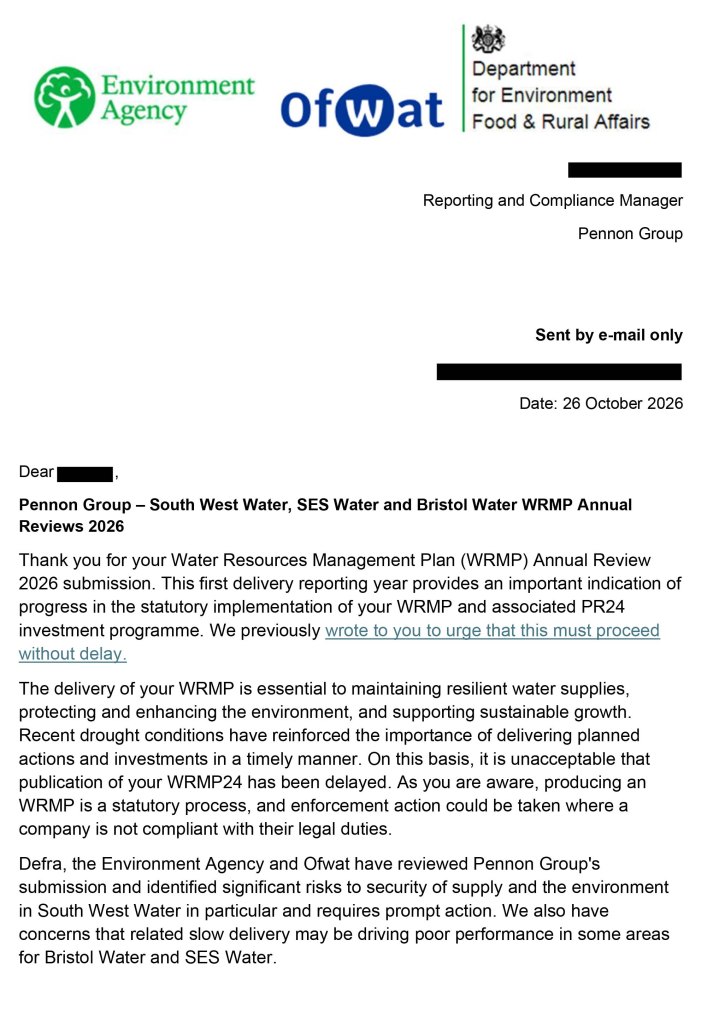
Text reads:
Pennon Group — South West Water, SES Water and Bristol Water WRMP Annual Reviews 2026
Thank you for your Water Resources Management Plan (WRMP) Annual Review 2026 submission. This first delivery reporting year provides an important indication of progress in the statutory implementation of your WRMP and associated PR24 investment programme. We previously wrote to you to urge that this must proceed without delay.
The delivery of your WRMP is essential to maintaining resilient water supplies, protecting and enhancing the environment, and supporting sustainable growth. Recent drought conditions have reinforced the importance of delivering planned actions and investments in a timely manner. On this basis, it is unacceptable that publication of your WRMP24 has been delayed. As you are aware, producing an WRMP is a statutory process, and enforcement action could be taken where a company is not compliant with their legal duties.
Defra, the Environment Agency and Ofwat have reviewed Pennon Group’s submission and identified significant risks to security of supply and the environment in South West Water in particular and requires prompt action. We also have concerns that related slow delivery may be driving poor performance in some areas for Bristol Water and SES Water.
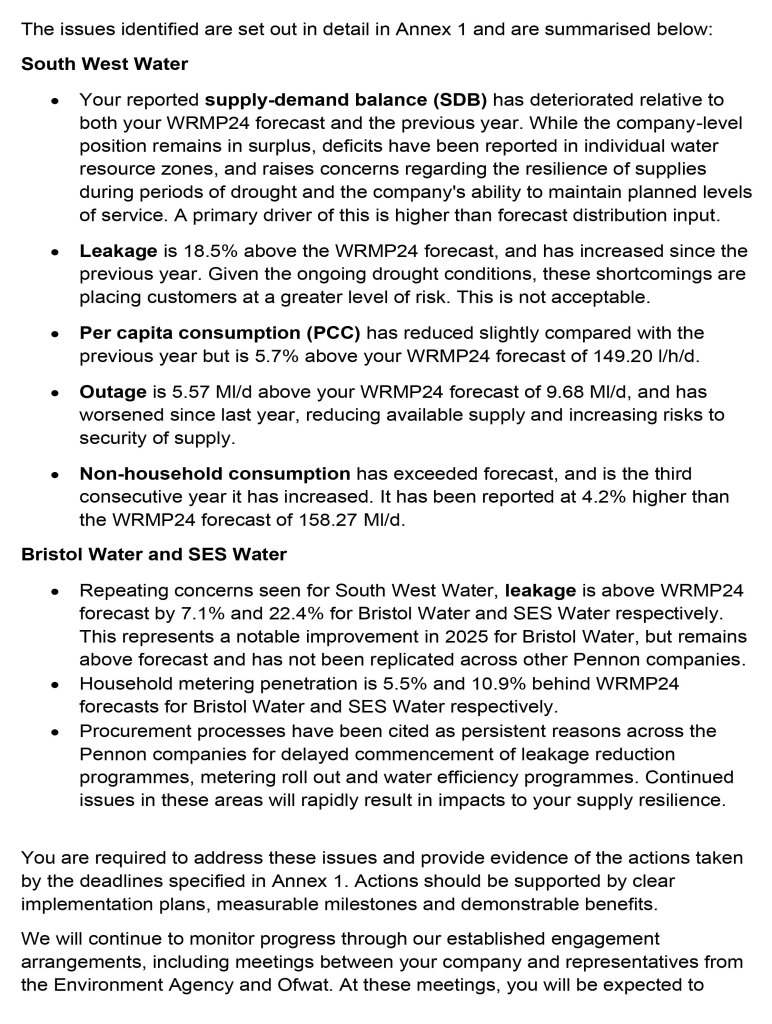
The issues identified are set out in detail in Annex 1 and are summarised below:
South West Water
• Your reported supply-demand balance (SDB) has deteriorated relative to both your WRMP24 forecast and the previous year. While the company-level position remains in surplus, deficits have been reported in individual water resource zones, and raises concerns regarding the resilience of supplies during periods of drought and the company’s ability to maintain planned levels of service. A primary driver of this is higher than forecast distribution input.
• Leakage is 18.5% above the WRMP24 forecast, and has increased since the previous year. Given the ongoing drought conditions, these shortcomings are placing customers at a greater level of risk. This is not acceptable.
• Per capita consumption (PCC) has reduced slightly compared with the previous year but is 5.7% above your WRMP24 forecast of 149.20 I/h/d.
• Outage is 5.57 MI/d above your WRMP24 forecast of 9.68 MI/d, and has worsened since last year, reducing available supply and increasing risks to security of supply.
• Non-household consumption has exceeded forecast, and is the third consecutive year it has increased. It has been reported at 4.2% higher than the WRMP24 forecast of 158.27 MI/d.
Bristol Water and SES Water
• Repeating concerns seen for South West Water, leakage is above WRMP24 forecast by 7.1% and 22.4% for Bristol Water and SES Water respectively. This represents a notable improvement in 2025 for Bristol Water, but remains above forecast and has not been replicated across other Pennon companies.
• Household metering penetration is 5.5% and 10.9% behind WRMP24 forecasts for Bristol Water and SES Water respectively.
• Procurement processes have been cited as persistent reasons across the Pennon companies for delayed commencement of leakage reduction programmes, metering roll out and water efficiency programmes. Continued issues in these areas will rapidly result in impacts to your supply resilience.
You are required to address these issues and provide evidence of the actions taken by the deadlines specified in Annex 1. Actions should be supported by clear implementation plans, measurable milestones and demonstrable benefits.
We will continue to monitor progress through our established engagement arrangements, including meetings between your company and representatives from the Environment Agency and Ofwat. At these meetings, you will be expected to demonstrate credible and adequately resourced plans, together with tangible progress in reducing the risks identified in this letter.
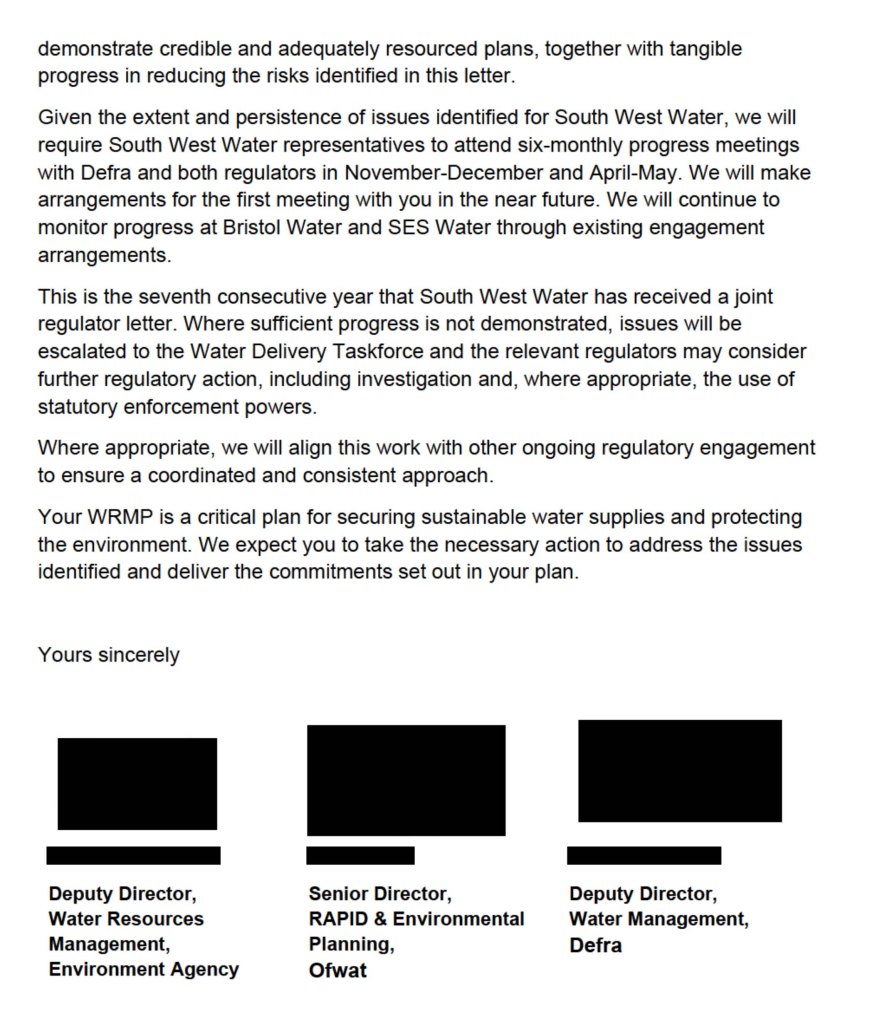
Given the extent and persistence of issues identified for South West Water, we will require South West Water representatives to attend six-monthly progress meetings with Defra and both regulators in November-December and April-May. We will make arrangements for the first meeting with you in the near future. We will continue to monitor progress at Bristol Water and SES Water through existing engagement arrangements.
This is the seventh consecutive year that South West Water has received a joint regulator letter. Where sufficient progress is not demonstrated, issues will be escalated to the Water Delivery Taskforce and the relevant regulators may consider further regulatory action, including investigation and, where appropriate, the use of statutory enforcement powers.
Where appropriate, we will align this work with other ongoing regulatory engagement to ensure a coordinated and consistent approach.
Your WRMP is a critical plan for securing sustainable water supplies and protecting the environment. We expect you to take the necessary action to address the issues identified and deliver the commitments set out in your plan.
Rearranging the chairs on the Titanic. [Where we are the passengers]
Here’s what SWW have to say
“Recent rainfall is having a positive impact on our water resources…..we need sustained rainfall in the right places to replenish our rivers and reservoirs……We are repairing leaks, moving water around our network and taking every practical step to strengthen supplies and reduce water losses. As conditions improve, we will keep doing everything we can to protect supplies”
The company has to report to the government and regulators with an action plan to tackle its leaks within six weeks.
Having failed over seven years, what hope is there of that! – Owl
County leaders have criticised South West Water after an official letter revealed the monopoly supplier is still missing leakage targets and now putting customers at risk of losing supply despite being warned for seven straight years.
The joint October 26 letter from industry regulator OFWAT, the Environment Agency and the Department for Environment, Food and Rural Affairs (DEFRA) revealed by the Guardian (see below) says South West Water’s owner Pennon has been warned for seven successive years that its repeated failures to meet its own forecasts on reducing leakage are putting drought-hit customers and businesses in danger of supply restrictions.
It states: “Leakage is 18.5 per cent above forecast …..and increased since the previous year. Given the ongoing drought conditions, these shortcomings are placing customers at a greater level of risk. This is not acceptable.”
South West Water forecast its leakage would fall but in fact it increased by 5.78 million litres in 2025/26 to 113.54 million litres per day – around 45 Olympic swimming pools in volume. The company also lost 5.57 million litres daily to bursts and supply interruptions above its own forecasts and put an extra 35 million litres of water every day into its network every day to make up for losses and keep taps flowing.
Last week, customers in areas most affected by drought began receiving letters from South West Water urging them to save water. However, the joint OFWAT, Environment Agency and DEFRA letter says they have “reduced confidence” in the company to ensure supplies and avoid emergency abstractions from rivers that will cause environment damage.
It adds: “A trend of rising leakage……represents a risk to your customers’ security of supply. Achieving your planned leakage reductions is reputationally important as you are asking customers to reduce their water use.”
Devon County Council Leader Julian Brazil commented:
“Householders and businesses have been told to save water to avoid worse drought restrictions and that was all down to the dry weather.
“Now we learn South West Water has been continually warned for seven years it’s not doing its bit on leakage. Their record is somehow even worse and that failure puts our rivers and wildlife at risk of prolonged environmental damage and may leave customers and businesses facing supply restrictions.
“I would say it’s a surprise but it’s not because this crisis has been decades in the making. While we’ve been paying the highest bills in the nation since 1989, South West Water has been busy continually polluting our bathing waters, busy losing nearly one in every five litres of water on its network and most busy paying out billions in dividends to its shareholders.
“I’m pleased the Prime Minister and regulators are finally telling water companies it’s closing time in their last chance saloon but businesses and families in Devon may be left picking up the pieces left by South West Water’s appalling record of greed and failure.
“I’m sure Devonians, businesses and public bodies will do their best to save water. South West Water can help them by funding from its own deep pockets a huge, Devon-centred communications campaign, getting a grip on leakage and making sure it is working with every customer, business and council to avoid the most dire consequences yet of its own neglect.”
The Guardian article referred to above
South West Water’s failure to fix leaks ‘putting customer supplies at risk’
Sandra Laville www.theguardian.com
Repeated failures by South West Water to tackle leaks are putting customers at higher risks of losing water supplies as parts of the region remain in severe drought, regulators have said.
In a warning to the privatised company that serves 1.8 million people across the south-west of England, the regulators said it had been failing to meet targets to reduce leaks and repair burst pipes for seven years.
“Leakage is 18.5% above forecast … and increased since the previous year. Given the ongoing drought conditions, these shortcomings are placing customers at a greater level of risk. This is not acceptable,” said Ofwat, the Environment Agency and the Department for Environment, Food and Rural Affairs in a letter to the company.
The letter emerged as the National Drought Group prepared to meet on Thursday, with about 82% of England still in drought, and severe drought declared in parts of Devon, Cornwall, Dorset, Somerset, East Sussex and West Sussex. The Met Office has said 120% of typical rainfall is needed over seven months to bring the country fully out of drought.
South West Water leaks 113.5m litres of water a day from its pipes and infrastructure, the equivalent of 45 Olympic swimming pools. Leakage is 5.7m litres a day higher than last year and poses a risk to customer’s security of supply, the regulators’ letter says.
The continued severe drought in many areas of the region affects about 325,000 people and thousands of businesses in Exeter and mid and east Devon. They are at risk of having their supplies regularly cut off over the coming weeks and months, which could lead to school closures and economic losses.
South West Water has written to households in those areas urging them to reduce their water usage to help secure supplies. The company does not acknowledge the contribution that the scale of its own leakage is making to the risk of outages.
In the joint letter to the company dated 26 October, the regulators and the government said: “Achieving your planned leakage reductions is reputationally important as you are asking customers to reduce their water use.”
After the driest April to September in more than a century, fuelled by the climate crisis, reservoir levels in some sites are critically low. Storage at Wimbleball, which supplies South West Water customers in east Devon, north Devon, Somerset and west Dorset, and Wessex Water customers in west Somerset, is at 16%. There are also concerns for several smaller South West Water reservoirs serving homes in Devon and Cornwall.
The joint letter says the failure to tackle leakage has reduced confidence in the company to ensure supplies and avoid emergency abstraction from rivers that will cause environmental damage.
“A trend of rising leakage … represents a risk to your customers’ security of supply,” it says.
…..The warning to South West water comes as the government announced that eight new regional water councils were being created to bring local leaders, customers and businesses together to set priorities for water companies and help shape billions of pounds of investment in water and flood infrastructure. Local leaders have been asked to submit proposals for running the new bodies by the end of the year.
The letter to South West Water says the company has to report to the government and regulators with an action plan to tackle its leaks within six weeks.
The company’s drought programme director, Richard Stanbrook, said: “Recent rainfall is having a positive impact on our water resources, with welcome improvements after months of exceptionally dry conditions. However, pressure on supplies remains significant, and we need sustained rainfall in the right places to replenish our rivers and reservoirs and secure a lasting recovery.
“We are repairing leaks, moving water around our network and taking every practical step to strengthen supplies and reduce water losses. As conditions improve, we will keep doing everything we can to protect supplies.”
Newspapers have reported this under headlines such as: “Chief Medical Officer issues warning to anyone moving to countryside” (DevonLive) and “A rural retirement could be bad for your health, warns Whitty” (The Times).
These miss the point. The challenges of providing care are: here, now, chronic and getting worse.
Prof Chris Whitty uses measured tones which, in Owl’s view belie the urgency. Will “Urban Labour” get the message?
The report provides more ammunition for our MPs who collectively seem to be on the same page following the suspension of maternity services at North Devon Hospital Trust, Barnstaple.
Here is a flavour of what he has to say.
The rural and small town population is not an urban population more widely dispersed, but systematically different in a number of ways important for health and healthcare provision….
The sparser population also means that healthcare is more spread out, with even primary care often distant, and secondary care a day’s round trip. There is also less capacity to sustain specialist services which are common in cities. The lack of regular public transport is one of the key challenges of providing health and social care in rural areas. Those who do not have a car or cannot drive due to illness may find accessing general practices difficult and secondary care (for example, outpatient clinics) even more so. Social care and health workers often rely on public transport. If people cannot drive safely, this can be much more isolating than in cities with dense public transport networks….
For those leading the NHS and public health we must avoid assuming that models of healthcare that work in cities can simply be translated to a rural or small town setting. Training and systems need to reflect the different realities of providing healthcare in these settings….
In full – Prof Chris Whitty: Forward to Chief Medical Officer’s annual report 2026
Health in rural areas and small towns
While most people in England live in cities, the great majority of the country’s landmass is rural, populated with people living in small towns or scattered communities. The urban majority depend on rural England, often without giving it much thought except as a very beautiful place for leisure – which it is. Some critical sectors rely on rural areas including agriculture and forestry, much of the armed forces, and several industries which need to be sited away from cities or require large amounts of land. Families associated with several of these sectors have particular health challenges.
Many people move from cities to small commuter towns when they start families, or retire to rural areas, while young adults often leave rural areas for cities to study or work. Due to this internal migration the rural population is significantly older on average than in the cities. The rural and small town population is therefore not an urban population more widely dispersed, but systematically different in a number of ways important for health and healthcare provision.
Rural poverty is often unseen, poorly measured, averaged out with more affluent areas or not registered in national statistics. Work in some important rural sectors including farming and tourism can be seasonal and low paid. Limited or non-existent public transport makes access to a car and being able to drive often essential for work.
The sparser population also means that healthcare is more spread out, with even primary care often distant, and secondary care a day’s round trip. There is also less capacity to sustain specialist services which are common in cities. The lack of regular public transport is one of the key challenges of providing health and social care in rural areas. Those who do not have a car or cannot drive due to illness may find accessing general practices difficult and secondary care (for example, outpatient clinics) even more so. Social care and health workers often rely on public transport. If people cannot drive safely, this can be much more isolating than in cities with dense public transport networks.
Set against these challenges, rural areas also have some significant inbuilt advantages for health. Communities are often stable and very supportive. Air pollution is usually minimal. There is the potential to access beautiful spaces for physical activity, although getting to the jumping-off point frequently requires a car, as walking and cycling safely on winding roads with fast traffic and no pavements is hard even for the young and fit.
General practice is even more clearly the bedrock of healthcare provision in rural and small town settings than in cities. Attracting healthcare staff can in some areas be very difficult, especially if they have young families. Rural and remote practice can require a wider range of skills and ability to work with minimal back-up from secondary care hospitals compared to city-based colleagues. Many GPs, nurses and others working in rural areas love the professional breadth and community-based care this brings, but current training often does not prepare them for this kind of medicine.
We have the opportunity to improve health and provision of care in rural areas and small towns for now. We also have to plan for the future, when the rural and small town population will be getting significantly older, while the major cities retain their current, younger demographic structure.
In the immediate future we must explore the potential for new opportunities, including telemedicine, to make the provision of some aspects of healthcare more accessible to those with limited transport a long way from secondary care. We also need to ensure we are training enough primary care medical and nursing staff to be able and want to provide care in rural and small town settings.
For national policymakers we need to recognise the ageing of the rural population makes this a national, not just a local, issue to solve, and find better ways to address the health impact of rural poverty.
For those leading the NHS and public health we must avoid assuming that models of healthcare that work in cities can simply be translated to a rural or small town setting. Training and systems need to reflect the different realities of providing healthcare in these settings.
For those undertaking the nationally important role of working in rural health we need to work together to harness new technologies, as well as ensure the voice of rural health is heard in decision-making.
Improving rural health is entirely possible and should be seen as a national investment in the future as well as the here and now.
Finally, I would like to thank the many people across the country who helped in the preparation of this report, and in particular the editor Dr Alex Thompson.
Prof Chris Whitty
Chief Medical Officer for England
[Full Executive Summary worth the read, it includes a lot of interesting facts and figures – Owl]
“The greatest reductions in second homes have been in the lower council tax bands, where properties are more likely to be affordable to rent or buy,”
The charge earns the council nearly £400,000 even though the number of second homes has dropped.
Bradley Gerrard www.devonlive.com
Double council tax on second homes look set to remain in East Devon thanks to the extra income and the charge prompting some properties to become permanent homes.
A recommendation has been put forward for the 100 per cent council tax premium on second homes to be maintained in the area, partly due to the additional cash it adds to coffers.
East Devon District Council said it received nearly £400,000 from the double-charging on second homes.
But beyond the finances, the report states that part of the rationale for keeping the premium relates to its impact on freeing up homes for residents.
The council said its review of the charge indicates it was supporting key priorities “by encouraging second and empty homes back into permanent residential use and helping to improve the availability of homes for local people”.
“The greatest reductions in second homes have been in the lower council tax bands, where properties are more likely to be affordable to rent or buy,” the report prepared for East Devon’s cabinet (Wednesday 4 November) states.
“The premiums have also generated additional income, with no evidence of material adverse impacts on collection, communities, the local economy or equality.”
The number of second homes in East Devon has dropped by nearly 600 from October 2023 to August 2026, with most of that dropping post the implementation of the double-charge in April 2025.
That means the number of second homes in East Devon has fallen more than a fifth (22 per cent) since October 2023, from 2,760 three years ago to 2,165 now.
Officers said the move from council tax into business rates – which would denote a second home becoming a holiday let – was minimal.
But it cheered the movement of properties becoming homes to permanent residents.
“A former council owned property had remained in the same family for many years and was subsequently being used as a second home,” the report stated.
“Following the council introducing the premium the owner made the decision to sell the property.
“The property was purchased by a young local couple as their first home. This is an example of how the council’s policy of introducing the second home premiums has resulted in a property suitable for first time buyers being brought into permanent residential use enabling young residents to own their first property in their local town.”
While this example is highlighted as positive, officers noted that less than 3 per cent of the district’s total households were second homes.
“Due to the low percentages, it is therefore unlikely that charging the premiums or the reduction in the number of second homes has had a negative impact on our local population, our communities or our local economy as statistically this is not a material change,” the report added.
East Devon’s cabinet is being asked to back the officer view that no changes are needed and that the 100 per cent premium for second homes should remain.

