We now have a single list of all candidate personal statements, where submitted
Philippa Davies www.midweekherald.co.uk
East Devon goes to the polls, along with the rest of the country, on Thursday, May 4, with all the seats on the district council up for grabs.
Here are the candidates standing for election in the Honiton, Axminster and Seaton area, with the details they have supplied to us.
Axminster (three seats)
Conservatives: Ian Hall, Steve Holt and David Willey:
“Ian Hall is a lifelong Axminster resident, current chair of Devon County Council and an East Devon District Councillor for Axminster. He is dedicated to improving the infrastructure of the town, education facilities and employment opportunities in Axminster.
Steve has the health and well-being of people at the heart of the work he does within his various charity roles and as a Town Councillor. He is passionate about the improvements needed to rejuvenate a ‘shop local’ town centre and make Axminster an even better place to live, work and socialise in.
David moved to this area to give his growing family a secure life in wonderful East Devon, bringing with him very significant expertise in setting up and working with youth groups. Ian, Steve and David offer a wealth of experience to deliver the things people in Axminster have told them they want for the town.
At the last elections, the Conservatives lost their majority. The first action of the new alliance council was to stop any debate on a relief road for Axminster. Four years later we are no further on; there is still no discussion about poor air quality or safety issues due to congestion, or a wider infrastructure review to unblock our choking town centre.
Ian, Steve and David’s overwhelming priority are the needs of everyone in Axminster. They agree that “we need to ensure the best outcomes for everyone, through the full cycle of life, and to help improve the health and prosperity of everyone who lives here”.
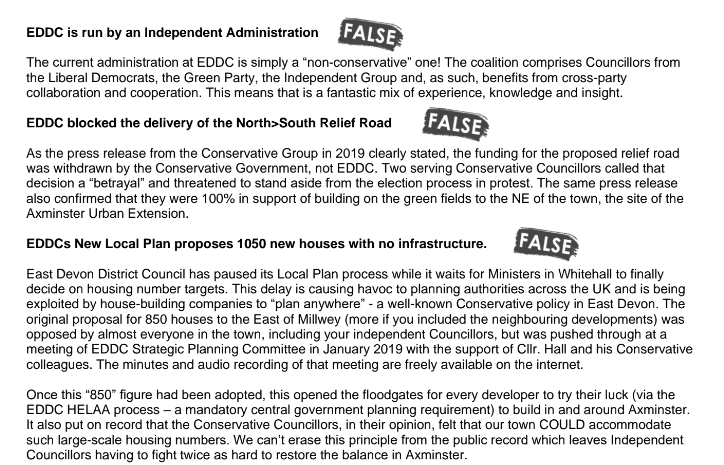
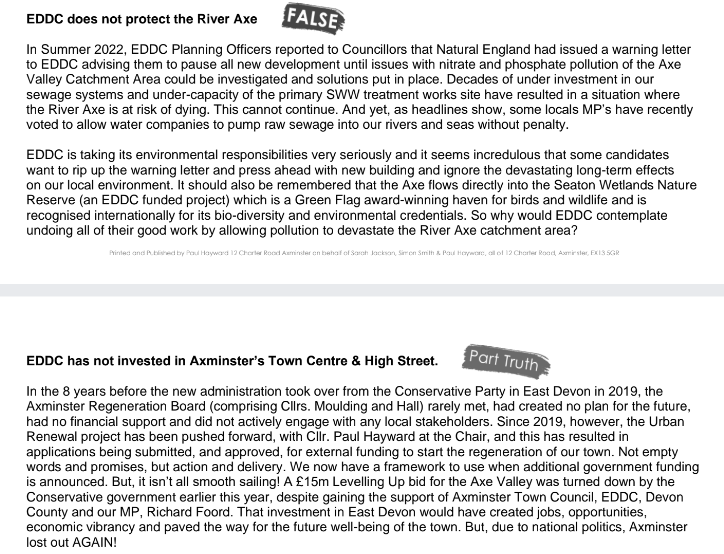
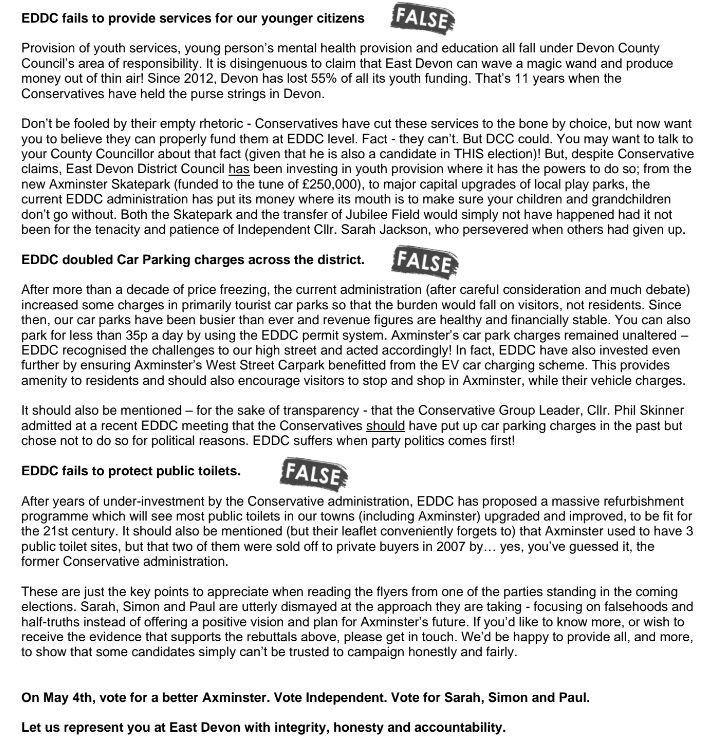
Independent: Paul Hayward
“I am standing for election as an independent candidate for Axminster. Many of you will know me from my work as the Clerk to Axminster Town Council but you may have also met me as a handyman, a DJ, a kid’s entertainer, a defibrillator warden, or as a co-founder of the Christmas Lunch event at the Guildhall. Axminster is my home, and I would be honoured to represent you at EDDC, with my independent colleagues, Sarah and Simon, for the next four years. Serving you with integrity, honesty and accountability. No nonsense, just straight talking and getting things done.”
Independent: Sarah Jackson
“Since my election, I’ve tirelessly advocated for those needing help and have delivered for our community as a whole. I ensured the transfer of Jubilee Field into public ownership. I also secured significant funding for Axminster Skatepark and found a new, collaborative way to deliver it. I’ve protected our environment, promoted biodiversity, and opposed inappropriate housing development without proper infrastructure.
“Locally elected representatives should answer to the public, not their political party. My independent colleagues, Paul and Simon, agree.
“Axminster has a great future, but it needs your help. Vote Independent to unlock its potential without losing its unique charm.”
Independent: Simon Smith
“I’m thrilled to be running for the East Devon District Council elections as an independent candidate. As a community manager in Axminster, I’ve seen the challenges our town faces. That’s why I want to make sure everyone has access to the services they need. Along with Paul and Sarah, we have a vision for a brighter future in Axminster. We want to reduce congestion, protect our town’s assets, and bring back its vitality. So please vote for us on May 4th! We’ve been listening to you, and we’re ready to work hard to make Axminster a better place to live.”
Liberal Democrats: Gillian Jordan
“I have lived in Axminster for 13 years. I have extensive experience in education – as a primary school teacher, an adviser and a school governor. I am currently a member of the Axminster Medical Practice Patient Participation Group, which aims to improve links between the Community and the Medical Practice.
My priorities for Axminster:
Ending the regular dumping of sewage into the Rivers Axe and Yarty;
Supporting local groups working to reduce single use plastic;
More services at Axminster hospital;
Affordable homes for local people;
Reducing heavy traffic through the town centre;
More investment and innovation to reduce the number of empty shops in Axminster;
Consulting with the County Council to address the issues of speeding and potholes;
Acting as a voice for children with Special Educational Needs and their parents.
Labour: Jeremy Walden
“I have lived in Axminster for 40 years. With my family I ran a pub and restaurant and latterly a sandwich making and distribution business. I retired last year. I am an Axminster Town Councillor, Governor at Axe Valley Academy and Chair of Trustees arc a local mental health charity.
“If elected I will generally support the Independent Alliance, but be separate from it as I feel they have not got it totally right.
“EDDC is not right in developing its new local plan by not coordinating new housing with infrastructure. In this it is not challenging its officers who should act according to councillors’ policy decisions, not the other way round.
“EDDC has also not acted in a robust enough way to SWW’s blatant treatment of excessive sewage outflows. This must end.”
Beer and Branscombe (one seat)
Liberal Democrats: Peter Burrows
“I have lived in Seaton for 27 years with my family, children and grandkids. In that time l have served on the District and the Town Council. I have been an East Devon District Councillor for 13 years and have stood for election as County Councillor, in Beer & Branscombe, following the wonderful Margaret Rogers. I served on the Planning committee fighting for the locals against excessive development. I very much understand the effect of second homes has on the community and would do my utmost to stop the spread as it is detrimental to the local economy especially during the quieter months. Council tax should be tripled! It is also forcing locals to find places elsewhere which is unacceptable.
I am a member of Greenpeace and Surfers Against Sewage and I am the lead on the Plastic Free Seaton group which organizes Beach & Town cleans and encourages people to be aware of their environment.”
Conservatives: Maria Hall – no details supplied
Independent John Heath
“I am contesting the Beer and Branscombe seat on EDDC as an Independent. I am local and have lived in Beer for 13-years having married a ‘Beer’ girl.
My professional career has been as a front-line child protection social worker and manager, and I have been an inspector of social services. I am newly retired so can devote my full attention to the needs of my local area.
I will listen to and act on your concerns ensuring your views are represented. I simply want what is best for our community. I am currently a councillor with Beer Parish Council and will use my skills and experience to serve the district.”
Broadclyst (three seats)
Conservatives: Keith Bickers – no details supplied
Conservatives: Colin Trudgeon – no details supplied
Liberal Democrats: Sarah Chamberlain
“I am a mother of two, and an adopter of orphaned animals. I am a social housing surveyor and I care deeply about the quality of our housing.
I believe we should build communities with properly planned infrastructure at the outset of any housing project.
Everyone should have access to green spaces. I have been a district councillor since 2019 and it would be an honour to be re-elected in May.”
Independent: Jane Chanot
“As a Farringdon Parish Councillor and experienced family lawyer, I regularly help people on a professional and personal basis. I speak at EDDC meetings, raising concerns and championing the causes that affect local residents. I encourage community involvement in strategic planning. I seek to protect our agricultural land and green spaces, wish to see families able to remain living within their communities and place emphasis on supporting inclusivity, equality and diversity for residents and visitors to our beautiful district. I am a truly independent candidate, without political bias or constraint, who will be a voice for East Devon residents.”
Green Party: Paula Fernley
“If elected I would like to:
Continue to work hard for the new developments in Broadclyst to get the promised infrastructure delivered.
Support the quest for local school places at local schools.
Continue to support residents in the battle with the district heat network to be treated better and to improve the service.
Support a balanced housing policy that delivers the type of homes we need in the right places.
Champion our wild places and help to green up the new developments.
Keep pressure on SWW to clean up our rivers.
Campaign for safer walking and cycling routes in the area.
Campaign for safer roads in residential areas.
Support Council services, especially housing and food banks.”
Liberal Democrats: Katie Jones
“I have lived in Broadclyst for 20 years and I’m passionate about our community.
I have been singing with the clients of Clyst Caring since lockdown. I now also work with a charity which brings musical therapy to all parts and areas of our district. Like so many of my new colleagues in the Libdems I feel a strong sense of responsibility to all parts of our community and the important part every generation plays in our lives. It’s part of the reason I also started Broadclyst Theatre Group and have devised and run the Youth Theatre Group.
I would be honoured to be elected to represent this Ward and if you place your trust in me I will work hard for Broadclyst.”
Liberal Democrats: Eleanor Rylance
“I’ve been honoured to be a councillor for the last 17 years, both at parish and district levels. I’m also very actively involved in Broadclyst community life- as Chair of the twinning association, organiser of a monthly supper club and allotment committee member.
My proudest moments have involved helping people in their greatest hour of need. I was also delighted in 2021 to propose that East Devon leave the out-of-control Greater Exeter Strategic Plan, which would have brought us lots more houses with inadequate infrastructure.
I will always use my assertiveness and voice to defend the individual against institutional might.”
Clyst Valley (one seat)
Liberal Democrats: Adrian Lock
“Adrian is a strong believer in democracy and voter choice, a research scientist and muscian.”
Conservative: Will French – no details supplied
Independent: Mike Howe – no details supplied
Coly Valley (two seats)
Liberal Democrats: Paul Arnott
“I have lived in Colyton for more than 20 years, serving as a parish councillor since 2007 and as your district councillor for four years. In 2020 I was asked to lead a progressive alliance of Lib Dems, Independents and Greens at EDDC to overhaul the district Council. I am still working hard to deliver more affordable and social housing to address the homes crisis while rejecting inappropriate policy. I will continue supporting business and the tourist sector to promote our unique character.”
Conservatives: Helen Parr and John Tristram
Helen Parr has represented Coly Valley ward on East Devon District Council since 2003. She says: “We must keep our rural communities sustainable, support our businesses and shops, making sure there are homes and work spaces for young people, protecting the environment and controlling inappropriate development.”
John Tristram is Chairman of Offwell Parish Council, a volunteer for Offwell Woodlands and the Parish Paths Co-ordinator. John says: “Our villages must be safe places to walk around and I will press for safe A35 access to bus services.”
He is active in the community and will continue to work hard to conserve our beautiful environment and push to increase Recycling Residents are Helen and John’s priority. “We will support projects which deliver homes our young local families can afford, in the right place, and small scale employment units for local businesses”.
Helen and John support affordable homes, to match local needs. “We need more affordable homes for young local people to buy and rent. They are the future and we must help them to stay here and keep our communities sustainable.
We will fight to keep the vital public toilets in Dolphin Street, Colyton which are essential services. We will also continue to work to find solutions to parking issues and problems along the A35 and A3052.”
Cranbrook (three seats)
Independent: Kevin Blakey
“Kevin was born and educated in Exeter and has enjoyed a career in various UK locations that has taken in commerce, finance and the food industry, with the last seven years in a photoelectronics business in Exeter. Retirement, from work at least, beckons next year.
Kevin moved to Cranbrook in 2012 and more than 10 years later has no intention of moving from a town that has so much going for it. He is seeking re-election so he can continue to push for the social and economic development of Cranbrook in the coming years, particularly the town centre and a wider range of sports facilities.”
Independent: Kim Bloxham
“Kim has lived in Cranbrook since 2013 and served as a member of Cranbrook Town Council since it was formed in 2015. Kim was elected to the District Council in 2019 when the Cranbrook ward was created. As a totally independent Councillor, Kim has played a key part in negotiations for delivery of the town centre. Kim has forged working relations with all partners involved in Cranbrook’s delivery and looks forward to continuing in that role. Kim has helped many residents with a range of concerns. She has a reputation in the town for getting things done!”
Independent: Sam Hawkins
“Sam has lived in Cranbrook since 2016, having moved from Exeter. He is a chartered accountant who joined the Town Council in 2017 and is proud to have been elected to the District Council in 2019. Sam has chaired the LED Monitoring Forum identifying the lack of a current leisure strategy at the District and therefore the absence of a formal strategy for Cranbrook. The Forum developed a new strategy which now incorporates plans for a leisure centre and swimming pool in Cranbrook. Sam wants to continue as an independent councillor to move forward leisure plans for the town as well the further development of the upcoming town centre to create local jobs and activities.”
Liberal Democrats: Rebecca Lipscombe
“Rebecca is a well known resident of Cranbrook. She is standing as the Liberal Democrat candidate in the East Devon District Council elections on 4th May.”
Conservatives: Barry Rogers
“I chose to be a councillor in my new home town some two years after moving to Cranbrook in 2015, realising that without an active and involved town council, the community’s voice will not necessarily be heard in determining the town’s future.
I firmly believe in the rights of the individual. However, this freedom has to earnt by respecting others in turn: that without the rule of law, without some moral envelope, action can impact and damage the quality of life of your neighbours, and the environment which we choose to occupy.
We can all influence and help create the best possible urban schemes, housing, transport, education, healthcare, and employment opportunities. I believe in ‘compassionate conservatism’ – in managing our urban and industrial landscape – and our rural environment – for the benefit of all who share the belief that we can, together, make this glorious part of Devon all that we aspire to.”
Conservatives: Alexandra Croft - no details supplied
Heritage Party: Lisa Goudie - no details supplied
Independent: Vincent Wilton
“I’m standing to represent the residents of Cranbrook, to champion the town whilst making local & district council processes more understandable and accessible to the whole community. The unique opportunity Cranbrook has by being a brand new town means that it’s imperative there is strong representation that understands the heartbeat of the town. Policy at Council needs to be shaped around the community being at the centre of future development. I’m bringing my IT background & know how to aid engagement with residents so Cranbrook can be a great place for everyone.”
Dunkeswell & Otterhead (two seats)
Conservatives: Colin Brown, Ian Morgan
“Colin Brown and Ian Morgan have are very experienced councillors, representing the interests of their local communities. Colin is a member of East Devon District Council, with Ian the current Chairman of Stockland Parish Council. This election gives them the opportunity to come together as one team, providing a huge wealth of experience, working on behalf of all local residents.
Colin says: “We will help to enhance the local Blackdown Hills economy by supporting businesses that offer a variety of services and encourage new appropriately sized ones”, with Ian adding: “We will work to provide the right conditions for new businesses, create more jobs, ensuring more money is spent in the local economy, helping lower our carbon footprints.”
“Colin and Ian will campaign for more affordable housing for local people, recognising that many people struggle to live in the communities they grew up in.
More affordable properties will help to overcome this problem, helping our communities to remain vibrant and sustainable.
Lack of superfast broadband in some parts of the Dunkeswell & Otterhead ward remains a big problem and both Colin and Ian agree that “Broadband is as important as water and electricity. Some places are at an economic, educational and social disadvantage due to this. We will campaign to end this unacceptable situation.”
Independent: Gary Burford – no details supplied
Liberal Democrats: Yehudi Levine
“I have lived in Smeatharpe for 15 years after retiring as a physics professor. I have been active in community life as Chair of Governors of Churchstanton Primary School, a volunteer at the Community Shop and fundraiser for the refurbishment of Smeatharpe Village Hall. I currently coordinate the Community Speed Watch and am trustee of the allotments.
I will work to:
protect our environment especially in matters of pumping raw sewage into our rivers
make local roads safer for pedestrians,
improve public transport links,
provide more affordable homes
secure our local GP services.
I believe the community needs a strong local voice and I will keep you up to date on local issues.”
Labour and Co-operative Party: Ollie Tucker
I’m Ollie and I’m proud to be standing once again for Labour and Co-op parties. I work for a local charity as well as spending time in London working for others. I believe in the value of local jobs, facilities and community resources – and the only realistic vehicle to make that happen at both the local and national level is the Labour and Cooperative party. If elected, I will use my experience as a town councillor and campaigner to champion Dunkerswell and Otterhead at every opportunity – both at the local level and by lobbying upward to our MP and Parliament. This being particularly important as the need to champion our rural wards is growing in our country. If you want to here more about our campaign please contact devonlabour@gmail.com
Exe Valley (one seat)
Conservatives: Kevin Wraight – no details supplied
Liberal Democrats: Jamie Kemp
“I moved to Devon over 15 years ago and began my teaching career at a mainstream secondary school before taking up a post at the Deaf Academy (then in Exeter) and later specialising in teaching children with special educational needs.
In 2015 I took the decision to leave teaching and become a carer for my deaf son. I am now back at work having recently qualified as an emergency care assistant with the South West Ambulance Service. With four young children growing up in the Exe Valley our lives are energetic.
I love living in Devon and am committed to serving the wider local community. Previously a firefighter, I have been a member of Dartmoor Search and Rescue Team, as well as a Community First Responder for the South-West Ambulance Service
I have been the Liberal Democrat District Councillor for Exe Valley since 2020. On the District Council I have served on a number on committees to represent the needs of residents in the Exe Valley.”
Feniton (one seat)
Conservatives: Alasdair Bruce
“Dr Alasdair Bruce is a leading environmental geologist, previously working for the BBC and government departments. He is passionate about our rural areas and works with the farming community and local groups to protect it.
Significant proposals announced by the government will hopefully ensure Communities gain the maximum influence, with changes to housing policy, being at the heart of deciding how many homes will be built and where.
Water pollution affecting our rivers and coastal inshore waters is seldom out of the news these days. Antiquated systems to deal with our sewage and lack of investment by our water companies has led to a wholly unacceptable level of discharge to our waterways. I pledge to increase pressure to bring about much needed improvements.”
Green Party: Jane Collins
“I am delighted to be standing as your Green party candidate for Feniton ward.
My work with children who have difficulty accessing mainstream education allows me insight into the challenges many face when trying to access support. I live less than a mile from the boundary of the ward and I understand the particular challenges that this beautiful yet busy part of the world faces.
Environmental issues touch us all, whether it’s the high cost of energy, pollution in our rivers and on our beaches or simply wishing to see our amazing countryside protected, we want a fairer greener country that works for us all.”
Honiton St Michael’s (two seats)
Conservatives: Jenny Brown, Paul Carter, Brice Cornelius
“Jenny Brown is a Town Councillor and committed to community work, including help reduce social isolation by running the popular Beehive Arts and Community centre café and helping those she comes in to contact with. Jenny previously sat on EDDC, and was the lead Councillor for Tourism and successfully campaigned for the reopening of Honiton Police Station.
Paul Carter works for the internationally famous Donkey Sanctuary, who have offices in Honiton High Street; in what spare time he has Paul breeds and trains horses. He was also previously a member of EDDC and has many years of experience in a number of Councillor roles to call on.
Brice Cornelius moved to Honiton 40 years ago and is well known locally. He is a highly experienced professional, working as a Senior Project Manager in the construction industry and would bring a wide range of skills to EDDC, if elected.
All three are strong advocates for the farming community, buying locally produced food whenever possible, helping reduce carbon miles and supporting local High Street businesses from food shops to hospitality venues and other services, including people’s health and wellbeing, where they will work for improvements to local health services and build more high quality affordable homes for local people.
Regenerating the High Street is a key priority for all of them, to keep Honiton sustainable and vibrant. We will all make every effort we can to regenerate Honiton High Street by innovative working, attracting more funding and new business, making Honiton an even better place to live, work shop and socialise.”
Independent: Joanne Fotheringham
“Originally from London, I have lived and worked in central Honiton for
five years.
I am a business analyst, an Associate of the Chartered Institute of
Bankers and gained a History degree as a mature student.
I am 100 per cent independent and have never been a member of any political party.
Government policies continues to cause huge problems across the country
with energy bills and food prices soaring and some children in Honiton
going to school hungry.
I will do all I can to support residents during the cost of living
crisis including supporting local community organisations such as Foodsave.”
Independent: Nicholas Ingham
“I am an IT consultant who has lived in Honiton for about five years.
During the election campaign I have been running the local “Ready To
Vote” campaign trying to make sure as many people as possible in Honiton
St Michaels ward are aware of the new Voter ID requirements.
After the election I will campaign for the Government to change the law
to allow East Devon District Council to publish the numbers of those
deprived of their right to vote by the new legislation.
If elected, I will remain independent and will put Honiton’s interests
first.”
Labour: Violet Bonetta
“I am Honiton born and raised and attended both primary and secondary schools here. I’m invested in community work in Honiton, through both volunteering and work.
Through my role at Honiton Foodsave, I have helped to give away tens of thousands of items of food to our local community and keeping the operation running by making and upkeeping their website. I also worked as the Member Pioneer at a local supermarket, supporting local community causes and charitable events.
Locally, we need a more diverse range of councillors who know people’s priorities. I will work with the community, continuing Labour’s legacy in the town of improving the lives of working people in Honiton and beyond. With the cost of living only rising, something needs to be done, and I commit to doing all I can to continue with Labour’s achievements on EDDC and to support you as your local Councillor.”
The Liberal Party: Roy Collins
“Roy Collins was born at Hale Farm, Honiton. He is married to Lucy (née Tratt) and has one son Fred, who is married to Kim. They have two girls.
Roy’s family have farmed Hale Farm since 1849 through six generations.
Honiton needs councillors who would vote against large scale expansion of the town.
Improved services for older people and people with disabilities.
High street pavements and roads in poor condition. Drains block water flowing over roads causing pot holes.
Hundreds more car parking spaces need toilets to be kept open, not closed.
Investment in railway and bus services to reduce traffic on our roads.
Urgent need for more sports pitches.”
Honiton St Paul’s (two seats)
Independent: Tony McCollum – no details supplied
Conservatives: John O’Leary and Andrew Pearsall
John O’Leary is very well known to many people in Honiton, working on the Deli counter at Complete Meats, in the middle of the High Street. John was previously a popular and hardworking EDDC Councillor representing Honiton St Pauls, where he is seeking electors support on May 4th.
Andrew Pearsall is a local builder, who is also a member of Honiton Town Council and recognises the challenges facing all of us, not least ensuring Ultrafast Broadband is available all over Honiton, critical for businesses to operate effectively, as well as attracting new ones who cannot operate without it, to be competitive.
Andrew and John are strong advocates for the farming community, buying locally produced food whenever possible, helping reduce carbon miles and supporting local High Street businesses from food shops to hospitality venues and other services, including people’s health and wellbeing, where they will work for improvements to local health services and build more high quality affordable homes for local people.
Regenerating the High Street is a key priority for all of them, to keep Honiton sustainable and vibrant. We will all make every effort we can to regenerate Honiton High Street by innovative working, attracting more funding and new business, making Honiton an even better place to live, work shop and socialise.
John Taylor – no details supplied
Newbridges (one seat)
Conservatives: Iain Chubb
Iain Chubb is very well known locally and has represented Newbridges since 2007, where he is also the County Councillor.
He says: “We must keep our rural communities sustainable. I support local businesses at every opportunity, promoting limited numbers of new, affordable homes for local people, essential for balanced communities.”
Iain supports genuinely affordable and social housing to match local needs in check. Iain says “I will support small scale development in our villages so that young people can live and raise Families, critical to the long term viability of our schools, community cohesion and our rural economy.”
Labour and Co-operative Party: Clara Douglas
“I’m sure that my grandfather, who was born and lived happily in Kilmington for 93 years, would be so proud of me. I am the third generation of my family to have attended Kilmington primary school and am the first in my family to go to university. I am about to complete my law degree at the University of Cambridge and for the last few years I have worked for local charities specialising in widening access to university and creating job opportunities for local young people. My work and experience growing up here has allowed me to appreciate our wonderful community and the potential within it. However, I believe it is time that you are represented by someone who will fight for us to flourish. I am committed to increasing local resources and supporting local jobs and believe a change in local representation is necessary to drive this.”
Liberal Democrats: Veronica Dower
Veronica Dower has lived in the council ward for the last 20 years and understands the issues affecting the local community. She wants to act as a voice for local people, raising concerns about your needs and making a positive difference. Her top priorities are the building of affordable, greener homes for local people, improving local transport links and working to ensure that our planning policy protects the beautiful natural environment of East Devon. Veronica will do everything she can to support the Liberal Democrats in their work to stop the dumping of raw sewage into our rivers and sea.
Seaton (three seats)
Labour and Co-operative Party: Honey Barlow Marshall
“I’m Honey and I’m standing to be your Labour and Co Operative councillor on May 4th. Having been active with the Labour Party since I was 14, I have gained a wide range of knowledge about our local area and the needs and issues of local people. I will push for a council that properly represents us. In Seaton particularly, we need to see more progress in our facilities for young people and funding be allocated to this specifically. This will not only help tackle anti-social behaviour but also improve the futures of our young people. Having grown up in the area and attended local schools, I understand the problems that our young people face and will ensure that their voices are heard. Seeing the success of a Labour council in Liverpool, whilst at university, I know that a Labour and Co operative council is what our local area needs. I will use my campaigning experience and passion in our community to ensure that Seaton can be properly spoken for.”
Conservatives: Del Haggerty, Marcus Hartnell
“Marcus and Del work to improve day to day life for everyone in Seaton. We have helped to deliver beach matting to improve accessibility for the less able, organised events that bring our community together such as the Queen’s Platinum Jubilee party at Cliff Field. Most importantly we have raised the profile of Seaton by pushing the tourism and ‘coach friendly’ agendas.
Residents have told us that more needs to be done to keep our lovely town looking at its best, so we want East Devon District Council and Seaton Town Council to work closely together, making our floral displays bigger and brighter, our bus shelters clean and pristine, and our streets, parks and gardens free of litter.
We will protect public toilets and explore innovative ways to get best value and better provision from them, so your council tax is spent wisely.
More affordable homes are needed for local people, as well as improving the quality of District Council homes. This must be achieved with sensitivity, preserving our stunning natural environment and securing improvements to local infrastructure.
We will lobby for funding from government to invest in our seafront and provide local employment opportunities. We will ensure Seaton’s voice is heard, which is why we think we are the best team to deliver a better future for Seaton.”
Liberal Democrats: Steve Hunt
“I have been a District Councillor in East Hampshire and was the leader of the opposition. The Lib Dem group I led managed to get a Climate Emergency recognised locally and Cost-of living help for residents through the council unanimously. Putting local residents and our planet first are Steve’s top priorities: protecting and expanding the Seaton wetlands, increasing public transport between Seaton and Axminster, and ensuring Seaton gets a fair share of EDDC’s plans.”
Independent: Dan Ledger
“I chose to be an independent as I believed national politics has no place at a local level. Every issue should be taken on its own merit, prioritising what is best for the area. Simply put, place should always come before any political party and that is exactly what I intend to continue to do for Seaton.
It’s easy for all to see the amazing qualities Seaton has to offer. Our only issue is that we lack vital investment in certain areas to take the town to that next level. This is what I want to address if re-elected.”
Tale Vale (one seat)
Liberal Democrats: Richard Jefferies
“I have lived in East Devon for 15 years and know and understand the issues affecting our communities. I am a part-time builder, specialising in sustainable building techniques. I combine this with being a stay-at-home dad, supporting my wife, a secondary school deputy headteacher, and our 4-year-old daughter.
I am campaigning
for honesty, integrity and accountability in politics
to protect our local environment
for more affordable homes locally
to prevent our countryside from becoming covered by large scale solar farms – small scale community projects are more appropriate
for better public transport locally so people can access vital local services and to reduce social isolation.”
Conservatives: Philip Skinner
“I am standing for re-election to give the residents of Tale Vale a strong voice at East Devon District Council. I have been absolutely delighted with the response I have received from local people to my positive campaign. For me, this election is not about what I am against but about what I am for and what I want to achieve.
Such as: delivering affordable homes for local people; running an efficient Council and delivering services; protecting the landscape and environment of our rRural communities. EDDC needs Councillors with vision, ambition and imagination to help shape East Devon.
Councillors who will always have the best interests of their ward and East Devon at heart.”
Trinity (one seat)
Conservatives: Andy Turner
“Andy Turner, the fourth generation of his family to live in Uplyme Parish sitting on Uplyme Parish Council for 17 years, and is deeply in a number of important community roles.
He will serve everyone in Trinity Ward with the same enthusiasm in the three parishes putting an emphasis on the provision of ‘real’ affordable housing for local people.
I will maintain and build new relationships to ensure the voice of Trinity is well represented and heard at all levels of Local and National Government. Together we will engage with utility companies across a wide range of issues, from roads and drains, to reducing the impacts of the unexpected, such as the cost of living crisis and weather emergencies.”
Liberal Democrats: Susan Westerman – no details supplied
Whimple and Rockbeare (one seat)
Conservatives: Richard Lawrence
“I have been your East Devon District Councillor for two years and I will be seeking re-election on the 4th May.
In a recent survey it was made clear by residents that by far the greatest concern is the loss of natural green space due to the overdevelopment and industrialisation of our green and pleasant land.
Our villages and surrounding areas are going to remain under considerable threat for some time to come, and I feel as a Member of both the Planning and Strategic Planning Committees I have the knowledge and understanding to ensure the wishes of local residents are at the forefront of any development decisions.
Being a District Councillor is not about politics, rather doing the best for the people you represent and I hope that on the 4th May you will allow me to use the experience I have gained to continue to work hard for the benefit of the Residents of Whimple, Rockbeare and Marsh Green.”
Liberal Democrats: Olive Todd
I’ve lived here in Whimple for nearly fifteen years. I grew up here, went to school here, and got my first job here. It’s my home – and I want to see the best for it, for my neighbours, for the community.
My background, professionally and in the academic world, is in sustainable development – planning policy, climate change and the environment, and much more besides: the challenges of today that we need to work through for a better, brighter future tomorrow.
Getting to grips with how Whimple & Rockbeare, and more broadly East Devon, move into that future is absolutely core to my motivation to run for East Devon District Council – as well as my belief in the fundamental values of democracy, and the importance of transparency and accountability in the elected representatives that act on our behalf.
I believe I have the expertise and commitment to take these challenges head-on on your behalf.
Yarty (1 seat)
Liberal Democrats: Duncan Mackinder
“I live near Membury and know and understand the issues affecting our community.
I am an IT Consultant, with a passion for the environment; this stems from training as a Marine Zoologist and working for the UN’s World Conservation Monitoring Centre. With my wife Barbara, I am committed to living as sustainably as possible, having incorporated many energy saving features into our home renovation.
I am campaigning:
• for environmental impact to become a major component of planning decisions in East Devon.
• to ensure Conservative run Devon County Council properly maintains our roads and fixes potholes.
• for better internet connections and faster broadband to allow people living in rural areas to easily take part in modern life.”
Conservatives: Richard Norman
“I am motivated and organised, having worked in the engineering industry for 30 years in IT Programme and Project management.
My clear aim is to work with people in Yarty to promote ways of us improving the wellbeing and prosperity of all people who live here.
I applaud Planning Policy proposals recently announced by government will ensure communities gain the maximum influence, to benefit from important changes to planning policy housing policy, being at the heart of deciding how many homes will be built and where.
I am committed to promoting wider alternative energy use, but not at the expense of our countryside. I support new ways of generating green energy, including use of ground source heat pumps, where viable.”
Green Party: Duncan Staddon
“I’m excited to be standing for a party that genuinely wants to make a difference. I’ve worked closely with a number of charities over the years and am aware of how tough it is for families at the moment. If elected, I’d do all I can to help families that are struggling. As a dad I also believe it’s crucial we do all we can to protect our environment for future generations and work towards a fairer more equal society.”

 29 Poplar Tree Drive Seaton Devon EX12 2TWRef. No: 23/0890/FUL | Validated: Fri 21 Apr 2023 | Status: Awaiting decision