“Help to Buy is not helping housing crisis, warn MPs”

As they say: No sh*t Sherlock!

“A parliamentary committee has slammed the government’s £12 billion Help to Buy scheme for tying up vast sums of money in a policy that has mostly supported homebuyers who could already afford to buy a property while failing to boost the provision of affordable housing or reduce homelessness.

The public accounts committee found that three fifths of buyers who took part in the scheme did not need it to buy a home. It said that the “large sums of money tied up could have been spent in different ways to address a wider set of housing priorities and focus more on those most in need”.

The committee has called on the Ministry of Housing, Communities and Local Government to carry out a full evaluation of the scheme’s value and necessity before a new version of the policy is launched in 2021.

Shares in Britain’s biggest housebuilders, which sell a significant proportion of homes through the scheme, fell this morning on the report. Persimmon lost about 53p, or 2.5 per cent, to £20.48; Taylor Wimpey fell by 4p, or 2.4 per cent to 159p; Barratt Developments slipped 9¼p, or 1.4 per cent, to 641¾p.

Help to Buy was introduced in April 2013 in response to a fall in house sales following the financial crash of 2008, when a tightening of regulations around mortgage lending made it more difficult to buy a property. It was originally intended to run until 2015 but will now last for a decade.

The scheme offers buyers with a deposit of 5 per cent a five-year interest-free loan of up to 20 per cent of the purchase price, or 40 per cent in London. The loan must be repaid in full on the sale of the property, within 25 years, or in line with the buyer’s main mortgage if it extends beyond 25 years.

The current scheme, which runs until March 2021, is not means-tested and is open to first-time buyers and those who have previously owned a property. Buyers can purchase properties valued at up to £600,000. From March 2021, a new scheme which is due to run for two years, will be restricted to first-time buyers and will introduce lower regional caps on the maximum property value, while remaining at £600,000 in London.

Help to Buy has increased housing supply by an estimated 14 per cent. Since it launched, it has supported more than 220,000 home purchases. The government has issued loans with a total value of more than £12.4 billion.

However, the committee warned that the government has allowed the scheme to become a semi-permanent feature of the housing market without thinking through the changes needed to improve the value to be achieved from the scheme. There is also no plan in place to prevent a fall in supply when the scheme ends in 2023.

Research by the committee also found that should house prices fall or interest rates increase, the government could make a substantial loss on the scheme. It warned that homebuyers who have used Help to Buy might not be aware of the financial risks if interest rates change. It also found that buyers who wanted to sell their property soon after purchase might find that they were in negative equity as new-build properties typically cost 15 per cent to 20 per cent more than equivalent “second-hand properties”.

Meg Hillier, Labour MP and chairwoman of the committee, said that the scheme had “increased the supply of new homes and boosted the bottom line of housebuilders.” She added: “It does not help make homes more affordable nor address other pressing housing problems in the sector such as the planning system or homelessness”.

“The scheme exposes both the government and consumers to significant financial risks were house prices or interest rates to change. Better consumer protection needs to be built into similar schemes in the future.”

Source: Times (pay wall)

Trump, Obama, Netflix – and Taylor Wimpey in Cranbrook?

Owl is not just interested in East Devon, oh no. Owl has relatives in the United States and has been known to cast its beady eyes over the pond to see what the owls over there are up to.

Imagine Owl’s surprise when reading about President Trump’s latest spat with ex-President Obama about Obama’s contract with Netflix to see this Google “push” advert pop up:

Now, Owl knows this is a targeted, personalised ad – but who would have expected it to turn up here? And why does Taylor Wimpey think Owl wants one of their little boxes in Cranbrook?

Obviously desperate times for Taylor Wimpey and Cranbrook!

“25% of households at risk of homelessness are in work”

https://www.theguardian.com/society/2019/sep/15/25pc-households-at-risk-of-homelessness-are-in-work?CMP=Share_iOSApp_Other

“Sharp increase in families on brink of becoming homeless”

“The number of families at risk of becoming homeless has risen by more than 10 per cent as councils struggle to support people living in overcrowded accommodation or facing eviction.

In the first three months of this year 70,430 households were judged to be on the brink of being made homeless, up from 63,620 in the previous quarter, the latest figures showed.

Local authorities have placed 84,740 families and couples in temporary housing, including 126,020 children, the highest figure in a decade.

A report last month by Anne Longfield, the children’s commissioner for England, showed that thousands of children were living in converted shipping containers and office blocks after being classed as homeless.

Yesterday’s figures were published by the Ministry of Housing, Communities and Local Government a year after rules came into effect requiring councils to do more to prevent people from becoming homeless. It doubled to 56 days the period over which they must assess a person’s risk.

The most common reason for people becoming homeless, affecting 18,150 households, was family or friends no longer being willing to provide temporary shelter. The second most frequent cause was the termination of a shorthold tenancy by the landlord, which applied in 14,700 cases.

Kate Henderson, chief executive of the National Housing Federation, which represents housing associations, said more homes should be built for rent by people on low incomes rather than for better-off private buyers.

“It is unacceptable that the number of families living in temporary accommodation has been allowed to reach an eight-year high with no real action to tackle the root of the problem,” she said.

David Renard, the Local Government Association’s housing spokesman and Conservative leader of Swindon borough council, welcomed extra funds announced in the budget to support homeless people but said that long-term funding was needed.

“A lack of affordable housing has left many councils struggling to cope with a rising number of people coming to them for help and are having to place more families and households into temporary and emergency accommodation as a result,” he said.

Luke Hall, a housing minister, said the Homelessness Reduction Act, which came in last year, was “helping people earlier so they are not having to experience homelessness in the first place”. He said the latest figures showed that progress was being made. “There is still more to do, though, which is why we have committed a record investment to ending homelessness and rough sleeping for good.”

The government published a separate report which showed that the number of vulnerable people sleeping rough had fallen by one third.”

Source: Times (pay wall)

Another think-tank says too many houses being planned

“Unaffordable property prices are down to Britain’s “broken housing market”, to use Sajid Javid’s words as housing secretary in 2017. The chancellor was referring to the undersupply of new homes, and he was not alone in his analysis. Most people accept that Britain is failing to build enough, including the Bank of England.

“The underlying dynamic reflects a chronic shortage of housing supply, which the Bank can’t tackle directly,” Mark Carney, the governor, said in 2014 and has repeated in various formats since. “We are not able to build a single house.”

Yet it turns out we’ve been wrong. Skyrocketing prices, which have risen 60 per cent above inflation since 2000, have more to do with the Bank than the builders. That’s the Bank’s own finding, published on its Bank Underground blog, where it posts research that officials believe is worth airing. The analysis, using housing data for England and Wales, could not have been clearer. “We find that the rise in real house prices since 2000 can be explained almost entirely by lower interest rates,” the authors write. “Increasing scarcity of housing has played a negligible role.”

To make their argument, they disaggregate housing into its two components: the asset, namely the property; and the service, by which they mean having a roof over your head. If the problem was supply, with more people wanting a place than there are homes to accommodate them, the cost of the service ought to have risen. But rents, a proxy for housing services, have increased roughly in line with inflation, the Bank found. That “does imply that housing hasn’t got significantly scarcer over the past two decades”.

But what about the “chronic shortage”? Ian Mulheirn, chief economist of Renewing the Centre at the Tony Blair Institute for Global Change, says there isn’t one. Official figures show that since 1996 English housing stock has grown by 168,000 per year, while household numbers have increased by 147,000. We have a surplus of 1.1 million homes now, he estimates. Amended figures suggest that England needs only 160,000 homes a year, not the 250,000 in Mr Javid’s 2017 white paper.

What that means, as both the Bank and Mr Mulheirn state, is that the explosion in house prices has been driven by falling interest rates. To many, that may seem obvious. Low rates mean that borrowers can afford more debt— and what they can afford banks will lend. More money means higher prices and, hey presto, a boom. But not a bubble, even though house prices are now eight times average incomes, compared with 4.5 times in the 1990s. Mortgages are as affordable today as they have always been because money is so cheap. In the 1990s the rate on a five-year fixed mortgage was 8 per cent above inflation. Today the margin is 2 per cent.

The Bank cannot be blamed for this price escalator effect. The cause has been near-zero rates and quantitative easing globally, which have pushed borrowing costs down everywhere, as well as fierce competition in the British mortgage market. Nor can it claim innocence. Its own analysis shows that central bank policies are driving up house prices, as it knew in 2014 when, on tightening the mortgage rules, it said that low rates pose “risks to housing markets”.

Rather than economic, the consequences have been social: pushing homes out of reach for those without rich parents, causing home ownership levels to tumble and leaving new borrowers with frightening levels of debt. Dame Colette Bowe, an incoming member of the Bank’s financial policy committee, calls housing “a social issue” and has questioned whether the commitee is getting its approach wrong. The Bank’s new analysis may be a good place for her to start.

Source: Times economic editor

“Green belt earmarked for homes ‘that may never be needed’ “

“Swathes of green belt in the heart of England have been earmarked for new homes for people who may never exist, in a trend fuelled by the drive to double the number built annually nationwide, campaigners have warned. …

… The city council believes it needs land to accommodate 42,400 new homes in the next 12 years, based on population predictions by the government’s Office of National Statistics (ONS), which predict the population will surge by almost a third between the last census, in 2011, and 2031. Green belt in neighbouring areas, including Warwickshire, Nuneaton and Rugby, has also been earmarked for housing to help Coventry meet its target.

Analysis presented at the British Society of Population Studies, in Cardiff, on Tuesday suggested homes earmarked for open fields were being planned for “ghosts”, because there is no wider evidence of the sharp predicted population growth. Just 15,000 new homes were needed, requiring the loss of far less green space.

“If there has been hyper population growth in Coventry, they are ghosts or vampires,” said Merle Gering, a Coventry-based campaigner whose analysis has been endorsed by leading demographers. “They don’t go to school, don’t attend A&E, don’t have babies, don’t own cars, don’t claim state pensions, don’t use gas or electricity, and don’t put waste into their bins … The net result? The death of the green belt.”

Similar fears have been raised elsewhere. Last week campaigners in Birmingham claimed housing need had been deliberately over-estimated after a scheme for 5,000 homes by 2031, on fields near Sutton Coldfield, was halved in size. In January, Andy Burnham, the mayor of Greater Manchester, accused the government of making it impossible to reduce the amount of protected green belt allocated to housing through the use of old population growth figures, which are higher than the most recent projections.

Housebuilders prefer to build on open land because they consider it quicker, cheaper and easier than previously-used brownfield sites. The government wants 300,000 new homes to be built annually by the middle of the next decade – more than double the output over the last 10 years. Campaigners fear planning inspectors are facing political pressure not to query ambitious targets set by councils, even when they involve the destruction of green belt.

“We agree with him entirely in terms of these crazy projection figures,” said John Wareham, the chairman of the Campaign for the Protection of Rural England in Warwickshire. “Coventry has forecasts of around 30% increase in population compared to Stratford-upon-Avon and others which are 10%, which makes no sense. This land between large urban settlements has been there for many hundreds of years and is valuable for leisure and for farming.”

Housebuilding targets set by councils are based on ONS population projections but Gering believes the figures for Coventry are skewed by a large number of foreign students, many of whom will not settle in the area. The ONS, which said it was always looking to improve its statistics to inform policymakers, said it used methods assessed by experts in the field and “we look to produce these estimates as accurately as we can”.

A spokesperson said: “We will continue to engage with the group of concerned residents in Coventry, as we would with any users who need assistance in understanding our estimates.”

Coventry city council said the population projections and the green belt site allocations were assessed by the government’s planning inspectorate.

A spokesperson said it saw “no evidence at this time that the housing requirements identified within its local plan are wrong or failing”.

It added it “will continue to work with our neighbours to monitor housing delivery and supply to inform any need to review the plan in the future”.

Gering’s analysis of the 2011 census and ONS predictions found the rate of growth predicted for Coventry was well over twice the regional average. He found attendances at A&Es over the last decade grew faster in Wolverhampton, Birmingham and Burton; increases in car registrations grew no quicker than in many other areas; and birth rates fell slightly as in most areas.

There was a lower-than-average increase in gas meters, electricity use fell quicker than in other areas, school admissions were average and the number of people on the electoral roll remained steady from 2011 to 2017. He also checked the volumes of domestic waste and found that it was trending in line with other areas.”

https://www.theguardian.com/uk-news/2019/sep/09/green-belt-to-be-destroyed-for-homes-which-wont-be-needed?CMP=Share_iOSApp_Other

“Property giants pay bosses £63m while ‘exacerbating housing crisis’ by sitting on enough land for 470,000 homes”

“Property giants have been accused of rewarding bosses for “exacerbating the housing crisis” after spending £63.6m on chief executive pay last year while sitting on more than 470,000 unused plots of land.

The chief executives of Britain’s 10 biggest housing developers raked in a combined £63.6m, earning a median sum of £2.1m, according to figures compiled by the High Pay Centre. Four FTSE 100 companies handed £53.2m to their top bosses in total, a median pay packet of £5.7m.

The 10 firms completed and sold 86,685 homes last year, but hold planning permission for 470,068 other plots of land on which homes have not been built. The UK needs an estimated 340,000 new homes a year to meet demand.

Councils have repeatedly complained of developers taking longer to build on sites which have been earmarked for housing, with the Local Government Association calling for powers that would allow local authorities to seize unused land.

The High Pay Centre said its findings raised questions about whether executives “should receive such vast sums of money, particularly given the many criticisms levelled at the big housing developers regarding the extent to which they are exacerbating the housing crisis”.

Luke Hildyard, the think tank’s director, told The Independent: “Homes are a public good and housing companies are charged with quite an important social responsibility. If the housing companies don’t play their part in delivering enough homes then we have real problems.

“There is something particularly unseemly about people who are supposed to be providing a public good raking in millions or even tens of millions.”

The 10 companies, which are all FTSE 350-listed, paid a combined £150m to chief executives and other directors last year. The four FTSE 100 house-builders – Barratt, Berkeley, Persimmon and Taylor Wimpey – accounted for £131.1m of that sum.

The average UK construction worker is paid £24,964 a year, 89 times less than the median pay packet of the 10 housebuilders’ chief executives, according to the union Unite.

The pay disparity was greatest at Persimmon, where chief executive Jeff Fairburn earned £39m – equivalent to the average pay of 1,561 construction workers – last year. He was forced out of the firm in late 2018 after a public outcry over his £75m bonus.

The pay ratio between Berkeley’s chief executive and the average construction worker was 331:1, at Taylor Wimpey it was 126:1, and at Barratt it was 113:1.

Support free-thinking journalism and subscribe to Independent Minds
Labour MP Siobhan McDonagh, who cited the figures during a debate in parliament on Thursday, said the “vast scale of inequality” showed “the British housebuilding industry is broken”.

She added: “In the midst of a national housing crisis, how can it be right, just or fair, for the top housebuilding CEOs to walk away with such astronomical sums while there are workers are seeing their salaries stagnate?

“These companies have a land bank of a simply staggering 470,068 plots but completed just 86,685 homes between them. Is that really a record worth rewarding?”

Barratt, Berkeley and Taylor Wimpey all declined to comment.

Persimmon did not respond to a request for comment.”

https://www.independent.co.uk/news/business/news/property-developers-housing-crisis-homebuilding-chief-executive-pay-ftse-100-a9093676.html

“Fat-cat bosses still rake in 117 TIMES more than an average worker despite a pay fall – and former Persimmon chief earned more in a minute than most made in nearly three days”

“Bosses at Britain’s FTSE 100-listed companies are raking in 117 times more a year than a worker on the average salary of just under £30,000.

Chief executives at the UK’s top 100 companies were paid £3.46million on average last year, down 13 per cent from £3.97million the year before.

Former Persimmon boss Jeff Fairburn was the biggest FTSE 100 earner last year, trousering £38.97million.

Five biggest FTSE earners: Chief executives at the UK’s top 100 companies were paid £3.46million on average last year

Fairburn’s salary for 2018 was 1,318 times more than the median salary of a full-time worker in the UK.

It would take an average worker nearly three days to earn what Fairburn raked in during a single minute, according to Chartered Institute of Personnel and Development and High Pay Centre analysis. …”

https://www.thisismoney.co.uk/money/markets/article-7378481/Persimmon-boss-earned-single-minute-nearly-three-days.html?ito=rss-flipboard

Bodies left to rot for months at sheltered housing after warden cuts

“The bodies of two dead people were allegedly left to rot for months at a retirement home because of ‘callous’ care cuts, residents have claimed.

The latest corpse was found on August 8 at Mussidan Place in Woodbridge, Suffolk, after a neighbour noticed the man’s kitchen was infested with flies.

Residents at the home, which previously used to be sheltered housing before it turned into retirement accommodation, believe the body had been there since June, when they first complained about a bad smell. They said they were shocked by the death but it was not the first.

Another body was found in February and neighbours claim the dead man’s relative told them it had been there since November last year. They said the bodies would have been found sooner if budget cuts hadn’t stripped away wardens who used to check up on residents.

Valerie Kersey, 74, who has lived at Mussidan Place, owned by Flagship Housing, for four years, said: “There’s been a lot of reaction since the latest death.

“You feel guilty, thinking you should have noticed, and you feel angry. It shouldn’t happen. We’ve been through it twice now.”

Residents are urging Suffolk County Council to bring back funding for wardens. The cuts to sheltered housing support sparked complaints from tenants across the region when they came into force in 2018.

Flagship said there is a pull-alarm system in all communal areas connected to a call centre and people could buy individual alarms, but residents say these are unreliable.

Clive Field, 78, said it could take 20 minutes to get through to one the call centres, as there’s “never anyone on the phone.” Trevor Rose, 70, said Flagship failed to respond to complaints about the buildings and had not reassured people after the deaths.

Woodbridge mayor Eamonn O’Nolan, who attended as a first responder when the latest body was discovered, has since held a meeting with residents. He said: “I’m quite frankly horrified that their essential support services have been reduced to zero, in a cold and callous way”. “Two elderly residents have died and their bodies lay undiscovered for weeks and months while their neighbours and the authorities were in complete ignorance of their deaths.

“There is no doubt that had Mussidan Place still had a warden, then at least the bodies would have been discovered immediately.” He said the deaths were tragic and ‘should come as a serious wake-up call for us all’. He added: “It is clear to me that the county council’s social services department is not doing its job.”

Sylvia Keeble, who was a warden for 35 years, said there were 17 sheltered schemes locally when she started, all with live-in staff and then gradually over the years, they got ‘rid’ of them. “We had cutback after cutback until there were just four staff managing 15 shelter schemes”, she said.

Flagship, which made record profits of £33.1m last year, stopped providing sheltered support in 2016. Orwell Housing stepped in with a reduced service, which saw wardens phone round residents each morning and visit if needed. The services stopped completely in April 2018.

Coun Helen Armitage, Labour’s adult care spokesman at the county council, was ‘saddened and appalled by the failings in social care’. She said: “Residents move into sheltered accommodation because they need additional support and security – support and security that regular warden visits used to provide. “Since the Conservatives at SCC have cut their funding, housing associations been unable to plug the gap and have been forced to reduce their services.”

The council said sheltered housing providers had been informed of the proposals to remove funding two years before they came into force.

A spokesman said Flagship and Orwell Housing were both told about the budget changes in 2016.

“This was to provide an opportunity for the providers to develop options on how they may choose to provide support when the grant expired at the end of the 2017/18 financial year.

“Suffolk County Council publishes its proposed budget and any changes to funding are in the public domain. The council is committed to working alongside providers of care and support to deliver quality services to residents across Suffolk.”

The council allocated £234m for adult and community services in 2019/20,
almost half its total £500m budget for the year. It has cut £260m from its overall budget since 2011.

https://www.mirror.co.uk/news/uk-news/bodies-two-people-left-rot-18977024

“Building more new homes WON’T solve Britain’s housing crisis”

“Britain’s soaring house prices and ‘broken housing market’ have long been put down to a chronic shortage of homes, but new evidence has emerged that building more homes is unlikely to bring prices down.

A paper written by Tony Blair Institute chief economist Ian Mulheirn argues that building 300,000 homes a year wouldn’t make homes in the UK more affordable. Nor, he says, would more homes mean that more people manage to get onto the housing ladder.

The paper, published today by the UK Collaborative Centre for Housing Evidence, suggests that 160 per cent of the growth in house prices since the late 1990s has had nothing to do with a shortage in housing supply. Instead, Mulheirn claims that rock bottom interest rates for more than a decade have made borrowing so cheap that those able to buy have ratcheted up their borrowing, causing prices to soar.

‘Building 300,000 houses per year will do very little to bring down house prices in Britain, and next to nothing to raise home ownership,’ he wrote.
‘The real culprit for sky-high house prices is low global interest rates that have made it easy for homeowners and investors to take on large amounts of mortgage debt and pay ever more for houses.’

The figure of 300,000 new homes needed a year has been largely undisputed for the past decade.

In 2004, Kate Barker wrote a landmark review on housing supply for the then Labour government, concluding that 245,000 new private-sector homes a year were needed, plus another 17,000 social housing units, to keep house price inflation down to 1.1 per cent annually. She later revised that number up to 300,000 homes a year.

But Mulheirn disagrees. He points to official data showing that since the 1996 nadir of house prices, the English housing stock has grown by 168,000 units per year on average, while growth in the number of households has averaged 147,000 per year. Even in London and the South East, the number of houses has grown faster than the household count.

As a result, while there were 660,000 more dwellings than households in England in 1996, this ‘surplus’ has since grown to over 1.1 million by 2018. Similar trends are also apparent in Scotland and Wales, suggested Mulheirn.
Nevertheless, UK house prices have spiralled from around 4.5 times median household income in 1996 to a multiple of around 8 today.

The most recent figures from the Office for National Statistics showed across Britain, prices rose 0.7 per cent in June to an average of £230,292 – up 0.9 per cent compared to June 2018.

Mulheirn argued cheap mortgage finance is to blame.

‘Since the late 1990s, mortgage rates have tumbled, with inflation-adjusted interest rates on five-year fixed-rate mortgages, for example, falling from 8 per cent to around 2 per cent today,’ he said. ‘Since mortgage interest rates tend to be the dominant element of the cost of capital for home owners, this change can be expected to precipitate a substantial increase in house prices of a similar magnitude to the 160 per cent increase seen since 1996.’

Meanwhile, he said, a shrinking social rented sector, cuts to housing benefit and slow wage growth among young people are making rented housing less affordable for many even as though private sector rents are stable.
He added: ‘Neither our ownership or rental affordability problems will be solved by hitting the 300,000 target.’

According to the paper a 1 per cent increase in the stock of houses tends to lead to a decline in rents and prices of between 1.5 per cent and 2 per cent, all else equal. This implies that even building 300,000 houses per year in England would only cut house prices by something in the order of 10 per cent over the course of 20 years. ‘This is an order of magnitude smaller than the price rises of recent decades,’ said Mulheirn.

‘If we are to create more affordable houses to buy and rent, the solutions lie elsewhere.’ …”

https://www.thisismoney.co.uk/money/mortgageshome/article-7378649/Building-new-homes-WONT-solve-Britains-housing-crisis.html?ito=rss-flipboard

Greater Exeter Strategic Plan – latest housing needs figures shows East Devon bearing greatest load

As at June 2019, ast Devon to bear the brunt of new housing:

Page 10:

Click to access Local-Housing-Need-Assessment-for-the-Greater-Exeter-Area-1st-Edition-June-2019-web.pdf

Countryfile presenter works out what we’ve all known for years about modern rural life!

“Countryfile host John Craven has hit out over the loss of rural services, saying the problem has left residents “socially isolated”.

He laments the disappearance of many rural shops, schools, post offices, pubs and bus routes.

He said: “In particular this has hit the rising number of pensioners who live long distances from surgeries and hospitals and maybe don’t have anyone to keep an eye on them.”

The TV veteran feels the main visual change to the countryside in the past 30 years is the swathe of “new homes on the outskirts of villages.”

But he voiced his concern that there have not been “enough affordable ones to stop young country folk migrating to towns”.

The long-running series’ presenter also told BBC Countryfile Magazine: “No matter what happens over Brexit, I worry for the future of UK food production.”

With just 60% of Britain’s food currently home-grown, he warned: “It’s vital that we step up our level of self-sufficiency and improve our exports.

“Most farmers are middle-aged to elderly and over the years so many sons and daughters have told me they have no interest in taking over from their parents.

“So we’ll need more young recruits from non-farming backgrounds if future food demands are to be met.

“Politicians must face up to this or the UK will be forced to rely increasingly on imports.”

The ex-Newsround host, 78, also said “one joy of being at BBC Countryfile Live every August is to be regarded as a friend by folk I’ve never met before”.

https://www.mirror.co.uk/3am/celebrity-news/tvs-countryfile-host-john-craven-18808486

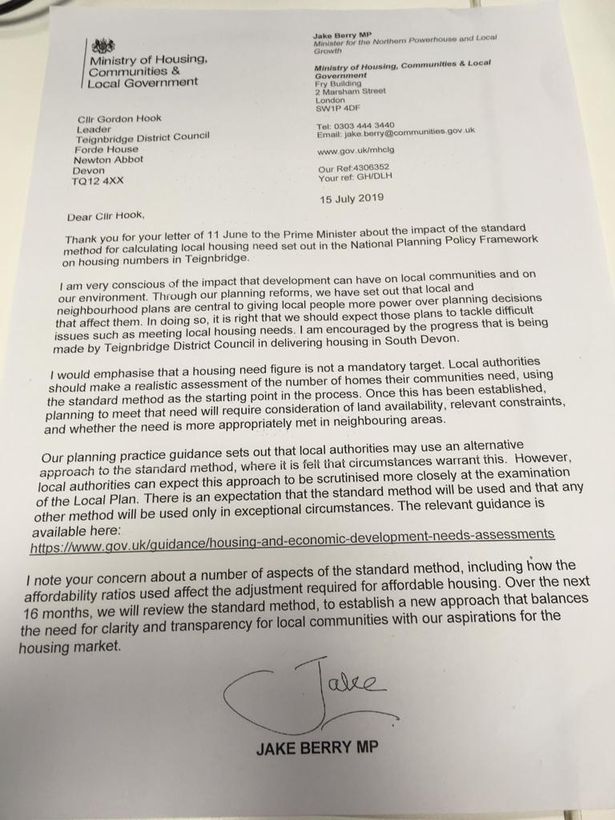
Housing numbers: government targets are NOT set in stone

Letter from Department of Communities and Local Government to Teignbridge Council, which queried its raised target:

For background, see:
https://www.devonlive.com/news/devon-news/glimmer-hope-housing-need-rise-3153098

“House prices in Devon have risen by around £44,000 in last 12 months, stats show”

The cost of homes in Devon has risen by 3.2 per cent over the past 12 months, with the average homeowner in the county seeing their property value jump by around £44,000 in the last five years. …

IN EAST DEVON:

Those wanting to buy in East Devon saw a slight drop in prices in May this year of 0.6 per cent, despite witnessing a 1.4 per cent rise over the last 12 months.

The latest ONS data shows the average property in the area sold for £282,602. Buyers who made their first step onto the property ladder in East Devon in May also spent an average of £217,225 – around £37,000 more than it would have cost them five years ago.

A total of 3,031 homes were sold in East Devon, five per cent fewer than in the previous year – according to the data for between April last year and March this year.

The average homeowner in East Devon will have seen their property jump in value by around £50,000 in the last five years.”

https://www.midweekherald.co.uk/news/house-prices-in-devon-statistics-1-6180451

New housing minister has great credentials …. not!

In addition to having 3 expensive homes (but calling himself ‘an ordinary businessman’) Jenrick has other “qualities” to recommend him, not least ANOTHER auctioneer a la Swire -and also a residency in Moscow! Perhaps he got some housing ideas there ..

https://eastdevonwatch.org/2019/07/24/correction-the-tory-hopeful-with-3-homes-who-says-hes-ordinary-bloke-is-new-housing-minister/

“Robert Jenrick has been appointed Secretary of State for Housing, Communities and Local Government in Boris Johnson’s first Cabinet.

Jenrick was elected Conservative MP for Newark in June 2014 and has served as Exchequer Secretary to the Treasury since January 2018.

His previous roles have included acting as Parliamentary Private Secretary to the Lord Chancellor and Secretary of State for Justice.

He replaces James Brokenshire who yesterday announced he was returning to the backbenches.

Jenrick studied History at St John’s College, Cambridge and was Thouron Fellow in Political Science at the University of Pennsylvania. He qualified as a solicitor in 2008 and practised corporate law at international law firms in London and Moscow. He then went on to have a career in business, notably at Christie’s, the art business. …”

https://www.localgovernmentlawyer.co.uk/governance/396-governance-news/41105-jenrick-named-secretary-of-state-for-housing-communities-and-local-government

“Ministers pledge to end ‘poor doors’ in new build housing”

Owl says: What they won’t donis stop developers from siting (the very little) affordable housing in “ghetto blocks” on the worst parts of their developments (by main roads, poor views, etc) when the housing is supposed to be “mixed” so that doesn’t happen. Why? Because planners don’t check it is happening – turning blind eyes.

“Ministers have pledged to put an end to the use of so-called “poor doors” in housing developments in England.

The separate entrances for social housing tenants living in new builds “stigmatise” and divide them from private residents, the government said.
Communities Secretary James Brokenshire said he had been “appalled” by the examples of segregation he had seen.

Under the new measures, planning guidance is to be toughened in a bid to create more inclusive developments. …”

https://www.bbc.co.uk/news/uk-49053920

“UK’s renting millennials face homelessness crisis when they retire”

“More than 600,000 members of so-called ‘Generation Rent’ are facing an “inevitable catastrophe” of homelessness when they retire, according to the first government inquiry into what will happen to millennials in the UK who have been unable to get on the housing ladder as they age.

People’s incomes typically halve after retirement. Those in the private rented sector who pay 40% of their earnings in rent could be forced to spend up to 80% of their income on rent in retirement.

If rents rise at the same rate as earnings, the inquiry found that 52% of pensioners in the private rental sector will be paying more than 40% of their income on rent by 2038. This will mean that at least 630,000 millennials are unable to afford their rent.

They will find themselves homeless or with no choice but to move into temporary accommodation, at the state’s expense, according to the report by the all-party parliamentary group on housing and care for older people.

“The number of households in the private rented sector headed by someone aged over 64 will more than treble over the next 25 to 30 years,” said Richard Best, the chair of the group. “But unless at least 21,000 suitable homes are built a year, there will be nowhere affordable for them to live. The consequence is bound to be homelessness for some.”

The report also forecasts that, in terms of quality of accommodation, the number of older households living in unfit and unsuitable private rented accommodation could leap from about 56,000 to 188,000 in 20 years’ time and to 236,500 in 30 years’ time. And it warns that the UK is headed towards an ‘inevitable catastrophe for the pensioners of tomorrow”.

Substandard housing is already known to be a direct cause of death for many older people: at least 53,000 winter deaths of old people over the last five years have been attributed to conditions related to living in a cold home.

While retired people in social housing are more likely to live in affordable, decent homes, the report – Rental Housing for an Ageing Population – says there is not nearly enough of this housing even now.

“We see the likelihood of a significant shortfall in the available places within the current stock since, at present, few retirement schemes are being created,” said Lord Best. …”

https://www.theguardian.com/society/2019/jul/17/renting-millennials-homelessness-crisis-retire?CMP=Share_iOSApp_Other

“West Midlands Combined Authority to redefine ‘affordable housing’ “

“The West Midlands Combined Authority (WMCA) has said it wants to redefine ‘affordable’ housing as [currently] the average house price in the region is seven times higher than the average annual salary.

The WMCA’s Housing and Land Delivery Board this week agreed an approach to define affordable housing “in a more localised and bespoke way”.

This will involve combining the national definition with specific local weighting and criteria within the WMCA.

A report prepared for the board’s meeting said the recommended approach to defining affordability in the West Midlands was one “that reflects the range of housing needs and ambitions across the region, ensures compliance with statutory local plans and provides investor and developer certainty”.

Local councils, the private sector and housing associations across the West Midlands were involved in shaping this work.

The report added: “As housing supply is a multi-dimensional policy area, we cannot find clear evidence that a definition on its own will unlock significant new affordable supply. But as part of the coherent comprehensive approach to affordable housing and homelessness, a regional definition can send a strong message of our commitment to address well evidenced and clear housing affordability and supply issues.”

https://www.localgovernmentlawyer.co.uk/housing-law/397-housing-news/41021-west-midlands-combined-authority-to-redefine-affordable-housing

“Berlin buys 670 flats on Karl-Marx-Allee from private owner”

THAT’S how you do it NOT “Help Developers to Make Obscene Profits” aka Help to Buy!

“The state of Berlin has bought back 670 apartments on the historic Karl-Marx-Allee from a private owner after decades of property privatisation in the German capital.

A 1950s prestige project for socialist East Germany, the grand boulevard that stretches from the city centre to Friedrichshain in the east has been the frontline of a months-long fight over gentrification and rising property prices.

The struggle erupted last November when the property management firm Predac announced its intention to offload 700 apartments on the road to Berlin’s largest property company, Deutsche Wohnen.

Fearing rent increases, tenants organised protest marches and hung banners from their apartments, eventually pushing the city senate to block the sale.

After months of legal wrangling, the senate confirmed on Monday that three blocs containing more than 670 apartments would instead be purchased by the state-owned housing provider Gewobag.

While the price of the sale was not confirmed by either side, the move to renationalise the buildings on Karl-Marx-Allee is likely to come at a steep cost, with estimates ranging between €90m-€100m (£80m-£90m).

Berlin’s mayor said the move was indicative of a wider strategy to reacquire housing stock sold to private investors in the 1990s, following rapid rises in rental costs in the city in recent years.

“Berliners should be able to continue to afford living in the city,” said Michael Müller. “That is why it was and continues to be our intention to buy up apartments wherever we can, so that Berlin can regain control of its property market.”

https://www.theguardian.com/world/2019/jul/16/berlin-buys-670-flats-on-karl-marx-allee-from-private-owner?CMP=Share_iOSApp_Other