“Human rights commission to launch its own Grenfell fire inquiry”

Britain’s human rights watchdog is to launch an inquiry into the Grenfell Tower fire that will examine whether the government and the Royal Borough of Kensington and Chelsea failed in their duties to protect life and provide safe housing.

The dramatic intervention by the independent Equality and Human Rights Commission, which has the potential to draw damning conclusions about the role of the state, could foreshadow the official inquiry, ordered by Theresa May and chaired by retired judge Sir Martin Moore-Bick, which has been criticised for excluding social housing policy from its remit. The commission’s recommendations are due to be published in April, considerably earlier than the official inquiry’s full findings.

The commission’s chair, David Isaac, said the EHRC, whose application to become a core participant in the official inquiry was rejected, had decided to launch its own inquiry amid concerns that key questions – including the extent to which the state has “a duty to protect its citizens”– were being neglected. While acknowledging that the move might be seen as “controversial” in some quarters, he defended the commission’s decision to become involved.

Six months on, Grenfell Tower fire survivors are left demanding answers
“We are the UK’s national human rights body and we have a statutory duty to promote equality and human rights,” Isaac said in an interview with the Observer. “We think the human rights dimension to Grenfell Tower is absolutely fundamental and is currently overlooked. Grenfell for most people in this country, particularly in the way the government has reacted, is a pretty defining moment in terms of how inequality is perceived.”

He recalled his reaction to the tragic events of 14 June. “Like everybody else, it was shock, horror, distress. I think it was a national moment that defined how certain parts of society experience the state’s public provision of housing and also how the state responds. We need to learn from what’s happened with Grenfell, look at it in the context of our human rights obligations, and think about how we can improve. There are loads of lessons to be learned.”

Last week it emerged that four out of every five families who were made homeless in the fire are still looking for new housing, with almost half of them likely to spend Christmas in emergency accommodation.

The EHRC inquiry, which will involve a panel of legal experts, will pay particular attention to the UK’s obligations to the tower’s residents under the Human Rights Act and international law. At a time when some want the act scrapped, the inquiry’s actions could be viewed as provocative.

“Human rights are for everybody,” Isaac said. “This is political and I know there is a view among some politicians, but also among society more generally, that human rights only protect extremists and terrorists but that isn’t the case at all. I always talk about Hillsborough as a really good example of where the Human Rights Act and the human rights lens has been used effectively to ensure justice prevailed.”

In a statement to be published on its website tomorrow, explaining its decision to launch what it refers to as its “project”, the EHRC will say: “The Grenfell Tower fire caused catastrophic loss of life for which the state may have been responsible. More than 70 people died in homes managed by the state. They should have been safe and they were not. The people who died and others affected by the fire come from diverse backgrounds. They include children, elderly people, disabled people and migrants. …

… The commission’s decision to examine the Grenfell Tower fire reflects a more muscular approach to addressing human rights and equality issues. Recently it has brought a number of high-profile legal actions and launched several major inquiries, such as that into the gender pay gap.

Isaac said: “We are a more confident organisation and this is a good example of us being that – holding the government to account by doing what only we can do. It might be perceived to be controversial but I believe that’s our role.””

https://www.theguardian.com/uk-news/2017/dec/09/human-rights-commission-to-launch-own-grenfell-fire-inquiry

Devon/Somerset devolution: DCC Tories and Labour votes Yes on deal that scrutiny committee savaged

From the blog of EDA Councillor Martin Shaw:

“Most Labour members joined the Conservative majority on Thursday in voting down my amendment for the County Council to revisit its controversial ‘devolution’ proposals to join Devon with Somerset in the so-called Heart of the South West, first in a formal Joint Committee and then (envisaged but not proposed at this stage) in a Combined Authority. I argued that the proposals for an extra layer of bureaucracy have no democratic consent – they were not even in the Conservatives’ Devon manifesto last May.

I argued that we were being asked to support ‘a regional economic strategy that doesn’t add up to a government which doesn’t know what it’s doing about devolution, and for this we’re prepared to enter a half-baked new constitutional arrangement which will probably have to be scrapped as soon as a more rational government devolution policy is devised.’

Six of Labour’s Exeter members followed the line of Exeter City Council which is joining the Tory-run County and district councils in supporting the current devolution proposals (one abstained). They believe that Exeter’s economy will gain from the (currently unknown) amount of money the devolution bid will gain from government (which of course will be giving back a small proportion of the money it is currently taking from services). I argued that the plan does not have a viable economic strategy behind it, and that rural, coastal and small-town Devon stands to gain virtually nothing from it.

Liberal Democrat and Green councillors joined Independents in voting for my amendment. The webcast will be available here:

https://devoncc.public-i.tv/core/portal/webcast_interactive/305858”

Labour joins Tories at Devon County Council to support joint ‘devolution’ with Somerset, against Independent, Lib Dem and Green opposition

“The Guardian view on social housing: time to fight for affordable rents”

“ …On Friday the specialist journal Inside Housing published research that showed a new and significant factor behind the sharp rise in the numbers relying on emergency support.

The right to buy, first introduced in 1980, already abandoned in Scotland and soon in Wales, was successfully reinvigorated in England by David Cameron five years ago. It has been a boon to the buy-to-let market and a curse on councils that find themselves renting them back at hugely inflated cost.

Soaring house values have turned what should be a place to live into a golden asset. Former council properties have been snapped up by private landlords. In the most prosperous areas, up to 70% of former council homes are now privately let. Private rents out of London average over £200 a week while council rents are nearer £90 a week.

Councils in England have been sending up emergency flares for more than a year, trying to alert the government to their inability to build enough new homes to replace the ones they have been forced to sell, with predictable consequences.

In the last five years, since right-to-buy discounts were nearly doubled, 54,581 homes were sold and only 12,472 homes were started. Some are built in one authority from receipts of sales in another, compounding local shortages.

Councils have to use part of the receipts from sales to pay off housing debt, and can only keep a third for replacement. They are still banned from borrowing to make up the full cost of buying or building new ones. Between now and 2020, councils also face having to sell off higher-value council homes in order to fund discounts on housing association homes that are due to come in under right-to-buy provisions.

Like so much else that has happened since 2010, social housing policy has not just been damaging but contradictory, fostering the chimera of a property-owning democracy in an age of shrinking social housing stock and rapidly growing demand. The government makes bold promises on new affordable homes to buy. But what’s needed is homes that people can afford to rent.”

https://www.theguardian.com/commentisfree/2017/dec/08/the-guardian-view-on-social-housing-time-to-fight-for-affordable-rents

“Shepton Mallet hospital campaigners: “Reopen this hospital or we’ll see you in court”

Any bets on this hospital re-opening!

“A group of campaigners have launched a legal bid to try and prevent the temporary closure of a community hospital in Somerset.

Shepton Mallet Community Hospital Supporters Group have submitted a pre-action protocol letter to the Somerset Partnership Trust in an effort to reverse the temporary closure of the town’s community hospital.

A pre-action protocol letter is sent from one party to another in a dispute to narrow any issues or to see if litigation can be avoided.

Ten in-patient beds were closed temporarily in October due to staffing issues with the trust saying that they hoped to reopen them in March 2018.

Confirmation of the decision to temporarily close the hospital came after an email to staff was leaked on social media, saying that the plans would “proceed”.

This was despite a previous statement which said that it was “considering its next steps”.

The partnership later insisted that “nothing has changed” and that it remains focused on reopening the hospital towards the end of March 2018.

In a statement, a spokesman for the supporters group said that the letter aimed to challenge the alleged “unlawfulness” of the trusts decision and to “achieve the re-opening of the in-patient beds as quickly as possible.”

Paul Turner said: “We have asked the Trust to rescind its decision before a Court quashes it, and if it wants to take any such decision in the future or any other decision on a change in service at SMCH, the Trust must undertake a prior proper public consultation.

“This is nothing new and the point has been made before in meetings with SOMPAR representatives.”

He added: “We are of course also prepared to take part in alternative dispute resolution to avoid going to court.

“We have asked to be kept up to date concerning developments in this dispute.”

Somerset Partnership Chief Executive, Peter Lewis said: “We have received the letter and we are considering our response.

“In the meantime, I want to reassure the Shepton Mallet community that we remain committed to re-opening the community hospital inpatient ward as soon as we can, although we do not expect this to be before the end of March 2018.”

The issue of the temporary closure was raised at a debate in Westminster Hall last month by the MP for Wells, James Heappey.

Mr Heappey said: “The overall nurse rota statistics for both day and night shifts were 100 per cent in Shepton.”

http://www.somersetlive.co.uk/news/somerset-news/shepton-mallet-community-hospital-883030

Christmas gifts?

The Radical Tea Towel Company

Owl particularly likes the Oscar Wilde quote:

To recommend thrift to the poor is grotesque and insulting. It is like advising a man who is starving to eat less

http://www.radicalteatowel.co.uk

“Philip Hammond causes storm with remarks about disabled workers”

Disability charity Scope and others call for chancellor to withdraw his comments implying disabled people are to blame for sluggish economy.

“Disability charity Scope called on Philip Hammond to withdraw his “totally unacceptable and derogatory comments” after he said Britain’s sluggish productivity could partly be blamed on more disabled people in the workforce.

In Wednesday’s treasury select committee, the chancellor was asked about low economic productivity levels, which he had reported during the autumn Budget last month.

At first, he responded saying that high levels of unemployment, particularly youth unemployment, “will be felt for many many years to come”.

He then added: “It is almost certainly the case that by increasing participation in the workforce, including far higher levels of participation by marginal groups and very high levels of engagement in the workforce, for example of disabled people – something we should be extremely proud of – may have had an impact on overall productivity measurements.”

https://www.theguardian.com/politics/2017/dec/07/philip-hammond-causes-storm-with-remarks-about-disabled-workers

RDE rushes ahead with unaccountable “Accountable Care Organisation” plans

[By total coincidence, of course, Tiverton has the only local 24 bed PFI-funded community hospital which cannot therefore be closed].

NEWS RELEASE
Tuesday 5 December 2017

“Tiverton GP practice due to join hospital trust – pioneering the way for Devon’s first primary and secondary health care integration

On 2 January 2018, Tiverton’s Castle Place Practice and its 50 members of staff*, including GPs, plan to join the Royal Devon and Exeter NHS Foundation Trust (RD&E). This new venture will be the first of its kind in Devon and will provide locally-led seamless care for the Tiverton community
This move fits with the direction of the NHS Five Year Forward View and offers better integrated working by removing organisational barriers. Castle Place is already co-located with Tiverton Community Hospital and has an established close working relationship with the Trust’s community teams so it was a pragmatic option for the practice to approach the RD&E with the proposal to explore a fully integrated model. Whilst offering the opportunity to work differently for the benefit of all the local community, it will also help address some of the challenges faced by primary care, particularly the difficulty in recruiting new GP partners and balancing time for clinical care with the demands of running a business.

Dr James Squire, GP Partner at Castle Place, explains: “This is an exciting new venture for us and one in which our patients’ best interests are central to our rationale for pursuing this change. I’d like to reassure our patients that in the short-term there will be no changes to the services we offer and in the longer-term will only provide better care.

“The ever increasing challenges and pressures are resulting in necessary changes right across the healthcare system. Thankfully, due to our focus on person-centred, continuity of care we have managed to fare some of these challenges well but we know that to maintain this for our current patients and future generations we need to explore new ways of working. There are a number of different ways GPs could adapt but it was important for us that we secured a future which was true to our core values and principles. Joining the RD&E gives us an opportunity to concentrate our efforts on leading and providing excellent clinical care in a way that’s right for our community”.

“This is a bold step for us but the whole team here is motivated to test new ways of working, not only between the practice and the hospital but also with the community services for our population, and we are really keen to share our experiences and learning for the wider benefit.”

Suzanne Tracey, RD&E Chief Executive, said: “At the RD&E we are prioritising working more closely with local health and care partners to support a move towards ‘place-based care’. This is the future of healthcare and we want to help create the conditions which enable communities to take the lead. To achieve this, we envisage working with our partners in a number of exciting and different ways and this proposal initiated by the Castle Place Practice in Tiverton is a great opportunity to put this into practice.

“Whether in primary or secondary care, all of us want to do what’s right for the person and right for a community but sometimes competing demands, targets and finances can get in the way or slow the pace of change. The partnership with Castle Place Practice is a great opportunity for us to work together with GPs to develop more proactive care which keeps people well and independent in their own communities.”

Castle Place Practice’s 15,000 registered patients, which is around half of Tiverton’s population, will see no immediate changes. Staff will continue in their existing roles, patients’ named GP will not change and access to appointments and services will continue in exactly the same way. However, in the longer term it will enable and increase the opportunities for better management of long term conditions plus improve access to care at home and in the community.”

Hinkley C gets its own posh hotel thanks to OUR LEP

Anyone know of any hotel that got LEP funding in Devon? Seaton, Honiton Premier Inns perhaps? Certainly not!

From an LEP report:

“In October Deepak Chainrai of DC Hotels (Bridgwater) Ltd welcomed representatives from HotSW LEP, Bridgwater Town Council and Sedgemoor District Council to the site of the new Mercure Bridgwater Hotel, which is visibly taking shape, as an opportunity for all to see the work and progress behind the construction hoarding.

Before touring all five floors, the group was shown around the lobby area, meeting rooms, lounge and bar, leading to the destination restaurant that will be operated by The Marco Pierre White Steakhouse Bar & Grill.

The new hotel was partly financed by a loan from the LEP’s Growing Places Fund, which aims to get projects off the ground that would otherwise not be immediately served by the commercial marketplace. The site is strategically placed as an asset for the area with the development of the nearby Hinkley Point C. The establishment of a modern hotel with an international restaurant chain and commercial units is an important amenity that will boost the local economy and generate new jobs.”

DCC Corporate Infrastructure and Regulatory Services Scrutiny Committee savages HOTSW Growth Strategy

NOW THAT’S HOW YOU DO SCRUTINY!
(Thanks to Independent East Devon Alliance DCC Councillor Martin Shaw for bringing to the committee 10 of the 11 points and Budleigh resident David Daniel for his succinct 3 minute take-down of the original document)
at:
https://eastdevonwatch.org/2017/11/30/watch-eda-councillor-shaw-and-budleigh-resident-david-daniel-make-most-sense-on-lep-strategy/

Heart of the South West Joint Committee and Draft Productivity Strategy (Cabinet Minute 77/8 November 2017)

Minute 31:

“The Committee received the Joint Report of the Head of Economy, Enterprise and Skills and the Head of Organisational Development (EES/17/5) providing information on the Heart of the South West Joint Committee and the draft Productivity Strategy, which was currently being consulted on and which highlighted a number of challenges facing the Heart of the South West area.

The consultation period had been extended to 14 December 2017 and an Action Plan would be shared with the Committee at a future meeting.

RESOLVED that

the Committee note the work to develop a Joint Committee and that, to enable a bid for devolved powers and funds to be successful, revisions were suggested to be made to the Heart of the South West Productivity Strategy, taking the following comments into account, namely:-

(a) the ambition to double the size of the economy in 18 years, involving an annual growth rate of 3.94%, was unrealistic given that the regional annual rate over the last 18 years had been 1.5% and the national growth rate, which had not exceeded 3% in a single year during that period, was now forecast to average less than 1.5% per annum in the next five years;

(b) the early ambitious aim of moving from less than average to above average productivity was not credible since the Strategy lacked the wide range of specific proposals needed to raise productivity across the board and contained little detail on how gaps in higher skills level would be filled;

(c) the Strategy did not adequately address the obstacles to higher than average productivity in sectors with endemic low pay and casual working, like social care and hospitality, which were disproportionately represented in the local economy, by our older than average population, and by under-employment;

(d) the Strategy said little about rural Devon and needed to include the key recommendations of the South West Rural Productivity Commission;

(e) the Strategy did not emphasise sufficiently the shortfall in broadband provision and the radical investment needed if Devon were not to fall further behind other regions;

(f) the Strategy did not provide details of the opportunities of Brexit, which it mentioned, nor did it take account of risks such as a decline in investment due to uncertainty, issues for firms exporting to Europe if the UK was not part of a customs union, and threats to the knowledge element of our economy due to universities losing EU staff and research opportunities;

(g) the Strategy needed to show how Devon would respond to automation and Artificial Intelligence;

(h) the Strategy needed to indicate clear performance indicators through which success could be measured;

(i) the Strategy needed to align more explicitly with the Government’s new Industrial Strategy and ‘Sector deals’ which may provide funding;

(j) the Strategy needed to explain what kind of devolution would help meet aspirations and articulate clear, realistic selling points and questions of Government; and

(k) the Strategy needed to include proposals to bring forward all forms of transport, including rail, which improved accessibility to the Peninsular.”

http://democracy.devon.gov.uk/documents/g2578/Printed%20minutes%2028th-Nov-2017%2014.15%20Corporate%20Infrastructure%20and%20Regulatory%20Services%20Scrutiny%20Comm.pdf?T=1

The scandal of child and pensioner poverty

Almost 400,000 more UK children and 300,000 more pensioners plunged into poverty in past four years, new study finds.

Hundreds of thousands of children and older people have been plunged into poverty in the past four years, according to a stark analysis laying bare the challenge to families trying to keep up with the cost of living in Britain.

The research from the Joseph Rowntree Foundation (JRF) found almost 400,000 more children and 300,000 more pensioners in the UK were living in poverty last year compared with 2012-13, the first sustained increases in child and pensioner poverty for 20 years. The foundation warned that decades of progress were at risk of being unravelled amid weak wage growth and rising inflation.

The thinktank urged the government to unfreeze benefits, increase training for adult workers and to embark on a more ambitious house-building programme to provide affordable homes for struggling families. …”

https://www.theguardian.com/society/2017/dec/04/uk-government-warned-over-sharp-rise-children-pensioner-poverty-study

“More than 3,000 foster children are excluded from the Tories’ flagship free childcare pledge”

“More than 3,000 foster children will be excluded from the Tories flagship free childcare pledge, ministers have revealed.

Under the policy, three and four year olds with working parents are entitled to 30 hours of childcare paid for by the government.

But early years minister Robert Goodwill has revealed foster children is only available for the 15 hours a week available whether parents are in work or not.

Some 3,030 children in care will lose out on care, even if their foster carers are in full time work.

It means a vulnerable child receiving 30 hours a week would lose up to half of their childcare funding if they were to be taken into care.

Labour’s early years spokesperson Tracy Brain said: “The decision to exclude foster children is cruel and clearly discriminatory.

“Every child should have access to high quality childcare and early years education, and while not every foster parent would decide 30-hours is best for the child, they should have exactly the same right to access as if they were with their birth parents.

“We’re looking at a few thousand children added to a policy already used by hundreds of thousands, in the interest of equality and our commitment to foster children, the Tories should think again and end this unfair exclusion.”

If foster children were included in the policy, they would make up just 1% of the roughly 300,000 expected to be eligible for the full 30 hours from January.

While foster carers do receive an allowance from the government, childcare costs are not included in the calculations.

She added: “We’re looking at a few thousand children added to a policy already used by hundreds of thousands, in the interest of equality and our commitment to foster children, the Tories should think again and end this unfair exclusion.” …”

http://www.mirror.co.uk/news/politics/more-3000-foster-children-excluded-11632976

Government money for UK, US and Chinese-backed mini-nuclear power stations but not cheaper green energy

“Ministers are expected to back the first generation of small nuclear power stations in Britain with tens of millions of pounds this week, in an attempt to give the UK a competitive edge on the technology and provide a new source of clean power.

Rolls-Royce and a host of US and Chinese companies have been lobbying and waiting for the support since George Osborne first promised them a share of £250m two years ago.

Now, after industry frustration at huge delays to the government’s competition to find the best value “small modular reactor” (SMR), funding to develop and test the power stations will be confirmed.

The energy minister, Richard Harrington, is expected to announce support for the embryonic technology on Thursday, industry figures told the Guardian. The funding is likely to be up to £100m, one source said.

Small modular reactors provide about a tenth of the power of a conventional large nuclear power station, such as the one EDF is building at Hinkley Point C in Somerset. But their backers pitch them as a cheaper and quicker way to generate the new, low-carbon power the UK needs.

Rolls-Royce has been publicly and privately lobbying the Department for Business, Energy and Industrial Strategy (BEIS) over its SMR design, which it positions as an industrial opportunity for Britain that would generate thousands of UK jobs.

The firm argues that with electric cars likely to drive up future energy demand, the reactors will become a vital part of national infrastructure. …

…The funding is designed to help Rolls and other consortia, including the US companies NuScale and Terrapower and the controversial Chinese firm CNNC, undertake the research and development for a small nuclear power station to be built in the UK. It is not yet clear who will win a share of public funds, or how the pot will be carved up between the 33 participants in the SMR competition. …

… However, energy experts said the case for SMRs was far from proved, especially given the falling cost of alternatives such as offshore windfarms.

Paul Dorfman, a research fellow at University College London, said: “The real question the government must ask is this: given the ongoing steep reduction in all renewable energy costs, and since SMR research and development is still very much ongoing, by the time SMRs comes to market, can they ever be cost competitive with renewable energy? The simple answer to that is a resounding no.”

An energy industry source also questioned how credible most of the SMR developers were. “Almost none of them have got more than a back of a fag packet design drawn with a felt tip,” the source said.

A BEIS spokesperson said: “We are currently considering next steps for the SMR programme and will communicate these in due course.”

https://www.theguardian.com/business/2017/dec/03/mini-nuclear-power-stations-uk-government-funding

Swire fails to save another hospital

In August 2017 Swire spearheaded a campaign to keep heart services going at London’s Royal Brompton Hospital (having miserably failed to lead similar campaigns in East Devon, leaving Claire Wright to fight for us:

https://eastdevonwatch.org/2017/08/05/more-on-swire-saving-services-at-royal-brompton-hospital-london/

Well, his attempts in London don’t seem to have worked either:

“The world-leading Royal Brompton Hospital in London, recently ‘saved’ by NHS bosses, is being lined up for a billion pound sale to make way for luxury flats. …”

http://www.dailymail.co.uk/news/article-5140315/World-class-heart-hospital-make-way-luxury-flats.html

“UK, Romania and Poland: fewest doctors in EU”

“The UK has the third-lowest number of hospital beds per person in the European Union as well as the third-lowest number of doctors, with only Romania and Poland worse off, a European Commission report has found.

The report, which compared the 28 EU countries, warned that hospitals will struggle to cope with the winter crisis predicted by many doctors and NHS managers as intensive care beds were full even during the summer.

It warned of the UK’s “limited capacity to absorb shocks”, adding: “Difficulties finding beds have introduced inefficiencies.”

Ian Eardley, vice-president of the Royal College of Surgeons, said Britain’s low ranking in the report should act as “a wake-up call for NHS leaders” and that the cuts have “now gone too far”.

He said: “Bed shortages lead to cancelled operations and patients waiting longer for treatment. Some will find themselves in pain for longer, possibly unable to go about their daily life. In the worst cases their condition may deteriorate while they wait.”

Last week doctors in intensive care units (ICUs) — where the sickest patients are given life support — said they were also nervous about the coming weeks.

Dr Christopher Bassford, a consultant in intensive care at University Hospitals Coventry and Warwickshire NHS Trust, said: “At our intensive care unit we have operated at 100% capacity or over for most of the summer. This winter we are anxious.”

Dr Gary Masterson, president of the Intensive Care Society, added: “It does feel as if we are on the cusp. This [bed occupancy at 100%] is the norm for many ICUs. It is right to worry about ability to cope should we have a busy winter.”

Bed occupancy runs at over 100% when more than one patient uses the bed during a 24-hour period.

Dr Nick Scriven, president of the Society for Acute Medicine, recently warned that doctors would need to make drips out of coat hangers this winter because of the anticipated shortage of beds and equipment.

While the number of doctors working in the NHS has increased, the report also found the UK still near the bottom of the EU league table. It said: “There have been steady increases in recent decades, despite which the number of doctors per 1,000 of the population was the third lowest in the EU.”

NHS England said: “These figures show our NHS is much more efficient than other countries such as France or Germany in helping patients avoid emergency hospitalisations, and we do so despite spending less and having fewer nurses and doctors than they do.”

Sunday Times (pay wall)

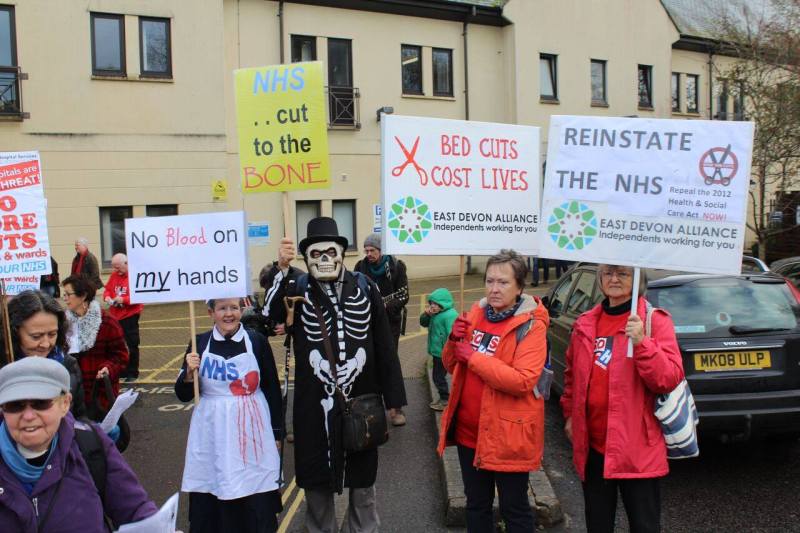
Who fights for our NHS? Independents fight for it!

Photos from demo in Totnes today with a few local faces you will probably recognise.

No Tories from East Devon then?

Thought not!

What you can get away with in business in a greedy, unregulated system

“Palmer & Harvey paid out £70m since 2008 despite ongoing losses.

UK’s biggest tobacco distributor called in administrators and ceased deliveries on Tuesday, making 2,500 people redundant.

Palmer & Harvey directors, former directors and other shareholders extracted about £70m in cash from the grocery wholesaler over the past nine years despite ongoing losses.

The company, where 2,500 people were made redundant earlier this week and a further 900 jobs are at risk, had been owned by dozens of private individuals via a complex web of equity and loans. The company supplied 90,000 stores including 50,000 independents that are now struggling to secure stocks of tobacco and groceries at one of the busiest times of the year.

The UK’s biggest tobacco distributor called in administrators and ceased deliveries on Tuesday after hitting “challenging trading conditions” while efforts to restructure the heavily indebted business were unsuccessful.

P&H was bought by its management team in 2008 in a deal that valued the company at £345m. The deal was largely funded by debt.

P&H (2008), the wholesaler’s parent company, has paid out more than £8m a year in dividends since 2009 to its shareholders despite making losses of about £10m a year or more in all but one year, 2014.

The company’s net debt hit £48.6m in April 2016 and has been above £29m every year since 2011.

Some former managers, including the former chairmen Christopher Adams and Christopher Etherington, hold special preference shares, according to the latest list of shareholders filed at Companies House. These “B preference” shares pay out a fixed dividend twice a year.

Etherington, who stepped down as chairman earlier this year, and his wife were entitled to an estimated £300,000 in dividends last year and Adams £941,000. Half of this payment was deferred under an agreement with shareholders which pledged that it could be repaid if and when the B preference shares were ultimately redeemed.

Etherington and his wife have together held the same number of these B shares since the takeover, entitling them to about £2.5m in dividends since 2009.

In 2009, Etherington also held another form of preference share, the “A preference”, that entitled him to an annual dividend. The latest annual report indicates he no longer owns those shares. He was able to redeem them for £1 each or £500,000, before dividends owed.

Accounts for Palmer & Harvey McLane (Holdings), another parent company of P&H, also show that Etherington received a £3.44m interest-free loan from the company’s employee benefit trust with which to fund his stake in the company. This was repayable on the sale of any shares held by him.

Only a handful of shareholders in P&H (2008), most of whom are former and current staff, retained their A preference shares at the time of the last Companies House filing. But their rights to redeem the shares were protected at the time of the 2008 buyout with ring-fenced cash of £42m held in a separate company, Buildtrue, in April 2016. That company is not part of the administration process and it is understood that the majority of A preference shareholders have cashed out in the past year, receiving funds from Buildtrue.

Administrators at PricewaterhouseCoopers declined to comment.”

https://www.theguardian.com/business/2017/dec/01/palmer-harvey-paid-out-70m-since-2008-despite-ongoing-loses

Watch EDA councillor Shaw and Budleigh resident David Daniel make most sense on LEP “strategy”

Jump to 2 hours into the meeting to see these two local people talk total sense to a bunch of mostly Tory councillors most of whom seem to understand beggar-all about why they are there!

Mr Daniel – a former government strategic analyst is at around 15 minutes into the meeting and speaks persuasively about why the Heart of the South West LEP strategy is totally unachievable. Independent East Devon Alliance DCC Councillor Martin Shaw (whose forensic report was totally accepted with one additional point added) is at around 2 hours into the meeting speaking on why the report before the councillors is style over substance and dangerous to go along with in its current form.

In Owl’s opinion, they run rings around the rest of the committee!

Although one councillor did make a point (Owl is paraphrasing here!} that this is an 18 year “strategy” and could well be redundant in a few years – when some other crazy idea might replace it!

https://devoncc.public-i.tv/core/portal/webcast_interactive/303464

Exmouth’s Lonely Christmas Tree

“The Lonely Christmas Tree”

I am the lonely Christmas Tree,
In Exmouth’s market place;
No vending stalls are round about
No shopper’s welcome face.

The Strand is bare of trade and cheer
In Exmouth’s market place-
All moved to Ocean’s empty hall
To fill that empty place.

Shopkeepers have all tried their best
Around the market place
To pay their rates and sell their goods
With patience and good grace.

The loss to trade and income gone-
They’ve moved the Christmas Cracker;
No help then for the working shops-
Their Christmas has been knackered !”

Who benefits from rail changes?

Deutsche Bahn (Germany),  SNCF and Govia (France), Abellio (Netherlands), Renfe (Spain),  First MTR (part-owned Hong Kong), Trenitalia (Italy):