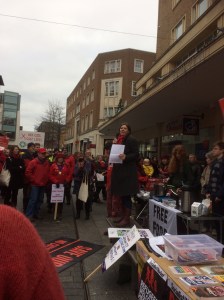
Hundreds protest over NHS cuts

“Protesters were seen marching in red lines from every direction along Sidwell Street, Fore Street, Queen Street, North Street, South Street, and Paris Street.

Protesters then gathered in Bedford Square where the speeches began.”

http://www.exeterexpressandecho.co.uk/hundreds-of-people-attend-protest-in-exeter-to-stop-nhs-cuts/story-29954867-detail/story.html

img_1358

It included a rousing speech by DCC councillor Claire Wright:

Has DCC Leader John Hart just killed off Devon and Somerset devolution plans?

Agenda item
Councillor John Hart, Leader of Devon County Council

Meeting of Exeter Board, Monday 21st November 2016 5.30 pm (Item 31)

Minutes:

The Chair welcomed Councillor John Hart, Leader of Devon County Council who spoke on the future direction and plans of the County Council in light of Government policy and continued cuts to local government funding – 2017/18 set to be the 8th consecutive year since 2009 of further restrictions, the precise nature of cuts to become clearer as part of the budget setting process in the New Year.

Having recently met Sajid Javid, the Communities Secretary, Councillor Hart expanded on latest developments in the Devolution debate.

A number of areas such as Norfolk and Suffolk had withdrawn interest and, whilst the Secretary had urged a joint Devon, Cornwall, Somerset and Dorset bid, Councillor Hart outlined the disparity of views across the region for this approach.

Quarterly meetings for the Leaders of Devon, Cornwall, Torbay and Plymouth councils continued to be held and, although Somerset now also participated, within that County the views of districts diverged.

Whilst funding of £15 million per year associated with the adoption of the Mayoral system would be available there was no enthusiasm for an extra tier of local government and this sum represented a fraction of the overall County Council budget.

With regard to two independent studies looking into potential local government reorganisation in county areas for the County Councils Network, he asserted that County/District relationships in Devon were much improved since the previous ruling on re-organisation as evidenced by various joint initiatives with the Districts, the National Parks and the LEP. However, he suggested that some Devon Districts would face increased financial challenges with changes in New Homes Bonus rules.

In his meeting with the Secretary he had urged greater funding commitment for training and skills given the gap of some 20% between the SE and the SW in productivity and he emphasised the value of apprenticeships, including for small businesses.

He thanked the voluntary/community sector for the role played in supporting the County in the delivery of many of its services referring to Senior Voice, Age Concern and CAB which were valued and supported by the authority. He also referred to ICE where again the input of this sector was invaluable, this initiative being a pilot for the rest of the UK. Community self-reliance was a growing theme and he referred to County initiatives encouraging collaboration between parishes.

Members referred to the impact of the reshaped County Council services on areas such as youth, libraries, reduced rural transport funding of 1.7 million, day care, closure of residential homes, the sale of old people’s homes as well as responsibilities under the Care Act legislation.

Responding, Councillor Hart stated that the old people/residential homes had no longer been fit for purpose and that this was also being reflected in the private sector, the County was retaining its overall £4million County wide bus service subsidy and that the transfer of the library service to Charitable Trusts would facilitate business rate relief.

Responding to the concerns of Members regarding the changes emerging from the Care Act legislation and the shift to community based service delivery, he advised that the County Council’s Health and Wellbeing Scrutiny Committee was leading on consultation and responses to the Wider Devon Sustainability and Transformation Plan which sought to achieve the NHS “Five Year Forward View”.

It was noted that the New Devon Clinical Commissioning Group had offered support towards the changes. The County Councils Network was reviewing changes at the national level. Devon’s older people population exceeded 170,000 – both over 65’s and over 85’s, with no specific Government funding for the latter.

It was noted that the Government had announced a £10 million investment to help strengthen the resilience of the railway line between Exeter and Dawlish and Teignmouth.

The Chair thanked Councillor Hart for attending.

http://committees.exeter.gov.uk/mgAi.aspx?ID=36263

“Fears that secretive NHS reforms will put savings before patients”

“Widespread bed cuts, closures of accident and emergency units and even shutting hospitals have been proposed by NHS bosses

A “secretive” plan to reorganise the NHS risks failing patients, a report warns.

Widespread bed cuts, closures of accident and emergency units and even shutting hospitals have been proposed by NHS bosses who are often more focused on saving money than improving care, the King’s Fund think tank says.

Simon Stevens, head of NHS England, has conceded that managers in many areas are not up to the job of implementing his vision for the health service and is warned today that it risks failure in most of the country.

Mr Stevens is attempting to undo Andrew Lansley’s 2012 NHS reforms without the need for another structural reorganisation, and has divided England into 44 areas where local bosses have been told to come up with “sustainability and transformation plans (STPs)” to move care closer to home.

He insists that doing more in local clinics will keep older people with long-term illness out of hospital. The report published today endorses that aim, but says that STPs are the “right thing being done badly”. Short-term savings are being prioritised over long-term improvements as the NHS faces a £22 billion black hole by 2020, it says.

Plans have been drawn up behind closed doors with patients “largely absent” and with little input from frontline staff, the King’s Fund says. Uncertainly over accountability for the plans is hampering the ability to get anything done, it adds. Chris Ham, chief executive of the fund, estimated that a third of plans were likely to succeed, a third had little hope and the rest would need more help.

“I don’t think the deliverability of STPs is something we can be confident about,” he said. “If STPs do not work then there is no plan B.”

Katherine Murphy, chief executive of the Patients Association, said the plans were “more about saving money”, adding: “They cannot axe services in a secretive way and expect the public to be happy.”

Professor Ham said that cutting hospital services was unlikely to work without money for local clinics to replace them. “GPs and district nurses are under massive pressure. It’s unrealistic to expect them without more staff and resources to take on more of the workload,” he said.

About a quarter of the plans have now been published or leaked and many include centralisation or shutting hospital units or cutting beds. In southwest London, one of Epsom, St Helier, Kingston and Croydon hospitals would be shut entirely.

Taj Hassan, president of the Royal College of Emergency Medicine, said that shutting A&E units would be “potentially catastrophic” and put lives at risk. “Furtively producing plans without involving patients is unacceptable,” he said.

Mr Stevens has acknowledged problems, telling NHS bosses last week that councils might need to take over from health service managers. “In some parts of the country the reality is we are short of leadership that is capable of engaging in the task ahead,” he said.

Sir Bruce Keogh, medical director of NHS England, insisted the plans would be “making it easier to see a GP, providing more specialist services in people’s homes, speeding up the diagnosis of cancer and offering help faster to people with mental ill health”.

He conceded that “to realise these benefits some communities might need to make choices about where to put resources and the NHS will need to be clear with the public about the options” but argued: “Claims of secrecy have been overtaken by the fact that we’ve asked that all STPs are now published over the next few weeks.”

Analysis

Most patients would agree that it makes more sense to keep elderly patients well at home rather than letting them tip into crisis and have to go to hospital (Chris Smyth writes).

In essence, this is what Simon Stevens’s “sustainability and transformation plans” are trying to achieve: getting the local NHS to pay more attention to preventing illness, improving mental health and working with social care.

Of course, it is not quite that simple. Nothing brings patients out on to the streets faster than plans for hospital closures. When Theresa May met Mr Stevens for the first time, she warned him not to use the threat of closures as a weapon to try to prise extra cash out of the government.

Often, there are good clinical reasons for shutting poorly performing units. But when so much emphasis is put on saving money, many in the NHS understandably fear this will mean cost-cutting masquerading as better care.

Among the possible cuts…

Southwest London One of St Helier, Epsom, Kingston or Croydon hospital to shut.

Northeast Stockton or Darlington could lose A and E.

Devon Cut 600 hospital beds and A and E, maternity, stroke and children’s services are deemed “not sustainable”.

Northwest London Ealing and Charing Cross hospitals to be downgraded.
Merseyside Merger of four Liverpool hospitals.

Cheshire Downgrade Macclesfield A and E.”

Source:Times (paywall)

Diviani votes against Claire Wright DCC motion to re-examine Honiton hospital closure

Reblogged from the site of Claire Wright, indefatiguable independent councillor fighting non-stop on health service cuts.

NOTE: EDDC Tory Leader Paul Diviani sabotaged her effort to “stop the clock” on cuts to re-examine the effects of closing Honiton and Okehampton hospitals.

REPORT FROM CLAIRE WRIGHT, DCC HEALTH SCRUTINY COMMITTEE

“• CCG does not know how many more staff it needs

• No answer (yet) to public health stated assumption that care at home costs the same as care in big hospitals

My proposal at yesterday’s health and wellbeing scrutiny committee meeting to suspend the consultation which proposes to halve the remaining community hospital beds in Eastern Devon, fell by two votes.

There was a packed public gallery. Several members of the public, including Di Fuller, chair of Sidmouth’s patient and public involvement group and Cathy Gardner, EDDC Independent councillor for Sidmouth spoke powerfully, expressing deep concerns about the bed losses.

Di Fuller said the consultation should be rejected as “invalid.”

Cathy Gardner called on the committee to demand more funding from central government.

Councillors, Kevin Ball and James McInnes from Okehampton made strong representations on behalf of the town relating to the hospital being excluded from the consultation.

(I am part of a sub-committee of health scrutiny that meets tomorrow to scope an investigation into the funding formula for Devon’s health services, which many people, including me believe is unfair, despite the government’s claims that Devon receives more funding than its fair share).

Staff from the NEW Devon Clinical Commissioning Group presented to the committee. They were Rob Sainsbury, Jenny McNeill and GPs – Joe Andrews and Simon Kerr.

We were shown a video of patients happy with the hospital at home scheme which operates in Exmouth and Budleigh Salterton only, as evidence that care in people’s homes work.

This to me didn’t seem to be adequate evidence given that hospital at home is limited to Exmouth and Budleigh Salterton, is consultant led and mirrors the kind of care one might expect in a hospital. It is a good service but expensive to run.

This is not what is being proposed for the remainder of Eastern Devon.

The four presenters tried their best to sell us their new model of care. Some of us weren’t convinced.

Cllr Andy Boyd was critical of the plans and other members asked questions about housing and various NHS procedures.

I asked how many more staff they would need to operate their new system. We heard they needed more “therapy staff” and other disciplines, but not how many more of each. We were told that a staff analysis was currently being carried out.

I said I was surprised that this information was not known, halfway through the consultation, with an expected figure of savings at around £5-£6m. How can the CCG be confident that the new system will save money when basic information is not known, such as how many staff are required?

Under the previous agenda item I had turned to page three of the October 2015 public health acuity audit – a document used by the CCG to back up its case for shutting beds, where it states as an assumption: “Caring for a patient in an acute care setting is either more expensive than, or at least as expensive as, caring for a patient in alternative setting, including at home.”

I asked for a reaction to this statement. Angela Pedder, Success Regime chief, said she would get back to me about it.

It is surprising that in a document the CCG is using to back up its case, where they say caring for people at home will save money, it states that this care costs the same as acute care (such as the care provided at the RD&E for example).

I raised the issue of Devon County Council’s adult social care budget being £5m overspent and how this overspend will need to be brought back to zero by April 2017. This will surely have a potentially significant impact on any NHS care that is provided in people’s homes.

But Rob Sainsbury said that social care packages could be organised in a different way to support care in people’s homes.

I said that earlier NHS (incorrect) statements about a third of community hospital beds not being used has now morphed into third of bed space not being used. If this is the case surely it is due to previous community hospital bed cuts over the years!

And the other CCG claim relating to Eastern Devon having far more beds than other parts of the county is surely because they have been cut in other parts of the county!

According to a public health audit from last year, there are 94 per cent bed occupancy levels in Eastern Devon. They are far from being half empty.

Finally, I raised the issue of a government watchdog – the Independent Reconfiguration Panel – that examined the Torrington Hospital case for bed losses. It stated in its response that communities must feel they have a genuine opportunity to influence the outcome of a consultation.

I proposed that the consultation be suspended while the CCG included both Honiton and Okehampton in the options to retain beds.

The proposal was seconded by Brian Greenslade but unfortunately was lost 5-7.

Instead, chair, Richard Westlake asked for urgent talks between the CCG and Honiton and Okehampton communities.

In other news, two motions calling for more funding to Devon’s NHS and for the Success Regime to be paused, were agreed by the committee and will go before full council in December.

To view the webcast see – https://devoncc.public-i.tv/core/portal/webcast_interactive/244717

To comment on the consultation email: d-ccg.yourfuturecare@nhs.net
The deadline is 6 January.

http://www.claire-wright.org/index.php/post/proposal_to_suspend_plans_to_cut_71_east_devon_community_hospital_beds_fail

Javid reiterates: no super-Mayor, no devolution

So that’s that – either Devon will be ruled by a Somerset super-mayor, or Somerset will be ruled by a Devon super-mayor or BOTH will be ruled by a super-dodgy-business-person with vested interests in one or both counties!

Speaking to the County Councils Network on Monday, the local government secretary said:

“… he was open to reorganisation proposals, such as that put forward by Buckinghamshire County Council to abolish its districts and form a county unitary.

This proposal was “exactly the kind of proactive, locally driven thinking I want to see”, he said.

While not committing commit himself on Buckinghamshire’s plan, he said: “Unitary status can be a great model…but I’m not for one moment saying it’s for everyone. This is not compulsory. It’s not going to be imposed.

However, he dashed hopes that he would allow devolution in county areas without the creation of elected mayoralties.

Former chancellor George Osborne had insisted on mayors as a condition of devolution deals but after his departure some county leaders hoped to change this policy.

Javid told the CCN: “I get that directly elected mayors aren’t universally popular within local government. And I know that’s especially true of the counties.”

He recognised arguments that counties were too large for one person to control but said: “I’m not going to devolve significant new powers and more taxpayers’ money without a corresponding increase in local accountability.”

Mayoralties would be “a real red line for me when it comes to negotiating devolution deals”, he added.”

http://www.publicfinance.co.uk/news/2016/11/nearly-all-councils-submit-plan-four-year-funding-deal-says-javid

Webcast link for this afternoon’s Devon County Council Health Scrutiny Committee

https://devoncc.public-i.tv/core/portal/home

Tiverton and Honiton Tory selections for Devon County Council seats

“We have now completed the selection of our candidates to stand for the Conservative Party at the Devon County Council elections in May 2017. The candidates are as follows:-

Axminster, Iain Chubb
Seaton and Colyton, Helen Parr
Feniton and Honiton, Phil Twiss
Whimple and Newbridges, Paul Diviani
Tiverton East, Colin Slade
Tiverton West, Polly Colthorpe
Willand and Uffculme, Ray Radford,
Cullompton and Bradnich, John Berry”

“Tory councils warn of £600m black hole after demise of education bill”

“Conservative council leaders are warning they face a £600m black hole in budgets to improve struggling schools after the government last week pulled the plug on its education bill.

With council budgets already under severe pressure after years of austerity, some say they may need maintained schools to contribute from their own shrinking budgets, while others may be forced to cut support services they provide to local schools, leaving them vulnerable to decline.

The threat to school improvement services comes as Ofsted’s chief inspector, Sir Michael Wilshaw, described England’s schools as “mediocre but getting better”, giving the education system a rating of “6.5 out of 10”.

Local authorities – including Conservative-run county councils in Kent, Hampshire and Buckinghamshire – say they have been left in limbo by the government’s axing of educational services grants worth £600m ahead of passing the bill that would have curtailed the role of local authorities in maintaining community schools in England.

But the demise, announced to parliament by education secretary Justine Greening last Thursday, of the education for all bill, means councils will still be legally required to run school improvement services next year and meet other costs, such as maternity cover for teachers, but without funding from central government.

Martin Tett, the Conservative leader of Buckinghamshire county council, condemned the government’s failure to coordinate its funding and support for the many state schools that have not become academies.

“What we now have is a situation where the grant is being removed but the responsibilities will remain, particularly the statutory responsibility with regard to school improvement. And councils at the moment – particularly upper-tier councils, like county councils – are very financially stretched,” Tett said.

“This is a massive issue for us, because we have an important role in school improvement – not only supporting schools that require improvement or are in special measures, but actually stopping schools from reaching that stage in first place, by intervening early in a preventative approach.That costs money and, at the moment, that money is disappearing.”

The cuts will affect the bulk of the more than 20,000 state schools in England which are still maintained by their local authorities, rather than the fewer than 5,000 academies which are funded directly by central government.

Research by the County Councils Network – representing 37 unitary authorities and county councils – has found that more than two-thirds of academies choose to purchase school improvement services from their local authority, meaning that academies also rely on council support in many places. …”

http://www.theguardian.com/education/2016/oct/30/tory-councils-600m-black-hole-demise-education-bill-grant-england

Local NHS bed cuts protest – County Hall, 8 November, 1.30 pm

The CCG ‘consultation’ document will come to the November health and wellbeing scrutiny meeting of Devon County Council which is on Tue 8 November at 2pm.

Protest against the loss of half of the remaining East Devon community hospital beds:

1.30pm
Tues 8 November
on the steps of County Hall

(before the health and wellbeing scrutiny committee meeting where the issue will be debated).

Placards! encouraged!

Straitgate quarry update

“This is just to let you know that the Inspector has now written his report for the Devon Minerals Plan. Straitgate is to remain in the new Plan, as a ‘Preferred Area’.

So, despite the Environment Agency’s recommendations, despite all your excellent letters submitted during the consultations, despite the fact that there is nowhere in the Plan for material from Straitgate to be processed, despite the fact that Aggregate Industries are struggling to find a suitable access to the proposed site, despite the fact that there are less than a million tonnes of sand and gravel available, the Inspector in his wisdom has concluded that Straitgate should be in the Plan.

Separately, AI continue to work on their plans for the site, albeit slowly. They have more or less ruled out Little Straitgate as a potential point of access and are now looking at Birdcage Lane onto the Exeter Road at the junction with Toadpit Lane.

They are also considering the possibility of quarrying Straitgate on a campaign-basis, spread over ten years. If they couldn’t process at Blackhill, they would apparently consider taking the material all the way to Hillhead at Uffculme, some 23 miles away.

For further information, see

http://www.straitgateactiongroup.blogspot.co.uk

http://www.straitgateactiongroup.blogspot.co.uk.

You can also read about the Minerals Plan decision on Claire’s blog:
http://www.clairewright.org/index.php/post/planning_inspector_endorses_straitgate_farm_for_quarrying_in_minerals_plan

http://www.claire-wright.org/index.php/post/planning_inspector_endorses_straitgate_farm_for_quarrying_in_minerals_plan”

FoI to EDDC – what response given to DCC on preferred new road route

“If EDDC has responded in any way to DCC expressing a view about the choice of routes for the A30 that they are currently consulting on, can you please let me know what that view was and what planning policy guidance you had regard to when deciding what route to support and what the advice was from your planning officers (if any) that you obtained?”

http://eastdevon.gov.uk/access-to-information/freedom-of-information/freedom-of-information-published-requests/

Whatever happened to … Skypark?

Readers will recall when EDDC got so panicky about vast swathes of undeveloped land at Skypark, on the edge of Cranbrook, that it created the seemingly batty idea to relocate its headquarters ther – 10-25 miles away from its voters and practically in the lap of Exeter City Council.

That was fairly quickly knocked on the head (but not without tens of thousands of our pounds being wasted – Owl wonders how much the mostly- vacant site is still costing us).

So far, there seem to be only two businesses at EDDC’s flagship Skypark – DHL couriers and an ambulance call centre.

In July of this year, St Modwyn put in a planning application for reserved matters on the site, including construction of an office block.

The planning application is:

16/1462/MRES
The erection of an office block, landscaping, car parking and associated access and infrastructure (Reserved Matters application in pursuance of outline planning permission ref: 06/3300/MOUT)

Skypark Clyst Honiton Exeter EX5 2D

Planning application describes:

… creche, 150 bed hotel, cafes, leisure and conference facilities, relocated football ground, clubhouse and facilities, strategic open space (including flood attenuation) …

It was originally submitted in July 2016, and further information was submitted 21 September 2016.

Does anyone recall a hotel, conference centre and football pitch in the original plans? Whose pitch is being relocated?

Here is a paper trail:
https://planning.eastdevon.gov.uk/online-applications/simpleSearchResults.do?action=firstPage

Surely such a big change, especially after ten years (2006 – 06/3300/MOUT) should merit a new planning application?

Implicit admission that LEP is mothballed and its Single Economic Plan was not effective and new consultation needed

QUESTION FROM COUNCILLOR VINT
Re: HOTSW and Economic Development Consultation

When drafting the economic development elements of the Heart Of The South West Devolution Prospectus how were the primary employment, housing and social needs of the region identified, and how were residents and small businesses consulted to help identify these needs?”

REPLY BY COUNCILLOR HART

“On the 19th September 2016, I gave a presentation at a Member Development Session on Devolution which is available on the Councils website at

Devolution

The presentation is clear in setting out the next steps for the partnership.

In respect of further engagement with key stakeholders in the development of our joint economic priorities; this will be undertaken through the development of a Productivity Plan. This plan will replace the current Single Economic Plan developed by the Local Enterprise Partnership and is an opportunity for all local authority partners and stakeholders to fully engage in developing proposals that will deliver greater prosperity across the Heart of the South West.

The Partnership is starting work on this in Autumn and will be engaging with groups through to Spring. Members will have the opportunity to consider the draft Productivity Plan before final approval.”

This presentation also set out a timetable for formal public and stakeholder consultation starting in the early New Year on the creation of a Combined Authority and a draft deal with Government.

At this meeting I did, however, emphasise that this timetable is subject to Government formally engaging with the Partnership.

I can confirm that the Partnership is not actively engaged in formal negotiations with Government and therefore this timeline will be amended.

The Partnership is clear that it will only go to formal public consultation when it has an offer from Government for the public and stakeholders to consider. I will, of course, continue to keep Members updated on progress with Devolution.

http://democracy.devon.gov.uk/mgConvert2PDF

Potholed Devon

The Daily Mail reported the story, pushed by Stuart Hughes, that volunteers are being trained to filll potholes in their local areas.

The most popular comment on the story (131 likes) on the Daily Mail’s website reads:

Cash strapped, yet they have the funds to pay their senior officers over £145,000 a year.”

http://www.dailymail.co.uk/news/article-3825272/Cash-strapped-council-recruiting-training-members-public-fix-potholes-afford-mend-itself.html

Tourism is expected to have a much higher growth rate than the national economy as a whole. Do our councils and Local Enterprise Partnership reflect this in their local plans or devolution plans? No. Why? You will need to ask them – provided you can drag them all away from their high-end housing development and nuclear industry interests first.

LGA press release 27 September 2016

“New research by the LGA has found that the tourist industry is set to grow by nearly 3% every year over the next decade.

The LGA is urging the Government to keep up the momentum on agreeing devolution proposals to further boost tourism-led growth.

English tourism can soar under devolution, say councils
LGA press release 27 September 2016

English tourism can soar under devolution deals with new figures revealing the tourist industry is set to grow by nearly three per cent every year over the next decade, research by the Local Government Association revealed today.

With tourism emerging as one of the fastest growing industries, the LGA said local areas can use the devolution agenda to turn their cities and counties into thriving tourist hotspots for the growing ‘staycation’ market and overseas visitors.

To mark World Tourism Day, new research commissioned by the LGA shows that domestic tourism is predicted to grow 2.9 per cent every year over the next decade, which is more than the overall economy (2.5 per cent).

It follows latest industry figures which reveal there were 103 million overnight trips in England in 2015, an 11 per cent increase compared to 2014, and an 8 per cent increase in expenditure compared to 2014, with a total spend of £19.6 billion.

Regions which saw the biggest increases in overnight trips include the West Midlands (+22 per cent), Yorkshire (+20 per cent), the South West (+14 per cent) and London (+14 per cent).

Councils are already enjoying huge economic returns on investment in tourism through ambitious projects. They include:

· Plymouth City Council – Plymouth has enjoyed visitor growth of over 28 per cent since 2008 and an increased spend of 23 per cent in turn has helped to increase overall jobs in the sector by 92 per cent to just over 8,000 – 7 per cent of the local economy. The strategy has included being re-branded as ‘Britain’s Ocean City’ in 2013 ahead of the 400th anniversary in 2020 of the Mayflower sailing which is to be celebrated on a globally significant scale

· Staffordshire County Council – adopting a new strategic approach to sport, “Sportshire”, is paying dividends for tourism. Hosting Ironman Staffordshire 70.3 and the UK Corporate Games, both in 2015, attracted 16,000 visitors into the area, creating an economic boost of £5.4 million. Staffordshire secured a three-year contract for the long-distance Ironman triathlon

· Liverpool City Council – to boost the city’s tourism industry, which is worth nearly £4 billion a year, the council is using its borrowing power to provide an upfront capital grant which is repaid by reduced revenue funding, or increased lease charges if it’s a council-owned building. The grant is used for venue refurbishments, resulting in a boost in revenue and visitors, making them more sustainable. To date, The Philharmonic Hall, Royal Court Theatre and Unity Theatre have all benefited.
The LGA is urging the Government to keep up the momentum on agreeing devolution proposals to further boost tourism-led growth. The recently announced Tourism Action Plan is a step in the right direction, but much more could be done to put the levers of growth in the hands of local leaders.

By focusing on improving transport, infrastructure, skills and business support – all central to devolution deals and key to boosting tourism – combined authorities and other similar arrangements can make better, more efficient decisions to maximise tourist revenue.

Crucially, councils and local partners can link these policy levers to enhance the distinctiveness of destinations, including high quality attractions and skilled labour to drive England’s tourist economy and unlock further growth.

With UK residents increasingly holidaying – and spending – at home rather than abroad, this is a trend that devolution deals can exploit. The UK’s tourism deficit – the difference between money spent by UK residents holidaying abroad and money spent in the UK by overseas visitors – has fallen from a peak of over £20 billion in 2008, to under £14 billion in 2014.

Even with this trend, less than 40 per cent of England’s total holiday spend goes on domestic tourism, which offers significant potential growth for devolved powers to target by offering high quality destination experiences that will keep people holidaying at home and persuade international visitors to London to extend their stay to the rest of the country.

Reports of a jump in tourist spending following a softening in the pound post-Brexit further underline the potential of tourism for local economies.

Councils will also be able to keep all locally raised business rates by 2020 which will further incentivise councils to attract and retain businesses in local growth sectors, including tourism.

Cllr Ian Stephens, Chair of the LGA’s Culture, Tourism and Sport Board, said:

“Councils have long recognised, and supported, the value of tourism to local growth, jobs and prosperity, which the devolution agenda should be primed to exploit.

“The tourist economy is one of the UK’s fastest growing economic sectors and councils have the opportunity to align their devolved responsibilities to improve their tourism offer to best showcase their unique identity and heritage, from food and drink and natural landscape to historic buildings and traditional festivals.

“Local areas have already capitalised on recent tourism opportunities and councils can use devolution deals to improve transport, infrastructure, skills and business support, which are crucial levers to maximise the tourist pound and economic growth.

“Decisions about these critical success factors for boosting tourism are best taken at the local level, which devolution deals stand to make possible through combined authorities and similar local governance arrangements.

“The move to full localisation of business rates in 2020 means that it will be even more important for councils to support and attract tourism-related businesses, where this is a local growth priority.

“There is significant growth potential from tourism and our analysis highlights an opportunity for increasing staycations in order to close the UK’s large tourism deficit.

“By creating the wider conditions for the visitor economy to thrive, local communities also benefit from a successful local visitor economy with an increased choice of facilities such as places to eat out, local shops, events and exhibitions, as well as conservation of local heritage and the natural landscape.

“The Government needs to keep up the momentum on agreeing devolution proposals to further boost tourism-led growth and transform local economies.”

Case studies

Plymouth City Council

Plymouth re-branded as ‘Britain’s Ocean City’ in 2013 as part of its first ever Visitor Strategy launched in 2010. With the 400th anniversary of the Mayflower sailing in 2020 the city aims to grow visitors to the city by 20 per cent and spend by 25 per cent up to 2020 in line with a huge ambition to commemorate the anniversary on a globally significant scale.

Since the baseline figures were established in 2008 visitor growth of over 28 per cent and increased spend of 23 per cent in turn has helped to increase overall jobs in the sector by 92 per cent to just over 8,000 – 7 per cent of the local economy. Looking forward to 2020, Plymouth has aligned itself behind the Mayflower plans and has in process unprecedented capital development of over £70 million as well as a major commitment of over £2.25 million revenue from the city council to supporting the project. Projects include a new hotel development, coach hub, re-designed railway station and cruise terminal as well as a £40 million extension by British Land to their Drake Circus development. It is estimated that more than 25 million Americans are descended from the Mayflower pilgrims and Plymouth is working closely with the national partnership to ensure that the UK benefits not just in 2020 but significantly beyond.

Staffordshire County Council

Developing from the City Deal process, Staffordshire County Council has adopted a new strategic approach to sport, “Sportshire”, which is attracting visitors and boosting the local economy through major events and sporting infrastructure.

The main aims were to increase the number of overnight stays and subsequent visitor spend, which are low in comparison to West Midlands counterparts, and attract more high spending visitors. In Year 1 (2015), this was achieved by hosting Ironman Staffordshire 70.3 and the UK Corporate Games. These events attracted 16,000 visitors into the area, creating an economic impact of £5.4 million. Staffordshire secured a three-year contract for the long-distance Ironman triathlon.

Liverpool City Council

Liverpool’s tourism industry is worth nearly £4 billion a year. One of its biggest challenges is funding cultural organisations which play a vital role in tourism landscape. Invest to Save is an initiative in which the council uses its borrowing power to provide an upfront capital grant which is repaid by reduced revenue funding, or increased lease charges if it’s a council-owned building. The grant is used for much-needed improvements to the physical condition of a venue, resulting in a financial and visitor number boost, making them more sustainable.

To date, The Philharmonic Hall, Royal Court Theatre and Unity Theatre have all benefited. This work directly supports the City Region’s plan to grow the visitor economy’s value by £200 million by 2020.

Devolution “myths” not myths at all, says Devon County Councillor

From the Facebook page of Lib Dem Councillor for Totnes, Robert Vint:

“On Monday Devon County Councillors were presented with a “Myth Busting” training session on Devolution. On Thursday there was a repeat session for South Hams District Councillors.

The “Myths” they were attempting to “bust” were that the Devolution process was led by the LEP, was undemocratic, would result in local government reorganisation / centralisation etc.

The explanations – or non-explanations – only strengthened my concerns. It was confirmed that there would be no public consultation on the economic development plan but only on the Combined Authority proposal and that the LEP had played a central role.

I asked why the plan did not start by identifying local needs such as rural unemployment and affordable housing then consult communities and small businesses on how to tackle these problems. They said not to worry as this was an outline economic plan – but later they confirmed that there would be no consultation on the economic plan or any opportunity to change it.

We have a Devolution Prospectus written by the few big businesses in the LEP to serve their own needs rather than those of the wider community of Devon and Somerset. This has then been rubberstamped by local authorities who did not have the staff, time or vision to rewrite it to meet our real needs and who failed to consult residents and small and family businesses. As a result we will be subjected, without any opportunity to comment, to a local economic development strategy that will serve the wealthy rather than the majority and that will fail to provide jobs where they’re needed or houses to the people who need them most.

In contrast the RSA – Royal Society of Arts – outlines how we should be delivering genuine, fair and inclusive devolution (see below).

The UK’s economic status-quo has resulted in huge sections of our population being ‘left behind’. So the RSA are proposing a radical programme of devolution, inclusive industrial strategies and investment in human capital to create a more inclusive, equal society.

https://www.thersa.org/discover/publications-and-articles/rsa-blogs/2016/09/inclusive-growth-proposals

“We need to talk about Devon”

Emeritus Martin Shaw joined Sussex as Professor of International Relations and Politics in 1995, and became Research Professor in 2008. He was head of department at Sussex from 1996-99. After graduating from the London School of Economics in Sociology, he held lecturerships in Sociology at Durham and Hull (from which he gained his PhD) and was Professor of Political and International Sociology at Hull. He currently holds a Professorial Fellowship at Roehampton University, London, and is a Visiting Professor at the Institut Barcelona d’Estudis Internacional.

Professor Shaw is currently a town councillor in Seaton, Devon.

“The Conservative hold on power in Britain is stronger than might be implied by its slim 17-seat majority in the 650-seat House of Commons. Labour, the only other party with a hope of forming an electoral majority, would need to gain around 100 seats even before the impact of the newly announced boundary changes is taken into account. Alternatively, it could settle for a coalition, and forge an agreement with the Scottish National Party; but this looks no more possible now than in 2015. As the Labour leadership contest draws to a close, the party’s road to power, whoever wins, is extremely difficult to forsee.

The Tory elective dictatorship rests on an almost complete dominance in southern England (outside large cities and university towns), which was also the principal area of support for Brexit. In the 2015 general election, the Tories’ targeted wipeout of the Liberal Democrats across the South West delivered their unexpected majority. South and west of Bristol there is only one non-Tory MP (Labour’s Ben Bradshaw in Exeter). Even more than in the much-discussed case of Scotland under the SNP, the South West has become a virtual one-party state.

Some outside the region have speculated that a Liberal Democrat recovery might help enable a ‘progressive alliance’ to form as an alternative to Theresa May’s Tories. However, a recovery to pre-2015 levels would not only be insufficient to offset Labour’s deficits in Scotland as elsewhere, it also ignores the extent to which the Tories have concentrated power to make it difficult for any opposition party to change the regional balance.The situation in the region’s largest county, Devon, shows the depth of the problem. But at the same time, it is where local activists are devising new ways of doing politics that are challenging Tory control.

A microcosm of Tory power
The Tory monopoly in Devon is even more complete than in neighbouring Cornwall and Somerset. Conservatives have overwhelming control of local government (both unitary authorities, the County Council and almost all the districts). In the urban areas, the general election results were close, and opposition parties remain in contention. Labour has strong representation in Plymouth, as well as Exeter where they recently consolidated their control of the City Council, and the Lib Dems enjoy considerable support in Torbay. But in the rural areas and small towns, the majority of the county, Tory dominance is almost absolute at every level – barring some town and parish councils where politics is less partisan.

Some rural areas have never had a non-Tory MP. The Tories had six of the seven non-urban Devon seats even in 2010. At least one council, East Devon, has been Tory since it was created in 1973. In semi-rural Devon, even an unlikely Lib Dem revival would make little difference. How then can things ever change?

Minority rule
It is important to understand that Conservative rule is based neither on majority support or extensive party membership. In 2015, the party gained under 45 per cent of all votes. Even in the seven non-urban seats, the 2015 increase in Tory support brought them only up to a 49 per cent average; in the urban seats they squeaked in on the same 37 per cent that gave them their national majority. Yet the non-Conservative majority are virtually unrepresented.

The Tory party is hollowed out and probably has far fewer members than Labour. The party could only take Torbay and North Devon from the Lib Dems with the aid of the notorious ‘battle bus’ activists, whose costs their Torbay agent, Alison Hernandez – like many others – failed to declare. Even after Channel 4 broke the scandal in 2016, Hernandez was narrowly elected as Devon and Cornwall Police and Crime Commissioner, but refused to stand aside as she was investigated (the case was transferred to another force and is still pending).

As ever where one-party rule is so entrenched, corruption is not far away. Revelations like those in 2013, when East Devon Tory councillor Graham Brown was forced to resign after telling a journalist he could obtain planning permission in return for cash, fuel widespread cynicism about local power which make the ruling party vulnerable.The flexibility of local Tory MPs over Brexit is likely to create a new constituency for opposition; ‘pro-Remain’ Neil Parish MP, Chair of the parliamentary Environment committee, quickly backed Boris Johnson and Andrea Leadsom in quick succession for the leadership and now describes Brexit as a ‘glorious opportunity’.

Failure of the opposition parties
That non-Tory votes largely fail to make an impact is partly the repsonsibility of previous Labour and Lib Dem politicians. They have repeatedly failed to reform the electoral system, both at the national and local level. Tony Blair’s government never held the referendum on Proportional Representation to which its 1997 manifesto committed it. Current Labour leader, Jeremy Corbyn, has never campaigned for PR during his 33 years in Parliament, and together with his rival Owen Smith continues to fudge the issue in recent responses to the Electoral Reform Society.

Nick Clegg abandoned the Lib Dems’ longstanding committment to proportional representation to obtain office in 2010, settling for the promise of a referendum on the weaker ‘alternative vote’ system without even securing government support for change. In the South West, the Lib Dems’ collective political suicide through the Coalition has broken the residual credibility of the first-past-the-post system.

Failing services
Because Tory dominance is so extensive, the party has largely taken voters for granted. Devon is suffering sharply from the general underfunding, balkanisation and creeping part-privatisation of public services. The NHS trust running the flagship Royal Devon and Exeter Hospital has been forced from a healthy surplus into deep deficit. The NEW Devon Clinical Commissioning Group, also in chronic deficit, tried to bar some patients from routine operations until obliged by public pressure to abandon its plans. Local Community Hospitals have lost beds and have been handed over to NHS Property Services, which can put up rents or, worse, sell off the sites.

Devon is a region of heavy immigration, mainly of retirees from other English regions (although with some international migrants, concentrated in its cities). As in the NHS, the gap between funding and need threatens adult social care. Child protection services are deemed inadequate. Since Tory Devon retains grammar schools, there are concerns about the effects of Theresa May’s proposed expansion of these schools on the excluded majority of children.

Phoney devolution
The unaccountability of Devon Tories is also evident in how they have embraced the half-baked, patchwork ‘devolution’ launched by George Osborne, which offers limited ‘additional’ money – while core government funding for local services is pared down or eliminated. Although Devon is a much larger and more populous county than neighbouring Cornwall which has a sole devolution deal, Devon is being forced into a merger with Somerset in a new brand, an affront to local identities, ‘Heart of the South West’.

The principal rationale for the linkage seems to be to create a larger base for the anachronistic and hyper-expensive Hinckley C nuclear project. Any benefits, if they materialise, will be overwhelmingly for the neighbouring county. The proposed devolution, with a hyper-aspirational prospectus which bears comparison to Vote Leave’s notorious offer, is being run through the Local Economic Partnership, dominated by unelected business leaders.

The county election challenge
Devon County Council comes up for reelection in May 2017. In 2013, the Tories won 38 of the 62 seats on a mere 35 per cent of the vote. Under first past the post, the divided Lib Dems, Labour, Greens and Independents between them won only 20 seats for 41 per cent of the vote. (UKIP, which polled 23 per cent, won 4 seats.) It is obvious that none of the three centre and left opposition parties can win a majority in 2017. The Lib Dems may keep some strongholds, but they are still picking themselves up from their 2015 battering, and elsewhere local activists are thin on the ground.

Despite a deep conflict between Bradshaw and pro-Corbyn Momentum activists, Labour will probably keep its Exeter seats, but is unlikely to win in the rural areas and small towns. Rural Labour parties have seen the Corbyn surge in membership but with modest benefits for local activism: a constituency party which has trebled its membership to 500 may still only get about 15 people to its meetings. Members vote for their preferred leader, but have too little scope to change things locally. Even if it advances, Labour is starting from a very low base, and the Greens are smaller.

New politics?
The 2015 elections saw important steps forward for a different kind of politics in semi-rural East Devon. From a standing start, Independent candidate Claire Wright leapfrogged UKIP, Labour and the Lib Dems to take second place in the East Devon parliamentary constituency of Hugo Swire, a ‘Cameron croney’ since knighted in his resignation honours. It was the only Independent second place anywhere in England, after a grassroots campaign typically ignored by the national press.

In parallel, the East Devon Alliance, formed in 2013 out of revulsion at the Brown case and East Devon’s pro-developer bias, put up over 30 district council candidates and succeeded, despite the simultaneous Tory general election victory, in taking ten seats from the Tories (this writer was an unsuccessful candidate). Independents led by EDA replaced the Lib Dems as the official opposition.

An investigative blog, East Devon Watch, has played an important informational role in the new politics, now matched by a South Devon Watch site. An Independent group successfully challenged for control of Buckfastleigh Town Council, in the Teinbridge district, at the same time as the better-known ‘flatpack democracy’ of Frome in Somerset. A loose Independent network is emerging across the South West, including Cornwall.

Although social media played an important part in these campaigns, many relied heavily on old-fashioned doorstep campaigning. A new campaign to influence the County Council elections, Devon United, is perhaps the first – certainly the most ambitious – initiative to be actually launched through social media. Its first meeting in October will be addressed by Paul Hilder, co-founder of OpenDemocracy.net and CrowdPac and former global campaigns director for Avaaz and Change.org.

I have written recently about the limitations of the national progressive crowdsourcing campaign organisation, 38 Degrees, during and after the Brexit vote. It remains to be seen what happens when crowdsourced politics meets local electioneering, and how the division of the anti-Tory vote will be overcome. But this initiative shows that the new politics is alive and kicking in a county where the old politics has so manifestly failed.”

https://www.opendemocracy.net/uk/martin-shaw/we-need-to-talk-about-devon

RIP Devon NHS – Conservatives get special advance briefing

“A ‘confidential’ briefing to Conservatives on Devon County Council confirms community hospital beds across the county will be cut and patients will not be admitted for treatment and care ‘unless it is absolutely necessary’.

The NHS has planned a series of carefully orchestrated announcements tomorrow (Wednesday 21st) but it has now been revealed that Devon’s Conservative councillors had a confidential email last week telling them about some of the planned cuts.

It’s angered other councillors who are demanding to know why confidential information was given to the Conservatives on Thursday last week (15th).

Cllr Alan Connett, Shadow leader of Devon County Council and leader of the Liberal Democrat opposition, said: “The NHS belongs to everyone. We are all concerned about what the new plans will mean and how treatment will be affected for residents.

“Yet again, we find the Conservatives at County Hall think the rules don’t apply to them. Isn’t it hugely arrogant of them to slip out a secret briefing in the early hours of Thursday to their own councillors a full week before NHS managers announce their plans publicly.

“It’s another Conservative shambles and will greatly undermine any confidence we can have in them or the NHS which, presumably has been telling county hall chiefs what’s in the cuts pipeline.

Across Devon, people may well be wondering if some grubby private deal has been stitched up between NHS bosses and county hall Conservatives over these planned cuts.”

In a confidential email to just Tory councillors, Conservative Stuart Barker, cabinet member at county hall for health and adult social care, said: “There are some consultation documents going out from the NHS which are likely to have an effect on the budget for adult social care.

“I am sending you a synopsis of some things that are in the consultation documents and included some information about how DCC (Devon County Council) could be impacted.

“We shall be working with NHS partners to ensure DCC has a share of any savings that can be found.”

And Cllr Barker goes on to tell his Tory colleagues: ” The NHS believe that there are too many people in community hospital beds across Devon, who don’t need to be there.

“Every day, in NEW Devon, there are 150 people in community hospital beds that could be cared for at home. In addition, of the current 247 community inpatient beds across the NEW Devon CCG (clinical commissioning group) footprint approximately 100 beds are unused.

Cllr Connett added: “We can see what’s planned, can’t we? The NHS is reported as saying they don’t need the 150 beds now being used and, by strange co-incidence, there are 100 beds not being used at all. Magically, the two come to around 250 – the same number of community hospital beds the NHS want to close.

“I’m as keen as everyone else to hear what the NHS plans are for health cuts across Devon, but I think it is totally wrong for the Conservatives to sneak out a private briefing just for their councillors, which will undermine the whole public consultation process the NHS is about to launch.”

http://www.theprsd.co.uk/2016/09/20/confidential-briefing-confirms-nhs-community-hospital-beds-close/

“Devon’s ‘devastating’ hospital cuts to be scrutinised”

We await Hugo Swire and Neil Parish’s plans on how to deal with devastating health and social services cuts in Devon. In the meantime, DCC councillor Claire Wright continues her long and tireless campaign on behalf of East Devon residents.

“Plans to cut nearly 200 community hospital beds across Devon by 2020/21 will come under the scrutiny of county council health bosses on Monday (September 19).

Councillor Claire Wright (pictured) described the proposals in a leaked document as ‘devastating’ and said the underfunding of the NHS should not mean that patients suffer.

More than 400 acute hospital beds in the county – one in six – could close, as the NHS in Devon looks to plug a predicted funding gap of £572million by 2020/21.

The leaked Sustainability and Transformation Plan (STP) for Wider Devon states: “The changes we are proposing will result in a reduction in the number of acute and community beds across our system of the order of 590 by 2021.

“NEW Devon Clinical Commissioning Group (CCG) are developing consultation proposals on the overall strategic direction of travel and provision changes, the components of new models of care and specific intentions to close a number of community hospital beds.”

NHS bosses were approached for comment, but would not specify how the cuts would affect different localities.

Cllr Wright said: “My understanding is that the document was submitted to NHS England for its consideration in June.

“That’s three months ago – why on earth it has been kept so secret from residents, and councillors including those like me on the health and wellbeing scrutiny committee?

“As an Ottery St Mary councillor, I am very worried indeed now for Ottery Hospital’s future – and the impact that so many acute and community bed closures in general will have on patient care all over the county.

“The fact that the NHS is massively underfunded should not mean that patients have to suffer.”

A statement issued by NEW Devon CCG says more analysis and consideration was to be undertaken before a further submission is made in October.

It said: “The STP creates the opportunity for health and local authorities to work together and formulate plans to improve and secure the sustainability of services we deliver to people across Devon.

“The programme of work to review acute and specialised service across Devon will commence in October.”

A report on the STP will be given to Devon County Council’s health and wellbeing scrutiny committee on Monday.

http://www.sidmouthherald.co.uk/news/devon_s_devastating_hospital_cuts_to_be_scrutinised_1_4698027

New Facebook Group: Devon United – Doing Democracy Differently

Inaugural Meeting: Tue 4 October 2016 18:00 – 21:30
Newton Abbot Races Ltd
Newton Road
Kingsteignton

Everyone very welcome – Paul Hilder is coming to talk to us all about localism and retaking democracy and there will be lots of discussion about the next county elections and how we can unite to be a challenge.

Free tickets can be obtained via:

https://www.eventbrite.co.uk/e/devon-united-doing-democracy-differently-tickets-27679676658

Devon United is a group of local people who want to see a change in the way our elected County Councillors work and represent us and believe that moving beyond party politics is the way to do it.

We will be joined by Paul Hilder, co-founder of OpenDemocracy.net and CrowdPac and former global campaigns director for Avaaz and Change.org who will share his insights on how people can make real change happen.

We are fed up of our communities being sidelined by our councils and having no voice in the decisions that affect our communities. We are being ignored about the loss of our community hospitals, care units and services for our young people, ignored over planning decisions that see enormous estates being built around our small country towns that do not have the infrastructure to cope and are unaffordable to local people, ignored and misled over devolution and enough is enough.

We want to put our communities first and elect accountable, transparent and open County Councillors to represent our views at next years County Council elections.

We will discuss how we would like our politicians to operate, how we can identify the best candidates and how we can work together to campaign and organise in our communities to make plans and find inspiration to make our county work for everyone.”

Come along and let’s Do Democracy Differently