So, what are MPs FOR?
This chap was selected by around 90,000 people out of a population of 66 million – whyy does HE get to decide?

So, what are MPs FOR?
This chap was selected by around 90,000 people out of a population of 66 million – whyy does HE get to decide?

Is your polling station too far away (eg some Seaton people who now have to travel to Beer to vote)?
Is it inaccessible or has other disadvantages that make it difficult to cast your vote?
Have your say now:
and, if you haven’t registered to vote, you can do it here in less than 5 minutes:
From a disillusioned correspondent:
“The “new” East Devon District Council has submitted their plan covering the next four years. Like the previous tory council it is interesting what has been left out. We are left reading between the lines.
EDDC is to “immediately start preparatory work on the next East Devon Local Plan” but no mention of the Greater Exeter Strategic Plan and of course the former will have to conform to the latter. We must also remember EDDC will be represented by Philip Skinner (conservative) and Susie Bond (independent). Councillor Skinner represented the council when EDDC was prepared to take the lion’s share of the housing for the GESP growth area. I hope that he may have changed his mind but I very much doubt it. This new council must come clean on its strategy. It is of the greatest importance and influence on all our lives.
I applaud the aspiration to provide “300 new affordable homes per annum including an increase of Council housing stock” but once again there is no clue how this is to be achieved. To put these 300 affordables into perspective. The average annual dwelling completions in East Devon between 2007 and 2017 were 469 of which 108 (23%) were delivered by Housing Associations and the Council. (Some of the residual 360 may have been bought through the “Help to Buy” scheme but the majority would have been “market housing”). The annual average housing target in the local plan is 950. To get 300 affordables the Council will have to up its game with developers and increase its affordable delivery achievement to 32% of target or increase its annual housing delivery to a whopping 1,304 a year. However you look at it, 300 affordables a year is nearly three times the historic delivery rate.
At the election I voted Independent in the expectation that we would have transparent, evidence based policy making and not one which plucks numbers out of the air.”

Announcements are happening only AFTER visits – so far Torbay Hospital and Brixham Harbour.
Extraordinary! Well, maybe not – after all, he was “elected” by 0.18% of the population!
And we all know Devon’s proud history of dissent!
Electoral Reform Society:
“May’s local elections in England showed just how unfit-for-purpose the voting system is, as voters were left with restricted choices and random results.
For voters of all parties, the local elections saw democracy denied: the First Past the Post voting system meant that millions of voters were unrepresented.
In our latest report, Democracy Denied: The 2019 Elections Audit, we present new analysis of local, regional and national results. Councils across England saw the wrong party winning, hugely disproportionate results, and voters left voiceless as many seats were completely uncontested. …”
The report is here:
‘Democracy denied’ as report reveals how voters are left voiceless across England
“Leaked Doc Reveals Civil Servants Told To Report ‘Unhelpful Narratives’ On Brexit To No.10:
Boris Johnson has been warned to “tread carefully” amid claims Number 10 aides are asking civil servants to operate an “overtly political” Brexit media strategy.
A Cabinet Office document leaked to HuffPost UK has revealed all government communications staff must report “unhelpful narratives” in the press and online to Downing Street.
While civil servants work for the government and are expected to ensure ministers can deliver on policy, they also have a duty to be impartial.
The document is further evidence suggesting Johnson’s most senior adviser Dominic Cummings – the ex-boss of Vote Leave once described by David Cameron as a “career psychopath” – is prepared to introduce sweeping change in order to deliver Brexit by October 31.
The controversial advisor is reported to have already had a huge impact on Number 10 since arriving last month, embarking on a so-called “jihad on spads [special advisers]” by cancelling annual leave and sacking aides from the Theresa May era.
According to the document, staff have been instructed to update Downing Street from 6am each morning with “all rebuttal lines to be approved by Number 10”.
The unit must also “counter emerging narratives” and ensure all departments push the Downing Street line, adding “if action not completed, escalate as needed”.
Shadow Cabinet Office minister Jon Trickett said Boris Johnson was “playing with fire”, adding: “Political neutrality is a central principle which has endured in relation to civil servants for more than 150 years.
“It is essential that the present government does not breach this basic part of the constitution. To do so would further imperil faith in politics, which is already at a low ebb.”
Alastair Campbell, who acted as former PM Tony Blair’s communications chief, called on civil servants to keep a record of “overtly political” requests.
Dave Penman of the FDA union, which represents senior civil servants, has also warned Johnson he risks “politicising” the work of his members.
Downing Street said it would not comment on leaked documents.
A source, however, stressed that the guidance was issued by the Cabinet Office and the Department for Exiting the EU, not Number 10, and was part of a standard cross-government communications plan.
But Campbell said: “There is a clear division between the legitimate work civil servants must do in support of ministers implementing government policy and this overtly political work which they are being asked to do.
“Clearly Johnson and his team wish to see that division straddled.”
He added that the cabinet secretary should issue clear guidelines on “the limits of what is permissible for a civil servant and assure civil servants they will not be punished for refusing to do political work.”
The full article has a very useful table at the end and includes a note that East Devon Alliance wants to change to a committee system.
“With the two main parties losing hundreds of council seats, and the Lib Dems, Greens and Independents gaining across England in May’s local elections, the number of councils where no single party had a majority increased in 2019. In the first of two articles, Chris Game details how this has shaped governing outcomes for English councils – and demonstrates why reporting political coalitions in local government matters. …”
England’s local elections 2019: council outcomes from ‘no overall control’ results
The “new” money for hospitals, announced by Boris Johnson, is actually money for projects already agreed but where funding had not been released. Suddenly the “magic money tree” has sprouted new leaves and plans for 20 projects are being given the go-ahead.
None are in Devon.
Most are in leave constituencies.
“Boris Johnson will upgrade hospitals in Leave-voting seats as he attempts to see off the electoral threat from the Brexit Party.
The Prime Minister has announced a £850million funding boost to add hundreds of new hospital beds and improve facilities in 20 hospitals across the country.
The money, which will be spent predominantly in Leave-voting constituencies, is part of a £1.8billion funding boost for the NHS, in addition to the £20bn a year Theresa May pledged for the NHS.
The new money will be funded by dipping into Philip Hammond’s £26.6billion “fiscal headroom”, a Downing Street spokesman said. …”
“Local democracy in England and Wales has long been under strain – with contests often seeing dismally low turnout, or indeed no contest taking place at all. But new research from the ERS adds fresh cause for concern.
There’s a ‘crisis of legitimacy’ for local elections in England, with the most detailed analysis of May’s elections in England yet revealing widespread disproportionality and absurd ‘wrong winner’ results.
In analysis published to mark this week’s 15 year anniversary of the introduction of proportional representation for Scottish local elections, we’ve highlighted a stark gap between the fairness of representation in Scotland and England.
In 115 English councils this May, a single party won over half the council seats up for election, despite getting fewer than half the votes in the area. This represents nearly half of all councils (46%) where local elections took place in England this year. In the most extreme case the Conservative Party took all of the seats up for election on Havant Council with just 43.9% of the vote.
Yet in the Scottish local elections in 2017 – conducted using the fairer Single Transferable Vote system – no council saw a party get more than half the seats with fewer than half the first preference votes. In other words, you only get a majority if you have majority support.
There are many other benefits to proportional representation. In many cases under First Past the Post, single-seat wards become ‘no go’ areas for other parties: the same person gets in every time, even in other parties have significant levels of support. That creates an incentive for parties to ignore areas all together and focus on ‘winnable’ seats. Voters lose out, denied a real choice.
In 2003, at the last Scottish local elections held under First Past the Post, 61 wards (5% of the total) were totally uncontested: there was only one candidate running.
In 2017 – having switched to proportional representation – there were just three uncontested wards in the whole of Scotland. Compare that with the broken winner-takes-all system in Wales where in 2017, 10.4% of Welsh council wards were uncontested.
In addition, in 17 English councils this May, the party with the largest number of votes did not secure the most seats creating ‘wrong winner’ results – a damning indictment of England’s woefully out-dated voting system.
As ERS Director of Research Dr Jess Garland noted, our analysis shows how our broken electoral system is distorting local election results. First Past the Post is delivering skewed results in over a hundred councils across the country meaning many voters’ voices are unheard.
England continues to rely on this undemocratic system for local elections, where only the votes for the top candidate to ‘get over the line’ secure representation – all others are ignored. Spread out over thousands of individual contests, this can lead to some parties being drastically over- or under-represented.
In Scotland and Northern Ireland, voters can rank candidates by preference, and ‘surplus’ votes (which would be ignored under FPTP) are redistributed according to voters’ other choices. Most advanced democracies use proportional systems where seats more closely reflect parties’ share of the vote.
It’s time we ended the broken First Past the Post system in England – a system that continues to warp our politics. A more proportional system would help open local democracy and make sure all voters’ voices are heard.”
Local elections: How voters in England were cheated by a broken voting system
“The Communities Secretary, James Brokenshire, has set out the circumstances in which he would be prepared to issue a formal invitation to councils under the Local Government and Public Involvement in Health Act 2007 to submit proposals for the establishment of new unitary councils.
In what could be one of his last acts as Secretary of State, with the prospect of Boris Johnson becoming Prime Minister and choosing a Cabinet, Brokenshire said in a written ministerial statement yesterday that he would also set out how he intended to assess any unitary proposals councils make in response; and the Government’s continued approach to any proposals two or more district councils may make to merge in order to form a new larger district council.
The Secretary of State said: “Locally-led changes to the structure of local government, whether in the form of unitarisation or district mergers, can – with local support – be an appropriate means of ensuring more sustainable local government and local service delivery, enhanced local accountability, and empowered local communities. This statement …. continues the Government’s commitment to supporting those councils that wish to combine, to serve their communities better and will consider unitarisation and mergers between councils when locally requested.
“However, I recognise that unitarisation may not be appropriate everywhere. I also recognise that it is essential that any local government restructuring should be on the basis of locally led proposals and should not involve top-down Whitehall solutions being imposed on areas. The Government does not support top-down unitary restructuring. This has been the Government’s consistent approach since 2010.”
The Secretary of State said he also wanted to provide further clarity for those councils who might consider the possibility of restructuring, by setting out the factors councils should consider and the processes to be followed – including with regard to local support.
For councils wishing to restructure to form unitary local government, the first step of the statutory process as set out under the 2007 Act is for the minister to issue an invitation to councils to submit proposals.
Brokenshire said there were two circumstances in which he would consider issuing such an invitation.
The first circumstance, he said, is where the following two conditions are met:
There is a local request for an invitation.
That he considers that the request “demonstrates local opinion is coalescing around a single option which is reasonably likely to meet the existing publicly announced criteria for unitarization”.
The Secretary of State said, in forming his view, he would carefully consider the request, including the groups making and supporting it and their reasons for so doing. “Where I issue an invitation, I would do so to all those councils that I consider to have regard to the area concerned, whether or not they were among those who had made the original request.”
The minister said the second circumstance was where he considered that doing so would be appropriate given the specific circumstances of the area, including in relation to the long-term sustainability of local services. This was the situation in which his predecessor, Sajid Javid, issued an invitation to the councils in Northamptonshire, he said.
“Following such an invitation, it would be for the councils concerned to decide whether to develop and submit proposals for unitarisation, either individually or jointly by two or more councils.”
In the statement Brokenshire confirmed that he would assess any locally-led unitary proposal that he received against the criteria for unitarisation announced to Parliament in 2017.
These criteria state that subject to Parliamentary approval a proposal can be implemented, with or without modification, if the Secretary of State has concluded that across the area as a whole the proposal was likely to:
improve the area’s local government;
command “a good deal of local support across the area”; and
cover an area that provides a credible geography for the proposed new structures, including that any new unitary council’s population would be expected to be in excess of 300,000.
On district council mergers, the Secretary of State confirmed that where two or more district councils submit a proposal to merge, he would assess this against the criteria for mergers announced to Parliament in November 2017 and which had been used since then.
“The statutory process for such mergers does not involve my inviting proposals, and I recognise that particularly small district councils may wish to propose merging as a natural next step following a number of years of successful joint working, sharing of services and senior management teams,” he said.
The criteria for district council mergers are that, subject to Parliamentary approval, a proposal to merge would be implemented if the minister had reached a judgement in the round that if so implemented it would be likely to:
improve the area’s local government;
command local support, “in particular that the merger is proposed by all councils which are to be merged and there is evidence of a good deal of local support”; and
the area is a credible geography, consisting of two or more existing local government areas that are adjacent, and which, if established, would not pose an obstacle to locally-led proposals for authorities to combine to serve their communities better and would facilitate joint working between local authorities.
Brokenshire said: “This statement is intended to provide clarity to councils and communities and help ensure that time and effort are not wasted on pursuing proposals which are unlikely to get the go ahead. It is important that those seeking to pursue locally led proposals are confident that there is a broad basis of common local support for the proposals to avoid unnecessary local conflict and distraction from the delivery of quality public services. The statement underlines the need for any proposals to be innovative, improve services, enhance accountability, have local support and deliver financial sustainability if they are to be taken forward.
“Moreover, restructuring is only one of the different ways that councils can move forward. Joint working with other councils and partners could also be an appropriate and sustainable way forward. Such joint working can take a variety of forms ranging from adopting joint plans, setting up joint committees, and sharing back office services, to establishing Combined Authorities, and may extend across county boundaries. Those in an area will know what is best – the very essence of localism to which the Government remains committed.”
Ivanka Trump, Twitter:
Congratulations @BorisJohnson on becoming the next Prime Minister of the United Kingston.
— Ivanka Trump (@IvankaTrump) July 23, 2019
By Peter Jukes:
The MARCH of LOOT
As the contest finally creaks
Into its last corrupted weeks,
So much is owed to the people who
Were robbed so often by so few.
Bombasts, blowhards, sound your horn,
Herald this disastrous dawn,
Moguls, oligarchs, raise a glass
As your chumps and champions pass.
In a bus, emblazoned in red,
Farage and Bannon at its head,
Inside he waits for Trump to tweet:
This is the triumph of deceit.
Piffle, kippers, dead cats, whey –
The land of Shakespeare blown away,
Famed for gravity and honour,
Led by a dunce to ruin and squalor.
*
Far away, in warmer water,
Kitts and Nevis, Cyprus, Malta
Lucre glitters, laughs and flies
Back to London where it buys…
Lawyers, bankers, spooks and hacks,
Shorting, leaking, legal attacks.
On the road to Downing Street,
All these frauds and chancers meet.
Stolen rubles, hedge fund debt
All double down on this last bet
To bribe, blackmail, and take power
In Britain’s most inglorious hour.
Churchill, Cromwell, pale with shame
Freeze with horror at his name.
Rooks are silent, lions mute,
At the vainglorious March of Loot.
*
Land of honour and fair play
Never saw a darker day.
As the doors of Number Ten
Close behind the hollow men
Who whistled up the dogs of race
And brought a nation to disgrace.
Weep Britannia, weep in grief.
Hope your neighbours bring relief.
Tell the truth – this cannot last.
Hold the faith, and hold it fast,
As clown, liar, cheat and fool,
Boris Johnson starts his rule.
Parish and Swire voted FOR the suspension of Parliament if that is what Johnson wants.

Owl says: recalling the mess EDDC’s CEO made of past elections (where he “lost” 6,000 voters), and when he was later forced to explain himself (not all that well) to a parliamentary committee:
this is LONG overdue!
“Last week, the House of Commons Digital, Culture, Media and Sport (DCMS) committee published its response to the government’s Online Harms White Paper, where it called for urgent legislation to safeguard future elections. Echoing the ERS’s calls, the committee noted that ‘[w]ere an election or referendum to take place later this year, campaigns would be fought using electoral law that is wholly inadequate for the digital age.’
The government’s long-awaited white paper on online harms was published in April 2019 and offered a package of measures to tackle online harms (e.g. cyberbullying and disinformation) and to regulate internet companies who do not adequately protect their users. This would be achieved by establishing a new statutory duty of care towards users, which would make tech companies responsible for users’ safety online and tackle harm caused by content or activity on their services. Compliance with this duty would be overseen by a new independent regulator. Both the duty of care requirement and the establishment of a regulator were proposals included in the DCMS committee’s Final Report on Disinformation and ‘fake news’.
While it welcomed the (limited) measures proposed to tackle disinformation, in its response the DCMS committee said it was ‘disappointed’ with the ‘scant focus’ the white paper paid to the urgent changes that are needed around electoral interference and online political advertising.
In particular, the committee said that the measures included in the white paper to tackle digital campaigning were limited and did not address the committee’s recommendations on creating a category for digital spending on campaigns (currently parties and campaigners do not need to provide a breakdown of online spend) and a searchable public repository where information on political advertising material would be available.
The committee also lamented the fact that white paper did not acknowledge the risks of foreign investments in elections or the role and power of unpaid campaigns and Facebook groups in influencing elections and referendums. Regarding the first point, the committee will be taking further evidence this month on how anti-money laundering regulations may be adapted to digital campaigning, particularly given the use of online payment systems such as PayPal.
Despite the government’s commitment to extending imprints (disclosures stating who paid for and promoted campaign material) to online election material, the committee voiced concern about ‘how long it may take in practice for digital imprints to be enshrined in legislation’ given the government’s lack of urgency in addressing the committee’s other proposals.
The committee is therefore calling for ‘urgent legislation’ to be brought forward at once so as to bring electoral law in line with digital campaigning techniques, particularly with regards to digital imprints, and has asked the government to respond by 24 July with a commitment on this.
Most of the calls reiterated by the DCMS committee in their report on the online harms white paper have also been made by the ERS and our contributors in our report on online campaign regulation, Reining in the Political ‘Wild West’: Campaign Rules for the 21st Century, namely:
Protecting the integrity of our elections and referendums is vital to ensuring public confidence in our democratic processes, and we welcome the DCMS committee’s calls for updating our outdated campaign rules. We hope the government will tackle this unregulated online Wild West with the urgency it deserves.”
An election could happen at any time – electoral law needs to be urgently updated
Owl promises to stop using the phrase TiggerTories (the close working relationship between current and past Tories and The Independent Group led by Ben Ingham and which excludes the East Devon Alliance and Lib Dens) if this ever happens!!!
And note that officers are already suggesting “hybrid systems” – gosh, they MUST be scared that a committee system will weaken their powers!
“A review into the governance arrangements of East Devon District Council is set to take place.
The leader of the council, Cllr Ben Ingham, had promised to fully consider alternative arrangements to the current leader and cabinet system as a condition of the support from the East Devon Alliance when they seconded his nomination to become leader at the annual council meeting in May.
Wednesday night’s cabinet meeting saw them unanimously agree that the overview committee should carry out that review.
Cllr Paul Arnott, leader of the East Devon Alliance, told Wednesday’s meeting it was a very welcome development.
He said: “This idea didn’t come from me but came from Ben who in 2015 made it a principal of his manifesto when he was the East Devon Alliance leader to abolish the cabinet and bring in the committee system. The proposals are potentially excellent but the devil is in the detail.”
“When the governance arrangements changed it was with the quid pro quo that the scrutiny function worked. But the scrutiny function has been a eunuch function in East Devon as many suggestions and motions have been refused or ignored by officers. In my view, the cabinet system is not working because scrutiny is not working.”
He said there were two winkles of the recommendation that concerned him though, as one was that the report from overview would come back to the cabinet, so it would be like ‘turkeys voting for Christmas’. He was also worried about the ‘due course’ wording as any decision on governance changes can only be made at the annual council meeting.
Cllr Paul Millar, portfolio holder for transformation, said that it was important that the recommendations did come back in time for the next annual council in May 2020. He added: “This review needs to be done fairly and to establish the rationale for change and if the preferred solution will deliver a satisfactory outcome and, if so, at what cost would it do so.”
The report of Henry Gordon Lennox, Strategic Lead Governance & Licensing & Monitoring Officer, said that if the council did agree to change to either an elected Mayor and Cabinet system, or committee structure, then they would be forced to stick with the change for the next five years.
His report added that there are also hybrid options where elements of the cabinet and committee system could be combined that the council could adopt, but it is the view of officers that it is for Members to determine why the necessity for change and to establish what the objective of the governance arrangements should be.”
https://www.devonlive.com/news/devon-news/way-east-devon-district-council-3082739
Owl says: if they can’t get this simple thing right, what hope for the country!
And will the Electoral Commission intervene?
“The Conservative leadership election has descended into chaos as furious members were told they face the prospect of being unable to vote for their next leader due to problems at the party’s headquarters.
Membership issues at Conservative Central Headquarters have meant hundreds of members have not received their ballot papers to cast their votes in the battle between Boris Johnson and Jeremy Hunt.
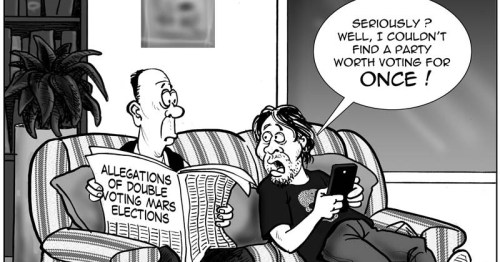
It comes just days after it emerged around 1,000 voters had been sent two ballot papers meaning they would be able to vote twice, raising doubts over the legitimacy of the election process.
Voting chaos
i has been told CCHQ staff have been forced to set up an Appeals Committee, which is holding meetings twice daily and working weekends, in a bid to work through the backlog of complaints.
According to John Hutchinson, a Tory member from Colchester who has not received a ballot paper, officials are struggling to manage having received 20,000 unique calls from members complaining about the handling of the leadership contest in just three weeks.
Mr Hutchinson, 75, who worked in the financial services before retiring, said he was told members’ details were lost after the party headquarters centralised their membership database.
“As a member I am pretty pissed off. Not only have we been told we will not receive a ballot paper, there is also the issue of the party losing members’ details, which is a major breach of new GDPR rules,” he said.
“It makes the legitimacy of the ballot very dodgy. How many more members have not got their ballot paper if the database is in such a mess?”
He was told there were more than 100 complaints from members who had not received ballot papers ahead of his own. It is unclear how many members have not received their voting slips.
Mr Hutchinson said he had written to the Information Commissioner about the handling of his and his wife’s personal details.
Another member said party officials were referring to today as the “date of high concern” as it is the latest that ballot papers could arrive in time for members to vote.
Senior party officials had expected around 60 per cent of voters to have sent back their ballot papers by Monday, but one Tory MP told i the number is much lower, suggesting members are holding back on voting.
‘You have to wonder what takes so long’
Kevin Edger, 31, was forced to contact his local constituency office in Bridgend and the Tory party HQ after his ballot paper failed to arrive.
He said he was told by party officials that 11 July is the “absolute cut-off for when it should be with me”.
The party said this date was several days after when it “should” have arrived and after this it would be a matter of “high concern”.
“You do have to wonder what takes so long,” he said. “I am going away soon so I need that ballot.”
Dillon Brown, 24, a student from Wakefield, was looking forward to voting for Boris Johnson to be the next leader but, without his ballot paper, he will be unable to do so.
“I am tempted to say this ballot could have been organised better,” he said. “It would be really quite concerning if they [ballot papers] aren’t getting out to everybody.”
Alison Morton, a 67-year-old author who lives in a village near Thouars, western France, said she is concerned the French postal system could be partly to blame for her lack of voting card.
“I’ve commented on Conservatives Abroad Facebook page and emailed the chair and the membership department,” she said. “I expect they are all very busy, but I want to make sure I participate.”
Some former members have received ballot papers despite cancelling their subscription to the party before the leadership race began.
Tory MP David Morris, who is a Jeremy Hunt supporter, told i: “There seems to be a glitch in the system at CCHQ. We have already seen some members being sent ballot papers twice, but I don’t think it’s a conspiracy.”
It follows news revealed by i in May that CCHQ is struggling to pay its rent with the party’s chief executive Sir Mick Davis bankrolling day to day operations after donors fled due to Theresa May’s handling of Brexit.
Ballot papers were sent to around 160,000 Conservative Party members around the UK to choose between Mr Johnson and Mr Hunt as their next leader as well as the country’s next prime minister.
Voting closes on 22 July, with the result announced the following day.
CCHQ has been contacted for comment.”
Tory leadership chaos as party members may not be able to vote for their next leader
Swire was Raab’s campaign manager – Raab was knocked out of the race.
Parish backed old coke-snorter Gove, who is also out of the race.
So who will they back now?
Both started off as Remainers and switched to Brexit (they can change their minds, we can’t).
Johnson and Swire are both Old Etonians, so that looks a pretty likely match.
Parish left school at 16 to work on the family farm so Bojo AND Hunt, who have no interest in agriculture, will patronise him, if they notice him at all.
Neither of them says anything (much at all) on their websites.
Probably still trying to extricate themselves from the tangled voting webs.
Leader Ben Ingham is on record as saying of his choice of Tory Stuart Hughes as Chairman of the council:
“The Tories are not in our Cabinet whatsoever. They hold the Chair because we felt we needed an experienced Chair to make sure Full Council is run properly. This is a civic appointment only.”
Apparently, there wasn’t a suitable independent (of either faction), including those who have already served for 4+ years in previous councils, that he felt would be able to take on the role of representing the council and chairing some of its meetings. So, it seems like a Catch 22 – you can’t get get the role if you don’t have experience – and you can’t get experience because it needs someone who already has experience, not even watching someone in the role for years and learning from it, so it seems the role might remain Tory forever!
But it ISN’T a purely ceremonial role – the Chairman of the Council also chairs the Standards Committee – the one that taps the wrists of naughty councillors.
Surely that isn’t a “ceremonial role”?
Or maybe now it is!
 East Devon Watch