“Ministers urged to provide rescue package for ailing high streets”

“The government should consider taxing online sales, deliveries or packaging and cutting property taxes for retailers as part of a package to help revive the UK’s ailing high streets, according to an influential group of MPs.

In a report published on Thursday, the housing communities and local government committee says local authorities need more help, including extra cash, to redevelop town centres. It also suggests an overhaul of planning regulations, including scrapping rules that allow developers to turn offices into flats without special permission.

Clive Betts MP, the chair of the committee, said it was likely that “the heyday of the high street primarily as a retail hub is at an end”. However, he added: “This need not be its death knell. Local authorities must get to grips with the fact that their town centres need to change; they need to innovate, setting out a long-term strategy for renewal, reconfiguring the town centre and finding new ways of using buildings and encouraging new independent retailers.”

Betts said dated planning policies and unfair business rates, which are a tax based on the value of property occupied by a business, were “stacking the odds against businesses with a high street presence and this must end”. …”

https://www.theguardian.com/business/2019/feb/21/ministers-urged-to-provide-rescue-package-for-ailing-high-streets

Flybe rejects second bid as too late

“Troubled Exeter-based regional airline Flybe has snubbed a rival rescue proposal from investors including US airline Mesa Air Group and backed by former Stobart boss Andrew Tinkler.

Shares in Flybe more than doubled to 2.9p as it confirmed the “highly conditional” approach from a consortium including Mesa Airlines of Arizona and South African hedge fund Bateleur Capital.

But Flybe said it “does not believe that the indicative proposal is executable in the timeframe required to enable Flybe to continue to trade”.

It added it continues to back the existing takeover by the Connect Airways consortium – which consists of Sir Richard Branson’s Virgin Atlantic, Stobart Group and investment firm Cyrus Capital – as the “only viable option available to the company which provides the security that the business needs to continue to trade successfully”.

https://www.bbc.co.uk/news/live/uk-england-devon-47226619

“Flybe or Flybmi? Airline reassures passengers after rival goes into administration”

“… Flybe has now spoken out to reassure users that it bears no relation to Flybmi.

A post on Twitter said: “We are very sorry to hear about the situation with the competing British regional airline Flybmi and our thoughts are with their employees during these difficult times.

“Flybe has nothing to do with Flybmi and our flights continue to operate as normal.”

But while flights may be unaffected, the airline is currently mid way through a takeover that could affect passengers later this Spring.

The company is currently being bought out by the firm behind Virgin Atlantic in a £2.2 million takeover.

It comes after the carrier put itself up for sale in November, placing 2,300 jobs at risk, just weeks after issuing a profit warning.

Speaking on what this means for customers, a Flybe spokeswoman told Mirror Money no changes to schedules are expected.

“There will also be no changes to bookings from its website, while existing flights won’t be affected by the announcement,” a comment added.

On twitter, the Exeter-based airline said: “Flights will continue to operate as per our published schedule and you can continue to book flights with us at Flybe.com “.

And speaking about flights over the summer holidays, it said: “Flybe with its consortium including Virgin Atlantic & Stobart Group would like to reassure passengers that there will be no major change to our published schedules to the end of Summer 2019 (i.e. end of Oct 19).”

Flybe, whose roots date back to 1979, has 78 planes operating from smaller airports such as London City, Southampton, Cardiff, Aberdeen and Norwich to destinations in the UK and Europe.

It serves about eight million passengers a year, but has been struggling to recover from a costly IT overhaul and has been trying to reduce costs. …”

https://www.mirror.co.uk/money/flybe-flybmi-airline-reassures-passengers-14014234

” FlyBMI [ NOT Flybe] collapses, blaming Brexit uncertainty

“The airline has faced several difficulties, including recent spikes in fuel and carbon costs, the latter arising from the EU’s recent decision to exclude UK airlines from full participation in the Emissions Trading Scheme. These issues have undermined efforts to move the airline into profit.

“Current trading and future prospects have also been seriously affected by the uncertainty created by the Brexit process, which has led to our inability to secure valuable flying contracts in Europe and lack of confidence around BMI’s ability to continue flying between destinations in Europe.

“Additionally, our situation mirrors wider difficulties in the regional airline industry which have been well documented.”

The company operates scheduled passenger services to 24 destinations, including Brussels, Leeds, Munich and Bristol using its fleet of 17 Embraer jets.

Passengers about to board a flight to Munich from Bristol were told their flight had been cancelled after they had checked in and the company’s planes that were in Brussels were called back.

Aircrew were told not to come to work and those due to be abroad for the weekend were flown back.”

https://www.theguardian.com/business/2019/feb/16/flybmi-collapses-blaming-brexit-uncertainty

“Flybe will wind up company if shareholders reject sale”

“Flybe has warned shareholders it will wind up the company if they do not back a sale to a consortium led by Virgin Atlantic and Stobart Air.

The airline said failure to approve a sale would mean investors were unlikely to get anything for their shares.
The airline’s board agreed the £2.2m sale to Connect Airways group last month, but the deal needs investor approval at a meeting on 4 March.

Flybe acknowledged the offer of 1 penny per share was “disappointingly low”.

However, it said it was the only rescue plan on the table.
In a statement on Thursday, Flybe said: “If the [sale] scheme is not approved, the Flybe directors intend to take steps to wind-up the company and shareholders are likely to receive no value for their shares in Flybe.”

Based in Exeter, Flybe carries about eight million passengers a year from airports such as Southampton, Cardiff and Aberdeen, to the UK and Europe.

It put itself up for sale last November, following a profits warning the previous month. …”

https://www.bbc.co.uk/news/47165902

Fight for Flybe

“Former Stobart chief executive Andrew Tinkler has made a capital injection offer for ailing airline Flybe as it prepares to complete a proposed sale to a group led by Virgin Atlantic.

The Flybe board today confirmed it had received a “very preliminary, short and highly conditional outline contingency proposal” from Tinkler, who was fired from the Stobart board last summer amid a row with incumbent chairman Ian Ferguson.

Flybe said the proposal “envisages a capital injection and replacement of the funding provided by Connect Airways”, the Virgin-led group which offered to provide a £20m liquidity injection to keep the carrier afloat last month/ It will also make up to £80m available in further funding.

Flybe said Connect Airways had provided the first £15m of the £20m credit facility it announced in January.

“Flybe confirms that its advisers have held an initial discussion with Mr Tinkler’s advisers in relation to the preliminary proposal and that no formal proposal was made,” it said. “For the avoidance of doubt, the preliminary proposal does not contemplate an offer for the whole of Flybe or any other acquisition structure.”

Flybe said the capital injection proposed by Tinkler would only be provided if the the airline’s sale to Connect Airways did not go through. …”

http://www.cityam.com/272618/former-stobart-boss-andrew-tinkler-makes-capital-injection

“Flybe pensioners risk losing all if Virgin takeover bid fails”

“Flybe pensioners could face financial ruin if a rescue takeover led by Virgin Atlantic falls through, after it emerged that the airline’s retirement fund is 
not protected by Britain’s pension 
lifeboat.

Some £170m of benefits owed to 1,350 members of the British Regional Airlines Group pension scheme may be wiped out if the Exeter-based airline failed because Flybe’s pension fund is registered in the Isle of Man, rather than the UK.

This means scheme members are not entitled to payments from the 
Pension Protection Fund (PPF) in the event of an insolvency. Flybe had a £11.6m pension shortfall in November 2018. …”

https://www.telegraph.co.uk/business/2019/02/02/flybe-pensioners-risk-losing-virgin-takeover-bid-fails/

Are the wheels falling off the East Devon growth wagon?

This is necessarily a somewhat technical summary of why Owl thinks EDDC has got its recent past and future jobs and housing numbers terribly wrong, and attempts to pinpoint why this is. If the assumptions below are correct East Devon cannot hope to match new jobs to housing number increases and hence to aspirational growth figures.

It has huge implications for the district – not least Cranbrook and Axminster, where huge housing growth does not appear to correlate with very modest job growth.

CURRENT STATISTICAL TREND 258 JOBS/YEAR
EDDC’s 2015 aspiration 950 jobs/year
EDDC’s “Jobs-led policy on scenario” 549 jobs/year
Ash Futures (Experian) “Upper end” 309 jobs/year
Ash Futures “more likely” scenario 200-234 jobs/year

Evidence from the first set of job growth statistics published by EDDC since the adoption of the local Plan are running at less than half the number used to justify the housing development target. This is only one quarter of EDDC’s aspiration to create one job per new household or 950/year.

A “Jobs-led Policy On” aggressive growth strategy lies at the heart of EDDC’s Local Plan for 2013 to 2031.

Consultants were employed to create a number of scenarios forecasting growth in jobs. They ranged from 162-191 jobs/year for forecasts based on past trends to a top estimate for above average “jobs led” growth of 309 jobs/year. This top estimate would justify a housing target of 13,050 for the period.

One of these consultants, Ash Futures, gave cogent arguments as to why this figure, in their opinion, lay at the upper end of likely growth and proposed a more modest, more realistic, set of growth assumptions generating 200-234 jobs/year. This more likely scenario was never converted from a jobs forecast to a housing assessment but it would have been just a bit higher than the 10,512 figure based on past trends. All these forecasts took account of demographic changes, migration into the region and economic growth.

Ignoring this, EDDC decided to add a further 240 jobs/year to the upper end 309 figure in a new “policy on” scenario to provide a total forecast of 549 jobs/year. (Something to do with Cranbrook but the details of this and whether there is any double counting remains a mystery). This 549 job/year figure was ultimately used to justify the final 17,100 minimum housing target for the 18 year period of the Plan adopted in 2016.

The plan requires a minimum average build of 950 houses/year. EDDC’s aspiration is to combine this with the creation of one job for every house built. But this demonstrates a complete failure to understand demographics and household formation. The need for houses and the need for jobs is not a simple equation of one with the other.

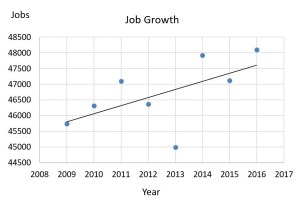
Papers attached to EDDC’s Strategic Planning Committee for 29 January 2019 (see footnote) contain data for East Devon employment covering 2009 to 2016. The explanatory text says: “It is recognised that it is an aspiration of Members [surely not every Councillor?] to deliver one job for each new home across the district but since the adopted Local Plan does not set out to deliver this it is not considered appropriate to formally monitor the relationship between the delivery of homes and the delivery of jobs.”

Here’s why – the real evidence, from the data, is of jobs growing at an annual rate of only 258 jobs/year.

This figure confirms the more modest forecasts presented by Ash Futures and, inconveniently for EDDC, is less than half of that used to justify the “Jobs-led Policy On” housing targets. It is only a quarter of the one job per house aspiration of “Members”.

Where does the 258 job/year trend come from? It is the gradient of the best fit linear regression trend line to the data given the Strategic Planning Committee and shown in the graph below. The full data source is referenced in the footnote.

This is a relatively small sample; and the extent of the fluctuations in the recorded number of jobs from year to year can be seen in the graph. For the technically minded the correlation coefficient of the trend line is 0.6, which is quite a strong one.

All the job number quoted above are for “full time equivalent” jobs (FTE).

Owl has been fortunate to find from the same official source as used by EDDC a set of estimates of the total number of jobs in East Devon which extends the time series to 2017. The significance of this is that the total number of jobs in East Devon fell between 2016 and 2017 and so we can expect the same to happen with FTEs. As a result Owl feels even more confident that the trend line shown above, despite the sample size, reflects what is actually happening.

The Local Plan has been in preparation since 2002 and EDDC has been following a growth policy for many years. So, although 2013 marks the formal start of the Local Plan, there is no statistical evidence to consider 2013 a “turning point” for job growth, though it does look to be an outlier.

With EDDC’s plan to build houses running ahead of creating the jobs needed for a sustainable community, just who are we building all these houses for?

Isn’t it time to cool the building programme, not ramp it up as Owl fears is being planned in the Greater Exeter Strategic Plan?

One of the key architects to all this is Councillor Paul Diviani. When asked at a recent council meeting why East Devon is taking all this development replied: “Because we have got the land, and we are good at it”.

Footnote: The combined minutes, agenda and reports of the Strategic Planning Committee with the job data for 2009 to 2016 on page 116 can be found here:

Click to access 290119strategicplanningcombinedagenda_opt.pdf

Enterprise Zone “gazelle” companies (some in Devon) have unintended consequences

“Britain’s fastest-growing businesses could be contributing to job losses, according to research that claims the government’s policy of backing entrepreneurial companies “may be fundamentally at odds” with tackling regional inequalities.

A study of the performance of more than six million companies over a period of 17 years found that high-growth businesses had a “spillover” effect that could damage local employers.

Fast-growing companies, sometimes dubbed “gazelles”, have been identified in recent years as a way of boosting job creation and improving the nation’s productivity. Despite accounting for less than 5 per cent of businesses, these companies create about half of all new jobs and typically show higher levels of productivity.

However, the study, conducted by the Enterprise Research Centre, found that companies with the fastest employment growth — 20 per cent growth every 12 months for three consecutive years — tended to grow by “hoovering up” jobs from slower- growing businesses in the same region, in what the researchers called a “crowding-out competition effect”.

A 1 per cent rise in the incidence of high-growth businesses in a region was found to actually slightly cut employment, by 0.35 per cent on average — equivalent to a net loss of about 122,000 jobs UK-wide over the period studied, 1997-2013. The worst affected regions included the Scottish Highlands, Cheshire, the North East, Lincolnshire and Devon. In contrast, many urban areas in the South East and Midlands saw a net jobs gain.

Negative effects were most pronounced in the manufacturing sector and rural parts of the UK, where competition for skilled workers was most intense, the researchers said.

The fastest growing companies often attract the most skilled workers in a region where such staff are scarce, leaving slower-growing rivals struggling to attract employees and having to pay more to keep existing team members. As a result they hire fewer people and could be forced into job cuts.

Mike Harding, director of Inspira Digital, said that his ecommerce agency based in Barnstaple, Devon, competes with a London-based agency with a satellite office in north Devon. “If you have someone offering London wages here, that is a black hole that sucks up the local talent,” he said.

The issue can be exacerbated by large companies being offered tax breaks to open an office in Devon in the name of local development, Mr Harding said.

Professor Jun Du of Aston University, one of the authors of the research, said that “while encouraging clusters of fast-growth firms can bring productivity benefits to whole supply chains, some regions and industries with acute skills shortages could see unintended consequences”.

Source: The Times (pay wall)

Flybe biggest shareholder threatens legal challenge to Virgin/Stobart takeover

Owl says: East Devon really does seem to be a very complicated place to do business!

“Flybe’s biggest shareholder has launched a stunning attack on its directors, accusing them of breaching their duties to investors and threatening a legal challenge to the cut-price takeover of one of Britain’s best-known airlines.

Sky News has learnt that Hosking Partners, a prominent London-based asset manager which holds a stake of close to 19% in Flybe, has instructed lawyers to explore its options in relation to the company’s proposed sale to a consortium‎ led by Virgin Atlantic Airways.

These options could include attempting to obtain an injunction prohibiting the deal from being completed, Hosking Partners is understood to have warned Flybe’s bosses this week.

The initial 1p-a-share deal, announced eight days ago, came at a huge discount to the airline’s prevailing share price and underscored its industry’s profound financial challenges.

In a letter to the directors of Flybe, details of which have been relayed to Sky News, Hosking Partners is understood to have expressed concern that they had allowed a false market in the company’s shares to develop by failing to update the City on its financial position in a timely fashion.

‎The fund manager, a long-standing shareholder in Flybe, is understood to have copied its ‎letter to City watchdogs including the Takeover Panel, which polices mergers and ‎acquisitions activity, and the Financial Conduct Authority.

Hosking Partners is said to have raised doubts as to whether the £2.2m offer reflected the intrinsic value of Flybe, and alleged that the handling of its proposed sale had blocked a rival offer from emerging at a higher price.

Flybe’s fate took a further twist this week when it said that its sale to Connect Airways – a consortium comprising Virgin Atlantic, Stobart Group and Cyrus Capital Partners,‎ an investment fund with links to the other two parties – would be restructured.

‎Instead of simply comprising a conventional offer for the shares, Flybe’s trading assets would be sold next month to Connect Airways for £2.8m, leaving the holding company as‎ a shell for which ‎the consortium would continue to pay a nominal sum.

Flybe said this change had been necessitated by its urgent need for liquidity – a claim challenged by Hosking Partners because of the company’s cash balance and ability to raise funds from the sale of assets such as its take-off and landing slots at London Gatwick Airport.

In a statement to the market on Tuesday, Flybe said it had had no alternative but to agree to the revisions because unspecified conditions attached to a bridging loan had not been met.

Hosking and other shareholders are said to be furious about the restructuring of the takeover because Flybe’s recent switch from a premium to a standard listing on the London market meant investor approval was now only required for the holding company bid, not the sale of the airline’s assets.

The fund manager is understood to have told Flybe directors that other parties remained interested in acquiring the airline but would now be unable to make an offer.

At the 1p-a-share offer price, Hosking Partners’ stake is worth roughly £400,000.

If it escalates, the row could pose significant reputational risks to the board of Flybe, which is chaired by Simon Laffin, a City grandee who has served as a director of companies including Mitchells & Butlers, Northern Rock and Safeway.

Investors’ anger has been exacerbated by the fact that early last year, Stobart made a takeover approach to Flybe understood to have been valued at roughly 40p-a-share.

This was rejected by Flybe’s board.

In a further development, Sky News revealed last week that Stobart’s estranged former chief executive, Andrew Tinkler, had himself swooped to snap up a stake of more than 10%‎ in Flybe.

Until as recently as this month, it appeared that Virgin Atlantic and Stobart were ‎likely to table competing offers for the regional airline, before it emerged that they had teamed up as part of the same consortium.

Hosking is understood to have raised concerns in its letter about the process through which they were permitted to form an alliance, although one source close to Flybe said that it had not breached any undertakings by doing so.

The investor is also said to have highlighted the rise in Stobart Group’s share price following confirmation of the 1p-a-share bid as evidence of “value transfer” from Flybe to one of its acquirers, according to a City source.

Under their plans, Stobart Air will be folded‎ into Connect, with all of Flybe’s services re-branded under the Virgin Atlantic name.

The chief executive and chief financial officer of Flybe will transfer to the bidding consortium, according to documents published by the company.

Hosking Partners’ letter is said to enquire about any incentive payments due to either of the duo as a result of the consortium’s takeover.

In a statement, a Flybe spokesman said: “The board of Flybe was faced with a very tough decision based on Flybe’s current difficult liquidity position and the expectation that this pressure will continue.

“Obtaining the revised facility, as announced on 15 January, from the consortium provides the security that the business needs to continue to trade, which preserves the interests of its stakeholders, customers, employees, partners and pension members.

“Flybe will be responding directly to letters received from shareholders.”

Flybe launched a formal sale process last autumn, blaming a toxic cocktail of currency volatility, rising fuel costs and Brexit-related uncertainty.

Although it is small in financial terms, it remains one of the UK’s best-known airline brands, carrying thousands of passengers between largely second-tier British airports as well as European destinations.

A source close to the company pointed out that it had warned in the results accompanying the launch of its sale process that if its credit card partners “were to choose to seek significantly higher cash collateral and the group cannot access sufficient additional liquidity, this would give rise to a material uncertainty which may cast significant doubt about the group’s ability to continue as a going concern”.

The Takeover Panel declined to comment, although a source close to it said it was confident its supervision of the bid had been handled in accordance with its policy of acting in investors’ interests.

For Virgin Atlantic, still part-owned by Sir Richard Branson’s Virgin Group, control of Flybe’s regional network will provide a valuable feed into its long-haul flights to international destinations.

Its return to the domestic UK aviation market will come four years after it announced the closure of Little Red, its previous attempt to make money from a notoriously difficult sector.

Rising oil prices and the weakening of sterling have put airlines under intense pressure, with a deepening industry price war accentuating the financial squeeze.

A Hosking Partners spokesman declined to comment on the contents of its letter, but said this weekend that investors were “entitled to transparency over precisely what has gone on to drastically reduce Flybe’s value”.

“The auction undertaken under the formal sale process has clearly not yielded a favourable outcome for all stakeholders, and it seems that the outcome has locked out any other bidder who may be able to provide a better solution for all of Flybe’s stakeholder‎s.”

https://news.sky.com/story/top-flybe-shareholder-threatens-legal-challenge-over-2m-bid-11611470

“Flybe rescued by Virgin and Stobart”

Wonder where its profits will end up?

“Shareholders in Flybe will receive 1p a share, while the consortium, which also includes venture capital firm Cyrus, will inject £100m.
It will operate under the Virgin Atlantic brand.”

https://www.bbc.co.uk/news/business-46834827

Business rates killing high street shops

“Leading retailers called for a major overhaul of business rates yesterday after Next suffered a sharp slump in store sales in the run up to Christmas.

With pressure mounting on ministers to reform the outdated tax, fashion chain Next said sales in its 500-plus stores fell 9.2 per cent over the crucial festive period.

In a clear sign of how shopping habits have shifted, the company said online sales soared 15.2 per cent in the same period, meaning overall revenues were up. …”

https://www.dailymail.co.uk/news/article-6556311/Retailers-demand-major-overhaul-business-rates-Christmas-sales-slump-9-2-cent.html

Branson for Flybe?

“Virgin Atlantic Airways is in talks to acquire regional airline Flybe Group Plc (FLYB.L), Sky News reported on Thursday, a week after Flybe said it was in talks to sell itself.

A tie-up with Flybe would provide opportunities to feed passenger traffic into Virgin Atlantic’s long-haul network and access valuable take-off and landing slots at London Heathrow Airport, Sky News reported, citing unnamed sources.

Virgin Atlantic’s main business is UK-to-U.S. flights. The company is owned by Richard Branson’s Virgin Group and U.S. airline Delta Air Lines.

The report did not mention any financial details. Flybe has a market capitalization of about 21 million pounds, according to Refinitiv Eikon data.

Flybe and Virgin Atlantic declined to comment.

Flybe issued a profit warning in October citing weakening demand, higher fuel costs and a weaker British pound.

Sky News had previously reported that Stobart Group Ltd (STOB.L) was likely to be one of the potential suitors for Flybe.”

https://uk.reuters.com/article/uk-flybe-group-m-a-virgin-atlantic/virgin-atlantic-in-talks-to-buy-flybe-sky-news-idUKKCN1NR27Y

“Flybe calls in crisis experts as insolvency fears mount”

“Flybe has called in accountants from KPMG as the low-cost airline attempts to save itself from collapse.

Britain’s biggest regional airline sounded the alarm yesterday by putting itself up for sale. The announcement came as half-year profits plunged and the company’s auditor, PwC, warned of “significant doubt” over its future.

KPMG has been appointed to provide Flybe with advice on its cash flow. City sources said the Monarch Airlines administrator is the frontrunner to take on a potential insolvency. …”

https://www.telegraph.co.uk/business/2018/11/14/flybe-puts-sale-profits-plunge/

Flybe puts itself up for sale

The airline employs around 1,000 people at Exeter airport and the Exeter and East Devon Growth Point relies heavily on the company’s HQ being in East Devon.

Here is the latest report of Exeter airport’s consultative committee in September 2018 was notable for unusually having no Flybe representative attending:

Click to access 1808_Consultative.pdf

“One of Exeter’s most important employers, Flybe, has put itself up for sale – partly because it’s been hit hard by Brexit-related uncertainty and currency fluctuations.

The move was announced to the stock market this morning.

Flybe, which employs around a thousand staff at its Devon HQ, was linked with Stobart earlier this year but no deal resulted.

The airline’s share price and profitability have struggled for years.”

https://www.bbc.co.uk/news/live/uk-england-devon-46102129

“Flybe ‘up for sale’ weeks after profit warning”

“Flybe is reported to have put itself up for sale less than a month after issuing a dramatic profit warning.

The regional airline is expected to say on Wednesday that its board is exploring a sale or a merger with a rival, according to Sky News.
Last month, the airline warned full-year losses would reach £22m due to a combination of falling consumer demand, a weaker pound and higher fuel costs.

The airline’s shares have fallen by almost 75% since September.

The Exeter-based airline is now valued at around £25m, far below the £215m it was valued at when it floated on the stock exchange in 2010.

Stobart Group – which pulled out of a bid to buy Flybe earlier this year after the airline rejected its offer – could be a possible purchaser, according to Sky.

Flybe, whose roots date back to 1979, has 78 planes operating from smaller airports such as London City, Southampton and Norwich to destinations in the UK and Europe.

It serves around eight million passengers a year, but has been struggling to recover from a costly IT overhaul and has been trying to reduce costs.
Last month, Flybe’s chief executive Christine Ourmieres-Widener said it was reviewing “further capacity and cost-saving measures”.

“Stronger cost discipline is starting to have a positive impact across the business, but we aim to do more in the coming months, particularly against the headwinds of currency and fuel costs,” she said at the time.

The airline is due to issue its interim results on Wednesday. The company declined to comment on the sale reports.”

https://www.bbc.co.uk/news/business-46203183

UK fish quotas and the Carters of Greendale … anyone remember this

Wonder what the situation is now?

“In a small marina in Exmouth sits the Nina May. The 4.8m fibreglass boat is not much to look at, with just a small outboard motor it pales against the luxurious sailing boats that crowd the harbour.

The boat is something of a legend amongst fishermen in the south west. Many have heard about this mysterious, tiny vessel but few have ever seen it sail.

That is because the Nina May has a secret. The tiny boat holds a massive amount of FQA, the unit used to dole out the right to fish in the UK.

In fact the boat holds nearly a fifth of all fishing rights for the South West of England, and has much more quota than all but one of the much larger fishing boats in the area.

But those figures seem to defy logic. According to government records, that amount of FQA equates to around 1,500 tonnes of fish a year. That means the tiny boat would need to fish an average of four tonnes of fish a day!

Greenpeace spoke to Robin Carter, who runs F W S Carter Limited, the fishing company that owns the boat along with 12 other, much larger vessels.

Carter explained that he transferred the FQA licenses onto the tiny boat and then sends out his bigger boats to write off their catches against that allowance.

By doing that Carter’s fishermen can essentially fish without risking being penalised on quota should they be caught breaking the rules.

“Why it’s on the Nina May is that if you get an offence, a log book offence, or some silly little offence, the ministry would freeze your licence. You wouldn’t be allowed to sell your licence or sell your quota on it.

“We took the precaution – because we got caught once – of taking the fish off all the boats and just putting it one the one boat.

“It’s on there for no other reason than that licence will never get frozen because it just goes in and out of the river and hopefully never commits an offence.”

Local news reports from 2011 state that a Robin Carter was charged £4,040 in fines and costs after pleading guilty to setting an illegal net off the coast near Sidmouth.

The chairman of the magistrates court which ruled on the case said that Robin Carter was an ‘experienced fisherman’ and described his actions as ‘deliberate and reckless.’

The company made an operating profit of £2,628,000 last year.

“We fish about 90% of the quota we have and lease the rest. We use the Marine Management Organisations set rates or the landing price to guide us, but markets prices move. It’s all about supply and demand. Quota is a currency you can swap,” Carter added.

The Marine Management Organisation, the government body that oversees fishing allocation, told Unearthed there are no regulatory restrictions on the number of FQA units that can be held on a single licence.

It said it has significantly improved the transparency of FQAs making data available through the FQA register which also enables FQA holders to transfer their FQA units electronically subject to Quota Management Rules.

Griffin Carpenter from the New Economics Foundation researches the economics of European quota systems. He says this type of hoarding goes against the spirit of the system.

“FQAs were intended to correspond to the actual fishing activity of vessels, but the case of the Nina May highlights just how far we’ve moved from matching quota with fishing activity. This practice may not be illegal, but it’s also not fulfilling any objective of the quota system, especially as many vessels are desperately trying to get access more quota and the government is trying to ensure that all existing quota is used,” said Carpenter.

Carter does not think there is anything wrong with holding so much fishing rights on a tiny dinghy.

“It’s an asset we’ve invested in for the last 20 years,” he explains. “Others sold themselves out of the industry- some people sold it off to foreign nationals- or sold it to us. We saw this system coming and that’s why we invested in quota.”

Investigation: Why this tiny boat has more fishing rights than many trawlers

Flybe not flying high

“Flybe is predicting it will make a loss of £12m this year.

The airline – which operates from Exeter, Guernsey and Jersey in the south west – made a £9.4m loss in the year ending 31 March 2018, and a £55.3m loss the year before.

The 2019 loss is based on predicted revenue which the board has “limited” visibility of so far.

The airline blamed “weakening” consumer demand, “higher fuel prices” and “weaker sterling”

The adverse effect of fuel prices and currency fluctuations was estimated by the company to be £29m.

https://www.bbc.co.uk/news/live/uk-england-devon-45837865

Very stupid Tory Minister says councils are not getting cuts just more flexible ways to earn income!!”

Owl says: As John Crace (Guardian) puts it – top Tories these days seem to be fighting over their only brain cell!

“Treasury minister Liz Truss has been branded “innumerate or inept” after falsely claiming that local councils are not facing cuts.

Philip Hammond’s deputy insisted the government was simply giving town halls more “flexibility” to raise money themselves, rather than slashing their funds.

“We are not making cuts to local authorities,” Ms Truss told BBC Newsnight.

In fact, the Local Government Association highlighted this week that funding will be reduced by 36 per cent next year, the largest annual deduction in almost a decade.

And the organisation’s Conservative leader has warned that more councils will go bust unless ministers “address the funding crisis”.

Andrew Gwynne, Labour’s local government spokesman, condemned Ms Truss’s comments, saying: “This shows she’s either totally innumerate or completely inept.

“Councils of all political persuasions are edging towards the financial cliff edge, and it’s a Tory Council, Northamptonshire, that’s the first to go bump on their watch, with others not far behind. …”

https://www.independent.co.uk/news/uk/politics/liz-truss-local-council-cuts-budget-treasury-minister-newsnight-conservative-conference-tory-party-a8566111.html

“Poorest to be worst hit by a cashless society, warns Which?”

Lyme Regis hit the headlines last week when it became yet another bank-less town. In East Devon we already have Ottery St Mary and Budleigh Salterton without banks, with surely others to follow.

“Lower-income households and older generations will be hardest hit by bank branch and ATM closures that threaten their vital access to cash, as these groups use cash more frequently than average, new research from Which? reveals.

More than three quarters (78%) of consumers in the two lowest income households groups rely on cash, using it at least two or three times a week. This group are less likely than average to use a credit or debit card – in fact, just over a quarter (26%) never use card payments.

Cash usage is high among over-65s – the group perhaps most at risk of social exclusion when bank branches and ATMs disappear – with four in five (80%) reliant on cash, using it at least two to three times a week.

The findings come amid concerns that consumers’ access to cash is under threat, due to a severe reduction in bank branches on Britain’s high streets and changes to the funding model of ATMs that is seeing 250 disappear every month.”

https://www.which.co.uk/news/2018/10/poorest-to-be-worst-hit-by-a-cashless-society-warns-which/ – Which?