Why are some new-build houses so cold? Corner cutting

“Newly built homes are more energy efficient than ever, the government said this week. But thousands of buyers are finding that their expensive new homes are cold and draughty with heating bills far higher than expected. The culprit? The finger of blame is pointing towards builders rushing to meet targets, lax standards and poor inspection, with badly installed dry lining at the heart of the issue.

Dry lining became popular in the UK in the 1980s, replacing traditional “wet” plastering with ready made plasterboard attached to walls and ceilings. It means plastering can be done in a couple of days rather than weeks.

There is nothing intrinsically wrong with dry lining, which is used commonly in Scandinavia and North America, where winter temperatures drop far below those of Britain. It gives a smooth finish and can be decorated straight away.

But what thermal imaging surveyors and other building experts are discovering is that widespread poor installation of plasterboard has resulted in the airtightness suffering badly.

Housebuilders rush to meet targets (their own and the government’s), often cutting corners, and airtightness suffers as a result. The plasterboard is attached to masonry with adhesive. But Paul Buckingham, a thermal imaging surveyor, says housebuilders often cut costs using “dot and dab” adhesive, rather than solid dabbing.

Thermal imaging often finds air pockets behind plasterboard walls, causing cold spots and reduced thermal efficiency.

“We don’t see any of this airflow in old houses,” he says. “In those built in the 60s and 70s, with concrete floors, the airtightness is pretty good.” (However, they may leak air elsewhere – through open trickle ventilators or fireplaces.)

Going even further back, case studies undertaken in 2011 by energy consultant Diane Hubbard found that most of the houses built before 1900 were more airtight than expected, and in some cases better than required by the 2006 building regulations, and “modern extensions may not be as airtight as the original building”. ….”

https://www.theguardian.com/money/2019/feb/02/new-build-homes-why-some-owners-are-left-feeling-the-cold

Strategic Planning pitfalls? Certainly for Axminster

A reporter … reports:

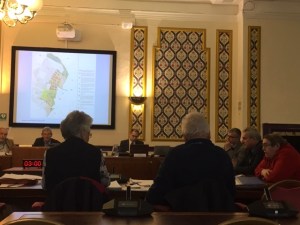
“At Tuesday’s Strategic Planning Meeting at Knowle (29 /01/2019), chaired by Paul Diviani, the masterplan for increasing Housing in Axminster by a whopping 30% , was voted through almost unanimously (there was one abstention), despite serious cross-Party criticism of the plan.

As the debate ended, the considerable number of Axminster residents in the public gallery were astonished to hear the Chair’s quip, to Cllr Jill Elson, “ I felt confident that you would come out with something that would stir things up”.

Cllr Elson (shown on right of the photo, beside Cllr Philip Skinner), had argued firmly that “the problem with plans is that they change” , citing her Ward as an example.

“Exmouth ended up with two huge estates with no play space or amenities whatsoever”, she said. Cllr Mike Howe (Con) shared her concerns, saying, (the masterplan) “doesn’t give us much credence or security that we will get the right houses”. But the Deputy Leader of the Council, Philip Skinner (Con ), expressed his view that “Give and take is needed in negotiations with a developer”.

Shortly afterwards, when Cllr Geoff Jung (East Devon Alliance, EDA) observed that the plan might not suit young families, it became apparent that Cllr Skinner was not aware that the proposal to include a primary school had been dropped.

Cllr Eleanor Rylance (Lib Dem) had noticed significant typing and other errors in the masterplan document. Cllr Rob Longhurst (Independent) observed there was no mention of the words ‘Neighbourhood Plan’ in the document.. although Cllr Moulding had told the meeting that he had designed one for Axminster… and suggested this Strategic Plan Committee would like to see “if the community wants and needs” the masterplan.

Cllr Susie Bond (Independent) asked for clarity about the legal implications for the Council if the costs for the relief road “went through the roof” (So far, EDDC has agreed to borrow £7m to ensure the road, estimated cost £16.7m, can be delivered.)

Ian Hall (Con) admitted “this masterplan doesn’t sit easily with the residents of Axminster”, which Alistair Ferguson’s speech in Public Question Time, confirms. The text is reproduced below, with Mr Ferguson’s permission):

In support of the objections, other District Councillors, Cathy Gardner and Marianne Rixson (both EDA), also attended the meeting, though not on the Strategic Planning Committee themselves.

Cllr Gardner pointed out that agreeing to a massive increase in the town’s housing numbers “would not be for the right reasons”, if it was done primarily to fund a relief road. The masterplan “was being done to the people of Axminster, not for them”, she said.

And Cllr Marianne Rixson added that “delivery of affordables does not have a good record” in East Devon.

Having listened to the comments aired, Cllr Geoff Pook (Ind) cautioned the committee not to be “persuaded by the opposition”. “There are just as many people in favour”, he opined.

Finally, the fear that the time-limited government funding for the relief road would be missed, therefore putting in jeopardy the 650 homes allocated in the Local Plan, swayed the committee members to approve the masterplan, albeit with caveats based on their misgivings.

Is this how the wrong sort of housing so often gets built in the wrong place?

In Axminster’s case, how much will the masterplan impact on the historic former deer park? As Cllr Mike Howe, Chair of the Development Management Committee (DMC) told yesterday’s meeting, there’s an urgent need to know….’

Tory councillor bemoans planning mess

Owl says: What the councillor neglects to say is that the mess he describes is entirely down to HIS own party!

“Cllr Stephanos Ioannou is a councillor in Enfield. He is studying Public Policy at King’s College London:

“Local councillors across the country will know the struggle is real in the planning system. Not only does it seem to be irresponsive to the real needs of our local communities that are in need of mixed residential, commercial, office, public buildings and green space. But we see planning applications that pose more negatives than positives being allowed to pass through for ‘the greater good, and the bigger picture’.

One surprising reason for this can be derived from the fact that awarding planning permission in the UK comes down to a Faustian pact. If the devil is in the detail, then the detail is Section 106 of the Town and Country Planning Act 1990. Specifically, a clause which formalised “planning gain”, making it in the local authorities’ interests to allow schemes to balloon beyond all reason, in the hope of raking some of the developers’ profits for the public good.

Introduced as a negotiable levy on new development, Section 106 agreements entail a financial contribution to the local authority, intended to be spent on offsetting the effects of the scheme on the local area. The impact of a hundred new homes might be mitigated by money for extra school places, or traffic calming measures. In practice, since council budgets have been reduced, Section 106 has become a primary means of funding essential public services, from social housing to public parks, health centres to highways, schools to play areas. The bigger the scheme, the fatter the bounty for both developers and authorities. Vastly inflated density and a few extra storeys on a tower can be politically justified as being in the public interest, if it means a handful of trees will be planted on the street.

My borough, Enfield, is seeing a surge in young families moving to our borough to escape the surge in housing costs elsewhere in the capital. Predominantly the reasons for the rising demand in our borough are those highlighted by an article in the Evening Standard which mention the ease of accessibility with good motorway connections, good transport links into central London, as well as a the fact that average house prices are modestly rising only 0.4% in our borough, which is something to be reckoned with compared to other parts of London.

But things start to go wrong when planning departments do not take into account, aspects of the local area that make our borough unique. Whether looking at local heritage, the mix of commercial, residential, offices, and the style of new builds, often Enfield Council is quick to bow to the demands by developers and architects for the simple reason of referring to ‘the housing shortage and the need for new homes’. This is a poor state of affairs, and I am worried that the council is moving towards the path of jeopardising local beauty and conservation for the sake of housebuilding. Particularly for a borough such as Enfield which is lucky to have the green-belt it does, this is a real problem for councillors who have to defend their communities.

The issue of planning is also one that concerns the issue of bureaucracy within the council, that sometimes leads to poor decisions and outcomes on certain issues. I remember a local constituent having issues with an application for the property behind her. The Council had, instead of looking at the issue and reopening the planning decision, moved on ‘under delegated powers’ despite major resident objections, to see this build through. This point is echoed by a piece in the Enfield Independent which mentioned that the construction caused ‘considerable cracks in the neighbouring properties of other residents’, and that despite objections being raised within the given time-frame of the regulated pre-planning decision consultation, the planning committee on the council did not even bother to respond to residents’ concerns, and even after ringing, residents could not get in touch with the department.

This goes fundamentally to the heart of what us Councillors try to do, and sometimes can’t do, that is to help our residents most when they need it. Why? Because the failures of planning departments, in this case, mean bureaucracy causes delays, which then causes miss-representation, which then lead to poorly made planning decisions that affect not only the aesthetics of the area, but the general confidence residents have in the council dealing with their concerns in future.

It also raises a bigger question, as to how many similar cases are there, where other developments have gone through without the necessary vigorous scrutiny they need? I agree that we must build for new families and promote a home-owning democracy, but if departments simply rubber stamp applications without giving the power to residents and councillors to scrutinise for the greater good, then what’s the point in even having these departments anyway. We might as well pack up and go home as Councillors, because they are making a major part of our job redundant.

Overall, we have a conundrum of problems. Firstly, local councils are disregarding the necessary mix of residential, commercial and office space for the sake of building homes to fix the housing crisis. This is further worsened by the fact developers can ‘help’ plug the funding pressure of new homes, and contribute towards the funding of some local services, and this makes it increasingly tempting for councils to bow to these demands so that they can increase provision because budgets are tight. And then there is the nitty-gritty issue of local residents who struggle to even express their concerns to local planning departments, and this does not help residents build trust in councils who clearly disregard their concerns.

Local council planning departments such as those in Enfield need a major rethink as to how they approach future planning applications. Otherwise we can expect poor decisions on planning to continue into the future, to the detriment of existing residents.”

https://www.conservativehome.com/localgovernment/2019/01/stephanos-ioannou-councils-have-financial-incentive-to-rubber-stamp-bad-development-proposals.html

“[Mortgage] Loans lasting up to 40 years can leave buyers unable to save for pension, say regulators”

“First-time buyers are taking out jumbo loans on longer terms that will leave four in 10 borrowers paying off their mortgage well into retirement, regulators have warned.

The Financial Conduct Authority (FCA) found that 40% of borrowers who took out a mortgage in 2017 will be aged over 65 when their mortgage matures – leaving them unable to save for a pension, and vulnerable to any financial shocks.

The 40% figure represents a huge change over the last five years. As recently as 2012, just 22% of mortgages were expected to run into the borrower’s retirement. But that number has nearly doubled as buyers stretch themselves to pay for escalating house prices.

Historically, buyers have taken out 25-year mortgages to pay for their home, and in 2007 the 25-year term was still the most common deal. But the FCA found that 30-year terms have now become the norm, with 34% of loans taken out in 2017 lasting 30 years or more.

Most lenders now allow mortgages of 35 years, while Halifax and Nationwide, the two biggest lenders, will offer loans with 40-year repayment terms.

Many first-time buyers are also delaying a purchase until they are in their 30s as they save to afford the deposit.

In a grim assessment of the financial health of UK households, the FCA warned that the burden of a mortgage throughout people’s working lives is likely to limit their ability to save for a pension and deal with financial shocks. …”

https://www.theguardian.com/money/2019/jan/10/four-in-10-uk-first-time-buyers-will-retire-with-mortgages-fca-warns

“England to Build Smallest Number of New Homes on Record”

“Homebuilding in England is set to drop for a fifth straight decade to the lowest number since World War II, according to the Centre for Policy Studies. That’s despite government pledges to step up construction to ease a chronic shortage that’s pushed prices out of the reach of many. Just 1.3 million new dwellings will be built in the 10 years through 2019, less than half the 3 million constructed in the 1960s. …”

https://www.bloomberg.com/news/articles/2019-01-02/england-to-build-smallest-number-of-new-homes-on-record-chart

East Devon average house price more than £50,000 higher than average

“A first-time buyer in East Devon is expected to pay an average of £220,486 to make their first step on the property ladder as part of an overall price increase of 1.6 per cent.

East Devon has seen property values increase by 3.6 per cent over the last 12 months and data from the Office of National Statistics shows the average property price in the area was £286,528. This price is over £50,000 higher than the UK average.

According to data from Rightmove, the average house price in Sidmouth was £358,370 which is a nine per cent increase since 2015.

The area has a similar average price to Ottery St Mary at £351,814 but is more expensive than Branscombe.

In the UK, house prices have increased by 3.5 per cent in 2018 and the average property owner in East Devon has seen their house value jump by £53,000 in the last five years.”

https://www.sidmouthherald.co.uk/news/east-devon-house-price-rise-1-5837746

Luxury properties snapped up by foreign buyers after pound fell

“The global super-rich have taken advantage of the Brexit-induced decline in the value of sterling to buy up three times as many £10m-plus luxury homes as before the referendum vote.

Some 300 homes sold for more than £10m each in the tax year to April 2017 (the latest for which figures are available), an increase from 100 sold during the preceding 12-month period. The figures, released by HM Revenue and Customs on Wednesday following a freedom of information request, were rounded to the nearest 10 by HMRC. …”

https://www.theguardian.com/business/2019/jan/02/uk-housing-market-is-a-goldmine-for-wealthy-foreign-buyers

“24,000 homeless families ‘sent miles from local area’ “

“The number of homeless families forced to move away from their communities is at its highest for 20 years, as councils struggle to find accommodation for the growing numbers of people in need.

According to official government figures, there were 23,640 families in temporary accommodation outside their local area in the second quarter of this year, the highest level in 20 years and more than double that recorded over the same period just five years ago.

The new data has emerged amid rising anger over homelessness, with recent research showing that deaths among homeless people in England and Wales have increased by 24% in five years. Deaths have risen every year since 2013, from 475 in 2014 to 597 last year, according to the Office for National Statistics.

Several factors are being blamed for the rise in homeless families being relocated. A freeze on benefits and a cap on payments have led to a rise in demand for temporary accommodation. Meanwhile, the stock of council-owned housing has been run down and rents are rising, making affordable private rented accommodation harder to find.

Melanie Onn, the shadow housing minister who uncovered the figures, said they revealed the “human cost of the housing crisis”.

“Eight years of Tory failure on housing means that more and more families are being forced to move away from their communities, schools and jobs,” she said. Labour blamed cuts to housing benefit and an 80% fall in the number of homes for social rent being built.

Greg Beales, director of campaigns at Shelter, said his charity had witnessed the damage caused “when homeless families are forced to uproot their lives and move miles away to temporary accommodation in another area, abandoning jobs, schools and support networks. To put an end to the devastating cycle of homelessness, the government needs to commit to a bold new vision for social housing.

“Only then will families have a fighting chance of a safe and secure home in their local area.”

Jon Sparkes, chief executive of Crisis, said the number of families being asked to relocate had become unacceptable: “As local councils struggle to find housing for people, the only option for many is to rent privately, but with renting costs now sky high and housing benefit falling short of rents, this is not a viable option for most,” he said.

“As a result many have no option but to leave any semblance of community and support behind, often moving to areas where they have no connections, leaving them trapped in a cycle of desperation.

“The government’s decision to start reinvesting in social housing is welcome, but it doesn’t go far enough. ” …

https://www.theguardian.com/society/2018/dec/23/24000-homeless-families-sent-miles-from-local-area

“Grenfell warning over creation of ‘a new generation of slums’ “

“The lessons of the Grenfell Tower fire risk being ignored because developers can convert office blocks into homes without full local authority checks, a former housing minister has warned.

Nick Raynsford said that “a new generation of slums” was being created in Britain because developers did not have to submit a planning application when converting old commercial properties into flats. The policy leaves councils with limited power to ensure that the buildings adhere to national standards.

Mr Raynsford said that “permitted development” rules were designed to minimise bureaucracy when making “modest adaptations” to existing properties, but developers were using them to create thousands of new homes in old commercial buildings.

“The council doesn’t have the power [to force developers] to comply with minimum standards on space, lighting, children’s play facilities, or fire safety,” said Mr Raynsford, who was a housing minister under Tony Blair.

A studio in Newbury House, a former office block in Ilford, east London, was planned with 13 sq m of space. The minimum standard is 37 sq m. Windowless flats have been marketed in a former office block in Brixton, south London, illuminated only by light wells that channel light from flats above.

More than 100,000 homes have been built under permitted development since 2013, accounting for up to 40 per cent of new homes in some areas. The Local Government Association found that 92 per cent of councils were “moderately or very concerned” about the quality of these homes, with 59 per cent worried about safety.

Many standards, including on space, are not compulsory and only apply to plans that go via the planning system.

Julia Park, of Levitt Bernstein architects, said such developments “tend to be occupied by vulnerable people” and were often used as temporary housing.

Mr Raynsford said: “There should be early engagement by planning authorities with the fire and rescue authority when an application for a high-rise residential development is submitted. That runs counter to the whole ‘permitted development’ approach, where obligations on developers are minimal and the council does not have the resources to explore the implications, to ensure fire engines can access the site, for example.”

The government is consulting on whether to extend the rules.

Mr Raynsford referred to evidence emerging from the Grenfell inquiry, after the fire in June last year in which 72 people died. “It seems to be extraordinary that one arm of government is pushing in a direction that’s very different to the conclusions emerging from the public inquiry in which failings, in terms of preparations for coping with serious problems, have been highlighted,” he said.

Hugh Ellis of the Town and Country Planning Association said the conditions in some developments were “Dickensian”, and added: “It is some of the most appalling slum housing this country has seen in the post-war era.”

Kit Malthouse, the housing minister, said: “All developments, including offices converted into homes, remain subject to strict fire safety rules.”

It is understood the government will look at permitted development when considering recommendations made by Dame Judith Hackitt’s Grenfell report. …”

Source: Times, pay wall

Disabled woman who paid rent on time for 12 years “evicted before Christmas … for highlighting the damp

What happened to us?

It is two weeks before Christmas and boxes are strewn across the living room of an apartment in Weybridge, an affluent town in the chancellor Philip Hammond’s leafy Surrey constituency.

Despite the time of year, this is not a festive gift-wrapping session. Instead, the packages contain the possessions of a 63-year-old woman, moving out of her home at a far from ideal time of year.

Wendy (not her real name) has little choice, however. She is being evicted by her landlord – a Malaysia-based investor and owner of numerous UK properties – who is throwing out his tenant despite her never having missed a rent payment.

“I am literally being sick,” Wendy said in the run-up to her move. “I am absolutely desperate and housing associations will not help; it is a nightmare.”

This tale of a Christmas eviction may seem Dickensian but it is current, commonplace and seemingly frequently tolerated by local authorities. In many cases – including Wendy’s – it is also perfectly legal.

Legal no-fault evictions – called “section 21” in the jargon – have existed since 1988. They are controversial and there is now a parliamentary move to change the law – partly because of the type of antics highlighted by campaigners such as the Labour MP Karen Buck, who told a Westminster Hall debate on section 21 earlier this month how an unidentified landlord had bragged on social media about timing his evictions at this time of year. The post read: “If a tenant has annoyed me I wait to pull the trigger in mid-November to screw up their Christmas.”

Wendy’s rent was paid in full during her 12-year tenancy, despite longstanding problems at the property, which she says included seven years of a leaking roof. She suspects that she was the victim of a “revenge eviction” – a punishment for her commencing legal proceedings because of conditions in the flat.

The complaint letter sent by Wendy’s lawyer to the landlord’s estate agent, Winkworth, in March of this year, stated: “You were notified [about conditions] verbally by our client on a number of occasions … The defects at the property are causing an exacerbation of our client’s health issues. Our client is disabled and the damp is causing our client to suffer significantly.”

Ten weeks later and Wendy, who describes herself as “slightly disabled [with] crippled fingers”, received a section 21 notice from her landlord Bazmore Enterprise, a UK-registered company owned by Bujang Bin Ahmad Zaidi.

When asked by the Guardian to explain the decision, Kim Karpeta, a director of Winkworth’s Weybridge franchise, said: “If she hadn’t got lawyers involved and tried to beat the landlord up with a stick, she’d have probably been fine.”

Karpeta later said he “used the wrong choice of words and … did not present the situation in the correct light”. Bazmore’s lawyers added that Karpeta was not authorised to comment on its behalf and denied the eviction was retaliatory.

Before Wendy left her home the leaking roof had been fixed but the smell of damp would hit you as soon as you entered the two-bedroom flat.

A dark mould clung to some ceilings and around the kitchen window, which remained moist to the touch. There was a coldness to the walls, stained by dripping water, while the ceiling lights would flicker on and off seemingly at a whim.

The property appeared, by most modern standards, a miserable place to live – an assessment pretty well agreed by all parties. However, each side has differing versions about why problems went unsolved – and why Wendy was evicted just before Christmas.

Bazmore and Winkworth said Wendy was an awkward tenant, who did not always allow workmen access to the property to make repairs. They also claimed that other tenants in the block had complained about her.

Wendy argued that despite years of complaints to the current and a previous landlord, Bazmore’s eviction proceedings only commenced after she started her legal claim in March.

If that was the trigger, she would hardly be alone. Nearly half of all tenants who make a formal complaint about their housing suffer a “revenge eviction” by private landlords, according to research by Citizens Advice. Rules protecting tenants from revenge evictions exist but they do not always work and did not apply in Wendy’s case.

So who can tenants complain to?

The obvious answer might be the local authority, although many are under financial pressure and the IFS, an economics thinktank, calculates that council housing budgets were down 53% in real terms from 2009-10 to 2017-18.

Also, Wendy resides in a borough with a statistically weak enforcement record.

Elmbridge was one of 53 councils in England and Wales that did not make a single prosecution under the Housing Act during 2015, 2016 or 2017, according to responses to freedom of information requests made as part of an earlier joint investigation into rogue landlords this autumn by the Guardian and ITV News.

Furthermore, Elmbridge failed to impose a single civil penalty on a landlord during 2017-18.

Dan Wilson Craw, a director of the private renters’ campaign group Generation Rent, said: “Relying on cash-strapped councils to give tenants protection from retaliatory eviction is too fiddly. We need a stronger fundamental right over our homes – and that starts with abolishing section 21.”

Elmbridge did serve an improvement notice on Wendy’s property in 2015, which supposedly compelled the then landlord – and future landlords – to act.

Russell Moffatt, a former enforcement officer with the London borough of Newham in east London and now co-founder of the property licensing software firm Metastreet, inspected Wendy’s property in November, at the request of the Guardian and ITV News.

He said: “Councils, I’m sure, want to do more, [but] they are hard-stretched at the moment. An improvement notice was served. Could it have been enforced and more done? Yes it could have.

“Breaches of an improvement notice are a criminal offence if the work is not properly carried out … It could have been done but wasn’t done here”.

A spokeswoman for Elmbridge said: “We did follow up on the improvement notice, in terms of reminding the then landlord of their responsibilities and strongly encouraging them to act … All things considered, we were broadly satisfied with the progress that was made.”

She added that the council preferred dealing with landlords using “an approach built on advice and guidance, backed up by the threat of enforcement action”.

A spokeswoman for Winkworth said: “We acted in good faith throughout [the] tenancy. At all times, correct landlord and tenant procedures, as prescribed by the industry codes of practice and relevant legislation, have been adhered to.”

Bazmore’s law firm said: “Our clients deny that they have failed in their obligations towards [Wendy] in respect of the property.”

https://www.theguardian.com/money/2018/dec/20/disabled-woman-evicted-before-christmas-for-highlighting-the-damp

Claim mortgages being refused in developments with gypsy and traveller sites

Will this affect Cranbrook?

“The Council of Mortgage Lenders are REFUSING to grant mortgages to prospective house buyers if a new housing development includes gypsy and traveller pitches, it has been claimed.

The shock allegation was made at Tuesday’s Teignbridge District Council planning meeting when councillors were discussing creating additional pitches at a site in Teigngrace.

The pitches were due to be delivered as part of the strategic allocations at South West Exeter where nearly 2,000 new homes are to be built.

But Rosalyn Eastman, Business Manager for Strategic Place, said that gypsy and traveller pitches were required to be delivered off-site as the Council of Mortgage Lenders had told them they won’t provide mortgages to homes which have gypsy and travellers pitches within their allocation boundary. …”

https://www.devonlive.com/news/devon-news/claims-lenders-refusing-offer-buyers-2349956

After health “hubs” come rough sleeper “hubs”

Definition “hub”: a pseudo-service that is put in place when a full service is withdrawn, often with privatised funding and/or staff, usually resulting in an inferior service.

“Ministers have announced that 11 new “rough sleeping hubs” will be established next year through a £4.8m project aimed at tackling rising levels of people in England sleeping on the streets.

Unveiling plans for the centres, the government said thousands of vulnerable people will be able to receive specialist support to address mental health problems and provide immediate shelter and rapid assessment for rough sleepers.

It will form part of the already announced £100m rough sleeping strategy and will be launched in 11 areas in the spring across England, including Derby, Liverpool, Preston, Bristol, Lincoln and Nottingham City.

The measures coincide with an announcement from Labour, who have also pledged £100m to give every rough sleeper a place to stay in the winter months – funded through a levy on second homes announced at the party conference in September. …”

https://www.independent.co.uk/news/uk/politics/rough-sleeping-hubs-homeless-uk-statistics-government-shelter-labour-party-england-a8687971.html

Positive ageing

“At the Centre for Ageing Better, we often say that the UK is experiencing a social revolution. People now live much longer than their parents and grandparents did. A child born today has a one in three chance of living to the age of 100 – the advances we’ve seen in longevity are truly incredible.

The problem is, when we talk about the ‘challenges’ of an ageing population, we make it easy to fall in to the trap of focusing on just the problems – such as rising pension and health care costs – and forgetting about the immense opportunity of living longer lives.

For me, it’s important to remember that people in later life contribute massively to the economy – in the UK, there are over 10m over-50s in the workplace. The gross income of households with an individual aged 50+ amounted to 47% of total UK household income in 2014/15. Older people also contribute hugely to society; one in five people aged 50–64 in the UK are carers and around two-thirds of this age cohort make some form of contribution to their communities.

However, too many people are missing out on a good later life. Around 1.8 million households headed by someone aged 50 to State Pension Age are struggling to maintain their living standards and save for retirement. Many people would like to move to a more age-friendly home, but find there isn’t anything suitable near to where they live and are connected to their communities. And while we are living longer, the number of years we can expect to have good health as we age varies greatly depending on where in the country we live.

We need action to respond to and plan for this demographic change across public and private sectors.

Housing – We need more affordable and attractive ways of adapting and improving our homes. Every new home built should be ‘age-proof’ – adaptable and accessible, whatever people’s ages or abilities.

Work – We need to explore how new technologies can support people to manage health conditions in the workplace. Employers need to offer flexible working, training and development or older workers, and change recruitment processes to be inclusive.

Communities – We need good transport links, opportunities to get involved in civic life and places and outdoor spaces to meet people’s needs. We need more places to become Age-friendly Communities and commit to supporting residents to age well.

Health – We need to focus on preventing people from developing the health conditions and disabilities which reduce their quality of life. If we can help people to remain physically active for longer and support them to adopt healthier lifestyles, we can make great strides.

I think that the real challenge is to seize the opportunity of a good later life – and stop thinking about ageing as challenge to overcome.”

https://apolitical.co/question/how-do-we-confront-the-challenges-associated-with-ageing-populations/

Brexit worries hit housing market and developers

Owl says: you can see why penalising local authorities for not getting enough new houses built just doesn’t work.

“… Simon Rubinsohn, Rics’ chief economist, said: “It is evident … that the ongoing uncertainties surrounding how the Brexit process plays out is taking its toll on the housing market. I can’t recall a previous survey when a single issue has been highlighted by quite so many contributors.

“Caution is visible among both buyers and vendors and where deals are being done they are taking longer to get over the line. The forward-looking indicators reflect the suspicion that the political machinations are unlikely to be resolved anytime soon.”

He said a weakening property market could prompt a slowdown in housebuilding: “The bigger risk is that this now spills over into development plans, making it even harder to secure the uplift in the building pipeline to address the housing crisis.” …”

https://www.theguardian.com/business/2018/dec/13/uk-property-market-at-weakest-since-2012-as-brexit-takes-toll-rics

Axminster masterplan – still searching for a useable website !

THIS time managed to track down at EDDC a Powerpoint presentation of a public information session – to add to the hazy schematic and cartoons in local media! Though note it takes a LONG time to load! Getting there slowly.

Click to access 181206-december-public-exhibition-1_revised.pdf

“Caviar care” retirement homes renting for up to £10,000 per month in Grenfell Tower borough

“The Royal Borough of Kensington and Chelsea has approved plans for a half-billion pound luxury retirement complex that includes just five affordable homes at a time when 11 families who survived the Grenfell Tower fire are still living in hotels 18 months on.

The Conservative controlled council granted consent for the scheme on a prime site in the south of the borough that includes 142 homes, some of which will be let for up to £10,000 a month.

Dubbed “caviar care”, the scheme is designed to appeal to multi-millionaire downsizers and includes three town houses expected to sell for about £12m apiece.

The council and the developer argue that it is allowable under planning rules because the properties are classed as “extra care” homes, regardless of how expensive they are. The sale value of the mostly one-bedroom and two-bedroom flats averages £3.6m each. The developer is also marketing another luxury retirement complex nearby featuring a restaurant serving £250 pots of caviar.

The consent comes amid a growing argument over affordable housing in the capital between the Labour mayor, Sadiq Khan, and the Conservatives. Khan said he was “extremely disappointed” at the amount of affordable housing as part of the retirement development, a factor he said was “unacceptable”.

Khan also attacked the housing secretary, James Brokenshire, for threatening to block a planning application for a separate development in the borough that would have 35% affordable homes. Brokenshire countered by accusing Khan of failing to tackle the housing crisis, saying he “simply doesn’t understand how the housing market works”. ”

https://www.theguardian.com/society/2018/dec/12/luxury-kensington-complex-grenfell-will-have-just-five-affordable-homes

Court case decides it is legal to re-home London homeless hundreds of miles away

“… The judge said that once London and the south east were eliminated for reasons of housing pressure, the West Midlands appeared the next available pool of supply.

The judge said: “It is, I suppose, theoretically possible that Brent might have been able to find somewhere in East Anglia or the East Midlands that was closer to Brent than Birmingham as the crow flies; but that places an onerous burden on a housing authority. Brent was not required to scour every estate agent’s window between Brent and Birmingham.”

http://localgovernmentlawyer.co.uk/index.php

“‘£65,000 prefab homes go into production” [but buyers will pay at least £200,000]

So, reading the article, they will REALLY cost buyers about £200,000 minimum each – but with less need for skilled trades developers will make more profit! Neat!

“The UK is entering a new era of prefab homes with the opening of a Yorkshire factory that will build fully-fitted three-bedroom homes with a price tag as low as £65,000.

Eight houses fitted with kitchens and bathrooms will roll off the production line every day in Knaresborough, to be loaded on to lorries for delivery across the country. Experts have hailed it a revolution in British housebuilding that would slash the 40 weeks it could take to build a traditional home to just 10 days.

The factory cost of a two or three-bedroom home would be from £65,000 to £79,000, although that excludes the cost of land, on-site assembly and connecting the home to services, which could double or triple the final price.

The plant, operated by the UK company Ilke Homes, said it would produce 2,000 houses a year, rising eventually to 5,000, which would catapult it into the top echelon of volume housebuilders in the country.

Meanwhile, the insurance company Legal & General has built a vast factory outside Leeds which it said would build 3,500 homes a year, with the first two and three-bedroom homes being delivered in the past few weeks. It said it intended to build similar factories in locations across the UK, which would turn L&G into a bigger builder than Persimmon or Barratt Developments.

The term prefab has been shunned by the new housebuilders. The new buzz phrase, with its connotation of low-quality, postwar emergency housing,has instead been described as “modular construction”. Developers have been promising homes built to higher standards than those using traditional methods. They also claim energy bills would be half that of a conventional home due to better insulation.

The housing secretary, James Brokenshire, speaking at the opening of the Knaresborough site on Thursday, said the factory would help the government reach an annual target of 300,000 new homes in England. Last year nearly 220,000 homes were built in England. “This is about challenging the ways we have done things in the past. We want to see 300,000 homes being delivered by the mid-2020s, so we need to scale up and build more, better and faster. And that is precisely what this facility is about,” he said. …”

https://www.theguardian.com/society/2018/nov/30/uk-housebuilding-revolution-65000-prefab-homes-go-into-production

“Builders criticised for lobbying against accessible homes”

“Private housebuilders have been accused of “appalling self-interest” over their lobbying against building more accessible homes for disabled residents.

The Home Builders Federation (HBF) has been objecting to councils across England that wish to fix new targets to increase the number of homes with room for wheelchair users and which could be adaptable.

It has made submissions to at least 17 authorities, from Liverpool to Sevenoaks, arguing that new local planning policies seeking more accessible housing could make it unprofitable to build new homes. The submissions also question whether predictions of an ageing population mean an increased demand for adaptable and accessible housing would be certain.

Charities including Age UK, the Centre for Ageing Better and Disability Rights UK said on Tuesday they were alarmed at its objections to planning policy proposals to make greater disability access mandatory. It said only 7% of homes were classed as accessible and that building to a higher accessibility standard would cost about £500 more.

The HBF represents highly profitable housing firms including Persimmon, which recorded gross profits of £565m in the first six months of this year, during which it built 8,000 new homes – a margin per home of about £70,000.

“Without homes that enable us to live safely and independently for as long as possible, we will see increased and unsustainable pressure on our health and social care services and much-reduced quality of life for people in older age,” the charities told the HBF in an open letter.

Unless it was enshrined in local planning policy, it remains optional under national regulations to incorporate features that make new homes suitable for people with reduced mobility and some wheelchair users. It also remains voluntary to make them fully wheelchair accessible, unless town halls make it mandatory.

In one submission to Broxbourne council in Hertfordshire, the HBF said: “The key issue we have with … policies that add financial burdens on the development industry in this local plan is that they have not been effectively tested.”

Objections have been raised by the HBF where it believes councils have not taken into account the financial impact of the proposals alongside other demands such as the provision of affordable housing, and said that if a council wanted to prioritise disabled access, it should reduce its demands for affordable homes.

An HBF spokesman said: “New homes are already more accessible than those built previously, but not all homebuyers want a home that has been adapted for accessible use.

“If government deemed that all homes should be built to higher accessibility standards it could make it a requirement. Currently levels are set by the planning system, which specifically requires local authorities to provide evidence to support their demands.”

“Their attitude is appalling self-interest,” said Cllr Pam Thomas, a wheelchair user and cabinet member for inclusive and accessible city at Liverpool city council, which has faced objections from the HBF to its plan to make 10% of new homes wheelchair accessible. “If they looked at this properly they would realise there wasn’t a problem with the cost or [extending] the footprint. They need to have a social conscience here.”

https://www.theguardian.com/society/2018/nov/28/builders-criticised-for-lobbying-against-accessible-homes