Special interest groups (such as blogs) and democracy

Summary of article:

“How should the interest group process operate in a liberal democracy?

• Elected representatives and politicians should recognise a need for continuous dialogue between decision-makers and different sections of the public over detailed policy choices. Procedures for involving interest groups in consultations should cover the full range of stakeholders whose interests are materially affected by policy choices.

• The resources for organising collective voice and action in pressure groups, trade unions, trade associations, non-governmental organisations, charities, community groups and other forms should be readily available. In particular, decision-makers should recognise the legitimacy of collective actions and mobilisations.

• The costs of organising effectively should be low and within reach of any social group or interest. State or philanthropic assistance should be available to ensure that a balanced representation of all affected interests can be achieved in the policy process.

• Decision-makers should recognise inequalities in resources across interest groups, and discount for different levels of ‘organisability’ and resources.

• Policy makers should also re-weight the inputs they receive so as to distinguish between shallow or even ‘fake’ harms being claimed by well-organised groups, and deeper harms potentially being suffered by hard-to-organise groups.

• Other aspects of liberal democratic processes, such as the ‘manifesto doctrine’ that elected governments implement all components of their election programmes, do not over-ride the need to consult and listen in detail to affected groups, and to choose policy options that minimise harms and maximise public legitimacy and consensus support.

• Since policy-makers must sometimes make changes that impose new risks and costs across society, they should in general seek to allocate risks to those groups best able to insure against them.”

The some paragraphs from the article:

“Between elections, a well-organised interest groups process generates a great deal of useful and perhaps more reliable information for policy-makers about preference intensities. By undertaking different levels of collective action along a continuum of participation opportunities, and incurring costs in doing so, ordinary citizens can accurately indicate how strongly they feel about issues to decision-makers.

So sending back a pre-devised public feedback form, writing to an MP, supporting an online petition to the government, or tweeting support for something indicates a low level of commitment. Paying membership fees to an interest group or going to meetings shows more commitment, and gives the group legitimacy and weight with politicians. Going on strike or marching in a demonstration indicates a higher level of commitments still. A well-organised interest group process will allow for a huge variety of ways in which citizens can indicate their views. …

This area of policy-making has been stable for many years, with occasional fringe scandals. Two small changes have taken place recently. The 2014 Lobbying Act introduced an official register of paid lobbyists operating with MPs in Westminster and in touch with Whitehall departments. But this was on a rather restrictive basis, affecting especially paid-for lobbying firms and some groups with developed governmental or parliamentary liaison operations.

The lobbying industry (estimated by some sources to be worth £2bn a year) also remains self-regulated. For a period during the bill’s passage (2013-14), the Cabinet Office proposals seemed to threaten to make academics, universities and a wide range of charities advocating for policy changes register too. But after much criticism this proposal was fought off. However, the legislation is still somewhat controversial – particularly among charities, who complain that it stifles them before election campaigns. …

Nobody now claims that the UK’s interest group process is an equitable one. There are big and powerful lobbies, medium influence groups and no hopers battling against a hostile consensus. Democracy requires that each interest be able to effectively voice their case, and have it heard by policymakers on its merits, so that the group can in some way shape the things that matter most to them. On the whole, the first (voice) criterion is now easily met in Britain. But achieving any form of balanced, deliberative consideration of interests by policymakers remains an uphill struggle. Business dominance is reduced but still strong, despite the shift to cognitive competition and more evidence-based policy-making.”

http://www.democraticaudit.com/2017/08/10/audit-2017-how-democratic-and-effective-is-the-interest-group-process-in-the-uk/

EDDC leaves elderly tenants marooned – again

No money for better facilities for elderly tenants, olenty of money for luxurious new offices for themselves?

“Fearful residents at a block of sheltered housing flats in Exmouth have spoken of their frustration after being left without a means of getting up or down the stairs – again.

A newly-installed lift at Morgan Court, in Rolle Road, has been broken for the last fortnight and a stairlift has now been removed.

The Journal previously reported in July how ‘trapped’ residents had waited three months for the lifts to be installed.

Elderly and vulnerable tenants with mobility problems living in upstairs flats say they have been unable to leave their homes to go shopping or attend vital doctors’ appointments.

Building owner East Devon District Council (EDDC) has blamed its contractor. A council spokeswoman said: “It would be an understatement to say that we are deeply disappointed in the service provided [by the contractor]. By leaving the flats without a lift and by removing the stairlifts, they have let us down badly by potentially putting our tenants, some of whom are extremely frail and vulnerable, at risk.”

Mary Snell, 84, who lives on the top floor of Morgan Court, needs to take 33 tablets a day and says she frequently needs to get to the doctors.

“It’s very frustrating – I can’t get out or do anything,” she told the Journal.

“They took away the stairlift and I think there were some people who had gone out and couldn’t get back in.”

Another top floor resident, who wanted to remain anonymous, said: “We’ve now been without a lift for 14 days and now they’ve taken the stairlift away, so we’re totally trapped in.”

Another resident, who lives on the first floor, has threatened to write a letter to the Government over the matter, which she fears could result in someone dying.

The woman added: “If there’s a fire it will cause a death. This has been six months now and we still can’t get out of these flats. Morgan Court residents have had enough – this is cruelty, and it has got to stop.

“We just want to get back to normality.”

An EDDC spokeswoman said: “We have been in constant contact with our contractor at all levels to ensure that they immediately rectify the fault with the new lift, which had only just been installed. We anticipate that the lift will be fully operational later today (Wednesday, August 2) as an engineer is replacing a faulty part.

“In the meantime, a team of our officers are continuing to work on site at Morgan Court, as we have been doing so over the last few days, to support residents through this immensely inconvenient situation with any access requirements, temporary housing, support issues and to keep them fully briefed on the situation. We will continue to monitor the lift closely over the next few days, in case any further problems arise.

“For our tenants to be without a lift, or even a stairlift, is simply not acceptable and we are looking into taking further action [against the contractor] for their unsatisfactory installation and poor project management. In the meantime, we apologise to our customers for the inconvenience and distress that the lack of a lift at Morgan Court may have caused them. Our priority is keeping tenants safe and we are working hard to ensure that this situation is not allowed to happen again.”

http://www.exmouthjournal.co.uk/news/morgan-court-residents-trapped-1-5134239

Shortage of care home beds in Devon – except for the rich, of course

Too ill to be cared for at home or in community-bedless Devon? Tough.

But no worries for the rich in their luxurious “assisted living” apartments in places like Pegasus in Sidmouth and Millbrook Village in Exeter!

And even there no use having beds if there are no carers to take care of people post-Brexit.

“Devon and the South West is heading for a major shortfall in care home beds, a leading property expert has warned.

The region will need to create 1,350 beds a year to offset closures and pressures from an ageing population.

Anthony Oldfield, director at property consultancy JLL, which has an office in Exeter, said: “Even before we take into account the impact of bed closures, the care home sector needs to double the delivery of new beds. Demand for private pay stock set to increase across all regions of the UK, not just the wealthy prime markets, as a result of historic house price growth and no change in the threshold for publicly funded care since 2010.

“The election showed what an emotive subject social care and how it is going to be funded can be. But it is essential that the government reaches a sustainable solution as to how social care is to be funded in a way that doesn’t pass the burden to a shrinking working age population.”

JLL estimates that there will be a shortfall of nearly 3,000 care home beds in 2018 based on the current development pipeline and anticipated increase in demand due to growing demographics in the UK.

Just within the South West, the forecasts suggest a need for an extra 15,100 beds by 2026, or roughly 151 beds per year. With just over 1,200 beds lost in the market in 2016, the regional build rate could actually be closer to 1,350 new beds per year in order to offset home closures.

At the same time that demand is rising, the pipeline of planned developments in the South West suggests that just 700 beds will be built during 2018.

With about 77% of all care home beds built before modern quality standards were adopted in 2002, there is an urgent need for new development to meet demand and improve living standards for future care home residents.

Mr Oldfield said that priority should be given to care home provision in planning policy.

“A change of mindset is required that sees the development of care homes as an imperative for society and ensures that applications are resolved in a timely manner and without the frustrations that many operators report. “Attendant to reforms contained in the green paper should perhaps be protection or classification of land allocated to retirement living developments to ensure that the right type of housing is being built in the right locations. This would enable people to extend the period of independent living.”

http://www.devonlive.com/care-home-bed-build-has-to-double-to-offset-major-shortfall/story-30468122-detail/story.html

300,000 homes in South-West with no internet access

And EDDC plans to become an “internet based” council! Inequality? You bet.

“Almost 300,000 homes in the South West don’t have access to the Internet, it has been revealed.

Latest data from the ONS reveals the shocking numbers of offline households in the region.”

http://www.devonlive.com/this-is-how-many-south-west-homes-don-t-have-the-internet/story-30468378-detail/story.html

Landlords refusing to rent to under-35s as they are too risky

Today, a report was released in which researchers at Sheffield Hallam University found that one third of landlords were cutting back on renting to under-35s. Because young people are more likely to be in insecure employment and, thanks to the last coalition government, are entitled to significantly lower levels of housing benefits, property owners are increasingly deciding it’s not worth the risk to take them on as tenants. …

https://www.theguardian.com/commentisfree/2017/aug/01/britains-housing-market-landlords-tenants-under-35-profit

Report recommends capping cost of all judicial reviews

The protective costs rules in environmental cases should be adapted and extended to all judicial review claims, Lord Justice Jackson has recommended.

In his Review of Civil Litigation Costs: Supplemental Report Fixed Recoverable Costs the judge said: “Whilst those rules were originally introduced to achieve compliance with the Aarhus Convention, they are in principle suitable for judicial review cases in general, all of which are of constitutional importance. Citizens must be able to challenge the executive without facing crushing costs liabilities if they lose.”

A report was written for the judge by Martin Westgate QC of Doughty Street Chambers on how the Aarhus Rules might be developed for general application across the whole landscape of judicial review.

Lord Justice Jackson wrote that government lawyers were “perhaps unsurprisingly….less enamoured of the idea” and had suggested that there was no access to justice problem which needed to be addressed.

His recommendations were based on his conclusions that:
“(i) Even though many JR cases fall into a standard pattern, costs are too variable to permit the introduction of a grid of FRC [fixed recoverable costs].
(ii) CCOs [costs capping orders] are of little practical value, because the procedure for obtaining such orders is too cumbersome and too expensive. The criteria for granting CCOs are unacceptably wide and the outcome of any application must be uncertain. Also, that outcome will not be known until too late in the day.
(iii) There would be merit in extending the Aarhus Rules, suitably amended, to all JR claims. The fact that most JR cases fall into a standard pattern makes it possible to set default figures as caps, even though it is not practicable to draw up a grid of FRC.
(iv)The discipline of costs management should be available in larger JR claims, at the discretion of the court.”

Lord Justice Jackson went on: “I accept that it is both tiresome and expensive for hard pressed public authorities to face (as they do) (a) a stream of unmeritorious claims and (b) and a much smaller number of meritorious claims. The fact that most claims are knocked out at the permission stage is not a complete answer. By then the defendant authorities will often have incurred significant costs in investigating the facts and drafting the acknowledgement of service.

“Despite those unwelcome burdens falling on public authorities, the ready availability of JR proceedings in which public bodies are held to account for their actions and decisions, is a vital part of our democracy. Both JR and a free press are, in their different ways, bulwarks against the misuse of power.”

Under the proposal:

The regime should be available in any case where the claimant is an individual (or an individual who is a representative of a number of natural persons with a similar interest) without legal aid.
The regime should be optional. Any judicial review claimant should be able to opt in.
There must be some form of means testing for those claimants who opt in.
Any investigation of means should be in private and the claimant’s disclosure should be made only to specified individuals within a defined confidentiality ring.
The default figures of £5,000/£10,000 for claimants and £35,000 for defendants should remain, but be subject to three yearly reviews.
Any application to vary those figures should be made by the claimant in the claim form and by the defendant in the acknowledgement of service. Such applications should be dealt with at the permission stage. Such applications should only be entertained later in exceptional circumstances, for example a fundamental change in the case or the discovery of dishonesty in the claimant’s disclosure.
If the claimant’s costs liability is increased above the default figure, they should be permitted to discontinue within 21 days and (if they do) only be liable for adverse costs to the extent of the previous figure.
Lord Justice Jackson argued that the fact that the defendant would not normally be liable for more than £35,000 in costs would protect the public purse against open-ended liability.

“The opportunity to vary the default figures at an early stage provides (a) an additional opportunity for claimants to secure access to justice, as well as (b) an opportunity for defendants to protect the expenditure of taxpayers’ money in litigation brought by wealthy claimants,” he added.
Lord Justice Jackson said the proposals could not be made by rule change alone, and legislation would have to be amended or repealed.

The judge also called for costs management to be introduced, at the discretion of the judge, in ‘heavy’ judicial review claims.
He proposed that in any judicial review case where the costs of a party were likely to exceed £100,000 or the hearing length was likely to exceed two days, the court should have a discretion to make a costs management order at the stage of granting permission.

Lord Justice Jackson rejected the courts being given a discretion to override agreed judicial review budgets.

“Both public authorities and claimants must be assumed to act rationally,” he said. “The defendants have a duty to conserve taxpayers’ money. Claimants and interested parties have their own commercial interests to protect. It would be a waste of scarce judicial time for judges to pore over the details of agreed budgets in JR cases.”

Elsewhere in his report the judge recommended a grid of fixed recoverable costs (FRC) for all fast track cases. Above the fast track, he called for a new ‘intermediate’ track for certain claims up to £100,000 which can be tried in three days or less, with no more than two expert witnesses giving oral evidence on each side. This intermediate track will have streamlined procedures and a grid of FRC.” …

http://localgovernmentlawyer.co.uk/index.php?option=com_content&view=article&id=32046%3Aextend-protective-costs-rules-to-all-judicial-review-claims-lord-justice-jackson&catid=56&Itemid=24

One in three earns less than two-thirds average wage in south-west

Affordable Housing (80% average price of houses being built at the time) – in your dreams. Inequality- the price paid for rampant “growth”.

“The wage gap is growing in the South West – with almost a third of people now earning less than two-thirds of the UK average.

New figures show 31.2% of full-time employees in our region earned less than two thirds of the national average during the last quarter of 2016.

That compares to just 29.3% as recently as the first quarter of 2015.

The increase is the fifth biggest for any region in the UK after the South East, the North East and Northern Ireland (with the same increase) and Wales. …”

http://www.devonlive.com/one-in-three-in-devon-earn-two-thirds-less-than-the-average-wage/story-30449598-detail/story.html

Corruption, absolute corruption, developers and councils

BUT THIS BLOG AND OTHERS HAVE BEEN SAYING THIS FOR YEARS AND YEARS AND YEARS AND YEARS!

HEAD … BRICK WALL … HEAD … BRICK WALL

Here are just a few recent East Devon Watch articles:

Tell EDDC what you want Section 106 money spent on so they can ignore you and spend it on what they want!

Section 106 scandal: New controls and a surprising revelation from CEO Mark Williams

The Great EDDC Section 106 Scandal of 2016 – and probably earlier years

Another loophole to avoid “Section 106” payments

Developers, councils and Section 106: the shocking truth

and the BBC has only just discovered it!

“The council that ran the Grenfell Tower block struck deals worth nearly £50m last year to allow developers to avoid having to build affordable homes, research for BBC News shows.

Kensington and Chelsea’s own analysis shows it has built a fraction of the social housing the borough needs.

Developers can pay a fee if they can convince the council that affordable homes would make their plans unviable.

The council said it struggled to build affordable homes in a crowded area.
Kensington and Chelsea has been severely criticised for its failures over Grenfell Tower, including allegations that the regeneration of the tower was done on the cheap and that survivors of the blaze were not properly cared for.

At least 80 people died in the fire.

The disaster, in one of the richest areas in the country, has also thrown a spotlight on the council’s attitude towards its poorest residents.

Huge shortfall

The council’s policy is for half of homes in large housing schemes to be available for rent or sale at below market rates.

The official target is to build 200 affordable units – flats or houses – each year between 2011 and 2021.

But the council’s own figures show that since 2011-12, just 336 units have been built; in 2012-13, just four were completed.

At the same time, Kensington and Chelsea struck deals with developers to pay it nearly £60m.

Since 2011, the council has agreed payments worth £59.7m, in what are known as Section 106 agreements.

The council is allowed to charge developers a fee if their scheme would ordinarily be liable to include social housing but its backers can convince officials that to do so would make the proposal unviable.

That headline figure includes £47.3m in 2016 alone.

The figures have been calculated for BBC News by EG, a property consultancy firm, whose work includes researching planning committee reports for Section 106 payments.

Senior analyst Graham Shone said payment to the council had undergone a “step change” on previous years.

“Maybe the council is a bit more receptive to those kinds of agreements going through as a way to encourage development across the borough,” he said.

The council will gain £12.1m instead of affordable housing at Knightsbridge station

K1 development, Knightsbridge

Developers Chelsfield plan to “reinvigorate, restore and celebrate” the block above Knightsbridge Tube station.

The design includes retail outlets at street level, new offices, 35 residential apartments, an underground car park and a rooftop garden and restaurant.

Given the size of the development, to comply with the council’s own policy, the scheme should include affordable housing.

However, in their planning application, the architects say: “The size of units [flats] are larger than what would normally be associated with affordable housing based on the London Housing Design Guide.”

They also argue the service charge on the flats “would far exceed what would be a sustainable level for affordable housing”.

And while they had considered creating another lift to accommodate affordable housing, this would “compromise” the retail units on the ground floor.

A mix of private and affordable homes, they say, is therefore “not viable”.
The council accepted the arguments, passed the scheme, and will receive £12.1m in lieu of affordable housing at the development.

The payments are meant to help the council provide affordable housing in other parts of the borough or to renovate existing stock.

A paper prepared for the council’s cabinet last year shows that of the nearly £21m the council has received since 2009-10 for affordable homes, £9.2m remains unspent.

Developers can also pay fees to off-set other impacts of their schemes. And the same paper shows that of the total £57.3m that Kensington and Chelsea has received since 2009-10, £36.7m has still not been spent.

None of the developers’ contributions has been used to improve air quality, libraries, sports facilities or healthcare, and very little has been spent on employment initiatives or children’s playgrounds.

The leader of Kensington’s Labour group says he is shocked by the lack of new affordable homes

Robert Atkinson, head of the Labour group at Kensington and Chelsea, said he was shocked by the amount of money the council was receiving and how few affordable homes were being built.

“One of the beauties of living in London is you have a balanced population, and I do think we have a duty not to produce the prettiest ghost town in Western Europe.

“Our first loyalty should be to maintaining and strengthening our communities, and we have fallen down on that job terribly.”

The need for affordable housing in Kensington and Chelsea is acute.

A Freedom of Information request submitted by the BBC last year showed the council had spent £28m providing temporary accommodation to homeless residents in 2015-16, a figure that has doubled in five years.

Almost three-quarters of those people are being housed outside the borough – the highest proportion in London.

The council said that “as the smallest London borough”, with the second highest population density in England and Wales and 4,000 listed buildings, “the borough only has a limited capacity to deliver housing”.

A spokesman said its policy of allowing developers to negotiate on affordable housing “stems from government policy”.

“The council scrutinises any viability information provided by the applicants in detail and in some cases is able to secure higher proportions than those proposed by applicants,” he added.”

http://www.bbc.co.uk/news/uk-40643072

Rules … what rules … none apply to HS2

“Fears that high-speed rail project HS2’s £55.7bn budget could spiral higher have been underlined by an audit showing unauthorised redundancy payments to staff, far above the government cap on payouts.

HS2 Ltd, the publicly funded company building Britain’s new high-speed rail network, spent £2.76m on payoffs in 2016, of which only £1m was authorised, according to the National Audit Office.

The head of the NAO, Sir Amyas Morse, said the findings highlighted troubling “culture and behaviours” at HS2, which needed to be addressed if taxpayers’ money was to be protected.

The NAO found that the redundancy payments were made in spite of explicit advice from the Department for Transport to HS2 Ltd that it was not permitted to exceed the civil service cap of £95,000.

HS2 circumvented the cap by placing a number of highly paid staff on gardening leave, continuing to pay them for several months although they were no longer working, on top of the maximum payouts. …”

https://www.theguardian.com/uk-news/2017/jul/19/hs2-cost-nao-redundancy-payouts

and, in the same article:

HS2 has an agreement with the Treasury to allow it to pay higher wages than elsewhere in the public sector, which Higgins has insisted is vital to recruit the best talent. The previous chief executive of HS2, Simon Kirby, hired from Network Rail in 2014 to oversee the start of construction on a £750,000 salary, quit last September.

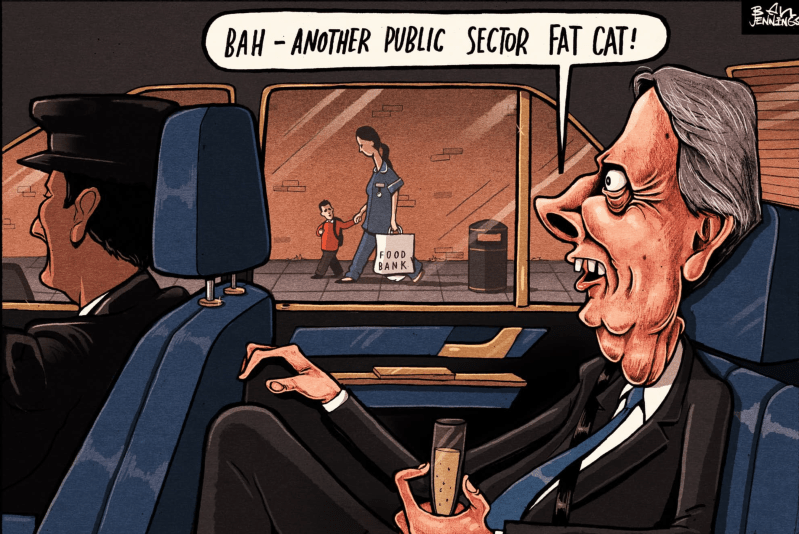
That public sector pay comment in perspective

The man who just got an 11% pay rise and will have a pension that probably pays out in a week what a nurse will earn in a year:

https://www.theguardian.com/commentisfree/picture/2017/jul/16/ben-jennings-on-philip-hammond-and-the-public-sector-pay-cap-cartoon?CMP=Share_iOSApp_Other

“Transformation plans” – a mortal danger to the public?

Our council talks a lot about its so-called “transformation plans” which are supposed to make it leaner and meaner – doing more with less. Except, of course, for its relocation plans, which get more and more bloated with every passing week (“doing the same with more”?).

It trumpets its plans – nay strategy, here:

Click to access transformation-strategy.pdf

There are objectives in it such as “WorkSmart”, “centred”, “clear”, “simple”, “fast”, “organised” and “rational”. As if our council was currently WorkDumb, off-centre, opaque, complex, slow, disorganised and irrational was the alternative. Hhhmm – let’s not go there!

But one word is missing – SAFE.

In the light of the Grenfell Tower disaster, we have seen that ALL of the above can impact directly on council tax payers to make them less safe – as cost-cutting (the REAL meaning of transformation plans) is the major driver.

The London Borough of Newham is so concerned that it has paused its transformation plans on hold saying:

“… Inevitably…in a programme of this scale there are certain areas which have associated risks to delivery both in timing and quantum. Due to the sheer complexity and scale of what the transformation programme is trying to achieve, there are risks attached with the programme being able to deliver fully against its target. Therefore, an adjustment of c£2m has been made to recognise potential non-delivery of savings/income shortfall for 2018/19.”

http://www.room151.co.uk/151-news/news-roundup-borrowing-to-increase-cash-needs-newhams-transformation-savings-residents-audit-lambeth-cipfas-ethics-update/

So, we (and EDDC) must ask: how far is too far?

And is the council’s relocation being done at great expense, when that money ought to be ploughed back into services that have been cut to the bone and may be much less safe for us all? In its race to be bottom of council tax bills has it also been a race to the bottom for our safety?

This is, of course, a national problem – driven by austerity cuts. But have our councils (DCC and EDDC) and other institutions such as the NHS been too passive or even too welcoming of these cuts and too conveniently blind to see their consequences?

Rural homelessness : government says LEPs should help (pull the other one)

“The “hidden crisis” of rural homelessness requires urgent attention from the government, a leading thinktank has said after research revealed a dramatic rise in the number of rough sleepers in countryside areas in the last five years.

The Institute for Public Policy Research warned that it is particularly hard to prevent or relieve because of the difficulties in covering larger areas and the lack of specialist resources compared to cities.

The report, Right to home? Rethinking homelessness in rural communities, finds the promotion of the countryside as a “rural idyll” where people go to escape the city and have a better life could “mask” the presence of households at risk of becoming homeless or already without a roof over their heads.

The research – which was commissioned by Hastoe, a leading rural specialist housing association – found that 6,270 households were accepted as homeless in 91 mainly or largely rural local authorities in England in 2015-16, an average of 1.3 in every 1,000 households.

A fifth of all homeless cases occurred outside of England’s most urban areas. From 2010 to 2016, “mainly rural” local authorities recorded a 32% rise in cases of homelessness. In areas that are “largely rural” there has been a leap of 52%, and an almost doubling in “urban areas with significant rural” (97%).

… Preventing and relieving homelessness can be especially difficult in rural areas, Snelling said, because of a relative absence of emergency hostels and temporary accommodation, large travel distances with limited public transport, isolated and dispersed communities, and constrained resourcing for specialist services.

Snelling said: “Rural homelessness often goes undetected but that doesn’t mean it isn’t happening and unless you tackle the difficulties in delivering services in rural areas and finding affordable homes, it will continue to be a problem.”

Jacob Quagliozzi, director for Housing Justice England, a Christian housing charity, said there has been a rise in churches and community groups contacting them for advice on setting up night shelters in their buildings.

The demand for emergency accommodation provision has seen “substantial growth” outside of the big cities, Quagliozzi said.

The report also recommends that local authorities should enter into two-way negotiations with the government to develop devolution deals on housing and planning in which ambitious commitments to increasing affordable supply should be met with a transferral of power to do so.

https://www.theguardian.com/global/2017/jul/10/rural-homelessness-hidden-crisis-needs-attention-says-thinktank

Local government lawyers: powerful are more important than the powerless

“Local government lawyers should make sure they have access to the ‘top table’ and that they are listened to rather than necessarily feel the need to be “at every meeting”, the former Head of the Civil Service and Permanent Secretary at the Department for Communities and Local Government has suggested. …”

http://localgovernmentlawyer.co.uk/index.php?option=com_content&view=article&id=31773%3Aaccess-to-top-table-more-important-than-being-at-every-meeting-lord-kerslake&catid=59&Itemid=27

Sidmouth mum exposes the reality of education cuts at primary academy school

Received by Owl:

“I wonder whether you’re aware/ could draw attention to the fallout from the budget cuts in our local school.

Parents discovered today that at Sidmouth Primary School funding cuts are having a direct impact on the children and structure of the school. They have had to reduce the number of classes in the school so children are being taught in mixed Year classes: Years 3&4; 5&6. This cost-cutting exercise means that teachers will be teaching an incredibly broad spread of abilities within the same class: they will have to differentiate hugely to cater for the weakest Year 5 and strongest Year 6 pupil for instance. Classes are heading towards 30 so it’s not as if these mixed groups are resulting in smaller groups.

When the school became an academy parents were told that this would mean more autonomy and access to more funds. This clearly has not materialised yet the former headteacher now seems to be sporting the title of ‘Executive Headteacher’. I imagine that his salary could cover the cost of a couple of those disbanded classes…”

Austerity and the poor

Letter in today’s Guardian:

“• Deborah Orr (Opinion, 30 June) is unfortunately absolutely right in all she says about the Grenfell catastrophe. A contempt has developed for health and safety considerations and they are considered a pathetic nanny-state approach.

This, coupled with the worship of cost-cutting at the expense of humanity, has caused this tragedy.

Even though I understood that terrible things were happening in the name of austerity I must admit I still thought we lived in a country that used regulation to require housing to be built or altered so as to offer adequate fire protection. Not if you live in social housing it seems. Could that be any more shameful?

Linda Maughan
Hartlepool”

Better-off buyers are the ones who benefit from help-to-buy

“Government schemes designed to help more people get on the UK housing ladder have little impact on improving social mobility as better-off buyers are most likely to benefit from the support, a report has found.

Research by the Social Mobility Commission reveals that many low-cost home ownership schemes are beyond the reach of almost all families on average earnings, prompting warnings that the UK housing market is “exacerbating inequality and impeding social mobility”.

Those benefiting from low-cost home ownership schemes, such as Help to Buy, earn more than one and a half times the national working age median income, according to the findings. …”

http://www.independent.co.uk/news/uk/home-news/government-home-ownership-schemes-families-average-earnings-social-mobility-report-commission-low-a7818616.html

Question: What is the average price a first-time buyer pays for a property?

Answer:

The average price first-time buyers are paying to get on to the property ladder has hit a record high of £207,693, according to the latest Halifax First Time Buyer Review.”

Source: Moneywise:
https://t.co/C5aHSWGKiV

Question: What is an average wage in Devon?
Answer:

Families in Devon need to earn almost £60,000 a year now to afford the average mortgage which represents a 156% pay rise for average earners.

With average Devon salaries now of £23,197, a worker would need a staggering £36,279 pay rise (156%) to £59,476 to get a mortgage for an average home in the county.

A couple each earning a combined average wage totalling £46,394 would still need a 28% pay increase to get a standard 80% mortgage.

With average private monthly rents in Devon of £687 this accounts for 43% of average monthly net pay. Average property prices are £260,209 which is more than 11 times the average salary.”

https://www.westwardhousing.org.uk/news-and-media/westward-building-to-meet-housing-needs-highlighted-in-report-1121/

Smart meters – free market and privatisation gone bonkers

” … In my column last week I asked why Britain’s smart meter rollout was costing £11bn and France’s just £4bn. One industry insider contacted me to say that it was partly because France’s “Linky” programme is for electricity meters only, whereas the UK’s is both electricity and gas. But it’s also because France does not have competition among utility providers, and we do.

Here, each supplier has to install smart meters only for their own customers, which means they can’t just go “street to street” – they have to contact individual customers wherever they live, agree for them to allow access and organise engineers around that.

The result is that we will be wasting billions in duplicated activity, with the bill passed on to consumers to satisfy the rules on “competition” – and also ensuring shareholders continue to receive those dividends.”

https://www.theguardian.com/money/blog/2017/jul/01/forget-austerity-government-cuts-profiteering-private-companies

“Public sector workers ‘most likely’ to seek payday loans, poll finds”

Owl asks: where are we on this? Has there been a u-turn on the u-turn on the u-turn yet, or does it come later today?

“Public sector workers are the most likely employees to take out payday loans, according to survey by a loans comparison website.

A survey of 8,000 people by Readies.co.uk revealed the majority of employed people taking out payday loans were working in the public sector.

Of those in employment seeking a payday loan, more than a quarter (27%) work in the public sector in roles such as nurses, teaching assistants and for councils, according to Readies.

The findings came a day after a proposed amendment to the Queen’s Speech to increase public sector pay and end the 1% pay cap failed to pass the Commons. There has been some suggestion that the government is poised to relax public sector pay limits.

Commenting on the poll’s findings, Stephanie Cole, operations manager at Readies, said: “Payday loans have a negative stigma attached to them, but the reality is that they are now part and parcel of some people’s’ lives as the pay squeeze intensifies as wage growth falls further behind inflation.

“The pay squeeze, particularly on public sector workers, will only serve to increase the number of people turning to payday loans who are already struggling with rising fuel, food and transport costs.”

Public sector unions have protested ongoing public sector pay restraint.

Speaking after the Queen’s Speech vote on public sector pay, Kevin Courtney, general secretary of the National Union of Teachers, said: “Pay for all public sector workers needs to be increased. The autumn budget must ensure that this 1% cap is lifted for all public servants.”

http://www.publicfinance.co.uk/news/2017/06/public-sector-workers-most-likely-seek-payday-loans-poll-finds