Hinkley C: do contractor changes signal problems?

” … On 21st August 2017, Balfour Beatty announced that it had now been awarded that very contract from under Costain’s nose.

Today Costain chief executive Andrew Wyllie said this on the matter: “Costain continues to undertake a number of enabling works contracts at Hinkley Point C. However, the group will cease its involvement in the marine works contract at Hinkley Point C following completion of a further circa £20m of existing obligations, anticipated to be concluded by the end of December 2017. Since Costain announced its initial appointment in October 2013, there was a significant delay in the approval for Hinkley Point C. While Costain has worked closely with EDF through the £40m of early contractor involvement phase to date, it was not possible to reach agreement on the final terms and conditions for the overall completion of the works.”

Mr Wyllie said that the company was still committed to, and involved in, the nuclear sector. “Costain remains involved in the planned UK new nuclear power plants and has started to develop opportunities in the small modular reactors market,” he said. “At Sellafield the Evaporator D contract is near completion and we have fully mobilised our team in support of the Decommissioning Delivery Partnership Framework. We have recently been awarded a major construction and programme management contract for AWE in the development of one of its nuclear facilities.”

http://www.theconstructionindex.co.uk/news/view/costain-explains-loss-of-hinkley-point-contract

and it seems workers at the site prefer to rent cheaply rather than buy in the area – not a sign of confidence:

“… workers on site at Hinkley seemed to be looking to rent as cheaply as possible, with many of them even travelling home on weekends.

… The people working on Hinkley at the moment are mainly construction workers and they are mainly opting to rent rather than buy,” Mr Zorab said.

“This has pushed up prices for buy to let properties but house prices in general have not been affected in a major way yet.”

He said the majority of the people who would be on site in the long term had not arrived yet, and expected a more noticeable increase when they started to arrive in year three of the project.”

http://www.somersetcountygazette.co.uk/news/15435410.What_impact_is_Hinkley_C_having_on_West_Somerset_s_housing_market_/

The erosion of democracy to serve the cult of celebrity and business

From an article about how Boris Johnsom frittered away nearly a billion pounds on projects that came to nothing while he was London mayor – echoes of the East Devon Business Forum, the Local Enterprise Partnership, Greater Exeter …

“… Still, Johnson merely highlights a number of problems. He shows what happens when our celebrity culture, in which he has a starring role, fuses with an era of denuded press and desiccated politics. This is the age of the administrative monarch. We are encouraged to place power and trust in individuals of purported unparalleled wisdom, vision and probity. Mayors, metro mayors, police commissioners, superheads; we outsource to individuals, increasing their power in the belief they will get things done, unencumbered by faint hearts and red tape.

By this thinking, democratic checks and balances are a bother. There can, in this political calibration, be some light-touch monitoring, but the monarch must have all the power. True democracy can be such a millstone.

This is a philosophy tilted towards business in its many lucrative interactions with the public sector, for it sends a message that the special individual talents of the market do not need the democratic or collective checks and balances that might save us from folly. We saw this in the framing of the London mayoralty, where the initial hope was that a Richard Branson or a Greg Dyke would seize the sceptre. That didn’t work out. Instead of an industry titan, the befuddled lawmakers ended up with Ken Livingstone, the very antithesis of their hopes, and then Johnson.

But the thinking endures that true progress needs turbo-empowered individuals in whom we endow complete trust, as we might for a pilot or a brain surgeon, because their knowledge and drive and networking prowess surpasses our understanding. Theresa May sought that sort of unquestioning trust when she implored us not to worry our pretty little heads and to give her complete and personal authority to do as she pleased in Brussels. The country eventually called her out on that, but isn’t it time to question that philosophy everywhere?

Isn’t it time to reassess the extent to which we have loosened the regulatory structures? The Tory-led coalition scrapped the audit commission and with it a level of scrutiny that once gave the reckless pause. The Standards Board for England, responsible for monitoring ethical standards in local government, was doused in ministerial petrol and thrown on to the same so-called bonfire of the quangos.

At the same time, the right or expectation that local councillors, representing their communities, should sit on the boards of organisations in receipt of public funds – such as schools, housing associations and private firms delivering communal services – has been steadily eroded.

Our system is a largely a centralised one, but still the canny determined mayor can disengage the handbrake knowing that no one can, in real time, reapply it. Voters can assert their authority at some point on the journey, but it may be some way down the road. By that point the vehicle, recklessly driven, may have crashed. And by the time the authorities arrive, the driver may well have legged it.

So these leaders may never be held to account. Maybe they have already left office. The heat turns down, the world moves on. The protection of celebrity deflects the glare. Isn’t that what’s happened in the case of the garden bridge and all of the wasteful, ill-conceived Johnsonian follies?

But isn’t it also – in terms of the public’s apparent inability to bring poor and reckless administrators to account – what’s happened in universities up and down the country? Vice-chancellors on grotesquely bloated salaries charge £9,000-plus tuition fees without any improvement in the offer to students. And in notorious academy schools, deified super-heads have taken advantage of huge pay cheques and light public supervision to provide pupils with a substandard education.

We have grown scornful of the mundanities of democracy. The celebrity-as-saviour populist version excites. But the dull, traditional, sometimes tortuous structures – with checks and balances and inquests and punishments – existed for a reason. With them grand projects took longer, consensus was required, and foolhardy stewardship carried risks. But without them we spend millions on the dream of a flowery bridge while services atrophy, food banks flourish, and the designers of that outrage move onwards and upwards.”

https://www.theguardian.com/commentisfree/2017/aug/22/boris-johnson-940-million-system-to-blame

Our Local Enterprise Partnership agrees it isn’t a “democratic representational body” and puts it in writing!

Our Local Enterprise Partnership has published a list of consultations to which it has responded on our behalf (though, of course, not having consulted US) which contains this golden nugget:

Consultation:

West Somerset Council & Taunton Deane Borough Council to create a new district council to replace both.

Our LEP’s response:

“Letter sent stating as the LEP is not a democratic representational body it does not as a matter of policy comment on such issues relating to democratic representation.”

Click to access 5.-LEP-Register-of-Consultations-2017-3.pdf

Why “growth” is almost impossible in East Devon

Our Local Enterprise Partnership trumpets “growth, growth, we must have growth to prosper” and EDDC chose the highest growth figures to ensure its Local Plan got LOTS of housing. But they both seem to have forgotten something that their bible, the Daily Telegraph, now points out:

Britain’s productivity crisis risks getting worse because the population is ageing steadily, leaving relatively fewer younger, more dynamic workers who typically innovate more.

Unless drastic action is taken to boost skills and creativity, or to increase the number of young workers, then growth will struggle to pick up, according to new economic research published in the journal of the National Institute of Economic and Social Research.

“The share of young workers impacts the innovation process positively and, as a result, a change in the demographic profile that skews the distribution of the population to the right [older], leads to a decline in innovation activity,” said the paper, written by Yunus Aksoy, Henrique Basso and Ron Smith. …

To avert a sustained slowdown they recommend that governments should look at ways to make the dwindling proportion of young people more productive.

“Unless there are drastic changes most OECD countries will need to devise new policies to foster medium-run economic growth in an environment with ageing population, perhaps by increasing investment in human capital,” the researchers believe.

Alternative options are also available, but some may be less politically palatable – for instance, encouraging greater flows of migrants of working age into the country.

“Demographics are not destiny and our conclusions assume that there will not be major changes in rates of immigration, labour force participation, fertility or longevity,” the economists said.”

http://www.telegraph.co.uk/business/2017/08/07/ageing-population-make-productivity-crisis-worse/

New nuclear plants in USA axed in situation eerily similar to Hinkley C

“Billions of dollars spent on two new nuclear reactors in South Carolina went up in smoke Monday when the owners nixed plans to finish them after years of delays and cost overruns, dealing a severe blow to the industry’s future.

South Carolina’s state-owned public utility has voted to stop construction on two billion-dollar nuclear reactors. The reactors were set to be among the first new nuclear reactors built in the U.S. in decades, but the vote by Santee Cooper’s board on Monday, July 31, 2017 likely ends their future.

The reactors were set to be among the first built in the U.S. in decades. While the decision will save customers billions in additional costs, customers of the two utilities — Santee Cooper and South Carolina Electric & Gas — may get little to nothing refunded of the billions they’ve already paid for the now-abandoned project.

“I’m disappointed today not just for Santee Cooper and its customers but for our country and the industry as a whole,” said Santee Cooper CEO Lonnie Carter. “If you really believe we need to reduce carbon, this was the way to do it.”

Energy demands are far less than the utility’s pre-Great Recession projections that factored into the initial decision to build.
But Monday’s decision may eventually result in the utility putting a coal-fired unit idled earlier this year back in operation. Another option for supplying power needs in the decades to come include building a natural gas unit.

“Absolutely, this pushes us back to more carbon, whether it’s natural gas or coal,” Carter said.

Santee Cooper’s board said the decision to end construction will save customers an estimated $7 billion. The utility had already spent about $5 billion for its 45 percent share of the project, and completing it would have cost an additional $8 billion, plus $3.4 billion in interest.
“I’m not celebrating,” said Tom Clements of Friends of the Earth, which has questioned the project from the outset. “This is a sad day for South Carolina. So much money has been wasted. Ratepayers are losers any way you take it.”

He said the group will work to “get to the bottom line of how this happened, who’s responsible” and what that means for customers.

Gov. Henry McMaster called for legislators to hold hearings to get customers’ questions answered.

The project has been shrouded in doubt since earlier this year, when primary contractor Westinghouse filed for bankruptcy protection.

The utilities have since determined the project likely wouldn’t have been finished until 2024. Under a timeline adopted in 2012, the first reactor was supposed to be operational earlier this year. Westinghouse hasn’t been forthright since, according to Santee Cooper.

South Carolina Electric & Gas, which owns 55 percent, announced its plans shortly after Santee Cooper’s unanimous vote. SCANA, SCE&G’s parent company, will seek approval from regulators Tuesday about their abandonment plans.
Under the approved Santee Cooper resolution, all work will end within six months. How quickly within that timeframe workers at the site will lose their jobs is uncertain.

About 5,000 people are employed at the site by contractors and subcontractors. SCE&G employs an additional 600 workers for the project, according to the utility.

The utilities announced last week that Westinghouse’s parent company, Toshiba Corp., agreed to jointly pay them $2.2 billion regardless of whether the reactors are ever completed.”

http://www.apnewsarchive.com/2017/Billions-of-dollars-spent-on-two-new-nuclear-reactors-in-South-Carolina-have-gone-up-in-smoke-when-the-owners-nixed-plans-to-build-them-because-of-delays-and-cost-overruns/

Times article: scrap Hinkley C, frack for shale and to hell with carbon reduction

Britain’s energy policy keeps picking losers

by Matt Ridley

The public have paid the price for years of missteps: it’s time to scrap Hinkley Point C and support the shale revolution

Shortly before parliament broke up this month, there was a debate on a Lords select committee report on electricity policy that was remarkable for its hard-hitting conclusions. The speakers, and signatories of the report, included a former Labour chancellor, Tory energy secretary, Tory Scottish secretary, cabinet secretary, ambassador to the European Union and Treasury permanent secretary, as well as a bishop, an economics professor, a Labour media tycoon and a Lib Dem who was shortlisted for governor of the Bank of England.

Genuine heavyweights, in short. They were in general agreement: energy policy is a mess, decarbonisation has been pursued at the expense of affordability and, in particular, the nuclear plant at Hinkley Point C in Somerset is an expensive disaster. Their report came out before the devastating National Audit Office report on Hinkley, which said the government had “locked consumers into a risky and expensive project [and] did not consider sufficiently the risks and costs to the consumer”.

Hinkley is but the worst example of a nationalised energy policy of picking losers. The diesel fiasco is another. The wind industry, with its hefty subsidies paid from the poor to the rich to produce unreliable power, is a third. The biomass mess (high carbon, high cost and environmental damage) is a fourth.

The liberalised energy markets introduced by Nigel Lawson in 1982, embraced by the Blair government and emulated across Europe, delivered both affordability and reliability. But they were abandoned and, in the words of the Lords committee, “a succession of policy interventions has led to the creation of a complex system of subsidies and government contracts at the expense of competition. Nobody has built a power station without some form of government guarantee since 2012.”

All three parties share the blame. Labour’s Climate Change Act of 2008 made Britain the only country with mandatory decarbonisation targets, a crony-capitalist’s dream. The Lib Dems who ran the energy department for five years, Chris Huhne and Ed Davey, negotiated the disastrous Hinkley contract. The Tories reviewed the decision in 2016, by which time it was clear we had managed the unique feat of finding a technology that was untested yet already obsolete. They decided to go ahead anyway, missing the chance to blame the other parties for it. As the energy analyst Peter Atherton put it, the three parties “have managed to design possibly the most expensive programme for delivering nuclear power we could have come up with”.

The chief Lib Dem mistake was to ignore the shale gas and oil revolutions under way in America and assume that fossil fuel prices would rise from already high levels. By 2011, influenced by peak-oil nonsense and lobbied by professors of “sustainability”, the department of energy and climate change was projecting that the oil price would be between $97 and $126 per barrel in 2017. Today it is about $50 a barrel, roughly half the lowest of the 2011 projections. Gas prices were expected to be about 76p per therm by now, whereas they are actually about half that: 37p.

The shale revolution is gathering pace all the time. Britain has very promising shales and could prosper and cut emissions if it joins in, so let us hope the first wells about to be drilled in Lancashire by Cuadrilla, against the determined opposition of wealthy, middle-class protesters, prove successful. (No, I don’t have a commercial interest in shale.)

American industry pays about half as much for its electricity as we do
This forecasting mistake is behind much of the rising cost of Hinkley. In 2015 the whole-life cost of its power was expected to be £14 billion. Now it is £50 billion. Because consumers are on the hook to pay the difference between the wholesale price of electricity and the “strike price” for Hinkley, we must hope that the project is badly delayed, because that way our children will at least spend fewer years paying inflated electricity prices.

These bad forecasts, widely criticised at the time, make all strike prices horribly expensive, for onshore and offshore wind and solar as well. Lib Dem ministers kept saying at the time that subsidies for renewables and Hinkley would protect the consumer against “volatile” gas prices. Yes, they have done so: by guaranteeing high prices. Oh for a little downward volatility!

Britain’s industrial and commercial users now have some of the highest electricity prices in the developed world, which find their way to households in cost of living and a downward pressure on wages. American industry pays about half as much for its electricity as we do, and everyone benefits. Energy prices are not just any consumer price: they determine the prosperity of the entire economy.

It is just possible some new arrangement could be salvaged

Well, no use crying over spilt future money. What are we to do? Here is where it could get interesting. Almost nobody wants Hinkley to go ahead, apart from the contractors who get to build it. EDF and Areva, the French owner and developer, are in trouble over the only two comparable reactors in Europe. The one at Flamanville is still to start working, many years behind schedule. The French unions want Hinkley cancelled. Lord Howell of Guildford, the former energy secretary, wisely pointed out in the Lords that the key player is China, a partner in the project. Rather than cost, the government’s excuse for revisiting Hinkley last year was partly worries about security. This was a silly worry and bad diplomacy. However, it is not clear China wants to go ahead, and subtle negotiation could tease this out. The great prize for China was regulatory approval through Britain’s gold-standard “generic design assessment” process, which could unlock foreign markets and give a green light for a Chinese-built reactor at Bradwell in Essex.

But Lord Howell says the Chinese increasingly realise that the Hinkley design is a dead end, as costs escalate and delays grow. And they know that the future for nuclear power must lie in smaller, modular units, mass-manufactured like cars rather than assembled from scratch like Egyptian pyramids. Their “Nimble Dragon” design could slot into both the Hinkley and Bradwell sites, perhaps beside the larger Hualong design.

Cancellation would cost some £20 billion. But if the initiative comes from Beijing it is just possible that some new arrangement could be salvaged from the certain wreckage of the EDF scheme, without seriously damaging both livelihoods and our relations with China.”

Hinkley C: more bad, bad news – and they are moving to renewable energy!

Not looking like a good idea …

“Earnings at energy giant EDF have plummeted by a fifth in the first half of this year due to ongoing woes in its French fleet of nuclear reactors and lower profits from those in the UK.

The French state-backed group behind the UK’s first new nuclear plant in a generation, Hinkley Point C, has suffered a major setback to its domestic reactors, some of which have been closed for safety checks since October.

French nuclear power output fell by 3.9pc from the first half of last year to 197.2TWh in the six months to June 30, the group said. Despite a 4.2pc rise in UK EDF’s nuclear generation to 32.2TWh, the fleet of reactors were still a drain on earnings due to the weaker market price for electricity.

The slump in its two core markets wiped more than 20pc from its underlying earnings before interest, tax, debt and amortisation to €7bn (£6.3bn) but the group has assured investors that it remains on track to meet its guidance of between €13.7bn to €14.3bn for the year.

Jean-Bernard Lévy, EDF’s chairman and chief executive, underlined the “unfavourable market context” but said the group’s move towards renewable energy was accelerating.

The roll-out of subsidised renewables in the last decade has effectively driven the wholesale price of power down, cutting revenue for existing nuclear power plants, which sell their electricity into the market.

The decline in income highlights the need for a guaranteed set price for the new Hinkley Point plant in order to recover its eye-watering costs.

Earlier this month EDF confirmed that the cost of developing Hinkley had gone from £18bn to £19.6bn but was quick to point out that this would not be borne by customers because of the fixed price of £92.50 per megawatt-hour already agreed with the Government.

However, the declining wholesale market price means the top-up payment needed to meet this set price, which is paid by consumers, has spiralled to £50bn over the lifetime of the project from the £6bn bill estimated in 2013.”

http://www.telegraph.co.uk/business/2017/07/28/edf-profits-dented-nuclear-woes/

Does our LEP have a plan B to replace European funding? And will it be a “functional economic area”?

“The Conservative manifesto earlier this year promised the government would use structural fund money that comes back to the UK following Brexit to create a UK “shared prosperity fund”.

However, deep concerns have been voiced about the replacement of EU structural funding. This week, Humber Local Enterprise Partnership chairman Lord Haskins aired doubts about the scale of the proposed fund.

He told the Hull Daily Mail that “so far, there is no indication it will match the sort of money we are currently getting from Europe”.

He added: “Long-term, I think we will have to start looking at other sources of funding for vital infrastructure work.”

The LGA also wants a new approach to distributing Westminster money that replaces EU regional aid, calling for a “single pot” for all domestic growth funding.

The association outlined three options for the future of funding currently sourced from the European Union. Its preferred method would see European Union structural funding, all other European funding streams and 70 UK funding streams supporting growth and regeneration pooled together.

The document said: “Under the single pot principle, local areas would be afforded maximum flexibility to target need and tailor provision, to stimulate growth in local areas and contribute to the national economy .”

The pot would be most effectively distributed to regional “functional economic areas” (FEAs) in England, and “appropriately identified” bodies in the devolved nations, the report said.

“In England, the FEAs could arguably follow the funding distribution geography of the current European Structural and Investment Funds (ESIF) programme,” the report added. It argued this would offer “much greater control over funding decisions , which would be devolved to all local areas.” …”

http://www.room151.co.uk/resources/billions-needed-to-match-eu-funding-for-local-communities-after-brexit/

Windfarms cheaper than gas or Hinkley C

“Tories urged to look at onshore windfarms which can be built as cheaply as gas plants and deliver the same power for half the cost of Hinkley Point, says Arup.

Onshore windfarms could be built in the UK for the same cost as new gas power stations and would be nearly half as expensive as the Hinkley Point C nuclear plant, according to a leading engineering consultant.

Arup found that the technology has become so cheap that developers could deliver turbines for a guaranteed price of power so low that it would be effectively subsidy-free in terms of the impact on household energy bills.

France’s EDF was awarded a contract for difference – a top-up payment – of £92.50 per megawatt hour over 35 years for Hinkley’s power, or around twice the wholesale price of electricity.

By contrast, Arup’s report found that windfarms could be delivered for a maximum of £50-55 per MWh across 15 years.

ScottishPower, which commissioned the analysis, hopes to persuade the government to reconsider its stance on onshore windfarms, which the Conservatives effectively blocked in 2015 by banning them from competing for subsidies and imposing new planning hurdles.

Keith Anderson, the firm’s chief operating officer, told the Guardian that onshore wind could help the UK meet its climate targets, was proven in terms of being easy to deliver, and was now “phenomenally competitive” on price.

“If you want to control the cost of energy, and deliver energy to consumers and to businesses across the UK at the most competitive price, why would you not want to use this technology? This report demonstrates it’s at the leading edge of efficiency,” he said.

The big six energy firm believes that with a cap on top-up payments so close to the wholesale price, onshore windfarms would be effectively subsidy-free – but the guaranteed price would be enough to de-risk projects and win the investment case for them.

“What we are asking for is a mechanism that underpins the investment risk,” said Anderson.

The group believes that any political sting for Tory MPs concerned about public opposition to turbines in English shires would be removed because such a low guaranteed price would see only the windiest sites coming in cheap enough – which means windfarms in Scotland.

“You put these projects in the right place, you will get the correct level of resource out of them to keep the costs down and you will get public acceptance of people liking them,” Anderson said, citing the example of the company’s huge Whitelee windfarm near Glasgow.

Dr Robert Gross, director of the centre for energy policy and technology at Imperial College, said: “Onshore wind has been coming in at remarkably low prices internationally, so a contract for difference price of around £50-60 per MWh looks perfectly feasible for a good location in the UK, one of the windiest countries in Europe. …”

https://www.theguardian.com/environment/2017/jul/23/drop-in-wind-energy-costs-adds-pressure-for-government-rethink

“UK households could pay £50bn to France’s state-owned energy company to prop up Hinkley nuclear plant”

Well, at least it’s not just Devon and Somerset, though Owl suspects we will be paying far more than pur fair share:

“UK households could pay £50bn for the new Hinkley Point C nuclear plant in Somerset, new government figures reveal. That number is more than eight times greater than the National Audit Office’s initial 2013 estimate that a public investment of £6bn would be required.

The spiralling costs are due to the terms of the Government’s agreement with EDF, the French state-owned electricity company, which is building the plant in conjunction with China General Nuclear Power.

That deal guarantees EDF a £92.50 “strike price” for every megawatt hour of electricity that the new plant generates, a figure that critics have said is far too high. …”

http://www.independent.co.uk/news/business/news/hinkley-nuclear-plant-edf-uk-households-energy-power-somerset-government-a7849216.html

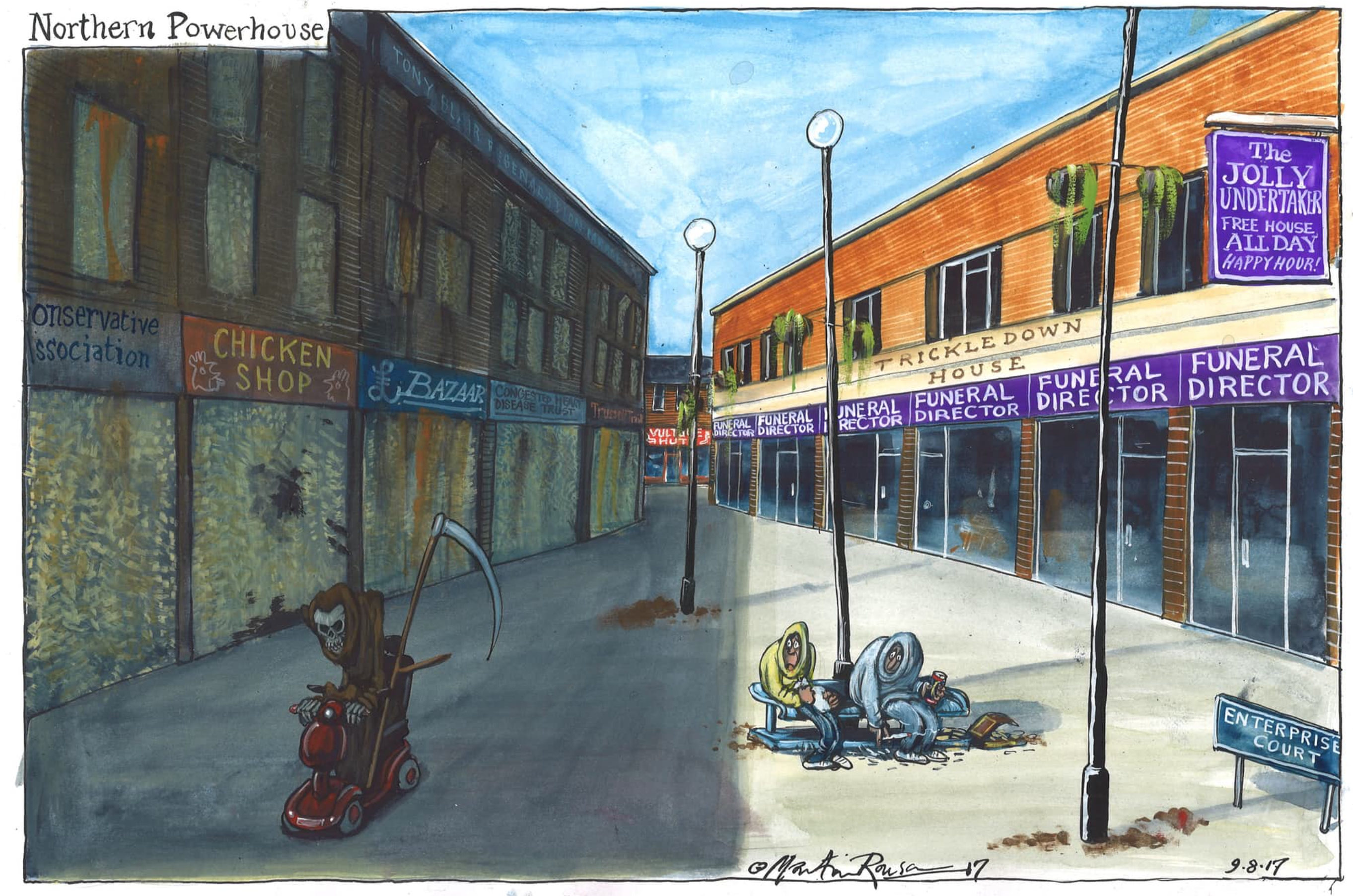
Heart of the South West: 50% self- interest, 49% spin, 1% substance

… and the 1% is generous!

That’s Owl’s summary of this puff job where the Emperors tell us how beautiful their new clothes are – and how we will all benefit from them:

http://www.devonlive.com/how-the-great-south-west-is-set-to-rival-northern-powerhouse/story-30447945-detail/story.html

“Never mind the quality – feel the width”!

And still not an ounce of accountability or transparency!

How long will our councils keep up the charade that these people are working for us – or working at all.

“LEP funded” project runs into problems

“A string of major restaurant chains have lifted the lid on how Plymouth’s £40million Bretonside development could look.

The Herald revealed earlier this month how Mexican food emporium Wahaca had become the ninth chain to rule themselves out of the massive cinema and restaurants complex, which is currently under construction.

They followed big names such as Wetherspoon, Pret a Manger, Five Guys, Harry Ramsden and Greggs in confirming they would not have a Bretonside branch.

And now a further six popular brands have told The Herald they will not be part of the project. …”

http://www.plymouthherald.co.uk/big-name-restaurants-reveal-why-they-ve-snubbed-bretonside/story-30442774-detail/story.html

“Watchdog concern over “inherently complex” structures of combined authorities”

“The introduction of combined authorities has meant that inherently complex structures have been added to England’s already complicated local government arrangements, the National Audit Office has said.

The evidence that investment, decision-making and oversight at this sub national level was linked to improved local economic outcomes was “mixed and inconclusive”, it added.

In a report, Progress in setting up combined authorities, the watchdog did acknowledge that the Department for Communities and Local Government had worked “speedily” to make sure combined authority areas were ready for the mayoral elections in May 2017.

It also accepted that there “is a logic to establishing strategic bodies designed to function across conurbations and sub-regional areas, and there is a clear purpose to establishing combined authorities especially in metropolitan areas, as economies and transport networks operate at a scale greater than individual local authority areas.”

The report also found:

There was a risk that local councillors would have limited capacity for the overview and scrutiny of combined authorities.

In May 2017, six mayors were elected to combined authorities in England, with candidates having campaigned on manifestos which frequently made policy commitments beyond the current remits of these organisations. “This raises the question of whether mayors can be credible local advocates if they only deal with the limited issues under the remit.”

Combined authorities were not uniform, and varied in the extent of the devolution deals they had struck with government.

If the United Kingdom’s departure from the European Union resulted in reductions in regional funding, the economic regeneration role of combined authorities would become more pressing. “Combined authorities are generally in areas which receive the most EU funding,” the NAO noted.

The NAO highlighted how a number of authorities had been unable to bring local authorities together to establish combined authorities, while areas with a long history of working together had often found it most straightforward to establish combined authorities.

“The capacity of most combined authorities is currently limited and the lack of geographical coherence between most combined authorities and other providers of public services could make it more problematic to devolve more public services in the future,” the watchdog warned.

The NAO’s recommendations were:

The DCLG should:

(a) continue to support combined authorities as they put in place their individual local plans for assessing their impact, including demonstrating the value they add;

(b) review periodically all frameworks and guidance in place for combined authorities and other bodies with joint responsibilities, to ensure that accountability for the delivery of services is clear to stakeholders in local communities; and

(c) continue to work with combined authorities as they develop sufficient capacity to:

deliver the functions agreed in the devolution deals;
support economic growth and the government’s industrial strategy; and
provide sufficient scrutiny and oversight to their activities.
Combined authorities should:

(d) work with the DCLG to develop their plans for assessing their impact, including demonstrating the value they add; and

(e) develop and maintain relationships with key stakeholders in delivering economic growth and public services in their areas.

Areas planning to establish combined authorities should:

(f) make sure they have and can clearly articulate a common purpose;

(g) form an area with a clear economic rationale, mindful of existing administrative boundaries; and

(h) develop relationships across areas where there is no history of joint working.

Amyas Morse, head of the National Audit Office, said: “For combined authorities to deliver real progress and not just be another ‘curiosity of history’ like other regional structures before them, they will need to demonstrate that they can both drive economic growth and also contribute to public sector reform.”

http://localgovernmentlawyer.co.uk/index.php?option=com_content&view=article&id=31779%3Awatchdog-concern-over-inherently-complex-structures-of-combined-authorities&catid=62&Itemid=30

Torbay Mayor expelled from Tory group but won’t resign

Owl says: “Massive changes on the horizon … LEP …” – seems there are a lot of things we are not being told about … and Mayor Oliver is obviously making his own post-2019 plans … wonder if his plans coincide with other people’s plans …

“I was elected by 20,000 voters not 20 councillors” is Torbay Mayor Gordon Oliver’s response to calls from his Tory colleagues to step down.

Though he has also been expelled from the Tory group on the council on Monday night and the resign call is going to the next full council meeting, the Tory veteran says there is too important work to be done before the next election in 2019 for him to resign.

With the council facing a black hole in its budget, the increasing pressures on adults and children’s services, and uncertainty over future Government funding and the prospect of increased partnership working with neighbouring authorities – particularly on major services like adults and children’s – Mayor Oliver says he intends to stay on until the next election.

The Tory group said in a statement after its meeting: “The Conservative Group on Torbay Council voted by a majority of over two thirds to expel the mayor from the group.

“A motion bringing forward a vote of no confidence in the elected mayor (endorsed by a majority of the Conservative Group) has already been submitted and will be brought to council for debate on July 20.

“It is regrettable that the group has seen the need to take this action, however it is their strong belief that the mayor has failed to carry out fully his duties in serving the best interests of the people of Torbay.

“The motion is very detailed, running to four pages, and will be is available on the council website when the agenda for the council meeting is published.”

Mayor Oliver said he would listen to the debate on the motion at full council but said: “At the moment I am just sitting and smiling and have no additional things to say about the motion.

“I was elected by 20,000 people not 20 councillors. I will listen to the members of the group and what they have to say. But my responsibility is to the people who supported my election.”

In response to the referendum last year which said the majority wanted a cabinet and leader system in the council, Mayor Oliver said : “By statute, the mayoral system finishes in April 2019. I’m not going anywhere.

“From now on you will see gradual change which is inevitable from a unitary council working on its own to something different. The budgetary pressures will decide how local government will be run in Torbay in future.

“While the mayoral system remains, until the next council election 2019, the structure will remain the same but there will be discussions this autumn as to how the changes will take place beyond that. The council will decide its future in discussion with its immediate neighbours and the wishes of our MPs.”

The major services would be run in partnership, such as children’s, adults and waste. Some changes could be made fairly swiftly he said.

A consultant’s report on possible changes should be published in September.

“Things will not be the same as they are now,” he said. “We have to see this as a challenge, and like all challenges there are benefits which flow from it. I see a dramatic change to create long term financial and political stability beyond 2019.”

At the same time progress is being made on the devolution of power to Devon and Somerset and the 17 districts, he said.

He said essentially Torbay was too small to succeed as a unitary. “It needs long term partnerships and arrangements. There have been various small scale agreements on services already with Teignbridge and Devon we are looking at some with Plymouth at the moment which have been beneficial to us all. But they are mainly backroom functions. These are massive changes on the horizon and we need to keep stability in the next two years and it’s important Government sees us being stable because of the huge responsibilities we have for example for the care of children and adult health.”

http://www.devonlive.com/i-m-going-nowhere-says-torbay-mayor-facing-resignation-call-from-his-own-tory-colleagues/story-30434779-detail/story.html

What can you do when an elected mayor upsets his (party) councillors?

Not much, it transpires.

Gordon Oliver, elected Mayor of Torbay and highly enthusiastic member of our Local Enterprise Partnership, has been upsetting most if not all of his councillors, who are finding it very difficult to do anything about it.

He got the job in 2011 and was re-elected in 2015. However, within the year, a public referendum had been organised on whether Torbay should have a Mayor was organised, and it was decided that, from 2019, the council would revert back to a Leader and Cabinet arrangement. Nothing could be done earlier than that.

Should the Local Enterprise Partnership ever be correctly constituted, as things currently stand, we would be forced to participate in an election for a Mayor of Somerset and Devon who would have a great deal of direct control over the two counties, deciding most things himself or herself and needing only votes from hand-picked colleagues to force through his or her decisions.

This is a situation similar to that where we were forced to accept a Devon and Cornwall Police and Crime Commissioner, when only 22.8% of registered voters bothered to turn out and we ended up with Alison Hernandez, a former Torbay councillor. Who now wants to employ her mate as her Deputy. And who can, if she goes against the wishes of our Police and Crime Panel, do so – and again there is nothing they or we can do about it until new elections in 2020.

And where is her mate from? Torbay! And who is a Torbay councillor. Who has been chair of planning there for several years.

Quite a little power block now built up from there. Must be something in the water.

http://www.devonlive.com/tory-colleagues-call-on-torbay-mayor-to-resign/story-30432407-detail/story.html

French government orders EDF to close 17 nuclear plants – to reduce France’ s dependence on nuclear energy

“A row has broken out in Paris after the French-state-backed group building Britain’s new nuclear plant was ordered to scale down its production of atomic energy in France.

Nicolas Hulot, the minister for ecological change, said that Eléctricité de France (EDF) would have to close up to 17 reactors over the next eight years under a government plan to reduce the country’s dependence on nuclear power.

His announcement unnerved investors and EDF’s share price fell almost 2 per cent to €8.57 in afternoon trading in Paris, its lowest value since May. …”

https://www.thetimes.co.uk/edition/business/nuclear-reactor-closure-declaration-takes-edf-by-surprise-8mq095xcf

Rural homelessness : government says LEPs should help (pull the other one)

“The “hidden crisis” of rural homelessness requires urgent attention from the government, a leading thinktank has said after research revealed a dramatic rise in the number of rough sleepers in countryside areas in the last five years.

The Institute for Public Policy Research warned that it is particularly hard to prevent or relieve because of the difficulties in covering larger areas and the lack of specialist resources compared to cities.

The report, Right to home? Rethinking homelessness in rural communities, finds the promotion of the countryside as a “rural idyll” where people go to escape the city and have a better life could “mask” the presence of households at risk of becoming homeless or already without a roof over their heads.

The research – which was commissioned by Hastoe, a leading rural specialist housing association – found that 6,270 households were accepted as homeless in 91 mainly or largely rural local authorities in England in 2015-16, an average of 1.3 in every 1,000 households.

A fifth of all homeless cases occurred outside of England’s most urban areas. From 2010 to 2016, “mainly rural” local authorities recorded a 32% rise in cases of homelessness. In areas that are “largely rural” there has been a leap of 52%, and an almost doubling in “urban areas with significant rural” (97%).

… Preventing and relieving homelessness can be especially difficult in rural areas, Snelling said, because of a relative absence of emergency hostels and temporary accommodation, large travel distances with limited public transport, isolated and dispersed communities, and constrained resourcing for specialist services.

Snelling said: “Rural homelessness often goes undetected but that doesn’t mean it isn’t happening and unless you tackle the difficulties in delivering services in rural areas and finding affordable homes, it will continue to be a problem.”

Jacob Quagliozzi, director for Housing Justice England, a Christian housing charity, said there has been a rise in churches and community groups contacting them for advice on setting up night shelters in their buildings.

The demand for emergency accommodation provision has seen “substantial growth” outside of the big cities, Quagliozzi said.

The report also recommends that local authorities should enter into two-way negotiations with the government to develop devolution deals on housing and planning in which ambitious commitments to increasing affordable supply should be met with a transferral of power to do so.

https://www.theguardian.com/global/2017/jul/10/rural-homelessness-hidden-crisis-needs-attention-says-thinktank

Nuclear power: “You could be doing your writing by candlelight on a typewriter’ by 2025, expert warns”

Owl says: Perhaps our LEP will underwrite the Hinkley C nuclear risks post-Brexit!

“Brexit will create “an alarming mess” for nuclear power stations in the UK, experts have warned, saying it could even cause major power cuts.

Scientists say leaving the Euratom agency that oversees nuclear safety in Europe will cause widespread confusion and have a potentially devastating impact on the industry in Britain.

Possible consequences include a reduction in foreign investment in UK nuclear power facilities, the loss of thousands of jobs and Britain losing its place as a world leader in new nuclear technologies.

UK-US trade deal won’t undo damage of Brexit, cabinet minister says
Professor Roger Cashmore, chair of the UK Atomic Energy Agency, told Buzzfeed News the current situation was “alarming” and “a mess”.

Although the treaties relating to Euratom are separate to those keeping Britain in the EU, the agency requires members to be under the jurisdiction of the European Court of Justice (ECJ), which Theresa May has insisted the UK must withdraw from as part of Brexit.

It is unclear how the UK will replace the procedures and regulations currently managed by Euratom. These cover the transportation of nuclear materials around Europe. Britain is a major producer of enriched uranium, which is used in nuclear fuel, and exports much of the material to other EU countries. The UK Government also owns a third of Urenco, the European uranium-enrichment company.

Unless new treaties relating to the transportation of nuclear materials between Britain and the EU are agreed quickly, the UK could run out of nuclear fuel within two years, meaning nuclear power stations would be unable to produce energy.”

http://www.independent.co.uk/news/uk/home-news/brexit-nuclear-power-euratom-hinckley-point-risks-nuclear-fusion-energy-bills-a7832136.html