Conservative leaves party over ‘damaging’ proposals

The nasty party in action, as the Plymouth Conservatives lose another councillor!  – Owl

Amber Edwards www.plymouthherald.co.uk

A Plymouth Conservative councillor and former council leader has resigned from the Conservative group. Patrick Nicholson will be seeking re-election to Plymouth City Council on May 4th 2023 as an independent when the Conservative’s proposed Council budget for 2023/24 is published, and following his de-selection by the Plymouth-wide Conservative approval panel.

Councillor Nicholson was first elected in 1992 and has served the Plympton St Mary ward throughout his time on the city council. He also served as the youngest city council leader in 2000 and as the youngest-ever Lord Mayor of Plymouth in 2005.

Cllr Nicholson was deputy leader of the council and of the Conservative group until March 2022 when, along with then council leader Cllr Nick Kelly and other cabinet colleagues, he stood down.

Cllr Nicholson said: “With the publication of the Conservative council budget with damaging proposals for district centre car parking charges, cuts to ward councillors’ community grants, potential cuts affecting important Plympton and Plymouth facilities such as swimming pools and community venues like Harewood House. I cannot and will not support the budget in its current form as it will damage my Plympton St Mary Ward residents.

“I am also appalled and disgusted with the treatment I have received by the current chairs of the three Conservative associations in Plymouth since last August when I submitted my application to stand again as a Conservative candidate, by de-selecting me as the Plympton St. Mary Ward Conservative Candidate.

“Along with the leader of the Conservative group Cllr Richard Bingley, many of these individuals have been Labour and UKIP Party members whilst over the last 30 years I have diligently sought to represent the residents of the Plympton St Mary Ward. I am confirming my intention to stand for re-election as an independent candidate in the forthcoming Plymouth City Council Elections in May.”

In order to campaign for his re-election Cllr Nicholson has tendered his immediate resignation from the Conservative group and will join the Independent Alliance Group of Independent Councillors to freely speak up for the Plympton and Plymouth issues that he is passionate about.

These include the unnecessary loss of trees in Armada Way and the impending council budget-setting meeting in February which is likely to see the introduction of car parking charges in the city’s district shopping centres like Ridgeway, Chaddlewood and Estover, as well as the potential closure of community facilities like Plympton’s Harewood House and the Plympton Swimming Pool.

Cllr Nicholson. said: “Over my long council service I have always put my Plympton St Mary Ward residents first and so my constituents should have the final choice of re-electing me or choosing a successor”.

Plans for Great South West region taken to parliament

In September 2017 Owl reported: We’ve had the Heart of the South West LEP! We’ve had the “Golden Triangle” LEP (Exeter, Plymouth, Torquay).We”ve even had the “Golden Quadrangle” LEP (Owl’s suggestion for adding in Cornwall or Dorset). NOW we have the “Golden Pentangle” (adding in Cornwall AND Dorset), yet ANOTHER unelected, unaccountable and non-transparent quango: The Great South West, the LEP for LEPs

Oh and who is the power behind the GSW economic strategy? None other than Pennon, the South West’s biggest employer and parent company of South West Water. So profit before investment – just what we need in the region! – Owl

Darren Slade www.bournemouthecho.co.uk

A DRIVE to promote Dorset as part of a “powerhouse” brand called the Great South West will share its vision of the future at the Houses of Parliament today [10 Jan]

The Great South West Partnership wants the name to sit alongside the Northern Powerhouse, the Midlands Engine and the Western Gateway as part of efforts to grow the UK economy.

The partnership recently held its first board meeting to discuss plans to build on the region’s natural capital, develop a clean, digital economy and tackle climate change.

It will host a parliamentary reception at the House of Lords today to showcase the Great South West prospectus and its vision for the future.

Karl Tucker, chair of the Heart of the South West Local Enterprise Partnership (LEP), said: “The Great South West is united by the idea that by working together, we can achieve more. It was therefore fantastic to come together with our partners to define our ambitions as a region, and set out our plan for becoming the country’s Natural Powerhouse.

“We are looking forward to the region’s green and blue opportunity being presented in Parliament, as part of our efforts to gain government support for the Great South West.”

Cecilia Bufton, chair of Dorset LEP, said: “I’m delighted that the Great South West Partnership is up and running, developing pan-regional activities in areas of our common interest. Thanks to the determination of many over the past five years, it is great to see the Great South West campaign move forward with such ambition.”

The partnership aims to unlock the region’s potential to be a world leader in clean growth. It wants organisations across the region to work together on business support, trade and investment, net zero, sustainable transport, clean energy, rural productivity and tourism.

It aims to make the south west the first net zero region, improving connectivity and supporting technologies that will help generate prosperity.

The partnership is made up of businesses, universities, LEPs and local authorities, including Dorset Council, BCP Council and Dorset LEP.

At their first meeting, the partnership agreed four initial funding awards:

  • to support the high value manufacturing sector;
  • to work with the Department for International Trade to deliver a regional trade and investment hub;
  • to deliver a carbon emissions study;
  • and to support the South West Social Mobility Commission.

Appledore – Cruise ship plan to tackle housing crisis

Plans to tackle the housing crisis in part of Devon being putting refugees or homeless people on cruise ships will be explored. Torridge District Council voted to look into the feasibility of leasing or renting a vessel to accommodate emergency or other housing list people.

Lewis Clarke www.devonlive.com

Torridge District Council had previously declared that they were committed to tackling the housing crisis in the area. Previous ideas included the possible use of modular housing units, evaluating options to reduce the number of empty homes, and bringing forward schemes in partnership with local social housing providers

But at the full council meeting at the end of December, proposals to accommodate refugees or homeless people on cruise ships in Devon were discussed. Councillors voted ‘overwhelmingly’ in support of the motion put forward by Cllr David Brenton.

His motion said: “With the large numbers of cruise ships being scrapped or laid up due to a fall in demand following Covid. I propose that TDC explore the feasibility of forming a partnership with our neighboring authorities i.e North Devon and Exeter etc, with a view to leasing or renting a vessel to accommodate emergency or other housing list people.

“Cruise ships have a high standard of habitation and self-contained servicing and a suitable craft which would fit into Middle Dock could provide a quick solution for some of our desperate citizens needing housing.”

Speaking at the meeting, Cllr Brenton added: “We live in radical times which call for radical measures to alleviate them. We do need to look at what’s coming our way and it’s about to hit the fan. It’s getting quite serious now over the question of accommodation.

“The very fact that our Home Secretary – who I try not to listen to very often, if at all – did mention it in one of her speeches about cruise ships being used for accommodation. I then heard it from the Scottish National Party housing minister, also talking about it.

“It is feasible I believe. They are scrapping perfectly good accommodation because there is no demand for it. We are in a unique position where we own Middle Dock which has got a good birthing situation there, despite over the years the shipyard had bought out some vast vessels to park alongside there.

“This clearly needs a lot of work to be done alongside this. It may be an ideal thing for an intern or apprentice to do some homework on this, but also to contact our neighbouring authorities.

“I have spoken to the housing officer at Exeter City Council who expressed an interest, but not in writing yet. I would also like you to have somebody look into this as a possibility.

“Bear in mind that the Ukrainian refugees are coming to the end of their period of being with host families and there are those who would like to find a place to live, and that will not be easy. We have AirB&B and all sorts of things conspiring to stop people getting accommodation, so we need to consider any possibility.”

Cllr Rachel Clarke added: “The idea in principle is very good. My concern is that when you put lots of people in tight accommodation like that, you’ve got to think of diseases and illnesses which could happen. Do we have the right infrastructure for doctors and nurses which we have a major problem with?

“It needs a lot of work and you’ve got to spread it out as there are other things, such as alcohol or drug issues. It’s not an easy fix. We’ve just got to think it through properly.”

Cllr Simon Newton said: “Scotland have been using cruise ships to accommodate Ukrainian refugees as they came over, initially as a holding centre and then when they could be found permanent accommodation, they could then move out. The difference there and going along the line of what Cllr Clarke has just said was that a single focus group who were socially going to mix well and easily together. While they came with many traumas they were unlikely to create other issues, whereas there are quite clearly many other issues.

“The idea is a good one, it’s thinking out of the box, and from my background, we’ve used this type of accommodation around the world many times in the past. You can sail up an instant hotel and accommodate people on it.

“Where you put it, and how you do it, is a completely different game. But the idea of thinking out of the box is completely worthy.”

Cllr Peter Christie added: “When I saw this first, I suspect I had the same feeling as many of us that this was slightly crackers. Having said that, I think it is worth looking at.

“I used to be in the merchant navy, and the big problem with ships is maintenance. I think we need to approach the harbourmaster, Appledore Shipyard, and ask them about this. It could be an ongoing cost that is so high it would rule it out, but by all means let’s look at it.”

Council tax hike planned for second homes and empty houses

Second home owners in East Devon will have their council tax doubled if planned Government legislation goes ahead. 

 “In East Devon we have a shortage of properties to enable people to rent or potentially purchase and stay and live/work in the area. 

 “If this change frees up empty properties to come onto the rental or purchase market then I and my cabinet colleagues welcome that.” 

(Bearing in mind that only seven per cent of that increase would go directly to EDDC as the bulk (73 per cent) would go to Devon County Council and the remainder to the police and fire service.) – Cllr Jack Rowland

Philippa Davies www.sidmouthherald.co.uk

Under the plans by East Devon District Council (EDDC) the owners of empty houses will also be charged double rates after just one year of non-occupation, instead of two. 

The proposals were agreed by the district council’s Cabinet on Wednesday, January 4, with the final decision to be made at the next full council meeting on Wednesday, February 22. The aim is to introduce the extra charges in April next year. 

The changes are subject to the Government signing off the relevant legislation under its Levelling Up and Regeneration Bill. 

District councillors are supporting the charges to encourage owners to bring empty homes back into use for the local community. 

The higher tax could also help make up for the money lost through reductions in council tax for lower income households. 

Councillor Jack Rowland, EDDC’s portfolio holder for finance, said: “This change, if the parliamentary bill receives approval and full council accept the cabinet recommendation next month, would be effective from April 2024 so the people affected by the change will have a full year’s notice of the change. 

 “In East Devon we have a shortage of properties to enable people to rent or potentially purchase and stay and live/work in the area. 

 “If this change frees up empty properties to come onto the rental or purchase market then I and my cabinet colleagues welcome that. 

“Where the people affected by this change may still choose to keep the property empty or as a second home, then the additional council tax they would have to pay will help ensure the current services provided by EDDC will be maintained, bearing in mind that only seven per cent of that increase would go directly to EDDC as the bulk (73 per cent) would go to Devon County Council and the remainder to the police and fire service.” 

The full Cabinet report can be found on EDDC’s website

Decisions about housebuilding should be made locally – Simon Jupp

Dear Simon,

The baseline housing target the EDDC coalition has inherited is 64% higher than needed to satisfy demographic growth trends and “normal” levels of inward  migration

This is the consequence of  the Tory “Build, build, build” strategy pursued by Conservative controlled EDC for decades.

The late Paul Diviani, alongside the faithful Philip Skinner, was the architect and driving force behind the current Local Plan, adopted in 2015, which was based on an aggressive development target of 950 houses/year, driven by a “jobs led policy on” scenario. 

In fact only around 580 houses/year were required to satisfy purely demographic growth trends. 

This is a Tory uplift of 370 or 64% and is the “poison chalice” that the coalition has inherited.

If the council goes is to go back to the drawing board, as you suggest, then you might like to “have a conversation” with Blue Leader Cllr Philip Skinner.

Regards,

Owl

Simon Jupp MP www.sidmouthherald.co.uk

The Conservative government wants decisions about homes to be driven locally. Councils should therefore be working hand-in-glove with the communities they serve to ensure homes are built in the right places with the right infrastructure.

Last month, the Secretary of State set out some welcome breathing room. Councils will be able to calculate housing need as a starting point but ultimately must consider how to protect the characteristics of each area – be that precious countryside, the character of an area, or heritage. There is no truly objective way to calculate how many homes are needed in an area and, since becoming an MP in 2019, I’ve repeatedly told Ministers that East Devon’s housing figures were the product of fanciful Whitehall algorithms.

Too often, it feels like communities have to grin and bear new housing development. My postbag has been full of complaints about East Devon District Council’s proposals for where homes should be built because they won’t help people stay in their own communities, reduce travel, or keep families close together. We must build new homes, but they must compliment the area, not concrete all over it. 

That’s why as your local MP I have responded to East Devon District Council’s Local Plan consultation – particularly to reflect concern among residents of north Exmouth, Lympstone, Farringdon and West Hill. I’d warmly encourage you to have your say too. Visit eastdevon.gov.uk. The consultation closes on 15 January.

Residents in north Exmouth and residents in Lympstone are extremely alarmed by the volume of development that is getting proposed, effectively merging the two historic towns together. I’m meeting with the Northeast Exmouth Residents Group again this week to look at the plans in depth.

Farringdon villagers stand to have a new town of 2,500 homes built a stone’s throw away. The parish is the most severely impacted of all in East Devon. I’m sitting down with residents here too, because I want to make sure their voice is heard.

The council should go back to the drawing board. The power is now in their hands to make the right calls, thanks to the Conservatives.

Former East Devon leader dies following long illness

In the words of “Blue Leader” Cllr. Philip Skinner:

Cllr Diviani was ‘instrumental’ in the creation of the Greater Exeter Strategic plan – although the council eventually pulled out of the proposed arrangement with other neigbouring councils in 2020 – and he praised his ability to “see the bigger picture.”

“He balanced providing good services but at the same time of course driving our economic agenda, which is the agenda I very much wish to promote myself.”

Owl remembers Paul Diviani, alongside the faithful Philip Skinner, as the architect and driving force behind the Tory “Build, build, build” strategy. This resulted in the current Local Plan having a development target of 950 houses/year, based on an aggressive “jobs led policy on” scenario.  Where only around 580 houses/year would be required to satisfy purely demographic growth trends. 

This is an uplift of 370 or 64% and is the target that the current EDDC coalition has inherited (is lumbered with).

Remember this when you read the next post on Simon Jupp’s position on local housing targets.

Former East Devon District Council leader Paul Diviani has died following a long illness.

Rob Kershaw www.sidmouthherald.co.uk

Mr Diviani joined East Devon District Council in 1999, becoming leader in 2011, a role he held up until he stepped down in 2018. He had also served on Devon County Council, representing Honiton St Paul’s, as well as being a board memeber of the Heart of the South West Local Enterprise Partnership, chair of the Blackdown Hills Area of Natural Beauty, and numerous other public service or community roles.

He joined East Devon Council at the same time as the district’s current Tory leader, Cllr Philip Skinner, a friend both in and out of politics, who paid a heartfelt tribute to him on Friday.

“Paul Diviani was a very selfless man,” said Cllr Skinner. “He was a man who was never critical of other people; he was more concerned about doing good things.

“He had a very good insight to vision work, and he was very much a strategic thinker. Strategic, not just in the planning process, but strategic in the way that the council should operate, and the way that it should run.

“He balanced providing good services but at the same time of course driving our economic agenda, which is the agenda I very much wish to promote myself.”

Cllr Skinner said that Cllr Diviani was ‘instrumental’ in the creation of the Greater Exeter Strategic plan – although the council eventually pulled out of the proposed arrangement with other neigbouring councils in 2020 – and he praised his ability to “see the bigger picture.”

The Conservative leader for East Devon describing Cllr Diviani as a ‘lovely, lovely man.’

Why did a perfectly good care home, and a Cottage Hospital close in Budleigh?

This comment from Anthony Rowcraft was posted a few days ago:

“A perfectly good care home, Shanford, in Budleigh Salterton was closed a couple of years ago amid much controversy and speculation as to who would benefit. Elderly patients were moved out against their wishes and staff given notice. It’s still empty!!!! Could it be reopened rather than using hotels??”

This has prompted Owl to commision an investigation into the current situation.

This investigation indicates that, despite attempts to sell  the unoccupied “Shandford” it  is still owned by Julie Rhodes of Agency Assistance who bought it at auction from Abbeyfield at the height of the Covid epidemic in December 2020.

To recapitulate the history of Shandford:

Shandford started as a care home in 1958 for local people funded by the people of Budleigh Salterton. In 2012, the trustees ceded it to Abbeyfield under a covenant that should Abbeyfield sell the property then the proceeds should be returned to “the people of Budleigh Salterton”

The closure was based on Abbeyfield’s declared aim of “freeing up assets” as it changes its business model to concentrate on larger homes; and County Councillor Christine Channon’s handpicked adviser, Chris Davis, who claimed that Shandford was no longer viable. Owl understands Chris Davis’ report has never been made public.

A local community effort to take back control failed despite the intervention of newly elected Simon Jupp MP.

During this process Owl received plausible arguments that showed that there were grounds to challenge the case for non-viability.

However, it now seems the proceeds (less expenses) have been returned to “the people of Budleigh Salterton” by way of the charity: “the Shandford Trust” registered just over a year ago.

A search of the Charity Commission web site reveals:

THE SHANDFORD TRUST – Charity 1192048 at year ending 31 December 2021 expended £696 on charitable activities, retaining £728.30k for future use.

“The Trust provides grant funding to older people for their accommodation or care, particularly those in financial need, those who are frail or with disabilities, who live in Budleigh Salterton, East Budleigh, Otterton, Colaton Raleigh or Bicton. It is indiscriminate as to age, disability, gender reassignment, marriage and civil partnership, race, religion or belief, sex or sexual orientation.”

The charity commission lists Christopher Haward Davis as Chair of trustees. 

Dr Richard Mejzner is also listed as another of the eight trustees. It is Interesting to note that Mejzner is also a trustee of two other charities: LEAGUE OF FRIENDS OF THE BUDLEIGH SALTERTON HOSPITAL; and the recently registered SEACHANGE DEVON. This would seem to be the CIO (Charitable Incorporated Organisation) now running the old BS Cottage Hospital, previously managed by Westbank as a “Hospital Hub” (a hospital without any beds).

Sarah Hicks is Chair of Trustees of Seachange Devon and is also currently CEO of Westbank Community Health and Care. It’s a small world.

Is Budleigh about to lose its “hospital” as well?

Budleigh Salterton was one of the first hospitals to lose all its hospital beds which served as a convalescent stepping stone between acute care and returning home. It was retained as a “hospital hub”.

Of further interest is the fact that this hospital site has not only been offered up as a potential development site in the draft EDDC Local Plan (by the freeholders Clinton Devon Estates?), but has been allocated as such. Under the terms of the lease, the site reverts to the freeholder when it is no longer used as a hospital.

Below is an extract from  the Site Selection and Settlement Boundary Setting (under Tier 3 settlements)

Settlement: Budleigh Salterton 

Site reference number: Budl_06 

Site Address: Budleigh Salterton Community Hospital, East Budleigh Road, Budleigh Salterton, Devon, EX9 6HF

Accessibility assessment: Budl_06 is within 1600 metres of at least 8 different types of services and facilities, including a GP practice, community hall, post office, pubs, shops and a primary and school. The site is close to an hourly bus route. Pedestrian access into the town centre is available along safe walking routes.

Other known site constraints: The site is currently used but the NHS as a health and wellbeing hub, providing local employment and a community facility.

Site opportunities: It would be possible to convert existing buildings to residential use. 

Amended Maximum Yield following discounted areas on site: 20

Brief summary of the key positives and negatives of the site: Budl_06 may provide an opportunity for conversion of existing buildings and some new development on a brownfield site very well related to services and facilities if it is no longer required for community use.

Should the site be allocated?     YES

4,560 new homes plan for Devon – draft Teignbridge Plan

East Devon is not the only one drawing up plans, but Teignbridge’s target looks “modest” compared with the East Devon Total of 6,615 – see calculations shown below the paragraphs on Teignbridge. – Owl

Daniel Clark www.devonlive.com (Extract)

A blueprint for future development across Teignbridge to meet housing need for the forthcoming future has been published. The draft Teignbridge Local Plan, which would shape development in Teignbridge until 2040, outlines where and how homes in the district will be built.

The draft plan sets out new land allocations for 4,560 homes, with about a quarter of all new properties to be affordable and more homes built for people with mobility issues. This is in addition to land previously allocated for development in the current Teignbridge Local Plan. About 65 hectares of land is allocated in the draft plan for employment sites while two sites are identified for gypsies and travellers.

The plans includes three major expansion areas to existing settlements. Land is allocated at Bradmore, west of Houghton Barton, on the outskirts of Newton Abbot, for approximately 1050 homes. This is in addition to the 1,800 homes for the area already allocated in the existing Local Plan.

On the edge of Exeter, approximately 900 homes are planned for Markham village, which will be created as a small new village, which will sit in green surroundings, between the villages of Ide and Shillingford Abbot. A mixed use development of approximately 750 residential units at Peamore, as part of the West Exe Business Park, near to the M5 is also proposed.

Sufficient land will be made available in this plan to increase the rate of new housebuilding to an average of 741 homes per year. All new-build open market homes on allocated sites, whether occupied as an owned, rented or leasehold home, will be occupied as a primary residence, as secured through a legally enforceable mechanism.

Under the draft local plan, brownfield sites would be prioritised to help regenerate town centres while most new homes would be located close to jobs, services and sustainable transport. Some small development sites are also identified in larger villages where new homes would help sustain essential local services.

The approximate distribution of new homes across the district will be: • Newton Abbot and Kingsteignton Garden Community – 37% • Edge of Exeter – 46% • Coastal and rural towns – 5% • Villages – 12%

For details of the individual town and village proposals see www.devonlive.com

For East  Devon the new housing target is 6,615 calculated as follows:

The Government set out minimum numbers of homes that should be built each year. In December 2020 the Government advised that the figure for East Devon should be at least 928 new homes per year (but it is subject to year on year review). It is marginally below our current local plan policy that identifies a need for an average of 950 homes to be built each year. It is also considerably lower than the figure of 1,614 homes per year that a now abandoned Government proposal, from autumn 2020, generated.

Analysis from a base date of 1 April 20209 shows a projected 11,945 extra homes will be built in East Devon under the current local plan up to 31 March 2031. A 20 year requirement (from 1 April 2020 to 31 March 2040) at 928 homes per year would give a grand total of 18,560 homes needed. Deducting 11,945 already projected to be built from a need of 18,560 leaves a residual figure of at least an extra 6,615 new homes up to 2040. 

Time running out to have your say on future development in East Devon

Time is running out to have your say on future developments in East Devon

Time is running out to have your say on future developments in East Devon’s Local Plan consultation

www.thedevondaily.co.uk 

The deadline to have your say on how much building takes place in East Devon from now until 2040 is fast approaching – East Devon District Council’s (EDDC) Local Plan consultation ends on Sunday, 15 January!

Thousands of people have already commented on proposals in the new draft Local Plan including on how many new homes need to be built and where. The consultation seeks views on specific sites for development which could be next to your house.

The plan sets out various other aims, including: 

• How the district would address the climate change emergency;

• How and where new jobs should be created how we should support our town centres;

• How East Devon protects its built heritage and natural environment;

• How EDDC intends to deliver housing to meet the needs of local residents and ensure new homes are net zero carbon ensuring they are more efficient and cheaper to run.

The new Local Plan will be a key document when making planning decisions in East Devon so it is vital people tell EDDC what they think of the proposals now.

Everyone who lives, works and spends time in the district has been asked to share their views about the future of the district as part the consultation.

Councillor Dan Ledger, EDDC’s portfolio holder for strategic planning, said: “It is so important that people look at this consultation and tell us what they think before the consultation closes.

“There has been lots of stories in the press about potential future changes to the planning system and how these might reduce the number of homes that we need to build.

\“These changes are currently unclear but what is clear is that we will still need thousands of new homes, business and community spaces and we need to hear as many views as possible on the proposals in our new Local Plan to help us decide which are best for the future of East Devon.”

The consultation can be viewed online at www.eastdevon.gov.uk/local-plan.

The feedback EDDC receives on this draft plan will be used to help inform and refine EDDC’s thinking as the Local Plan is progressed.

In just over a years’ time, EDDC hopes to have a final version of the plan informed by the comments it receives that will be consulted on and then subject to an examination in public by a Government-appointed planning inspector.

Planning permission sought to raise Exmouth football pitches

Devon County Council’s Flood Risk Management Team said that the applicant had not submitted sufficient information in relation to surface water drainage.

It added: “The applicant does not appear to have provided any drainage strategy. Changes in ground levels can alter surface water flowpaths and may require mitigation to ensure there is no increased surface water risk to neighbouring land/property.”

exmouth.nub.news 

Plans to raise and level football pitches at Warren View Sports Ground have been submitted to East Devon District Council on behalf of Exmouth Town Youth Football Club.

According to the planning documents, the site floods regularly due to poor drainage and is located within flood zone three, the highest risk category.

The land is also reportedly “undulating with an uneven surface”.

If approved, the proposals would see the playing pitches raised “very marginally” (by around a metre or less in most places), levelled, and re-seeded.

Sport England, a public body, said it supported the raising of the playing field land and levelling of the pitches but asked for further information about drainage and pitch construction.

Devon County Council’s Flood Risk Management Team said that the applicant had not submitted sufficient information in relation to surface water drainage.

It added: “The applicant does not appear to have provided any drainage strategy. Changes in ground levels can alter surface water flowpaths and may require mitigation to ensure there is no increased surface water risk to neighbouring land/property.”

The plans have received five objections from the public at the time of writing, one neutral comment, and one comment in support.

Concerns raised include drainage issues, the height of the new pitches, and a perceived impact on wildlife.

Mark Hansford, objecting, said: “The fields are a habitat for a huge range of wildlife. There is at least one foxes den/set on the edge of the pitches and the foxes are out on the pitches at night and during the daylight. There is a badger set. There are oystercatchers and wading birds, bats, birds of prey and many small mammals.”

Penelope Cowman, remaining neutral, said: “I support the comments of the DCC Flood Risk Management Team that there is no drainage strategy. There is no mention of a geotechnical assessment of the ground or whether percolation tests have been carried out to ensure that soakaways will work or what alternative is proposed if they don’t?”

Robin Humphreys, objecting, said: “There are already considerable traffic and access problems when the football club is in operation which will be made worse if the surface is improved, allowing increased use of the site.

“Having been a resident overlooking the site for over 20 years the rationale for the development, that of flooding, has not been apparent.”

The application is currently awaiting a decision from the district council.

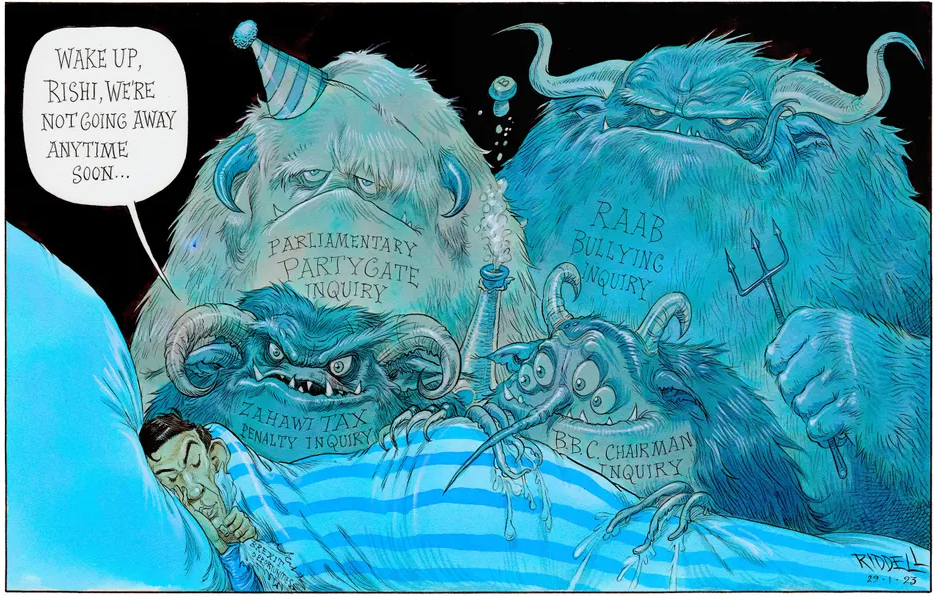
Rishi Sunak refuses to accept NHS in crisis and won’t say if he uses private GP

Nero fiddling while Rome burns? – Owl

Rishi Sunak has refused to accept that the NHS is in crisis, despite acknowledging the “enormous pressure” the health service is under this winter.

Adam Forrest www.independent.co.uk

The prime minister also refused to say whether he uses a private GP, insisting the issue is a “distraction from the things that really matter”.

Asked about overwhelmed emergency services, record waiting lists and whether the NHS was “in crisis”, Mr Sunak told BBC’s Sunday with Laura Kuenssberg: “The NHS is undeniably under enormous pressure.”

Pointing to the Covid pressures, the PM added: “Recovering from Covid is going to be tough and we’re seeing that play out on our TV screens every day and in communities up and down the country.”

Mr Sunak refused three times to discuss reports that he uses a private GP, saying: “As a general policy I wouldn’t ever talk about me or my family’s healthcare situation … it’s not really relevant, what’s relevant is the difference I can make to the country.”

Asked if he was registered with a private GP, Mr Sunak said: “Yeah, my dad was a doctor. I grew up in a NHS family.” Asked why he won’t tell people if he used a private GP, he replied: “It’s just a personal choice. I think healthcare is somewhat private.”

It comes as Royal College of Nursing (RCN) general secretary Pat Cullen, in an interview with The Independent, said Mr Sunak’s pledge to bring down waiting lists would fail without pay being addressed and said the upcoming strike would be the biggest of its kind in the world.

Ms Cuillen also said Mr Sunak needs to “come clean” about whether he uses a private GP. “I think he needed to come clean,” the RCN boss told the BBC. “As a public servant he is elected by the public, so he is accountable to the public – and when you’re accountable to the public you have to be honest with them.”

The NHS is set for more disruption when nurses strike on 18 and 19 January, while ambulance staff are striking on 11 and 23 January. Junior doctors will walk out for three days in March if they back industrial action at Monday’s ballot.

Mr Sunak said he wanted to have a “reasonable, honest, two-way conversation about pay” with the unions – but suggested health secretary Steve Barclay would only talk about next year’s pay settlement when he meets NHS union chiefs on Monday.

Mr Barclay has hinted at pay increases on the table if the unions will agree to efficiency savings – but will try to discuss the 2023-24 pay review process, which starts in April, rather than this financial year’s pay row.

Despite Mr Barclay’s previous refusal to discuss pay, Mr Sunak denied it amounted to a shift in the government’s stance. “The door has always been open,” the prime minister told the BBC. “When it comes to pay, we’ve always said we want to talk about things that are affordable, that are reasonable.”

Pressed again if ministers were willing to talk about pay for this year, he said: “We’re about to start a new pay settlement round for this year [2023-24]. Before that process starts, the government is keen to sit down with the unions and talk about pay, and make sure they understand where we’re coming from.”

His comments come after Ms Cullen said the RCN would be willing to “meet the government halfway” on pay – effectively cutting the union’s pay demands from 19 to 10 per cent.

Ms Cullen said there was a “chink” of optimism and detected a “little shift” in the government’s stance on pay from Mr Sunak’s comments on Sunday – but said she still did not expect Mr Barclay to engage with this year’s pay demands.

“What the government wants to talk about is pay going forward … and that’s not going to avert strike action that’s planned for 10 days’ time,” she told Sunday with Laura Kuenssberg. “It must it must be about addressing pay for 2022-23.”

She added: “The prime minister talked about coming to the table, now that’s a move for me, because I have said, let’s meet halfway,” she said. “Grasp the nettle, come to the table. I can’t negotiate on my own, and I can’t negotiate on the airwaves.”

Mr Barclay is expected to unveil extra funding to expand bed capacity in hospitals and care homes as part of a package to be announced on Monday.

Hundreds of millions of pounds will be spent on block buying thousands of care home beds, according to the Sunday Times, in a bid to free up 1,000 to 2,000 hospital beds and ease pressure on emergency services.

Government officials reportedly believe there are enough spare beds at Care Quality Commission approved facilities, and could have a positive impact within four weeks.

The government’s plans will also propose more “virtual wards”, in which patients are “remotely monitored” in their own homes, using wearable devices, according to the Telegraph.

The government has been accused of trying to blame the NHS pressures on Covid. Mr Sunak said: “I think it’s not right to ignore the impact that Covid has had. Has the NHS had pressures before? Of course it has, but Covid has undeniably had an enormous difference.”

Prof Clive Kay, chief executive of King’s College Hospital NHS Foundation Trust, asked if it sounded like the prime minister understood the gravity of the crisis facing the health service, said: “No, if I’m honest.”

Prof Kay told BBC: “I don’t think I heard [the PM] grasp the fact that this is a really, really difficult situation. This is not just a winter 2023 problem. We need some realistic conversations. The suggestion that’s going to be a quick fix, a sticking laster, it’s not a reality.”

Westminster Accounts  – Simon Jupp and Richard Foord

Simon Jupp received £16,500 from five donations, including from FW Carter.

Richard Foord received £6,820 from four donations.

Details can be found using this interactive tool:

Sky News and Tortoise Media interactive tool

Every year, millions of pounds pour into Westminster – into the accounts of the people, groups, organisations and parties that work and operate at the centre of government. Although most of this money must technically be disclosed to the public, the way that information is reported, stored and displayed almost guarantees the records will not be widely scrutinised.

Payment records are spread across different government websites, often split into small files covering short periods of time and regularly published with duplicate entries, spelling mistakes and other errors. The data required to examine the financial interests of just one Member of Parliament is laborious to gather.

Tortoise Media and Sky News have programmatically collected and analysed thousands of donations and payment records from MPs, political parties, and all-party parliamentary groups (APPGs). The resulting database is an extensive, though not comprehensive, record of the financial interests in Westminster.

Because the purpose of this database is to look at exterior sources of money and influence, it does not cover the everyday expenses required to run a central government’s main legislative body. Notably, you won’t find any reference to Members’ annual base salary of £84,144. Nor will you find references to the additional compensation made by government ministers and MPs with other extra responsibilities.

It also doesn’t cover outgoings. For example, members sometimes report that they’ve donated a sum to charity or given it to their local party, but our database doesn’t make that distinction. (You can find more detail on how and why we made decisions like this in our publicly-accessible methodology.)

What the database does include is the following datasets for the entirety of the current parliament – from its start on 19 December 2019 to the most recent disclosures:

  • From the Register of Members’ Financial Interests: Earnings from secondary employment, donations, gifts (including all gifted international travel), and other benefits for all sitting and former members of the current parliament
  • From the Register of All-Party Parliamentary Groups: Donations, gifts and other benefits for all APPGs that have operated at any point during the current parliament, as well as membership lists for each group
  • From the Electoral Commission: Donations, gifts and other benefits received by all political parties currently represented in the House of Commons

Simon Jupp received £16,500 from five donations,

Richard Foord received £6,820 from four donations.

May’s millions 

Theresa May has earned more outside parliament since leaving Number 10 than any other MP, and nine times more than she earned in her two years as prime minister.

Catherine Neilan www.tortoisemedia.com

May has been paid £2.5 million for speaking engagements since 2019. That includes a six-figure fee for a speech in Saudi Arabia and is more than double the outside earnings of Boris Johnson since his stint in Downing Street – although he is expected to overtake her soon. 

The two ex-prime ministers are among 25 MPs who have earned more outside parliament since the last general election than from their salaries. A larger group of 36 MPs have earned more than £100,000 outside parliament overall in the same period. 

In total, MPs have earned £17.2 million from second jobs, but the vast majority of that money has gone to a relatively small number of people: 20 MPs receive more than two thirds of their income from second jobs. In fact, May’s outside earnings account for nearly 16 per cent of the total.

The top 5 earners are all Conservative MPs: 

  • Theresa May – £2.55 million
  • Geoffrey Cox – £2.19 million
  • Boris Johnson – £1.06 million
  • Fiona Bruce – £711,749
  • John Redwood – £692,438

May’s clients for speaking engagements have included JPMorgan, the US investment bank, and Deutsche Bank, but she often doesn’t say who she is speaking to. 

One fee for £107,600 from the World Travel and Tourism Council was for a speech to a conference in Riyadh. The largest single item she has declared is £408,200 from the Cambridge Speaker Series, for six speeches last spring. She is the only MP to have registered any payments from this firm, which is based in California.

Other US-based speaking agencies which May has received six-figure sums from include the Washington Speakers Bureau and the Distinguished Speaker Series. Again, precisely who she was speaking to – and what was said – remains unclear. 

These earnings are among thousands of payments to MPs and associated bodies brought together by the Westminster Accounts tool, a searchable database developed by Tortoise and Sky News which makes it possible to create leader boards and league tables showing where the largest sums flow from and to.

The payments are from lobbyists and – often in kind – from all-party parliamentary groups (APPGs; informal networks of MPs often supported financially by companies seeking to forward an agenda) as well as second jobs. But not all second jobs are created equal. 

Matt Hancock, the former health secretary, lost the whip for his stint in the Australian jungle – the earnings for which had not been registered at the time of writing. But little is said of the many other sidelines supplementing MPs’ wages over many more hours and with much less clarity over the ultimate source of income. 

Revealed: NHS trusts tell patients they can go private and skip hospital queues

NHS trusts with record waiting lists are promoting ‘quick and easy’ private healthcare services in their own hospitals, offering patients the chance to skip years of queues observer can reveal.

ukdaily.news 

Hospitals offer hip replacements from £10,000, cataract surgery from £2,200 and hernia repairs from £2,500. MRI scans are offered for between £300 and £400.

This comes as figures show a record 7.21million people waiting for NHS treatment in England, routinely exceeding the maximum waiting time of 18 weeks for non-urgent referrals. Health experts warn of the danger of creating a “two-tier” healthcare system. On observer Investigation has revealed:

  • The East Sussex Healthcare NHS Trust has thousands of patients awaiting diagnostic tests but is offering “quick access” to scans through its private department.
  • Great Western Hospitals NHS Trust in Wiltshire is warning patients that services are “extremely busy” while its private department is promoting self-pay treatment for those who “don’t want to wait for an NHS referral”.
  • James Paget University Hospitals NHS Trust in Norfolk advertises private services on its NHS website, stating: “We provide highly experienced, consultant-led services… with no waiting list.”

The premium treatments are provided through private patient units owned and operated by NHS trusts, usually located on hospital premises. Procedures are often carried out by the same staff who would ultimately treat patients if they remained on the NHS waiting list. Under a code of practice, private services cannot impact NHS patient care and profits go back to the health service.

Sussex Premier Health, part of the East Sussex Healthcare NHS Trust, is doing MRI scans in 48 hours for £379, according to a recent Instagram promotion. The Trust has more than 7,800 patients awaiting diagnostic testing.

Sussex Premier Health MRI scan promotion. Photo: Instagram/sussexpremierhealth

Great Western Hospitals NHS Trust in Wiltshire provides private health care through a 20 bed unit, the Shalfourne suite. The private patient website states: “We believe that quality healthcare should be easily accessible.”

A woman whose elderly mother was treated by the Trust in October claims she was told she could avoid long waiting lists if she paid. “My 86-year-old mother has to wait two years for the NHS or can see the same surgeon in the same hospital and be treated for £1,200 in two weeks. How is that right?” she wrote on Twitter.

A North East teacher, who asked not to be named, said she borrowed £350 for an MRI scan. “At the appointment there were posters on the walls saying the times for results to be returned: three days for private, three weeks for the NHS.” The scan revealed she had a swollen cyst on her knee, which is treating had to become.

The private Candover Clinic, part of the Hampshire Hospitals NHS Trust. Photo: Instagram/Candoverclinic

Another trust, Hampshire Hospitals NHS Trust, sponsors services through its private Candover clinic. More than 53,500 patients were waiting for non-urgent elective treatment at the foundation in October.

Meanwhile, Kingston Private Health, the private unit of Kingston Hospital’s NHS Trust in south-west London, is offering “rapid access” without “long waiting lists”. Treatments include hip replacements costing £10,100. Patients will be cared for by “skilled NHS nurses”, the website says.

The Royal Free London NHS Foundation Trust writes on its private department’s website of a “quick and easy way to get immediate access to the healthcare you need”.

Under the Health and Social Care Act 2012, NHS hospital trusts were allowed to derive up to 49% of their income from private patients. By 2015/16 almost £600m a year was being generated by the NHS treating private patients.

The pandemic and record waiting lists prompted a review of private services by some trusts. The NHS Trust at King’s College Hospital in south London has suspended inpatient and outpatient private services during the pandemic to allow inpatient beds to be used for NHS patients. The stationary service has not yet reopened.

Archie Bland and Nimo Omer take you through the top stories and what they mean for free every weekday morning

Newcastle Hospitals NHS Trust, which has some of the longest waiting times in England, says its private patient facilities are “currently being used for NHS services”.

David Rowland, director of the Center for Health and Public Interest, said while it was “potentially defensible” for trusts to offer private services when the NHS was not under pressure, it was “very ethically dubious” during a crisis.

Advocates of private patient units say they can help boost revenue for trusts, but some experts say the benefits are unclear, arguing that if private departments lose money they could drain NHS resources.

Hampshire Hospitals NHS Trust said: “NHS care always comes first. Any revenue generated from our operations will be fully reinvested in the NHS.”

The Great Western Hospital NHS Trust said it has not operated a full private patient unit since Covid and where it offers private treatment “it is out of hours and where there is capacity in empty ambulances”, with NHS patients always “priority care”.

Kingston Hospital NHS Trust said it scaled back private activities over the winter and used the space to ease pressure on the NHS. “Of our 417 adult beds, we currently only have 2 patients in private beds,” a spokesman said.

The Royal Free said it has cut waiting lists over the past two years. “All profits from our private patient unit are reinvested into the trust. It is entirely separate from our NHS capacity and has no impact on the care provided to NHS patients.”

The Department for Health and Social Care said: “NHS hospitals have always been able to generate small extra revenue by treating private patients, which can then be used to improve services for NHS patients.”

Cullompton relief road needed to unlock 2,000 homes plan

Which comes first: the “garden village” of 2,000 or the relief road; and will the “garden village” development stop at 2,000? 

Sounds familiar? – Owl

Ollie Heptinstall www.devonlive.com

Plans for a new Cullompton relief road are progressing despite full funding not yet being secured. Mid Devon District Council is still awaiting the outcome of a fresh bid to the government’s levelling-up fund, which will provide most of the road’s revised new £28 million cost.

However, to prevent further delays, the authority’s ruling cabinet agreed on Tuesday to use a further £210,000 of £10 million cash already secured from Homes England to carry out further technical work. The planned road to the east of the town will improve capacity at junction 28 of the M5.

The aims it also to help reduce traffic through the town centre and unlock the development of 2,000 homes nearby, including an initial 500 properties as part of what is being called Culm Garden Village. It will also provide improved pedestrian and cycle access to the planned new Cullompton railway station, which could be in use by 2025.

Mid Devon approved a new bid to the government levelling-up fund’s second round last June, after an initial bid was rejected in December 2021. Originally set to cost £15 million, the road has now ballooned to a projected £28 million; blamed on increased construction costs, replacing sporting facilities and the potential amount needed to buy land.

Planning permission has already been granted for both the road and a new home for Cullompton Cricket Club, which will need to relocate. Devon County Council supports the project and has pledged £1.5 million, while the area’s Liberal Democrat MP Richard Foord has also given his backing.

Cabinet member for planning and economic regeneration, Councillor Richard Chesterton (Conservative, Lower Culm), told this week’s meeting: “It is the first of more than just this infrastructure that will be needed to deliver ultimately the Culm Garden Village.

“That’s part of what has made the levelling-up bid, we think, quite a good bid that hopefully government will accept, because it does bring forward so much else for the town and allow things that the government are obviously wanting to deliver in terms of the garden village.”

He added: “Hopefully the levelling-up [bid] will be granted but obviously, in the meantime, we have to deliver the relief road to be able to progress long-term on the other items that are on the agenda for Cullompton.”

Highlighting the project’s importance, Councillor Margaret Squires (Conservative, Sandford and Creedy) referred to a comment made by a Cullompton resident, stating: “The existing Cullompton could be dying if the relief road’s not delivered, so I welcome any progress.”

Councillors were previously told how the terms of the funding already provided by Homes England requires the road to be built by March. A council director acknowledged this agreement would need to be reviewed, probably when the outcome of the levelling-up bid is known.

Cabinet members agreed to use a further £210,000 of funding already in place to carry out further technical work, subject to an “agreement on appropriate indemnity” to protect the council from paying back the money if the levelling-up bid fails. It expects to hear whether the bid has been successful by the end of January.

Mid Devon: Second homeowner tax increase

They could pay double next year

Mid Devon plans to double council tax for second homeowners when new powers come into force.

Ollie Heptinstall, local democracy reporter www.radioexe.co.uk 

The government included the surcharge for second homes in its levelling up and regeneration bill last year, but they are not expected to be introduced until next year at the earliest.

On Tuesday [3 January] Mid Devon District Council’s cabinet agreed to adopt the policy, subject to further approval by full council, becoming the latest of Devon’s local authorities to provisionally sign up.

Before Christmas, South Hams Council also agreed to double council tax for people who own second homes, once it has the power to do so. Cornwall Council has agreed likewise.

According to a report, the 100 per cent premium could bring more than £400,000 in extra council tax revenue per year.

It is hoped the change will also free up more properties and ease the current housing crisis in Devon,  with claims that key workers are struggling to move to the area due to the lack of suitable housing.

At this week’s meeting, deputy council leader Clive Egington (Conservative, Taw Vale) said: “I’m sure a number of members are content that the provision for second homeowners will be increased to 200 per cent with effect from 1 April 2024.

“I know this is something that cabinet for a number of years has discussed and wish to have implemented and I’m glad to see that the wherewithal has now given us, effectively, the opportunity to do this.”

When the levelling-up bill was first unveiled last year, including allowing English councils to be able to double tax on unoccupied second homes, housing secretary Michael Gove told Times Radio that he didn’t think second homes were “immoral.”

But he added: “I think it’s important to recognise that when you have people in places like Devon who are local folk who can’t get onto the housing ladder, because the price of property has been bid up by second homeowners, sometimes you need to take appropriate steps in order to make sure that communities can flourish.”

Mid Devon’s cabinet also provisionally agreed to adopt another new power in the levelling-up bill, allowing councils to double council tax faster on properties that have been empty of furniture and residents for 12 months – a reduction from the current two years.

A full meeting of the council will be asked to rubber-stamp the decisions in the coming weeks.

Exclusive: Downing Street Accused Of ‘Quietly Editing’ One Of The PM’s Five Promises To Voters

“No tricks, no ambiguity” – Rishi Sunak

Downing Street has been accused of “quietly editing” one of Rishi Sunak’s five new promises to voters.

Kevin Schofield www.huffingtonpost.co.uk 

The prime minister unveiled the pledges in a major speech setting out his plans for 2023.

They included a vow to halve inflation this year, grow the economy and cut hospital waiting lists.

Sunak said: “No tricks, no ambiguity – we’re either delivering for you or we’re not.”

The original version of the announcement published on the government website after Sunak made his speech on Wednesday says: “By March, NHS waiting lists will fall and people will get the care they need more quickly.”

The fourth bullet point claims waiting lists will fall "by March".

The fourth bullet point claims waiting lists will fall “by March”.

UK government

However, visitors to the same page are now told that it was “updated” on Thursday and the March reference has been removed.

That pledge now says: “NHS waiting lists will fall and people will get the care they need more quickly.”

The page has since been edited and the March reference removed.

The page has since been edited and the March reference removed.

UK government

Shadow health secretary Wes Streeting told HuffPost UK: “Just 48 hours after promising the British people a series of cast-iron promises, Sunak is already quietly editing the small print.

“The longer we give the Conservatives in power, the longer patients will wait.”

Answering questions from journalists after his speech, the PM said: “By spring of next year, we will have practically eliminated those waiting over a year, with the overall waiting list falling.”

A Downing Street source said the target for bringing waiting lists down is March 2024, and the government website had been edited to avoid any confusion.

HuffPost UK can also reveal that former health secretary Sajid Javid first made the March 2024 vow almost a year ago.

Speaking last February, he said: “Assuming half of the missing demand from the pandemic returns over the next three years, the NHS expect waiting lists to be reducing by March 2024.

“Addressing long waits is critical to the recovery of elective care and we will be actively offering longer waiting patients greater choice about their care to help bring these numbers down.”

More on PPE Medpro: Michelle Mone-linked firm referred to UK health watchdog

A company linked to the Conservative peer Michelle Mone was referred to the UK’s health products watchdog for an investigation after it allegedly presented a false document to the government when tendering for PPE contracts.

Can it get any worse? – Owl

David Conn www.theguardian.com 

The referral of the company, PPE Medpro, was described in a high court document made public this week, setting out the legal claim against the company by the Department of Health and Social Care. The DHSC is seeking the return of £122m in public money it paid for the supply of sterile surgical gowns, plus £11.6m for storing and disposing of them.

It has accused PPE Medpro of delivering gowns that were not sterile, did not comply with the regulations for the production of medical devices, and could have compromised patients’ safety had they been used in the NHS.

The DHSC awarded that gowns contract, and another contract worth £80.85m for the supply of face masks, to PPE Medpro within weeks of Mone approaching Conservative ministers in May 2020 offering to supply PPE through “my team in Hong Kong”.

In the court document setting out its claim, the DHSC states that PPE Medpro “made multiple offers to supply different types of PPE”. The referral of the company to the Medicines and Healthcare products Regulatory Agency (MHRA) related to a different tendering process from the one that led to the DHSC granting the company the gowns contract, the legal claim states.

“[PPE Medpro] was found to have supplied a test report (numbered SHAT06648491) purporting to be from an entity called Intertek, but which Intertek denied having issued. As a result, PPE Medpro was referred to the MHRA’s compliance unit for further investigation.”

Intertek is a large, global, UK stock market-listed quality assurance company, which provides technical testing, inspection and safety certification services in a wide range of industries, including medical devices.

PPE Medpro did not respond to a question from the Guardian this week about the DHSC’s allegation that it supplied an allegedly false document purporting to have been produced by Intertek, nor about the referral to the MHRA. Regarding the DHSC’s legal claim, the company said it refuted all the allegations, argued that the gowns it supplied did meet “correct quality standards and specification”, and said it will “rigorously defend” the court action.

In a statement, Intertek said: “We are not involved in the MHRA investigation or court process. We have reviewed the reference to us in the court document and we have no further comment to make.”

An MHRA spokesperson said the agency could not confirm the outcome of the referral to its compliance unit: “We are not able to provide updates regarding the state of any referrals or investigations due to the confidentiality requirements set out in the Medicines and Medical Devices Act 2021.

“However, we review all information and referrals we receive and where necessary we will take appropriate regulatory action.”

Mone has been under intense public and political pressure since the Guardian reported in November that leaked bank documents indicated she and her three adult children secretly received £29m originating from PPE Medpro’s profits on the government deals. Her lawyer told the Guardian at the time: “There are a number of reasons why our client cannot comment on these issues and she is under no duty to do so.”

Mone has previously denied via her lawyers that she had any involvement in PPE Medpro, despite her approach to ministers in May 2020 and the Guardian reporting last year, based on leaked files, that she did appear to have been secretly involved. Her lawyer has also said she did not declare PPE Medpro on her Lords register of interests because “she did not benefit financially and was not connected to PPE Medpro in any capacity”.

Lawyers for Mone did not respond to requests for comment about the DHSC’s legal claim or the purported Intertek document.

PPE Medpro is the subject of an ongoing potential fraud investigation by the National Crime Agency (NCA). Lawyers for PPE Medpro have declined to comment on the NCA investigation.

For the Love of Money: Michelle Mone – the Epitome of Modern Conservatism Byline Times 

The scandal-hit baroness was elevated for years by the party now backtracking over the PPE firm linked to her that won millions in pandemic contracts

bylinetimes.com

Michelle Mone is today’s tabloid baddie.

The baroness stands accused of earning a fortune from two 2020 contracts that went to PPE Medpro worth £203 million to supply masks and medical gowns during the pandemic.

The claim is that the company, which was only a few weeks old when it landed its first contract, was lobbied for by Conservative peer Mone herself. If true, this might constitute an abuse of power, given that she enjoys a seat in the House of Lords. 

It has been alleged that millions of pounds worth of the medical gowns were never even used, even though PPE Medpro claims it delivered the contract to its terms and supplied equipment “fully in accordance” with the contracts.

It has also recently been revealed that a company linked to Mone’s husband donated £171,480 to the Conservative Party. The payments were made through UK firm Lancaster Knox LLP, which forms part of the Doug Barrowman Knox Group. The donations were made before he and Mone were alleged to have benefited from the PPE deal struck during the pandemic.

In response, the Government has announced it is suing PPE Medpro, which won contracts through the so-called ‘VIP lane’ of suppliers, claiming that the gowns supplied “did not comply with the specification in the contract”.

Mone’s reputation stands in tatters. But she isn’t the only villain in all of this.

The baroness is the product of a Conservatism that has uplifted and honoured her up until this point of hubris. She was steadfastly very much the epitome of a modern day Tory, and the Government suing the firm linked to her shouldn’t mask what’s really under all that political greasepaint.

When that is removed, it is clear that – in truth – Mone represents stolid Conservative values.

First, she is the epitome of the Conservative ‘rags to riches’ promise. Born in the east end of Glasgow, her story is one of being raised in a one-bedroom house with no bath and becoming a millionaire through hard work and perseverance. It is the ‘pull yourself up by your bootstraps’ political trajectory that she shares with the likes of Nadine Dorries, Sajid Javid and Gillian Keegan.

Although just one in 100 Conservative MPs have come from a working-class job, Mone’s rise from The Barras to the Baronetcy is held up as heady proof that Thatcher’s promise holds true. The self-same entrepreneurial spirit that saw Mone make her millions out of lingerie was lauded until it made the Conservative Government look bad. 

Mone’s story is representative of a Conservative ethos that has all too clearly been recently revealed: that political connections are not there to debate ethical principles and work together for society. They are there for profit. Her messages to Michael Gove – WhatsApp discussions the Government once refused to admit even existed – were just a fraction of the secret lobbying endemic in Westminster.  

Connections matter. Yes Gove, poor man, claimed he was “bullied” into giving her company a contract. But don’t forget that – as reported by this newspaper – more than half a billion pounds in Government PPE deals went to Conservative backers. Remember too that companies which were referred by Conservative MPs and peers to the expedited ‘VIP lane’ have since seen their profits quadruple. When it comes to Conservatives profiting from the pandemic, Mone is not alone.

But Mone’s own place and behaviour in the Lords also reflects a wider pattern that seems noticeable among some Conservative peers.

The baroness, who joined the second chamber in 2015, has not taken part in a vote since last April and has not spoken in a debate since March 2020. She has now taken a ‘leave of absence’ from the Lords – a seeming technicality given her attendance rating – but hers was always a lukewarm commitment to public service that exposes the upper house for what it has become.

Take Lord Evgeny Lebedev, co-owner of the Evening Standard and the Independent newspapers. He was appointed to the Lords by Boris Johnson in December 2020, but has since turned up to just 1% of sessions. Similarly, Lord Bamford, the JCB owner and Conservative Party donor, attended only 32 times between April 2015 and March 2022. Indeed, of the 1,042 peers who have sat in the House of Lords since April 2015, 142 (13.6%) attended the Palace of Westminster on 25 days or less, with 58 having never attended during that period. 

Under the Conservatives, the House of Lords has become more sclerotic, not less. The fact that this roughly 800-member club has seen appointments such as Johnson’s brother, Lord Johnson of Marylebone, has already raised concerns. And that, of all upper houses in the world, only the Chinese National People’s Congress is bigger shows just how much it’s been packed by donors and sycophants.

Mone’s place there – or her absence – is reflective of a wider decay of an institution whose average age is 71. No wonder Labour wants to get rid of it.

Then there are her opaque business interests in the Middle East. Whether working with the Sultan of Oman or trying to sell apartments in Dubai using crypto-currency, Mone reflects a wider Conservative obsession with the oil-rich states. 

‘Follow the money’ might be an investigative journalist’s mantra, but it is also a Conservative’s own. From scandals such as the Conservative Party chair Ben Elliot failing to disclose client ties with Middle East envoys, to Middle East-based magnates being revealed as major party donors, and the UK Government being paid more than £300 million by Saudi military for weapons systems training, there are countless political scandals linking Conservative politics to the Gulf states. These are the result of stronger post-Brexit ties with countries like Oman and Saudi Arabia driven forward by a Tory Party desperately seeking economic allies, regardless of their human rights records.  

Finally, there is Michelle Mone’s own poor character. There was the Met Police investigation, for instance, into allegations that she sent a racist message after a banker of Indian heritage Richard Lynton-Jones complained to the police. During a disagreement following a fatal yacht collision in 2019, Mone told him in a WhatsApp message that he was “a waste of a man’s white skin”. She settled for £50,000.

There was also the time she replaced Rod Stewart’s wife with his ex, choosing Rachel Hunter as the face of her bra company Ultimo, ditching model Penny Lancaster. The singer branded Mone “a manipulative cow”. Mone said she had done it “for the publicity”.

Then, in 2016, she faced her fourth employment tribunal over claims of bullying and failure to pay wages, her company having lost or settled the previous three. Mone had bugged employees’ offices and listened to the recordings for evidence of disloyalty.

Mone’s behaviour – evident in her litigious threats to reporters covering the PPE scandal – appears to show a person who seems to care little for the feelings of others. And, in this way, given all the scandals of bullying by Conservative ministers – with Dominic Raab, Priti Patel and Gavin Williamson all exposed as martinets – she seems to fit right in.

Mone then does seem to be driven forward by a desire for power not principle, whatever the cost. And just over her shoulder, stood the Conservative Party – facilitating, or at the least not condemning, her behaviour all the way.

District council agrees council tax reduction changes

At a cabinet meeting on Wednesday (4 January), East Devon District Council agreed a series of council tax reduction (CTR) changes to help people in arrears during the cost-of-living crisis.

sidmouth.nub.news 

Currently, 18 per cent of households in tax arrears in East Devon are of working age, up from 13 per cent in 2019 before the start of the covid pandemic.

It was decided that the council should cover 100 per cent of council tax for band one households – up from 85 per cent – and matching the discount already being applied by North Devon, East Devon and Teignbridge.

The council agreed that self-employed people who work at least 16 hours per week are entitled to support, in line with universal credit. This means people who are self-employed who do not work more than 16 hours a week due to caring responsibilities are covered under the scheme.

Claims can be backdated for up to 12 months, with any increased income from universal credit also being considered when dealing with tax reduction claims to ensure that those receiving such funding or other emergency schemes don’t lose out.

Devon Fire and Rescue Service, and Devon and Cornwall Police, both supported the scheme, although Devon County Council objected on the grounds that it is forecast to cost the council more than half a million pounds.

Of the 178 members of the public who responded to a six-week consultation, 25 were “very against” the planned council tax reductions for eligible people.

Some respondents felt that discounting taxes based on low income did not ‘incentivise working,’ and that cases involving self-employed workers should be considered using their actual income, rather than the hours they work.

Others suggested that allowing backdating for 12 months would be “excessive,” and that considering emergency income through other schemes is “unfair” to those whose income does not include government support.

Cllr Paul Hayward (Independent East Devon Alliance, Yarty) asked that those against the proposal show a little more compassion.

“It reads like watching the first 10 minutes of Christmas Carol over and over again,” he said. “And it appears that the milk of human kindness has just curdled for some of these people who respond.

“It’s just astonishing that… we are simply attempting to help those most vulnerable people who have the least, who are struggling.”

Libby Jarrett, the officer presenting the proposal, reasoned that increasing band one support to 100 per cent has the same effect on the tax received as simply writing off the arrears. Cllr Hayward agreed.

“If we don’t do this, they’ll end up reneging, they’ll end up defaulting, and we’ll end up in the same position,” he said. “So actually we can be ahead of the game and help people at this time of absolute crisis, so I’m delighted to propose this.”