Chris Pincher raises chilling questions about Tories’ ability to tackle sexual harassment

Today, I spent a lot of time thinking about a man named Alex Story. A former Olympic rower, he once looked like a rising star in the Tory Party. Then in November 2017, Story gave an account of an encounter he’d had with Tory MP Chris Pincher when he was 26 years old.

Any echos come to mind? – Owl

Kuba.Shand-Baptiste inews.co.uk (Extract)

Story alleged that after an afternoon of political canvassing – a common way MPs spend time with young activists – Pincher had suggested the two grab dinner. Pincher then directed a taxi to take them both to his home, instead of – as Story had expected – a restaurant. “The deceit employed to get me to his flat went beyond misreading the signs”, Story later claimed.

Pincher allegedly poured him a whisky, upon which Story “suddenly felt a bit woozy”, only to find Pincher untucking the back of his shirt, massaging his neck, and whispering: “You’ll go far in the Conservative Party.” Despite Story’s refusals, Pincher then changed into a bathrobe “like a poundshop Harvey Weinstein”, before Story escaped.

When he went public with this claim in 2017, Pincher insisted that “I do not recognise either the events or the interpretation placed on them.” He continues to deny them. He resigned as Assistant Whip and later referred himself to the Conservative Party’s own complaints procedure and to the police, neither of which found enough evidence to pursue the case. The Conservative Party later found that he had not broken their Code of Conduct.

Pincher rose back up the party, later becoming Deputy Chief Whip as a reward for loyalty to Boris Johnson. Alex Story left politics. His career had already been damaged when he was mysteriously blocked from an expected nomination for a European Parliament seat in 2016; friends allege this was because he’d already complained about Pincher.

Naturally, Pincher continues to deny this old story. But in the 24 hours since he was witnessed drunkenly groping two different men in the Conservative-affiliated Carlton Club, numerous MPs and Tory staffers have spoken to journalists (including me) about rumours that have circulated about Pincher’s pattern of behaviour. When asked directly, the Prime Minister’s spokesman could not deny that the PM was aware of “unsubstantiated” allegations about this behaviour before appointing him Deputy Chief Whip – he simply denied knowing of specific allegations. Against that background, the rest of us can make up our own minds about whether Story was telling the truth.

What breaks my own heart is that he went public on 4 November 2017, just as the #MeToo movement was spreading across the world. Inspired by the women who spoke out against Harvey Weinstein, a number of young women and men working in politics came forward to tell our own stories about sexual harassment in Westminster – myself included.

In that giddy week, with the sheer number of us speaking out, it seemed Westminster might finally face up to the endemic problem of sexual predation amongst its power brokers. The problem was widespread across all parties, but the Tories had a particular problem because they had been in power for a long time, where executive power breeds entitlement and enables cover-ups. That was nearly five years ago…..

‘Who will respect him after this anyway?’: Voters in Tamworth call on MP Chris Pincher to resign amid scandal

Residents in the Staffordshire town of Tamworth say MP Chris Pincher should quit his seat after being accused of groping two men on a night out.

Colin Drury www.independent.co.uk

Overnight, Mr Pincher – a Conservative first elected here in 2010 – had quit as the government’s deputy chief whip after admitting he got drunk on a night out in London. Further allegations suggest he also groped two male members of parliamentary staff. “I drank far too much,” he wrote in his resignation letter. “I’ve embarrassed myself.”

In the smoking area of the Phoenix pub on Tamworth high street, Dave Markole was happy to admit that he too, like the local MP, had occasionally drunk too much and embarrassed himself. “We’ve all done that, mate,” he said between drags. “Me as much as anyone.

“Have a skinful by all means, but behave,” the 52-year-old truck driver declared.

Such opinions were not uncommon in this Staffordshire market town yesterday morning.

The fact that the incident took place in Piccadilly’s £1,700-a-year Carlton Club added an extra frisson to the whole episode for voters – and drinkers – in Tamworth, a town currently being savaged by the cost of living crisis. Nevertheless, noted Mr Markole philosophically, it was perhaps “a good job it was there [and not in the Phoenix]”.

Politics hadn’t been talked about so much in the place, one bar member said, since… well, since partygate.

What were people saying? “Well, I don’t think he’s won himself any new voters,” she replied.

Touché.

Outside on the high street itself, retired lecturer Ray Williams was adamant that Mr Pincher – who has also had the party whip removed – should now stand down as the town’s MP.

“He should resign immediately, simple as that,” the 71-year-old said. “The groping might just be an allegation at this point, but someone in his position of seniority should not be putting himself in a position – on a night out – where these kind of things can happen.”

Sleaze, he feared, was becoming “normalised” by a serious of Conservative scandals.

“We have a right to expect better from our politicians and certainly from the party of government,” said Mr Williams, who voted Tory in 2019. “He should resign. Who will respect him after this anyway?”

By Friday afternoon, there was no suggestion Mr Pincher would be handing in his parliamentary notice, with Boris Johnson saying he now considered the matter closed. Which – in purely political terms – might not be altogether unsurprising.

Why? Because, if Mr Pincher did quit as an MP, the resulting by-election could well sound the death knell for the prime minister.

Strictly speaking, Tamworth is something of a bellwether constituency: since its creation in 1997 it has voted for the winning party at every general election. Yet since 2010 the Tories have built up a 19,000 majority here, and the party also holds 25 of the 30 borough council seats.

Were this constituency to become the latest blue patch lost mid-term, Mr Johnson – still scarred by only just scraping through a confidence vote earlier this month – would find himself with even fewer friends. One suspects a trip to Kyiv would be planned for results day.

How, though, did the local Conservatives feel about the thought of such a contest? They were not for talking, it seemed. A message had apparently gone out to senior councillors to keep it buttoned.

Did silence not effectively condone the local MP going out and getting plastered? “No comment,” said Alex Farrell, a cabinet member here.

Would he personally be comfortable voting for a man accused of groping? “That’s a good question,” came the reply. “But I’m afraid I’m about to go on holiday.”

If the local blues wouldn’t answer, Margaret and Stacy Anderson – a mother and daughter sat outside the landmark St Editha’s parish church – certainly would.

“I wouldn’t have voted [for the Conservatives] again anyway because of how they’re dealing with the cost of living,” said Stacy, who did go blue in 2019. “But now this too. They’re playing us for fools – out drinking and getting up to no good while the rest of us scrape by.”

The 43-year-old mother of three had just been to Farmfoods to help her mum Margaret pay for her weekly shop because prices had gone up so much in recent weeks. “Fair enough, they’re giving out a payment later this year,” she said. “But just dishing out money isn’t a proper fix. What happens when that runs out? Where are the ideas to solve this in the long term?”

The trainee ecologist thought about it and answered her own question: “They’re not coming up with them,” she said, “because they’re too busy misbehaving.”

No, this isn’t just Tory sleaze. This looks like a crime wave

Letting an alleged sex pest resign from one of his two overpaid jobs isn’t punishment enough, says Fleet Street Fox

Fleet Street Fox www.mirror.co.uk (extract – click on link for full article)

You have to wonder what, exactly, the Tories expected to happen when they gave the job of ‘whip’ to a man called ‘Pincher’.

But considering Boris Johnson’s propensity for doubling, ahem, down, we can presumably expect that a Mr Groper will be named as next incumbent of the Woolsack, and auditions for the role of ‘Black Rod’ will be held in the 1922 Committee’s Red Room of Pain.

The sound of knicker elastic being twanged by Tories has caused many – mostly those who remember the 1990s fondly – to talk about sleaze and the final days of John Major. Which is to say, it’s caused many people to talk more b*llocks than an MP being teabagged….

…….What the Tories have on their hands at the moment, however, is allegations of sexual assault, investigations of suspected rape, multiple accusations of sexual harassment, and drunken indecent assaults. That’s not ‘sleaze’ – that’s a crime wave.

If a similar tsunami of criminality were to be alleged in any other organisation – a school, for instance, a hospital, or a charity – it wouldn’t be dismissed as simple pervery. The heads of those organisations wouldn’t shrug it off as an embarrassing incident, and if they did, the head would be squeezed out by lunchtime…….

Breaking News: Chris Pincher MP suspended

Tory MP Chris Pincher suspended by party over ‘drunken groping’ claims

Sky news.sky.com

A Tory MP accused of drunkenly groping two men has been suspended by the party.

Chris Pincher has had the Conservative whip withdrawn at Westminster over the claims, forcing him to sit as an independent without the support of the parliamentary group.

The 52-year-old resigned from his role as deputy chief whip and apologised after admitting he had drunk “far too much” and “embarrassed myself and other people” on a night out.

Mr Pincher “groped two men in front of others” at the Carlton Club in the St James’s area of central London, a government source told Sky News.

One of those groped is an MP, and the second one may also be a member of parliament, the source added.

Cabinet minister Simon Hart said any victims should raise complaints, telling Sky News that something had gone “terribly wrong” and that the allegations made him “very sad”.

In his government role, Mr Pincher had been responsible for party discipline and the smooth running of government business at Westminster.

At the last election, Mr Pincher was returned to his Tamworth seat with a majority of more than 19,000 and this could be vulnerable if he were to step down, coming after two recent bruising by-election defeats for the Tories.

One of those saw the Tories have a 24,000 majority wiped out by the Liberal Democrats in Honiton and Tiverton – a record reversal for the party.

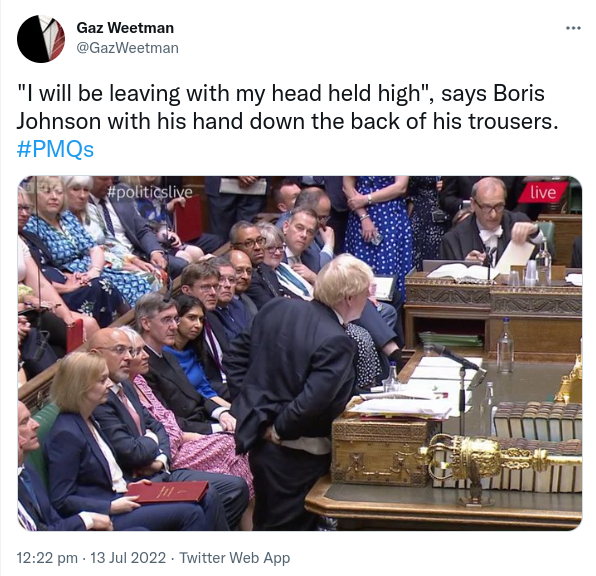
Boris Johnson and Chris Pincher

PESTMINSTER RETURNS — AGAIN

“Surely sexual harassment is worse than Googling tractors?”

Politico London Newsletter

 Boris Johnson wakes up in London today probably wishing he could jump back on a plane as he grapples with the fallout from the resignation of his deputy chief whip in the Conservative Party’s fifth major sex pest scandal in three months.

SCOOP — PM under pressure: Playbook can reveal this morning that Johnson was made aware of allegations of inappropriate behavior by Chris Pincher before the last reshuffle, at the time when Pincher was in the frame as a potential chief whip.

More detail: Three sources, including one Tory MP who personally raised the issue, told Playbook that the PM was made aware of complaints about Pincher’s conduct but appointed him deputy chief whip in February anyway. No. 10 did not deny the story last night.

Hang on, what’s happened? Pincher quit as the government’s deputy chief whip just before 8 p.m. — in a cracking scoop by the Sun’s Noa Hoffman (less than a week into her new job with the paper) and Kate Ferguson — with a terse letter which began: “Dear prime minister, last night I drank far too much. I’ve embarrassed myself and other people which is the last thing I want to do and I apologize to those concerned.”

**A message from Blackstone: Rapid investment is needed in new housing across the UK. We’re investing in the housing needs of the future by backing companies like St. Modwen, one of the UK’s leading developers of homes, that put quality, sustainable housing at the heart of their business. Find out how.**

The allegation: Pincher allegedly groped two men on Wednesday night while drunk at the Carlton Club in St James’s, triggering several complaints by MPs to the whips’ office about his behavior — read the Sun story in full here. A witness who was present told Playbook that Pincher was “clearly trying to seduce several young men.” The Guardian reports — and Playbook has heard too — that Tory Whip Sarah Dines is one of the people who reported Pincher.

The question now: Why did the PM decided to appoint Pincher back in February as the No. 2 in command in the whips’ office — which is responsible for overseeing and disciplining MPs’ behavior — when Johnson had been made aware of concerns about Pincher’s own conduct?

No. 10 view: A No. 10 source said that allegations about Pincher had been conveyed to the PM’s chief of staff Steve Barclay, who flagged them to the Cabinet Office propriety and ethics team during the February reshuffle and refused to sign off the appointment until they were looked at. Pincher’s appointment was signed off only after PET gave it the green light, the No. 10 source claimed, something which delayed the reshuffle by hours (though it was reported at the time that the delay was partly down to Pincher resisting the deputy title when he had been expecting to get the top job).

Open secret: In this essential piece in May, POLITICO’s Esther Webber reported claims that a member of the government had a “minder” to ensure he left events without drinking too much and getting into trouble — and we can now reveal the MP concerned was Pincher. That obviously went well. He did not respond to a request for comment last night, and a senior party official said they were not aware of the claim.

What the Tories are saying: A Tory Party source told the Mail’s Jason Groves, among others: “The PM thinks he’s done the decent thing by resigning. There is no need for an investigation and no need to suspend the whip.” Playbook is told that the PM texted Pincher last night to accept his resignation and thank him for taking responsibility for his wrongdoing.

However: It doesn’t feel like that line will hold for long — Twitter is already flooded with incensed quotes from Tory MPs who think the position is untenable. A Tory source pointed out to Playbook: “If anyone makes a complaint against him, CCHQ would have to investigate (and given he’s admitted he did it) they’d have to suspend party membership. You can’t keep the whip if you’re not a member without it looking ridiculous.” And an influential female Tory MP said: “If it’s a sexual assault and he’s admitted it, he needs to lose the whip.”

Knives out: Another well-connected Tory MP said: “No. 10’s initial response — suggesting he’s done ‘the decent thing’ and allowing him to retain the whip — tells us that Boris Johnson doesn’t take allegations of sexual assault as seriously as the leader of a government should and is the latest demonstration of why he is unfit to be prime minister. The standards of behavior expected in an organization are set by the person who leads it.”

Needless to say: The two people allegedly groped by Pincher on Wednesday may well not be satisfied with the No. 10 response. Their identity was unclear amid conflicting reports last night — Sky’s Beth Rigby and the Mail’s Jason Groves hear that at least one is an MP, Insider’s Cat Neilan hears that at least one is not; according to the Guardian both are said to be staffers.  

Activist distress: It’s difficult to overstate the dismay among loyal Conservative Party activists and strategists — including some in government — about this state of affairs. A Tory source told Playbook: “Pincher had earned the nickname ‘arse pincher’ and his impropriety was known about. He was empowered nonetheless.” And a party member affected by the Imran Ahmad Khan case summed up the sentiment among younger Conservatives to Esther: “Feels a bit like Groundhog Day in the party right now.”

Incredibly: Pincher writes a monthly column “on drink” for the Critic.

What’s more: Pincher had to resign as a whip back in 2017, after being accused of drunkenly making a pass at former Olympic rower Alex Story. Story alleged at the time that Pincher attempted to untuck his shirt, massaged his neck and whispered: “You’ll go far in the Conservative Party.” Pincher referred himself to the police after the incident and was cleared of wrongdoing by a Conservative Party investigation. But the decision to reappoint him to a more senior role in the whips office after that whole scandal — let alone after having been warned about fresh concerns from MPs — is a questionable judgement call to say the least.

Of course there’s this: Pincher was instrumental in shoring up support for the PM last winter when the Partygate scandal was at its peak and was effectively rewarded with the deputy chief whip’s job, as the Telegraph’s Ben Riley-Smith points out.

Reminder: Neil Parish was suspended from the Tory whip after he referred himself to the standards commissioner over complaints he had been looking at porn on his phone in the Commons. He claimed he had chanced upon the offending page accidentally while looking up farming tools. As one Tory staffer quipped last night: “Surely sexual harassment is worse than Googling tractors?”

What does population growth mean in terms of growth in households and houses?

Household sizes have been gradually reducing over the years as the population ages and as families have fewer children.

From the 2011 census  figures for the South West  it is possible to estimate that about 33% (one third) of households comprise a single person, about 20% (a fifth) comprise families of just two and the remaining 47% comprise families of three or more

Currently it is  estimated that  across the UK there are 2.4 individuals per household.

For local planning purposes EDDC uses a lower average of 2.2 individuals per household.

Over the past eight years the average number of dwellings completed in East Devon is 918 per year. For the purposes of housing monitoring, generally, a dwelling is defined as being a separately Council Tax banded property. 

In East Devon, the ONS estimates that population size has increased by 13.8%, from around 132,500 in 2011 to 150,800 in 2021, an increase of 18,300. 

Assuming 2.2 individuals/household means that around 8,318 households must have been created in the ten year period, implying house building averaging around 830/year. This is close to the recorded dwelling completion rate and indicates that local household occupancy rate is below the national average, as you might expect for a retirement area.

During the development of the 2015 Local Plan it was estimated that only around 580 houses/year would be required to satisfy purely demographic growth trends. 

The Old Guard’s “build, build, build” policy was based on a high economic “jobs-led” growth scenario of around 3% that simply hasn’t materialised. It required a build rate of 900 houses/year minimum.

If this economic growth hasn’t materialised then it begs the question of who is occupying these properties? We know that, locally, housing demand is running ahead of need.

Has the excess development over demographic needs estimated by the ONS been taken up by homes for retirement, for second homes (estimated at 4% in 2018 and rising) or for housing to satisfy Exeter’s needs? 

Are there any clues in the changes in age profiles in East Devon?

Wilfred Johnson’s godmother given government salary via closed recruitment process

Ava Evans www.joe.co.uk 

A close friend and godmother to the prime minister’s son was given a £350-a-day role at the Home Office without the position being first advertised, a freedom of information request has revealed.

Nimco Ali OBE was appointed to the advisory role in October 2020, where she worked around 2 days a month on the UK government’s strategy on tackling violence against women and girls.

While the role’s announcement stipulated she would feed into a potentially influential report, a source close to the Johnsons said that Ali had “hassled Carrie for a job” and that the role “was just a dressed up way for her to hang out with Priti.”

Information released by the Home Office shows it was a direct appointment, meaning the role was not advertised and was not offered to anyone other than Ali.

It also appears the role may have been specifically created for her, with no evidence available to prove the job had existed prior to her employment.

Ali is a prominent social campaigner who has long worked on publicising the horrors of female genital mutilation (FGM), a practice she was subjected to as a child.

She went on to form the Daughters of Eve organisation to campaign against FGM, and later became the CEO of The Five Foundation, a global partnership to end female genital FGM.

Notably, Ross Kempsell who was personally appointed by Boris Johnson to a senior comms role in CCHQ, worked as the foundation’s secretary.

Ali has a longstanding relationship with wife of the prime minister, Carrie Johnson.

A few months after the government advisory appointment had been announced, it is understood Ali stayed with the couple during the 2020 festive period at Downing Street, despite tough social distancing rules being in force throughout London.

At the time Downing Street insisted no coronavirus rules had been broken, and she is said to have stayed over the Christmas lockdown period as part of their childcare support bubble.

During the height of lockdown, Ali was seen out walking Wilfred with Carrie Johnson around London’s West End. 

Ali has also been a guest at the prime minister’s taxpayer funded, grace-and-favour-home, Chequers.

A spokesperson for the Home Office said: “Nimco Ali has a strong track record of campaigning on violence against women and girls (VAWG) issues, raising awareness and educating people about Female Genital Mutilation.

“She brings a huge amount of experience and passion to this role, providing independent advice to help inform Government policy and challenge the status quo.

“She was appointed via a direct appointment to lead a short-term project, and her appointment was agreed by the Cabinet Office Public Appointments Policy Team.”

Nimco Ali did not respond to request for comment.

Chris Pincher ‘groping’ resignation shows Tories are ‘mired in sleaze’, says Angela Rayner

“Boris Johnson has serious questions to answer about why Chris Pincher was given this role in the first place and how he can remain a Conservative MP.”

[The Tamworth constituency has swung between Labour and the Conservatives since the boundaries were redrawn in 1976.]

Emily Atkinson www.independent.co.uk

The resignation of the deputy chief whip shows the Conservatives are “mired in sleaze”, Angela Rayner has said.

Chris Pincher, who was appointed to the role last February to strengthen party discipline, resigned following a drunken incident in which he said he “embarrassed myself and other people”.

He stood down after allegedly assaulting two fellow guests at the Carlton Club – a Tory Party private members’ club in London’s Piccadilly – on Wednesday evening, The Sun claimed.

The Metropolitan Police said it was not aware of any calls to that location last night. It also said there was no record on its systems of any related reports submitted today.

Reacting to Pincher’s resignation, Ms Rayner, the deputy Labour leader, said in a statement: “This latest episode shows how far standards in public life have been degraded on Boris Johnson’s watch.

“Boris Johnson has serious questions to answer about why Chris Pincher was given this role in the first place and how he can remain a Conservative MP.

“The Conservative party is so mired in sleaze and scandal that it is totally unable to tackle the challenges facing the British people.

“The Conservative MPs who continue to prop up this prime minister’s paralysed administration need to grow a backbone and tell him the party’s over.”

In his letter of resignation to the prime minister, Mr Pincher apologised to Mr Johnson, saying it had been “the honour of my life” to have served in the government.

The Tamworth MP said: “Last night I drank far too much. I’ve embarrassed myself and other people which is the last thing I want to do and for that I apologise to you and to those concerned.

“I think the right thing to do in the circumstances is for me to resign as deputy chief whip. I owe it to you and the people I’ve caused upset to, to do this.

“I want to assure you that you will continue to have my full support from the back benches, and I wish you all the best as you deal with aftershocks of Covid and the challenges of international inflation.

“It has been the honour of my life to have served in Her Majesty’s Government.”

It is the second time he has quit the whip’s office, having resigned as a junior whip in November 2017 following a complaint that he made an unwanted pass at the former Olympic rower and Conservative candidate Alex Story.

Having referred himself to both the police and the Conservative Party complaints procedure, he was brought back by Theresa May as deputy chief whip in January 2018.

With additional reporting from the Press Association

“We got the big calls right” – Boris Johnson 19 January 

A phrase often repeated by Helen Hurford who failed to hang on to the “safe” seat of Tiverton and Honiton.

So why is our economy tanking? – Owl

“The UK is on course to be the worst performing developed world economy this year after being hit with inflationary pressures that will drive up prices more than in neighbouring economies in Europe and the US.”

Doesn’t look as if it will come good before the next election either.

[The general claim of getting the big calls right has always been contentious even with regard to the handling of the pandemic see www.theguardian.com ]

Mehreen Khan www.thetimes.co.uk

UK economic growth slowed at the start of the year amid mounting fears that the economy will tip into recession by the end of 2022.

Official figures from the Office for National Statistics (ONS) maintained an initial estimate of 0.8 per cent growth in the first three months of the year, down from 1.3 per cent in the previous quarter and in line with estimates. Year-on-year growth was 8.7 per cent, also in line with initial estimates from the ONS.

The GDP figures mean that the UK economy has just surpassed its pre-pandemic peak but growth is on course to shrink in the second quarter after a monthly GDP contraction of 0.3 per cent was recorded in April.

Economists widely expect that a combination of higher national insurance contributions, additional bank holidays over the Jubilee weekend and climbing inflation will cause growth to turn negative in three months to June, the first quarterly GDP fall since the start of last year.

The ONS said that IT, transport and manufacturing were the main drivers of economic growth in the first quarter. Rising inflation meant, however, that households’ real disposable income fell by 0.2 per cent in the first quarter, the fourth consecutive quarterly decline. Consumer price inflation has hit 9.1 per cent and will peak at above 11 per cent in October, according to the Bank of England, driven mainly by the rising cost of energy and food.

The UK is on course to be the worst performing developed world economy this year after being hit with inflationary pressures that will drive up prices more than in neighbouring economies in Europe and the US.

Andrew Bailey, governor of the Bank of England, repeated warnings this week that households were facing sharp falls in real incomes, a factor that will depress growth for the next three years. The Bank expects UK GDP to remain stagnant until 2024.

“Our latest estimate for economic growth in the first quarter is unrevised as a whole, showing the UK continued to recover from the pandemic,” Darren Morgan, director for economist statistics at the ONS, said. “Both household incomes and spending rose in cash terms in the first quarter, leaving the rate of saving unchanged. However, once taking account of inflation, incomes fell again, for the fourth consecutive quarter.”

As your Liberal Democrat MP, I won’t take anyone for granted

Richard Foord www.msn.com 

I’m proud to live in our beautiful part of the world – and to be elected to represent my neighbours in Parliament. Having been born in Somerset, I served our country in the Army for over a decade. I was promoted to the rank of Major after completing tours in Iraq and with the United Nations in Kosovo.

When I left the Army in 2010, my wife and I chose to move to Devon in order to settle down and raise our family. From rolling hills, to hospitable towns, to beautiful beaches – we really do have it all in our part of Devon.

But I can see how our area has been let down by the Government. Their focus is on winning over people in the north of England, rather than paying attention to places like Devon.

People feel particularly let down by Boris Johnson. He lacks the moral courage to lead and do the right thing, with many lifelong conservative voters switching their support to the Liberal Democrats as a result.

On Thursday last week, people in Devon spoke for the country and made history by electing me to represent them in Parliament. For the first time in 100 years, Tiverton and Honiton does not have a Conservative MP. This is a political earthquake and sends a clear message that our communities won’t be taken for granted any longer.

I am deeply humbled by their support and will work tirelessly for everyone in our area. Indeed, on my first day in Westminster I got straight down to business by tabling a motion calling for a cut to rural fuel duty.

This cut would bring down the price of fuel in rural communities like ours by 10p a litre. This would reflect the fact we are more reliant on our cars than those living in urban areas and would help ease the cost of living pressure people are feeling.

I hope other West Country and rural MPs will join me in this cross-party campaign, because it is the right thing to do for the people we represent. On top of this, we need to see greater action taken to help those struggling with the cost of living. With families struggling to put fuel in their cars and food on the table, Liberal Democrats are calling for a cut to VAT and a cap on the cost of heating oil.

The Government is raking in £40billion extra in tax due to rising prices, so it’s only right they give some of that money back to you. Cutting VAT would bring down prices in the shops and put £600 back in your pocket.

Many people in our part of the world rely upon heating oil to keep their homes warm. Yet there is no cap on the price of heating oil, meaning we’re seeing eye-watering price rises without any support from the government.

A cap would keep costs down, by ensuring the Government steps in to shield people from sharp rises in prices. We also need to see action to bring down ambulance waiting times, improve local dentistry services and stop water companies dumping raw sewage in our rivers.

I promised to be an active and vocal champion for our part of the world – and I meant it. I will continue to bang the drum for Devon and make sure the issues we face here are raised loudly in Westminster. The Conservatives have taken our part of the world for granted for far too long. As your Liberal Democrat MP, I won’t take anyone for granted.

NHS privatisation drive linked to rise in avoidable deaths, study suggests

The privatisation of NHS care accelerated by Tory policies a decade ago has corresponded with a decline in quality and “significantly increased” rates of death from treatable causes, the first study of its kind says.

Andrew Gregory www.theguardian.com 

The hugely controversial shakeup of the health service in England in 2012 by the health secretary, Andrew Lansley, in the Tory-Lib Dem coalition government, forced local health bodies to put contracts for services out to tender.

Billions of pounds of taxpayers’ cash has since been handed to private companies to treat NHS patients, according to the landmark review.

It shows the growth in health contracts being tendered to private companies has been associated with a drop in care quality and higher rates of treatable mortality – patient deaths considered avoidable with timely, effective healthcare.

The analysis by the University of Oxford has been published in the Lancet Public Health journal. “The privatisation of the NHS in England, through the outsourcing of services to for-profit companies, consistently increased [after 2012],” it says.

“Private-sector outsourcing corresponded with significantly increased rates of treatable mortality, potentially as a result of a decline in the quality of healthcare services.”

With a record 6.5 million patients now waiting for care, and private companies being lined up to help tackle the backlog worsened by the Covid-19 pandemic, the research will prompt new fears over the potential harms of the increased outsourcing of NHS care.

“Our study suggests that increased for-profit outsourcing from clinical commissioning groups [CCGs] in England might have adversely affected the quality of care delivered to patients and resulted in increased mortality rates,” the authors said.

“Our findings suggest that further privatisation of the NHS might lead to worse population health outcomes.”

The study examined the impact of the Health and Social Care Act 2012 in England, which “intensified pressures on the NHS to outsource service provision from state-owned providers to private, for-profit providers”.

Researchers analysed data showing how much 173 CCGs in England spent on outsourcing between 2013 and 2020, which grew from 3.9% to more than 6.4%. In total, £11.5bn was handed to private companies over the period, although the amount varied considerably between CCGs.

The analysis shows that an annual increase in outsource spending of 1% is associated with a rise in treatable mortality of 0.38% – or 0.29 deaths per 100,000 people – the following year. Researchers claim 557 additional deaths between 2014 and 2020 might be attributed to the rise in outsourcing.

The authors speculated that the higher mortality might be due to private companies “delivering worse-quality care, resulting in more health complications and deaths”, or because greater competition for contracts may result in for-profit providers prioritising shorter waiting times “at the expense of quality of care”.

“While some have argued the Health and Social Care Act would improve the performance of health services by increasing competition, our findings add merit to longstanding concerns it could instead lead to cost-cutting and poorer health outcomes,” said the study’s lead, Benjamin Goodair of the University of Oxford.

Dr David Wrigley, deputy chair of British Medical Association, said the doctors’ union had repeatedly raised concerns about ministers throwing “huge amounts of money at private firms rather than investing in rebuilding our health and care system”.

“A policy of outsourcing with minimal oversight, governance or transparency is one which is going to lead to diminished quality and poorer patient care, which is exactly what today’s Lancet study shows,” he said.

The waiting list for NHS care in England this month hit 6.5 million. Dr Danny Bhagwati, vice-chair of the Doctors’ Association, said: “Given the scale of the backlog and proposed solutions involving the use of the private sector, this data highlighting the risk to patient safety must result in the government looking at the regulation of this sector urgently.”

Further analysis looked for any association between outsourcing and preventable mortality – deaths avoidable with effective public health instead of medical interventions.

None was found, suggesting the relationship between contracting out NHS services and treatable deaths is linked to quality of care, rather than as a result of general trends in population health outcomes.

Sign up to First Edition, our free daily newsletter – every weekday morning at 7am BST

“We have raised the alarm for years over the false promotion of outsourcing as better for healthcare and better for the NHS,” said Alan Taman, a spokesperson for the campaigning organisation Doctors for the NHS. “This vindicates what we have been saying.”

The authors acknowledged several limitations to their research. Their findings are not evidence of a causal relationship between outsourcing and deaths, so other factors cannot be ruled out.

Nigel Edwards, the chief executive of the Nuffield Trust, cautioned that the study “leaves many questions unanswered – not least whether outsourcing is directly responsible for these outcomes or is simply associated with them”.

However, the study’s co-author, Dr Aaron Reeves, of the University of Oxford, said: “These results clearly have implications for the NHS privatisation debate, suggesting that increased outsourcing to the private sector could lead to a decline in the quality of care provided to patients.

“While more research is needed to determine the precise causes of the declining quality of healthcare in England, our findings suggest that further increases in NHS privatisation would be a mistake.”

When NHS outsourcing has run into trouble

Hospitals

In 2012, Circle became the first profit-driven health firm to be put in charge of an NHS hospital when it took over Hinchingbrooke hospital in Cambridgeshire. However, it handed the contract back to the NHS in 2015 after the hospital experienced financial problems and could not keep up with the rising demand for care, which was branded “inadequate” by the Care Quality Commission.

Eyecare

Vanguard faced legal action over a series of eye operations carried out in 2014 at Musgrove Park hospital in Somerset. A confidential report on Vanguard said the operations appeared rushed and that surgeons were allowed to continue practising even after patients reported serious complications. The hospital terminated its contract with Vanguard after just four days.

Mental health

The main private mental health hospital chains that treat NHS patients have been criticised by coroners and inquest juries dozens of times over the last decade for providing unsafe care. The Priory, Cygnet and Elysium have been censured at least 37 times for mistakes and lapses in care involved in the deaths of patients, including several children.

Why Brexit could end up costing the Tories their rural vote

Unless he can turn things round in normally solid farming areas, Boris Johnson’s MPs may send their former thoroughbred to the knacker’s yard

Paul WaughChief Political Commentator inews.co.uk 

“Our farmers, who art in Devon, hallowed be thy name.” Ahead of their apparently daunting task in the Tiverton and Honiton by-election, that was my guess of what a Lib Dem Lord’s Prayer would sound like.

In the end, it was Boris Johnson who faced a Devon retribution for his twin sins of Partygate and appearing out of touch over the cost of living crisis.

After overturning a whopping 24,000 Tory majority, new Tiverton MP Richard Foord was this week sworn in, with Lib Dem leader Ed Davey at his side.

Tory MPs had jeered Davey in Prime Minister’s Questions earlier this month when he called for the extension of the rural fuel duty relief scheme to areas like “Cumbria, Shropshire and Devon”.

Conservatives knew the choice of geography was hardly coincidental, given the Lib Dems have held a seat in Cumbria since 2005, won a by-election in Shropshire last year and were campaigning hard to win another in the West Country.

But with Davey and his party having the last laugh, several Tories are very nervous indeed that their countryside core vote risks crumbling before their eyes. Some even worry that Johnson has spent more time trying to hold onto “Red Wall” urban seats at the expense of rural areas.

That tension is highlighted in the post-Brexit trade deals the Government is signing, with the UK-Australia deal in particular coming in for criticism. Although ministers insist the deal will boost British exports of cars and fashion, the Government’s own impact assessment revealed the deal will cost farmers and food producers almost £300 million due to Australian imports.

Today, the Commons International Trade Committee published a report which was scathing about ministers’ attempts to “rush” through Parliament the deal without sufficient scrutiny of its impact on issues like British animal welfare and agriculture.

When International Trade Secretary Anne-Marie Trevelyan decided at the last minute to back out of a session with the committee to discuss its report, chairman Angus Brendan MacNeil “empty chaired” her. With the notable backing of the five Tory MPs on the committee, they held a one-minute session simply to embarrass her for her absence. Trevelyan’s reason for cancelling her appearance, to announce the UK’s extension of steel tariffs, may have seemed to some yet another example of “Red Wall” concerns dominating once more.

The row also laid bare the relative lack of scrutiny over trade deals since Brexit. The UK Parliament now has less power to interrogate new international trade agreements and treaties than the European Parliament does (the long process of approving the Brexit trade deal was an anomaly). The Australian Parliament has more of a say over both the trade deal and the new AUKUS security pact than Westminster does.

However, there is a wider problem with the Prime Minister’s bare-bones Brexit deal and its impact on rural areas. Farmers were promised that EU subsidies would be replaced in full, but they are being gradually phased out, with basic payments being cut by 20 per cent this year.

There is also anger over Jacob Rees-Mogg’s decision to again postpone post-Brexit import checks on food imports from the EU. The National Farmers Union said the move left British farmers at an unfair disadvantage and posed a risk to the nation’s biosecurity, animal health and food safety.

Although Environment Secretary George Eustice, himself a farmer, has tried to offer reassurances about protecting farmers in trade deals (and is a big backer of Brexit freedoms to boost “gene-edited” crops), he’s also had to battle with complaints that leaving the EU has hit agricultural worker employment.

Before Brexit, under the now defunct Seasonal Agricultural Workers’ Scheme, about 60,000 to 70,000 seasonal farmworkers, mainly sourced from Bulgaria and Romania, would travel to the UK to work on farms.

The politics feel ominous too. Johnson sounded acutely aware of the problem when he recently accused the Lib Dems of going “around the country bamboozling rural communities”. The party has made council gains in its traditional West Country battleground and is also targeting Shropshire, Kent, North Yorkshire, Hertfordshire, Cambridgeshire and Buckinghamshire. Rural voters who used to think they’ve nowhere else to go now see they can boot out their local MP.

There’s the risk of a pincer movement too from Labour. Back in 1997 when Blair won his landslide, Labour took an astonishing 170 seats in rural areas (compared to just 17 in 2019). A poll in April put Labour nearly neck and neck with the Conservatives among rural voters (36 per cent to the Tories’ 38 per cent).

Perhaps the biggest worry for the Tories is that the Prime Minister himself is the lightning rod for anger over the cost of living, over standards in public life and over worries that his oven-ready Brexit deal has turned out to be half-baked.

Johnson spent just one campaign day in Tiverton (including on a farm), but he failed to conduct a walkabout that would mean encountering members of the public in front of the cameras. His big asset in 2019 was that he could refresh the parts Tories couldn’t normally reach.

Now, from being booed by Royalist crowds at the Platinum Jubilee to shedding votes in normally solid farming areas, we seem to be witnessing a “reverse Heineken” effect, where he toxifies the parts of the electorate the Tories never normally lose. Unless he can quickly turn things round, his MPs may send their former thoroughbred to the knacker’s yard.

Number of holiday-let homes in England up 40% in three years

The number of holiday lets in England has risen by 40% in three years, BBC analysis of council figures suggests.

By Helen Catt  Political correspondent www.bbc.co.uk 

Tourist areas which already had large numbers of such properties – including Scarborough, the Isle of Wight, North Devon, the Cotswolds and Norfolk – have seen sharp increases.

Ministers are looking at whether holiday lets should be registered.

This comes amid concern that inflated property prices are pushing established residents out of many areas.

Estate agents have reported a surge in second home ownership during the pandemic, with many buyers now offering these as holiday lets.

The BBC has obtained data from 152 individual councils across England on short-term lets – available for at least 140 days of the year and registered for business rates rather than council tax.

Among the councils who responded to the BBC, there was a 40% increase in such accommodation – from 19,543 in 2018 to 27,424 last year.

This tallies with government figures for the same period – covering the whole country but not broken down to a council-by-council level – which also show a 40% rise.

Among the BBC’s findings, the seaside resort of Scarborough, which includes Whitby, had the highest number of holiday lets, rising from 2,032 in 2018 to 2,913 in 2021.

In second place was North Devon, where the figure went from 1,319 in 2018 to 1,758 in 2021.

East Suffolk was third, going from 1,475 to 1,614 over the same period.

Other areas where there was a sizeable number of holiday lets and a substantial increase between 2018 and 2021 included:

  • The Isle of Wight – up 39%, from 908 to 1,262
  • South Norfolk – up 97%, from 117 to 230.
  • The Cotswolds – up 25%, from 802 to 1,002
  • York – up 49%, from 448 to 669
  • Great Yarmouth – up 44%, from 871 to 1,251
  • East Riding of Yorkshire – up 51%, from 549 to 831
2px presentational grey line

What’s the impact on local people?

Charlotte Bater grew up in the village of Georgeham in North Devon, close to the popular surfing beach at Croyde.

She had to leave a rental property 10 months ago after being served with a no-fault eviction notice and she and her children moved back in with her parents.

“It does put a whole stop on your life. You can’t plan anything. Everything comes back to: well, we don’t know where we’re going to be living. My children don’t know where they’re going to go to college. My youngest son, do you put him into nursery, do you not? I can’t start back at work.”

She says there are simply no properties available. “If they do come up, they are extortionately expensive. There’ll be two, three hundred going for the same properties – that’s for private rentals.”

In the village, banners outside the school show it has spaces – Charlotte says it used to be oversubscribed but now struggles with numbers “which kind of gives you an indication as well into how the community’s being affected, not just me”.

Her friend Emma Hookway set up a campaign group for North Devon and neighbouring Torridge.

“There’s a real fear in the area at the moment if you’re renting. One of my friends the other day. she got a phone call from her estate agent and she felt like crying instantly. She thought, ‘Oh, that’s it, it’s going to be sold. It’s going to be converted into a second home or a holiday let.'”

Emma cleans holiday lets and says she understands the importance of the tourism industry to the area.

“We understand that people want to move to the area, that people are wanting to have holidays, especially being locked up after Covid. But there’s got to be a balance and I think it’s more important for people to be able to have their first home.”

The government admits it only has a limited picture of how many properties across England are second homes and holiday-lets, particularly given the growth of online marketplaces such as Airbnb and Vrbo.

The Department for Digital, Culture, Media and Sport is looking at whether holiday lets should be registered, or even licensed.

It has now launched a call for evidence, promised in its Tourism Recovery Strategy in June 2021, on the impact of short-term lets on England.

Tourism Minister Nigel Huddleston said the government was “very aware” of the issues.

“There are many benefits to having more accommodation provision in the UK. It’s good for our tourism industry that there’s a variety of accommodation offers, but it can come with a downside as well so we want to get the right balance,” he said.

“One of the options is to license accommodation at one extreme, or we could end up doing nothing.”

MPs from several different parties have been raising concerns.

Lib Dem MP Tim Farron has previously called for more help for local people, and said the desire to buy second homes during the pandemic and the ease with which people can now advertise holiday lets online had pushed up prices.

“A bad situation has become entirely disastrous,” he said in a debate earlier this year, adding that the cost of an average home in his constituency, which includes parts of the Lake District and Yorkshire Dales, was now around 11 times the average wage.

Some holiday-let owners say they switched to paying business rates during the pandemic to be able to access Covid grants, which may also have contributed to the increase in numbers.

Simon Matthews, who runs a holiday let in Ventnor on the Isle of Wight, said: “These businesses were as badly impacted by Covid as any other hospitality business, the grants were a lifeline to keep them viable.”

Houses for ‘ghosts’: ONS overestimated growth in many areas, census suggests

[ONS projection from 2011 base for 2020 gives a population of 148,080 for East Devon compared to 2021 census estimate of 150,800 for 2021 so no obvious discrepancy here – Owl]

Robert Booth www.theguardian.com 

Green belt land may have been torn up for housing unnecessarily, campaigners believe, after the 2021 census suggested population growth in many areas has been overestimated – in some cases by tens of thousands of people.

But the census also revealed other estimates were far too low – by up to 16% – meaning local politicians now face pressure to allocate more land for homes than previously anticipated.

The discrepancies matter because official population estimates are used to project housing need and building targets. They are likely to be seized on by campaigners for both more and less new housing. About 340,000 new homes are needed each year in England, according to one estimate, while 216,000 were built in 2019-20, the last year for which full figures are available.

In Coventry, the ONS had estimated the population at 379,387 but the census recorded only 345,300 people – a 34,000 difference. Campaigners said this meant some of the recently built housing around the city was in effect being planned for “ghosts”.

“The best remaining pieces of unspoiled Arden landscape in Warwickshire have been sacrificed for no good reason,” said Merle Gering, a campaigner. “There was enough brownfield land in the city to cater for all the likely growth to 2031.”

Guildford was estimated to be home to 150,352 people in June 2020 but the census showed it had almost 7,000 fewer the following March. The council had based a housebuilding target of 562 homes a year on ONS population projections, carried out before the census.

“My concern is that large areas of the green belt around Guildford have been allocated for development based on inaccurate and misleading statistics,” said Niels Laub, a member of the Guildford green belt campaign group. “Housing targets should be reappraised.”

The census will also increase pressure for higher housing targets in some areas. Before the population count was published, Cambridge city council and South Cambridgeshire district council launched a joint plan to build 33,500 additional homes by 2031. But the census showed that the 2020 ONS population estimate for Cambridge city of 125,063 was 20,637 people short, suggesting many more homes may now be needed.

The council said: “It is vital for more good quality, sustainable housing to be built in the area, which is why this continues to be a priority for both councils as they prepare their next joint local plan.”

The ONS estimates for Peterborough also missed more than 13,000 people, and in Oxford more than 10,000 people were missed.

A spokesperson for ONS said it expected differences between the census and its estimates and that it would “rebase” its figures using the census data. It said it was also planning a new approach using different data sources.

“The population continues to change and we recognise the need to understand those ongoing changes in a more timely and frequent way than ever before,” they said.

In 2020, MPs in Warwickshire called for an inquiry into the ONS estimates, telling Sir David Norgrove, the chair of the UK Statistics Authority, that “bad decisions – to irrevocably destroy historic countryside – are being made on the back of bad data.”

In 2021 the Office for Statistics Regulation concluded: “Population estimates for some cities such as Coventry did seem to be inconsistent with, and potentially higher than, local evidence would suggest.”

The same problem was seen in “a number of smaller cities with large student populations”, it said.

After years of bobbing along, the water regulator may be waking up and smelling the sewage

“This is a last chance to restore regulatory credibility on a problem that should have been tackled a couple of decades ago.”

Nils Pratley www.theguardian.com 

Has Ofwat woken from its slumbers? There are encouraging signs. On the troubled issue of sewage – specifically, the vast quantities of the stuff pumped into rivers – the water regulator in England and Wales is suddenly talking as if it means business.

“From what we have seen so far, the scale of the issue here is shocking,” said David Black, chief executive, in unusually strong language as he added South West Water, owned by quoted group Pennon, to the list of firms targeted with enforcement cases connected to the management of treatment works.

There is a question of whether Ofwat has a right to be shocked. It has regulated the sector since privatisation 30 years ago, so should have uncovered the industry’s dirty secrets by now. But the joint investigation with the Environment Agency (EA) into potentially illegal spills at treatment works, launched last November, is shaping up – possibly – as a major event.

The stench of a scandal grows with every update. South West joins Anglian, Northumbrian, Thames, Wessex and Yorkshire on the regulator’s list for specific targeting. So more than half the sector is now in a process that can lead to fines of up to 10% of turnover.

The City is starting to take it seriously. Analysts at Jefferies, who recently hosted the chief executive of campaign group Surfers Against Sewage to address fund managers on the grim technicalities of waste dumping, have been warning for a while about “increasing regulatory risks for UK water”. They called Ofwat’s Pennon move “a strongly toned update that signals to us that further scrutiny and regulation is to come”.

About time too. Data from the EA revealed an astonishing 2.7m hours of spills in England in 2021. Only 14% of English rivers are deemed to be of good ecological standard, a grotesque statistic. Sewage isn’t the only cause of poor river health, it should be said, but the gamechanging development for the water companies may be better monitoring equipment.

One suspicion is that companies have been interpreting previously ambiguous data in their favour. Another is that claimed capacities at treatment works have not been maintained, leading to excess discharges. Both touch on basic licence conditions. If evidence of breaches is found, the authorities would be virtually obliged to get heavy.

Despite the regulators’ deserved reputation for timidity, there is a precedent. Southern Water was ordered by Ofwat to pay £126m to customers in 2019 for enormous spills plus deliberate misreporting of data, and a £90m fine followed in 2020 in a criminal case brought by the EA. The sums represented a rare instance of when owning a water company is not a one-way bet in which the customers pay via their bills. The owners of privately held Southern promptly sold it.

Customers should still brace to fund future upgrades of the network that are plainly needed to meet tougher storm overflow requirements. Jefferies put the cost at £23bn-£80bn, implying £69-£140 a year on average household bills. But the backward-looking focus of the Ofwat/EA investigation is the first event. It is vital that both bodies hold the line against inevitable corporate lobbying. This is a last chance to restore regulatory credibility on a problem that should have been tackled a couple of decades ago.

Martin Shaw, Chair East Devon Alliance: “We need even greater unity to consolidate the victory”

Together we won the by-election, but we need even greater unity to consolidate the victory

My column which should have appeared in today’s Midweek Herald

seatonmatters.org 

The Liberal Democrats have achieved an historic victory in the Tiverton and Honiton by-election. I warmly congratulate Richard Foord and wish him the very best as the area’s first non-Conservative MP for over a century. The result shows, as he says, that we have spoken for the country and told our disgraced prime minister, Boris Johnson, to go and to go now. 

But it is more than that. It is a rejection of twelve wasted years of Conservative government which have left Britain diminished by Brexit, our NHS and public services starved, and many people facing hardship this coming winter. Voters have recognised that far from being ‘levelled up’, the South West has been left further and further behind. People agree that the Tories have ‘taken Devon for granted’ as the Lib Dem leaflets rightly put it.

One of the good things for me about the by-election campaign was the chance it gave me to meet more readers of this column. One man I spoke to thought it was too anti-Tory. But now we know the result, it appears that my criticisms are in tune with what many residents are thinking. Previous Conservative voters are themselves becoming ‘anti-Tory’, because the party is no longer ‘conservative’ in the traditional sense. No wonder the three openly far-right candidates did so poorly – the extreme right is now represented by the Conservatives!

A grassroots progressive alliance

The result was the result of an impressively professional Lib Dem campaign but also of a genuine progressive alliance at the grass roots. Moderate former Conservatives, Labour and Green voters all joined together to prevent Boris Johnson’s candidate winning. Many activists from other parties including the East Devon Alliance of Independents joined the Lib Dem campaign. 

My Independent colleague Claire Wright ruled herself out to avoid splitting the Lib Dem vote, when it became clear that they had the best chance of winning. It has to be said that the Labour Party did themselves no favours by campaigning so vigorously only to lose their deposit. The Greens got almost as many votes without campaigning and their candidate wisely acknowledged that tactical voting was necessary.

Richard’s task is our task

Richard Foord faces a formidable task. He must speak up on all the issues he picked up in his campaign and address the consequences of decades of government neglect. While bedding in at Westminster, he also needs to make himself much more available and better known to voters than Neil Parish was, perhaps through public meetings and monthly surgeries in each of the area’s towns. 

These are not just Richard’s problems, however. The by-election campaign mobilised voters with the help of Lib Dem activists from all over the country, but the new progressive majority in the area is not strongly enough organised in our local communities. Lib Dems, Labour, Greens and EDA need to find ways of working together to build a support base which can make this week’s historic change permanent.

The challenge of consolidating the victory

The size of Richard’s victory gives me hope that it is more than a flash in the pan. Hard though it was, it could prove however to have been the easy bit. The Tories will try to sneak back in at the general election when boundaries change, presumably with a less hapless candidate. In this context, Richard’s majority will probably be squeezed. The votes ‘wasted’ on Labour and the Greens could be the difference between success and failure.

This takes us back to the national crisis. Johnson intends to defy the voters and cling on. To be sure of getting rid of him in the next election, the Lib Dems, Labour and the Greens need to come together at the national level. The crisis in our country is enormous and it requires a new kind of cooperative politics. Together we have won the by-election battle, but we need even greater unity to win the bigger prize.

Tiverton & Honiton: the lessons

Opposition parties in this campaign claimed the Conservatives’ dominance in rural England had led to them taking seats like Tiverton and Honiton for granted, with money being diverted into former ‘red wall’ seats in the north of England  – a suggestion they strongly denied.

Many voters expressed concern about the state of local services – and that ‘levelling-up’ meant money from the south being directed to the north. Lack of progress over a new Tiverton High School – backed by all major parties – was frequently mentioned, as were the area’s lengthy ambulance waiting times and struggles to access NHS dentistry.

Devon Tory MPs should be concerned

Ollie Heptinstall, local democracy reporter www.radioexe.co.uk 

Richard Foord MP thanks voters

Tiverton and Honiton’s newest MP Richard Foord described his triumph in last week’s by-election as a “shockwave through British politics.”

Certainly it was felt quickly in Westminster, where Conservative chairman Oliver Dowden resigned shortly after the Devon defeat became the Tories’ second loss of the night.

Ripples also reached under-pressure Boris Johnson in Rwanda, there for the Commonwealth heads of government meeting. If some in his own party have their way, he will not be a head of government for much longer.

Now the dust has settled on the result, we explore some key themes from the by-election.

No typical by-election defeat

The Lib Dems won this seat by eliminating a Tory majority of 24,000 – the biggest ever overturned at a by-election. The prime minister cannot therefore dismiss this result as a case of the mid-term ballot box blues typically endured by governing parties.

Furthermore, the predominantly rural constituency was about as safe as parliamentary seats go until Neil Parish’s much-publicised resignation in April.

No party other than the Conservatives had represented Tiverton or Honiton at Westminster – in one form or another – since the 1920s. Even then, only Tiverton went to the Liberal Party for a time between 1923 and 1924. Otherwise both towns have been blue since at least 1885.

Lib Dems a force in south west again

The south west has traditionally been a Liberal Democrat heartland, holding power in councils and returning MPs. The 2015 general election, in which they were decimated following their first taste of government in a coalition, put paid to that.

But buoyed by winning overall control of the new unitary Somerset Council in May’s local elections and widespread dissatisfaction with a government mired in scandal, the Lib Dems eyed Tiverton & Honiton as a potential win. Despite Labour coming second here at the last two elections, its focus was on the other by-election in Wakefield.

Mr Foord was always likely to be the more obvious option for disgruntled Tories, given the Lib Dems are well represented at local council level. By contrast, Labour have just two district councillors in Mid and East Devon combined.

But an overwhelming win for a party that campaigned to re-join the EU at the last general election – no longer its policy – in an area that voted leave in 2016, suggests Brexit is no longer the big issue for voters it once was.

Local issues matter

While the cost-of-living crisis was an overriding concern, local issues also played a big part in how people voted.

Opposition parties in this campaign claimed the Conservatives’ dominance in rural England had led to them taking seats like Tiverton and Honiton for granted, with money being diverted into former ‘red wall’ seats in the north of England  – a suggestion they strongly denied.

Many voters expressed concern about the state of local services – and that ‘levelling-up’ meant money from the south being directed to the north. Lack of progress over a new Tiverton High School – backed by all major parties – was frequently mentioned, as were the area’s lengthy ambulance waiting times and struggles to access NHS dentistry.

All the main parties chose local candidates – something that doesn’t always happen. All but two – the Lib Dems and the Conservatives – lost their deposits, meaning they couldn’t win enough support to bag five per cent of the votes cast.

But national issues matter too

Despite the reason for Neil Parish’s departure, many constituents spoke highly of him and the work he had undertaken locally since his election in 2010. But his Conservative successor as candidate, Helen Hurford, failed to impress sufficently enough with her local credentials as a former headteacher and businesswoman, suggesting national issues were important to voters.

Against a background of inflation above nine per cent, fuel hovering near £2 a litre, food and fuel prices soaring, and partygate fresh in the electorate’s mind, a candidate whose government has been in charge for 12 years didn’t have an easy sales message. Cabinet ministers pitching up to support Ms Hurford were kept well away from the media and from voters other than true blue supporters.

Lib Dem candidate’s Richard Foord’s campaign leaflets quoted Helen Hurford’s backing for the prime minister

The Lib Dems’ election machine exploited that. When Ms Hurford revealed she supported Boris Johnson in the week 148 of his MPs decided they didn’t, Richard Foord’s team quickly distributed leaflets with the PM’s photo and Ms Hurford’s quote.

Will tactical voting continue in the general election?

There is little doubt many voters felt forced into compromise at the ballot box. Many Conservative loyalists stayed at home on polling day or switched their vote. Labour’s vote collapsed, although both Labour and the Lib Dems deny the existence of any formal pact.

Labour was the nearest Conservative challenger in 2019 but it appears its supporters simply got behind the most likely challenger – in this case Mr Foord.

The Lib Dems were helped by an orange army of activists and a candidate whom the Economist said “looks Devonian, with an authentically unfashionable haircut.”

He also had the advantage of being a former soldier in a region with a high proportion of service veterans.

The scale of tactical voting in Thursday’s poll will worry some of Devon’s sitting Tory MPs, with the Lib Dems jumping 38 percentage points on their previous result.

East Devon MP Simon Jupp’s constituency is to alter considerably in the forthcoming boundary changes. He will have to choose whether to contest a new Exmouth seat that will include a huge chunk of south and east Exeter, or more rural Honiton.

In Newton Abbot, Totnes, Torridge/West Devon and North Devon, Liberal Democrats were second to the Conservative winner in the 2019 election – and all have smaller majorities to overcome if they are to win.

If the tactical voting approach seen in Tiverton and Honiton is replicated elsewhere in Devon and further afield at the next general election, it may hamper the chances of a fifth consecutive term in office for the Tories.

WHIPPED INTO SUBMISSION –  Simon Jupp joined 72 in abstaining on NI Protocol Bill

WHIPPED INTO SUBMISSION: Government whips are pretty feeling pleased with themselves after the outcome of last night’s vote on the Northern Ireland Protocol Bill, which passed its second reading by 295 votes to 221 — a majority of 74.

Extraordinarily: Not a single Tory MP voted against it — not Theresa May, who said the bill was “not legal” and would “diminish the standing of the United Kingdom in the eyes of the world” … not Simon Hoare, who accused ministers of “playing fast and loose with our international reputation” and suggested this was all a “muscle flex for a future leadership bid” from Liz Truss … and not Andrew Mitchell, who said it “brazenly breaks a solemn international treaty.”

Instead … 72 Tory MPs abstained (including a number who will have been excused from voting). The abstainers include two former Northern Ireland secretaries — Julian Smith and Karen Bradley … two former attorneys general — Geoffrey Cox and Jeremy Wright … as well as May, a former PM, and Hoare, who chairs the NI select committee. More from POLITICO’s Cristina Gallardo.

Behind the scenes: A Tory MP texted Playbook last night that the rebellion had been whittled down by “a combination of veiled threats about losing the whip, political honors being dangled and an ability for the government to dupe MPs by lying openly about quite a technical bill.” They added that some MPs are reluctant to fall out with Tory leadership contenders who will be in the market for Euroskeptics to promote to Cabinet if they make it to No. 10.

(London Politico Playbook)

Census 2021 data confirms East Devon Tories’  “Build, build, build” policy produced the fastest population growth in Devon

Memo to Rt Hon Michael Gove MP, Secretary of State for Levelling Up, Housing and Communities:

At 13.8% over ten years East Devon has the highest growth for any local authority in Devon, Cornwall, Somerset, or Dorset and second only to Trowbridge in the South West Region which also includes Gloucester and Wiltshire. 

It is higher than the population growth of the cities of Bristol (10.3%), Exeter (11.1%) or Plymouth with a paltry (3.2%).

It is more than twice the average for England and Wales, at 6.3%.

This is also well above the average of 8.3% increase from 2011 for the East of England, the region with the highest population growth.

Why did our local Tories do this?

Obviously a few landowners have made a killing, but our district has become more congested. We have lost valuable grade 1 agricultural land. We have lost hospitals and hospital beds.

Where are the benefits? What has a grateful government done to support us?

Has this provided affordable houses for local people?

Surely we have “done our bit” – Owl

For details and interactive map see this ONS site.

Ofwat investigates South West Water over sewage discharge

South West Water is under investigation over its treatment of sewage, the Water Services Regulation Authority has announced.

By Georgina Rannard www.bbc.co.uk

It joins five other water companies in England and Wales being probed over wastewater concerns.

Raw sewage was discharged into waterways 375,000 times last year, according to the Environment Agency.

South West Water said it was taking Ofwat’s decision “very seriously.”

Discharged raw sewage poses a serious risk to health and the environment.

South West Water cover Devon, Cornwall and small parts of Dorset and Somerset, areas of England that are popular with swimmers and surfers.

Investigations are ongoing into Anglian Water, Northumbrian Water, Thames Water, Wessex Water and Yorkshire Water.

It has become common in England and Wales for members of the public to report seeing raw sewage in rivers, canals and along the coasts.

Condoms, toilet paper, and even excrement can be seen in the water and on riverbanks or beaches.

“As we gather and analyse more information, including data on storm overflow spills, our concerns have grown further about South West Water’s operation of its wastewater assets and environmental performance,” said David Black, Ofwat Chief Executive.

He called the scale of the issue so far “shocking” and told BBC News that Ofwat had never taken action on this scale before.

A South West Water spokesperson said the company would work “openly and transparently” with Ofwat. The company noted that it had recently announced its largest environmental programme in 15 years.

“This will reduce our use of storm overflows, maintain our region’s excellent bathing water quality standards all year round and reduce and then remove our impact on river water quality by 2030,” South West Water said.

The charity Rivers Trust told BBC News that the decision to open the investigation was “long overdue” and that “this kind of practice has become business as usual in the water sector.”

In January, MPs were warned that a “chemical cocktail” is running through all of England’s rivers.

Ofwat has the power to fine water companies 10% of their annual income.