Jacob Rees-Mogg mulls Tory leadership bid
Jacob Rees-Mogg is mulling a shock entry in the Conservative leadership race as a “continuity Boris” candidate, The Telegraph can disclose. www.telegraph.co.uk

Jacob Rees-Mogg mulls Tory leadership bid
Jacob Rees-Mogg is mulling a shock entry in the Conservative leadership race as a “continuity Boris” candidate, The Telegraph can disclose. www.telegraph.co.uk
 The Farmhouse Rousdon DT7 3XRRef. No: 22/1469/FUL | Validated: Fri 01 Jul 2022 | Status: Awaiting decisionFoxwood Combpyne Axminster EX13 8SYRef. No: 22/1476/FUL | Validated: Fri 01 Jul 2022 | Status: Awaiting decisionWindsor House West Street Axminster Devon EX13 5NXRef. No: 22/1475/LBC | Validated: Fri 01 Jul 2022 | Status: Awaiting decisionWindsor House West Street Axminster Devon EX13 5NXRef. No: 22/1474/FUL | Validated: Fri 01 Jul 2022 | Status: Awaiting decisionLand And Barn North Of Summerway Farm NorthleighRef. No: 22/1460/FUL | Validated: Thu 30 Jun 2022 | Status: Awaiting decision2 Glen Farm Crescent Honiton Devon EX14 2GXRef. No: 22/1458/FUL | Validated: Thu 30 Jun 2022 | Status: Awaiting decision45 Mill Street Ottery St Mary Devon EX11 1ABRef. No: 22/1459/FUL | Validated: Thu 30 Jun 2022 | Status: Awaiting decision15 Long Park Woodbury Devon EX5 1JBRef. No: 22/1455/FUL | Validated: Thu 30 Jun 2022 | Status: Awaiting decision40 North Street Ottery St Mary Devon EX11 1DRRef. No: 22/1454/FUL | Validated: Thu 30 Jun 2022 | Status: Awaiting decision30 Primley Road Sidmouth Devon EX10 9LDRef. No: 22/1463/FUL | Validated: Thu 30 Jun 2022 | Status: Awaiting decisionRoselea Dalwood Axminster EX13 7DZRef. No: 22/1453/FUL | Validated: Thu 30 Jun 2022 | Status: Awaiting decision1 The Red Lodge 11 Elwyn Road Exmouth EX8 2ELRef. No: 22/1464/FUL | Validated: Thu 30 Jun 2022 | Status: Awaiting decisionHalse Hill House 1 Halse Hill Budleigh Salterton EX9 6ABRef. No: 22/1466/TCA | Validated: Thu 30 Jun 2022 | Status: Awaiting decision6 Summer Meadow Lympstone Devon EX8 5BQRef. No: 22/1447/FUL | Validated: Wed 29 Jun 2022 | Status: Awaiting decisionJackmoor Cottage Upton Pyne Exeter EX5 5HYRef. No: 22/1448/FUL | Validated: Thu 30 Jun 2022 | Status: Awaiting decisionLand Opposite Broadhembury Memorial Hall BroadhemburyRef. No: 22/1435/AGR | Validated: Fri 01 Jul 2022 | Status: Awaiting decision56 Foxholes Hill Exmouth Devon EX8 2DHRef. No: 22/1439/FUL | Validated: Fri 01 Jul 2022 | Status: Awaiting decisionTrelowen Higher Metcombe EX11 1SLRef. No: 22/1443/FUL | Validated: Tue 28 Jun 2022 | Status: Awaiting decisionGoodrich House Cheese Lane Sidmouth EX10 8RARef. No: 22/1440/TRE | Validated: Tue 28 Jun 2022 | Status: Awaiting decision14 Essington Close Exmouth EX8 4QYRef. No: 22/1438/FUL | Validated: Tue 28 Jun 2022 | Status: Awaiting decisionBroadhayes Farm Stockland Honiton EX14 9ELRef. No: 22/1422/AGR | Validated: Mon 27 Jun 2022 | Status: Awaiting decisionUpexe Farm UpexeRef. No: 22/1426/FUL | Validated: Mon 27 Jun 2022 | Status: Awaiting decisionHoneysuckle Thatch Talaton Exeter EX5 2RNRef. No: 22/1428/FUL | Validated: Tue 28 Jun 2022 | Status: Awaiting decisionMortimer House Cliff Road Sidmouth EX10 8JNRef. No: 22/1429/FUL | Validated: Mon 27 Jun 2022 | Status: Awaiting decision20 Linden Close Exmouth Devon EX8 4JWRef. No: 22/1423/FUL | Validated: Tue 28 Jun 2022 | Status: Awaiting decision9 Mudbank Lane Exmouth Devon EX8 3EGRef. No: 22/1431/FUL | Validated: Mon 27 Jun 2022 | Status: Awaiting decision3 Old Barn Close Stoke Canon Exeter EX5 4ADRef. No: 22/1430/FUL | Validated: Mon 27 Jun 2022 | Status: Awaiting decisionThe Walled Garden RousdonRef. No: 22/1421/FUL | Validated: Mon 27 Jun 2022 | Status: Awaiting decisionVillage Station The Strand Lympstone EX8 5JWRef. No: 22/1424/TCA | Validated: Wed 29 Jun 2022 | Status: Awaiting decision27 The Laurels Sidmouth Devon EX10 8UXRef. No: 22/1413/TCA | Validated: Tue 28 Jun 2022 | Status: Awaiting decisionInglenook Rockbeare Hill Rockbeare EX5 2EZRef. No: 22/1401/FUL | Validated: Mon 27 Jun 2022 | Status: Awaiting decisionBendarroch House Bendarroch Road West Hill Ottery St Mary EX11 1JYRef. No: 22/1397/TRE | Validated: Tue 28 Jun 2022 | Status: Awaiting decision12A Tower Country Chalet Park Harepath Hill Seaton Devon EX12 2TFRef. No: 22/1404/FUL | Validated: Tue 28 Jun 2022 | Status: Awaiting decisionMarble Close Alston Axminster EX13 7LGRef. No: 22/1399/FUL | Validated: Mon 27 Jun 2022 | Status: Awaiting decision189 Manstone Avenue Sidmouth EX10 9TLRef. No: 22/1408/FUL | Validated: Tue 28 Jun 2022 | Status: Awaiting decision7 Woodlands Drive Exmouth EX8 4QPRef. No: 22/1375/FUL | Validated: Wed 29 Jun 2022 | Status: Awaiting decisionRose Cottage Lower Budleigh East Budleigh EX9 7DLRef. No: 22/1381/FUL | Validated: Mon 27 Jun 2022 | Status: Awaiting decision1 Knowle Hill Budleigh Salterton EX9 7ALRef. No: 22/1374/FUL | Validated: Thu 30 Jun 2022 | Status: Awaiting decision5 Moor Lane Budleigh Salterton Devon EX9 6PPRef. No: 22/1366/FUL | Validated: Wed 29 Jun 2022 | Status: Awaiting decisionBurnthouse Farm Northmostown Sidmouth EX10 0NLRef. No: 22/1370/FUL | Validated: Wed 29 Jun 2022 | Status: Awaiting decisionMaglea Barn KerswellRef. No: 22/1344/FUL | Validated: Fri 01 Jul 2022 | Status: Awaiting decisionLand At Hayne Farm Hayne Lane Gittisham Honiton EX14 3PDRef. No: 22/1322/MOUT | Validated: Mon 27 Jun 2022 | Status: Awaiting decisionEbford House Old Ebford Lane Ebford EX3 0QPRef. No: 22/1332/LBC | Validated: Fri 01 Jul 2022 | Status: Awaiting decision8 Meadow Bank Kilmington Devon EX13 7RLRef. No: 22/1324/FUL | Validated: Mon 27 Jun 2022 | Status: Awaiting decisionFlat 2 Norton Garth Court Station Road Sidmouth EX10 8NYRef. No: 22/1320/LBC | Validated: Thu 30 Jun 2022 | Status: Awaiting decision1-2 Mill Street Sidmouth Devon EX10 8DFRef. No: 22/1327/FUL | Validated: Thu 30 Jun 2022 | Status: Awaiting decisionFlat 8 Norton Garth Court Station Road Sidmouth EX10 8NYRef. No: 22/1310/LBC | Validated: Thu 30 Jun 2022 | Status: Awaiting decision3 Mayfield Drive Exmouth Devon EX8 2HDRef. No: 22/1291/FUL | Validated: Thu 30 Jun 2022 | Status: Awaiting decisionAshmount Green Lane Axminster Devon EX13 5TDRef. No: 22/1257/FUL | Validated: Thu 30 Jun 2022 | Status: Awaiting decision91 Sidford High Street Sidford Sidmouth EX10 9SARef. No: 22/1270/FUL | Validated: Wed 29 Jun 2022 | Status: Awaiting decisionKillerton House Killerton Exeter EX5 3LERef. No: 22/1212/LBC | Validated: Mon 27 Jun 2022 | Status: Awaiting decisionMorton Cottage The Strand Lympstone EX8 5JRRef. No: 22/1217/LBC | Validated: Mon 27 Jun 2022 | Status: Awaiting decisionChurch Cottage Church Hill Otterton EX9 7HURef. No: 22/1080/FUL | Validated: Thu 30 Jun 2022 | Status: Awaiting decisionCrinhayes Farm Yarcombe Honiton EX14 9NDRef. No: 22/1044/FUL | Validated: Thu 30 Jun 2022 | Status: Awaiting decisionCricketers Cottage 4 Chapel Street Sidbury Devon EX10 0RFRef. No: 22/1050/LBC | Validated: Wed 29 Jun 2022 | Status: Awaiting decision
From the London Playbook www.politico.eu
FIGHT FOR THE RIGHT: MPs head back to Westminster this morning with the race to be the next prime minister about to hit full throttle. Foreign Secretary Liz Truss has finally announced her bid for Downing Street, Tom Tugendhat and Kemi Badenoch have clinched major endorsements and onlookers are asking themselves: Who the hell is Rehman Chishti? The temperature gauge will edge up another notch tonight when Conservative bosses announce the rules of engagement — but don’t expect bitter briefing against rivals, accusations and recriminations to be outlawed. The Tories wouldn’t be able to handle a contest without gnawing lumps out of each other.
All in a spin: The number of MPs still to decide which candidate to support is fast diminishing, which means most of the people Playbook spoke to last night were spinning like mad. Others who are still to back a horse used words like “ridiculous” and “mental” to describe the ballooning circus of hopefuls, and were finding the smorgasbord of right-wing crazies overwhelming. No one had the faintest idea who might win the thing, or if the last Conservative standing would be up to the job. “You need people with experience and humility in the final two,” one minister quipped. “But those aren’t characteristics that are common in people who think they could be prime minister.”
On that note … Chair of the committee on standards in public life Lord Jonathan Evans told the Week in Westminster last night that after the Boris Johnson era, a new PM must show that “public standards are going to be very high on their agenda.” On the Andrew Neil Show on Channel 4, former Chancellor George Osborne said the Tories must “drain the poison” of Johnson’s period in office.
One thing is for certain: The U.K. is showing little sign of shifting to the center ground anytime soon, as my POLITICO colleague Annabelle Dickson writes in her take on the pledges made so far. She brands it “a heady mix of tax-cutting, woke-bashing and Brexit-backing policies.” It’s no surprise Conservatives Zac Goldsmith and Chris Skidmore are terrified the fight for net zero will be a victim in the leadership race.
By the time the Conservative party gets around to electing a new leader, Britain will either be in recession or perilously close. The cost of living crisis will be entering a new, more painful phase with a fresh surge in energy bills. A tough autumn will be approaching, with inflation – already at a 40-year high – heading for 11%.
All they are offering is a game of tax-cut Top Trumps
Richard Partington www.theguardian.com
These are far from ideal conditions for an incoming prime minister. Yet so far, none of the Tory candidates is offering real solutions to the cost of living challenge. Instead, the leadership contest is taking place in some parallel universe where the biggest tax cutter is king.
With the tax burden heading for the highest level since Labour’s Clement Attlee was prime minister in the late 1940s and early 1950s, this game of tax-cutting Top Trumps is perhaps understandable. The party feels it has lost its way, and needs a major reset. However, it’s a debate that is devoid of reality.
Of the leading candidates, only Rishi Sunak is arguing for restraint. The Sunday newspapers are full of pledges to cut rates for businesses, workers and consumers, with promises worth billions. Taken together, they would eradicate the tax base of a small country. In a big economy such as the UK, they would blow a serious hole in the public finances – something past Conservative leaders told us could turn Britain into Greece.
Tax cuts, big spending and budget deficits aren’t always bad news if they are backed by sound economic reasoning. However, planning fiscal policy to woo a narrow group of mainly affluent Tory party members isn’t likely to meet the needs of wider society amid the worst hit to household finances of our times.
Outside of this world of fantasy politics, economists warn that some of the tax cuts being dangled would throw petrol on the inflationary fire and turbocharge inequality.
Take VAT: cutting the rate from 20% to 17.5% would cost up to £15bn a year, but help richer households most. Inflation would be stoked by boosting the spending power of wealthier families, who were likelier to have built up savings during lockdown. Poorer households, suffering most from soaring living costs, would benefit least.
To kickstart a moribund economy, Sajid Javid and Jeremy Hunt are promising not only to scrap a planned corporation tax rise from 19% to 25% from next April – a move that was supposed to bring in about £17bn a year – but also go further, with a cut to 15% that would cost billions more.
It’s a demand that not even the big business lobby groups are making, and one that two former health secretaries ought to recognise would have serious consequences for public services.
Britain already has one of the lowest corporation tax rates among rich countries, and slashing it to 15% would fly in the face of the emerging global consensus that a race to the bottom on tax competition is a zero-sum game. Almost 140 nations – including the UK – agreed this much at the OECD last year, acknowledging that governments lose while footloose multinationals prosper.
There is growing recognition that headline tax cuts are terrible at promoting more business investment. According to a report by the Social Market Foundation, the UK spent close to £100bn with little to show for it when George Osborne slashed the corporation tax rate from 28% in 2010 to 19% today. Economic growth remained weak, while levels of business investment fell behind comparable rich nations.
When companies invest, they do so because of far more than just tax, often placing more weight on political and economic stability, as well as other key fundamentals that might benefit their returns – such as the skills of the local workforce, quality of infrastructure, and depth of their potential market.
Business investment has stalled because of Brexit and the pandemic – and now an imploding political system. It now stands almost 10% below pre-Covid levels.
Business leaders will this week warn that the wrong types of tax cut will make matters worse. The Confederation of British Industry, the country’s foremost business lobby group, will publish a report calling for a smarter tax policy rather than eye-catching measures to please the Tory faithful.
“We need tax changes that drive investment, not tax changes that fuel inflation,” it will say.
The lobby group is worried about the planned rise in corporation tax to 25% next spring, but has previously suggested it could be offset by a package of tax reliefs to support business investment. Such a move would be a far smarter way to develop a pro-growth economic stance.
Sunak, the architect of this carrot-and-stick approach to business taxation before his resignation as chancellor, has used his leadership campaign to kick back against the party telling itself “comforting fairy stories” of magical-sounding but ultimately reckless giveaways.
It’s an argument strikingly similar to Labour’s bitter infighting of recent years, reminiscent of Tony Blair warning the party against reaching for the comfort blanket of Jeremy Corbyn’s socialist policies. His argument was that this might feel right to the party faithful, but is splintered from mainstream opinion and not what the country needs.
Sunak is right to argue that cutting taxes for the sake of ideological purity is not a recipe for sound public finances and a strong economy. Where his message falls apart, however, is that tight budgetary constraints should triumph every time. This embraces a Treasury orthodoxy that ought to have been binned after a decade of austerity. For years it has been recognised that budget deficits can and should be used to soften economic shocks and support recoveries, if good tax and spending decisions are taken.
For the Conservatives it’s important to remember that where Boris Johnson cut through with the public was on the need to escape austerity and “level up” Britain’s lopsided economy. Levelling up delivered an electoral coalition spanning poorer “red wall” constituencies and the more prosperous south. Blunt tax cuts are not the tool to achieve a better balance.
In focusing on ideologically driven tax cuts alone, the Conservatives are missing the point that a more fundamental rethink of Britain’s economy is needed than an old and tired reboot of Thatcherism.
For a more detailed economic assessment, also by Richard Partington see:
Boris Johnson has left the UK economy in a parlous state www.theguardian.com
Extract:
…In the midst of this succession of generational shocks, experts say deep structural faultlines have been exposed – all made more difficult to tackle by three problems: the legacy of austerity; Brexit; and Johnson’s lack of a coherent plan to deal with them all.
“This whole period is his legacy,” said Prof Jagjit Chadha, the director of the National Institute of Economic and Social Research, who believes without Johnson’s key role in the Vote Leave campaign six years ago, Brexit may not have happened. At least not in the same way.
“It has dominated our economic performance since 2016,” he said, referring to the year in which Britain voted to leave the EU.
What has followed is weak business investment – with the level of spending estimated to be about 20% below where it would have been without Brexit – as well as limited gains in living standards.
Without sufficient investment and productivity gains – and now with a lack of workers to fill record job vacancies – growing the economy without stoking inflation has become harder.
Prices are rising at a rate of 9.1%, and heading for 11% this October. The Bank of England is responding by hiking interest rates to the highest levels since the 2008 financial crisis, with more rises expected next month.
“We’ve had very slow growth,” said Chadha. “To be fair to Johnson, there has been a sequence of errors from successive governments. Brexit was thought to be the answer to our economic woes. In the way it has been managed, it has only exacerbated them.”…
Rishi Sunak’s 2001 video is very different to the glossy one that emerged “overnight” following Boris’ resignation.
Could this sink his chances (not what he says but the way he says it)? – Owl
More than 10,000 people on Twitter have ‘liked’ and shared Kathryn Franklin’s video of Sunak’s comments. Kathryn, from Huddersfield, told WalesOnline: “We first saw that Rishi Sunak clip on our local BBC Politics show back in March. We recorded it as we found it to be quite shocking and telling. I tweeted it at the time but I haven’t many followers so it didn’t get seen.
“I then saw Rishi Sunak’s slick campaign video in support of his bid to become PM and it seemed to contradict what he’d said in that video clip back in 2001. So I posted the clip again… It did take me by surprise how many people were seeing the little video that my husband Stuart and I had clipped but we felt it was a good insight into the potential PM candidate and we’re glad it’s been seen by quite a few people now. We don’t belong to any political party but we just think honesty, integrity and authenticity are important values in public life. All sadly lacking of late.”
Source Wales Online

Watch video on Twitter here
The 2022 Rishi Sunak is portrayed here
Harold Wilson’s controversial 1976 resignation honours list was dubbed “the Lavender List”.
Owl thinks “The Wallpaper List” would be appropriate for Boris.
“For defending the indefensible”
Boris Johnson planning to put Nadine Dorries in the House of Lords
Jack Peat www.thelondoneconomic.com
Nigel Adams, Nadine Dorries and Allegra Stratton are among the names being tipped for a peerage before the summer recess.
With Boris Johnson clinging to power, the outgoing prime minister is expected to use the coming weeks to draw up a list of people he wishes to appoint into the House of Lords.
According to the Sunday Times, Dorries is “expected” to go to the upper chamber and depart frontline politics for novel writing after Johnson’s downfall.
Paul Dacre, the former editor of the Daily Mail, and billionaire Tory donor Michael Hintze are also said to be in line to be ennobled in the next couple of months.
The newspaper reported that a No 10 official contacted a veteran Tory to ask whether it was possible to give Stanley Johnson a knighthood on the basis he was “once an MEP”, but the senior party figure advised against it.
Allegra Stratton – who quit as Mr Johnson’s spokeswoman after she was captured joking about at Christmas gathering at the start of the Partygate scandal – is also said to be “tipped” for a peerage as part of the PM’s resignation list.

Liberal Democrat MP for Tiverton and Honiton has warned that the Conservative government isn’t doing enough to help rural areas like Devon being hit by soaring petrol prices.
More help needed for rural areas like Devon says Richard Foord
Paul Haydon www.devonlive.com
It comes after a report by the Competition and Markets Authority (CMA) found “cause for concern” in the sector. The urgent CMA review into fuel prices, originally commissioned by Business Secretary Kwasi Kwarteng, also reported there are “significant differences in prices between many rural and urban areas.”
The government has not yet announced any further action to tackle sky-rocketing fuel prices despite several recommendations being but forward in the CMA review, including greater transparency for consumers over fuel prices.
The Liberal Democrats are calling for a rural fuel duty cut of 10p per litre, to help families being hardest hit by soaring prices at the pump. The party is also calling for an emergency VAT cut to 17.5%, which would reduce fuel prices and put an average of £600 in the pockets of the average family.
Liberal Democrat MP for Tiverton and Honiton Richard Foord said: “This review confirms what we already knew, residents in rural communities like Devon are being hit hardest by soaring petrol prices. Yet instead of acting now, the Conservatives are kicking action into the long grass. They’d rather wait to see who their next leader is than offer help to those who really need it now.
Senior Tories accused Boris Johnson of trying to torpedo Rishi Sunak’s bid to succeed him as prime minister – and of refusing to leave No 10 with good grace – as the leadership race descended into bitter infighting.
Toby Helm www.theguardian.com
As a trio of cabinet ministers entered the contest last night, senior MPs said the battle now risked inflicting even more damage on the party than the fall of Margaret Thatcher more than three decades ago.
One party grandee accused Johnson of installing unsuitable MPs to middle-ranking and junior government posts when he knew he was on his way out “to cause maximum problems for his successor” who would inevitably have to sack most of them on taking office.
“Those appointments were the most appalling thing I have seen in politics,” said the senior source. “It was obviously a move to sabotage his successor’s first weeks in office.”
Another senior figure in the government added that Johnson was so incensed at the way he had been ousted, having won such a huge mandate at the 2019 general election, that he was now intent on exacting revenge on those he saw as responsible, and on influencing events wherever possible from the outside.
“This is not an administration that is going to go quietly. There is a lot of anger about how this all happened,” said the source. “It is clear that much of it will now focus on Rishi. It is all very Trumpian.”
A former vice-chairman of the 1922 committee of Conservative backbenchers, Sir Charles Walker, told the Observer that pleas for restraint were pointless because there was so much bad blood.
“People like me can say until we are blue in the face that the Conservative party should not tear itself apart, but our pleas will fall on deaf ears.
“Clearly the prime minister remains deeply bruised by the chancellor’s resignation. Rishi’s camp will have to soak up a lot of anger over the days to come. That will apply to whoever takes over.”
Meanwhile, Johnson allies warned the party it would soon regret ditching him and accused the candidates vying to replace him of being incapable of repeating his successes. They say Sunak, in particular, faces questions of “loyalty and propriety” and accuse him of plotting his leadership bid for months while publicly professing his loyalty.
On Saturday night , amid the succession turmoil, fresh allegations emerged that Johnson had lobbied for a job for a young woman who claims she was having a sexual relationship with him during his time as London mayor.
According to the Sunday Times, the appointment was blocked because Kit Malthouse, then a senior figure in City Hall and now a cabinet minister, suggested the pair had an inappropriately close relationship. Johnson is said to have admitted pushing her forward for a job when the woman, who remains anonymous, confronted him in 2017.
The claims follow reports last month that Johnson had tried to secure his wife, Carrie, a role as his chief of staff during his time as foreign secretary. The pair were having an affair at the time. He is also accused of helping an American businesswoman Jennifer Arcuri gain access to taxpayer-funded business trips after their affair in 2011.
Foreign secretary Liz Truss, transport secretary Grant Shapps and the new chancellor, Nadhim Zahawi, all entered the leadership contest on Saturday night, alongside Sunak, the attorney general Suella Braverman, ex-minister Kemi Badenoch and the chair of the foreign affairs select committee, Tom Tugendhat.
Shapps said he would focus on the cost of living crisis, while Zahawi promised to lower taxes “for individuals, families and business”.
The chancellor also stressed his “culture war” credentials, saying he would “focus on letting children be children, protecting them from damaging and inappropriate nonsense being forced on them by radical activists”.
Truss is expected to pledge to reverse the government’s recent national insurance rise when she officially launches her campaign this week.
Others expected to declare in the coming days include former cabinet ministers Sajid Javid and Jeremy Hunt. Supporters of trade minister Penny Mordaunt are urging her to declare, while the defence secretary Ben Wallace – one of the bookies’ early favourites – said on Saturday that he would not be throwing his hat into the ring.
The chair of the 1922 committee, Sir Graham Brady, will meet senior MP colleagues and members of the party’s board on Monday to decide how the contest will proceed. They are expected to agree a timetable that will see the number of candidates whittled down to two in a series of votes by MPs over the coming fortnight. Then there will be a programme of hustings for the final two, leading to a vote by party members, and the announcement of a new leader and prime minister in early September.
According to the latest Opinium poll for the Observer, Sunak is the favourite among people who voted Conservative at the last general election. Some 55.4% said he would be a good prime minister. Javid was in second place on 50.5%.
Those close to Johnson are struggling to decide which candidate they should back. “People are trying to work this out at the moment, the field is muddied by so many unrealistic candidates,” said one.
“There is a strong concern in what you might call the pro-Boris camp of certain candidates – some, perfectly reasonably, have never bought into what Boris was trying to do.
“Then there are those who have been running leadership campaigns from within the cabinet for some time, which is an act of the highest disloyalty. If you’re that far gone in terms of your support to the prime minister, you ought to have resigned months ago. I think that raises a fundamental question of loyalty and, indeed, of propriety.”
Johnson loyalists will look at any potential campaign by the home secretary, Priti Patel, as well as Truss and Zahawi, before deciding who to back. Another Johnson supporter said “buyer’s remorse” was already beginning to grow among those who had helped to topple Johnson.
Neil Parish’s wife says he’s ‘oversexed’ and obviously feels the detailed record should be set straight.
If neither were very good with computers, why did Neil employ her as his parliamentary assistant?
It’s probably a good job the voters of Tiverton and Honiton got rid of him.
He can now spend more time with his family. – Owl
‘Porn MP’ Neil Parish is ‘oversexed’, wife claims – but he says it’s just ‘healthy appetite’
Lili Stebbings www.devonlive.com
Mr Parish said wife Sue of 41-years “always says I’m oversexed – I don’t know if I am but I have a healthy appetite.”
The wife of former Devon MP Neil Parish who was caught watching porn in the House of Commons has branded him ‘oversexed’ – but he insists he just has a “healthy appetite.”
Mr Parish, 66, quit his role as Tiverton’s MP after he was caught watching porn – although he insists he really was Googling tractors the first time. He told the Mail: “Everybody laughs and says you’re telling porky pies but I’m not. When you go on to Google, lots of things come up. I look at tractors and cars.
“There was a direct link [to the site]. I’m not going to say what I Googled but it’s not The Dominator as has been reported, because that’s a combine harvester.
“I have gone on to sites before — you know, scantily clad things and what have you — but I haven’t gone on to anything like this, to be honest with you. The problem is I shouldn’t have gone on to it a second time. It was the second time that did it.”
Sue, 66, rallieed to his defence saying: “I guess we’re not very good at IT, either of us. We’ve just booked a holiday. Neil wanted to go from Dover to Dunkirk. It ended up being Dover to Calais. It’s only down the road so it doesn’t matter but we aren’t very good on computers at all.”
Mr Parish’s resignation as an MP prompted the Tiverton and Honiton by-election, where Boris Johnson suffered a crushing defeat, losing the seat to the Lib Dems for the first time in nearly a century, the Mirror reports.
Mr Parish claimed he had accidentally stumbled upon the X-rated videos while searching for farm machinery, before doing so deliberately a second time.
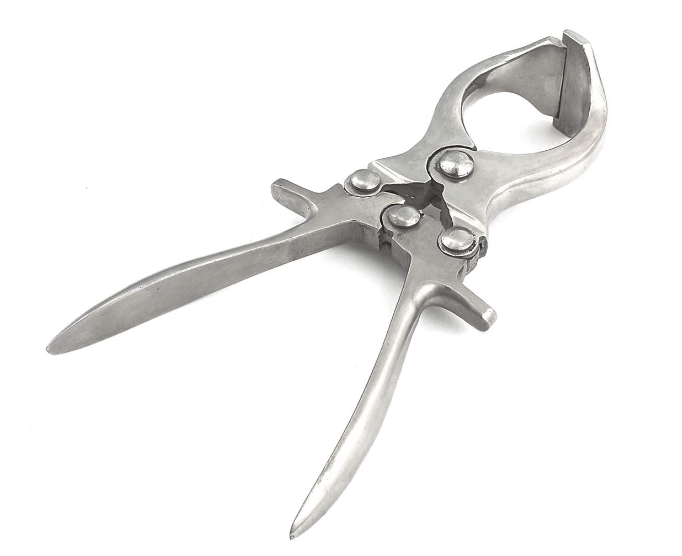
Mr Parish said his wife Sue of 41-years “always says I’m oversexed – I don’t know if I am but I have a healthy appetite. She used to say when I was a little too amorous, “I’ll get the scissors to you if you don’t behave yourself. Snippety, snip.”
Mrs Parish corrected him to say she had, in fact, chased him around the kitchen with “burdizzos — the things you use on cattle to crush their b***s.”
Earlier this week, Mr Parish appeared on ITV programme Lorraine, where he admitted he experienced a “moment of madness”. Speaking on the show, Mr Parish said: “I think there are moments of madness in your life and this was one of them and of course, you know, one has plenty of time to regret afterwards. I did the right thing, I’ve apologised and I left parliament.”
But the interview seems to have left the former MP with some fans as left viewers in stitches with one person calling it “one of the funniest interviews” on Lorraine.
The Conservative Party faces two key questions as it begins the process of electing a new leader. First, how much distance should it put between itself and Boris Johnson? Second, what policy stances should it take in the post-Brexit, post-Covid world that threatens the biggest crisis in living standards since 1945.
John Curtice www.thetimes.co.uk
The controversy surrounding Johnson’s judgment and ethics that has dogged the party over the last six months has not only damaged his personal reputation, but also harmed its electoral standing. On the eve of Johnson’s eventual downfall on Thursday, the party stood at just 33 per cent in the polls, seven points behind Labour.
But will simply replacing Johnson be enough to reverse the damage? Certainly, the new leader will need to have a different style — to be seen to show more regard for due process, a greater sense of collegiality, and a greater readiness to provide a direct answer to tough questions than was characteristic of Johnson.
However, will voters be willing to warm to anyone who was a member of Johnson’s cabinet through thick and thin until earlier this week? And will the spectacle of a near collapse in the government this week have raised questions in voters’ minds about the ability of the party collectively to provide effective government? Certainly, support for the party is down on average by another three points in the first polls to be taken since Johnson’s resignation, leaving Labour as much as 11 points ahead.
One way in which the next leader might hope to reverse the damage done to the party’s reputation in the eyes of voters is to provide it with a renewed sense of direction. In truth, the party has found itself in an uncomfortable place in the wake of a pandemic that has resulted in record levels of spending, taxation and fiscal deficit, a trio now overlaid by a “cost of living crisis”. Many Conservative MPs feel they did not come into politics to preside over a significant growth in the size of the state, and the debate over how best to respond had opened a gulf between Johnson and his chancellor, Rishi Sunak.
The reaction among many in the party has been to reach for the familiar ideological lever of tax cuts, arguing that such a step would immediately help put money in voters’ constrained pockets. Yet those advocating this course have yet to spell out the implications of such cuts for both the management of the fiscal deficit and public expenditure.
Is the party ready to abandon the spending on infrastructure that was central to Johnson’s “levelling-up” agenda, from which Leave voting areas in particular are meant to profit? And will tax cuts — rather than trying to repair the damage done by Covid to the NHS and schools — have a sufficient appeal for an electorate that has already shown signs of concern about the impact of a pre-Covid decade of fiscal austerity on the funding of public services?
Equally, there is debate within the party about how Johnson’s principal legacy as prime minister — Brexit — should now be managed. Some Tory MPs appear keen to seize more vigorously what they regard as the opportunity afforded by Brexit to deregulate the economy by divesting the country of many an EU regulation. Yet research suggests that voters, including many Leave voters, value much of the consumer and environmental protection that has been put in place by the EU and are inclined to evaluate regulation on an unideological, case-by-case basis. Meanwhile, although even many Remain voters do not want to see a return to EU freedom of movement, voters do not necessarily want to see immigration cut at the expense of being able to deal with the labour market shortages that have evolved in the wake of Covid.
Hanging on to old verities will not necessarily provide the Conservatives with the direction they need to persuade voters that the party can govern effectively in the midst of the very different and complex challenges that Britain now faces. Rather, the party needs to be willing to think afresh rather than simply resort to its comfort zone.
John Curtice is Professor of Politics, Strathclyde University, and Senior Research Fellow, NatCen Social Research and ‘The UK in a Changing Europe’.
“At least three current candidates would be worse than Boris.”
The Tory civil war has begun.
On one level it will be hugely entertaining but from a national perspective very damaging.
Also, our local porngate saga continues:
Read in a separate EDW post: ‘Porn MP’ Neil Parish is ‘oversexed’, wife claims – but he says it’s just ‘healthy appetite’
Caroline Wheeler www.thetimes.co.uk
No sooner had Boris Johnson announced his resignation last week after a series of scandals rocked Downing Street than the fresh mud-slinging begun.
The bitter civil war engulfing the Conservatives looks set to deepen as the party braces for what is likely to become the dirtiest leadership campaign in history.
So divided is the party that at least two rival leadership campaign teams have passed the Labour Party a digital dossier containing a series of lurid allegations about their potential opponents. Last week tongues were set wagging when a prominent supporter of one of the frontrunners in the race was seen meeting a senior Labour official at the White Horse pub in Soho, central London.
The documents include a catalogue of claims about the likely runners and riders, including allegations about their private lives and financial arrangements, among them the use of tax dodges and loans. At least one private investigator has been hired to dig into some of the candidates’ financial arrangements. There are also claims of drug taking and the use of prostitutes.
A senior Tory party source said: “There are rumours being widely circulated about candidates getting involved in bondage, domination and sadomasochism, claims of inappropriate relationships and compromising explicit photographs that could be used as kompromat.
“It has even been claimed that one of the contenders requests that staff deliver their government papers to them while they are in the bath.”
The negative briefing has sunk to such depths that even the staff who work for candidates are being targeted. One aide is accused of regularly attending orgies, something that is alleged to have precluded them from receiving the highest level of security clearance.
Details of alleged extramarital affairs are also being widely shared with Labour by Tories desperate to discredit their opponents. Hostile briefings between the rival camps raises the prospect of blue-on-blue attacks escalating during the course of the contest.
Dominic Cummings, the prime minister’s former aide, has already gone public with some of the claims about affairs between the leadership hopefuls and their special advisers, known as spads.
In a tweet posted on Friday, he wrote: “At least three current candidates would be worse than Boris. At least one is more insane than Truss, clearly unfit to be anywhere near nuclear codes. At least one is a spad shagger.”
He later tweeted: “Sorry, correction, I’m informed by Cabinet Office at least two spad shaggers . . . would be very Westminster for Boris to get the bullet cos of lies over sex/groping . . . only to be replaced by someone actually shagging their spad!”
Guto Harri, Johnson’s director of communications, has already been forced to deny that he has been briefing against Rishi Sunak’s campaign. He called the campaign team on Saturday morning to reassure them that he was not the source of hostile briefings against the former chancellor.
According to the Financial Times, Johnson’s allies aim to stop Sunak becoming leader and are accusing the former chancellor of treachery for triggering the prime minister’s premature exit. More than 50 Conservative MPs quit the government after Sunak and health secretary Sajid Javid resigned on Tuesday, leading Johnson to step down as Tory leader two days later. Close allies of Johnson said there was “huge anger” in Downing Street over Sunak’s resignation. One senior No 10 official called Sunak “a treacherous bastard”.
A government source said the skullduggery had reached new depths and was symptomatic of a party where scandal had become commonplace.
Last week it was claimed that Chris Pincher, the former deputy chief, whip, had groped two men in a private members’ club, triggering a chain of events that eventually led to the prime minister’s downfall. Pincher denies the claims. It was the latest sleaze scandal to hit the Conservative Party, which has now lost four MPs over allegations of sexual misconduct, with a fifth being investigated by the police for rape.
A senior MP said: “Everybody is desperate for this sordid period of our party’s history to end and for us to elect a new leader with bags of integrity who can draw a line under this disastrous episode. But that does mean that scandal now has a currency in the forthcoming leadership elections, which will likely make this the dirtiest campaign in history.”
Many of the candidates who have declared, including Sunak, have avoided the traditional campaign launches and interviews with leading media outlets. Sunak launched his campaign by posting a video on Twitter.
It is understood this is to avoid the candidates being asked too many difficult questions as they progress through the first stages of a swift campaign.
Penny Mordaunt, the trade minister, is expected to run on a “zero-tolerance” ticket promising to clean up politics. One source feared this could make her vulnerable to a dirty-tricks campaign.
“If she is going to make this a dividing line, surely her rivals will do whatever it takes to undermine her and make her look like a hypocrite,” they said.
Last night the briefing against her had already begun, with one Tory source claiming that Mordaunt had spent months priming allies for her resignation, only to remain in government and let others finish Johnson off. “Tom Hunt and Lee Anderson resigned from the government before she did. She’s still there,” they added.
“When it comes to the crux of it she has done absolutely nothing in government. There’s a reason she’s known as ‘Penny Dormant’.”
Meanwhile, Lord Goldsmith, a close ally of Johnson who has thrown his weight behind Nadhim Zahawi, has broken ranks to accuse Mordaunt of failing to heed concerns about the environment.
As international trade secretary, Goldsmith claimed that colleagues “couldn’t persuade her of the importance of nature”, adding: “You can do all the development you want, but lose the Congo Basin and hundreds of millions lose their rainfall and food and there’s an unprecedented refugee crisis.”
The Brexiteer candidates, who are all trying to win the support of the European Research Group and Common Sense group, are also turning on each other.
In one hostile briefing, Liz Truss, the foreign secretary, has been accused of not reading her own Northern Ireland Protocol Bill and staying quiet during key meetings. “It’s important to remember, when she is flashing her Brexit credentials, that Liz campaigned for ‘project fear’ and the emergency budget. She also supported Theresa May’s deal,” a source in a rival camp added.
There have also been claims that whips, who have been ordered to stay neutral, have been ringing around on behalf of candidates, including Ben Wallace, the defence secretary.
With the field wide open and the potential for more than a dozen candidates to run in the contest, the knock-out rounds, which could start as early as Tuesday, are likely to be particularly brutal.
Previously, the parliamentary stage of the contest has lasted for weeks, but it is likely the 1922 Committee of backbench Tory MPs will announce on Monday that the slate is to be whittled down to the final two by the time the Commons rises for the summer recess on Thursday, July 21.
One source close to the 1922 Committee said active discussions are under way to truncate the second stage of the process, when party members vote for their preferred candidate. This could last for just three weeks, meaning a new Conservative Party leader — and prime minister — will have been elected by mid-August.
A Tory MP said: “The candidates will only have a matter of days to make their mark. The gloves are going to have to come off pretty quickly.”
Candidates vying for support from the same wing of the party will be particularly eager to pick each other off in order to hoover up their rivals’ support and make it through to the final two.
Previously, candidates have been accused of lending others support in order to ensure they knock out their closest rival. In 2019, supporters of Michael Gove accused Johnson’s campaign team of “dirty tricks” after the former housing minister was narrowly eliminated in the battle for No 10.
In 2016, Theresa May’s aides are alleged to have drawn up a dirty dossier on Johnson at a time when he was considered her fiercest rival. It was not used because his campaign imploded. The document, which was seen by The Sunday Times, contained a string of allegations about Johnson’s sexual liaisons, quips from him about cocaine, and damning assessments of his character.
“If only we had taken more heed of that dossier,” said one aide. “Maybe we would not have got into this mess in the first place.”
If you are a Tory and need Johnson’s flat makeover items on the cheap, the Daily Mail is always there to guide you:
Budget stores (and even John Lewis) have VERY convincing copies of Lulu Lytle’s expensive pieces
Harriet Johnston www.dailymail.co.uk (Extract)
While Boris Johnson and his wife Carrie may have been billed £200,000 for their flat revamp in Number 11 Downing Street by Lulu Lytle, the couple could have picked up high street alternatives to their purchases – for a fraction of the cost. …..
…FEMAIL can reveal that many items similar to those for sale on the exclusive Soane Britain website can be purchased from high street stores like John Lewis, whose furnishings Carrie apparently rejected, as well as Wayfair and Dulemn – without the hefty price tag.
On the other hand a more sophisticated critique is offered by Oliver Wainwright in the Guardian:
A £200,000 paean to French knock-offs and gilded tat
…..Beyond the sense of fortified desperation, the shopping list reflects other sides of the prime minister’s worldview. In keeping with Boris’s talk of “piccaninnies” and “watermelon smiles”, Lytle’s aesthetic has been criticised for its colonial undertones, with patterns featuring exotic animals and Orientalist motifs. She has defended her designs as the result of “30 years of research” and said in one recent interview that she was “completely baffled by the idea that having a woven lion on my wall from Nepal could be anything other than respectful”.
Instead, she likes to think she is following in the footsteps of William Morris, the socialist artist and designer who saw craftsmanship as a route to fundamental social change (he later realised he had spent his life “ministering to the swinish luxury of the rich”). Like Morris, Lytle sees her work as championing a revival of lost traditions, peddling a Brexit-friendly message as “the Boudicca of British craftsmanship”, as one antique dealer described her.
Foremost in her crafts crusade is rattan, a material with its own allusions to colonial verandas, and the Johnson bill includes several such items of rattan furniture – the £3,650 Leighton table and a £3,800 Hurlingham bookcase, which would both be at home on the terrace of a Raj-era governor’s palace. When Britain’s last rattan workshop, Angraves in Leicestershire, went into administration in 2011, Lytle bought the machinery and hired two of the staff. In another exquisite piece of Johnsonian symbolism, she also acquired the rights to Dryad – the company that designed rattan seating for the Titanic.
Theresa May’s No 11 decor might have been dismissed as a “John Lewis nightmare”, but that sounds infinitely preferable to being stuck inside this folksy, chintz-laden sinking ship.
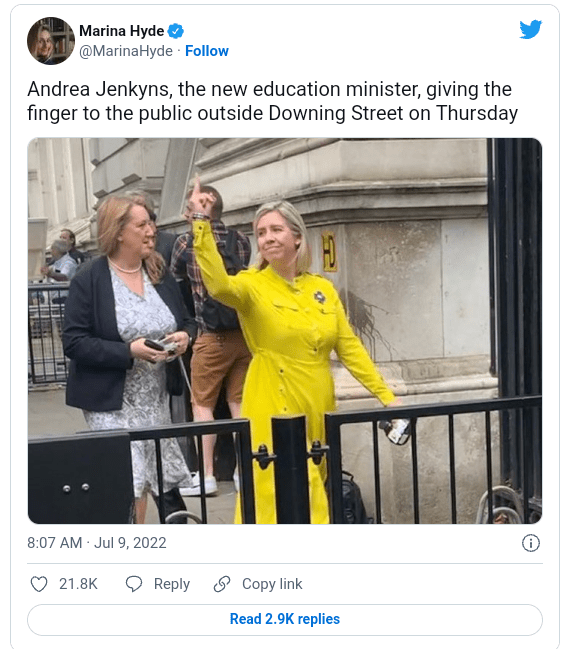
….showing contempt for the “little people”.
The caretaker government gets off to a cracking start, – obviously no lessons learned.
Well what do you expect when Boris is still PM? – Owl
Persimmon, one of Britain’s biggest housebuilders, said shortages of materials and labour contributed to a 10% drop in the number of homes built in the first half of the year.
Julia Kollewe www.theguardian.com
The company completed 6,652 homes in the first six months of 2022, down from 7,406 a year earlier. It blamed further delays in the planning system, as well as material and labour shortages. Customer inquiry levels were healthy and cancellation rates low, Persimmon said.
Prices for key materials such as timber and steel have rocketed since Russia invaded Ukraine in late February. Bricks and blocks have been in short supply, along with windows and boilers at times, according to Dean Finch, the Persimmon chief executive, while labour shortages – for example plasterers – have had a bigger effect, forcing the company to pay workers more.
Soaring raw material prices, shipping and energy costs, coupled with higher wages, have hit builders across the sector, in particular smaller firms. More than 3,400 smaller construction businesses, many of which are family-run, went into administration in the year to April, the highest number since the financial crisis, according to the Office for National Statistics.
Persimmon shares fell 5.5% on Thursday morning, making it the second biggest faller on the FTSE 100.
Total revenues in the first half fell 8% to £1.7bn, while forward sales were slightly higher than this time last year at £1.87bn.
The housebuilder, which has sought to rebuild its reputation after a damaging scandal over poorly built homes and a public backlash against its former boss Jeff Fairburn’s £75m bonus, expects to complete 14,500 to 15,000 homes in 2022, compared with 14,551 last year.
The firm said first-half profits would be slightly higher than expected because house price inflation has offset rises in build costs. Its average selling price increased by 4% year on year to £245,600 in the first half, reflecting strong demand and a reduction in the proportion of homes sold to its housing association partners.
The UK housing market has defied expectations of a slowdown so far, with prices rising at the fastest annual rate in 18 years last month, according to Halifax, one of the country’s biggest mortgage lenders. Experts are expecting the market to cool in coming months, however, as the cost of living squeeze and higher interest rates affect people’s ability to buy.
Finch said: “Delays in the planning system, disruption in material supply chains and challenges in securing labour have impacted completions in the period. We anticipate, however, profit at the half year to be modestly above our expectations reflecting strong demand and positive pricing conditions. Our forward sales position is robust.”
UK housebuilding declined in June for the first time in two years, an industry survey showed this week. The housing market has been surprisingly strong throughout the Covid-19 pandemic, fuelled by the government’s temporary stamp duty cut and people’s desire to move to larger homes and greener surroundings amid a rise in home working.
From a correspondent (including the suggested editorial comment):
“Of all the guilty men and women in the dismal reign of Boris Johnson, the British right-wing press bears heavy responsibility for what the country has become. From the self-lacerating Brexit referendum to the elevation of a man they knew to be unfit, they set the pace, at the behest of extreme Brexiteer press barons – Murdoch–Rothermere–Barclay foghorns still dominate the political landscape. In this sleazy Johnson era, so often the Guardian [and East Devon’s Owl – ed.] has been foremost among those puncturing this mendacity.”
Q: Who gets the final choice of next Prime Minister?
A: The approx 200,000 paid up members of the Conservative party.
These are a mere 0.29% of the whole population or 1.43% of the 13.94 million who are estimated to have voted Conservative in the high waters of 2019.
The full extent of the notorious Wallpapergate scandal seen by some as heralding the start of Boris Johnson’s downfall has been laid bare.
Will the next Conservative choice of Prime Minister live with the decor or will the long suffering taxpayer have to fork out for yet another refurbishment? (Some of the likely candidates are rich enough to pay for a refurbishment on this scale out of small change) – Owl
Estimate for PM’s renovation plan included £7k rug and £3,675 trolley
Simon Walters www.independent.co.uk
The Independent has obtained a leaked copy of the estimate for the renovation of the prime minister’s Downing Street flat which totals more than £200,000.
Items suggested for Mr Johnson and wife Carrie by upmarket interior designer Lulu Lytle include a £3,675 drinks trolley said to be like the one owned in Paris by ballet dancer Rudolph Nureyev and £2,260 worth of the “gold” wallpaper that Mr Johnson privately complained his wife had purchased.
Two sofas were priced at more than £15,000; £3,000 was considered for a “paint effect” for the flat hallway; and the cheapest item is a £500 kitchen table cloth.
The estimate for building works, which involved sanding the floorboards, painting and decorating, and installing new furnishings and fittings came to £30,000.
The leak from the Cabinet Office will reopen the long-running controversy over the Johnsons’ luxury refurbishment of their flat over at 11 Downing Street.
The £208,104 estimate was sent to the Cabinet Office in early 2020, which has a £30,000 annual budget to renovate the PM’s official Downing St flat, in the early stages of the work.
In fact, the rest of the cost was secretly funded by Lord Brownlow and the Conservative Party until the scandal was uncovered and Mr Johnson was told to pay it from his own funds.
The leaked bill shows that the Johnsons ordered a £3,675 “Nureyev Trolley” said to be “inspired by a French 1940s drinks trolley owned by ballet dancer Rudolph Nureyev”.
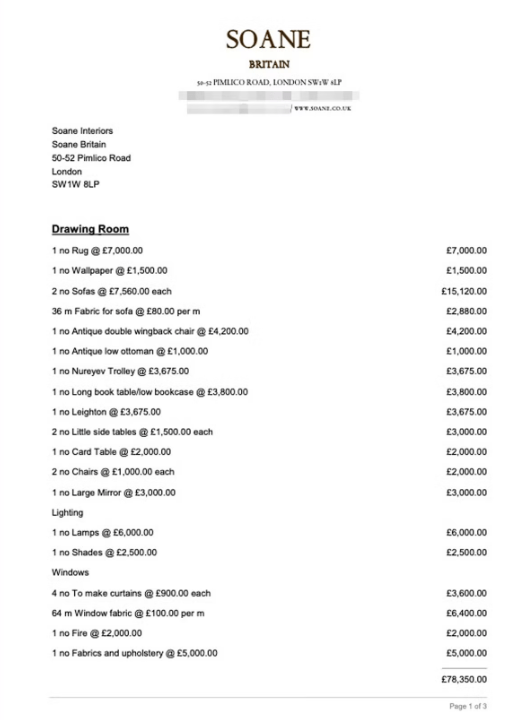
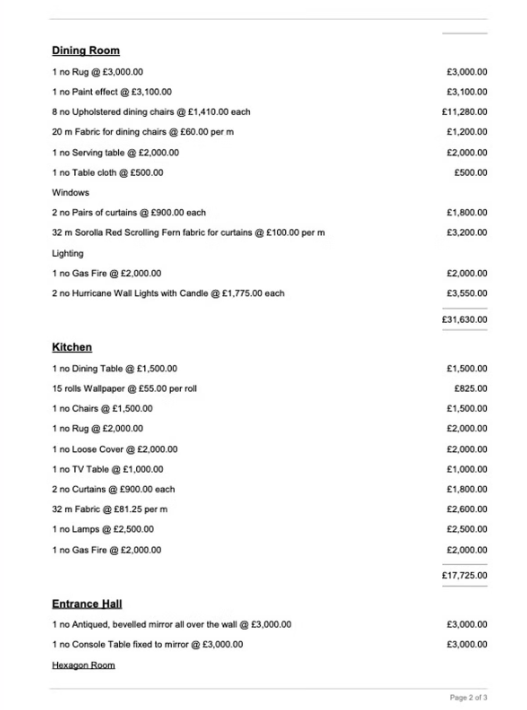
The leaked estimate in full:
(The Independent)
(The Independent)
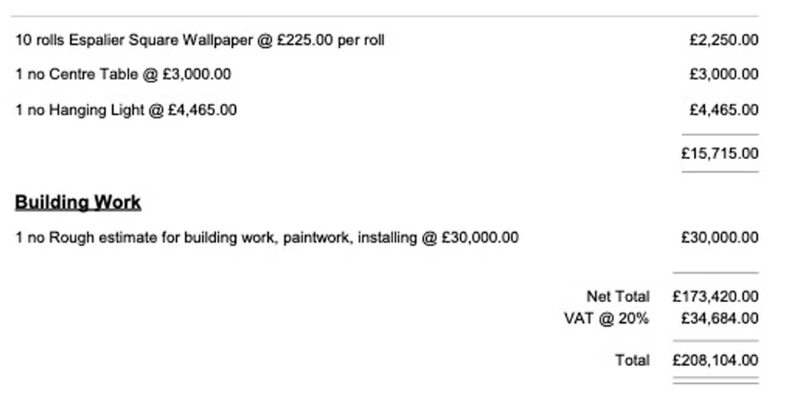
(The Independent)
The Johnsons were invited to spend £15,120 on two sofas (with another £2,880 for fabric to upholster them); £11,280 on eight dining chairs; £7,000 on a rug; £4,200 on a “double wingback chair”; £3,800 on an antique mirror for the hall and £1,000 for a kitchen TV table.
The leaked estimate from Ms Lytle’s Soane Britain company lists a drawing-room lamp for £6,000 with an extra £2,500 for the lamp shade.
Despite being known as Wallpapergate, in fact, the fabrics would have cost far more than the wall hangings.
On the wallpaper front, the single most expensive item was £2,260 for 10 rolls of “Espalier Square design” for the entrance hall.
According to the Soane Britain website Ms Lytle “imagines this gives the all-encompassing effect of fruit trees to form tunnels and pergolas in a 19th-century kitchen garden”.
Although described as “emerald and stone linen” in colour the “Espalier” wallpaper can appear to be gold in a certain light and is said to have inspired Mr Johnson’s frustrated remark that his wife was “spending thousands on gold wallpaper”.
The estimate for upholstery and curtains came to £21,280, including £3,200 for “32m of sorolla red scrolling fern” for dining room curtains.
It is not known which items the Johnsons ultimately chose for their home.
Mr Johnson was then forced to apologise in January for failing to disclose to his former Whitehall ethics adviser Lord Geidt messages between himself and Lord Brownlow, who contributed more than £50,000 towards the flat makeover.
In his report into the flat refurbishment in May 2021, Lord Geidt said Johnson told him he did not know Lord Brownlow paid the money before media reports earlier that year.
However, a separate inquiry by the Electoral Commission watchdog found out that Mr Johnson had in fact messaged Lord Brownlow over WhatsApp about the revamp in November 2020.
Lord Geidt, who resigned from his post last month, rebuked the prime minister for failing to disclose the texts, but did not change his initial verdict that Mr Johnson did not break the ministerial code.
In 2021 it emerged that the cost of the refurbishment was met by the Cabinet Office and recharged to the Conservative Party. After the scandal was revealed the money was returned to Tory HQ and Mr Johnson agreed to pick up the bill, though it is not clear where he obtained the necessary balance once the Cabinet Office paid its £30,000 share.
A councillor who says he was groped by former deputy chief whip Chris Pincher, says he was told by a colleague to hold off talking about it after instruction from Conservative headquarters.
“The wall of silence” – Owl
BBC News www.bbc.co.uk
Daniel Cook said Mr Pincher, MP for Tamworth in Staffordshire, groped him in 2005 and 2006 which the BBC understands he denies.
But Mr Cook said the instruction led him to speak out about what happened.
The BBC has contacted national and local Conservative parties.
Tamworth Conservative Association and Conservative Campaign Headquarters (CCHQ) was contacted on Friday afternoon and has yet to respond.
The BBC understands Mr Pincher strongly denies any such conduct relating to Mr Cook.
Prime Minister Boris Johnson then faced questions from his party about what he knew and his handling of the allegations. which led to him apologising for appointing him, admitting he had been made aware of a complaint in 2019.
Mr Pincher is facing a string of claims of inappropriate behaviour stretching back several years, which he has denied.
He has now spoken to BBC West Midlands political editor Elizabeth Glinka, again waiving his right to anonymity.
He said the incidents happened at his home when Mr Pincher, drunk on both occasions, knocked at his door.
Mr Pincher “groped his penis and said have you got any good porn”, Mr Cook said, and on the second occasion he “grabbed my backside and tried to cup my penis again”.
After laughing the first incident off as a “badly timed drunken joke”, the second time, Mr Cook reacted angrily and threw him out of his home and did not take any further action.
“In the morning when I had calmed down I genuinely thought, he’s a lonely, gay man who was seeking some company for want of a better term, trying it on,” he said.
Chris Pincher and Daniel Cook, here pictured in 2010, joined forces on several local issues in Tamworth
“I chose to forget about it. We never ever discussed it. I moved on… I’ve never felt like a victim. I was able to defend myself.”
After allegations emerged about Mr Pincher allegedly groping the two men in the private members club, Mr Cook said local Conservatives in Tamworth were contacted by CCHQ telling them “everybody needs to shut up”.
He told the colleague that informed him of that instruction that he could potentially be defined as one of Mr Pincher’s victims and that it seemed like he was being told “to be quiet”.
“We need to be very careful how we approach this because this is what you’re doing to me now – you’re telling me to be quiet,” Mr Cook said he told his colleague.
“There was a wall of silence from Conservative councillors until I said something… we were told under no uncertain circumstances not to say a word – that’s what finally pushed me to come forward and actually say something.”
More people – mostly women – have been underpaid their state pension than previously thought, latest government figures show.
By Kevin Peachey www.bbc.co.uk
A new estimate suggests 237,000 state pensioners were paid less than their entitlement, with a total of nearly £1.5bn underpaid.
That is 105,000 more people affected than the Department for Work and Pensions (DWP) calculated a year ago.
They include widows and divorcees who could have been underpaid for years.
The problem dates back to 1985 and relates to the “old” state pension system. Married women who had a small pension of their own could claim a 60% basic state pension based on their husband’s record of contributions. But an error at the DWP meant they were not automatically given this money.
Along with widows and divorcees, some will eventually receive all their entitlement, although years later than they should have done. Others will only be able to claim for 12 months of missed payments.
When figures were first revealed by the DWP, it was thought that 200,000 female pensioners were collectively owed up to £2.7bn. After more details were collected, the estimated numbers were scaled back to just over 130,000 people affected, at a total of just over £1bn.
Now those estimates have been changed again, with the prospect of more revisions to come.
“DWP has carried out additional reviews of its records to understand the pensioners that may be affected, but the full extent of the underpayments will not be known until every case has been reviewed,” the National Audit Office said.
The situation was described as “a shameful shambles” by the Public Accounts Committee of MPs in January,
Errors repeated
The committee’s report said the errors were the result of outdated systems and heavy manual processing of pensions at the DWP. It also said there was a risk that the errors that led to underpayments in the first place could be repeated in the correction programme, the ninth such exercise since 2018.
Former pensions minister Sir Steve Webb, who is now a partner at consultancy LCP, said the DWP had also admitted to an error in which credits for time at home with children – previously known as home responsibilities protection – may be missing from people’s National Insurance records and therefore affect their state pension.
“Not only is the cost of the underpayment correction exercise set to soar, DWP are now admitting a whole new category of errors,” he said.
“In both cases it is women who will bear the brunt of the errors. We need much greater transparency about all of this rather than leaving it to figures buried in the small print of annual reports. Far too many people have been underpaid for far too long”.
From a Correspondent:
As one of 600 residents in Axmouth. A village with no shops or facilities I am shocked at the announcement that the 9a bus, operated by Stagecoach is no longer to pass through our village. This has happened very quietly and quickly. We learned about it only yesterday during a meeting of 20 elderly ladies gathered for a social event. We need this bus as many of us do not drive and parking in Lyme Regis is impossible during the summer.
I think there is a timescale involved to alert the public as to the changes they intend to make. There is no notice in the bus shelter and I have not seen anything in the local press.
See proposals to cut bus services (the devil lies in the detailed timetable changes – Owl)

