Neil Parish ‘slowly recovering’ from political death

He says he’s coming up for air now.

(No mention of campaigning for the Tories) – Owl 

Joe Ives, local democracy reporter www.radioexe.co.uk

Disgraced former Neil Parish MP, who resigned following revelations that he had watched pornography in the House of Commons, says he is starting to recover from his “political death.”

Mr Parish, who served as MP for Tiverton and Honiton for 12 years, has explained how the fallout from the controversy has impacted his life and wellbeing. 

It is a month since Mr Parish was identified as the Tory MP caught watching porn on his phone in parliament. 

He said: “I feel that I’m coming up for air now. It’s your political death really and you don’t sleep. 

“I’m a great one for eating food but I’ve hardly been eating my food. You get completely thrown.

“My wife is very good, very down to earth, very supportive but also says to me: ‘come on, pick up the pieces, get on with it.’

“This is life and there is life outside of parliament. Even though I shall miss parliament greatly, there is life outside. 

“I have a practical farming background [and I have] still got the farm. I go back to that. I’ve got plenty of gardening to do. I’ve got some practical things to do and I can build that up.

“I also want to keep going on other issues, People4Ponies, I’m the president of that and I want to help that as well.

“[It’s] a charity trying to stop ponies being mistreated across the south west. Lots of things there that I can do and hopefully help with.”

Mr Parish wants to “keep his brain alive” by focusing on these activities as well as farming charities and the environment.

He continued: “I’ve really appreciated the support that I’ve been given in the constituency.

“I tried to work hard over the last 12 years and I hope that’s paid off and I really have been glad of the support.”

The by-election for Mr Parish’s successor will take place on Thursday 23 June.

Tourists to south-west England urged to check if rental affects housing crisis

Tourists heading to holiday homes in the south-west of England are being urged to check before they travel if their rental will worsen the area’s affordable housing crisis.

Robert Booth www.theguardian.com 

The call for “ethical consideration” of the potential negative impact of short-term lets comes as figures showed 3,000 new holiday and second homes were registered in the south-west during the pandemic while homes listed for normal letting halved and rents jumped.

The housing campaign group Generation Rent also found that in Wales, over the same period, the number of second homes and commercial holiday lets increased from 31,779 to 33,474, with the average weekly rent rising from £155 to £181, based on analysis of figures from Zoopla.

As thousands of families prepare to descend on coastal hotspots for half-term, the former St Ives MP Andrew George, who now builds affordable housing, said people renting holiday lets should consider challenging landlords over the impact.

In parishes around Padstow on the north coast, as many as one in four properties are second homes, according to Cornwall council, which has about 22,000 households on its social and affordable housing waiting list.

In March, graffiti appeared in St Agnes, Cornwall, which read: “No more investment properties. Second homeowners give something back. Rent or sell your empty houses to local people at a fair price.”

Gwynedd in Wales, which includes most of Snowdonia national park, is a hotspot for holiday lets and, according to research by the estate agency Hamptons, 16% of sales in the year to May 2022 were second homes.

George, the chief executive of the Cornwall Community Land Trust, which builds affordable housing, said the people were not at the point of “superglueing the locks or burning [second homes] down” but “anger is directed at the legislature that allows this to happen”.

He is calling for a new planning class for second homes that would allow town halls to cap their numbers. Asked what holidaymakers should do if they are renting, he said: “They should ask [the landlord] before they come: ‘can you assure me this accommodation is not having a negative impact on housing need?’”

He added that if they found, while on holiday, thattheir rental was causing problems they should complain at being “mis-sold”. If holiday renters “find the housing needs of people in the area are being overlooked they could write to the owner of the property and say they are never coming again”.

He said the acute shortage of affordable homes means low-income renters too often have to endure damp, cramped and energy-inefficient homes from private landlords who enjoy an imbalance of power.

The incentive to offer properties as short-term lets is huge. A small two-bedroom house in St Ives was this week offered for more than £3,000 for half-term on Airbnb, while a four-bedroom house on Vrbo cost £668 a night.

Merryn Voysey, 33, moved from Cornwall to Portugal in part to escape the stress of the housing crisis, he told the Guardian. While working as a gardener he had to live in his van for 18 months. Average weekly private rents in the south-west rose from £206 to £238 from February 2020 to July 2021.

“One of the reasons I am here [in Portugal] is that the housing crisis is not right in front of me and I am not driving around feeling like a victim,” he said. “I am feeling the benefits. My peace of mind and wellbeing has improved.”

Generation Rent is calling for government action to bring properties back into the residential market, including scrapping mortgage tax relief for holiday lets, plus powers for councils to license and cap holiday lets.

“We have heard countless stories of people being evicted so their landlord could start renting to tourists,” said Dan Wilson Craw, the campaign’s deputy director. “Taking homes out of the residential market prices out people who want to settle down in the place they grew up. That destroys communities and starves local businesses of workers.”

Earlier this month, the government announced a new bill that will allow councils to apply a discretionary council tax premium of up to 100% on second homes, as defined by “periodically occupied”.

Paula Higgins, the chief executive of the Home Owners Alliance, predicted some second homeowners would pass on the cost to holiday renters, but said: “It might put people off purchasing extra homes because it’s an extra cost. That combined with the increasing stamp duty on second homes, I think it could have an effect.”

Council tax on a band E home in Cornwall is £2,577, so a doubling would push the annual bill above £5,000.

A group of Cornish tourist bodies this month began consulting on a compulsory registration system for holiday lets. The Welsh government has said it will increase the council tax premium that councils can charge on second homes and long-term empty properties to 300% from April 2023.

Porn, parties, petrol prices: True blue Tories consider Lib Dem switch in Tiverton and Honiton by-election

Despite the excellent choice of Liz Pole for Labour this columnist concludes this will be a two horse race.

This is without discussing the additional headache the Tories face from the four right wing cum populist cum re-branded Brexit candidates:

  • Jordan Donoghue-Morgan, Heritage Party
  • Andy Foan – Reform UK
  • Frankie Rufolo – The For Britain Movement
  • Ben Walker – UK Independence Party

Porn, parties, petrol prices: True blue Tories consider Lib Dem switch in Tiverton and Honiton by-election

It was the afternoon of the Sue Gray report and, stood under the historic Tiverton Clock Tower, life-long Tories Andrew and Heather Barlow had already decided how they would vote in next month’s by-election here.

Colin Drury  www.independent.co.uk 

Lib Dem candidate Richard Foord talks to voters in Honiton

Liberal Democrats,” he said decisively. “Until that man [Boris Johnson] is no longer leader, I will never vote Conservative again.”

This was, he made clear, not a decision taken lightly.

The couple, both retired teachers, had gone blue at almost every election since they turned 18. As a student, Andrew had been a member of the Oxford University Conservative Association. He once had dreams of being a politician – until Heather told him that she had no dreams of being a politician’s wife.

Yet this near lifelong loyalty will be broken after the prime minister refused to resign over revelations he broke coronavirus lockdown rules by attending boozy Downing Street parties.

“He wouldn’t know integrity if it was looking him in the face,” said Heather. “I cannot understand how other Conservatives are not embarrassed to be associated with him. I think they are. They just don’t say it. And I’m not sure which is worse.”

Tiverton and Honiton – a sprawling, largely rural constituency in Devon – may feel a million miles from the machinations of Westminster but next month this agricultural heartland will find itself at the centre of the UK’s political universe.

A by-election is to be held here on 23 June after former Tory MP Neil Parish stood down following an admission that, while Googling tractors, he had ended up watching pornography in parliament. Twice.

It means that people here will be the first to ever go to the polls with a prime minister who has broken the law while in office.

And, if a former minister’s observation earlier this month is correct – that the longer the gravel drive the greater the anger about Partygate – the Tories may have good reason to be worried: while this is a constituency with pockets of considerable deprivation, it is also one with plenty of long, gravel drives.

“You get a lot of Tories here,” said Annie Hargreaves, a Northern Irish woman who settled in Tiverton 23 years ago and now runs Leela, a sustainable lifestyle store, in the town. “But it doesn’t feel like any of them are especially proud to be Tory at the moment. They feel let down by what’s happened.”

On paper, Tiverton and Honiton should still be a safe blue seat.

It has been Tory ever since it was created in 1997. In 2019, Parrish won a majority of 24, 239. For good measure, the Conservatives are the largest parties on the county, district and town councils here too. In 2016, it voted Brexit.

Yet voters here are openly debating if they are prepared to give their backing once more to a party so bogged down in sleaze and which – perhaps more significantly – is increasingly seen as taking the area for granted.

In an uncanny echo of last year’s North Shropshire by-election, the Lib Dems – third place in 2019 – have emerged as the unlikely frontrunners. “It’s a tougher gig [than North Shropshire],” party leader Sir Ed Davey said in an early campaign visit to the area. “But the Tories know we’re on their case.”

It was a sentiment reiterated by candidate Richard Foord in a Tiverton coffee shop this week.

“It’s clear to people that the Tories don’t feel they need to work for votes,” the 44-year-old said. “They’ve been complacent for years – and people are fed up of that. Absolutely fed up. Just like they were in North Shropshire.”

The evidence of complacency? Brexit trade deals have more or less ignored the region’s farmers; no action has been taken to address the fact that Devon has England’s longest ambulance waiting times; and a perceived lack of investment across the constituency.

“There’s been no levelling up money,” said Foord, who works for the University of Oxford but lives in Uffculme. “Tiverton has got a high school that’s simply not big enough for the town anymore – we’ve needed a new one for years – and the hospital now closes through the night because of cuts.”

There is, he says, a joke that people know when it’s election time here because local Conservatives start talking about building an Axminster bypass or a Cullompton train station. “These have been the same promises going back 20 years,” the father of three says. “They will still be making them in another 20 years, I expect.”

The cost of living crisis, too, is hurting people here in a way the government doesn’t recognise, he reckons. Fuel intensive sectors – like farming – are being devastated. In a place where people are reliant on their cars to get between small towns and villages, ever-rising petrol prices are adding to hardship. A cut on national insurance is needed, he says. A windfall tax on energy companies announced on Thursday doesn’t go far enough.

Against this backdrop of grievances, it has been suggested the Conservative contender here – that’s Helen Hurford, the deputy mayor of Honiton – has been selected, ultimately, as an “electoral sacrifice”.

“I asked in the tea room this morning if we had actually selected an electoral sacrifice,” Sir Roger Gale, MP for North Thanet, told BBC Newsthis week. “And I’m told that we have.”

What Hurford herself makes of this is anyone’s guess.

As has become the norm with Conservative by-election candidates, the former headteacher is said to have been ordered not to talk to media during the campaign. The fear, apparently, is that she will not be capable of answering questions about Partygate in any satisfactory manner.

Safe to say, a request by The Independent to speak with her went firstly unanswered and then got declined.

More unusual, perhaps, is the fact that it is not just the candidate who appears silenced.

Local Conservative councillors, too, are said to have been informally told to go to ground in the wake of the Sue Gray report this week. One, the mayor of Tiverton, Sue Griggs, pulled out of a planned interview literally minutes after the document was published.

To add to the possible Tory woes, meanwhile, is the suggestion Labour – represented by local businesswoman Liz Pole – appear set to run a minimal campaign.

Sir Keir Starmer has insisted he wants to win this seat but, self-evidently, it makes sense for the party to focus resources on Wakefield, in West Yorkshire, where another by-election is being held the same day and where there is a greater chance of red victory.

And yet and yet.

Despite such a host of issues, it is by no means beyond the Conservatives to retain this seat. The fact is there are still plenty of people here who believe the government has served them well enough – not least in keeping them safe and financially secure through the pandemic.

“What’s he [Johnson] ever done for me?” pondered Carole King, in her eponymous Tiverton lifestyle shop. “He kept my business alive during the pandemic. He got a vaccine out before anyone else in Europe.”

It’s a popular point.

In a region with a large portion of independent businesses, there is a sense that whatever the prime minister’s faults, he had got a lot right.

“The cheques he signed off saved people from going under, including me,” said Tom Hirst, who runs Tivvy Cobblers. “We’ve got a lot to thank him for.”

He has, he admitted, a “soft spot” for Mr Johnson. “He’s different, isn’t he?” the 36-year-old said. “I think the parties just show he’s like the rest of us, really. I can’t feel angry about them.”

Pertinently, too, while senior Conservatives MPs may have questioned Hurford as a candidate, there are plenty in the constituency who think she is a wise choice. The fact she is local appears especially popular.

“She certainly will get my vote,” said Honiton’s mayor Serena Sexton, who herself sits as an independent. “I vote for the person, not the party and Helen is extremely capable. Compassionate, analytical, trustworthy. She would do an excellent job, just like she has done during her year sitting on the town council.”

Which brings us back, perhaps, to Annie Hargreaves in her Tiverton shop, surrounded by plants.

She herself will vote Lib Dems but she thinks, whatever the result, the by-election is already doing some good for the constituency.

“It’s so blue that people can be quite apathetic at election time, because they don’t think their vote will matter,” she said. “But this is different – it’s a real contest – and that’s invigorating people a little bit. It feels like our voice can make a difference for once.”

A by-election brings Ministers, U-turns and promises – Priti Patel has been in Devon 

And Alison Hernandez, our PCC, doesn’t miss a photo opportunity to be snapped with her, and the Tory candidate, whilst reopening a desk in Tiverton police station. See photograph below which looks like it has been taken by the PCC herself. (Problem is that it’s a mirror image and describes the police station as belonging to the Llawnroc & Noved force, but shows her best side!).

A couple of days earlier, she was photographed with newly chosen Helen Hurford also outside what looks like Tiverton police station, see: Police Commissioner photographed with new Tory candidate raises question. Makes Owl wonder just how many times the front desk at Tiverton policed station has been reopened by the PCC. Perhaps this is the only example the Tories can find of what they have done for Tiverton.

Is Owl the only one to find such blatant political posturing by a Police and Crime Commissioner, supposedly “the voice of the people”, at odds with the Nolan principles? These are the seven principles governing those in public service and include: integrity, objectivity and leadership.

Is this another example of how the Conservatives under the leadership of Boris Johnson have lost all sense of integrity? How are we supposed to believe in the political neutrality of the police knowing they are accountable to, and the Chief Constable appointed by, such an overtly political PCC?

The Home Secretary is quoted as saying “I’m absolutely thrilled that the station will be reopened again. It speaks to the Conservative Party in government, the party of law and order being focused on delivery, delivering for local residents and delivering for the British public because we do believe in our police, we back the police.”

Wasn’t it the Osborne Tory austerity programme that caused the closures in the first palace? “Law and order”, what a joke. Expect a succession of Cabinet Ministers making their first visit to Devon. – Owl

Lewis Clarke www.devonlive.com (extract)

The Home Secretary Priti Patel has been in Devon this morning, talking about policing, the crisis in Ukraine and the shocking murder of Bobbi Anne McLeod.

She spent time speaking to campaigners on May 25 ahead of the upcoming by-election on June 23, backing their Conservative candidate Helen Hurford. She also headed to Tiverton Police Station to meet Alison Hernandez, the Police Crime Commissioner, as well as the town’s police force.

Speaking exclusively to Devon Live she said: “I’ve had a fantastic visit this morning. It’s a privilege to be here supporting in Helen and the great Conservative team. Actually just having the opportunity to get out and about, meeting activists, but I’ve also been with our Police and Crime Commissioner, Alison Hernandez today, down to the police station speaking to the front line and the officers that do everything that they can day in, day out, to keep local streets safe.”

Speaking about Helen Hurford, the Tiverton & Honiton Conservative candidate she said: “Helen is a great candidate and local. A local lady who’s absolutely dedicated to public service. Her professional background as a teacher, but also someone that’s been active in the community for the last 12 months as well.

“She’s going to be a fantastic member of parliament for this constituency. I think residents will be blessed to have her as the MP, but I think importantly as well, she will go on to serve and represent the local area in an exceptional way.”

Priti Patel, Helen Hurford and Alison Hernandez

This week it was announced by Alison Hernandez that the front desk of Tiverton police station was among those planned for reopening this year. These offices will be staffed by Police Enquiry Officers from Monday to Saturday, from 10am to 3pm, while the existing nine operated by the force will operate extended opening hours of 8am to 6pm on the same days. Officers staffing the offices will be able to support the 101 contact centre too when not dealing with people person.

The Home Secretary welcomed the move: “I’m absolutely thrilled that the station will be reopened again. It speaks to the Conservative Party in government, the party of law and order being focused on delivery, delivering for local residents and delivering for the British public because we do believe in our police, we back the police……

Proposed solar farm near Rockbeare could power up to 18,500 homes in East Devon and Exeter

Developers of a proposed solar farm totalling the equivalent size of 55 football pitches near villages in East Devon are gearing up to outline their plans to residents.

Becca Gliddon eastdevonnews.co.uk 

Ford Oaks Solar and Green Infrastructure says its proposed ‘facility’, near the hamlet of Westcott and Marsh Green village, made up of 45 hectares of ‘green infrastructure improvements’, could power up to 18,500 homes across East Devon and Exeter.

East Devon

The area outlined in red shows where the proposed solar ‘facility’ will be built.

The project manager of charity Devon Communities Together, leading the community consultation process which began in autumn 2021, will attend the Aylesbeare Annual Parish Meeting on Wednesday, May 25.

The Taiyo Power and Storage team, promoting the development, will attend the Aylesbeare Parish Council meeting on Wednesday, June 1, to answer questions and outline the plans through an exhibition.

A date with Rockbeare Parish Council is to be confirmed.

Ford Oaks Solar and Green Infrastructure said the site, located next to the A30 close to Exeter Airport, East Devon, is a ‘solar development that would provide renewable energy that will help to deliver East Devon District Council’s target for being net zero by 2040 and meet Devon County Council’s net zero target for 2050 after having declared a climate emergency in 2019’.

East Devon

The proposed site would be near Westcott Lane, pictured.

A planning application setting out the details and design has been submitted to East Devon District Council.

If it is approved, it will be the first solar development in the UK to apply for the Building with Nature Accreditation.

A Taiyo Power and Storage spokesperson said: “In practice, this will lead to the delivery of approximately 45 hectares of green infrastructure improvements that would increase wildlife in the valley and reduce existing flooding issues. The plans will result in a biodiversity net gain of 121% across the site.”

The plans include:

  • 45 hectares of green infrastructure improvements, in line with the Devon Green Infrastructure Strategy.
  • Delivery of 121% biodiversity net gain, achieved through creating grasslands habitats with species-rich seed mixes, Devon traditional meadows, a mosaic of wetland habitats, and beetle and butterfly banks.
  • Flood mitigation, with new leaky dams and scrapes designed into the scheme to keep surface waters in the fields to reduce flows both onto local lanes and downstream under the A30.
  • 29 hectares of solar arrays designed to permit extensive sheep grazing.

In addition, the proposal states of the intended solar panels:

  • The arrays will be a maximum of 3.15m in height and will be mounted on a south facing axis, except in two fields adjacent to identified properties where the orientation has been realigned to the southeast, thus reducing potential glare to a minimum.

The proposed development also requires the following supporting infrastructure:

  • Substations and transformers which will be held in containers of 3.5m in height.
  • CCTV on poles between 2.5m and 4m high directed away from residential property.
  • A 2m deer fence.
  • Distribution Network Operator (DNO) and client substation, including internal connective cable routes.
  • Internal access tracks.
East Devon

The plans say: “In addition to the solar arrays, the proposed development will provide an expansive network of ecological and landscape enhancements.” Image of some of the proposed schemes: with permission.

Simon Crowe, Director at Taiyo, said: “Ford Oaks will be a fantastic opportunity for East Devon to progress its ambitious climate strategy.

“At a local level, we are providing a renewable energy source for 18,500 homes for the area. At a national level, we need five times as much renewable energy as we are currently producing if we are to be net zero by 2050.

“Ford Oaks marks an important first step in Taiyo’s journey in supporting the UK’s commitment.”

He added: “If we are to truly make East Devon a greener district, we must go beyond renewable energy provision to also enhance the local area’s biodiversity. That’s why we are excited to make this the UK’s first solar park to apply for the Building with Nature accreditation, with vast amounts of biodiversity and nature improvements to the local area.”

Ford Oaks is a joint venture between Kajima and Low Carbon Alliance Limited in partnership with local landowners, including Devon County Council.

The energy produced will be used to power homes across East Devon and Exeter.

A spokesperson for Tayo Power and Storage said: “By providing a renewable energy source that will export 30MW of power to local electricity circuits and power 18,500 homes, 7,430 tonnes of CO2 emissions will be saved – the equivalent of taking 1,600 petrol cars off Devon’s roads for one year.”

They added: “This will be a secure energy source for residents in the Exeter and East Devon area, while positively contributing towards the climate emergency by aligning with Devon County Green Infrastructure Strategy, the Devon Climate Declaration and government targets to increase solar power capacity to 50GW by 2030.”


“I worked at Shell for 33 years – the government is wrong on North Sea oil”

I was a principal scientist for the oil company Shell, for which I worked for 33 years. I have a degree in aeronautical engineering and a PhD in fluid mechanics.

Grahame Buss www.independent.co.uk

I recently read a letter from the business and energy secretary, Kwasi Kwarteng, in which he tries to justify government plans to encourage investment in new North Sea oil and gas. He says it would “protect Britain’s energy security” and smooth the “transition to cheap, clean, home-grown energy”, as well as cutting energy bills.

But expanding North Sea oil will do none of those things, for several reasons.

We don’t own the oil and gas, which we give away to energy companies together with substantial subsidies. They sell the oil and gas to the highest bidder on international markets, keep all the revenue, and are currently making eye-watering profits on which they pay almost no tax. Almost 80 per cent of UK production of crude oil is exported and plays no part in our domestic energy security.

We don’t own the companies that exploit this oil and gas. According to one study, more than a third of the licence blocks in the North Sea now have a private or state-backed controlling interest, with fossil fuel firms from China, Russia and the Middle East playing an increasingly dominant role. As well as being unaccountable to UK shareholders, these businesses have no strategic interest in UK energy security or in keeping bills low for UK households.

We don’t own the refineries. They are owned by private companies like Essar (Indian-owned, and reportedly had links to Russian company Lukoil), Petroineos (Chinese joint venture) and Exxon Mobil.  To make money these refineries must run close to full capacity with specific types of crude oil not found in the UK. Reconfiguring is expensive, so the refineries have a strong interest in tying us into foreign crude imports.

We have no control over the price of oil and gas. Producing our own oil and gas does not guarantee that it is available to UK consumers at a price they can afford, as the recent energy price crunch has demonstrated. We pay the international price of oil no matter where it comes from. Fluctuations in the oil price both up and down are felt directly by us.

We can’t just turn on a tap. Allowing new UK oil and gas production is not a quick fix to plug the small gaps caused by the Russian invasion of Ukraine. The new licences in the North Sea will take years to come on stream – an average of 28 years from the licence being granted to production, says the Climate Change Committee. Even the “easy” stuff can take up to 8 years depending on the geology.

So despite Kwarteng’s plans, the UK public will remain vulnerable to global instability in oil availability and price for the foreseeable future.

As for smoothing “the transition to cheap, clean, home-grown energy”. What kind of clean energy investment signal is the government sending by continuing to subsidise fossil fuels?

By refusing to recognise and incentivise investment in the most cost-effective opportunities to cut carbon – solar and wind energy, insulation and free public transport – it is destroying jobs and ensuring higher and more volatile energy bills are baked in.

The only way to be truly secure is to exit fossil fuels and invest in the alternatives.

National Farmers Union funding legal challenges to curbs on river pollution

Environmental groups have criticised the National Farmers Union for helping hundreds of agricultural businesses to push back against measures designed by the Department for Environment, Food and Rural Affairs to protect vulnerable rivers in the UK.

Wil Crisp www.theguardian.com 

Working with the specialist consultancy Hafren Water, the NFU has helped at least 200 land users in nearly 40 river basins and groundwater catchments to fight against “nitrate vulnerable zone” designations, according to documents made available to the union’s members.

Farmers operating in areas of the UK that are designated as nitrate vulnerable zones are required to comply with restrictions related to the use of fertilisers and the storage of organic manure, designed to reduce the risk of pollution leaching into waterways.

In a video made available to union members, the NFU announced that its legal board had agreed to make special financial support available to agricultural businesses that wanted to appeal against these designations through its legal assistance scheme.

In the video, which was obtained by the investigative journalism organisation Point Source, an in-house solicitor for the NFU said the organisation’s legal assistance scheme would fund the entire cost of preliminary research and consultations before the formal appeals process.

The solicitor also said the scheme would provide subscribers with financial contributions towards costs during the formal appeal proceedings.

The NFU encouraged members to form groups to share costs and work with Hafren Water to challenge designations, saying the consultancy could be trusted and had previously “fought really hard on behalf of members”.

In a document accompanying the video, the NFU said it had “enjoyed a good degree of success” working on nitrate vulnerable zone appeals with Hafren Water in the past.

The NFU declined to tell the Guardian how much money it had already provided to support appeals against designations.

Under the existing system farmers are given an opportunity to appeal against designations every four years.

During the last round of appeals, which started in 2017, 94 of 135 were successful.

The appeals that the NFU and Hafren Water helped farmers to win included removing designations from the River Calder in Lancashire and the River Dove in the Midlands. Together their catchments cover an area of about 1,500 sq km (580 sq miles).

No English rivers have good chemical status and only 14% have good ecological status, according to the most recent Environment Agency figures published under obligations originally established by the EU water framework directive.

Environmental organisations were highly critical of the NFU’s efforts to push back against designations intended to reduce pollution in waterways.

Runoff from agriculture is the biggest single polluter of English rivers, responsible for 40% of damage to waterways.

The chief executive of Salmon & Trout Conservation, Nick Measham, said: “The NFU’s efforts to reduce the number of designated nitrate vulnerable zones in the UK is part of a broader push to deregulate farming.

“The organisation is pushing to remove designations even if it is clear that their removal will result in worsening ecological conditions for already degraded waterways.

“What the NFU should be doing is using its resources to make members true stewards of the countryside instead of seeking to game regulations so that farmers can increase their profits at the expense of the environment.”

The head of science and policy at the Rivers Trust, Rob Collins, said: “Nitrate vulnerable zones are designed to prevent excessive levels of nitrate from polluting surface and groundwaters, causing eutrophication and requiring costly water treatment.

“Rather than challenging designations, funds would be better spent supporting farmers to optimise fertiliser application through nutrient management plans and improving slurry management.”

During the latest round of appeals the Environment Agency has received 55 applications across nine river basin districts, according to information obtained by Point Source using freedom of information legislation.

Defra said Hafren Water was named as the representative acting on behalf of owners or occupiers for 14 appeals.

None of the appeals have been heard yet in the current round, which is the first since Britain left the EU.

David Baldock, a senior fellow at the Brussels-based Institute for European Environmental Policy, said organisations that opposed restrictions on fertiliser use could achieve significant change during the forthcoming appeal hearings.

“The NFU has always had its sights set on trying to push back against these nitrate regulations,” he said. “Previously Defra was under pressure from the European Commission to report back and demonstrate that they were complying with the EU nitrate directive, but now that Britain has left the EU this is no longer necessary.

“Defra’s reaction to these appeals is going to be one of the tests of its resolve to maintain standards of environmental legislation after Brexit.”

Nitrate vulnerable zones covered about 69% of England in 2009. Over the past decade, this figure has been eroded and during the last round of appeals it was reduced from about 58% to 55% of the country.

In a statement the NFU said: “Farmers are perfectly entitled to follow that appeals process to ensure that the designation is correct and has been applied fairly. NFU members are able to seek guidance and support from our legal assistance scheme to help with the appeals process.”

Hafren Water said: “The decision as to whether an area should be designated as a nitrate vulnerable zone is entirely objective and determined using catchment-specific data and Defra-derived methodology.”

A Defra spokesperson said: “We are committed to working with farmers to improve water quality through advice, incentives and effective regulation. Our goal in the agricultural transition plan is for a modern approach where farmers and regulators work together to improve standards, underpinned by credible deterrents for severe or serial harm.”

Break the rules? Change the rule book. 

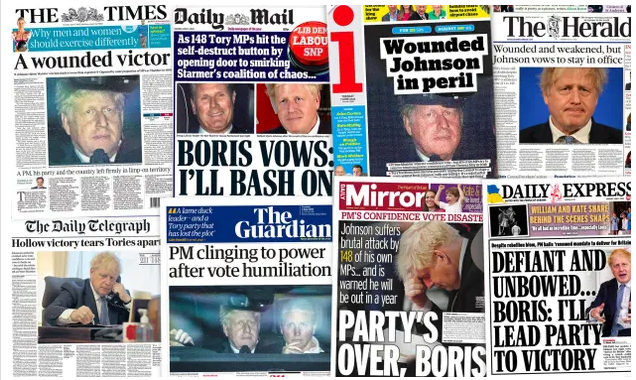
Government ministers will no longer be expected automatically to resign or be sacked if they breach their code of conduct, under changes announced by Boris Johnson.

Ministers to escape sack for ethics breaches, as Boris Johnson accused of ‘rigging’ rules

Andrew Woodcock www.independent.co.uk

An update to the code published today states that it is “disproportionate” to expect heads to roll for every breach of the code no matter how minor, and says ministers could instead be punished by “some form of public apology, remedial action or removal of ministerial salary for a period”.

The chair of the House of Commons standards committee said the change took the UK into “banana republic territory”, while Labour accused the prime minister of “watering down the rules to save his own skin”.

It comes ahead of an inquiry by the Commons privileges committee into whether Mr Johnson lied to parliament over lockdown-breaching parties at 10 Downing Street.

However, it is unlikely to provide the PM with a get-out if the cross-party panel finds against him, as the new code continues to state that “ministers who knowingly mislead parliament will be expected to offer their resignation to the prime minister”.

The former chair of the committee on standards in public life, Sir Alistair Graham, told The Independent that it was “very unfortunate timing that Johnson is seeking to weaken the ministerial code after receipt of the damaging Sue Gray report” into Partygate.

“It will reinforce the cynical view that politicians do not care about standards,” said Sir Alistair.

The announcement came just hours after the first resignation from Mr Johnson’s government since Wednesday’s publication of the full Gray report, with Eastleigh MP Paul Holmes quitting his role as a Home Office aide in protest at “the toxic culture that seems to have permeated No 10”.

“It is clear to me that a deep mistrust in both the government and the Conservative Party has been created by these events, something that pains me personally as someone who always tries to represent Eastleigh and its people with integrity,” he said.

And former minister Sir Bob Neill became the 12th Tory MP to announce he has written a letter of no confidence in Mr Johnson, declaring: “To rebuild trust and move on, a change in leadership is required.” Another MP Alicia Kearns, who represents Melton and “was rumoured to be a key part of the “pork pie” plot against the prime minister earlier this year, also said she did not have confidence in him.

Meanwhile, the prime minister has rejected a demand from his independent ethics adviser Christopher Geidt for powers to launch his own investigations into ministerial misconduct without seeking permission from Downing Street.

Instead, the new rules say Lord Geidt must “consult” the PM on any inquiries – but grant him the right to go public if Mr Johnson refuses to allow them to go ahead. Even this new right is qualified by a provision allowing the PM to overrule him on publicity.

The review was demanded by Lord Geidt in the wake of the row over the refurbishment of Mr Johnson’s flat at 11 Downing Street. The decision to release the long-delayed outcome on a Friday afternoon during parliamentary recess was viewed by many at Westminster as a bid to avoid scrutiny.

A new foreword to the code, penned by the prime minister, has removed previous references to the principles of “integrity, objectivity, accountability, transparency, honesty and leadership” which should guide ministers’ conduct.

In their place, the PM said ministers’ duty was to be “innovating, challenging assumptions and striving always to mobilise the power of the state for the benefit of the public”.

Labour deputy leader Angela Rayner accused Mr Johnson of “downgrading and debasing the principles of public life before our very eyes”.

“In a week when Boris Johnson’s lies to parliament about industrial rule-breaking at the heart of government were finally exposed, he should be tendering his resignation but is instead watering down the rules to save his own skin,” said Ms Rayner.

“Once again, Boris Johnson has demonstrated he is not serious about his pledge to address the scandal and sleaze engulfing his government or the frequent and flagrant breaches of standards and rule-breaking that have taken place on his watch.”

And standards committee chair Chris Bryant told The Independent: “The new ministerial code is a disgrace. The code is already so threadbare when it comes to ministerial accountability that it barely covers their dignity. And now they want to strip away what’s left.

“I despair. The government motto seems to be ‘If you break the rules, change the rule book’. This is banana republic territory.”

Liberal Democrat chief whip Wendy Chamberlain described the code rewrite as “an appalling attempt by Boris Johnson to rig the rules to get himself off the hook”.

“The prime minister shouldn’t be allowed to decide on his own punishment, with zero accountability,” said Ms Chamberlain. “This is making him judge and jury in his own case.

“If the privileges committee finds Boris Johnson lied to parliament, surely Conservative MPs will have no choice but to sack him.”

Since the code’s introduction by John Major in 1992 and its formalisation by Tony Blair in 1997, there has always been an expectation that ministers found to have transgressed will resign or be dismissed.

But Institute for Government expert Tim Durrant said that the option of a more lenient penalty has always been available to prime ministers, at the cost of public controversy. He pointed to David Cameron’s decision to allow Baroness Warsi to get away with an apology for a minor breach in 2012.

“There has been a public expectation that a breach always results in resignation,” he told The Independent. “But the code itself has only ever explicitly included that sanction for ministers who have knowingly misled parliament. This update makes explicit that there are other sanctions available for different breaches, which was not previously stated.

“At the end of the day, it is always going to be the prime minister who decides who is in his or her government.”

Until this year, the ethical adviser could only launch an investigation if ordered to by the prime minister, but following the “Wallpapergate” controversy over the Downing Street flat, Lord Geidt won the right to propose an inquiry.

The new changes go further, allowing him to initiate an investigation of an alleged breach of the code. But the adviser is still required to consult the PM, who the code states “will normally give his consent”.

It adds: “Where there are public interest reasons for doing so, the prime minister may raise concerns about a proposed investigation such that the independent adviser does not proceed.

“In such an event, the independent adviser may still require that the reasons for an investigation not proceeding be made public unless this would undermine the grounds that have led to the investigation not proceeding.”

The new code makes clear that the PM retains the final decision on whether and how a minister should be punished for breaches.

But a new paragraph makes it explicit that he has the leeway – after taking “confidential advice” from his adviser – to be lenient.

It states: “Where the prime minister retains his confidence in the minister, available sanctions include requiring some form of public apology, remedial action, or removal of ministerial salary for a period.”

Latest: Tory candidate for Tiverton and Honiton “all but invisible since selection”

Owl would be delighted to receive reports of any sightings of the elusive Helen Hurford.

The Conservative candidate for the upcoming Tiverton and Honiton by-election has been ordered not to speak to the media by senior party officials because they fear she will be asked about partygate, insiders say.

Tory by-election candidate ‘told to stay silent because of partygate’

Colin Drury www.independent.co.uk 

Parish councillor Helen Hurford has been selected to fight the seat after former Tory MP Neil Parish resigned following revelations that he had twice watched pornography in parliament.

But the former headteacher is said to have been told not to speak to press – because CCHQ think she will struggle to deal with questions about Boris Johnson’s lockdown lawbreaking.

One local Tory says that anger about Downing Street shindogs (sic) is now so widespread in the rural Devon constituency that it has been decided Ms Hurford’s best chance of victory is to remain largely silent and hope the party’s current 24,000 majority carries her to victory.

Strategists are said to have spent time workshopping a response to difficult questions but even the favoured option – to suggest the prime minister got things wrong but it is time to move on – is considered likely to antagonise voters in an area where integrity is expected to come as standard.

The result is that Ms Hurford has been all but invisible since being selected as the Tories’ candidate on Monday. Requests to speak to her by The Independent went firstly unanswered and were then declined with no reason given.

The order for silence is said to have even been extended to local Conservative councillors who have been informally told not to discuss the by-election with media.

Asked in a WhatsApp message if such an instruction had been given, one councillor Colin Slade replied: “I couldn’t possibly comment!”

Another, who asked not to be named, added that members had been told they should “button up”.

Responding to the revelations, a source with the Lib Dems, who are considered the main challengers here, said: “It’s sad that Tory bosses have now effectively gagged their candidate. How can voters trust her to speak up for them if she isn’t even allowed to speak?”

It all comes after Sir Roger Gale, the MP for North Thanet, said Ms Hurford had been chosen as a “electoral sacrifice” amid growing fears the Tories could lose the contest.

“I asked in the tea room this morning if we had actually selected an electoral sacrifice to fight…and I’m told that we have,” he told BBC News on Wednesday.

Yet how well the tactic of eschewing scrutiny will work is yet to be seen.

A similar playbook was used in the Hartlepool, Batley and Spen and North Shropshire by-elections last year when Conservative candidates were labelled invisible for their lack of media engagement.

While it worked in Hartlepool, it proved a disaster in Batley and Spen and North Shropshire where the Tories lost despite being favourites.

The Conservatives have been approached for comment.

Second and third home owners to scoop almost £700 million in windfall

Further to Owl’s earlier post:

The Times www.thetimes.co.uk estimates about 772,000 households with two homes will receive an £800 discount on their energy bills (£620 million windfall).

With about 61,000 people owning three homes in line for payments totalling £1,200 ( a further £73 million windfall).

The Tory MPs calling on Boris Johnson to resign – and what they said

Includes two Devon MPs – Owl

Here is the full list of Tory MPs who have urged the prime minister to stand down, though some say they have not written letters to Brady. Several other critical MPs say they will not reveal whether they have sent a letter – so the true number is likely to be higher.

Jessica Elgot http://www.theguardian.com 

Boris Johnson was warned he would face a string of no-confidence letters after the Sue Gray report into Partygate concluded. In order for a vote of no confidence to be triggered, the chair of the 1922 Committee, Graham Brady, must receive letters from at least 54 Conservative MPs – 15% of the parliamentary party.

No confidence in the PM

William Wragg

Hazel Grove

I cannot reconcile myself to the prime minister’s continued leadership of our country and the Conservative party. I say this by means of context, so that everyone, particularly my constituents and colleagues, can understand my position, without hiding my views with ever more elaborate disguises.

Gary Streeter

South West Devon

I cannot reconcile the pain and sacrifice of the vast majority of the British public during lockdown with the attitude and activities of those working in Downing Street. Accordingly, I have now submitted a letter seeking a motion of no confidence in the prime minister.

Anthony Mangnall

Totnes

Standards in public life matter. At this time I can no longer support the PM. His actions and mistruths are overshadowing the extraordinary work of so many excellent ministers and colleagues. I have submitted a letter of no confidence.

Tobias Ellwood

Bournemouth East

I have made my position very clear to the prime minister: he does not have my support. A question I humbly put to my colleagues is: are you willing, day in day out, to defend this behaviour publicly? Can we continue to govern without distraction, given the erosion of the trust of the British people? And can we win a general election on this trajectory?

Peter Aldous

Waveney

After a great deal of soul-searching, I have reached the conclusion that the prime minister should resign … Whilst I am conscious that others will disagree with me, I believe that this is in the best interests of the country, the government and the Conservative party.

Roger Gale

North Thanet

It’s absolutely clear that there was a party, that he attended it, that he was raising a toast to one of his colleagues. And therefore, he misled us from the dispatch box. And, honourably, there is one answer.

Steve Baker

Wycombe

Having watched what I would say was beautiful, marvellous contrition … the prime minister’s apology lasted only as long as it took to get out of the headmaster’s study. That is not good enough for me, and it is not good enough for my voters. I am sorry, but for not obeying the letter and the spirit of the law – we have heard that the prime minister knew what the letter was – the prime minister should now be long gone. Really, the prime minister should just know that the gig is up.

John Baron

Basildon and Billericay

Parliament is the beating heart of our nation. To knowingly mislead it cannot be tolerated, no matter the issue. Whether or not the prime minister is an asset to the party or the country is of less importance. Having always said I would consider all the available evidence before deciding, I’m afraid the prime minister no longer enjoys my support – I can no longer give him the benefit of the doubt.

Aaron Bell

Newcastle-under-Lyme

I wrote my letter following PMQs on 12 January, when I could not square the prime minister’s words from the dispatch box with his previous statements to the house before Christmas. Subsequently I have also struggled to reconcile assurances given directly to me with the implications of Sue Gray’s interim findings.

Karen Bradley

Staffordshire Moorlands

I am proud of the British values of democracy, individual liberty, mutual respect, tolerance and the rule of law and have been privileged to promote those values around the world as an MP and during my time as a government minister. But we will lose the right to promote those values if we do not uphold them ourselves. I do wish to make it clear that if I had been a minister found to have broken the laws that I passed, I would be tendering my resignation now.

Nick Gibb

Bognor Regis and Littlehampton

The prime minister accepted the resignation of Allegra Stratton for joking about a Christmas party that she hadn’t attended, but he won’t take responsibility for those that he did attend. I am sorry to say that it is hard to see how it can be the case that the prime minister told the truth. To restore trust, we need to change the prime minister.

Mark Harper

Forest of Dean

I have formally submitted a letter of no confidence in the prime minister to Sir Graham Brady MP. This was not an easy decision for me – I have been a member of the Conservative party since I was 17 years old and will remain in the party I love until my dying day.

Tim Loughton

East Worthing and Shoreham

The reason for my conclusion in calling for him to stand down is the way that he has handled the mounting revelations in the last few weeks. Obfuscation, prevarication and evasion have been the order of the day when clarity, honesty and contrition was what was needed and what the British people deserve.

Nigel Mills

Amber Valley

He’s been fined, I don’t think his position is tenable. I think people are rightly angry that at a time when they were observing the very strictest of the rules people who were making the rules didn’t have the decency to observe them.

Andrew Mitchell

Sutton Coldfield

I think this is a crisis that is not going to go away and is doing very great damage to the party. It is more corrosive, in my judgment, than the expenses scandal was, and it will break the coalition that is the Conservative party.

Caroline Nokes

Romsey and Southampton North

I have been very clear that I believe the PM’s conduct fell far short of what my constituents have every right to expect. I do not need to write a letter of no confidence to the chair of the 1922 Committee – mine was in a very long time ago.

David Simmonds

Ruislip, Northwood and Pinner

It is clear that while the government and our policies enjoy the confidence of the public, the prime minister does not. It is time for him to step down so that new leadership can take forward the important work of the government in ensuring that our people and country prosper.

Julian Sturdy

York Outer

It is clear discussions about parties in Downing Street remain a damaging distraction at a time when our country faces massive challenges with war returning in Europe, a global cost of living crisis and our recovery from the pandemic being more important than ever. This is clear a time when we cannot have any doubt about the honesty, integrity and personal character of the prime minister.

Stephen Hammond

Wimbledon

I am struck by a number of my colleagues who were really concerned that it’s almost impossible for the PM to say I want to move on, as we cannot move on without regaining public trust and I am not sure that’s possible in the current situation. All I can do as a backbencher is speak out and submit a letter… I have said for several months I already have done all I can as a backbencher.

Calls to resign – but say no letter sent

Neil Hudson

Penrith and The Border

The situation is untenable moving forward. That said, I do not believe it would be prudent or responsible to change the leadership of the government in the midst of the international crisis. I will therefore be looking to the prime minister to show the statesmanship he has been showing with Ukraine, and outline a timetable and process for an orderly transition to a leadership election as soon as the international situation permits.

David Davis

Haltemprice and Howden

I expect my leaders to shoulder the responsibility for the actions they take. Yesterday he did the opposite of that. I will remind him of a quotation which may be familiar to his ear: Leopold Amery to Neville Chamberlain. “You have sat too long here for any good you have been doing. In the name of God, go.”

Craig Whittaker

Calder Valley

It is my belief that they should both [Johnson and Rishi Sunak] resign. The PM and chancellor should not be an exception to the rules they set to protect us all. I’ve been asked by many of my colleagues and constituents whether I will submit a letter to the chairman of the 1922 Committee, Sir Graham Brady. The answer is “no”. I believe it should be down to the British people, and the British people alone.

Unclear if letter sent

Angela Richardson

Guildford

Trust has been broken and it saddens me that the culture in No 10 and the length of time the inquiry has taken has eroded trust in your political representatives. It reflects badly on all of us. Sue Gray reflects many people’s view when she says: “The senior leadership at the centre, both political and official, must bear responsibility.” I am clear that had this been a report about my leadership, I would resign.

Letters withdrawn

Andrew Bridgen

North West Leicestershire

It would be an indulgence to have a vote of no confidence at the time of an international emergency, and this is not going to go away quickly.

Douglas Ross

Moray and Scottish Conservatives leader

I’ve said previously that the prime minister’s position was untenable, and I’ve only changed that because of the situation in Ukraine. Sadly, since the report has been published, the situation in Ukraine has not changed.

Quote of the week

Sir Keir Starmer at PMQ:

“What is it about the Sue Gray report that first attracted him to a U-turn this week?”

The previous week Boris Johnson had ordered his MPs to vote against the idea of a windfall tax on fuel profits. This included our own “Jumping Jupp Flash”.

How do you explain yourself Simon?

Rishi Sunak offers tax incentives to fossil fuel firms despite climate emergency

More unintended, or should that read intended, consequences of the latest screeching U-turn? – Owl

Rishi Sunak has been accused of risking Britain’s reputation as a climate leader by announcing tax relief measures that will encourage energy firms to invest in fossil fuel extraction during a climate emergency.

Saphora Smith www.independent.co.uk

Climate groups and opposition politicians rebuked the chancellor for incentivising oil and gas extraction when climate scientists, the United Nations and the International Energy Agency have made it clear that the world needs to stop new investment in fossil fuels.

“It’s bone-headedly stupid, even by this government’s low standards, not only to allow but in fact to incentivise the production of new climate-wrecking fossil fuels, rather than keeping them firmly in the ground where they belong,” Green MP Caroline Lucas told The Independent.

“This measure will not only make absolutely no difference to families’ soaring energy bills, [but] any new fossil fuel production acts as a wrecking ball to our net zero climate targets, and makes us an embarrassment on the world stage, particularly while we still [retain] the Cop26 presidency.”

Rishi Sunak announces £15bn package for cost of living crisis

The incentive came as part of a package of announcements to tackle the cost of living crisis in Britain, which included a temporary 25 per cent windfall tax on the profits of oil and gas companies to help support struggling households.

In order to ensure that companies are not deterred from investment by the new levy, Mr Sunak announced that those that invest in oil and gas extraction will be entitled to hefty tax relief on that spending.

“The UK government’s position breaks the pledge it made at the climate talks last year to phase out subsidies for oil and gas projects,” Tessa Khan, director of Uplift, a group that campaigns for a just and fossil-fuel-free UK, told The Independent.

“It is also completely contradictory when it comes to both heading off the climate crisis and tackling the cost of living crisis,” she said. “Fossil fuels are at the heart of both, and yet the chancellor is doubling down and encouraging companies to extract more.”

Analysts and oil executives suggested the measure wouldn’t fundamentally change energy companies’ investment strategies, as the investment tax break, along with the tax on their profits, is due to expire in 2025.

“That’s quite a short time for companies looking at investment in the North Sea,” said Sam Alvis, head of economy at Green Alliance.

An energy company executive who spoke to The Independent on the condition of anonymity said the announcement wouldn’t change the course on net zero in a big way because the firm’s investment horizons are mostly five or 10 years.

Nevertheless, the executive described the move by the government as “messy” and “confusing”.

“We are trying to sell a message to our shareholders – that investment and dividends will have to be shaped by, focused on, ensuring a net-zero-compatible future,” the executive said.

“This muddies the waters, with a mixed message on where investment should be focused from the government.”

Companies can get tax relief for investment in renewables through the super-deduction mechanism. This gives businesses tax breaks on investment in physical capital.

However, the mechanism can also be used to invest in fossil fuel infrastructure, according to Mr Alvis.

Ami McCarthy, political campaigner for Greenpeace UK, described the tax break announced on Thursday as “utter stupidity”. “The Chancellor is either in the pocket of the oil and gas industry or is simply happy to see the world burn,” she said.

Ed Davey, leader of the Liberal Democrats, said that in order to reach net zero, the country needs to go “hell for leather for renewable power”.

“We should be cracking down on new exploration because it’s not needed,” he said. “If you were serious about getting to net zero, if you were serious about protecting us from climate change, if you were serious about making sure our country was independent of Russia and other people, you would go far more into renewables. So why aren’t they doing that?”

A Shell spokesperson said that the company had “consistently emphasised” the importance of a stable environment for long-term investment. “The chancellor’s proposed tax relief on investments in Britain’s energy future is a critical principle in the new levy,” they said.

The spokesperson confirmed that Shell still intends 75 per cent of its planned £20-25bn investment in the UK energy system to be in low- and zero-carbon products and services, including offshore wind, hydrogen, carbon capture utilisation and storage, and electric mobility.

A spokesperson for BP said: “As we have said before, we see many opportunities to invest in the UK, into energy security for today, and into energy transition for tomorrow.

“Naturally we will now need to look at the impact of both the new levy and the tax relief on our North Sea investment plans.”

The Treasury declined to comment.

U-turn on energy profits flags up Sunak’s lack of long-term plan

“He’s out-Laboured Labour” was the verdict of one upbeat Tory aide after Rishi Sunak announced £15bn worth of handouts to UK households in what was, to all intents and purposes, an emergency budget.

Heather Stewart www.theguardian.com 

The scale of the package was larger than many in Westminster had expected. But when Sunak decides to do a U-turn, he tends to go big.

The “temporary targeted energy profits levy” – don’t say windfall tax – raises significantly more than Labour’s would have. And the cost of living payments were more targeted, and much more generous, than the measures in the spring statement.

As Paul Johnson, the director of the Institute for Fiscal Studies, put it: Sunak’s overall approach – taking this announcement along with other recent outings – is “hugely redistributive, taking from high earners and giving to the poor”.

After the punishment beating Boris Johnson’s Tories have taken over Partygate, the announcement will have done him no harm with backbenchers fed up with having no answer to constituents struggling to heat their homes or feed their kids.

Backbench MPs from across the party had been putting pressure on the Treasury to act and in the absence of a clear steer, floating their own widely differing plans for tackling the crisis.

Johnson was widely ridiculed earlier this month when he responded to a heartbreaking story from a Good Morning Britain viewer, Elsie, about riding around on buses to save on energy bills by boasting about the Freedom Pass.

Next time he is asked, Sunak’s package will give the prime minister something concrete to say.

After many months of being the leading contender to succeed Johnson, Sunak’s ham-fisted spring statement, combined with negative stories about his personal tax affairs and those of his super-rich wife, had led many to write off his leadership chances.

But the blizzard of slick social media messaging that poured out alongside the statement – complete with Sunak’s signature – suggested the one person who hasn’t written off his chances is the chancellor himself.

The lofty tone of his speech in the chamber harked back to Sunak’s greatest political hit, the furlough scheme, as he promised, “this government will not sit idly by whilst there is a risk that some in our country might be set so far back … they might never recover”.

Yet when you look back on the past six months, the overwhelming impression is of a government without what George Osborne used to call a “long-term economic plan”.

They were against a windfall tax, now they have implemented one. Sunak claims to be a tax-cutting chancellor, but the tax burden is rising. He thinks tackling the deficit is a “moral responsibility”, but two-thirds of Thursday’s £15bn package is unfunded or, in other words, paid for by increased borrowing. And he repeatedly implements policies that are partly – or fully – reversed, sometimes just a few months later.

The £20 universal credit uplift was scrapped, but then part of the cut was handed back to low-income households with a cut in the taper rate. The hard-fought health and care levy was partly handed back with the increase in the NICs threshold. And a widespread backlash has led Sunak to cancel plans to claw back October’s energy bill rebate –while doubling its value. Putting it politely, he’s all over the place.

Cabinet ministers put these zigzags down partly to wrangling between Sunak and Johnson, who are very different Conservatives without a shared political project – if indeed Johnson has a project at all, aside from keeping himself in No 10.

But many Conservative MPs say they struggle to discern what it is the chancellor stands for either, aside from burnishing brand Rishi. Thursday’s statement, embracing a policy he had previously scorned, and all but conceding that the spring statement fell way short of the scale of the crisis, did little to change that.

Windfall for second homers

They get second dibs on the £400 household fuel discount because there is no way of distinguishing them.

Is this an illustration of “unintended consequences” from a government caught unawares, having to devise support policies overnight?

Or, perhaps not…..

From a government ideologically opposed to increasing targeted redistribution mechanisms such as universal credit and having a strong personal interest in second homes; think “Three homes” Jenrick.

(This windfall will be part funded by a TTEPL “temporary targeted energy profits levy”)

Tory backbenchers can no longer ignore that a liar is sitting at the heart of government

The most pithy comment so far – Owl

It’s all falling apart for them. You can see it in the faces of the Conservative parliamentary party, as they sullenly watch Boris Johnson defend himself over Partygate. You can see it on the empty benches, as they scurry from the Chamber rather than defend the indefensible. The Government has entered a period of sustained decay. It is a moral decay. But it is also an electoral decay.

Ian Dunt inews 1 day ago www.msn.com

If those MPs were honest with themselves, they would have found a reassuring truth in the Chamber today: the Conservative party’s interest and the national interest are perfectly aligned. The Prime Minister must be removed from office. He is a threat to their election prospects and his continued presence in Downing Street degrades the basic legitimacy of British governance.

Sue Gray’s report was finally published today, after months of waiting. It confirmed, in forensic detail, the stories we’ve seen emerging from journalists since Partygate broke. Late night parties in No 10 and the Cabinet Office during lockdown. Vomiting, fights, karaoke sessions, red wine spilled all over the walls, broken children’s swings in the Downing Street Garden. Security and cleaning staff treated with sneering disdain by staff.

They knew what they were doing and what people would think about it. “A 200 odd person invitation for drinks in the garden of No 10 is somewhat of a comms risk in the current environment,” Lee Cain, No 10 director of communications, emailed his colleagues on 20 May 2020. After the party, Martin Reynolds, the Prime Minister’s principal private secretary, was pleased to have escaped any media scrutiny. “A complete non story,” he said, referring to some other issue, “but better than them focusing on our drinks (which we seem to have got away with)”.

A culture had taken root in Downing Street. It was one of boozing and misbehaviour, sure. But far more importantly, it was a culture of lawbreaking. A kind of feudal court, in which the rules which apply to others do not apply to the leadership caste.

Cultures like that come from the top. But when Johnson arrived in the Commons an hour later, he told a different story. It was lawyered to within an inch of its life. It sounded like a defence barrister casting doubt in the jury’s mind about whether the defendant was close to the scene of the crime.

No 10 is a big building, he said. 500,300 metres square over five floors, excluding the flats. He’d attended the birthday party in the Cabinet room and been fined. But the other events were leaving parties for members of staff, which he only popped in on. “I briefly attended such gatherings to thank them for their service, which I believe is one of the essential duties of leadership.”

He’d had nothing to do with the late evening debauchery that followed and wasn’t even aware it happened. “I have been as surprised and disappointed as anyone else in this House,” he said. “I have been appalled by some of the behaviour.”

By some miraculous turn of events, he had not heard these parties as they happened, despite the report stating that during one gathering: “people working elsewhere in the No 10 building that evening heard significant levels of noise”. He had not been informed they happened, despite repeated communication about them from senior members of his staff. And he had not realised they were against the rules, despite the people around him clearly joking about it in written communication.

And anyway, reforms had now been put in place. The No 10 operation was being rejigged. “The entire senior management has changed,” he said proudly. Everyone, that is, except him.

This was operation “Save Big Dog” – reportedly the name he himself gave the rescue operation for his career. First, he denied the parties ever happened. Then he lied about it. Then he insisted he could not talk about it because of the Gray report. And then finally, once it was published, he was prepared to speak about it only for as long as it took him to misrepresent it. After that, as he said at the close of his statement, it was time to “move on”.

A few Tory MPs dutifully got up to lip-sync No 10’s position. Most trooped out in the early stages of the debate. There were just a few brave souls on the government benches prepared to grapple with reality.

Bournemouth East MP Tobias Ellwood spoke directly to his colleagues. “Are you willing, day in and day out, to defend this behaviour publicly? Can we win the general election on this current trajectory?” He was breaking the omerta. He was refusing to go along with the conspiracy of silence and inaction. So they tried to shout him down. “I’m being heckled by my own people,” he said desperately.

They should have listened carefully, because amid a spectacle of lies here was one man who was prepared to speak the truth. Johnson’s excuses were literally unbelievable. He would sacrifice anyone for his own advancement. He was bringing his office into disrepute and disgracing the party he leads. But it is not a truth the Tory party is prepared to hear.

Instead, they go grimly on. A zombie party, knowing what has happened is intolerable, and yet unable to admit it or act upon it. Every day they fail to do so, they take Johnson’s moral culpability and slather it on themselves.

Tory MPs suspect cover-up over ‘Abba party’ in Boris Johnson’s flat

Conservative MPs fear a “cover-up” over potentially the most damaging event of the Partygate scandal after Sue Gray admitted she did not fully investigate an alcohol-fuelled gathering in the flat shared by the prime minister and his wife.

Aubrey Allegretti www.theguardian.com 

The six-month inquiry concluded with an acknowledgment from Gray that little was known about what took place in the flat above 11 Downing Street on 13 November 2020, with food, alcohol and loud Abba music reported.

Gray said it would not have been “appropriate or proportionate” to continue her inquiries into the gathering after they were paused to make way for a Scotland Yard investigation.

Her report said a “meeting” was held in the Downing Street flat involving Johnson and five political special advisers to discuss the resignations of two senior No 10 aides that day – Johnson’s chief of staff, Dominic Cummings, and the director of communications, Lee Cain.

‘Absolutely shameless’: MPs grill Boris Johnson over Sue Gray findings – video

Gray said the meeting began after 6pm and Johnson joined at about 8pm, and the discussions “carried on later into the evening” with food and alcohol available.

But she admitted her knowledge of the gathering was limited because she had only just started collecting evidence about it before the Metropolitan police announced its own Partygate investigation in January, prompting her investigation to stop to avoid prejudicing officers’ inquiries.

When the Met’s Operation Hillman came to an end last week, with 126 fines handed out, Gray said she “considered whether or not to conduct any further investigation into this event but concluded it was not appropriate or proportionate to do so”.

One senior Tory MP told the Guardian they believed it amounted to a cover-up. Another said it had the potential to be “the most damaging event of the bunch for Johnson personally” and suggested it was highly suspicious the event had not been looked at, given several of the people present are believed to be friends of Johnson’s wife.

A frontbench Conservative MP also said they were disappointed the Gray report “doesn’t clear up what parties did or didn’t happen in his flat”, and added: “I think he’s getting away lightly.”

Another Tory MP argued: “The report makes clear the PM attended party after party in his frat house.

“While he partied in his, others were domestically abused or isolated in theirs. The failure to investigate the infamous Abba party is a failure of courage and duty on the part of Gray.”

Chris Bryant, a Labour MP and chair of the Commons standards committee, said he was “mystified why this hasn’t been investigated by Sue Gray”.

Several MPs tackled Johnson directly about it in the Commons chamber. Justin Madders, a former shadow minister, asked: “Can he confirm for the record everyone who was there that evening and [that] there was no alcohol, no music, or anything else that people might reasonably conclude constituted a party?”

Johnson declined and said he had “nothing to add” to Gray’s findings.

Joanna Cherry, an SNP MP, also said she was “puzzled as to why the Abba party in the prime minister’s flat had never been investigated either by Sue Gray or the Met police”. She added: “So can I ask the PM what can be done by way of an independent investigation to assure me and my constituents that the Met police have not been nobbled?”

Sign up to First Edition, our free daily newsletter – every weekday morning at 7am BST

In response, Johnson told her to “look more closely at Sue Gray’s report because I think she will find the answer she needs”.

Pressed further on the flat party at a press conference on Wednesday, Johnson said Gray had pointed out the Downing Street flat had a “dual use”. He added: “Historically, prime ministers have used it for meetings. The event in question was a work meeting and the Metropolitan police did investigate it and that was certainly the outcome of their investigation.”

Major plan for eight mile route near Exeter

A public consultation has been launched over plans to create a new eight-mile scenic trail between Topsham and West Clyst. The route through parkland and river valleys will be accessible for walkers, cyclists, mobility scooters and, where feasible, horse riders.

Anita Merritt www.devonlive.com 

More than 40,000 people will be able to benefit from the Clyst Valley Trail which will link Pinhoe in Exeter with the Exe Estuary Trail. It will also connect to 12,000 new homes and businesses near the Exeter and East Devon Enterprise Zone, as well as nearby towns and villages including Clyst St George, Clyst St Mary, Sowton, Clyst Honiton and Cranbrook.

East Devon District Council is currently in the early stages of designing the multi-use route. It will enable people in and around Exeter to enjoy the new Clyst Valley Regional Park and East Devon. The consultation will run until Friday, June 10.

Councillor Stuart Hughes, cabinet member with responsibility for cycling, said: “The Clyst Valley Trail is a high priority route as part of the delivery of Devon County Council’s multiuse trail strategy and this consultation is a good opportunity for people to have their say and help us refine the proposals at this stage. The trail will promote leisure trips to the East of Exeter which will support local tourism, recreation and hospitality businesses.

“It will also encourage sustainable commuter travel, providing health and well-being benefits to local communities and supporting carbon reduction targets.”

The Clyst Valley Trail would be delivered in three sections. The route will be well served by bus with West Clyst, Clyst Honiton, Clyst St Mary and Topsham all having several buses per hour into Exeter. There are also railway stations at Pinhoe, Cranbrook, Digby Sowton and Topsham, which are all within 2km of the trail.

The proposed Clyst Valley Trail route towards the Exe Estuary

The proposed Clyst Valley Trail route towards the Exe Estuary (Image: DCC)

Councillor Geoff Jung, East Devon District Council’s portfolio holder for coast, country and environment, said: “I am really excited to see the plans for the Clyst Valley Trail. As a ‘multiuse’ trail it will benefit everyone: walkers, people with disability, cyclists, families and horse riders too.

“The trail will take people from their front doors into work, places of historic interest, our fabulous countryside and country pubs. So, if you’re young or old, or need the help of an e-bike (like myself!) please support the creation of this new trail and enjoy the benefits it will provide.”

Part of the proposed Clyst Valley Trail from Clyst St Mary to Topsham

Part of the proposed Clyst Valley Trail from Clyst St Mary to Topsham (Image: DCC)

The consultation team will attend a parish council meeting Bishops Clyst (Clyst St Mary and Sowton) on Wednesday, June 1, at 7pm at Clyst St Mary Church. Other meetings have previously taken place.

Following the consultation, the scheme plans will be updated before approval is sought through the county council’s cabinet and East Devon District Council’s strategic planning committees.

To comment on the proposals complete the online consultation survey. Paper copies of the consultation leaflet, maps and survey can be requested by emailing transportplanning@devon.gov.uk or by writing to: Transport Planning, Devon County Council, Matford Offices, County Hall, Topsham Road, Exeter, EX2 4QD.

“Old Muck Spreader” explains why he’s not standing

“I was just a lilttle bit worried that somebody might come in from London that would not be suitable for Tiverton and Honiton because not only do you need a good parliamentary representative in London, it’s a seat that wants a good local representative as well and I tried to be that over the years.”

(Of course! – Owl)

Neil Parish not standing for re-election

Joe Ives, local democracy reporter www.radioexe.co.uk

He’d worried about national candidate entering fray

After much speculation, otherwise, disgraced former Neil Parish MP, who resigned following revelations that he had watched pornography in the House of Commons, will not be standing in the upcoming Tiverton and Honiton by-election.

Speaking with the Local Democracy Reporting service Mr Parish said he had had “a lot of support” from constituents including more than 100 letters to his house and lots of emails but said he now feels “happy” with the Consevative candidate, local ex-headteacher Helen Hurford.

He continued: “I was just a lilttle bit worried that somebody might come in from London that would not be suitable for Tiverton and Honiton because not only do you need a good parliamentary representative in London, it’s a seat that wants a good local representative as well and I tried to be that over the years.”

Mr Parish said he would be “very happy” to campaign with Ms Hurford but added that it would be a will be a decision for her and the Conservative Party.

“But I am here,” he continued. “ I will be talking to people that have supported me in the past.

“I’m very happy to introduce her to people if she wishes me to do so but I’m entirely really now in the hands of the party.

“Naturally It’s her decision very much how she runs her campaign  and I do wish her every success.”

Mr Parish said it is important to have a female candidate, partly “because of the circumstances” of his own exit.

He added: “I think it’s probably quite fitting now that after 12 years of a man representing the constituency it’s really good to have a very able woman.” 

He said the quality of the Conservative candidate is the main reason why he won’t be running for his old seat as an independent. 

Mr Parish explained that he and his wife feel he has contributed a lot to his local constituency and to parliament, adding: “I think what I need to do now is let somebody else get on with that work and I need to concentrate on my family, my wife, who’s been so supportive, and also I can do some more farming.” 

Mr Parish wants to “keep his brain alive” by focusing on food production, farming, animal welfare, the environment and farming charities. “[There’s] lots of things I get my teeth into” he added.

Mr Parish continued: “I’ve really appreciated the support that I’ve been given in the constituency. I tried to work hard over the last 12 years and I hope that’s paid off and I really have been glad of the support.

He said he was sorry he had to leave his post “in such circumstances.” 

The former MP now expects his role in the Conservative Party to be “very limited, especially to start with” but does see a more background role for himself in the future “once the storm is over – and the storm is dying down now.”

The Tiverton & Honiton by-election will be held on Thursday 23 June.

As well as Helen Hurford for the Conservatives, businesswoman Liz Pole, who also ran in 2019,  will stand for Labour, and former army major Richard Foord,  will be the Lib Dems’ candidate.

Reform UK, formerly known as the Brexit Party, have named Andy Foan as their candidate.

The Conservatives are defending a majority of more than 24,000 votes from the 2019 general election.

‘Disgraceful’: voters in key byelection seats respond to Sue Gray report

Appears to be uncertainty in Tiverton and Honiton – Owl

Josh Halliday www.theguardian.com 

Wakefield

Walking towards Wakefield’s medieval cathedral, lifelong Conservative voters Pat Spawforth and her husband, Peter, were in no mood to forgive Boris Johnson after watching his apology to the Commons over Partygate.

“It’s disgraceful,” said Spawforth, 80. “Disgusting,” added her husband. The prime minister’s refusal to resign following the excoriating Sue Gray report was evidence, he said, that the Conservative leadership was “rotten to the core”.

Pat Spawforth, who has voted Tory in most elections since she was 18, said she would not back the party in the forthcoming Wakefield byelection, which was triggered by the resignation of Imran Ahmad Khan after he was convicted of sexually assaulting a 15-year-old boy. Peter, who has always voted Conservative, said he was undecided.

“Boris was in charge; he should have stopped it. He should go,” said Pat. “He consistently seems to twist the truth, shall we say. That’s not how we’ve been brought up and it’s not what I approve of.”

The Conservatives are doomed if the views of these two party loyalists are reflected across Wakefield on 23 June. The West Yorkshire constituency has a Tory majority of only 3,358, having turned blue for the first time in 87 years in 2019.

Labour is odds-on to take the seat back in a key test of public opinion in a vital electoral battleground, although the next general election will not happen until May 2024 at the latest.

Smoking a roll-up outside Costa, Jeff Thomas, 77, was one of many Wakefield residents who voted Tory for the first time in 2019.

Like many who lent their vote to Johnson three years ago in protest at Labour’s direction, he said his vote was up for grabs next month. “Whether I’ll vote for them again, I’m undecided, but a lot of people won’t. I think Labour will get in. A bit will be down to Partygate but a lot of people didn’t vote last time who would this time.”

Thomas, a former construction manager, felt the parties in Downing Street were “wrong” but that it was “trivial” compared with issues such as the cost of living crisis and war in Ukraine.

Allan Jones, a 69-year-old stallholder, agreed that it was time to move on from Partygate even though he was angry about it. “The first three months [of lockdown] was torture. Everybody suffered. You can’t make the law up then break it yourself,” he said, petting his yorkshire terrier, Albert. “He ought to be in a circus, that Boris. He’s a full-class berk.”

Several voters said they were sick of hearing about the lockdown-busting parties in Downing Street. Some also expressed fatigue with the early days of the byelection campaign.

Tidying up at Karpaty bakery, Anna Zach said it was obvious the prime minister should step down. “I’m disappointed. We stayed at home and we closed,” said Zach, 34. “Of course he must resign.”

Tiverton and Honiton

Two hundred and fifty miles south, in the Devon town of Tiverton, Nicholas Page was strolling through the pannier market in tweeds and green wellies, looking every inch a West Country Tory supporter, but even he admitted he was feeling less sure.

“I’m a lifelong Conservative voter,” he said. “And I’ll probably vote for them again but it’s only a probably this time. Boris Johnson should have just admitted what had been going on. Instead it’s been all obfuscation and prevarication. His relationship with the truth is tenuous, to say to the least.”

But Page, a former farmer and now a self-employed countryside contractor in his 60s, said he could not see who could take over from Johnson. “He’s surrounded by useless yes men. I don’t know who’d be better.”

Nneka, 18, a college student, said she was disgusted by the Partygate scandal. “While the rest of us were following the rules, they were having a good time. They should be role models. They have failed and Johnson should resign.”

One of the elements of the Gray report that hit home for Nneka was the poor treatment of cleaners and security staff. “That’s terrible. They are powerful people who clearly don’t care about ordinary workers. We know Johnson is a racist with his remarks about watermelon smiles and letterboxes. I’ll never vote for them.”

Theresa Kelland, who runs the fruit and veg store in the town’s pannier market, recalled being stopped by the police during a lockdown when she was delivering supplies to vulnerable people. “The police were keeping an eye on people like me but not the prime minister,” she said. “They were partying when people were dying.”

Sweeping from Exmoor in the north to Lyme Bay in the south, Tiverton and Honiton has returned a Tory MP since its creation in 1997. The disgrace of Neil Parish, who resigned after being caught watching pornography in the House of Commons, may let in another party.

The Lib Dems were in Tiverton as the Gray report was published, drumming up support as they try to make inroads into the Tories’ 24,000 majority on 23 June. Hannah Kitching, a Lib Dem councillor from South Yorkshire who was spending her holiday on the campaign trail, said she had knocked on more than 200 doors.

“We’re finding a lot of discontent, disappointment, anger. People are really angry and hurt that Boris Johnson was breaking lockdown rules while they were doing everything they could to follow them.”

At the Independent Coffee Trader cafe, the owner, Leigh Parker, said she usually voted Tory but wasn’t sure who she would opt for in next month’s byelection. “I’m on the fence at the moment,” she said.

However, she added that she was fed up with hearing about Partygate. “I’m ready to move on,” she said. Parker is more concerned about the cost of living crisis. She has run her cafe for seven years but does not take a wage for herself and works two other jobs – as a venue manager and private paramedic – to make ends meet.

“My electricity bill for this cafe has gone up from £110 to nearly £300 a month. That’s what is really on my mind.”