Category Archives: Misc
Did Neil Parish commit a criminal offence under the Indecent Displays (Control) Act of 1981?
Last night Jess Phillips, Labour’s shadow minister for domestic abuse and safeguarding, said that it appeared that Parish “of his own admission” had committed a criminal offence under the Indecent Displays (Control) Act of 1981.
Extract from www.theguardian.com
The act states that: “If any indecent matter is publicly displayed the person making the display and any person causing or permitting the display to be made shall be guilty of an offence.”
It adds that: “Any matter which is displayed in or so as to be visible from any public place shall, for the purposes of this section, be deemed to be publicly displayed.”
Sentences range from a fine to up to two years in prison.
Phillips, who said the law was not widely known about and therefore not often enforced, told the Observer: “If this law was to be applied it appears he has committed an offence by his own admission.”
Phillips said Labour would now call for a full review into the law’s application and how many charges had been brought under it. She said a public information campaign should also be launched as a matter of urgency to enable people to know that watching porn where others could see it was already illegal, including on public transport.
Phillips said: “There are plenty of laws on the statute books that are meant to protect women and girls in society, however they are not enacted. They are very rarely enacted appropriately.
“People don’t know they can complain about it. What we will do now is look into where charging has and hasn’t happened [under this law], such as on transport networks where people watch it on the bus next you.”
She added that greater awareness of the act would not be enough, but charges needed to be brought under it to demonstrate to people that watching pornography in public was completely unacceptable and would lead to prosecutions.
On Friday Parish had referred himself to the parliamentary commissioner for standards, Kathryn Stone, for investigation, but had said he would only stand down if found guilty. He said yesterday he changed his mind after realising the pressure he was putting his family under and the damage he was doing to his party.
Parish was identified and stripped of the whip on Friday afternoon after two female colleagues had claimed last week they had seen him looking at adult content on his phone while sitting near them in the chamber.
Boris Johnson’s defence on Covid risk to care homes hit by new revelation
Boris Johnson’s claim that a lack of knowledge about the asymptomatic transmission of Covid-19 put care homes at risk has been further undermined after it emerged he openly discussed the potential scale of symptom-free transmission.
Michael Savage www.theguardian.com
The prime minister has already been accused of misleading parliament over the claim. He made it last week after the high court ruled that the government had acted unlawfully in ordering the discharge of patients to care homes without testing in the spring of 2020. Johnson told the House of Commons: “What we didn’t know in particular was that Covid could be transmitted asymptomatically.”
However, the prime minister commented on papers examining the issue at a Covid press conference on 25 March – several weeks before rules were altered to ensure that all patients were tested before they were admitted to a care home.
At the press conference, he asked chief scientific adviser Patrick Vallance about reports that many people could have the disease without symptoms. “Patrick, on the numbers of people who have the disease asymptomatically, there was a study I saw quoted from some Oxford academics saying that as many as 50% may have had it asymptomatically,” he said. “How do you evaluate that at this stage?”
Vallance said studies in China and Italy had pointed to asymptomatic cases but the role of those cases at a population-wide level was unknown. He also said that new antibody tests would “be able to work out how many people have had the disease asymptomatically, and that’s going to be important to understand what to do next”. He added: “These tests are crucially important. We need more of them.”
Care homes emerged as a major casualty in the first Covid wave. In mid-March 2020, NHS England had told hospitals to “urgently discharge” patients to help free 15,000 beds. Compulsory tests were not introduced for discharged patients until 15 April. About 25,000 patients were discharged to care homes in the intervening period.
Last week’s high court judgement listed several occasions in early 2020 when the risk of asymptomatic transmission was raised by scientists and ministers. A submission from the government’s own lawyers stated that “there can be no doubt that [the government] understood that it was possible that asymptomatic people could bring the virus into care homes”. A government spokesman responded to the findings by stating the court “recognised this was a very difficult decision at the start of the pandemic, evidence on asymptomatic transmission was uncertain”.
Martin Green, chief executive of Care England, said that even if there was not proof of asymptomatic transmission, ministers should have erred on the side of caution, as the risks were known. “The Sage government advisory committee had identified the issue of asymptomatic transmissions in early 2020, but if there was any doubt about issues relating to transmission pathways then this should have led to a clear directive that no one should be transferred between any health and care settings without a Covid test.”
Johnson also acknowledged, in a press conference on 18 March, the problems the virus posed. “The thing about this disease, it’s an invisible enemy and we don’t know who’s transmitting it, but the great thing about having a test to see whether you’ve had it or not is suddenly a green light goes on above your head.”
If he did not understand that meant people without obvious symptoms might be among those transmitting the virus, other people were on hand to point it out. Lord Bethell, then a junior health minister, was explicit about this during a Lords debate on 9 March 2020 about the government’s first Covid regulations, which created the power to keep people in isolation if they posed a risk. He told members: “Large numbers of people are infected and infectious but completely asymptomatic and never go near a test kit.”
At that point, the public was told that the incubation period for Covid could be as long as 14 days, and most people did not develop symptoms until about three to five days after . There was no proof at that stage how Covid was transmitted, – prompting advice about handwashing rather than mask-wearing – but the high level of infectiousness and the possibility of asymptomatic transmission were being actively discussed by scientists and commentators.
The Imperial College report that was so influential to the government’s initial response to the virus – and which led to the widespread antipathy among lockdown sceptics towards its chief author, Professor Neil Ferguson – stated that they assumed “symptomatic individuals are 50% more infectious than asymptomatic individuals”.
A government spokesperson said was “being clear about the understanding of the virus changing over time and that it changed significantly day by day, particularly at the start of the pandemic”. They said the “vast majority” of last week’s court judgment found in the government’s favour and that evidence on asymptomatic transmission was “extremely uncertain”.
They added: “Our thoughts are with all those who lost loved ones during the pandemic. Throughout the pandemic,our aim has been to protect the public from the threat to life and health posed by Covid-19 and we specifically sought to safeguard care home residents based on the best information at the time.”
More sewage? It’s because we’re measuring more, says Environment Agency
What a preposterous argument – Owl
“It’s like putting up a speed camera”
Joe Ives, local democracy reporter www.radioexe.co.uk
Increased monitoring of sewage being dumped into rivers and the sea is part of the reason why public pressure on water companies is on the rise, according to a senior member of the Environment Agency.
Speaking at a joint meeting of Torridge District Council (TDC) and North Devon Council (NDC), Dave Trewolla, team leader for integrated environmental planning for Devon and Cornwall at the agency said: “It’s the same as vehicles speeding. You don’t know they’re speeding unless you put a camera up and catch them.”
As a result, says Mr Trewolla, “part of the increase in notifications, awareness, and social-political pressure reflects the increased monitoring and therefore increased awareness, rather than increased spills necessarily.”
South West Water (SWW), which oversees sewage in Devon, is one of several water companies facing increasimg criticism for dumping raw sewage into rivers and the sea. It carried out 42,000 such discharges in 2020.
Research by The River’s Trust, a conservation group, shows that many of those discharges were in North Devon.
One storm overflow in Illfracombe spilt out raw sewage 123 times or 2,260 hours, the equivalent of 94 days. Another in Bideford In 2020 spilt 326 times for a total of 1,832 hours or 76 days. Two in Barnstaple spilt for a combined total of 155 times for 4,466 hours, or 186 days.
Mr Trewolla said that in recent years the Environment Agency’s ability to monitor waterways has been hamstrung by cuts by the Department for Environment, Food and Rural Affairs (DEFRA). “You get the environment you pay for” he added.
“If we don’t get resourced to do our full duties, we cannot do our full duties.”
Also speaking at the meeting was Alan Burrows, director of environmental liaison and culture at South West Water. He said the company has a target of zero harm from combined sewage overflows by 2030 and aims to reduce harm on rivers by a third by 2025 and to zero by 2030.
Since 2016, SWW has increased the number of its sewage overflows it monitors and keeps tabs on around 80 per cent of its network. The company plans to monitor them al by the end of 2023.
Independent East Devon Alliance statement on Neil Parish & the Tiverton & Honiton by-election
The East Devon Alliance has issued this press release:
Like most people in the Tiverton and Honiton constituency, the Independent East Devon Alliance is shocked by Neil Parish’s actions and believes that he has done the right thing by resigning. The forthcoming by-election is an opportunity to choose an independent-minded, local MP who will stand up for the people of the area and oppose the debasement of public life by the present Conservative government. We will be consulting our members about the best way to achieve this.
About the Independent East Devon Alliance: We have 13 councillors on East Devon District Council and are the largest party within its ruling Democratic Alliance Group which also includes the Liberal Democrats and Greens. In the 2019 elections, IEDA candidates topped the polls in the Seaton, Axminster, Coly Valley and Yarty wards of the Tiverton and Honiton constituency.
Martin Shaw
Chair
Independent East Devon Alliance
The surprise winner of Saturday’s caption competition is….
Neil Parish, himself, with this caption:
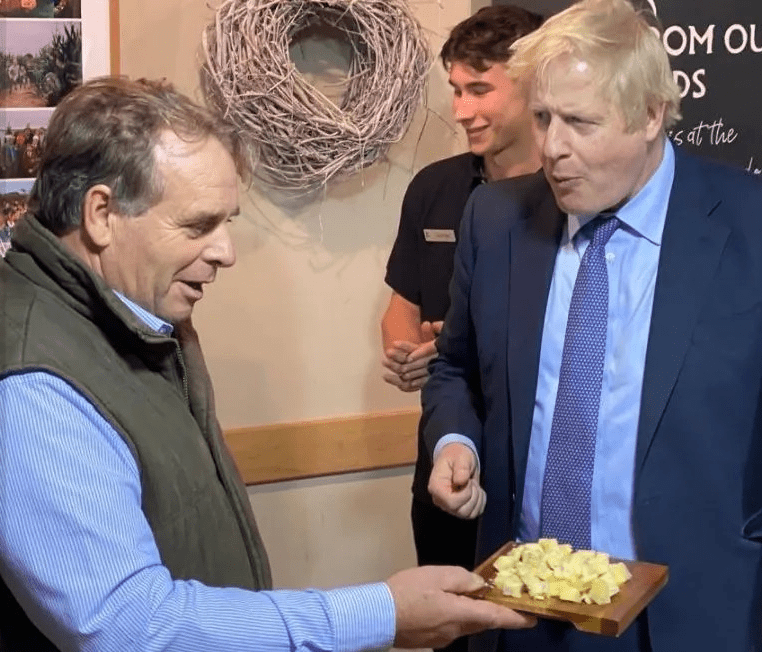
“I was trying to watch tractors”
‘Did he watch the full tractor porn…or just the trailer?’ Social media is flooded with hilarious memes as Tory MP Neil Parish quits after watching pornography in the Commons
You might have expected this but not the Daily Mail to be the front runner!
BBC News flash: Neil Parish resigns
Neil Parish MP: I’m resigning after porn ‘moment of madness’
Neil Parish has told the BBC he is resigning as an MP after admitting he watched pornography twice in the House of Commons.
Mr Parish – the MP for Tiverton and Honiton in Devon – said it had been a “moment of madness” and “I was not proud of what I was doing.”
He said the first time was accidental after looking at tractors, but the second time was deliberate.
He was suspended by the Conservative Party on Friday over the allegations.
Two female colleagues claimed they had seen him looking at adult content on his phone while sitting near them.
He previously told the BBC he would co-operate fully with the inquiry.
“Of course it’s embarrassing,” he said on Friday. “And it’s embarrassing for my wife and family, and so that’s my main concern at the moment. I have a very supportive wife and I thank her for that.”
Asked if it was a mistake and he had opened something on his phone in error, he said: “I did, but let the inquiry look at that.
“I will await the findings of the inquiry and then I will consider my position. I will not remain if I am found guilty.”
Media caption,
Tory MP Neil Parish on porn allegations: ‘Of course it’s embarrassing’
In an interview with the Times, Mr Parish’s wife, Sue Parish, said the allegation was “very embarrassing” and described her husband as “quite a normal guy” and “a lovely person”.
“If you were mad with every man who looked at pornography, you would not have many wives in the world,” she said.
She added she did not see the attraction of pornography and understood why the women who had made the allegation were upset.


Neil Parish said last night that he would remain an MP while his conduct was investigated.
But overnight, under significant pressure, he has changed his mind.
It’s expected he will confirm his resignation from Parliament in the next few hours. That will trigger a by-election in what is a safe Tory seat.
But the bigger picture here matters too. Westminster has been rocked by allegations of a sexist culture this week. If Mr Parish had continued as an MP, he would have been plagued by questions over his conduct.
Caroline Nokes questioned this morning whether he would be able to do his job as extensively as required. Others suggested it would be impossible for him to continue to hold his influential position chairing the environment committee.
This story – and others – have damaged Parliament’s reputation. They’ve also damaged the Conservative Party. Both will be hoping that Mr Parish’s resignation will help them start to move on.

Mr Parish is facing an investigation by Parliament’s standards commissioner. If it is found that he violated the code of conduct for MPs, possible punishments could include apologising to the Commons, or being suspended or expelled.
Other politicians have called for Mr Parish – who also chairs the environment select committee – to stand down as an MP.
And Labour has criticised the wider culture in Parliament, accusing the government of having known about the incident for days but failing to take action.
Senior Tory MP Caroline Nokes also criticised the delay by the Tory whips office to act and suspend him from the Conservative party, saying the whips office was “still too blokey”.
“I fully expected to wake up on the Wednesday morning and find that a member of Parliament had had the whip suspended,” she told the BBC on Saturday.
“And I felt that by leaving it until Friday before we knew that action had been taken by the whips, that felt like unnecessary dither and delay.”

Who is Neil Parish?
- The 65-year-old, an MP since 2010, was a Member of the European Parliament for South West England from 1999 to 2009
- He left school at 16 to manage his family’s farm and, in 2000, was an election monitor during Zimbabwe’s parliamentary election
- He opposed Brexit in the 2016 referendum and voted against the introduction of same-sex marriage by David Cameron’s government
- Mr Parish is married and has two children and two grandchildren

On Wednesday, it emerged that a female minister had reported a male colleague for viewing pornographic material while sitting beside her in the Commons chamber. The female minister said she had also seen the MP watching pornography during a hearing of a select committee, The Times reported.
A second female Tory MP said she had tried but been unable to capture video proof of him doing so.
The allegations were subsequently revealed to have been made about Mr Parish.
The government’s safeguarding minister Rachel Maclean denied that the Conservative Party was institutionally sexist, saying: “I think there is clearly a problem in the House of Commons. And I think it extends to all parties actually.”
And asked about the delay to Mr Parish being suspended, she said: “There clearly needed to be some time to establish the veracity of what was said, the facts of the case. Where we’ve got to now is the right place we need to be, which is there is the investigation happening, the chief whip has taken the action he’s taken.”
South West suffers from ‘profound’ social inequality, study finds
People in the south west of England face some of the “most profound social and educational divides in the country”, according to a report.
BBC News www.bbc.co.uk
Researchers at the University of Exeter discovered the region suffered from poor exam grades, low wages and limited opportunities.
It said a “lack of impetus for change amongst some leaders” was “harming” the lives of residents.
The government said it was taking “action” to create “well-paid jobs”.
The report looked at data from Cornwall, Devon and Somerset, and was the result of a year-long review.
Prof Lee Elliot Major said he hoped the report served as a “wake-up call”
Prof Lee Elliot Major, who specialises in social mobility and worked on the report, said: “Our evidence demonstrates to central government that levelling up efforts must prioritise the South West.
“Improving social mobility is about ensuring that all people fulfil their potential and lead full lives in the communities they come from.”
Prof Major, based at the University of Exeter, added: “We hope that this will be a wake-up call for a region which faces some of the most profound social and educational divides in the country.”
Prof Sir Steve Smith, an education champion for the government, said the report was “damning and shocking”.
“It lays bare the huge challenges facing the peninsula and makes a compelling case for improving the prospects of future generations,” he said.
Researchers discovered that just 40% of disadvantaged pupils attained a standard pass in GCSE English and Maths in 2019 compared with almost 60% in inner London.
And just 17% of disadvantaged students went on to university in 2018/19 compared with 45% in London.
- Low earnings and poor pay are common in many parts of the region with four of Devon’s eight districts among the UK’s top 25 low wage “hotspots”
- Poor mental health outcomes for both children and adults
- Teacher recruitment, retention and training are challenges for isolated schools
- Schools have on average lower levels of funding than elsewhere
- The area has long travel times to pursue further education or work which has been linked to higher drop out rates
- Fewer professional jobs are available in most areas, which has contributed to a youth exodus
The report made some suggestions to address the challenges:
- A university-led tutoring scheme targeted to disadvantaged pupils in need of extra literacy and numeracy help
- School-centred community hubs to provide support for people aged up to 21. These hubs would be coordinated by schools and tailored to specific community needs
- Flexible post-16 learning, combined with a free 16-19 travel pass, to reduce the cost and risk of pursuing further study and training
- A greater focus on disadvantage, to close the gap in schools. It includes regional schools commissioners leading a regional drive to instil best practice in schools and academy trusts; and a concerted effort to improve parental engagement
The government said: “We want to fire up the South West’s economic engine and are taking decisive action to spread opportunity and investment, creating well-paid jobs across the region.
“Our landmark Levelling Up White Paper includes targeted investment and support in education and plans to provide more power to local leaders across the south west.
“This is on top of more than £490m for levelling up projects in towns and cities like Bournemouth, Plymouth and Glastonbury, as well as new quality jobs created by the Lithium Recovery Plant in Cornwall.”
House price bidding wars are rising fastest in Bath
The southwest of England dominates the nation’s property hotspots. Asking prices in Truro, Cornwall, have risen by 14.6 per cent since this time last year to £323,200, while Plymouth and Gloucester have seen rises of 12 per cent or more.
Tom Howard www.thetimes.co.uk
Asking prices for houses in Bath are rising more quickly than in any other city in Britain as would-be buyers battle each other to snap up the few homes to come onto the market.
The average asking price for a home in the largest city in Somerset has jumped by 15 per cent over the past year, Rightmove, the online property portal, said. The average asking price there has risen to £558,000 — almost £75,000 more than the figure sellers were looking for this time a year ago.
The southwest of England dominates the nation’s property hotspots. Asking prices in Truro, Cornwall, have risen by 14.6 per cent since this time last year to £323,200, while Plymouth and Gloucester have seen rises of 12 per cent or more.
The only location outside of the southwest to break into the five fastest-rising cities is Southend-on-Sea in Essex, where asking prices are up 13.4 per cent year-on-year to £343,000.
On average, prices in the ten fastest-rising cities have climbed 12.6 per cent over the past 12 months. That compares with national asking price growth of 9.9 per cent over the same period.
Buyers, Rightmove said, are trying to balance the desire for more space while remaining close to workplaces and city amenities. “In the first stages of the pandemic we saw the popularity of some major cities, like London, temporarily drop as people looked for more space,” Tim Bannister, the website’s director of property data, said.
“However, for other cities, such as Bath or Plymouth, which perhaps have easier access to the coast and countryside, we saw demand really soar when the market reopened in 2020.”
House prices in the UK more generally have been fuelled by the desire of many to move into bigger properties that offer more potential home-office and garden space, sparked by the pandemic. It has been described as a once in a lifetime re-evaluation of how and where we live, and property market analysts expect that the trend will last for a little while yet.
House prices in Britain are at their highest ever, having risen, on average, by more than a fifth since the onset of Covid. While part of that record rise is down to booming demand, estate agents have for months been complaining that they do not have much housing stock left to sell. That is leading to bidding wars between determined buyers, further inflating prices.
The Rightmove data shows that in those cities where prices are rising fastest, there is a pronounced shortage of houses for sale. In the southwest, the number of houses available for sale has fallen by 39 per cent over the past year, Rightmove estimates.
“[At the start of the pandemic], the supply of homes available kept up with some of this surge in demand, steadying asking prices,” said Bannister.
“Now we’re still seeing really high buyer demand for cities like Bath, Plymouth and Truro, but the number of new homes coming onto the market hasn’t been able to keep up with the buyers enquiring.”
Glasgow is the most competitive city in Britain in which to buy a home, measured by the number of enquiries estate agents are receiving for houses.
“We are seeing 50-plus viewers and offers being made within days for every property coming on the market,” John O’Malley, chief executive at Pacitti Jones estate agents in Glasgow, said.
Today’s caption competition has to be
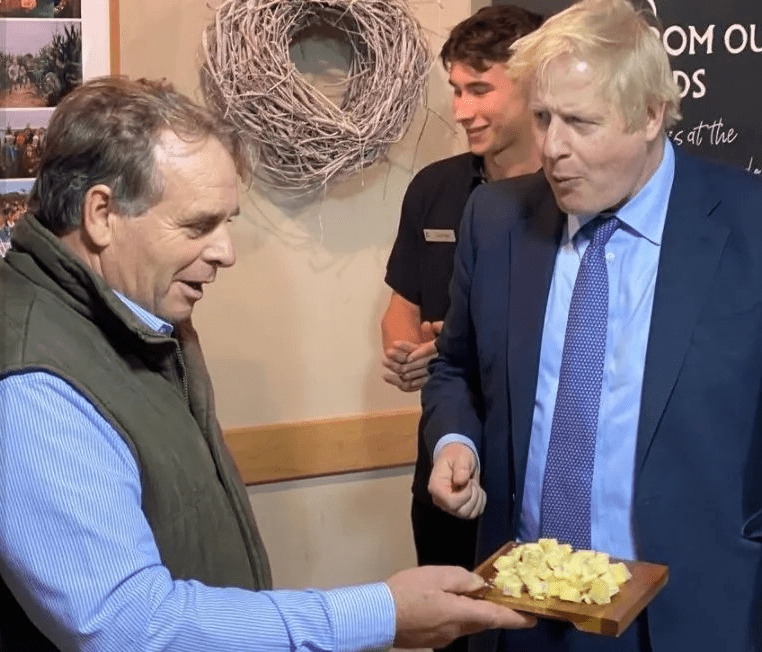
Oooh you didn’t open that attachment did you?
Go now, Tories urge MP in Commons porn row
Today’s Headline in the Times
One local party chairwoman said: “How do we explain this on the doorstep? I couldn’t get people to go out with all the party stuff, and now this.”
But for the moment “our” Neil looks like he is hanging in “due process and all that” (following his leader?)
On returning to his home in Somerset yesterday he told his wife, Sue: “I’m sorry you’ve married a f***ing idiot.”
Conservative MP Neil Parish suspended after accusations of watching porn in Commons
Ashley Cowburn www.independent.co.uk
Tory MP Neil Parish is facing calls to resign after being named as the individual accused by female colleagues of watching pornography in the House of Commons chamber.
The 65-year-old backbencher has been suspended from the Conservative parliamentary party and is set for investigation after referring himself to parliament’s standards commissioner.
He offered an apology “for the situation”, but vowed to continue serving as MP for Tiverton and Honiton while the inquiry takes place, promising he would quit parliament if found guilty.
Speaking to reporters outside his Devon home, Mr Parish suggested that he had opened the offensive material by error in the Commons chamber. But he declined to confirm suggestions that he plans to say in his defence that it was sent to his phone by someone else.
“I will await the findings of the inquiry and then I will consider my position,” he said. “I will not remain if I am found guilty.”
His suspension comes after politicians of all stripes reacted with outrage at the claims first made privately by two female Tory MPs during a meeting with party officials on Tuesday evening.
Ending days of rife speculation over the identity of the individual alleged to have watched porn, Mr Parish – who also chairs the Commons Environment, Food and Rural Affairs Committee – had the whip suspended on Friday.
Asked if he recognised the offence caused to female colleagues, he said: “Of course I can understand why they are concerned and I can only apologise for the situation, but I will maintain my duties as MP.”
He revealed that he only informed his wife this afternoon i- some time after it became public knowledge – that he was the MP at the heart of the pornography storm which has raged in Westminster over the past two days.
“Of course it’s embarrassing, and it’s embarrassing for my wife and family,” he said. “I have a very supportive wife and I thank her for that.”
Mr Parish’s wife Sue told The Times her husbnnd was “quite a normal guy, really, a lovely person”, adding: “It’s just so stupid.”
She said that the female MPs who complained about Mr Parish were “quite right” to be upset”, adding: “He would never just sit there with people looking. He would never just do that knowing [people were looking]”.
Mrs Parish said she did not understand the attraction of pornography. “I’m a woman,” she said. “Hence why the women were so cross. It’s degrading. It’s demeaning.”
Standards commissioner Kathryn Stone may launch a probe if she believes Mr Parish caused “significant damage to the reputation and integrity” of the House of Commons.
A second investigation by the Independent Complaints and Grievance Scheme (ICGS) — established in the wake of the MeToo scandal — was launched after the allegations surfaced.
But the senior Labour MP Harriet Harman insisted Mr Parish should resign “right away” if the allegations are true, saying the incident was a “new low” for the House of Commons.
Ms Harman, the mother of the house – the longest serving female MP – told BBC Radio 4: “If this is what he has done, he should stand down from parliament right away.
“It’s not right for him to go through the investigation process if that is what he has done. Clearly he is not fit to be in parliament. He should accept that and not drag the processes out”.
After his suspension, it emerged Mr Parish was asked about the allegation that an MP had watched porn in the Commons chamber in a TV interview days before being named as the suspect, and told GB News the incident should be treated “seriously”.
In the interview Mr Paris also denied there was a cultural problem of misogyny in parliament – but said some MPs might “step over the line”.
“I think the whip’s office will do a thorough investigation and we will wait and see that result and I think from that, then the decision will have to be made what action should be taken,” he said.
Asked if there was a culture of misogyny in parliament, Mr Parish replied: “When you’ve got 650 members of parliament in what is a very intense area, you are going to get people that step over the line.
“I don’t think there’s necessarily a huge culture here but I think it does have to be dealt with and dealt with seriously and I think that’s what the whips will do.”
The move on Friday by chief whip Chris Heaton-Harris followed accusations that the Conservatives were failing to act on complaints from two of their own female MPs, with demands for action from opposition parties and some Tories.
Labour’s shadow leader of the Commons, Thangam Debbonaire MP, said: “The Conservatives knew for days about the disgusting behaviour of one of their MPs and tried to cover it up … this is a government rotting from the head down. Britain deserves better.”
Daisy Cooper, the deputy leader of the Liberal Democrats, added: “If Boris Johnson had any shred of decency left, he would tell Neil Parish to resign immediately.
“In any other workplace this would count as gross misconduct and the person responsible would lose their job. Parliament should be no different.
“We don’t need to insult the women MPs who witnessed this with a lengthy investigation. All his bosses need to do is ask for his devices and look at his viewing history, this isn’t rocket science.”
Former Conservative leader William Hague suggested thatMr Heaton-Harris should have moved more quickly to suspend the MP from the parliamentary party.
“It would have been better to make sure everybody knew who it was involved and take this action a few days ago,” Lord Hague told Times Radio.
The former Tory leader said it was right to wait for the outcome of Ms Stone’s inquiry but said it should be “resolved quickly” to avoid “terrible shame on [parliament’s] reputation”.
The pornography claims come amid renewed focus on misconduct and misogyny in parliament and reports at the weekend that 56 MPs – including three cabinet ministers – are facing sexual misconduct claims that have been referred to the ICGS.
Lord Hague said: “Clearly these things are completely unacceptable, utterly depressing. And I think we will end up with MPs having to vacate their seats. You know, there are going to be resignations from parliament over this and the political parties really have to clamp down on it.”
Women’s charities have warned that Westminster’s working culture is “in the gutter”. The CEO of charity refugee told The Independent the last seven days had been a “difficult week for women”.
Some female MPs have also detailed the sexual harassment they have experienced, including cabinet minister Anne Marie-Trevelyan, who told LBC on Friday that a male MP once pinned her against a wall and told her she “wants him”.
The international trade secretary said female MPs were still subjected to “wandering hands”, later adding: “It’s never okay anywhere. It’s not okay in Westminster either. If you’re a bloke – keep your hands in your pockets”.
Suella Braverman, the attorney general, added that a minority of men in politics “behave like animals” and were bringing parliament into disrepute with unacceptable behaviour.
Before Mr Parish was identified and had the whip suspended for allegedly watching porn in the Commons chamber she said she was “ashamed this person is carrying the Conservative rosette”.
Jess Philips on Neil Parish
… But I am a tiny bit irritated by the idea that it is a pervading culture, that people can’t fight against it, the reason that somebody thought it was okay to watch porn in the chamber is because of the late nights and the drinking and the culture in Westminster – utter rubbish. The reason that person did that is because, for want of a better word, they’re an arsehole. And they should take personal responsibility for their behaviour. …
Breaking: Tory MP Neil Parish investigated over claims he watched porn in Commons
Owl has been “on the wing” all day and out of contact.
Owl has now literally fallen off the perch on catching up. Seems to sum up the state of the Tory party nationally and locally.
The Conservative MP accused of watching pornography in the House of Commons chamber has been named as Neil Parish.
He has been suspended from the parliamentary party and is under investigation by Parliament’s standards commissioner.
Two female colleagues complained earlier this week after allegedly seeing him looking at adult content on his phone while sitting near them.
Mr Parish said he had referred himself for investigation.
If the standards commissioner, Kathryn Stone, finds that he has violated the code of conduct for MPs, possible sanctions range from having to make an apology to the Commons to suspension or expulsion.
Questioned by the BBC, Mr Parish said he would co-operate fully with the inquiry and would await Ms Stone’s findings before commenting on the allegation.
When asked if he made and mistake and opened something on his phone in error, he said: “I did, but let the inquiry look at that.”
In a statement on his website, Mr Parish said he would “continue to perform my duties as MP for Tiverton and Honiton” while the investigation was ongoing.
In an interview with the Times, Mr Parish’s wife, Sue Parish, said the allegation was “very embarrassing” and described her husband as “quite a normal guy and “a lovely person”.
She said she did not see the attraction of pornography and understood why the women who made the allegation were upset.
“I’m a woman,” she was quoted say saying. “Hence why the women were so cross. It’s degrading. It’s demanding. But on the other hand it takes two to tango. There must be women posing for all this.”
But veteran Labour MP and former deputy party leader Harriet Harman told the BBC the allegations marked a “new low for the House of Commons”.
She said Mr Parish should stand down as an MP immediately if he watched porn in Parliament, adding: “It’s not right for him to go through the investigation processes if that’s what he’s done.”
And Liberal Democrat deputy leader Daisy Cooper said: “If Boris Johnson had any shred of decency left, he would tell Neil Parish to resign immediately.
“In any other workplace this would count as gross misconduct and the person responsible would lose their job.”

Who is Neil Parish?
- The 65-year-old, an MP since 2010, was a Member of the European Parliament for South West England from 1999 to 2009
- He left school at 16 to manage his family’s farm and, in 2000, was an election monitor during Zimbabwe’s parliamentary election
- He opposed Brexit in the 2016 referendum and voted against the introduction of same-sex marriage by David Cameron’s government
- Mr Parish is married and has two children and two grandchildren

It emerged on Wednesday that a female minister had reported seeing a male Tory MP viewing pornographic material while sitting beside her in the Commons chamber.
A second female Tory MP said she had tried but been unable to capture video proof of him doing so.
A Conservative spokesperson said Mr Parish has been suspended from the party whip pending the outcome of Ms Stone’s investigation.
Conservative chief whip Chris Heaton-Harris has already asked for the matter to be referred to Parliament’s Independent Complaints and Grievance Scheme.
Mr Parish, MP for Tiverton and Honiton, in Devon, chairs the Commons Environment, Food and Rural Affairs Committee.
The investigation does not prevent him from continuing in that role.
Environment committee member, the SNP’s Kirsty Blackman, said she was “shell-shocked” and that Mr Parish “absolutely shouldn’t remain as chair”.
“I hope this does not detract or distract from the good work the committee has done and continues to do,” she added.
Conservative MP Pauline Latham also suggested Mr Parish should be removed as chairman of the select committee.
Meanwhile, fellow Conservative MP and former Home Office minister Karen Bradley said she hoped Mr Parish would “do the right thing and not come into Parliament” now an investigation was under way.
Mr Parish was quizzed by GB News earlier this week about allegations an MP had been caught watching porn.
“I think the whips’ office will do a thorough investigation, and we will wait and see that result,” he told the channel.
“I think from that then the decision will have to be made what action to be taken.”
The claims against Mr Parish follow a series of allegations about other MPs’ behaviour.
International Trade Secretary Anne-Marie Trevelyan said on Friday that she had once been “pinned up against a wall” by a male colleague and subject to misogyny and “wandering hands” on numerous occasions.
Attorney General Suella Braverman told BBC Radio 4’s Woman’s Hour there had to be a discussion about “moral standards”, complaining that a minority of men in politics “behave like animals”.
And a Welsh MP alleged that a member of Labour’s shadow cabinet had made lewd remarks to her.
Comment on local independent politicians
Owl has upgraded Mark Hawkins’ comment on East Devon leader attacks Tories’ Russian links to this full post below:
Before commenting on this piece it’s important to say that plenty of conservatives are decent, honourable, public spirited intelligent people.
Others, as we see here are touched by rather less warmth and fewer brain cells. It can be very difficult when one has had a sense of entitlement and a taste of certainty to realise the public chose to wake up and smell the gravy. It can provoke unreasoned, childish unpleasantness.
Most independent politicians in my experience have less personal ambition than those who choose the party route. I can name two very good local ones who have stood as Independents but were persuaded to join the conservative group because that group’s unchallenged dominance offered the chance to achieve more of their priorities. They both achieved within a relatively short time the previously unsought office of mayor.
Some of the current Independents have significant achievements in their principal careers. The majority were motivated to stand for local government because of a distaste for aspects of how things were, a consequence of a lack of electoral balance and of democratic accountability.
It took three electoral cycles for this movement to achieve success and a further year to overcome the mischief of careerists. These won’t be seen as achievements, more as establishing the opportunity to achieve.
I don’t know any of them well, but have never detected any sense of the politics of envy. No jealousy of legitimately gained success, financial or otherwise. Though I recognise a commonly shared distaste for illegitimately gained wealth, home and abroad, through plundering of the public purse and significantly flawed procurement processes which apparently benefit a targeted few.
It is surely legitimate comment to question the advertisement, for a significant salary, for a campaigns director. If I were a local conservative voter on the minimum wage or universal credit I would want to know why a group which believed itself to possess the collective talent to manage our community’s affairs felt it necessary to employ someone for three times my family’s income to make the case they should surely be capable of themselves.
In the incumbents I have recognised a desire to put the community first and on occasion right wrongs. The presumably anonymous author of the spiteful assassination belittles their achievements, so I will note a few, in a couple of cases noting the shaming distortions of their critic. Coming out of the first lockdown and working remotely they worked to resolve problems with the licensing issues in the Strand, Exmouth, whilst sustaining the appropriate duty of care to the officers on the ground. The tories on the three councils had the opportunity to resolve this over 10 years ago but left the area a hotch potch of ownership and licensing. Stuart Hughes should remember this, he was the lead councillor on the project. Now they seek to exploit it.
The new regime have also resolved recent mistakes in this area caused by the excessive corporate zeal of an outsourcing company, inappropriately tasked by the old guard, who are once again seeking to exploit their own mess.
The new regime have also worked with honourable members from all groups to resolve one of the more distasteful wrongs of the last administration and return Warren View sports ground to it’s rightful place as the home of a community football club. Many residents of Exmouth are well aware now of what really went on in 2016/17 so no need to dwell unless pressed.
Another success achieved in harmony with other groups is to address the functioning of the complaints procedure, which had been used to bully opponents of the dominant group and fallen into disrepute with them and the public. It is still not fully transparent, but I understand Cllr Twiss was a participant in the improved process, which must be a positive.
One endeavour of Cllr Arnott with limited success so far but which has apparently enraged one or two conservatives is his compassionate desire to achieve for the victims of John Humphreys some understanding of how the cesspit of that man’s past remained hidden for over thirty years from the first known offence and still remains substantially concealed. To achieve this requires the active participation of a number of organisations.
This was not mentioned in the conservatives’ anonymous character assassination.
For Tory Eyes Only
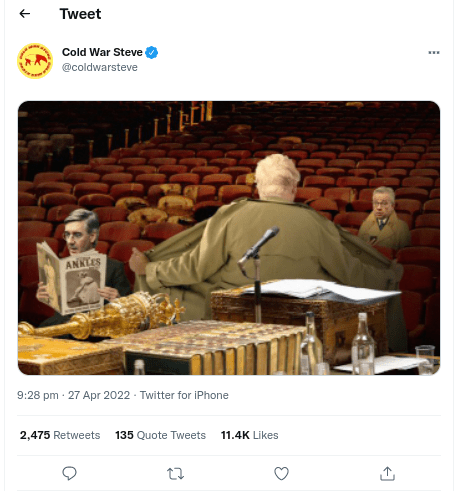
Boris’ big bet on more nukes and EDF’s nuclear bombshell
According to Private Eye:
THE global nuclear industry is lobbying in overdrive, evidently with great success in No 10, the major European nuclear incumbent EDF well to the fore. Unfortunately for the French firm, its failings advertise themselves loudly. At home, France is suffering the highest electricity prices in Europe, which have blown clean through its price cap.
This is down to major operational difficulties with the large fleet of EDF nukes. Output is at historic lows and France, traditionally an exporter of electricity, is now importing.
Here, EDF’s efforts to build Hinkley Point C are coming unstuck again (Eyes passim), with more delays and cost increases – it’ll now be a mere 10 years later than originally planned. Blaming Covid and Ukraine, in fact EDF has badly misjudged the size of the construction workforce it needs.
Financial disclosures in France suggest EDF fears its Chinese partner in the Hinkley project may not stump up its share of the new cost overrun, and also that EDF has run out of cash on its Sizewell project, for which it now desperately needs the government to contribute. Why will EDF’s assessment of the problematic bedrock at Sizewell (Eye 1527) prove any better than at Hinkley? How any of this rationally justifies Johnson making a “big bet” on more nukes, and on EDF at Sizewell in particular, is anyone’s guess.
Most of the publicity and comment covering Thursday’s High Court Ruling on care homes was not in the national but regional press.
For example:
“One city care home manager says that the sector was thrown into a ‘nightmare’ by the ‘policy failure’, while a Portsmouth MP has slammed the government’s ‘callous neglect’ of vulnerable people.”
City care sector faced ‘nightmare’ due to government’s ‘failure’ as High Court rules policies allowing untested hospital patients to be discharged into care homes to be ‘unlawful’
[Anyone heard any “slamming” from either Neil Parish and Simon Jupp or even an apology? – Owl]
Emily Jessica Turner www.portsmouth.co.uk
In early 2020, patients were rapidly discharged into care homes without testing – despite the risk of asymptomatic transmission – with government documents showing there was no requirement for this until mid-April.
In a ruling made today, Lord Justice Bean and Mr Justice Garnham concluded that policies contained in documents released in March and early April 2020 were unlawful because they failed to take into account the risk to elderly and vulnerable residents from non-symptomatic transmission of the virus.
The government’s actions in allowing patients to be discharged into care homes at the start of the Covid pandemic has been declared unlawful as it did not take into account the risk of asymptomatic patients spreading the virus
They said that despite ‘growing awareness’ of the risk of asymptomatic transmission, there was no evidence that Mr Hancock or anyone advising him addressed the issue of this risk to care home residents in England.
A Freedom of Information request submitted by The News in 2020 revealed that 25 patients with the virus were sent to care homes from hospital as the pandemic hit.
The 25 discharged from Queen Alexandra Hospital and confirmed as having Covid were among nearly 400 released between March 1 and April 15 – with 206 placed in the community with no records held at QA of testing.
Steve Bonner is chairman of the Pompey Pensioners Association, a group calling on the city’s MPs to lobby government for change.
While he welcomes the High Court’s ruling, Steve believes it is crucial to ‘learn our lessons’ from what happened.
He said: ‘It’s belated, but better late than never.
‘It’s a situation that we shouldn’t have been put in – hospital beds being cleared and people being put in an area where there were vulnerable people being put at risk.
Andrea Pattison outside St Ronans Care Home. Picture: Habibur Rahman
‘With the benefit of hindsight, it was an extremely dangerous move and no doubt significantly increased the number of deaths.
‘We’re the group that were put most at risk by that sort of activity.’
At the time, then health secretary Matt Hancock promised that a “protective ring” had been put around care homes nationally.
Andrea Pattison, owner of St Ronan’s Care Home in Southsea and member of the Hampshire Care Association, said: ‘The sector has been fully aware that there was no “protective ring” thrown around care homes – we’ve lived and worked through that nightmare together, and our amazing staff and residents did an outstanding job in the crisis.
‘It’s heartening to see that this element of policy failure is now recognised as such by law.
‘What we need now is accountability and chance – there’s a lot of talk of reform but we need changes that recognises people’s dignity and treats them with respect.
‘We need better funding in the system’.
Portsmouth South’s MP Stephen Morgan says that ministers ignored ‘alarm bells’, despite claiming to have thrown this “protective ring” around city care homes.
He added: ‘This is yet another sad reminder of how many people in our city needlessly died because of government’s callous neglect of the services we all rely on.
‘Ministers cannot claim they weren’t warned at the time and now they cannot claim to have acted to save lives. They broke the law and people died.
‘The government owes it to bereaved families in Portsmouth to make sure that this never happens again.’
Dave Sheppard, Bluewater Care Home in Buckland, said: ‘We were very fortunate and we avoided Covid. Our infection control was really red hot.
‘We put extra staff on, we were extra vigilant – we even purchased an extra spray machine and we got an extra cleaner to clean every surface.
‘There was loads of pressure – all of it could have been better dealt with.
‘It was difficult for every care home and for the residents.
‘Policies were changing by the week, and sometimes by the day – what was perfectly okay one day was illegal three days later.’
Roger Batterbury, chairperson of Healthwatch Portsmouth, said: ‘It’s very upsetting to the many families that have suffered as part of the government’s decisions during the height of the pandemic.
‘Healthwatch Portsmouth has always advised the public to follow the science and Government guidance on testing and social distancing.
‘The news of the High Court ruling though will clearly make uncomfortable reading for many people and trigger still-raw emotions.’
One person who spoke to the Healthwatch Portsmouth chairperson earlier today and who has been through this and lost a parent was very angry.
Roger added: ‘Today’s High Court ruling supports his concerns at the time about the government’s disregard for safety in their decision and the impact it had on patients relating to the practice of ‘no prior testing for COVID on hospital transfers’ of patients to Care Homes.
‘At HWP we feel deeply for the people still suffering or for whom this has brought back difficult emotions, we would advise anyone affected by the impact of today’s news to seek help.’
Penny Mordaunt MP has been approached for comment.
High Court ruling on discharge into care homes: should we now hold Abbeyfield and Devon County to account?
Or at least ask questions about how they justify pressing on with the Shandford care home closure during March 2020?
In Wednesday’s ruling the High Court found that two government policies were unlawful: the March 2020 Discharge Policy, which led to an influx of patients into care homes to free up hospital beds, and the April Admissions Guidance, which provided care homes with advice on admissions of people from hospitals.
This ruling concerns the movement of patients from hospital to care homes with no testing or isolation period.
Here is what Owl wrote on 28 March 2020 questioning the wisdom of moving frail and vulnerable care home residents from one home to another to meet a commercial objective as Covid-19 raged, infection rates doubling every three days:
Despite a national lockdown care home residents are being shuffled from one home to another.
“Abbeyfield appear intent on moving two frail residents from Shandford on Monday to other care homes, despite the country being in lockdown.
Owl has been deluged by local comment since this story appeared on-line a couple of days ago. This is Owl’s attempt at putting these in context.
The country is in a form of lockdown described as: stay at home, protect the NHS, save lives, allowing limited movement outside the home for essential purposes.
This week the most vulnerable were sent a letter instructing them to stay at home and not to move outside for any reason. These would have included the sort of vulnerable centenarians, resident in the Abbeyfield “Shandford” care home.
Yesterday, the national restrictions were further tightened when healthy people contracted to move house, even as soon as this weekend, were advised not to.
Despite this national emergency, Owl understands, Abbeyfield are intent in moving the frail and vulnerable out of Shandford to meet their self imposed deadline to close the home. Apparently, at least two are scheduled to leave on Monday. When the safety of this has been questioned the reply given by Devon County Council is that this is in accordance with “existing protocols” . [To a correspondent via email]
Owl finds this incomprehensible. Unfortunately, Covid-19 has breezed through “existing protocols” which is why we are facing an uncontrolled epidemic with infections doubling every three days. Covid-19 is spread by person to person contact. Shuffling people around is recklessly irresponsible, “existing protocols” must be torn up and common sense applied or our collective attempts at achieving control will fail.
To date Covid-19 restrictions appear to have kept Shandford open for longer than Abbeyfield intended. Owl understands that Shandford could have been saved. Amica Care Trust had made approaches to take over the home. Simon Jupp MP had tried to facilitate this.with no success. A local “Save our Shandford” organisation could have formed the nucleus of providing a local source of fundraising. An attempt at creating a Community Interest Company to take Shandford back into local control has been frustrated by Abbeyfield’s refusal to disclose details of the 2012 deed of transfer, when local control was ceded to Abbeyfield.
Owl has been told all monies will be returned to the Town when the site is sold. So Owl is puzzled by why Abbeyfield appears intent on “realising the assets” at the start of an economic crash, rather than transfer it to Amica or back to local control as a going concern.
To Owl this appears a scorched earth policy.”
We got all the big calls right!
James O’Brien on the government’s care home ‘protective ring’ is a devastating 2 minute listen
Use this link listen to his Tweet
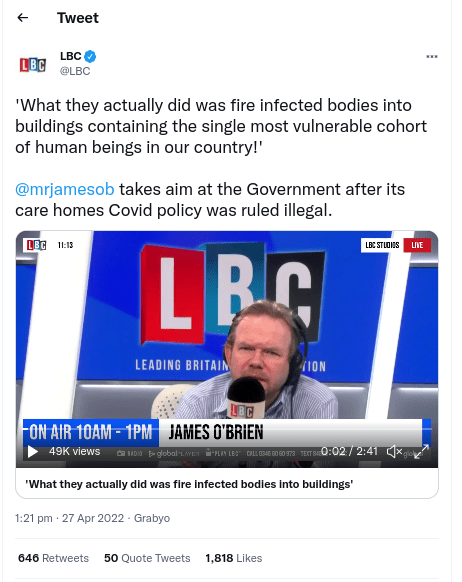
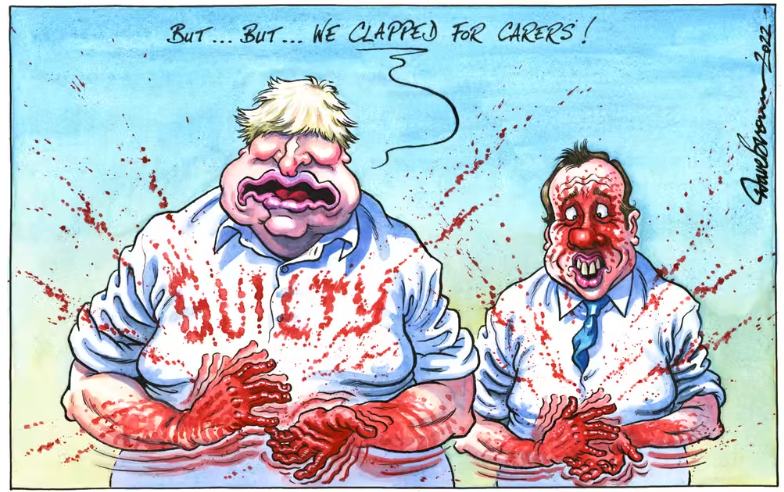
But…But…We Clapped for Carers!