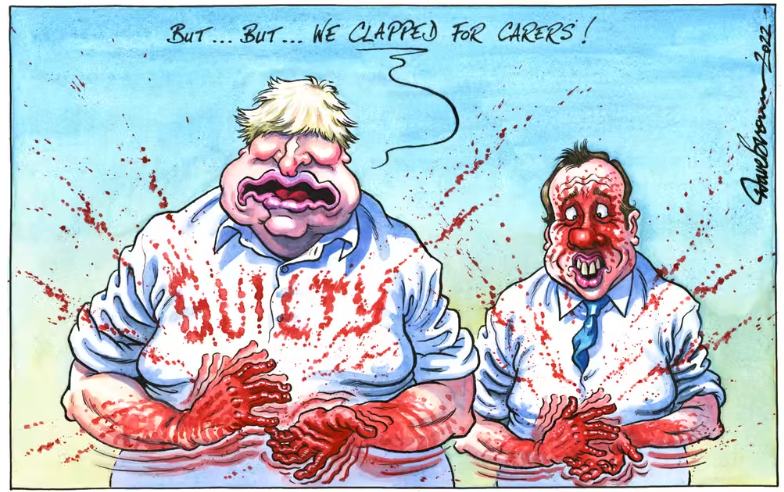
But…But…We Clapped for Carers!

Today’s Western Morning News reports a number of Devon MPs on the list including Luke Pollard, Johnny Mercer and Sir Gary Streeter, along with former Totnes Conservative MP Sarah Wollaston.
Speaking during Prime Minister’s Questions shortly after the list was published, Boris Johnson said those on the list “should regard it as a badge of honour”.
From yesterday’s Politico London Newsletter
Today’s Times splash has astonishing revelations of the ways people misused and abused the COVID loan scheme that was set up to support businesses during the pandemic, up to the extreme of Border Force officials stopping people carrying suitcases filled with COVID loan cash at airports. In another example, a builder obtained the maximum COVID bounce-back loan of £50,000 by claiming his firm had turned over at least £200,000 the previous year — when prior to receipt of the loan his firm’s account balance stood at £2.72 in credit. The builder then admitted he spent the loan playing poker. Well worth reading the full investigation by George Greenwood and James Hurley here.
[Lord Agnew resigned in parliament (January) after £4.3bn write-off, saying oversight of loans scheme had been ‘nothing less than woeful’]
Sajid Javid used an offshore trust while working as an MP in the heart of the Treasury – but did not declare it in the register of members’ interests, The Independent can reveal.
Anna Isaac www.independent.co.uk
As the then chancellor George Osborne’s parliamentary private secretary (PPS) in 2011, Mr Javid – now health secretary – played a key role in selling the Coalition government’s austerity policies to MPs.
But at the same time, Mr Javid was using a trust, understood to have been located in a tax haven, to cut his personal tax burden. He also served in the Treasury while the government launched a consultation on policies covering non-doms and overseas trusts in December 2011.
Earlier this month, Mr Javid admitted he had used non-dom status before entering politics and to having had an offshore trust, but it is only now that it has been revealed that he did not declare the trust as an MP and PPS.
The ministerial code states that while PPSs, who act as ministerial aides, are not technically members of the government “they must ensure that no conflict arises, or appears to arise, between their role as a parliamentary private secretary, and their private interests”.
It was only on becoming a government minister in 2012 that former banker Mr Javid revealed more details on the extent of his overseas assets and how they were managed.
“If Sajid Javid held money in an offshore trust while he was part of the Treasury, it would raise further questions about decision making in this government,” said James Murray, shadow financial secretary to the Treasury.
“It is rank hypocrisy for senior ministers to defend the tax hike hitting working people this year, when they have spent so many years avoiding their fair share of tax themselves.”
Earlier this month Mr Javid admitted he had used non-dom status to cut his tax bill after The Independent revealed that Akshata Murty, the chancellor’s wife, exploited the same route to cut her tax bill in the UK. Ms Murty subsequently decided to pay tax on her worldwide income in the UK, but has retained non-dom status.
Offshore trusts and use of non-dom status are entirely legal methods of limiting taxes.
Mr Javid’s trust was not listed in his entry in the register of members’ interests in 2011, but he did declare a shareholding in Deutsche Bank, his former employer.
A spokesman for Mr Javid declined to say if the assets in the trust – which Mr Javid said in a statement he dissolved in 2012 – included these Deutsche Bank shares as well as other assets, including shares in different companies. They also declined to say whether this trust was operated as a blind trust or under a blind management arrangement, or say where it was located.
The health secretary did not collapse the offshore trust until the year after he entered the Treasury. He stopped making use of the controversial non-dom tax status in 2009, before entering politics.
“Sajid has been very open and transparent about his previous tax status in the UK and when he lived abroad. He has nothing further to add,” a spokesman for the health and social care secretary said.
When he dissolved his trust, Mr Javid, incurred a rate of 50 per cent tax, which he claimed offset any “accrued benefit” from the financial arrangement.
He also said that he had always declared the information required by tax, governmental, and parliamentary authorities.
“The public has a right to know which ministers have benefited from tax avoidance arrangements and how much money they have saved as a result,” Mr Murray said.
“While the Tories are raising taxes on working people as inflation and energy bills soar, Labour would make the tax system fairer. We would abolish the outdated ‘non-dom’ system, so that everyone who makes their home in Britain pays tax here on all their income,” he added.
The fresh examination of the timeline laid out by Mr Javid reveals he was at the government’s political front line, selling tough austerity policies to Tory backbenchers in the aftermath of the financial crisis, while exploiting mechanisms to protect his wealth.
During his time as a banker, Mr Javid – himself a former chancellor – was linked to Dark Blue Investments, an employee benefit trust in which staff were paid share bonuses via trusts to avoid tax. The supreme court ruled that tax ought to be paid on these bonuses.
Experts have queried Mr Javid’s use of non-dom status, given that he was born in the UK and therefore would have had to declare that he did not intend to live in the country in the long term.
The debate was held on Wednesday and the record can be found here
The purpose of these debates is simply to raise the profile of the issue being discussed. A Minister has to be present and respond.
Here are just a few extracts:
Sir Geoffrey Cox (yes him, the rich baritone and defender of tax havens)
(Torridge and West Devon) (Con)
Does my hon. Friend agree that the situation at the moment allows landlords to buy up good residences in towns such as Barnstaple and Bideford, register themselves as businesses, apply for small business interest rate relief, pay nothing to the community, either in council tax or business rates, and provide very little by way of employment, and that that racket has to be stopped?
(North Devon) (Con)
…I believe that we also need to go beyond just tackling business rates on short-term holiday lets; we need to tackle the inequalities between mortgage relief on long-term and short-term rentals, which are viewed as capital assets. Their profits are taxed differently, as returns on capital. Both types of property were built as homes, and they should be taxed comparably. Without a register of short-term holiday lets, I imagine that many are paying no tax at all, which is another opportunity for the Treasury. This is a step that could be taken rapidly to make the private rental sector more appealing to landlords, which is ultimately a step that we need to take quickly in order to begin to provide more housing in the south-west….
…..Will my right hon. Friend the Minister commit to assist our planning departments to reverse building where appropriate, to stop building properties solely for holiday lets or second homes, and to have a clause that exempts people from living there full time? It is one thing for holiday parks, which are designed that way, but actual housing is being built with this restriction in place along the North Devon coast. Clearly that is needed on occasion, but as we have such a shortage of long-term housing, can we not focus on this, given that we are short of the other necessary resources—land, builders and materials?
Will my right hon. Friend the Minister also commit to work with the Treasury to look at taxation reforms and how to tackle the issue of empty properties? We have an abundance of them in North Devon, but it is simply not viable for the council to spend its time and resource on tackling this issue. If we could breathe life into empty buildings, we could take steps to regenerate additional housing, without building all over the beautiful fields of North Devon. I keep being told that the councils have it in their remit to convert space above empty shops into homes. Will someone please come to Barnstaple and make that happen? We have so many empty units with huge storage areas, rather than flats, above them, and tackling this issue could transform our town centre as well as provide vital accommodation.
Finally, please can steps be taken to tackle the issue of viability and barriers to councils being able to build developments with more than an 18% social housing component? I know that we English believe that our home is our castle, but far too many of the residents of North Devon worry about not having a home at all. That causes mental health issues, which are exacerbated further by having so many shortages in mental health services, as we cannot recruit to fill the vacancies.
Many Devon MPs made contributions (eg Ben Bradford, Luke Pollard, Gary Streeter and Anthony Mangnall) but, of these, Owl found the brief interjections from Simon Jupp and Neil Parish the least impressive. Readers can check this for themselves.
“East Devon deserves better” Simon.
She said that she was “minded” to issue an intervention notice, which would lead to the sale being blocked.
Nadine Dorries, the culture secretary, is poised to intervene in a takeover by the local newspaper group Newsquest of its rival Archant.
Newsquest, which publishes titles including The Northern Echo and the Lancashire Telegraph, sealed a deal last month to buy the East Anglia-based company. Archant, which was sold by the private equity firm Rcapital, owns newspapers including the Eastern Daily Press and Norwich Evening News plus the regional Country Life magazines. It employs 760 staff.
Dorries said that she was “minded” to issue an intervention notice, which would lead to the sale being blocked.
In-depth analysis and comment on the latest financial and economic news from our award-winning Business teams.
The Department for Digital, Culture, Media & Sport said in a letter to the groups that Dorries has “plurality concerns” over how the merger could impact competition where the two companies operate.
“The merger will see the two largest local newspaper groups in East Anglia combining,” the letter said.
“While news will still be available for consumers from other local and national providers (ie. radio, TV and online) . . . the majority of local newspapers will come under single ownership. Such concentration of ownership has the potential to impact the plurality of views available in local newspapers in East Anglia.
“This risk may be exacerbated by any potential restructuring within Archant’s titles, a possibility that has been subject to press speculation.”
The culture secretary has asked for reports by two watchdogs, the Competition and Markets Authority and Ofcom, before deciding whether a full investigation is needed by the competition regulator.
East Devon Tories have released a fiery statement accusing the leader of the district council of having “extremely left-wing views” after he suggested potential funding links between East Devon Conservatives and Russian oligarchs.
Dare to question Tory allegiances and look what nonsense they come up with, not that clairvoyant Owl hadn’t foreseen this sort of thing in February.
Are they getting jumpy?
Joe Ives, local democracy reporter www.radioexe.co.uk

Paul Arnott leads the East Devon Alliance (courtesy: Paul Arnott)
Conservatives retort he’s extreme left-winger
In their letter, they accuse East Devon District Council (EDDC) leader Paul Arnott (Coly Valley), head of the Democratic Alliance Group coalition running the council, of having a “remarkable chip on his shoulder” and of appearing to “believe that any successful businessman can only have done it through dubious means.”
The response follows a column published by councillor Arnott published by the Exmouth Journal last Sunday [24 May].
In the piece, Cllr Arnott referred to a previous article he had written which questioned the fundraising tactics of East Devon Conservatives, saying that former East Devon Tory MP Sir Hugo Swire had a “fondness” for raising party funds “at exclusive auctions from close associates and family of Russian oligarchs.”
In his latest article, Cllr Arnott challenged the East Devon Conservatives to “confirm none of their past local campaigning has drawn on their Russian-sourced HQ funding, and confirm that future elections and campaigns will be wholly free of that dirty money?”
He also asked them to join him “in an appeal to the PM that all Russian cash in their bulging funding pot is returned.”
The council leader also questioned how the local Tory group had obtained the funding for glossy leaflets and a newly advertised role for a campaign manager.
He added: “In some ways, independents such as me should take this as a compliment. The Tories have obviously lost all confidence in their local ability on the ground to run any kind of campaign.
“Lucky them, though. People like me standing have to raise every penny for leaflets on our own, with a tiny amount of help in my case from my group, the East Devon Alliance, with the odd sign or placard.”
In response, East Devon Conservatives published a blistering statement on Wednesday [27 April] stating they only receive money from membership fees and donations from local residents and local fundraising activities. “There is no national (still less international!) money provided for local Devon campaigns”, they added.
Defending their leafleting campaign and new campaign manager job they said: “East Devon Conservatives more often than not have employed professional campaign staff with money being raised locally and the recent job advertisement is nothing unusual.
“From time to time, we issue newsletters to residents and not just at election time. We believe residents should be kept informed.”
The rebuttal then goes on the counter-attack, criticising EDDC’s recent decision to double car parking charges in 21 council-run seaside car parks, describing the move as “arrogant and insensitive”. The council also raised fees by 50 per cent in five other ‘prime location’ car parks.
The council leadership has defended the rise, the first in 12 years, saying it was needed to raise £1.1 million extra a year to help pay for essential public services.
The Tory statement also criticises the council’s leadership for its handling of rent charges for businesses wanting to offer outdoor seating at Exmouth’s town centre square, the Strand.
The issue was resolved last month after the council backtracked on its initial proposals, eventually reaching “mutually agreeable rents” between the vendors and the council.
The statement slams the independent group for hiring new council staff “whilst apparently lacking the resources to pay for them” and for spending thousands of pounds on an unpublished Local Government Association report on an employment dispute. [See this EDW post for the explanation of this particular attack levelled in the Tory leaflet “Keeping in Touch; and this post for the most hypocritical.]
[Their announcement concludes: “Being a so-called independent should mean that you are open to working with everyone, yet the mask slips all too often with the East Devon Alliance Party.
“Cllr Arnott would be wise to concentrate his columns on his council’s achievements rather than attack others. We understand that may mean we see fewer of his contributions.”
Owl fact checks the PM’s reply
Source: www.theguardian.com
Daisy Cooper (Lib Dem) asks if the PM will apologise to the families of people who died in care homes, and to care worker staff, in the light of today’s court ruling.
Johnson says he wants to renew his apologies, and sympathy, to people who lost relatives in care homes in the pandemic.
He says the government did not know much about the disease at that point. It did not know how easy it was for the disease to spread asymptomatically.
On the court judgment, he says the government will study it carefully.
Fact check from report of judgement:
The judges said the risk of asymptomatic transmission had been highlighted by people including Sir Patrick Vallance, the government’s chief scientific adviser, in a radio interview as early as 13 March.
“Non-symptomatic transmission would mean that one elderly patient moved from hospital to a care home could infect other residents before manifesting symptoms, or even without ever manifesting symptoms,” they said.
A woman [Cathy Gardner] whose father died from COVID in a care home has said government claims a “protective ring” had been thrown around residents at the beginning of the pandemic were “a lie”.
Dr Cathy Gardner said her father Michael Gibson died at the age of 88 at a care home in Bicester in April 2020 and took legal action against Health Secretary Sajid Javid, NHS England and Public Health England.
High Court judges ruled government policies on discharging patients from hospital to care homes at the outset of the pandemic were “unlawful” because they failed to take into account the risk to elderly and vulnerable residents from non-symptomatic transmission of COVID.
Dr Gardner told Sky News she “realised something was badly wrong” and wanted to “hold the government to account” because they had “not protected my father” – and strongly criticised claims made by the then health secretary, Matt Hancock.
She said: “They haven’t protected my father and other residents in care homes and I wanted to hold the government to account.
“When secretary of state Matt Hancock said that he’d thrown a protective ring around care homes right from the start – I heard him say that on television and my chin nearly hit the floor because all of us who were involved in any way with care homes at the start of the pandemic knew that was absolutely not true.
“It was a lie. It was a lie then and it is a lie now.
“They didn’t do anything to protect my father, there was no help given to care homes and the death toll in those first few weeks of the pandemic was catastrophic.
“I think they never imagined they were going to be found out. You only have to look at the parties (in Downing Street) to realise they never think they’re going to be found out.”
‘We don’t believe they did anything’
She added: “I think at the time Matt Hancock made that statement about the protective ring, the death toll in care homes was already horrendous.
“I think he was under attack and he felt that he needed to say that they’d done this even though blatantly they hadn’t to those of us who were there at the time and knew.
“They should have taken steps to protect the most vulnerable people. Measures should have been put in place. We don’t believe they did anything.
“There’s no evidence ever been provided that they did anything. Matt Hancock unfortunately made a statement which is untrue.”
Dr Gardner said she holds “many parts of the government responsible” and believes the “focus” at the time was “very much on the NHS”.
She added: “I was really shocked when it was suggested to me that my father had COVID.
‘I never blamed the care home’
“He got ill in March 2020, it was so early. The idea that he caught COVID in his care home just seemed almost impossible to me at the time.
“I never blamed the care home, never – and I don’t blame myself – I trusted that he would be safe in the care home and they did their absolute best.
“But the government had the responsibility and they had the legal duty.”
Dr Gardner’s High Court action was taken with Fay Harris, whose father Donald died – and they had asked two judges to make declarations that unlawful decisions were made.
Lawyers for Mr Javid, Public Health England and NHS England wanted the women’s claim dismissed.
A government spokeswoman had said in a statement outside court during the hearing that “we worked tirelessly to protect the public from the threat to life and health posed by the pandemic and specifically sought to safeguard care homes and their residents”.
Heart felt congratulations from Owl!
Covid: discharging untested patients into care homes was unlawful, says court
Robert Booth www.theguardian.com
The government policy towards care homes in England at the start of the Covid pandemic has been ruled illegal, in a significant blow to ministers’ claim to have thrown a “protective ring” around the vulnerable residents.
The high court judgment was sought by two grieving daughters, Dr Cathy Gardner and Fay Harris, who lost their fathers to the virus in care homes in spring 2020. Michael Gibson died aged 88 in Oxfordshire on 3 April 2020 while Don Harris died aged 89 in Hampshire on 1 May 2020, both after outbreaks in their care homes.
More than a quarter of all deaths among care home residents in March and April 2020 involved Covid-19 – more than 12,500 people. Lawyers for Gardner, 60, and Harris, 58, had argued in a judicial review the government did the “very opposite” of the claim by then health secretary, Matt Hancock, that “right from the start we have tried to throw a protective ring around our care homes”.
After an almost 22-month crowdfunded legal challenge to the legality of policies advanced by the health secretary, Public Health England and NHS England, the verdict was handed down on Wednesday.
Lord Justice Bean and Mr Justice Garnham said: “The decisions of the secretary of state for health and social care to make and maintain a series of policies contained in documents issued on 17 and 19 March and 2 April 2020 were unlawful because the drafters of those documents failed to take into account the risk to elderly and vulnerable residents from non-symptomatic transmission.”
As ministers and officials pushed to free up space in hospitals by discharging 25,000 hospital patients into care homes, government guidance issued on 2 April 2020 said negative tests were not required prior to transfers.
The daughters had argued the failure to protect care home residents was among the most “egregious and devastating policy failures in the modern era”.
During proceedings government lawyers denied any policy failure and told the court that scientists did not advise of “firm evidence” of asymptomatic transmission until mid-April 2020. They said fears of hospitals becoming overwhelmed were “far from being theoretical” and that ministers had to balance competing harms amid enormous challenges.
The judges said the risk of asymptomatic transmission had been highlighted by people including Sir Patrick Vallance, the government’s chief scientific adviser, in a radio interview as early as 13 March.
“Non-symptomatic transmission would mean that one elderly patient moved from hospital to a care home could infect other residents before manifesting symptoms, or even without ever manifesting symptoms,” they said.
“The judges found that it was irrational for the DHSC not to have advised until mid-April 2020 that where an asymptomatic patient (other than one who had tested negative for Covid-19) was admitted to a care home, he or she should, so far as practicable, be kept apart from other residents for 14 days.”
The court dismissed the other aspects of the case brought by the claimants, including claims under articles 2 and 8 of the European convention on human rights, and a claim against NHS England.
We already know that our “cold fish”: East Devon Tories, and two MPs Neil Parish and Simon Jupp; are opposed to any more subsidies for LED, the “standalone” company that runs EDDC leisure facilities. Indeed, they are currently attacking the Democratic Coalition in their latest Tory “In Touch” leaflet for doing so during the pandemic, despite having subsidised LED themselves ever since they set LED up in 2006.
If you haven’t read this odious little gem, it will be popping through your door soon. See local Tories sink into nauseating hypocrisy
Matthew Weaver www.theguardian.com
Heating bill increases of up to 150% will lead to the widespread closures of UK swimming pools without an emergency government bailout, ministers have been told.
Campaigners say that even if financial help is provided, swimmers will have to accept colder pools and higher prices.
The sport governing body Swim England and ukactive, which represents gym and pool operators, met the sports minister Nigel Huddleston on Tuesday to make an urgent plea for emergency funds to keep pools open.
Speaking before the meeting, the Swim England chief executive, Jane Nickerson, said: “We need some acute support now. At the moment swimming is not viable unless it’s supported. Our real worry is that doors will just shut because operators will find they can’t afford to run their pools. We need a bailout now because you can’t suddenly make a pool energy efficient.”
The chief executive of ukactive, Huw Edwards, agreed. He said: “Fitness and leisure operators are reaching tipping point as rising energy costs bite, forcing them to consider price rises, service restrictions or permanent closure. Pool operators, in particular, are facing huge bills, with hundreds of facilities across the country just months away from closures and service restrictions.”
The fear of widespread closures comes after the chancellor, Rishi Sunak, who is building a private pool in his North Yorkshire mansion, ignored calls for a long-term strategy to keep pools open as part of his spring statement.
Nickerson said public pools were struggling to cope with a total energy bill of £1.25bn this year compared with £500m in 2019, at a time when the sector was still reeling from forced pool closures during lockdown. “Providers have run their reserves down to cope with the pandemic,” she said.
One of the biggest public pool operators, GLL, which trades under the name Better, says its energy bills have increased by at least 150% since April 2019. Its chief executive, Mark Sesnan, who attended Tuesday’s meeting, said: “We are heading for a crisis and it needs urgent action. The minister went away with a clear message that we need something to be done. Although he was clear that he would struggle to make a special case to the Treasury.”
Sesnan added: “People need to realise that this is a real and present danger to swimming in the UK. And it will be very difficult to maintain the current stock of pools. The business model has been completely disrupted. Just to meet the energy price increase we need an extra £1 for every person who uses a pool.”
He said the public would also need to accept “more realistic” prices of about £7 or £8 a swim, as well as reduced opening hours and more stringent temperature controls to save on heating bills.
Nickerson said: “Letting people swim in wetsuits is fine for someone like me doing lengths, because I can swim fast to keep warm. But you can’t teach children to swim in cold water – parents won’t take their kids if they see their teeth chattering.”
She added: “If you shut the doors on these pools now you are losing out on kids learning to swim. You won’t die if you don’t learn to kick a football, but you can certainly drown if you don’t learn to swim.”
She is also worried that price rises could make swimming unaffordable for many families. Nickerson said: “We don’t want public pools to become like private health clubs. It should be an activity for everyone, not just for those who can afford it.”
Edwards pointed out the wider health benefits of swimming. He said: “More than 1 million children missed out on swimming lessons during the pandemic and many people’s physical and mental health deteriorated without access to pools and gyms. We need the government to act with urgency to support pools and gyms so that our nation’s health inequalities do not widen any further.”
Pool closures, or threatened closures, have already been reported, including in Halifax, Newport, Shropshire, Falmouth, Croydon and Keswick.
Even before the increase in fuel prices, a report by Swim England last September estimated that 40%, or 1,868, of the 4,336 public pools in England could be forced to close by 2030. Nickerson said: “There was a massive building programme in the 1960s and 70s but those pools have come to the end of their lifespan.”
She said the energy crisis had increased the urgency of replacing those inefficient buildings. “The sector is looking at what it can do to save energy and retrofit buildings. But that won’t happen overnight. And they will also need grants to do it because the payback period is so long,” she said.
A government spokesperson said: “We are in regular contact with Ofgem, business groups and energy suppliers to understand the challenges they face and see how they can best be supported.”
Boris, remember you usually get “Owt for nowt”. Do you understand the urgency? – Owl
Boris Johnson is a big-picture guy. He doesn’t do details. But our prime minister appears to be running short of big ideas on Britain’s cost of living crisis. So he has asked his cabinet colleagues to come up with “innovative” suggestions.
Adam Forrest www.independent.co.uk
The problem is, their innovative suggestions cannot involve Treasury spending. Mr Johnson told his cabinet he is only interested in cost-free ways to ease the burden of soaring bills and rising prices on hard-pressed families.
Hence the ridicule from opposition parties, who claim that the PM is “completely out of ideas” and that the chancellor, Rishi Sunak, is unwilling to provide badly needed help. Is it possible to solve such a lack-of-money crisis without spending more money?
No 10 has hinted at the kind of cost-free things it wants ministers to consider. Whitehall departments are being encouraged to do more to promote existing support schemes that have not been widely taken up.
For instance, the government has estimated that around 1.3 million families could be taking up more support through the tax-free childcare scheme, which offers up to £2,000 a year towards costs.
No 10 has hinted that childcare rules could be changed in a bid to bring down costs – but there is no indication that the amount offered through the tax-free scheme will be increased.
Downing Street is flagging an estimate that 850,000 eligible households are not claiming pension credit, which can be worth over £3,300 a year.
Mr Johnson’s team also pointed at a move to freeze energy bill deductions from universal credit, designed to give claimants a bit more time to sort things out with their gas and electricity providers.
No 10 has not denied reports that the government is considering plans to cut tariffs on food the UK does not produce – such as rice – in a bid to bring down costs for British consumers.
Tinkering at the margins? Perhaps. Will it be enough to ease even the political pressure on the government? Probably not.
Increasingly restless Tory MPs fear that Mr Sunak’s failure to offer more help with bills and benefits at his recent spring mini-Budget will cost the party dearly at the local elections next week.
Backbencher Andrew Bridgen is among those who have said the chancellor may have to consider an “emergency Budget” before the summer recess – something Labour is now demanding.
But Mr Sunak made clear to cabinet ministers on Tuesday that there would be no new money available to spend on measures to tackle living costs.
No 10 says Mr Johnson will hold another meeting to decide on the “non-fiscal” measures “in the next couple of weeks”, with the PM apparently on the same page as the chancellor on holding down debt.
The local elections on 5 May could sharpen minds. If the results are terrible for the Tory party, then speculation about a backbench leadership putsch will hit feverish new heights.
Mr Johnson may find himself knocking on Mr Sunak’s door to ask if he can rustle up a few billion from somewhere to help him – and everyone else – through the summer.
The government plans to axe section 106 agreements in favour of an infrastructure levy, but Richard Harbord warns that consultation paralysis, levelling-up concerns and developer opposition could block any progress.
[Readers may remember the scandal unearthed through FOIs that the then Conservative controlled EDDC were so focused on “Build, build, build”, around 2016, that they had lost track of S106 payments, including uncollected payments. – Owl]
There are rumours that central government is planning a reform to the current planning legislation involving the removal of section 106 of the Town and Country Planning Act 1990. The understanding is that it would be replaced by a levy on developers.
Originally section 106 agreements required developers to build infrastructure whenever they constructed housing estates. They would be required to provide schools, doctors’ surgeries and any other relevant item that the increased number of residents would need. This became, in many instances, the payment of a cash sum to cover the estimated cost of such infrastructure or contribute towards it.
In many local authorities there are considerable Section 106 reserves where these deposits are held but not immediately used. It has also been used to secure a specified percentage of affordable homes (as defined).
This is not actually a new idea because the proposals in the subsequently scrapped planning white paper were for the replacement of section 106 agreements and the Community Infrastructure Levy with a fixed tax on development value paid at the date of occupation.
The government says that it is developing models for a new levy. This, it says, will enable local authorities to capture value from new developments more efficiently. It would be used to finance affordable housing and community infrastructure.
The devil will, of course, be in the detail and consultation will follow. However, an interesting side issue is the government’s tardiness in responding to consultations affecting local authorities. Glacial response times could be another effect of the pandemic, but some are suspicious that there is an unwillingness to deal with politically sensitive issues.
Stuck in the consultation queue
My point is that once the new levy proposals go out to consultation, they may well be stuck in a queue and not reach legislation for some time.
Developers, it has to be said, are not over-excited with the new proposals, arguing that a fixed-rate levy lacks the local flexibility of a section 106 agreement. There is also a feeling that fixed-rate levies may disadvantage certain parts of the country over others and be against the spirit of levelling up.
A figure of £7bn apparently could be raised through the levy, although that sum is not quantified over time a time period. Local authorities will be eager to see how the money is to be distributed and what limits there will be on its use. The spirit of such levies is that they are raised and spent locally. We will not know until we see the detailed consultation.
One police station has shut every two weeks under the “Law and Order” Party.
No wonder the Tories have made so much of reopening a station in the largest town in Devon, Exmouth, after seven years without.
What about smaller towns?
Remember for every £1 you spend in local taxes on services provided by EDDC you spend £1.6 on the Police. Value for money? – Owl
Amy Gibbons www.independent.co.uk
The Government is being warned that people feel “unsafe on their own streets” as new analysis suggests more than 200 police stations and counters have closed in the past seven years.
The Liberal Democrats said the figures, which the party obtained under freedom of information laws, equate to the loss of more than one site every two weeks.
It said a total of 217 stations and counters in England and Wales were shut from 2015 to 2021, with an average of 31 closures a year.
London and the South East in particular have seen a “staggering fall” in numbers, the party said, with Thames Valley Police closing the most sites – 23 stations and 44 counters.
Ahead of the local elections in May, the Lib Dems are promoting a three-point plan to crack down on crime and anti-social behaviour.
This would involve restoring “proper community policing”, where officers are more visible, trusted and known personally to local people; and reversing cuts to youth services by investing an extra £500 million a year through a ring-fenced fund to local authorities, it said.
The party also wants to scrap police and crime commissioners and invest what it says will equate to £50 million in savings in frontline policing and solving crimes.
Lib Dem leader Sir Ed Davey said: “Shuttered police stations have become a symbol of the Conservatives’ failure on crime. Too many people feel unsafe on their own streets, and too many criminals are getting away with it.
“The Liberal Democrats are calling for a return to proper community policing, where officers are visible, trusted and focused on cutting crime.
“This May people will have a chance to send Boris Johnson’s Conservatives a message. A vote for the Liberal Democrats is a vote for more investment in our police and youth services to help make our communities safer.”
A Home Office spokesperson said: “The Government is already over halfway to recruiting an additional 20,000 additional police officers and the police are being given the powers, tools and funding they need to cut crime.
“It is the responsibility of locally elected police and crime commissioners and chief constables to take decisions around their resourcing and estates.
“However, police stations – which remain one of many methods where incidents can be reported – should be kept open where possible to ensure people feel safe in their communities.”
The site forms part of a major housing expansion in the area, as part of the Monkerton and Hill Barton masterplan which is included in the city’s housing land supply.
This document, published in 2010, provides a framework to “guide the future development of a sustainable urban extension to the north east of the city.”
Ollie Heptinstall, local democracy reporter www.radioexe.co.uk

They could affect Met Office satellite info
New homes on the outskirts of Exeter could affect the Met Office’s ability to receive satellite information, unless planning conditions are put in place.
The weather forecaster has submitted a response to outline plans for up to 285 new homes at Hill Barton that city councillors will consider next week.
Devon developer Salter Property wants to built the properties just north of the Met Office, on land between it and Hollow Lane.
The site forms part of a major housing expansion in the area, as part of the Monkerton and Hill Barton masterplan which is included in the city’s housing land supply.
This document, published in 2010, provides a framework to “guide the future development of a sustainable urban extension to the north east of the city.”
In the last couple of years, approval has been given for housing on land adjoining the site , with construction well underway and many homes already built.
The wider development area received outline permission for 750 homes in 2013.
There is likely to be a mix of properties including houses and flats, however this does not need to be confirmed at the outline stage and will be subject to the final stage ‘reserved matters’ application.
The proposal will also provide open space with a multi-use games area (MUGA) and other equipped play areas.
Planning officers recommend approval, subject to a number of conditions and contributions towards local amenities. This includes £1 million towards new secondary school provision at South West Exeter, over £500,000 in transport contributions and £166,349 for GPs to be able to take on more patients.
The council wants 35 per cent of the homes set aside as affordable, in line with its policy for new developments, with 70 per cent of these for social rent.
Four objections have been received from members of the public, with worries about overdevelopment, a loss of open green space, and nearby schools and GP surgeries being “over capacity to cope.”
The Met Office’s concern is about the potential for the construction work to “obstruct the receipt of satellite data transmissions” but it has has no objection subject to the “inclusion of suitable worded planning conditions” to prevent such issues.
In conclusion, the planning officer’s report states: “The site is allocated with the core strategy for residential development and therefore the principle of development is considered to be acceptable.”
“Furthermore, the site has previously benefitted from an outline consent for residential development as part of a wider site, large parts of which have already been constructed.
“The development would provide a significant level of housing towards the council five-year housing supply which is to be welcomed.
“The application is for outline planning permission and therefore, while some concerns have been identified with the illustrative layout submitted, these have been drawn to the attention of the applicant. It is considered that there is no reason why these cannot be addressed as part of any ‘reserved matters’ application…”
Sidmouth’s promised Rockfish restaurant is facing a delay.
Joe Ives, local democracy reporter www.radioexe.co.uk
No date is yet set for the conversion of the derelict Drill Hall in Sidmouth into the seafood eatery as “legal matters” continue to halt progress.
East Devon District Council (EDDC) agreed to sell the historic building to the restaurant chain in February 2020, but the pandemic intervened. Legal disagreements with the previous owners, reported in December last year, continue to hold the deal back.
According to the council, the former owners say they could be owed money if the land becomes significantly more valuable in future; for example if a block of flats were to be built there.
EDDC, which currently owns the property, says that’s not the case because Drill Hall is being refurbished and that these payments, known as overages, only have to be paid when a building is knocked down and the land redeveloped.
EDDC says no agreement has been reached with the former owners: “despite the efforts of the council and its solicitors”, a situation it describes as “very unfortunate.”
The news came in a statement in response to a question submitted by Sidmouth councillor Cathy Gardner (Independent East Devon Alliance and Democratic Alliance Group) ahead of a full council meeting. In its reply, EDDC also reported it was looking at ways to give Rockfish “the comfort” to enter an agrrement to buy the building before the legal dispute is resolved.
Rockfish, owned by award-winning chef and restaurateur Mitch Tonks, has an ‘option agreement’ to take over the Drill Hall which expires at the end of October. If the legal dispute is not settled before this date the council might have to re-market the building.
EDDC says it expects Rockfish to stick with its plans, which is said may bring £1million of investment and 30 to 40 jobs into the area.
In her written question, Cllr Gardener said: “After many years of campaigning to save the Drill Hall at Port Royal, Sidmouth from demolition, I was delighted that Rockfish were willing to take on the lease and convert the building…[but] residents are now concerned about the future of this historic building.”
Speaking in 2020 another Sidmouth representative, Councillor Denise Bickley (Independent East Devon Alliance and Democratic Alliance Group), said she hoped the regeneration of the derelict building would “transform the Port Royal area.”
Her views were widely shared. At the time councillors voted unanimously in favour of the plans.
Torbay playing catch-up – Owl
Joe Ives, local democracy reporter www.radioexe.co.uk
Netflix beware!
Torbay residents will soon be able to watch council meetings online as the local authority finally takes more permanent steps to make use of streaming.
Torbay Council’s cabinet agreed to a ‘trial’ period for live streaming meetings that will start in May and last until the end of July next year.
Councils were allowed to hold and make decisions in virtual meetings at the start of the pandemic. But since a High Court ruling in May last year, most local councils have had to meet in person.
However, this does not stop them from streaming meetings for the benefit of the public or councillors who may be unable to attend.
Many councils, including most in Devon, have made use of this right and have kept live streaming their in-person meetings, allowing the public to watch online.
Over the past year, the leadership of Torbay Council has insisted that this isn’t a good option for Torbay because of the cost and difficulty of setting up the technology in the council’s old buildings.
Since late June 2021 the council hasn’t streamed any of its decision-making meetings, not even with a rudimentary webcam as has been used successfully by some councils.
Council leader Steve Darling (Lib Dems, Barton with Watcombe) said it was “a pity” that the government didn’t allow local authorities to decide if they wished to hold decision-making meetings over the internet or in person.
Commenting on the new streaming trial, Councillor Mike Morey (Independent, Furzeham with Summercombe), cabinet member for infrastructure, environment and culture, said: “Why should we expect people to come here [Torbay Council] to a central point to take part in and listen to meetings?
“When we had Zooming, 12 months, two years ago, we had many more people taking part, whether that’s listening or participating.
“They could dip in and out of meetings as and when they had something of interest, whereas if they travel here they’ve got to sit through a lot of interesting conversation until they get to their actual item.
“I do think live streaming and hybrid meetings do go some way to bring decision-making back to the people.”
Deputy leader of the council Darren Cowell (Independent Group, Shiphay) said the move was “long overdue” as many people are unable or unwilling to attend meetings. It’s also thought that more councillors attended meetings when they were streamed.
There are no plans as yet to broadcast meetings of the council’s overview and scrutiny committee. Cllr Darling said: “This is a starter for ten and it is very costly as far as making this provision on a temporary basis and we need to get a longer-term solution for this.
If the pot will extend to overview and scrutiny then clearly we’ll do that. It’s about being realistic with what we have as far as the finances.”
The council has not publicly revealed how much the trial will cost but it is known to be spending more than £50,000.
From a Correspondent:
We hope that the images below do not ‘stick in the craw’ of Owl, local ornithologists, naturalists and other East Devon environmentalists?
[Owl’s don’t have craws/crops for anything to get stuck in. They either swallow their prey whole or, Owl’s preference, tear them into small pieces and swallow them bit by bit!]
They are published in reply to today’s EDW posting entitled:-
‘VETO PLANS FOR UGLY HOMES, COUNCIL URGED – Could this apply to Clyst St Mary and the Winslade proposals? – Owl’
. . . . and indeed many residents living beside the proposed 15-metre 40 x 4.5 storey flats on a Winslade Park car park, encroaching into a TPO protected woodland and towering above tree-lines and existing 7-metre tall two-storey homes, have submitted their objections to these incongruous proposals (Application No. 21/2217/MRES) sited opposite a Grade II* Listed Historic Manor House in the East Devon rural village of Clyst St Mary.
The phrase ‘ugly homes’ can always be defended and dismissed by Developers as being subjective and based on personal feelings, tastes and opinions – but many will agree on what isand was is not ‘ugly behaviour’ i.e. inappropriate, harmful and disgraceful practices.
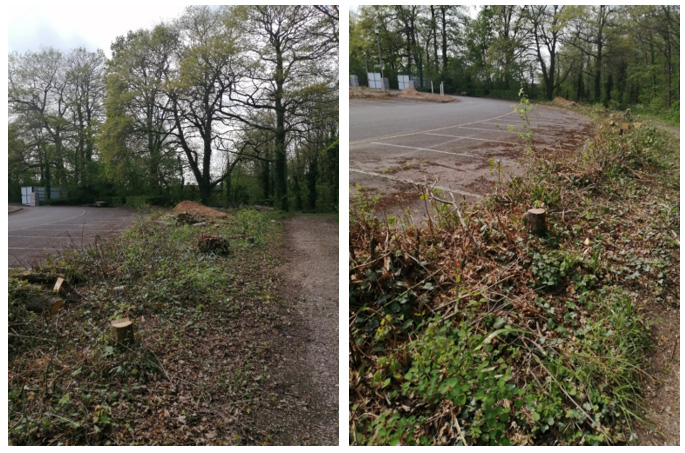
The following images show not only the ugly buildings that are proposed for Winslade Park in Clyst St Mary but also the ugly behaviour that has resulted in the recent decimation of large areas of mature trees and hedgerow within this car park area . . . . . and all this has happened before the Reserved Matters Planning Application has even been listed for an East Devon Planning Committee decision by elected planners!
The moment the chainsaws and mechanical chippers began annihilating this valued, natural environment, the residents informed various departments within EDDC – but to date there has been no official verification as to whether such extensive tree felling and hedge removal have authorisation or permission, either under the previous outline planning application or at all? Irrespective of this – these works have been undertaken and are still continuing during the prime bird nesting season, which, is surely, an offence under the Wildlife and Countryside Act 1981, (which appears to recommend a pre-work schedule being agreed by the local authority to ensure no bird nests, bats, wildlife are present within the trees and hedges being removed)? Obviously the Developers have submitted evidence that there are no nesting birds in these areas – although local people did report seeing bird boxes and nests thrown down by their boundaries during the chainsaw massacres – but all evidence has now been chipped into piles of sawdust – along with all the mature trees and hedges! Furthermore, the area that has been destroyed to date totals more than 5m3 of trees – so isn’t a felling licence required from the Forestry Commission, even if the trees do not have the benefit of TPOs (again does such evidence exist)?
Sadly, the birdsong from innumerable, diverse, indigenous bird species – some rare – some more common – have been replaced by the continuing, intrusive drone of the chainsaws!
The images below tell their own story:-



True Blue Tory Heath Council by-election falls to Lib Dem 2:1 landslide (thanks to “George Dixon” for spotting this one) – Owl
Ninian Wilson www.thenational.scot
THE Tories have been hit with a big loss in a local council by-election where Michael Gove is the MP.
As the Tories suffer a relentless barrage of scandals following Boris Johnson’s partygate fine, voters in the traditionally Tory area of Bisley and West End (Surrey Heath) have turned away from the Conservative party.
The Liberal Democrats managed to win almost twice as many votes as the Tories in what Gove will be hoping is not a forecast of things to come for his party in the upcoming May elections.

One Twitter user wrote: “Having lived in this area for a number of years and knowing how true blue it was, take it from me, this is a colossal result”
While the turnout for the election was relatively low, Tories may fear that an election result like this -and those coming up in May – could be seen by voters as an opportunity to voice their anger over the partygate scandal and the controversial Rwanda asylum scheme.
Rishi Sunak will this week attempt to put his recent political troubles behind him when he courts City figures at a Conservative donors’ dinner designed to bolster party finances.
Mark Kleinman news.sky.com
Sky News has learnt that the chancellor will speak at the event in central London on Tuesday evening, with guests being charged £10,000 for a 10-person table.
Sources said the dinner had been organised by Malik Karim, the investment banker who was appointed as a Tory treasurer last September.
He is said to be keen to broaden the party’s donor base in an industry that has historically provided a reliable source of funding, and wants this week’s inaugural City dinner to become an annual event.
Ironically, major Tory donors who are members of the House of Lords will be unable to attend Tuesday’s dinner because they have been told to be available to vote in the chamber.
Mr Sunak is understood to have been promoted as the event’s guest of honour, with tickets costing £1,000-a-head.
Buyers of individual tickets would not be required to disclose their purchase, although anyone buying an entire table would, because of the £7,500 threshold for declaring political donations to national parties.
The chancellor has endured the toughest month of his political career amid scrutiny of his family’s tax affairs and the fixed penalty notice he received, alongside the prime minister, for attending a Downing Street gathering during one of the pandemic lockdowns.
Mr Sunak has asked the government’s independent ministerial standards adviser to investigate whether he has adequately disclosed his financial interests since joining the front benches.
The Treasury declined to comment.

