Saves his “War Chest” for a pre-election bonanza.
Do you remember the 50’s or will this be a new experience for you? – Owl (who is as old as the hills)
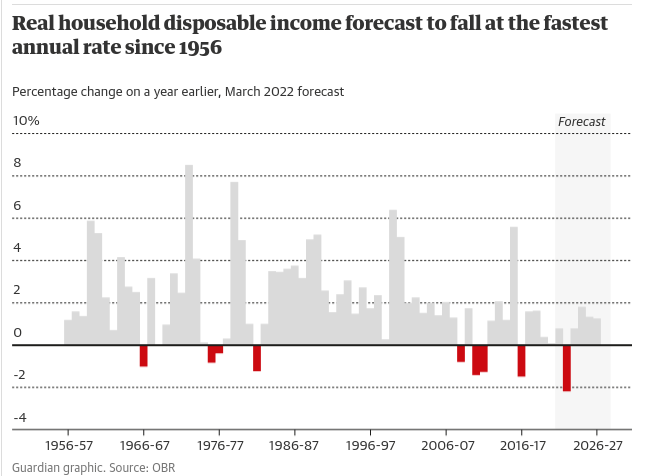
Real household disposable income forecast to fall at the fastest annual rate since 1956 – graphic

Saves his “War Chest” for a pre-election bonanza.
Do you remember the 50’s or will this be a new experience for you? – Owl (who is as old as the hills)
Real household disposable income forecast to fall at the fastest annual rate since 1956 – graphic

If the Tories hadn’t torn up the planning policies on land based wind farms in 2015 we would have had a seven year start to make ourselves less dependent on fossil fuels. There can be no quick fixes from nuclear power as the Hinkley saga demonstrates. Tories aren’t good at strategic planning. – Owl
Ione Wells www.bbc.co.uk
Boris Johnson’s cabinet is split over proposals to ease planning rules in England to enable more onshore wind farms, sources have told the BBC.
Ministers are next week due to set out plans to produce more energy in the UK to tackle spiralling household bills.
Business secretary Kwasi Kwarteng is in favour of loosening planning regulations to make it easier to approve plans for more onshore wind.
But the BBC has been told other cabinet ministers strongly oppose the plans.
In 2015, planning laws were changed to give local councils tougher powers over whether onshore wind turbines were built in their areas. Labour have described this as an effective “moratorium” on onshore wind – and have called on the government to end it.
The government wants the UK to become more “energy independent”, as the West tries to wean itself off Russian gas and oil.
Its “energy supply strategy” will focus on:
This week, Kwasi Kwarteng told the i newspaper “the prime minister has been very clear that onshore wind has got to be part of the mix and we’ve got to look at planning”.
Speaking ahead of Wednesday’s cabinet meeting – the last before the energy strategy is due to be unveiled – he said: “We are not saying we are going to scrap all planning rules and all of these things have got to be in line with community support.”
He described 2015 arguments against more onshore wind as “historic”, as the government had not then committed to achieving “net zero” emissions by 2050.
“The circumstances today with Putin, Russia, Saudi Arabia, all of those things, mean that we’ve got to have more energy independence and I think onshore renewables are absolutely part of that,” he added.
Downing Street sources told the BBC the government has “got to be open” to more onshore wind where it works, but that the “big wins are offshore”.
Boris Johnson is thought to be particularly keen on offshore wind and nuclear power, telling nuclear industry leaders on Monday that he was “insanely frustrated” that the UK has “so little” nuclear capacity and was “moving so slowly” on building new reactors.
But multiple cabinet sources have told the BBC they are against relaxing planning laws for onshore wind, with one saying there was “very, very little” support for the idea.
‘Fed up’
Another cabinet source said ministers were generally united on the need for more offshore wind and nuclear power, but onshore wind would cause a “bigger problem” and needed more discussion.
Among the cabinet ministers opposed to more onshore wind turbines is Scottish Secretary Alister Jack, but the BBC understands he backs offshore developments.
The majority of the UK’s large scale wind farms are in Scotland, and onshore wind is Scotland’s main source of renewable energy, with about 70% of electricity generated in Scotland coming from onshore wind in 2020.
Onshore wind farms have been controversial among Tory MPs in the past, with David Cameron saying in 2014 that people were “fed up” with onshore wind farms being built, and Conservative activists criticising the visual impact of them on the landscape.
But in recent years government surveys have shown public support for onshore wind, albeit not always in the areas where turbines are built.
Some cabinet ministers we spoke to were “sceptical”, rather than strongly against, more onshore wind.
Separately, the BBC has been told that Brexit opportunities minister Jacob Rees-Mogg would back whatever would bring “cheap and reliable” energy to the UK, but has long been frustrated by what he views as its unreliability as an energy source.
Collapsed airline Flybe has announced 23 new flight routes ahead of its return next month.
Exeter isn’t even on the map, let alone being a regional hub.
Natasha Meek www.winsfordguardian.co.uk
The regional carrier will operate up to 530 flights per week across 23 routes, serving airports such as Belfast City, Birmingham, East Midlands, Glasgow, Heathrow and Leeds Bradford.
Flybe flights will resume on April 13, 2022.
If you’re already planning an adventure, here’s the full list of flight routes for 2022.
New Flybe flight routes
Flybe was pushed into administration in March 2020 with the loss of 2,400 jobs as the Covid-19 pandemic destroyed large parts of the travel market.
Before it went bust it flew the most UK domestic routes between airports outside London.
Its business and assets were purchased in April 2021 by Thyme Opco, which is linked to US hedge fund Cyrus Capital.
Thyme Opco was renamed Flybe Limited.
The airline will be based at Birmingham Airport.
Caroline Dinenage given approval to take up nonexecutive role at care home developer owned by Tory donor
Rowena Mason www.theguardian.com
A Conservative MP and former social care minister has signed up for a second job working as a director for a care home developer, just months after Boris Johnson promised a crackdown on outside earnings.
Caroline Dinenage asked for formal approval to take up a job as a nonexecutive at LNT Group, a developer of new care homes owned by Tory donor Lawrence Tomlinson.
Many of her party colleagues have been offloading second jobs following a furore about MPs spending too much time on outside interests after the Owen Paterson lobbying scandal that forced him to resign.
The government pledged to bring in changes to the rules on MP jobs to tighten restrictions around lobbying and consultancy after a consultation held by the Commons standards committee, but last week No 10 quietly dropped support for capping hours and earnings.
Despite the lack of formal new rules, many MPs have cut back their work for private companies.
Julian Smith, a Conservative former cabinet minister, quit all of his private sector advisory roles, which had been earning him £144,000 a year, while Iain Duncan Smith, the former Tory leader, ended his advisory board role at Tunstall Healthcare, which had been earning him £20,000 a year.
In contrast, Dinenage, the MP for Gosport, was given approval for the new part-time role at the care home developer earlier this month by the Advisory Committee on Business Appointments (Acoba), which noted that she had toured an LNT site while she was a social care minister but said her former department had no concerns about her taking up the job.
It said she must not lobby the government on behalf of LNT, draw on privileged information, advise on government contracts or use contacts from her time in office.
Angela Rayner, Labour’s deputy leader, said: “Just as Boris Johnson breaks his promise to crack down on Tory MPs’ outside work, it emerges one of his former health ministers has a second job with a care home firm.
“This is a prime minister who has repeatedly allowed his own MPs to put their own private business interests ahead of their constituents and it must be stopped. Labour will set up a commission for integrity and ethics to make sure the British people’s interests always come first.”
The government’s pledge last year to put tighter restrictions on second jobs came amid a public outcry over lobbying breaches by Paterson, whom MPs were initially whipped to try to protect, and a furore over the former attorney general Geoffrey Cox being paid nearly £6m as a lawyer since joining parliament, voting by proxy on days he was undertaking paid work.
Two cabinet ministers, Dominic Raab and Anne-Marie Trevelyan, backed a time limit on second jobs last autumn, suggesting it could be 10 to 15 hours a week.
But with pressure off Johnson’s premiership because of Russia’s invasion of Ukraine, ministers submitted their view to the Commons standards committee that a time limit or ceiling on such earnings would be “impractical”.
At least 20 Conservative MPs have lobbied the standards committee investigating new rules on second jobs and their behaviour in the Commons chamber, with many saying they strongly disagreed with time limits on outside work.
Dinenage has been contacted for comment.
Data shows £11.8bn lost in support schemes
Harriet Line www.dailymail.co.uk
Coronavirus fraud cost taxpayers almost twice the amount Britain lost on Black Wednesday, figures revealed last night.
A staggering £11.8billion was lost to fraud and error in the Government’s business support schemes during the pandemic, the House of Commons library estimates.
It said 1992’s Black Wednesday, when Britain crashed out of the Exchange Rate Mechanism, cost £3.3billion – which in today’s prices is around £6billion.
Labour, which commissioned the analysis, accused the Chancellor of having ‘casually written off’ pandemic fraud.
Chancellor of the Exchequer Rishi Sunak (pictured) has been accused of writing off pandemic fraud, which is estimated to have cost the taxpayer £11.8billion
Labour have been critical of Rishi Sunak’s response to the fraud, Shadow Chancellor Rachel Reeves (pictured) said the Conservatives have mishandled public finances
Shadow Chancellor Rachel Reeves added: ‘Coming on top of billions spent on crony contracts and billions more of unusable PPE burnt away, any claim the Conservatives have to careful stewardship of the public finances is well and truly gone.’
The scale of Covid fraud waste is equivalent to the £12billion expected to be raised each year by next month’s planned national insurance hike.
A Treasury spokesman said last night: ‘Fraud is totally unacceptable, and we’re taking action on multiple fronts to crack down on anyone who has sought to exploit our schemes and bring them to justice.’
Estimated losses due to fraud and error for the five business support schemes most susceptible to fraud are between £8.6billion and £16.3billion.
The House of Commons library used a central estimate of £11.8billion, which it compared to Treasury estimates for the cost of Black Wednesday.
It estimated the crash cost £3.3billion from August 1992 to February 1994, which in today’s prices is around £6billion.
Rishi Sunak has resisted a clamour of calls for a rethink on the tax rise, insisting the money it will raise is needed to provide long-term funding for the NHS and social care.
But campaigners fear it will exacerbate the cost of living crisis, and insist the Chancellor could afford to delay its introduction.
He is under pressure to deal with the worsening crisis when he delivers his Spring Statement in the Commons tomorrow.
Landfill site in AONB withdrawn just before planners make decision, Owl hopes that it would have been refused. Although planning policies always allow the subjective assessment of “economic benefit” to outweigh the “harm”.
Anita Merritt www.devonlive.com
A controversial planning application to turn farmland owned by the makers of Exeter’s renowned Orange Elephant Ice Cream Parlour into a landfill site has been withdrawn. Just over a week before a decision was due to be made on the proposals by planners at East Devon District Council [? Teignbridge – Owl], the applicant – BT Jenkins – has withdrawn the application. The reason for doing so has not been confirmed.
Lower Brenton Farm in Kennford had been identified as being a replacement for Trood Lane landfill site at Matford in Exeter, which is nearing completion having exhausted its permitted capacity.
The new 33 hectares site had hoped to start accepting fill material as the Trood Lane facility closes within the next 18 months or so. The land is designated as an area of outstanding landscape value and a vast number of objections – said to total more than 700 – were received following a consultation held at the beginning of the year.
News that the application has been withdrawn has been described as a ‘huge collective sigh of relief’ from local residents according to local Devon County councillor Alan Connett.
The location of the proposed landfill areas at Lower Brenton Farm in Kennford (Image: Friends of Shillingford Wood)
He said: “When I put on social media that the application had been withdrawn yesterday it had lots of comments from people across the wider community who were delighted to receive the news.
“There is the concern whether there will be a new application at some point, but at the moment they are relieved to know it has been withdrawn.” He added: “The application received about 700 comments which is one of the highest I can think of for any planning application.”
Among the objectors was the Friends of Shillingford Wood, a registered charity set up by local residents to raise the funds needed to secure the purchase the 12-acre woods, who put together a campaign video. In the video it states: “For centuries this landscape and ancient woodland in the hills south of Exeter has provided food and shelter for its people and its wildlife.
“A hidden gem, known locally as The Bluebell Wood, sit at the top of the hill in this beautiful Devon landscape that belongs to us all, but for how much longer?
“Devon County Council is now currently considering a planning application to create a large waste recycling facility on farmland. between the villages of Kennford and Shillingford St George. This would also include over 80 acres of landfill with 1.2m cubic meters of inert waste material – an area roughly the same size as 40 football pitches. “The site would run up the hills behind the well-known Orange Elephant on the A38.”
It continued: “Local residents, environmentalists, wildlife experts and walkers have all been shocked by the extent and the location of the site., and the lack of any kind of public consultation with Devon County Council.”
The Taverner family have been farming at Lower Brenton for five generations. The farm itself is more than 800 years old. Current owners Helen and Rob Taverner keep a dairy herd of 300 cows that graze outside most of the year.
Their milk is sold to a farmer-owned co-operative that makes cream, butter, cheese, milk as well as being made into ice cream on the farm. The additional of the landfill site would have formed part of its Dadmore Dairy project, named after an old, half-forgotten field name, to help renew the way they grow food and secure the farm’s future.
It would have allowed parts of five of its steepest fields to be filled with inert material from nearby excavation, demolition and construction schemes, before being returned to productive pasture as soon as the valleys are filled and the slopes reduced.
A drawing of the proposed landfill site at Lower Brenton Farm in Kennford
BT Jenkins, which operates the Trood Lane recycling and landfill site, was seeking permisison for the provision of temporary construction, demolition and excavation waste recycling facility.
The land is currently used for agricultural grazing as part of the Lower Brenton farm holding. The village of Kennford lies approximately 400m to the southeast of the site, separated by the A38. Devon Live has contacted BT Jenkins for a comment but has been informed the owner is currently not available this week.
Owl’s talons are well and truly crossed, and will remain so until the day of judgement.
Cathy Gardner: The trial is over, we await the verdict
Our trial concluded today, March 21st 2022, after 6 days during which the Government has sought to justify its failure to protect care home residents during the first wave of the covid pandemic. It has sought to justify the approach it adopted by stating that it considered the risk of asymptomatic transmission to be low at the beginning of the pandemic. It said that its policies therefore on discharging patients from hospitals into care homes, without testing or isolating them, was therefore justified. The Government also sought to argue that the pandemic was an exceptional situation where it and the NHS faced very significant challenges. It was therefore justified in adopting the policies that it did.
During the trial my legal team challenged the Government’s version of events and their justification for the policies they adopted. In particular we pointed out that the risk of asymptomatic transmission was acknowledged early on in the pandemic and the particular risk this posed to care home residents. Sir Patrick Vallance, the Government’s Chief Scientific Adviser, explained on the Today programme on 13th March 2020 that there was likely to be some degree of asymptomatic transmission, and that care homes were a particular concern. The Government was aware of the risk. It could and should have taken a more cautious approach that would have protected lives. As my legal team told the Court on the first day of the trial, the Government’s policies were always a recipe for disaster in care homes, and disaster is what happened.
What was very unusual in the trial was that there was no direct evidence of what information the Government or NHS were provided with in order to make the key policies we challenged. In a normal judicial review, the decision maker explains what advice they were given, how they weighed it and why they reached the decision they did. On the key decisions in March and April 2020, this was completely absent. The Government has had ample opportunity to provide evidence that the risks to care home residents were taken into account, and that ministers thought about how to mitigate those risks. It has failed to do so. The obvious conclusion is that the lives of vulnerable people were simply overlooked – with devastating consequences.
We now await the judgement of the Court. This could take several months.
I wish to thank everyone who has given so generously to bring us to this critical point. We still have a mountain to climb to meet the legal costs so please do pass this message on if you can. All donations are very much appreciated.
Vince Cable was warning about excessive consumer debt years before anyone else tumbled to the problem. In November 2003 he challenged the then-chancellor Gordon Brown about “the brutal truth” that “the growth of the British economy is sustained by consumer spending pinned against record levels of personal debt, which is secured, if at all, against house prices that the Bank of England describes as well above equilibrium level”.
As a result he gained “economic guru” status, though this has been frequently challenged. Owl, certainly, would be critical of the central role he played in introducing Local Enterprise Partnerships.
Here is his view tomorrow’s (Wednesday) Spring Statement:
Vince Cable www.independent.co.uk
Most politicians encounter a hero-to-zero moment (I speak from experience). I suspect Rishi Sunak may be bracing himself for one now, as he approaches Wednesday’s spring statement. But he should not lose hope.
Even before the Russians invaded Ukraine, the outlook was uncomfortable: 5 per cent consumer inflation; a big rise in the energy price cap; a rise in National Insurance to pay for spending on the NHS and care. The latest YouGov survey of 6,000 households shows consumer confidence to be at its lowest level since records began over a decade ago.
The war makes that outlook even worse. There is much uncertainty about how much further punitive measures against Russia may go but supply disruptions and sanctions amount to a big global tax on oil and gas, cereals, fertilisers and several key metals. The effect will be to aggravate “stagflation”: pushing up costs and prices while simultaneously depressing demand.
The geo-political earthquake in Ukraine will generate an economic tsunami, sweeping away comforts and orthodoxies with which we have become familiar in recent decades. We don’t yet know the height of the waves, but we know they are on their way.
The era of low interest rates is first to go. Central Banks, including our Bank of England, are getting alarmed about inflation and moving to higher rates, which further depresses consumer demand and investment. Despite rate rises, some forecasters believe the UK could hit 10 per cent inflation by the end of the year and be in recession.
Given chronic uncertainty, and his very public commitment not to undermine the public finances, there is a strong temptation for Mr Sunak to do as little as possible. But then he runs the risk of doing too little, too late, since tax and spend measures operate with a time lag. The tax tap takes a long time to run hot; the spending tap takes a long time to shut off. He is also in a stronger position to be generous than he might appear, with government borrowing running £25billion below expected levels.
The Chancellor will make a lot of the rising interest cost of servicing government debt as a justification for not doing more to cut taxes or increase spending. That would however be a poor excuse. Only about a fifth of government debt is linked to inflation, and the costs of new borrowing are negative in real terms. The level of government debt to GDP is expected to be shown in the budget statement as falling and is not high in historical terms, against the background of war and pandemic.
Sunak’s guilty secret is that higher inflation will actually help the Treasury in budgetary terms. Income tax is set to rise because tax thresholds are being eroded in value by rising prices: so-called “fiscal drag”. And public spending is squeezed in real terms because departmental spending has been fixed in cash terms over several years. Inflation tax is a big earner.
For that reason, I would expect the Chancellor to make some crowd-pleasing gestures after all. There are strong but competing demands to ease the pain of the current “cost of living crisis”. The best option is to concentrate resources on low-income households who are the main sufferers from high domestic energy and food costs. The most obvious step would be to increase universal credit (and pensions) beyond the 3.1 per cent uplift currently planned. The OECD has urged its members, including Britain, to use their “fiscal firepower” to protect the poorest in society, helping them pay their bills for essentials.
A more politically-popular measure with Conservative MPs would be to cut fuel duty. In remote and rural areas without public transport, there is a real issue. But a policy which provides the biggest help to motorists with gas-guzzlers flies in the face of environmental commitments. The same could be said of a cut in the 5 per cent VAT rate on energy – though it would directly help fuel-poor households with gas and electricity bills.
Meanwhile, although an across-the-board cut in VAT tends to benefit big spenders most, it has both political and economic appeal. Taking VAT temporarily down to 17.5 per cent would be simultaneously disinflationary (slowing the rate of inflation) and reflationary (stimulating spending), offsetting stagflation directly.
The Chancellor will also be expected to boost defence spending and ease the pain of energy intensive industries. And, although he is not relenting on his ill-advised increase in National Insurance rates, he could soften the impact on low earners by lifting the NIC threshold (perhaps with a simultaneous increase in the “cap” at which higher earners stop making NI contributions).
Finally, there are some tax increases which would be popular – not least taxing windfall profits from North Sea oil, despite the risk of suppressing investment in increased production and domestic energy security.
By combining tax hikes on the corporate bogeymen with some spending on a hard-pressed public, Mr Sunak may not hold on to his “hero” status, but he could prove he has some way to go before reaching zero.
Sir Vince Cable’s podcast, Cable Comments with Vince Cable, is available here
Plymouth changes its Leader ahead of the May when one third of the seats come up for election.
Currently neither of the major parties have overall control.
Richard Bingley replaces Nick Kelly as new council leader
Carl Eve www.plymouthherald.co.uk
Plymouth City Council has elected Cllr Richard Bingley as its new leader after Cllr Nick Kelly lost a vote of no confidence. Cllr Kelly, a Conservative for the Compton ward, had been leader of the council since the Conservative group won the largest number of seats in the May 2021 elections.
But his position became less secure after several resignations and suspensions, meaning the Tories had the same number of councillors as the Labour group. Cllr Kelly’s annual budget included a 1.74 per cent council tax increase, but he failed to get it approved after Labour brought an amendment to freeze council tax for the next financial year – other than the one pre cent ring-fenced for adult social care.
Labour launched a vote of no confidence in his leadership, which has now passed with 29 votes for, one absention, and 23 against. Speaking after the vote, he offered his thanks to people including Lord Mayor Terri Beer and other council staff, and described it as an “honour and a privilege” to become leader.
Cllr Bingley and Cllr Vivien Pengelly [both Conservatives – Owl] were proposed as new leaders and in a vote Cllr Bingley won 26 votes, Cllr Pengelly won 12, and there were 15 abstentions. Cllr Bingley is a Conservative and represents the Southway Ward on Plymouth City Council. He is currently chair of Brexit, Infrastructure and Legislative Change. In April last year, just before elections, he was described by his party.
Who is new leader Cllr Richard Bingley?
They said: “Richard is an education and training director, living and working in Plymouth. In Southway, he recognises the urgent need to improve the basics, as the ward’s roads are in disrepair, fly-tipping hotspots are left neglected, green space and play areas are becoming less well maintained.
“Richard has leadership experience – in the government, higher education and security sectors and will use these skills to proactively promote Southway as a place to live, work and invest. Richard will offer a strong voice for all residents living across Tamerton, Southway, Widewell and Belliver.” He also has a number of business interests.
His register of interest lists the following: UK Global Cyber Academy LTD, City Security & Resilience Networks LTD, Saveourstatues.org.uk, Security Consultants Handbook – book sales, and ad hoc consultancy work.
Related to this work, earlier this month he wrote an article for the Express website saying that the Kremlin is trying to control people using social media. You can read it here. In November 2021 he reacted angrily at a debate over speed limits on the A38, adding: “None of us want to see fatalities on the A38 or any other road so to pretend otherwise is distasteful.
The worst debate that we have had since I have been elected to this place.”
In yesterday’s post “Sewage: you should take personal responsibility”, Radio Exe claimed that Susan Davy received a bonus of more than £370,000, on top of her £475,000 base salary.
As previously reported by Owl, The Times quoted a substantially higher bonus figure of £1.2 million:
Water bosses’ pay and bonuses in 2020-21 from www.thetimes.co.uk
• Susan Davy, chief executive of Pennon, the parent company of South West Water, was paid £1.7 million, including £1.2 million in bonuses
• Steve Mogford, the chief executive of United Utilities, was paid £2.9 million, including £2 million in bonuses.
• Liv Garfield, the chief executive of Severn Trent Water, was paid £2.8 million, including £1.9 million in bonuses
• Sarah Bentley, the chief executive of Thames Water, was paid £1.2 million, including a £273,000 bonus.
• Ian McAulay, the chief executive of Southern Water, was paid £1 million, including £550,000 in bonuses.
From a correspondent:
A South West Water story about “taking personal responsibility ” …
Suddenly, after many years in my home with clean water, dirty black marks on shower head and toilet rim and little, black “worm like things” coming out of all basin taps. Ugh! Reported to SWW.
South West Water say it is “biofilm” – a completely harmless interaction of substances inside water pipe and my job to keep it at bay – bleach, etc. They even sent me a leaflet telling me what to do, which I did, but it didn’t stop.
Refused to accept this and, after pressure my tap water was tested. Same response from SWW – clear, harmless “biofilm” and my responsibility.
Pointed out an area just behind my home (miles from a water course and on top of a hill) covered in pondweed and always wet and suggested there might be a leak – no response.
I found a university which specialised in biofilm research – yes, it is kind-of harmless ON ITS OWN BUT known to attract bugs and bacteria – including e coli and other nasties. Remember, I was told I could brush my teeth in this stuff …
A few weeks later, without warning, a repair team turned up and did a “running” repair to the water main (ie water not turned off so no-one needed to be informed).
Since then:
no black stuff in water or toilet
showerhead clean
no “worms”
water pressure has improved enormously
pondweed outside drying up and being replaced by grass and normal weeds
Yep, I took MY responsibility …
This summer, you can rent a beach hut at Budleigh Salterton.
Adam Manning www.exmouthjournal.co.uk
Running from April 1, until October 23, the new scheme by East Devon District Council includes five large huts and seven small ones. The new huts were put in place last week, replacing the broken structures from last season.
EDDC Budleigh and Raleigh ward Councillor Paul Jarvis said: “This can only be a step forward in sharing our wonderful resources. Both locals and visitors can both enjoy the use of the huts, giving them all a truly unique Budleigh experience.”
Cllr for Budleigh, Tom Wright, added: “It will be wonderful to be able to offer these bright new beach huts. After two dreadful years an omen of things to come.”
A small beach hut for a day will cost £35 and £110 for the week. A large hut for the day will cost £40 and £120 for a week.
To hire a hut or make inquiries about availability, contact Budleigh Information Centre on 01395 445275 , email info@visitbudleigh.com or use the booking inquiry form on www.lovebudleigh.co.uk or www.visitbudleigh.com
“Torbay and South Devon NHS Foundation Trust is committed to continuing to engage with local people on both the development of the planned new health and wellbeing centre and the future of Teignmouth Community Hospital.”
“Committed to continuing to engage” this buzz phrase says it all – Owl
Ollie Heptinstall www.devonlive.com
The first purpose-built NHS hospital looks set to close after a review dismissed concerns about consultation over the plans. An independent panel found the NHS consulted ‘adequately’ with councillors over the future of Teignmouth Hospital.
The community hospital on Mill Lane was the first to be built by the NHS in 1954 but is planned to close, with services moving to Dawlish Hospital and a new £8 million health centre in Teignmouth town centre. Doubts about the hospital’s future were first raised in 2014, and campaigners have argued against the closure decision made by NHS Devon. They say community hospital beds are “desperately needed,” and a petition titled ‘Hands Off Teignmouth Hospital’ has been supported by more than 1,000 people.
Last March, the county council’s health and care scrutiny committee reconsidered the NHS Devon Clinical Commissioning Group’s plans and decided they were unhappy with the lack of consultation over the future of the site. After referring the issue to the health secretary, it was announced in November that Sajid Javid had agreed to the request and plans to close the hospital would be reviewed by a panel of independent experts – the IRP.
The panel has now ruled that the CCG’s consultation with the committee was “adequate,” paving the way for the closure to go ahead. But it did warn there are “lessons to be learned for both parties, particularly around engagement with scrutiny committee members to resolve issues and agree reasonable timescales for discussion before a final decision on a proposal is made.”
The CCG said during its consultation process that the hospital site would be “likely to be sold to generate funds for reinvestment in the NHS”. But it has since told the panel that any decisions are for owner Torbay and South Devon NHS Foundation Trust to make.
Despite complaints from the committee, the panel’s report ruled: “…the future of Teignmouth Community Hospital under the proposal has been in plain sight for everyone and open for discussion with the NHS since 2018.”
However, it went on to say: “With hindsight, and given the sensitivities around this, the panel feels that the CCG perhaps could have been more explicit in its communication with the public about how they would be involved in determining the hospital’s future, should the proposal be implemented. In this regard, for example, the public consultation document was a missed opportunity.”
The NHS must also “engage the local community and interested parties, such as the local authority, in a programme to determine the future” of the site, it added, drawing on the example of nearby Dartmouth where the former cottage hospital could be taken over by the community.
Despite concerns about 12 rehabilitation beds not reopening, especially during Covid to help with capacity, the view of the experts was that: “…opening beds at Teignmouth Community Hospital is not a viable option to consider for providing additional COVID-19 capacity in the future.”
The report also concluded that the plans would not disadvantage groups with protected characteristics but agreed there are “still some legitimate concerns” around public transport and called for a group of stakeholders to work on the issues. In addition, it recommends the NHS “keeps its scenario planning and risk analysis of bed and workforce capacity under close review” following the pandemic, and that mental health services are included in the care model for the Health and Wellbeing Centre in Teignmouth.
Responding to the findings in a statement, MP Anne Marie Morris said the decision “is not one I welcome.” She added: “I remain very concerned that this decision is not in the best interests of Teignmouth residents given the lack of evidence that, following Covid, our local health system will have the capacity it needs, and lack of any evidence as to the adequacy of home-based care which it is argued satisfactorily replaces it.”
Ms Morris went on to say the panel had made “a number of helpful recommendations to ensure the community is fully involved in the future of the Teignmouth Hospital site. “For me that has to mean full consideration is given to options of including the site in some form in the ongoing provision of care in the Teignmouth community,” she added
Although there can be a judicial review of the process undertaken by the panel in the High Court, Ms Morris said it is “eye-wateringly costly and without a good case to show that the IRP process was flawed, could not succeed.” In the report, the panel says it “acknowledges the CCG’s evidence on reducing hospital admissions and that the integrated care model is able to care for around four times as many patients at home when compared to caring for patients on a ward at Teignmouth Community Hospital.”
Ms Morris added: “My priority now must be not only to ensure the recommendations proposed are taken up but to hold the CCG to account for what it says it can and will deliver to the residents of Teignmouth and I will be asking Healthwatch and Devon County Council to undertake full scrutiny of the quality and adequacy of home-based care.”
She commended the “tireless determination of the local Teignmouth community, the League of Friends of Teignmouth Hospital and the many other groups who have lobbied hard in our fight to save the hospital and ensure the provision of excellent healthcare in Teignmouth and more widely in Teignbridge.
“I would also praise Devon County Council’s health and care scrutiny committee for calling this in to the Secretary of State and recognising the deficiencies in the process. I have little doubt but that they will work with the Teignmouth community and the NHS to ensure these recommendations are implemented in full.”
In response to the findings, Dr David Greenwell, clinical representative for the southern locality on the governing body of NHS Devon CCG, said: “We are pleased that the Independent Reconfiguration Panel found that the CCG has fulfilled its responsibilities and we accept the additional recommendations made by the panel.
“The IRP noted that the CCG has carried out extensive engagement and consultation since 2013, and found that the future of Teignmouth Community Hospital under the proposal had been in plain sight for everyone and open for discussion with the NHS since 2018.
“We believe this is the right outcome for the future of health and care services in Teignmouth and Dawlish and we will now continue our focus on investing in a new health and wellbeing centre in the heart of the town.
“Torbay and South Devon NHS Foundation Trust is committed to continuing to engage with local people on both the development of the planned new health and wellbeing centre and the future of Teignmouth Community Hospital.”
Woodcote Cottage Gosford Road Ottery St Mary EX11 1NURef. No: 22/0572/FUL | Validated: Fri 11 Mar 2022 | Status: Awaiting decision
3 Newlands Close Sidmouth EX10 9NWRef. No: 22/0574/FUL | Validated: Fri 11 Mar 2022 | Status: Awaiting decision
Store And Garage Adjoining Strand House The Strand Lympstone Exmouth EX8 5EYRef. No: 22/0599/LBC | Validated: Thu 10 Mar 2022 | Status: Awaiting decision
1 Cottington Court Sidmouth EX10 8HDRef. No: 22/0564/TRE | Validated: Thu 10 Mar 2022 | Status: Awaiting decision
Store And Garage Adjoining Strand House The Strand Lympstone Exmouth EX8 5EYRef. No: 22/0565/FUL | Validated: Thu 10 Mar 2022 | Status: Awaiting decision
25 Raleigh Road Ottery St Mary EX11 1TGRef. No: 22/0567/FUL | Validated: Thu 10 Mar 2022 | Status: Awaiting decision
Drewe Arms Inn Broadhembury Honiton EX14 3NFRef. No: 22/0558/TCA | Validated: Thu 10 Mar 2022 | Status: Awaiting decision
Land East Of Broadoak Farm Clyst HydonRef. No: 22/0557/VAR | Validated: Thu 10 Mar 2022 | Status: Awaiting decision
Manataka Redwood Road Sidmouth EX10 9ADRef. No: 22/0560/TCA | Validated: Thu 10 Mar 2022 | Status: Awaiting decision
Godford Farm Awliscombe Honiton EX14 3PWRef. No: 22/0551/FUL | Validated: Wed 09 Mar 2022 | Status: Awaiting decision
40 Sidford High Street Sidford Sidmouth EX10 9SLRef. No: 22/0550/FUL | Validated: Wed 09 Mar 2022 | Status: Awaiting decision
The Gardens Blackhorse Exeter EX5 2FTRef. No: 22/0549/FUL | Validated: Fri 11 Mar 2022 | Status: Awaiting decision
Thornbury The Strand Lympstone Exmouth EX8 5JSRef. No: 22/0538/TCA | Validated: Wed 09 Mar 2022 | Status: Awaiting decision
13 Ballard Grove Sidford Sidmouth EX10 9EPRef. No: 22/0543/FUL | Validated: Tue 08 Mar 2022 | Status: Awaiting decision
Redstock Bickwell Valley Sidmouth EX10 8SQRef. No: 22/0537/TCA | Validated: Tue 08 Mar 2022 | Status: Awaiting decision
High Nooke Littledown Lane Newton Poppleford Sidmouth EX10 0BGRef. No: 22/0536/FUL | Validated: Tue 08 Mar 2022 | Status: Awaiting decision
Saddlers Mead Sid Road Sidmouth EX10 9AQRef. No: 22/0535/TCA | Validated: Wed 09 Mar 2022 | Status: Awaiting decision
38-40 Chapel Street Exmouth EX8 1HWRef. No: 22/0568/ADV | Validated: Tue 08 Mar 2022 | Status: Awaiting decision
Seddul Bahr Barline Beer Seaton EX12 3LSRef. No: 22/0523/TRE | Validated: Fri 11 Mar 2022 | Status: Awaiting decision
Annexe Chowns Pool Bungalow Plymtree Cullompton EX15 2LNRef. No: 22/0517/FUL | Validated: Tue 08 Mar 2022 | Status: Awaiting decision
St Peters School Harefield Lympstone Exmouth EX8 5AURef. No: 22/0514/FUL | Validated: Tue 08 Mar 2022 | Status: Awaiting decision
The Bungalow Poltimore Exeter EX4 0AARef. No: 22/0510/CPE | Validated: Mon 07 Mar 2022 | Status: Awaiting decision
59 Woolbrook Road Sidmouth EX10 9XBRef. No: 22/0515/FUL | Validated: Mon 07 Mar 2022 | Status: Awaiting decision
Lower Pithayne Farm Yarcombe Honiton EX14 9ABRef. No: 22/0513/FUL | Validated: Mon 07 Mar 2022 | Status: Awaiting decision
13 Exmouth Road Budleigh Salterton EX9 6AFRef. No: 22/0519/TRE | Validated: Mon 07 Mar 2022 | Status: Awaiting decision
6 Chestnut Crescent Stoke Canon Exeter EX5 4AARef. No: 22/0512/FUL | Validated: Thu 10 Mar 2022 | Status: Awaiting decision
Cotswold Knowle Drive Sidmouth EX10 8HWRef. No: 22/0518/FUL | Validated: Wed 09 Mar 2022 | Status: Awaiting decision
The Old Orchard Elsdon Lane West Hill Ottery St Mary EX11 1TZRef. No: 22/0525/TRE | Validated: Mon 07 Mar 2022 | Status: Awaiting decision
Watch Hill 3 Cricket Field Lane Budleigh Salterton EX9 6PBRef. No: 22/0526/TRE | Validated: Mon 07 Mar 2022 | Status: Awaiting decision
Beautiport Farm Marwood Road Aylesbeare Exeter EX5 2BWRef. No: 22/0528/FUL | Validated: Mon 07 Mar 2022 | Status: Awaiting decision
Courtneys Farm Clyst Hydon Cullompton EX15 2NHRef. No: 22/0495/FUL | Validated: Fri 11 Mar 2022 | Status: Awaiting decision
Bickwell Grange Bickwell Valley Sidmouth EX10 8SGRef. No: 22/0500/FUL | Validated: Tue 08 Mar 2022 | Status: Awaiting decision
102 High Street Honiton EX14 1JWRef. No: 22/0497/FUL | Validated: Tue 08 Mar 2022 | Status: Awaiting decision
Land North Of South Farm Cottages East Budleigh Road Budleigh SaltertonRef. No: 22/0492/VAR | Validated: Thu 10 Mar 2022 | Status: Awaiting decision
102 High Street Honiton EX14 1JWRef. No: 22/0529/LBC | Validated: Tue 08 Mar 2022 | Status: Awaiting decision
9 Old Home Farm Rousdon Lyme Regis DT7 3YLRef. No: 22/0489/FUL | Validated: Wed 09 Mar 2022 | Status: Awaiting decision
Land At Pound Farm HawkchurchRef. No: 22/0508/MFUL | Validated: Wed 09 Mar 2022 | Status: Awaiting decision
Pacehayne Woodhouse Hill Uplyme Lyme Regis DT7 3SLRef. No: 22/0474/CPE | Validated: Mon 07 Mar 2022 | Status: Awaiting decision
11B Marine Parade Budleigh Salterton EX9 6NSRef. No: 22/0446/FUL | Validated: Wed 09 Mar 2022 | Status: Awaiting decision
74 Hazelwood Close Honiton EX14 2XARef. No: 22/0439/TRE | Validated: Wed 09 Mar 2022 | Status: Awaiting decision
Upottery County Primary School Upottery Honiton EX14 9QTRef. No: 22/0418/LBC | Validated: Tue 08 Mar 2022 | Status: Awaiting decision
Wren Cottage Payhembury Honiton EX14 3HRRef. No: 22/0419/LBC | Validated: Tue 08 Mar 2022 | Status: Awaiting decision
Fat Face 4 Fore Street Sidmouth EX10 8AJRef. No: 22/0399/FUL | Validated: Mon 07 Mar 2022 | Status: Awaiting decision
Fat Face 4 Fore Street Sidmouth EX10 8AJRef. No: 22/0400/ADV | Validated: Mon 07 Mar 2022 | Status: Awaiting decision
11 Rolle Barton Church Hill Otterton Budleigh Salterton EX9 7HRRef. No: 22/0401/FUL | Validated: Tue 08 Mar 2022 | Status: Awaiting decision
46 Greenpark Road Exmouth EX8 4JTRef. No: 22/0243/FUL | Validated: Mon 07 Mar 2022 | Status: Awaiting decision
Land SW Side Of Weston Lane Road From Weston Cross To Cherry Bridge Weston EX14 3NYRef. No: 22/0195/VAR | Validated: Fri 11 Mar 2022 | Status: Awaiting decision
55 High Street Honiton EX14 1PWRef. No: 22/0186/LBC | Validated: Wed 09 Mar 2022 | Status: Awaiting decision
55 High Street Honiton EX14 1PWRef. No: 22/0185/FUL | Validated: Wed 09 Mar 2022 | Status: Awaiting decision
9 Sidgard Road Sidmouth EX10 9DARef. No: 22/0044/FUL | Validated: Thu 10 Mar 2022 | Status: Awaiting decision
The Guildhall West Street Axminster EX13 5NXRef. No: 22/0016/ADV | Validated: Wed 09 Mar 2022 | Status: Awaiting decisionA nationally scarce plant that grows in East Devon is to be moved to new sites in the county this week as work continues on the Lower Otter Restoration Project (LORP).
The area is being returned to a natural state of floodplain in a scheme to avoid a catastrophic failure of sea defences. But floodwater means that some plants will need help.
The Lower Otter is currently the only known place in Devon where the divided sedge (Carex divisa) is found and is one of only a few sites in the south west where it grows.
Their survival is threatened by rising sea levels and the deterioration of embankments at the Lower Otter. Volunteers will be helping to move the yellow-tipped grass-like plant to new sites nearby.
Also being moved are some populations of galingale (Cyperus longus), which is also scarce nationally, though less so in Devon than the divided sedge. Unlike the divided sedge, the galingale will be able to continue to survive in some areas of the lower Otter valley.
Three sites with similar ecological characteristics have been chosen to replant these rare species and their progress will be monitored over the next year. One of the chosen sites is grazing marsh associated with the Axe estuary, where divided sedge had been known to grow but was last recorded in 1934.
Divided sedge is on the move (courtesy: Environment Agency)
Moving the rare plants follows on from 400 southern marsh orchids that grew on the Lower Otter being relocated elsewhere last year.
Dr Sam Bridgewater, head of wildlife and conservation for Clinton Devon Estates, which owns the land which is being deliberately flooded as part of a conservation scheme said: “The divided sedge is an unassuming little plant which you could be forgiven for overlooking, but it’s the rarest living thing that the LORP scheme will provide help to. We hope it will thrive in the new sites it is to be moved to.”
Last week saw planting of hedgerows to the north of Little Bank begin. Native species, including hawthorn, blackthorn and dog rose, have been planted in among gaps to existing hedgerows. The LORP project will see a net gain of 1.5km of hedgerow when completed.
The Environment Agency led LORP project is one of two schemes under the ERDF’s Interreg France Channel England funded Promoting Adaptation to Changing Coasts project. The second site of the total €26m project is in the Saâne Valley in Quiberville, Normandy.
South West Water pleads poverty and tells East Devon residents to “do their bit” to prevent sewage overflows into rivers and seas.
Joe Ives, local democracy reporter www.radioexe.co.uk
People living in Devon need to do their bit to help prevent sewage overflows going into rivers and the sea, according to a boss at South West Water (SWW).
It follows a year of controversy for the private company, whose sewage dumping has come under increasing scrutiny after it was revealed it made 42,000 raw discharges into Devon’s rivers and coastal areas in 2020.
Speaking at a meeting of the overview and scrutiny committee at East Devon District Council (EDDC), Alan Burrows, director of environmental liaison and culture for South West Water, argued that people should consider their own actions in addressing the problem and that the company wants to “educate” people on their personal responsibility.
“We can do many things,” he said, “but we can’t do it alone. South West Water can build systems, it can create treatment works – but ultimately those treatment works are built to receive certain things.
“Those certain things aren’t armchairs, they’re not bricks, they’re not wet wipes etcetera etcetera, which is surprisingly what we find in our networks.”
The main thing, he said, is to “love your loo,” pointing to a campaign by South West Water to promote the “three P’s: pee, poo and paper.”
“That’s what we should be receiving and that’s what we should be treating. If everybody did that we would remove 4,500 blockages a year because we wouldn’t have wet wipes blocking it.
“We wouldn’t have oils and greases blocking up the network as well which can create those instances when the storm overflows operate at the wrong time.”
The company says 200,000 wet wipes found in South West Water’s sewers in 2021, enough to fill 11 double-decker buses.
Mr Burrows said storm overflows of sewage are a “necessity” because SWW has an ageing system with surface water and sewage going to the same network and an increasing demand on it caused by a growing population and high numbers of tourists.
East Devon has had more than its fair share of sewage problems recently. Problems have been particularly acute for residents of Clyst St Mary. The village was flooded with sewage at least 11 times last year, with South West Water offering portable loos to the worst affected households, some of which were left without working toilets for up to 60 hours at a time.
The situation attracted criticism from local councillors and East Devon’s Conservative MP Simon Jupp.
Speaking at a previous EDDC meeting councillor Eleanor Rylance (Lib Dems, Democratic Alliance Group, Broadclyst) said: “We actually have turds in the streets in some places when it rains, and that’s really not on.
“We can’t have poo in the streets, we can’t have poo in the rivers and we can’t have poo in the sea. We need to find out why it’s happening and get it sorted out.”
Overflow pipes for sewage (courtesy: BBC Panorama)
Members thanked Mr Burrows for coming to speak to the council, but with only an hour in his schedule for both his presentation and a follow-up Q&A, the meeting raised more questions than answers.
In the brief session, the SWW boss was questioned by members of the public as well as councillors.
In a dramatic piece of staging, local resident Geoff Crawford attended the morning meeting, held on Zoom, standing at the end of a combined sewage overflow pipe in Exmouth.
He said: “The pipe that I’m stood on top of, it’s two hours from low tide and it’s completely exposed.
“I swim in the sea most mornings and I’ve realised that there’s a back eddy here and it doesn’t matter if the tide is going in or going out, the sewage comes in because the back eddy brings the sewage even when the tides going out to the beach.
“No amount of sewage discharge is acceptable, and that’s where you should start as a basis.”
Mr Burrows responded, saying he agreed that any sewage released into Devon’s waters is not good but defended his company, saying “it is technically challenging and it isn’t something we can do alone.”
Local resident Geoff Crawford quizzes South West Water at an East Devon District Council meeting
It will take money to fix the problems. As a private business SWW gets to choose where that money goes. The company is owned by Exeter-based Pennon Group plc, which is listed on the FTSE 250.
It made £157 million in pre-tax profit in the 2020/21 financial year. In that time South West Water’s CEO Susan Davy received a bonus of more than £370,000, on top of her £475,000 base salary.
Commenting last year about concerns over flooding in East Devon, South West Water’s engineering director Matt Crabtree said: “We are committed to delivering a permanent solution which will involve detailed works and upgrades to our network.”
Speaking after Mr Burrow’s presentation to EDDC, Councillor Tom Wright (Conservative, Budleigh and Raleigh), chair of the council’s overview and scrutiny committee, said it could be beneficial for the committee to come up with recommendations on “how we can keep South West Water’s hand on the stove so to speak.”
The committee agreed that it would invite the company back for more detailed discussions in the near future.
“Local officials this month passed tough new rules to block the development of Airbnb and holiday lets in 24 towns and villages across the region, including in Biarritz.“
With its elegant boutiques and stretches of golden sand, the French resort of Biarritz has long proved a popular holiday destination. Wealthier visitors have flocked to the Hôtel du Palais, while another crowd comes for the surf and heads inland for stunning mountain hikes.
Yet as tourism has boomed, local residents have increasingly struggled to find somewhere to live. The reason, say campaign groups, is holiday homes. The number of holiday lets across the French Basque country has more than doubled to 16,500 between 2016 and 2020. Private rental accommodation is scarce and there is almost a two-year wait for social housing.
Local officials this month passed tough new rules to block the development of Airbnb and holiday lets in 24 towns and villages across the region, including in Biarritz.
From June, landlords who want to let a second home for holiday stays will need to provide an equivalent property to rent for the whole year in the same town or village. As many landlords will struggle to find and fund a third property that matches the requirements, advocates hope the new rules will bring thousands of flats back on to the rental market.
Maider Arosteguy, the mayor of Biarritz, described the current situation as “untenable”. At the vote, she raised the case of a couple going through a separation but forced to remain in the same accommodation despite incidences of domestic violence. She said officials had to “find solutions to enable young people and those on average incomes to stay and live in the Basque country”.
The move may help people such as Charlotte Belot, a 27-year-old environmental campaigner. “When I finished my degree, it was impossible to find somewhere to live,” she said. “So I moved back in with my parents. I later found a shared house where the contract ended each June so the landlord could turn it into a tourist flat for the summer.
“I was lucky enough to be able to go home again, but some of my housemates had to rent Airbnbs for two months at summer prices as they had nowhere else to go. Finding a place here is really hard.”
Edouard Gruson, director of the Maisons du Sud-Ouest property agency, agreed that “something had to be done for long-term lets”, particularly for younger people, and believes the new rules will have an effect. He estimates that for every long-term let the agency advertises, it receives 30 to 40 inquiries. Still, Gruson described the new rules as “too tough”. He understood the desire to target smaller apartments but hoped the rules will be reviewed for bigger houses.
The Pays Basque is not the first region in France to restrict the development of Airbnb and similar platforms. In some larger towns and cities, listings have to be registered with the local authority, while primary residences cannot be let out for more than 120 days per year. Paris and Bordeaux are among those to have implemented tougher restrictions, particularly targeting short-term lets.
The new rules in the Basque country will affect both existing and future lets, as licences need to be renewed every three years. Landlords will not be able to convert ground-floor commercial premises such as beloved local boulangeries into accommodation.
Campaign group Alda described the decision as a “social and ecological victory”, though for it and many others this is still the start of a process. Some see the need for complementary measures on second homes. There are disagreements over whether the measures will harm tourism or improve it by protecting accommodation and the local character
Questions remain too over the prospect of landlords simply removing their holiday lets and putting the properties up for sale. “In that case, they would again be out of reach for those who want to live and work here,” said Belot. “So this new measure is not enough, but it’s a start.”
Thriving local journalism is vital to local democracy, social media is no substitute. – Owl
Local newspaper giant Newsquest seals deal to snap up rival Archant
Henry Saker-Clark www.independent.co.uk
Newsquest said it has completed the acquisition of Archant Community Media from private investment firm Rcapital.
Local newspaper publisher Newsquest is to expand further after sealing a deal to buy East Anglia-based rival Archant.
The move will solidify Newsquest – which publishes titles including the Northern Echo and Lancashire Telegraph – as one of the country’s biggest newspaper groups.
It confirmed on Friday that it has completed the acquisition of Archant Community Media from Rcapital, a private investment firm which snapped up majority ownership of the publisher in a rescue deal in September 2020.
Archant owns a number of local newspaper brands in East Anglia, including the Eastern Daily Press and Norwich Evening News, alongside a portfolio of regional Country Life magazines and employs 760 staff.
Sky News reported last week that the two groups were in talks over a merger deal which would value Archant at between £10 million and £15 million.
Henry Faure Walker, Newsquest chief executive, said: “We’re really looking forward to working with the Archant group who worked so hard to build up the business after it went into administration 18 months ago.
“The Archant strategy focused on building out digital marketing solutions and digital subscriptions is closely aligned with our own and the additional scale that our combination brings will greatly assist Archant’s local news and Life brands in building a stronger future.”
Lorna Willis, Archant chief executive, said: “By bringing the best of Archant and Newsquest together we have the opportunity to lead the way in building an exciting future for regional media, a future that speaks to growth, innovation and sustainability, built on quality local journalism.”
Sidmouth on the list but you have a Post Office within a mile and a half and plenty of other ATMs (for now)!
Rupert Jones www.theguardian.com
HSBC is to shut a further 69 branches, on top of the 82 it axed last year, claiming the pandemic has accelerated the shift to digital banking.
It is the latest in a line of banks to announce it is reducing its network in response to changing customer habits. Consumer organisation Which? said the number of closures during the last few years was “alarming” and that millions of people were not yet ready or able to go fully digital.
Early last year HSBC had 593 branches, but the latest round of closures – scheduled to take place between mid-July and early October – will take that down to 441, of which 96 are described as “full service” outlets offering a comprehensive range of services.
The 69 branches that are closing are spread across the UK, from Inverness in the Scottish Highlands to Falmouth in Cornwall.
Those being axed include branches in high-profile London locations such as New Bond Street, Moorgate, Angel Islington and Gloucester Road in South Kensington – areas that are likely to have seen a reduction in footfall during the pandemic, when millions of the capital’s employees turned to working from home.
HSBC said the decision to “reshape” its network was in response to an increasing preference for mobile and online banking.
Fewer than half of its customers now actively use the branch network, with average footfall falling by more than 50% since 2017, said a spokesperson.
The closures mean the average distance a customer will have to travel to a branch to speak to a real person will be four miles.
Jenny Ross, the money editor at Which?, said: “There has been an alarming number of bank branch closures in recent years, and many consumers who rely on banks to access cash for everyday essentials and face-to-face services will be concerned about what these latest closures mean for them.”
A series of branch closures have been announced during the pandemic, with financial institutions insisting customers are spurning traditional counter service in favour of online banking. In November 2021, TSB announced it was closing a further 70 branches. Last October, Lloyds Banking Group said it would be closing a further 48 branches, while in September, Virgin Money announced it was shutting 31 outlets for good.
Ross said Which? urged the government to make good on its promise to bring in legislation to ensure consumers would continue to be able to access cash for as long as it was needed.
HSBC said all of the branches that were closing had a post office within 1.5 miles, and that 90% had 10 or more free-to-use ATMs within one mile. It added that it would be refurbishing branches in important locations, installing new integrated deposit and withdrawal cash machines, holding pop-up events in local libraries and community halls, and providing free tablet devices to some vulnerable customers.
Tories facing a cost of living reckoning
Rishi Sunak says he has already done enough to shield Britain from the looming cost-of-living crisis. Every time the Chancellor is questioned on how he will shield people from soaring energy bills and inflation which far outstrips wage growth, he replies confidently that his £9bn package of grants and loans announced last month will do the job.
Independent experts, Opposition MPs and – crucially – Conservative backbenchers disagree. And on Wednesday, Mr Sunak will face a reckoning as he delivers his Spring Statement in the House of Commons. The Treasury wants this event to be as low-key as possible: rather than a mini Budget, the official view is that these statements should be nothing more than an update on the economy and the public finances.
But will an update cut it? The Bank of England is now forecasting that inflation will peak at 8 per cent this year. Petrol prices have hit their highest level ever, and heating bills will more than double in the autumn if the market price of gas remains at its current rate. One former Treasury minister told i the Chancellor would have no choice but to step in again, even if the intervention is smaller than those unveiled during the pandemic: “He’s going to have to do something, it just can’t be the full Covid.”
The senior Tory added that if Mr Sunak sticks to his guns, the Government will suffer in the eyes of the public just as it was starting to recover from the “Partygate” scandal. “Living costs haven’t really hurt us in the polls too much so far, but that is going to change,” the MP said.
Lord Hayward, a Conservative peer and polling expert, is more optimistic, telling i voters would conclude that any inflation linked to the war in Ukraine would be seen by voters as “part of what we’re paying for a fight for democracy”. He added: “You can say the oil price is high, petrol’s expensive.”
But other parties are rubbing their hands at the prospect of the Chancellor finally losing his shine. In focus groups, voters from across the spectrum have stopped bringing up popular Covid-era initiatives such as furlough when asked for the views of Mr Sunak, according to one person who has been running them for an Opposition party.
Speaking at the Conservative spring conference on Friday, Mr Sunak finally hinted he was willing to go further. He said he had “enormous sympathy for what people are going through at the moment”, adding: “That’s why we will always be there to make a difference if we can.” Over the weekend he is planning a media blitz with TV and newspaper interviews defending his position.
Mr Sunak is said to be “receptive” to approaches from Tory MPs with ideas for how to soften the impact of the crisis. Some argue Mr Sunak’s costly support packages throughout the pandemic have built him up a certain level of credibility and trust with the public – and, arguably, with his colleagues.
This, they suggest, means he can be “honest” with them about what the Government can and cannot afford to do: “He can say we can’t help everyone because it’s too expensive,” one said. “He is a pragmatist.”
For some MPs, the number one demand is delaying the rise in national insurance contributions which takes effect in just a fortnight and adds an additional 1.25 per cent levy to the tax bill of every worker. While both the Prime Minister and the Chancellor have stuck to their guns, one MP has suggested a way out: “If it’s about pride, they can now say that Ukraine is the reason they need to change course.”
But opinion is split and many backbenchers previously hostile to the policy have come round to it. Multiple MPs told i that raising national insurance was the right thing to do, and they do not see Mr Sunak reneging on this. “It’s cuts, borrowing or taxes,” one said. “I am not pro-increasing taxes but here it’s the best policy.”
That same backbencher added, however, that they would support removing green levies on energy bills to reduce the cost for households. And they would like to see the Government offering more support to big industries, such a steel.
Others have a particular concern for pensioners who are likely to have limited options for increasing their income and face a significant real-terms cut in their pension due to inflation and the suspension of the triple lock.
Duncan Baker, MP for North Norfolk, says living in a rural area like his own constituency can make things even worse for the elderly. “We have a double whammy of people relying on their cars more to get around and being off the gas grid so having to use heating oil,” he said. “Two or three years ago, oil per litre was 30 pence, it’s now £2. It’s unbelievable.”
Backbenchers are not short of ideas for how to help hard-pressed households. Suggestions submitted to Mr Sunak include bringing forward a scheduled increase in universal credit; reducing the tax rate faced by the lowest earners; cutting VAT and green levies on energy bills; slashing fuel duty; increasing the tax relief for people who need to drive as part of their job; cutting the universal credit “taper rate” again; and bringing back the triple lock.
Economist Tom Pope, of the Institute for Government, pointed out that the Spring Statement was originally supposed to be a simple update of the latest forecasts from the Office for Budget Responsibility – telling i: “In normal times, once a year should be enough for Chancellors to make changes to the tax system.”
But he accepted that this time around, there is a strong case for Mr Sunak to go further. “The Spring Statement is there to make policy changes if the situation has changed since the autumn,” Mr Pope said. “The situation has been so volatile that it is understandable – but there is a danger that you never return to the cycle. This should be a small, select set of changes.”
Both inflation and unexpectedly strong economic growth give the Chancellor cover to U-turn: a stealth tax rise announced in the Budget, which freezes the current payment thresholds for income tax, will raise £12.5bn more than expected because of inflation, while overall Government borrowing in the past year is forecast to come in £20bn lower than originally expected.
Mr Sunak’s two years in office have been dominated by a series of short-term interventions to prevent economic catastrophe, rather than building for the future, a fact which Labour’s shadow Chancellor Rachel Reeves has exploited – dubbing him a “high tax, low growth” politician.
A former Tory minister agreed with the assessment, saying: “We don’t seem to have many pro-growth policies, we’ve pretty much given up on supply-side reforms.”
Mr Sunak’s future ambition to move from No 11 to No 10 is no secret. But he has been painstakingly subtle: one of his closest friends in Parliament told i they had not had a single discussion on the issue and insisted that anyone canvassing on his behalf was “doing it without permission”.
Allies of the Prime Minister are showing some signs of irritation – one No 10 insider said Mr Sunak “always gets to do the shiny stuff” by announcing interventions which often come with his signature plastered on them online.
His standing with colleagues remains high: one MP who entered the Commons at the same time as him said that “we always knew he was the most talented of any of us and the most likely to reach the top”.
Nevertheless, Wednesday will be a key moment in determining whether or not the Chancellor keeps his status as Britain’s most popular politician. According to Redfield & Wilton Strategies his approval ratings have slumped to +6, down from +35 last summer, as Mr Johnson’s fortunes have partially recovered. If voters continue to feel poorer, Mr Sunak’s fortunes will suffer too.