Why Sasha Swire regrets nothing about Diary of an MP’s Wife

“Regrets, I have a few, but nothing major. I regret that my husband comes across as a bit hapless, which he isn’t at all in his professional life. It was much more a case of a husband coming home from his grand job in the capital and his wife telling him to take out the rubbish and the whole of the bottom of the sack spills out over the kitchen floor. ….”

Susan de Soissons, SS’s publisher, says that, since the original article is copyright Owl may only publish an extract.

(Owl had another word in mind “useless” considering he was so “in” with Dave but didn’t “do” anything for his constituency. Christmas sales of the book need a bit of a puff?)

Read the full article here

Sasha Swire www.thetimes.co.uk

‘Heavy and intense’ rainfall sparks flood alerts for parts of East Devon

The Environment Agency has warned of possible flooding in areas of East Devon as a result of heavy rainfall expected to start on Friday afternoon (December 18).

Becca Gliddon eastdevonnews.co.uk 

Flood alerts have been issued for the areas of the River Axe, Lower Exe, Rivers Clyst, Culm and their tributaries, plus the Rivers Otter, Sid and the Exmouth area.

The Environment Agency (EA) said ‘heavy and intense’ rainfall of up to seven centimetres could fall in localised areas within a 15-hour period, beginning on Friday afternoon and continuing until the early hours of Saturday morning.

It is warning of possible flooding of low-lying land and roads near to rivers, plus blocked drains.

The EA said further heavy rainfall was expected for Monday into Tuesday across East Devon.

An EA spokesperson said: “Widespread totals of up to 35mm, with localised totals up to 70mm are forecast within a 15-hour period from Friday afternoon.

“Areas of higher ground such as Dartmoor may see isolated totals of up to 100mm in fifteen hours.

“Rivers are expected to respond quickly to this rainfall.

“Flooding of low-lying land and roads close to rivers is possible.

“Surface water may be deep, especially where leaves have blocked the drains.”

The EA said it would monitor river levels and staff would check and clear any blockages.

A flood warning for the South Devon coast, from Dawlish Warren to Seaton, was removed on Friday lunchtime.

The EA said: “Coastal conditions have now improved and this flood alert is now below criteria.”

Ministerial aide sacked after leaking of letter warning MPs not to leak to media

What would Owls do without “chatty” rats and moles, and are canary traps legal?

Archie Bland www.theguardian.com 

A ministerial aide was sacked on Thursday night after the Conservative chief whip sent out a letter with varied wording in a “canary trap” designed to catch whoever leaked it.

Andrew Lewer, a Home Office parliamentary private secretary, was fired from his junior government role when a letter urging the recipients not to leak information to the press found its way into the hands of the Guido Fawkes website.

But it is understood that the letter, from the chief whip, Mark Spencer, was worded slightly differently for each recipient so officials would be able to tell which version had reached the media.

Lewer, PPS to the policing minister Kit Malthouse, denied he had leaked the letter when confronted by Conservative whips, but suggested it could have come from a member of his staff.

He told the Politico website: “In nearly 20 years of elected office I have never leaked to the press.” The Guardian has approached Lewer for comment.

The letter, sent to all PPSs and vice-chairs of the Conservative party, told recipients – or, at least, told Lewer – that “there seems to be a lack of clarity in what is expected of you in your position as Private Parliamentary Secretary or Vice Chair … I would like to take this opportunity to remind you of the severe consequences that you will face, should you choose to breach the [Ministerial] Code.”

It went on to say that the prime minister’s foreword to the code “strictly prohibits ‘leaking’ or any other breaches of trust”.

The letter was swiftly leaked to Guido Fawkes and published under the headline: “LEAKED: CHIEF WHIP WRITES TO PPS’S WARNING THEM NOT TO LEAK.”

It is not clear which parts of the letter were varied in order to catch the leaker, but the entire text was published as part of the Guido Fawkes story.

Ministers could not claim not to have been warned of the possibility of such a method being used to identify possible leakers. Last month, No 10 briefed that it could use a “canary trap” strategy in an attempt to identify the source of leaks. That ploy was viewed by some Westminster observers as unlikely to succeed given it had been announced to the press.

Despite attempts by the former No 10 aide Dominic Cummings to crack down on leaking, with threats of the sack for any adviser who was found to have given information to the press, the government has so far been unable to clamp down on leaks since it won reelection.

A Cabinet Office inquiry is under way to find the “chatty rat” who passed plans for the second lockdown to the press before they had been finalised.

Do we hear from Johnson the voice of authority he admires in Churchill? We do not

The prime minister has at least been impressively consistent with his incoherent, indecisive hopelessness.

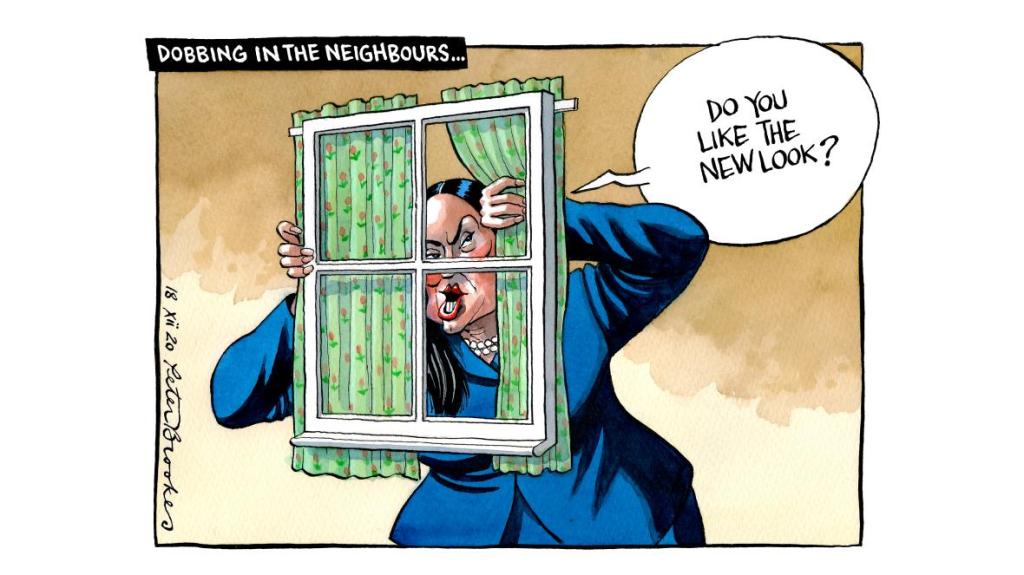
“But at least Covid has brought some cheer at last. Because Priti Patel announced she won’t be visiting her parents this Christmas. They must be bloody delighted.”

Mark Steel www.independent.co.uk 

It’s quite charming now, how this government changes the rules back and forth every few days, like some eccentric old professor that’s lost his short-term memory.

So they shout: “Why are the schools shut? We can’t have schools shut, it’s where children go.”  

“You shut them, prime minister, to stop the virus spreading.”

“Nonsense. Open them up.”  

Then a week later they go: “Who opened the schools? That’s how the virus spreads, what idiot did this?”

“You did, prime minister.”  

“Balderdash. Oh my God, why are the pubs shut? You can’t shut pubs, the Battle of Waterloo was fought so we could go to the pub.”

The Independent would like to keep you informed about offers, events and updates by email, please tick the box if you would like to be contacted

Read our full mailing list consent terms here

“But that’s where the virus spreads, prime minister.”

“Don’t be such a nincompoop, who are you?”

“I’m the global scientific advisor for the transmission of viruses in pubs”  

“You know nothing. I order all scientists to do your duty to go to the pub and get ratarsed.”

Then a week later: “WHO OPENED THE PUBS?”

A week ago they were saying: “It’s Christmas, you are commanded to be British, by giving your grandparents a naked massage with your own spit, it’s what Christmas is all about.”  

But this week they screamed: “Why are you idiots going round each other’s houses at Christmas? Christmas must be on Zoom, or held on an app we contracted to a company owned by an MP’s sister-in-law who has no experience of apps, but she has trained beagles. DON’T GO ANYWHERE, YOU MURDERERS.”

So now no one knows the rules, as once an hour there’s an announcement: “Matt Hancock has said you CAN cross one edge of tier 2a to get to tier 3b+ as long as you travel through space but NOT on a comet unless you’re with less than three people from at least four different planets.”  

Half the country is looking at government guidelines on websites, trying to make sense of instructions such as: “If you yawn on Boxing Day, you must sit on a bus shelter for 10 minutes. Before you open presents, all your cats must point south.”  

None of the rules seem to make sense. Theatres are shut, presumably because that’s where no one can be trusted, because the minute the curtain goes up, everyone starts gobbing on the violinist, and everyone in the circle wees into the stalls.

But pubs were allowed to stay open because in a pub, no one behaves in a way that might spread a virus. Everyone sits quietly, reading old legal documents, or admiring the craftwork of the beer pumps.

Maybe one of these people who talk about parenting, on daytime television, should tell the government: “The problem you have, my darlings, is you’re sending out mixed messages.” Because they are like someone telling a six-year-old: “We’re going to the seaside, so to be safe, before we set off, make sure you go to the toilet, which is shut and bolted. Because it’s dangerous to go to the toilet, so we’re trusting you to decide whether you should go or not, though you shouldn’t, unless you go outside, and I know Uncle Dominic did a huge turd on the kitchen floor but that was because he was testing his hearing.”

One of the instructions this week was: “Try and avoid crowds in the Boxing Day sales.” That makes sense, in the same way as if you said: “You are allowed to go swimming, but while you’re doing it, try not to get wet.”

Perhaps the reason for this is to pass the responsibility onto us. Matt Hancock said: “It’s up to each of us to collectively do our bit.”  

This is fine, but it’s harder to do your bit when you’ve no idea what you’re supposed to do, as the instructions are so hopeless. This is why, if you go to bomb disposal school, I don’t suppose the instructor says: “The thing with a bomb is there are wires poking all over the place. Some of them are fine and some blow the street up, so be careful. You just prod about with whichever one you fancy, I’ve no idea which ones to leave alone and which ones to snip, so it’s up to you to do your bit with each bomb, and if you can, try and avoid taking it into a crowded Boxing Day sale.”

Boris Johnson’s other instruction has been to make Christmas “shorter and smaller”. So does Christmas Day end at half past six? Do the crackers have to be half an inch long? Will the Queen just say: “Hello. What a shitty year” for her speech?  

He might as well have said: “This year, make Christmas more triangular than normal, and less prosaic, with a hint of irony.”

This is the decisive voice of authority he admires so much in Winston Churchill. It’s as if he’s copying his hero’s famous speech: “We face a brutal enemy, so I demand of all of you, make things a bit shorter and smaller, Hitler won’t like that.”

But at least he’s been impressively consistent with his incoherent, indecisive hopelessness. The instruction about masks was to wear one if you fancy but not if you can’t be bothered. The instruction for whether to shake hands with people who are infected was: “You might as well, I don’t have a clue.”

When he was ill with it himself, maybe the medical staff were like that, and said: “You can wear a respirator if you want, some people think you need air to live but it’s up to you, really.”

But at least Covid has brought some cheer at last. Because Priti Patel announced she won’t be visiting her parents this Christmas. They must be bloody delighted.

Rosamund Kissi-Debrah’s fight for the truth will save many lives from pollution

After delivering his ruling on the death of Ella Kissi-Debrah, the coroner turned to her mother sitting in the court and thanked her. Philip Barlow said: “We all have many reasons to thank you for the determination you have shown in getting us here.”

Ben Webster, Environment Editor www.thetimes.co.uk 

Rosamund Kissi-Debrah fought to secure a fresh inquest into her daughter’s death not only to find out why she died but to ensure other parents never had to endure the same agony.

The Commons environmental audit committee warned in 2010, when Ella made the first of about 30 visits to hospital after severe asthma attacks, that air pollution caused 35,000 premature deaths in the UK. Subsequent reports produced similar statistics but, despite promises, successive governments and local authorities did little.

The death of a nine-year-old girl, who the inquest was told would have been repeatedly terrified by the sensation of drowning because of mucus blocking her airways, has brought a human face to statistics.

Seven years after her death in 2013, some parts of the country, especially in London, still have illegal levels of air pollution. Nearly half of the 56 million people in England were exposed last year to levels of fine particles, the most dangerous form of air pollution, that exceeded the World Health Organisation’s (WHO) recommended limit.

Many politicians have shied away from acting on air pollution because the solutions involve potentially unpopular restrictions such as charging drivers of polluting vehicles to enter urban areas and banning or restricting domestic fires.

The government has pledged under the Environment Bill to set a new legally binding target for fine particles but it has not said what that will be or when it should be achieved. The ruling on Ella’s death and renewed calls by her mother and others for a new Clean Air Act may embolden ministers to set an ambitious target based on WHO recommendations and give local authorities new powers and resources to deliver it.

The finding that Ms Kissi-Debrah was not given information about the health risks of air pollution by doctors or via government alerts on poor air quality will also help to ensure other parents are properly informed.

The inquest was told that the Department for Environment, Food and Rural Affairs, which had expert knowledge about air pollution levels and risks, and the Department of Health failed to work together to tackle the problem.

The court was told that none of the clinicians who had treated Ella at six different hospitals from 2010 to 2013 had considered the possible impact of air pollution. Her mother said that she would have moved home to a less polluted area if she had been informed of the risks and the coroner ruled that this would have made a difference.

The government and local authorities are now under greater pressure to improve text, internet and roadside warnings of poor air quality, which are still not reaching many vulnerable people.

Next month Mr Barlow will issue what is known as a “prevention of further death report”, which is expected to give details of the risks identified during the inquest that still need to be addressed. This will put further pressure on the government to act.

The new Clean Air Act, which Ms Kissi-Debrah is seeking, could be known as “Ella’s Law”. It might carry the name of one little girl who lost her life to air pollution but could save thousands of others from the same fate.

Reaction as East Devon & Exeter remain under Tier 2 Covid restrictions

East Devon and Exeter will remain under Tier 2 coronavirus restriction for Christmas, the Government has confirmed today.

Interesting to compare what the local MPs and Council Leaders say – guess who says very little? Below this article Owl posts the latest Covid-19 symptom tracker data for East Devon.

Daniel Clark eastdevonnews.co.uk 

Case numbers and pressure on the NHS have been cited as reasons why all of Devon will stay subject to the second-strictest set of rules.

Whitehall will carry out its next review at the end of the year.


Tier 2 restrictions in East Devon & Exeter mean:

  • No household mixing indoors;
  • Rule of six applies outdoors;
  • Pubs and restaurants to shut at 11pm;
  • Alcohol only served as part of a substantial meal;
  • Spectators allowed at sports events and live performances, in limited numbers;
  • Personal care, including hairdressing, allowed.

Conservative East Devon MP Simon Jupp said: “Following the latest review, Devon will sadly stay in Tier 2.

“Cases are rising and the RD&E is under severe strain due to staff sickness.

“The Nightingale is helping to relieve pressure and we can all do our bit by remembering #HandsFaceSpace. We will get through this, together.”

Ben Bradshaw, Labour MP for Exeter, said: “Many people will be disappointed by this, given our Covid rates and Covid hospitalisations have been low and falling.

“But the shortage of NHS beds and staff after ten years of Conservative Government cuts and fears about the impact of the Christmas relaxation probably made this decision inevitable, sadly.”

East Devon District Council leader Paul Arnott said: “The ongoing lack of bed capacity in our county’s NHS – as warned about for many years – remains the key reason why we cannot escape Tier 2, and I feel very sorry for all the businesses and employees affected by this.

“It is now absolutely clear that the return of Devon’s student populations in October after a successful summer suppressing the pandemic was the key factor bringing the virus into our area.

“The students themselves are blameless, but the Government and university decisions to press on with the autumn term have come at the cost of local health and employment.

“I am relieved that the universities seem much better prepared for the spring term of 2021.

“Finally, I would urge everyone to take the greatest care with the basics of personal and collective hygiene, and that all who are offered vaccination take it without delay.”

Devon County Council leader John Hart, who also chairs the county’s multi-agency Local Outbreak Engagement Board, said: “I’m afraid this is the right decision because of the number of positive cases in Devon right now – especially among our older residents – and the huge pressure on our NHS services.

“But if we are to accept these restrictions continuing into the New Year, the Government must act swiftly with more support for local businesses.

“When we went into Tier 2, I called for action and I am renewing that call today.

“Every day I am hearing from businesses which are being severely affected and many of our local hospitality companies are on their knees. The Government must do more to help them survive otherwise many of these companies – which are the lifeblood of Devon’s economy – won’t be here in the New Year.”

Devon’s Director of Public Health Steve Brown, added: “We had been seeing our case numbers falling due to the recent national lockdown, but that fall has slowed and has now levelled off since we adopted Tier 2 restrictions.

“I do not believe that we are ready yet to relax our restrictions to the lower tier, especially as we head into Christmas, and the likelihood – although I would advise people think really hard about doing so – of families and friends meeting up in Christmas bubble arrangements.”

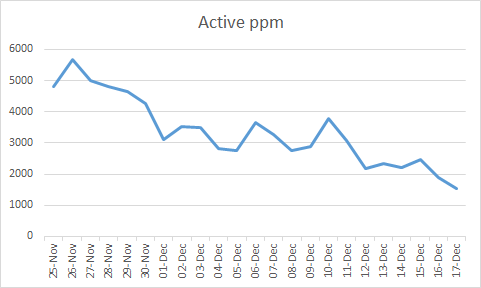
Data from the covid-19 symptom tracker app.

As Owl has explained before, these data are well worth keeping an eye on. In Owl’s opinion they provide a daily record from a very large sample of a proxy measure of infection. In the first phase of the study these measures of self- reported symptoms were statistically compared, and adjusted, against those eventually testing Covid positive. Their significance is that they have been shown to track the trajectory of the pandemic, indeed, have given the earliest indication of turning points.

For the moment the local picture is looking encouraging as can be seen in the graph below which plots the number of active cases estimated from the app per million (generally elsewhere reports have standardised on cases per 100,000). It is really only the app. that has a sufficient daily sample to provide such a picture at local level. Before Owl started a daily record, the East Devon case rate was double that shown. What this indicates is that the infection appears to be still slowly falling in East Devon, despite the relaxation from Lockdown 2 to the revised Tier* system. Lockdown 2 started on 5 November and ended on 2 December.

Priti Patel accuses senior Tory MP of breaking Covid rules

The home secretary, Priti Patel, has accused a senior Tory MP of breaching Covid-19 rules after he attended a Christmas dinner for 27 people at a private members’ club.

[Hopefully, this “Blue on Blue” spat will turn really nasty. But remember the rules only apply to the little people – Owl]

Simon Murphy www.theguardian.com

Tobias Ellwood, a former Foreign Office minister who chairs the influential Commons defence select committee, attended an event at the Cavalry and Guards Club in London on Tuesday evening hours before the capital moved into tier 3. Only a day earlier in parliament he called on the government to review its plans to relax restrictions for Christmas to avoid a third wave in the new year.

The dinner, in Piccadilly, was held by the Iraq Britain Business Council (IBBC) and was initially described as a “Christmas party” on its website before the reference was removed.

Ellwood, MP for Bournemouth East, defended his actions, telling the Daily Mail, which first reported the story, that it was a “business meeting” allowed under tier 2 restrictions that applied at the time. “I would not be attending a Christmas party, it was a business meeting,” he told the newspaper. “I went there to meet business people and that is what it was. The club went to extreme lengths so that as a business function it was absolutely Covid compliant.”

However, asked if Ellwood’s actions were an “egregious” breach of the rules, Patel told ITV News on Thursday: “Well, it is. Of course it is, exactly that.” Asked to again confirm she believed it was a breach, Patel added: “Having dinner … outside of the rules with a large number of people is a breach of the regulations.”

Asked what penalty Ellwood should face, Patel replied: “There are fixed penalty notices. I don’t know the details as to where this happened or the location, but I’m sure … as it is a breach, that will be followed up.” But she declined to say whether it was a Conservative party disciplinary matter, adding: “That is something I’m not getting into because I simply don’t know the full details.”

Boris Johnson’s spokesman backed Patel’s criticism of Ellwood’s behaviour. “The prime minister has been clear throughout the pandemic that it’s vital for everybody to abide by the rules in order to suppress the virus, and therefore protect the NHS and save lives,” he said.

After Patel’s interview, Ellwood tweeted a statement in which he explained he had been invited to give an address at the dinner in his role as chair of the defence select committee. “We still have troops based in Iraq and the security situation is deteriorating. I work hard to leverage every opportunity to further my understanding of international foreign policy and security matters. I gleaned extremely useful intelligence from this gathering about what is happening on the ground and wider issues affecting the Middle East,” he said.

“I appreciate, given the current challenges, some will question the wisdom of my attendance. I am sorry that coverage of my well-intentioned attendance may have muddied the government’s clear message as we head towards Christmas. Whilst the event was fully Covid compliant – perceptions count. Something I will be more conscious of in conducting my portfolio duties during the difficult months ahead.”

The government’s guidance for tier 2 says: “Gatherings for work purposes are only allowed where they are reasonably necessary. If meetings take place in the workplace, workplaces should be set up to meet the Covid-19-secure guidelines. Meals to socialise with work colleagues are not permitted.”

Separately, the guidance says: “Business events are permitted, but capacity should be restricted to whichever is lower: 50% capacity of 2,000 people outdoors or 1,000 people indoors.”

Meanwhile, Patel has urged people to consider cancelling Christmas plans that involve travelling to visit family or friends, in another ratcheting up of government warnings about the relaxation of coronavirus rules.

The home secretary said that while, under law, people could mix in up to three households for five days over Christmas, people who had made plans to travel long distances should now not do this. “I would urge people to change,” Patel told BBC Radio 4’s Today programme. “I won’t be seeing my parents this Christmas. My parents live in a different part of the country and I will not travel to see them.

“I want to protect them, I don’t want to be spreading the virus. I feel I will take that responsibility and others will make that judgment too.”

While Patel insisted the government was right to keep the Christmas rules unchanged, she appealed for people to be cautious.

“We would urge everyone to be conscientious and to make the appropriate plans and the appropriate changes to their plans as well, hence the point about having a smaller and shorter Christmas,” she said.

“We’re urging people not to travel. Why would you travel? If you’re in a low-tier area, why would you travel into a high-tier area? So people will exercise their judgment.”

UK redundancies rise to record high amid second Covid-19 wave

The number of people being made redundant in the UK soared to a record high in October amid the second coronavirus wave and as the government scaled back its furlough scheme before an 11th hour extension.

Richard Partington www.theguardian.com 

The Office for National Statistics said redundancies rose to 370,000 in the three months to October, the most since records began in 1992. Fuelled by job losses in retail and hospitality, the figures reflect a period when furlough was being made less generous before its intended closure at the end of the month.

However, the government staged a last-minute U-turn to extend the scheme until the end of March 2021, as rapid growth in coronavirus infections led Boris Johnson to impose a second national lockdown in England from November and as tougher controls were put in place in Scotland, Wales and Northern Ireland.

The ONS said the 217,000 quarterly increase in redundancies in October was unprecedented and pushed up the headline UK unemployment rate to 4.9%, up slightly from 4.8% in the three months to September. The rate was 3.8% at the end of 2019.

Analysts said the relatively small rise in the unemployment rate was down to the way the ONS compiles figures for a three month period. More than 200,000 people were also away from work and not being paid due to the pandemic, but were still officially counted as employed. The ONS said for the single month of October, the unemployment rate had jumped to 5.2%.

The devastating impact of the pandemic on the jobs market was underlined by HMRC figures showing there were 820,000 fewer employees on company payrolls in November than in February, before the pandemic struck. More than a third of that reduction has come from the hospitality sector.

However, while the number of people being made redundant hit a fresh record, the ONS said there were signs the pace of job cutting eased towards the end of October. According to a survey of company bosses by the statistics agency, 7% of businesses surveyed between 19 October and 1 November planned to make redundancies within the next three months, compared with 9% in a survey between 5 and 18 October.

Business leaders said the reintroduction of tighter restrictions and the expected cliff edge from the furlough scheme drove up redundancies. Suren Thiru, the head of economics at the British Chambers of Commerce, said extending the wage subsidy scheme would help to protect jobs over the winter months, but that a messy Brexit would further drive up unemployment.

“Failure to achieve a UK-EU trade deal risks adding to the longer-term structural unemployment caused by the pandemic by limiting the competitiveness and viability of some industries,” he said.

The latest unemployment figures are likely to pile renewed pressure on the chancellor, Rishi Sunak, to provide additional financial support for businesses and workers as coronavirus infections continue to climb in some parts of the country, leading to continued government restrictions. Sunak is expected to review the furlough scheme in January.

Anneliese Dodds, the shadow chancellor, said it was no coincidence that redundancies soared in October when companies believed the furlough programme was due to end. “The chancellor’s irresponsible decisions haven’t just cost jobs – they’ve left us in the worst recession of any major economy. It was his decision to wind down the furlough scheme before we were out of this crisis, and his decision to wait until the last possible minute to change course,” she said.

Frances O’Grady, the general secretary of the TUC, said the government needed to boost the value of universal credit benefits and invest more money in creating new jobs. “We are staring down the barrel of mass unemployment. There’s no time left to waste,” she said.

The ONS said hiring trends had remained flat in recent months. There were 547,000 vacancies in the three months to November – 110,000 more than the previous quarter but still 31.5% below the number of job openings available a year ago.

The government’s independent economic forecaster, the Office for Budget Responsibility, estimates that unemployment could increase from the current rate of 4.9% to as high as 7.5% by the middle of next year after the furlough scheme ends – representing 2.6 million people unemployed. The jobless rate had been as low as 4% this year before the Covid pandemic struck.

Mims Davies, the employment minister, said the government was helping people to find new jobs and hinted there was “more to come” to cushion the economic fallout from the pandemic.

“It’s been a truly challenging year for many families but with a vaccine beginning to roll out with more perhaps to follow and the number of job vacancies increasing there is hope on the horizon for 2021,” Davies said.

“Our plan for jobs is already helping people of all ages into work right across the UK, with increased jobcentre support, new retraining schemes, new job placements like Kickstart for our young people and more to come as we are determined to build back better.”

Pay gap in Britain between executives and workers ‘obscene’, says union

Report reveals ‘runaway train’ of inequality in corporate Britain, led by Ocado

Rupert Neate www.theguardian.com 

Unions have described companies who pay their chief executives huge multiples of their workers average salary as obscene, and called on ministers and shareholders to act to end the “runaway train” of inequality in corporate Britain.

A report by the High Pay Centre thinktank on Tuesday revealed that Ocado, the online supermarket, had the biggest pay gap between those at the top and those on the shop floor.

Its chief executive, Tim Steiner, was paid £58.7m last year – which works out at 2,605 times the £22,500 paid to the online grocery delivery company’s staff on average. It means Steiner was paid as much as the average Ocado worker’s annual salary for just one day’s work.

In second place was JD Sports, which paid its chief executive, Peter Cowgill, £5.6m, but paid staff an average of only £18,300. That means Cowgill’s pay was 310 times the median average. Tesco took third place for paying its outgoing chief executive 305 times the median pay.

Laurence Turner, head of research and policy at the GMB union, said: “This shocking and important report provides a vivid snapshot of the staggering inequalities and exploitation in the world of work on the eve of the coronavirus outbreak.

“There is no business or moral justification for paying an executive an obscene ratio of more than 2,000 times the average worker.

“Action is needed, especially at a time when hundreds of thousands of jobs are under threat and households are struggling to make ends meet. Ministers, employers, and shareholders must all put an end to this runaway train.”

The report showed that across the UK’s 100 biggest stock market listed companies, chief executives collect 73 times the amount paid to workers on average.

Luke Hildyard, director of the High Pay Centre, said the report provided “valuable new insight into the corporate cultures and working practices of some of the UK’s biggest employers”.

He added: “These findings show that quite low levels of pay are commonplace for large numbers of workers at many of our major companies. Hopefully the disclosures can help investors, policymakers and of course the companies themselves think more deeply about how to improve fairness at work, and pay for low-paid workers in particular.”

A spokesperson for Ocado said: “The pay ratio is particularly high for 2019 due to the inclusion of the growth incentive plan (GIP), which was a five-year award granted in 2014 and vested in 2019. The level of the GIP payment recognises the extraordinary performance of Ocado during this period when the business grew from a circa £1.5bn business to the multibillion pound technology-led global business we are today.”

The High Pay Centre figures shows that the biggest pay gaps are in the retail sector, where on average bosses are paid 140 times that collected by employees. The smallest gap was in financial services with a ratio of 35:1. The company with the smallest gap was identified as the asset management firm Sanne Group, where the chief executive collected eight times the median pay.

UK companies have been forced to publish chief executive pay ratios in their annual reports following widespread anger over excessive executive pay. The new figures show the relationship of the chief executive’s pay relative to the median and 75th and 25th percentile of the company’s UK employees.

Mubin Haq, chief executive of the Standard Life Foundation, said: “There is great potential for rethinking pay, benefiting those on lower incomes. Nowhere is this more stark than in the retail sector, which has the highest levels of inequality. During the pandemic the industry either relied heavily on government support or made significant profits. Rewards are not being fairly shared, but companies can begin to make plans to reduce the gaps that exist.”

Coronavirus: tensions over handling of UK Covid vaccine rollout

Vaccinating the population against Covid-19 will cost up to £12bn, Whitehall’s spending watchdog has disclosed, amid details of tensions between health bodies over the rollout.

Rajeev Syal www.theguardian.com 

The National Audit Office said the government would spend up to £11.7bn on purchasing and manufacturing Covid-19 jabs for the UK before deploying them in England.

A report released on Wednesday reveals officials from Public Health England complained that they had been cut out of key decisions despite having previous experience of vaccine delivery programmes.

Meg Hillier, the chair of the Commons public accounts committee, said the report showed that the government was right to have backed a number of vaccines but the accountability arrangements were “highly unusual”.

“The organisations who know how to carry out mass vaccination campaigns didn’t always have a seat at the table when decisions were taken.

“The logistical challenges of vaccinating tens of millions of people – on top of the other pressures on the NHS – can’t be underestimated,” she said.

The report examined how the government has approached developing and planning for a mass vaccination programme.

Kate Bingham, the venture capitalist and chair of the vaccine taskforce, was appointed in May and reports directly to Boris Johnson. She has been in charge of selecting which vaccines to purchase and securing UK access to sufficient quantities.

NHS England and NHS Improvement (NHSE&I) and Public Health England are leading on the operational delivery of the vaccination programme in England.

The report disclosed that Public Health England raised concerns in June that “operational experience of vaccine deployment was not represented within the senior boards and groups of the Taskforce”. It was not until September 2020 that both Public Health England and NHS England and Improvement had regular senior representation, the report said.

Current government plans are to vaccinate up to 25 million people with two doses of a Covid-19 vaccine throughout 2021, but these are subject to change depending on vaccine developments, the report said.

The public purse may incur additional costs because the vaccine contracts each contain a form of indemnity protection for the pharmaceutical companies in case of any legal action arising from adverse effects from the vaccines.

No cap has been applied to the amount the government could have to pay if there is a successful claim against the companies in four of the five contracts agreed so far, auditors warned.

The UK has ordered 100 million doses of the Oxford/AstraZeneca vaccine, as well as 40 million of the Pfizer/BioNTech, seven million of the Moderna, 60 million of Valneva SE, and 60 million of the Novavax jabs.

The Pfizer vaccine is already being rolled out by the NHS after it was approved by the regulator.

Bingham, who is married to the treasury minister Jesse Norman, is expected to leave her post at the end of this year.

A spokesperson for the Department for Business, Energy and Industrial Strategy said: “Thanks to the work of our Vaccine Taskforce, the UK is now in an exceptionally strong position with a diverse portfolio of 357m doses of some of the world’s most promising vaccine candidates.

“To ensure our country is in the best position to make any Covid-19 vaccine available as quickly as possible and respond to future pandemics, we have worked to build an entire domestic vaccine manufacturing base from scratch by investing in state-of-the-art facilities across the country.”

UN aid agency Unicef will help feed BRITISH children for the first time in its history after Covid

The United Nations humanitarian aid agency Unicef has launched an emergency response in the UK for the first time in its 70-year history. 

Antonia Paget www.dailymail.co.uk 

Unicef will help feed children left in difficulty as a result of the coronavirus crisis by providing food boxes to struggling families.  

The UN agency launched the domestic emergency response for families in Southward, south London, in reaction to the ‘unprecedented’ situation brought on by the Covid crisis.   

It comes after Unicef compared the plight of children left hungry due to the pandemic to the effect of the Second World War on youngsters. 

Deputy Labour leader Angela Rayner called the need for Unicef’s intervention a ‘disgrace’, adding: ‘It should have never come to this.’ 

Unicef will help feed children left in difficulty as a result of the coronavirus crisis by providing food boxes to families in partnership with the School Food Matters charity (pictured). It is the first time in the UN agency’s history they have launched an emergency response in the UK

Some 1,800 families struggling as a result of the coronavirus pandemic will receive breakfast boxes and bags over the Christmas school holidays, the charity School Food Matters said.

The charity said the initiative has been made possible by a grant from Unicef UK, which represents the first time the organisation has developed a domestic emergency response. 

Anna Kettley, director of programmes at Unicef UK, said: ‘This is Unicef’s first ever emergency response within the UK, introduced to tackle the unprecedented impact of the coronavirus crisis and reach the families most in need.

‘The grant for School Food Matters will address the gap in current provision for children, providing approximately 1,800 children with breakfast bags during the Christmas holidays and February half term.

‘This funding will help build stronger communities as the impact of the pandemics worsen, but ultimately a longer-term solution is needed to tackle the root causes of food poverty, so no child is left to go hungry.’

The scheme to provide food parcels has been made possible by Unicef’s £25,000 grant 

Some 1,800 families struggling as a result of the coronavirus pandemic will receive breakfast boxes and bags over the Christmas school holidays, the charity School Food Matters said

The Food Power for Generation Covid initiative, in partnership with Sustain: the alliance for better food and farming, and the Southwark Food Power Alliance, has been made possible by Unicef’s £25,000 grant. 

The charity will use the funds to support families in Southwark, South London, by delivering food boxes packed with ingredients for 10 nutritious breakfasts. 

This includes fresh pineapple, oats, desiccated coconut, and rice in addition to whole meal bread, baked beans and milk.

Deputy Labour leader Angela Rayner said: ‘The fact that Unicef is having to step in to feed our country’s hungry children is a disgrace and Boris Johnson and Rishi Sunak should be ashamed.

‘We are one of the richest countries in the world. Our children should not have to rely on humanitarian charities that are used to operating in war zones and in response to natural disasters.

‘Charities and businesses across the country have done a brilliant job stepping in where the Government has failed, but it should have never come to this.’

The Prime Minister’s official spokesman added: ‘We would point to the substantial action we’ve taken to ensure that children don’t go hungry through the pandemic and I would point to the additional £16 million we pledged not too long ago to food distribution charities.’ 

The Unicef grant will ensure families in need are provided with the boxes over the two week Christmas holidays, while an additional 6,750 breakfasts will also be distributed over February half term next year.  

The food boxes are packed with ingredients for 10 nutritious breakfasts (pictured). This includes fresh pineapple, oats, desiccated coconut, and rice in addition to whole meal bread, baked beans and milk

In the past 12 months, the number of families struggling to feed themselves has dramatically risen. 

Research commissioned by the Food Foundation charity earlier this year found more than 2.4million children were living in ‘food insecure households’.

The Trussell Trust, a separate charity that also provides food parcels to hungry families, also said they had seen a shocking 47% increase in need during the Covid crisis. 

These figures came in addition to an unprecedented demand for their services in 2019. 

School Food Matters Founder and CEO, Stephanie Slater said: ‘Families are really struggling and many were facing the grim reality of a two-week winter break without access to free school meals and the indignity of having to rely on food banks to feed their children.

‘We cannot continue to rely on civil society to fill the hunger gap as too many children will miss out on the nutrition they need to thrive.’

It comes as a report from Unicef found child poverty is expected to remain above pre-pandemic levels for at least five years in high-income countries including the UK, Germany and Canada.

The organisation urged the government to increase Universal Credit payments and strengthen ‘child focused social protection systems’.

Joanna Rea, Unicef UK Director of Advocacy, said: ‘Interventions made by the UK Government to date have helped support children and families in the short term. 

‘However, warnings of sustained high rates of child poverty, potentially for five more years, demonstrates an urgent need for the UK Government to prioritise investment in social policies and long-term solutions that place children and families at the heart of recovery plans.’

Ditching Jenrick’s ‘mutant algorithm’ is a win for localism

“The reality of modern Britain is that the local is fighting back”.

Simon Jenkins www.theguardian.com 

Planning secretary Robert Jenrick’s climbdown over his planning white paper is welcome. Its core proposal for houses to be built according to a Whitehall formula – the so-called “mutant algorithm” – emerged in August reputedly at the bidding of the building lobby, eager to boost their development land-banks in the south-east. It has collapsed under a barrage of protest from southern Tory constituencies that faced being concreted over and northern cities that Jenrick was going to starve of housing subsidies.

The reality of modern Britain is that the local is fighting back. It is no longer unusual for provincial counties and towns to be mentioned on the BBC. In one hour I recently heard Manchester, Leicester, Stratford, Hereford and Kent all demanding freedom to fix their own lockdown strategies. Others have sought to regulate their own schools or distribute their own furlough grants. But nothing has evoked greater fury than Jenrick’s stripping local councils of planning powers.

The Jenrick formula demanded that every community in England build a precise number of houses dictated by Whitehall, irrespective of local wishes. It was rumoured to be rooted in the medieval principle that a “local need” for housing was determined by local births, marriages, divorces and deaths, as if today’s population did not travel. This was then adjusted by price to yield a “need” figure.

The bias towards development in the south-east was massive. It decided house-building should decline by 28% in the north-east but rise by 633% in Kensington.

Horsham was told to cram its entire past century of growth into the next 10 years. I am not aware of any country in the world, except possibly China, with so arithmetically top-down a plan. It would have made Lenin blush. Such an idea would not have passed first base under most prime ministers, if only for its political ineptitude.

Policy to Boris Johnson is a matter of slogans. He appears not to have noticed that his cry of ““build, build, build” now contradicted his cry of “we must level-up the north”. Nor did he notice that he had opposed 514 homes in his own south-east constituency, including a 12-storey tower that he called “wholly out of character for the locality”. This was laughable, given his tower infatuation as London mayor.

Jenrick now has two tasks. He has promised to bring some sanity to his housing formula. He would do better to scrap it altogether. Local people can best judge whether and where they want their communities to grow, and there is no evidence they automatically oppose it. Besides, they have some collective rights to decide such matters in a democracy.

Subsidies should then be concentrated – as Jenrick now proposes – on the renewal of brownfield land especially outside the south- east. He should honour Johnson’s levelling up. He should worry less about his developers and look at the scandal of empty sites, under-occupancy and housing vacancy. The luxury towers, many foreign owned, that now line the Thames in London are reportedly half empty, but they will doubtless contribute to Jenrick’s 300,000 new “homes”. For most people a home implies a place someone lives, not a shell.

Britain’s housing policy is chaotic. The rental sector requires urgent review. Property taxes are too low, renting is too insecure, but at the same time incentives to sublet empty space are inadequate. It is absurd that repairs and conversions attract full VAT while new-build is VAT-free. If Jenrick is bereft of good advice, ask the Germans or the Dutch.

As for the future of British planning, it is still up for grabs. The reason for the most drastic reform of British planning in half a century was Jenrick’s allegation that “it takes an average of five years for a standard housing development to go through the planning system”. This developers’ gossip is simply untrue. The BBC’s Reality Check could find only five big developments that had taken that long, while Whitehall’s own figures showed that 89% of major applications were decided “within 13 weeks or the agreed time”. Delay was usually caused by developers themselves going to lengthy appeal.

As for landscape conservation, the August white paper implied that, subject to central targets, areas of rural land could still be declared “protected”. The paper nowhere defined what should qualify. Meanwhile, outside these protected areas, almost any building is to be permitted without so much as planning permission. This is like arming the police and allowing them to shoot on sight.

Most protests at the new system have pointed out that the current system is not broken, except insofar as it allows builders to build land banks against rising prices. This is already rampant. The CPRE claims land for 1.3m homes is lying idle, with permits already in place for more than half a million of them.

A planning lawyer of my acquaintance considers the dropped proposals so vague that, far from Johnson’s “build, build, build”, they would have meant the opposite, “a lawyer’s paradise”.

All is not bad. There is virtue in the white paper’s concept of zoning for different degrees of development. There is virtue too in its design code and calls for “more beauty”, though not a whisper about who should enforce it if at all. What is unarguable is that planning matters to the entire appearance of Britain. Bruised and abused over the decades, that appearance remains each generation’s lasting legacy to the next.

Bad planning is for all time. Jenrick has spent the past year playing with dynamite. The former Tory leadership contender Jeremy Hunt accused him of nothing less than undermining local democracy. Now his humiliation of local government has exploded in his face. It shows that two can play at another Johnson slogan – “Take back control”.

Anger after another delay in finalising how town centre will look

The future of Cranbrook has once again been delayed after councillors voted against accepting an offer as to how the new town will be developed, much to the disappointment of many people.

Interesting to note that Simon Jupp criticises the Council for “dithering”. Dithering is what Boris Johnson does.

In this case, although you may not like it, the Council seems to Owl to be consistent.

Remember this was meant to be a showcase for “developer-led” development which has failed to deliver, leaving the Council to pick up the pieces. It’s another legacy problem.

Daniel Clark www.devonlive.com

East Devon District Council’s strategic planning committee had the option of accepting a revised masterplan for the town from the East Devon New Community Partners (EDNCp) when they met on Tuesday afternoon, having previously turned down their vision.

Further negotiations had taken place between the consortium and the council since the October meeting and subsequently councillors heard that an improved offer had been made, one that the council’s strategic lead for planning described as ‘being fit for purpose for the town centre both now and in the future’.

The proposals include a 2,500 square metres Morrisons supermarket, around 350 town centre homes, a town square, a town hall, a children’s centre, youth centre and library in a single building, as well as land that could be used for a leisure centre, a hotel and retail units.

Artist impression of the plans for Cranbrook town centre

Artist impression of the plans for Cranbrook town centre

But committee members rejected the recommendation to accept the offer and instead voted to go back to the consortium and try and negotiate further to deliver on some of the commitments initially promised that would be dropped.

The news though has angered Cranbrook councillors and the town’s MP Simon Jupp, who said they ‘showed little knowledge of the needs of Cranbrook’.

Ed Freeman, Service Lead for Planning Strategy, told Tuesday’s meeting that following the negotiations, the proposed offer from the consortium has been amended, which included relocating the extra care facility to elsewhere in the town to free up active frontage space on Tillhouse Road. This would also see sufficient space on provided to accommodate a leisure centre alongside the town council building and health and wellbeing centre, while the EDNCp are also suggesting that a hotel could be accommodated on this parcel of land.

The EDNCp are also willing to make land within the town centre available for the Council to acquire, however they have made it clear that they would expect that land should be valued on the basis of a residential use.

Artist impression of the plans for Cranbrook town centre

Artist impression of the plans for Cranbrook town centre

Mr Freeman said: “While the revised offer would not deliver everything sought in the draft Supplementary Planning Document, it would deliver the majority of what is needed and although any hotel delivered on the additional land would not have frontage onto the London Road, in the spirit of compromise the overall offer would in terms of the mix and quantum of uses be acceptable.

“This would provide sufficient land and flexibility to deliver a fit for purpose town centre, both now and in the future as the town grows.

“If you are not content with the revised offer, the SPD is the best way to deliver the town centre, but would be significantly delayed.”

But accepting the offer, while speeding up the delivery process, would see the town miss out on more than £2m of contributing towards formal open space, sports pitches, education, the health and wellbeing hub, and walking and cycling infrastructure in the revised legal S106 agreement.

Cllr Matthew Osborn, from Cranbrook town council, said that he was speaking on behalf of the residents who were sold the dream of moving to a new town and be a pioneer and called for the committee to accept the offer.

Artist impression of the plans for Cranbrook town centre

Artist impression of the plans for Cranbrook town centre

He said: “Like many people, I was amazed by the community spirit and sense of belonging and pride, but the dream has become harder as we have faced false dawns and were over promised and under delivered and we are losing faith in any sign of delivery.

“The residents’ wishes are to have a delivery and to start to believe again that they made the right choice in coming here and the current proposal delivers what the town needs. We have reached the point where officers and councillors and consortium can accept it, so please listen to the people of the town and don’t ignore us.”

Nick Freer, from the East Devon Community Partnership, said that this was now a collective proposal that had been worked on and the first elements of the town centre could be in place within 18 months, but said: “We cannot risk losing the momentum we have built up as the risks and the stakes are too high. We have a proposal that is worked on and that we all can be genuinely proud of.”

Cllr Kim Bloxham said: “These are good proposals for Cranbrook and what the community wants and needs, and for the hope for the residents’ of Cranbrook, accept the offer and allow it to progress without delay,” while Cllr Helen Parr said that it was a much improved offer and that residents wanted it to go forward so they can get on with their lives

Backing the proposals, Cllr Mike Howe said that there were issues still with the offer, but there are issues with every application, and the council were walking the fine line of the balance to get the best out of it now, and a future where they might get something but 10 years late.

He said: “Even with reservations, this gives us just enough to move forward, as we have the majority of the residents in support.”

Cllr Kevin Blakey added: “The vast majority of residents want to see the facilities delivered sooner rather than later, and the offer is now fit for purpose for now and for the future. There are matters of detail to be sorted out but now is the time to prove that the future of the residents of Cranbrook counts. We have a deal that we can progress.”

Cllr Ian Thomas added that the proposals meet the objective to deliver a town centre that the residents want, is supported by their representatives, and meets the reasonable aspirations of the consortium and the council, with much stronger officer support this time, and he proposed agreeing in principle to the Memorandum of Understanding.

He added: “We need to send a clear message and that we have something a lot better than Boris’ ‘oven ready deal’ and that the council is ready to move forward and deliver a town centre that meets the needs of residents and the partners.”

Artist impression of the plans for Cranbrook town centre

Artist impression of the plans for Cranbrook town centre

But while Cllr Eleanor Rylance said that while compared to what they initially saw, the proposals were heading in the right direction, she had fears that the MOU would be the ‘high point’ of any offer and not the starting point. She said: “There is lot of potential to deliver what the residents need now but questions over if it will deliver the need for the future residents.”

And Cllr Paul Hayward said that the £2m loss of amenity contributions if they accepted the offer was ‘robbing Peter to pay Paul’,

He added: “The residents were sold a dream on a false promise, but someone who is desperately thirsty will pay any price for a glass of water even though there is an oasis over the hill. I am not convinced by the deal and think there is still room for more negotiating. I cannot support this as I don’t believe it will deliver. I hope I am proved wrong, and I don’t want to be proved right, and if I am wrong, then people can have a go at me.”

And Cllr Paul Arnott, leader of the council, added: “There is huge disappointment and it is unacceptable we don’t have an open book here and it is unclear what the land values will be. There is obviously concern about the town square which is just a bit of open pavement.

“We need to find a way out of this but we are underestimating our negotiating position. They have the Morrisons card and everyone is terrified that they may go off and in a strop and open up somewhere else, and that may be a risk we may have to take.”

Artist impression of the plans for Cranbrook town centre

Artist impression of the plans for Cranbrook town centre

He called for further negotiations to take place over the MOU with the outcome of them to either come to the cabinet meeting on January 6, or at the very least within 14 days of that, and then the cabinet can take a look and see what changes can be made, adding: “I’m sorry if it will ruin a few Christmases, but that’s tough.”

Councillors voted by seven votes to six, with one abstention, to reject the proposal made by Cllr Thomas for them to agree to the MOU, before then voting by nine votes to four to agree to further negotiations that will come back to the cabinet early in 2021.

Work on the SPD, which would deliver a more comprehensive town centre but further into the future, will be paused while the further negotiations take place.

But Simon Jupp, MP for East Devon, reacting to the decision said: “Cranbrook residents, some of the highest council tax payers in Devon, look on in disbelief as their voice is ignored and the can is kicked down the road yet again. Dithering by councillors who don’t represent Cranbrook is putting plans for a proper town centre and a new supermarket at risk. It’s time to stop faffing and start delivering what was promised to the people of Cranbrook.”

And in a joint statement, Cllrs Bloxham, Blakey and Sam Hawkins, the three ward members for Cranbrook, said: “The Democratic Alliance members of EDDC’s Strategic Planning Committee once again showed little knowledge of the needs of Cranbrook together with a lack of understanding of the whole planning process within which the town is being delivered.

“Remarks about failure of the developers to deliver on their obligations and comments about the needs of the town now and in the future were totally misplaced and led to a committee decision potentially plunges the town into a very uncertain future.

“Having been involved in detailed negotiations with the consortium for more than a year we had reached a place where there was a very positive proposal on the table. Yet just seven members of EDDC – all part of the Democratic Alliance, none of whom represent the town – decided to reject it.

“The proposal brought forward to the recent Strategic Planning Committee where the developers were not only delivering on all of their obligations (including those not due until later) but also bringing forward many additional town centre facilities including the supermarket, town square, nursery, double the amount of retail premises with further land being handed to the local authority to bring forward more shops, a leisure centre and other potential facilities such as an hotel and business units as well as a town council building that would not just be offices for the council but provide a cafe, meeting and event space, toilets and much needed office space for local businesses to grow.

“But the decision plunges Cranbrook into a further period of uncertainty and instead of enjoying Christmas with the prospect of a supermarket and a town centre in the foreseeable future the future now looks so much bleaker.”

Strong waves smash restaurant window in Exmouth

Strong waves smashed a window – and broke the wall – at The Rockfish Restaurant.

(See radioexe link below for video)

Sam Sterrett www.radioexe.co.uk

Strong wind and rain has caused havoc across Devon this morning (Wednesday 16th December). The Environment Agency has issued multiple flood warnings across the county. 

Exmouth, in particular, was hit hard by the weather. Strong waves smashed a window – and broke the wall – at The Rockfish Restaurant.

The inclement weather is expected to continue until Saturday, says the Met Office, who issued a four-day weather warning for Devon yesterday. We’ll have full updates on Radio Exe through the day. Watch the short video above, taken in Exmouth earlier this morning. 

Tory Activists Told To ‘Openly Lie’ And ‘Weaponise Fake News’ In Party Newsletter

The Tories stand accused of a secret policy to “openly lie” after a local party newsletter urges would-be politicians to ape Donald Trump and “weaponise fake news”. 

Will East Devon Tories be singing from the same hymn sheet? Saying the first thing that comes into their head is “the tell”. – Owl

Rachel Wearmouth www.huffingtonpost.co.uk 

In a document circulated to activists, Wellingborough Conservatives urge campaigners to “say the first thing that comes into your head” as “you can live that down later”.

Labour has accused the party of having a policy to “openly lie” to the public. 

In a section calling for grassroots campaigners of Boris Johnson’s party to “learn” from Trump, the document says the president successfully managed to “weaponise fake news”. 

“Trump has learnt that a ‘lie can go round the whole world before the truth can get its boots on’,” it says. 

“If you make enough dubious claims, fast enough, honest speakers are overwhelmed. If someone tweets ten dubious claims per day and it takes you a week to disprove each one, then you are doomed. 

“Trump uses this tactic to dominate the news and to crowd out legitimate politicians.” 

The local party then instructs campaigners to “say the first thing that comes into your head”.

It says: “It’ll probably be nonsense, but it knocks your opponent out of his stride and takes away his headline.

“You then have a few seconds (possibly minutes) to reword it, say that you mis-spoke, were mis-heard, or whatever.

“You may get a bad headline saying that you spoke something silly, but you can live that down. Meanwhile your opponent is knocked off the news-feed.

“It runs counter to everything that traditional politicians are taught – viz. never say anything that is not 100% accurate. The problem is that 100% right, two weeks late equals defeat.

“Sometimes, it is better to give the WRONG answer at the RIGHT time, than the RIGHT answer at the WRONG time.”

Labour deputy leader Angela Rayner has written to Tory Party chair Amanda Milling, called for an urgent investigation. 

Her letter calls for Milling to take disciplinary action, and says: “The public rightly expect honesty and integrity from political parties, elected politicians, candidates and local party activists. 

“A Conservative Party newsletter that encourages members and politicians to openly lie raises serious questions that demand urgent answers.” 

Labour leader Keir Starmer also raised the document with prime minister Boris Johnson in the Commons on Wednesday. 

Holding aloft the newsletter, he told MPs: “It gives a lot of advice to wannabe politicians.

“It says this: ‘Say the first thing that comes into your head – it’ll probably be nonsense, you may get a bad headline, but if you make enough dubious claims fast enough, you can get away with it’.

“And it includes, the December edition, the advice: ‘Sometimes it’s better to give the wrong answer at the right time, rather than right answer at the wrong time.’ So my final question to the Prime Minister is this: is he the inspiration for the newsletter or is he the author?”

Johnson did not address the document directly, but replied: “I think what the people of this country would love to hear from (Starmer) in this season of goodwill is any kind of point of view at all on some of the key issues.”

Devon disease expert offers reassurance over new Covid strain

Devon’s disease expert has assured people not to worry about the new strain of coronavirus that has been identified in England because it is common and ‘nothing out of the ordinary’.

Anita Merritt www.devonlive.com

Dr Bharat Pankhania, Exeter University’s communicable disease and public health expert, says that new variants of a virus are common and are produced normally as a virus replicates.

He added that it is unlikely the new variant will alter the effectiveness of the new vaccine, and that vaccines can be easily adjusted if necessary.

Any previous immunity to coronavirus should still remain, according to Dr Bharat, and that reports of faster spread of the virus are more likely a case of the new predominant strain being picked up more, and should not be read as the virus spreading faster.

Dr Bharat Pankhania, Exeter University's communicable disease and public health expert

Dr Bharat Pankhania, Exeter University’s communicable disease and public health expert (Image: Dr Bharat Pankhania)

Yesterday it was reported how a new variant of coronavirus has been found which is growing faster in some parts of England.

Health Secretary Matt Hancock said at least 60 different local authorities had recorded Covid infections caused by the new variant.

He said the World Health Organization had been notified and UK scientists were doing detailed studies.

He said there was “nothing to suggest” it caused worse disease or that vaccines would no longer work.

In an interview with Sky News, Dr Bharat said: “The best way to describe it for everyone is imagine a large giant oak tree and the we have a little branch that takes off from that oak tree, and then that branch becomes the main trunk and the main artery of that tree.

“Often this happens with viruses whereby there are different variants, or different branches, and then one branch becomes the predominant one; the common one for Africa, the common one for Europe, the common one for the United States etc.

“So this is nothing new or out of the ordinary.”

When commenting on how the new strain will impact on immunity, he said: “I don’t think is going to nullify your immunity if you have had an infection and got better. I also don’t think it will nullify our vaccines which have just been developed.

“What is happening though is it is a predominant strain. It’s a bit like earlier on in the summer, the predominant strain is what came from Spain and it affected a lot of people, again in the South East.

“This again is a similar version of a strain spreading very fast in the London area.”

He added that the vaccine people are being offered will still be effective, and that it can me modified if later necessary.

Dr Bharat said: “I am very confident that we won’t have to refashion our vaccines because what we are looking at is a large spike of protein and there is no information that this spike protein changes dramatically over months or years.

“If it was to become non-infectious we are home and dry. So if the spike protein isn’t really changing with just minor variations then I expect our immune system not to be fooled by a new version of it, and therefore all immunity should last with new immunity.

“If that isn’t the case it still doesn’t matter because we can refashion the vaccines very quickly to make spike proteins are pertaining to the new strain.

“Don’t worry about this. These things are common and they do happen.”

Assurance were also given following reports that the new strain might be associated with a faster spread of the virus.

He said: “I think we need to have more data and more information. I don’t think it is faster spread; it is more a case of the predominant strain. In other words we are finding more of it because that is the strain that wishes to circulate in our population and our population has been interacting a lot with Christmas shopping and the easing of restrictions.”

It has also been reported how positive case numbers are increasing in over 60s, which Dr Bharat says he has also noted.

He said: “I have been observing this for the South East of our country and my observations and concerns over the past three weeks are the upward trend in the older age group .

“Now that is really concerning because older people are the ones who go on to develop severe illness. They are the ones who get admitted to hospital and ICU and some of them do die.

“I expect more older people to die which is disappointing and upsetting in equal measures.”

Government revising plans for its ‘mutant’ housing algorithm

The Government has revised plans for its controversial “mutant” planning algorithm, which will now prioritise building in urban areas most in need of development.

Hot off the press – Owl

By Amy Jones, Political Correspondent 16 December 2020 • 6:00am www.telegraph.co.uk 

The original proposals were heavily criticised by dozens of Conservative backbenchers, including the former prime minister Theresa May, amid fears that it would lead to a surge of house building in their greenbelt constituencies.

An updated formula will be weighted to focus on developing family homes in 20 of England’s largest cities and making the most of vacant buildings and underused land.

The decision follows a consultation launched in the summer that sought views from planners, councils and the wider public.

It is understood that the views of MPs were sought by Housing Secretary Robert Jenrick, after many aired their concerns in the Commons. An updated formula will now be rolled out to local councils to enable the delivery of 300,000 homes a year by the mid-2020s.

However, the Government could still face opposition on its own benches, as Tory MPs expressed concern that the White Paper would still have “serious implications” for local democracy.

Mr Jenrick said: “This Government wants to build more homes as a matter of social justice, for inter-generational fairness and to create jobs for working people. We are reforming our planning system to ensure it is simpler and more certain without compromising standards of design, quality and environmental protection.

“The Covid-19 pandemic has accelerated and magnified patterns that already existed, creating a generational opportunity for the repurposing of offices and retail as housing and for urban renewal.

“We want this to be an opportunity for a new trajectory for our major cities – one which helps to forge a new country beyond Covid – which is more beautiful, healthier, more prosperous, more neighbourly and where more people have the security and dignity of a home of their own.”

He also confirmed that a new Urban Centre Recovery Task Force has been set up to help promote the “development and regeneration of our great town and city centres”, with a focus on revitalising the high street.

The Task Force includes Peter Freeman, who is responsible for the redevelopment of King’s Cross and new Chair of Homes England.

The Government also intends to revise the so-called “80/20 rule” which guides how much funding is available to local areas to help build homes to ensure funding is not just concentrated in London and the South East.

It comes after analysis by Lichfields, a planning consultancy, revealed that the previous proposed system would lead to sharp increases in house building in areas with high Conservative support.

In Chichester, West Sussex, the annual target would have risen from 425 to 1,120; in Reigate, Surrey it would have gone up from 460 to 1,091; and in Tonbridge in Kent it would have increased from 425 to 1,440.

Several Tory MPs argued that the algorithm would have “concreted over” the south rather than “level up” the north, while complaining that it favours building in rural areas rather than cities and towns. 

Bob Seely, the Tory MP for the Isle of Wight, who led backbench calls to amend the planning proposals, hailed the change as “good news”.

He said: “I am sure MPs will want to look at the re-jigged plans in detail, but this is an initial victory for those who care about their communities.

“It’s very good news that more homes are planned for northern cities, many of which have suffered population declines in the past 50 years, especially as locations such as my constituency of the Isle of Wight have increased our populations significantly and at, frankly, an unsustainable rate.

“I hope this is the beginning of a renaissance in building back better and supporting our vital levelling up agenda.”

Dominic Cummings Got A Pay Rise Of At Least £40,000 From No.10 This Year

Dominic Cummings received a pay rise of around £40,000 for his role as Boris Johnson’s top adviser, official figures show.

Arj Singh www.huffingtonpost.co.uk 

The prime minister’s top aide is currently paid between £140,000 and £144,999, as he prepares to officially leave his job on December 18 after walking out of No.10 last month.

It is an increase on his £95,000 to £99,999 salary which was published in last December’s figures on special adviser (spad).

The pay rise came in a year when Cummings sparked outrage for appearing to break coronavirus rules by travelling to Durham during the middle of the spring lockdown and then visiting Barnard Castle with his wife and son to test his “eyesight”.

One Whitehall source said Cummings’ 40% wage rise was a “disgrace” when other special advisers who, like the PM’s top aide, stayed in the same pay band got just a 1% increase.

“It’s a disgrace,” they said.

“He always said he was gonna find a way to reward spads who were doing a good job.

“All he did was secure a massive pay hike for himself.

“He must have thought he was doing a great job. Others might think otherwise.” 

A Tory source said: “Remember his whole not in it for the money thing? £140,000 a year, a million pound house and a £50,000 car (a Land Rover Discovery Sport) is hardly sack cloth. Is it?”

Another source described the pay rise as a “shocking indictment” as Cummings presided over the introduction of performance related pay for teachers as Michael Gove’s special adviser at the Department for Education.

“It’s one rule for us, one rule for everyone else,” they said.

Labour MP Karl Turner pointed out that Cummings got a pay rise in the same year that millions of key workers were hit with a public sector pay freeze.

Cummings was in the same pay band as Downing Street director of communications Lee Cain when both decided to quit No.10 last month.

A footnote in this year’s list of spad salaries said: “Lee Cain and Dominic Cummings are in the process of leaving their government posts and are not included in the above list. 

“They are, however, included in the December FTE numbers. Both individuals were in PB4 (pay band 4) and pay band £140,000-£144,999.” 

Meanwhile, it emerged in further official documents that Johnson overruled Civil Service advice, in order to continue fighting a legal action brought by an ex-Treasury spad over her summary sacking at the hands of Cummings.

HuffPost UK understands that a written ministerial direction issued by the prime minister to the Civil Service relates to the case of Sonia Khan, who was escorted out of No.10 by police after being fired by Cummings.

Khan eventually won a payout of tens of thousands of pounds in a settlement over her dismissal, having rejected an earlier offer.

Following that rejection, Civil Service chief executive Sir John Manzoni wrote to Johnson on March 3 to urge him to abandon fighting a legal case brought by Khan due to the high cost of defending the case to the taxpayer.

Manzoni wrote: “Given the ongoing expenditure of defending the case and the potential costs that a court may award, it is my advice, taking account of legal and financial analysis that a further negotiation (on a settlement) should be carried out to seek to avoid litigation.”

But replying a day later, the PM instructed Manzoni that “no further offer should be made to attempt settlement in advance of any potential litigation”.

“I understand your concerns as expressed concerning the value for money of contesting the claim without further attempts at settlement, however as you have correctly stated I am able to take into account wider considerations than value for money.

“The legal position is clear that the prime minister can withdraw consent for the appointment of any special adviser.

“That is the reason for the termination of employment and I am content for a reasons letter to be issued to the individual setting that out.

“I do not believe that individuals should receive more compensation than they are entitled to under their contract and therefore I believe that this claim should be tested in litigation.”

Eventually, Johnson relented and agreed a settlement for Khan, who was an adviser to ex-chancellor Sajid Javid.

Post-Brexit key worker shortage ‘may hamper UK economic recovery’

The economic recovery from the Covid-driven recession will be hampered by a post-Brexit shortage of key workers including nursing assistants, senior care workers and dental nurses, the UK government’s migration advisers have warned.

Jamie Grierson www.theguardian.com 

In its annual report, the Migration Advisory Committee (Mac) said many of the roles with the highest vacancies in the UK, such as veterinary nurses and welders, require a significant level of training, which could cause a delay in filling jobs and “hinder future economic recovery”.

The migration experts warned the gap was unlikely to be filled by the government’s flagship post-Brexit skilled worker route due to the ongoing economic impact of the coronavirus pandemic and a renewed focus on domestic workers.

The Mac chair, Prof Brian Bell, said: “This is a time of great change for the UK immigration system, with the contribution that migrants can make becoming the focus rather than where they were born. Such major changes are never easy, but there is no denying the significant impact of the ongoing pandemic.

“There will be continued economic disruption, with significantly higher unemployment predicted in the coming months. It is considerably more costly to recruit a worker from overseas and it seems less likely that foreign workers will want to move at this time.

“It is more important than ever that we monitor migration and keep the system under constant review.”

The Mac’s report said there would be limited use of the new skilled worker route, at least in the first half of 2021. Job vacancies have fallen substantially, and most forecasts predict significantly higher unemployment in the coming months, the advisers said.

Firms that are still recruiting are likely to receive more applications from the domestic workforce than has been the case in recent years when the labour market has been tight, the committee said.

In addition, the report said the immigration system was deliberately designed to make it considerably more costly to recruit a worker from overseas than to recruit from the domestic workforce, while at the same time it seems less likely that foreign workers will want to move countries until the pandemic is under clear control.

The end of free movement, at 11pm on 31 December, will mean that all non-Irish EU citizens arriving in the UK after the end of 2020 will be subject to the same immigration rules as those from outside the EU.

A Home Office spokesperson said: “People from around the world are already applying through our new points-based immigration, which welcomes people to the UK based on the skills they can provide, not where their passport comes from.

“This new fairer, firmer, skills-led system ensures employers can recruit the skilled workers they need, whilst also encouraging employers to train and invest in the UK’s workforce.”