“Help the Old”?

“In Britain we put our elderly into living graveyards, put them in a home, arrange the chairs in a half circle, turn on the heating and leave them to watch tv.

We should be copying what is happening in Amsterdam, where they have care homes with extra accommodation for students. The students get a free place to live in return for 30 hours a month assisting around the home.

For elderly people, the best medicine is youth. It energises them – ask any grandparent, We could kill two birds with one stone here, easing student debt and massive social care costs”.

Source: Sunday Times, pay wall

Austerity is “economic murder” say academics in British Medical Journal

Where EXACTLY are the “12,700 more doctors and 10,600 more nurses” the government says we have had since 2010? How many have left during that time? How many are employed in the privatesector treating private patients? And IF we HAVE had them why are avoidable deaths rising?

“An extra 120,000 patients have died in the past seven years following cuts to health and social care budgets, a major study has found.

The patients were all over 60 and the majority died in care homes or their own homes, rather than in hospital.

Researchers from Cambridge University likened the cuts to ‘economic murder’ and said local NHS and social care funding means vulnerable patients are not receiving the help they badly need.

They also linked a fall in nurse numbers, particularly to district nurses who work in the community, to the additional deaths.

The study by Cambridge, Oxford and University College London is the first of its kind to look at the effects of funding reductions.

It is based on a computer model which calculated how many deaths should have occurred between 2010 and 2017, based on the number of deaths from 2000 to 2010.

It also predicted that if the current trends continue, there would be another 100 excess deaths a day between now and 2020. Researchers said that, although they could not prove the deaths were caused by the fall in health and social care spending, there was a very strong link.

One of the lead authors, Professor Lawrence King, from Cambridge University, said: ‘It is now very clear that austerity does not promote growth or reduce deficits – it is bad economics, but good class politics.

‘This study shows it is also a public health disaster. It is not an exaggeration to call it economic murder.’

The study, published in the BMJ Open journal, is complicated and the researchers admitted there may be other ‘factors’ behind the increased deaths such as the fact the population is ageing, unhealthy lifestyles and deprivation.

Dr Ben Maruthappu of University College London, senior author of the study, said: ‘While the Government’s investment into social care earlier this year is welcome, it is clear that more must be done, with better modernisation of services, and protection of health and social care funding.’ The research also found that previous rises in life expectancy rates had stalled.

The average woman was living 3.8 months less than previous predictions and the average man 5.2 months less.

Life expectancy rates are 82.9 for women and 79.2 years for men. The findings come amid calls from the medical profession for the Government to substantially increase health and social care funding in next Wednesday’s Budget. A Department of Health spokesman said: ‘As the researchers themselves note, this study cannot be used to draw any firm conclusions about the cause of excess deaths.

‘The NHS is treating more people than ever before and funding is at record levels with an £8billion increase by 2020-21. We’ve also backed adult social care with a £2billion investment, and we have 12,700 more doctors and 10,600 more nurses on our wards since May 2010.’ “

http://www.dailymail.co.uk/health/article-5087527/NHS-cuts-blamed-120-000-extra-deaths.html

“Social care could drain local services cash dry, warns LGA”

For every £1 of council tax, almost 60p could be spent on social care by 2020, taking away from “vital day-to-day services”, the Local Government Association has warned ahead of the Budget later this month.

The umbrella-group has called on the government to ensure councils could keep raising the local tax to keep providing services as the money is “running out fast”.

Clair Kober, chair of LGA’s resources board, said: “With the right funding and powers, local government can play a vital role in supporting central government to deliver its ambitions for everyone in our country.”

She added: “Demand for services caring for adults and children continues to rise but core funding from central government to councils continues to go down.

“This means councils have no choice but to squeeze budgets from other services – such as roads, street lighting and bus services – to cope.”

The association projected 56p could be spent on caring for the elderly, vulnerable adults and children, up from 41p in 2010-11, and that this would take away funds that could be spent on services such as waste collection, road repairs and bus services.

Almost half of all local authorities (168 councils) will no longer receive any revenue support grant funding from central government by 2019-20, the LGA point out in a new analysis.

Uncertainty was growing over how local services would be funded after 2020, as the Local Government Finance Bill, which was passing through parliament before the election, was not reintroduced in the Queen’s Speech, the association said.

This has made it uncertain whether councils would be able to keep all their income from business rates by the end of the decade.”

http://www.publicfinance.co.uk/news/2017/11/social-care-could-drain-local-services-cash-dry-warns-lga

What do you have to do to get sacked if you are a Tory these days?

“As a prime minister drained of authority struggles to hold her party together, ambitious ministers feel increasingly able to cock a snook with impunity.

This week’s rows over Boris Johnson’s dangerous handling of a disagreement with Iran, and Priti Patel’s freelance policymaking in the Middle East may seem a coincidence.

But the conduct of the foreign secretary is bound together with that of the international development secretary.

Both Mr Johnson and Ms Patel are able to play fast and loose because normal collective cabinet disciplines no longer apply. The prime minister is afraid to reprimand or sack. In this government it is everyone for themselves. …”

and yet there are people who will continue to vote for them.

It says as much about their voters as it does about their Ministers and MPs.

And so many of their voters in East Devon – where we had our own mini-scandal when Diviani voted against his own district councillors at county council over closure of community hospitals.

Did Tory district councillors sack him? No, they rallied round him and agreed to keep him not just as a councillor but as their Leader.

Such is political life today. Thank you Tory voters – for worse than nothing.

“We want our Brexit cash boost – NHS boss”

“The health service should get the cash boost it was promised during the EU referendum, the head of the NHS in England is expected to say later.
Simon Stevens will use controversial claims used by Vote Leave to put the case for more money in a speech later.

With waiting times worsening, he will say trust in politics will be damaged if the NHS does not get more.

During the referendum it was claimed £350m a week was sent to the EU and that would be better spent on the NHS.

The claim was widely contested at the time and ever since – it did not take into account the rebate the UK had nor the fact the UK benefited from investment from the EU. Some argued it proved highly influential in the referendum result.

‘Honour the promises’

The speech by Mr Stevens at the NHS Providers’ annual conference of health managers is highly political, coming just a fortnight before the Budget.
And it is being made as three highly-influential health think-tanks – the King’s Fund, the Nuffield Trust and the Health Foundation – publish a joint report calling for an extra £4bn to be given to health next year. That amounts to eight times more than health spending is due to rise by.

Mr Stevens is not expected to say exactly how much he wants, but instead will argue the health service needs a significant boost in funding beyond what has already been promised by ministers.

He will tell delegates gathered in Birmingham: “The NHS wasn’t on the ballot paper, but it was on the Battle Bus. Vote Leave for a better funded health service – £350m a week.

“Rather than our criticising these clear Brexit funding commitments to NHS patients – promises entered into by cabinet ministers and by MPs – the public want to see them honoured.

“Trust in democratic politics will not be strengthened if anyone now tries to argue: ‘You voted Brexit, partly for a better funded health service. But precisely because of Brexit, you now can’t have one.’

“A modern NHS is itself part of the practical answer to the deep social concerns that gave rise to Brexit.

“At a time of national division, an NHS that brings us together. An institution that tops the list of what people say makes them proudest to be British. Ahead of the Army, the monarchy or the BBC. Unifying young and old, town and country, the struggling and the better off.”

Targets ‘being missed’

NHS Providers chief executive Chris Hopson has also given his backing to extra money. He pointed out key targets for A&E, routine operations and cancer care were now being widely missed.

“The Budget is an important opportunity, at the beginning of this Parliament, to protect care quality for patients and service users and help the NHS break out of the downward spiral in which it is currently trapped.
“There isn’t enough funding to cope.”

The government has promised the NHS frontline budget will be £8bn a year higher by 2022 – once inflation is taken into account – than it is now.
But that does not take into account the whole health budget – which also includes spending on things such as training and healthy lifestyle services, like stop smoking services.

Once that is factored in, the current average annual increase are running at less than 1%.

Historically, the service has enjoyed rises of around 4% to cover the cost of the ageing population and new drugs.

A Department of Health spokesman said: “Research shows spending on the NHS is in line with most other European countries, and the public can be reassured that the government is committed to continued investment in the health service.”

http://www.bbc.co.uk/news/health-41908302

“NHS cannot continue ‘in red zone’, providers’ leader warns”

“Hospitals in England are spending £900 less per person than Germany, an expert has warned.

Chris Hopson, chief executive of NHS Providers, a trade association that represents acute, ambulance, community and mental health services, said the argument for additional funding for the health service was clear as he warned that it could not continue to operate in the “red zone”.

He said UK health spending needed to be about 13% higher to match German or French levels.

Figures from the Office for National Statistics show that the UK spent £2,777 per person on healthcare in 2014.

Speaking at the NHS Providers conference in Birmingham, Hopson described the effects of the NHS being in the middle of the “longest and deepest” financial squeeze in its history.

He pointed out that last year, the NHS in England had missed all four major targets – the four-hour A&E standard, the 18-week elective surgery waiting time standard, the expectation that cancer patients would begin treatment within 62 days and the ambulance response time target.

Hopson added that the NHS could no longer meet performance standards on current funding levels. He also warned that the health service was “slipping back” on improvements made throughout the 2000s.

“The simple point is that if we want the best care, we have to pay for it. UK health spending would need to be around £24bn, or 13% higher, to match current German or French levels of health spending,” Hopson said.

“If we wanted to spend as much per head of population as the French do, we’d need to be spending £300 a year more per person. To match the Germans, we’d need to be spending £900 a year more per person. Sobering figures which show that, in the end, as my Dad used to say, you get what you pay for.”

Hopson added: “We are now trying to run the NHS above its sustainable limits, well into the red zone … and [there is] a growing, tangible frustration that the hard-fought gains of the 2000s across a range of measures – for example, waiting times and single-sex wards – are starting to slip back at increasing pace.”

He said the NHS budget and staff numbers were growing, but they were not keeping up with demand and to meet performance standards.”

https://www.theguardian.com/society/2017/nov/07/nhs-cannot-continue-in-red-zone-providers-leader-warns?CMP=Share_iOSApp_Other

‘A&E unit for elderly to tackle waiting times and bed blocking’

“The Norfolk and Norwich University Hospital is to open Britain’s first A&E unit for elderly people in an attempt to avoid them becoming stranded on wards.

It will ask all patients over the age of 80 to go to a separate unit, next to the existing A&E, staffed by geriatrics specialists. …”

Times (paywall)

Of course, they could have gone to specialist community hospitals to take the pressure off A and E – of we still had enough of them.

NHS staff ‘working on the edge of safety’

Who do YOU believe?

“NHS staff in England are working on the “edge of safety” as rising demand is outstripping the increasing numbers being employed, health bosses say.
There are now 6% more staff than there were three years ago, but demand for services has risen by three times as much in some areas.

NHS Providers, which represents health chiefs, said staff shortages was now the number one concern in the NHS.

But ministers insisted there were plans in place to tackle the problem.

Over the past year, Health Secretary Jeremy Hunt has announced rises in the number of training places for both doctors and nurses.

The Department of Health said this represented the “biggest ever expansion of training places” and would help ensure the NHS had the staff it needed. …”

http://www.bbc.co.uk/news/health-41892336

Another CCG judicial review request – but not in Devon

Campaigners have applied to the High Court for judicial review over Calderdale and Huddersfield NHS Foundation Trust plans to shake up services.
The Hands Off HRI campaign, advised by law firm Irwin Mitchell, is seeking to challenge the NHS Trust’s plans to axe the A&E department at Huddersfield Royal Infirmary (HRI) and replacing the 400-bed hospital with a 64-bed “planned care” facility.

It said the plans would also see a transfer of capacity to Calderdale Royal Hospital (CRH) in Halifax, which would be expanded to have 674 beds.
The group claimed that the costs of the plans were estimated at being more than £300m, proposed to be funded by a Private Finance Initiative.

Yogi Amin, a partner at Irwin Mitchell and the lawyer representing the Hands Off HRI campaign, said: “We believe that the Calderdale and Huddersfield NHS Foundation Trust has produced a flawed business case, which does not present all the necessary evidence or follow the government guidelines.

“The effect of seeing through these plans could not only be millions of pounds of taxpayers’ money being used, but also the closure of much needed acute local NHS services. Local campaigners and professionals have argued that alternative local options based on the use of existing resources should have been considered as opposed to the current proposed plan which would see hundreds of patients every month transported from the Huddersfield facility to CRH in Halifax.”

A spokesman from Hands Off HRI campaign group said: “This is a long and complicated road that we are taking to challenge the proposed changes to take away our much needed local hospital services in Huddersfield.

“We support the judicial review and we believe that the Court will consider the case fairly. In the meantime we hope that no steps are taken to make any changes to the hospital services.

“The NHS Trust plans are opposed by local people and have yet to receive any funding or full backing from the government, so we do not think that it would be fair to go ahead and move hospital services from Huddersfield to the CRH in Halifax.”

The NHS trust has been approached for comment.

http://localgovernmentlawyer.co.uk/index.php

Do tors question privatisation – no confidence in contractor Capita

Oh Lord, government says it is “holding Capita’s feet to the fire”. Would that be the same fire that MP Neil Parish said he was holding the CCG’s feet to, just before Honiton and Seaton hospitals closed?

Not much of a fire, feet rather a long way from it.

“Doctors raise alarm about controversial private company’s plans to overhaul cancer screening

GP representatives have raised concerns about the potential risk of delayed or missed cancer diagnosis from a new IT service being developed to administer smear testing for cervical cancer.

The British Medical Association’s GP Committee (GPC) has written to NHS England chief executive Simon Stevens to highlight the continued failures in key back-office functions from paying doctors to registering patients.

The problems all relate to a major contract for primary care “support services” that are essential to the day-to-day running of GP practices, dentists, opticians and pharmacists.

NHS England decided to contract for a single national supplier and awarded a contract to outsourcing giant Capita, starting in September 2015.

The BMA letter says major problems have persisted since NHS England commissioned the service two years ago, changes the letter says are “putting patients at risk”.

But it warns there are more changes planned for next year.

GPC chair Dr Richard Vautrey writes: “We understand that new systems for both cervical screening and GP payments and pensions are due to go live in July of next year.

“We are very concerned that preparations are not sufficiently advanced at this stage of the projects to guarantee a seamless transfer to the new service.”

“We have no confidence in Capita’s ability to deliver this service,” the letter adds.

A spokesperson for Capita told The Independent that a final date had not been set, but did confirm that a July deadline has been discussed.

They added that the new service was being developed alongside NHS England, NHS Digital and Public Health England.

Capita’s support services website shows it is responsible for updating and operating key elements of the National Cervical Screening Programme.

The programme invites women aged 25 and 64 years for a routine smear test every three years, and health chiefs warned earlier this year that screening uptake had hit a 19-year low. …

… A Capita spokesperson said: “This is a major transformation project to modernise a localised and unstandardised service, which inevitably has meant some challenges.

“This letter does not accurately reflect our involvement and responsibilities in PCSE, nor does it reflect our recent correspondence from NHS England who have recognised the improvements and significant progress being made across services in 2017, which has been demonstrated through improved and increasing customer satisfaction.

NHS England said: “We are holding Capita’s ‘feet to the fire’ on needed improvements”.

http://www.independent.co.uk/news/health/nhs-cancer-screenings-changes-capita-overhaul-doctors-raise-alarm-a8036381.html

NHS England spends £100,000 on focus groups and “research” to shift letter headings

Earlier this year NHS England issued a diktat ordering hundreds of organisations to rework their publicity materials, claiming that inconstistencies could be fuelling pressures on Accident & Emergency units.

Under the new rules, every trust is told to place the NHS logo above the name of their organisation, instead of beside it.

Health officials said the move would cost just £23 per organisation, because trusts were told to only make changes when stationery runs out or signs need replacing.

But Freedom of Information disclosures reveal that NHS England spent £81,645 running focus groups and other “research fieldwork” and more than £30,000 on other running costs and analysis. Health officials had failed to provide the information until the Information Commissioner intervened to order the release of the information to the Telegraph.”

Much of the funding was spent on a market research company which carried out 28 focus groups with members of the public, 1,000 interviews and nine workshops involving 100 communications officials.

The policies were then drawn up by NHS England’s identity team, which has two members of staff on salaries of between £56,000 and £69,000 and £40,000 to £48,000 each.

The exercise attracted criticism from health charities and hospital managers, saying it would divert precious funds and time at a time when the NHS is under precendented strain.

But health offiicals said the rules would reduce “confusion and concern” among the public.

A spokesman for NHS England claimed that inconsistencies in current use of the format could be resulting in “more people inappropriately defaulting to A&E.”

The main change is moving the “NHS” lozenge so it is above an organisation’s name – instead of beside.

Every organisation has been instructed to make changes to online publications by January and to make changes to physical signs when practical.

An email sent to trust managers explaning the rules, sent out earlier this year said: “Patients and the public are seeing the NHS identity in a range of diverse and inconsistent styles. This is creating confusion and concern.”

Research Works, the market research and consultancy firm based in St Albans, holds a string of contracts with the health service and its quangos, including NHS England, the Department of Health, and the Care Quality Commission.”

http://www.telegraph.co.uk/news/2017/11/04/nhs-spent-100000-move-nhs-logo-stationery-signs/

Public services are not, and should not be, businesses

“One of the greatest myths of our time is that public services can be made more efficient if we run them as businesses. The commercialisation of our public services has been a manifest failure, and the response offered by the mainstream parties is that we simply haven’t commercialised them enough. What they fail to understand is that a public service and a business are inherently different beasts and asking one to behave as the other is like asking a fish to ride a bicycle.

The primary aim of a public service lies within its name. This service exists to avoid negative social impacts and protect crucial social utilities from the instabilities of capitalism.

Within living memory it was considered basic common sense that essentials like food, water, energy, access to health services, housing, sanitation and sewage, social care and core manufacturing industries were too important to expose to the volatilities of the free market. Aside from this practical view, there were also two core value statements:

Profit should not be sought from a need to eat, heat a homes, drink water, healthcare or have a roof over their head.
2. Access to such necessities should not be based on an ability to pay.

Public services are democratic and accountable at the ballot box. Important matters like wages, pensions and working conditions are the result of negotiation and subject to internal and popular support.

Public services are funded by public money and managed by public representatives working together to deliver social utility. Every penny recycles within the public economy.

Neoliberal Capitalism is inherently unstable, creates inefficiencies and gaps in supply and demand, and does not create full employment. For these three reasons, critical services must be independent of capitalism, commercialisation and profit. In short, they must be universal and eternal.

This is the purpose of a public service.

A business, on the other hand is a commercial entity. The primary responsibility of a business is to create a profit for its shareholders. A corporation may well have other aims, but all must be subservient to this primary aim or the corporation will cease to exist, or be taken over by another corporation.

A business is not a democratic organisation. They are hierarchical, and wages, terms and conditions, are set by the executive and subject to the market forces. This can be mitigated to some degree by collective bargaining through unions, but workers in the private sector has historically delivered lower wages and reduced working conditions for the bulk of its employees.

Of the 23 million UK workers in the private sector, just 3.2 million (13.9%) have a workplace pension. Of the 6 million public sector workers, 5.3 million (88%) have a workplace pension.

Public sector employees are paid on average between 7.7% and 8.8% or £86 a week more than private sector workers. More significantly, this is a twelve year high in the wage gap, as private sector wages continue to fall in real terms.

The pay gap between the private and public sector is nothing compared to the pay gap within the private sector. Unlike the public sector where wages are clustered around a midpoint with a small proportion of very high and very low wages, the private sector has a great wage differential between its lowest and highest earners. Women are also paid a far higher average wage in the public sector, while constituting the bulk of the lowest paid workers in the private sector.

The public purse is picking up the bill for the wage and conditions gap in the form of large increases in state benefits paid to working people. As the current government remove these compensations, the failure of businesses to pay a living wage, together with clear provision for old age and care needs is exposed.

The privatised energy market has provided six energy giants, who dominate the market and have continued to deliver above inflation price rises whilst making record profits each year. The UK now rests at the very bottom of the league tables, with the worst fuel poverty in Western Europe.

The privatised railway is an example par excellence of total lack of accountability for failure to deliver. The rail service is, as always failing to raise sufficient ticket revenues to turn a profit. Ticket prices are rising above the rate of inflation. Train firms give the government £1.17bn in premiums to run their franchises, only for the government to hand them back £4bn in subsidies. So, instead of spending £140m in 1960’s money for a fully nationalised service where costs were kept low. We are now spending almost £3bn a year today simply to fund the profits of private companies. Network Rail profits doubled in 2012, and all rail franchises are running at a profit as the companies prioritise (as they have to, as businesses) making a profit rather than lowering ticket prices or investing in the network. Despite all this, the government are not complaining as they were when the service was nationalised, of a loss making service.

The move away from a social housing policy during the Thatcher government and continued since has been a disaster for housing. We are building 100,000 homes a year less than we need because the housing supply has been almost entirely handed over to the private sector to manage. The National Housing Federation issued a report last year which showed Housing Benefit has doubled in recent years as a direct result of an astronomical increase in housing costs. The report shows an 86% rise in housing benefit claims by working families, with 10,000 new claims coming in per month. House prices are now 300% higher (in real terms) than in 1959. If the price of a dozen eggs had risen as quickly, they would now cost £19. Rents across the UK have risen by an average of 37% in the UK in just the last three years.

The list could continue to include care, employment support services and a litany of other failed attempts to commercialise public services. The project is doomed.

There is No Such Thing as a Loss Making Public Service

If a business fails to recoup the costs of providing its service in money, it is described as running at a loss. This language of business is now being applied to our public services. When Dr Beeching dismantled the railways in 1963, the narrative then and now was that the rail network was losing £140m a year. This is commercial speak. This means the gap between ticket revenue and costs to run the service was £140m. If the railway was a business, this would be a loss. But it was a public service. A well-funded, serviceable, cheap at the point of use railway service was and is an important social utility. We need to be able to get our people around to work, to keep connected to family and friends, to transport goods up and down the country. So we all pitch in taxes and through an economy of scale we run a cooperative service. Unless someone is stealing, defrauding or otherwise ‘disappearing’ public funds, then there is no such thing as a loss making public service. The gap between ticket revenues and running costs in this case could have been entirely expected, since the priority was accessibility and maximum utility of the service. This idea is anathema to business.

[the paper goes on with more examples] …

… We have now reached the stage where enforced accountability of Politicians and those in Public Office is warranted on the grounds that patients are being injured and avoidable mortality is escalating in an NHS that has been engineered to fail. The preservation of Parliamentary Democracy may depend on the ability to make public figures accountable in the Courts.

We need to understand that there is a difference between the provision of healthcare and the causation of personal injury. The Health and Social Care Act 2008 cannot protect the Government from Criminal Negligence and causation of physical harm to patients. There can be no Nuremburg Defence by Government Officials and Agencies in relation to avoidable injuries to patients.”

https://www.linkedin.com/pulse/nhs-trainwreck-funding-public-service-ninian-peckitt/

“Jeremy Hunt faces legal action over attempts to ‘Americanise’ the NHS”

Exclusive: Senior health professionals and campaigners have now come together to take legal action and demand a judicial review

Legal action is being taken against Jeremy Hunt and the Department of Health over their proposals to restructure the NHS, The Independent can reveal.

Plans have been tabled to convert the NHS into a public/private enterprise, which critics say is based upon the US private health insurance-based system.

Senior health professionals and campaigners have now come together to take legal action and demand a judicial review, to ensure full parliamentary scrutiny of the proposals.

Under NHS England’s new plans, the boundary between health and social care would be dissolved and new systems and structures would allow alternative funding sources, ultimately leading to the creation of new healthcare overseers called Accountable Care Organisations (ACOs).

ACOs would permit commercial, non-NHS bodies to run health and social services. They could be awarded huge contracts to manage and provide whole packages of care, allowing the ACOs to either provide the NHS service themselves or sub-contract it.

Solicitors representing prominent NHS campaigners have now contacted Mr Hunt to inform him that they are seeking a judicial review in an attempt to ensure parliament can fully scrutinise the proposals.

They claim the Department of Health’s consultation process was limited, inadequate and unlawful due to the lack of national consultation or parliamentary approval.

Dr Colin Hutchinson, Professor Allyson Pollock, Professor Sue Richards and Dr Graham Winyard are all working together to put the case to the Department of Health.

Prof Pollock, a BMA council member and co-author of the NHS reinstatement bill, said the proposals were an attempt to Americanise health care in England and that the NHS was progressively being dismantled.

“Our NHS has been an international model for countries around the world for a health system that represents fairness, efficiency and freedom from the fear of illness. It has provided health care for all free at the point of delivery through public funding, public ownership and public accountability,” Prof Pollock told The Independent.

“Its popularity has endured since 1948 and is a symbol of all that is decent about Britain. However it is being starved of funds and progressively dismantled and replaced with corporate structures known as Accountable Care Organisations which will facilitate the introduction of American-style healthcare systems.

“These latest proposals are the tipping point in steps towards the Americanisation of England’s health care.

“We call on everyone to support this legal action against the Secretary of State for health to ensure proper national public consultation and full parliamentary oversight and scrutiny,” she added.

A Department of Health spokesperson said: “It is completely inaccurate to suggest ACOs are a step towards an insurance based system. They have absolutely nothing to do with the funding model of the NHS, which will remain a taxpayer-funded system free at the point of use, and are simply about making care more joined-up between different health and care organisations.

“It is irresponsible to scare vulnerable patients with these type of misleading allegations.”

The news comes as NHS bosses reportedly issued a “cry for help” after years of funding cuts.

NHS and social care leaders have written to Chancellor Philip Hammond to demand an increase in the pace of investment and an end to public sector pay restraint.

The heads of groups representing the entire NHS, medical royal colleges and a host of UK charities have co-signed a letter to the Treasury in advance of the upcoming budget.

It follows assessment from regulator the Care Quality Commission (CQC), which said that front-line services are now in a “precarious condition”.

The letter says: “Even if the Government were only to stick to its current commitment, we believe the remaining £5.2bn should not be reserved for the last two years of the Parliament. It should instead be brought forward now to address significant current challenges.”

Clive Lewis MP has endorsed calls for a judicial review and said the plans were an attempt to “erode and meddle” until a US healthcare style system was in place.

“I, like many, feel increasingly alarmed by what is happening to the NHS. It’s perilously threatened. Jeremy Hunt’s reply to me in health questions indicates that he feels he has the right to change fundamental structures without reference to those who work in, use and care about the NHS, without an Act of Parliament and without explaining properly why these commercial organisations are needed and how they will improve care,” Mr Lewis told The Independent.

“He’s wrong. If we don’t stay vigilant the Tories will erode and meddle until they get the US healthcare system they appear to have planned.

“The Labour party conference voted unanimously to oppose ACOs and we must fight Hunt and Simon Stevens [CEO of NHS England] every step of the way until a Labour government can reinstate the NHS as a publicly provided and funded service,” Mr Lewis added.”

http://www.independent.co.uk/news/uk/politics/jeremy-hunt-health-department-nhs-legal-action-americanise-privatisation-customers-id-pay-a8033986.html

Palliative care at home unavailable in more than two-thirds of health districts

“NHS palliative care delays mean thousands of terminally ill patients risk dying in hospital rather than at home.

Less than a third of NHS areas providing timely funding so terminally ill patients can be cared for at home.

… The report by end-of-life nursing charity Marie Curie estimates 57,000 patients who are terminally ill, or progressing to a terminal stage of their illness, are not receiving timely home terminal-care support.

The charity found fewer than a third (28 per cent) of NHS clinical commissioning groups (CCGs) hit national targets on providing fast-track Continuing Healthcare (CHC) support within 48 hours.

Of the two thirds missing the target, a third (32 per cent) of CCGs reported patients waited more than a week, with some areas even reporting two week waits for this support. …”

http://www.independent.co.uk/news/health/nhs-palliative-care-packages-terminally-ill-patients-dying-hospitals-home-a8029901.html

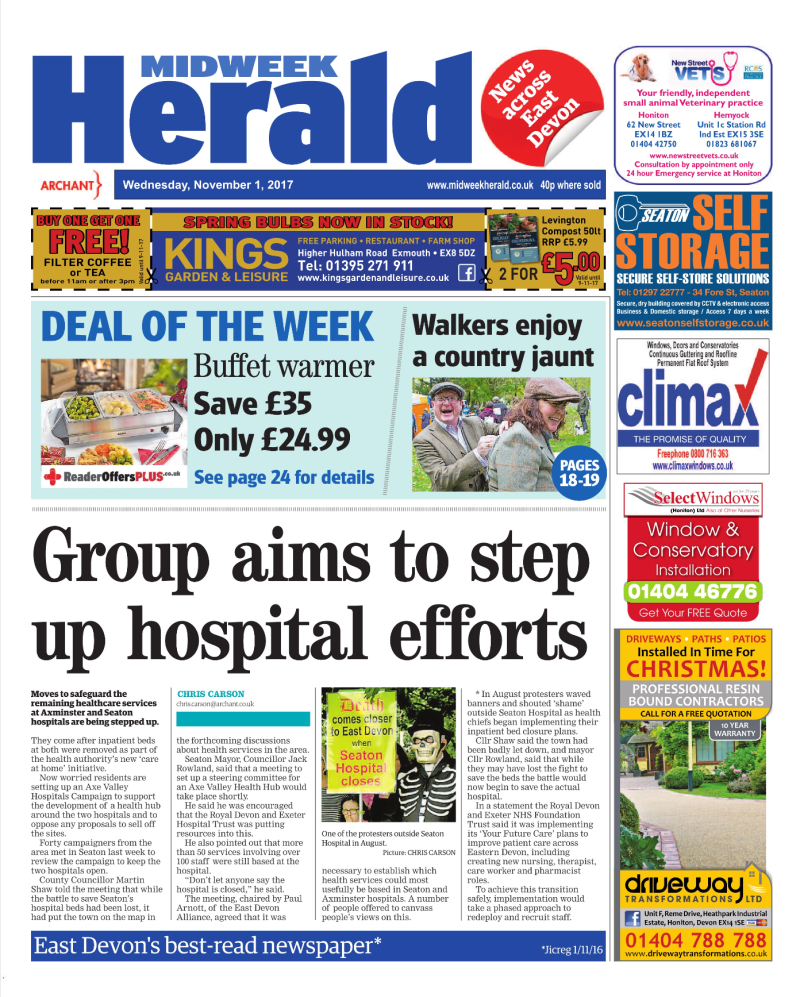
Save (what’s left of) Axe Valley hospitals hits the headlines

Things MUST be bad in the local NHS if they hit the front page of the Midweek Herald!

“Care Closer to Home”: the Torquay experience (not good)

Concerns that care in the community is failing some Torbay and South Devon residents have been raised by a health campaign body.

Gordon Jennings, chairman of the Community Health and Welfare Alliance, set up at the time of the consultation on the closures of community hospitals in Torbay and South Devon, said they feared the consequences of the closure of at least 74 beds across Torbay alone. One of the main providers of care in the area Mears Care was recently taken out of special measures by Government inspectors but they still rated it as ‘requiring improvement.’

It comes after Torbay and South Devon NHS Foundation Trust marked the second anniversary of the launch of the pioneering integrated care organisation in the area.

Mr Jennings said: “We are concerned as we have a high proportion of over 80s in the population, we should be making sure there are suitable arrangements for those people. The integrated care organisation’s argument is that the alternative to community hospitals is care at home. But they haven’t got the staff for home care. How are you going to get quality of care? Changes usually mean improvement, but it’s arguable that under the Devon NHS Sustainability and Transformation Plan (STP) this is not always the case and is a series of cuts – including the loss of 100 hospital beds.

“Evidence is being gathered on experiences under ‘Care in the Home’, but we would implore Torbay communities to become involved and share your experiences with Healthwatch Torbay, Paignton Library, who are conducting ‘have your voice heard today’ consultation on this and other health subjects.

“We need to remind ourselves that South Devon and Torbay Clinical Commissioning Group admitted at the consultation meetings in regards the lack of staff in this area. With your help it is our intention, not only to seek a meeting with the CCG, with these findings, but also Torbay Council Health and Well Being Board, who have a responsibility in this area.

“We have been seeking evidence that it isn’t working and we have had some cases come forward but we are looking for more. If people can write to us with their concerns we can take it up with the right people.”

Dr Kevin Dixon, chairman of Torbay’s independent consumer champion for health and social care, Healthwatch Torbay, said: “Healthwatch Torbay regularly shares an extensive variety of local feedback from Torbay residents on hospital discharge and community care with both Torbay and South Devon NHS Foundation Trust and the Care Quality Commission, along with relevant providers and health commissioners, in order to contribute to their intelligence reports and prompt them into any relevant action.

“Although we have heard public concerns with both discharge and community care, we have also received praise for both.

“The findings of the CQC report into Mears Care Ltd. were reflected in the feedback we have gathered from those people who shared their experiences with us, which indicated that although there was some improvement in the quality of care Mears have provided since the original CQC report in 2016, a number of issues still exist.

“We remain committed to escalating any public complaints and concerns directly with Mears Care Ltd. and continue to monitor the quality of care they provide. Healthwatch Torbay will carry on gathering local public feedback and sharing it with key decision-makers to ensure the public voice is listened to at a commissioning level.”

Michael Rennolds of Coombe Road, Preston, has muscular dystrophy and Muscular Dystrophy UK say the condition is a progressive and life limiting muscular wasting condition for which there is no cure and no effective treatment. That means he has high needs.

Joel Rackham, care and information advocacy officer has written to Torbay and South Devon Healthcare Trust saying Michael required constant individualised care and intervention over each 24- hour period including regular physiotherapy, support with food and drink, toileting and bathing needs.

They say it is critical an up-to-date care plan is in place. But they say he has lost out on several respite days as well as his care hours were reduced from 84 hours a week to 41 which the charity say is ‘insufficient to meet his care needs’ .

At the same time £16,200 was taken out of his bank account which would have been used to pay for care. The charity has asked for the money to be reinstated and say it is ‘not fair’ to expect his mother, who works part time to be expected to care for him as her health is being affected and she cannot be expected to handle Mr Rennolds on her own.

The charity has asked for a minimum of 98 hours of care per week, more than double the amount budgeted for.

Nic Bungay, director of Campaigns, Care and Information at Muscular Dystrophy UK told Devon Live: “Without the right support in place, the difficult job of helping Michael to get out of bed, get dressed, eat his meals and live his life will fall on his mother Susan. The severe and progressive nature of Duchenne muscular dystrophy means that any reduction in care is wrong, but cutting the hours in half and leaving an entire day without any provision is unthinkable. His hours need to rise to the recommended 98 hours a week immediately.”

Mrs Rennolds said the money has still not been reinstated and she had been told the consideration of her complaint had again been adjourned.

“The NHS have taken the £16,200 out of Michael’s bank account, because he wouldn’t sign some papers that were in dispute. Only an idiot would sign some papers they disputed. The charity has written stating that money has to be put back. Michael is really down about this.”

A Torbay and South Devon NHS Foundation Trust spokesman, said: “We are currently in the process of responding directly to Mr Rennolds’ complaint. “We are fully committed to providing our clients with the best possible care. We work hard to ensure that people stay as healthy and independent as possible and that those who would be at risk of injury, illness or isolation are cared for as a priority. Each client will have their individual needs professionally assessed on a regular basis and our health and care professionals will work with them to identify the best way for their needs to be met. This means we can be sure we continue to meet individual’s changing needs.

“Whilst we cannot discuss individual client cases, when clients have their needs and care plans reassessed, we always do this working in partnership with the person and jointly agree the outcome.

Direct payments are made to meet an individual’s specific care needs. In addition, as part of the national guidelines, all recipients of Direct Payments sign an agreement that states that we reserve the right to reclaim money that is not being used. If people in receipt of direct payments accumulate a significant amount of money saved from their direct payments, in line with these national guidelines, we will recover a proportion of this money which will then go towards providing care for other vulnerable people. When monies are recovered, we will always ensure a significant proportion still remains in their Direct Payment account to cover their own care costs as well as a contingency for any unexpected expenditure.”

Marilyn and Ivor Martin, of Salisbury Avenue, Torquay say they are struggling with the level of care offered at home after Ivor, 68, had a serious stroke.

Marilyn said he had a stroke out of the blue one lunchtime which has left him affected all down the left side and incontinent. She said: “I cannot fault the hospital staff at all, the ambulance staff they were incredible. He was moved to Newton Abbot and his care there was wonderful, impeccable. Then I had a visit from occupational therapy from Newton Abbot who said he was coming home. I said my house isn’t suitable.

“I have steps in my garden, I was told there was no money to do that. I have a corner bath and they said there were no aids to get him in and out of the bath so he would have to strip wash and he would need to for the rest of his life if needs be. If I wanted adaptations I would have to pay for it myself. I was offered handrails which would take six to eight weeks to install after he got home. He couldn’t get upstairs and I said I was not having him home if it was not safe. They said I would have to put a bed in the dining room. I don’t have a single bed but was told I would have to buy or borrow one. They put a rail on my bed upstairs, a commode, a rail around the toilet so he could get himself up.

“I was told if I don’t have him home he would have to go in a care home. That would cost hundreds of pounds, money which should be put into caring for people in the community. We had him home and within three days he had a hospital appointment at 12noon. I was told there would be transport but it would come at anytime between 9.30am and 11.30am, and they would pick him up any time between 1pm and 4pm. He’s incontinent, he would be sat at the hospital all that time without food. I was told ‘that’s the way it is’. We had three appointments in one week for the heart and lung department, but they said they couldn’t arrange for them all on one day so we had to get him up there three times. I took him up with my son’s girlfriend who helped, but I am lifting him in and out the car and I had open heart surgery last year. There is no thought about the carers.

“They said that while I was at work, there could be someone coming in the morning to dress him and someone to give him a sandwich at lunchtime. They said they could come any time between 7.30pm to 10.30am. He wouldn’t stay in bed that late, he’d be getting himself up and falling. I can’t have that. Then they could be back at 11am and 2pm getting him lunch. It’s ludicrous.

“I had help filling out the forms for attendance allowance but you can’t have that until they have been ill for six months. I have spent nearly £4,000 on having a ramp put in the garden and shower unit changed and putting in a second hand stairlift. The physios have been fantastic but suddenly they were told they weren’t coming again until October. His arm isn’t working at all and his hand is swollen. It’s not right. Having the physio in really boosts his morale as well. If you are going to have care in the community you have to the people to do it. Ivor could go swimming at Plainmoor Pool but there’s no way to get help taking him there, I have got to do it. If someone doesn’t have someone at home to help how do they get there?

“There needs to be an organisation that sets up a package and says you will need this, this and this and get it organised for you. In hospital they were fantastic every single nurse and doctor, but if you are going to do care in the community you need to set up what people need before you throw them out there. Nobody is helping us. “

Torbay and South Devon NHS Foundation Trust, the integrated care organisation responsible for social care in Torbay, said they could not comment as they had not had a direct complaint from the Martins. On the question of a shortage of carers a trust spokesman said: “We recognise that, like other places in the country, having enough people with the right skills and training to provide domiciliary care for people to be able to continue to be supported at home is a challenge. And there are a number of things we are doing to ensure the right level of care can be provided including supporting the campaign ‘Loving to Care’ to encourage more people to enter this very rewarding career.

A key part of how we are addressing the challenge is our partnership with a national provider of domiciliary care, Mears, This partnership helps to ensure enough carers are recruited, trained and supported to develop their skills. We extend our training and support so that carers working for all care providers are able to benefit from our training provision. This is an incredibly worthwhile profession and by supporting providers to be able to offer increased opportunities for development of their staff they are not only gaining important skills they also benefit from greater job satisfaction and are more likely to want stay in the caring profession.

“In addition to this support we also offer alternatives for people , such as direct payments which enables people to employ their own support assistant directly.”

Torbay residents can share their experiences by calling Healthwatch free on 08000 520 029, visiting upstairs at Paignton library, or even by rating and reviewing a local health and social care service online via http://www.healthwatchtorbay.org.uk. If you have a case write to Mr G Jennings, c/o Acorn Centre, Lummaton Cross, Torquay, TQ2 8ET.”

http://www.devonlive.com/news/devon-news/south-devons-pioneering-care-community-708511

NHS: where the money goes – short-term fixes

“The NHS spent almost £100 million on stand-in midwives last year, with the figure for England 20 per cent higher than in the year before.

Jon Skewes, director of policy at the Royal College of Midwives, said that the money could have paid for 4,391 newly qualified midwives or 2,731 more experienced staff.

Years of pay freezes were blamed for driving NHS midwives away, adding to pressure on Philip Hammond, the chancellor, to promise health workers a pay rise in next month’s budget.

The NHS spent £2.9 billion on private agency workers in 2016-17, down from £3.6 billion the year before after pay caps were imposed on nurses, doctors and midwives. Much of the fall was due to the NHS switching from external agencies to in-house “staff banks”, where workers are called in as required.

Data collected by the Royal College of Midwives found that private agency spending in English maternity units fell from £29 million in 2015 to £20.6 million last year. NHS bank staff costs rose from £43.2 million to £58.6 million.

Once overtime is included, spending rose from £72.7 million in 2015 to £87.3 million in 2016. For the first time, the college gathered comparable data from Scotland, Wales and Northern Ireland, finding that overall the NHS spent £97.1 million on maternity gaps.

Mr Skewes said: “The use of temporary midwives to staff permanent shortages is counterproductive and smacks of short-termism . . . It is costing more in the long run to pay agency, bank and overtime than it would if services employed the right numbers of midwives.” He added that the “average midwife has seen their salary decrease in value by over £6,000 since 2010”.

•Charities such as Macmillan Cancer Support, the Alzheimer’s Society and Age UK joined health bosses and senior doctors to issue a “cry for help” for more money. “Without additional resources there will be a further deterioration in what can be provided for patients, service users and carers”, says a letter also signed by Carrie MacEwen, chairwoman of the Academy of Medical Royal Colleges, a group for the professional standards bodies that usually stay out of politics.”

Times (pay wall)