
Category Archives: NHS (local)
Tory MP demands greater transparency over health cuts
” … the former GP [Sarah Woollaston, Conservative Totnes] had some stern words for Mr Hunt regarding his department’s attitude to transparency. The health secretary has consistently pushed for “transparency and openness” about NHS performance. However, earlier this week it emerged two reports on the state of services due to be published last month have not yet been released, and Dr Wollaston said she is still awaiting details of a review on the affects of sugar. “We’ve heard the word transparency mentioned several times by the secretary of state but I’m afraid transparency has to apply to him as well,” she said.”
NHS crisis much bigger than government is letting on
“Government ministers have buried NHS statistics that show the service hurtling towards an unprecedented £2bn deficit to avoid overshadowing the Tory party conference, say top NHS officials.
One senior figure at the health service regulator Monitor said his organisation had been “leaned on” by Whitehall to delay its report, which shows that NHS finances are worsening.
Neither Monitor’s quarterly report on how the NHS is faring, nor equivalent data from the NHS Trust Development Authority (TDA), have been published, as they usually are around the time of the organisations’ board meetings last month. Hospital trusts passed their information to the two regulators two months ago.”
http://gu.com/p/4dxy6?CMP=Share_iOSApp_Other
Well, we all know that the crisis in Devon is being covered up by the fragmented way bad news on bed closures is being fed to the media and residents hospital by hospital over a period of time instead of all at once. And we know that positive spin takes the place of real numbers and total lack of information and transparency in press announcements.
It is never too long before the excrement that hits the air circulation system starts dropping down on us all.
New leader for our “special measures” (now branded a “Success Regime”!) local NHS named
“Judith Dean, a former nurse, is the programme director of the scheme which is aimed at providing increased support and direction to the most challenged systems.
Previously Judith worked on transformational work in Wiltshire, following periods in senior NHS roles across the Thames Valley.
Dame Ruth Carnall, former head of the NHS in London, will take on the role of chair of the programme. As well as chairing the Success Regime’s Programme Board, her responsibilities will include top-level liaison with stakeholders including MPs and other elected representatives.”
Love the way it is being branded a “Success Regime” – sounds like something out of North Korea!
NHS Executive gets £410,000 payoff
Imagine what that could have done for a community hospital.
North Devon GPs powerfully challenge the closure of community beds
Our thanks to the blog of Claire Wright for this post from North Devon GPs to the Commissioning Group which has already closed community beds in our area –
Dear Dr Diamond,
‘Safe and effective care within the budget’ consultation
We, the undersigned GPs, would like to register our grave concerns over patient safety regarding the forthcoming plans of Northern Devon Healthcare NHS Trust (NDHT) to close community beds, either in totality or part of the locality, in an unprecedented move before this coming winter as proposed in your current consultation paper.
The current consultation process for “safe and effective care within the budget” has been experienced as a hasty cost improvement process given the far-reaching safety implications of the proposed changes. Whilst we recognise the current context of austerity, we are concerned that the untried, untested closures of so many community hospital beds in this area could prove dangerous for a significant population of patients who might need to rely on community beds to bridge the gap between acute hospital care and their homes when they become severely ill this winter.
The population in North Devon is 166,093 with 1555 people living in residential care homes. There are 4 community hospitals in Holsworthy, Bideford, South Molton and Ilfracombe which has 10 community beds but is temporarily closed. The current 64 beds in 3 community hospitals are fully occupied. East of the Water near Bideford and Ilfracombe are among the most deprived areas in the country with complex health and social needs. Patients in our rural areas will have more difficulties in getting transport to North Devon District Hospital (NDDH) in Barnstaple should all the community hospital beds be closed. Patients in Holsworthy areas will have to travel 35 miles to NDDH should Holsworthy community hospital be closed.
We have particular concerns over the safety of these proposals that are being made in the absence of concrete plans for bolstering and investing in safe staffing levels of the existing very stretched community nursing service. Vulnerable patients this winter could find themselves with inadequate community nursing, physiotherapy and other ancillary services, as well as an over-stretched primary care GP services which will be forced into taking clinical responsibility in an inadequate and under- resourced system. The current time-frame does not suggest any contingency or risk and impact assessment to account for laying down sufficient and timely investment in community services and staff to prevent this.
It must be recognised that North Devon District Hospital (NDDH) currently faces frequent bed shortages, resulting with patients at times having to be placed temporarily in the day surgery unit overnight in bed state emergencies with inadequate facilities as in a normal ward and delayed admissions. Closing community hospitals beds will further compound this situation and may also affect the safe running of NDDH itself.
NEW Devon CCG’s suggested strategic direction is for a timely process of reduction in the numbers of community beds shared over a number of community hospital sites, with money saved by reduction of community beds reinvested in community staffing. This is a very different proposal.
If staff cannot be attracted to work at the community hospitals, it is unlikely they will be recruited in a timely manner to provide sufficient community nursing cover to the local population, resulting in unsafe levels of staff to cover patients discharged from NDDH in the community, often very early in the course of their illness with multiple needs, both medical and social.
Similarly, we are not convinced by the proposal of a community bed unit based at NDDH to be established in time for the winter prior to the closure of all community hospital beds, nor the proposal that a “Frailty Consultant” will be recruited in time to provide clinical guidance and leadership to those proposed beds at NDDH reserved for community patients. NDHT has had severe difficulties and is unable despite multiple advertisements in replacing recently resigned Care of Older People Consultants. North Devon population will end up with no community hospital beds, no consultant with the appropriate skills to provide clinical skills and direction and an over-stretched community service in addition to an acute hospital with bed shortages over the winter.
It has been suggested that the closure of Torrington Community hospital was a success. The truth of the matter is that these patients were often placed in other community hospitals which are still open and evidence shows these community beds are needed.
We agree that patient safety is paramount and as such we do not support the current “safe effective care within budget” plans and their time-frame. We propose NDHT engage all stakeholders including the CCG and staff for a timely and proper consultation to find the best and safe solution for our population.
Yours sincerely
Dr Glenys Knight, Senior Partner, Bideford Medical Centre
Dr Mark Clayton, GP Partner, Bideford Medical Centre
Dr Geoff Spencer, GP Partner, Bideford Medical Centre
Dr Duncan Bardner, GP Partner, Bideford Medical Centre
Dr Alison Stapley, Executive & GP Partner, Bideford Medical Centre
Dr Yuk Chan, GP Partner, Bideford Medical Centre
Dr Ed Bond, GP Partner, Bideford Medical Centre
Dr Ruth Down, GP Partner, Bideford Medical Centre
Dr Richard Davies, GP Partner, Bideford Medical Centre
Dr Andrew Clarke, GP Partner, Bideford Medical Centre
Dr Sarah Ansell, Salaried GP, Bideford Medical Centre
Dr Nicky Relph, Salaried GP, Bideford Medical Centre
Dr Steffan James, ST4, Bideford Medical Centre
Dr Fiona Duncan, ST3, Bideford Medical Centre
Dr Alan Howlett, Senior Partner, Black Torrington Health Centre
Dr David Hillebrandt, semi-retired Holsworthy GP, Sessional and OOH GP
Dr Birgit Hole, Sessional GP
Dr Caroline Flynn, Session GP
Dr Chris Gibb, Senior Partner, South Molton Health Centre
Dr Justin Bowyer, GP Partner, South Molton Health Centre
Dr Rebecca Geary, GP Partner, South Molton Health Centre
Dr Wayne Sturley, GP Partner, South Molton Health Centre
Pay freezes do not lead to poor morale in NHS says health minister
So, bankers bonuses are not needed then? And MPs don’t need it either?
“A health minister has sparked anger by claiming that NHS pay freezes have had no effect on staff morale.
Health minister Alastair Burt argues that NHS staff surveys show slight improvements in morale in recent years.
NHS pay costs were frozen between 2011 and 2013 and then pinned to 1% – although many staff, including most doctors, were at first refused 1% increases this year.
Non-medical staff eventually got a 1% staff after a series of one-day strikes.
Asked by the MP for Sheffield Heeley, Louise Haigh, he said: “There is no evidence that the pay freeze affected staff morale.”
Royal College of Nursing chief executive Janet Davies criticised his interpretation of the survey findings.
She said: “This is an interesting perception of NHS nurse morale which bears little relation to what we’re hearing on the frontline or what the NHS’ own staff survey revealed.
“The economic evidence speaks for itself. Nurses who are struggling to make ends meet are choosing to work for agencies instead.”
She added: “The Government must start taking the concerns of NHS staff seriously, by valuing the important work they are doing and giving them a decent wage. Five years of pay freezes would affect anyone’s morale.”
doctors.net.uk
An angry doctor speaks out
A frustrated NHS medic has appealed to his fellow health workers to “wake up” to what the Conservative government is doing to public sector pay and conditions.
In a powerful post on Facebook, medic Chris Smart wrote “I’m so angry, it’s hard to articulate in words.
“The Tories are just doing what is in their nature, like a cat disembowelling a sparrow on the kitchen floor. They can’t really help it.
“It is just what they’ll do if you let them. I am however, absolutely incensed, to the point of approaching aneurysm popping levels of blood pressure, with the fact that we are even -considering- letting them.
“I don’t know which I hate more. The pathetic servile fatalism of the majority, or the way the rest want to pussy off to Australia.”
Smart has also produced an online calculator which allows medics to input their shift patterns to determine how much they will earn under new reforms by Jeremy Hunt, the Health Secretary.
Smart’s solution to ever-dwindling levels of pay is to call for a mass strike – the first in the service’s history.
He writes: “We can strike entirely safely. We close all non-urgent outpatients clinics. We stop all non urgent surgery. We let the entire elective side of the NHS grind to a complete halt.
“Nobody has to die. Your honour will remain intact.
“Furthermore, in two decades time you will be able to tell the medical students you teach, that the reason they have chosen a good career, is because twenty years ago, you f*ing stood up for it.”
Smart has received a huge amount of support from fellow NHS workers, hinting at the level of discontent amongst front line medical staff.
His post has already been shared of seven thousand times online, and hundreds of people have commented to lend him support.
But not everyone agrees NHS workers should be able strike to achieve better conditions.
One commenter wrote: “I think the NHS needs to look at where the money is being spent and, look a bit closer to home at the top heavy brass and administration were your money is flowing out of your organization.”
Huffington Post UK, today
From the papers …
Yet more examples of how our district is out-of-tune with both evidence and the electorate:
POLICING
Rural communities lose confidence in police
A new report from the National Rural Crime Network (NRCN) estimates that rural crimes are costing communities £800m while a quarter of crimes go unreported due to a lack of confidence in policing and low satisfaction with local forces. The NRCN found 27% of the more than 17,000 people in the countryside it consulted had not reported the las crime of which they had been the victim. This compares with a national rate of 20%. Of these, 44% said calling the police would have been a waste of time, while 43% said that the police could not have done anything. The report is published amid concerns over the impact that reductions in police numbers and budgets will have in more remote areas, as forces face further cuts of between 20 and 40%.
The Times, Page: 4
HEALTH
King’s Fund calls for further NHS funding
The King’s Fund has warned that an extra £8bn of funding promised to the NHS by 2020, a figure put forward by Simon Stevens, will not be enough. The think-tank claims additional emergency funding of about £1bn will be needed if standards of care and access to services are to be maintained.
Financial Times, Page: 4
TAX
Retailers call for rates cut
The Mirror reports that Tesco is among a group of 12 retailers which have signed a letter from the British Retail Consortium calling on George Osborne to cut business rates. The paper says the move reflects growing concern over the Government’s review of business rates, announced in the March Budget.
Daily Mirror, Page: 45
What mainstream media isn’t telling you about that DCC Cranbrook Report!
What the Express and Echo article on Cranbrook DIDN’T report:
Firstly, that along with Councillor Moulding, other EDDC (or former EDDC) councillors were part of the DCC task group which were closely involved with the development of Cranbrook: councillors Bowden and former EDDC Leader Sarah Randall-Johnson.
and bits of the report that didn’t make the mainstream media have been extracted here:
Developers are house builders, not town builders. The planning of e.g. the town centre and open spaces is the responsibility of the district council as the local planning authority whose responsibility it is to ensure that developing land commercially is coordinated with building a new community with social as well as physical facilities and infrastructure. It took five years to negotiate the original Section 106 Agreement.
Numerous concerns were shared with the task group in relation to the developers’ activities, among them a large number of incidents relating to the quality of the completed homes, including compliance with plans and residents struggling to encourage developers to address any shortcomings. Landscaping of community space has followed rather than preceded development and the management and maintenance of future community space and development land is lacking. The number of complaints regarding the quality of the built environment resulted in some community representatives being concerned about Cranbrook’s future reputation and the success of future phases.
Despite numerous invitations it was disappointing that none of the four house builders were available to comment on the concerns which participants shared with the task group.
Community Infrastructure
There is no standard model for planning community infrastructure and negotiating with developers, service commissioners and providers, but what is critical in creating a new town is upfront funding to support delivery the development of roads, community infrastructure and affordable housing from the public purse. Some of those facilities, e.g. the primary and secondary schools, Clyst Honiton bypass and Younghayes Community Centre, have been finalised ahead of schedule in Cranbrook. For others, notably the train station, there is a strong public perception that facilities are substantially behind schedule. Building and operating facilities without residents to use them is not viable but equally, residents expect facilities as soon as they move in. Participants repeatedly called for a multi-disciplinary team to plan and shape the future provision of services in Cranbrook.
In the absence of alternative public transport provision other than a limited but expanding bus service, car parking facilities were described as inadequate, including insufficient car parking allocation per bedroom, no visitors’ car parking, allocated parking bays being situated away from homes and garages being physically too small for cars to fit in them. Concern was expressed that habits formed in the early days would be hard to unlearn and that transport infrastructure should be delivered in line with residential development. Residents criticised “blue sky” bicycle thinking ignoring the reality that today’s Society had a two car per dwelling dependency which should be catered for in new development.
The roads in the town are not yet adopted, and as they are carrying significant volumes of construction traffic, the County Council does not currently have timescales for when responsibility will be transferred. The maintenance for the roads remains the responsibility of the developers, including gritting in the winter. The task group understands that the developers have an agreement with Devon County Council to finance gritting by the highway authority in severe weather. Several participants expressed concerns about dangerous car parking by residents and developers on pavements, corners and junctions but Devon County Council cannot extend its civil parking enforcement service until the roads are adopted.
Safe access routes to the Cranbrook Education Campus (primary and secondary schools) were due to be completed by the end of August 2015, including secure footpaths. An Infrastructure Site Manager employed by the Developer Consortium was overseeing their completion.
The task group remains concerned about the secondary school being located next to the railway line. Network Rail has committed to delivering awareness training for the children once per year in the school. The school was also planning to operate manned gates.
The main road through Cranbrook is not finished which might cause problems for parents whose children attend both the Cranbrook Education Campus. They would have to drop children off at both sites at similar times with no direct access route to both.
A pre-school facility would have assisted at an early stage.
When the first residents moved into Cranbrook in the summer of 2012, there was no social or community infrastructure or service provision beyond the completion of their homes. The task group repeatedly heard how this was a problem especially for the more vulnerable residents, including single parent families and residents without access to private transport. Social housing occupants were housed in Cranbrook and thereby removed from established communities, with shops, public transport and public services, and lived in Cranbrook in isolation. The complete lack of healthcare, social care or other professional support during the first 18-24 months meant that some residents were left to struggle on their own, exacerbating existing problems, including (post-natal/long-term) depression and drug/alcohol dependency.
Participants repeatedly expressed how there was provision for young children under the age of five in the form of open spaces and safe play areas, and some surrounded by unsafe fencing, but still no facilities exist for older children and teenagers. This resulted in problems, e.g. older children using the park and making it an unpleasant environment for younger children to play. Although funding had been available in the Section 106 Agreement from the beginning, the youth bus had only commenced at a later date. The task group understands that this provision was temporally withdrawn following an alleged antisocial behaviour incident at the end of July 2015. Participants commented that the provision should increase in order to combat antisocial behaviour issues, rather than be withdrawn.
The Cranbrook Medical Centre opened on 20 April 2015, nearly three years after the first residents moved in. An unsuccessful tender for new services and premises had been issued by the then Devon Primary Care NHS Trust in the past. The reorganisation of the NHS saw the responsibility for the commissioning of primary care services transfer to NHS England which awarded the contract to Devon Doctors. A funding challenge remains: Core services delivered in GP surgeries are funded per capita based on the number of formal registrations with a surgery. Although the current practice in Cranbrook has a capacity for approximately 3,500 patients, only 514 patients were formally registered at the end of July 2015. NHS England has provided some core minimum funding to the practice whilst the list size remains low and this will be paid until the registered population reaches a certain size, at which point capitation-based funding will be applied; another example of upfront funding required in the initial period. Two GPs, who are building their work load up to full time, and one nurse are currently practicing.
A backlog of patients who still need to be registered remains. When moving to Cranbrook, residents had to register with the Pinhoe & Broadclyst Medical Practice in cases where their old surgeries would not keep them registered. The Pinhoe & Broadclyst Medical Practice was difficult to access with public transport from Cranbrook which had proved a challenge for the more vulnerable members of the community.
Cranbrook is forecast to have approximately 20,000 residents by 2031 and the GP surgery will have to slowly evolve in order to grow in conjunction with the growth in residents and their future healthcare needs. The surgery will need a new building in the future with sufficient capacity to expand in a modular way to grow with the population. It would therefore be important for the NHS to be able to access Section 106 funding as appropriate to enable such premises to be facilitated, although there are concerns around State Aid which will need to be addresses as GP practices are effectively private businesses. NHS England is currently working with other health partners to develop a joint response to planning applications being received.
Pharmacy
The independent pharmacy is being accommodated in temporary premises at present and the task group heard from participants how its provision might have been better coordinated and co-located with the GP surgery with improved forward planning.
One of the objectives in the development of Cranbrook is to develop the employment infrastructure, i.e. create one job per residential dwelling. Employment opportunities exist in nearby Exeter, the SkyPark and the Science Park and eventually in the town itself, with the intention that Cranbrook develops as a small enterprise town. The development of small-scale employment spaces is currently being pursued with the conversion of two residential dwellings into offices. Commercial properties in the town centre have not yet sold. The task group questioned where spaces are in the town for small- and medium-sized enterprises to establish their businesses. An Economic Development Strategy has been developed for Cranbrook.
Bed-blockers stay, on average for 100 days
And how that could be cut by the judicious use of community hospital beds … the ones now being cut!
“Some NHS patients are now waiting more than 100 days to be discharged after their treatment, according to figures from NHS England. The data reveal that in the year to July 31, patients waited a total of 1,685,604 days to be discharged after they were declared ready to go home, an increase of 15.8% on the previous year. The figures on delayed discharges reveal that in July patients waited a total of 147,005 days to be discharged. About 62% of the delays were attributable to the NHS, 30% were due to social services, and the remainder were caused by both.
The Sunday Times, Page: 16″
“Middle-class people missing out on 8 years of full and active life”
Middle class people in the UK are missing out on an average of eight years of full and active life because of deep-seated inequality extending far beyond the gap between the richest and poorest, one of the world’s leading experts on the issue has warned.
Sir Michael Marmot, the incoming president of the World Medical Association and former BMA president, calculated that 200,000 people a year – or 550 people a day – die prematurely in the UK because of a health gap between a small elite and the rest.
Figures are regularly published showing a difference of between 17 and 20 years in so-called healthy life expectancy between people born in the richest and the poorest neighbourhoods in Britain – a divide widely attributed to a combination of lifestyle factors such as smoking and drinking, social issues such as drugs and unemployment, diet, working conditions and the effects of education.
But Sir Michael, director of the Institute of Health Equity at University College London, warned that the focus on the gap between the rich and poor is effectively obscuring a more widespread inequality, affecting millions of middle class people.
He calculated that a typical British person, who would never be classed as deprived is missing out on eight full years of “disability free life expectancy” – the length of time they could expect to live before the onset of a chronic or life limiting illness or other condition.
There is, he said “no good biological reason” why everyone in the UK does not enjoy the same chance of a long and healthy life as those at the top.
The gap cannot, he said, be blamed on a postcode lottery in health provision because, despite problems with the NHS, Britain enjoys one of the most equitable systems of access to health care in the world.
Sir Michael also said the gap could not simply be blamed on people being “irresponsible” because there is a clear social gradient linking levels of conditions such obesity and people’s position in the overall hierarchy.
He said: “When we think about health inequalities commonly we think about health of the worst-off compared to everybody else – and I’ve contributed to that, I’ve spoken about a 28 year gap in male life expectancy in Glasgow, a 20 year gap in the London borough of Westminster, comparing the poor with the best off.
“But I want to change the conversation based in the best evidence: people in the middle have worse health than people at the top.
“Instead of focusing on the bottom let’s focus on the top.
“People at the top have the best health and there is no good biological reason why everybody, wherever they are, should not enjoy the same good health as people at the top.
“Let’s make common cause between people wherever they are in the social hierarchy because the evidence suggests that we can make a difference and we know what to do to make a difference.”
He said that inequality amounted to the greatest health challenge of our time.
“If these 200,000 deaths were caused by a pollutant people would be on the streets marching to have it banned,” he said.
“The irony is the actual cause is just as pin-pointable as a toxin.
“The cause of inequalities are the conditions in which we were born, grow, live work and age and it’s damaging the health of us all.
“It is not simply about money and it is not just the poor who suffer – it is unfair we don’t all live in the best possible good health.
“We know what to do to make it better and save 550 lives a day in the UK alone.”
Local health commissioning group “not fit for purpose”
This is the group that is top-heavy with jargon-speaking managers behind the closure of community hospital beds. Can we now expect to see a re-assessment of that decision?
Article in today’s “View from …” titles:
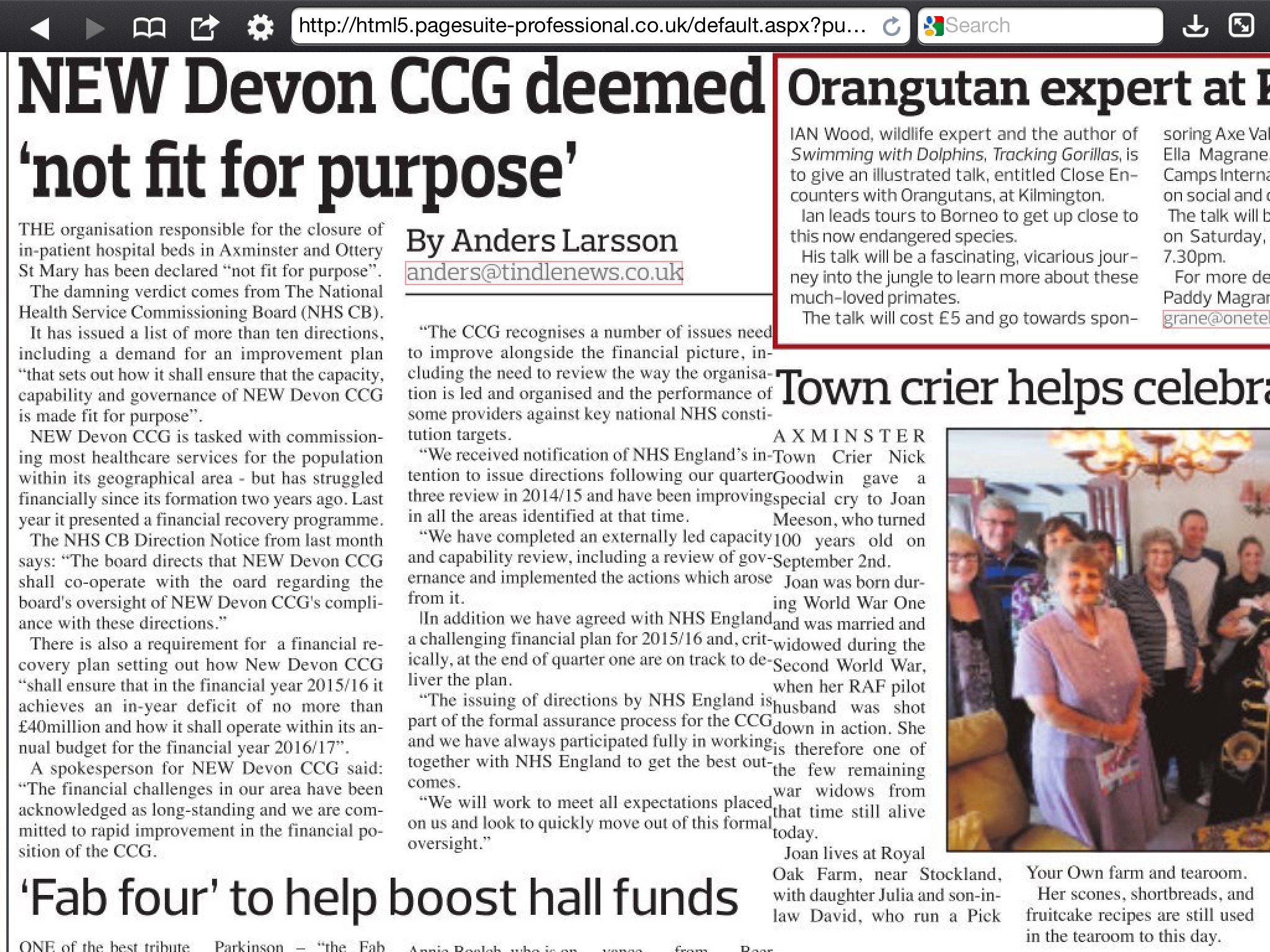
MPs getting special VIP treatment at nearest hospital to Parliament
No wonder they think that the NHS is doing just fine!
Cranbrook to become a “health town” to cut NHS burden?
The head of the NHS has had this bright idea and Cranbrook is mentioned as a possible pilot town.
The chosen towns will emphasise active travel, parks, table tennis, more sheltered housing for elderly people, mobile and accessible health services, no fast food restaurants close to schools, GP monitored technology in homes, no kerbs, non- slip pavements and symbolic signs to help dementia sufferers.
Good luck with that one, with a fish and chip shop opening near the school and a row already going on about the school playing fields having no floodlighting making it inaccessible at night and cars parked half-on kerbs because there isn’t enough parking. Not to mention – so far – zero provision for specialist housing for the elderly.
The article mentions that Cranbrook is expected to have 20,000 new homes which seems to imply that all the 17,100 homes claimed as being required in the Local Plan will be sited there along with another 3,000 for good measure.
Source: Sunday Times 30/8/15, page 15
OTTERY HOSPITAL SUPPORTERS SEEK JUDICIAL REVIEW ON INTENDED CLOSURE
PRESS RELEASE:
CONTACT PHILIP ALGAR on
01404 814157:
philipalgar@btinternet.com
Plan attendance at important committee meeting at County Hall on 14th September
Join a free coach in Ottery or West Hill
A number of local residents, concerned that the inpatient beds and minor injuries unit at Ottery Hospital are to be closed, are to seek a Judicial Review to contest the decision taken by the Clinical Commissioning Group (CCG). They are working with others who have similar problems and are keen to link with other groups, including the League of Friends of Ottery Hospital, and local councils.
James Goddard, who has led the Ottery campaign from the beginning, said “we must demonstrate to the CCG and others involved in taking decisions which ignore the wishes of local people and undermine their interests, that they are blatantly wrong. Community hospitals must be saved, not least to prevent bed-blocking and Black Alerts at the Royal Devon and Exeter hospital. The closure of the Minor Injuries Unit means that people will have to travel further, thus creating additional demand on hospitals already under pressure from those who are ill.
“We have done all we can so far and owe it to the 2,000 people who signed a petition in favour of sustaining Ottery Hospital to take this important step. We not only strongly disapprove of the outcome but also feel profound dissatisfied with the CCG process which led to this decision. Indeed, many of us believe that the decision to close the inpatient beds was taken before the “consultation”. One scenario in which more money would be spent on local hospitals still saw the Ottery Hospital lose all its inpatient beds. A report from the Stakeholders Group, set up by the CCG, recommended a positive change which would have allowed all inpatient bids in the five hospitals in the local area to remain. However this study was ignored. The CCG also failed to send it to the Devon County Council Health and Wellbeing Scrutiny Committee. So we are doing all we can to mobilise support from the local MP, councils and other groups. This might well be our last chance to save our hospital.”
The intention is to demonstrate that the decision was not in the public interest and that the process was flawed. The group, backed by professional experts, is considering how best to proceed in the limited time available to activate a request for a review and some considerable preliminary work has already been done.
Meanwhile, the Health and Wellbeing Scrutiny Committee of Devon County Council will examine the decision to close hospital beds in East Devon at its meeting on 14th September. It is hoped that many members of the public, from the affected areas, will attend this session, which begins at 2.00. Philip Algar, a fellow campaigner on behalf of the hospital, said that if many local people attended this meeting, it would show the committee the depth of feeling and the importance of sustaining the inpatient beds and minor injuries unit locally. “As the population of Ottery is expected to increase by a quarter in the near future and Cranbrook continues to expand, we cannot understand why it is necessary to close the facilities at a modern and geographically well-located hospital. The “justification” offered by the CCG flies in the face of common sense and defies logic.“
To ensure that as many critics of the CCG attend this important meeting, a coach has been arranged for those in Ottery who wish to go to County Hall. It will leave the Land of Canaan at 1.00 and will call at the British Legion Hall in West Hill at 1.10. Those who wish to book a free place on the coach should ring John Giblin on 01404 815815 or email him on John.giblin@otternurseries.co.uk.
END: 27.8.15
Whatever happened to …
… the “special measures” that was supposed to happen to out Devon health authorities?
We were promised “troubleshooters” but all we seem to have so far are troubles and health authority members shooting themselves in the foot:
When is a Community Hospital not a Community Hospital?
Anecdotal evidence reaches us that some of our Community Hospitals are taking patients discharged from RD and E who are from places as far away as North Devon.
Can anyone confirm this?
It would make a mockery of the ethos of community hospitals if true and would mean that bed closures leading to bed shortages in other areas were being covered up.
Privatisation of the NHS continues
GPs are set to find themselves dealing with the controversial public services giant Capita, it has been revealed.
The company has won a £330 million deal to take over the primary care support services run by NHS England.
Capita specialises in taking on public administration tasks.
NHS England claims the deal will cut costs by more than quarter over a seven-year period.
Capita will take over the services from the beginning of next month. Some 29 offices are due to close in the course of the year – reflecting a purge of the local facilities that were run by primary care trusts until two years ago.
Dr Richard Vautrey, chair of the British Medical Association’s GP committee, told the Health Service Journal: “The big question is whether Capita have enough resource to deliver the service – Primary Care Support was already overstretched.”
Source: Doctorsnet
More Devon community hospitals face axe
Pretty soon, community hospitals may cease to exist in Devon:
 East Devon Watch