Twiss gets his words into a twist – ANOTHER reason we need independent councillors!

This time from the blog of DCC EDA councillor Martin Shaw.

“Conservative County Councillor for Honiton, Phil Twiss told Devon County Council on 4th October that ‘Sonja Manton [Director of Strategy for the Devon Clinical Commissioning Groups] said at the Health and Adult Care Scrutiny Committee the other week that there no plans to close any community hospitals in our area. We were talking about Seaton, Honiton and Axminster at the time.’

I was surprised that he should give us this good news in passing, and that the CCG had made no announcement of something so obviously important. So eventually I watched the webcast of the Health Scrutiny meeting on September 20th. Although Sonja Manton spoke several times, I couldn’t find her saying anything like what Phil said – indeed anything about community hospitals at all.

So I emailed Sonja and she confirms she didn’t speak about the hospitals. As for the issue, all she would say was, ‘I can assure you that our continued focus remains on planning and commissioning services and support to meet the needs of the Devon population in the best possible way. We recognise how strongly communities feel about community hospital buildings and will continue to work with communities and stakeholders to modernise and evolve the way our services are delivered and where they are based to make sure we make best use of all our resources and public estate.‘

So was Sonja more forthcoming at another, presumably private, meeting, Phil? Or was what you said wishful thinking?”

@philtwiss’claim that @SonjaManton said ‘there are no plans to close any community hospitals in our area’, not backed up by @NEWDevonCCG. What’s the explanation, Phil?

Why we need independent councillors

From the blog of Claire Wright. The review would NOT be happening without Claire’s dogged persistence (and similar action by EDA Independent Councillor Martin Shaw. Without them these issues would be kicked into the very, very long grass!

“A Devon wide review of how carers are coping will take place, following my successful proposal at last month’s Devon County Council Health and Adult Care Scrutiny Committee meeting.

I had been carrying out research into this area since January, when I asked for more information on a scrutiny report, which suggested that carers may be struggling.

I had a meeting with officers and asked for a report of a focus group that was carried out last autumn (2017). …

The results (which I was asked not to publish) were worrying. In almost all areas carers who took part indicated that they were worse off, or saw services being poorer.

What came out strongly to me that the three key areas of health, financial support and respite care, were all deemed as being poorer, according to the carers who took part.

I proposed a review at the June scrutiny committee meeting but chair, Sara Randall Johnson suggested a meeting with Devon Carers staff first, at the Westbank League of Friends. Devon Carers is commissioned to provide support for carers in the Devon County Council area.

This was a useful meeting. What emerged for me, among other issues, was that under the Care Act 2014, the bar has been raised by the government for both financial support and for respite care so it is now harder to access. I am quite certain that this is partly the reason that carers are finding things tougher.

I asked for a further agenda item for the September Health and Adult Care Scrutiny Committee meeting. I invited two carers who had asked for my help – Maureen Phillips and Mary Hyland, who gave powerful and moving presentations of their experiences of caring. Maureen, for her father and Mary for her partner.

Mary said there is no respite care available. And that overnight she became a carer, she was thrown into it, she knew nothing about it and had to give up her job. She has no support and finds it hard to even leave the house. Previously, she was a very outgoing person, even having her own programme on BBC Radio Devon. She said she was there on behalf of all local carers. Everyone is finding things hard.

The committee was silent.

Maureen said she had been the carer to her father for eight years. Life is exhausting, demanding, frustrating and isolating, she said. Maureen said specialist support workers are required. She said both she and her father need emotional support. She asked who she should turn to when things get tough. There is a shortage of care workers. In the last eight years she had one holiday. She had to take her father with her. Maureen said she had to fight for every bit of support. She has turned to the services of a solicitor in desperation.

When I made the proposal for a spotlight review at the September meeting, it was seconded by the chair and agreed by the committee. I hope to have a date for the first meeting soon.

We need your help! If you would like to take part by giving your story to the spotlight review, please get in touch at claire@claire-wright.org – many thanks

Here’s the webcast: You can see Mary’s and Maureen’s presentation under public participation – https://devoncc.public-i.tv/core/portal/webcast_interactive/359701

The agenda item itself is under number 12..”

http://www.claire-wright.org/index.php/post/scrutiny_review_to_take_place_into_how_devon_carers_are_coping

Hospitals should not be used as “weapons”

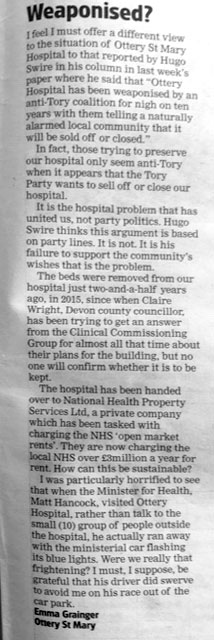
Here are some images of a few of the responses in the Sidmouth Herald to Hugo Swire after his claims that campaigners for Ottery St Mary Hospital are “anti-Tory” and have “weaponised” their campaign (click on images for better view):


Clinical Commissioning Group merger for Devon – good or bad?

Owl says: a bigger group fo DCC NOT to scrutinise – right….

“There are claims a planned merger between two NHS bodies in Devon will result in a less accountable system with no guarantee of improved healthcare for patients.

At present, there are two clinical commissioning groups – or CCGs – which plan and buy healthcare for local people. There’s one covering the North, West and the East of the county – NHS NEW Devon CCG – and the other covering Torbay and the South – NHS South Devon & Torbay CCG. Health bosses want them to merge into one big organisation, claiming this will save money and result in a stronger service. They say there’s already been benefits from the two organisations working more closely together.

But GPs in Torbay have voted against the move and local councillor in the Bay, Swithin Long, is also worried…”

https://www.bbc.co.uk/news/live/uk-england-devon-45865015

Take a deep breath … on second thoughts – don’t

“UK ‘won fight to weaken rules on waste emissions’

The Government has successfully lobbied to water down new EU rules on waste incinerators’ emissions, according to Greenpeace. The decision comes amid concern that the UK already has levels of air pollution above legal EU limits in many cities, leading to the early death of 40,000 a year, according to the Royal College of Physicians.
i p8

Toxic air health threat at 2,000 GP surgeries
A new report by Cambridge Environmental Research Consultants, commissioned by the British Lung Foundation, has found that more than 2,000 GP surgeries and 200 hospitals are in areas with toxic air. This means people with heart and lung conditions could be putting themselves at risk by visiting these GP surgeries and hospitals. Air pollution has been linked to diseases ranging from Alzheimer’s to type 2 diabetes.
Guardian Online, Mail p21”

The “army” “weaponising” Ottery Hospital!

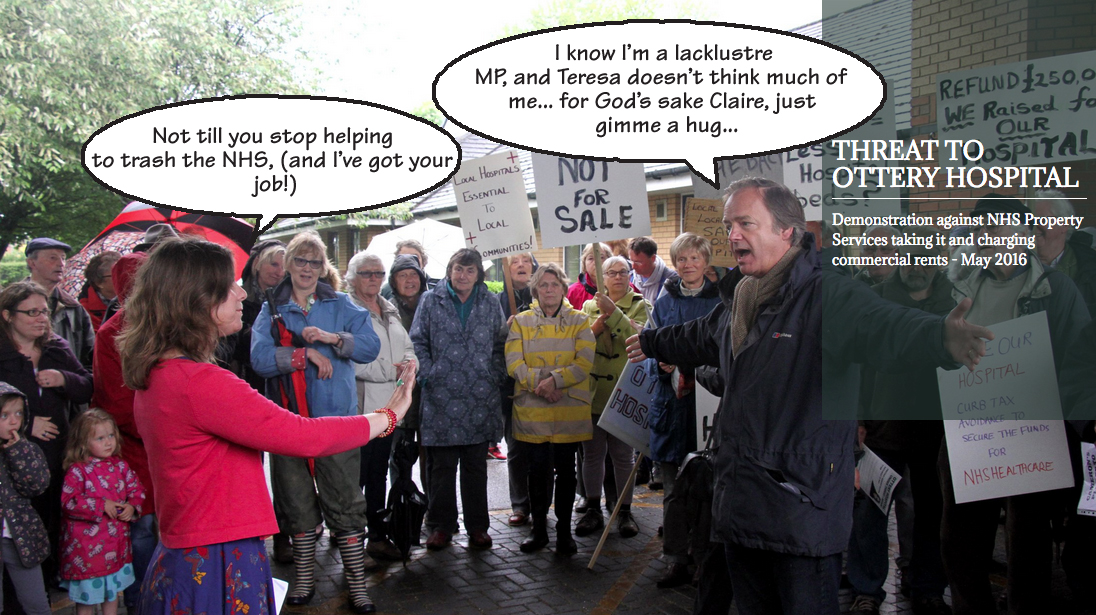
A few of the “weaponised army” at Ottery Hospital – the strapline picture from the blog of tireless health campaignet Claire Wright – the picture shows 2 children, a dozen ladies of a certain age and two mem. Can anyone see any weapons! Do placards and peaceful protest constitute weaponising?

Added to which, Claire Wright looks distinctly unarmed!

or perhaps this is more appropriate:

or this:


and remember, Swire signed up to this:

Open letter to Swire on hospital bed closures from DCC Independent East Devon Alliance councillor Martin Shaw

“Dear Hugo Swire,

In a recent Exmouth Journal article you said: “Regrettably, Ottery Hospital has been weaponised by an anti-Tory coalition for nigh on ten years with them telling a naturally alarmed local community that it will be sold off or closed. I have spent 10 years trying to counter this scaremongering. …”

It’s hardly scaremongering when the hospital has lost its beds and this July’s Devon NHS Sustainability and Transformation Partnership report said, ‘We know a large amount of space in our community hospital buildings is underused. The revenue cost of our community hospital estates is in the order of £20 million; money the NHS could use to improve other services. Working with other public sector partners, as part of the One Public Estate initiative, we will review the space that is required to deliver care, and plan to consolidate the number of sites to free up estate and generate money, which can be re-invested in technology and infrastructure.’

It’s also rich for you to talk about ‘weaponising’ community hospitals. In Seaton we remember all too well when the Clinical Commissioning Group launched its consultation on the future of community hospital beds in 2016, with its preferred option being Option A which would keep the beds in Tiverton, Exmouth and Seaton. You said in Parliament that ‘option B, which sees the beds retained in Tiverton, and also in Sidmouth and Exmouth, is the option worthy of support. Sidmouth has an extremely high proportion of over-85s, with people increasingly living longer, and of people with dementia. Exmouth is the biggest town in Devon with more than 35,000 people.’

Four months later the CCG followed your recommendation, changed its preference, and closed Seaton’s beds. The reasons given for preferring Sidmouth to Seaton were specious – Seaton has an almost identical proportion of elderly. In short, Hugo Swire, you sold Seaton down the river because it was no longer in your constituency (having been removed due to boundary changes in 2010) and you needed to save beds in Sidmouth as well as Exmouth to fend off the challenge from Claire Wright, who even so ran you close in the 2017 General Election.

Today Seaton Hospital, like Ottery, Honiton and Axminster, faces an uncertain future. If it closes, it will be a knock-on effect of the beds decision, and it will be partly on your head.

Martin Shaw, County Councillor for Seaton and Colyton”

Who’s ‘weaponising’ community hospitals, @HugoSwire? Two years ago you were happy to sell out Seaton Hospital to save your parliamentary career

Seaton councillor to ask searching question of EDDC on NHS

From the blog of DCC Independent East Devon Alliance councillor:

The question to be asked by former Mayor and Seaton Councillor Jack Rowlands:

“EDDC has recently decided not to list Seaton Community Hospital as an asset of community value citing that it does not meet the definition of “social wellbeing”. EDDC has now declined requests from 3 community hospitals in the district giving the same reason each time. Please explain why other district councils in Devon have agreed to list community hospitals as assets of community value e.g. Tyrell Community Hospital in Ilfracombe, Moretonhampstead Community Hospital, Bovey Tracey Community Hospital and Teignmouth Community Hospital.

Why is EDDC interpreting the definition differently to neighbouring district councils on this important issue where our community hospitals may be under threat of being fully closed and sold in the future by NHS Property Services?”

Why has EDDC refused to list Seaton and other community hospitals as ‘assets of community value’, when other Devon districts have done so? Jack Rowland will ask at the EDDC on Wednesday

Swire accuses Ottery hospital campaigners of “weaponising” their cause

In an extraordinary rant – no cancel that, Swire seems to be ranting much of the time these days so it isn’t at all extraordinary! – Swire accuses those campaigning for the retention of beds (gone)and services (some) remaining of “weaponising” Ottery St Mary hospital. By implication, he appears to include his arch-enemy, Claire Wright in this “weaponisation” (aka peaceful campaigning).

In a recent Exmouth Journal article (which they will presumably allow campaigners to respond to as a right to reply) he says:

“Regrettably, Ottery Hospital has been weaponised by an anti-Tory coalition for nigh on ten years with them telling a naturally alarmed local community that it will be sold off or closed. I have spent 10 years trying to counter this scaremongering. … “

He then goes on to puff up his recent visit to Ottery – well what do tou call a hospital with no beds? – let’s say “closed community bed building” with the new Secretary of State for Health, when said Secretary refused to meet tireless campaigner Claire Wright and other local people who are keeping up the pressure on him and his mates – though rumour has it that Sarah Randall-Johnson was somewhere in his vicinity. You know, the woman who thinks her DCC committee has no need to scrutinise these changes.

SWIRE MAKES NO MENTION OF THE FACT THAT THE MINOR INJURIES UNIT AND ALL INPATIENT BEDS HAVE ALREADY BEEN CLOSED AT THE HOSPITAL DURING THIS SO-CALLED 10 YEARS!!!!!!!

He says we must look to the future not back at the past and see how our changing needs can be met.

Owl has a suggestion: with the ageing population in East Devon how about a Minor Injuries Unit and Community Hospital beds?

“Optum CEO resigns from top NHS Job, Optum partner replaces him”

“This is an everyday story of the sordid revolving door between US Health insurance company United Health and the NHS.

In the UK, United Health’s subsidiary Optum sells the NHS what it needs in order to morph into a version of United Health – the previous employer of NHS England’s boss Simon Stevens.

With NHS England’s blessing, Optum is all over the NHS, installing their technology & redesigning the NHS through its use.

Optum sells the NHS:

Commissioning support services
Scriptswitch decision support for GP prescribing (which United Health UK acquired in 2009) is in most GP surgeries.
Referral management services
GP Empower (accelerating large scale GP practices

Integrated Care Systems support: “Optum® brings practical hands-on experience having delivered integrated care for over 20 years in the US. Our tried and tested approach has helped systems deliver proven results.” This updates an earlier brochure on accountable care systems/organisations which is no longer available. However NHS For Sale quotes Optum’s now defunct webpage: “We currently operate 26 accountable care organisations in the U.S., and are supporting sustainability and transformation partnerships in the U.K. to manage population health risk and deliver care as an integrated group of providers.”

The overall aim is to control, sideline and override doctors’ treatment decisions – as we can see through NHS England’s consultation on stopping funding numerous elective care treatments and its mandatory Integrated Urgent Care Services specification. This removes patients’ direct access to clinicians and redirects them through NHS 111 to a clinical advisory service that works off the algorithms in a clinical decision support tool.

And now it has its finger firmly in the National Institute of Health and Care Excellence pie – the organisation responsible for providing evidence-based guidance and advice to the NHS.

The revolving door that connnects United Health, Optum and the National Institute of Health and Care Excellence

This concerns:

former United Health Director Andrew Witty
Lord Darzi (head of the Imperial College department which is partnered with OptumLabs, a United Health business); and
a new public-private partnership in the National Institute of Health and Care Excellence called the “Accelerated Access Collaborative“, that’s about pushing new technology and drugs through the NHS.
It puts Optum centre stage in the Accelerated Access Collaborative. Now there’s a surprise. Or not. If you have been following United Health’s relatively rapid takeover of the NHS.

As a result of these shenanigans, we would treat any new recommendation from NICE with a pinch of salt.

Here is a short Witty timeline:

March 2017 – Andrew Witty leaves CEO position at Glaxo Smith Kline
August 2017 – Witty joins UnitedHealth’s Board of Directors
November 2017 – Following the Accelerated Access Review, the Department of Health appoints Witty as head of the Accelerated Access Collaborative. The job is to fast track drugs & technology into the NHS, to start April 2018
March 2018 – United Health announces Witty to be new Optum CEO, to start July 2018
Andrew Witty must have been rumbled somewhere along the line as he graciously resigned from the Government position in March 2018, due to the enormous conflict of interest of him starting as Optum CEO in July 2018. Ignored of course was the huge conflict of interest in hiring Witty in the first place while he was a Director of UnitedHealth.

And who replaced him? Lord Darzi.

Who is Lord Darzi

I am tired of writing about Lord Darzi. He stalks the NHS like a zombie. He was behind the New Labour government’s massive, failed and costly privatisation of elective NHS services in the horrible Independent Sector Treatment Centres – one of which totally messed up my son’s broken wrist – twice, before an NHS hospital fixed it for him.

This is what his nasty scheme has come to now. Regardless, he has returned to push his idea a second time as Accountable Care – with the apparent support of the Labour Shadow Health Secretary Jon Ashworth. This time from his perch in the Institute of Global Health Innovation (IGHI) at Imperial College, London.

Which, surprise surprise, is an OptumLabs partner.

What is OptumLabs

OptumLabs (launched in 2013) is all about United Health number crunching and framing raw patient data for academics to play with to derive the “best treatments” for patients.

OptumLabs is desperate to pass itself off as pioneering and respectable in the academic research field. But reality of the profit motive and UnitedHealth’s track record of

“deception, manipulation of data and outright fraud”

(see the Ingenix case ) means their number crunching will most likely point to treatments that United Health finds most profitable, not what’s best for patients. And OptumLabs is useful cover to collect patient data.

We pointed out some time ago Optum’s invidious position as a provider of commissioning support services, able to direct Clinical Commissioning Groups to commission Optum products. Now they have their fingers in the NICE pie too.”

Optum CEO resigns from top NHS Job, Optum partner replaces him

What can WE do to save our NHS?

“Greetings, KONP supporters in the South West!
Important information from Keep Our NHS Public on…

Integrated Care Providers

The Government likes to bury its plans to defund, break-up and privatise the NHS in jargon. KONP are producing a series of videos to help you understand what’s going on…

NHS England is consulting on the contract for a new model of health and social care provision that threatens the break-up of the NHS into units run by less accountable ‘Integrated Care Providers’ – or ‘ICPs’. Each of these ‘business units’ would control spend and rationing of healthcare for populations of up to 500,000. These huge contracts will be eminently open to the private sector to compete for.

The ICPs will deliver the dangerous new restructuring plans of government which could see fragments of the NHS managed by non-NHS, non-statutory and therefore less accountable bodies. They are the embodiment of government plans to disperse the NHS and its staff, drive down public funding, promote private contracts and put cost limits and profit before patient safety.

Integrated Care Provider contracts:

Dis-integrate the NHS;
Give control to non-NHS bodies potentially beyond scrutiny;
Threaten public accountability;
Hand over control to these non-NHS bodies for 10-15 years;
Manage multi-billion-pound contracts for blocks of 500,000 population;
Open the door to private companies winning these contracts.

Please watch the video above and share on social media to help spread the word about the Government’s deliberate and insidious privatisation plans.

You can also visit our website:

https://keepournhspublic.com/privatisation/icps-what-are-they/

and our Facebook Page:

https://m.facebook.com/story.php?story_fbid=167804364127012&id=172710059485626&refsrc=https%3A%2F%2Fm.facebook.com%2Fkeepournhspublic%2Fvideos%2F167804364127012%2F&_rdr

for more information, videos and links.

For a written explanation of ICPs and what the represent for the NHS please read and share this briefing (broken link) by HCT co-chair and KONP campaigner Louise Irvine.

How can you help?
1. Along with our friends at We Own It

https://weownit.org.uk

and Health Campaigns Together

https://www.healthcampaignstogether.com

we have created a petition

https://weownit.org.uk/ICP-petition-NHS

calling on the Government to;
a) Abandon the Integrated Care Provider contract model:
b) Guarantee that any Integrated Care Provider organisations will be statutory organisations i.e. NHS bodies, not private providers.
c) Focus health improvement efforts on pressing the government for:

o Sufficient funding and staffing for health and social care.
o Social care to be brought into public provision, free at point of use
o Legislation to end the failed NHS contracting system and to renationalise the NHS: the only sound basis for service integration.

SIGN THE PETITION

https://weownit.org.uk/ICP-petition-NHS

2. NHS England have launched a 12 week consultation on contracting arrangements for Integrated Care Providers. You can read the full consultation document here

Click to access integrated_care_providers_consultation_document.pdf

Please let them know what you think by submitting a response before the consultation closes on the 26 October. You can do this online. HCT have created a document of a sample response

Click to access suggested.pdf

in case you wish to take some guidance from KONP and HCTs position.
You can also see a comprehensive written response:

Click to access Consultation_response_PeterRoderick_FINAL_01Oct18_1_.pdf

to the proposed changes from the JR4NHS team who, along with the late Stephen Hawking, took Jeremy Hunt and ACOs to Judicial Review this year.

3. Share the KONP video, HCT and KONP briefing and the JR4NHS response to the NHSE consulation around your networks and on social media.

“Failure to halt rip-off drug deals costs the NHS £200m”

Owl says: Follow the (MPs involved in the pharmaceutical industry and Tory donors) money …

“The NHS is still overpaying for price-hiked drugs by hundreds of millions of pounds a year because the government has failed to use powers brought in to combat profiteering, The Times can reveal.

A Times investigation in 2016 exposed how several manufacturers had taken advantage of a loophole in NHS pricing rules to significantly increase the price of dozens of commonly prescribed drugs by up to 12,500 per cent. The government passed legislation in April last year to end the practice by giving the health secretary powers to impose a lower price for these generic drugs if taxpayers were being ripped off.

However, the government has failed to use these, with a Times analysis revealing that the NHS is continuing to spend more than £200 million a year on the extra costs created by the hikes.

Just 19 of the 70 drugs identified by this newspaper two years ago have undergone significant price reductions, amounting to about £150 million a year in savings to the NHS. The total extra cost of the price hikes across all 70 medicines was £370 million a year in 2016, meaning that at least £200 million is still being overspent annually. The figures are approximate because prescription data is not yet available for the second half of 2018.

The government has referred a number of cases to the Competition and Markets Authority (CMA), which has opened at least nine investigations. These cases have been stalled after Pfizer and another drug company won an appeal against a record fine for increasing the price of an epilepsy treatment. The CMA is seeking permission to appeal against that verdict.

One company previously exposed by The Times, Atnahs, increased the price of seven medicines for which it was the sole UK manufacturer by up to 2,600 per cent. These included 50mg capsules of doxepin, an antidepressant, which rose from £5.71 and now costs £154 a packet. Atnahs was able to increase prices by dropping the brand name of the products, which were all out of patent, and relaunching them under generic names. Branded generics are subject to a profit cap but the NHS does not limit the price of unbranded generics. More than two years later, all seven medicines are at the same inflated prices.

Another firm, Concordia International, increased the cost of eye drops from £2.09 to £29.06 and has kept them at this level since 2016. An antidepressant which increased from £9.57 to £353.06 after being acquired by the company has risen further still in the past two years and now costs £386.53.

A Department of Health and Social Care spokeswoman said that the overall spend on generic medicines went down compared to last year.”

A spokesman for Atnahs said the company’s pricing was “competitively benchmarked” and that it would adhere to any government guidance. Concordia International said it believed the generics system was working well and “the government may not see a need to use these prices controls”.

Case study

Melanie Woodcock, 47, credits the thyroid medication liothyronine with giving her a life. She used to take an alternative that left her “feeling sluggish, constant headaches, dizziness, nausea feeling all day, it even affected my vision, just a constant brain fog”.

“I wasn’t going out anywhere, I wasn’t living a life, I wasn’t going on holiday, I wasn’t doing anything because I didn’t have the energy,” she said.

When she first took liothyronine, a synthetic hormone known as T3, she said it “changed my whole outlook on life”. “I could think clearly I’d got a memory, my vision was better, I lost the achy joints,” she said. “No more living on Neurofen because I had headaches all the time and joint pain.”

Now doctors have stopped prescribing the drug after the price rose from 16p to £9.22 per tablet. The medicine only had one supplier for many years, but even though two companies have recently begun supplying it, the cost to the NHS has barely fallen.

Liothyronine is cheaply available in many European countries and after her prescription was stopped in July 2018, Ms Woodcock, a mother-of-two who lives in Banbury, Oxfordshire, turned to a “website that is aimed at bodybuilders for bulking up” which sells the drug at £31 a packet.

She said when she tried to go back to the alternative treatment, levothyroxine, she was hospitalised with violent illness and a headache so powerful she was unable to see.

Even the liothyronine she buys online has not solved the problem. “It’s not the same [as the NHS-prescribed version], I still feel sluggish, I still have a lack of energy. I’ve had to take several days off work.”

Ms Woodcock, who works in the security industry, said she couldn’t understand “how the government have allowed this to happen”.

Concordia International, which was previously the sole supplier of the medicine, said a high price was justified in order to guarantee a steady supply beause it was a niche product and difficult to manufacture.”

Source: The Times (pay wall)

“NHS hospitals warn of lack of preparation for winter as figures reveal next year will be ‘tougher than ever’ “

“The NHS is set to face an “even tougher winter” than the record-breaking crisis it weathered less than 10 months ago, as hospital bosses warn of staff and funding shortages.

Despite the government claiming the health service was “better prepared than ever” last year, ambulance queues tripled, there were fewer beds available and doctors wrote to Theresa May warning of patients “dying prematurely” in corridors.

Hospital leaders said the major issues of workforce, funding and social care remain unresolved, and figures released on Thursday show how an unprecedented summer heatwave has left no time to tackle the significant backlog in operations.

Theresa May has pledged an extra £20bn for the NHS by 2023 but this will not start to plug gaps until April 2019.

Meanwhile, hospital heads told The Independent funds usually held in reserve to add capacity in winter were already used up, or useless because there was no one to work.”

https://www.independent.co.uk/news/health/nhs-winter-crisis-emergency-care-extra-funding-summer-heatwave-hospitals-a8579481.html

Torbay GPs may hace scuppered merger of Devon Clinical Commissioning Groups

“The Breeze can reveal GPs in South Devon have voted against plans to merge the area’s CCG with the rest of Devon.

Bosses from the clinical commissioning group made the revelation at a Torbay Council meeting last night.

Apparently, unless a majority of GPs back the idea they can’t do it.

GPs in the area are now being asked to explain their reasons as bosses look to save the merger plans.

To date the two CCGs have saved £4 million by working closely together. [Owl: yeah, right – pinch of salt or whole salt cellar needed here …!]

Torquay councillor Swithin Long, who asked questions at the meeting, said: “At the Overview and Scrutiny Board last night the CCG advised that they were proceeding with the merger – however there is a fly in the ointment.

“In September a poll of GPs was done across the whole of Devon.

“In the rest of Devon (excluding South Devon and Torbay) 59 voted for the merger, 13 against and 3 abstentions.

“In South Devon and Torbay 12 GP practices voted in favour, 14 against and 2 abstentions (so 50% not in favour).

“The meeting was advised that the merger cannot go ahead without the majority of GPs in Torbay and South Devon voting in favour.

“Discussions will be proceeding with the GPs in Torbay and South Devon to see what their concerns are and the CCG will be coming back to Overview and Scrutiny at a date to be confirmed.”

A spokesperson for Devon’s clinical commissioning groups said: “Over the next two months we’re taking the time to meet up with local GP practices in South Devon and Torbay to listen to their views.

“The feedback we receive will help us shape what is the right thing to do next.

“In parallel we’re simply keeping the door open to the possibility of merger by working with NHS England on the next steps.”

For more about the meeting click here:
http://www.torbay.gov.uk/DemocraticServices/ieListDocuments.aspx

Failing our vulnerable children – we sink even lower

“The NHS and councils need to collaborate to develop a system to support children with mental health problems, the Local Government Association has said.

Its call came in the wake of a Education Policy Institute report, published yesterday, which revealed a 26% increase in the number of children referred to mental health services.

At the same time, a quarter of councils have phased out support they offer to children including schools-based services, family counselling and support for those exposed to domestic abuse.

One in four children referred for mental health support were rejected, the report said.

David Laws, chair of the EPI, said it was “very worrying” that services and support were being cut back just as demand was rising.

“A large number of children referred to mental health services are already rejected for treatment, and the follow up for these children looks unsatisfactory,” he said.

“It is also disturbing that many mental health providers seem unwilling or unable to provide even basic data on their services – the government should take steps to compel all providers to report regularly on their standards and performance, and this data should be collected and reported nationally.”

Responding to the findings, the LGA highlighted the £3bn funding gap that will face children’s services by 2025.

“As a result, many councils are being forced to cut early intervention work, including youth services, which helps children avoid reaching crisis point, perform better at school and avoid mental health issues in later life,” said Anntoinette Bramble, chair of the LGA’s children and young people board.

“This has been compounded by government cuts to councils’ public health funding, which also helps young people to get the best start in life.”

She said there was a need for an “urgent root and branch review” of children’s mental health services and local government and the health should together develop a system that “says yes” to children, rather than rejecting them.”

https://www.publicfinance.co.uk/news/2018/10/children-mental-health-problems-need-public-service-collaboration

Community hospitals in Devon lost to nursing homes in privatisation move

“There was a staggering revelation yesterday at Health Scrutiny from Liz Davenport, Chief Executive of South Devon and Torbay NHS Foundation Trust, that they had made ‘block bookings of intermediate care beds in nursing homes’ when they introduced the ‘new model of care’. South Devon has closed community hospitals in Ashburton, Bovey Tracey, Paignton and Dartmouth and is currently consulting on the closure of Teignmouth – where I spoke at a rally last Saturday.

The ‘new model of care’ is supposed to mean more patients treated in their own homes, and there does seem to have been an increase in the numbers of patients sent straight home from the main hospitals.

But the idea that all patients can be transferred directly from acute hospitals to home is untrue. There is still a need for the stepping-down ‘intermediate care’ traditionally provided by community hospitals – the only difference is that now it’s being provided in private nursing homes instead.

It’s likely to be cheaper to use private homes, because staff don’t get NHS conditions, and crucially it frees up space in the hospitals so that the CCGs can declare buildings ‘surplus to requirements’ and claim the Government’s ‘double your money’ bonus for asset sales. It seems NEW Devon CCG has also made extensive use of nursing home beds, but we don’t yet know if there were ‘block bookings’.

However the private nursing home solution may not last – DCC’s chief social care officer, Tim Golby, reported that nursing homes are finding it difficult to keep the registered nurses they need to operate, and some are considering reversion to residential care homes.

This may be where the South Devon trust’s long term solution comes in – it had already been reported that it is looking to partner with a private company in a potential £100m deal which will include creating community hubs that contain inpatient beds.

The new model of care is also about privatisation.”

Shock revelation at Health Scrutiny suggests the ‘new model of care’ is more about switching intermediate care from community hospitals to ‘block bookings’ in private nursing homes – saving costs and freeing up assets. How long will it last?

Independents knock some sense into DCC Tories about health and NHS

Thank the Lord for independent Councillor Claire Wright and East Devon Alliance Independent Councillor Martin Shaw

Press Release:

“In a hour-long debate in yesterday’s meeting, the Council adopted proposals which Cllr Claire Wright and I, the two Independent members from East Devon, put forward, in place of the original recommendation by the Cabinet. The ruling Conservative group adopted (with a small addition) the wording of my amendment, which Claire seconded, which proposed to work with to influence NHS decisions ‘in the direction of retaining all community hospitals to be used as health and wellbeing centres for their areas’, in place of the original Cabinet recommendation to merely seek ‘decision making appropriate to individual circumstances, including population need and the quality of building.’

This is an important change in direction by the Council, which is now committed for the first time to work to retain ALL hospitals, as Claire (who proposed the original motion) had requested. The Conservative leader, Cllr John Hart, insisted on adding the words ‘where appropriate’ to my proposal, which we opposed because it provides the NHS with additional leeway to close hospitals. Cllr Hart’s addendum was too much for one Conservative Councillor, Jonathan Hawkins (Dartmouth), who voted with the opposition for my amendment without this addition, in the light of his community’s experience of the closure of Dartmouth Hospital.

The Devon Clinical Commissioning Groups could end this controversy with a clear policy statement that all remaining hospitals will stay open and will be supported as health and wellbeing centres for our communities. Until this happens, Claire and I, with the support of tens of thousands of people around Devon who are fighting for their local hospitals, will continue our campaign. On yesterday’s evidence, we are winning.”

Martin Shaw
Independent East Devon Alliance County Councillor for Seaton & Colyton”

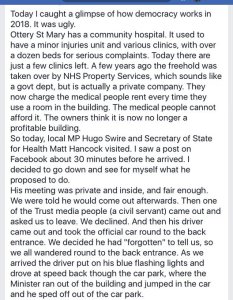
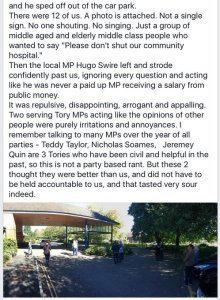
Report that Randall-Johnson was with Swire and Minister of Health at Ottery St Mary

“If you thought Health Secretary Matt Hancock was a safe pair of hands for the NHS after Jeremy Hunt think again. Comedy antics ensued when the Hancock turned up at Ottery hospital. First he hid, then he hurried.

Matt may well have been doing a favour for a rich mate, East Devon money-bags MP Hugo Swire, but at what price, making him appear a hapless lacky to East Devon’s Tory elite.

Hugo by-passed the Department of Health to take Matt hospital surfing. They went to Budleigh Salterton Hospital, before popping into in Ottery.

East Devon Councillor and Devon County Council Health and Adult Care Scrutiny Committee Councillor Claire Wright was on hand, along with some residents, to ask the Health Secretary some questions.

Unfortunately, he was holed up solely with a number of East Devon Tories, including Sara Randall Johnson, chair of the Health and Adult Care Scrutiny Committee. East Devon MP, Mr Swire and his aides were also present.

Have a read of Claire’s account. It certainly seems weird, so does the behaviour of the communication people of the NEW Devon Clinical Commissioning Group.

‘Why was he so frightened about talking to a dozen residents, and the local county councillor?’ asks Claire.

‘I had been quite encouraged that he was visiting the hospital and wanted to hear from him that he will protect Ottery’s and other hospitals. After all, Mr Hancock commands the NHS and also NHS Property Services, which now owns many hospital buildings in the area.

‘They are all at risk of possible closure and sell-off due to the lack of funding available to pay the enormous rents NHS Property Services demands.

‘But his cowardly escape bid simply gave the impression of a man who does not wish to be even remotely accountable.’

But that’s not all. Here’s the response of an East Devon constituent, as posted by Channel 5 News Health Correspondent Catherine Jones (check out the picture).

[There follow many hilarious comments on Swire’s justification for his actions and a You Tube video of Hancock doing a karaoke version of “Can’t Stop Me Now]

http://www.theprsd.co.uk/2018/09/27/first-he-hides-then-he-hurries-health-secretary-hancock-hot-foots-it-on-east-devon-hospital-visit/