Carillion and outsourcing: Cost versus accountability and loyalty

“The collapse of Carillion has exposed “fundamental flaws” in government outsourcing, which is obsessed with costs and is damaging public services, a review by the Commons public administration committee has found.

Carillion, a private construction company, that was one of the government’s biggest contractors, collapsed in January, raising fears about the future of hundreds of its projects for HS2, schools, prisons, the NHS and the armed forces, and 20,000 UK jobs.

The government refused to bail out Carillion but said that it would provide the funding to maintain all of the company’s public services when it went into liquidation. Its failure revived a crisis of confidence in government’s reliance on the private sector to deliver public projects and shone a spotlight on the efficiency of government spending on private firms. The government spends £251.5 billion a year on outsourcing.

That spending has been criticised as unclear and ineffective by the public administration and constitutional affairs committee in a report into government outsourcing released today. “It is unclear how and why the government decides whether to outsource a particular service. The government needs to move quickly to improve public confidence in the competence of its commercial abilities,” the parliamentary report said.

The committee, which is chaired by Sir Bernard Jenkin, has called on government to provide greater transparency on how it awards public sector contracts after it discovered deals had been done based on incorrect data.

It found that the government has had to renegotiate more than £120 million of contracts since 2016 to ensure public services would continue after initially pushing providers to offer unsustainable prices.

Sir Bernard accused the government of using “thin or non-existent” evidence to support decisions to outsource contracts and said it did not understand the risks it was pushing on to contractors. “It has accepted bids below what it costs to provide the service, so the contract has had to be renegotiated,” he said. “The Carillion crisis was well-managed, but it could happen again unless lessons are learnt about risk and contract management.” In its report, the committee accused the government of prioritising spending as little money as possible while forcing contractors to take “unacceptable” levels of financial risk.

“Ultimately this has led to worse public services as companies have been sent a clear signal that cost, rather than quality of services, is the government’s consistent priority,” it said.

The report questioned the rationale behind the belief that outsourcing provides a better service for less public money and said that ministers could not provide evidence that this was true.

A Cabinet Office spokesman said that the government had announced a wide package of measures to further improve how it works with its vendors.

“This includes extending the requirements of the Social Value Act in central government to ensure all major procurements explicitly evaluate social value where appropriate, consulting on improvements to the prompt payment code, as well as measures to make the outsourcing process more robust and the results more transparent.

“We will respond formally to this report in due course.”

Source: Times (pay wall)
“China looking to buy stake in UK nuclear plants, say reports”

No problem, our Local Enterprise Partnership members with vested interests in nuclear power will ensure that all their workforce take Mandarin lessons.

“The Chinese government has emerged as a potential buyer of a multibillion-pound stake in Britain’s nuclear power plants.

The talks will reignite debate about China’s involvement in the UK nuclear power industry. Two years ago, the government paused approval for the £18bn Hinkley Point C project because of security concerns over China’s stake.

China General Nuclear Power Group (CGN), a state-run corporation, is said to be interested in buying a major stake in eight power stations, including Sizewell in Suffolk and Dungeness in Kent.

The power stations are operated by EDF Energy, a subsidiary of the French company EDF, but earlier this year, the British Gas owner, Centrica, put its 20% stake up for sale. The Sunday Times suggested CGN hoped to acquire a 49% stake, which indicates EDF could be looking to offload some of its shareholding.

The proposed deal would be a headache for Theresa May, who is concerned about giving China greater access to critical infrastructure projects and has initiated a new national security test for foreign takeovers.

CGN is becoming an increasingly important player in Britain’s atomic plans, and is working with EDF Energy on plans to develop a new nuclear power station at Bradwell-on-Sea in Essex.

The sale could attract interest from pension and insurance funds, but analysts say the pool of bidders is small because the reactors have a limited shelf live.

Paul Dorfman, a senior researcher at University College London’s Energy Institute, said Britain was an outlier in its openness to Chinese investment.

“It’s entirely credible [that China would be allowed to buy the stake] in the context of what the British government is doing,” he said. “There is no other OECD country that would allow China to own any of its critical infrastructure, let alone its nuclear infrastructure.”

Dorfman said EDF, with €33bn (£29bn) of debt, was eager to raise funds from asset sales. “EDF is in financial difficulties and has been for some time. It’s looking to sell off whatever it can sell off. It’s worried about debt, its credit rating … plus its waste and decommissioning liabilities,” he said.

The eight nuclear power stations, which used to be grouped under British Energy, generate 8.9 gigawatts of electricity and supply about 20% of Britain’s electricity needs. They were bought by EDF for £12.5bn in 2008. The following year, Centrica took a 20% stake, which it values at £1.7bn.”

https://www.theguardian.com/environment/2018/jul/08/china-interested-majority-stake-uk-nuclear-power-stations-reports?CMP=Share_iOSApp_Other

“Councils better at turning around failing schools than academy chains, report says”

” … the report, which looks at 429 council-run schools rated as inadequate in 2013, found that 115 (75 per cent) of 152 schools that stayed with the council became good or outstanding by 2017. …

Meanwhile, only 92 (59 per cent) of the 155 schools that had been inspected since becoming sponsored academies saw their Ofsted ratings improve to good or outstanding during that period. …”

https://www.independent.co.uk/news/education/education-news/councils-academy-chains-failing-schools-inadequate-ofsted-lga-a8432626.html

Hinkley privatised nuclear waste clean up contract cancelled and nationalised

“The UK government has been forced to take a multibillion-pound nuclear cleanup contract back into public ownership, after a botched tender to the private sector landed the taxpayer with a £122m bill.

The government will take over the decommissioning of Britain’s 12 Magnox sites, including the former nuclear power stations at Dungeness in Kent and Hinkley Point in Somerset.

The move is a response to the fallout from the Nuclear Decommissioning Authority (NDA) awarding a 14-year deal to the international consortium Cavendish Fluor Partnership in 2014.

Last year the government settled with two US companies that lost out on the £6.2bn contract and brought a legal challenge over the tender process.

Ministers terminated the contract early, leading to speculation over whether it would be put out to tender again to the private sector or brought back into public hands.

David Peattie, the NDA’s chief executive, told staff he understood they had faced uncertainty in recent months, as he confirmed that the private company Magnox Ltd would become a subsidiary of the NDA on 1 September. He said the change would result in “more efficient decommissioning”.

A source close to the process said: “The reason that this has been done is to remove some of the commercial complications and the large fees paid to contractors. This will ensure more money is spent directly on cleaning up these sites.”

Unions said they wanted talks with the new management regime for assurances over pay and terms.

Peter McIntosh, the Unite union’s acting national officer for energy, said: “This decision is long overdue. The 2014 contract should not have been awarded to any organisation.”

He added: “We need to ensure the taxpayer gets value for money through the transfer of the business and it is not paid for at the expense of the workforce.”

Whitehall’s spending watchdog, the Public Accounts Committee (PAC), has strongly criticised the NDA and the Department for Business, Energy and Industrial Strategy over the handling and oversight of the nuclear cleanup contract, one of the government’s biggest ever.

A review of the failings that led to the bungled process, written by the former National Grid boss Steve Holliday, is due to be published later this year.

Bringing the Magnox work back into the public sector means that about 85% of Britain’s nuclear cleanup work is in public hands, after the NDA’s takeover of the Sellafield storage and reprocessing site in 2016.

The PAC last week announced an inquiry into the NDA’s work at Sellafield, which is forecast to be £913m over budget and faces potential delays.

Magnox Ltd looks after 10 former Magnox power stations and two nuclear research sites.”

https://www.theguardian.com/politics/2018/jul/02/uk-nuclear-cleanup-contract-back-in-public-hands-after-122m-bill

PFI – not value for money, offshore companies paying little tax own strategic assets

“The private finance initiative has created “immense pain” for councils and the Treasury cannot back up claims that it represents value for money for the taxpayer, a review has found.

The Commons public accounts committee has demanded that the government “comes clean” about the value of PFI and has accused it of having no plans to examine whether the initiative delivers financial benefits.

The committee said that what it had found was “unacceptable”. Meg Hillier, its chairwoman, said: “Government’s inability to answer basic questions about PFI remains undimmed. It beggars belief that such apparently institutionalised fuzzy thinking over such large sums of public money should have prevailed for so long.”

The public accounts committee launched its review of PFI and PF2, the second iteration of the initiative, in January after an inquiry by the spending watchdog found that the taxpayer would foot a £200 million bill for the contentious contracts.

Its findings show that PFI deals have allowed offshore investment funds, which pay little tax in Britain, to own billions of pounds of public infrastructure. Offshore funds have bought about half of the £60 billion of schools, hospitals, roads and other infrastructure assets built through 700 PFI deals signed in the past 25 years. That has resulted in owners of public services being “increasingly remote” from the services themselves, the MPs said.

The government has used PFI deals for 25 years to build public infrastructure assets such as schools, hospitals and roads. Under such deals the public sector signs a contract with a private company, which raises money to fund the asset and leases it to the government. Typically the leases run for 25 to 30 years. The government has paid £110 billion to private companies under the contracts and will pay a further £199 billion by the 2040s for existing deals alone.

The arrangement has faced repeated criticism. In January the National Audit Office said there was little evidence that government investment in public-private projects had delivered financial benefits. PFI contracts have been attacked, too, for being inflexible, sometimes leaving councils with a large bill for assets that are not in use.

“It is critical that taxpayers are not further lumbered with excessive costs arising from poor contracting,” Ms Hillier said.”

Source: Times (pay wall)

Ottery Health Matters! Meeting 29 June 2018, afternoon and evening

Ottery St Mary & District Health & Care Forum, in partnership with:
RD&E, Coleridge GP’s, NEWCCG, Devon County Council, East Devon District Council & Ottery St Mary Town Council

Ottery Health Matters!

Health and Wellbeing Community Information Event

Date: Friday 29th June 2018

Time: Two drop-in sessions
2pm – 5pm
6pm – 8pm

Venue: The Institute, Yonder Street, Ottery St Mary, EX11 1HD.

Come along to this informal drop-in event to find out about the care and support available in Ottery and the surrounding areas. It will be a great opportunity to talk to health and care experts plus volunteers about the local services and activities to help people live well.

We need to hear from you about what’s important to you, what you think the challenges and priorities are to improve health and care for people in our community now and in the future.

Refreshments will be provided. Transport to and from may also be available. For any queries or feedback please contact:

Elli Pang via e-mail: ellipang@btinternet.com or Tel: 01404 812268 or Leigh Edwards via e-mail: leighp3@sourcemode.com or Tel: 01404 814889

“Just look at housing to see the true cost of privatisation”

“Council homes are being sold off far more quickly than new social homes are being built, a new report has warned. The research into the government’s right-to-buy scheme, by the Local Government Association, finds that this has been the case since 2012: at no point has the social housebuilding rate matched, or come close to matching, the rate at which homes are being sold.

Right to buy was given a boost by the Conservatives after the 2010 election in an attempt to sell even more homes, since traditionally homeowners tend to vote Tory. In 2013, the then chancellor, George Osborne, announced the maximum discount available for those renting a council home in London would rise to £100,000. In effect he’d approved the asset-stripping of some of our most-needed council stock.

But right to buy needs to be viewed for its long-term effects, and not just with regard to how it helped those families who bought their council homes in the 1980s and 90s. Today, 40% of the homes sold under the scheme are rented privately at far higher rents than local authorities would ever charge. Right to buy has become right to buy to let.

Across the country, home ownership is in crisis, with renting exorbitantly expensive and young people especially – even those in professional jobs – being priced out of the market. Their earnings disappear into the pockets of private landlords, while the finances of local government are given a kicking.

Council housing works because it pays for itself relatively quickly: the rent paid by tenants covers the building costs in the long term, and eventually makes a profit for the local authority, which continues to invest in the local area. The money continues to circulate within the community rather than simply boosting the profits of landlords.

But with councils forced to sell to tenants through right to buy, then being obliged to give a chunk of the receipts straight to Whitehall, building becomes ever more difficult. And the property shortfall is expensive, as authorities struggle to house their homeless residents. Last year £8.4m was spent by 23 councils to rent 725 flats as temporary accommodation, the magazine Inside Housing found. A vast transfer of wealth has taken place from the public to the private sector, under the guise of helping the aspirational working class. Instead, we’ve just made it harder to provide housing for those most in need.

The folly of right to buy echoes the mess that is Britain’s rail system. In the mid-90s, John Major – echoing Margaret Thatcher’s disdain for the state a decade earlier – believed that breaking up British Rail would create competition, and that competition would ensure greater services and be far more efficient than control by the bloated state. Instead, the cost of train travel has become exorbitant, the service appalling almost everywhere you attempt to travel, and the state is constantly required to intervene – either because a franchise has collapsed, in the case of the east coast mainline, or because the rail service has become chaotic, witness recent weeks in the north and the south-east.

The long-term effects of privatising both rail and housing, aside from ensuring we live in a country of crumbling infrastructure (in contrast to mainland Europe), is one of diminished social and personal opportunities. Many people are unable to see friends and family as often as they’d like due to the cost of rail travel. Others are delaying having children, or wondering if they can afford them at all, since they cannot afford to buy a home and landlords can be hostile to children. Those with children are in no better position: well oOverMore than 100,000 children are living in temporary accommodation, usually due to eviction.

Right to buy was popular, but with 1.8m council homes having been sold off, there are now about 750,000 households paying far more than a local authority rent. Housing, not buying, should be a right – and available and affordable for all. Right to buy is devastating our housing system, just as rail privatisation has devastated our transport infrastructure.

Privatisation rarely works: we need new ideas, and far more public ownership of housing, infrastructure and utilities, if we wish to provide for our citizens.”

https://www.theguardian.com/commentisfree/2018/jun/12/housing-true-cost-privatisation-right-to-buy-landlords

Shock revelation suggests the NHS’s ‘new model of care’ is more about switching intermediate care from community hospitals to ‘block bookings’ in private nursing homes – saving costs and freeing up assets

Martin Shaw, East Devon Alliance councillor for Seaton and Colyton, Devon County Council:

Press release:

“There was a staggering revelation yesterday at Health Scrutiny from Liz Davenport, Chief Executive of South Devon and Torbay NHS Foundation Trust, that they had made ‘block bookings of intermediate care beds in nursing homes’ when they introduced the ‘new model of care’. South Devon has closed community hospitals in Ashburton, Bovey Tracey, Paignton and Dartmouth and is currently consulting on the closure of Teignmouth – where I spoke at a rally last Saturday.

The ‘new model of care’ is supposed to mean more patients treated in their own homes, and there does seem to have been an increase in the numbers of patients sent straight home from the main hospitals.

But the idea that all patients can be transferred directly from acute hospitals to home is untrue. There is still a need for the stepping-down ‘intermediate care’ traditionally provided by community hospitals – the only difference is that now it’s being provided in private nursing homes instead.

It’s likely to be cheaper to use private homes, because staff don’t get NHS conditions, and crucially it frees up space in the hospitals so that the CCGs can declare buildings ‘surplus to requirements’ and claim the Government’s ‘double your money’ bonus for asset sales. It seems NEW Devon CCG has also made extensive use of nursing home beds, but we don’t yet know if there were ‘block bookings’.

However the private nursing home solution may not last – DCC’s chief social care officer, Tim Golby, reported that nursing homes are finding it difficult to keep the registered nurses they need to operate, and some are considering reversion to residential care homes.

This may be where the South Devon trust’s long term solution comes in – it had already been reported that it is looking to partner with a private company in a potential £100m dealwhich will include creating community hubs that contain inpatient beds.

The new model of care is also about privatisation.”

Carillion: taxpayer £200 million bill – government contracts placed after warnings

“The collapse of Carillion will cost taxpayers more than £200 million, according to a report.

The National Audit Office (NAO) said that ministers had failed to monitor the government’s sixth largest contractor effectively before it went into liquidation with debts of £1.5 billion.

The spending watchdog questioned why the construction company was given public work, including a £1.3 billion contract to help to build HS2, after a profit warning last July. The company had 420 public-sector contracts worth £1.7 billion a year. The scale of its profit warning was a “surprise” to the government, the NAO said.

“Doing a thorough job of protecting the public interest means that government needs to understand the financial health and sustainability of its major suppliers, and avoid creating relationships with those which are already weakened,” said Sir Amyas Morse, head of the NAO. “Government has further to go in developing in this direction.”

The cost to the taxpayer on the losses on Carillion’s contracts since it was put into the hands of the Official Receiver in January is £148 million, the NAO report found. On top of that is an expected bill from PWC of £50 million for handling the first six months of the receivership. That bill is expected to rise as the liquidation process continues.

Frank Field, the Labour MP who leads a House of Commons committee that has issued a report on Carillion and the failings of its directors, said that the NAO report showed how the Cabinet Office had fallen short.

“Carillion hoodwinked the government as they did many others who were so naive as to trust their published accounts,” he said. “At the earlier stages government oversight was inadequate. The government has to up its game.”

The report says that the Cabinet Office employed no direct overseer of Carillion in the three months after the profit warning after the departure from the civil service of the “crown representative” that each major contractor is assigned by government.

Despite the evidence that Carillion was in a crisis from which it might not recover the company was not assigned to the Cabinet Office’s “high risk” red alert until September and contingency plans for Carillion’s failure were not stepped up until October. Even when the company went into liquidation in January, the Cabinet Office still did not have a complete list of the government’s exposure to Carillion and did not have contingency planning in place.

A spokesman for the Cabinet Office said: “Throughout this process the government has been clear that its priority is to ensure that public services continue to run smoothly and safely. The plans we put in place have ensured this, and we continue to work hard to minimise the impacts of the insolvency, having safeguarded over 11,700 jobs to date.”

Insolvency Service reports show that 2,332 Carillion staff have lost their jobs.”

Source: Times (pay wall)

Privatisation: water company fat cats

“The bosses of England’s privatised water companies have been criticised for banking £58m in pay and benefits over the last five years while customers have been faced with above-inflation rises in their water bills.

The GMB union said the chief executives of England’s nine water and sewage companies were “fat cats” earning “staggering sums” from the management of a natural resource. …

Household water bills have risen by 40% above inflation since the industry was privatised in 1989, according to a National Audit Office report. The average bill this year will be £405, a 2% increase on last year, according to Water UK, the trade body that represents water and sewerage companies. …

Anglian Water and Southern Water paid no corporation tax last year, while Thames Water “has paid no corporation tax for a decade”. …

Liv Garfield, the chief executive of Severn Trent, was paid £2.45m last year, making her the UK’s best-paid water company boss. Garfield took home a salary of £674,000, a £615,000 bonus, and long-term incentive shares worth £975,000, a pension contribution of £168,000 and other benefits worth £18,000. …”

https://www.theguardian.com/business/2018/jun/05/water-companies-pay-national-scandal-gmb-union-says

A surgeon speaks on community hospitals and NHS privatisation

David Halpin FELLOW OF THE ROYAL COLLEGE OF SURGEONS knows what is needed – see his letter………

LETTER sent by DAVID HALPIN FRCS to the WESTERN MORNING NEWS

Dear Letters Editor, 25th April 2018

I reply to the letter from B Gelder (WMN April 23rd) entitled ‘Cottage Hospitals ease strain on the NHS.’ I have written before on this vital subject and listed their functions.

Recovery from serious illness or major operations requires loving and professional care, good nutrition and sound sleep. These were provided in good Community Hospitals. The last thing patients might get in the District General Hospital is a good night’s sleep. The noise, the moving of beds and the distress of disorientated patients do not allow sleep.

This retreat, supposedly for economy, from past high standards is part of what I call the ‘atomising’ of all that we hold dear. The dogmas of capitalism win out all the time. ‘Private good, public bad’. So with the privatisation of OUR railways under the Major government, the wheels were stupidly separated from the tracks to meet EU competition rules. There are about 3000 separate contractors working on the permanent way. There are probably more ‘contractors’ working in OUR NHS.

This is a sign of these shabby and confused times. Walking to Paddington Station past St Mary’s Hospital where I qualified as a doctor in 1964, I saw an ambulance – ‘NHS working in partnership with DHL.’

I understand that Teignmouth Community Hospital is likely to be closed completely. That catch phrase ‘not fit for purpose’ is being applied – ‘going forward’. The Philistines who order this will know that the original hospital was bombed by the Luftwaffe. Seven patients and three nurses were killed. They do not ‘remember them’. The first hospital to be built by the NHS, when the UK was on its uppers, was Teignmouth Hospital. Patients were treated for acute illness there by good GPs, nurses and physiotherapists, and others taken for further care from the big hospitals. It is being bombed again.

When this good hospital, with its views over Lyme Bay, becomes a 5 storey block of ‘luxury’ flats and second homes, the capital from the sale of the site will disappear in a puff of smoke. Taxpayers money is being burned in the NHS. The non-clinical staff in one Devon hospital now outnumber the clinical staff – nurses, physios, doctors etc. Watch BBC’s ‘Hospital’ from Nottingham as a quart fails to be squeezed into a pint pot. The proliferation of managerial personnel with unusual titles is excruciating and the distress of patients likewise.”

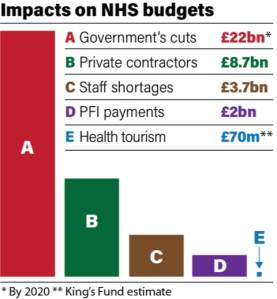
“8,900 checks on NHS ‘health tourists’ find just 50 liable to pay”

It almost certainly cost more to find the 50 than to leave this alone.

So, knock on the head – it is underfunding to speed privatisation that is bringing our NHS to its knees NOT health tourism!!!

https://www.standard.co.uk/news/health/8900-checks-on-nhs-health-tourists-find-just-50-liable-to-pay-a3850121.html

Auditers and privatisation

“It is difficult to get a man to understand something”, wrote Upton Sinclair, “when his salary depends upon his not understanding it.”

https://www.theguardian.com/news/2018/may/29/the-financial-scandal-no-one-is-talking-about-big-four-accountancy-firms

Public perceptions of Carillion collapse

” The parliamentary select committee report pulls no punches in blaming the greed of the Carillion executives, who gouged out millions from the business up to the moment of collapse, with £1.5bn owed to creditors and £0.5bn to the pension fund (Carillion fall blamed on hubris and greed, 16 May). The wider issue, for all financial institutions, is the greed of the “big four” auditors, paid £72m, who colluded with the directors, gave no warnings and signed clean certificates. Surely the executives and auditors should pay all the creditors in full. At what point does the “cosy relationship” become a criminal fraudulent conspiracy? As Polly Toynbee argues, the people want their money back from the fat cats, not slippery apologies. Are the supine regulators part of the conspiracy or will they bring charges?
Noel Hodson
Tax Reconciliations, Oxford

• We in the west criticise Putin’s Russia as a “kleptocracy”, but the damning report into the collapse of Carillion shows that something similar exists in too many of the boardrooms of British companies. Time and again we read reports of chief executives and their boardroom cronies, to quote Frank Field, “stuffing their mouths with gold”, while their companies go to rack and ruin with thousands thrown out of work and pension schemes impoverished. There is a word for people who appropriate other people’s money: “thief”. If boardroom larcenists can steer clear of the law and go unpunished, it is surely time that the law was changed.
Ron Mitchell
Coventry

• A simple solution is to ban the auditors of all public companies from undertaking any consultancy or other non-audit work. We need specialist audit firms and totally separate consultancy organisations so that audit opinions are not influenced by potential consultancy fees.
Jim Michie
Chester

The government’s culpability and responsibility for the collapse of Carillion and its consequences is broader and deeper than your article and the select committee’s report suggest: the government’s insistence that its estate be constructed and managed through prime contract procurement strategies increases the risk of prime contractor default and its disastrous consequences, as well as increasing the cost of everything it purchases. There was a time when local builders or suppliers would deal direct with their local government client: now we must go through a pyramid of consultancies, all adding 20% and “retaining” 10%.
Michael Heaton
Warminster, Wiltshire

• If a benefits claimant makes a fraudulent claim they may end up in court for their abuse of public funds. When I read about the way in which public money has been handled by Carillion, I find myself wondering when we can expect the court appearances of the directors and their accountants.
Stephen Decker
Chelmsford, Essex”

https://www.theguardian.com/business/2018/may/17/carillion-and-britains-modern-kleptocracy

“NHS England and Capita misunderstood the risks in outsourcing primary care support services …” says hard-hitting report

Summary:

NHS England and Capita misunderstood the risks in outsourcing primary care support services resulting in services to 39,000 GPs, dentists, opticians and pharmacists that were a long way below an acceptable standard. Capita’s performance against the contract has improved but widespread failures are still being experienced by primary care practitioners, says today’s report by the National Audit Office (NAO).

In August 2015, NHS England entered into a seven-year, £330 million contract with Capita to deliver primary care support services. NHS England aimed to reduce its costs by 35% from the first year of the contract and provide a high-quality and standardised service. Capita expected to make a loss of £64 million in the first two years of the contract, which it planned to recoup in later years.

NHS England’s decision to contract with Capita both to run existing services but also simultaneously to transform those services, was high risk. Capita was incentivised through the contract to close existing services to minimise its losses but the interaction between running, closing and transforming services was more complex than Capita or NHS England had anticipated.

Performance issues emerged in 2016 shortly after Capita started closing primary care support offices and making other changes to the service. Capita acknowledges that it made performance issues worse by continuing to close support offices in summer 2016 even though it was aware the customer service centre was struggling to meet demand at that time. NHS England was contractually unable to stop Capita’s aggressive office closure programme, even though it was having a harmful impact on service delivery.

Failure to deliver key aspects of the end-to-end service, delivered by Capita and other organisations, impacted primary care services and, potentially, put patients at risk of serious harm. For example, 87 women were notified incorrectly that they were no longer part of the cervical screening programme; processing issues led to an estimated 1,000 GPs, dentists and opticians being delayed from working with patients and some of these practitioners lost earnings. No actual harm to patients has been identified.

Users continue to experience poor delivery with seven severe service failures in February 2018. A number of organisations have contributed to underperformance as Capita relies on other organisations to provide some services.

NHS England has made savings, in line with expectations, of £60 million in the first two years of the contract, as the financial risk of increased costs sits with Capita who have made a £125 million loss over this period. To date, NHS England has deducted £5.3 million from payments to Capita as penalties for poor performance but it expects it may have to pay up to £3 million in compensation to primary care providers.

NHS England has not yet secured all the benefits it wanted to achieve as Capita’s transformation programme was halted while it focused on operational issues. NHS England remain concerned about three of the services – the national performers lists, payments to opticians and GP payments and pensions but recognises that some of the issues with them pre-date the contract with Capita.

Two and a half years into the contract basic principles are still not agreed, which limits NHS England’s ability to hold Capita to account. NHS England and Capita have still not agreed how to calculate 11 performance measures, and how these data should be used to calculate payments owed to Capita for delivering the services.

The NAO recommends that NHS England should determine whether all current services within the contract are best delivered through that contract or be should taken in-house by NHS England.

“Neither NHS England nor Capita fully understood the complexity and variation of the services being outsourced. As a result, both parties misjudged the scale and nature of the risk in outsourcing these services. “While NHS England has achieved financial savings and some services have now improved, value for money is about more than just cost reduction. It is deeply unsatisfactory that, two and a half years into the contract, NHS England and Capita have not yet reached the level of partnership working required to make a contract like this work effectively.”

Amyas Morse, the head of the NAO, 17 May 2018″

https://www.nao.org.uk/press-release/nhs-englands-management-of-the-primary-care-support-services-contract-with-capita/

Full report here:

Tories nationalise East Coast Main Line Railway

Virgin wasn’t making enough money so they decided they didn’t want to play any more:

http://www.bbc.co.uk/news/business-44142258

Labour comment was priceless:

“Good to see Grayling implementing first stage of Labour’s Manifesto promise to renationalise the railways. I think I’m right in saying that he’s now nationalised more railways than any Labour minister in 6 decades. Come on Chris, East Coast line today, the whole system tomorrow.”

Privatisation and outsourcing: beware ‘delusional’ directors, blind auditors and absent regulators

“Frank Field, chairman of the Work and Pensions Committee, said: “A board of directors too busy stuffing their mouths with gold to show any concern for the welfare of their workforce or their pensioners.”

For a longer and even more critical report published after this article, see:
http://www.bbc.co.uk/news/business-44129678

“The directors of Carillion should be formally investigated after overseeing a “rotten corporate culture” and may warrant disqualification from holding boardoom roles in the future, a House of Commons inquiry has concluded.

A damning 101-page report into the collapse of the public services contractor, undertaken by the joint business and work and pensions select committees, has identified failings by regulators, the accountancy firms KMPG and Deloitte and the government, as well as the company’s directors.

The government called the Official Receiver into Carillion four months ago after banks and investors refused to support the group, which had annual turnover of £5 billion and 43,000 employees. It collapsed with £2.6 billion of pension liabilities and about £2 billion of debts with suppliers and lenders. Its demise left serious issues over the delivery of maintenance, catering and cleaning contracts in schools, hospitals and military bases.

The company blamed its financial crisis on failing construction contracts, including those to build hospitals in the West Midlands and on Merseyside, a new motorway in Scotland and developments in Doha ahead of the 2022 World Cup finals in Qatar.

The MPs’ report recommends that:

•The Insolvency Service investigate “potential breaches of duties under the Companies Act” and claims of “wrongful trading” that could lead to “action for disqualification as a director”;

•The intervention powers of the Financial Reporting Council should be beefed up and its remit be extended to company directors that are not accountants;

•The Competition and Markets Authority should investigate the Big Four accountancy firms and consider that they be broken up;

•The Prompt Payment Code for suppliers should be reviewed after Carillion’s flagrant abuse of it;

•The “Crown representative” system used to oversee large public services contractors should be reviewed after it appeared to pick up no warning signals about Carillion’s financial crisis;

•The leadership of The Pensions Regulator should be is shaken up to make sure that it takes “harsher sanctions” against companies such as Carillion that fail to properly fund their retirement schemes.

The damning report will cast a shadow on the careers of the grandees on the Carillion board: Philip Green, the former United Utilities and P&O boss who was chairman; and Keith Cochrane, the former chief executive of Weir Group who was Carillion’s senior independent director.

There were criticisms, too, of Alison Horner, Tesco’s head of personnel, over her role as chairwoman of Carillion’s executive pay committee. Senior executives Richard Howson, Richard Adam and Zafar Khan were all sharply criticised.

Mr Green, who is called “delusional” in the report, criticised the MPs’ inquiry. “The report fails to understand and accurately reflect the true, more complex picture of events,” he said.”

Source: The Times (pay wall)

Tories to nationalise rail line!

Owl says: well, this will take some explaining!!!

“Chris Grayling is expected to make a decision “within days” to end the existing East Coast rail franchise operated by Stagecoach and Virgin Trains.

The transport secretary was said to be preparing to either renationalise the London to Edinburgh line or negotiate a “not-for-profit” arrangement with Stagecoach and Virgin Trains before the end of the week. …

Ministers have denied that the companies are being bailed out, saying they will lose a £165m performance bond and face other penalties. Beyond 2020, the government is expected to introduce a new public-private partnership model on the line.

Virgin Trains East Coast said it had “met or exceeded” all of its contractual commitments on the East Coast line. The DfT declined to comment.”

https://www.theguardian.com/business/2018/may/14/east-coast-rail-franchise-to-be-scrapped-chris-grayling