94-99% of rented accommodation too expensive for those on benefits

And remember this includes working people whose wages are so low they are entitled to benefits (effectivelya subsidy to employers).

“The government must increase the levels of housing benefit given to people in the private rented sector as families are being priced out of homes, according to a trade association.

The National Housing Federation analysis has found that 94% of homes for private rent – and up to 99% in some areas – are too expensive for those on housing benefit.

The Local Housing Allowance – used to calculate how much benefit households in the private rented sector will receive – when introduced in 2008 was worked out from the bottom 50% of market rents and later reduced to 30% under the coalition government.

In 2013, rates of LHA were separated from market values and eventually frozen in 2016 leaving working families unable to afford a place to live, the federation said.

NHF said the benefit – for which there are 1.3 million claimants – is inadequate and is leading to increasing levels of poverty and debt.

Kate Henderson, chief executive of the NHF, said: “Low income families are being punished two-fold, no longer able to access social housing because of the dire shortage of it, they now can’t access enough housing benefit to rent privately either.

“The crippling effects of the housing crisis and significant cuts to benefits have forced thousands of parents into impossible situation in order to keep a roof over their children’s heads, many having to choose between crippling debt, overcrowding or homelessness.”

The number of homeless children in temporary accommodation has increased by 83% since 2011 to 126,020, the report added.

The federation has urged the government to end the freeze on LHA and increase it so that it covers 30% of private rent homes in any local area. It also repeated its recommendation to spend £12.8bn each year on new social housing.

The NHF analysed 75,000 rental homes advertised on Zoopla in July 2019 and compared the cost of rent for each property with the rate of LHA that a family requiring that sized property would be entitled to.

A government spokesperson said: “Providing quality and fair social housing is an absolute priority. The government increased more than 360 Local Housing Allowance rates this year, by targeting extra funding at low-income households.

“We’ve helped councils and housing associations to speed up the delivery of more homes, including social housing, through our £9bn Affordable Homes Programme – delivering over 430,000 affordable new homes since 2010.”

Housing minister Esther McVey told the Conservative Conference last week that the government would prioritise brownfield land for new builds.”

https://www.publicfinance.co.uk/news/2019/10/nine-out-10-families-priced-out-private-rented-sector

The personal debt crisis

“… More than three million people are struggling to pay council tax and other essentials bills , a new study reveals.

Over the past year almost 1.6million households have fallen behind with council tax payments, nearly one million are in rent arrears, while over one million are behind on water bills.

The report from the Universities of Birmingham and Lincoln shows poverty is rising for all groups, even those in work, as six in ten people in the poorest fifth of the population are deep in debt.

More than eight million of those living in poverty have at least one person in paid employment in their family.

And the research highlights a worrying trend as more than two million people were contacted by bailiffs in 2018.

Almost one million of those said bailiffs had broken rules such as refusing to accept affordable payment offers, threatening to break into properties where they do not have the power to do this and taking goods that didn’t belong to the person who owes the debt. …”

https://www.mirror.co.uk/money/more-three-million-brits-struggling-20532238

“Boris Johnson Ridicules Extinction Rebellion Protestors As ‘Hemp-Smelling Crusties’ “

To all those, old and young, who are doing so much to highlight the enviromnmental crises upon us, Owl can only apologise for the stupid, stupid, stupid remarks by our so-called Prime Minister.

To those who disagree with him: use your general election vote wisely and, if you have not yet registered to vote – do it NOW!

https://www.gov.uk/register-to-vote

“Boris Johnson has ridiculed Extinction Rebellion protestors as annoying “nose-ringed”, “hemp-smelling” “crusties”.

In a broadside at the demonstrators who started a fortnight of disruption in central London, the prime minister used a speech praising Margaret Thatcher to make plain his disdain for the group’s tactics.

Johnson told an event hosted by the Policy Exchange think tank that Thatcher was an environmentalist “long before Greta Thunberg”, taking action on greenhouse gases.

More than 100 people were arrested on Westminster Bridge and near the Houses of Parliament as Extinction Rebellion vowed to to blockade “every single road” in Westminster “to make sure no traffic can get through to the central area of the government and the executive”.

The protests – which the group said would be “five times” the size of its April rebellion – will also include a three-day sit-in at City Airport.

Johnson was surrounded by heavy security as he made his way across Whitehall to an event to praise the latest biography of Thatcher by former Telegraph and Spectator editor Charles Moore.

Speaking at the Royal United Services Institute just yards from Downing Street, he revealed: “I am afraid that the security people didn’t want me to come along tonight because they said the road was full of uncooperative crusties and protestors all kinds littering the road.” …”

https://www.huffingtonpost.co.uk/entry/boris-johnson-hemp-smelling-crusties-extinction-rebellion_uk_5d9b9a99e4b03b475f9e51cd

DCC Tories block discussion of fire station closures

From the blog of DCC East Devon Alliance councillor Martin Shaw:

“Yesterday I tried to propose a motion to Devon County Council to halt the fire station closures. The grainy photo (on his blog) taken from the webcast shows the Conservatives voting as a block to stop it even being discussed. They wanted to refer my motion to the Cabinet who would amend it and bring it back to the Council in December. By then, the Fire Authority – chaired by Colyton’s former county councillor, Sarah Randall-Johnson – will have decided on its proposals at a meeting on 8th November.

Following this disgraceful episode, there can be little doubt that Tory councillors on the fire authority are preparing to vote through the fire station closures. Local people need to increase pressure on all the individual members of the Authority, change their minds. …”

This is the moment the Conservatives voted to stop Devon County Council even discussing fire station closures – you have been warned, they are preparing to vote them through at the Fire Authority

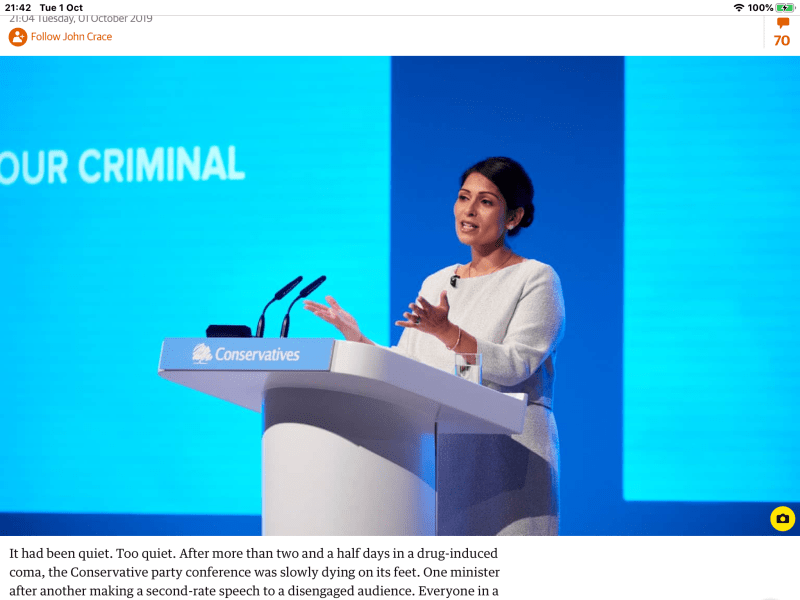
Unfortunate juxtaposition of Home Secretary and slogan

This is the woman who took a secret trip to Israel, passing it off as a “holiday” without informing the Foreign Office, daughter of immigrants who hates immigrants, former consultant to a tobacco company, and, after being appointed Home Secretary, began working for Viasat in India as a strategic adviser on a salary of £5,000 a month for five hours’ work a month, without seeking prior approval from the government’s Advisory Committee on Business Appointments – leading to accusations that she has broken the ministerial code for a second time.

So, maybe that juxtaposition isn’t as unfortunate as it first might seem!

“Boris Johnson Has Handed £100,000 Of Taxpayers’ Cash To One Of His Main Donors”

“Boris Johnson’s government has awarded £100,000 of taxpayers’ money to a company that donated to his leadership campaign in order to help it “prepare for Brexit” — despite the firm having already declared itself “Brexit ready”.

Bristol port will receive the six-figure payment to “help their preparations for Brexit on 31 October”, the Department for Transport told BuzzFeed News. It is one of 16 ports across the UK that has received a share of a £10 million funding pot, and the only one in the west of England.

The decision to hand Bristol port a large sum of taxpayer cash will raise conflict-of-interest questions, because just four months ago the Bristol Port Company made a £25,000 donation directly to Johnson ahead of the Conservative party leadership contest.

Johnson then stoked controversy when he endorsed a report calling for a Singapore-style tax-free port at Bristol during his campaign.

The payment will also raise eyebrows because, despite Transport secretary Grant Shapps saying the money is about “ensuring they are ready for Brexit”, the Bristol Port Company has previously insisted it is already “ready” for the UK to come out of the EU. …”

https://www.buzzfeed.com/alexwickham/boris-johnson-bristol-port-cash

Tory conference Day 3

https://www.theguardian.com/politics/live/2019/oct/01/brexit-latest-news-boris-johnson-conservative-conference-interviewed-as-ireland-dismisses-uk-border-plan-as-non-starter-live-news?CMP=Share_iOSApp_Other

Well. Mrs Thatcher did say there’s no such thing as society!

“Capitalism Isn’t Working And People Are ‘Pissed Off’, Says Tory Former Minister”

“Capitalism is in crisis and and the government must radically reform the UK because “people are pissed off”, a Tory MP has said.

John Penrose said it is “clearly true” that the system “isn’t working well enough” for ordinary people and has not been since the financial crash.

The former heritage minister said people feel crushed by large corporations and angry at the “illegitimate corrupt wealth” of mansion-owning foreign oligarchs who are “some of the nastiest people on the planet”.

Penrose, who is Boris Johnson’s anti-corruption champion, also hit out at rising inter-generational inequality, with the number of pension-age people growing while the tax-paying working population who “pay for the benefits we have promised ourselves” was “shrivelling”.

“Pretty soon everyone under 40 will feel like the system is a conspiracy and it is a conspiracy against them,” he said.

But Penrose, the MP for Weston, was told by one Tory activist at the Conservative Party fringe event, organised by The Enterprise Forum, that he “sounds like a Labour MP”.

With a snap election on the horizon, however, Penrose said his party must acknowledge the current market system had faults.

“We can’t just sit there saying, it’s all working perfectly because it manifestly for quite a lot of people for the last ten years hasn’t been working, and they are hacked off,” he said. “They are pissed off.”

He added: “It is clearly true, clearly true, that at the moment capitalism, corporatism, business, call it what you like, free markets, isn’t working well enough for enough people in our society.”

Penrose said the “danger is that the devil has all the best tunes” and voters could turn to Labour’s socialist agenda as an “answer”.

“Roughly once every ten years, once a generation, something goes wrong with British capitalism, with Britain’s economy, quite fundamentally, and we have to remodel ourselves,” he said. …”

https://www.huffingtonpost.co.uk/entry/capitalism-isnt-working-says-tory_uk_5d929cf8e4b0019647ad810e

Promises about south-west economy? Let’s check some very recent onest first to see if they happen!

Four years ago, the current government made the following promises about what they would do for the south-west.

Check for yourself whether any of them have come to pass!

“The Prime Minister and Chancellor today (Monday 26 January 2015) set out their six point long term economic plan for the south-west showing what has been delivered, what is underway and what more can be done to support the regional economy in the long term.

At a speech at the National Aquarium in Plymouth the Chancellor set out the detailed plan as part of a day-long tour of the south-west, on which he was joined by the Prime Minister.

The plan includes six points:

1) increase the size of the regional economy by £6.4bn in real terms by 2030 – equivalent to over £1,000 per person – by increasing the long term growth rate of the south-west to at least the long term growth rate of the whole UK

2) create over 150,000 new jobs in the south-west by supporting private businesses, advanced manufacturing and skills to ensure we maintain the current high rate of job creation

3) deliver at least £7.2 billion of investment in transport in the south-west and deliver a step change in digital connectivity, supporting the complete dualling of key roads including the A303, and the full electrification of Brunel’s Great Western Main Line including brand new electric trains, together with exploring the feasibility of a dedicated rail franchise for the south-west and delivering 95% superfast connectivity by 2017 through the government’s superfast broadband programme

4) support the tourism sector to draw more people to the south-west’s beautiful countryside and coastlines, with the aim of increasing the number of annual overseas visits to the south-west to 3 million by 2020, creating around 7,000 more jobs

5) ensure the world class defence assets and cyber security industry of the south-west provide the maximum benefit to the local economy; this includes new plans to expand the economic benefits of the Royal Navy and Royal Marines in Devon, the Army at Salisbury Plain, and the defence industries near Bristol, so we sustain 59,000 defence industry, 36,500 military and 17,000 civilian defence jobs in the region.

6) build on the south-west’s existing reputation in life and agricultural sciences and boost science more broadly, supporting tech clusters, green energy, promoting skills development and an innovative rural economy

There are no quick fixes to achieving these important goals, so the Prime Minister and Chancellor are also setting out a specific timetable to deliver the key concepts of this plan over the five years of the next parliament, and the following decade.

As important next steps in the plan for the south-west, the pair announced a number of new measures to improve transport links, boost tourism, and invest in defence:

developing a comprehensive rail strategy for the south-west by setting up a south-west Peninsula Rail Task Force – this strategy will increase resilience, reduce journey times, and increase capacity, responding to the 3-point plan of the south-west Connectivity Study. It will also address the question of the potential re-opening the inland rail route between Exeter and Plymouth

Coastal Communities Fund (CCF): the Chancellor today announced the successful bids for the CCF, a £10m package which will support coastal communities and is estimated to bring over 75,000 visitors to the region. This investment will create over 860 new jobs (direct and indirect) and support over 225 businesses, generating over £12m in increased visitor spending

Chancellor announced a new £2m challenge fund as part of the GREAT Britain campaign to promote regions and cities including in the south-west, to international tourists, students and businesses. He also said that he wants to see government support for a Mayflower exhibition in Plymouth in the run up to the 400th anniversary in 2020

south-west will be a centre of operations for the Army, Navy, Royal Marines and cyber security. The Chancellor therefore today announced a £900m investment in the Salisbury Plain area to create new service and technical accommodation for the army. GCHQ will also continue to play a major role in supporting the cyber security industry in the region, including by recruiting over 400 cyber specialists, the majority of whom will work in the region

working with leading experts to support the south-west’s technology and skills base: Mark Walport and Sally Davies bring together leading figures from industry, the NHS and academia to explore the potential for new proposals for investment in life sciences in the south-west, with a particular focus on medical technologies

As both the Prime Minister and Chancellor have set out clearly, the only way for the UK’s recovery to be truly sustainable is for it to be truly national. While the challenge is significant, so is the prize ahead. By pursuing this plan, the Prime Minister and Chancellor, aim to achieve real outcomes for the people of the south-west who have already seen the fastest employment growth in the UK.

The Prime Minister and Chancellor will be visiting a variety of businesses and institutions across the south-west to hear how the government’s long term economic plan is delivering for them and what more can be done to support the region.

The Chancellor will started the day by visiting a local fishing business in Cornwall, before delivering a key note speech at one of the south-west’s best known tourist attractions.

He will go on to visit one of the south-west’s largest defence employers before being joined by the Prime Minister to visit a local college and successful small business that has benefitted from the region’s recovery under the government’s long term economic plan.

The Chancellor of the Exchequer, George Osborne said in his speech:

The south-west contains some of Britain’s greatest economic strengths. It should be as central to our nation’s future prosperity as any other part of these islands. And the Prime Minister and I are determined that it will be.

That’s why I am here today, to set out our long term economic plan for the south-west – and why the Prime Minister will be joining me later today to seek local support for it. The plan I set out is based on this insight. Over the last thirty or forty years our economy has become more imbalanced, with the gap growing between London and the rest of the country. Our ambition is to reverse that – and it can be achieved.

He added:

What we need is a coherent plan that identifies those strengths, makes them stronger still – and connects them to each other so that the whole is greater than the sum of its parts. If you look at the south-west, stretching from Wiltshire and Bristol, to Somerset and Dorset, down to Cornwall and Devon, of course, you see the differences – they all have a unique identity. But you also see the strengths they have in common.

What are they? There’s the beautiful countryside and coastline that makes this one of the most attractive parts of the UK, and one of the most visited. There’s the industries that thrive in this landscape – the agriculture, the fishing and the tourism – that are more important here than many places. But there’s also the great universities, the incredible science happening here, skills and high tech manufacturing associated with the strong relationship with our armed forces. Bring these ingredients together with better transport links and you have a very attractive place to invest, to grow a business and to build a life.

Speaking in Plymouth, he concluded:

So we have a long term economic plan for the south-west. It aims to create over a hundred and fifty thousand jobs. It seeks to add over £6 billion to the local economy – equivalent to over £1,000 per person. It will support the future of our defence forces and capitalise on their economic benefit. It will deliver the next step for national cyber intelligence, and other world leading scientific innovation. It will make the most of the countryside and coastal towns.

Our long term plan for the south-west is about recognising the value of both its natural beauty and the economic strengths nurtured by the people who live here. It says that we can only have a truly national recovery if we get behind the private sector, put in the transport, support the tourism, the science and the industries of the future. And it says that if we do that: the future is bright in the west. It is a commitment to you – and to your future. And with your help, we will help deliver it.

The Prime Minister, David Cameron said:

Our long-term economic plan for the south-west is about making life better for hardworking local people. It involves backing business to create more jobs, improving transport links and building on the region’s strengths to secure a brighter future.

For too long, people living in this part of the country have suffered from Britain’s unbalanced economy – from the growing gap between London and the rest. That is what this plan sets out to change – to ensure that Britain’s recovery really is a recovery for all

Further information: timetable for action and implementation in the south-west 2015-2030

2015

Connectivity
Road Investment Strategy announced at Autumn Statement 2014 will see £9.4bn committed to new schemes nationwide. £2bn of that will be spent in the south-west, including upgrading of the M5, M49, A303, A30, A358 and A417 to reduce bottlenecks and provide motorway quality journeys

establishment of a south-west Peninsula Rail task force to develop a comprehensive rail strategy for the south-west, which will address the question of potentially re-opening the inland rail link from Exeter to Plymouth via Okehampton and Tavistock that could improve local connectivity

Network Rail develops plans for western rail access to Heathrow, based on a link from the Great Western Main line, which could potentially deliver a 30 minute reduction in journey times between Heathrow, the Thames Valley and all points west for 12 million residents, benefitting the whole UK economy

government will explore the case for establishing a new dedicated Devon and Cornwall franchise for the south-west of England, bringing together parts of the current Great Western and south-west Trains franchises into a coherent whole to support better timetabling and provision of rail services to and within the south-west, not simply focused on journeys to London. Alongside this, government would like to encourage local government in the region to come together to form Rail south-west, with the long term aim of devolving the franchise to local decision makers (subject to the development of satisfactory capability to let and manage such contracts)
negotiations with First Group over the Great Western Main Line franchise will be completed, with the aim being to secure significant improvements to trains and journey times to the south-west

work under the Filton Four Tracks Programme will get underway to double the track between Bristol’s two main stations, reducing journey times and increasing passenger and freight services

contracts are being signed to take superfast broadband coverage to 95% by 2017. . Technology pilots, including one in Exmoor National Park, will test innovative ways to bring coverage to the final 5% of premises

Technology and innovation

Agri-Tech Catalyst programme will spend £70m (which will be matched by private sector funding) nationwide up to 2018/19, with funds already allocated to a number of projects amounting to almost £1m for firms and universities in the south-west and a further round of bids currently ongoing
ensuring that knowledge gained by research activity is transferred and applied in farm businesses to improve efficiency and competitiveness has been identified as a priority for £1.5m of funding from the Rural Development Programme (RDP) by the Cornwall and the Isles of Scilly LEP
completion of the conversion of Bristol Planetarium in a 3d Data Visualisation Dome by April 2015. This forms part of the Bristol R&D Testbed, a key component of the “Bristol is Open” initiative. The Testbed, which has received £4.3m of government funding, is a joint venture between the City and the University of Bristol and will create the world’s first Open Progammable city testbed, linking data from across the city so that companies can test equipment, applications and software in a real world environment

both the 3D Visualisation Dome and the R&D Testbed are already generating interest from researchers, companies and universities around the world

government is contributing £4m towards the £16.5m cost of the West of England University Enterprise Zone in Bristol, which will focus on robotics and health technologies. Construction will begin in March

first phase of the Met Office’s High Performance Computer in Exeter will be operational by September, helping to cement the UK’s position as a world leader in weather and climate prediction and potentially delivering £2bn of socio-economic benefits to the UK

business cases for ‘wind engineering’ project benefiting Bath and Exeter will be developed

Heart of the South West LEP has identified as a priority projects to provide advisory services and knowledge transfer around Agri Sciences; promote SME competitiveness through giving business skills support; bring superfast broadband to areas not covered by the Superfast Extension Roll-out; help rural businesses to understand how superfast broadband can support them and offer bespoke support to those businesses that will benefit the most; and encourage rural businesses to reach new markets, seeking £15.5m through the rural development programme

UKTI south-west will launch their Global Entrepreneur Programme, which will attract entrepreneur-led, innovation-rich businesses from all over the world

Tourism and housing

investment of £4.4m to refund up to 50,000 Chinese tourist visas in the financial year 2015/16 to encourage more Chinese tourists to visit the UK and visit regions outside of London
this parliament, £532m has already been allocated to Local Authorities to deliver 25,580 affordable homes and 7,783 households in the south-west have completed mortgages with the support of Help to Buy

Get Britain Building scheme has committed to an investment of £54.1m which has already seen 456 homes out of a total of 700 delivered in the south-west. The remaining homes will be completed by 2017

Large Sites Fund has committed £52m to sites in the South West with 914 homes (out of a total of 6500 for the site) already completed at Cranbrook and building of homes at Sherford expected to begin in May

decisions on proposals for eight Housing Zones in the south-west are expected by Budget. These zones have requested £29m in funding and, if supported, could provide over 11,500 homes
further building projects are being assessed in the south-west under the following schemes and, assuming they are approved, work will begin in 2015. The Builders Finance Fund is considering a shortlist of 19 projects with a potential total investment of £66.8m, which could deliver 1,299 units.

The Large Sites Infrastructure fund is considering a shortlist of ten projects with a potential total investment of £149m. The infrastructure being considered under this scheme has the potential to unlock 22,795 homes. Local Growth (housing infrastructure) fund is considering a shortlist of five projects with a potential total investment of £35.2m. The infrastructure being considered under this scheme has the potential to unlock 2,919 homes

Rural Economy

south-west will benefit from its share of the £3.5bn for investment up to 2020 under the Rural Development Programme (RDP) to boost farming, food, the rural economy and protect the natural environment; including £68m already allocated to be spent on local growth schemes in the region. Some of the projects that LEPs have prioritised for funding include £9.4m to support agriculture through diverse projects covering livestock and horticultural support through to farmer specific renewable technologies such as fuel generated from biogas plants, and £1.4m to roll out farm scale Anaerobic Digestion plants which could serve as heat distribution networks or energy storage in Cornwall and the Isles of Scilly

homes across the south-west will be better protected from floods thanks to an unprecedented six-year £2.3 billion flood defence programme, announced at Autumn Statement, providing better protection for at least 300,000 households by 2021. £149m of this will be invested in the South West with £19m being spent in financial year 2015/16. The programme will also support economic recovery and growth, working alongside partners including private companies, local planning authorities and Local Enterprise Partnerships (LEPs). Overall, the national programme will help avoid over £30bn in long-term economic damages. Some of the projects that are likely to see work started over the next 6 years are:
the £30.9m flood defence scheme in Exeter to protect 4149 properties in the area.

the £8.8m Dawlish Warren and Exmouth beach management scheme which will help protect almost 3000 homes and businesses.
the £4.4m Exmouth tidal defence scheme, protecting 1099 properties in the area.

the £3.4m Congresbury Yeo tidal banks project to protect 4,101 homes and businesses.

the £3.3m Parret Estuary at Cannington Bends to protect 1257 properties.

government will invest £535.4m through PFI credits in essential waste management infrastructure in the south-west over the next six years. This will amount to £74.1m in financial year 2015 to 2016.

Defence

£3.2bn is already being spent on the maintenance and repair of ships and yards, including HMNB Devonport, where it sustains 4000 jobs

second offshore patrol vessel built at Appledore shipyard is expected to be handed over to the Irish Navy

A400M is a multi-national tactical and strategic lift aircraft with over 170 ordered so far by partner countries. All the wings will be made in Filton, securing 8,000 jobs. 24 pairs of wings will be delivered to the MoD and customers in other partner nations in 2015

£15m contract to militarise the new Royal Fleet Auxiliary tankers awarded to A&P Engineering, based in Falmouth
investment in Salisbury Plain to create the new Army Basing Area for units returning from Germany – £900m to create service personnel accommodation and infrastructure, with the work being competed down the supply chain. In addition 1000 Service Families Homes to be built in this area by 2020
£1.4M of LIBOR fines will be used to improve childcare provision for service personnel in the South West. This will be spent on upgrading or opening new facilities across Tidworth, Warminster, Perham Down, Blandford, Bovington, Taunton, Collingwood and Bulford

£1M in LIBOR fines will be used for a Gurkha Homes project in Wiltshire which will build small clusters of homes for older Gurkha veterans and their partners

2016
Connectivity

electrification of rail lines from London to Bristol, Newbury and Oxford will be completed as part of an investment in 235miles of new electric lines, making journeys smoother and more comfortable for passengers and quieter for people living near railways

Bristol area rail improvements begin, including converting Filton Abbeywood station to four platforms, an extra platform at Bristol Parkway and two new platforms and major investment at Bristol Temple Meads plus a new junction will be created at Bristol East

Technology and Innovation

work completed on the West of England University Enterprise Zone, the first clients expected by July

Tourism and housing

Large Sites Infrastructure fund will issue contracts for further schemes by March

Rural economy

ongoing work on key flood defence works will see investment of £33.5m in financial year 2016 to 2017

ongoing investment in essential waste management infrastructure through PFI credits in the south-west will amount to £85.7m in financial year 2016 to 2017
Defence

28 pairs of wings for the A400M tactical and strategic lift aircraft will be delivered to UK and partner nations, safeguarding 8000 jobs building their wings in Filton
third maritime patrol vessel built at Appledore shipyard is expected to be handed over to the Irish Navy

2017

Connectivity

electrification of rail lines from London to Cardiff complete
first IEP super express trains will be introduced by Great Western, improving reliability and reducing environmental impacts

Superfast broadband coverage reaches 95%

Tourism and Housing

700 new homes will have been built in the south-west supported by £55m of investment through the Get Britain Building scheme

Rural economy

by the end of 2017, through the Priority School Building Programme, 16 schools will have been rebuilt or refurbished, with capacity for nearly 6,000 children

ongoing work on key flood defence works will see investment of £26.3m in financial year 2017 to 2018

ongoing investment in essential waste management infrastructure through PFI credits in the south-west will amount to £89.5m in financial year 2017 to 2018

Technology and Innovation

Met Office’s new High Performance Computer will be fully operational

‘Wind Engineering’ projects will commence.

government rollout of superfast broadband will reach 95% of premises nationwide.

Defence

26 pairs of wings for the A400m tactical and strategic lift aircraft will be delivered to partner nations

2018

Rural economy

ongoing work on key flood defence works will see investment of £20.7m in financial year 2018 to 2018
ongoing investment in essential waste management infrastructure through PFI credits in the south-west will amount to £91.8m in financial year 2018 to 2019.

Defence

first aircraft carrier with parts made in Devon begins initial trials and operations

28 pairs of wings for the A400m tactical and strategic lift aircraft will be delivered to partner nations. This includes the pair for the final UK aircraft

2019

Connectivity

if the business case is approved, work on the western rail access to Heathrow could begin as early as 2019
Rural economy

ongoing work on key flood defence works will see investment of £15.3m in financial year 2019 to 20

ongoing investment in essential waste management infrastructure through PFI credits in the south-west will amount to £94m in financial year 2019 to 20

Defence

28 pairs of wings for the A400m tactical and strategic lift aircraft will be delivered to partner nations

1000 Service Personnel homes and 3000 single living accommodation will be completed in the Salisbury Plain Area.

An extra 4600 service personnel will live and work around Salisbury Plain

2020

Connectivity

construction will begin on the Stonehenge tunnel

Rural economy

ongoing work on key flood defence works will see investment of £22m in financial year 2020 to 2021 with work completed to: protect 4149 properties through the flood defence scheme in Exeter; protect almost 3000 homes and businesses through the Dawlish Warren and Exmouth beach management scheme; protect 1099 properties through the Exmouth tidal defence scheme;

protect 4,101 homes and businesses through the Congresbury and Yeo tidal banks project;

protect 1257 properties through work on the Parret Estuary at Cannington Bends

ongoing investment in essential waste management

infrastructure in the south-west will amount to £100.4m in financial year 2020 to 2021

Defence

28 pairs of wings for the A400m tactical and strategic lift aircraft will be delivered to partner nations

first Scout vehicles will enter service with the British Army. The Scout was announced at the NATO summit in Cardiff last year and has received 589 orders. Part of it will be designed by Thales in Bristol

all British troops will have left Germany and be based at new locations around Salisbury Plain

2021-2025

Connectivity

if the business case is approved, work on the western rail access to Heathrow could be completed as early as 2023
work to upgrade the M5, M49, A303, A30, A358 and A417 under the road investment strategy complete by 2021″

https://www.gov.uk/government/news/long-term-economic-plan-for-the-south-west-unveiled

“Best places for a car-free commute in Britain: from Bristol to Liverpool, Newcastle and Nottingham”

Can you ride your bike SAFELY from Exmouth or Cranbrook to Exeter? And whatever happened to that National Cycle Route From Seaton to … somewhere that can’t even take you to Axminster!

And whatever happened (we know what happened) to the dedicated cycle officer at Devon County Council?

Warm words butter no parsnips, as they say!

“Congested roads and environmental concerns are leading many of us to get on our bikes — or the buses. Tim Palmer reveals the best spots in Britain for a car-free commute

Today is World Car-Free Day, that annual reminder of how much we would gain if we all spent a bit less time in those metal boxes on wheels.

We’d have more time — drivers in London spend 227 hours a year stuck in traffic jams, according to a survey by the data analyst Inrix — and money. A report by Kwik Fit found that the average motorist spends nearly £400 a month on their car.

We might be happier and healthier, too, according to Xavier Brice, chief executive of the charity Sustrans, which runs the National Cycle Network: “It sounds silly, but some of the biggest crises facing the country — climate change, air quality, obesity, mental health, loneliness — could be eased if we were less dependent on our cars.”

Nagging people isn’t the answer, he adds. Instead, the key is to make it easier for people to do the right thing and harder to do the wrong thing. The reason Cambridge is the most popular place in the UK for cyclists — more than half of adults there get on their bike every week — is that its narrow one-way streets are simpler to negotiate on two wheels than on four.

Yet ditching the car is easier said than done. Try going to the supermarket without one, taking the kids to football practice or, if you live in the country, going anywhere at all.

The long-term solution, Brice says, is to stop building cul-de-sacs miles from anywhere. Instead, we need to create “20-minute neighbourhoods”, where everything you need is within walking distance. For now, though, the simplest answer is to get on your bike. In some places that means taking your life in your hands, especially in London (despite that, 15% of commuters in Hackney still cycle to work), but if you look carefully, you should be able to find somewhere to live where getting around is easy.

For drivers, Bristol can be a pain — it’s the fifth most congested city in the UK — but it is Britain’s first official “cycling city”. Four National Cycle Routes converge here, at providing easy access to suburbs and satellite towns such as Easton and Portishead. The star attraction is the traffic-free Bristol & Bath Railway Path, which celebrates its 40th birthday this year. A 13-mile route used by more than 2.5m people every year, it’s a big draw for househunters.

Sara Ladkani-Knowles and her husband, Leif, spent a long time looking for the perfect base when they left London two years ago. They picked the suburb of Staple Hill because of its proximity to the path. “Leif uses it every day,” Sara says. “He can get from home to work at the university, in the city centre, in 30 minutes. On the bus, it would take him an hour. He loves it and it puts him in a good mood when he gets there — although it probably helps that it’s mostly downhill.”

They still have a car for longer trips, but Sara, 36, an environmental tutor, doesn’t drive. She uses the cycle path nearly every day, usually with their 16-month-old daughter, Noula, in tow. “It’s an amazing place to take her, because it’s away from busy roads and she’s not breathing in polluted air. There are three supermarkets on the route, so it’s really handy when I need to buy food. I don’t even have to see a car.”

Other places well served by traffic-free cycle paths include the up-and-coming Manchester suburb of Levenshulme, which has easy links to the rest of the city via the Fallowfield Loop bike path, good buses, a six-minute train service to Piccadilly station and affordable houses: three-bedroom terraces start at £150,000.

Glasgow has 36 miles of traffic-free cycle path to go with its excellent public transport — buses, local trains and the “Clockwork Orange” underground — as well as 400 public bikes for hire through its Nextbike scheme.

About 196,000 cyclists a year use the Nidderdale Greenway, in Harrogate, to get to work, the shops and the beautiful Yorkshire Dales countryside. In Wales, the Aberystwyth-Llanilar route provides an easy two-wheeled route between the lively seaside town and the surrounding villages. There’s a public bicycle repair station near the university in case of any mishaps.

Staying in Wales, Cardiff is setting an example to the UK’s other capital cities. The number of people commuting to work by bike more than doubled between 2005 and 2015, to 9.2%. It has a Nextbike hire scheme and a good network of cycle paths, including a route to Castell Coch that follows the River Taff and links neatly with Cardiff Central, Cardiff Bay and Radyr stations.

The trainee accountant Christopher Freestone, 24, pedals along the riverbank every day to get to work from his home in the city centre. “Cycling is the quickest, cheapest, easiest and most environmentally friendly way to get around,” he says. “And you don’t need all the gear — I never wear Lycra and my bike is worth about £80.”

Not everyone can get on a bike, though, which means relying on public transport. According to the Campaign for Better Transport, the best cities for this are Liverpool, thanks to the Tube-style Merseyrail network; Newcastle, which has the Metro system and good bus services; and, leading the pack, Nottingham.

Forty per cent of journeys here are by public transport, the highest figure outside London. The East Midlands city has a 20-mile tram network and fast and reliable buses, both of which have good links to rail services at the revamped station, paid for by the UK’s first workplace parking charge, levied on companies that provide parking spaces for their staff. It has raised £61m since 2012.

“Transport here is getting slicker and slicker,” says Emily Haslam-Jones, a yoga teacher who lives in Carrington, a suburb north of the city centre, with her husband, David, and their two young children. “There’s no need to look at a timetable — buses and trams are so frequent, you don’t have to plan anything.

David cycles to work, and she uses the buses and trams to get out and about. “It’s not a big city, and you can get around it easily. The children love travelling by bus and tram, and it means you get to meet other people who live locally, which you wouldn’t if you were travelling by car.”

Electric car hotspots

Sunderland, Orkney, Newcastle and Milton Keynes are all well stocked with charging points for electric cars, but if you don’t want to risk running out of juice, consider moving to Dundee. We picked the vibrant, creative city as our Best Place to Live in Scotland this year, and it has just invested £3m in pop-up electric chargers — vital if you don’t have a driveway — and a network of petrol station-style “charging hubs”.

Dundee is also pioneering a 350-strong sharing scheme for electric bikes to encourage people to cycle in an area where the topography is unforgiving.”

Source: Sunday Times (pay wall)

And again …

...”During debate on a bill designed to force Mr Johnson to seek an extension to Brexit talks if he cannot get a deal, Conservative MP Sir Edward Leigh said: “The difficulty we face is that most laws are relatively easy of interpretation, because they prevent you doing something, rather than make you do something.

“They prevent you murdering your wife, they don’t make you love your wife.” …”

https://www.independent.co.uk/news/uk/politics/boris-johnson-commons-debate-parliament-speech-bercow-jo-cox-death-language-a9121281.html

And here it goes – intended consequences of inflammatory speech by PM

“Man ‘arrested trying to get into Labour MP Jess Phillips’ office in Birmingham’ ”

“MP Jess Phillips has said a man has been arrested after trying to get into her constituency office while reportedly shouting that she was a “fascist”.

Ms Phillips, who represents Birmingham Yardley, said her staff had to be locked in the office while the man allegedly tried to “smash the windows” and “kick the door”.

She told LBC Radio: “I’ve only just heard about it myself, but my staff had to be locked into my office while the man tried to smash the windows and kick the door, I believe.

“I don’t know what I can say because the man has been arrested. But he was shouting that I was a fascist, apparently.”

https://www.standard.co.uk/news/uk/man-arrested-trying-to-get-into-labour-mp-jess-phillips-office-in-birmingham-a4247631.html

Q: Why are party conferences so important ? A: It’s not the politics!

Lucky Labour and Lib Dems – getting their conferences in during the prorogation-that-never-was!

“James Cleverly, the chairman, has already said it is not going to be cancelled. Political parties make a huge amount of money from their party conferences, because members and lobbyists have to pay to attend (you can read the Tory charges here – pdf) and so it was always going to go ahead, regardless of what the supreme court decided on prorogation. …”

https://www.theguardian.com/politics/live/2019/sep/26/boris-johnsons-brexit-rhetoric-condemned-as-mps-tell-of-death-threats-politics-live?CMP=Share_iOSApp_Other

How do you purge Parliament of the spreaders of hatred (and muck)?

If you found the language and behaviour used by Boris Johnson and his cronies objectionable, how do you object? How do you change things?

You can’t write to MPs Swire (retiring) or Parish as they will stick up for him.

You can’t write to most local, regional or national newspapers because they are his sycophantic mouthpieces. And the people who need to know it is objectionable and why don’t read newspapers critical of him.

You can demonstrate, but those demonstrations will be ignored or misrepresented.

Just one thing left – get a decent (and I mean decent) candidate to oppose him, make it a STRAIGHT fight between him and that candidate in his constituency and make every effort to persuade the voters there to

VOTE HIM OUT

Use the democratic processes he scorns and despises to oust him.

The same way a Tory candidate should be in a straight fight with Claire Wright in East Devon and even (hope beyond hope here) against Parish in Tiverton and Honiton.

Boris, the waitress and the far right propaedophilia supporter

Owl cannot verify this Twitter thread, but has Googled (as suggested) Boris Johnson, Boris Johnson, Milo Yiannopoulos & InnoTech and InnoTech and the information appears to be verified there. It is reprinted in good faith.

Milo Yiannopoulos, (Milo Andreas Wagner), is a British far-right political commentator, polemicist, public speaker, and writer. Yiannopoulos is a former editor for Breitbart News and describes himself as a “cultural libertarian”. He is currently banned from several countries. He is banned from Twitter and Facebook.

Wikipedia:
In [an] interview in a January 2016 episode of the podcast Drunken Peasants, Yiannopoulos stated that sexual relationships between 13-year-old boys and adult men and women can “happen perfectly consensually”, because some 13-year-olds are, in his view, sexually and emotionally mature enough to consent to sex with adults; he spoke favourably both of gay 13-year-old boys having sex with adult men and straight 13-year-old boys having sex with adult women.

He used his own experience as an example, saying he was mature enough to be capable of giving consent at a young age. He also stated that “paedophilia is not a sexual attraction to somebody 13 years old, who is sexually mature” but rather that “paedophilia is attraction to children who have not reached puberty.” Later in the interview, after his previous comments received some pushback from the hosts, he stated: “I think the age of consent law is probably about right, that is probably roughly the right age … but there are certainly people who are capable of giving consent at a younger age, I certainly consider myself to be one of them.”

Here is the Twitter feed on the story:

A thread on the Jennifer Arcuri & Boris Johnson story & why it’s a bigger scandal than you think.

Where to start?

The press are reporting that she is a “business woman” or a “model”.

Wrong. When she met Boris Johnson, Jennifer had just….
2/

Jennifer Arcuri was a waitress working a shift at an American restaurant after finishing college

After 4 years working at a restaurant she decided to go back to college & get a degree.

She decided to study in London & moved there in 2011.
3/
Arcuri moves into a flat in the East End, with pole dancing pole installed, Jennifer hit London’s social scene.

At this time to make money she also ran the flat as a hotel like place, also registering the flat on Airbnb to generate customers.
4/

In 2012 Arcuri signed up as a one of many volunteers to work on Boris Johnson’s mayoral election.

From 2012 onwards Arcuri then reinvents herself as a “Tech entrepreneur”.

Arcuri decided to specialize in “bridging the gap between legislation & business”, but needed funds…
5/

Funds were quickly supplied via UK govt agencies to launch the company in 2013.

But, at this point, no actual tech work seems to have been done. A lot of the activities were geared to meetings, travel & hosting public events.

And here’s where it gets stranger…
6/

Arcuri’s events were able to attract very “interesting” speakers. For a start Boris Johnson would lend his support by agreeing to be a keynote speaker ensuring publicity, sponsorship & attendees…but what other type of speakers do you think came….?

Have a guess…
7/

Very quickly these supposedly Tech events generated notorious speakers from the far right US scene – one example, now banned in most mainstream media, Milo Yiannopoulos, but then a key part of Brannon’s Breitbart network.

Now think about this…
8/

UK govt money was being siphoned off to a supposedly tech start up by a former waitress to sponsor events with US far right with sponsorship, attendance & participantion of the now Prime Minister.

The key scandal here is not his sexual relationship with Arcuri.

It’s Boris.
9/

Now you see what’s wrong here.

Boris Johnson’s sexual activities is not the most important thing.

Public money is symphoned off to support a foreign far right presence/network in UK by a blackmail vulnerable politician thru a “young friend”.

That man is now Prime Minister.
Edit:

I’ve now received 3 journalist inquiries about the Milo Yiannopoulos example.

How about typing in Boris Johnson, Milo Yiannopoulos & InnoTech into google. It’s all there there’s even an FT link.

Do your jobs journalists FGS.
Addendum:

Now received confirmation Boris Johnson’s active participation at Jennifer Arcuri’s events was larger than I originally thought.
It should be noted that Boris Johnson can earn six figure sums for public speaking – each time he spoke at Arcuri events he did for free.
12/ BREAKING

I have now received confirmation that the House of Commons helped to atleast partially support/subsidize Jennifer Arcuri event(s) at the Houses of Parliament in 2014.

Still trying to get clarity on the exact details.
13/

Arcuri was of course no stranger to other House of Commons MPs. If you look on conservative home website you can still find the article Arcuri supposedly wrote with Boris Johnson backing MP George Freeman to help support the HofC-Arcuri event.
BREAKING

I have now got further confirmation (thanks JaT!) that theres a further corruption element in that companies Boris Johnson was responsible for as Mayor were “encouraged” to subsidize Arcuri events both at Parliament and outside.

Thanks to all those sending info.
Addendum

10 people called out comment as sexist on thread.

Upon reflection I feel they have a point. As someone who’s worked in a pub, the comment on “ex waitress” wasn’t meant pejoratively but to illustrate Arcuri was not a tech entrepreneur.

I should have phrased it better.

https://threadreaderapp.com/thread/1176839648406122497.html

Ed Milliband nails tonight’d disgusting performance from Boris Johnson

So, so shocked at Johnson’s behaviour in Parliament this evening, particularly his disdain for the late Jo Cox, MP. Surely no-one can think he and his equally reprehensible cronies are fit to govern this country.

What we saw tonight was a sociopathic narcissist man-child, cornered. A deeply disturbing sight.

Waiting to see what Hugo Swire and East Devon Tories have to say.

Bleak outlook for children in social housing

“Thousands of homeless children are growing up in cheaply converted shipping containers and cramped rooms in former office blocks; 130,000 families in England are being crammed into one-bedroom flats; and social housing residents of a block of flats in east London engulfed in flames say they are being forced to move back despite safety fears.

These are just a few recent examples of how the UK housing crisis is affecting the country’s poorest and most vulnerable citizens. But how much notice is the prime minister, Boris Johnson, taking?

He has made spending pledges for the NHS and police, but there is little to suggest Johnson will address the UK’s shortage of truly affordable homes for rent. Housing expert Colin Wiles points out that during Johnson’s two terms as London mayor, he redefined the term “affordable” in 2011 to mean rents of up to 80% of market rents – extremely expensive in the capital. “Johnson’s philosophy, in a nutshell, is that homeowners mean Tory voters and social housing means Labour voters,” says Wiles. “Johnson in No 10 signals a gloomy outlook.” …”

https://www.theguardian.com/society/2019/sep/25/social-housing-crisis-builds-government-passes-buck?CMP=Share_iOSApp_Other

“Prime Minister should ‘apologise to the Queen’ and resign, says parliamentary candidate”

Owl says: Tories don’t apologise!

“Boris Johnson suspended – or ‘prorogued’ – Parliament for five weeks earlier this month.

Supreme Court judges have now said the move, which stopped MPs carrying out duties in the run-up to Brexit on 31 October, was unlawful.

Speaking to the Herald, Councillor Wright said: “The term ‘constitutional crisis’ has been used so often in recent months, associated with the actions of the Conservative government that it has ceased to have much impact – until today.

“Amazingly, we have almost come to expect that Boris Johnson’s Tory government will offend the practice of fair play, will not observe democratic traditions, and will not even respect the rule of law.

“But the Supreme Court ruling this morning is of a different magnitude.

“In a disastrous decision for the government and personally for the Prime Minister, eleven judges ruled unanimously, that suspending parliament was ‘unlawful, void and of no effect’.

“They said he had not put forward a reason, let alone a good reason, to shut down parliament, and stop it doing its proper job.”

“Boris Johnson’s actions in seeking to prorogue parliament go way beyond his kicking 21 moderate Tory MPs out of the party, and turning it into an extreme right wing group.

“Johnson has also been found guilty of misleading the Queen. It’s a rather squalid state of affairs when our Queen gets dragged into supporting the actions of our unscrupulous Prime Minister.

“The defiant Boris Johnson must now apologise to the Queen unreservedly, apologise to parliament unreservedly, apologise to the electorate unreservedly, and resign.”

Mike Gordon, professor of constitutional law at the University of Liverpool, has argued that the court decision raises the issue of what powers the monarch should hold and the need for the introduction of a law on prorogation.

He told the PA news agency that the Queen had been placed in a ‘no-win’ situation when asked to act on Mr Johnson’s advice.

“She’s in a no-win position here because of the nature of our constitutional monarchy,” Prof Gordon said.

“Convention says she has to comply with what the Government requires of her, but now she’s been told by the Supreme Court that what they told you to do was unlawful.

“But it would have been very difficult for her to challenge that advice at the time, and if she had that would have brought her into very difficult political territory.”

He added: “These are powers that probably, if we want to maintain the image of a monarch who is impartial and above politics, then this is probably not a power that such a figure can possess.”

The court’s ruling stated that it was ‘not suggested in these appeals that Her Majesty was other than obliged by constitutional convention to accept that advice’.

It added: “In the circumstances, we express no view on that matter.”

It also declares that is not known what discussions went on between Mr Johnson and the Queen when the PM telephoned the monarch at Balmoral at 6pm on Tuesday August 27 to formally advise prorogation.

Buckingham Palace has not commented on the ruling.”

https://www.exmouthjournal.co.uk/calls-for-prime-minister-boris-johnson-to-apologise-to-his-queen-and-country-and-resign-1-6288301?

Tories massively borrow their way out of austerity with an election coming up

“A marked deterioration in the public finances means Sajid Javid will have to relax borrowing limits if the government is to boost spending and cut taxes before an early general election.

With the Treasury preparing for the the autumn budget, data from the Office for National Statistics (ONS) showed that the slowing economy and a series of accounting changes had made life more difficult for the chancellor.

Boris Johnson’s government has pledged higher spending for the NHS, schools and the police since it was formed in late July, but against the backdrop of an economy flirting with recession. The ONS said borrowing in the first five months of the financial year was up 28% on the same period a year ago, at more than £31bn.

In addition, changes to the way the ONS accounts for student debt and public sector pensions, together with new corporation tax data, means the size of the deficit in the last full financial year, 2018-19, has almost doubled. A deficit of £23.6bn has been revised up to £41.3bn.

Analysts said that if the trend for the first months of 2019-20 continued for the rest of the year the deficit would be close to £53bn, £12bn higher than the government’s fiscal watchdog, the Office for Budget Responsibility, estimated in March.

The government’s fiscal rules stipulate that borrowing in 2020-21 should be below 2% of national output after taking into account the state of the economy. Achieving that would require either spending cuts or tax increases amounting to 0.5% of gross domestic product – about £10bn.

Andrew Wishart, the UK economist at Capital Economics, said the existing fiscal target was “dead in the water”. …”

https://www.theguardian.com/politics/2019/sep/24/tories-increase-borrowing-by-28-as-possible-election-looms?CMP=Share_iOSApp_Other