This could have been the first time South West Water’s major multi-million “improvement” to our sewage system has gone live.
Owl is referring to the engineering work at the Budleigh Lime Kiln car park which is replacing the Victorian discharge pipe with a new one less liable to storm erosion. All this investment does is allow SWW to continue releasing untreated sewage into the sea at Otter Head, nothing to improve treatment capacity.
Was this investment included in Simon Jupp’s £70m announcement, and is the work being funded by us the consumer; or us the taxpayer through the Environment Agency? Just asking.
The work was to have been completed so as to free up the car park by Easter.
As Owl reported a month ago the “wrong sort of rain” has delayed the final connection.
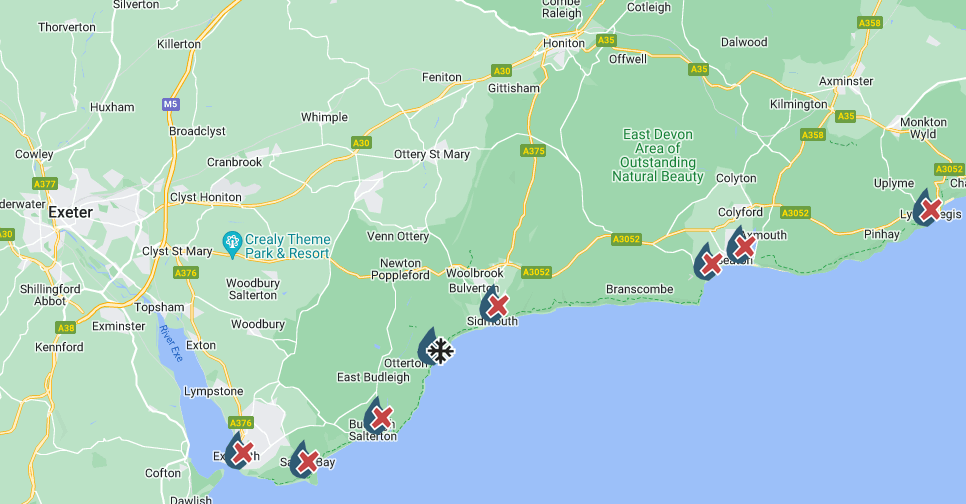
Map of sewage discharged in the past 48 hours as at 27 April.
As DCC teeters on the abyss of bankruptcy, 78 years old John Hart, who has been a county councillor for 34 years and its leader for the past 14 years, doesn’t see the need for “fresh ideas or a fresh face”.
It’s not just the Tories in Westminster that are past their sell-by date. – Owl
The leader of Devon County Council says he is not ready to retire after a councillor asked whether it was time for him to step down.
Born in 1945, John Hart was elected to the council in 1989, and took charge at county hall 20 years later when his Conservative group won overall control.
Independent group leader Frank Biederman told Cllr Hart: “John, you are a tremendous leader. I have a huge amount of respect for what you’ve had to do.
“You’ve been the leader through the most difficult time for local government nationally.”
But he added: “We’ve got a new chief executive. Is it time to give somebody else the opportunity? Fresh ideas, a fresh face … I just question it. I genuinely question it.
“And I don’t do it lightly. I just think you’ve done a tremendous job and I have really got huge respect for you.
“I certainly wouldn’t have wanted the job with the cuts and the scale of the cuts that you’ve had to face.”
In response, Cllr Hart said he isn’t ready to retire: “A time might come. A time might happen, but at the present moment, ironically, I do still quite enjoy the job.
“I will admit equally I never dreamt I was going to be here for the length of time that I have, but the Conservatives seem to be doing something right and the other parties don’t seem to be catching us up yet.
“It will happen, I know that … but at the present moment I’m reasonably comfortable if I put it this way.
“I’m available to talk to any councillor if any councillor wants to talk to me.”
The review into the way the council is run and overseen comes as it admits its internal operation is “very challenging,” with a report citing its failing children’s services and budget pressures.
The council also accepts there is “concern from stakeholders regarding confidence in the council to address these challenges”.
Next month’s full council meeting will be asked to rubber-stamp the review, which will be carried out by a cross-party working group.
The Government made a preemptive move to thwart Labour’s pollution debate on Tuesday by announcing their own, improved, plans.
But it amounts to very little:
A target published last year will be made legally binding one But the goal in question is for 2050.
Yes you read it correctly 2050, more than a quarter of a century in the future. Hope you’re still around to see this through and be able to swim safely in our rivers and seas Simon!
Targets on curbing the spills from storm overflows, before that, will not yet become law. I.e. will remain just targets.
The Conservatives have overseen underinvestment by the water industry and a gutting of environmental regulation capacity.
If Coffey and colleagues want to avoid public frustration over water spilling into a general election campaign, they will need to do better.
Sewage spill law is progress but Tories must do more
‘Shameful”, “revolting”, “disgusting”, “scandalous” and an “absolute catastrophe” — MPs from across the political spectrum queued up yesterday to see who could express the strongest outrage about water pollution, and argue about who personally cared the most about ending the problem.
Labour held a Commons debate to put Tory MPs in the lose-lose position of backing an opposition bill on sewage solutions or being seen to vote against it. Largely, the parliamentary exchange generated more froth than clear water.
Jim McMahon, the shadow environment secretary, berated ministers for the economic and environmental hazards of a raw sewage spill roughly every two and a half minutes. Thérèse Coffey’s rejoinder as environment secretary was that we know about the problem only because of monitoring her party brought in, and to attack Labour’s record on water quality in Wales. However, the stunt did have the welcome effect of pushing the government to make a pre-emptive strike. As The Times was first to report, Coffey promised to enshrine in law a key target for effectively ending the sewage spills that outraged MPs. That is good news.
This newspaper’s Clean It Up campaign has been calling for stronger regulation, so making a target published last year a legally binding one is progress. But the goal in question is for 2050, a conveniently pain-free option for today’s government. Other, earlier targets on curbing the spills from storm overflows will not yet become law.
The targets in the storm discharge reduction plan fall short in other respects. The Times wants to see the earlier goals, for 2035 and 2045, either brought forward or strengthened. Some water bosses, such as Liv Garfield of Severn Trent, agree.
Sewage spills from storm overflows are very visible and rightly anger people. But they are far from the only reason why only 16 per cent of England’s rivers and waterways are in a good ecological condition. Yesterday’s pledge and Coffey’s recent Plan for Water suggest the government is starting to get serious about tightening the screws on water companies. But on the pollution of rivers by farming, Coffey and colleagues still have huge strides to make, as Britain’s three biggest conservation groups have pointed out.
Yes, the Conservatives improved monitoring. But they also oversaw underinvestment by the water industry and a gutting of environmental regulation capacity. If Coffey and colleagues want to avoid public frustration over water spilling into a general election campaign, they will need to do better.
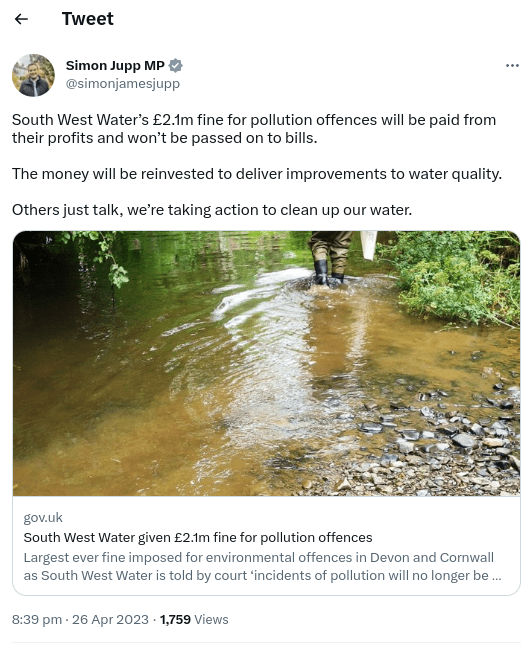
The £2.1m fine covers offences over four years, or £0.5m/year
As far as SWW is concerned it’s actually peanuts. Simon needs to get his head around their accounts.
Susan Davy, who is chief executive of South West Water’s parent company Pennon, is paid a base salary of £456,000, but with her bonus, incentives and benefits the company’s latest set of accounts (2022) show her total pay was bumped up by anadditional £1.1m in bonuses for the year. Between them the top three directors took more than £2m in bonuses.
So, the fine equates to a single year’s bonus payments for four years of offences and what about the dividends?
SOUTH West Water has been fined more than £2 million for a series of environmental offences across Devon and Cornwall spanning a period of four years.
It is the largest ever fine imposed for environmental offences in the region.
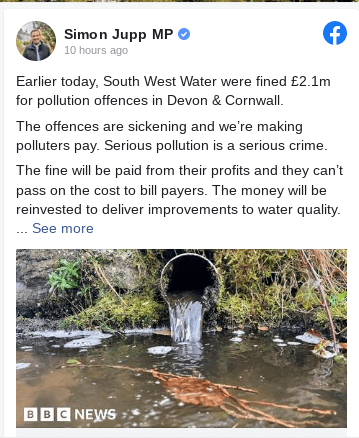
Delivering her sentence, District Judge Matson said: “Incidents of pollution will no longer be tolerated by these courts” and fined the water company £2,150,000 today, April 26.
The EA has shown that there were numerous common deficiencies in the implementation of SWW’s management systems which have contributed to each of these offences.
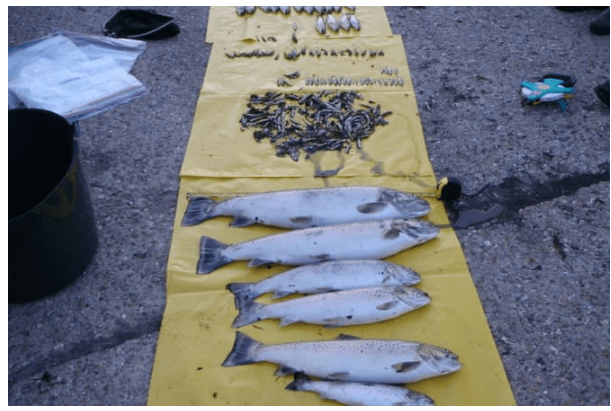
Fish killed because of pollution discharged into the River Axe at Kilmington. (EA )
The company had pleaded guilty at an earlier court hearing and District Judge Matson, sitting at Plymouth Magistrates’ Court sentenced the company on 13 charges – six for illegal water discharge activities and for seven offences of contravening environmental permit conditions.
The offences took place between July 2016 and August 2020 at Lostwithiel, Kilmington, Crediton and Torpoint sewage treatment works and the Watergate Bay sewage pumping station.
The water company was ordered to pay £280,000 costs and £170 victim surcharge.
Inaccurate and inadequate operational procedures led to harmful chemicals escaping from SWW sites on more than one occasion which resulted in significant environmental damage including sites at Kilmington on the River Axe and in Crediton on the River Creedy.
Following the spill at Kilmington, thousands of fish died in the River Axe including some protected species.
Failure by SWW to operate its assets and processes in an effective manner was also demonstrated at Lostwithiel in July 2016, where raw sewage was pumped into the River Fowey for more than 12 hours despite control room alarms indicating there was an issue with the works.
Not responding adequately to alarms the same year resulted in an illegal discharge from the Watergate Bay sewage pumping station in August 2016. The discharge lasted for more than 35 hours and a sample taken from a stream at the beach showed E. coli levels to be 2,000 times higher than the level that would be classified as poor.
On two occasions effluent from the Torpoint sewage treatment works was pumped into the St John’s Lake Site of Special Scientific Interest – this also lies within the Plymouth Sounds and Estuaries Special Area of Conservation. The site is designated due to its variety of bird life and invertebrates.
Today’s sentence “shows the shareholders and management of South West Water the importance of compliance”, said the judge.
Alan Lovell, Chair of the Environment Agency, said: “We welcome this sentence. Serious pollution is a serious crime – and we have been clear that the polluter must pay.
“The Environment Agency will pursue any water company that fails to uphold the law or protect nature and will continue to press for the strongest possible penalties.”
Clarissa Newell, Environment Agency environment manager for Devon and Cornwall said: “Failure to apply basic environment management principles has caused pollution incidents at some of the most scenic locations in Devon and Cornwall including bathing waters and designated Special Areas of Conservation (SAC).
“Having alarms to alert you that sewage is spilling is no good if no action is taken. Enforcement is intended to prevent these things from happening again and ensure South West Water improve and meet the expectations placed on it.
“Like all water companies, South West Water has a responsibility to operate in accordance with permit conditions and to prevent pollution. Polluters must pay and the Environment Agency will continue to do everything in its power to ensure that they do.”
An Ofwat spokesperson said: “The actions of South West Water have rightly been condemned and we welcome the penalty imposed by the court.
“This stands as another example of regulators using all available means to hold water companies to account. We will continue to work with our colleagues in the Environment Agency and across Government, to ensure companies meet the standards expected.”
According to the Tory leaflet for the Woodbury and Lympstone ward for the upcoming district elections the Tories are going to protect our rivers our landscape and environment.
Maybe the 2 prospective conservative candidates Ben Ingham and Cheryl McGauley should start asking their friends to assist them, rather than working against them.
The current goings on at Greendale Business Park owned by FWS Carter and sons who`s directors financially support the Tory party don’t seem to be helping their declared aims unfortunately.
There are a number of challenges with unlawful development, and enforcement issues at the Business Park that over the last 10 years has seen over 60 retrospective applications and a large number of enforcements.
The most recent anomalies that FWS Carter and sons have managed to create are:
Greendale Business Park Covid Centre
The Large Covid Vaccination Centre at Greendale Business Park which most residents visited during the pandemic is now being used for truck parking, caravan storage/occupation, all without any planning consent.
There is a current live planning application for this area to use either an NHS walk-in Centre or business space (application No. 22/1893/FUL) which is due to be considered in June, but there is no application for it to be used by other tenants which would require a change of use application.
NHS covid facility was built under government emergency powers (which did not require planning approval) but there is prior history to this extension to the business park which was built illegally in around 2015 but had to be removed following a retrospective application was refused, both by the Planning Authority and upheld by the government Planning Inspectorate! The decision was subsequently upheld in the High Court. The land was then required to be returned to agricultural use, but the owners simply covered the concrete apron with soil and grassed it!
At the time of the NHS Covid centre being built the planning authority did inform the NHS and Greendale the significant previous planning history but they decided to proceed due to the covid emergency.
Greendale Farm Shop
Further down the road at the continuous expanding Greendale Farm Shop a new Covid Drive Thru Vaccination Centre has been built without the benefit of planning permission and FWS Carter and sons are now seeking retrospective consent for its retention under application No. 23/0298/FUL.
It is not clear what the intentions of the NHS are regarding the vaccination centres at these two locations are. The farm shop new centre is described as a “replacement” and yet the description of development for the existing large vaccination centre also requires its “retention” as a vaccination centre!
It would suggest the NHS is keeping their options open by retaining some form of lease on both centres. Their intention appears to be to use the new drive-thru centre for the roll out of the spring booster jabs to over 75’s and those in the most vulnerable category while retaining an option on the main vaccination centre should it be ever needed in the future.
These applications are submitted by the land owners and not by the NHS which suggests that the NHS is being offered either or both sites for delivering the vaccination programme, but it is questionable whether the cost of renting either of these premises is cheaper than a normal mobile vaccination centre in an HGV in a shopping centre car park is not made clear.
At present it is difficult to justify these developments which are both outside agreed employment and development zones but in the open countryside. The question is why the NHS or Greendale think it should be granted contrary to the Local Plan and National Planning policies.
Hogsbrook Farm
On the hill overlooking the Business Park is Hogsbrook farm where there seems to be illegal storage of vehicles in a field. There is an open enforcement case that the use of an agricultural field is unacceptable for this purpose.
The landowners FWS Carter and sons are required to either make a retrospective planning application to retain it and in so doing justify why it should be allowed to remain contrary to the policies of the local plan or enforcement action will require the removal of the vehicles.
Clyst St Mary
Further afield close to the village of Clyst St Mary a field hedge boundary has been removed which is contrary to the approved planning application.
There had been some initial activity last year which was finally stopped, but only after substantial damage had taken place to an orchard and treeline with mature oaks that was removed without a tree felling licence. FWS Carter and sons have agreed to stop work again at the site under the threat of a temporary stop notice.
PS Simon Jupp MP has not only received donations from FWS Carter and Son but rents his office from them.
I would like to tell a tale of two announcements. We are used to reannouncements, where the Government use much fanfare to introduce funding that, it later emerges, they have announced before. But I want to describe something that is new to me: an announcement with two faces.
On 7 April, the Sidmouth Herald quoted a Government press release:
“confirmed £70 million of cash will be used to improve sewage systems in Sidmouth, Tipton St John and Axminster, as well as Falmouth in Cornwall. East Devon’s share of the cash…will help prevent sewage overflows in Sidmouth and Tipton St John, as well as water pollution in Axminster.”
On the surface, that is welcome: £70 million to improve sewage systems in east Devon. Those reading that in the paper in Devon are led to believe that that relates to our area, and might miss the passing reference to a distant town in Cornwall, but readers in my part of Devon are discerning and they notice a mention of Cornwall in a story that is supposed to be about Devon.
To get a full picture of what is going on here, one needs to travel 125 miles south-east of Axminster and read the same announcement in Falmouth’s local newspaper, The Packet. What does the Conservative Government’s announcement claim in Falmouth?
“South West Water’s total investment for the Falmouth area includes…a total of £40 million.”
By reading about the same announcement in the neighbouring county, we find that most of the £70 million funding is not for east Devon at all.
I, for one, will never defer to the interests of polluting water firms or simply parrot the lines they suggest we MPs might like to use. Instead, I will always stand up for my constituents, who are seeing their bills rise and profits leaking out in bonuses, all while sewage poisons our rivers and beaches.
It’s in line with plans to grow the town’s population to 20,000
The coalition led EDDC of the past three years inherited a local plan devised and driven through by successive Conservative administrations based on a high growth scenario. The 18 year housing target in the 2013-2031 EDDC local plan is a minimum of 17,100. This is an increase of 63% over what is needed purely to satisfy demographic trends.
The coalition has also withdrawn from the secretive Greater Exeter Strategic Plan (GESP), a move opposed by every Tory councillor present at the debate.
GESP was the strategic plan to spread Exeter’s housing needs more widely with its neighbours: Teignbridge; East Devon and Mid Devon.
A draft allocation plan was published in 2019 (since withdrawn from the public domain). However we know that East Devon was set to take a disproportionate share of the total which amounted to a 150% uplift to the already eye watering local plan, and would continue to 2040.
A vote for a Tory under the leadership of Phil Skinner is a vote to return to this “Build, build, build” policy.
Cranbrook is set to get even bigger as planning permission for more than 1,400 homes has been granted today (April 25). It comes as a separate application for another 1,035 homes was also approved last month.
A scheme of 1,435 new homes to be built in Cranbrook has secured planning permission at an East Devon District Council planning committee meeting today. The plans, which include a mix of apartments and houses on land at Cobdens, were first submitted in March 2022 by Persimmon Homes South West.
The Cobdens development is following the Local Plan’s outlines for 15 per cent affordable housing as Persimmon has confirmed that 215 of the 1,435 will be transferred to a social housing provider for rent and shared ownership. A number of amenities are also set to be built, including a primary school with 630 spaces, a SEN school, a local centre, allotments, a place of worship, cemetery, ‘enhanced’ green space for leisure and recreation and 10 serviced pitches for Travellers.
A development of 1,435 new homes in the Cobdens area of Cranbrook has been granted planning permission (Image: Persimmon Homes South West)
Developers say that the design also incorporates a SUDS strategy, Country Park, SANGs (Suitable Alternative Natural Green Space) and six local play areas in a bid to create attractive open space areas, deliver biodiversity enhancements and mitigate flood risk.
Persimmon Homes’ South West Managing Director, Daniel Heathcote, said: “We’re delighted to have secured outline planning permission for our scheme at Cranbrook Cobdens.
“The development will provide a wide range of high-quality new homes designed for local people, especially young families and first-time buyers, who otherwise might struggle to get onto the housing ladder in Devon.
“Throughout the planning process for Cranbrook Cobdens, we have worked closely with officers and stakeholders at East Devon District Council to ensure that our homes are in keeping with – and enhance – the local area and its surroundings.
“The scheme will deliver substantial community benefit including over 400 new jobs, a range of new facilities including a new primary school, local centre, allotments, place of worship, cemetery and enhanced green space for leisure and recreation.
“Persimmon has an established record of delivery in Cranbrook and we are excited about this latest scheme as we continue to build the best value homes in sustainable and inclusive communities.”
The party wanted to introduce a new law bringing in legally binding targets and automatic fines for water companies guilty of the disgusting practice.
But following a three-hour debate, MPs voted 290 to 198 to kill off a Labour motion which would have given them party parliamentary time to bring in the legislation.
In a separate development, the government today announced its own plans for legally binding targets to cut sewage discharges.
Environment secretary Therese Coffey said: “A clear, credible and costed legally binding target will add to our transparent and determined approach to solve this issue, whilst keeping consumer bills low.”
Labour’s Water Quality (Sewage Discharge) Bill would require water companies to reduce discharges from storm overflows by 90% by the end of 2030 and impose automatic financial penalties for sewage dumping.
Shadow environment secretary Jim McMahon told MPs the plans “would finally see an end to the Tory sewage scandal”.
He said: “The reason we’re here today is because the country we love and the quality of life for millions of working people is being treated with utter contempt, dumped on with raw human sewage, dumped on on an industrial scale, and dumped on with at least 1.5 million sewage dumps last year alone.
“Dumped on for a total of 11 million running hours, that’s a sewage dump every two and a half minutes.”
But Therese Coffey said Labour’s bill was “pointless”.
She said: “We already have a target for reduction in sewage discharges which we will put into law, we’ve already consulted to remove caps on financial penalties and we’ve already undertaken an assessment of sewage discharges – but unlike the opposition we have a credible, costed plan to stop the scourge of sewage.”
Following the vote, Lib Dem environment spokesperson Tim Farron said: “It is scandalous that Conservative MPs have blocked the Sewage Discharge Bill.
“This is a new low for Conservative MPs who simply don’t care about the sewage crisis.
“They would rather these water firms rake in millions in profits whilst we all swim in sewage. Frankly, the whole thing stinks.”
Labour is determined to make the sewage problem a major issue in next month’s local elections.
In their latest Twitter attack ad, the party said: “Do you think it’s right to allow raw sewage to be dumped into our rivers and beaches 800 times a day? Rishi Sunak does.”
Tories must be scraping the bottom of the barrel to find candidates – Owl
A would-be Tory councillor has been criticised after his social media account suggested the holocaust would have been less likely if more Jews had guns. He also claimed if parents spent time with their children at rifle ranges it would be “quality family time and gun control all in one.”
Ivybridge West Conservative hopeful Stanley Murphy’s personal Facebook site additionally argued the Covid vaccination programme was an experiment on the population and some equality programmes in schools are “communism.”
In a series of comments posted in 2021, Mr Murphy, who is standing for South Hams District Council, argues for controversial ideologies associated with US far-right groups, including limiting restrictions on firearms and his support for Donald Trump, who was sanctioned by social media giants following the 6 January 2001 Capitol riot.
Two Ivybridge residents, who do not wish to be named, say some local people are concerned about Murphy’s Facebook profile. One said: “It would appear from his personal Facebook postings [he holds] some worryingly extreme far-right American political views.”
They continued: “These posts appear to support the right to carry arms, concerns that the Chinese military are extracting DNA from pregnant women from around the world and that Covid-19 is a bio-weapon manufactured by the Chinese.”
In one post, Mr Murphy shows an image of Jews being forced onto trains during the notorious “Grossaktion” in 1942, when victims were deported from the Warsaw Ghetto before being sent to the extermination camp in Treblinka. The image includes the words: “Why gun control? Because armed people will NOT willingly load themselves into railroad boxcars.”
Another of Mr Murphy’s Facebook post shows a photograph of a man, woman and young boy, all pointing rifles and says: “This is quality family time and gun control all in one. Re-post because the communist [sic] at Facebook are covering it up and deleting.”
The Conservative candidate also reposted a YouTube video in which a British man in the United States aggressively criticises a school programme to improve the attainment of black students. Mr Murphy adds: “This is how you deal with crazy leftist school boards or anyone who hates their own country in favour of communism and behave in a dictatorial manner.”
The Facebook posts were dated between April and July 2021, at the height of the UK’s vaccination programme, but Mr Murphy reposts a meme stating: “Stop saying you did your research before you got the injection – you are the research.”
Stanley Murphy’s Facebook comments appear to be at odds with the Conservative Party, which he is representing in the local elections. Mr Murphy and the Conservative Party have been approached but have not responded.
Postal ballots have had to be-issued in Lympstone & Woodbury as a result of confusion about whether or not one of the candidates, Amanda Ford, could display a red “Labour” logo on the ballot paper.
The “description” section of her nomination paper blank had been left blank and she seemed to be standing as an independent, adding the logo means that she isn’t. (Owl understands that the returning officer is acting on advice from the Electoral Commission on what must be an unprecedented case).
Amanda is a bit of a chameleon figure who popped onto Owl’s radar in 2018 when she quit as the Teign Valley ward member on Teignbridge District Council, slashing the Conservative majority to one.
Her resignation followed suspension by the Conservative Party days before her resignation following claims that she had broken the Code of Conduct for members.
In 2017 she stood as the Conservative candidate in the Barnsley Central ward in the General Election.
“Prior to her departure, she had resigned from the vice-chairman role of the overview and scrutiny committee, had complained that she was being bullied by officers, and that the atmosphere at council HQ was ‘poisonous’.
But Cllr Jeremy Christophers, leader of the council, denied her claims and said that he was saddened by the allegations and misrepresentations that she made and that the council’s senior leadership team did not recognise her version of events and relations between officers and members.
He added: “It was sad end for someone who showed some promise in the early days but who couldn’t get her head around the idea of collective decision making.
“Just saying what you like to who you like, when you like, doesn’t apply when you are a councillors, and some officers were concerned by a lack of respect that she had for them.
“We had tried to help her through the complaints process with her grievances but she did not take and listen to the relevant legal advice from the council. In fact, she was actually suspended from the Conservative Group on October 31 as she had broken the members’ code of conduct which says that you must treat officers with respect.”
Cllr Ford did not reply to request from the LDRS to comment on the reasons for her departure from Teignbridge District Council.”
Another opportunity for “ I would never vote to pollute our water” Simon Jupp to repeat his vote against toughening up the rules. – Owl
Labour is planning to use the same Commons procedure that helped remove Liz Truss from Downing Street to force Conservative MPs into a politically embarrassing vote about whether to toughen up rules on sewage discharges.
The party plans to use its regular opposition day motion on Tuesday to push a binding motion, which would oblige the government to set aside Commons time next week for a debate and vote on a Labour bill to impose tougher penalties for sewage spills.
While the motion will fail if the government, as expected, whips its MPs to vote it down, this outcome would allow Labour to say Tory MPs had opposed plans to clean up rivers, beaches and chalk streams, a potentially potent attack before local elections, also next week.
When Labour last used the tactic of an opposition day motion to seize control of the Commons order paper, in an attempt to ban new fracking, a bungled whipping operation by Truss’s government resulted in bedlam, prompting her to resign the next day.
Tuesday’s motion would overturn the Commons’ standing order 14 (1) to take control of the order paper, a tactic popularised during the period of chaotic Brexit wrangling under Theresa May. Standing order 14 (1) sets out that government business takes precedence in the chamber, but can be overturned by a majority vote.
The Labour motion would set aside Commons time on 2 May to debate and vote on the water quality (sewage discharge) bill, introduced last month by Jim McMahon, the shadow environment secretary.
If passed, the bill would increase penalties for water companies and others who fail to adequately monitor sewage discharges, impose fines and binding targets for such events, and oblige the government to publish a strategy on the issue.
Downing Street and Conservative whips have not commented on whether they will order Tory MPs to vote against the motion. While the government often ignores opposition day votes, allowing an unopposed win, because Tuesday’s motion is binding, they are likely to vote it down.
This could prove uncomfortable for Conservative MPs, given public anger in many areas about sewage discharges into rivers, streams and coastlines, generally exacerbated by a long-term lack of investment by privately owned water companies.
Launching a cleaner water plan earlier this month, the environment secretary, Thérèse Coffey, warned that upgrading the sewage network to stop spills could add hundreds of pounds to water bills.
Both Labour and the Liberal Democrats have used previous votes over sewage – particularly one in October 2021, when Conservative MPs voted down an amendment to the environment bill on reducing discharges – to target individual Tories over the issue.
Sewage has become a prominent issue in advance of the local elections that take place across England next week, with the Lib Dems in particular using it in their campaign.
After data showed raw discharges were sent into English rivers 825 times a day last year, Keir Starmer has accused the government of “turning Britain’s waterways into an open sewer”.
McMahon said: “Tory MPs have an opportunity to support Labour’s water quality bill, which will put an end to sewage dumping once and for all. Their constituents will be watching to see if they will put the best interests of our country before their party.”
National Grid Electricity Distribution has announced a new Green Spaces Fund – with £500,000 to support areas of East Devon.
The aim of the fund is to boost communities, encourage wildlife, improve air quality, reduce noise and a host of other benefits.
Applications are invited from community organisations and projects that encourage volunteering. The closing date is Friday, May 12.
The fund will award grants of up to £2,000 for unregistered organisations. Registered charities and eligible non-profit companies can apply for up to £10,000.
Jill Russell, environment manager at National Grid, said: “We’re committed to empowering communities and promoting sustainability across our region.
“The launch of the Green Spaces Community Fund is a testament to this commitment and we’re excited to support grassroots organisations to create green spaces that benefit everyone.
“We believe that access to green spaces is essential for the wellbeing of both individuals and communities, and we look forward to seeing the positive impact of this initiative on our communities.”
Funding could be made available in East Devon, Exmouth and Honiton for projects such as:
Planting spaces and new allotment creation in existing green spaces
Bee banks, bird/bat boxes, wildflowers, ponds, trees, hedges, and other projects to improve biodiversity
Development of unused land into green spaces
Gardening workshops and allotment activities to bring vulnerable members of the community into green spaces, including sensory or mindfulness garden creation
Access pathways, ramps and seating in in parkland or nature reserves
Redevelopment of existing green spaces to encourage greater community use
Forest school education sessions for young people or craft workshops in nature
Innovative approaches to create or develop green spaces for public enjoyment
The Green Spaces project is the latest phase of the Community Matters Fund run by National Grid Electricity Distribution.
The fund – paid for entirely by shareholders – has awarded £4.3 million to eligible organisations since 2021.
A National Grid spokesman said: “Applications are now open for a new Green Spaces Fund which will support communities across East Devon to enhance their local environment and encourage more people to make the most of their green spaces.
“The aim of the fund is to support the development of green spaces to bring communities together, encourage more wildlife and biodiversity, improve air quality and reduce noise, as well as delivering health benefits, and creating employment and volunteering opportunities.
“Applications are welcome from community organisations of all kinds, particularly those supporting vulnerable groups to overcome barriers to accessing green spaces.
“Projects that create volunteering opportunities for members of the local community are also encouraged to apply.”
John Hart, the leader of Devon County Council, doesn’t back the Tory government’s initiative.
Election day on Thursday 4 May will be the first time that voters need to show an accepted form of photographic ID, such as a passport or driving licence, before being allowed to cast their ballots.
The move is controversial, with those against the change saying it creates a problem that doesn’t exist and will make it harder for some people to vote. There has also been criticism that older people are more likely to have forms of ID to choose from. Student ID cards, for example, are not permitted.
However, the government says the requirement to show photographic indentification will “protect the integrity of the ballot box” and eliminates the “potential for voter fraud.”
Those without the acceptable ID can apply for a free voter authority certificate from their local council, but only have until tomorrow, Tuesday, to do so.
Discussing the new requirement, Councillor John Hart, Conservative leader of Devon County Council has said: “I’m not sure it’s needed, personally.”
Speaking to BBC Politics South West, he added: “I do know, though, that our district councils have worked very hard to make sure that they make a success of it in May.
“On the basis of that, I do congratulate them on what they’ve done to try and make sure that everything on election day runs smoothly.”
Some Devon councils, including East Devon, North Devon and Plymouth, had urged the government to delay introducing the new rules, while Cllr Hart said it had supported the Local Government Association in calling for a delay.
Former Tiverton and Honiton Tory MP Neil Parish defended the change last month, telling Devoncast from Radio Exe: “I think it’s really necessary because, in the end, we need to make sure everyone who votes are who they say they are.”
It would appear that the Tories are struggling to find Sidmouth folk who aren’t related to stand in the 3 Sidmouth wards in this election, or to find candidates who actually live in the Ward they’re standing in.
Sidmouth Town has two Tory candidates. Firstly, John Zarczynski who lives in Honiton and was on Honiton Town Council. In December 2019 an independent investigation by East Devon District Council’s monitoring officer found that he, Councillor John Zarczynski, and two other Honiton Town Councillors had all breached the code of conduct as they hadn’t treated others with courtesy and respect. The monitoring officer found that all three had brought Honiton Town Council into disrepute.
John Zarczynski was sanctioned to apologise in two separate cases in 2019. I wonder why he’s not standing for a Honiton seat in this election? Perhaps the thought is that the good people of Sidmouth won’t have been following his activities over the hill in Honiton over recent years.
John Zarczynski’s Tory running mate in Sidmouth is serial candidate Sophie Richards. By serial candidate I mean this is her third location in 5 years and her fourth attempt at getting elected to something. God does love a tryer.
In 2018 Sophie was unsuccessful in getting elected as a Councillor for North End on Hammersmith & Fulham Council in London. She then flitted to Coventry for the 2019 general election where Sophie again was unsuccessful, but this time as a parliamentary candidate in the NE Coventry Constituency. Bless her, Sophie still tells everyone on her Twitter biog of that campaign, but strangely not of her current attempt in Sidmouth.
Then in 2022 Sophie has another, albeit unsuccessful attempt, at getting elected as a Councillor on Hammersmith & Fulham Council, this time for the West Kensington Ward.
And now Sophie has rocked up to stand in Sidmouth, living it would seem at “Mama Richards” home in Sidmouth. I guess she likes the commute to our special part of the world and it’s a short hop to seek out “friends” in Exmouth.
Welcome, albeit presumably temporarily Sophie, to your latest election test in your new home with Mama. There’s just no stopping you in your hunger to get elected. Somewhere!
Mama Richards, as Sophie referred to her on Twitter recently, lives in Sidmouth where she works as a solicitor. Mama, or Christina as the ballot paper will refer to her as, is standing in Sidmouth Rural and if elected alongside Sophie, will have the pleasure of quality mother and daughter time in the Council chamber. And it’s always nice to see parents opening their doors to their grown-up children to “live” with them. It always is necessary to live in the area where you are standing in a local election.
The Tories are standing Councillor Mike Goodman, who lives a short distance from Sidmouth sea front to stand in his neighbouring Ward of Sidford. Presumably John and Sophie were seen as better candidates for his home Ward of Sidmouth Town.
Councillor Goodman has been a Councillor on Windlesham parish Council since 2019 and this year has managed to get back to Surrey to attend 6 out of its 9 Council meetings, as recently as 28 March. Will he be attending his next one on 25 April?
Whilst Mike has been a Councillor in Windlesham it hasn’t stopped him climbing the local Conservative Party greasy political ladder to become local deputy chairman political last summer. He’s also been very active in continuously attacking the decisions of the same district council he now wants to be elected to.
Mike still has a property back in Windlesham that he registers himself as the landlord of and he still, according to his Councillor profile, sits on the Surrey County Association of Parish & Town Councils.
Mike has a bee in his bonnet about the increase in local car park charges, but he easily forgets how Surrey Live reported in 2019 that “Surrey councillor ‘fully committed’ to maintaining controversial countryside car parking charges”. As a Surrey County Councillor Mike was responsible for introducing car parking charges that upset local residents. Despite local opposition, then Surrey County Councillor Mike was reported by Surrey Live as saying “he was “fully committed” to keeping the
charges”.
Oh, how easily Mike forgets his controversial past and is able to lambast our district council over car parking charges. Mike loves to have his cake and eat it.
And finally, Sidford has that old Monster Raving Loony supporter, and activist, Stuart “Huggy” Hughes partnering Mike on behalf of the Tories in these elections.
I’m a wise old owl and so I encourage Sidmouth voters to look behind their Tory candidates’ names and judge them on their track records, and their roles in Sidmouth and the Sid Valley.
River Exe under threat from pollution and ‘human activity’
Friends of the River Exe (FORE), will be launching this week with open meetings in Tiverton, Exeter, and Exmouth.
The launch meetings will be held from 6 pm – 8 pm on Monday, April 24th, in Tiverton at St George’s Church Extension, on Tuesday, April 25th, in Exmouth at the Railway Club, and on Wednesday, April 26th, in Exeter at the City Gate Hotel.
The River Exe is under threat from pollution and human activity, with heavily polluted water, stripped banks, and depleted wildlife, a new campaign group has warned. The new organisation, Friends of the River Exe (FORE), will be launching this week with open meetings in Tiverton, Exeter, and Exmouth. FORE aims to bring together diverse grassroots organizations and people who live, work, and play along the Exe and its tributaries to be a voice for the river.
“These first meetings will be to gather communities to plan how best to protect, restore and celebrate our river,” said Mary Culhane, one of the organisers. “We’re excited about this chance to pull together all the amazing groups, people, and organizations that exist along the River Exe and believe that together we can really make a difference in tackling this horrendous crisis.”
The launch meetings will be held from 6 pm – 8 pm on Monday, April 24th, in Tiverton at St George’s Church Extension, on Tuesday, April 25th, in Exmouth at the Railway Club, and on Wednesday, April 26th, in Exeter at the City Gate Hotel. Speakers will include Franny Armstrong, a filmmaker who made Age of Stupid and Rivercide, and campaigners from Friends of the River Wye, a pathbreaking campaign contesting pollution in the Wye from sewage and intensive poultry farms.
The group is angry that sewage was discharged into Devon rivers over 2,068 times in 2021, totalling over 20,853 hours of sewage discharge in just one year. But Friends of the River Exe believe the river can be restored to full ecological health, benefiting birds, fish, invertebrates, and humans who depend on the Exe for life and happiness.
The group is inspired by organisations forming to fight for their rivers in many other catchments in England. From gathering together as a force for change to signing up as citizen scientists to test the water, to celebrating the river with a Festival of the Exe in September 2023, the organizers hope to hear what citizens feel moved to do and would like to be a part of.
Franny Armstrong, who grew up near the River Exe in Devon, said: “Do we sit back and watch such a natural wonder being destroyed? Or do we step up, get together, and fight to protect, restore and celebrate our river, for ourselves and for future generations? Come and join us.”
Free places can be reserved at Tiverton, Exmouth, and Exeter events through Eventbrite. Friends of the River Exe hopes that this initiative will bring the community together to save the river and make a significant difference in its restoration.
‘Affordable housing” is a joke. The term is so subjective as to render the 80 per cent of market value definition useless. Housing is increasingly unaffordable to many, whether it comes at a 20 per cent “discount” or not. It is a problem particularly exacerbated in holiday let and second-home hotspots.
In places popular with second-home owners house prices are likely to be more indicative of the income levels of the incomers than the resident population. This is why a more logical way of defining “affordable” would be to peg it to local earnings rather than local house prices.
Take Southwold on the Suffolk coast, where the average new-build home is £396,151; with a 20 per cent discount that’s £316,921. The median local salary is £22,856, so for housing to reflect local wages (4.5 times salary) a new home would have to be priced at £102,852 — a difference of 208 per cent, or £214,069, according to data provided by the property portal OnTheMarket.com.
Southwold’s Liberal Democrat councillor, David Beavan, says one so-called affordable house in the town is now being sold on the open market because no local could afford it — “unless they earned more than £80,000 a year”. He claims the three-bedroom shared-ownership home in the Old Hospital was earmarked for residents but which would cost £1,500 a month, has sat empty for nearly two years.
Southwold is far from the worst affected. For instance, in the Cotswolds the average affordable home costs £582,088 — 486 per cent more than the average resident could borrow — while the mortgage available for an average local income is just £99,356.
The issue was discussed in the Lords last week; peers argued for an amendment to the levelling-up bill to peg affordable housing to local earnings.
It was recently announced that second-home owners will be forced to seek planning permission before renting out their properties as holiday lets. It is a well-meaning intervention supported by many in holiday hotspots, but there are those who say it could push house prices up even further.
Chris Norris, policy director of the National Residential Landlords Association, has told me that the proposed changes could backfire, with homes that have an established use as short lets — or, in future, with planning permission — trading at a premium. In effect this will force prices up in some holiday locations and accentuate the two-tier property market between second homes/holiday lets and local homes.
So what’s the punchline? The definition of affordable housing needs to be re-thought and linked to local salaries rather than local house prices. The setting up of community land trusts (communitylandtrusts.org.uk) needs to be encouraged and supported. These community-owned organisations own the land on which they build genuinely affordable homes based on what residents earn. Add to this a concerted effort to build more housing, particularly of the social kind.
Admittedly it isn’t exactly hilarious, but being able to afford a home shouldn’t be.
Not only is he campaigning to “stand up for our environment” but he is also pledging “to deliver the right homes in the right places”.
He should know, because he is also a major developer and will become a beneficiary of the South West Exeter urban extension plan.
He and his partner Helen Lee applied for outline planning permission in March 2015 [Teignbridge 15/00921/MAJ] for major development of Matford Home Farm. This was granted in Nov 2020.
They submitted a more detailed design and access statement (glossy brochure) application a year later in Nov 2021 [Teignbridge 21/02604/MAJ] which is still under consideration.
The proposals for this site provide up to 250 homes, relocation of existing farm shop use [Parr’s Farm Shop] with additional employment units of up to 560m2, 3 travellers pitches and recreational opportunities for future residents and neighbours.
According to the Design and Access Statement ,the overall area has been promoted through the planning system and forms part of the South West Exeter Development Framework adopted by Teingbridge District Council and the current Local plan.
Caveat: this is still an outline plan and as we all know, once outline permission has been granted, as it has been in this case, developers have a habit of making successive changes. The final result is all too often very different especially with regard to total numbers (upwards) and provision of “affordable” housing (downwards).
Major development in Matford which in effect creates a new ‘town’ on outskirts of Exeter has been described as “changing the countryside forever”, see www.devonlive.com
The coalition led EDDC of the past three years inherited a local plan devised and driven through by successive Conservative administrations based on a high growth scenario. The 18 year housing target in the 2013-2031 EDDC local plan is a minimum of 17,100. This is an increase of 63% over what is needed purely to satisfy demographic trends.
In this short period the coalition has withdrawn from the secretive Greater Exeter Strategic Plan (GESP).
GESP was the strategic plan to spread Exeter’s housing needs more widely with its neighbours: Teignbridge; East Devon and Mid Devon. A draft allocation plan was published in 2019 (since withdrawn from the public domain). However we know that East Devon was set to take a disproportionate share of the total which amounted to a 150% uplift to the already eye watering local plan, and would continue to 2040.
Looks like Matford Farm is part of Teignbridge’s early contribution.
Those voting to keep East Devon in GESP in August 2020, were all the Conservatives present and all the self-styled “Independent Group”. These were the remainder of Ben Ingham’s group of “Independents” who did not join the Coalition or form Cranbrook Voice. The other unaligned “Independent” from the Ingham Group, Cllr Peter Faithfull, also voted to stay in the GESP. You can see how your councillor voted here.
The Coalition has also paused reviewing the local plan now that the government does not intend to impose central targets, pending clarification.
A couple of weeks ago Owl wrote an article pointing out that despite losing 50% of their seats on the council in the space of eight years, in choosing Phil Skinner as leader, they were signalling “no change” to the discredited “Build, build, build” policies of the “Old Guard”.
If a return to the “Old Guard” is what you want, Richard Parr looks to be your man.
National parties are a bit behind reality – think what has been happening in East Devon for the past three years. – Owl
In terms of the issues dominating the campaign trail, there is nothing unusual about the battle taking place to win seats on Berkshire’s Bracknell Forest council in May’s local elections. Potholes, council tax and sewage are among the hot topics on the doorstep.
Yet a closer inspection of the candidate list in the Tory stronghold reveals an odd quirk that some political pundits believe is unprecedented – and has also led to furious accusations from party leaderships that the local parties involved have “gone rogue” in their quest for electoral success.
You won’t hear any local party figures broadcasting it – in fact, none are prepared to talk about it publicly – but Bracknell Forest has emerged as the unlikely scene of a de facto progressive alliance between Labour, the Liberal Democrats and the Greens, attempting to make gains on a council where the Conservatives hold 37 of 42 seats.
In 12 of the council’s15 wards, only one of the three progressive parties are standing candidates. None of the 15 wards features Labour candidates taking on the Lib Dems. “It’s not unusual to have alliances between two or three parties at local level,” said local election expert and Tory peer Robert Hayward. “To have it as total as it is in Bracknell Forest is very rare, if not unique.”
To believe that this arrangement is the result of some bizarre coincidence stretches credulity, yet when asked how it came to pass, local party figures clam up. “You might think that,” said one party figure. “I couldn’t possibly comment.” Several people said a combination of the struggle to raise enough candidates and cash, together with the local knowledge of where they have the best chance of winning, had led to the unusual election choice.
While the local party bosses admit to “getting on well” with each other, they insist there has been no secret meeting to carve up the council contest between them – something they all know would lead to fierce condemnation from party headquarters.
“It’s not like we came together in a dark room saying, ‘you have this one and I’ll have that one’,” said one local party figure, on condition of anonymity. “It’s really a story about how to make the best of it in a borough which is heavily skewed [towards the Tories]. Focus your attention on where you’re going to win. And that’s what’s happened.”
It is frustration at the Tory domination, as well as a desperation to improve the diversity of the council, that has fuelled the unusual set up. “We’re just all fed up with it,” said another. “We’ve had really good people with something to offer – a real commitment, intelligence, capacity, insights and the knowledge to make a big difference. Instead, Donald Duck with a blue rosette gets voted in.”
While the frustration is understandable, the development will anger officials in Labour and Lib Dem headquarters, who oppose any local arrangement with other parties over where candidates run. The Labour party has already spent a lot of time clearly stating it would not do any deals with other parties – be it the SNP or the Lib Dems – in order to win power. Meanwhile, the Lib Dems need to win over traditionally Tory voters in many seats, and any suggestion it is standing aside for Labour is seen as damaging to those efforts.
“This was a decision taken by a single local party, which doesn’t reflect our position nationally with the highest level of candidates since 2007,” said Lib Dem deputy leader Daisy Cooper. “As our stunning byelection wins have shown in recent years, voters know who to vote for to get the Conservatives out, and in many areas across the country that is the Liberal Democrats.”
For anyone hoping that Bracknell Forest could lead the way in showing that progressive alliances could work across the country at a general election, pollsters and political scientists are not encouraging. Apart from national parties hating them, Hayward said history suggests they simply don’t work. “In terms of a progressive alliance as such, I don’t think it’s a precursor,” he said. “Both because of the general approaches of national parties and also because, when it comes to national issues, there are marked differences between the political parties involved.
“On a psephological basis, there’s very clear evidence that ‘progressive alliances’ don’t work. If you look at the way people transfer their votes on occasions like police and crime commissioners elections where they have the opportunity to transfer a vote, it has not gone wholeheartedly well for parties that people want to describe themselves as part of a ‘progressive alliance’. So there is no reason for believing that it will work now when it hasn’t worked previously.”
A Labour party spokesperson said the party “hasn’t done any deals and is not in the business of doing so … Voters aren’t fools, they don’t need parties to do deals – they need politicians who will put them first and improve their lives.”





 Faraway Tipton St John Devon EX10 0ARRef. No: 23/0821/FUL | Validated: Fri 14 Apr 2023 | Status: Awaiting decision
 East Devon Watch