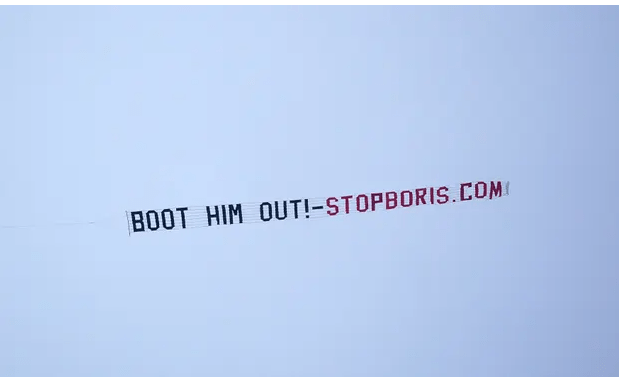
No 10 ‘held birthday party for Boris Johnson during lockdown’

Following the latest allegations, many people on Twitter shared a letter Mr Johnson wrote to a seven-year-old girl in March 2020 after she had delayed her own birthday party because of Covid rules. “Josephine sets a great example to us all,” the PM tweeted.

(See tweets below – Owl)

www.independent.co.uk 

Downing Street staff held a birthday party for Boris Johnson inside No 10 in June 2020 despite Covid lockdown rules banning all indoor socialising, according to fresh claims.

The prime minister’s wife Carrie Johnson led the surprise gathering on the afternoon of 19 June which featured up to 30 people, ITV News reported on Monday evening.

She is said to have led staff in a chorus of happy birthday, before well-wishers enjoyed picnic food from M&S at the event held just after 2pm.

The Independent has seen evidence which suggests that Mr Johnson had a birthday cake with candles which he blew out after attendees finished singing happy birthday.

A No 10 spokeswoman confirmed that a group of staff had “gathered briefly” in the Cabinet Room “to wish the prime minister a happy birthday”, adding: “He was there for less than ten minutes.”

Downing Street did not deny Mr Johnson had a birthday cake and blew out candles, but instead referred to their previous statement.

The Independent has separately been told by sources that a group joined Mr and Ms Johnson in their flat the same evening, as first reported by ITV – a claim denied by No 10.

“This is totally untrue. In line with the rules at the time, the prime minister hosted a small number of family members outside that evening,” a Downing Street spokeswoman added.

Interior designer Lulu Lytle – the person later caught up in the scandal over the complex funding of the PM’s flat refurbishment – also attended the afternoon birthday gathering, ITV reported.

A spokeswoman for Soane Britain, the luxury designer co-founded by Ms Lytle, said she had been in Downing Street on June 19 working on the refurbishment.

“Lulu was not invited to any birthday celebrations for the prime minister as a guest. Lulu entered the cabinet room briefly as requested, while waiting to speak with the prime minister,” said the spokeswoman.

Mr Johnson was also said to have been joined for food and cake by Martin Reynolds, his under-fire principal private secretary, as well as No 10 special advisers, operations and events staff.

Sir Keir Starmer responded to the latest claim of a rule-breaking party by saying Mr Johnson had become a “national distraction”, adding: “He’s got to go”.

The Labour leader added: “We’ve got a prime minister and a government that spends their whole time mopping up sleaze and deceit, meanwhile while millions of people are struggling to pay their bills.”

Liberal Democrat leader Sir Ed Davey said it was time for the “disgraced” prime minister to “save the country even more pain and resign”.

He added: “It is clear now the Sue Gray inquiry is not fit for purpose. The Met must investigate this to deliver justice for millions who sacrificed so much during this pandemic.”

One Tory MP – who has been considering whether to send a letter of no-confidence in Mr Johnson to the 1922 Committee of backbenchers – told The Independent the claims made the PM’s position more precarious.

“There’s a sense of shock about these allegations. A lot of us are still getting our heads around it. I think many MPs will still wait to hear what Sue Gray says. But it’s going to make it more difficult for him to survive.”

In June 2020 all social gatherings indoors were still banned under Covid laws. Mr Johnson had asked the public to “show restraint and respect the rules” during a press conference nine days before his birthday gathering.

Jo Goodman, co-founder of Covid-19 Bereaved Families for Justice, said the latest claim was “completely sickening” and “though we’re not even surprised any more, it still brings fresh pain.”

She added: “Every day and every fresh scandal pours salt on the wounds of the hundreds of thousands who have lost loved ones – if he had any decency he would do what we and the country is calling for him to do and go.”

However, culture secretary Nadine Dorries, a staunch ally of Mr Johnson, appeared to question whether the birthday gathering would have broken the rules in place at the time.

“So, when people in an office buy a cake in the middle of the afternoon for someone else they are working in the office with and stop for ten minutes to sing happy birthday and then go back to their desks, this is now called a party?” she tweeted.

Following the latest allegations, many people on Twitter shared a letter Mr Johnson wrote to a seven-year-old girl in March 2020 after she had delayed her own birthday party because of Covid rules. “Josephine sets a great example to us all,” the PM tweeted.

The latest allegation came as senior civil servant Sue Gray continues to complete the inquiry into a series of claims of rule-breaking parties in No 10 and Whitehall departments.

Her report – which could prove critical for the PM’s political survival – was expected to be published this week. But it was not immediately clear whether the latest allegation will further delay its publication, or whether Ms Gray had been aware of the birthday event.

On Monday night, The Guardian reported claims that Ms Gray was expected to make deeply critical recommendations on overhauling No 10’s operation, after uncovering “appalling evidence of mismanagement” at the heart of Downing Street.

It came after Dominic Cummings claimed evidence was being kept from the investigation because staff fear it will be seen by Mr Johnson.

The former Downing Street adviser suggested on Monday that the fear of reporting to Ms Gray officially meant that further evidence – including photographs – will keep leaking after she publishes her report.

“I know others are very worried about handing things to the Cabinet Office because they know the PM will see everything SG [Sue Gray] collects,” Mr Cummings said in his latest blog post.

It follows The Independent’s exclusive report that officials at No 10 have held back information due to a “culture of fear” surrounding the probe.

Three sources said they had not divulged messages and pictures on their phones after a senior member of staff told them to remove anything which could be damaging following the first party revelations.

Minister quits in Lords over government handling of Covid loans fraud

Boris Johnson suffered another major blow to his authority on Monday after a Treasury minister staged a dramatic public resignation over the government’s decision to write off £4.3bn in fraudulent Covid loans.

Jessica Elgot www.theguardian.com 

Theodore Agnew, a Treasury and Cabinet Office minister, called the oversight of the scheme “nothing less than woeful” and accused officials of “schoolboy errors” on multiple fronts.

Speaking in the House of Lords, he accused the government of “arrogance, indolence and ignorance” in its attitude to tackling fraud estimated to cost £29bn a year.

The row over the decision will leave Johnson fighting Conservative anger on yet another front, with the prime minister facing pressure from backbenchers over Sue Gray’s inquiry into alleged lockdown-breaking parties, as well as over the rise in national insurance contributions, whips’ tactics, and accusations of Islamophobia.

In his statement, Lord Agnew said his resignation was not an attack on the prime minister but that he could not stay on in good conscience.

“Given that I am the minister for counter-fraud, it would be somewhat dishonest to stay on in that role if I am incapable of doing it properly. It is for this reason that I have sadly decided to tender my resignation as a minister across the Treasury and Cabinet Office with immediate effect.”

Agnew, a life peer since 2017, was responding to a Labour urgent question about the Treasury’s decision. He left the chamber to applause from fellow peers.

Asked by the Labour peer Denis Tunnicliffe if he could provide an accurate figure for how much had been written off, Agnew said he was speaking to defend the government, adding: “But I will only be able to do that in part.”

Oversight of Covid loans by the business department and the British Business Bank had been “nothing less than woeful”, Agnew said.

“They have been assisted by the Treasury, who appear to have no knowledge or little interest in the consequences of fraud to our economy or our society,” he said, adding that two counter-fraud staff at the business department would not “engage constructively” with his counter-fraud team in the Cabinet Office.

He said: “Schoolboy errors were made: for example, allowing over 1,000 companies to receive bounce-back loans that were not even trading when Covid struck.”

Agnew insisted that his decision had nothing to do with “far more dramatic political events being played out across Westminster” relating to Johnson and a continuing investigation into No 10 parties.

He said: “This is not an attack on the prime minister and I am sorry for the inconvenience it will cause. I hope that as a virtually unknown minister beyond this place, it might prompt others more important beyond me to get behind this and sort it out.”

Labour’s Rachel Reeves, the shadow chancellor, said Agnew’s resignation was a “damning indictment of the chancellor and the government’s failures on fraud”.

She said: “That the government’s own anti-fraud minister feels he is unable to defend the government’s record on billions of pounds of taxpayer cash gifted to criminals tells you all you need to know about the incompetence of this government.”

Speaking after him, the Lib Dem peer Susan Kramer said: “Can I just take this opportunity to say on behalf of these benches how much we appreciate the honour and integrity that has just been displayed by the minister? I don’t think anyone could have raised questions more forcefully, more accurately or more completely than he has.”

Johnson’s spokesperson said: “We are grateful to Lord Agnew for the significant contribution he has made to government.

“On the wider issues that he’s raised, we introduced our unprecedented Covid support schemes at speed to protect jobs and livelihoods, helping millions of people across the UK, including nearly 12 million on the furlough scheme alone.

“We’ve always been clear fraud is unacceptable and are taking action against those abusing the system, with 150,000 ineligible claims blocked, £500m recovered last year, and the HMRC tax protection taskforce is expected to recover an additional £1bn of taxpayers’ money.”

HMRC believes that about £5.8bn, or 7%, of the £81.2bn paid out by the taxpayer through the various Covid-19 emergency response schemes has been stolen. So far, just £500m has been recovered, and it expects to be able to recover between another £800m and £1bn by 2023.

The National Audit Office (NAO) has singled out the government’s “inadequate” attempts to tackle fraud within the £47bn business bounce-back loan scheme (BBLS). It warned in December that loans worth £4.9bn, or 11% of the total, would be lost to fraud because anti-fraud checks had been “implemented too slowly”.

“It is clear that government needs to improve on its identification, quantification and recovery of fraudulent loans within the scheme,” Gareth Davies, the head of the NAO, said in his report.

HMRC said in its briefing paper on money lost to fraud through the various schemes, including furlough, the self-employment income support programme, BBLS, and “eat out to help out”, that: “From the beginning it was clear the schemes would be targets for fraud.”

A British Business Bank spokesperson said: “From the launch of the [bounce-back loan] scheme, the British Business Bank has worked with lenders and across government to prevent, detect and counter fraud and put in place as quickly as possible additional measures to further mitigate fraud risks.”

Senior council officer dismissed from South Somerset District Council

(Owl has since learned that this story, and more, had been published by “The Leveller” much earlier, see updated post here)

“She failed to declare that council staff had been used (on council time) to build glamping pods, strim grass, lay turf outside her cottage and – on one occasion in February 2020 – remove a dead pig from her land, his [independent investigator] report found.”

See also: www.dailymail.co.uk 

Daniel Mumby, Local Democracy Reporter www.chardandilminsternews.co.uk 

A SENIOR council officer in Somerset was dismissed following allegations that she used council staff to build glamping pods, lay turf and remove a dead pig from her Dorset vineyard.

Clare Pestell joined South Somerset District Council in 2012, eventually becoming its director of commercial and income generation and at one point was in line to become the new interim chief executive.

Following a letter from a whistleblower in April 2021, an independent investigation was conducted into numerous claims that council money and resources had been misused by Ms Pestell.

Ms Pestell, who vehemently denied the allegations, was summarily dismissed in October after the Appointments Committee of the council met to discuss the findings of independent external investigator Richard Penn.

Ms Pestell, who had already resigned and was serving out her notice, appealed the decision but the decision was upheld by the council’s appeals committee. She left the council in October.

In his confidential report that has been seen by the Somerset Local Democracy Reporting Service, Mr Penn ruled: “My conclusion is that, taken as a whole, the cumulative conduct of the Director amounts to gross misconduct.

“I conclude that there is evidence that CP has abused her position as a council director and has failed to ensure that the correct information was documented and declared.

“CP has also disregarded government guidance and paid council employees who were in receipt of furlough payments as part of the Coronavirus Job Retention Scheme for work which could be seen as enabling benefit fraud and a reputational risk to the Council and the spirit of the scheme to preserve employment.

“CP has been negligent to the council in that she failed to take the appropriate steps to ensure that employees were not working for her and using council resources at the same time as being paid by the council, thereby resulting in a loss to the council.”

Although the council has not released the report, we believe there is a strong public interest in reporting the dismissal of the senior officer who was in charge of the authority’s commercial investment programme and who had been lined up as interim chief executive.

We also believe that the public has a right to know that that dismissal came after an independent investigator found she had breached the council’s code of conduct on numerous occasions and had risked bringing the authority into serious disrepute.

Who is Clare Pestell?

Ms Pestell began working for South Somerset District Council in 2012 as a development and valuation manager, before being promoted in 2017 to become its director of commercial and income generation.

This put her in charge of the council’s commercial investment programme – under which the council invested millions of pounds of taxpayers’ money in commercial properties, such as offices and retail outlets, with the rental income serving as a long-term funding source for front-line services.

Under her watch, the council made a large number of commercial investments – including a battery storage facility on the outskirts of Taunton and purchasing the Wilko and Marks & Spencer outlets in Yeovil town centre.

Outside of her official duties with the council, Ms Pestell runs Melbury Vale Winery near Shaftesbury in Dorset, which she purchased with her brother Glynne in December 2003, according to its official website.

She declared this business as an interest, as well as declaring that some off-site meetings or training for the council had been held at her premises.

Ms Pestell originally worked full-time for the council, but her working week was reduced to four days a week in August 2019 on agreement with the then chief executive Alex Parmley, with the decision being shaped in part by the demands on her Dorset business.

She was the council’s original choice to succeed Mr Parmley as interim chief executive, with the council’s appointments committee confirming her appointment on May 4.

However, she dropped out in June 2021 for “personal reasons” before she had formally taken up the post – with the committee meeting in July to appoint her replacement.

She left the council on October 21, 2021.

When did the investigation start?

On April 22, 2021, Mr Parmley and leader Val Keitch received a letter from an anonymous whistleblower.

The letter – which has not been made public – alleged Ms Pestell had breached the council’s code of conduct by failing to “declare conflicts of interest between her official duties for the council and her private business, her personal relationships and other interests.”

Following an initial “fact-finding” investigation by the South West Audit Partnership (SWAP), the council commissioned Richard Penn in July to conduct a full, independent, external investigation.

Mr Penn – who spent ten years as chief executive of Bradford City Council – interviewed numerous members of staff, including Ms Pestell, and delivered his final, damning report in September.

This report was not released to the public but has been seen by the Local Democracy Reporting Service.

What did Mr Penn’s report find?

Mr Penn has ample experience of holding public figures to account, having spent ten years as commissioner for standards for the National Assembly for Wales between 2000 and 2010.

He concluded Ms Pestell had breached the council’s code of conduct numerous times, identifying several occasions where she used council employees to carry out work on her Dorset winery, and recommended she should be subject to a disciplinary hearing for gross misconduct.

She failed to declare that council staff had been used (on council time) to build glamping pods, strim grass, lay turf outside her cottage and – on one occasion in February 2020 – remove a dead pig from her land, his report found.

According to the report, she sent a message to an officer on February 24, 2020, asking them to take the pig to the Frome Vale livestock dealer near Maiden Newton.

The officer (who is not identified in the report) responded: “I can be with you no later than 10am and will bring everything we need (rope etc.). If you say where we need to get her to, then you can leave it with me.”

The glamping pods were granted planning permission by the then-North Dorset District Council in May 2018, before the current Dorset Council unitary authority was formed.

Ms Pestell also failed to declare that one of her relatives was appointed to the council’s commercial services and income generation team, having been recruited out of the council’s normal recruitment processes through an external agency – which charged the council for its services.

Mr Penn also concluded she had “risked bringing the council into serious disrepute” by paying council employees cash in hand or in kind for work done on her winery.

Some of these employees were shielding under the government’s coronavirus restrictions, and were already in receipt of furlough payments through the coronavirus job retention scheme.

Mr Penn said Ms Pestell’s actions represented a “serious misuse of council resources” – including repairs carried out to her own tractor and other vehicles at the council’s official Lufton depot on Artillery Road in Yeovil during work hours.

How did Ms Pestell respond to the investigation?

When interviewed by Mr Penn, Ms Pestell “consistently denied” all of the allegations laid before her, according to his report.

She acknowledged that the code of conduct had been breached and council resources had been misused, but “blamed other managers in her directorate for allowing this to happen” – claiming that she would have taken “corrective action” if such things had been brought to her attention, the report said.

Mr Penn said: “Clare Pestell has consistently claimed that she had no knowledge of SSDC employees carrying out work at her premises in working time, or that she knew that any of this work was carried out using council equipment, plant and fuel.

“She has not denied that this may have been the case but she has also consistently blamed others – those who organised the work and those who carried it out – for any improper use of council resources or for working at her premises in working time when they had not taken leave.

“As she said in response to my question about her responsibility as director: ‘If some staff have taken advantage of this situation and not been honest then they will need to answer for their actions’.”

Responding to the cash in hand claims, she stated during interviews: “I think that people are entitled to do what they want to do in their own time and it is above board.

“I think it would be naïve to think that these trades do not do this in their own time.

“To say that I am not aware would be wrong, but I cannot manage my own business alone and therefore use various people and trades that do work in their own time.

“To my knowledge I have declared everything I need to declare and as far as I am aware, the work had not been done in council time or using council equipment.”

Mr Penn said that there was “sufficient evidence” from both managers and employees within the commercial services arm of the council that the misuse of council resources “was known” by Ms Pestell – and that she had commissioned the work herself “in a number of instances”.

When asked what the public would think about her conduct, Ms Pestell said she “doubted the public would be interested in what council employees do in their own time as self-employed individuals” and “would be more concerned about their bins not being collected”.

She added that she had “never missed a deadline, never not responded, nor not delivered for the council in nine years”, and that her work for the local authority had generated “substantial income to cover known council revenue shortfall”, ensuring front-line services could still be delivered.

Ms Pestell was approached by the Local Democracy Reporting Service but did not respond to requests for a comment.

How has the council responded?

Following Mr Penn’s investigation, the council’s appointments committee met on October 15 to discuss its findings.

The committee ruled Ms Pestell should be dismissed, with these findings being confirmed in writing on October 21 – a decision which Ms Pestell appealed.

The council released an initial statement on December 14. Elected members were informed a few days later.

It said: “This was a complex and difficult investigation. We thank all those involved for their diligence, and also express our thanks to all colleagues who have participated in the process.

“This has been kept confidential to date to ensure that the appropriate evidence was gathered and any disciplinary proceedings resulting from the investigations were fair and legal.

“It was always the council’s intention to inform elected members, staff and the public appropriately at the right time. It would not have been appropriate to comment on this matter publicly during the investigation to respect all of those concerned.”

The council did not respond to suggestions that information surrounding Ms Pestell’s conduct had been kept from the appointments committee when it met to appoint her in early May.

The spokesman added: “We have a proud reputation for going above and beyond to support our communities, and it is vital that we follow our code of conduct in all the work we do, which sets standards of behaviour and conduct that we expect from all of its employees.

“The investigation has also highlighted a number of actions that we need to undertake to ensure lessons are learned. This will include but will not be limited to reviewing our training offering and the implementation of our financial policies, and these will be implemented as a matter of urgency.

“Please be reassured, as this has demonstrated, we take all allegations of misconduct and gross misconduct very seriously, so that we protect our residents, partners and our staff.”

Here is what I think will be in Sue Gray’s report

A cartoon in Private Eye has a man cheerily greeting a neighbour: “Nice day!” The other replies: “We should wait for Sue Gray’s report before making a judgement.” The whole country is waiting for Gray’s findings as if they will decide the prime minister’s fate and therefore the direction of the nation.

John Rentoul www.independent.co.uk

But we already know what Gray, a senior civil servant with long experience in charge of ethics at the Cabinet Office, is likely to say. There may have been other parties in Downing Street, and there may be new details that have been reported to her by the people she has interviewed, but the main facts are known. If we look at the terms of reference of Gray’s inquiry, it is possible to guess what her report will be like.

The terms of reference say that “the primary purpose” of her investigations is “to establish swiftly a general understanding of the nature of the gatherings, including attendance, the setting and the purpose, with reference to adherence to the guidance in place at the time”.

An important word there is “guidance” rather than “regulations”, which means that she will not be making any direct findings about whether there might be a case against anyone for breaking the law. She will be looking at whether ministers and officials followed the government’s own advice.

At least two parties from which Boris Johnson was absent do seem to have been in breach of the guidance. There was the Christmas party in No 10 on 18 December 2020 – about which Allegra Stratton, the prime minister’s former spokesperson, was asked in a rehearsal for a news conference. The guidance at the time said: “You must not have a work Christmas lunch or party, where that is a primarily social activity.” I doubt if Gray will be persuaded that handing out prizes is enough to activate the “not primarily social” exclusion.

Then there was the party in the basement of No 10 on 16 April last year – the one which ended with Wilf’s swing in the garden being broken. Again, that would seem to be in breach of the guidelines for step two of the “road map” out of lockdown.

In both cases, some officials seem likely to be told off, although Gray’s terms of reference say that “any specific HR action against individuals will remain confidential”.

The implications for Johnson, however, are limited. Gray may have some words about how unwise it was for the prime minister to allow his staff to form the impression that he thought shipping suitcases of booze into the party house was absolutely marvellous. But he wasn’t there. Alibi in Latin means “elsewhere”.

Two other alleged gatherings may be more dangerous for Johnson. We do not know the full story, and here Gray may add to the sum of public knowledge. Dominic Cummings, Johnson’s former chief adviser, claims that Boris and Carrie held a party in the Downing Street flat to celebrate his departure on 13 November 2020 – the second national lockdown having come into effect eight days earlier. And Johnson is reported to have made a speech at a leaving party for Cleo Watson, a special adviser, two weeks later. However, I suspect nothing is going to come of either of these.

The main event, therefore, is likely to be the “bring your own booze” gathering in the Downing Street garden on 20 May 2020, during the first lockdown. About which we already know most of what we need to know. The government’s guidance at the time is unhelpful, because it wasn’t written to cover the unusual situation of an office with a private garden.

In law, the prime minister has an arguable case that it was “reasonably necessary for work” that staff should gather to be thanked for their efforts. That doesn’t cover the “bring your own booze” email invitation and a loud party continuing for some hours after people had been thanked, but Johnson said he didn’t see the email and was only at the “work event” for 25 minutes. He also denied that anyone had suggested to him that there was any doubt that the event was within the rules. This contradicts Cummings’s claim that he and another official warned him, but I imagine that Gray will avoid adjudicating on a “who said what” dispute with a former adviser who has made it clear that he is out to remove the prime minister from office.

In any case, simply laying out the facts will confirm everyone in the view they hold now, which in most cases is that the party in the Downing Street garden was clearly contrary to the spirit of the guidelines. Indeed, Johnson admitted it himself, saying that, “in hindsight” – and he has the gall to call Keir Starmer Captain Hindsight – he should have told everyone to go inside.

We know, therefore, that Gray will find that the gathering should not have happened, and that Johnson was responsible for it, even if Martin Reynolds, his principal private secretary, sent the email invitation and is likely to be criticised as well.

When her report is published, therefore, there is likely to be a propaganda exercise from No 10 declaring that it says nothing new, or nothing significantly new, that the prime minister has apologised to parliament and the country, and that it is time to unite and get on with delivering the people’s priorities.

But the importance of the publication of the report is that it is for Conservative MPs a moment of decision. They will have given the prime minister the benefit of due process, which will have concluded what he has already reluctantly admitted. He made an error of judgement. For a large number of voters it was a serious enough mistake to require his resignation.

But Conservative MPs are not waiting for Gray’s findings; they are waiting for the publication of her report as the moment to trigger – or to refrain from triggering – the removal of Johnson and his likely replacement by Rishi Sunak. They will make that decision not on what they think of what happened in the garden of Downing Street 20 months ago, but on who they think will best put them in an election-winning position in 20 months’ time.

Send Devon homeless to Cornwall, says councillor

Ron Dolley, vice chairman of Mid Devon District Council, has been reported as saying that homeless people in the area should be sent to Cornwall to cut the amount of money being spent on B&B accommodation.

Richard Whitehouse Local democracy reporter www.radioexe.co.uk 

The Cornwall councillor responsible for housing has told a Devon councillor to concentrate on solving his own area’s problems after he suggested that homeless people should be sent to Cornwall.

The Independent councillor said: “We are here in Devon, but over the border in Cornwall, they’re begging for people to come down. They have lovely chalets and all the mod-cons, everything you could want.

“I’ve been around the town and spoken to a few people in doorways and asked them why they can’t get there.”

He said that the suggestion was coming from ‘left-field’ that the council could liaise with Mid Devon charity CHAT who provide services for the homeless and those at risk of losing their accommodation to ‘get something done’.

“If we could find five or ten people and send them down there on a mini-bus or other transport,” he said.

However the suggestion has been met with a frosty response from Olly Monk, Cornwall Council’s cabinet member for housing.

He said: “Councillor Dolley should concentrate on solving and addressing the issues in his own area before he advocates an exodus of people to Cornwall where we have our own issues and challenges in Cornwall.

“I can’t understand why he thinks that Cornwall is a land of milk and honey when it comes to housing. It is clear to anyone who takes an interest in south west current affairs that Cornwall faces an extremely challenging time with regards to housing.”

He added that he could assure Cllr Dolley that Cornwall definitely is not begging for people and that it was more the opposite.

Cllr Monk did offer to have a conversation with Cllr Dolley to see whether work being done in Cornwall to address the current housing crisis could be replicated and used to help in Devon.

“If councillor Dolley sees Cornwall as doing some good with temporary accommodation and our plans with housing then by all means contact us and we can have a conversation with them about how we can help Devon rather than simply telling people to come to Cornwall.”

The Conservative councillor said that Cornwall Council would be contacting Mid Devon District Council to get some clarity on Cllr Dolley’s comments and see whether the two authorities can work together.

Planning applications validated by EDDC for week beginning 10 January

Boris Johnson’s ‘bus back better’ plan in tatters as Treasury cuts funding by half

Boris Johnson is facing a growing backlash over his “levelling up” agenda as leaked documents on Sunday reveal that funding has been slashed in half for his favourite transport policy – improving bus services in more deprived areas including “red wall” seats.

Toby Helm www.theguardian.com 

The prime minister announced last year that £3bn would be spent on “new funding to level up buses across England towards London standards” as part of the government’s “bus back better” strategy. He said: “I love buses and I have never quite understood why so few governments before mine have felt the same way,” adding that “better buses will be one of our major acts of levelling up”.

But a letter sent to Local Transport Authority directors by the Department for Transport on 11 January – and obtained by the Observer – makes clear that the budget for the “transformation” of buses – a pot from which local regions can bid for funds – has now shrunk to just £1.4bn for the next three years.

The letter says this will mean hard choices for areas that had expected more, adding that “prioritisation is inevitable, given the scale of ambition across the country greatly exceeds the amount”.

The funding cuts have caused dismay behind the red wall and are an embarrassment for the government, particularly as a white paper on levelling up is expected to be published by Michael Gove – the cabinet minister in charge of the broad push to equalise standards of living across the country – within a fortnight.

The white paper has already been delayed, partly as a result of pressure from the Treasury to keep costs down. In his spending review last autumn the chancellor, Rishi Sunak, prepared the way for a reduction in spending on buses, but local transport leaders had still pinned hopes on the prime minister sticking to his word about £3bn for extra investment.

Figures compiled by the shadow buses minister Sam Tarry’s office show the amount of funding bids submitted by 53 out of 79 local transport authorities from the extra funding pot is already more than £7bn. This suggests the total is likely to exceed £9bn, against a total available of £1.4bn.

Local transport authorities and bus operators are already facing huge financial uncertainty as a result of the fall in passenger numbers and fare revenue during the Omicron surge, and lack of clarity from government over whether extra Covid-related funding will continue.

Tarry said last night: “The Tories promised ‘transformational’ investment in bus services. But millions of passengers are seeing managed decline. They’ve dramatically downgraded the ambitions of local communities. With bus services being slashed nationwide, this is proof that this government simply will not and cannot deliver for the people that need it most.”

The mayor of West Yorkshire, Tracy Brabin, said the decision to cut the funding for bus service improvement by more than 50% was a major blow. After losing out on long-promised rail investment – with the scrapping of HS2 and paring-back of Northern Powerhouse Rail – we in the north of England were counting on this funding, so we could deliver the green, reliable and affordable bus network our people deserve.”

The director of the Urban Transport Group, representing the transport authorities for the largest urban areas, Jonathan Bray, said: “We welcome any additional funding for buses given they are relied upon by those communities with the least and which are most in need of levelling up. However it is disappointing that the Treasury has substantially reduced the amount we were originally promised.”

Transport expert Stephen Joseph, a visiting professor at the University of Hertfordshire’s Smart Mobility Unit, said: “On buses, the Treasury isn’t counter-signing the cheques No 10 is writing. In fact the prospect seems to be of cuts, including in the red wall areas, rather than the expansion Boris Johnson has been promising.”

A Department for Transport spokesperson said: “It is incorrect to claim that funding has been cut from our original ambition. Over this parliament, the government has committed to making a step change investment of over £3bn into bus services.

“This includes £1.2bn in dedicated new funding to deliver improvements in fares, services and infrastructure, and a further £355m of new funding for zero emission buses.”

Move along – nothing to see here

Boris Johnson still believes he broke no lockdown rules at Downing Street party

Henry Zeffman www.thetimes.co.uk 

Boris Johnson is “determined” to fight on and still does not believe that he broke any lockdown rules as he braces himself for Sue Gray’s imminent verdict on parties in Downing Street.

The senior civil servant’s report on a series of allegations about rule-breaking in Downing Street during periods of severe coronavirus restrictions is expected to be published this week.

It could prove decisive in determining the fate of Johnson’s faltering premiership, and he is drawing up plans to “own the narrative” afterwards. The vast majority of Britons have already made up their minds about the allegations, regardless of what the report says, polling for The Times has found.

Johnson, who faces allegations that he did not take seriously the case of Nusrat Ghani, who was told she was dismissed as a minister because of her Muslim faith, spent the weekend making calls to Conservative MPs trying to shore up support before Gray’s findings.

“He’s feeling determined,” one loyal MP said. “He genuinely believes that he didn’t break any rules and that he was going to the garden [on May 20, 2020] to say thank you.”

Even Johnson’s allies accept that the report by Gray is likely to make a series of damaging claims about the conduct of people working in Downing Street at the height of the pandemic.

The prime minister’s inner circle — recently bolstered by the return of the MPs who masterminded his 2019 leadership campaign — is preparing to argue that whatever Gray’s findings it would be “disproportionate” for him to resign.

“Clearly there was a culture and clearly that culture was wrong,” one ally said. “But the prime minister was not in No 10 for many of these events, he didn’t know about them, and while it’s perfectly proper to hold the prime minister to account for things that he is responsible for, are we really going to ask the prime minister to resign because some people organised a party that he didn’t know about? It’s an argument about proportion.”

Downing Street is drawing up plans to “own the narrative” of Gray’s report, The Times has been told. Members of Johnson’s team have approached Sir Lindsay Hoyle, the Speaker, to ask whether Johnson could go to the dispatch box almost immediately after Gray delivers her findings to address MPs, regardless of what business is planned for the Commons at that time.

Johnson’s team is especially keen for him to speak on the same day as the findings are published if the report is critical. “If it’s leaning towards a difficult finding then you don’t want an overnight period for a narrative to build,” a minister said.

Relatively few voters are waiting to read the Gray report to form a view of the issue, according to polling by YouGov for The Times. Fifty-one per cent believe that Johnson should resign as prime minister whatever Gray’s report says, including 26 per cent of people who voted Conservative in 2019. Nineteen per cent think he should remain as prime minister regardless of the findings. Sixteen per cent think that Johnson’s future should depend on what the report says.

Dominic Raab, the deputy prime minister, declined to commit the government to publishing Gray’s report in full, saying only that “the substance of the findings” would be released, and that there would be “full transparency” and “full scrutiny”.

Angela Rayner, the deputy Labour leader, said that the report “must be published in its entirety with all accompanying evidence”, adding that Johnson “cannot be allowed to cover up or obscure any of the truth”.

Last night it was reported that Gray had interviewed police officers who guarded Downing Street when the gatherings took place. Members of the Metropolitan Police’s parliamentary and diplomatic protection command provided an account of who entered and left No 10, according to The Daily Telegraph. Gray is said to be in “ongoing dialogue” with the Met about her investigation.

Johnson’s official diary is also said to be among the sources being examined as part of the inquiry. It is understood that Dominic Cummings, the prime minister’s former chief adviser, is to be interviewed by Gray today.

The Sunday Times revealed that Gray had widened her inquiry to include allegations that parties were held in Johnson’s flat above 11 Downing Street. The paper claimed that two government advisers, Henry Newman and Josh Grimstone, visited the flat on several occasions during lockdowns.

Did you get the call?

Neil, Simon did either of you get a personal call from Boris over the weekend?

On balance was it more stick or more carrot?

Did he make any promises?

If you didn’t get a call, are you disappointed?

Owl

PS hope you weren’t in a mobile blackspot.

No 10 police officers ‘interviewed in Partygate inquiry’

Police officers who guard No 10 have reportedly been interviewed as part of Sue Gray’s inquiry into parties held at Downing Street during Covid restrictions.

www.independent.co.uk 

A source told The Telegraph their statements to the civil servant in charge of the probe were “extremely damning”.

Ms Gray is looking into allegations of a number of parties held at Downing Street while the country was under Covid restrictions. She is expected to publish her findings in the next week.

Officers who were on duty outside No 10 at the time of alleged rule-breaking parties have now reportedly been spoken to for the inquiry.

Access to Downing Street is controlled by the Metropolitan Police’s parliamentary and diplomatic protection command. According to The Telegraph, members of this branch have given detailed testimonies about what they saw to Ms Gray.

Asked how significant their information was, a source told the newspaper: “Put it this way, if Boris Johnson is still prime minister by the end of the week, I’d be very surprised.”

Downing Street refused to comment on the ongoing investigation.

On Sunday, Dominic Raab, the deputy prime minister, said Tory MPs were rallying behind the prime minister ahead of the Partygate inquiry’s expected publication this week.

The Met has previously faced questions over how officers could have been unaware of a “bring your own booze” garden gathering as they stood guard outside Downing Street.

Ms Gray is also looking into reports of other gatherings alleged to have happened at No 10 – including two events on the eve of Prince Philip’s funeral.

Officials working in No 10 claim they have held back information from the investigation into the partygate scandal due to “culture of fear” surrounding the probe. Three sources told The Independent they had not divulged messages and pictures on their phones after a senior member of staff told them to remove anything that could fuel speculation in the wake of the first party revelations.

The Met has been approached for comment.

We face a land crisis, not a housing crisis 

Letter www.theguardian.com

Sam Bowman (The big idea: could fixing housing fix everything else, too?, 17 January) is quite right in pointing out that one social problem – the housing shortage – lies at the root of many other problems, and he provides a pretty full list of what those problems are.

As he says, it is not the cost of bricks and mortar that has sky-rocketed, but the cost of land. We face not a housing crisis, but a land crisis. It is clearly wrong that when the state – in the guise of the local planning authority – grants permission for development on an area of land, the enormous increase in its value is largely pocketed as unearned income by the landowner, rather than going to the community whose needs and whose taxes that have paid for local infrastructure give value to land in the first place.

Bowman blames the shortage on the scarcity of permissions to build, but Julia Kollewe (Report, 8 May 2021) told us that since 2010-11, permission for 2.78m houses has been given but only 1.6m have been built in the same period, prompting the suspicion that developers are holding land unused while speculating on further increase in its value, and therefore in their profits.

Bowman considers various ways to fix this modern ill, but fails to mention the best one: a revenue-neutral reform of the tax system so that tax is increased on the unearned income from land, ignoring improvements, and reduced on earned income and consumption. Such a land value tax would be levied on unused land as well as other land and so would put a stop to land speculation. There would be a strong incentive to develop, the cost of land and therefore of houses would reduce, leading to real affordability, as well as to solutions of all the problems he identifies as stemming from our housing crisis.

Dr Justin Robbins

Yealmpton, Devon

Hospital patients to be moved to hotel to free up beds amid ‘enormous pressure’ on NHS

Hospital patients in Norfolk will be moved to a hotel to free up bed space as the NHS faces extreme pressure.

news.sky.com 

Up to 15 patients will be moved to the hotel in Norwich in a three month pilot scheme, NHS Norfolk and Waveney Clinical Commissioning Group has confirmed.

Patients are expected to move there within weeks.

The scheme will only include people who are healthy enough to leave hospital, but may still require care before they can go home.

This comes as the area’s health system declared a critical incident on 5 January as it struggled for bed space.

Chief Nurse Cathy Byford says the system is under “enormous pressure” despite staff “working tirelessly to ensure that people get the medical help they need as quickly and as safely as possible”.

She added that using hotels for extra capacity had been “used successfully in other regions”.

Patients at the hotel will be looked after by Abicare, a care provider with experience of delivering similar services in England.

Its managing director, Anne-Marie Perry, said staff are “keen to help” relieve current pressures on the health system.

Please use Chrome browser for a more accessible video player

NHS deals with sicker patients this winter

“Care hotels are an excellent example of a proactive short-term solution that can be readily set up as they are needed, utilising resources that exist within the community,” she added.

The scheme will not include people who have tested positive for coronavirus, or anyone with symptoms.

Similar methods have been used in other parts of England.

A hotel in Plymouth saw 30 patients moved into its rooms in December 2021 to relieve pressure on hospitals.

Health Secretary Sajid Javid told the Commons this month that he has “looked at every available route to secure the maximum capacity possible across the NHS”.

This includes creating virtual wards, using beds in hotels and hospices, setting up new Nightingale “surge hubs” within hospital grounds, and making use of the private sector.

Omicron falling fast, but new uptick detected in children

covid.joinzoe.com

According to ZOE COVID Study incidence figures, in total there are currently 144,527 new daily symptomatic cases of COVID in the UK on average, based on PCR and LF test data from up to three days ago [*]. A clear decrease of 21% from 183,364 reported last week (Graph 1). 

In the vaccinated population (at least two doses), there are currently 53,703 new daily symptomatic cases in the UK. An decrease of 36% from 83,699 new daily cases reported last week (Graph 2).

The UK R value is estimated to be around 0.9 and regional R values are; England, 0.9, Wales, 0.8, Scotland, 0.9. (Table 1). 

In terms of prevalence, on average 1 in 27 people in the UK currently have symptomatic COVID. In the regions, England, 1 in 26. Wales, 1 in 30. Scotland, 1 in 35. (Table 1).

New daily symptomatic cases are now dropping in all regions (Graph 3).

New daily symptomatic cases have seen a recent uptick in the age group 0-18. Cases in the over 75’s have fallen back to very low levels (Graph 4).

According to the data, ZOE estimates that 46% of people experiencing new “cold-like“ symptoms are likely to have symptomatic COVID-19, meaning any new ‘cold-like’ symptoms are now again more likely to be a cold than COVID. (Graph 5).

The ZOE COVID Study incidence figures (new symptomatic cases) are based on reports from around 840,000 weekly contributors and the proportion of newly symptomatic users who have received positive swab tests. The latest survey figures were based on data from 46,284 recent swab tests done on symptomatic cases in the two weeks up to 17 January 2022. 

Professor Tim Spector, lead scientist on the ZOE COVID Study app, comments on the latest data:

“It’s great to see cases falling rapidly. In just two weeks, the number of new cases per day has fallen around 31% from its peak of over 211,000 to under 145,000 and new cold-like symptoms are now again slightly more likely to just be a cold and not COVID. While it is easy to think the worst is over, our health service is still not functioning properly, and complacency will inevitably lead to trouble. The ZOE data is already showing an uptick in symptomatic cases in children due to the back to school effect. With cases still high and restrictions being lifted, we’ll just have to hope that people remain sensible, their households are triple vaccinated, and regardless of official advice, that everyone knows to isolate and self test when experiencing cold-like symptoms.” 

Graph 1. The ZOE COVID Study UK incidence figures total number of daily new cases over time.

Graph 2. The ZOE COVID Study UK incidence figures results over time; total number of new cases and new cases in fully vaccinated

Graph 3. Incidence rate by region

Graph 4. Incidence by age group 

Graph 5. Comparison of new onset of cold-like illness and new onset of COVID with respiratory symptoms

Table 1. Incidence (daily new symptomatic cases)[*], R values and prevalence regional breakdown table 

Map of UK prevalence figures

Families forced to leave Isles of Scillies amid housing crisis

“Several properties on the island which have historically been rented out to people on a long-term basis have either been sold or converted to holiday lets as a result of the growth in staycations – or because of the boom in property prices because of the pandemic.”

www.itv.com

A housing emergency has been declared on the Isles of Scilly as a lack of homes mean families are being forced off the islands.

The council is warning essential services – such as the hospital and the school – could soon be in “danger” due to a lack of homes.

It comes as 15 households are being forced to leave the islands due to having nowhere to live.

Councillors unanimously agreed to support an emergency motion recognising a housing crisis exists on the Isles of Scilly at a full council meeting this morning (January 21).

The motion was was put forward by Cllr Tim Dean, who is the lead member for housing for the Council of the Isles of Scilly.

He said the isles are facing unprecedented pressure on housing.

Part of the motion says: “We currently have 15 households who have presented themselves as homeless. This means that they will be without a home in March and will have to leave the islands.

“These are our friends, colleagues and family and many perform essential work on the islands. We are in real danger of putting essential services at risk, such as the hospital and the school.

“Without these, our islands will no longer be a viable place for our community to survive. Our population is declining and getting older. If we don’t act now, we will pay the pricein the coming years.”

The letter goes on to say the housing crisis affects everyone on the island, from businesses, schools and health providers who are in need of accommodation for staff.

It adds: “The council is finding it increasingly difficult to recruit, as are pubs, restaurants, hotels, the Steamship company, the carriers, and the boatmen and letting agents. Without all of these services, the islands economy will change irreversibly.

“So, what can we do? One thing is for sure, we at the council can’t solve this crisis on our own. We need the help of the wider community. The Duchy of Cornwall, private landlords, second homeowners and even households with a spare room can help.”

The council has bought a property on St Marys to try to ease the situation and plans to covert it to provide two properties with two bedrooms and one property with one bedroom.

“But it’s an expensive solution,” the motion adds.

“We are a very small authority with very limited financial capability, but we felt it was the right thing to do given the current situation. However, we are acutely aware that it is not enough… we need help.”

Hugh Town, Isles of Scilly Credit: Steve Spinner

Several properties on the island which have historically been rented out to people on a long-term basis have either been sold or converted to holiday lets as a result of the growth in staycations – or because of the boom in property prices because of the pandemic.

The council is also asking tenants to consider downsizing and is offering to help with moving costs and looking at financial incentives.

Plans going forward will include a public meeting to explore the current housing issues facing the islands and possible solutions.

Silence over Teignmouth Hospital’s future

Will long standing local Tory dogma on bed closure withstand scrutiny?

When Claire Wright tried to challenge hospital bed closures during a County Council Health Scrutiny meeting in  2017, Cllr. Randall Johnson ignored her motion and instead allow a fellow Tory, Rufus Gilbert, to seize the momentum by kick starting the debate and swiftly proposing the exact opposite. – Owl

Ollie Heptinstall, local democracy reporter www.radioexe.co.uk

Members of the public expecting to hear an update on the future of Teignmouth Hospital at a council meeting this week were left disappointed when there wasn’t one.

In November, it was announced that plans to close the community hospital on Mill Lane will be reviewed by independent experts after an intervention by the health secretary, Sajid Javid, who asked them to aim to report back by mid-December.

At a meeting of Devon County Council’s health and adult care scrutiny committee on Thursday, the first since then, the agenda contained ‘modernising health and care services in the Teignmouth and Dawlish area – update on referral to secretary of state for health and social care’ as one of the items.

However, when it came up an hour into proceedings, chair of the committee, Councillor Sara Randall-Johnson (Conservative, Broadclyst) announced there was no update and she had yet to receive a response.

The town’s county councillor David Cox (Lib Dem) responded: “How did this get on the agenda then? Because there’s lots of people watching this at home in Teignmouth because they believed there was going to be a great announcement – either yes or no – and it seems a bit bizarre that it’s on the agenda.”

The clerk of the meeting clarified it had been included because Mr Javid’s letter said that he hoped to get information to the committee by then, calling it a “just in case item, in case any information had been sent to us.”

But Cllr Cox remarked: “It could have been removed because people have been inconvenienced and they’re watching at home expecting to hear something, and they’ll be a bit disappointed.”

Cllr Randall-Johnson then said: “There hasn’t been an update. There might well have been an update this morning, but there hasn’t been,” to which Cllr Cox replied: “Oh well, fair enough.”

The community hospital was the first to be built by the NHS after it was established 74 years ago but was facing closure, with services moving to Dawlish Hospital and a new £8 million health centre in Teignmouth town centre.

However, campaigners argued against the decision made by NHS Devon’s clinical commissioning group (CCG), saying community hospital beds are “desperately needed,” while a petition entitled ‘Hands Off Teignmouth Hospital’ has been supported by more than 1,000 people.

Local MP Anne Marie Morris has also campaigned to keep the hospital open and welcomed the decision by the Exeter University-educated Mr Javid last year.

It is not known when a decision will be made on the hospital’s future.

Friday – Go back to your constituencies and prepare for …..

A call from Boris Johnson ensuring that you’re not wavering in your undying support for him?

A party with activists as they are now legal, though you could always have had a work gathering?

Being seen out and about your constituency – business as usual?

Or just keeping your head down?

Police stations should reopen to ‘reassure the public’

But … but … but – when they closed did that mean we ought to have been worried?  If so, why were they closed in the first place! – Owl

www.bbc.co.uk

More police stations should be reopened to give the public “reassurance” and revive confidence in policing, according to a crime chief.

Alison Hernandez, the Conservative police and crime commissioner for Devon and Cornwall, said the idea was “controversial with chief constables”.

She said public confidence needed to be restored.

“We need to reopen and show that policing is open to the public,” Ms Hernandez said.

Speaking to reporters at an Association of Police and Crime Commissioners’ briefing, she told of her plans to reopen six stations in her region but said it was “very hard” to get such proposals “over the line”.

Hundreds of police stations are thought to have closed to the public across Britain over the past decade as part of cost-cutting measures.

Typically the front desks of the stations, where people could come to report crime, were shut but the offices behind remained in use.

Alison Hernandez was first elected as the Devon and Cornwall Police and Crime Commissioner in 2016

Ms Hernandez said the difficulty in reopening stations was low footfall – the reason many closed in the first place.

“I’m determined,” she added.

“I’ve only got six I’m trying to reopen and you’d think I was trying to reopen 60.

“It is really hard because the resourcing for them, they know will mean low footfall, and it feels to them like a wasted resource.”

Exmouth’s police station was closed to the public in 2015 but remained a base for operational officers

She made clear she thinks police staff, as opposed to officers, should be posted to front desks.

“So yes, it’s controversial in the chiefs’ world. I’d say it’s very hard to get it over the line, to get that push forward because they feel like they should be spending it on policing rather than being accessible to the public,” Ms Hernandez added.

Some police and crime commissioners have used mobile vans, particularly in neighbourhoods where it may not be possible to have a station, to make policing more visible.

Stephen Mold, the Conservative police, fire and crime commissioner for Northamptonshire, who has dubbed his mobile vans “beat buses”, said: “It’s very much an evaluation but it’s already proving itself to be so successful. I’ll probably be buying another one.”

Ms Hernandez said mobile vans were “great”, but added: “What the public need for reassurance is that there’s a reliable place that you can go to and you know it’s there.”

‘Half a million’ new Covid-19 cases each day in UK over Christmas

We will follow the data hour by hour – Owl

www.inyourarea.co.uk

New cases of Covid-19 in the UK averaged nearly half a million a day during the week after Christmas, almost three times the official figures, new analysis suggests.

It comes as health agencies have urged caution about interpreting the regular case numbers published each day for the UK, following changes in rules about testing.

An average of 173,400 new cases of coronavirus per day were recorded from December 26 to January 1, according to the Government’s Covid-19 dashboard.

But the true number of cases was likely to be nearer 479,100 a day, according to estimates by the Office for National Statistics (ONS).

The sharp difference in totals reflects just how many new cases of Covid-19 are being missed in the dashboard figures, which count only those people who have reported themselves as having tested positive for the virus.

This means the numbers are affected by how many people are coming forward for tests, have chosen to report their test results, or who are taking a test because they know they have coronavirus symptoms.

By contrast, the ONS figures are based on analysis of nose and throat swabs taken from a representative sample of more than 150,000 people in private households.

The same people are sampled every week, regardless of whether they know they have Covid-19 or have reported a positive result.

The ONS then produces estimates of the likely number of new cases of coronavirus across the country.

The estimates for the week after Christmas have only now been published, due to the time needed to collect and process the data.

The number of new cases reported by the Government has always been lower than the level estimated by the ONS, but the gap has become wider since the arrival of the Omicron variant of the virus.

In the week to November 27, before Omicron had started to spread in the UK, the ONS estimated an average of 99,100 new cases a day – just over twice the average of 41,900 a day recorded on the dashboard.

The ONS estimates are now nearly three times the equivalent total on the dashboard.

High levels of under-reporting will still be affecting the Government’s daily figures, meaning the true volume of cases in the UK is increasingly unclear.

The recent change in the rules for testing, removing the the need for asymptomatic people to get a confirmatory PCR test after a positive lateral flow result, is also likely to affect the daily figures.

In its latest weekly Covid-19 surveillance report, the Health Security Agency said the removal of confirmatory PCR testing “may affect case rates” in England.

Public Health Wales has estimated that removing the follow-up test “is likely to reduce overall reported cases by at least 10%, based on analyses linking lateral flow tests to PCR positive episodes”.

The agency acknowledged that “changes in testing behaviour” may lead to under-reporting “should symptomatic new cases not test using PCR”.

In Scotland, health officials have recently widened their method of counting new cases to also include people who have recorded a first positive lateral flow test – though this change has yet to be reflected in the figures published on the UK Government dashboard.

The dashboard numbers are currently limited to all positive lab-confirmed PCR test results in the UK, plus positive lateral flow tests in Northern Ireland and, in England, any positive lateral flow tests not followed by a negative PCR test taken within 72 hours.