Did Simon Jupp and Neil Parish show “cross-party” support against sleaze?

There were two similar motions on offer, one was much weaker than the other (non-binding, wishy washy wording only likely to impact 10 MPs, no time table). They voted against the stronger one and for the weaker one. To show cross-party support, they could have supported both or abstained on one

See Chris Bryant chair of the committee for standards in public life:

Plan to rein in MPs’ second jobs is ‘for the birds’, says Labour MP

Labour challenges Tories over checks on Russia-linked donations

Labour has asked the Conservatives what checks the party has made on donations received from Russian-linked individuals – and if it could be sure that no cash received came from the Kremlin or others hostile to the UK.

Dan Sabbagh www.theguardian.com

The questions follow revelations about a group of wealthy donors who have given money to the Conservatives and have business links to Russia or other wealthy Russians.

Labour’s Conor McGinn, the shadow security minister, said it was “deeply worrying to see revealed potential financial links between senior donors and Putin’s Russia” and asked about “the adequacy of the processes” by which donors are vetted.

Donors who have made money from Russia or Russians have given £1.93m to either the Conservative party or individual constituency associations since Boris Johnson took power in July 2019, according to calculations made by Labour based on disclosures to the Electoral Commission.

Their ranks include the financier Lubov Chernukhin, the industrialist Alexander Temerko and an energy company he part-owns, Aquind, plus the businessman Mohamed Amersi.

They have donated £700,000, £357,000 and £258,000 respectively, either directly or through linked companies, since Johnson became prime minister, a total of £1.3m. Other donors with business interests in Russia take the total to £1.93m.

Both the Pandora papers, based on leaked documents from offshore financial institutions, published by the Guardian and others last month, and other reporting over the past 12 months have revealed greater Russian links than previously known.

“What checks have been completed on the financial origins of the donations themselves and were any links to hostile state actors discovered?” McGinn asked in a letter addressed to his opposite number, the security minister, Damian Hinds.

The Labour MP also asked whether MI5 had raised any concerns. “Have officials in the Home Office at any point issued internal concerns about the potential implications for the UK’s national security?”

Chernukhin, a Briton since 2011, has donated £700,000 to the Conservative party and is married to Vladimir Chernukhin, a former deputy finance minister under Putin. Documents published in the Pandora papers in October suggest he was allowed to leave Russia in 2004 with assets worth about $500m (£366m) and retain Russian business connections.

The Chernukhins’ lawyers said it was not accepted that any of Lubov Chernukhin’s political donations had been funded by improper means or affected by the influence of anyone else. Vladimir had not accumulated any of his wealth in a corrupt manner, they added.

Amersi advised on a lucrative telecom deal in Russia in 2005 with a company that a Swiss tribunal subsequently found to be controlled by an associate of the Russian president, Vladimir Putin. Amersi told the Financial Times in July he had made $7m in the country, but only prior to 2008. “Not a penny that I earned in Russia …  has even remotely come close to being invested in the UK political system,” he said.

Temerko is a minority shareholder and co-owner of Aquind, a company that wants to build an electricity interconnector to France. Its majority investor, the Russian-born oil tycoon Viktor Fedotov, secretly co-owned a company once accused of participating in a massive corruption scheme relating to a Russian pipeline.

Lawyers for Fedotov have denied the accusations, while Aquind’s lawyers said the allegations against the Russian company co-owned by Fedotov came from a wholly unreliable report and were completely false.

Aquind has also stressed that Fedotov did not personally donate to the Conservative party, was not involved in the management of the company and had “no influence” over the company’s donations. No accusations were made against Temerko.

In the run-up to the last general election, Downing Street refused to release the Russia report compiled by parliament’s intelligence and security committee (ISC), taking advantage of a procedural loophole to prevent it being released.

When it was finally published, seven months after Johnson’s landslide win, it concluded that Britain’s intelligence agencies had taken their “eye off the ball” when it came to Russia and had made no serious attempt to examine whether the Kremlin had sought to interfere with the Brexit referendum result.

“Fifteen months after the ISC’s report was published, the government’s continued complacency and inaction on the need to face down hostile state threats is simply staggering,” McGinn wrote.

The Conservative party said: “If a British citizen is able to vote in an election for a political party, they also have the democratic right to donate to a political party.

“All donations are properly and transparently declared to the Electoral Commission, published by them, and comply fully with the law. It would be wrong to suggest malign motive on behalf of individuals simply because of the country of their birth.”

Rising Devon Covid cases driven by teens

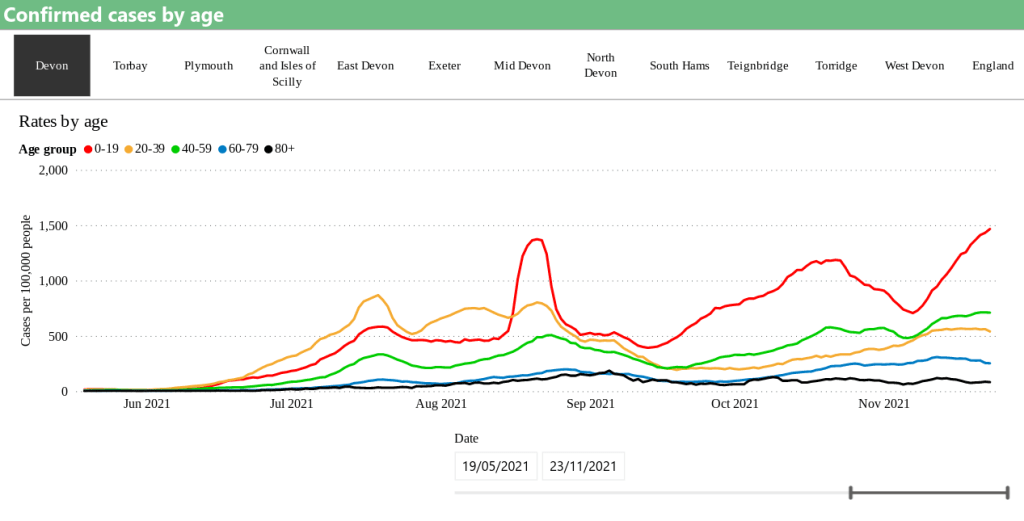
Teenagers in the 16 to 19 bracket are driving an increase in covid cases in North Devon and Torridge, according to Devon’s Director of Public Health.

Alex Davis www.devonlive.com

Steve Brown released a statement today to explain the high rates in the North of the county.

Case rates of coronavirus in Northern Devon are among the highest in the country, with levels in Torridge in particular now reaching 713 cases per 100,000 people, compared to the national average, 364 cases per 100,000.

The figures are from the latest available data, released on the government’s Coronavirus dashboard.

While infection rates are almost twice the national average, Mr Brown said that this has not translated into coronavirus-related hospitalisations or deaths.

Mr Brown said: “Case rates across Devon generally are higher than the national average at the moment, and in all age groups, although the 0 to 19 and 20 to 39 age groups are the highest.

“And although we’re seeing positive cases across a range of settings, it is the high case levels particularly in the 16 to 19, secondary school and college-age people, that are driving the increase to some extent.

“There are a few reasons why North Devon and Torridge may be seeing such high rates.

“Both district areas have, until recently, maintained steady and comparatively low case levels, and with that, therefore relatively lower levels of infection-induced immunity within communities.

“Secondly, testing for coronavirus here in Devon is a lot higher that the national average, so it may be that we are seeing higher levels than elsewhere because we’re identifying them.

“We know that the dominant strain across the UK, and in Devon, is the highly transmissible Delta variant, and that too is driving case levels.

“The good news is that the high case levels are not translating into a significant increase in coronavirus-related hospitalisations, nor deaths. People developing the virus may tend to feel unwell, but are not requiring the medical attention that was once required, and they’re getting better.

“The vaccination programme is undoubtedly helping to keep people from becoming seriously unwell, and I urge everyone to take up the vaccine when they’re eligible to do so, including the third doses and booster doses.

“Testing is still important, as too is self-isolating if you test positive with a PCR test. And following the common sense precautions, remembering that this is an airborne virus, of meeting outside where possible, and ensuring good ventilation if gathering with others indoors; wearing face coverings for other people’s protection when in crowded spaces; and washing your hands regularly.”

Minutes of call with Owen Paterson about Randox contract lost, minister says

Liberal Democrat Alistair Carmichael said: “I wonder if the search by these ministers extends to the shredding room.”

www.independent.co.uk 

No minutes of a key telephone call about a Covid contract awarded to Randox after it employed Owen Paterson as a consultant can be found, a minister says.

MPs were told the failure to “locate” them meant details of the conference call could not be published – just one hour after Boris Johnson bowed to pressure to release details of the contracts.

Labour’s Angela Eagle attacked the “astonishing revelation”, saying: “There have been meetings with no minutes that are official and involve government ministers.”

The Commons Speaker, Lindsay Hoyle, also laid bare his alarm – at the start of a Commons debate on sleaze, in which Labour is attempting to force the release of all records.

Sir Lindsay said accurate record keeping was even more important during the Covid pandemic, telling the minister, Gillian Keegan: “I’m very, very concerned.”

Mr Paterson’s work for Randox is in the spotlight after documents appeared to show the firm was awarded a £133m testing contract despite government officials knowing it did not have enough equipment.

The army had to be drafted in to secure the equipment for the Northern Ireland company that eventually won almost £600m in Covid testing deals

Attention has been focused on a conference call on 9 April last year between Mr Paterson and the conservative peer Lord Bethell, the minister responsible for testing contracts, a week and a half after the first contract.

The Sunday Times reported that the Department of Health and Social Care (DHSC) was refusing to release minutes of the call.

In the Commons, health minister Ms Keegan was asked to commit to releasing details of the phone call – claiming, at first, that only Randox and Mr Paterson would know what was said.

Under pressure, she then switched tack, admitting to “a courtesy call from the minister to Randox”, but told MPs: “We have been unable to locate a formal note of that meeting.”

Ms Keegan said of “other notes that are available”: “In terms of the minutes, I think we’ve said we will publish things here in the library.”

Angela Rayner, Labour’s deputy leader, seized on the comments as an admission “that the government is routinely breaking the ministerial code”.

“When a minister meets an organisation or company an official must be present to keep a record of that meeting,” she tweeted.

Ms Keegan said later the government would sit on its hands in the vote on the release of the Randox contract details, which will allow it to pass with Labour votes.

The government, meanwhile, argued it had not lost the minutes of the Randox meeting, but was unable to find them at present.

But the Liberal Democrat Alistair Carmichael said: “I wonder if the search by these ministers extends to the shredding room.”

Paul Millar: environmental regulation is too weak

Weak regulation has a dreadful impact on our environment

Paul Millar www.exmouthjournal.co.uk

Dear readers, sleaze and sewage have not just been the talk of the Westminster bubble but the streets of Exmouth too.

We have sea waters which only weeks ago, along with Budleigh and 13 other Devon beaches, were judged to be too dirty to swim in. 

We have an MP whose response days later was to vote against a legislative amendment to ensure water companies took ‘all reasonable steps’ to reduce raw sewage discharge into our rivers and oceans. Instead, Simon Jupp last week backed a government amendment which gives water companies carte blanche to do diddly squat. 

Water companies have handed a total of £57 billion to their shareholders in the 30 years since privatisation. Across Europe, only the Czech Republic joins England and Wales in having a fully privatised water industry. 

Our weak regulatory framework allows for dreadful environmental outcomes, as the residents in Clyst St Mary have experienced, with a total of 11 instances of sewage flooding this year, and toilets being out of action for 60 hours at a time. England’s only colony of wild beavers at the River Otter is being affected by raw sewage being discharged from an overflow site further up the river. The Devon Wildlife Trust, which lobbied Mr Jupp to vote for the amendment in question, is monitoring the beaver population but is concerned that species of wildlife have suffered much greater harm. Many local people cannot understand Mr Jupp’s position. What was he thinking? 

The cosy relationship between big players in the water industry and the Conservative Party should be a concern to us all. It might well explain the lack of will and action to tackle the companies’ performance. It is a fact that membership of the European Union forced us to improve environmental standards. It is deeply concerning that we seem to be moving backwards, at a time when protecting our environment has never been more important.

Flybe returns but not based in Exeter

Collapsed Exeter-based airline Flybe is returning to the skies, but its comeback will see its new head office relocated to Birmingham Airport.

Anita Merritt www.devonlive.com

In March 2020, the airline – which had its base at Exeter Airport and also operated flights from Cornwall Airport Newquay – went into administration with all flights grounded as a result.

Disruption to the aviation and travel industry brought on by the coronavirus pandemic were partly blamed for the firm’s collapse.

Its brand, intellectual property, stock and equipment was bought last year for a nominal fee from administrators by global private equity firm Cyrus Capital which was a shareholder in the old business.

Last November, Devon County Council bought the former Flybe Training Academy at Exeter Airport for £4m to transform it into the Future Skills Centre which is being leased by Exeter College.

The 2021 version of Flybe has now announced it is to have a head office and operations centre at Diamond House next to the airport in Solihull.

It is one of the first new UK airlines to be certified by the Civil Aviation Authority since Brexit and said it planned to serve key regions across the UK and EU, with services launching in early 2022.

It expects to create 200 new jobs to be based at Birmingham Airport with a further 400 elsewhere in the country over the next three years.

The new carrier recently installed airline turnaround specialist David Pflieger as its new chief executive who brings experience from senior roles with airlines such as Fiji Airways and Delta.

Mr Pflieger said: “We are thrilled to be partnering with Birmingham Airport, the city of Birmingham and the Mayor of West Midlands to make Birmingham Airport the location of our new headquarters and first crew base.

“It was an ideal choice for us due to its great people and highly skilled workforce, its central UK location and the fact that airport is a global travel hub where local and connecting customers have access to over 150 worldwide destinations.

“Today’s announcement marks the culmination of over 12 months of dedicated hard work by all involved and it would not have been possible without the support of the CAA and the UK Government.

“We plan to provide more information in the coming weeks and months about ticket prices, new routes and destinations and other important news. This is an incredibly exciting time for us and we look forward to sharing more updates in the future.”

Prior to its collapse, Flybe was Europe’s largest regional carrier and flew around eight million passengers a year and employed 2,500 staff.

It was owned by Cyrus Capital alongside Virgin Atlantic and Stobart Group.

Birmingham Airport’s chief executive Nick Barton added: “This is fantastic news for our region’s connectivity needs and it will bring with it some great new employment opportunities.

“Dave’s vast experience in managing start-up airlines and turnaround situations, coupled with the recovery of the Midlands’ economy post-covid, means that Flybe’s return to the skies from Birmingham is a shot in the arm for our airport as well as West Midlands businesses and communities.

“We look forward to working with Dave and his team in preparation for next spring and to launch such a well-known brand here in Birmingham.”

Tory MPs set to revolt against Boris Johnson over ban on lobbying and second jobs

Boris Johnson faces a confrontation with his backbenchers today as he pushes for MPs to be banned from taking on second jobs as consultants.

Steven Swinford,Henry Zeffman, www.thetimes.co.uk

The prime minister gave in yesterday to pressure over sleaze by proposing that MPs be barred from acting as paid political consultants. He also called for a limit on the amount of time MPs can spend on outside interests.

He will push his plans to a vote in the Commons today in an attempt to outflank Labour. The move represents a significant shift in Johnson’s position a fortnight after his botched attempt to block the suspension of Owen Paterson, a former cabinet minister.

There was a backlash yesterday from Tory MPs with outside interests, who accused him of “capitulation”. One said: “It’s pouring petrol on to the flames. He’s caved to the left. Now if you have a consultancy it will be assumed you’re evil.”

Another MP said that Johnson announced the plans because he was concerned about being embarrassed during an appearance before the liaison committee of MPs this afternoon. “There’s a lot of unease. It’s the lurching, the U-turning, the lack of consultation.”

However, the proposals do not bar MPs from taking paid directorships or acting as consultants in non-political roles. Many of the 29 Tory MPs who act as consultants believe that they will be able to continue working because their second jobs are unrelated to parliament.

There was more concern on the back benches about plans to place “reasonable limits” on outside work by MPs to ensure they are focused on their constituents. “It looks very odd,” one senior Tory MP said. “How do you determine how much time people should be spending on something? How do you arbitrate on that? How do you define parliamentary consultancy?”

In a letter to Sir Lindsay Hoyle, the Speaker, Johnson identified two recommendations from a 2018 report by the committee on standards in public life for inclusion in an updated code of conduct for MPs. One of the new provisions would be that “any outside activity undertaken by an MP, whether remunerated or unremunerated, should be within reasonable limits and should not prevent them from fully carrying out their range of duties”.

The move follows criticism of Sir Geoffrey Cox, a former attorney-general, who voted in parliament from the Caribbean while advising the government of the British Virgin Islands in a case brought by the British government.

The other would state that “MPs should not accept any paid work to provide services as a parliamentary strategist, adviser or consultant, for example, advising on parliamentary affairs or on how to influence parliament and its members”.

Johnson published his letter moments before Sir Keir Starmer, the Labour leader, began a speech about his proposals to ban most outside earnings for MPs.

The government’s amendment calls for “cross-party work” to “bring forward recommendations” on changes in line with Johnson’s ideas by the end of January. Unlike Labour’s motion, it does not specify that that work must be completed by the standards committee.

Labour accused the government of “dirty tricks” last night because its amendment does not guarantee parliamentary time for a vote on changing the standards rules next year.

There are 25 politicians who spend the equivalent of at least one working day a week on outside work for which they are paid. Almost one in four Tory MPs spend at least 100 hours a year on their second job.

Chris Bryant, a Labour MP and chairman of the standards committee, which is already looking into the code of conduct, accused Downing Street of “flapping about like a demented chicken”.

Johnson held a Downing Street reception last night for Tory MPs from the 2019 intake during which he apologised for “driving the golf ball into the sandpit” over his handling of the Paterson vote and sleaze allegations.

Sidmouth and Ottery councillors clash over Four Elms Hill roadworks at meeting

Cllr. Stuart Hughes acting as high handed as ever – Owl

Joe Ives, Local Democracy Reporter sidmouth.nub.news

Roadworks at a notorious accident blackspot near Sidmouth are expected to be completed in the next day or two, but a Devon County Council highways chief has been criticised for the “undemocratic” way he’s handled the concerns raised about the road.

Councillor Stuart Hughes (Conservative, Sidmouth), cabinet member for highway management at Devon County Council (DCC), says the roadworks on the A3052 Four Elms Hill near Sidmouth which started on Monday should be completed by Wednesday. The works involve new double-white lines indicating ‘no overtaking’, signs urging motorists to slow down and a skid-resistant surface on parts of the road.

The news will come as a relief to some residents who have been urging the council to improve safety on the stretch of the A3052 by reducing speeding and dangerous overtaking. Councillor Jess Bailey (Independent, Otter Valley) said she will be happy when “the long-overdue works” are done but has criticised the way Cllr Hughes handled the issue at DCC.

Following a request by Cllr Bailey, an update on the works at Four Elms was provided recently by county council officers to members of its East Devon Highways and Traffic Orders Committee (HATOC). Cllr Hughes, who chaired the meeting, did not allow committee members to comment on the update despite a request made by Cllr Bailey.

Cllr Hughes did not allow Councillor Bailey to speak on the issue because she had called for the update and, as it had been given by an officer, “therefore there was nothing to discuss.”

She said she was “gobsmacked” she was denied the right to speak, adding: “I was left, literally, speechless. Cllr Hughes also prevented Cllr Hayward, who is a member of the committee and clerk for Newton Poppleford Parish Councillor, from speaking, too.

“In not allowing me to speak, Cllr Hughes, from the position of chair of the meeting, blocked me from doing my job on behalf of residents.

“It is very disappointing to be treated in such a dismissive way by Cllr Hughes who, as the portfolio holder for highways, sets the tone for his entire department.

Cllr Bailey added: “I think it’s very undemocratic to silence your ward member. If they’ve got a question they should be able to ask it.”

And now to the House of Lords

“The Lords is as central as the Commons to the latest outbreak of “sleaze” headlines, something also highlighted by a prime ministerial spokesperson’s initial refusal to rule out smoothing the exit from the Commons of the disgraced MP Owen Paterson by making him a peer. The Lords element of the story, moreover, has an even clearer underlying plotline: the survival of a part of the British state that has long been absurd and corrupt – and the sense that, as our established institutions are constantly disrupted and disgraced, the public might at last be persuaded to support the idea of doing something about it.”

Fifteen of the last 16 Tory treasurers have been appointed to the Lords, all of whom have donated at least £3m to their party.

Read more here:

The Lords is a scandal in plain sight. If we won’t abolish it now, then when?

John Harris www.theguardian.com 

Michael Gove backer won £164m in PPE contracts after ‘VIP lane’ referral

A Conservative party donor who supported Michael Gove’s Tory leadership bid won £164m in Covid contracts after the minister referred his firm to a “VIP lane” that awarded almost £5bn to companies with political connections, new analysis reveals.

David Conn www.theguardian.com 

The disclosure draws Gove into a furore over alleged cronyism that has led critics to accuse the government of running a “chumocracy” where MPs’ friends, contacts or acquaintances have won huge contracts without proper process or transparency.

Meller Designs, based in Bedford, was awarded six personal protective equipment (PPE) supply contracts worth £164m from the Department of Health and Social Care (DHSC) during the coronavirus pandemic.

Until January this year it was co-owned by David Meller, who has donated nearly £60,000 to the Tory party since 2009. This included £3,250 to support Gove’s party leadership bid in 2016, a campaign on which Meller worked as chair of finance.

When the contracts were awarded, Gove was a minister at the Cabinet Office, which is responsible for government procurement, and in charge of the office of the chancellor of the duchy of Lancaster, which referred Meller Designs for PPE supply.

The company was among 47 awarded contracts for PPE totalling £4.7bn after referrals from politicians and officials, according to a Guardian analysis. Several were linked to MPs, all of them Conservative. Due to the health emergency, many contracts were awarded without competitive tender.

The list of 47 companies awarded contracts via the VIP lane was published by Politico on Tuesday before its official planned release by the DHSC after a freedom of information request by the Good Law Project, which is challenging the propriety of some contracts.

The VIP or “high-priority” route was a fast-track process set up by DHSC procurement teams for offers to supply PPE from companies referred by ministers, MPs, NHS officials or other people with political connections. A report by the National Audit Office last year found that firms referred to the VIP lane had a 10 times greater success rate for securing contracts than companies whose bids were processed via normal channels.

Labour has repeatedly accused the government of favouring people with Tory party connections in the awards of multimillion-pound contracts during the pandemic.

The list of companies includes 18 whose contracts were processed through the fast track after being referred by a Conservative MP, minister or peer. When questions were first asked about the process last year, the government responded that referrals were a way of filtering credible offers that came to MPs and ministers. However, only companies referred by Conservative politicians are on the list of those awarded contracts.

The then health secretary, Matt Hancock, referred four firms subsequently awarded contracts; Andrew Feldman, a health department adviser at the time, referred three of the companies; Theodore Agnew, a Cabinet Office minister, referred three; and the Tory backbenchers Julian Lewis, Andrew Percy, Steve Brine and Esther McVey referred one each.

Another Tory peer, the lingerie businesswoman Michelle Mone, is stated to have referred one company, PPE Medpro, which was awarded two contracts worth £200m via the VIP lane. Corporate services including accounting and directorships were provided to the company by Knox House Trust (KHT), an Isle of Man firm run by Mone’s husband, Douglas Barrowman.

Mone, who made her career and fortune with her Ultimo lingerie company, last year denied to the Guardian via her lawyers that she had “any role or function in PPE Medpro, nor in the process by which contracts were awarded to PPE Medpro”. Mone’s lawyers told the Guardian she maintains her denial of involvement.

Angela Rayner, Labour’s deputy leader and the shadow chancellor of the duchy of Lancaster, said in relation to Gove: “It shows just how engulfed in corruption this government is that the minister in charge of procurement and ensuring that contracts are awarded to the best bidder and represent value for money for the taxpayer was helping his own donor to get VIP fast-track access to contracts.

“It is time this … government published the full details of every PPE and testing contract awarded to companies with links to the Conservative party, Conservative ministers and Conservative MPs.”

A spokesperson for Gove denied that the referral involved any impropriety, saying he passed on offers to supply PPE. “The former minister for the Cabinet Office played no role in the decision to award any PPE contract, and all ministerial interests were properly declared to officials,” they said.

A spokesperson for David Meller said he had nothing to add to a previous statement provided by Meller Designs, which said it had approached the government offering to supply equipment and was “extremely proud” of the role it played in supplying “more than 100m items of PPE”.

The Cabinet Office has refused Freedom of Information Act requests from the Guardian to release correspondence between Meller and Gove during the pandemic.

A lawyer for Mone and Barrowman said: “Baroness Mone is neither an investor, director or shareholder in any way associated with PPE Medpro. She has never had any role or function in PPE Medpro, nor in the process by which contracts were awarded to PPE Medpro.” They added that she did not accept that PPE Medpro was “referred in as alleged” or “that our clients misled anyone”.

The DHSC has stressed that ministers were not involved in decisions to award contracts, and that all company offers referred were subjected to a due diligence process. A government spokesperson said: “At the height of the pandemic there was a desperate need for PPE to protect health and social care staff and the government rightly took swift and decisive action to secure it. Ministers were not involved in awarding contracts.”

Lord Feldman said the companies were referred to him by third parties and he passed them on to officials. He was “neither responsible for nor played any part in the decision to award these contracts … never had any commercial relationship with them or their owners” and “did not request, or indeed know, that these offers has been assigned to the high-priority lane”.

The Cabinet Office said Lord Agnew had been referring on companies that had approached his office. Uniserve said the DHSC had approached it directly and that it had no connections with Agnew.

McVey and Lewis said the companies they referred were local to their constituencies. All other MPs and peers have been contacted for comment.

Farmer Parish spent yesterday dealing with pigs.

Without a division we will never know whether Neil changed his mind, he may not have even been in the chamber for the U-Turn debate. So he may have escaped cleaning out the stables.

Yesterday Neil Parish was at the Commons environment committee where George Eustice, the environment secretary, was giving evidence.

“ The hearing opened with some highly critical questions from Neil Parish, a Conservative, who complained that the visa systems offered by the government were not doing enough to address the serious problems facing farmers. He went on:

All we are doing at the moment is staggering on, as far as I can see. The pig sector is not profitable. Pig prices are on the floor …

A lot of pig farmers will stop keeping pigs, bluntly. Poultry is being reduced. All of these visas are very time limited, and half the time people don’t want to come for a short period.

What gets me so cross is we put in place a system that’s not working. And when the industry doesn’t take it up, you’ll say the industry didn’t take it up, so it’s all the industry’s fault. No, it’s not the industry’s fault.

We’ve got a very good industry which, as far as I can see, we are not actually destroying, but we are actually making it very difficult.

Eustice said he thought the visa scheme should be working for the pig and poultry sector. He also said that pig production had increased by about 7% or 8% this year, and that was part of the reason for the problem of over-supply.”

Boris Johnson proposes ban on MPs working as paid consultants

Is he sincere? Too little, too late! – Owl

Aubrey Allegretti www.theguardian.com 

Boris Johnson has bowed to pressure from Labour to take tougher action against MPs with second jobs, as he sought to avoid haemorrhaging further public support in the wake of sleaze scandals that have engulfed the Conservative party in recent weeks.

The prime minister said MPs who prioritise outside financial interests over their job representing constituents should be investigated and “appropriately punished”, and all MPs should be banned from acting as paid political lobbyists.

The move came at the end of a humiliating episode for Johnson, when, after two weeks, the government finally U-turned on its plan to save the Tory ex-cabinet minister Owen Paterson from suspension by approving a report that found he committed an “egregious” breach of lobbying rules, which it had initially blocked.

MPs’ second jobs have also been in the spotlight recently after it was revealed that the former attorney general Geoffrey Cox had earned hundreds of thousands of pounds for legal work, appeared to use his parliamentary office to attend a hearing remotely, and voted by proxy from the Caribbean.

Johnson wrote to the Commons Speaker on Tuesday, just as the Labour leader, Keir Starmer, was due to give a speech challenging ministers to support a tougher approach to MPs’ outside financial interests.

The prime minister said the MPs’ code of conduct should be updated so their work “continues to command the confidence of the public”, and added that any elected legislator’s “primary role” should be “to serve their constituents”.

Johnson said he supported two recommendations made in a 2018 report by the Committee on Standards in Public Life. The first said MPs should not undertake any extra employment that would “prevent them from carrying out their range of duties”.

The second said MPs should not receive “any paid work to provide services as a parliamentary strategist, adviser or consultant”, for example by advising on “how to influence parliament and its members”.

Johnson said adopting these suggestions would “form the basis of viable approach which could command the confidence of parliamentarians and the public”.

He added it was “a matter of regret” the suggestions made a year before he won the keys to Downing Street had not been implemented already, and voiced his support for them being “adopted as a matter of urgency”.

The move represents an about-turn for Johnson, who has resisted backing calls over the past few weeks for tougher action against MPs’ second jobs.

It is also likely to rile some of the more traditional members of his party, whom Johnson has previously defended and said that their expertise in fields outside politics was actually a positive.

The announcement came as Starmer was preparing to announce an opposition day motion to be put forward in the Commons on Wednesday that called for all of the recommendations of the Committee on Standards in Public Life to be implemented.

When he was told of Johnson’s intervention at a press conference on Tuesday, Starmer said: “So we’ve won the vote tomorrow already.”

Neil, does this give you a clue how to vote this afternoon?

Since you seem to be having difficulty in setting your moral compass, not that Owl would normally recommend following this lot.

According to this latest report from the Guardian:

“Rees-Mogg will have to present the motion on Paterson on Tuesday, with an hour of debate due to follow about the former North Shropshire MP’s conduct. Unlike the motion the previous night that only needed one opponent to defeat it, a simple majority will be enough for it to pass.

It will be a free vote, meaning Tory MPs will not be whipped one way or the other, but they have been told that the chief whip, Mark Spencer, will be voting to endorse the Paterson report, which will put pressure on them to follow suit.

Rees-Mogg was one of the three senior figures – including Spencer and the prime minister – to originally push for Paterson to avoid suspension by overhauling the standards system, partly to introduce the power to appeal for MPs found guilty of wrongdoing.” 

Link:

Rees-Mogg says trying to spare Tory MP from suspension a ‘serious mistake’

Students tell Exeter to cut ties with Chinese university

“The problem is that the partnership was all very much behind closed doors. There wasn’t an independent review process, there wasn’t any scope for the wider university community to input, there wasn’t any transparency about it until it was a fait accompli.”

Charlie Parker, Ben Ellery www.thetimes.co.uk

Exeter University is being urged to cut institutional ties with a Chinese university over its employment of academics considered the “ideological architects” of the oppression of Uighurs.

Students say Exeter may be “complicit in cultural genocide” over its decade-long relationship with Tsinghua University, President Xi’s alma mater.

Senior academics at Tsinghua, considered the “Oxbridge of China”, are said to have laid the ideological foundations of forced assimilation policies.

It has drawn criticism for facilitating the work of Hu Angang, an influential political economist, and Hu Lianhe, a counterterrorism researcher who became a senior Chinese Communist Party (CCP) official.

Hu Angang, director of the university’s Institute for Contemporary China Studies, has argued for the creation of a “unified race” in China and is understood to have significant influence among CCP politburos.

The two academics have written about the failure of multi-ethnic states in other countries and proposed government intervention to eradicate ethnic differences, making them “blend together” into a single “state-race”.

The CCP has adopted at least seven important policy reforms proposed by Hu Angang, according to the Jamestown Foundation, a think tank, suggesting that his ideas on ethnic policy reform are likely to have received “a serious hearing”.

A Freedom of Information request from students in Exeter revealed that one academic from its College of Humanities met Hu Angang in 2016 when giving a talk at Tsinghua.

Tsinghua has partnerships with other leading western universities, including Oxford, Cambridge, Imperial, Harvard and Yale. It was crowned the best university in Asia this year in the World University Rankings.

It is understood to have provided resources to Exeter worth tens of thousands of pounds.

Mark Goodwin, a deputy vice-chancellor at Exeter, and Richard Foord, the university’s acting head and lead on global partnerships, debated the issue with members of the university at a panel hearing last night.

Rahima Mahmut, a Uighur who fled China and is now the UK project director of the World Uighur Congress and an adviser to the Inter-Parliamentary Alliance on China, said all UK universities should review their relationships with Tsinghua, adding that the partnerships “make my blood boil”.

Exeter students associated with the Students For Uighurs campaign began to scrutinise the relationship their university had with Tsinghua this year after the two institutions announced a new joint chair post.

The Freedom of Information request revealed that the universities had signed and repeatedly renewed a memorandum of understanding in 2011 “to facilitate deeper research engagement across a large number of academic disciplines”.

As part of the agreement the universities collaborated in fields including leadership, engineering, data science and artificial intelligence.

Flo Marks, a politics student at Exeter, has led a student protest against the agreement which has won support across the campus as well as from hundreds online.

She is calling for more informal links between the two universities so that collaboration on important subjects could continue between specific scholars and departments while maintaining ethical standards.

One Exeter academic told The Times: “The problem is that the partnership was all very much behind closed doors. There wasn’t an independent review process, there wasn’t any scope for the wider university community to input, there wasn’t any transparency about it until it was a fait accompli.

“There is a reasonable argument that working with an institution that employs Hu Angang is just a red line. If push comes to shove I would probably agree with that.”

Hu Angang and Hu Lianhe took inspiration from the American “melting pot” model, claiming that creating a shared identity helps to maintain “national unity, development vitality and social order”. They described the “fusion” of ethnicities as a matter of national security.

After their paper was published they were met with strong opposition from other Chinese scholars of ethnic policy who argued the government should focus on reining in the heavy-handed policing and discrimination they believed was fuelling divisions.

However, violent incidents in the years that followed intensified calls for the adoption of more extreme measures. Xi became vocal in the debate after terrorist attacks in Beijing and in the southwest city of Kunming in 2014 that Chinese authorities said were carried out by Uighur separatists from Xinjiang.

The government in Xinjiang has since built “unity villages” where Han and minorities live side by side. It has also been increasing efforts to support marriages between Han and Uighurs.

In a written response to questions about the policies, Hu Angang told The Wall Street Journal that compared with other countries “China’s policies towards ethnic minorities and ethnic regions have all been the most successful”.

Charles Parton, a former British diplomat with two decades of experience working on issues in China, Hong Kong and Taiwan, said Hu Angang’s work may have given the CCP “direction” when making policies for ethnic minorities in Xinjiang.

“The specifics of implementation are nothing to do with Hu Angang — he might provide ideological justifications and suggestions,” he said. “He’s well known as an ideologue whom one wouldn’t want to shake hands with too closely.”

However, Parton called for caution over cutting all ties with Tsinghua. “We want relations with China, so there needs to be balance there. Keep Hu Angang at arm’s length to the extent that you can, don’t invite him to Exeter, but if he turns up to a meeting [in Tsinghua] then tolerate him.

“You may not agree with these people but it’s better to talk to them and understand where they’re coming from so that you are in a better place to argue against it.”

An Exeter University spokeswoman said: “No one at the university has collaborated with Hu Angang or Hu Lianhe. University researchers have not worked with Tsinghua researchers on questions of ethnicity, be that ethnicity in Xinjiang, in China or elsewhere.

“Before entering into any new collaboration, the University of Exeter employs robust due diligence processes and ensures that it is following the most up-to-date regulations and guidance from the UK government and Universities UK.

“To date, that advice has been that we should continue our connections with China, as a part of the UK’s extensive education and cultural links with the country. The University of Exeter is implementing recommendations set out in recent Universities UK guidance to all universities on ‘Managing risks in internationalisation: security related issues’.

“In common with other UK universities, the University of Exeter works with wide range of partner universities across the world — including Tsinghua University — on global challenges such as climate science and public health.”

Tsinghua, Hu Angang and Hu Lianhe did not respond to requests for comment.

Aye, No or Abstain? A tricky one for Tories.

Owl is hearing reports that a formal motion to rescind the so-called Leadsom amendment, which looked to establish a review of the MPs standards investigation process and delay Owen Paterson’s suspension for breaking lobbying rules, will now be debated and voted on possibly this afternoon.

Tomorrow Labour intends to table their own “clean up” motion.

It will be interesting to see how many Tory MPs reveal their “true colours” in the debate and subsequent vote – Aye, No, or Abstain?

Work to replace dated Exeter homes to start next year

With 92 new apartments built to Passivhaus standard.

There is a Passivhaus development in Seaton, are there any more in East Devon? – Owl

Anita Merritt www.devonlive.com

Next stage plans have been revealed for dated homes awaiting demolition in Exeter which have become an eyesore in the local area and have been targetted by intruders causing criminal damage.

In February 2020, plans were approved to replace the existing buildings of Whipton Barton House in Vaughan Road, Whipton, with 92 new apartments built to Passivhaus standard.

The new development – created by Exeter City Council-owned development company Exeter City Living – will be called The Gardens. Out of the new homes being built, 60 of the new homes will be affordable and retained as new Council housing, and 32 homes will be for market rent.

The apartments would be arranged in three and four-storey blocks around the perimeter of the site, with a communal garden and play area at its centre.

However, work is yet to commence on the new environmentally-friendly housing project which is currently surrounded by hoardings to keep the site secure.

Repairs to the hoardings were scheduled for installation last month. A main contractor will then start the construction of the new building in spring 2022.

Work is yet to begin at new housing development The Gardens in Vaughan Road, Exeter

Work is yet to begin at new housing development The Gardens in Vaughan Road, Exeter (Image: Exeter City Council)

A number of incidences of anti-social behaviour have been reported at the site, including trespassing and criminal damage.

Exeter City Living has stated on its website: “As a building site it presents a number of potential dangers, and we do not wish for anyone to get hurt.

“While we are keeping the site as secure as we can, any help from the community in identifying intruders will help to keep people safe and assist the police dealing with the situation.”

In the meantime, in a bid to improve the look of the site, colourful artwork has been created on the hoardings during workshops with artist Stuart Crewes, funded by Exeter City Living.

More than 50 pupils from Whipton Barton School and Willowbrook School, plus families at the Beacon Community Centre, participated in the workshops, drawing inspiration from nature and the built environment, and by thinking about what makes a vibrant and healthy place to live.

Cllr Ruth Williams, lead councillor for supporting people, who helped with the coordination of the community artwork, said: “These beautiful artworks are the culmination of a series of workshops with the artist and local community, and the result is fantastic.

Pupils from Whipton Barton School and Willowbrook School have helped to created artwork on the hoardings of The Gardens development site

Pupils from Whipton Barton School and Willowbrook School have helped to created artwork on the hoardings of The Gardens development site (Image: Exeter City Council)

“I know that the people of Whipton will enjoy the artwork and it will be there at the front of this wonderful development, where we will have 92 homes for local people, including 60 council socially-rented homes, and I so happy to see this.”

The site has previously been used to provide single-storey sheltered housing facilities.

The development is part of the council’s wider plans to create 500 new Passivhaus Council homes in Exeter over the next five years.

The Gardens in Vaughan Road, Exeter

The Gardens in Vaughan Road, Exeter (Image: Exeter City Council)

The homes are created to be healthier and more comfortable; where heat regulation costs are reduced and where climate emergency and fuel poverty are tackled head on.

The development will feature a biodiverse green space, built with community in mind. Private gardens, electric car club, electric vehicle hook ups and extensive cycle parking have also been included in the design of the development.

Sleaze – Tory true colours run deep

All it took was one Tory to holler “OBJECT” to block the attempt to reverse the “sleaze” vote. 

But was he taking his lead from the Prime Minister? 

After all, Boris Johnson has refused to apologise for the sleaze row and only admitted that he could have handled the matter better.

So the vote of two weeks ago to create a “kangaroo court”, stuffed with conservative MPs, to review standards still stands!  – Owl

PM fails to stifle sleaze scandal as ratification of Paterson report blocked

Aubrey Allegretti www.theguardian.com 

Boris Johnson’s attempt to draw a line under the sleaze scandal engulfing the Conservative party fell apart after a Tory MP blocked parliament endorsing a report that found a former colleague committed an egregious breach of lobbying rules.

The backbencher Christopher Chope was named by multiple sources as the person who objected to ratifying the findings about Owen Paterson’s behaviour which followed a two-year investigation by the Commons standards watchdog.

The government had tried to shunt the vote to the end of the day but put forward a motion that only one MP needed to object to in order for it to fail. In a deeply embarrassing move for the prime minister, one Tory cried out “object” late on Monday night – prolonging the resolution of the issue that has prompted some MPs to warn tensions are “frighteningly high” within the Conservative party.

Chris Bryant, a Labour MP and chair of the standards committee, said he had been assured the motion would be retabled on Tuesday with a one-hour debate to try again to endorse the Paterson report. Chope was contacted for comment.

Fury from Tories exploded at the issue being prolonged, with a minister telling the Guardian: “He has been for many year a Jurassic embarrassment – tonight he crossed a line. The man should retire and the executive are livid. If he comes into the team room tomorrow, colleagues would want to say two words to him and the second word would be ‘off’.”

A former minister said: “The fact we can’t deselect these people is baffling”, while a frontbencher called Chope “a selfish twat”. Backbenchers complained it would “make a bad situation even worse”, and expressed severe disappointment it was “handing Labour a freebie”.

Meanwhile, the shadow Commons leader, Thangam Debbonaire, said the “farce was of the Tories’ own making and serves Johnson right for trying to sneak a U-turn out at night rather than do the decent thing and come to the house to apologise”.

It came hours after Kwasi Kwarteng apologised to parliament’s standards commissioner for casting doubt on her future in the role earlier this month.

The business secretary wrote to Kathryn Stone saying he regretted his choice of words and recognised that ministers must adhere to high standards that treat others with consideration and respect.

“I did not mean to express doubt about your ability to discharge your role and I apologise for any upset or distress my choice of words may have caused,” he said.

Kwarteng made the comments in a broadcast interview as he was sent out to defend the government’s bid to overhaul the standards regime and spare Paterson a six-week Commons suspension.

He told Sky News: “I think it’s difficult to see what the future of the commissioner is, given the fact that we’re reviewing the process, and we’re overturning and trying to reform this whole process, but it’s up to the commissioner to decide her position.”

Just hours later, the government U-turned on its efforts to undermine the system that regulates the actions of MPs, as Johnson agreed to let the parliamentary standards committee come up with its own proposals for reform.

Tory MPs had already been whipped to vote in favour of reforming the system in a way that would let Paterson off the hook, but the government has since agreed to reverse that parliamentary decision.

After the motion narrowly passed on 3 November, ministers privately vented their fury and a public backlash forced the prime minister to U-turn.

Johnson promised to retract the motion that set up a new committee that would have been chaired by a Tory MP and reviewed the existing processes for investigating sleaze claims.

The humiliating climbdown led to Paterson resigning as MP for North Shropshire, and sparked a close examination of other lawmakers’ second jobs and outside interests.

In the nearly two weeks since, many in Johnson’s party have vented their frustration at yet another “unforced error” by Downing Street that has potentially cost them a lead in the polls and seen their faith in Johnson diminish further.

One former cabinet minister said there was still widespread unhappiness in the parliamentary party, with particular ire about the way the chief whip had been “hung out to dry” when the decision had ultimately been Johnson’s.

He said the preference of many Conservative MPs would have been to plea for leniency for Paterson, who has always denied wrongdoing, rather than letting him off altogether, but those MPs suggested that course had been ignored.

Planning applications validated by EDDC for week beginning 1 November

Covid: Biggest drop in cases since start of winter wave

covid.joinzoe.com 

According to ZOE COVID Study incidence figures, in total there are currently  72,546 new daily symptomatic cases of COVID in the UK on average, based on PCR and LFT test data from up to five days ago [*]. A decrease of 18% from 88,592 new daily cases last week. 

In the vaccinated population (at least two doses) cases are dropping more slowly and it’s estimated there are currently 24,766 new daily symptomatic cases in the UK. A decrease of 11.5% from 27,980 new daily cases last week (Graph 1). 

The UK R value is estimated to be around 0.9 and regional R values are; England, 0.9, Wales, 0.9, Scotland, 1.0 (Table 1). 

The ZOE incidence data is always a week ahead of the other surveillance surveys and continues to work as an early warning signal. The ZOE data has been reporting a downturn in cases for the past two weeks, the latest ONS figures are yet to reflect this trend. (Graph 5). 

In terms of prevalence, on average 1 in 58 people in the UK currently have symptomatic COVID. In the regions, England, 1 in 57. Wales,1 in 47. Scotland, 1 in 84. (Table 1). 

The number of daily new cases continues to show a steep decline in cases among 0-18 year olds, which is the driving group behind both the initial increases and the recent fall in overall case numbers. Cases in 20-29 year olds are still increasing but cases have started to fall in the 35-55 year age group. Cases among those over 55 are levelling off. (Graph 2).

In terms of prevalence, cases are highest in the Midlands, South East and North East but prevalence is falling in those areas (Graph 3). 

ZOE’s predicted Long COVID incidence rate currently estimates, at current case rates, 1,279 people a day will go on to experience symptoms for longer than 12 weeks. This number continues to fall in line with the overall incidence figures (Graph 4). 

The ZOE COVID Study incidence figures (new symptomatic cases) are based on reports from around 750,000 thousand weekly contributors and the proportion of newly symptomatic users who have received positive swab tests. The latest survey figures were based on data from 40,100 recent swab tests done between 23 October and 6 November 2021. 

Professor Tim Spector, lead scientist on the ZOE COVID Study app, comments on the latest data:

“This drop in cases is the largest weekly decline we’ve seen all year, and is being driven by a sustained fall in cases among children over the last two weeks. However, cases are still high and, worryingly, we’re still seeing high death rates as COVID takes up to 8% of hospital beds. 

As we head into the colder months, we’re seeing a lot of sickness in the population with widespread outbreaks of colds and still high levels of COVID. Knowing the difference between the two is harder than ever, as cases in the vaccinated are mild and include symptoms like sneezing, headache and a runny nose and can be easily transmitted to family members or work colleagues. To keep numbers down it’s crucial for everyone eligible to get their booster jabs, even if they have recently had a COVID infection, as we’ve shown natural infections do not always produce an immune response and protection. We know from our research that the vaccines (given in 3 doses) provide the greatest possible protection against contracting the virus, and being admitted to hospital with more serious symptoms.”

Graph 1. The ZOE COVID Study UK incidence figures results over time; total number of new cases and new cases in fully vaccinated

Graph 2. Incidence by age group 

Graph 3. Prevalence rate by region

Graph 4. Predicted Long COVID incidence over time

Please refer to the publication by Thompson at al. (2021) for details on how long covid rates in the population are modelled

Graph 5. A comparison of prevalence figures; ZOE COVID Study, and other COVID surveillance studies

Table 1. Incidence (daily new symptomatic cases)[*], R values and prevalence regional breakdown table 

Map of UK prevalence figures