
Levelling up: Getting on with the job!

Work started on October 1 to create three miles of dual carriageway to by-pass the single lane bottleneck winding up Camel Hill on the A303 between Sparkford and Ilchester. That still leaves over 35 miles of the A303 to Exeter with only a single lane carriageway.
“Not only will it enhance capacity, cut journey times and improve road safety, but as we continue to build back better from the pandemic this project will provide a real boost to the local economy in Somerset and the surrounding region – creating jobs, improving access to housing and opening the region up to the rest of the country.” Roads Minister Baroness Vere.
“Getting on with the job”. At this rate how long will it take to finish the remaining 35 miles? – Owl
Tim Dixon www.midweekherald.co.uk
Work is now under way to improve a major route from London and the South East into East Devon.
The £135 million road scheme will upgrade the A303 between Sparkford and Ilchester, providing a major boost to the South West’s economy, improving local journeys and making roads safer.
A ceremony on October 1 marked the start of the works, which will create a high quality, dual carriageway on this congested stretch of the A303.
This multi-million-pound major project is managed by National Highways and funded entirely by the Department for Transport as part of the Road Investment Strategy.
Roads Minister Baroness Vere said: “We’ve provided £135 million to make this scheme a reality, and this is a fantastic moment for the South West as works get under way.
“Not only will it enhance capacity, cut journey times and improve road safety, but as we continue to build back better from the pandemic this project will provide a real boost to the local economy in Somerset and the surrounding region – creating jobs, improving access to housing and opening the region up to the rest of the country.”
Hannah Sanderson, Programme Manager for National Highways, said: “We are really pleased that we are now starting this long-awaited project in earnest.
“The scheme is incredibly important for Somerset’s future, vital to the A303 / A358 corridor and it’s exciting that work is finally under way.
“The three new miles of dual carriageway will support economic growth and facilitate a growth in jobs and housing by creating a free-flowing and reliable connection between the South East and South West.
“It will also tackle a long-standing bottleneck, reduce journey times to the South West and improve traffic flows in that area at peak times and during peak seasons.”
Somerset County Council’s Cabinet Member for Economic Development Cllr David Hall added: “It’s really satisfying to see work commence on this vital scheme, which is so important for Somerset’s economy and future growth.
“We’ve worked really had to promote the need for this investment and we’re delighted to be supporting National Highways as they deliver these much-needed improvements.”
On an average day, the A303 between Sparkford and Ilchester carries 23,500 vehicles, but numbers increase significantly in the summer, particularly at weekends, making journeys unreliable and unpredictable.
With construction now officially under way, the upgrade is scheduled to be open to traffic in spring 2024 and you can find out more about the scheme and the construction process on our virtual exhibition which you can access via our webpage – https://highwaysengland.co.uk/our-work/south-west/a303-sparkford-to-ilchester/
The upgrade aims to:
improve the capacity of the road to reduce delays and queues that occur during peak hours and at key times of the year i.e. the height of summer
support economic growth, facilitating growth in jobs and housing by providing a free-flowing and reliable connection between the South East and the South West
make the road safer, by providing additional capacity and reducing driver stress. We’ll make routes safer for pedestrians, cyclists, horse riders in the area
protect the environment and look for opportunities to improve it, minimising any unnecessary impact of the scheme on the surrounding natural and historic environment and landscape
work with local communities to reduce the impact of the road and look for ways to improve local peoples’ quality of life
make journey times more reliable and resilient; by providing more capacity it will become easier to manage traffic when incidents occur
Current work is all about preparing the ground for construction, with traffic management not planned until early next year and minimal disruption to 2021 holiday traffic, especially around Christmas.
Main construction work will get under way in 2022, with closures kept to a minimum throughout the scheme. For those wishing to remain informed, a text alert system will be launching next year.
Further along the A303 / A358 corridor, a consultation will be launching on the A358 on the 12 October, with National Highways welcoming your views on the new designs.
Boris Johnson has sparked outrage on the eve of the Conservative Party conference after saying “never mind” about cancer death rates and the recent fall in life expectancy.
Grilled about his plans for Britain’s recovery from the Covid crisis, the prime minister chose to emphasise economic growth over health measures.
Pointing to the recent growth in wages, Mr Johnson told the BBC: “I’ve given you the most important metric – never mind life expectancy, never mind cancer outcomes – look at wage growth.”
Opposition parties pounced on the prime minister’s remarks, with Labour accusing him of showing an “outrageous” disregard for the health of British citizens.
Shadow health secretary Jonathan Ashworth told The Independent: “Boris Johnson starts his conference with the most chilling words ever spoken from a prime minister dismissing the importance of cancer outcomes.”
The Labour MP added: “If cancer incidence and survival rates across the poorest matched the wealthier there would be 19,000 fewer deaths per year. Life expectancy has stalled for those in the poorest areas.
“There is no levelling up without levelling up health. It’s now clearer than ever that all Boris Johnson offers is just glib words and no action.”
The SNP’s Ian Blackford also shared the clip of Mr Johnson’s comments in an interview with BBC Northern Ireland. “Every citizen should see this insight into the thinking of our PM,” said the party’s Westminster leader.
Mr Blackford claimed the prime minister was “literally prepared to sacrifice our health”.
Dr Clive Peedle, a consultant clinical oncologist and NHS campaigner, said: “As a cancer doctor in the North East of England, I find Boris Johnson’s comments abhorrent.”
The NHS cancer specialist added: “Wage growth is only beneficial if wealth inequality is addressed, but his government has no intention of tackling this.”
Macmillan Cancer Support also responded to Mr Johnson’s remarks. “People facing the fear and trauma caused by disruption to their cancer treatment and care need to know that they are at the top of the government’s priority list and cannot be forgotten,” said Steven McIntosh, an executive director at the charity.
He added: “Any measure of ‘levelling up’ for our country must focus on urgent progress for people facing delayed cancer care, poorer cancer experience or outcomes.”
Among the many Labour MPs sharing the clip of Mr Johnson’s BBC interview, left-wing stalwart Ian Lavery tweeted: “Ghastly appalling disregard for our people.”
Labour frontbencher Wes Streeting – the shadow secretary for child poverty – said millions of people do mind about cancer outcomes. “This is stomach-turning, insightful and outrageous,” he tweeted on Mr Johnson’s remarks.
Life expectancy for men has fallen for the first time since records began, government figures revealed in September – as the higher-than-usual deaths caused by the pandemic begin to make an impact.
More than half a million cancer patients are missing out on vital healthcare support due to severe staff shortages across the NHS, new research from Macmillan Cancer Support revealed last month.
One in four people who were diagnosed with cancer in the last two years have gone without proper support from a specialist nurse during that time, equating to roughly 630,000 patients, the charity said.
The row over health measures comes as Mr Johnson drafts in a former senior military commander to carry out a far-ranging overhaul of leadership in the NHS and social care sector.
The government said General Sir Gordon Messenger, an ex-vice chief of the defence staff, would conduct the most far-reaching review the sector in England has seen in 40 years.
Elsewhere in his interview with BBC Northern Ireland, Mr Johnson said the Northern Ireland Protocol “could in principle work” but it will be a case of “fixing it or ditching it”.
The prime minister did not rule out triggering Article 16 to suspend the crucial part of his Brexit deal with the EU. Asked if he planned to trigger Article 16 during the Conservative Party conference next week, Mr Johnson replied: “That depends on the response from the EU.”
As Tories head to Conference the Mirror breaks these two stories
Quarter of Johnson Cabinet took Russia-linked cash as Tories head to Conference
Donors offered cosy dinner with ministers for £4,000 a table at Tory Conference
“There is a pattern here, if we’re only willing to see it. A populist government hobbling those bodies that exist to keep it in check, trampling on democratic conventions and long-held rights, all to tighten its own grip on power. We need to recognise it, even when it wears a smile and tousled hair, and speaks in the soothing cadences of Eton College.”
Jonathan Freedland www.theguardian.com
If this wasn’t us, how would we describe it? If this was Viktor Orbán’s Hungary, or Poland, what language might we use? Would an announcer on the BBC World Service declare: “Amid fuel and food shortages, the government has moved to cement its grip on power. It’s taking action against the courts, shrinking their ability to hold the ruling party to account, curbing citizens’ right to protest and imposing new rules that would gag whistleblowers and sharply restrict freedom of the press. It’s also moving against election monitors while changing voting rules, which observers say will hurt beleaguered opposition groups … ”
It doesn’t sound like us. We like to tell ourselves that we live in a mature democracy, our institutions deep rooted. Political competition is brisk, never more so than at this time of year, as one party conference ends and another begins. This is not a one-party state. All it would require is Labour to get its act together – to which end it made a decent start this week – and, with a fair wind, the Conservatives would be out.
It’s a consoling thought, but not a reliable one. Almost unnoticed, perhaps because it’s done with an English rather than a Hungarian accent, our populist, nationalist prime minister is steadily setting out to weaken the institutions that define a liberal democracy: the ones that might act as checks and balances on him. And he’s moving, Orbán style, to make it ever harder for his government to lose power.
Start with the courts. After all, that’s what Boris Johnson did. It seems petty to suggest that he is out for revenge after the supreme court delivered an 11-0 humiliation over his unlawful suspension of parliament in 2019, but Johnson is acting like a man determined to settle a score.
He set his sights early on a bill to reform judicial review, the process by which courts can overturn unlawful decisions by the government and others. The language is less overt than it was, but that bill stays true to its initial aim of declaring entire categories of government action off limits to judges – and it explicitly bans a particular, 11th-hour form of judicial review often used in immigration cases. No wonder the Law Society has been sounding the alarm, warning of a threat to essential curbs on “the might of the state”.
If that enrages you, think twice before taking to the streets. Under the new police bill, ministers will have the power to suppress pretty well any protest they don’t like. It makes it a crime, punishable by up to 10 years in jail, merely to cause “serious annoyance” to the public. The police will be able to clamp down on a demonstration, or ban it altogether, on the flimsiest basis. If they deem a demo sufficiently loud to cause someone in the vicinity “serious unease”, that would be enough.
Of course, no one goes on a march unless they know about whatever outrage the government or others has committed. That can take a whistleblower or journalist or both, and Johnson is moving against them too. He wants to widen the scope of the Official Secrets Act, applying it to more areas of government activity and increasing the punishment for breaking it. Crucially, he refuses to add any kind of public interest defence for journalists or their sources. Even the Sun calls the move a “licence for cover-up”, adding that a society where journalists and whistleblowers face jail even over leaks that are clearly in the public interest is “in the grip of oppression”.
But Johnson is bent not only on preventing his government from being held to account. More sinister, he is taking steps to ensure it can’t easily be replaced. He wants to tilt the playing field of electoral competition permanently in the government’s favour, and his first target is the referee.
The Conservatives’ elections bill hands ministers powers over what has, until now, been an independent Electoral Commission. Suddenly, ministers will be able to deploy the commission as they see fit, using it to define what counts as election campaigning. A minister could order the commission to impose a criminal penalty on a group that had been campaigning for, say, higher NHS pay, six months before an election was called, by retroactively defining that effort as election spending. It’s not hard to imagine ministers using that power selectively to hurt their opponents. Little wonder that an alliance of charities and trade unions, convened by the Best for Britain group, has called the change “an attack on the UK’s proud democratic tradition and some of our most fundamental rights”.
The same bill would require voters to show photo ID before being handed a ballot, a remedy for the nonexistent problem of voter fraud – and a practice known to exclude poorer voters less likely to back the Conservatives. Meanwhile, note who got the money from a £1bn fund set aside by the government for struggling towns: in a remarkable coincidence, 39 of the 45 towns chosen are in constituencies with a Conservative MP, even when that meant cash going to a Tory-held seat rather than the poorer place next door. That looks a lot like using public money as an electoral war chest to keep Tory seats Tory.
And let’s not forget a trick straight out of the Orbán or Donald Trump playbook. Ofcom, like the Electoral Commission, is meant to be independent. But Johnson persists in his determination to install in the chair an ideological ally: the former Daily Mail editor Paul Dacre.
There is a pattern here, if we’re only willing to see it. A populist government hobbling those bodies that exist to keep it in check, trampling on democratic conventions and long-held rights, all to tighten its own grip on power. We need to recognise it, even when it wears a smile and tousled hair, and speaks in the soothing cadences of Eton College.
A room cancellation due to the fuel crisis was the last straw for pub owners in Devon who said they have been affected by the consequences of Brexit, the pingdemic and house prices every day.
“Build back better – Getting on with the job”. This year’s slogans at the Tory Party Conference – Owl
Charlotte Becquart www.devonlive.com
The owners of the Bull Inn in Totnes decided to post a rant on their pub’s social media after the fuel shortage England has been experiencing because of people panic buying prevented guests from enjoying a weekend stay in the Devon pub.
They said it’s another blow for the pub which has been hit by alcohol and staff shortage for a while due to a range of issues currently affecting the country.
They wrote: “We have a cancellation! Due to fuel! – See RANT below – Can you ruddy believe! Anyway Room 4, a gorgeous super king room, with a bath, is now free for this weekend, until Monday. If it sells via Insta I’ll give the booker/bookee/bookster (I think they are actually called a guest!) a complimentary meal for two, which I reckon is what it would cost for fuel from here to London/midlands/ maybe even Manchester! And if you come on the train I’ll add a bottle of fizz.
“Now the rant. This post is in part an opportunity to dig at the government and the media for creating chaos through a) the shortage of workers and b) stirring up bloody hysteria. I mean seriously, this is one tiny inconsequential impact, rooms chop and change all the time but when all the impacts on our business seem to have be created or mismanaged into existence and exasperated by the bunch of donkeys we’ve got governing us it becomes infuriating and depressing.
“Every day of the week we are dealing with something directly connected to this sh*t show, whether it’s booze not turning up (no drivers/deliveries slowed at border) staff off ad infinitum (pingdemic/baffling ever changing guidelines = endless risk assessments/rota changes) to staff shortages (Brexit/ house or rental prices meaning you can’t afford to live where they bloody live!). Oh, I could go on, but I won’t, not now but me and Geetie are determined to start being more vocal about all the things that matter to us, as we all should. “
Pubs and the hospitality industry have been hit hard since the start of the coronavirus pandemic.
They had to deal with successive lockdowns and restrictions, the pingdemic which saw staff having to self-isolate countless times, and supply issues due to slower border controls and a shortage of drivers linked to Brexit.
Now pubs are also impacted by the fuel crisis. From Monday, military drivers will be deployed to deliver fuel to forecourts as the crisis at the pumps continues.
Almost 200 military personnel – including 100 drivers – have been undertaking training at haulier sites and will start deliveries to help relieve the situation at petrol stations, which ministers insist is stabilising, PA reports.
The Government also announced that a temporary visa scheme for nearly 5,000 foreign food haulage drivers that was due to expire on December 24 will now be extended to the end of February.
The Petrol Retailers Association (PRA) – representing independent filling stations – warned queues at forecourts were set to continue unless fuel supplies increased, and said the independents had been particularly hard hit.
Welcome to the One Million Pound Club.
By Chris Mason Political correspondent, BBC News www.bbc.co.uk
To make the top ten donors to the Conservative Party since Boris Johnson became prime minister, you need to have stumped up a seven figure sum.
At the top of the chart, by a considerable margin, the providers of one of the most memorable political images of the last few years.
Boris Johnson at the wheel of a JCB, a polystyrene wall smashed, his ‘Get Brexit Done’ slogan in the mechanical shovel.
JC Bamford Excavators Limited has given just over £2.5m in the last two years. Lord Bamford, the chairman of the family owned company, has personally given £100,000 since 2010, when the Conservatives returned to government. He became a Conservative peer in 2013.
I’ve been trying to find out what motivates people to give money to the Conservative Party, how do they choose how much to give and how do they measure if it is worth it?
Incidentally, I put all these questions to JCB, but Lord Bamford didn’t want to talk to me. That, of course, is his prerogative – what he chooses to do with his own money is his own business.
But collectively, these are important questions to explore – for they offer an insight into how our governing party is bankrolled, and by whom.
It is also a window into the world of the super-rich, what motivates them to donate, and the context of some stark and big numbers you might occasionally read about.
So who is willing to talk publicly?
Access
“It is a perfectly reasonable thing to ask about.”
Meet Alasdair Locke, a veteran of the shipping and oil and gas industries, and a multimillionaire.
“They will put you in everything you want,” he says, when I ask what he gets in return.
Mr Locke has agreed to talk to me on the record, where others said they would speak to me, but only if I protect their identity.
He has donated £280,000 to the Conservative Party since Boris Johnson became prime minister.
Electoral Commission rules mean any donation over £7,500 to a party has to be reported by that party, and the figure and the donor will be published.
“I can get access via the Leaders Group. It is usually senior ministers and 15 or 20 people. Sometimes in person. Sometimes on Zoom. The last thing I attended was a lunch with Michael Gove in July. It was all donors who were there.”
To become a member of the Leaders Group, you have to have donated £50,000 in the last year.
Two to three lunches a week are arranged, to which around a dozen donors are invited.
Groups don’t tend to be bigger than this, to ensure all those who turn up get a chance to feel part of something that isn’t impersonal.
Some donors are very regular attendees, others don’t come to any.
Does this amount to buying access, and influence?
“It is interesting, but I’m not sure we are that influential. Politicking doesn’t really interest or excite me. I would reckon I do get heard, but I don’t expect it to be acted upon,” Mr Locke says.
“Politicians are always cautious, in any case. At the lunch with Michael Gove, I asked about trade relations with the US. There was no attempt by any of us to influence policy.”
Mr Locke was drawn into political donations by a “strong conviction” for keeping Scotland in the United Kingdom.
“I started off with the Conservatives when they were facing oblivion in Scotland. I am an old fashioned One Nation Tory, there wouldn’t be much between me and centrists in the Labour Party.
“I wanted to support the centre right unionist party. I wanted to move the Scottish Conservatives away from the patrician tweedy layered image, to involve people who people would vote for,” he tells me.
He is a big fan of the Scottish Conservative Leader Douglas Ross, and Baroness Davidson, a predecessor.
It is not just the Leaders Group that donors can be a member of.
There is the Treasurers Group, for those who have given £25,000, although I am told plenty of prospective members can be tempted to upgrade to the Leaders Group, as those with a spare 25 grand rattling around can often afford to double it.
There is then the Advisory Board, for those who have given £250,000 or more in the last year.
Transparency
But how transparent is this?
The short answer: not very.
Yes, there is the legal obligation for donors’ names and how much they have given to be published.
But what they actually get for that money is much, much less clear, and less clear than it used to be.
Back in 2012, there was a big row about the then Conservative co-treasurer, Peter Cruddas.
He resigned as party co-treasurer after The Sunday Times suggested he was offering access to then Prime Minister David Cameron for a donation of £250,000 a year.
But the following year he won £180,000 in damages in a libel victory against the newspaper.
The newspaper’s appeal succeeded in part and the damages were later reduced to £50,000.
Peter Cruddas is sixth in the league table of Conservative donors since Boris Johnson became prime minister, having given £1.1m.
In December last year, Mr Johnson nominated him for a peerage, against the advice of The Lords Appointments Commission, describing the earlier allegations as “historic and untrue”.
After the row in 2012, David Cameron decided greater transparency was the answer, even if some internally felt donors were already being told they would be named by the Electoral Commission and a further step was unnecessary.
But Mr Cameron pressed ahead, and the Tories began to publish a public register of donors who attended private dinners with the then-PM.
But then, in 2018, they stopped. And there has been nothing since.
The former housing secretary Robert Jenrick got caught up in one of the most awkward of political binds possible with a donor last year.
He found himself sitting next to businessman Richard Desmond at a Conservative fundraiser.
Mr Jenrick said he regretted the contact and Downing Street supported him, at the time.
He was sacked from the cabinet this month; one minister telling me his dismissal was far too late – he should have been shown the door a year earlier.
A Conservative spokesperson didn’t address the question of the register straight on, but they did say: “Donations and donors to the party are declared to and published by the Electoral Commission as required by the law and this is freely and openly available on the Electoral Commission’s website.”
So what do donors get for their money?
“It does give me the chance to speak to some people,” a very significant donor tells me privately.
This includes chances to speak to the prime minister and chancellor, as the Financial Times reported over the summer.
But, when I ask if this represents value for money, I’m told: “I’m not sure how you measure it, to tell you the truth. It doesn’t amount to being involved in making policy.”
This is where we get into a fascinating subtlety about very rich people and what they do with their money.
This same donor offers an insight that all of my conversations tacked back to: he said his – by any conventional metric – vast donations to the Conservative Party, amounted to “barely a flicker” compared to the sums involved in the charitable work he does.
This single example of giving is matched by the picture more broadly. The Conservative Party generates around £25m a year. Charities, collectively in the UK, are a multi billion pound sector, with around 50 generating more than £100m a year.
Motives
Some inside the party ponder how giving money to any political party could be perceived to be more noble, as a contribution to public life, rather than so often raising awkward and, usually, unanswered questions.
Should party political donations be treated like donations to charity, which are subject to tax relief, called Gift Aid?
Maybe, argue some, while acknowledging it would look self serving and so politically awkward.
But let’s get back to what motivates people to give money.
Beyond access to ministers, and, for some, eventually, maybe a knighthood or a seat in the House of Lords (although their other work, in industry or for charity, might qualify them for this anyway), there is an X factor available here too.
Auctioning off a weekend for two at a plush hotel in the Lake District doesn’t tick any boxes for a donor who may just own that hotel anyway.
But offer them a dinner at which the prime minister is speaking and there is, perhaps, a near equivalent in terms of social cachet to said donor having spent vast sums having a stratospherically famous rock star play privately at their 60th birthday party.
Or there might be an auction lot for something with next to no monetary value, but which offers a rich anecdote.
I’m told of one such auction, where a speech the prime minister was yet to even give was to be sold off and might fetch around £1,500.
Think this through: it’s a pile of A4 paper with words printed on it, which, by the time you receive it, is already in the public domain, and has been merely garnished with a prime ministerial scrawl, his signature.
It might even turn out to be a speech which you barely agree with a word of. Or a complete dud.
But, to those for whom material purchases have little added value, because they have all they could ever want, something that can hang on the back of a toilet door and comes with a story, and a smiley picture of you and the prime minister, might just be tempting.
An alternative?
Questions will forever swirl about political parties and how they are funded.
Where does the money comes from, who is giving it, how much, and to whom? Who are the donors? Why are they doing it, what are they getting out of it?
The alternative, many people I spoke to said, was state funding of political parties: asking the taxpayer to pick up the tab for politics.
In the grand scheme of public spending, the cost of this would be minimal, but most political parties would probably think twice, or more than twice, before attempting to sell the merits of a potential voter picking up their tab.
As one donor said: “It doesn’t always look good. It really doesn’t. But, intellectually, it is the least bad way of funding political parties.”
And a Conservative spokesperson points out that the party is funded by membership, fundraising and donation, which are properly and transparently declared to the Electoral Commission, published, and comply with the law.
“Fundraising is a legitimate part of the democratic process. The alternative is more taxpayer-funding of political campaigning, which would mean less money for frontline services like schools, police and hospitals.”

Leading Devon councillors say it is ‘terrifying’ that almost three-quarters of privately owned properties that were rented out just two years ago in the county are no longer available for tenants.
An open meeting of the Team Devon local outbreak engagement board has heard that around 70 per cent of private rental properties have left the market in the two years up to July 2021. The figures exclude Torbay and Plymouth, which are outside the Devon County Council administrative area.
Keri Denton, the county council’s head of economy, enterprise and skills, told members reductions are more prevalent in parts of the county such as North Devon, Torridge and West Devon where there are higher levels of second-home ownership, she said: “A number of private rentals are turning up as Airbnbs and that’s obviously a decision for the homeowner, but it is placing pressure on our ability to attracting a workforce and offering housing to support those key sectors that we’re short in to support our economic recovery.”
Councillor Alistair Dewhirst (Liberal Democrat, Ipplepen), deputy leader of Teignbridge District Council, expressed his shock at the figure, adding: “It’s just such a staggering figure that I was just really taken aback.”
Councillor John Hart (Conservative, Bickleigh & Wembury), leader of Devon County Council, responded: “It is quite terrifying, and Airbnb’s got a lot to answer for, I keep saying that, without the controls that they ought to have.”
After the meeting, cllr Hart said in a statement: “Having a buoyant private rental market is important to the Devon economy as it provides much needed accommodation for workers, so to hear that the private rental market has shrunk by around 70 per cent compared to pre-pandemic levels, is quite terrifying.
“And if teachers, nurses and young professionals were turning down opportunities to work here because there’s no accommodation to rent, that’s got to change.
“We know that with the current popularity of the staycation, a lot of private landlords have shifted their properties to become short term holiday rentals. Whether that shift is long term, or opportunistic for as long as holidaying at home is popular, is yet to be seen.
“Granted, tourism to the county brings in a lot of income to our retail, leisure and hospitality sectors, but we need to find the right balance. One that makes sure that good housing is available for rent by workers and their families in the county; while also providing attractive holiday accommodation to keep tourists coming back.”
Speaking after the meeting, cllr Dewhirst said: “I am shocked. I think we are all shocked. Everybody I understand in the trade is amazed at what has happened in the housing market. I understand that estate agents are experiencing levels of business they’ve never known before, many have beaten all their targets for this year already.”
Cllr Dewhirst admitted he doesn’t know why private rentals had fallen so substantially across Devon, but said: “I’d like to hope that this isn’t down to people like Airbnb as it were gobbling up the market.”
He pointed to measures in Teignbridge to help address the shortfall, which include the building of new council homes and a major regeneration project in Newton Abbot that was approved last week.
Oliver Williams, director of Exeter-based Robert Williams Estate Agents, said he was “very surprised” by the figure based on the company’s own portfolio, which hasn’t seen large amounts of landlords selling their rental properties.
“What we have seen is a massive increase in demand, which has definitely led to a shortage of properties and lots of tenants being unable to find new properties.”
Asked whether landlords had shifted rented homes over to Airbnb, Mr Williams said: “It is something we’ve seen to a certain extent. We actually also have a business that manages Airbnb properties and have had a few of our landlord clients move their properties over to that model.
“I wouldn’t say it’s an excessive amount because it’s dependent on the particular type of property for that market, but potentially over the county maybe there is a shift in that direction.”
He added the lack of supply had ‘definitely forced rental prices up’, and questioned how many new homes being built were then being made available as rental stock.
The Office for National Statistics this week announced the average cost of rent in the south west increased by 2.6 per cent in the year to August, more than double the 1.2 per cent increase for the whole of the UK, while the fall in supply was most widespread in the south west, east and west Midlands.
The figures also revealed that eight per cent of properties in the South Hams [1 in 12] are now second homes, with the number four per cent in North Devon and East Devon [1 in 25].
Airbnb were approached for a comment but had not issued a response at the time of publication.
Local residents, councillors and other members of the community have been invited to a public consultation for a solar farm north of Whimple in East Devon.
So far Owl has been unable to find the acreage involved or the quality of agricultural land involved. The outline on the map gives a perspective, looks as big as Whimple.
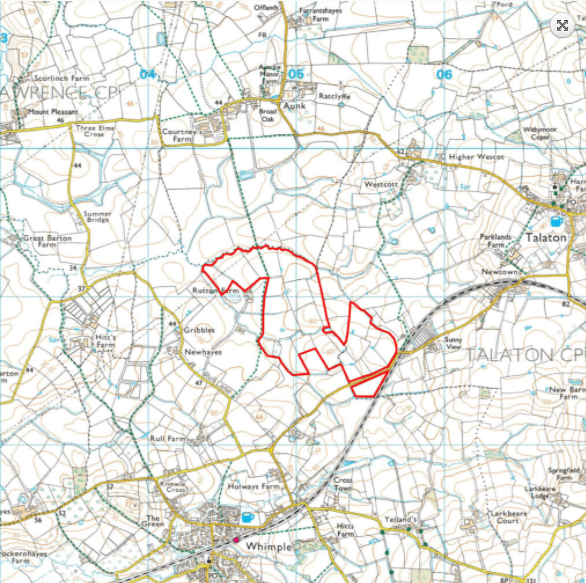
The proposed development by Aura Power is for a subsidy-free solar farm of up to 49.9 MW capacity that would generate enough renewable electricity to supply the equivalent of over 12,000 typical homes or to power 18,000 electric vehicles annually. It would save an estimated 11,500 tonnes of CO2 per year, making a substantial contribution to local and national net zero targets.
East Devon Council has declared a Climate Emergency and has a target to become carbon neutral by 2040. Solar is ideally suited to the area which is one of the sunniest parts of the UK.
Aura Power is holding two public consultation events about its plans: a virtual consultation online, using the Zoom webinar platform, on Tuesday 12th October 2021 at 6pm, followed by a drop-in face-to-face event and public exhibition on Wednesday 20th October 5.30 – 8.30pm at Whimple Victory Hall, EX5 2TS.
Both events will provide an opportunity for local people to view the proposals, ask questions and provide feedback to the Aura project team, which Aura will take into account before submitting its planning application.
Those interested in attending the webinar will need to register in advance, via the following link on the Aura Power website: www.aurapower.co.uk/horton-solar-farm
Chris Featonby, UK Development Manager, Aura Power, said: “The recent rise in fossil-fuel energy prices has underlined the importance of increasing the amount of renewable energy we generate in the UK. With its sunny climate, Devon is ideal for producing solar power which is one of the lowest costs forms of new energy generation, helping bring down costs for everyone.
“The site we are proposing for Horton solar farm is well suited for this type of development with limited visual impact on nearby homes. We will also be providing a community benefit fund with a total value over £700,000 for the solar farm’s life and are keen to learn more about local priorities and projects that might benefit from the funding. By offering a choice of virtual and physical consultation events, we hope that as many local residents as possible will be able to see our plans and provide their feedback.”
The site is well screened with existing hedgerows. A range of ecological measures are also proposed, including species-rich wildflower meadows around the panels, and additional native tree planting and hedgerow enhancement both for improved screening and to boost biodiversity.
Aura is also planning to set up a Community Benefit Fund of £17,500 a year, index-linked (based on £350 per MW capacity), for the 40-year life of the solar farm. A proportion of this would be set aside for yearly educational sessions with local schools and site visits to the solar farm.
Around 1,000 invitations have been sent out by post to local people living near the proposed site.
Separate beauty competitions for multiple ring-fenced pots of gold judged on the quality of the images in glossy brochures; presentation over substance – what not to like?
No mention of the surely now “dead duck” LEPs. – Owl
Josh Halliday www.theguardian.com
Ministers must stop making council leaders “plead on bended knee” for vital funds if “levelling up” is to work, the government’s infrastructure adviser has said.
Sir John Armitt, the chair of the UK’s National Infrastructure Commission, said town halls in England should be given £30bn to spend on transport projects over the next five years.
In what will be read as a message to Michael Gove, the new secretary of state for levelling up, he called for a radical change to the “inefficient and ineffective” system of councils bidding for multiple pots of ringfenced money from Whitehall.
He said: “It will be quite a radical change, I accept that. But we’ve had a secretary of state just moving into MHCLG [the now-rebranded Department of Levelling Up, Housing and Communities] who is known for having radical thoughts and challenging the status quo, so hopefully this won’t land on deaf ears.”
Armitt, who previously ran the body that delivered the London Olympic Games, said the government should axe the 15 different funding streams for local transport and instead hand more spending and powers to England’s 74 county and unitary authorities.
In what would be the biggest change to local government funding in decades, he suggested giving each council mayoral powers over transport and overall funding of £6bn a year to develop long-term transport plans over the next five years.
This would equate to a 40% increase in the budget for England’s buses and trains outside London.
Neil O’Brien, the MP who is writing a white paper on levelling up to be published within weeks, became a minister at the DLUHC along with Gove during the reshuffle.
Levelling up is the cornerstone of Boris Johnson’s domestic policy but the announcements so far have failed to match the rhetoric.
The appointments of Gove and O’Brien – as well as that of Nadhim Zahawi as education secretary – have given local leaders hope that the prime minister will soon announce bold policies to help close the gap between London and the rest of the UK, rather than the piecemeal funds and woolly speeches that have typified the programme so far.
Johnson has hinted vaguely at elected mayors, such as those who represent big urban areas such as the West Midlands and Greater Manchester, being extended to counties and towns but only in areas deemed pro-business.
Armitt said suburban areas and towns, home to 31 million people in England, were being held back because Whitehall controls the purse strings. “Local leaders have got to go and plead on bended knee with London to get the money to be able to deliver what they promised at a local level,” he said.
“The devolution on a regular basis of funds to the regions and local authorities just seems to be the obvious way to go.”
The National Infrastructure Commission is the government’s adviser on large-scale projects and is an executive arm of the Treasury.
In a report published last week, which was commissioned by the government in March, the body said ministers “need to pivot away from a reliance on centrally controlled pots of money for which councils must compete”.
Armitt said the “prize” for Johnson’s government was to be able to show at the next election that it was committed to improving life chances by devolving powers and money to the local level.
“I don’t think anybody’s in disagreement here. It’s one of those questions of, is the spirit willing and the flesh weak? Well, in this case we want the flesh to be strong and not weak,” he added.
Planning permission has been granted for 12 new gleaming [glamping?] pods and three new holiday lodges in the Otter Valley in East Devon.
Against the local plan and within the Blackdown Hills AONB. When are we going to focus on building a sustainable economy supporting high paid jobs? Because tourism doesn’t do it. – Owl
Joe Ives www.devonlive.com
The new facilities will expand Otter Falls, a holiday park in that already offers cottages and luxury lodges.
The accommodation will be built along with parking – including two electric vehicle charging points- landscaping, access and drainage improvements.
The development technically goes against the local plan as it is within the Blackdown Hills Area of Outstanding Natural Beauty (AONB) which prohibits new developments there.
However, East Devon District councillors argued that any downsides of the new pods and lodges could be mitigated.

An artist impression of how the glamping pods will look (Image: : Living Outside LTD)
They granted planning permission on the condition that no light pollution arises and that the new pods and lodges will be be short enough to be mostly hidden by surrounding trees,
Cllr Philip Skinner said: “Although it looks like it could fly in the face of some of our policies, in actual fact when you look at it in the grand scale of things it really doesn’t.”
“What we’re trying to create in the AONB is an environment people can enjoy.”
Cllr David Key added that some local residents were concerned by the new holiday accommodation but said he did not think the area would be too affected by the extra traffic.
The planning committee, like all EDDC meetings, was held online as a ‘consultative’ meeting.
As the law allowing councils to meet virtually ended on 7 May, official decisions now can’t be made virtually, but once an ‘indicative’ decision is made by the council on Zoom, it passes to the chief executive or senior officers to make the final decision, although they are assumed to back whatever the committee decides.
According to ZOE COVID Study incidence figures, in total there are currently 58,126 new daily symptomatic cases of COVID in the UK on average, based on PCR and LFT test data from up to five days ago [*]. An increase of 22% from 45,081 new daily cases last week.
In the fully vaccinated population, it’s estimated there are currently 14,352 new daily symptomatic cases in the UK. Cases in this group have slightly increased from 13,118 cases last week (Graph 1).
In terms of prevalence, on average 1 in 93 people in the UK currently have symptomatic COVID (Table 1).
Across the different age groups, there has been an uptick in the number of active cases in people aged 20-50, but cases continue to increase most in the under 19s. Cases remain low and stable in contributors over the age of 50 (Graph 2).
The UK R value is estimated to be around 1.1 and regional R values are; England, 1.1, Wales, 1.1, Scotland, 1.0 (Table 1). Prevalence figures in the regions show that all regions are currently seeing an uptick in new cases, particularly in Wales, which after having some of the lowest levels, now has the highest number of cases (Graph 3).
ZOE’s predicted Long COVID incidence rate currently estimates, at current case rates, 804 people a day will go on to experience symptoms for longer than 12 weeks (Graph 4).
The ZOE COVID Study incidence figures (new symptomatic cases) are based on reports from around 750,000 thousand weekly contributors and the proportion of newly symptomatic users who have received positive swab tests. The latest survey figures were based on data from 39,742 recent swab tests done between 11th and 25th September 2021.
Professor Tim Spector, lead scientist on the ZOE COVID Study app, comments on the latest data:
“While the latest ZOE data shows new cases are up on last week, it’s encouraging to see national hospitalisation rates falling as we approach winter. While most cases are still in the young, we’re seeing infections being passed up the generational ladder, likely from school children to their parents. Most of these new adult infections are in the under 50s, who still have a relatively low risk of being admitted to hospital, especially if they’ve been fully vaccinated.
As the winter approaches, it’s important parents of school-aged children and students don’t pass the virus on to more vulnerable grandparents by not recognising simple cold-like symptoms as a possible COVID infection. This is a critical time and a little caution could make all the difference in avoiding a winter crisis for hospitals.”
Graph 1. The ZOE COVID Study UK incidence figures results over time; total number of new cases and new cases in fully vaccinated

Graph 2. Prevalence by age group

Graph 3. Prevalence by region

Graph 4. Predicted Long COVID incidence over time
Please refer to the publication by Thompson at al. (2021) for details on how long covid rates in the population are modelled

Table 1. Incidence (daily new symptomatic cases)[*], R values and prevalence regional breakdown table

Map of UK prevalence figures

A leading Labour mayor has suggested that Devon and Cornwall should be next to get an elected regional leader, but the idea has been rejected by people from the counties.
Edward Oldfield www.cornwalllive.com
Andy Burnham, the mayor of Greater Manchester who challenged the Government over lockdown funding, made the suggestion during a discussion on devolution at the Labour conference in Brighton.
The idea for a metro mayor covering the peninsula was greeted with big cheers in the hall, according to political journalist Jennifer Williams.
But replies to her tweet about the proposal were less enthusiastic, with one asking: “A single mayor? How would they decide how to correctly add jam and cream when the mayor had scones?”
And the suggestion was rejected outright by Dick Cole, councillor for St Enoder on Cornwall Council and the leader of Mebyon Kernow, the left-of-centre Cornish nationalist party.
Mr Cole said: “Andy Burnham is completely wrong to suggest that there should be a metro mayor for Cornwall, linked on a geographical basis with the English county of Devon.
“Cornwall needs proper devolution, we need a national assembly or parliament like the other Celtic parts of the UK, like Scotland and Wales. I would remind Andy Burnham that 20 years ago 50,000 signed declarations calling for a Cornish Assembly, which were totally ignored by the Labour Party at that time.
“It is a terrible shame that Cornwall has not achieved devolution, not least through their lack of interest, and perhaps now is the time for them to back serious calls for proper Cornish devolution.”
The issue of central government handing over more power to local authorities is likely to form part of the ‘levelling up’ agenda, now in the hands of Communities Secretary Michael Gove who took on responsibility in the prime minister’s recent cabinet reshuffle.
The Government is expected to publish a white paper setting out its plans before Christmas, but it is unclear whether they will include creating more regional combined authorities, led by ‘metro mayors’.
Cornwall already has some devolved responsibilities granted in 2015, giving its single-tier council more control over areas including health and social care, transport, employment and skills, and business support.
Devon has a mixture of top-tier councils for Plymouth and Torbay, and a two-tier system of the county council and eight districts covering the rest of the area.
In Torbay, voters scrapped the post of elected mayor after a decade in 2016, and opted instead for a leader and cabinet system.
On economic development, Devon is lumped together with Somerset in the Heart of the South West Local Enterprise Partnership, one of 38 in England set up to lead economic growth.
Its role includes handing out government cash to support road building across the region.
Plymouth Labour MP Luke Pollard, the Shadow Environment Secretary, said mayors like Andy Burnham had shown how they could stand up for their region, but he was unsure whether adding another politician into the mix was the answer for Devon and Cornwall.
The MP for Sutton and Devonport called for a debate about securing more funding for the region, and added: “Instead of creating a new politician, let’s get the current politicians that we have to stop voting for cuts and start campaigning for us to get our fair share of funding.”
He said children in the South West received £300 per pupil less than the national average and the region was “bottom of the national league” for transport investment.
East Devon Labour councillor Paul Millar has called for the Greater Exeter region to get a metro mayor, to take strategic decisions on issues such as public transport in the wider area.
His proposal followed the collapse of talks to create a Greater Exeter Strategic Plan for the city and the area covered Teignbridge, Mid and East Devon.
The two-tier system of local government in Devon is believed to be next in line for reorganisation, following the streamlining of councils in Dorset and Somerset.
The closest regional mayor is Labour’s Dan Norris, elected in May as the Metro Mayor for the West of England Combined Authority, covering Bath and North East Somerset, Bristol and South Gloucestershire.
The authority was set up in 2017 and says it has secured a total of £1.15billion of new funding for the region to deliver decisions using devolved powers on homes, transport, skills and the economy.
An influential report by the UK’s infrastructure advisers has urged ministers to overhaul the current funding system and give local authorities five-year infrastructure budgets instead of having to compete for funding.
The National Infrastructure Commission (NIC) report said: “Failure to empower local authorities to deliver local infrastructure will lead the Government to fail in its levelling up goals.”
It recommended streamlining around 15 sources of funding into two, creating five-year flexible budgets based on population and network size, plus a targeted scheme for areas with poor transport connections or the potential for new industries.
It suggested around £6billion a year could be made available for local transport investment outside London in the next five years, up by 40 per cent compared to last year.
Commissioner Bridget Rosewell said: “Levelling up cannot be done from Whitehall.
“Every English town faces a different set of challenges and opportunities and local leaders are best placed to develop strategies to address these.
“Competing against other councils for multiple pots of cash creates a focus on the short term, continual uncertainty, and burns up staff time.
“Local councils need to be empowered to deliver transformational plans for the future and held accountable for doing so.”
Councillor David Renard, economy spokesperson for the Local Government Association, said: “Reducing and simplifying the number of funding streams available to councils and providing long-term certainty will help councils plan and deliver better transport and connectivity across the country.”
Second-home owners in Cornwall accessed funds to the tune of £170 million intended to help businesses weather the Covid crisis — and almost 62 per cent of the cash went to people who live outside the county.
Plus the Council and local community miss out on council tax and business rates.
Also don’t forget the lack of accommodation for long-term rent and the whole question of affordability. – Owl
Will Humphries, Southwest Correspondent www.thetimes.co.uk
Tensions between Cornish locals and wealthy out-of-towners who own second homes in the county have been steadily rising — and the influx of tourists this summer has not helped relations.
The row has intensified after it emerged yesterday that second-home owners in Cornwall accessed funds to the tune of £170 million intended to help businesses weather the Covid crisis — and almost 62 per cent of the cash went to people who live outside the county.
Second-home ownership has resulted in many locals being priced out of the area and at a council meeting yesterday Andrew George, a Liberal Democrat councillor, demanded that £100 million of Covid grants that went to those living outside the county should be paid back.
He said the money should be returned by those who use their second homes in Cornwall as an “investment or leisure toy” and instead be used to tackle the “housing emergency” in Cornwall.
“It is time the government sought to recover these monies and ensured they are deployed to address the shocking circumstances of local families suffering the housing emergency,” he added.
Malcolm Bell, chief executive of Visit Cornwall, said he was “not happy with it … a minority did return their money but it’s such a minority it’s not worth commenting about.”
To further ruffle feathers, second-home owners who put their properties up for rent as registered holiday lets can separately apply for small business rates relief and as a result do not end up paying business rates or council tax.
David Harris, deputy leader of Cornwall council, said yesterday that this benefit was “just wrong and unfair”.
During the meeting it was revealed that there are 13,255 second homes recorded on its council tax database with 11,081 holiday lets registered for business rates and 8,953 getting business rates relief.
It was also revealed that 61.8 per cent of the holiday lets in Cornwall that claim small business rates relief and received Covid grants were registered to people living outside Cornwall.
Harris told the meeting he had made “very strong representations” to the government that the Covid grants should not “just be paid out automatically to these holiday let businesses”.
But, he added: “Unfortunately civil servants in London didn’t agree with me and I got nowhere.”
It has previously been claimed that Cornwall misses out on as much as £10 million a year as a result of holiday homes not paying council tax or business rates.
The government announced this year that it would close a loophole that enables second-home and holiday let owners to avoid paying council tax and business rates.
The growth in popularity of homes in Cornwall shows no signs of abating. Among the celebrities to own property are Dame Judi Dench, who owns a house near St Ives.
The seaside town of Fowey this month voted to ban people buying new-build homes as second properties.
Jo Ashby, a director at estate agent John Bray and Partners, said at the time there has been an “explosion” in interest in the past 18 months.
Rebecca Hemingway, from Fowey Folk Museum, added: “There’s nobody with a view of the sea that’s local — maybe one.
“It’s too late to do anything about the second homes situation now — it would be nice for the community if there were more affordable homes.
“There’s a handful at the top, but not enough.”
Don’t say ‘panic’ amid fuel crisis, Cabinet Office warns councils
By Ben Weisz www.bbc.co.uk
The government has advised councils not to use the phrases “panic” or “panic buying” about fuel supply problems, documents seen by the BBC reveal.
Slides prepared by the Cabinet Office’s Behavioural Science Team also advised against using language that morally judges people buying petrol.
A Green Party council leader called the recommendations “nonsensical”.
The government said it worked “closely with councils… on communications to encourage a co-ordinated response.”
The advice sent to local authorities from central government comes after days of long queues at petrol stations which began after fears a lorry driver shortage would hit fuel supplies triggered a surge in demand.
On Wednesday the government deployed a reserve tanker feet to boost deliveries and Business Secretary Kwasi Kwarteng insisted the situation was “stabilising”.
In a power point presentation marked “official sensitive” the Cabinet Office warns against using the terms “panic”, “panic buying” and “stockpiling”.
The document – labelled “considerations for local authorities” – explains that people don’t recognise their own behaviour as “panic buying” and that the use of such phrases can cause panic which can become contagious.
Instead it recommends using phrases like “filling up earlier than usual” or “changed patterns in demand”.
Other tips include avoiding language that morally judges those queuing for petrol as “framing all individuals who stock up as ‘selfish’ or ‘irrational’ is likely to receive some backlash”.
“Framing people buying excess fuel as ‘taking away from those who need it/ the NHS etc.’ is likely to lead to them feeling like their freedom has been threatened, leading them to more readily engage in ‘panic buying’ behaviour,” the document says.
The advice also says councils could encourage petrol stations to take down signs saying “abuse will not be tolerated” – which could lead customers to expect confrontation on arrival.
Speaking to BBC Radio Sussex, Phélim Mac Cafferty, the Green Party leader of Brighton and Hove City Council said the recommendations amounted to asking councils to “help the government cover up the fuel crisis”.
“Instead of guidance to help us, help our communities navigate the fuel crisis, we have been given platitudes.
“This is beyond not good enough. It’s a disgrace.”
Covid cases have risen in some parts of Devon, ending weeks of gradual falls in infections.
Ollie Heptinstall, local democracy reporter www.radioexe.co.uk
In the week to Thursday 23 September, infecitons increased by 20 per cent in both the Devon County Council area and Plymouth, but fell slightly in Torbay.
Devon’s number of cases per 100,000 people now stands at 258, while the respective figures for Torquay and Plymouth are 275 and 319. By comparison, the UK average is now 351.
Whilst that means at ‘top tier’ level, all three parts of Devon are below the national average, it masks the picture at district council level. Of the county’s eight district areas, South Hams recorded the biggest rise of 75 per cent, putting the area’s infection rate above the national average at 378 cases per 100,000.
Teignbridge and West Devon also had increases of around 35 per cent, but their infection rates remain below the UK-wide figure. East Devon mirrored the county with cases here going up by a fifth.
Elsewhere, Torridge and Mid Devon registered the only falls in Devon, and even these were modest drops of 13 and five per cent respectively. Mid Devon’s infection rate of 169 is now the lowest in the county and around half that of the national average.
Last week, Devon’s director of public health said there had been an increase in infections in educational settings, which was being replicated across the country. Secondary school and college students are being instructed to wear face coverings in communal areas for a further two weeks.
However, Steve Brown added there is unlikely to be an extension to the current covid enhanced response area for Devon and Cornwall, which ends this Friday [1 October].
HOSPITALISATIONS
Prior to this update there had been a steady drop in infections, leading to a slight reduction in the number of people being treated for covid in Devon’s hospitals. That number is again down on last week – by 31.
Latest figures for Tuesday 21 September show 97 covid patients in the county’s hospitals, 41 of which are at Derriford in Plymouth, 28 at the RD&E, 16 in Torbay and 12 in North Devon. Of the total number of patients, ten are on mechanical ventilation beds.
DEATHS
Fourteen more people died in the county within 28 days of testing positive for covid in the latest complete weekly period (up to Wednesday 22 September). Eleven were in the Devon County Council area, two in Plymouth and one in Torbay.
A total of 1,210 people in Devon (including Plymouth and Torbay) have died within 28 days of a positive test since the pandemic began.
VACCINATIONS
Government figures for vaccinations now include people aged 16 and over.
The number of people who have received at least one dose of a vaccine is now 87 per cent in the Devon County Council area, 86 per cent in Torbay and 84 per cent in Plymouth.
The proportion of people who are now fully vaccinated with both jabs is now 82 per cent in Devon, 79 per cent in Torbay and 77 per cent in Plymouth.
Owl has received these considered observations on the latest planning details submitted on the reserved matters on the Winslade Park development:
We have carefully worked through the detailed planning applications for Zone A (old Plymouth Brethren field) and Zone D (the 3 x blocks of flats).
Having been part of the campaign team for seven years, this was far from what we fought for and was contrary to the Local Plan, Neighbourhood Plan and Strategy 26B of East Devon’s Plan.
However, as we know, the Councillors that make up the Planning Committee voted to accept the outline planning application for Winslade Park on the economic and employment benefits that it will bring to the area. So far we haven’t heard or seen too much evidence of this, however the Manor House has been beautifully refurbished, although a little pricey.
We remain concerned for residents that have houses that back onto Zone A. Should the proposals get the go ahead the roofs of the new houses will tower above the bungalows, with the chimneys above the ridge lines. The backs of the proposed houses will overlook the properties in Clyst Valley Road. These proposed houses don’t meet and are contrary to the Bishops Clyst Neighbourhood Plan.
Some of the proposed gardens appear to encroach into and beyond the tree line. We believe these areas need amending or at least objecting to.
Zone D appears to totally contradict the Bishops Clyst Neighbourhood Plan. There appears that little design has gone into these apartments and they still appear to resemble Lego blocks, far from the quality development that should be adjacent to a Grade II* listed Manor. The apartment blocks are planned to be four storeys tall and will significantly tower over the backs of the houses in Clyst Valley Road, resulting in loss of privacy for a number of residents within our estate. This cannot be claimed to be, in any way, appropriate for a village in the countryside and more akin to the likes of Exeter City centre.
The Parish Council have arranged a meeting on Wednesday 6 th October at 19.30 for any residents that want to attend. It’s going to be held in Clyst St Mary Church (due to Covid we can’t use the school hall and the village hall is unavailable.) Please come along and give your views to the Parish Council.
Formal comments to planningwest@eastdevon.gov.uk by 14 th October quoting reference 21/2235/MRES for Zone A, and 21/2217/MRES for Zone D. It is always important that you state clearly whether your comment is in support, an objection or neutral.
It’s all kicking off in Torbay
Fierce row about who should be on committee
[If anyone can track down the Zoom recording, please drop Owl a link].
Joe Ives, local democracy reporter www.radioexe.co.uk
A Torbay Council meeting desended into disarray this week as councillors took an hour to decide not to have a vote.
Along the way, they created a procedural row that left one clerk too upset to continue with their duties.
In a meeting which had echoes of the famous ‘Jackie Weaver’ incident at Handforth Parish Council that went viral earlier this year, Torbay members engaged in a fierce hour-long debate over who could or could not be a member of a new group set up to scrutinise the council’s efforts at addressing its housing crisis.
The argument arose over a disagreement over how politically balanced the committee should be.
Councillors had been sent an email inviting them to join the committee, but problems began when the response turned out better than expected. Normally, scrutiny panels struggle to attract enough councillors to join up, but with housing being such a key issue in the Bay, many councillors were eager to take part.
This meant that an agenda listed three Liberal Democrats, two independents and seven Conservative councillors as members.
Fearing that the panel would be politically unbalanced (the overall council is run by a coalition of Lib Dems and independents, although the Conservatives have the largest number of councillors), Lib Dem overview and scrutiny co-ordinator Margaret Douglas-Dunbar (Clifton with Maidenway) held discussions and told group leaders to put forward a limited number of candidates of their choosing.
The measure was meant to create a political balance reflecting the makeup of the council with three Liberal Democrat nominees, three Conservative nominees and two independents. The move was rejected by the Conservatives, who felt it was an unfair attempt to move the goalposts and that it would give their members too little input into the scrutiny process. Leader of the Conservative group councillor David Thomas (Preston), said the request was sent too late and did not put forward any nominees.
Panel chairwoman Councillor Hazel Foster (Conservative) attempted to start the meeting with a vote to ratify the membership as printed on the agenda. Liberal Democrats were up in arms, arguing that such a move should not go ahead, given the request to form a politically balanced council.
A vote was started by Cllr Foster but was quickly interrupted when Councillor Mandy Darling (Liberal Democrat, Tormohun) questioned the democratic process saying: “I don’t recognise this and I will not be a part of this.”
It was to set the tone of a fierce back-and-forth between councillors which quickly spiralled out of control. Chris Lewis (Conservative, Preston) said: “If this went public people would be amazed that we’re arguing about this. All members want to do the best for our community in Torbay.”
At one point, a council clerk, who is not allowed to be involved in political debates, was put in the crossfire when she was asked to weigh in. After being placed in an impossible position, the clerk became visibly distressed and was granted permission to step out of the meeting.
The moment sparked even more bitterness. When Councillor Foster attempted again to proceed with the vote, Cllr Karen Kennedy (Independent Group, Churston with Galmpton), who wanted the meeting to be reconvened, was furious. She said: “I think it’s totally and utterly unacceptable to put a member of the council staff in a situation like this where they clearly are very very upset.
“This is out of order and it’s close to bullying and harassment. I don’t agree with what’s going on at all. It’s unfair, it’s unkind.”
Council chief executive Anne-Marie Bond was eventually drafted into the meeting, held over Zoom, to help councillors reach a consensus.
As the hour mark approached it was decided the meeting could carry on without a panel and that group leaders would agree on the make-up of the scrutiny panel before the next meeting.
Only then did invited guests finally get to discuss the housing crisis, but by then the subject had been largely overshadowed.
It’s thought more than 1,400 households are awaiting affordable accommodation in the Bay, with demand quickly outstripping any new supply. Earlier this month, the council rented all 47 rooms of The Richmond Hotel in Torquay to provide a ‘circuit breaker’ for some of its housing pressures.
In August, the council’s leadership split opinion in its coalition when said it would not directly provide housing to Afghan refugees because of the Bay’s accommodation shortage. It subsequently launched a campaign trying to encourage landlords to provide homes but still says it won’t provide council homes to refugees fleeing the Taliban.
Torbay Council has yet to release the footage of the Zoom meeting, but is expected to do so as it generally publishes all public meetings after a few days.
The end of the temporary £20 a week uplift in universal credit payments is expected to affect 30,000 households in Devon.
Ollie Heptinstall www.midweekherald.co.uk
The figure, which excludes Torbay and Plymouth, was revealed at a virtual meeting of the Team Devon local outbreak engagement board this week, made up of local authorities including the county council, police and NHS.
Presenting the economy briefing compiled in August, Keri Denton, the council’s head of economy, enterprise and skills, told members the end of the uplift would amount to a reduction of £31 million in support to families.
“Obviously the greater impact will be on the lowest income households, and obviously they tend to be in our areas of deprivation. And that will have consequences for the health and the social wellbeing of our residents, some of the demand we’re seeing appear in the health system,” she said.
However, Ms Denton described the number of universal credit claimants in the county as ‘rapidly reducing,’ going down from five per cent in May 2020 to 3.6 per cent in June 2021.
The briefing adds there is “anecdotal evidence (so far) of highly significant increases (doubling in some instances) in food bank usage in Devon during the pandemic lockdown periods and more widely worry about food insecurity, especially among those with children.”
Following the meeting, Councillor Alistair Dewhirst said the number of households impacted by the end of the £20 uplift was “absolutely terrible.” He describes poverty as a major issue.
“At the Devon County Council scrutiny committee I chair, we decided to put poverty on our list of urgent actions to look at.
He added: “I think it’s very interesting that [on Thursday] I understand the prime minister was put on the spot and asked if he could live on universal credit and he refused to answer that.”
Speaking to reporters on a visit to the United States, Mr Johnson said: “I have every sympathy with people who are finding it tough and I really really do, but I think we have to recognise that in order to maintain the covid uplift you‘ve got to find another five or six billion in tax, that would have to come out of people’s pockets.”
 East Devon Watch