UK government spent half a million pounds on lawyers to fight FOI disclosures

Exclusive: Government accused of ‘wasting time and taxpayers’ money’ after spending heavily on legal challenges to prevent Freedom of Information releases

Jenna Corderoy www.opendemocracy.net

The UK government has spent at least half a million pounds on legal fees trying to prevent the release of information under Freedom of Information (FOI) legislation over the last five years, openDemocracy can reveal.

At least six government departments spent heavily on legal challenges to decisions from the information regulator, the Information Commissioner’s Office, to release information in response to FOI requests.

The Department of Health and Social Care spent almost half a million pounds on legal costs challenging decisions from the ICO that they must release information FOI, including spending more than £129,000 fighting on a single case, to try and stop the release of ministerial diaries. Eventually, a judge ruled that most of the information should be released, against the wishes of the government.

Elsewhere, the Department for Work and Pensions launched three appeals against ICO decisions since 2018, spending more than £80,000, while the Department for Education has racked up a bill of more than £52,000.

Get dark money out of UK politics

Sign our petition to tell the government to tighten electoral laws and shine more light on political donations. We need to know who is giving what to our political parties.

The fees included outside counsel as well as the cost of lawyers from the Government’s Legal Department. Some of the cases are still on going but in most the government was ultimately forced to release the information.

Commenting on openDemocracy’s findings, Duncan Hames, director of policy at Transparency International UK, said: “These figures will no doubt come as a shock to taxpayers who have effectively bankrolled these attempts to obstruct the public’s right to know.

“The government should stop wasting time and taxpayer money opposing legitimate freedom of information requests and do what it’s required to by the law,” he added.

I expect that for the government, spending £20,000 to make a journalist give up is good value

The Department of Health and Social Care (DHSC) spent £13,000 trying to avoid having to disclose the register of interests of its special advisers to The Times. 

In another case, DHSC spent £20,000 trying to stop journalist Sid Ryan from obtaining information about fire safety in hospitals. Ryan was told his Freedom of Information request was “vexatious”, but a tribunal disagreed and ruled against the government.

The tribunal recognised Ryan’s work as having serious purpose and value. But during the appeal, a witness for the Department of Health said: “The department’s view (which I share) is that Mr Ryan is trying to prove a conspiracy theory of his own.” It was suggested that the department should apologise to Ryan for making that remark.

Ryan left journalism shortly after the tribunal. He told openDemocracy: “The process was so slow, so physically and mentally draining for the requester and to be branded as vexatious and a conspiracy theorist after all that work was deeply upsetting.

“For me, that whole process was a complete waste of time. But I expect that from the government’s perspective, spending £20,000 to make an investigative journalist give up is very good value for money.”

7DHJi-uk-government-spent-half-a-million-pounds-to-fight-foi-disclosures (6).png

openDemocracy. All rights reserved

The Ministry of Housing, Communities and Local Government spent £38,950 trying to block a request from another journalist, who had asked to see copies of official ministerial diaries. The ICO ruled that the information should have been released, but the department appealed to the tribunal.

The appeal was later dismissed, and internal communications obtained by The Guardian revealed how the government knew it had little chance of succeeding.

Other government departments were unable to tell openDemocracy how much they had spent on appeals, claiming that it would cost too much to investigate and provide figures. This includes the Cabinet Office, which runs a controversial Clearing House unit that vets FOI responses from across government.

News of the scale of government spending to avoid transparency comes ahead of a parliamentary inquiry into Freedom of Information launched in the wake of openDemocracy’s revelations about the Clearing House.

openDemocracy went to court after the Cabinet Office appealed against the ICO’s ruling that it should disclose the advice the Clearing House gives to other government departments

openDemocracy also asked for how much the government had spent on fighting the ICO’s ruling, only to be told that final invoicing costs have not yet been confirmed.

Details of the scale of government spending to prevent FOI disclosure come as a new poll for openDemocracy found that seven in ten UK adults were concerned by the sharp fall in FOI responses across government departments.

Views on government transparency are shared across the political spectrum, with 83% of Conservative voters and 76% of Labour voters agreeing that it is important for democracy, according the poll, which was carried out by SavantaComRes.

‘Opposition for the sake of it’

Author Andrew Lownie has spent four years and £250,000 fighting for the release of Lord Mountbatten’s diaries, after his attempts were blocked by Southampton University, which owns the archive, and the Cabinet Office. Lownie said the government seemed to have a policy of opposing transparency.

“If the government directed the money they spend on frustrating FOI requests on actually assessing and releasing material then there might be greater confidence in FOI,” he told openDemocracy.

“The policy seems to be opposition for the sake of it, even on files which pose no threat to security or data protection.

“The Cabinet Office and Southampton University have consistently refused to say how much they have spent on my fight to see the Mountbatten diaries and letters, beyond Southampton admitting to £33,000 just on a QC for the case management hearings.

The policy seems to be opposition for the sake of it, even on files which pose no threat to security

“Given I’ve spent £250,000 on subsidised rates with a young barrister and they have deployed very expensive QCs in a double defence, it probably runs to double that – all for material which should never have been closed in the first place and is innocuous. Might that money not be better spent on the NHS?”

The government said it was “committed to being open and transparent”, but needed to “balance the need of making information available with our duty to protect sensitive information”.

A spokesperson said: “Just like any other public authority, under the FOI Act the government has a right to appeal ICO rulings and set out our position when we feel there is a need to protect particularly sensitive information, including related to national security and personal data.

“We routinely disclose information beyond our obligations under the FOI Act, and are releasing more proactive publications than ever before.”

Local government working together to help refugees

It is said that the greatest curse of the Chinese philosopher, Confucius, was to say to his enemies, “may you live in interesting times”. This is pretty much what 2021 so far feels like to a British citizen today.

Paul Arnott www.sidmouthherald.co.uk 

Understandably, we don’t like to wear a hair shirt every day, but when this year comes to be summarised on New Year’s Eve it will be impossible for commentators not to note the withdrawal of the British from Afghanistan, or the manifest lack of preparation the Conservative government had made to protect the lives and interests of those Afghans who had fought against the Taliban insurgency alongside us.

Boris Johnson will hope that with the sacrifice of the now ex-Foreign Secretary Dominic Raab, political patron of East Devon’s MP Simon Jupp, the story can “move on”. Mistakes made, lessons learned, and all that old flannel.

This cold attitude, thank heavens, does not take into account the innate sense of justice and kindness present in many millions of British people, who do not judge everything by its price or what a series of actions can do for them. As testimony to this, since the chaotic departure from Kabul, I have been inundated with offers from good people to provide homes for refugees. And this is where the cynical Confucius got it wrong; it’s not about being cursed by having to live in “interesting times” but how individually and collectively we respond to them.

For that reason, I feel the people of Exmouth and East Devon should take great pride that last weekend Exmouth received 60 Afghan refugees – on a temporary basis it is important to add – who are now lodged in a hotel booked by central government. This is one part of government making up for the selfish idiocy of another, and is to be welcomed.

The refugees are 60 people in 12 family groups. There are 28 children under 12, with 37 under 18. There are quite a few young parents, and none are older than 57. There is one disabled child, and fortunately there are eight fluent English speakers who have volunteered to translate. Of the total, six families already have close links to families in the UK and this will have implications for resettlement when offering more permanent accommodation.

So far, local people – bar the usual keyboard warrior best left in their own shavings – have been nothing but welcoming. And in particular here I would like to fly the flag for local government, which in this case has been a magnificent and multi-agency response including Devon County Council, East Devon District Council and Exmouth Town Council. All these are democratically elected authorities, and you pay for them through various chunks of your annual council tax.

They have risen to the occasion and I can report to you that they have responded with extraordinary speed. Matters like this are profoundly complex. We need to think of clothing, medical help, a small amount of financial assistance, catering, and child welfare – just some of the many matters which need daily attention.

And then there is the further assessment of need, and where these people would like to live. As I said above, some already have connections in the UK, and all previous examples of this kind of inward migration prove that such refugees go on to be productive, tax-paying members of the local communities. I have no doubt that from a local government, national health and policing perspective all that can conceivably be done is being done now.

Yet we all know that at times of fear like this for these unfortunate Afghan people the hand of friendship means as much as material help, and so I applaud Exmouth mayor, Cllr Steve Gazzard, and

other local councillors like Eileen Wragg and Joe Whibley who have got themselves down to the hotel as fast as possible and uttered that crucial word: WELCOME.

Ambulances waited 67,000 hours (7+ years) at Devon and Cornwall hospitals

Ambulances have waited for almost 67,000 hours – more than seven years – outside the region’s three main hospitals in the past two and a half years, a Freedom of Information request has revealed.

Olivier Vergnault www.devonlive.com

According to figures obtained from the South Western Ambulance Service NHS Foundation Trust (SWASFT), ambulances crews, and therefore patients, have had to wait a total of 26,448 hours outside the Royal Cornwall Hospital at Treliske in Truro between January 1, 2019, and June 30, 2021.

Over the same period of time, ambulances had to wait a combined total of 27,120 hours outside A&E at Derriford Hospital in Plymouth and 13,425 hours outside the emergency department at the Royal Devon and Exeter Hospital in Exeter. Converted into days, these figures equate to 1,102 days (three years), 1,130 days (just above three years) and 560 days (one and a half years) respectively.

The figures mean that ambulances crews have spent a combined total of more than seven years waiting outside Devon and Cornwall’s three main hospitals in the past two and a half years, up to the end of June 2021, before being able to discharge their patients.

The figures also show that ambulances waited almost 24,000 hours outside the three hospitals in the first six months of 2021 alone – almost the same at the total for the whole of last year.

Ambulances and crews tied up outside the region’s hospitals are unable to attend other incidents, even if they might be more urgent.

In a joint statement, all three hospital trusts apologised for patients having to wait longer to get into emergency departments and insisted investment was taking place across Devon and Cornwall to alleviate the pressure by creating extra capacity, with new theatres and diagnostic facilities in Plymouth and at the former NHS Nightingale hospital in Exeter and a new ward unit under construction at Treliske.

The three trusts say they are also encouraging people to embark on careers in care and trying to recruit more hospital staff, but also have to ensure their staff are not overworked so they can do their jobs properly and are looked after.

A lack of beds at the region’s hospitals, underfunding in the NHS and hospitals in general and the lack of a cohesive social and health care programme, which would allow for so called ‘bed-blockers’ to be released and cared for in the community when they no longer need hospital care, have all been blamed over the years for increasing ambulance waiting times.

Peter Levin, from the watchdog West Cornwall Healthwatch, said many patients used to be discharged from acute hospitals to recover in community hospitals, but these had been closed down.

“The acute hospitals say it’s not their job to provide rehabilitation and recovery facilities,” Dr Levin said. “They do exist in Cornwall but they are in community hospitals, and NHS Kernow has made it its mission to close such beds. We’ve already lost the only two community hospitals in Penwith. Two more – Fowey and Saltash – are on the way. That’s 40 beds gone, with some residents discharged from Treliske being sent to the other end of the county as a result.

“What is needed is ‘joined-up thinking’ that covers a patient’s entire journey from admission to hospital through to recovery and rehabilitation. It is sadly absent at present.”

In August health and care leaders issued a joint letter describing “ongoing extreme surge in demand”, which included 700 people in need of care and support that was currently unavailable in Cornwall and the Isles of Scilly.

The letter said more than 20 care homes were closed due to Covid-19, while more than 400 people had visited the Royal Cornwall Hospital’s emergency department over the weekend of August 21 to 22; the NHS 111 telephone advice service had received more than 2,000 calls during the same period, and some patients with dementia were not being treated in locations designed for their needs.

Cherilyn Mackrory, the Conservative MP for Truro and Falmouth, said she was very much aware of the situation and insisted she had been in regular contact with both the Royal Cornwall Hospitals Trust and SWASFT to discuss what steps they were taking to ease these issues and how she could help.

“It’s been an unprecedented summer in Cornwall, with record visitors,” she said. “With that comes huge demand on our NHS – particularly on the emergency department at Treliske. We’ve all seen the stories and the pictures of the ambulances queued up outside. This is not an ideal situation and to any of you who have had to wait for an ambulance, I can only apologise.

“There is a lot of hard work going on to address this. The ambulance queues, in particular, are exacerbated by Covid restrictions at the hospital, with people not being allowed to wait in corridors and therefore having to stay with ambulances, therefore causing further delays and backlogs both at the hospital itself and also with the ambulance service.

“Obviously another ongoing issue is – much as I don’t like the term – so-called ‘bed-blocking’, with people who are otherwise able to leave the hospital being kept in because of the lack of social care plans to get them home.

“This is currently being addressed by the new administration at Cornwall Council on a local level, but I would also be remiss in not commenting on the recent changes announced by the Prime Minister, unprecedented as they are, which will put a considerable boost into our health and social care system.”

A SWASFT spokesman said: “NHS services across the South West, including our ambulance trust, have been under significant pressure during the Covid-19 pandemic and especially this summer.

“We work closely with our hospital partners to manage the issue of handover delays at hospital emergency departments, so that our crews can respond to the next patient as quickly as possible.

“We treat around half of our patients over the phone or at the scene of incidents, without needing to take them to hospital. We provide clinical care to our patients until they are handed over to hospital staff, and offer welfare support to our colleagues at various hospitals in our region.”

The crisis has highlighted the lack of a holistic approach to health and social care, meaning many patients who may be medically fit to leave hospital are unable to do so because there is not enough social care provision in the community.

Only last week, it was revealed that there were 150 so-called ‘bed-blockers’ at Treliske.

Anne Thomas, chief executive of Cornwall Care, which runs 16 care and nursing homes in the county, said her industry was acutely aware of the problem.

“We are working hard with all social care and voluntary providers in Cornwall to help get people home from hospital”, she said. “An emergency ‘care bunker’ team has been set up for that purpose this week, which includes both care and voluntary sector teams working together.

“Our aim is to give people the support they need in their own homes, and to do that effectively we’re using every resource possible – regardless of whether that comes from a range of different providers.

“We’re in the middle of a health and social care emergency, and working together is vital.”

The joint statement from all three hospital trusts added: “There are no easy answers to resolving these issues, which have increased since the start of the Covid pandemic.

“Patient safety is our number one priority and people are seen based on urgency and need.

“Emergency departments (EDs) are under extreme pressure due to the rising demand for services across the health and care system in Devon and Cornwall in recent years and patients are more unwell, meaning that more of the patients coming through our doors need to be admitted to hospital.

“Some patients come to our EDs with minor conditions which could be treated more quickly and effectively elsewhere.

“Care providers also have rising demand for their services and are experiencing significant pressures due to a shortfall of people wanting to work in the care sector, which can impact on the ability to discharge people with very complex needs promptly from hospital and free beds for people waiting to be admitted from ED.

“These issues have been further complicated throughout the pandemic by the need for additional infection prevention and control measures and the need to keep patients with Covid separate from others.”

The three hospital trusts and SWASFT all reiterated the same message, urging both residents and visitors not to call 999 unless it was a genuine, life-threatening emergency and to get themselves vaccinated against Covid.

Johnson’s staff knew he had a crush on me, says Jennifer Arcuri

The US businesswoman Jennifer Arcuri has claimed that officials in Boris Johnson’s office knew he had “crush” on her when he was mayor of London.

Matthew Weaver www.theguardian.com 

Arcuri also claimed that the mayor was aware she going on international trade missions approved by his promotional agency, London & Partners (L&P), despite claims from Johnson’s lawyers that he was not expecting her to attend the trips.

Giving evidence to members of the London Assembly via video link, Arcuri repeatedly said that the grants and access to L&P trips she gained between 2013 and 2014 had no connection to her friendship with the mayor.

Johnson made no mention of Arcuri in his declaration of interest as mayor, and when news of their alleged affair broke in 2019, he said there was no relationship to declare.

Arcuri’s evidence to the Assembly oversight committee suggested that the interest should have been declared.

Asked if the mayor’s office aware of this relationship, she said: “People knew that there was an interest of the mayor in me and that he had somewhat of a crush on me when we went to events. Everyone could see the dramatic difference of this man when I entered the room. People kind of assumed what they wanted. But there was never any discussion about any of this.”

Frequently referring to herself in third person she added: “They assumed whatever they wanted, it didn’t change the fact that Jennifer Arcuri was the most annoying, perseverant hustler. Even when they said no, I didn’t listen.”

The hearing was focused on lessons that could be learned for the future, as the committee has been advised it cannot investigate the conduct of former mayors.

When Arcuri was still a MBA student at London, she persuaded Johnson to launch her tech startup Innotech in April 2012 and he went on to speak at three more of the company’s events. She also secured £11,500 in sponsorship from L&P for two of these events and secured a place on L&P trade missions led by Johnson to the Far East, New York and Israel, despite initially being refused places and not meeting the agency’s criteria for a place.

Arcuri told the committee: “My relationship with the mayor or my non-relationship had really no bearing on my complete pursuit of London and my ability to build a business.” She added: “When you’re hustling something from nothing, especially with clocks ticking with me getting a visa, I have to be everywhere, find everyone, interested in London because ultimately that helps my events.”

Last year the Independent Office for Police Conduct (IOPC) decided against launching a criminal investigation into Johnson’s conduct surrounding Arcuri despite finding evidence that officials were influenced by the close relationship between the pair.

Lawyers for Johnson had told the IOPC that as mayor he was unaware that she was due to attend trade missions that he led. “If and when Ms Arcuri did attend any such events, our client was not previously expecting her to attend,” they said in an email.

Arcuri was asked if she told Johnson she was due to attend the trade missions. She said: “Yes. With New York I remember calling him specifically saying, ‘Look, you can fake it everywhere else, but they’ll eat you alive in New York. You can’t fake it.’

“The other discussion was before Tel Aviv, where I made sure to give him a mouthful about never connecting to public wifi.”

She added: “He wasn’t really a fan of technology at that time. I was [asking him] do you have a private VPN? Have you set up two-factor authentication? Don’t connect to free wifi. Has anyone trained you on any of this? I mean, those were the discussions on trade missions.

“He would oftentimes ask, ‘How was the trade mission, was it beneficial for you? And I would say, ‘Yes all is well.’ There would never be any kind discussion beyond that.”

Arcuri claimed that at one stage she was in the offices of L&P every other day. She also said she dealt with senior officials in Johnson’s office including Eddie Lister, then deputy mayor for policing, and Will Walden, the mayor’s head of communications.

She recalled that there was rumour at the time of the trip to Singapore and Malaysia in November 2014 that news of her relationship with Johnson was about to appear in the press. She said: “Maybe the day before the Malaysia trip, there was some talk of journalists seeding a story at City Hall, where there was going to be as some kind revelation of a relationship.”

Later, at the high commissioner’’s house in Singapore, she said she asked Walden if the story was going to run. “He said, don’t worry about it,” she said.

She added: “When the mayor did show up at the events I stayed back. This was not why I was there. I didn’t want to ask his permission.”

Covid ‘high alert’ warning as more than 100,000 pupils in England miss school

Headteachers say the government needs to be on “high alert” to curb school Covid outbreaks, after more than 100,000 children were absent with confirmed or suspected infections last week – the highest number for England during the pandemic.

Richard Adams www.theguardian.com 

The figures from the Department for Education showed that fewer than 92% of pupils were present in classrooms on 16 September, with 59,000 absent with confirmed cases of Covid-19 and a further 45,000 off with suspected cases.

In total, 122,000 children were absent from state schools for Covid-related reasons last week, including 16,000 marked off as isolating and another 2,000 “due to attendance restrictions being in place to manage an outbreak,” according to the DfE.

Paul Whiteman, general secretary of the National Association of Head Teachers, said: “These national figures mask some significant issues arising at a local level, and we already know of schools that are struggling to keep classes open due to outbreaks occurring.

“It is crucial that both central and local government are now on high alert and are ready to react quickly if and when cases rise rapidly or outbreaks occur. The next few weeks will be crucial.”

The 103,000 pupils with confirmed or suspected cases is higher than the number at the end of the last school year, a little more than two months ago. In mid-July the DfE said just 82,000 children were absent with Covid cases.

Secondary schools were the worst hit, with nearly one in every 100 pupils off with confirmed Covid cases. Including non-Covid absences, the overall absentee rate for secondary schools was 10%, twice as high as pre-pandemic absences.

One in every 100 teachers in all types of state schools were also absent with Covid last week.

The statistics are the first official signs of the spread of the virus within schools and colleges since the start of the new school year, when the use of preventive measures such as mask-wearing, social distancing and small group “bubbles” was halted by the DfE.

In July more than a million children were absent but that included 930,000 self-isolating because of classroom contacts. This year the DfE has ruled that children who are close contacts of confirmed or suspected cases do not need to self-isolate unless they also display symptoms.

Geoff Barton, general secretary of the Association of School and College Leaders, said he was aware of schools where “significant numbers” of students were absent.

“We are hopeful that the vaccination programme for 12- to 15-year-olds will help to reduce this level of disruption. However, the government must also take more action to support schools and colleges,” Barton said.

“It should launch a public information campaign to encourage twice-weekly home testing among pupils in the appropriate age groups, provide funding for high-quality ventilation systems in schools and colleges, and commit to providing more support if onsite testing is directed under the contingency framework.”

Barton also urged the government to publish its plans for A-level and GCSE exams in spring, saying it was “extremely frustrating” that guidance had still not been issued.

Nadhim Zahawi, the new education secretary, said it was “fantastic” to see more than 91% of children back in the classroom, compared with 87% at the same time last year.

“That’s down to the hard work of teachers, support staff as well as families, whose efforts have been heroic in making sure children can get back to school safely,” Zahawi said.

“The rollout of the vaccine to those aged 12-15, which started this week, is another significant step in building the walls of protection from the virus across society.”

Kate Green, the shadow education secretary, said: “The Conservatives’ chaotic failure to plan ahead or to listen to Labour, parents and teachers and get ventilation and mitigations in place saw over 122,000 children out of school again last week. This is not good enough. The Conservatives have left schools in a mess; the new education secretary urgently needs to set this right.”

Developers who sit on land face new tax to fix cladding

Is this the start of taxing “land banking”? – Owl

Developers who hoard land face a new tax to help pay for the cost of the cladding crisis. Rishi Sunak is to announce a levy on housebuilders with profits over £25 million in his autumn budget.

Melissa York www.thetimes.co.uk

The chancellor’s tax is expected to raise at least £2 billion over the next decade to pay for the removal of flammable cladding from high-rise buildings. MPs have estimated that the cost of fixing the crisis could total £15 billion.

Yesterday the government published draft legislation for the Residential Property Developer Tax. It shows that ministers want to tax profits made on land that has secured planning permission even if no homes have actually been built. There are 1.1 million homes awarded planning permission that have not been built, according to the Local Government Association.

Critics have accused housebuilders of stockpiling planning permissions to restrict supply and keep prices high. However, a government review on land-banking from 2018 concluded that the problem was overstated.

The draft legislation was published days after Michael Gove was appointed housing secretary with a directive from Boris Johnson to break the deadlock on cladding. Gove replaced Robert Jenrick, who drew fury from leaseholders when he announced a £5 billion package to remove cladding from buildings over 18 metres tall this year.

Flat owners in buildings under 18 metres have only been offered loans to remove cladding. High-rise buildings with other fire-safety flaws such as wooden balconies and missing fire barriers are not eligible for support.

The profits on high-end rental flats in Build to Rent developments could be taxed to fix unsafe buildings. Goldman Sachs and John Lewis have recently invested in the sector.

Builders of student housing will not have to pay the tax if students live there for less than 165 days a year.

However, developers of retirement homes will have to pay unless they also provide “personal care”, the consultation suggests.

Affordable housing is within the scope of the tax but most developers build this at cost or with charitable housing associations, who are exempt.

A Treasury spokesman said: “We want to ensure the biggest residential property developers help fund the removal of unsafe cladding, and obtaining planning permission is a key part of the development process. We are consulting extensively on this tax.”

Zoom meeting star Jackie Weaver: ‘You need to put yourself out there’

Jackie Weaver wants to inspire women to stand for public office. Too often, she says, women step back, bow out and listen to the negative voices, external ones – as heard in her now-infamous Handforth parish council meeting – and internal voices.

Amelia Hill www.theguardian.com 

The celebrated chief officer of the Cheshire Association of Local Councils tries to think of good leaders but things being as they are, she can’t think of any real-life examples. “A good leader is somewhere between the dictator/tyrant and the boss who wants to be everyone’s friend,” she says.

Weaver eventually comes up with a list: Cersei Lannister in Game of Thrones (“She’s the most evil of the lot but she knows what she wants and, ultimately, she does what she has to do to survive and to keep her family safe”), Queen Elizabeth I (“She was shrewd, determined and prepared to sacrifice her personal life for the greater good”).

But she then runs out of women, before adding: “Captain Jean-Luc Picard in Star Trek.”

“He embodies everything I admire in an authority figure: he’s powerful and in control but also caring for his staff and the opposite of Captain Kirk, who was far too emotional and easily distracted by the ladies,” says Weaver, who has written a self-help book, You Do Have the Authority Here!

Her interest in local democracy is her battle cry. But it was her refusal to be emotional and her determination to retain control that propelled her to international fame in February.

Thanks to a 30-second video clip, what happened during the Handforth Zoom parish council meeting is now infamous. But what was less well known was that, after the incident, the men in the meeting – both of whom have stepped down – made a formal complaint against Weaver to the Cheshire Association of Local Councils.

“The association were hauling her over the coals,” laments her husband, Stuart. “They set up a panel of executives to investigate her.”

Weaver is more sanguine: “It is right and proper to investigate any formal complaint,” she says. “If they had upheld the complaint, the panel could ultimately have removed me from my job but that wouldn’t have been a logical conclusion to come to.”

When the video went viral, however, the association decided, as Stuart puts it, “to side with the rest of the country”.

“The men in the meeting wouldn’t have challenged me if I’d been a man,” Weaver says. “That’s partly why women are vastly under-represented in positions of authority.”

This matters, says Weaver, because no society can be properly representative if it doesn’t offer a range of different perspectives and experiences.

But Weaver practises strong love: “If you’re going to move up the ladder at work, head up a committee or take on some form of leadership you need to put yourself out there and not wait to be invited. Your work won’t always speak for itself and sometimes you need to highlight to others what you have done.”

Having said that, Weaver concedes that women often expect too much of themselves – and certainly more than men do. “That needs to change,” she says. “But it can’t be changed from the outside. Only you have the power to change it for yourself.”

Since February, Weaver has been an international cause célèbre. Her name has been celebrated in songs and poems – although she is scathing about Andrew Lloyd Webber’s ballad in her name. “The music was pompous but more importantly, he didn’t bother to contact me, not even to drop me a text, despite performing the song on Good Morning, Britain. He’s a man with power and I felt somewhat used by him. His behaviour just seemed supremely arrogant. I guess musical theatre was in the doldrums at that moment and he had nothing else to do,” she says.

More happily, Weaver has also appeared at the Brit awards, Celebrity Mastermind and had a guest slot as herself in The Archers. “I’ve had the most wonderful time,” she says.

“But when all this has finished and the world forgets me, I’m still going to be remembered by the people around me in Cheshire as the woman to go to if they need help with local issues,” she adds. “That’s what gets me out of bed in the morning: being the person who solves problems in a parish council.”

#WhatWouldJackieWeaverDo?

On being happy: ‘You are not unique, special or perfect and that is absolutely fine.’

Say YES to: Getting on with your life – do the stuff you want to do. Tell your loved ones how you feel and compliment other people

Say NO to: bucket lists and saving the best for later. Being vague and hinting at what you want. A relationship full of drama. Dusting skirting boards.

Expect the unexpected and arm yourself: expect life to be full of adversity. Don’t panic if something goes wrong. Be tenacious. Read signs very carefully at airports!

Stay calm and healthy: don’t let argument escalate, focus on your objective. Don’t go into a meeting with all guns blazing. Tell yourself you’re in control and at any time you can leave the situation. Things are never as embarrassing as you think.

Seaton Heights – new planning application

The saga of on/off development of the now derelict hotel site has been running from the early days of East Devon Watch.

Just type – Seaton Heights – into the search box to reveal the twists and turns.

The last planning application posted yesterday was this:

Erection of No. 9 x 2-bed and No. 14 x 3-bed and 19 x 4 bed two storey detached holiday homes with associated parking and amenity space Open for comment iconSeaton Heights Harepath Hill Seaton EX12 2TFRef. No: 21/1782/MFUL | Validated: Fri 10 Sep 2021 | Status: Awaiting decision.

The application is made by Lyme Bay Leisure Ltd (new web site coming soon – lovely image of the Seaton wetlands though).

In 2015 planning permission for a 12 bedroom hotel, 38 holiday lodges and a restaurant/leisure complex was granted permission (14/0667/MFUL).

Since then a new Premier Inn has been built in Seaton and this permission has lapsed.

This application is for 39 “units”, one of which will be used as an office/reception and cafe.

Planning applications validated by EDDC for week beginning 6 September

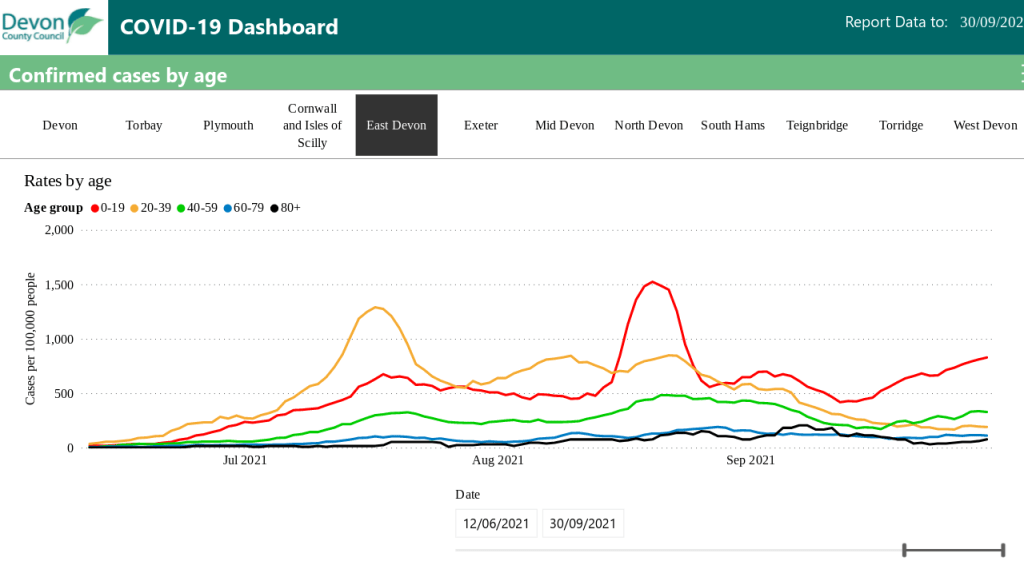
Devon covid down again

Devon’s covid infection rate is now lower than the national average.

[Up to date data can be found on the Devon Covid dashboard]

Joe Ives, local democracy reporter www.radioexe.co.uk

Government figures for the week up to Sunday, 12 September show that the average rate of infection across all Devon councils was 295 per 100,000 of the population. In the Devon County Council area, which excludes Plymouth and Torbay, the rate of infection was 255 per 100,000.

In contrast, the average infection rate across the country is now 337 per 100,000 of the population.

The only council area to report a rise in cases was Torridge, which recorded 248 new cases, 57 more than the previous week. The infection rate in the district is at 361, the highest in the county.

Plymouth recorded 822 new cases, 354, or 30 per cent, less than in the previous week. The rate of infection in the city is now 316 per 100,000 of the population.

Torbay also reported a significant drop in infection, recording 120 fewer cases than in the previous week. Its total of 431 cases represents a 22 per cent drop on the previous seven days. The rate of infection in the Bay is now 316 per 100,000 of the population.

Devon councils will be hoping this trend continues ahead of the autumn and winter months. This week the government set out “Plan A” and “Plan B” scenarios for the winter. “Plan A” is designed to prevent the NHS from being overwhelmed and promotes vaccines and testing. “Plan B”, to be used if the NHS is coming under “unsustainable pressure”, includes measures such as a return to widespread use of face masks.

Hospitalisations 

The decline in infection rates in Devon have continued to translate into a reduction in hospitalisations. The latest figures [Tuesday 14 September] show that across Devon, 128 people are in hospital as a result of covid, eight fewer than the previous week.

Of these 128 patients, 58 are at Derriford, 42 are at the RD&E, 21 in Torbay, while 7 are being cared for in north Devon.

Fourteen of the patients in hospital with covid in Devon are on mechanical ventilation beds.

Deaths

Deaths have risen in Devon, with a further 29 people dying within 28 days of a positive covid test in the most recent seven day period (up to and including Sunday, 12 September), thirteen more than in the previous week.

Eighteen people died in the Devon County Council area, which excludes Plymouth and Torbay. In Plymouth, nine people lost their lives, whilst three deaths were recorded in Torbay.

The total number of people who have died within 28 days of positive covid test in Devon is now 1,183.

Vaccinations

Eighty-seven per cent of adults have had their first dose of a vaccine in the Devon County Council area, which excludes Plymouth and Torbay, with 82 per cent receiving both doses.

In Plymouth, 84 per cent have had one dose, while 76 per cent have had both.

In Torbay, 86 per cent have received one dose, while 79 per cent have had both jabs.

This means that vaccination rates in Devon are still slightly behind the rest of the UK. Eighty-nine per cent of adults in the country have had one dose, while 82 per cent have had both jabs.

Alison Hernandez says she takes it seriously but……

Violence against women may not be in crime plan 

Philip Churm, local democracy reporter www.radioexe.co.uk 

But police commissioner says she takes it seriously

The police and crime commissioner for Devon and Cornwall says she wants people to know she takes violence against women seriously, but might not include it as part of the new police and crime plan. 

Addressing the Devon and Cornwall police and crime panel in Plymouth on Friday, Alison Hernandez responded to suggestions that tackling gender-based violence isn’t given high enough priority in her draft plan.   

Unveiling her strategy for 2021-25, Commissioner Hernandez said key community priorities are breaking the cycle of violence, reducing drugs harm, tackling antisocial behaviour and improving road safety. 

But panel member Cllr Laura Wright (Labour, Exeter, St Thomas) said, although ensuring the safety of women was clearly indicated in the report, the commissioner had not given it the weight it deserved. 

Cllr Wright said: “All the way through the commissioner’s update report, I really strongly heard the voice of women through the Safer Streets project funding and bids …  with the focus on women and girls in public spaces – their safety.” 

Cllr Wright highlighted the focus on community safety, extra out of hours support for victims of domestic abuse, and investment for domestic abuse perpetrator-focused programmes.   

The plan also mentions a stakeholder recommendation that there should be a specific focus on women, children and families and highlights the national focus on victims of domestic abuse.  

But Cllr Wright added: “When we come to the draft plan itself, we have to go to page 10 before we see a small paragraph which then highlights this work that’s being done and that you want to carry forward.

“Here, at last, I can hear the voice of the woman elected to a position where her voice on these matters can actually echo down through the ranks of the force and reverberate around the streets of Devon, Cornwall and the Isles of Scilly.”

Cllr Wright asked Ms Hernandez to speak more about gender based violence.    “Would you amend this report and pump up the volume of your voice and give more prominence to your plans  to tackle the violent crimes that disproportionately affect women and girls?” she asked.

Ms Hernandez made it clear that she is committed to tackling abuse and violence against women and wants this to be publicly known.  

“I will go back and reflect on how we enable people to understand that I do take that seriously,” she said.  

“I am actually wondering whether I need to have a policy written around this – as opposed to it being necessarily in the plan – but a policy about what I’m doing in relation to violence against women and girls.” 

But Ms Hernandez said it was important to note that, although violence against women is an important issue, it is crucial to see the statistics in perspective.   “I will just highlight that men are more likely to be a victim of crime than women, and that more men are likely to be murdered than a woman,” she said.

“This plan is for everyone. I do not want young boys thinking that they can’t report violence against themselves because we ‘only care about women’. So I have to get the tone right on this, in particular.”

In the draft plan the police and crime commissioner lists her priorities as: 

  • Breaking the cycle of violent crime
  • Tackling antisocial behaviour
  • Reducing harm caused by drugs
  • Improving road safety

She adds: “I am committed to tackling and reducing all forms of violence. This includes focusing on ending violence against women and girls, addressing domestic and sexual violence and learning from the national end-to-end rape review, driving out modern slavery, countering terrorism and extremism and reducing murder and homicide rates – the most serious outcome of violence.” 

The meeting began with a minute’s silence in remembrance of the people murdered in the mass shooting in Plymouth last month.

Members were updated on efforts to support Keyham residents in their recovery. The commissioner told the panel how she has been supporting partnership efforts across the city and how she made additional resources available in the immediate aftermath of the shootings. 

Ms Hernandez is also supporting a funding application to central government to help the community in the longer term.

Beachgoers witness dramatic cliff fall in Sidmouth [Saturday]

Cliffs in a popular Devon seaside town have crumbled again in the latest of a series of falls this year.

Sam Beamish www.devonlive.com

People in Sidmouth witnessed the incident which happened by the town’s beach and near the Esplanade at around 5pm today (September 18). [Saturday].

The moment was captured on camera by Chris Heywood who was walking along the seafront at the time.

He said: “I’ve been at the Sidmouth Classic Car Show today and walking the Esplanade aftewards.

“I just saw the cliff fall and then dust – there was no sound.

“I wouldn’t say it was scary because we were far enough away, standing by the pedestrian area and crossing.”

Chris Heywood caught the cliff fall on camera

Chris Heywood caught the cliff fall on camera

It is not the first landslide to have occurred this year in Sidmouth.

Back in June there were four colossal landslides at the same beauty spot.

They were so large that they prompted a warning from Beer Coastguard Rescue Team.

Coastguards asked people attending the beach to stay clear of the cliffs in case another incident occurs.

And In May, this year there was another cliff fall at the same spot.

People sat on the sand watched as part of the cliff face crumbled down, leaving behind a huge sandy red cloud that could be seen across the beach.

Continuing planning controversy in Clyst St. Mary

Owl has received the following updates from a correspondent:

Enfield Farm

We have become aware of a new planning application regarding Enfield Farm and the Biodigester plant. The applicants intend increasing the annual input of crops into the Biodigester these proposals increases in annual input tonnages to the site from 26,537 to around 66,000 tonnes together with the annual output tonnages leaving the site from 21,354 to around 56,000 tonnes this will create significant detrimental effects which will impact on Clyst St Mary.

These tonnage increases are virtually identical to those previously applied for in 2018. Planners found inappropriate and excessive and consequently REFUSED the application but the Applicants challenged EDDC’s Refusal decision with a subsequent Appeal to HM Planning Inspector, the Inspector agreed with EDDC’s Refusal Decision and DISMISSED their Appeal in November 2020 – but now the Applicants are again challenging both previous refusal and dismissal decisions by re-applying for these increases in 2021 under new variation applications to EDDC. 

Links to the planning application

The Parish Council will discuss this at Clyst St Mary Village Hall EX5 1AA at 3pm on Monday 20th September. 

Winslade Park Zone’s A and D

We have received notification from East Devon District Council that the developer Burrington Homes have now submitted full planning applications for a new development on the green field (previously known as the Brethren field)(zone A) and 3 blocks of apartments on the car park, opposite Winslade Manor (zone D). This will effect a number of residents that have houses that back onto the proposed site. The EDDC Councillors previously overruled their own plans and policies on economic grounds in order to grant outline planning permission for this development. This planning application provide the in depth detail.

Links to the planning application

The Parish Council will discuss this at Sowton Village Hall EX5 2AF at 19.30pm on Monday 4th October.

Afghan refugees to be housed in an Exmouth hotel

A number of Afghan families are to be placed in temporary accommodation in an Exmouth hotel.

Daniel Clark www.devonlive.com 

The bridging accommodation is a temporary measure until individuals and families are found permanent, long term accommodation in locations across the country.

Up to 15 families are expected to move into the temporary accommodation over the coming week, consisting of individual adults and families with young children.

They will be placed there as part of the government’s refugee resettlement programme.

Cllr Roger Croad, Devon County Council’s cabinet member with responsibility for communities, said: “All local authorities have been asked to help support with Afghan refugees who worked with and for our UK forces in Afghanistan and who were forced to leave their country as a result of the collapse of the country following withdrawal of US and UK forces.

“We have received notification from the Home Office that a group of these refugees will be placed temporarily in Exmouth as part of the Government’s national Afghan resettlement programme, pending their onward journey to long term accommodation, which could be anywhere in the country.

“We are working closely with our District and Town Council partners, NHS Devon, and local community and voluntary groups to make sure we are ready to welcome them.”

Cllr Steve Gazzard, chairman of Exmouth Town Council, added: “Local authorities across the country are being asked to step up and support this national effort to provide temporary accommodation as part of the re-settlement programme for Afghan families.

“Exmouth is a town with strong military connections and many of the refugees will have been working for our military services.

“Exmouth Town Council will do all it can to provide a safe environment for them to start the process of coming to terms with what has happened to them.”

Cllr Paul Arnott, Leader of East Devon District Council, said: “East Devon District Council, along with other authorities in the area, will be working closely with the Home Office, which has helped a number of Afghan evacuees find emergency accommodation at an Exmouth hotel while further, more long-term, measures can be found.

“We will be offering as much support as we can to help the families who have lost their homes in such tragic circumstances. We would like to thank the Exmouth and wider East Devon communities, in advance, for their understanding, support and compassion for the men, women and children who have been offered sanctuary after living through some truly harrowing experiences.”

Councils across the UK have also been asked to help identify suitable long term accommodation for the resettlement scheme, and in Devon local appeals to private sector landlords have resulted in some potential homes being found.

The Afghan refugees, who worked with and for the UK forces in Afghanistan, are understood to have been flown into the country from the capital, Kabul, in the final days before flights out of the country were stopped by the new Taliban regime. Since then they have been living in quarantine hotels in London.

In Devon, district councils, which have responsibility for housing, are attempting to identify more long term accommodation specifically from private sector landlords, so that there is no impact on their local housing waiting lists.

Devon County Council is now working with local community groups and volunteers to ensure that, once refugees are found suitable accommodation in the county, support around them is available quickly to help them settle in, access local health services and education, and find employment if possible.

For the record, Simon Jupp’s views on vaccine passports: “unethical”

There is comment in the media that Boris Johnson’s “freedom day” Covid plan is becoming another example in his pandemic response of doing too much too soon; and that the contingency Plan B is another example of doing too little too late.

So for the record here is Simon Jupp’s view on vaccine passports – “unethical”.

Does this put him on the “libertarian” wing of the party? – Owl

Link here

Photo of Simon JuppSimon Jupp Conservative, East Devon

Make no mistake: vaccine passports will create a two-tier society with the hospitality industry having to police an unethical policy that will hammer its recovery. Given the Government’s own words that we need to live with this virus, will my hon. Friend confirm how long vaccine passports will be in place—if passed by this House?

Photo of Nadhim ZahawiNadhim Zahawi Parliamentary Under-Secretary (Department for Business, Energy and Industrial Strategy), The Parliamentary Under-Secretary for Health and Social Care

We will set out in detail in due course exactly how the vaccine pass will work for domestic use: for example, in nightclubs.

Boris’ relaxed attitude to National Security comes in for criticism

Is he becoming more like Trump?

“……It is the Prime Minister’s personal investment of time and authority that lends credibility to the NSC and its cross-government structures. Yet under the new system, the Prime Minister will spend roughly 65% less time in NSC meetings than under the previous practice of weekly meetings when Parliament is in session.

 In our initial assessment, therefore, this is a retrograde step that suggests a more casual approach to national security. However, we encourage the Government to return to a more open dialogue with us, sharing—in confidence as necessary—the information we need (and have previously received) if we are to make a constructive contribution to the reform of the UK’s national security machinery in this Parliament.”

These are the last few sentences from the summary of the House of Lords and Commons “Joint Committee on the national security strategy” published last week.

Don’t let Government muzzle charities – Good Law Project

goodlawproject.org

Last weekend, the then Secretary of State, Oliver Dowden, announced his intention to muzzle the third sector. In his blog about the process for appointing a new Chair of the Charity Commission – the Government’s regulator of charities – he complained about “a worrying trend in some charities that appear to have been hijacked by a vocal minority seeking to burnish their woke credentials”. He said the Chair will be selected based on how they “rebalance” charities away from that agenda. And that Ministers will only appoint someone who does this.

One might assume from this that the previous Chair was a radical, activist earth-mother? Well… not exactly. The previous Chair was the former Tory Leader in the House of Lords. She was appointed contrary to the unanimous wishes of the Culture, Media and Sport Select Committee, which raised understandable concerns about her lack of independence.

But apparently Government wants even more political influence. 

It’s a chilling thought. What would a politically motivated regulator mean for food banks who push back against policies that mean people don’t have enough to eat? What would it mean for a housing charity which challenges legislation that leaves people without a roof over their head?

What about charities that campaign against Government policies that could do untold damage by baking in racial injustice or poverty? Will these fit with the Government’s views? 

Good Law Project is well aware from actual cases that these are not idle speculations. 

Together, through our taxes, we subsidise the activities of charities to the tune of £2bn a year. We give them this relief because they exist for “public benefit”– various types of do-gooding which Parliament wants to encourage in the Charities Act.

These things are not the same as pushing the political agenda of the Government of the day. You don’t get charitable tax relief if your activities are “political” – a term which the Charity Commission defines as including “furthering the interests of a particular political party.” This need for charities to stand outside party politics is also embedded in legislation made by Parliament: for example, the Charity Commission should not be subject to direction by the Secretary of State. 

We don’t think it’s the Charity Commission’s job to muzzle or ‘cancel’ charities that want to tell the truth about Britain’s past. But Ministers want to turn Charity law on its head. Charities that help their political agenda will be left alone and charities that resist it will be punished. 

Our public institutions exist to serve the public good – not the political whims of passing Governments. Anyone accepting an appointment following this flawed process should be very clear – we believe it is unlawful and will ask for it to be quashed.

You can read our letter to Oliver Dowden’s successor, Nadine Dorries, that formally starts the judicial review process here

If you are in a position to do so, you can support the legal challenge here.

Calls for Labour to back reform grow as members back PR in record numbers

With Labour’s conference set to begin next week the debate on electoral reform looks set to be one of the big issues on conference floor this year.

Author: Jon Narcross, www.electoral-reform.org.uk 

At least 144 constituency parties have called on Keir Starmer’s Labour to back a switch to proportional representation this year – more than have made a single demand on any other issue in recent conference history.

Nearly half of all constituency Labour Parties – 314 out of 648 have backed motions in support of the change in recent years with at last 144 making the issue their key policy priority for this year’s conference.

At Labour conference 2019, 135 motions were submitted on the Green New Deal policy and 91 were sent on Brexit. In 2018 the Brexit debate attracted 151 motions calling the party to take different positions on the issue.

Campaigners from the ERS backed Labour for a New Democracy coalition welcomed the “unprecedented demand” for electoral reform and urged the party to back members calls for a fairer voting system.

We’ve long known that support across the Labour membership was growing. Recent polling from YouGov found that 83% of members believe the party should support the introduction of a proportional voting system – with just 10% opposed.

Keir Starmer pledged to address the failings of Westminster’s warped voting system during the leadership contest arguing: “We’ve got to address the fact that millions of people vote in safe seats and they feel their voice doesn’t count. That’s got to be addressed by electoral reform. We will never get full participation in our electoral system until we do that at every level.”

The PR debate at this year’s conference is just the chance to do that, backing the overwhelming calls for political reform.

Until we see the end of Westminster’s broken voting system millions of voters will continue to go ignored each election – a far cry from the far fairer results in Scotland, Wales, the London Assembly and modern democracies across the world.

We don’t have to look far to see how FPTP is failing voters. The current government is able to push through dangerous legislation like voter ID and the policing bill on a minority of the public vote, all because of a broken one-party-takes-all voting system.

Labour could learn a lot from New Zealand, Germany, and Norway, where its sister party looks set to lead a progressive coalition into government, where proportional results are the norm and cooperation is valued.

Voters want political equality, and Labour should seize the chance to build a much better democracy. In the face of attacks on democracy and free elections worldwide, this would send a powerful message of hope.

An introduction to brownfield: the land that’s ripe for recycling – CPRE

All you need to know about brownfield sites – Owl

By Patrick Ford www.cpre.org.uk

At CPRE you’ll hear us talk about brownfield a lot; but what do we mean when we talk about this – and why do we think this often-neglected land matters so much?

Heard the term brownfield and wondered what it means, and what all the fuss is about? Here’s our potted guide to everything you need to know about brownfield land, and why it can form an essential part of future developments across the country.

What is this brownfield stuff, and why should I care?

Brownfield land is defined, in England at least, as ‘previously developed land that’s no longer being used’. Picture a disused industrial estate or an abandoned excavation site – it’s land that has previously had stuff built on it or that has been altered by human activity (but not including farmland). The term is used slightly differently around the world but has broadly the same meaning wherever you go.

‘It’s land that has previously had stuff built on it or that has been altered by human activity.’

Brownfield matters because it holds potential space for a huge amount of housing. Building on brownfield land directly reduces the amount of countryside that’s lost to development, meaning more green spaces and more space for nature to thrive.

Regenerating and renovating brownfield land can breathe new life into areas most in need. It’s the building equivalent of recycling – it’s better to use land that’s lying idle than to unnecessarily concrete over pristine countryside. Naturally, it’s not quite as cut and dried as this – more on that later – but at CPRE, we’re big fans of the principle of using recycled land, as you can imagine.

‘At CPRE, we’re big fans of the principle of using recycled land.’

Globally speaking, England is a relatively small country and land can be at a premium. We’re also becoming ever-increasingly aware of the indisputable importance of the countryside, not only for our physical and mental wellbeing but for nature, biodiversity and the climate. So, logically, it’s more vital than ever that we use land wisely, prioritising brownfield and protecting greenfield.

Is brownfield actually brown? And what’s greenfield, you ask?

Okay, maybe you didn’t ask. In contrast to brownfield land being essentially defined as ‘previously developed land’, it follows that greenfield land is defined as ‘land that’s not yet been built on’ – the idea being that a pristine, untouched field will be a vibrant green whilst land that’s been developed on may look a bit brown.

Of course, designating land into one of two categories – greenfield or brownfield – is arguably a touch simplistic, and, naturally, not all brownfield sites are suitable for being built on.

‘Despite not always being the most visually appealing, lots of brownfield sites harbour ecologically important habitats.’

This nomenclature also arguably does a bit of a disservice to brownfield, as by no means is all of it brown and run-down. Despite not always being the most visually appealing, lots of brownfield sites harbour ecologically important habitats, such as scrubby grassland, patchy pockets of water, and thistly weeds.

In fact, some sites are massively high in biodiversity, providing different ecological niches in which species, particularly invertebrates like bees, can thrive.

A slow worm, a legless lizard which looks like a brown snake, slithering out from brickwork

A slow worm, a legless lizard, emerging from a brick on a brownfield site | Tim Hunt / Alamy

For instance, Tata Steel in Scunthorpe provides habitats for species such as the hill cuckoo bee and snowberry. Sites like this must be protected for biodiversity to flourish.

‘Sites like this must be protected for biodiversity to flourish.’

Setting aside the areas with special ecological conditions, it’s generally better to build on brownfield land ahead of greenfield land (‘brownfield-first’). There can be big benefits to developing on brownfield land, such as the fact they’re often close to where people already live and work, as well as the additional benefits that we see from leaving greenfield sites alone to do what they do best.

As with everything, balance is key, and decisions need to be made on a case-by-case basis.

Brownfield’s potential: land waiting to be unlocked

Brownfield land could provide an enormous number of homes – including the truly affordable homes that are so desperately needed – whilst allowing the countryside and nature to thrive. In fact, CPRE’s research shows that there’s capacity for well over a million homes on brownfield land – and that’s a conservative estimate.

‘CPRE’s research shows that there’s capacity for well over a million homes on brownfield land.’

It’s important not to conflate the argument of needing more housing with the argument for brownfield versus greenfield. At CPRE, we’re leading the call for an increase in affordable housing to allow for thriving rural communities.

Homes that people can actually afford and that work for people, nature, and the planet, are vital. So, whilst we have swathes of brownfield land available, why not use it?

Brownfield registers: on the hunt for hidden land

Brownfield registers were first introduced in 2017, following the findings of CPRE’s successful ‘Waste of Space’ campaign.

These registers require local planning authorities to provide a consistent, updated list of sites that they think are appropriate for development. The registers act as a ledger of land identified as being suitable for new housing once their environmental, amenity and heritage value have been factored in.

The introduction of these registers has given much more clarity and insight into the current state of the brownfield land that’s out there. Now we know the (huge) amount of land already available for building homes, a strong brownfield-first approach becomes even more sensible.

Why isn’t brownfield being used for new homes?

So… if brownfield land can provide space for over a million homes, why isn’t it being used? Well, this is where things get a bit more complicated.

Firstly, the identification and subsequent analysis of brownfield sites can be costly and complicated – although the registers help with this.

‘There really needs to be better funding from the government to make building on brownfield sites viable for developers.’

Secondly, there really needs to be better funding from the government to make building on brownfield sites viable for developers. There can be some extra costs attached to building on brownfield – such as cleaning the site, if it used to be a factory, for example – and at the moment it’s too tempting for housebuilders to avoid these sites and go for ‘easier’ greenfield options – or to try and pull back costs by only building more expensive houses on brownfield.

And we need to see more homes that are truly affordable. We mustn’t confuse regeneration with gentrification. Instead, we’ve seen cases of these high-priced, grander homes being built which, whilst some have their place, don’t do much to tackle the pressing shortage of affordable housing for people on low and medium incomes (that is, most people!).

A bright sunny courtyard with benches and grass with pale stone houses around

A view of the green courtyard of Goldsmith Street, Norwich, an environmentally-sensitive housing development built on a brownfield site | Jim Stephenson_VIEW / Alamy

At CPRE we strongly believe in the brownfield-first approach. For instance, Goldsmith Street in Norwich is a perfect example of how once-dormant brownfield land can be repurposed into providing high-quality housing, whilst still being respectful to nature and climate.

So what’s CPRE doing to promote the use of brownfield?

We’ve got a long history of campaigning on brownfield, and that’s not changing any time soon. We’re keeping our eagle eyes out to monitor the amount of brownfield land available in England – no mean feat. We’ll run a citizen science project with communities to identify brownfield land, too, which will help to increase the capacity in England. And we’ll keep pushing for a brownfield-first policy to be widely adopted.

‘Once home to much of the beating heart of the industrial revolution, the Midlands and the north have large amounts of industrial brownfield land.’

There are some areas where this makes extra sense. Once home to much of the beating heart of the industrial revolution, the Midlands and the north have large amounts of industrial brownfield land. We’re calling for changes to the funding for investment in housing to help regenerate these areas. Harnessing the brownfield here would be a huge bonus for areas of particular need of an extra boost.

Want to be a part of our work promoting recycling land? You can support us with a donation to keep us calling on the government to make brownfield-first the default, or become a member and connect with your local CPRE group to hear more about brownfield sites in your area.

From another correspondent “I’m sure Burrington Estates are doing this (lol) …”

… but each block should have a lift.  It’s very expensive to put them in and raises service charges a lot with maintenance, etc.

Service charges raise an interesting issue – who will manage the blocks and grounds?  Is there ground rent?  How will refuse be dealt with?  Will DCC adopt roads?  What about estate management (grass cutting, etc)?  Remember Cranbrook had to buy up developers’ estate management charges and absorb them into council levy … raising total council tax for everyone.

I am sure planners are on top of it …..!