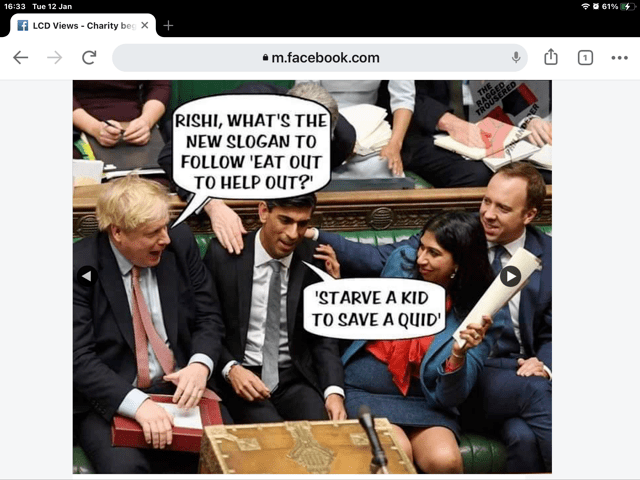
What’s the new government slogan?

Higher car parking charges, work to address climate change, beach management protection plans, the start of work on Cranbrook’s town centre, and a big screen on the Strand in Exmouth are among the objectives for East Devon District Council in the next 12 months. Seventy-three proposals (all listed below) are in the council’s draft budget and key service plans developed by the Independent councillors who run the council.
Daniel Clark, local democracy reporter www.radioexe.co.uk
They’re planning to review the business case for a fixed big screen on the Strand, Exmouth, using funding set aside for the area after its redevelopment some years ago. A large screen could run local advertising and council promotions as well as events such as Wimbledon, concerts and proms.
Most car park charges haven’t been increased since 2010 and some have been reduced significantly. Increasing the capacity of Manor Road car park in Sidmouth, the Ham car parks in Sidmouth and Coombe Lane Car Park in Axminster is also considered, while they’ll consult on how to manage several currently free car parks.
The council plans to deliver the Sidmouth and East Beach Management Scheme and submit a business case to the Environment Agency. Work could begin next year.
Upgrades to play areas are planned, as is a new tram halt and boardwalk at Seaton Wetlands, using part of Seaton Tramway’s Heritage Lottery Grant Fund, while The Manor Pavilion theatre should improve its customer experience.
Work on a vibrant town centre for Cranbrook is planned, while the revision of the Axminster Urban Extension masterplan and the development of a masterplan for the Hayne Lane, Honiton will take place.
Not all of the service objectives are new, and some may not be finished by March 2022, but work to begin them is targeted.
THE 73 SERVICE PLAN OBJECTIVES
New Onward research: The Policies of Belonging
This morning Onward publishes its latest research report, The Policies of Belonging, supported by a cross-party coalition of MPs and leading civic organisations. The report calls for ministers to hand power and capital back to communities after the pandemic to repair Britain’s fraying social fabric.
The Government’s flagship levelling up ambition will fail unless Ministers take concerted action to invest in and empower fraying communities after the pandemic, our report finds. The report, The Policies of Belonging, is a response to growing evidence that community is in long term decline in Britain. In 2019, polling for Onward found that 71% of people agree that “community has declined in my lifetime” and in September 2020 the thinktank warned that there has been a steady fall in the last decade in levels of volunteering, local group membership, church attendance, community activities, family trips, philanthropy and social trust. While the pandemic led initially to an outpouring of public spiritedness, this benefited high trust neighbourhoods much more than others.
To rekindle a sense of belonging in all Britain’s communities after lockdown finally ends, Onward sets out a series of policies to give power to individuals and communities to give back locally, and greater resources to ensure that the most fraying communities have strong reciprocal networks and institutions. The main proposals suggest ministers should:
The report is backed by a large number of MPs, including: Jo Gideon MP, Gareth Davies MP, Paul Maynard MP, Aaron Bell MP, Kevin Hollinrake MP, Siobhan Baillie MP, Rob Largan MP, Alex Stafford MP, Nicholas Fletcher MP, Robert Halfon MP, Paul Bristow MP, Danny Kruger MP, Jon Cruddas MP. In addition to the programme funders – the Joseph Rowntree Foundation, Shelter and Power to Change, the report has also been endorsed by Local Trust, Trust for London, New Philanthropy Capital, Unbound Philanthropy, the Young Foundation, NAVCA and Catch22.
The report is the latest in Onward’s Repairing our Social Fabric Programme, a major cross party programme launched last year to study the changing nature of community in the UK and to develop ideas for how to strengthen the ties that bind people together at a local level.
Will Tanner, Director of Onward, said:
“Everyone focuses on the impact of lockdown on the economy but the truth is that the pandemic has taken a terrible toll on the social fabric of our lives, compounding the long-term decline of community over recent decades.
“As we emerge – finally – from the pandemic, we need to not just revive a flatlining economy, we need to take steps to empower and recapitalise communities, to give people back a sense of belonging and rekindle the social networks and institutions upon which we all rely.”
Yesterday the Government published its 43 page vaccine delivery plan.
Owl found this interesting section under the heading:
Drawing on local authorities’ knowledge of their communities
Para 5.30
“Meaningful community engagement is also being led by local Integrated Care Systems (ICSs) across the country. For example, Devon ICS are working with national advocacy organisation Friend, Families & Travellers to produce a best practice guide to engaging with the traveller community which will include community informed communications and be shared across the country. Building on lessons learnt, Bristol, North Somerset and South Gloucestershire ICS are developing best practice approaches to engaging and supporting people experiencing homelessness, including providing accessible information and supporting GP registration. This is supported and shared nationally through well established networks of frontline outreach workers and practitioners. These are just two examples of community engagement that is going on up and down the country; systems are working hard to engage effectively with their local communities, through established community leaders, such as faith leaders, or by working with local partners to address the concerns and meet the needs of communities.”
There is also a separate map showing the vaccination sites that are open across the country, meaning 96% of the population is within 10 miles of a vaccine service. But, looking at the map, journey distances seem to be based on “as the crow flies” which doesn’t reflect actual journey distance in rural areas.
A quarter of coronavirus admissions to hospital are people under the age of 55, the head of NHS England has said.
Rajeev Syal www.theguardian.com
Sir Simon Stevens told MPs on Monday the virus was spreading out of control across much of the country, with worrying consequences for hospitals.
“In London perhaps one in 30 people has the coronavirus, in parts of London it may be twice that number. In Merseyside in just the last week there has been a further 50% increase in the number of Covid hospitalisations,” he said.
“It’s worth remembering that this affects all ages – a quarter of the Covid admissions to hospital right now are for people aged under 55.”
Officials later confirmed that for the week commencing 28 December, 3,326 under-55s were admitted to hospitals in England, out of 13,530 overall admissions.
Stevens’ comments came as data showed the youngest person with no known underlying conditions whose death from Covid-19 was reported in the last 24 hours was aged 26.
The NHS England chief, addressing the public accounts committee about the UK’s vaccine programme, also revealed more than 370,000 people in England had received two doses of a Covid vaccine, despite ministers previously saying first doses would be prioritised.
“There were some second jabs, where that was a clinical decision to do so given that last week was just a few days after the changed advice from the JCVI [Joint Committee on Vaccination and Immunisation] and chief medical officers,” Stevens said.
Localised vaccine data – crucial to ensure the vaccines are being evenly spread around the country – will be sent out over the next week to 10 days, Stevens said.
Kate Bingham, who recently stood down from her position as head of the vaccines taskforce, told the same committee she was the victim of “politically motivated” attacks. She had faced criticism over a £670,000 contract for public relations advice and was also forced to deny claims she shared commercially sensitive information with investors.
Bingham, who is married to the minister Jesse Norman, said she knew Boris Johnson when they were both undergraduates at Oxford University but dismissed allegations of cronyism. She said the taskforce could have been more open about its work.
“I just don’t think we have handled that very well. So if I had my time again I would be more insistent that we did cross-party briefings – because those didn’t happen – and that anybody who wants to know what it was that we were doing or how we were doing it or wanted to kick the tyres, within Westminster, should be free to do so,” she said.
A government plan to relieve packed hospitals by designating hundreds of care homes to accept Covid patients has fallen far short of its target, increasing pressure on the NHS.
Owl isn’t surprised by this news, given the risks of repeating the mistakes of last year.
Denis Campbell www.theguardian.com
Only 136 “hot home” social care facilities have been set up across England, despite the Department of Health and Social Care (DHSC) saying in October that up to 500 would be approved by the end of November to prevent beds being blocked in hospitals. They are mostly wings of care homes that use separate staff and separate entrances to prevent the virus from spreading.
There are now more than 29,000 people in hospital with Covid in England, and more than 3,800 are being admitted daily. But only 2,533 care home bed spaces have been found where patients who may still be infectious can be cared for without the risk of sparking fresh care home outbreaks, according to figures from the Care Quality Commission (CQC), which has been checking the safety of proposed locations.
In the absence of designated facilities, the NHS now wants the government to underwrite the risk of normal care homes taking in hospital patients who are ready to be discharged. With many care homes refusing to take Covid patients because insurers will not cover the risks associated with the virus, the NHS has urged the Treasury to effectively indemnify care homes against possible claims triggered by accepting patients.
“It’s imperative that care homes take patients that can be discharged safely in order to free up capacity [in hospitals] to deal with the huge numbers of Covid patients that require care,” said a well-placed NHS source. “You’d have to do this only with patients where there’s no risk of spread of Covid. And it mustn’t be seen as a dumping exercise. But it needs to happen, and urgently.”
It could cost the taxpayer between £600m and £800m, the Guardian understands, and the DHSC is understood to endorse NHS England’s view that accessing care home beds is vital to protect the NHS.
Fifty-eight council areas have not designated any facilities, although some have proposed NHS facilities such as community hospitals.
Without a deal on insurance, care bosses have said more designated settings are needed to ensure that care homes will not have to take in Covid-positive patients when it is not safe to do so.
“If people cannot be supported to leave hospital, whether that is by moving into a care home or having care at home, then the whole system will fail,” said Vic Rayner, executive director of the National Care Forum, which represents not-for-profit providers. “NHS saves lives, but so does social care, and it must be properly supported to ensure that it can play its vital role in making the whole system work.”
Rising outbreaks in care homes and growing staff absences are causing some providers to stop accepting new admissions.
The number of care homes in England that recorded a Covid infection in the last week of 2020 rose to 503, more than double the total a fortnight ago. Care managers are facing absences of between 11% and 50% of staff caused by positive Covid tests, according to a survey by the NCF.
Four residents died and 43 staff were infected in an outbreak at Oakdown House in East Sussex last month, its owner, Mike Derrick, told the Guardian on Monday. “The new variant seems to be so easily transmissible that once it is into a service, it spreads so quickly,” he said. “It’s so much more difficult.”
Derrick, who chairs the East Sussex Registered Care Association, said at least three other homes in his area had had serious recent outbreaks, and the local authority “has serious concerns about several homes every week”.
Last week it emerged that over the Christmas period, 13 residents died at Edendale Lodge care home in Crowhurst, East Sussex.
The CQC said it was in talks with the government “to address issues of capacity across the country, particularly in areas where there is a shortage or lack of designated settings”.
“It is our role to ensure that proposed locations … are safe for people with a confirmed Covid-19 test result to be discharged into,” said Kate Terroni, chief inspector of adult social care. “By rapidly inspecting and, where appropriate, approving designated locations … we are working to help combat the spread of infection and increase the number of people who can access care by ensuring that people can be safely discharged from hospital.”
A DHSC spokesperson said: “We have put in place enough designated care homes or NHS community settings to provide the small proportion of Covid-positive residents who require access to this care with the support they need, while protecting other vulnerable residents from the risk of infection.”
“Today was supposed to be the day No. 10 Press Secretary Allegra Stratton held her first televised briefing, but alas that’s been postponed to the end of the pandemic — with many Tory insiders now doubting they’ll ever happen. The Sunday Times reported the new Downing Street media suite refurbished for the briefings cost the taxpayer £2 million. What’s it made out of, gold?”
Just another £2,000,000 to add to the bill – Owl
(Politico newsletter)
Background to earlier story on Police clarification of Covid rules
A deputy chief constable has said “people are beginning to flout” lockdown rules, following hundreds of coronavirus breaches over the weekend.
“People are beginning to get fed up with it and I can understand that, but we have to be firm,” said Devon and Cornwall Police’s Paul Netherton.
A control room supervisor tweeted that he had dealt with more than 250 coronavirus rule breaches on Saturday.
Government guidance says unless it is necessary you must not leave your home.
“People know what the rules are by now” but “they’re beginning to think how can I get away with the rules rather than abide by them,” said Mr Netherton.
He said police officers do not want to be seen as “draconian”, but they are going out to tell people that by mixing, the disease is continuing to spread.
“So in Devon and Cornwall, we are stopping people” and “having to make a really difficult judgement about what is reasonable and what is not”.
“But the key message remains, stay at home.”

Just an hour into his shift, control room supervisor with Devon and Cornwall Police Glenn Shuttleworth said there had been “41 Covid breaches” attended by police..
Unless you have a reasonable excuse for doing so, you are not able to leave your home for holidays or overnight stays – this includes staying in second homes or caravans, if they are not your primary residence, according to government guidance.
People are only allowed to leave their homes for exercise, once per day and are advised to not travel outside their local area.
On Friday, Devon and Cornwall’s chief constable Shaun Sawyer said: “We can’t enforce” lockdown rules without help from the public.
A Somerset MP has accused the county council of using central government grants to “balance its books” rather than support residents during the coronavirus pandemic.
Planetradio.co.uk By Daniel Mumby, local democracy reporting partnership
Ian Liddell-Grainger, who represents the Bridgwater and West Somerset constituency, used parliamentary privilege on Wednesday (January 6) to accuse Somerset County Council of financial irregularities.
The Conservative MP (who has held the seat since 2001) described senior council officials as “cowboys” and urged prime minister Boris Johnson to personally intervene in the matter.
The council has strongly denied Mr Liddell-Grainger’s claims and said it would be writing to the prime minister directly to “set the record straight.”
Mr Liddell-Grainger made his comments directly to Mr Johnson during a debate in the House of Commons on Wednesday afternoon (January 6).
He said: “We in the Bridgwater and West Somerset constituency accept that the lockdown was vital and we appreciate the extra help for businesses, but will my right honourable friend consider urgently the way in which government help for local authorities is being paid?
“Somerset County Council has been given huge grants but has then diverted much of the money to balance its books, which is not what it was for.
“These cowboys want to become a new unitary authority. It is a con trick to use that cash, which was meant to fight covid.
“The Prime Minister is Somerset born and bred. I urge him to put a stop to this, so that the money goes to the people who need it most—the people of Somerset.”
Mr Liddell-Grainger has been a consistent critic of the county council’s One Somerset proposals, which would see both it and the four district councils dissolved and replaced with a single unitary authority.
The government is currently considering this proposal, along with the rival Stronger Somerset proposals for two unitaries, to which Mr Liddell-Grainger has lent his support.
Mr Johnson responded: “My honourable friend is absolutely right to highlight what is going on in Somerset.
“The county obviously has a duty to use covid grants for that purpose and not for any other. I thank him for drawing attention to what is going on.”
Somerset County Council has received a total of £31.9M of covid funding from the government in four tranches, the most recent being £2.8M in October 2020.
Leah Green, the council’s finance manager, told the cabinet in mid-December that these funds were being allocated to essential services to cover additional expenditure the council had accrued during the pandemic.
She said in her written report: “The four tranche of funding will initially be added to the corporate contingency and then allocated to services to cover their additional costs.
“The government is also covering some of the council’s losses of income and it is estimated that a total of £3.7M can be claimed back though this scheme.”
The council has vehemently denied any wrongdoing, and said it would be writing to Mr Johnson directly to assure him that all grants were being used appropriately.
A spokesman said: “We will be writing directly to the prime minister to set the record straight, but we can confirm that all covid grants received from the government have been used as they were intended – to help residents, communities and businesses in Somerset.”
The Ministry for Housing, Communities and Local Government is expected to give its verdict on the separate unitary proposals for Somerset in the spring, including a ruling on the prospect of delaying the local elections in May.
Issued by the Leader of the ruling Independent Group.
No – it’s not Paul Arnott, or any other Devon Councillor!
Read on. – Owl
The Northern Echo Staff www.thenorthernecho.co.uk
A COUNCIL leader has come under fire after issuing a ‘stay local’ warning to constituents, while on holiday thousands of miles away in the Maldives.
Angie Dale, leader of Richmondshire District Council, was quoted in a press release sent out on Friday urging people to ‘heed the stay local message’ amid surging Covid cases in the area.
But it has now emerged at the time Mrs Dale and her family were enjoying the crystal waters of the Indian ocean from a beach on the Maldivian island of Kudahuvadhoo.
It is understood the politician has not broken any rules and left for the holiday before the national lockdown came into place, and when North Yorkshire was in Tier 2.
The joint press release was issued by Mrs Dale’s Richmondshire District Council, neighbouring Craven District Council and North Yorkshire police on Friday.
Each was quoted under the headline: ‘People urged to Stay Home and Stay Local – don’t travel to exercise.’
Mrs Dale, leader of the ruling independent group, said: “The number of Covid cases is rising dramatically every day and we are told we haven’t reached the peak yet, so it is vitally important that people heed the stay local message.
“Our beautiful Dales will still be here to visit when this pandemic is over – please do not make unnecessary journeys now and exercise close to your home.”
Tonight, opposition members of Richmondshire District Council said it was “disappointing” and “hypocritical” of Cllr Dale to issue the statement whilst abroad.
Councillor Leslie Rowe, leader of The Green Party and Independent group on the authority, said: “It seems to me to be the height of hypocrisy to be issuing that press release when in the Maldives, having flown from Manchester which I believe meant moving from a Tier 3 to Tier 4 area in itself.
“I don’t know who would go on holiday to the Maldives at this time of such severe Covid crisis, there are so many people catching it at the moment.
“As the leader of a district council she should be setting an example for the rest of us.
“I personally would not dream of going on holiday at a time of national crisis.”
Councillor Yvonne Peacock, Conservative Group leader on the authority, said: “It is disappointing to learn she is away.
“The case numbers in Richmondshire, and the upper Dales, have gone up.
“Residents are concerned, there is a lot of fear, businesses are closed because of lockdown.
“It hasn’t been a good time and to hear the leader of Richmondshire District Council is not even in the country does not look good and does not bode well for her.”
The temporary attractions on the site of the former fun park in Exmouth are set to remain in place this summer – with more set to be provided on land which was used as a car park.
Daniel Clark www.devonlive.com
East Devon District Council’s cabinet on Wednesday night agreed unanimously that the temporary uses for 2021 at the Queen’s Drive site should remain the same as previous years.
And they also agreed that the temporary car park built in 2019 for around 50 new car parking spaces to be provided on a plot of land off Queen’s Drive that previously was partially used for the Railway Carriage Café should not remain as a car park.
The land had previously been allocated for leisure uses before temporary planning permission for its use as a car park had been granted, and with that having run out, the cabinet unanimously agreed to not proceed with keeping it as a car park.
Clearer signage to other car parks on Exmouth seafront will instead be provided, and officers will research and report back on alternative options for use of the temporary car park land.
The report of the recommendations from the Exmouth Queen’s Drive Delivery Group over uses for the Queen’s Drive Space for 2021 said that the temporary uses for 2021 should remain the same as previous years, but with suggestions for temporary uses included pop-up events, beach volleyball, bungee jumping and extending the Dinosaur Play Park.
Other changes could see seating replaced by picnic benches which could be re-used elsewhere, that the attractions should be aimed at children over 10 years old, teenagers and young adults, and that the temporary car park should be removed.
The food and beverage offering could remain the same with a preference for supporting local traders and play equipment will be kept in good order, but the arrangement of events to be put on hold pending clarity on the situation with the Covid-19 pandemic.
While phase 1 of the overall Queen’s Drive project – the realignment of the road and the car park – has been completed, and phase 2 – the new watersports centre – is on the verge of completion and should be fully open early in 2021, the final phase of the regeneration remains as unclear as ever.
Planning permission for the redevelopment of a 3.6-hectare swathe of Queen’s Drive has been granted, and has been implemented, the council say, with the realignment of the road, but the attractions currently on the Queen’s Drive space – the replacement for the former Fun Park – only have planning permission to stay on the site until March 2022, with no further extension allowed under planning law likely.
The next meeting of the Exmouth Queen’s Drive Delivery Group takes place on Monday, January 25, and it is hoped that further details around the long term vision for the site may come forward then.
“If people do leave their homes, they should ‘stay local. This is defined as staying ‘in the village, town, or part of the city where you live’.
Despite that clarification, more than one third of Devon and Cornwall Police’s incidents yesterday [Saturday] revolved around Covid-19 lockdown breaches – many of which were linked to holiday homes.”
Howard Lloyd www.devonlive.com
Despite England now being in its third coronavirus lockdown – there is still confusion over the rules.
The UK Government has explained on its website when people are allowed to leave their homes and for what reasons.
It states you should not leave your home if it can be avoided unless it is for reasons such as shopping for basic necessities, going to work and exercising once a day.
Meeting a support bubble, seeking medical assistance or attending education are other reasons which are also permitted.
If people do leave their homes, they should ‘stay local. This is defined as staying ‘in the village, town, or part of the city where you live’.
Despite that clarification, more than one third of Devon and Cornwall Police’s incidents yesterday revolved around Covid-19 lockdown breaches – many of which were linked to holiday homes.
The police have issued another warning this morning to people thinking of taking their exercise on Dartmoor today.
In an effort to tidy up any remaining confusion over the rules, Devon and Cornwall Police have released a question-and-answer session of the issues they are most commonly asked.
Below is a selection of them taken directly from their website.
Contact between parents and a child where the child does not live in the same household as their parents, or one of their parents is allowed.
Any existing visitation arrangements that are in place can continue.
Those with caring responsibilities for children within their household are able to form a childcare bubble with one other household for the purposes of informal childcare for children aged 13 or under. You should not swap bubbles and not use the collection or pick up of children as a reason to socialise with someone helping with childcare.
No, unless they are part of your support bubble. You must not leave your home to meet socially with anyone you do not live with, including in private gardens. You can exercise in a public outdoor space on your own, with your household or support bubble, or with one other person from another household. You should continue to maintain social distance from anyone from other households.
Yes, single adult households (including single parents with children under the age of 18 as of 12 June 2020) are able to form a ‘support bubble’ or ‘linked household’ with one other household. Those in the support bubble can act as if they live in the same household, meaning they can spend time inside each other’s homes, including staying overnight, and do not need to stay two metres apart.
Support bubbles must be exclusive and you cannot switch households, meaning you cannot form a support bubble with a household that is part of another support bubble. If anyone in the bubble develops symptoms, all members of the bubble will need to follow the isolation guidance.
The other criteria for forming a support bubble includes households with:
Visits to care homes can take place with measures to protect residents, such as substantial screens, visiting pods and window visits. Close-contact indoor visits are not allowed. No visits will be permitted in the event of an outbreak.
More information about visiting care homes during COVID-19 can be found on gov.uk.
Support bubbles or ‘linked households’ can be formed by linking with one household with another. One of the households must meet the following criteria:
Those in the support bubble can act as if they live in the same household, meaning they can spend time inside each other’s homes, including staying overnight, and do not need to stay two metres apart.
Support bubbles must be exclusive and you cannot switch households, meaning you cannot form a support bubble with a household that is part of another support bubble. If anyone in the bubble develops symptoms, all members of the bubble will need to follow the isolation guidance.
Read more on the gov.uk website.
Childcare bubbles or ‘linked childcare households’ are formed between one household linking with one other household to provide informal childcare to a child or children aged 13 years or under. They can provide the childcare in either or both of the homes from the two households. These bubbles should only be used for childcare and not socialisation. If anyone develops symptoms or tests positive for COVID-19, all members must follow isolation guidance.
Read more on the gov.uk website.
If you are a keyworker or your child is considered vulnerable, they can continue going to schools and colleges. All other students will learn remotely until February half term.
If you do need to go on a school run, it should not be considered a social activity and you should make sure you are following the rules whilst dropping your child off at school. Whilst you may need to queue or wait at the school, this should be at a distance and not be used for socialisation. Please consider wearing a face covering, particularly if you are not able to keep two metres distance from other families.
Schools will have their own measures in place to manage the risks associated with pick up and drop off times at school, such as marked out and distanced waiting zones, staggered start or finish times, or limits on the number of people allowed at the school at any one time. Please follow these to protect yourself, your family and others.
Ask yourself whether it’s essential that more than one of you goes shopping. Sometimes it will be, for example if there is no one else available to look after a child.
It’s important that we all reduce our day-to-day contact with other people, so if you can go alone that will help cut down potential chances of contact with others. When you are outside of the home, make sure you try to stay two metres (six feet) apart from anyone outside of your household or support bubble.
The law requires people to wear face coverings in some enclosed places, including shops, transport hubs, banks and post offices. Staff working in retail are also required to wear face coverings.
Yes, if you are able to do so. The law in England requires people to wear face coverings in some enclosed places. This means that unless individuals have exemptions, a shop can refuse entry and can call the police if people refuse to comply. People who are exempt from wearing a face covering include, but are not limited to, children under 11 and those with certain disabilities. Retail staff are also required to wear face coverings.
You can read more about face coverings on gov.uk.
Unless you are exempt, you must wear a face covering when entering a shop. If someone without an exemption refuses to wear a face covering, the shop has the option to refuse them entry. If the Police are called they may direct that a face covering is worn or to leave the shop, they may also remove an individual from the shop if necessary. We hope this will not be necessary but if the police are called we will endeavour to engage, explain and encourage people to follow the rules. Enforcing these regulations will always be a last resort.
We expect that the public will follow these regulations to help everyone keep the spread of the virus under control.
Hospitality venues such as pubs, restaurants and cafes must close for eat in services. However, they can continue to offer food and non-alcoholic drinks by takeaway (until 11pm), click-and-collect and drive-through. All food and drink, including alcohol, can be provided by deliver services.
The Government’s position is that everyone who can work from home should do so. You should travel to work, including to provide voluntary or charitable services, where you cannot reasonably work from home and your workplace is open.
Workplaces should follow COVID-secure guidelines. At all times, workers should follow any measures put in place by their employers.
You should not go into work if you are showing symptoms, or if you or any of your household are self-isolating.
You are allowed to leave home to exercise with your household, support bubble or one person from another household. You should continue to maintain social distance from anyone you don’t live with.
We would advise you to stay local and walk or cycle if you can to avoid putting unnecessary pressure on frontline services and the NHS.
Leaving your home to exercise is one of the reasonable excuses. While there is no specified limit in the regulations, you are asked to remain local and walk or cycle if you can. This is to avoid putting unnecessary pressure on frontline services and the NHS.
You should minimise time spent outside your home and stay in your local area when you go outside for exercise. There is no legal limit on how long you can exercise outside for. However, it is recommended that you limit this to once a day. The NHS recommends 150 minutes of moderate intensity exercise or 75 minutes of vigorous intensity activity a week.
You can exercise in public outdoor spaces with the people you live with, your support bubble or with one person from another household, but this should not be for socialising.
However, if you’re out for exercise and need to pause for a moment to catch your breath then this would be fine. You should then either continue with your exercise or make your way home if you are finished.
You should not leave home without reasonable excuse, so we ask that you only drive when it’s absolutely necessary. The NHS is already under extreme pressure and having fewer cars on the road will reduce the chances of serious road traffic collisions.
If you are concerned that you have seen a gathering which contravenes the regulations, we would encourage you to report it using the national COVID-19 reporting form.
Under the current lockdown regulations you cannot leave your home for holidays or overnight stays unless you have a permitted reasonable excuse, such as for work. This means holidays and stays in second homes are not allowed.
We are working with our partners to ensure we have one clear, consistent message for the public – do not travel to Devon and Cornwall at this time. Please stay at home and do not undertake travel that isn’t essential. We understand that people may have second homes in the area but we urge you not to travel to them.
Our primary approach remains engagement, explanation and encouragement. As a last resort police officers will use their discretion around issuing fines but this is not an approach that we would take lightly.
Unless you are exempt, you must wear a face covering when on public transport.
Some forces, such as ours, cover areas of high footfall due to our beauty spots and outdoor public spaces. We may on occasion stop vehicles to enquire where they are going and why. The rules are to protect lives and save the NHS.
But these are not roadblocks – each force is dealing with a very different area that needs policing. In some parts of the country, people mostly move around by car – so of course some officers will need to stop vehicles to engage with people.
The strain on the NHS is unprecedented. Within a few weeks, hospitals across the country expect to be overwhelmed, meaning that they will be unable to deliver the standard of care to which people are entitled.
Editorial www.theguardian.com
The number of Covid patients in UK hospitals, 32,294, is the highest ever and climbing. Staff absences are at crisis levels, due to illness and the need to self-isolate. Morale is at breaking point (and in some cases, broken). The UK is on course to exceed 100,000 Covid-related deaths by the end of the month, or soon after.
The pandemic and the winter are the causes, at a basic level. The second wave of Covid-19 arrived with its more infectious variant at what is always the busiest time of year for the health service. But poor leadership by an inadequate, overcentralised government with an ideological bias against the public sector has made a difficult situation far worse. The number of excess deaths in the UK is among the highest in the world, with the current death rate above that in Germany, France and the European Union as a whole.
Weak and tardy decision-making around restrictions, the prime minister’s strong preference for individual freedom over social protection, and the failure of the outsourced test-and-trace system have piled pressure on to frontline workers in hospitals, schools, nurseries and supermarkets. That ministers were focused on Brexit, rather than health, over the crucial Christmas period, was a gross misjudgment. On Sunday, the health secretary, Matt Hancock, warned that restrictions may have to be further tightened, in recognition of the fact that with the R number estimated to be as high as 1.4, the virus is still spreading to a dangerous extent.
But responsibility, and blame, for the parlous situation in which the UK now finds itself extends beyond the current cabinet. Conservative governments (and their coalition with the Liberal Democrats) have been shortchanging the NHS and care system for 11 years, at the same time as widening the inequalities that are among the causes of poor health, including Covid. Jeremy Hunt, the former health secretary who now chairs the health select committee, admitted in 2019 that social care cuts went “too far”. Last year, he wrote in this newspaper that the pandemic has removed “any possible excuse” for the delay in resolving the crisis once and for all.
The immediate priority is to reduce current pressures. This means clear communication by the authorities and compliance with regulations by the public. Tasked with delivering the vaccine programme as well as care for patients, the NHS faces enormous demands. Doing what we can to support this effort (including by volunteering), and countering noxious misinformation, is essential. The chancellor, Rishi Sunak, said last year that the NHS would have “whatever it needs”. In the short term, that means renewing last year’s deal with the private sector, and funding care homes to open up spare capacity if possible.
Looking after those who are suffering, and trying to prevent further harm, is the first task. On vaccinations, thankfully, the UK has made a strong start. But attention must soon turn to a new settlement. Spending on health and social care in the UK is lower than in many comparable countries; so are the numbers of doctors, nurses and hospital beds. It is good that so many British people value the NHS; indeed, it is a cornerstone of progressive politics. But a resilient health system cannot be run on goodwill. What it needs, particularly in a country with an ageing population, is sustained and strategic investment.
Councils across England are facing having to make unprecedented cuts to services in the coming years, after coronavirus left them with multimillion-pound black holes in their funding.
The cost to local authorities of the pandemic has been revealed as £1.1bn to £2.2bn, prompting leaders to describe their financial situations as the worst they have ever seen.
Early intervention and prevention projects for vulnerable families, as well as recycling schemes, are among the cutbacks most likely to be in the firing line as local authorities seek to claw back cash to avoid meltdown.
And council taxpayers will be asked to stump up more, with bills increasing by as much as 5 per cent, just as household incomes have been squeezed by job losses and instability.
Already struggling after years of austerity, local authority finances have been badly hit as income from car parking and leisure facilities have fallen off a cliff, at the same time as councils faced unplanned bills for costs such as PPE, helping support care homes and launching test and trace systems.
The Local Government Association (LGA) said councils would be forced to absorb £1.1bn in 2020-21 – and warned that given the continued impact of the pandemic, the figure could grow to £2.2bn.
Cheshire East Council, which is down by £13m this year thanks to the pandemic, is among many local authorities consulting residents on where to make cuts.
Next year’s budget would be the most challenging it has ever had to set, said deputy leader Craig Browne and warned of having to make “some very tough choices” with no area of responsibility exempt.
Sam Corcoran, the Labour leader of the Council, said despite several government grants, the council had not been fully recompensed for the pandemic costs, and told The Independent the axe could fall on household waste recycling centres.
Cutting family early prevention services, such as Sure Start centres, would save money now but store up trouble and costs for later, he said.
“We’ve been in austerity for a number of years and it gets harder after the easy things have been cut. Residents have to face either cuts to services or increases in council tax, or both.”
John Clarke, the Labour leader of Gedling Borough Council in Nottinghamshire, told The Independent that cuts might have to be made to the support given to police and the police and crime commissioner, as well as anti-knife crime schemes.
Other services such as maintenance of parks and open spaces could be threatened, as well as eco-friendly initiatives such as educating people on recycling and installing solar panels on council buildings.
Mr Clarke could not rule out redundancies among managers at the council, where the senior team has already been restructured through some natural job shrinkages.
Last month, Croydon Council in south London declared “effective bankruptcy” and imposed emergency spending limits.
In a survey by the County Councils Network, eight in 10 councils said they would have to make “damaging” cuts to services. Social care could be among the areas to suffer, the group said, unless the government stepped in.
A spokesperson for the LGA said: “It is not a pretty picture. Councils have worked closely with government throughout the pandemic to protect our local communities and save lives.”
As well as a drop in income from parking and leisure, local authorities are having to deal with more people defaulting on council tax and business rates because of the lockdowns. The government is giving local authorities up to 75 per cent of that lost revenue.
Overall, ministers say local government has been given £7bn to cover Covid costs, which is being paid in four tranches.
They say councils have also been given extra spending power – but it takes the form of increasing council tax precepts for social care by 3 per cent, on top of a base rate rise of 2 per cent, totalling up to 5 per cent.
The Institute for Fiscal Studies has warned households across the UK may face an average £70 rise in council tax next year.
The spending review also provided councils with £300m of new grant funding for social care.
David Williams, leader of Hertfordshire County Council and chairman of the County Councils Network, said: “If you had told me a year ago we’d spend about £130m we hadn’t budgeted for, I’d have thought you were having a laugh. But I’ve been astounded at the amount of support we’ve had from central government. For councils that deliver social care, the government has dealt with them pretty fairly.”
He said he would be reluctant to cut services for vulnerable families, and would look for central government funding initially.
But others say the support is not enough.
Leeds City Council, which has a £119m deficit, earlier this month announced a potential 914 staff redundancies, as well as council tax rises.
Newcastle City Council has revealed it has to save a further £40m over the next two years by raising fees and charges and not filling vacancies, and will raise council tax by 5 per cent.
Leader of Newcastle City Council Nick Forbes said: “Coronavirus has cost councils across the country over £11bn this year alone. The government have so far refunded less than half of that. They have done nothing to fundamentally change the fact that councils will be forced to make severe cuts in 2021 to balance their books.”
City councillors are considering £8.4m of cuts to adult social care spending and £3.8m of cuts to children’s social care.
Leicestershire County Council said it had an £18m gap in funding, after Westminster grants, because of the Covid crisis.
Extra costs and loss of income have increased costs by £90m this year, it said, despite furloughing some staff.
Byron Rhodes, cabinet member for finance, said the council was stopping non-essential recruitment and spending, and stepping up spending controls.
“Government support has been significant but not enough. Without funding reform or a major efficiency initiative, more savings will be required including service reductions.”
And Brighton and Hove council revealed it had a £20m funding gap, the “biggest black hole the council has seen for a very long time”, deputy leader Hannah Clare said.
Paul Hodgkinson, leader of the Lib Dems on Gloucestershire County Council, said he feared roads and road safety measures could be the biggest victim of any cuts in his rural area.
“Our roads have a high accident rate, sadly some fatal, with a lot of single carriageways, which tend to be worse than motorways for accidents, and I would fear measures to make them safer could be in jeopardy.”
The borough council in Crawley, the town identified has having been the hardest hit by the pandemic because it is largely dependent on Gatwick Airport, this month decided to close two children’s playgrounds and close five “superloos” among other measures.
In its budget consultation, Kent County Council said it was potentially facing a financial challenge “bigger than anything we have seen over the last 10 years”.
Leader Roger Gough said the concern was less for the immediate future than for the medium and long term. “We had an in-year budget this year, which we’ve never felt the need to do before.
“We were very concerned about children’s social care. After lockdown, cases coming in were more complex because they’d been left for longer.
“Local government tends to be a lower priority for government than the NHS and defence, so it’s likely council tax as a whole will increase – we’ll look at that very carefully. A 5 per cent increase will be a cause for concern and distress for many people already in financial distress.”
The LGA spokesperson said early communication with councils was key, and initially, the sharing of testing data with councils was poor.
“Lessons must be learnt from the past months, particularly around the importance of tapping into and using local expertise.
“We are calling on the government to address in full the financial challenges facing councils as a result of Covid-19, including all lost income and local tax losses.”
A spokesperson for the Ministry of Housing, Communities and Local Government said: “Councils have played a critical role during the pandemic, and we are ensuring they have the resources needed to deliver effective services for their communities.
“We’ve given councils an unprecedented £7.2bn package of support. This includes £4.6bn in un-ringfenced funding, recognising that councils are best placed to decide how to meet the major Covid-19 service pressures in their local area.
“Next year we’re giving councils access to an additional £2.2bn to deliver services including social care and £3bn of additional support for Covid-19 pressures. This takes the total support committed to councils in England to tackle the impacts of Covid-19 to over £10bn.”
First we thought Covid would come in July, when restrictions were lifted and tourists and second home owners escaped the confines of their cities and headed down the M5 for fresh air at the coast. Then we thought it would come in September, when tourists and second home owners headed back up the motorway, leaving the virus behind them.
Rachel Stevenson www.theguardian.com
But coronavirus rates have remained persistently low in Cornwall since the beginning of the pandemic and for many of us, including myself and my family, the crisis has seemed far removed from our corner of the world.
Well, Covid is in Cornwall now. Confirmed cases have tripled in just the past week and public health officials are warning the virus is almost “out of control” here. At the beginning of December, Cornwall was one of only two places in the country enjoying the freedoms of tier 1 with just 18 cases per 100,000 people. Now there are more than 300 cases per 100,000 people and the rate is still rising.
“Cases were low compared with the rest of the country for some time, but now it is quite different,” Rachel Wigglesworth, director of public health in Cornwall, said last week. “The message now is that it is very serious and the virus is very nearly out of control in Cornwall.”
Feeling extremely fortunate to live here, we have at times been a little smug during the course of the pandemic. My husband had a kidney transplant 10 years ago and so needs to shield, as the drugs that stop his body rejecting the kidney make him highly vulnerable to the virus. Thank God we’re not in London, we’ve said countless times while watching the news. As friends and family in other areas of the UK sent messages of despair about lockdown life with children and nowhere to go, I would sheepishly send photos of my kids larking about on the beach.
I don’t blame people for travelling here when the restrictions allowed it – I would probably have done the same. But tourism is a divisive issue in Cornwall at the best of times. Having a deadly virus on the loose was always going to fuel age-old Cornish jokes about destroying the Tamar Bridge and sealing Cornwall off from the rest of the country.
While outsiders are being squarely blamed in many social media postings, public health officials here say there is very little evidence to suggest they are behind the spike in cases. Community and household transmission between friends, family and colleagues over the festive season are the main source, with the new variant making transmission easier. “We are only now seeing the impact of Christmas gatherings and things are clearly going to get worse,” Wigglesworth said.
Did people in Cornwall let their guard down? Did, perhaps, a little bit of complacency creep in after so many months of low rates? Of course most of us have stuck rigidly to the rules, but I’ll admit there were times when I may have been too relaxed. Back in the relatively carefree days of early December, I went out for dinner with a few friends. We were within the tier 1 guidelines, but looking at it now, the restaurant was pretty busy. I’m racked with guilt at how reckless that now seems.
What worries so many people here is that while Cornwall is well served with ice-cream kiosks and surf shops, it isn’t so well served with healthcare facilities. There is only one major hospital and there are only 15 intensive care beds in the county, although this can be increased. The hospital is already preparing for a surge in admissions, having seen the number of Covid inpatients more than double since the end of December.
Covid was probably always going to get to Cornwall, especially given how easily the new variant spreads. We may still have our beaches and fresh air, but we are now like many other parts of the country, anxiously waiting to see how our health services cope over the coming weeks.
The village of Kilmington is remarkable in that it is situated in not just one, but two Areas of Outstanding Natural Beauty – the East Devon AONB and the Blackdown Hills AONB – and is bisected by one of Devon’s main roads, the A35.
Daniel Clark www.devonlive.com
There is a strong sense of community and social cohesion within the village, with the vast majority of 830 residents in the parish very satisfied with living here, citing the friendliness of the people as major factor.
Crime is almost non-existent and residents tend to ‘self-police’ anti-social behaviour, speeding and other minor disruption.
The small physical size of the village, the network of its roads, footpaths and green spaces means that neighbours of all ages frequently meet, has created a caring community with significant social action organising many regular social gatherings to the benefit of the health and wellbeing of its residents.

Kilmington from the air
But there is the danger that the village could become a “retirement community”. Currently, this is not the case and is decidedly not what the residents’ wish, however most residents recognise a need for a small amount of new housing in line with growth over recent decades to keep the village alive.
And so the Kilmington Neighbourhood Plan, which is now out for consultation, has been developed in order to give local people the chance decide what new housing was needed and where it should go and so any change in the parish should make a real and positive difference to the lives of local people and the future of our community.
Cllr Ben Trott, chairman of Kilmington Parish Council, in the foreword to the plan, said: “The Parish Council wanted the people of Kilmington to have a say in all aspects of the future of our village but most importantly it wanted local people to decide what new housing was needed and where it should go.
“The Plan also sets objectives on key themes such as moving around, housing, employment, green space and community facilities. It builds on current and planned activity and says what the Parish Council and its partners will work towards.
“Research in our community confirms that residents want to retain the heritage, community culture and identity of Kilmington and therefore any change in the parish should make a real and positive difference to the lives of local people and the future of our community.
“The Parish Council is committed to developing and strengthening the contacts and groups that have evolved as a result of the Neighbourhood Planning process. It believes that by working together to implement the Plan it will make Kilmington an even better place to live, work and enjoy.”

(Image: Derek Harper/Geograph)
In a vision statement, the draft Neighbourhood Plan states: “We recognise that Kilmington village and its surrounding Parish is a special place to live, lying within two Areas of Outstanding Natural Beauty. While recognising the need for evolution and development within the Parish, the community wishes the Parish to retain its unique and intimate character.
“We aim to maintain these qualities, whilst enhancing the rural and built environment by allowing limited incremental development to meet the needs of local people until 2031, in a way that will not compromise future generations and will encourage the maintenance of a sustainable and balanced rural community.”
When residents were asked, ‘what do you like most about living in Kilmington?’ the replies were very similar, the plan document says.
The majority liked Kilmington’s friendly community spirit. Community cohesion is critical to the quality of life of local people, adding: “We believe social cohesion within Kilmington has grown and been retained because the rate of population growth has been incremental and gradual. Any large increase in village population over a short period of time may breakdown this close spirit to the detriment of the community.
“The population size of Kilmington village provides a feeling of belonging as social interaction is high. The small physical size of the village, the network of its roads, footpaths and green spaces means that neighbours of all ages frequently meet. This has created a caring community with significant social action organising many regular social gatherings to the benefit of the health and wellbeing of its residents.
“Villagers take care of the lonely and elderly individually and through two churches, many social clubs and the strong Royal British Legion membership. Crime is almost non-existent and residents tend to ‘self-police’ anti-social behaviour, speeding and other minor disruption.
“Cohesive communities are communities which are better able to tackle common problems, to provide mutual support and to work together for a positive future.
“Kilmington residents care strongly about their village – they appreciate that change will occur, but they want a common-sense approach to maintaining the environment that drew them to Kilmington and helps to give them a lifestyle they value.”

St Giles Church, Kilmington (Image: Roger Cornfoot/Geograph)
Kilmington has a range of facilities and amenities including a parish church, a Baptist church (The Beacon), village hall, cricket pavilion on the playing field (which doubles as a meeting place), village primary school, 2 pubs, a filling station with a shop, motel and café attached, and a large farm shop, and there is also a small wildlife park, while a mobile library calls into the village once a month and a post office once a week.
Residents were asked in the neighbourhood plan questionnaire if they wanted new housing, and the majority wanted no new housing (164 said no: 30 yes).
However, in further questions most residents recognise a need for a small amount of new housing in line with growth over recent decades (2 or 3 on average each year) to keep the village alive.
The plan says that the critical issue therefore seems to be the rate of growth and most respondents have suggested slow incremental growth so that Kilmington does not lose its sense of community, outgrow the existing village amenities, or cause further traffic pressure.
Any significant increase which cannot be accommodated through mitigation by provision of additional services, infrastructure or capacity could significantly overstretch existing resources which are currently running at capacity, the plan says.
It adds: “The population of Kilmington is similar to that of East Devon, which is older than the national average, a trend that is likely to be exacerbated in the future. There is the danger that the village could become a “retirement community”.
“Currently, this is not the case and is decidedly not what the residents wish. The provision of low cost housing to attract or retain young families therefore remains a priority, as does the retention of a thriving school, preschool and other youth leisure activities.”
In order to meet the needs of housing for the local community and be in a position of control over where development occurs, two potential sites which could be developed for new housing have been identified.

Land allocated for housing in George Lane in Kilmington

Land allocated for housing in Whitford Road in Kilmington
Land off George Lane and adjacent to Dares Field is allocated for around 14 dwellings over the ten years 2021 -2031, while land off Whitford Road (north of The Beacon) is allocated for the development of 6-10 smaller bungalows depending on design and layout, over the ten years 2021 -2031, with developments on the sites expected to) deliver a mix of dwelling types and sizes which meet demonstrable up-to-date local needs to help maintain a balanced and thriving local community to accommodate the needs of younger generations and families and to respond to the needs of the elderly by providing housing to enable downsizing and also fully accessible housing to the needs of the elderly through design.
The plan also says that existing community facilities and amenities will be protected for such use and their loss will not normally be supported.
Particularly locally valued community facilities and amenities are the Primary School, a Village Hall, two Churches, two Pubs, a Recreation Field which includes a cricket oval, a tennis court, a children’s play park with equipment and a multi-use pavilion.
Proposals which result in the loss (redevelopment or change of use) of locally valued community facilities and amenities will only be supported where there is no reasonable prospect of viable continued use of the existing building or facility which will benefit the local community and they demonstrate a need for their proposed change and they do not have an adverse impact on the special character of the area’s natural and built environments.
Consultation on the plan also revealed that the volume of traffic passing through the Parish and the speed of much of this traffic was raised as one of the two major concerns to residents, as the extremely busy A35 trunk road, running east-west, cuts the parish in two and acts as something of a barrier between the two halves of the parish to its north and south.

(Image: Robin Webster/Geograph)
A recent Highways England Average Annual Daily Traffic Flow Survey recorded over 13,600 vehicles, of which 2,040 were classified as Heavy Goods Vehicles, passing along this road each day, with traffic flow is significantly greater during daylight hours, particularly during commuter times and the tourist holiday months.
The plan says: “The high frequency of these vehicles passing by, within a speed limit of 50 miles an hour, makes it very difficult for vehicles emerging from the village side roads to find a suitable gap to enter the A35 carriageway safely. As there is no pedestrian crossing facility it is also dangerous and difficult for pedestrians and cyclists to cross and as the majority of Kilmington’s population live to the south and therefore many villagers regularly have to make the dangerous crossing. Children and elderly residents have to be accompanied.
“The latest Highways England accident reports available show that for period 2010 to 2016 there were 24 slight, 6 serious and 1 fatal accident reported. Many more ‘non serious’ accidents and near misses go unreported. All of these discourage others, particularly the elderly from driving on, walking alongside and crossing the A35 road.
“Village residents made different suggestions in the neighbourhood plan questionnaire to improve the safety on the A35 including improvements to sign visibility, installing an assisted crossing point, reducing the speed limit on the A35 to 40 mph (or even 30 mph) and introducing traffic calming and half-way crossing island.
“We propose that the A35 corridor is considered a ‘planning entity’ in its own right, mixing commercial, residential (impact) and environmental components to benefit those travelling through the parish as well as residents. While the road itself is the responsibility of the Devon County Council (Highways), how it interacts more widely with the parish can be influenced by planning policies and decisions.”
A number of community actions have been identified through local consultation and the development of the plan’s Objective, and while they may be outside the remit of the planning system (and therefore the Neighbourhood Plan) to influence or deliver, the actions would typically fall to the Parish Council or the community, or partners such as local authorities or statutory agencies to lead.

Gammons Hill, Kilmington
They also provide an indication, in some cases, of what local infrastructure in Kilmington is seen as a priority
They include:
The draft Neighbourhood Plan for Kilmington is now out for consultation until February 28, 2021, after which the parish council will decide whether or not to amend the Plan in response to each representation before the Plan is submitted to East Devon District Council for further consultation and on to independent examination.
A feedback form can be downloaded from the parish council website, and copies are in the phone box library on Jubilee Green. You can also email feedback forms to: np@kilmingtonvillage.com or post to The Clerk to the Parish Council, Tower View Fruit Farm, Offwell, EX14 9RW.
More about running elections in a pandemic, especially the use of postal voting from the Electoral Reform Society
Toby James, University of East Anglia and Alistair Clark, Newcastle University
Which activities are essential during a pandemic? Across England, school buildings have been closed, as have many shops, businesses and sports facilities. So what about elections? Should they go ahead? It’s an important question since local elections are scheduled to take place in the UK in May.
Among them are the English elections that were originally meant to take place in May 2020 but were postponed because of the pandemic. That means that as well as votes in Scotland and Wales, a bumper set of contests is now scheduled in England for May 2021. There will be votes for English councils, police and crime commissioners, the London mayor, the London Assembly, regional mayors and local mayors.
There has been some speculation that these too might be postponed. When asked, the prime minister has said that we have to “keep it under review”. But keeping things under review isn’t enough. If the English votes are to go ahead, important steps need to be set in motion immediately.
Running an election during a pandemic means making significant changes to the normal routine. Citizens may not want to risk their health and decide not to vote if their safety can’t be assured, so measures need to be taken to ensure their safety.
But many of the English local elections have been postponed once already. At some point, it becomes a question of whether postponing poses a threat to democratic freedoms. Some officials have had an extra year in office as a result of the first delay. These elections matter because they hold politicians to account and allow citizens to shape how public services are run. They will also provide the first litmus test for how the current UK government is performing since the 2019 general election.
Many elections worldwide were postponed in 2020 so England was not alone. Our research with International IDEA shows that between February and December, 75 countries and territories postponed elections for at least a short time. Most were rescheduled very quickly, however.
Italy held a referendum and elections, due in late March, at the height of the first wave, in September. Countries that did not hold or reschedule a postponed election were very troubled political systems such as Somalia. For context, Somalia has not conducted a direct popular vote since 1969.
The UK was unusual in postponing for a whole year. It has already delayed as long as Hong Kong, a postponement that even the Trump administration described as undermining “the democratic processes and freedoms”.
There have been more than 100 national and local elections that did happen around the world in 2020 and we have found many success stories.
A key takeaway was the importance of enabling postal voting. This facilitates higher turnout and reduces risks to staff and the public. Bavaria showed how elections in which everyone votes by post can be organised with very short notice.
However, it would be difficult to organise all-postal elections for May in England, as administrators have warned. There are rigorous anti-fraud mechanisms in place which would require the electorate to provide their signatures and date of births before being given a postal vote. Only one in five have done so so far.
Only if these mechanisms were relaxed could all-postal elections be feasible for May, which means this isn’t really a serious option. It would, however, be possible with a short delay if everyone could be encouraged to apply for a postal vote since there are no limitations on who can apply.
There are other best practices that the UK government has been slow to adopt. It needs to act urgently to have them in place.
For a start, voting should be spread over several days. This makes it easier for voters to socially distance in polling stations while giving everyone time to take part. Even local elections, where turnout is low, have peaks and queues during busier moments. Early voting can also encourage higher turnout. There is time for such legislation to be drawn up and introduced. This would improve elections anyway, if the government acts now and is clear about the intentions of such legal changes.
The people running these elections also need more funding so that they can make voting safe. In Australia, polling stations were provided with hand sanitiser and extra staff were laid on so that extra cleaning could be done. In South Korea, temperature checks were taken before citizens entered polling stations. This all took money. The provision of PPE in South Korea was estimated to add $16 million to the cost of running an election in March 2020. Hand sanitiser and other health measures added $32-37 million to the budget for Sri Lankan elections.
Unfortunately, the UK government has not promised additional funds to make the 2021 elections safe. Chloe Smith, the minister for constitution and devolution, apparently envisages no additional funding being made available to local authorities to conduct the 2021 elections. Writing to electoral officials in September, she said only that local authorities had been given £3.7 billion of un-ringfenced funding to deal with coronavirus in general, and that it continued to be local authorities’ responsibility to fund local elections. This is unacceptable. More is needed.
Decision making needs to be open and transparent. We’ve seen examples of authorities holding public hearings about elections during the pandemic. But decisions are being made unrecorded behind closed doors amongst government officials. Groups representing voters with special needs need to be heard in particular so that everyone is included.
COVID-19 is presenting a very changeable situation and the new strain in the UK may cause plans to change. But if the May elections are to go ahead in England, urgent and decisive action is needed immediately.
Toby James, Professor of Politics and Public Policy, University of East Anglia and Alistair Clark, Reader in Politics, Newcastle University
This article is republished from The Conversation under a Creative Commons license. Read the original article.
DevonLive spoke to local businesses about how they’re feeling faced with a lockdown that looks set to last until at least mid-February.
Geographic spread: Axminster, Cullompton, Ottery St Mary, Rockbeare, Barnstaple, Torquay, Crediton, and Salcombe
Charlotte Vowles www.devonlive.com
On January 5, the country was forced back into lockdown for the third time in an effort to combat the rapid spread of the coronavirus.
With many businesses already facing tighter restrictions upon how they operate, the lockdown measures meant that some businesses including gyms, beauty salons and zoos were forced to close their doors once again.
Non-essential retail outlets such as clothing and homeware stores can operate only if they’re offering click-and-collect services and the already hard-hit hospitality industry must close its venues unless they’re offering takeaway, click-and-collect or drive-through.
DevonLive spoke to local businesses about how they’re feeling faced with a lockdown that looks set to last until at least mid-February.
High Grange Devon
“The whole industry has been thrown under the bus”
Luke and Sara Vandore-Mackay moved with their three children from West London to East Devon in September 2019 to set up their dream lifestyle business – High Grange Devon.
They planned to have a cookery school with feast nights and private events and butchery, foraging and curing masterclasses along with everything from yoga to dry flower arranging.
But the pandemic put a stop to their planned activity. Luke said: “Sadly, because of Corona, lockdowns and social distancing we haven’t been able to get going. We are at heart all about communal dining, sharing platters, making new friends and conviviality. Almost by definition, you can’t do a socially distanced feast so we decided to wait until we could.
“We haven’t earned a penny from the business since March, but luckily we have been able to fall back on freelance and consultancy work to pay the mortgage.
“I suppose that we are ‘lucky’ in that the virus hit before we had really got started – we would have been in much more trouble next year if, for example, had we taken loads of deposits and given up all of our freelance work.”
Luke, who has been in the hospitality industry for 20 years, added: “My heart breaks for all those restaurants, cafes, pubs and bars who have been sacrificed at the expense of other areas of society – the whole industry has been thrown under the bus with limited financial support and more unforgivably terrible communication at every stage.
“Last year, we felt confident that we’d be able to hold our first event in the spring. That now looks unlikely, and if we manage to open by the summer, we’d be grateful.
“We do feel confident that once the threat of the virus has gone, we will be in a fantastic position to capitalise – people will be holidaying in the UK, and we are in a gorgeous corner of East Devon, not far from the Jurassic Coast. I also sense that outdoor feasting and socialising will be hugely popular going forward, and we are all about fire pits, sunsets and warm hospitality.
“We also hope to build some log cabins in our woods in the next few months so people can stay and enjoy the whole High Grange experience – being woken up by Neville the Rooster.
“I dread to think how many pubs, for example, won’t reopen after the latest lockdown. Without small independent hospitality businesses, the world is a bleak place indeed. The Government needs to make it a priority to support each and every one. We’ll miss them when they’re gone.”
Bear Town, Cullompton
“Well, it’s been an interesting 12 months!”
Bear Town is an interactive children’s play centre which has had more than its fair share of upheaval during the pandemic.
When Ben Jordan came up with the idea for the children’s role-play attraction, the world was a very different place. He had already created the Bear Trail, the outdoor muddy adventure trail just outside Exeter and wanted to create something which would appeal to families with younger children and, importantly, would be open all year round.
He employed local builders and craftsmen, and Bear Town was created. It opened to the public on October 23 in time for half-term to positive reviews and feedback. Only to close 10 days later with the introduction of the November lockdown.
Ben said: “Well, it’s been an interesting 12 months! Full of ups and downs. If you were to create an environment not to open an indoor children’s attraction, 2020 would be it.
“However, strangely, the existing business ‘The Bear Trail’ actually had a fantastic summer as it was outdoors, socially distanced, and most of all, fun. That enabled us to ensure the finish of the Bear Town build was to the highest standard.
“We have struggled, as every business has, to manage the careful balance between ensuring we have good custom coming and being a safe environment. We have had to move many bookings for all three lockdowns, but our loyal customers have been very understanding and supportive.
“The staff have been amazing dealing with it all, and we are so lucky to have an incredible team. It sounds cheesy, and that it may be, but they are literally the most wonderful and inspiring people.
“We can’t wait for some stability so we can make it unstable with our crazy ideas club plans!”
Chunk of Devon, Ottery St Mary
“Covid has been a kind and cruel mistress to different people”
Multi-award-winning pie and pasty makers Chunk of Devon is just one of Devon’s businesses that have had to adapt during the Coronavirus restrictions.
Simon Bryon-Edmond, head of Chunk of Devon, commented that some businesses have struggled while others have thrived.
He said: “Covid has been a kind and cruel mistress to different people. Some businesses have had a feast, others a famine.
“Chunk of Devon has survived, despite the challenge of significant hurdles that came our way [such as] losing stadiums as an outlet for our pies and pasties.
“Our factory and office team have put in a monumental effort, working around the clock to keep the business going during lockdown.
“We consider ourselves lucky that we have had to change tack to jump on opportunities and have maintained a full team. We have survived and thrived as a result.”
Rockbeare Manor
“The distress and emotional lows that engaged couples have faced during this time is very real”
Rockbeare Manor is a grade I listed wedding and events venue just outside Exeter.
The venue, which is operated by PM Hospitality is a popular location for weddings and other special events, but the lockdown and the subsequent cancellation of events have presented a huge challenge for the team.
Even when the country opened up a little during the summer, the number of guests that could attend a gathering was hugely restricted.
Aimée Carveth, of PM Hospitality, said: “This has been a very difficult year for the hospitality industry, and the constant changes in restrictions and guidelines at very little notice has made it almost impossible to plan anything.
“Marriage is an incredibly important life event which takes months of planning, and it has been heartbreaking to see brides and grooms, left with no choice other than to postpone their wedding to a later date. The distress and emotional lows that engaged couples have faced during this time is very real, which is why we have done everything in our power to support them to make sure that they get the chance to celebrate their marriage – albeit at a later date.”
Aimée said that although they could host small weddings and events, they wanted to do something else to protect jobs and ‘keep the spirit of the house alive.’ So, they developed their Dine Stay and Unwind concept, and the doors of the beautiful Regency house were opened to the public for the first time in 260 years.
She added: “Whilst we have been able to host small weddings, we wanted to offer something which would ensure we could keep our wonderful venue busy by entertaining guests – which is what beautiful properties like ours were originally built for. It also gave us the best chance to retain our fantastic team, which was very important to us.”
Despite the challenges, there is much optimism for the future of Rockbeare Manor. They are still taking appointments for virtual tours for newly-engaged couples and booking weddings for the next two years ahead.
Aimée said: “We are now really looking forward to the spring when restrictions ease, and we can get back to doing what we love – hosting momentous occasions!
“We are positive that when these long-awaited celebrations take place, the experience of friends and family coming together will be enjoyed and appreciated more than ever before.”
Aleafia Fitness and Wellbeing Centre, Barnstaple
“If we don’t get support I don’t see how we’ll have a future”
Lauren Lepley-Caldon finally opened her business in August last year after having to postpone opening due to the first national lockdown.
The business would usually offer a range of services from massage therapy to wellness packages – and even has an onsite cafe facility.
But, as it is classed as a gym/leisure centre, they have also been forced to close temporarily under lockdown.
However, Lauren is trying to focus on moving the business forward: “Lockdown is giving us time to sit back and strategise. I couldn’t see how we wouldn’t go into a lockdown”, she said.
“I understand the need for it – I just wish we were given some pro-active decisions rather than knee-jerk reactions. My heart goes out to all the businesses – it’s so so tough.”
“We weren’t entitled to any grants during the first lockdown as we hadn’t started paying business rates.”
The business offers classes such as yoga and meditation – all of which have now had to move online.
Lauren said: “If we don’t get support, I don’t see how we’ll have a future.”
The Elephant Torquay
“We’re trying to make the best out of a bad situation.”
Run by chef-proprietor, Simon Hulstone and his wife Katy, The Elephant was the first restaurant in Torquay to be awarded a Michelin star which it has maintained for 15 years.
From them, Covid and another lockdown have bought both positives changes and challenges.
“Obviously, it’s very frustrating to keep stopping and starting”, said Simon.
“We’ve gained a lot of positives, we’ve opened ourselves up to new customers.
“Our customers are sensible – they understand the rules, and we’ve followed them from day one.”
Simon said the business had received support from the community, and they have been playing their part in community support too by helping to provide food to a housebound customer.
Simon said, “I think the hardest thing for us is to sit at home and do nothing. We’re trying to make the best out of a bad situation.”
The staff are currently taking a short break but will be resuming a click and collect takeaway service again from food from the middle of January.
Crediton Community Bookshop
“The impact of lockdown was dramatic”
Crediton Community Bookshop is a not-for-profit, community-owned, independent bookshop with invests its profits into social impact activities.
The lockdown restrictions mean that shop has had to close to customers, but its team have continued to meet the needs of the community and to replicate as much of its activities virtually to continue to engage with the community.
Bookshop manager Dee Lalljee, said: “This has been an incredibly tough time for so many businesses. Our high street is normally a busy, bustling place full of thriving, independent shops, and the impact of lockdown was dramatic.
“It was really important to us to ensure we could keep connected with our community -our bookshop is more than just a place for people to buy books, although, of course, it is that as well. But it is a place of connection and with our outreach work, a place from which we can support our community.”
In the March lockdown, the bookshop set up a distribution hub for traders to deliver to key workers, vulnerable and shielding people in the town. During December it gave customers the opportunity to buy a book for Crediton Foodbank and joined the Exeter Festive Appeal, donating books for food parcels which were delivered to hundreds of disadvantaged families across the city.
The bookshop also began offering people virtual tours via Facebook, walking them through the shop and helping them to choose their books. Staff also gave telephone consultations and delivered books by bike to local customers.
Dee said: “We are so grateful to our customers who have continued to support us throughout this time.”
The team is currently developing a further programme to reach people who are isolated due to the pandemic.
Salcombe Brewery
The brewery said that they would like to see better support for breweries from the Government and are urging people to contact their local MPs to lobby for support to save local breweries.
In the meantime, they’ve been forced to adapt.
Mark Higgs, general manager said: “We adapted our business in the first lockdown in March to ensure that we were still able to get our much-loved beer to consumers even when pubs are closed.
“We have always had an online shop providing nationwide delivery of our bottled beers, but during the lockdown, we are also providing free local deliveries of both our bottles and bag in boxes.
“We set up ‘Fill Up Fridays’ in the first lockdown, allowing customers to fill up their own containers at the brewery shop for just £1.25 a pint. When the pubs shut in November and also during this lockdown, we moved to offering Fill Ups every day of the week.”
“If you live locally, try our doorstep delivery or visit our on-site shop 1-4 pm weekdays to pick up some beer or cider. If you bring your own container, you can fill it up for just £1.25 a pint.
“For those further afield, our online shop provides nationwide deliveries of our beers, including some great gift sets perfect to send to friends and relatives in need of a pint of Salcombe cheer.”
The devastating reality of how quickly coronavirus can spread has been witnessed first hand by a Devon care home which has tragically recorded around 41 Covid-19 cases and six deaths.
Anita Merritt www.devonlive.com
Knappe Cross Care Centre in Brixington Lane, Exmouth, had its its first case confirmed on December 5, after one of its residents was tested positive during a hospital admission.
By December 11, the outbreak had risen to 26 positive cases among residents and staff. At its peak, around 20 residents and 21 staff had coronavirus.
Care home registered manager Mircea Ciobanu has confirmed that although there have not been any hospital admissions, there have been up to six deaths at the care home which are believed to be related to the outbreak.

Knappe Cross Care Centre
However, vast efforts to halt its spread seem to have now been successful because the last confirmed case, a member of staff, was reported on December 28.
Mr Ciobanu said: “We have been through a process of support with the infection control team at the Royal Devon and Exeter Hospital and Devon County Council.
“We have had meetings every week and the outbreak has gradually stopped. It is very good news that we have not had a positive test since December 28, and we’re hoping we’re out of it now.
“It’s had a very, very deep impact on everyone, and there has been a lot to learn from it. I think we managed the outbreak fairly well considering the circumstances. At no point were we under staffed.
“It has impacted on staff in every way, but it didn’t cause any fatalities. I managed to stay negative. The ones that had vulnerable people in their families chose to self-isolate at home.
“It was a very difficult time, and frightening at the same time. Winter is never easy for elderly people and health care providers. It is a period when they are more susceptible to disease, but this particular outbreak was very stressful.”
The care home is hoping to be provided with vaccinations for its residents and staff from its local surgery within the next two to three weeks.
Mr Ciobanu said: “Hopefully we are past the worst, but you can never know for sure. Staff and residents are continuing to be regularly tested.
“I would like to thanks the whole team, including all the agencies who have been involved in the process.
“I would also like to offer my deepest condolences to the families of residents who have lost their loved ones.”
Elections due in May are expected to go ahead despite coronavirus, officials have said, amid warnings they are likely to be among the most logistically fraught and complicated the UK has witnessed.
[That’s the Devon County Council elections for us]
Peter Walker www.theguardian.com
Boris Johnson told MPs this week that while the plan was still for local and mayoral elections, some of which were postponed from last year, to happen on 6 May in England, this remained “under review”.
Officials stress that while the pandemic means all government plans are theoretically subject to change, the strong expectation is the polls will go ahead.
In England, as well as a double set of council elections, there will be ballots for the London mayor and assembly, for a series of other mayors, and for police and crime commissioners (PCCs).
Scotland and Wales are holding elections on the same day for their parliaments, and for PCCs in Wales. Each UK nation organises its own elections.
While Scotland’s government has left open the prospect of the Holyrood elections being staged over two to three days, to allow distancing and cleaning at polling stations, England is committed to its usual timetable.
Election officials are warning that while turnout at English local elections tends to be low, the practicalities could mount up, not least because of the sheer number of contests taking place, with some voters receiving up to seven polling cards.
With the government rejecting the idea of all-postal voting, polling staff will be protected by plastic screens. Voters will socially distance and be encouraged to bring their own pens. They will show polling cards rather than handing them over.
There are nonetheless worries about attracting enough volunteer election staff, many of whom tend to be older, and about finding venues, with schools and community halls potentially wary about hundreds of people tramping through their building.
With people able to apply for postal votes up to 11 working days before the election, there is also uncertainty of how many of these need to be produced – and thus how many people will turn out in person.
Peter Stanyon, the chief executive of the Association of Electoral Administrators, which represents election officials, said the situation was hugely complex.
He said: “I’m confident in my colleagues to do all they can to deliver a safe and secure election. If you’d asked me this a month ago, I’d have been more bullish. We are concerned, as key decisions and planning are happening now, without really knowing what the situation will be like in May.”
All the preparations will cost money. While the Cabinet Office says councils can provide for this out of Covid funding already granted, the Local Government Association says government “will need to meet any additional costs of holding these elections in these extraordinary circumstances”.
It also remains to be seen whether distancing rules might hamper campaigning, much depending on the speed of Covid vaccinations. If significant restrictions remain in place there is a worry it could favour incumbent candidates, as regular election practices such as handing out leaflets and knocking on doors would be impossible.
In Wales – where the elections will be the first to include 16- and 17-year-old voters – people are being encouraged to vote by post, and plans are in place to delay the poll if needed.
In Scotland, there have been isolated calls for the election to be postponed but Nicola Sturgeon, whose Scottish National party is at 58% in opinion polls, has said she can see “no reason at this stage” why they would not go ahead.
Neil Findlay, a Labour MSP who is quitting Holyrood at the election, said there were strong public health reasons to postpone the vote. “Can you think of any other place during this crisis where we’d be encouraging thousands of people to go into the same small spaces? That’s effectively what we’d be doing,” he said.
 East Devon Watch