Coronavirus test results must come in 24 hours, says Sage scientist

A massive expansion of testing will still leave Britain struggling to keep Covid-19 infections under control unless the system can inform people they are positive within 24 hours, one of the government’s most senior scientific advisers has warned.

Michael Savage www.theguardian.com

Ministers have insisted that they are on course to hit a target of 500,000 tests a day by the end of the month, with suggestions this weekend that capability of a million tests a day could be reached by Christmas.

However, Graham Medley, a member of the government’s Scientific Advisory Group for Emergencies (Sage) and chair of its subcommittee on modelling, said that returning test results “ideally within 24 hours” was as critical as capacity in a successful test-and-trace system. He said if necessary, capacity should be curbed in favour of speed.

His advice is at odds with testimony from Dido Harding, the Conservative peer who heads NHS Test and Trace. When demand for tests was surging last month, she said a “conscious decision” was made to extend the turnaround time.

There are still significant delays in the test-and-trace system, according to the latest figures. In the first week of October, 32.8% of tests conducted at regional test sites were returned within 24 hours. The figure was 24.4% for local walk-in sites and 41.9% for mobile testing sites. The number of home-testing kits received within 48 hours was 16%.

Medley told the Observer: “There’s been a huge advance in terms of the capacity for testing, but I think we’re still learning how to optimise the use of that testing. The length of time it takes to get the test result is critical for the contact-tracing. And so there has to be a potential compromise between the volume of testing done and the ability to return the result, ideally within 24 hours.

“Suppose you could treble the number of tests you did, but only at the expense of returning them in a longer period of time, then that’s not really going to work. The volume is important, but only if it can be done promptly. The people doing it need to consider that delay as being as important as the volume.”

Sir Paul Nurse, the Nobel laureate and director of the Francis Crick Institute in London, said using smaller labs alongside the big, privately run Lighthouse labs could speed things up. “Big labs have very long lines of communication,” he said. “For very good reasons, they find it difficult to get the sample into them and the information aggregated rapidly. I call [our small labs] lifeboat labs. It’s local, it’s small. It’s a different way of working. Government should think about supporting them, as well as their big labs. We could have repurposed 20 to 30 labs in a month. We may still be able to, but we’ve lost a bit of goodwill.”

The warning over the speed of test results comes amid mounting concerns over tracing efforts. Last week saw another record low for reaching the contacts of those who tested positive, with only 62.6% of close contacts reached in England. Almost 250,000 contacts of people who have tested positive in England have not been reached by tracers since the end of May, according to Labour’s analysis of test-and-trace data. The research, verified by the House of Commons library, found that in the last week for which data is available, almost 80,000 close contacts were not notified.

Local public health experts again demanded a rethink. Dr Jeanelle de Gruchy, president of the Association of Directors of Public Health, said: “As is clear from the latest performance figures, the national element still requires significant and urgent improvement. That means quick access to, and turnaround of, testing and at least 80% of contacts reached, as recommended by Sage in May.

“Locally, directors of public health have developed their own contact-tracing functions to supplement what is happening nationally. This approach has proved effective at reaching the areas and communities that the national system cannot. They are also managing, with PHE [Public Health England] colleagues, more complex contact tracing and outbreaks in settings like schools, care homes and businesses. More funding and resources are critical to keep doing this valuable work.”

A Department of Health spokesperson said: “NHS Test and Trace is breaking chains of transmission – over 900,000 people who may otherwise have unknowingly spread coronavirus have been contacted and told to isolate. The number of people who were reached and asked to provide information about their contacts, has increased from 74.9% to 76.8% this week.

“We’re continuing to drive forward local contact tracing as part of our commitment to being locally led, with more than 100 Local Tracing Partnerships now operating, and more to come.

“Since its launch, 84% of contacts have been reached and told to self-isolate where communication details were provided.”

Families across Devon worried after COVID test failures

Families in Devon are writing to MPs claiming that the COVID-19 testing system is failing in Exeter after being told to go back for retesting because their results could not be read.

Colleen Smith  17 Oct www.devonlive.com 

At least seven families who were tested at the Honiton Road Park and Ride test centre have since received the same official letter from the NHS.

Mums whose children were tested on Monday have been told they need to go back because of testing problems. Some say their children are refusing to have the uncomfortable swab test a second time.

Emma, a Newton Abbot mother has written to her MP saying the system is failing. After sharing a Facebook post she has had hundreds of replies and knows of at least seven families in the same position.

Another Exeter mum who asked to remain anonymous said she believed there may have been a “bad batch”.

She had taken her child to Honiton Park and Ride on Monday and finally got an email last night saying the result could not be read.

She said: “Now it would appear that five people so far who had a test on Monday had had the same email, which to me indicates a bad batch, we have all been asked to retest.

“The five day wait means a substantial loss of earnings with us all having to isolate for potentially another five days while we wait.

“Some of us are unable to work, also children are unable to attend school or nursery. It is also worrying as before my little one developed a temperature we were around elderly relatives who are now more at risk due to this delay and what appears to be a failing in the testing system.”

Emma from Newton Abbot contacted MP Anne-Marie Morris saying: “I am writing as one of your constituents, currently struggling with the consequences of Covid test system inefficiencies and failings.

“A number of local families recently presented at the coronavirus test centre in Exeter, at Honiton Road Park and Ride, on Monday October 12.

“We took our tests, and, despite having chased for results several times this week, many of us have received this message today (some are still waiting):

Families in Exeter are worried after receiving this letter

“It may appear that we didn’t test properly and the tests couldn’t be read, but a recent thread on a local parenting Facebook group highlights that there are at least six families who tested on Monday morning and received this same message last night. This number is growing as more parents join in the discussion.”

“We are dutifully rebooking and retaking tests where possible. Some families are out of the eight-day window for testing when symptoms first started so cannot retest. These delays have had immense impacts on us and our families this week.

“These general impacts for our families include: children unable to go to school, pre-school or nursery, parents unable to work from home with children around (both for employed and self-employed parents) and stress and other mental health impacts while we await delayed results and no idea of when this will be resolved

“Perhaps even more importantly, without knowing whether our symptoms are indeed due to coronavirus, us and members of our families could be unknowingly positive, and in the days before our tests and isolation we could have been infecting others which will not be traced. As that ripples out, the impact of a batch of lost or spoiled tests and a lack of communication is immense. As you know, this could result in illness or even death in large numbers. All the things we were trying to avoid when we got our families tested.

“Additionally, this results in a huge loss of faith in the testing system. No doubt this means many will decide to not get tested or isolate in the future.

“Please can you raise this at a governmental level. This is not the first time this has happened for many of these families, and probably is a wider issue.

“When the testing system works, it works really well. Quick turnarounds and effective communication mean that slight disruption is worth it for the peace of mind that we can get back to “normal” pretty quickly. “

DevonLive has contacted Public Health England for a comment.

Rishi Sunak warned public sector’s food supply at risk

The supply of food to care homes, schools, hospitals and prisons is at risk unless the government steps in to support struggling wholesalers, the UK chancellor, Rishi Sunak, has been warned.

Rob Davies www.theguardian.com

Trade bodies representing major food companies said the loss of business from the hospitality sector, which has been rocked by the 10pm curfew and limits on household mixing, meant that firms which also serve the public sector could fail.

“Without the income from the commercial sector, the supply of food to institutions such as care homes, prisons, schools and hospitals is at immediate risk,” they told Sunak in a letter seen by the Guardian.

They highlighted items made especially for care homes and hospitals, such as easy-to-swallow foodstuffs for people who have difficulty eating.

“Wholesalers send specialist food to care homes and this cannot be replaced by deliveries from supermarkets,” said the Federation of Wholesale Distributors and the Food and Drink Federation.

“The same supply chain is also essential to the ongoing supply of food to primary and secondary schools for the provision of school meals.”

They urged Sunak to hand out discretionary grants and extend the furlough scheme to wholesalers in areas under tier 2 and 3 restrictions, to avoid supply warehouses closing.

They also want business rates relief to be extended to the wholesale sector.

“The above measures are essential to ensure continuity of critical public sector food and drink supply and the government must introduce them immediately,” they said.

Andrew Selley, chief executive of wholesaler Bidfood, said the industry had not been eligible for support offered to hospitality businesses affected by the government’s tiered system of Covid-19 restrictions.

“Our customers range from Michelin-starred chefs through to high street casual dining, cafes, restaurants, pubs, workplace, travel catering and all of those in areas that have been affected,” he said.

“But we also do schools, universities, care homes, hospices and prisons. That varies by wholesaler but it’s about 70% hospitality and 30% public sector. When 70% of your customer base is impacted, your income goes down significantly.

“Whilst we have some variable cost like the number of people picking and delivering, the public sector contracts require delivery to every postcode. There’s a limit to how much cost you can take out.

“Not all of the wholesalers will survive and that means disruption to supply. The thing that’s galling for us is that the wholesale sector and supply chains in general have had no sector-specific support.”

The Treasury is understood to believe that financial packages on offer for some struggling hospitality businesses is, by proxy, support for the supply chain.

The Treasury said: “We’ve put in place a comprehensive plan to protect, support and create jobs, with more than £200bn of support since March – with particular support for the hospitality sector and it’s [sic] wider supply chain.

“And our winter economy plan will ensure this continues in the difficult weeks and months to come – providing a toolkit of support for all situations.

“Our expanded job support scheme will protect jobs in businesses that are open or closed, we’ve increased grants for firms required to close and are providing additional funding for local authorities and devolved administrations.

“This is alongside existing support measures including extended VAT cuts, businesses rates holidays and our extended loan schemes.”

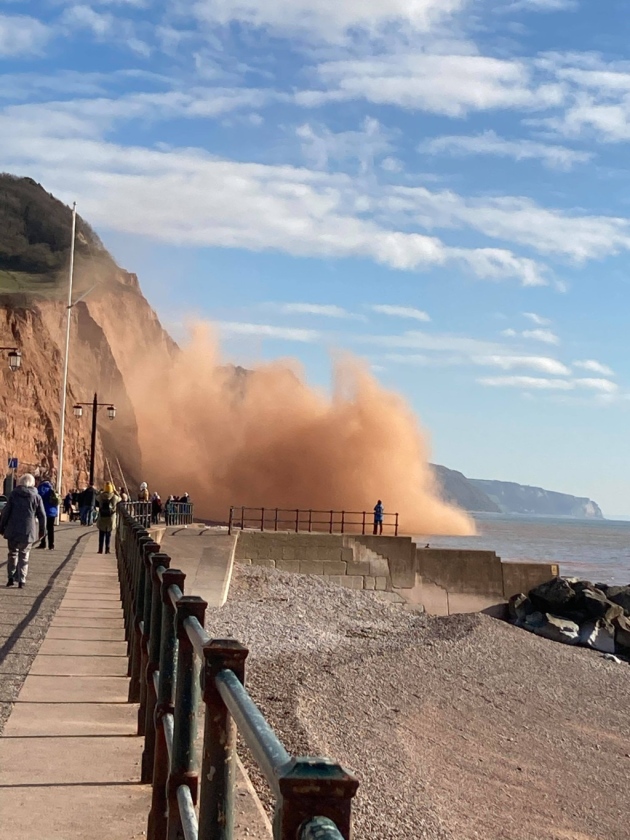
Caught on camera: dramatic cliff fall in Sidmouth – Friday

Go to Sidmouth Herald online to see more images

Alex Walton

PUBLISHED: 23:00 17 October 2020 www.sidmouthherald.co.uk 

Sidmouth cliff fall Picture: Linda Allen

A large cliff fall kicked up a dust cloud at East Beach in Sidmouth this morning (Friday, October 16).

Terry Whitmore from Exmouth was visiting the town and enjoying a walk along the seafront at the time of the fall.

She said: “It happened at 10.25am. There was a small fall just before the large one.

“It was an amazing sight. You could taste the dust.”

This latest cliff fall highlights just how dangerous this stretch of the coastline is and how susceptible it is to erosion.

It comes after a monitoring station was recently installed at Port Royal to observe and record changes caused by coastal erosion.

The public are strongly advised not to use this beach with fresh warning signs in place at the access point on the new bridge to deter any would-be adventurers.

Covid ‘clusters’ in 12 parts of East Devon with 69 new cases across district

Another 69 coronavirus cases have been confirmed in East Devon in the past week – with ‘clusters’ identified in a dozen of its wards.  

East Devon Reporter eastdevonnews.co.uk 

It means a total of 466 Covid-19 cases have now been recorded in the district, where the infection rate is 318.6 for every 100,000 people.

In Exeter, 379 new cases have been confirmed in the past seven days. The city’s overall total stands at 1,442 with an infection rate of 1,097.4.

There were 1,133 new cases across both Devon and Cornwall.

Statistics are from both ‘pillar one’ NHS data and ‘pillar two’ data from commercial partners.

Ninety-two new cases had been confirmed across East Devon – and 603 in Exeter -in the previous week.

However, around half of these were backdated due to a widely-reported national database glitch.

‘Clusters’ in 12 East Devon areas

A dozen ‘clusters’ – where three or more Covid cases have been confirmed – have been identified in East Devon in:

  • Cranbrook, Broadclyst and Stoke Canon (18 cases);
  • Exmouth Town (eight);
  • Clyst, Exton and Lympstone (seven);
  • Sidbury, Offwell and Beer (six);
  • Ottery St Mary and West Hill (five);
  • Exmouth Littleham (five);
  • Feniton and Whimple (five);
  • Axminster (four);
  • Exmouth Halsdon (four);
  • Budleigh Salterton (three);
  • Exmouth Brixington (three);
  • Exmouth Withycombe Raleigh (three).

The ‘clusters’ data, last updated yesterday afternoon (Friday, October 16), is based on a rolling rate of new cases by specimen date ending on October 11.

Figures are based on Middle Super Output Areas (MSOA) in England – broken down into zones of around 7,200 people.

‘Clusters’ have been identified in all of Exeter’s 15 wards:

  • Pennsylvania and University (193 cases);
  • Central Exeter (66);
  • St James Park and Hoopern (56);
  • Middlemoor and Sowton (28);
  • Mincinglake and Beacon Heath (23);
  • Alphington and Marsh Barton (20);
  • Pinhoe and Whipton North (19);
  • St Leonard’s (18);
  • Heavitree West and Polsloe (14);
  • Wonford and St Loye’s (14);
  • St Thomas East (12);
  • Heavitree East and Whipton South (ten);
  • Exwick and Foxhayes (nine).
  • St Thomas West (nine);
  • Countess Wear and Topsham (seven).

New cases across Devon and specimen dates

Some 943 new cases of coronavirus have been across Devon in the past week.

Of these, 69 were in East Devon, 379 in Exeter, 39 in Mid Devon, 50 in North Devon, and 176 in Plymouth.

There were 41 cases in the South Hams, 71 in Teignbridge, 88 in Torbay, 23 in Torridge and 27 in West Devon.

Cornwall recorded 170 new cases.

Of the 943 Devon cases, 581 had a specimen dare of between October 9 and October 15.

Fifty of these were in East Devon and 218 were in Exeter.

There were 109 in Plymouth, 45 in Torbay, 44 in Teignbridge, 40 in North Devon, 26 in the South Hams, 21 in Mid Devon, 15 in Torridge, and 13 in West Devon.

Eighty-two of Cornwall’s cases had specimen dates in the past week.

The number of people in hospital in the South West in the past week has risen to 151 from 77 and there are currently 17 people on a mechanical ventilator.

How the figures compare to the previous week

Of the 1,369 Covid cases confirmed across Devon and Cornwall in the week before last, 745 had a specimen date between October 2 and 8.

Some 310 of these were in Exeter and 45 were in East Devon.

Covid cases totals and infection rates

Devon has now recorded a total of 3,376 confirmed coronavirus cases. The county’s infection rate is 420.8 per 100,000 people.

Of these, 466 have been in East Devon, where the infection rate is 318.6.

Exeter’s total is 1,442 and its infection rate 1,097.4.

There has been a total of 1,268 cases in Plymouth, 550 in Torbay, 418 in Teignbridge, 320 in Mid Devon, 256 in North Devon, 220 in the South Hams, 137 in West Devon, and 117 in Torridge.

The total in Cornwall and the Isles of Scilly is 1,804 cases.

A total of 584,843 Covid-19 cases have been confirmed in England. The national infection rate is 1,039 per 100,000 people.

Hope for Covid vaccine at New Year

The NHS is preparing to introduce a coronavirus vaccine soon after Christmas. Trials have shown it will cut infections and save lives, Jonathan Van-Tam, the deputy chief medical officer, has privately revealed.

[Similar story carried here https://www.medscape.com/viewarticle/939260 ]

Tim Shipman and Andrew Gregory www.thetimes.co.uk 

He told MPs last week that stage three trials of the vaccine created at Oxford University and being manufactured by AstraZeneca mean a mass rollout is on the horizon as early as December. Thousands of NHS staff are to undergo training to administer a vaccine before the end of the year.

The government changed the law this weekend to expand the number of health professionals able to inoculate the public. The regulations will enable pharmacists, dentists, midwives and paramedics to administer jabs.

Van-Tam gave a briefing to MPs on Monday afternoon in which he said: “We aren’t light years away from it. It isn’t a totally unrealistic suggestion that we could deploy a vaccine soon after Christmas. That would have a significant impact on hospital admissions and deaths.”

The first vaccines will be given to the elderly and vulnerable and to vaccinate those most at risk will take several months. Most people will not be given the jab.

An MP who attended another briefing with Van-Tam said he was “very bullish about the third stage AstraZeneca results, which he expects between the end of this month and the end of next”. The MP said: “Van-Tam expects it to protect the elderly and vulnerable. He gave us to understand that it stopped the virus ‘shedding’ in the young. He said he would expect vaccination to start in January.”

Boris Johnson warned last week that there might never be a vaccine, but insiders say he did so because the government does not want to “overpromise and underdeliver”.

A health department official confirmed a “robust and comprehensive training programme” was being developed by the NHS and Public Health England to train more people to administer injections.

Matt Hancock, the health secretary, said: “These legal changes will help us in to make sure we are ready to roll out a safe and effective Covid-19 vaccine as soon as it has passed clinical trials and undergone rigorous checks by the regulator.” Van-Tam added: “Vaccines are being developed at a speed that, if successful, will save lives.”

Planning applications validated by EDDC week beginning 5 Oct

Coronavirus: Poll shows lack of trust in Boris Johnson as Britons feel the financial pinch from pandemic

British voters do not trust Boris Johnson and his health secretary Matt Hancock to beat coronavirus, according to a new survey – and less than a quarter (22 per cent) think it would be reasonable for ministers to expect them to keep obeying restrictions on their social and economic lives beyond the spring.

Andrew Woodcock, political editor www.independent.co.uk

The poll by BMG Research for The Independent laid bare the extent of financial hardship caused by the Covid-19 pandemic and the lockdown measures imposed by the government to fight it.

More than a quarter of those questioned (26 per cent) said that their household incomes had gone down as a result of the outbreak.

And some 3.4 per cent – the equivalent of more than 900,000 families or sole-person households – said their income had fallen by more than half.

The poll of 1,500 people was conducted as Mr Johnson struggled to maintain his grip on his regional coronavirus policy, with councils in the north rejecting his efforts to tighten local restrictions and Labour’s Sir Keir Starmer demanding a national “circuit-breaker” lockdown.

It found that just 36 per cent now trust the prime minister to lead the response to the pandemic, against 44 per who do not – an overall rating of -8. For Mr Hancock, the figures were more damning, with a trust rating of -13 based on just 26 per cent trusting him and 39 per cent expressing distrust.

The most trusted politician was chancellor Rishi Sunak, whose +19 rating of 44 per cent trust compared to 23 per cent distrust was no doubt buoyed by his role handing out close to £200bn in state support, including a furlough scheme paying up to 80 per cent of wages for employees unable to work.

Nicola Sturgeon had a +13 trust rating (42 – 29 per cent), soaring to +22 (52 – 30 per cent) in Scotland, while Starmer’s positive rating was a more modest +9 (36 – 27 per cent).

Levels of trust in the key pandemic experts were comfortably higher, with chief medical officer for England Chris Whitty scoring +25 (41 – 16 per cent) and chief scientific adviser Sir Patrick Vallance +21 (36 – 15 per cent).

The figure with lowest public credibility on dealing with coronavirus was US president Donald Trump, with just 11 per cent of Britons saying they trusted him  on the issue, against 73 per cent who did not.

There was little sign of optimism for an improvement to families’ financial position in the near future, with 25 per cent of those questioned saying that they expect their household income to decline further over the next six months. The period will see the replacement of Mr Sunak’s furlough scheme in November with a less generous system paying 22 per cent of wages – or 67 per cent for firms forced to close in tier 3 Covid alert areas.

And it will see the withdrawal in April of the £20-a-week temporary uplift to universal credit and working tax credit provided to help benefit claimants weather the coronavirus storm.

The poll found that those most likely to lose out financially due to coronavirus were 25- to 34-year-olds – those most likely to be bringing up small children – among whom 36 per cent said their household income had fallen, against just 10 per cent who said it had gone up. By contrast, just 8 per cent of over-65s reported financial loss.

Ethnic minority households were far more likely to report that they had lost income (35 per cent) than white British (24 per cent).

The director of policy at the Child Poverty Action Group, Louisa McGeehan, said the poll’s findings reflected the group’s own experience of families with children suffering money woes.

“As these figures suggest, parents of young children are more likely to be struggling due to falling incomes, lack of childcare and the additional costs of raising children,” Ms McGeehan told The Independent.

“Our own research found that eight in 10 hard-up families are financially worse-off as a result of the pandemic. Despite this, there has been no financial support from the government specifically targeted at families with children.”

Removing the benefit uplift in the spring “makes no sense”, said Ms McGeehan, calling instead for a  £10 weekly increase in child benefit to help protect children from hardship.

And Emma Revie, chief executive of foodbank charity the Trussell Trust, said: “It is shocking how many people have seen their incomes fall during the pandemic.

“This has led several thousands of people to be forced to use a food bank for the first time. This is not right.

“Our own research forecasts that if we don’t take action as a nation, our network of food banks will be giving out six food parcels a minute this winter.

“But it doesn’t have to be like this. This year we’ve seen the power of what happens when we stand together in the face of adversity. That is why we’re urging the government to preserve the lifelines that have saved many of us from destitution through this pandemic.”

Among the 26 per cent reporting a blow to their finances, around one in six (16 per cent) said their household income had fallen by less than 10 per cent, a quarter (25 per cent) said it was down by 10-19 per cent, a further 22 per cent had taken a hit of 20-29 per cent in their income, 10 per cent had lost 30-39 per cent, and 7 per cent had lost 40-49 per cent. But a staggering 13 per cent of this group – equivalent to 3.4 per cent of the population – said that the money coming into their home was down by more than 50 per cent as a result of the pandemic.

The poll found that 49 per cent of voters believe that the government is right to prioritise limiting the number of deaths caused by the disease, while 30 per cent say limiting the damage to jobs and the economy should come first.

But it also indicated that Britons’ patience may soon run out for the lockdown restrictions which have forced them to stay in their homes, give up visits to pubs and restaurants and limit socialising with friends and family.

A clear majority (65 per cent) said it was “reasonable” for the current restrictions in their area to continue until Christmas, against just 19 per cent who said it was not.

That majority fell if the restrictions were extended to the spring of 2021 – as Mr Johnson has suggested they might – with 46 per cent saying this would be reasonable and 34 per cent unreasonable.

But beyond this date, support for continued measures drops off a cliff, with 51 per cent saying it would be unreasonable to carry on to the end of 2021 and 59 per cent into 2022, even if no vaccine or effective treatment is found.

Only a hardcore 13 per cent of lockdown accepters said that it would be reasonable to keep measures going into 2022, and these people appear ready to maintain them almost indefinitely, as virtually the same proportion were happy to continue into 2023.

BMG head of polling Robert Struthers said: “Boris Johnson’s own personal ratings strengthened as the first wave of the pandemic hit the UK back in February and March of this year.

“Now, as the second wave of the virus takes hold, it appears public trust has slipped away. 

“The collapse in trust will likely worry those working across government, as the prime minister tries to reassure the public that the new measures introduced over the past week will be enough to halt the spread.”

Mr Struthers questioned whether Mr Sunak’s popularity would survive the  planned rollback of his support schemes.

“You might expect the trust ratings of the chancellor and prime minister to be closely aligned given how closely they will be working together at the top of government,” he said.

“However, this polling clearly shows that the public rate the chancellor’s performance and ability to hand the virus effectively – up until now at least – much more highly.

“However, as the second wave takes hold and economic support packages become more targeted and less generous, whether this trend continues is another matter entirely.”

– BMG Research questioned 1,500 UK adults between 8 and 13 October. 

Former Flybe shareholder Cyrus in talks about reviving collapsed regional airline

A shareholder in Flybe when it collapsed this year with the loss of thousands of jobs is in talks with its administrators about a potentially controversial bid to resuscitate the regional airline.

Mark Kleinman news.sky.com

Sky News has learnt that Cyrus Capital, a hedge fund with offices in Mayfair, is behind a plot to reacquire some of Flybe’s assets, despite the devastating impact of the coronavirus pandemic on Britain’s aviation industry.

Cyrus Capital, which is run in Europe by Lucien Farrell, is understood to be in discussions with EY – which was appointed to handle the company’s insolvency in March – about a deal.

It is said to want to relaunch a smaller version of Flybe next year, although the precise timetable would be subject to a recovery in passenger demand and the removal of coronavirus-related quarantine measures.

Flybe was Europe’s largest regional airline, carrying around 9m passengers annually and accounting for 40% of domestic UK flights.

It served more than 80 airports across Britain and Europe, including locations such as Belfast, Birmingham, Exeter, Manchester and Southampton.

It fought a frantic battle to survive, securing a rescue deal involving Cyrus Capital, Virgin Atlantic Airways and Stobart Group, the owner of Southend Airport, early last year.

However, it ran into fresh financial turbulence in January, with mounting losses prompting it to approach the government to seek emergency financial support.

Despite premature public comments from cabinet ministers including the transport secretary, Grant Shapps, that a deal had been struck to keep Flybe aloft, weeks of talks about a £100m state loan foundered.

Opponents of a government funding package were led by Michael O’Leary, the Ryanair boss, who called it “a billionaires’ bailout” in reference to Sir Richard Branson’s involvement in the ownership of Flybe.

The company eventually called in administrators in early March, causing more than 2300 job losses, with Virgin Atlantic’s refusal to inject new funding the eventual catalyst for its collapse.

Virgin Atlantic was forced to seek its own bailout this year following the slump in international air travel.

More than a dozen of Flybe’s routes have been taken on by Loganair, another regional carrier, although many remain unfilled.

Further details of Cyrus Capital’s plans to revive Flybe, including whether it would seek to use the defunct airline’s name, were unclear this weekend.

A number of former Flybe executives are understood to be involved in the proposed relaunch.

The hedge fund held a 40% stake in Connect Airways, Flybe’s parent company, before its insolvency.

According to an administrator’s report, it was also the largest secured creditor, with £53m of loans outstanding when EY was appointed.

Cyrus Capital and EY declined to comment.

As well as Virgin Atlantic’s privately funded rescue deal, International Airlines Group, the owner of British Airways and Aer Lingus, has tapped shareholders for more than £2bn of additional equity since the COVID-19 crisis began.

Sky News revealed earlier this month that easyJet had warned the government that it might require further state support beyond its access to the Bank of England’s coronavirus funding programme

Further evidence of the continuing crisis in the aviation sector was provided this weekend as the UK’s biggest airport entered into a new phase of consultation with employees, heightening the possibility of substantial job losses.

Heathrow Airport has been consulting with unions since early last month about revised pay deals for thousands of staff, but the statutory 45-day period expired on Friday with no deal in place.

That will involve individual consultations with up to 4700 affected employees, although the number of any eventual job losses will be significantly lower than that.

Kathryn Leahy, Heathrow’s director of operations, said: “In order to ensure our business recovers from this crisis and is sustainable and competitive in the future, changes need to happen.

“For the past 45 days we have been in formal talks with our unions, but we have been unable to reach an agreement.

“Whilst we will continue to talk, we now need to move on to the next stage of this process with our colleagues.”

She added that Heathrow, which has seen passenger numbers plummet this year, had “a new future ahead of it and in order to be competitive, we need to create cost efficiencies across the business”.

Ms Leahy insisted that the company’s pay offer meant there was “a job for everyone who wants one”.

Heathrow’s plan involves equalising pay, with a ‘buy down’ offer – for those whose salaries will be decreased – involving the difference being paid in a lump sum or in monthly instalments over a two-year period.

The airport has told unions that while no further pay deals will be considered until the beginning of 2023, that would be reviewed if passenger numbers return to at least 80% of 2019 levels across three consecutive months compared with the same three-month period in 2019.

Not following the science: How No 10 parted company with Sage

“The base will not be sufficient.”

Ian Sample www.theguardian.com 

With owlish understatement, the chief medical officer for England, Chris Whitty, made clear that Boris Johnson’s three-tier local lockdowns, which the prime minister had just set out alongside him in Downing Street, would not curb the second wave of coronavirus crashing over England.

Just hours later, a startling late-night document dump from the government’s Scientific Advisory Group for Emergencies (Sage) confirmed in stark terms that Johnson had parted ways with his scientific advisers.

With Sage’s call for action out in the open, it became clear that the national consensus in the fight against coronavirus, increasingly strained over the past six months, had ruptured. From Andy Burnham on the steps of Manchester city hall refusing to allow his city to become the “canary in the coalmine”, to furious Conservative MPs attacking the health secretary, to Keir Starmer calling for a “circuit breaker”, the prime minister was beset by critics on all sides.

And with winter approaching, there were growing concerns in government about the public’s willingness to comply with measures they could see being attacked from across the political spectrum.

The seeds of this week’s disarray were sown almost a month earlier. Whitty and the chief scientific adviser, Patrick Vallance – CMO and CSA as they are known in Whitehall – briefed Johnson on 16 September about what one person present called the “terrifying reality” of allowing the virus to go unchecked.

But eight months into the pandemic, Downing Street is unashamedly listening to other voices. “People will look at Sage papers and go, ‘Oh, they’re not following the science’, but Sage is only one part of the decision-making process, and always has been,” said a Downing Street aide.

Many key decisions are made by the Covid operations committee, which receives, as well as scientific papers, economic analysis, reports from the NHS and NHS Test and Trace, and gives updates on how other governments are managing the crisis.

“Fundamentally, this has always been the challenge the prime minister has,” the aide said. “Pretty much everyone else has a focused area. Understandably, because that’s their job – you have Alok [Sharma] looking at the impact on businesses, Rishi [Sunak] looking at the wider economy, Matt [Hancock] looking at health costs. The PM’s the one who has to tie all that together.”

Sunak allies say the chancellor is relentless in questioning the data and “pushy” where he feels ministers are parroting their department’s line without analysis to back it up. “There have been times when he’s been, like, ‘Sorry, what’s your basis for X?’, and it falls apart.”

Hancock was pressing for tough action to be taken urgently – but focused on the worst-affected areas.

By Monday 21 September, it was becoming increasingly clear inside government that Johnson had decided to try to walk a middle course, between the alarmed scientists and the lockdown sceptics in his party, including the chancellor.

“‘Circuit breaker’ felt a bit like a hammer to smash a walnut,” says a government source about the discussions that weekend, which went on late into Sunday night. “When you’re looking at cases in the south-west and south-east, to cripple those economies and totally ruin lives in a different way would feel a disproportionate response.”

While No 10 was quietly shifting towards a largely local approach, the experts on Sage were determined to send a strong message to Downing Street as they fired up Zoom for their 58th meeting on Monday 21 September.

Over the weekend, they had had time to read an eight-page paper summarising “the effectiveness and harms of different non-pharmaceutical interventions”. It was co-written by a number of Sage experts, with a cover note from Prof John Edmunds, dean of the faculty of epidemiology and population health at the London School of Hygiene and Tropical Medicine.

While most Sage papers are technical and dry, this one was different. The language was frank and bleak. It spoke of coronavirus cases rising around the country and intensive care beds filling up. A failure to act immediately, it warned, would unleash an epidemic with “catastrophic consequences”.

Most of those taking part in the meeting knew this all too well. From the opening moments, it became apparent that everyone felt the same: the situation demanded action, and fast.

They concluded that no single intervention would get on top of the outbreak. A second document, circulated before the session, gave the numbers: the impact different restrictions would have on R, which must be below 1 for the epidemic to shrink. At the time, Sage’s national estimate for R was 1.1 to 1.4. Close all bars, pubs, cafes and restaurants and R might fall by 0.2. Close the schools and it could fall by as much as 0.5.

 Boris Johnson delivers statement on new three-tier coronavirus restrictions for England – video

In the event, the experts proposed a package of interventions – “required urgently” – to push the rate of new infections down and prevent the epidemic spiralling out of control. On the shortlist were a circuit breaker, or two-week mini-lockdown; advice to work from home where people could; a ban on indoor mixing with other households; the closure of all bars, restaurants, cafes, indoor gyms and services such as hairdressers; and for all university and college teaching to be online unless absolutely essential.

They felt a two-week circuit breaker was particularly appealing. The mini-lockdown could replace two weeks of growth with two weeks of decline, pushing the epidemic back four weeks. England’s struggling test and trace system would likely catch more people. An inexorable rise might become a sequence of smaller, sawtooth peaks. All the measures had downsides, but doing nothing was worse. When the meeting wrapped up, the consensus was clear: England needed decisive action.

Yet the following day, when Johnson announced new restrictions, it became clear that Sage’s call to arms had gone unheeded. The centrepiece was a 10pm curfew on hospitality – and a reversal of Johnson’s message, a few weeks previously, to go back to the office.

Some Conservative MPs welcomed the prime minister’s willingness to deviate from the path set by the scientists. One former cabinet minister praised Johnson for his leadership. “Once you say publicly that you’re following the science, then you basically have to do everything that Chris Whitty says, and I think that’s very unhealthy, because that’s asking him to do something that he’s not actually qualified to do,” he said.

One Whitehall source remarked waspishly that if the government had followed Sage, “we would never have come out of lockdown”, adding, “They’ve always wanted to let nothing happen.”

Sceptics about the circuit-breaker plan argue that it merely buys time. “It doesn’t change the fundamental path of the virus. The argument that it changes the trajectory is scientifically wrong. Unless you’re expecting it to change behaviour, in which case it’s not a circuit breaker, it’s about frightening people, and there are better ways of doing that.”

But in the face of the government’s lack of action, Sage members turned to the media to hammer home their point. Edmunds and Graham Medley, a member of Sage and professor of infectious disease modelling at the London School of Hygiene and Tropical Medicine, went public with some of their concerns.

But inside government, negotiations were ongoing about the details of a three-tier local Covid alert system. Insiders said this was actually Hancock’s idea. “He’s pleased that approach has won out,” a source said, describing the policy as a result of the “healthy challenge” between those with different responsibilities.

Among the scientists, however, frustration was evolving into alarm and fear. At a subsequent Sage meeting, Whitty looked “quite murderous”, one researcher was told after the session.

It was his Sage co-chair, Vallance, who decided to publish the minutes of the committee’s fraught discussions of September. The timing was striking: it was the earliest moment Vallance could have made them public – and it dramatically reignited the public debate over a circuit-breaker lockdown.

The release of the papers had been signed off by the Cabinet Office. Downing Street hoped the more extreme options laid out would help reassure anti-lockdown renegades on the Tory benches that far from taking an extreme course, the prime minister was holding the line.

Instead, Steve Baker and his band of rebels underlined the prime minister’s fragile base by delivering a carefully calibrated symbolic rebellion, with 42 Conservative MPs voting against the government.

The sharp contrast between the scientists’ evident alarm and the government’s modest measures hadn’t gone unnoticed by Keir Starmer. “Constructive opposition requires a constructive government,” said one source close to the Labour leader. “There’s a frustration that every time we put a proposal, it’s dismissed, only to be adopted a couple of weeks later.”

Much of the decision-making about Labour’s handling of the pandemic takes place at Starmer’s Covid committee, an inner shadow cabinet. Meeting several mornings a week by Zoom, the group includes the shadow health, foreign and home secretaries, Starmer’s deputy, Angela Rayner, the shadow chancellor, Anneliese Dodds, and Rachel Reeves, the opposite number to the powerful Cabinet Office minister, Michael Gove.

Increasingly alarmed about the trajectory of the disease, they had been discussing the idea of a short-term circuit breaker since the idea emerged from leaked accounts of Sage meetings. By the time they met on Saturday 10 October, there was “pretty much a consensus” to back a short, sharp shutdown, but they decided to wait for the prime minister’s statement to parliament on Monday before taking a public stand.

The group met again on the Tuesday morning to make their final decision. It was signed off by the wider shadow cabinet at lunchtime, and Starmer’s team contacted Labour’s metro mayors to prepare the ground.

Later that day, Starmer gave his dramatic press conference at the Garden Museum just across the river from Westminster, endorsing a two- to three-week circuit breaker, albeit with schools kept open.

The prime minister’s allies insist that they are “really relaxed” about Starmer’s intervention. They believe when the hard winter has passed, Johnson will come into his own. “When we get to the spring, and we get over the hump of this, then it will all be about building confidence; and then it gets more like a campaign. That will be a very natural groove for him,” said one.

But the mood among scientists remains gloomy. Jeremy Farrar, a doctor on Sage and director of the Wellcome Trust, described the measures as “the worst of all worlds”. His comments reflect a pessimistic mood on Sage as Covid continues its relentless march.

On Friday, the Office for National Statistics estimated that 28,000 people had caught the virus each day between 2 and 8 October.

Stephen Reicher, a professor of social psychology at the University of St Andrews and a member of the behavioural science subgroup of Sage, said: “For me, this was not just another decision. It seemed to portend something much larger in terms of the way the science is treated.” The measures, he said were a “middle-of-the-road fudge … This is like going to sea in half a boat”.

How Boris Johnson’s indecision over a second Covid-19 lockdown is splitting the Conservative Party

Is the Covid-19 pandemic the start of a new era, or merely a painful interruption of the old one? The Conservative Party is split in its answer, and its fractious tribes reach these two conclusions through a ­variety of different routes.

By Stephen Bush www.newstatesman.com 

Rishi Sunak, the Chancellor, has used his private meetings with Conservative MPs not to advance his credentials as a ­future party leader, but to deliver an altogether bleaker message: that the economic ­activity lost during this period will not ­return. The British economy will be ­suffering from its own form of “long Covid” for some time. The biggest headache, as far as Sunak is ­concerned, is that the government’s debt will be more than 100 per cent of GDP for the foreseeable future, but the complications extend much further.

The Sunak economic remedy involves an immediate reduction of financial support for businesses, no second lockdown and a tax-raising budget sooner rather than later. The coronavirus crisis has robbed Sunak of the opportunity to use his first budget to hike taxes long before a general election, as chancellors tend to do, and both he and Treasury officials are keen to catch up as soon as possible.

For other Conservatives, the ­problem with lockdowns is as much social as it is economic: they bridle against the infringement of ­liberty and extensive involvement of the state in people’s lives. “It’s not a question of whether we can afford it,” one ­backbencher told me, “it’s a question of whether a Conservative Party should be locking people in their homes and forcing businesses to shut.”

For a third group, the central challenge is that the crisis is without a clear end. They note that it took the best part of a decade for medical science to produce an Ebola vaccine, and that vaccines for HIV/Aids or Sars have yet to arise. Palliative treatments have hugely advanced the care of patients with HIV/Aids, but they were the work of decades, not years.

Is it fair, some Tory MPs wonder, to ask people to spend years socially distancing from one another when there is no ­guarantee of a medical breakthrough? “We have to talk about quality of life,” says one veteran ­Conservative. “Is it really in anyone’s ­interests for an 87-year-old to spend the last years of their life locked up, unable to visit their family or attend a wedding, without a clear end date?”

All three groups, whatever route they take, reach the same conclusion: that the country needs to live with the new disease, not hide from it. Only a loud minority believes that there should be no restrictions on anything – in Westminster they are more commonly found not in the House of Commons but in the House of Lords, where among Conservatives there is a sizeable group of what one peer ­derides as “flat-earthers”.

Most think that some form of restrictions are necessary and a greater level of surveillance is a sad necessity, but that lockdowns – and painful limitations on ceremonies, religious worship and students – need to be scrapped, and government policy should facilitate a greater level of freedom and normality within those constraints.

On the other side are those who think coronavirus is something to be endured and overcome, not adapted to. Similarly, several different lines of thought lead to the same conclusion. There are those like Michael Gove, who has told MPs that the biggest weapon that Nicola Sturgeon has is the perception that she is a safe pair of hands, while Westminster is playing fast and loose with public health. There are those like Matt Hancock, whose overwhelming priority is to avoid a second spike that is more lethal than the first. And there are others who believe that there can be no economic recovery while social distancing remains in place – and that the time for the British government to grapple with the extraordinary debts it has taken on will come before, not after, lockdown measures are brought to an end.

These factions all come down in favour of something resembling a second lockdown and a series of economic measures to keep the economy in cryogenic suspension ­until either palliative treatments or a vaccine ­allows them to make progress.

The problem is that Boris Johnson is a member of neither movement, though he flirts with both. He talks up the importance of new treatments, and has imposed fresh lockdowns on large swathes of England: on 12 October he announced a three-tier system of restrictions, placing Merseyside in the highest category. Yet he rejected ­recommendations by Sage – the ad hoc body of medical and scientific experts that ­advises the government – for a swift reduction in freedoms and a second ­nationwide lockdown.

Johnson’s defenders like to describe the Prime Minister as someone finding a middle or third way between extremes. The problem is that the third way doesn’t exist: you either support the economy during lockdown, or you don’t. You either remove the barriers to the country learning to live with coronavirus, or you don’t.

The Prime Minister’s present course is the worst of all worlds: a lockdown without sufficient economic support, and a regulatory environment that prevents businesses from adjusting to the new world. The mess is not surprising given Johnson’s trajectory. His political success has always been based on telling the country it can have it both ways: spending rises and tax cuts, a close relationship with the European Union and a reclamation of sovereignty. Now, events have forced him to pick one of two options, and his approach is to pretend there is a middle way. It hasn’t worked. The question is how much damage his indecision will do to the country’s economic and physical health before he realises as much.

Improving Broadband – National Audit Office (NAO) Report

“Government has set a very challenging timeline in promising nationwide connectivity by 2025 and the experience from the Superfast Programme, as well as our previous work on major programmes demonstrates the importance of setting and publishing a realistic timetable and continuing to test whether this is achievable.”

Owl can read between the lines- don’t hold your breath!

www.nao.org.uk

Background to report

In 2010, government announced its aim for the UK to have the best superfast broadband network in Europe. It established the Superfast Broadband Programme (the Superfast Programme) to support broadband roll-out to areas which were not commercially viable. The Department for Digital, Culture, Media and Sport (the Department) allocated grant funding to local bodies (a local authority or group of local authorities, devolved governments or local economic partnerships). Local bodies would then provide additional funding and procure superfast broadband services for their areas. The Superfast Programme’s original target was for 90% of premises to have access to download speeds of at least 24 megabits per second by 2015. In June 2013, the Department revised its target to achieving 95% by 2017. These targets could only be met in conjunction with industry-funded roll-out.

Superfast broadband is fast enough for most household use today, but internet traffic is growing at around 40% each year driven largely by video streaming. In 2018, to meet future demands of consumers and businesses, government announced a new policy for the UK’s telecoms industry to provide gigabit-capable infrastructure to 50% of premises by 2025 and nationwide coverage by 2033. It has since committed to 2025 for nationwide coverage and has allocated £5 billion for its UK gigabit programme (the Future Programme), to subsidise roll-out to the most difficult to reach 20% of premises. The Department estimates that accelerating nationwide gigabit capability to 2025 will need government to subsidise roll-out of 20% of premises compared with only 10% for a 2033 timeline.

Scope of the report

This report considers what the Superfast Programme has delivered and how the UK’s broadband infrastructure has held up during the COVID-19 pandemic. We examine the lessons from the Superfast Programme and other comparative projects, and how the Department could apply these as it establishes its Future Programme.

The report focuses on the role of the Department and considers:

  • progress with superfast broadband (Part One);
  • managing current and future broadband provision (Part Two); and
  • learning lessons (Part Three).

The Department is still developing its plans for the Future Programme. It expects to let its first contracts in autumn 2021 and is currently awaiting approval of its outline business case. This report therefore does not examine the Department’s progress on the Future Programme in detail. Those that are digitally excluded out of choice or for financial or other reasons are also out of scope.

Report conclusions

The Superfast Programme has extended the nation’s broadband connectivity and has delivered benefits, which the Department expects will continue to increase with time. Better broadband has helped communities across the nation to work and study from home and stay connected during the COVID-19 pandemic in ways that would not have been possible five years ago. However, in managing the trade-off between coverage and speed, the UK has a broadband network that is not fully future-proof and, less than a decade after launching its Superfast Programme, government has identified the need to upgrade it again.

Government has set a very challenging timeline in promising nationwide connectivity by 2025 and the experience from the Superfast Programme, as well as our previous work on major programmes demonstrates the importance of setting and publishing a realistic timetable and continuing to test whether this is achievable. The Department is working towards finalising its plans for its Future Programme to support nationwide gigabit coverage. In doing so, it must manage the tension between meeting a timeline and serving those in greatest need. Failure to do so risks leaving those left behind by the Superfast Programme even further behind and widening the rural divide. The Department still has much to do to mobilise and deliver a substantial programme. It has applied some learning from the Superfast Programme but it has moved away from some of its more successful aspects in a bid to meet its challenging timeline. As the Department develops its approach for the Future Programme it will need to show that it has considered how best to mitigate any new risks arising.

Hotel industry reels as COVID three-tier system bites in Devon

“The value of the visitor economy to Devon is £2.5BN and people employed is 63,000 and the estimated loss of revenue due to the pandemic is £1.3BN. The visitor economy is vital to the region, and many businesses will not survive this next phase if further assistance is not forthcoming. “

Eye-watering numbers – Owl has always believed that our local economy is dangerously over-exposed to tourism. It is an economic sector which provides seasonal and low paid employment. Future recovery plans must look to diversification. Not an easy task when tourism is so entrenched.

Colleen Smith www.devonlive.com

The tourism and hospitality industry across Devon is reeling as the new three-tier COVID restrictions have started to hit hard with redundancies, closures and financial losses already amounting to hundreds of million pounds.

The largest hotel group in Devon, TLH Leisure Resort which employed 420 people in Torquay, has already made redundancies and has warned staff there will be more job losses to come.

Hotel and coach tour companies are reeling as the three-tier system of local lockdowns limits millions of people from travelling outside their local areas.

Sally Everton, Visit Devon’s tourism boss, said: “The repercussions this will have across the many tourism and hospitality businesses across the county is immense.

“With travel restrictions now in place for many people across the country, the adverse knock on effect into half term will be catastrophic for many. Cancellations had already started with the Rule of 6, which of course includes children, so many group and extended family group bookings had already gone affecting many self catered accommodation providers.

“I am now hearing of increasing cancellations across the county from all areas, which is a major concern. The lost revenue for October half term is estimated at over £287M which is hugely worrying for us.

“The value of the visitor economy to Devon is £2.5BN and people employed is 63,000 and the estimated loss of revenue due to the pandemic is £1.3BN. The visitor economy is vital to the region, and many businesses will not survive this next phase if further assistance is not forthcoming. “

Carolyn Custerson, Chief Executive Officer of the English Riviera BID Company Ltd, said that in Torbay alone the tourist industry has lost £138 million because of COVID: “All the new COVID restrictions are unfortunately going to have repercussions for our local Tourism and Hospitality businesses with a large part of our market now unable to travel on holiday.

“We have already seen notable Group Coach cancellations which is very worrying.

“We will continue to promote the English Riviera and Devon as a great year-round destination but have no choice but to focus our activity closer to home whilst these latest restrictions are in place.

“The English Riviera has lost £138 million so far from the impact of COVID.”

Torbay relies heavily on the tourist industry and many staff who were on furlough during the first lockdown will now be put on to the new and less generous Job Support Scheme (JSS) which will be introduced on November 1.

JSS will replace furlough from November 1 for six months. The Chancellor announced it will be targeted at businesses required to close entirely due to tighter local or national coronavirus restrictions.

Under these proposals, the government will pay two-thirds of wages for businesses forced to close in the coming months as it seeks to slow the rise in coronavirus cases.

Jason Garside the CEO of TLH Leisure Resort – a huge complex of linked hotels and leisure facilities covering 7.5 acres near the Riviera Conference Centre, said the business had gone from an annual turnover of £14m to a likely £8m this year – and that was boosted by the boom in August and September this year when guests flocked to the Bay.

He said: “We are currently dealing with the loss of all our Welsh business.”

Mr Garside said TLH was in a strong cash position before COVID and because of that the business will survive.

He said: “We will survive this and we want to retain our loyal dedicated workers – 70 of our staff have been with us for more than 10 years. It’s more costly to keep staff than it is to make them redundant.”

But he said that after making a strong start the Government was losing its way: “The new Job Support Scheme does not go far enough to support the hospitality business.

“It’s not going to mitigate fully against job losses. We will use it over the next six months and attempt to retain as much of our workforce as we can.

“Business levels are less than a third of historic levels for the next six months.

“We have already made some redundancies. We employ 420 people and initially we made around 32 full time equivalent posts redundant – less than 10 per cent. Now we are reviewing future redundancies.

“We are going to use JSS and we have informed our workforce that we will retain as many as we can.”

Mr Garside was part of a management buyout of the hotel group in 2018 along with fellow directors Iain Piercy and John Finnegan.

He said: “It’s frustrating that the government have not got to grips with track and trace and we are disappointed with how they are communicating through media announcements followed by late guidance.

“It’s further eroding confidence. We went to great lengths to ensure we were a COVID secure hospitality business.

“We experienced a boom in August and that was very positive for us. But then a week ago the Government announced tiering and further restrictions on parts of the country. “

Mark Wright, director of Majestic Tours and the Torquay Majestic Templestowe Hotel, said: “We have refunded in excess of £2million this year due to cancelled tours.

“It really is a scary time for everyone and it looks like a number of hotels along Belgrave Road have closed.”

Majestic Tours usually brings over 350 coaches of holidaymakers a year to Torquay.

“Hopefully, we will all be able to trade through the winter, all be it on reduced numbers of guests, able to keep all our staff employed – without the safety net of furlough.

“In relation to coaches from Wales, we haven’t had an arrival since South Wales went into lockdown.

“We cancelled all coaches departing from Wales from the 25th September immediately they had lockdown announced and refunded all clients.”

In the meantime the Templestowe is closed for a two week £100,000 refurbishment to the ballroom.

Cases rising steadily and rapidly in the North of England – Covid-19 symptom tracking app

16 October 2020. According to the data, Burnley and Manchester, the two regions already earmarked by the Government to be next to enter Tier 3, are top of the app’s Tier Prediction model. The next regions are; Newcastle upon Tyne, Nottingham, Bury, Hartlepool, Salford, Sheffield and Leeds.

covid.joinzoe.com

According to the COVID Symptom Study UK Infection Survey figures, there are currently, 27,762 daily new symptomatic cases of COVID in the UK on average over the two weeks up to 11 October (excluding care homes) [*]. This compares to 21,903 daily new symptomatic cases a week ago. This figure is based on the number of newly symptomatic app users per day, and the proportion of these who give positive swab tests. The latest survey figures were based on the data from 13,361 recent swab tests done between 27 September to 11 October.

The app’s data continues to show a big disparity between the North and South of England. This week the North West (7,313 new cases per day) has overtaken the North East and Yorkshire (5,762). The South West (1,279) remains the lowest region, followed by East of England (1,356) and South East (1,417).

The COVID Symptom Study is now using its symptomatic COVID estimates to predict which regions in the UK could be next to be put under Tier 3 restrictions. Using predicted symptomatic cases means that predictions can be made up to ten days before confirmed tested cases are made public. The new Tier Prediction model takes the Tier 2 regions as defined by the Government (100,000 cases per million), uses the average estimated cases over the last seven days and ranks the regions in descending order. The area with the largest weekly average prevalence is ranked the highest. According to the data, Burnley and Manchester, the two regions already earmarked by the Government to be next to enter Tier 3, are top of the app’s Tier Prediction model. The next regions are; Newcastle upon Tyne, Nottingham, Bury, Hartlepool, Salford, Sheffield and Leeds.

The COVID Symptom Study UK Infection Survey has been running since early May when the COVID Symptom Study commenced the daily swab testing programme provided by the Test and Trace. The CSS has so far recorded over a million swab results from app users. The COVID Symptom Study UK Infection Survey estimates the number of current COVID-19 positive cases in the community based on the information logged by users in the app and the results from the swab testing programme. It identifies differences in numbers within the regions throughout the UK, and tracks the change in estimated cases over time. It is the largest survey of its kind in the UK.

The COVID Symptom Study app is a not-for-profit initiative that was launched at the end of March 2020 to support vital COVID-19 research. The app was launched by health science company ZOE with scientific analysis provided by King’s College London. With over 4 million contributors, the Study is the world’s largest ongoing Symptom study of COVID-19.

Tim Spector, Professor of Genetic Epidemiology at King’s College London, comments:

“The data is no longer showing the exponential increases that we were seeing a couple of weeks ago, but is clearly showing new cases continuing to rise. The North West still has the most cases and the fastest acceleration of cases with doubling times of around 10 days. Slowing this rapid rise is a priority. Scotland, Wales, London and the Midlands are slowly increasing with a doubling time of 14-28 days and the South and East of England remaining relatively flat with five-fold fewer cases than the worst hit regions. Our data is roughly 7-10 days ahead of other sources meaning that it acts like an early warning system, whilst we wait for the data from the confirmed cases.

Our new Tier Prediction model highlights that nine out of 10 are in the North of England, where most of the cases currently are concentrated, unlike the North which is accelerating, London has been showing a steady linear increase, doubling every 21 (range 14-28) days so it will be interesting to see how the new Tier 2 restrictions influence the rate of new cases in the next two weeks.”

COVID cases linked to Uni fall but indoor mixing ban extended

Dr Virginia Pearson, Director of Public Health for Devon has today welcomed the continued reduction in student cases in Exeter but had warned of the need for extra vigilance across the City and the rest of Devon as wider community cases rise.

Daniel Clark  www.devonlive.com

University of Exeter students are being asked to not to mix households indoors for a further seven days in a bid to tackle the spread of coronavirus.

While cases linked and confirmed in students at the University of Exeter have been dropping in the last week – the Pennsylvania and University MSOA has fallen from a height of 307 down to 169 – the University has extended the indoor household mixing ban until October 26 in a bid to drive down the infections further.

It comes as Devon’s Director of Public Health has warned of the need for residents to be vigilant as coronavirus cases in the community continue to be identified.

While the rolling average of new cases in the county has been dropping in recent days, the drop is mainly related to the fall in cases being confirmed in students at the University of Exeter.

Exeter University Forum

Exeter University Forum (Image: Google)

Mike Shore-Nye, Registrar and Secretary, at the University of Exeter, said: “We know from our close working with Public Health England that the measures we have introduced and the fact that our colleagues and students have responded so well have been a major factor in our regions being placed in the ‘medium’ (lowest) rather than ‘high’ risk level with no further restrictions introduced at this time.

“We also know that this is a fragile position and that we must remain steadfast in our commitment to prevent the virus spreading. The latest Devon County Council COVID-19 dashboard, dated 14 October, shows that there were 262 positive cases in Exeter over the preceding 7 days, and PHE tell us that more than 70 per cent of these are linked to the University. We also know that in the 7 days up to 13 October there were fewer than five cases related to our Cornwall Campus. We have seen no increase in the small number of staff cases.

“The case numbers related to our campuses in Exeter have fallen over the past 7 days. We continue to discuss the data and the underlying picture with our PHE colleagues and we are hopeful that we now see signs that the numbers of cases are no longer rising. This is due to the efforts of all of you in adhering to the guidelines and in doing so showing respect and compassion for all members of our local communities.

“These are very early signs, and for this reason I am once again asking students based in Exeter to continue not to meet indoors with students who are not part of your household for a further 7 days, until October 26.

“If we can establish a clear trend in the reduction of cases associated with the University then we can hope to reduce these restrictions and increase the amount of teaching and activities we are able to deliver on campus. To achieve this we must all continue to follow the COVID-19 rules.”

He added that in recognition of the low number of cases attributed to the Cornwall Campus, the Students’ Union have been able to begin the phased reintroduction of COVID-safe, in-person student society events.

He added: “We are working with the Students’ Guild and Athletic Union to begin the reintroduction of COVID-safe indoor sports activities next week, if we see no evidence of an increase in positive cases. We are also asking students not to join sports teams based in the community at this time, to further reduce the risk of community transmission.”

Dr Virginia Pearson, Director of Public Health for Devon has today welcomed the continued reduction in student cases in Exeter but had warned of the need for extra vigilance across the City and the rest of Devon as wider community cases rise.

“The pattern in Exeter has shown a successful reduction in student cases with no sign of significant spread thanks to the swift actions of the University and other partners in working together to contain the situation. But we must not be complacent,” she said.

“We are now seeing more community cases in Exeter and across Devon, in line with the rise in the rest of the country, particularly in the working age population, and we expect cases to increase over the next few weeks.

“These cases cannot be linked to university students and the coronavirus appears to be passing between people outside of COVID-secure settings, which suggests that community spread is now occurring.

“Obviously, we want to limit the impact on people in older age groups and on to those who are particularly vulnerable so the time to act is now.

“Everyone – and particularly those people of working age – must be extra vigilant about maintaining social distancing, handwashing, wearing face coverings and avoiding social mixing if they can.”

Coronavirus cases in Devon as of Oct 15

Coronavirus cases in Devon as of Oct 15

Across Devon’s eight districts, cases in East Devon and Exeter are dropping by specimen date – although the latter is primarily due to the large drop in University cases – while Mid Devon and West Devon are seeing cases flatline.

Cases in North Devon, South Hams and Torridge – although the latter from a very low level – are rising, while Teignbridge has also seen a rise but that has now flattened off.

‘An alarmingly familiar picture’: UK on course to miss most biodiversity targets

Out of 24 indicators of ecological health, 14 show long-term decline, according to new report

Phoebe Weston www.theguardian.com

The UK is failing on its long-term biodiversity targets and seeing “relentless” declines in wildlife, according to government data that shows public sector investment in conservation falling in real terms by 33% in five years.

Out of 24 biodiversity indicators, 14 showed long-term decline, including continued deterioration of UK habitats and species of European importance, as well as a decline in priority species, according to the 2020 UK biodiversity indicators report, which gives the most comprehensive overview of the action the government is taking on the most pressing wildlife issues.

“The picture is a painfully familiar one of relentless decline in species and habitats,” said Dr Richard Benwell, chief executive of Wildlife and Countryside Link. “Unfortunately, there were no surprises in this report – I would have liked to be surprised. It’s an alarmingly familiar picture.”

A lot of the data was used in the RSPB report that found the UK government failed on 17 out of 20 UN biodiversity targets agreed in Japan in 2010. The data was also part of the 2019 State of Nature report, which found that populations of the UK’s most important wildlife had fallen by 60% in 50 years.

The report showed that in 2018/2019, government funding for UK biodiversity was 0.02% of UK gross domestic product. “One thing that jumps out is the rather worrying decline in public sector spending on biodiversity,” said Prof Richard Gregory, head of monitoring conservation science for RSPB. “With the climate and biodiversity crisis, nature-based solutions are part of what we should be doing, so it’s crazy we’re not investing in this.”

Natural England, which is sponsored by Defra, has seen its budget cut by £180m since 2008, and continued cuts are having a huge impact on the protection of habitats, conservationists warn. “It’s a real ski-slope decline in funding. Government agencies cannot act to do the really great things they want to do … They need to put money there to have real action,” said Gregory.

Generally, habitat “specialist” species do worse than generalists; farmland birds have declined by 55% since 1970 and woodland birds have declined by 29%. These declines are not just historical – numbers have continued to drop in the past five years.

The report did show some improvement in the designation of protected sites, such as an increase in sustainably managed forests and fisheries.

Conservationists say that if the new Environment Land Management programme is designed well, it could bring a significant boost to nature funding, but it is not being rolled out until 2024. The issue has been worsened by the significant financial losses many charities have faced and projects being put on hold due to the coronavirus pandemic.

“This report shows just how far we have to go,” said Green party peer Natalie Bennett. “Not only are we running out of time to tackle the climate emergency, there is also increasingly little time left to reverse this catastrophic decline in nature and wildlife.”

Joan Edwards, director of public affairs at the Wildlife Trusts, said: “There’s a loss of woodland and farmland birds, long-term decline of pollinators, and the condition of important habitats is deteriorating. We need investment and action on the ground to put nature into recovery and we need it now.”

A Defra spokesperson said the report showed positive signs in terms of the contribution of UK forests in mitigating climate change and the increase in bat populations. “However, there remain huge ongoing pressures on the country’s biodiversity, and many of our native species are in decline, which is why we must continue to act to restore and enhance nature.”

High charges for rural broadband investigated by Ofcom

Ofcom is to investigate why BT is quoting some people thousands of pounds to get broadband connections.

www.bbc.co.uk

It follows legislation to introduce a universal service obligation (USO) giving homes and business the right to request broadband with speeds of at least 10 megabits per second (Mbps).

BT’s job is to assess the costs of providing a connection.

It said it “strongly disagree with Ofcom’s assessment of our delivery of the USO”.

Mike Hooper lives in Cumbria, and currently gets 4Mbps broadband speeds. He told the BBC he was given a quote of £152,000 to provide fibre broadband to his home and five neighbouring properties.

Another person, living in south Cheshire – only 2.5 miles from the telephone exchange – told they BBC they were quoted £133,000.

“While the cost of some connections will be high due to the remoteness of any of these premises, we are concerned that BT may not be complying with the regulatory conditions correctly where it assesses excess costs for a given connection,” said Ofcom.

“This could result in some customers’ quotes for a connection being higher than necessary.”

BT said it was disappointed that Ofcom had opened an investigation when “we’re fully committed to working with both Ofcom and the government to find better ways to connect the hardest to reach”.

It added: “We are obliged to send USO quotes to customers when they request them, and appreciate that for the most remote properties some of these can be unaffordable. We’re working hard to enable communities to be able to share the costs of an USO connection to help drive down costs for individuals. We will launch this as soon as possible.”

And it pointed out that connecting the last 0.5% of the country remained “a challenge”.

It called for a new plan for these “hardest to reach” properties, with other solutions such as satellite needing to play a role.

“We know these are the hardest to reach and most expensive households to connect, where there are real barriers and real costs to deploying broadband, and where further government subsidy may be needed,” said Matthew Howett, founder of research firm Assembly.

“Sometimes eye-watering quotes might arise because of estimates made without full engineering surveys having yet been completed. We’re still at the early stages of the scheme so Ofcom’s investigation may result in useful guidance when calculating quotes for future requests.”

The regulator will now gather evidence and plans to decide what should happen next before the end of the year.

Grade 1 Bicton Park and Gardens “at risk”

Grade 1 listed landscapes are rare.

Here is a brief description of the significance of the formal gardens and parkland at Bicton:

Original layout of the formal gardens with its axial vista dates from c 1735. But the present appearance of this and the surrounding park land is largely the work of John, Lord Rolle, and his second wife Louisa Trefusis on the advice of W S Gilpin circa 1830/40. The reason for this high designation is that the parkland, designed by Gilpin, was in his distinctive style of clumps of trees planted in an “amoeboid pattern”. The lake he created at Bicton has inlets and promontories mirroring the outline of the tree planting.  It is quite simply unlike anything usually encountered in an English landscape park. Comparatively few of his designs survive in a recognizable form today.

(see article  in The Devon Garden Trust Journal Issue 2,  September 2009. Author: Kim Auston, Landscape Architect Western Territory for English Heritage.)

Ownership is complex as described in Wikipedia:

[Note: The Rolle family, mentioned above with estates in East Devon, merged with the Clinton family in 1907. The Clinton estates were based in North Devon. This left them with two Mansion houses.]

“The 21st Baron [Clinton] let and later sold the [Bicton] mansion house and surrounding lands to Devon County Council as an agricultural college [from 1947], now Bicton College, which as of 2016 covers 490 acres (200 ha), and sleeps 231 residential students.The gardens at Bicton were renovated by the baron in the 1950s and opened to the public in 1963. The 22nd Baron [current Lord Clinton] gave the botanical gardens to a charitable trust in 1986, which sold them in 1998 to Simon and Valerie Lister who turned their 63 acres (25 ha) into a commercial visitor attraction named Bicton Park Botanical Gardens. The remainder of the land comprising the former manor of Bicton is still owned by Baron Clinton under the management of Clinton Devon Estates. This includes 17,000 acres (6,900 ha) of tenant farmland, 4,700 acres (1,900 ha) of woodland and 2,800 acres (1,100 ha) of the East Devon Pebblebed Heaths. The equestrian venue known as Bicton Arena is also part of the estate.”

From Historic England at risk register:

https://historicengland.org.uk/advice/heritage-at-risk/search-register/list-entry/24592

C18 and C19 country house estate developed from earlier manor. Large park, important gardens and arboretum. Registered park in three main ownerships. The core of the site, including the principal house, has been developed in the post-war era as a land-based college. Continuous pressure for development as the college has expanded has tended to erode the integrity of the designed landscape. The absence of a masterplan to guide and inform development remains a major cause for concern.

Assessment Information

Assessment Type:
Park and garden
Condition:
Generally unsatisfactory with major localised problems
Vulnerability:
High
Trend:
Stable
Ownership:
Mixed, multiple owners
Designation:
Registered Park and Garden grade I, 19 LBs, SM

Desire expressed to ‘Get Seafront Done’ for controversial site

Queen’s Drive delivery group meeting Thursday 15 October

https://www.youtube.com/channel/UCmNHQruge3LVI4hcgRnbwBw

First a scene setting report from Sally Galsworthy

“I spoke at the Queen’s Drive Delivery Group this morning. What a transformation in style and attitude from the new administration. Felt we were in the hands of grown ups at last.

We are where we are was the continuing theme but if the guardians of the ancien regime think they are off the hook. They are not.

Spirited speeches from the public and committee members and other Councillors who spoke but were not included in the voting.

There was a definite agreement that action must be taken to win back the confidence of Exmouth which has,as eloquently explained,by Cllr Nick Hookway stunning natural capital.

Cllr Megan Armstrong an unstinting campaigner for the ejected local businesses on Queen ‘S Drive was moved to tears at one point when the discussion moved to giving longer leases to the local businesses as she had been pressing for that years ago and she must be delighted that finally Councillors will get to see the real costs of the strategy of the previous regime.

The Delivery Group voted to include The Ocean in their remit as they only learnt very recently officially that the Council now owns it This is a very sensible idea. The offer on that part of the Seafront should be looked at as a whole.

Overall very encouraging meeting and it is obvious that the leader Cllr Arnott is going to lead this very effectively.

Eileen Wragg summed up that she was optimistic Exmouth people welcome the openness of the new approach.”

 Now a Press report which also summarises the history

Daniel Clark www.devonlive.com

Councillors have expressed a real desire to ‘get seafront done’ but that the views of local residents have been listened to.

Described as ‘The Brexit of Exmouth’, the saga of what happens to the Queen’s Drive site has been rumbling on for close to ten years.

While phase 1 – the realignment of the road and the car park – has been completed, and phase 2 – the new watersports centre – is on the verge of completion and should be fully open early in 2021, the final phase of the regeneration remains as unclear as ever.

Planning permission for the redevelopment of a 3.6-hectare swathe of Queen’s Drive has been granted, and has been implemented, the council say, with the realignment of the road, but the attractions currently on the Queen’s Drive space – the replacement for the former Fun Park – only have planning permission to stay on the site until March 2022, with no further extension allowed under planning law likely.

The Exmouth Queen’s Drive Delivery Group meeting on Thursday morning heard that there was an acceptance that something had to be decided sooner rather than later for the future of the site, but that it was vitally important to get it right and for the residents to be in favour of the proposals.

The latest scheme, which followed a Wayne Hemingway led consultation last year, would have Exmouth seafront redeveloped with a high quality waterfront restaurant, an 80 bedroom hotel, and an area for play and leisure uses.

East Devon’s cabinet in February agreed to go out and test the market for the proposals – but following it being called in for scrutiny, the coronavirus pandemic, and a change of administration – that decision has now been reversed, with no clear way forward yet having been agreed.

The current view of the Exmouth seafront site

Thursday’s meeting saw members of the public and councillors thrash out some historic grievances over what has happened in the past and saw a consensus that residents needed to be in support of any proposals for the site, but that no decisions as to what should happen were agreed.

Laura Woodward-Drake, the chairman of the Exmouth Chamber of Commerce, said that they need to move forward and forget the problems of the past. She said: “The Hemingway plans did reenergise the seafront. There are concerns, but from a business point of view, it combined business and beauty well, and combined leisure and culture. We need to get it moving as have wasted a lot of time in the past.”

Justin Moore added: “We cannot allow this to slip through our fingers. The Hemingway design was balanced and the hotel will complement the Sideshore development that is taking place. Exmouth will be turned from a staycation in the summer to an all year round destination. I was apprehensive and I see positive change, but we need to deliver – it is fast becoming the Brexit of Exmouth.”

But Gordon Hodgson said that the site needed to be unburdened from the need to raise large sums of cash, the public had to be involved in the decision making process, and to remove any requirement for a hotel.

And Daphne Courier added: “A hotel was bottom of the council’s own questionnaire, so what is the point if the people driving it take no notice of the public response?”

Cllr Paul Arnott, leader of the council, said that they must look to the future, but added: “Those who do not remember the past are doomed to make the same mistakes. We have to get on with this –but the economic aspects have changed, and we need to have an idea of what we would want for next Spring.”

Tim Child, Senior Property & Estates Manager, said: “Officers are ready to support members, whatever they choose to take forward. Once the next steps are scoped out, we will consider the resourcing implications. This is a great opportunity to complete the final stage of Queen’s Drive project, working together with members, residents and business, to bring forward a scheme that reflects the aspirations of all, supports Exmouth, and provides a sustainable legacy for current and future generations.”

Cllr Paul Millar said that the intention has to as Cllr Joe Whibley said, to ‘get seafront down’. But he added: “The plan was the market the site only for a hotel accommodator, but that’s a narrow remit, and Hemingway had a narrow remit. The public consultations haven’t been meaningful and last year the former leader of the Council said it would either be a hotel or your council tax has to go up, and that went down like a pint of cold sick with the public.

“We should market the sites but with a wider remit. I’m not predetermined whether for or against a hotel but some are, and local residents don’t want a hotel and we need to listen to local residents. We need something that is commercially viable but we cannot ignore the views of residents.”

Cllr Whibley added that this was such a complex issue and they need to look to answer the questions over the future by involving the public and look to do something, ‘as everyone in Exmouth just wants something done’.

Cllr Olly Davey said that if East Devon get it right, it will be fantastic, but ‘if we get it wrong, it will be an absolute mess’.

He said: “A hotel was the least popular with the residents and I’m not convinced a hotel on that site is the way to go. Something has to be commercially viable and generate income for the council – there has to be something that will be self-financing, but should not necessarily pay off the historic debt.

“What is there is fantastic and what we need, and we need to build on what we have to make it more attractive, but we need something else to compliment it and help pay for it.”

Exmouth seafront’s current play park

Cllr Megan Armstrong said that the previous attractions on the seafront where want people wanted, but just ‘upgraded a bit’. She added: “We have poured loads of money into the project that is getting nowhere. The public have to be involved in this and there have to be facilities for people who have little money.”

Cllr Steve Gazzard said he was impressed the current Queen’s Drive play space is superb and what the tourists are looking for, adding: “If we do anything that takes away from the jewel in the crown, it will affect people coming to Exmouth,” while Cllr Eileen Wragg said that they need to be careful as whatever the council chooses to build will be there for a very long time.

The council’s portfolio holder for the economy, Cllr Paul Hayward, said that Exmouth is the biggest town in East Devon, so it was critically important to the economy and the reputation of the council that they do the right thing.

But he said: “If you have an artificial deadline to hit, you will make poor decisions, and it may be that we need to extend the planning deadlines as I would rather kick it down the road than make a poor decision now.

“If we need to park a final binding decision then we park it until we see the outturn as to what Brexit will give. I would like to lock everyone in a room with pizza and coffee and not leave until we have a consensus view, and I think that is going to be necessary.

“The potential is incredible, but the potential to balls it up or foul it up is equally high. We cannot be tied down by artificial deadlines, and if it is prudent to do so, then should, as we need to make the right decision for the people of East Devon.”

In terms of what the plan for the site for 2021 would be, Mr Child said that a decision would need to be made within the next couple of months.

He said: “We need to scope out initial thoughts. The existing traders would like to be there next summer but there is a question around the need to tender. We need to be clear by Christmas what the plan for next summer is but it needs to be driven by members, and are you looking uses in line with previous years or something different?”

On the planning permission, he said that the 2012 outline and 2017 reserved matters permission had been implement by virtue of the road and the car park being done.

While the current temporary uses planning permission expires in March 2022, Mr Child added it is not usual for a temporary permission to be renewed for a third time unless there are exceptional circumstances regarding why a permanent planning solution cannot be brought forward for the site with a detailed planning application.

He said: “If it is not permissible to pursue a further temporary planning application, the council needs to consider what it will do with the site from March 2022 when the site has to close. In practical terms this will mean that the council has to erect fencing around the site to prevent access to the facilities which may well need to be removed.

“Notwithstanding the possibility of an extension to the temporary uses, it remains the view of officers that the council does need to give consideration to how it wants to take forward a more permanent development of the site in the near future (already delayed) so that when any further temporary permission expires, the council and any developers/operators are ready with legal agreements, planning permissions and funding in place to commence work in redeveloping the site very soon after the site closes to the public.

“The site requires further investment before too long, not all of the site is used, and the layout is not ideal with poor integration of the events area to the rear thus not affording optimum use of the site for the enjoyment of the public and the generation of income.”

The notes and comments from the meeting will be collated and brought forward to inform future discussions over the way forward, with the next meeting scheduled to take place in the second week of November.

One suggestion that had been put forward was to write to every household in the town to gauge their views on a variety of options.

The committee also agreed that the future of the Ocean building should be brought into the scope of the Queen’s Drive board – and made that recommendation to cabinet for approval when they next meet.

THE HISTORY OF QUEEN’S DRIVE

In 2012, plans to redevelop the area between the old lifeboat station and the Maer, known as the Splash Zone, formed part of the Exmouth Masterplan which sets out future regeneration in the town

The controversial plans divided opinion in the town in 2013 when more than 500 people completed questionnaires about the authority’s intention to redevelop the area between the old lifeboat station and the Maer, known as the Splash Zone.

When asked for a general opinion, 52 per cent of respondents of the questionnaires were in favour of the overall proposals with 41 per cent against. The remaining seven per cent did not express a preference.

In December 2013, East Devon District Council’s Development Management Committee gave the go-ahead for the development of the Queen’s Drive area in Exmouth.

The outline permission includes the realignment of the road to give easier access to the beach and stunning views from the proposed new watersports hub, cafe and public open space.

East Devon District Council were then working with Moirai Capital Investments of Bournemouth to put forward proposals to “breathe new life into the nine acre council-owned seafront site at Queen’s Drive with a range of exciting leisure facilities”.

The detailed plans included luxury flats, shops, eateries, a multi-screen cinema and a new Harbour View Café and coastwatch tower

At the same time, a new action group was launched to ‘save’ Exmouth seafront from developers, with Save Exmouth Seafront concerned that the £18m redevelopment would mean some of the town’s oldest most popular businesses closing.

In October 2015, the Carriage Café on the seafront left the town. It had been open for nearly 50 years and the restored 1956 carriage business’s closing brought an end to an era for residents.

At around the same time, more than 1,000 residents and visitors town took part in the Exmouth Seafront Survey, initiated by Cllr Megan Armstrong. Led by author and analyst Louise MacAllister, the survey aimed to discover if plans for a multi-screen cinema, outdoor water splash zone and adventure golf park were wanted by those who would be using the facilities.

Organisers said the survey showed 95 per cent were against the redevelopment, it showed widespread support for the businesses at the time occupying the seafront and that many Exmouth residents felt their concerns regarding the plans have been ignored.

In April 2016, Exmouth residents went to the polls, and around 95 per cent of those who turned out to vote want more consultation on multimillion-pound plans for Queen’s Drive. Called by concerned residents, the parish poll saw 4,754 people – 17.8 per cent of the electorate – take part.

The summer of 2016 Moirai Capital Investments sacked as the developer due to the length of time it had taken for them to bring more plans.

September 2016 saw the Jungle Fun attraction and Arnold Palmer Putting Course closed for the last time. Hours earlier, locals and tourists had flocked to the attraction for one last round. The crazy golf course had been established around 40 years ago.

In November 2016, campaigners in Exmouth staged a protest march calling for further consultation on controversial seafront redevelopment plans. The Save Exmouth Seafront protesters set off from the lorry park in Marine Way and marched through Imperial Road, The Strand and Alexandra Terrace before finishing on the seafront.

April 2017 saw the reserved matters application for the seafront redevelopment approved. It meant the council could now go ahead and build the £18million redevelopment of a 3.6-hectare swathe of Queen’s Drive, but had no plans to do so. Had the application been rejected, it would have meant the outline permission for redevelopment would have no longer been extant and sent the project back to the drawing board.

The Fun Park, run by the Wright family, closed after more than 40 years at the end of August 2017, with a vigil held and floral tributes presented.

A last gasp bid to reprieve the Fun Park from closure failed two weeks later, when East Devon councillors voted 26 to 21 against extending the lease of the Fun Park. The contents of the Fun Park were auctioned off the following day.

The Harbour View café was also due to close at the same time, but has seen its lease extended.

October 2017 saw Grenadier reveal their plans for the Watersports Centre, before submitting the formal planning application in February 2018, which was then approved in June 2018 by eight votes to five.

Work has begun, and is scheduled to be complete this month, with a full opening scheduled for the early part of 2021.

The temporary attractions for the seafront at the Queen’s Drive Space, which include the food and drink area and the dinosaur-themed play park opened in May 2018, having been given planning permission in March 2018.

Permission was initially granted for one year, followed by a second permission for a further three years. That expires in March 2022, and the council will not be able to apply for any further temporary use.

Work began at the end of 2018 to realign the Queen’s Drive road, which was completed in June 2019, although questions have been raised about where the funding for the road, which East Devon District Council paid for, actually came from.

At the end of 2019, HemingwayDesign and Lambert Smith Hampton submitted their vision for Phase Three for Exmouth Seafront to East Devon District Council.

The suggested uses for the site include a new two storey café/restaurant on the existing Harbour View café site to the south of Queen’s Drive, a mix of playspace (including free play) and open public space on the remainder of the site, and an 60–80 bed 3–4 star hotel of high design quality.

East Devon District Council’s cabinet, when they met on Wednesday, February 5, agreed to launch a formal marketing exercise to identify developer/operator partners for the Queen’s Drive site, with a final decision on what to take forward set to be made in July.

But that the council’s scrutiny committee then unanimously agreed that the panel the purpose of agreeing the selection criteria for the commercial development was not properly balanced, and expressed their anger at how they felt Exmouth residents were not being listened to.

Having been delayed by the coronavirus pandemic and a change of administration, in August, full council accepted that recommendation and sent it back to cabinet, who are now able to make the decision they wish over the future of Queen’s Drive.

More Conservative councillors resign


Two more councillors have left the Conservative group on Plymouth City Council, taking the total number of recent departures to six.

[Owl’s recent advert of two day courses on how to retrain as a Tory appears to have been well timed.]

Ed Oldfield Local Democracy Reporting Service BBC Devon


The latest to resign are Andrea Johnson and Richard Ball, both councillors in the Compton ward alongside group leader Nick Kelly.


In a joint statement on Wednesday, they blamed “irreconcilable differences” with the current leadership.


Councillor Ball, who was Lord Mayor until May, said the group had “fallen apart” and suffered “massive damage”.


The spate of resignations began when former leader Ian Bowyer and Peverell councillor Tony Carson quit on Friday after being suspended for comments in a press release calling for a cut in the speed limit on the A38.


They urged the Labour-run council to seek a review following concerns about safety, pollution and congestion.


Councillor Kelly said they were temporarily suspended pending an investigation as they had broken group rules and their statements did not represent the group’s views.


He denied allegations from Councillor Bowyer, who he replaced as leader in March, that there was a culture of “aggression and intimidation” and said the disciplinary action had followed group procedure.


The departures were followed on Monday by Councillor Bowyer’s colleagues in the Eggbuckland ward, his wife Lynda Bowyer and Heath Cook, in protest at the leadership’s behaviour.