“Workers in the South West are £1,500 a year worse off in real terms than they were before the financial crash, according to new figures published by the TUC.
The analysis shows that real wages in the region are 6.7 per cent lower, on average, than they were in 2008. …
One in three jobs created in the South West since 2011 have been in insecure work, according to the figures. The TUC estimates that 281,223 people now work in insecure jobs in the region. That represents one in 10 workers in the South West.
TUC General Secretary Frances O’Grady said: “Workers in the South West are £1,500 a year worse off than before the crash.
“This region badly needs a pay rise. It’s nearly ten years since the financial crisis, and working people are still suffering. Politicians have to explain to voters how they’ll create decent jobs that people can actually live on.
“And there needs to be recognition of the damage pay restrictions in the public sector are having. Hard-working nurses shouldn’t have to use food banks to get by.”
“The head of a publicly funded body tasked with boosting prosperity in Devon and Somerset has been awarded a 26 per cent pay rise.
Chris Garcia will now earn £115,000 a year for his role as chief executive of the Heart of the South West Local Enterprise Partnership.
The controversial proposal was approved by the LEP board at a meeting in Tiverton on Tuesday, January 17.
Devon County Council had signalled that its representative on the board, Councillor Andrew Leadbetter, would vote against the proposed pay award in light of “the tight financial times in which we live”.
“Calls have been made for East Devon District Council’s returning officer to resign from his post after a total of 9,000 postal votes were sent out without the correct security mark.
The Acting Returning Officer for the East Devon Constituency, Mark Williams, issued a statement earlier this week to reassure postal voters who have not yet returned their postal votes after the postal votes after packs that were issued on May 25 contained voting slips that did not have an official security mark visible on the front of the ballot paper.
A total of 9,000 postal voters were affected by the mistake, which has been put down to ‘human error’ and people are being reassured that little damage has been done.
But the chairman of the East Devon Alliance has said they are appalled that Mark Williams is even in his post to be able to commit this unforgivable mistake after the ‘disaster’ of the 2015 elections, in which Parliamentary, District and Town council elections were all held on the same day.
The Electoral Commission have been informed of the postal voting error.
A statement issued by Mr Williams said: “It has come to my attention that the postal vote packs we issued on 25th May contained voting slips that did not have an official security mark visible on the front of the ballot paper. This has affected a total of 9,000 postal voters.
“I want to reassure those postal voters affected that if they have not yet returned their postal votes they should still do so. We have taken all the necessary steps to ensure the postal votes are valid and will be counted. I apologise for the error but want to reassure postal voters that they should still complete their postal voting statements and return their postal voting envelopes back to me for validating as part of the normal postal voting process.
“To be valid, a postal vote has to be accompanied by a valid postal voting statement containing the voters date of birth and signature. After these are checked, the envelope containing the postal voting slip is opened and the slip is put into a sealed ballot box where it is kept safe until the formal count. My postal vote opening teams will ensure that all validly completed postal votes are double checked so that they will go forward to the count along with all the other votes that will be cast on polling day itself.”
But the ‘cock-up’ has left Paul Arnott, chairman of the East Devon Alliance, furious, and said that he would have more confidence in a village raffle than in Mr Williams running the forthcoming election.
Mr Arnott said: “The East Devon Alliance is appalled that Mark Williams is even in his post to be able to commit this unforgivable mistake. In 2015, after the debacle of the elections for town, district and Parliament, we wrote a measured report, in which our concerns included his prematurely calling results at his chaotic count for district elections with no reference to candidates or agents even when majorities were easily within the need for a recount.
“As a result we are not confident that two current serving councillors were duly elected. He had no control over who was at the count itself, and we know about the 2015 disaster with the postal vote. All our concerns in 2015 were mirrored by a report from the Electoral Commission.
“As a result, I was successful this year in demanding that the County Solicitor’s office and the Electoral Commission observed the County election last month. Under this level of scrutiny the conduct of the 2017 county election was unrecognisable from the disgrace of 2015.
“Now we are witnessing the final tragedy for democracy in East Devon because Mr Williams remains in position to make what must be his final mistake.
“How is the electorate meant to trust that he forgot to check before sending out no fewer than 9,000 postal votes that they did not bear any proper markings? It’s his job to check them and to have a commissioning relationship with the printers.
“How did these ballot papers, which frankly any of us could have run off from a home printer, ever get to be created? This must be the last election he ever runs and we will be issuing a report on this and take it to the highest level. The dog has eaten his homework for the last time.
“Meanwhile the only honourable act for Mr Williams himself is to resign from all future electoral activities, including voter registration, his laxity in which was condemned by a committee in Parliament. I never thought I would live to be a 55-year-old citizen of one of the most beautiful parts of the world and be unable to assure my children that they are able to trust the electoral processes here anymore than in some underfunded and unfortunate part of the developing world.”
A spokesman for East Devon District Council said that the mistake was ‘simply the result of human error for which we apologise’.
They added: “A total of 9,000 postal votes were involved but as we have outlined in our statement the issue has been remedied. We want to reassure those postal voters affected that if they have not yet returned their postal votes they should still do so as we have taken all the necessary steps to ensure the postal votes are valid and will be counted.”
A spokesman for the Electoral Commission said: “The Electoral Commission is aware of the issue surrounding postal ballot papers in East Devon which were issued without an official mark. We were contacted by the Acting Returning Officer and provided advice, and steps have been taken to ensure that these ballot papers will still be counted and nobody will be disenfranchised in the UK Parliamentary General Election.”
Following the 2015 elections, the East Devon Alliance raised concerns with Mark Williams about some aspects of the election that required immediate corrective action as part of their response to the East Devon District Council request for comments on the 2015 elections.
THE FULL RESPONSE THEY PROVIDED WAS
Comment 1 about issues during voting: Mark Williams (as the District RO) would not take responsibility for ensuring that EDA candidates and agents across the District could have access to apply seals to boxes and packages as they were taken from Polling Places and, after verification and separation of the national election papers, were transported to the Knowle for final counting. For all District election concerns about issues outside the East Devon constituency, MW referred the EDA to the RO’s for the other constituencies within East Devon District.
This led to a number of unsatisfactory standards in the District elections, specifically:
1.The ballot boxes used in that part of the East Devon District in the Tiverton and Honiton Constituency were not rigid boxes (flexible cloth), so an elector could reach to touch previously cast ballot papers. At least one of these ballot boxes was damaged so that previously cast ballot papers were in full view.
2.None of the flexible cloth boxes could be sealed with the EDA seals, which were purchased following MW’s email illustrating what was a suitable seal. This caused great confusion and distress to candidates and polling officers alike.
3.The EDDC District election unused ballot papers and other information from the Central Devon Constituency RO were returned in an unsealed clear plastic bag.
4.When the ballot first opened at 7am Colyton Polling Place did not allow for privacy in voting. At first, only open tables were provided.
5.Conservative election advertisements for the District were placed within the premises of Polling Places in Otterhead. There was disagreement and delay between the East Devon RO (MW) and the Tiverton & Honiton RO as to who should take action to deal with this.
6.The Presiding Officer in Feniton illegally prevented a number of voters from casting their District vote. MW blamed the illegal behaviour of this PO on poor training by the Tiverton & Honiton RO.
7.Polling Places in Seaton had hour-long queues of voters. Who was responsible for predicting the popularity of voting in this town?
8.A Liberal Democrat candidate was allowed to hand out an electioneering leaflet (it said “Vote Liberal” and had the candidate’s imprint on it) inside the Polling Place at Axminster. This was reported by EDA to the Presiding Officer but no action was taken to prevent it happening.
We believe that the RO for the District elections should have responsibility for ensuring the safe and secret transport of information from the casting of electors’ District votes to their receipt at the final count location (Knowle). We also believe that the RO for District elections should have overall responsibility for the satisfactory conduct of the whole District ballot.
Comment 2 about Candidates’ and Agents’ experiences at the District election count.
Whilst we acknowledge the difficulty of running three elections on the same day, we believe that there was sufficient notice and central government funding so that the organisation could have been much more effective. At our meeting on March 4th we signalled our concern about this, and were concerned that MW refused to consider providing separate ballot boxes for the district and parish elections. This mechanism would have done much to ensure the visible integrity of the counting process
“Bearing in mind that most of the EDA candidates had no previous experience as a candidate, we believe that more help should have been forthcoming from MW to ensure that their legal rights as candidates were not inhibited.
“Specifically:
1.There was no general briefing for candidates and their agents about the procedure that would be followed at the count
2.There was no check of who was allowed into the count. As a result, the room was very overcrowded and observers were inhibited from carrying out their function of observing the counting agents.
3.It is a requirement for the RO to provide facilities for Party agents to check that their seals on ballot boxes are unbroken. The arrangements for this were inadequate because the EDA agent was kept out of the area where the boxes were brought prior to opening them.
4.It is a requirement for the RO to share the verification results with candidates and/or their agents prior to proceeding to the count. This is the relevant statement in the EC instructions for ROs: “Any agent may make a copy of this, and indeed you should make available copies of this for the agents present once verification has been completed”. This was not done with EDA candidates/agents.
5.It is a requirement that the RO should share with candidates and agents the reasons why he has decided to reject various ballot papers. This is the relevant instruction from the EC booklet on dealing with doubtful ballot papers: “When undertaking the adjudication of ballot papers it is important to ensure that the process is carried out in full view of all candidates and agents present at the count”. This was not done with EDA candidates/agents.
6.The multi-member Ward ballot papers were sorted in different ways by different counting agents. There was no standard way of doing it. Observers watched as some agents were trying to sort ballot papers into piles based on all the possible permutations of voting. At this point the agents were very tired, so this was an enormous task for them and led to many challenges from observers. We recommend that a simpler standardised approach be taken to pre-sorting the ballot papers that requires decisions between at most three or four different piles on each sort.
7.The multi-member Wards were counted using the “grass skirt” method.
[For an explanation of the “grass skirt method” see here
Only one person was involved in preparing and counting the grass skirt, which is the most complex of the vote permutations, whereas other, simpler counts were always checked by at least one other person. The grass skirt was used extensively in the counts for some of the closest Ward results in the District.
8.It is a requirement for the RO to share the count results with candidates and/or their agents prior to announcing the result for their Ward. This is so that candidates can request a recount if the result is close. This is the relevant instruction in the EC instructions for ROs: “7.34 Once satisfied, you must advise candidates and election agents of the provisional result and you should seek their agreement on the announcement of the result. You should make clear that the candidates and agents are entitled to request a recount”. This was not done with EDA candidates/agents.
9.Many of the declared results for the District Council do not have a complete statement about the reasons for rejection of ballot papers as required by law. Given that candidates and agents were not made privy to the reasons for rejecting individual ballot papers during the count, this gives some cause for concern.
We understand that previous East Devon District elections have not been hugely competitive and this may have led to some casual practices in verification and counting of votes. However, publicity and debate prior to the 2015 elections should have led the RO to expect a high turnout and close results. Because of this we believe that the RO should have taken particular care to ensure that election law and the spirit of election law were more carefully followed.
A report from Elizabeth Gorst, the Electoral Commission representative for the 2015 elections, said:
Feedback for the attention of Mark Williams, Returning Officer:
1)You explained to me that postal vote identifiers were not checked for postal votes delivered to the count. You should ensure that you make provision to check 100% of postal vote identifiers, even for postal ballot papers being delivered last-minute to the count. A 100% check is now a legal requirement.
2)Some less experienced candidates and agents were not clear on the processes being followed to count the multi member wards – separation of block votes, grass skirts etc. At one point this resulted in a heated exchange between an observer and a non-supervisory member of count staff as to whether there was a better way to count the votes! We would recommend that you provide a written guide to attendees in advance of the event of the processes that will take place.
3)Some count staff themselves did not appear to be clear about the processes they had to follow and particularly in respect of the multi member count. For example I noted staff at the start of the count who were not familiar with extraction of block votes or the use of grass skirts and were initially looking puzzled/confused about the processes they were being asked to undertake. This in turn impacts on the confidence of observers. Additionally, as I raised with you, during verification there was a mixture of face up and face down verification being carried out. We would recommend that you review your provision of training to count staff. Also that written instructions are provided in advance of the event to all count staff.
4)You announced the start of each local government ward count (no PA system in place). It is also helpful if the ward name on the empty ballot box is positioned in such a way as to be visible to observers throughout the count. The same advice applies to verification.
5)When the ballot papers have been removed from a ballot box at verification or count stage, the empty box should be shown to agents and observers so that they can be satisfied that it is indeed empty.
6)A PA system should be in operation to ensure that all attendees at the count can clearly hear announcements
7)We recommend that you review your processes for stacking and signposting ballot papers on the individual counting tables. As an observer it was difficult to see what the various piles of ballot tables on the paper related to. Staff were also confused by moments about what ballot paper should go where. Sorting trays with labels would improve transparency and auditability.
8)We recommend that you develop a suite of paperwork for count staff and supervisors for recording counted votes. I noticed staff on count tables relying on A4 pads of paper to add up the total number of votes for each candidate.
9)Count staff seemed to be missing other stationery items – personal mobiles phones were being used as calculators and I noted staff working on grass skirts having to share pencils.
10) Because of space constraints there was at times insufficient room on the tables for ballot papers. Completed grass skirts and other items were having to be stored on the floor beneath the tables. Wider tables would have alleviated this to some degree, but we would recommend that the detail of the count processes you will undertake are considered at an early stage as part of the selection and layout of your venue.
11) I was not clear that candidates and agents were being consulted on provisional results before proceeding to a declaration. Our advice to Returning Officers is that ‘you should advise candidates and election agents of the provisional result and seek their agreement on the announcement of the result…… This process should be undertaken within the framework of maximum openness and transparency….. so that all candidates and agents can have confidence in the processes and the provisional result provided.
12) I was also not clear on the process for adjudication of doubtful ballot papers. Because there was no distinct tray on the counting tables for doubtful papers (see point 6), it wasn’t easy to see the audit trail of those papers and how they were being adjudicated on and who was carrying this out. I also couldn’t see that agents were being given the opportunity to review rejected ballot papers.
13) It may be that the points I mention in 11 and 12 were being undertaken, but because there was no PA system, I was unaware that candidates and agents were called by the Returning Officer to hear the provisional result and review the rejected ballot papers. Usually the candidates and agents are called over a PA system to receive the provisional results. This ensures that all those entitled to hear the provisional result are aware that the Returning Officer is ready with this information.
14) You mentioned to me the space constraints of the venue and your consideration of other venues. Certainly for the local government count, the number of observers present meant that it was impossible to move freely around the count tables and clearly observe the processes taking place. We would recommend that you consider venues other than the council offices for future counts – not only in terms of the number of observers, but also the number of count staff you require to conduct the count to your planned timescale.
15) Your actual count timings varied from the estimates you had announced. High turnout, three-way verification, the complexity of the multi-member local government counts, available staffing resource (determined by venue size) and the lesser ability of some count staff all impacted on this. You will have gathered some valuable experience on timing and we would recommend that for future elections you review the experience of 2015 and factors influencing the timing of the count in establishing your resource requirements. For future events, it could be worth making calculations of likely numbers of ballot papers to be processed and then producing a sample of mock ballot papers on which you carry out tests of your timings and processes
16) At the local government count on Friday morning, there was no control of admission to the count. Given that only certain individuals are permitted by law to attend the count, such controls need to be in place.
The news comes after it was revealed East Devon was chosen as one of eight UK constituencies to be monitored as part of an international mission to ensure elections are fair.
The Commonwealth Parliamentary Association (CPA) has announced that the constituency will be one of its target seats for the general election.
An Election Assessment Mission (EAM) will be conducted in the area from June 4 to 9 by Phillip Paulwell, an MP from Jamaica who will lead a team of Observers from the Commonwealth.
The Mission, which is being arranged by the Commonwealth Parliamentary Association UK Branch (CPA UK) as it did in the 2015 and 2010 general elections, will also observe elections in seven other UK constituencies to oversee:
polling
counting
post-election complaints or appeals
The team will compromise of three parliamentarians and one election official from Tonga who will monitor Election Day procedures at polling stations, meet with candidates, returning officers, local officials, community groups and other relevant stakeholders in order to assess the conduct of the election.
“East Devon Independent Claire Wright is now within an ace of taking the Tory heartland seat of East Devon.
This week polling company YouGov predicted that political independent Claire Wright will win the seat of Devon East which includes Exmouth, Sidmouth and parts of Exeter as well as Devon’s newest town of Cranbrook. The constituency has been Conservative since it was created in 1997.
Claire who stood for the first time in 2015 and came second has had a terrific campaign, she has been endorsed by Gina Miller’s Best for British campaign group as one of 25 key national political figures who can help stop extreme Brexit; she is the only Independent endorsed by Voting Site Tactical2017, her odds have steadily improved from 9/2 to 10/3 while her opponents’ have worsened and she is the only credible alternative to the Conservatives.
But it is out on the streets where her campaign has really taken off. Her crowd funding website has raised more than £12 000 in over 200 donations in less than four weeks, there are boards and posters and banners everywhere and people are coming up to Claire and her canvassers in the streets to wish her well. Her Facebook page is alive with support and encouragement and her army of 600 volunteers has been busy day and night to bring this home for Claire and the people of East Devon.
Claire has captured the mood of the moment – as the polls narrow nationally and the debate centres on health, education and elderly care Claire is here with a track record of working for people in local government, rather than relying on sound bites and hiding from the people as Prime Minister Theresa May has done.
The local conservative candidate Hugo Swire has been heavily criticised for being an absentee MP who has claimed (on his blog) that the role of MP isn’t a job and it is part time. This is costing him dear as many of his core voters look to Claire’s track record of action in the community.
Her appeal is broad and she has built a rainbow coalition with people from across the political spectrum getting behind her to send a strong message to politicians that if you want to represent us you must work for us.
Claire says:
“I’m over the moon at the level of support I’m getting and that the people of East Devon are realising they can be part of one of the biggest electoral upsets in UK history.
“On the streets of East Devon, in towns like Sidmouth and Budleigh Salterton, there’s a real sense of excitement. People are coming up to me full of enthusiasm, asking for posters and boards to put up, taking copies of my manifesto to give to their friends. After a recent hustings in Exmouth dozens and dozens of people wanted to shake my hand. People are telling me they’re tired of the Tories, tired of attacks on pensioners, and angry with Hugo Swire’s complacency.
“I would love to have the chance to be MP for East Devon. I was born in Devon and I’ve lived in this constituency for most of my life. I love Ottery and East Devon and I want to take the voices of the people straight to Westminster. As an independent MP I won’t have to follow a ‘whip’ but I’ll be free to follow my conscience and that of my fellow Devonians.
The time for out of touch and arrogant tribal politics is over. Now more than ever people want someone honest and transparent and that is exactly what Claire is.
Claire is East Devon’s Macron, she isn’t tribal and she isn’t part of the party machine of either left or right.
This is a key election for the U.K. and Claire Wright is at the heart of the story in East Devon.”
His newspaper submission. As he’s doung a Theresa May and refusing to appear at hustings, it’s all we have to go on.
My main concentration if re-elected would be to support the Government in its Brexit negotiations [he was a Remainer] .
The next five years are the most challenging that Britain has faced in my lifetime. Brexit will define us as a nation [no it won’t WE define ourselves as a nation] .
It will define our place in the world, our economic security and our future prosperity. For that we need a clear plan and stable leadership [er, Owl thinks May has already scotched that one!].
We also need to lock in the economic progress we have made already Massively increased debt, lowest growth rate in Europe, devalued pound] because a successful economy is the key to a successful nation; it means you can help those left behind [by cutting benefits for the old and the vulnerable], you can build better schools and hospitals [whilst following plans to privatise, close hospitals and sell them off and cutting school funds – how do you do that exactly?], look after the elderly [by closing community hospitals and the dementia tax”] .
Locally, we need to work closely with NHS providers as it moves towards a new model of care [privatising, closing hospitals without other options being in place] to cope with an ever increasing ageing population and to protect our beautiful environment by importing EU protections then tailoring them to fit our own special requirements [right! we all know what that means!]
” … The council have now said that they hope to sign an agreement with the watersports centre developer Grenadier, who will reveal their building designs soon, ahead of submitting a formal planning application later this year. …
Now [protesters] are planning to link arms and form a ‘conga cordon’ around the area threatened with the redevelopment to highlight the scale of change that will engulf the seafront on
Saturday 17 June at mid-day
Nick Hookway, the spokesman for Save Exmouth Seafront, said: “The time has come to raise the profile again of the campaign again because the two remaining businesses on Queen’s Drive – the Harbour View Café and the Fun Park – will have to close at the end of the summer period on August 31 at their leases expire. What happens next after that we just don’t know.
“We are concerned that the area will be left empty and there will be an air of dereliction about the whole site. Why should Exmouth residents have to put up with a derelict seafront as a result of this?
“We are still concerned about the overall development and the protests will continue and we want to raise the profile again.”
“The Conservative candidate for South Thanet has been charged for alleged overspending in the 2015 general election campaign.
Craig Mackinlay, who is running again on 8 June, stands accused under the Representation of the People Act 1983, alongside his election agent Nathan Gray and party activist Marion Little.
The Conservative Party said the allegations were unfounded.
Other Tory candidates were investigated but no charges were brought.”
“Darren Hughes, deputy chief executive of the society which promotes electoral reform, said: ‘It is frankly astonishing that a fifth of Brits feel unable to vote for their first choice party this election.
‘That’s a huge proportion of people having to hold their nose and opt for a ‘lesser evil’ rather than who they actually support – and a significant and worrying rise on the last election.”
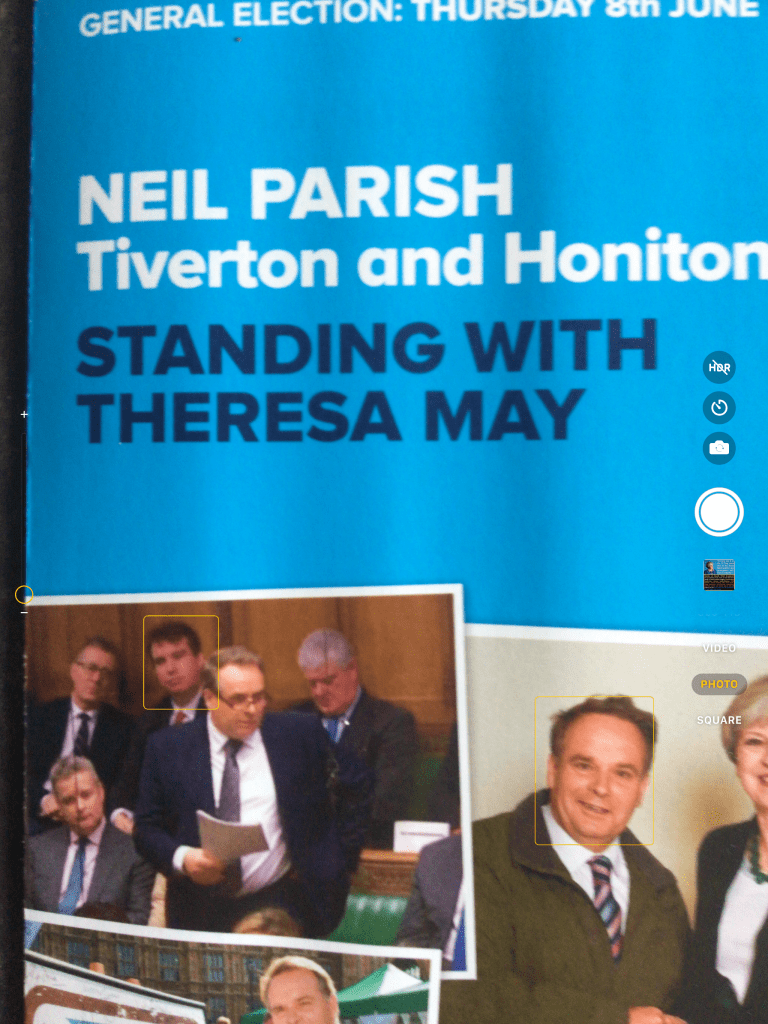
Owl thought that Neil Parish might live in his Tiverton and Honiton constituency. It appears not from this tweet from Tory MP Peter Heaton-Jones which implies that he lives near South Molton in north Devon on the edge of Exmoor National Park.
If so, we have BOTH MPs for East Devon NOT living in the district and several of the candidates from other parties who don’t live here either:
East Devon
Lib Dem candidate Alison Eden lives in Teignbridge
Jan Ross, Labour candidate MIGHT live in Exmouth but in election papers she gives an address in Central Devon
Tiverton and Honiton
Lib Dem candidate Matthew Wilson and Green candidate Gill Westcott appear to emanate from Paignton and Exeter
THERE IS NOTHING WRONG WITH CANDIDATES FROM OTHER AREAS STANDING – BUT WHO UNDERSTANDS AN AREA BEST? Someone who has always lived here (Claire Wright in East Devon) or someone who has never lived here?
Tories: £3.77 million from donors this week
Labour: £331,499 this week
Liberal Democrats: £310,500 this week
Women’s Equality Party: £71,552 this week
UKIP: £16,500 this week
Claire Wright: £12,000 since her campaign started – all from small, local donors as Claire does not accept corporate donations
“The Conservatives raised more than 10 times as much as Labour last week, partly thanks to a donation of over £1m from the theatre producer behind The Book of Mormon and The Phantom of the Opera.
John Gore, whose company has produced a string of hit musicals, gave £1.05m as part of the £3.77m received by the Conservatives in the third week of the election campaign.
In the same time, Labour received only £331,499.
The Electoral Commission only publishes details of donations over £7,500, so the smaller donors who make up most of Labour’s fundraising are not identified. Almost all Labour’s larger donations came from unions, including £159,500 from Unite.
The new figures show the Conservatives have received £15.2m since the start of 2017, while Labour has received £8.1m. The large donations came as the poll lead held by the Conservatives and Theresa May appeared to fall following controversies around her social care policy.
In the week starting 17 May, the Liberal Democrats received £310,500, of which £230,000 came from the Joseph Rowntree Reform Trust and £25,000 came from the former BBC director general Greg Dyke.
The Women’s Equality party received £71,552, with Edwina Snow, the Duke of Westminster’s sister who is married to the historian Dan Snow, giving £50,000. Ukip’s donations fell dramatically to £16,300 from £35,000 the previous week.
Political parties can spend £30,000 for every seat they contest during the regulated period. There are 650 seats around the country, meaning that parties can spend up to £19.5m during the regulated period in the run-up to the election.
Other large donations to the Tories in the third week of the campaign included £500,000 from JCB Service, which is run by the manufacturing billionaire Anthony Bamford. Lord Bamford, who strongly supported the leave campaign, received a peerage from David Cameron in 2013.
John Armitage, founder of the Egerton Capital hedge fund, also gave £500,000, bringing his donations this year to £1.125m. Mark Coombs, chief executive of the investment manager group Ashmore, gave £300,000.
Jersey House (Developments) Ltd, which is owned by the telecommunications entrepreneur Charles Wigoder, gave £250,000.
The haulage millionaire Steve Parkin gave £125,000. Parkin, who reportedly paid Robbie Williams £1m to perform at one of his parties, founded the delivery business Clipper Logistics.
The large sum from Gore is believed to be his first political donation. He is a seven-time Tony winning and Emmy-nominated producer and owns the John Gore Organization, which is headquartered in New York. The company presents shows, including Wicked and Jersey Boys, across the US, Japan and in London’s West End. Gore’s early investments included the original London production of Cats.
Last week, it emerged that the Conservatives had raised £1.6m in the second week of the general election campaign while Labour raised £383,000.”
With EDDC allowing building on flood plains all over the district – a timely warning:
“Only a tenth of England’s extensive floodplains are now fit for purpose – 90% no longer function properly – with the shortfall putting an increasing number of homes and businesses at risk of flooding, according to a new report.
Floods are more likely due to climate change and will claim higher economic costs unless action is taken to halt the damage to floodplains and restore some of their functions, warned the authors of the 12-month study – the first to paint a comprehensive view of England’s floodplains and their capabilities.
“We have ignored our floodplains,” said George Heritage of Salford University, co-author of the study the Changing Face of Floodplains, published by Co-Op Insurance on Thursday. “The changes to them mean water [from heavy rainfall] can flow much faster downstream, and can flow at the same speed as the water in the rivers.”
This accelerated flow has led to sudden and unstoppable deluges in recent years. For instance, Storm Desmond in 2015 affected more than 6,000 homes as rivers and streams burst their banks and spread water over floodplains. As these natural floodplains had been altered by man-made features, they no longer had the ability to store water, leading to rapid flows into urban areas which led to the devastation.
Storm Desmond caused more than £500m in damages, and misery for families excluded from their homes sometimes for months. The UK’s flooding bills are on the rise, with scientists warning of rocketing numbers of cloudbursts and periods of sudden and intense rainfall as climate change takes effect.
Floodplains act as natural “sponges”, soaking up excess water in their vegetation, forming natural buffers that hold back or divert rushing water after rain, and providing areas where rivers can breach their banks and wetlands can be replenished.
Intensive agriculture, increasing urbanisation, poor management of rivers and the draining of wetlands have left the vast majority of these natural features – many previously preserved for centuries by communities who understood their value – unable to fulfil these valuable functions, with some close to collapse.
Building on floodplains has been singled out for years as a key problem, but perhaps surprisingly was found to contribute only about a tenth of the damage in the study. Far greater is intensive farming, which has created artificially “smooth” and uniform landscapes, with hedgerows removed, large areas given over to single crops, wetlands drained and woods and grassland diminished. Farming accounts for nearly two-thirds of the loss of functioning floodplains, according to the study.
Natural floodplains cover about 5% of England, from upland areas and tablelands to low-lying marshes, such as the Somerset levels and the East Anglian fens. Once they were used for grazing for parts of the year, or left uncultivated. However, the exploitation of such areas accelerated in the middle of the last century, when wetlands were drained, hedgerows grubbed up and small farms gave way to bigger farming enterprises.
Today, the report found, 90% of England’s floodplains no longer function properly, with 65% modified by agriculture “meaning they’re now man-made, smoother surfaces”; 9% lost to urban and suburban building developments; 4% are now occupied by open water and 6% by semi-natural woodland and rough grassland; and only 0.5% is now natural or semi-natural wetland.
“It would be almost impossible to return the altered areas to their original state,” noted Heritage. “But it is possible to work with farmers to introduce features that would allow them to function better. …”
Almost always voted against restricting the provision of services to private patients by the NHS
Show votes
0 votes for, 5 votes against, 2 absences, between 2011–2012
Generally voted for reforming the NHS so GPs buy services on behalf of their patients
Show votes
4 votes for, 0 votes against, 3 absences, between 2011–2012
Almost always voted against introducing foundation hospitals
Show votes
0 votes for, 4 votes against, 1 absence, in 2003
Voted a mixture of for and against smoking bans
Show votes
2 votes for, 4 votes against, 5 absences, between 2002–2015
Has never voted on allowing terminally ill people to be given assistance to end their life
Generally voted for reducing housing benefit for social tenants deemed to have excess bedrooms (which Labour describe as the “bedroom tax”)
Show votes
8 votes for, 0 votes against, 9 absences, between 2012–2014
Consistently voted against raising welfare benefits at least in line with prices
Show votes
0 votes for, 5 votes against, in 2013
Almost always voted against paying higher benefits over longer periods for those unable to work due to illness or disability
Show votes
0 votes for, 11 votes against, 4 absences, between 2011–2016
Generally voted for making local councils responsible for helping those in financial need afford their council tax and reducing the amount spent on such support
Show votes
2 votes for, 0 votes against, 2 absences, in 2012
Almost always voted for a reduction in spending on welfare benefits
Show votes
39 votes for, 0 votes against, 15 absences, between 2012–2016
Almost always voted against spending public money to create guaranteed jobs for young people who have spent a long time unemployed
Show votes
0 votes for, 7 votes against, 2 absences, between 2011–2014
Generally voted for reducing housing benefit for social tenants deemed to have excess bedrooms (which Labour describe as the “bedroom tax”)
Show votes
8 votes for, 0 votes against, 9 absences, between 2012–2014
Consistently voted against raising welfare benefits at least in line with prices
Show votes
0 votes for, 5 votes against, in 2013
Almost always voted against paying higher benefits over longer periods for those unable to work due to illness or disability
Show votes
0 votes for, 11 votes against, 4 absences, between 2011–2016
Generally voted for making local councils responsible for helping those in financial need afford their council tax and reducing the amount spent on such support
Show votes
2 votes for, 0 votes against, 2 absences, in 2012
Almost always voted for a reduction in spending on welfare benefits
Show votes
39 votes for, 0 votes against, 15 absences, between 2012–2016
Almost always voted against spending public money to create guaranteed jobs for young people who have spent a long time unemployed
Show votes
0 votes for, 7 votes against, 2 absences, between 2011–2014



 East Devon Watch