A Christmas Carol for the NHS

Good king Jeremy Hunt looked out
so did Simon Stevens
healthcare crisis all about
they were disbelieving.
“There’s no problem on the wards
waiting times are super.
Moan too much, we’ll sell the lot
to our friends at Bupa.”
Long term sick and elderly
shoved where you can’t see’em,
care from cradle to the grave
now in a museum.

Trolleys for the dying poor,
posh wards for the wealthy
don’t expect an ambulance –
pray that you stay healthy.
Give us back our stolen wards,
two hundred beds and counting.
Give us back our hospitals:
hear the anger mounting
Pay our nurses what they’re worth,
cherish those who mend you:
Happy Christmas, NHS,
we’ll always defend you.

“More than 3,000 foster children are excluded from the Tories’ flagship free childcare pledge”

“More than 3,000 foster children will be excluded from the Tories flagship free childcare pledge, ministers have revealed.

Under the policy, three and four year olds with working parents are entitled to 30 hours of childcare paid for by the government.

But early years minister Robert Goodwill has revealed foster children is only available for the 15 hours a week available whether parents are in work or not.

Some 3,030 children in care will lose out on care, even if their foster carers are in full time work.

It means a vulnerable child receiving 30 hours a week would lose up to half of their childcare funding if they were to be taken into care.

Labour’s early years spokesperson Tracy Brain said: “The decision to exclude foster children is cruel and clearly discriminatory.

“Every child should have access to high quality childcare and early years education, and while not every foster parent would decide 30-hours is best for the child, they should have exactly the same right to access as if they were with their birth parents.

“We’re looking at a few thousand children added to a policy already used by hundreds of thousands, in the interest of equality and our commitment to foster children, the Tories should think again and end this unfair exclusion.”

If foster children were included in the policy, they would make up just 1% of the roughly 300,000 expected to be eligible for the full 30 hours from January.

While foster carers do receive an allowance from the government, childcare costs are not included in the calculations.

She added: “We’re looking at a few thousand children added to a policy already used by hundreds of thousands, in the interest of equality and our commitment to foster children, the Tories should think again and end this unfair exclusion.” …”

http://www.mirror.co.uk/news/politics/more-3000-foster-children-excluded-11632976

Government money for UK, US and Chinese-backed mini-nuclear power stations but not cheaper green energy

“Ministers are expected to back the first generation of small nuclear power stations in Britain with tens of millions of pounds this week, in an attempt to give the UK a competitive edge on the technology and provide a new source of clean power.

Rolls-Royce and a host of US and Chinese companies have been lobbying and waiting for the support since George Osborne first promised them a share of £250m two years ago.

Now, after industry frustration at huge delays to the government’s competition to find the best value “small modular reactor” (SMR), funding to develop and test the power stations will be confirmed.

The energy minister, Richard Harrington, is expected to announce support for the embryonic technology on Thursday, industry figures told the Guardian. The funding is likely to be up to £100m, one source said.

Small modular reactors provide about a tenth of the power of a conventional large nuclear power station, such as the one EDF is building at Hinkley Point C in Somerset. But their backers pitch them as a cheaper and quicker way to generate the new, low-carbon power the UK needs.

Rolls-Royce has been publicly and privately lobbying the Department for Business, Energy and Industrial Strategy (BEIS) over its SMR design, which it positions as an industrial opportunity for Britain that would generate thousands of UK jobs.

The firm argues that with electric cars likely to drive up future energy demand, the reactors will become a vital part of national infrastructure. …

…The funding is designed to help Rolls and other consortia, including the US companies NuScale and Terrapower and the controversial Chinese firm CNNC, undertake the research and development for a small nuclear power station to be built in the UK. It is not yet clear who will win a share of public funds, or how the pot will be carved up between the 33 participants in the SMR competition. …

… However, energy experts said the case for SMRs was far from proved, especially given the falling cost of alternatives such as offshore windfarms.

Paul Dorfman, a research fellow at University College London, said: “The real question the government must ask is this: given the ongoing steep reduction in all renewable energy costs, and since SMR research and development is still very much ongoing, by the time SMRs comes to market, can they ever be cost competitive with renewable energy? The simple answer to that is a resounding no.”

An energy industry source also questioned how credible most of the SMR developers were. “Almost none of them have got more than a back of a fag packet design drawn with a felt tip,” the source said.

A BEIS spokesperson said: “We are currently considering next steps for the SMR programme and will communicate these in due course.”

https://www.theguardian.com/business/2017/dec/03/mini-nuclear-power-stations-uk-government-funding

Swire fails to save another hospital

In August 2017 Swire spearheaded a campaign to keep heart services going at London’s Royal Brompton Hospital (having miserably failed to lead similar campaigns in East Devon, leaving Claire Wright to fight for us:

https://eastdevonwatch.org/2017/08/05/more-on-swire-saving-services-at-royal-brompton-hospital-london/

Well, his attempts in London don’t seem to have worked either:

“The world-leading Royal Brompton Hospital in London, recently ‘saved’ by NHS bosses, is being lined up for a billion pound sale to make way for luxury flats. …”

http://www.dailymail.co.uk/news/article-5140315/World-class-heart-hospital-make-way-luxury-flats.html

“40,000 children trapped in ‘zombie’ academy schools”

“The government has been urged to review its policy on multi-academy trusts after it was revealed that more than 40,000 children were being educated in “zombie schools” waiting to be transferred to another academy chain.

Department for Education figures, obtained through a freedom of information request, show 64 academy schools are waiting to find a new sponsor after being abandoned by, or stripped from, the trust originally managing them. A calculation using the average number of pupils in state-funded primary and secondary schools in England – 279 and 946, respectively –suggests the 64 schools would contain more than 40,000 students.

The government has encouraged academies to join multi-academy trusts, promoting them as a support for schools that have left local authority control, although some have been criticised for financial mismanagement and a lack of oversight.

Half of the 64 “zombie schools” are waiting to be transferred from two chains: the Education Fellowship Trust and Wakefield City Academies Trust. In March the former became the first trust in England to give up control of its 12 academies – including a school in the prime minister’s Maidenhead constituency – following concerns about educational standards. In September the Wakefield trust said it would divest itself of 21 schools across Yorkshire, as it could not undertake the “rapid improvement our academies need”.

The DfE said it was in the process of securing new academy chains for the schools in both trusts.

Until a new multi-academy trust is found, the schools remain in limbo, often unable to make long-term planning decisions, hire new permanent members of staff or organise pay rises. They do not have the option to return to local authority control. Campaigners say that the government is struggling to find new chains willing and able to take on the schools, many of which have been left in a precarious financial position by their previous sponsor.

“The Tories’ fragmented education system is now creating ‘zombie schools’ caught between academy chains who are under no obligation to take them on, and a government that won’t step in to help them,” said Angela Rayner, Labour’s shadow education secretary. “Even in the prime minister’s own seat it seems there are classrooms of children not getting the education they deserve. … ”

The figures come after it was announced on Thursd

BBC: Save our Hospital Services Totnes demo “disrupted traffic and Christmas shoppers”

Well, now we know for sure where the BBC’s priorities lie!

“Hundreds of protestors disrupted traffic and Christmas shoppers as they marched through a town centre.

The protest in Totnes, Devon, was over the loss of two hundred hospital beds and four community hospitals – and the threat of further cuts.

Save Our Hospital Services campaigners wheeled a hospital bed and carried placards through streets on Saturday. …”

http://www.bbc.co.uk/news/uk-england-devon-42213994

A reader asks: what is the definition of “kerbside”?

A few weeks ago I had to phone EDDC up re. a missed collection of my kitchen waste and recycling. All the refuse had been placed in the normal place (where it has been collected for a number of years) and ALL of it was put there the night before collection.

My landfill bin was emptied but not my kitchen waste and the recycling containers, so I contacted the refuse department.

Firstly, I was questioned as to whether the containers had been put out on time and, secondly, where they had been placed (they are always placed just inside the gate and I need to keep this shut for various reasons). This, apparently, is not acceptable and I need to put them on the pavement if the gate is shut. Surely, this is a trip hazard?

I emailed them later on and said that I am not insured for leaving them on the pavement and I am sure they are not either. In fact, after the landfill bin had been emptied the gate was left open, so there was no excuse for the recycling not to have been collected. What is the definition of kerbside?”

Owl replies:

Did you ask if EDDC’s public liabilty insurance includes accidents “kerbside” when waste bins are involved?

Best to do that by email and get their response in writing!

Half of Parliament’s sleaze watchdog panel have themselves breached its code!

“Half of the members of a sifting panel for the appointment of a new Commons sleaze watchdog have themselves broken parliamentary rules. …

The disclosure prompted fresh concerns last night for the appointments process for the role and the principle of MPs “marking their own homework …”

Sunday Times (paywall)

“UK, Romania and Poland: fewest doctors in EU”

“The UK has the third-lowest number of hospital beds per person in the European Union as well as the third-lowest number of doctors, with only Romania and Poland worse off, a European Commission report has found.

The report, which compared the 28 EU countries, warned that hospitals will struggle to cope with the winter crisis predicted by many doctors and NHS managers as intensive care beds were full even during the summer.

It warned of the UK’s “limited capacity to absorb shocks”, adding: “Difficulties finding beds have introduced inefficiencies.”

Ian Eardley, vice-president of the Royal College of Surgeons, said Britain’s low ranking in the report should act as “a wake-up call for NHS leaders” and that the cuts have “now gone too far”.

He said: “Bed shortages lead to cancelled operations and patients waiting longer for treatment. Some will find themselves in pain for longer, possibly unable to go about their daily life. In the worst cases their condition may deteriorate while they wait.”

Last week doctors in intensive care units (ICUs) — where the sickest patients are given life support — said they were also nervous about the coming weeks.

Dr Christopher Bassford, a consultant in intensive care at University Hospitals Coventry and Warwickshire NHS Trust, said: “At our intensive care unit we have operated at 100% capacity or over for most of the summer. This winter we are anxious.”

Dr Gary Masterson, president of the Intensive Care Society, added: “It does feel as if we are on the cusp. This [bed occupancy at 100%] is the norm for many ICUs. It is right to worry about ability to cope should we have a busy winter.”

Bed occupancy runs at over 100% when more than one patient uses the bed during a 24-hour period.

Dr Nick Scriven, president of the Society for Acute Medicine, recently warned that doctors would need to make drips out of coat hangers this winter because of the anticipated shortage of beds and equipment.

While the number of doctors working in the NHS has increased, the report also found the UK still near the bottom of the EU league table. It said: “There have been steady increases in recent decades, despite which the number of doctors per 1,000 of the population was the third lowest in the EU.”

NHS England said: “These figures show our NHS is much more efficient than other countries such as France or Germany in helping patients avoid emergency hospitalisations, and we do so despite spending less and having fewer nurses and doctors than they do.”

Sunday Times (pay wall)

Social mobility? Forget it

“The board of the government’s Social Mobility Commission has stood down in protest at the lack of progress towards a “fairer Britain”.

Ex-Labour minister Alan Milburn, who chairs the commission, said he had “little hope” the current government could make the “necessary progress”.
Tory former cabinet minister Baroness Shephard is among three others to quit.

In a resignation letter first reported by the Observer, Mr Milburn said ministers were preoccupied with Brexit.

He said that meant the government “does not have the necessary bandwidth to ensure the rhetoric of healing social division is matched with the reality”.
Mr Milburn added: “It seems unable to commit to the future of the commission as an independent body or to give due priority to the social mobility challenge facing our nation.”

He took up his role with the commission, which monitors progress towards improving social mobility in the UK, and promotes social mobility in England, in July 2012.

‘Unable to commit’

The resignations come as Theresa May, who entered Downing Street in July 2016 promising to tackle the “burning injustices” that hold back poorer people, faces questions over the future of senior minister Damian Green – who is effectively her second in command – and is under pressure as Brexit talks continue.

In his resignation letter addressed to Mrs May, Mr Milburn said he was standing down with “much sadness” and was “deeply proud of the work the commission has done”.

He said: “All the main political parties now espouse a Britain that is less elitist and more equal, while growing numbers of employers, universities, colleges, schools and councils have developed a shared determination to create a level playing field of opportunity in our country.”

Mr Milburn added: “Individual ministers such as the secretary of state for education have shown a deep commitment to the issue.

“But it has become obvious that the government as a whole is unable to commit the same level of support…

“I do not doubt your personal belief in social justice, but I see little evidence of that being translated into meaningful action.”

http://www.bbc.co.uk/news/uk-politics-42212270

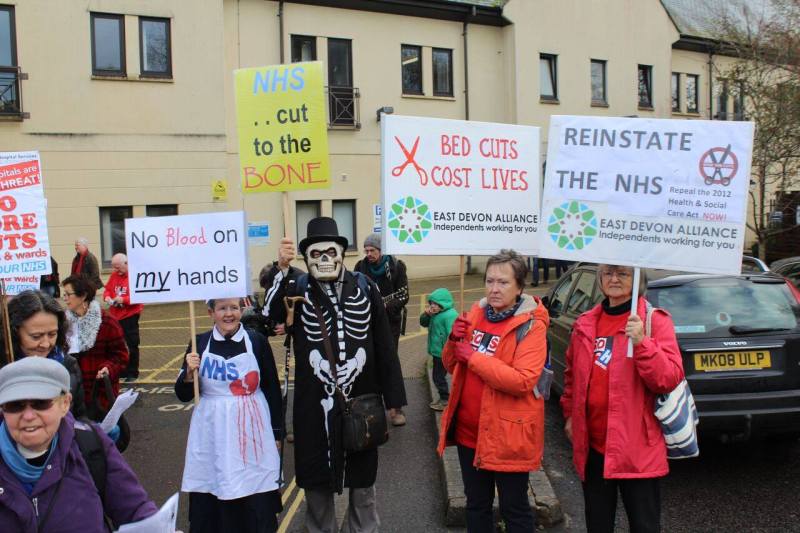
Who fights for our NHS? Independents fight for it!

Photos from demo in Totnes today with a few local faces you will probably recognise.

No Tories from East Devon then?

Thought not!

“David Cameron admits ‘we didn’t solve’ problem of funding social care for Britain’s ageing population”

Owl says: LOTS and LOTS of things Dave didn’t solve …..

“David Cameron has expressed regret he was unable to do more to deal with the “huge” challenge funding social care for Britain’s ageing population.

The former prime minister – who has since become president of Alzheimer’s Research UK – said a way had to be found to meet the “catastrophic” costs of caring for people with dementia.

“There is a huge social care funding challenge we have to answer, and I accept that we’ve made some steps forward, but we didn’t solve that problem,” Mr Cameron told the Financial Times.

“Everyone knows it’s a difficult conundrum. Lots of effort has been made to try and solve it but we haven’t got there yet.”

In office Mr Cameron sought to introduce a £72,000 cap on the costs an individual would have to pay towards care home charges with the state picking up any further bills.

Ministers had hoped insurance companies would develop products that would enable people to insure themselves against their care costs up to the £72,000 limit.

However the plans were put on hold in July 2015 after insurers proved reluctant to enter the market.

“The disappointment I had was I was hoping that a combination of the cap on care costs would help to deliver an insurer’s model, where a market would grow up where everyone could insure themselves against the cost of long-term care. And we just haven’t cracked that yet,” Mr Cameron said.

“I’m not in politics any more but we’ve got to find an answer. (Given) the catastrophic cost of care that people face from dementia, and I saw this with constituents, we’ve got to find a better answer there.”

http://www.independent.co.uk/news/uk/politics/david-cameron-regret-alzheimers-dementia-social-care-funding-a8088031.html

Middle-aged renters – must start saving £6,000 a year for their rent in retirement

Scottish Widows is the sort of unassuming pensions company that rarely likes to publicly criticise government policy. But an analysis it published this week is a stark warning about the ticking time bomb that will explode in 10 to 20 years’ time. And it’s not pension incomes that are the worry – it’s the fact that so many of tomorrow’s pensioners who never got on to the property ladder in the 2000s and 2010s will have to find huge amounts of money to pay ever-escalating rents to private landlords.

Scottish Widows skirts around the issue by suggesting that non-homeowners currently in their 50s should start saving an extra £6,000 a year now to be able to afford their rent in retirement. As if people on low incomes are going to find that sort of money. The reason they are renting is that they were never able to find the savings for a deposit on a house in the first place, or didn’t earn enough to qualify for a mortgage.

The reality is that these people are likely to retire with little more than the state pension plus a small bit of private pension. Maybe they will be picking up about £200 a week once they are 67. Given that the average rent in England and Wales is £845 a month – and in London it’s about £1,250 a month – then the whole lot will be gobbled up by the landlord. So the taxpayer will have no alternative but to step in and pay most of the rent, and we are then on the hook for payments going on for maybe 20 or 30 years. All so that the buy-to-let landlord with multiple properties can enjoy a lavish retirement themselves.

This is the lunacy of promoting buy to let as a long term form of tenure for millions of people. Even in developed countries where renting is common, such as Germany, most people are living in a home they own by the time they reach retirement. Renting all the way through retirement, funded by the taxpayer, to a landlord who has the power to evict without reason and at short notice, is the worst possible situation. And it’s one we are hurtling towards.

Make no mistake about the dramatic change in the retirement landscape that is coming. Scottish Widows projects that one in eight retirees will be renting by 2032 – treble today’s figure. After that it will continue rising. It says there is a £43bn gap between the income and savings people have now and what the rent bill will be in retirement. That’s more than one-third of the entire NHS budget for a year – to be squandered on rent.

Dan Wilson Craw of campaign group Generation Rent says: “The common perception is that retirees either own their home outright or have a council tenancy, so the government will be in for a nasty shock as more of us retire and continue to rent from a private landlord. Many renters relying on pensions will qualify for housing benefit which will put greater strain on the public finances.”

Aviva, the UK’s biggest pensions company, also publishes figures on Saturday on the colossal financial issues facing non-homeowners currently in their 50s. While those who have bought their homes feel pinched – and expect to use the equity in their home to pay for a better retirement – the outlook for non-homeowners is so grim that 20% believe their only hope is having a lottery win. Most non-homeowning workers aged above 50 say they have no money left after basic costs to put aside extra money for a pension.

There was some good news on pensions this week: the Resolution Foundation said that auto-enrolment schemes will mean tomorrow’s pensioners will enjoy a roughly similar income (about £300 a week) to today’s pensioners. But they didn’t account for the large number that will now have to pay rent out of that money.

The solution? Build more houses, of course. But even 300,000 a year won’t solve this problem if they are snapped up by landlords. That only leaves us with rent control and much higher taxes on buy to let.”

https://www.theguardian.com/money/blog/2017/dec/02/pensions-timebomb-rents-homeowners

Another new-build developer scam

Estate rent charges apply in Cranbrook:

Thousands of homeowners on private estates are facing unregulated and uncapped maintenance fees, amid allegations that developers have created a cash cow from charging for communal areas not maintained by the council.

Management contracts for “unadopted” private estates are frequently sold off to speculators and property management companies in the same way as freeholds and ground rents – leaving homeowners with spiralling fees and nowhere to turn.

If a new-build estate is “unadopted” it means communal areas such as roads, grass verges, pavements and playgrounds are retained by the developer. The developer then usually sub-contracts day-to-day management.

These companies then pass on the costs to homeowners (both freeholders and leaseholders) via a deed of transfer which obliges the homeowner, under the Law of Property Act 1925, to pay for maintenance of this land. This is often referred to as an “estate charge” or “service charge”. These are on top of full council tax – even though the council doesn’t maintain their street.

Critics say the system is open to abuse because management companies have no obligation to keep costs down or provide evidence the services they charge for are being carried out. Buyers may find the bills spiral as soon as a management contract is sold on.

Lynn Myers bought her two-bed leasehold house in Penrith, Cumbria, from developers Persimmon in September 2016. The sales agent told her the estate would be managed by Carleton Meadows Management Company with an estate charge of £100 a year per household for grass cutting.

When Gateway Property Management took over in July 2017 it tripled the fee to £308 a year – that’s £17,000 from the 55 residents. Myers alleges that the fee includes more than £3,000 “postage”.

“I am on a lower-end income and ploughed my late husband’s insurance money into this property,” says Myers. “I worry that I will be unable to afford this on top of full council tax etc, and also I will be unable to sell. I have been mis-led by Persimmon and the government.”

Persimmon says the initial costs had been miscalculated and that it was working with Gateway to resolve the issue.

Meanwhile, 40 miles away across the Lake District, residents in Church Meadows in Great Broughton are in a similar situation. Richard Elsworth moved into his Persimmon-built freehold property in May 2013. The estate’s 58 residents each pay Gateway a service charge of £125.53 a year, amounting to £7,281 to maintain about 600 square metres of grass.

But Gateway’s charges don’t stop there. When Elsworth’s neighbours sold their home, they were charged £360 for a “management pack” for the buyer, plus £144 for a deed of covenant.

“The only part of the pack that is relevant to the sale is a financial statement so that the service charge information is available to the prospective buyer. As the properties are freehold, Gateway has no responsibility whatsoever for the conveyancing process, other than to receive a deed of covenant from the conveyancing solicitors,” says Elsworth.

Gateway claims it provided an “often exhaustive” amount of information to purchasers’ solicitors when a sale takes place. It said it was common practice for managing agents to charge fees for sales packs and additional legal documentation. It says: “The information we are asked to provide varies from development to development and this is reflected in the amount we charge ranging from £150-£300 plus VAT.

“It is best-practice for the information to be prepared by professionally qualified staff because purchasers are reliant on information being accurate to enable the sale to proceed as smoothly as possible. Typically, a sales pack contains in excess of 25 pages and is tailored to the development.”

Privates estates were debated in parliament earlier this month. Kelly Tolhurst, Conservative MP for Rochester and Strood in Kent, told MPs how homeowners in Hoo bought from Taylor Wimpey and Bellway but are now in dispute with their property management company, SDL Bigwood.

Tolhurst went on to criticise Hyde Housing Association, and London and Quadrant. The latter tried to charge residents at Lodge Hill, Chattenden, for street lamps and street cleaning undertaken by Medway Council.

The Homeowners’ Rights Network (Hornets) is the campaign group fighting for a fairer deal for homeowners on private estates. Its main issue is a lack of a cap on charges and that homeowners don’t have a choice of provider. And, if homeowners have a dispute, there’s no resolution service in place.

Cathy Priestley, spokesperson for Hornets and a freeholder on a private estate, says the private estate model seems to be the norm for new-build estates. “We can only speculate as to why this has happened. The main benefactors are the plc developers who get to keep the estate land, don’t have to prepare it to adoption standards and don’t have to pay for its maintenance or the commuted sums for adoption,” she says. “All councils have to do, under planning, is to ensure there is a long-term sustainable arrangement to maintain the land (under the Town and Country Planning Act). They seem to readily accept assurances from the developers that the management company will deliver this. They don’t appear to have thought about how this affects homeowners.”

While leasehold owners have some (albeit limited) statutory protection, freeholders have very few options. They can take cases to court, but this can be expensive and time consuming. If they decide to simply not pay, they can ultimately lose their home. “Any arrears will normally be recoverable as a debt claim in the county court.

“However, homeowners should be cautious as the rent charge owner may have a number of options including the ability to take possession of the property,” says Adrian McClinton, associate solicitor at Coffin Mew.”

https://www.theguardian.com/money/2017/dec/02/homeowner-freehold-management-fees-unadopted?CMP=Share_iOSApp_Other

What you can get away with in business in a greedy, unregulated system

“Palmer & Harvey paid out £70m since 2008 despite ongoing losses.

UK’s biggest tobacco distributor called in administrators and ceased deliveries on Tuesday, making 2,500 people redundant.

Palmer & Harvey directors, former directors and other shareholders extracted about £70m in cash from the grocery wholesaler over the past nine years despite ongoing losses.

The company, where 2,500 people were made redundant earlier this week and a further 900 jobs are at risk, had been owned by dozens of private individuals via a complex web of equity and loans. The company supplied 90,000 stores including 50,000 independents that are now struggling to secure stocks of tobacco and groceries at one of the busiest times of the year.

The UK’s biggest tobacco distributor called in administrators and ceased deliveries on Tuesday after hitting “challenging trading conditions” while efforts to restructure the heavily indebted business were unsuccessful.

P&H was bought by its management team in 2008 in a deal that valued the company at £345m. The deal was largely funded by debt.

P&H (2008), the wholesaler’s parent company, has paid out more than £8m a year in dividends since 2009 to its shareholders despite making losses of about £10m a year or more in all but one year, 2014.

The company’s net debt hit £48.6m in April 2016 and has been above £29m every year since 2011.

Some former managers, including the former chairmen Christopher Adams and Christopher Etherington, hold special preference shares, according to the latest list of shareholders filed at Companies House. These “B preference” shares pay out a fixed dividend twice a year.

Etherington, who stepped down as chairman earlier this year, and his wife were entitled to an estimated £300,000 in dividends last year and Adams £941,000. Half of this payment was deferred under an agreement with shareholders which pledged that it could be repaid if and when the B preference shares were ultimately redeemed.

Etherington and his wife have together held the same number of these B shares since the takeover, entitling them to about £2.5m in dividends since 2009.

In 2009, Etherington also held another form of preference share, the “A preference”, that entitled him to an annual dividend. The latest annual report indicates he no longer owns those shares. He was able to redeem them for £1 each or £500,000, before dividends owed.

Accounts for Palmer & Harvey McLane (Holdings), another parent company of P&H, also show that Etherington received a £3.44m interest-free loan from the company’s employee benefit trust with which to fund his stake in the company. This was repayable on the sale of any shares held by him.

Only a handful of shareholders in P&H (2008), most of whom are former and current staff, retained their A preference shares at the time of the last Companies House filing. But their rights to redeem the shares were protected at the time of the 2008 buyout with ring-fenced cash of £42m held in a separate company, Buildtrue, in April 2016. That company is not part of the administration process and it is understood that the majority of A preference shareholders have cashed out in the past year, receiving funds from Buildtrue.

Administrators at PricewaterhouseCoopers declined to comment.”

https://www.theguardian.com/business/2017/dec/01/palmer-harvey-paid-out-70m-since-2008-despite-ongoing-loses

Want cleaner air? Your council tax must pay for it

Government criticised over plans to cut air pollution

The Government has been accused of passing responsibility to cut air pollution to councils. A Parliamentary inquiry into air quality heard that five cities and 23 local authorities have been selected in a plan to devise measures to reduce illegal levels of nitrogen dioxide by December 2018, but that the Government has refused to legislate for more clean air zones. Environment Minister Therese Coffey said the Government was working with councils to help draw up plans.

Source: LGA – Guardian p19

Seaton – the UK’s Monacco?

From the people who are continuing to try to build on the Seaton/Colyford green wedge, destroying rare bat feeding routes and breathtaking views of the Wetlands comes another BIG BIG idea:

http://fenitonpark.co.uk/east-devon-marina/4592689237

Is it a plan for when (as we read) the UK becomes a tax haven after Brexit – just like Monacco?

As one commentator said: well, at least that would keep a team if dredgers in business until the first big storm!