
https://www.devonlive.com/news/devon-news/four-lloyds-branches-close-devon-1469716
Monthly Archives: April 2018
At last something we are best at – potholes – we have the most, biggest and best!
Third-world roads …
“Pothole related breakdowns have doubled in the space of three months following the harsh winter, the RAC has revealed.
The breakdown rescue firm said the proportion of call-outs caused by issues such as damaged shock absorbers, broken suspension springs and distorted wheels reached 2.3 per cent between January and March.
This is almost double the rate during the previous three months and equates to 5,540 cases.
Since RAC records began in 2006, only two three-month periods – January to March in both 2015 and 2017 – saw a higher proportion of pothole-related breakdowns.
A better indicator of the true state of the UK’s roads is expected to be revealed in figures for April to June as the Beast from the East brought snow and freezing weather towards the end of the previous quarter.
RAC chief engineer David Bizley said: “Anecdotally, few would disagree that the harsh cold weather experienced over the last three months has led to a further deterioration of road surfaces.
“While RAC patrols saw the third highest quarterly share of pothole-related breakdowns in the first three months of 2018, the figure was not as high as we had been expecting, probably due the fact that the weather hit relatively late in the quarter.
“For this reason we feel we are likely to see more vehicles suffering pothole damage in the second quarter of 2018 compared with recent years.
“The Government has made additional funding available through yet another emergency pothole fund, but at best this will only allow councils to patch up roads that in many cases are in desperate need of longer term preventative maintenance.”
A Local Government Association spokesman said: “When exceptional weather occurs, the impact on local roads can be significant.
“It’s essential this is measured and that funds are provided for serious repairs so that traffic can move freely through our communities, and local economies and businesses aren’t impacted.”
Source: The Times (paywall)
A DCC meeting tomorrow that will show if democracy is dead or alive at the council
From the Facebook page of Claire Wright:
“PROCEDURES COMMITTEE TO DEBATE RELAXING PUBLIC SPEAKING RULES, TOMORROW
Devon County Council’s Procedures Committee will consider my proposal to relax public speaking rules at committee meetings, at tomorrow morning’s meeting.
I asked for the agenda item, following the January Health and Adult Care Scrutiny Committee meeting, where I was prevented from asking a question of Dr Mike Slot, Sidmouth GP, who had addressed the meeting about his concern that care at home may not be working as effectively as it should.
Care at home is the system which replaced the loss of many community hospital beds, 72 of which closed locally last year.
Across Devon, around 250 community hospital beds have been shut since 2012.
Up until 2016 there was no public speaking at scrutiny committee meetings which was quite wrong, especially for Health Scrutiny as the committee’s remit is to take up matters of public concern.
The lack of public speaking resulted in frustration from members of the public who heckled and shouted when they heard the NHS representatives say things they disagreed with, or believed were untrue.
In February 2016, Devon County Council unanimously backed my proposal to bring in public speaking at scrutiny meetings…. and they have functioned much more democratically as a result, following this decision.
However, there was a problem in January, where I was prevented from asking a question from a Sidmouth GP who had addressed the committee with concerns about care at home on the basis it was contrary to standing orders.
The upshot of the refusal was that the committee would have simply have allowed Dr Slot to walk out the room without further information or investigation, if I hadn’t then proposed a spotlight review into the issue.
So that’s the background to tomorrow’s meeting.
I have also asked for some flexibility on the issue of members of the public needing to register four days ahead of the meeting to speak.
Again, at the January meeting, this rule resulted in one member of the public speaking, leaving other members of the public who hadn’t managed to register in advance, unable to speak! There was nine minutes left of time too. What a waste of an opportunity to hear members of the public’s views.
To me these are simple issues and matters of common sense. We need to enable members of the public to participate, not get stuck behind the bureaucracy. I will see how the rest of the committee views it…”
Maybe (surely?) we should be doing this in East Devon?
“Date for your diary – 12 June 2018 in Devonport Guildhall we will be holding a community meeting about local decision making, the role of councils, social enterprise etc. Indra Adnan will be leading the event with input from Transition Town, Real Ideas Organisation, Peter Macfadyen author of Flatpack Democracy and Buckfastleigh Independent Group. Full details to be announced shortly.”
One law for the rich, one law for the NHS

When Northampton County Council went “bankrupt” – Inspectors’ comments on scrutiny an “how others see you”
…”The way that NCC went about its scrutiny function brought very strong words from the inspectors. They noted that a number of councillors told them that they had been refused information. They cite a specific example which I extract below:
Perhaps the clearest demonstration of this unnecessary secrecy during the inspection took place at the Cabinet meeting on 13th February 2018.
3.80 Agenda item 11 was titled Capital Asset Exploitation. This was in fact a proposal to sell and lease back the recently completed HQ building at One Angel Square. This disposal is a potential £50m in value so it would be reasonable to expect a full options appraisal and some clear professional valuation advice as to the likely quantum of proceeds and the ways in which a disposal might be handled to best achieve a best value result. It is likely that much of this information would be exempt information so that there would be a confidential paper appended to the agenda. If that information was not available then it could only be on the basis that it was not being relied on in taking a decision.
3.81 At the meeting a number of questions were raised on these very matters and Cabinet members stated that they were privy to confidential information which supported their recommendation but that it was not available to other members.
3.82 Even if there was a concern about the publishing of confidential information most authorities have protocols and practices which make it possible for key information to be shared and protect the authority. To refuse it outright is just wrong.
Again, during an inspection, it appears that a decision for members to take was incorrectly presented without the necessary evidence.
Lesson 6 – How others see you
A key measure of governance is how well does an authority deal with complaints. During the Inspection the Inspectors commented that most unusually the Local Government and Social Care Ombudsman contacted them. He said that NCC was one of the most difficult authorities to engage with both in time to respond and also in terms of approach to complaints handling learning from mistakes and remedying injustice [32].
Here again the point emerges that services may well be worse than they superficially appear, but there could come a time when the council is on the ropes and at that point others come forward and say what they really think. It is always sensible to treat concerns by the Ombudsman as meriting a chief statutory officers’ agenda spot.”
Note: this puts Owl in mind of this what judge said when the Information Commissioner v East Devon District Council Knowle confidential information case was decided in court:
“Correspondence on behalf of the council, rather than ensuring the tribunal was assisted in its function, was at times discourteous and unhelpful, including the statement that we had the most legible copies [of the disputed information] possible. A statement which was clearly inaccurate as, subsequently, we have been provided with perfectly legible documents.”
http://www.midweekherald.co.uk/news/election/heads-should-roll-as-judge-criticises-eddc-1-4075293
Feniton seeks a new councillor, preverably one who wants to work with young people
From Susie Bond, Feniton’s indefatiguable independent District and parish councillor:
“Do you want to serve your Community?
Do you have time or expertise which could benefit your Community?
Do you want to make a difference to all those around you?
Are you concerned about your local area?
Do you want to represent the views of local people?
If you would like to make a difference, and be involved in shaping the future of your local Community, why not step forward and apply to become a Feniton Parish Councillor?
Feniton Parish Council is looking for a new Parish Councillor – specifically someone who is keen to work with the Youth of the Parish – if you are interested, would like more information or an application form, please contact:
Parish Council clerk, Alison Marshall, on fenitonpc@gmail.com
or
Chairman of Feniton Parish Council, Martyn Smith, on martyn@feniton.org.uk
The closing date for completed applications to be with the Clerk is 9 a.m. on Tuesday 8 May 2018
To qualify to become a Parish Councillor a person must:
be a British subject over 18 years old
be listed on the current electoral role
live in Feniton, or within 3 miles of its boundary, or occupy as owner/tenant any land/premises therein or have a principal place of work within the Parish
must not be disqualified from holding office as a Councillor.
“Bankrupt’ Tory Council Raided £9m Schools Subsidy To Fix Budget”
“A “bankrupt” Tory authority used a £9m fund meant for school improvements in a failed attempt to fill a growing financial black hole, it can be revealed.
Cash-strapped Northamptonshire County Council spent the money to “mitigate” losses in an account used for general everyday spending in 2016, HuffPost UK has found.
The authority has been hit by one of the worst council cash crises in decades, after central government cuts coincided with surging demand for services.
The situation has prompted fears that Northants could become the first of a number of county councils to “fail” as financial pressures mount.
The £9m schools’ funding was meant to be set aside to pay for “future educational improvements within the county”.
It came from a so-called Section 106 (S106) obligation, which are placed on property firms to ensure new developments benefit the whole community.
But an independent review into Northamptonshire’s finances by government inspector Max Caller revealed the “one-off” payment of S106 money was transferred to the council’s general revenue account during the year 2016-17.
Auditors KPMG confirmed in an August 2017 report that the £9m came from funds meant for education improvements and that it was intended to be replaced “through council borrowing”.
County council officials this week declined to elaborate or provide further details. …”
EDDC Leader-in-waiting gets his first headache
The new EDDC Leader lives on the Lyme Regis border with Uplyme in East Devon on his patch.
“THE Sidmouth Road park and ride planning application has resulted in an acrimonious dispute between Lyme Regis and Uplyme councils.
Uplyme parish councillors have accused their Lyme Regis counterparts of “misrepresenting” what has happened in the run-up to a planning application being submitted for continued use of land off Sidmouth Road as a park and ride. …
… Speaking at a recent meeting, Lyme Regis councillor Steve Miller said that they had been working “extremely closely” with East Devon District Council, which had actually requested that another temporary application be submitted to allow time for the full traffic survey to be carried out.
He expressed disappointment that Uplyme Parish Council had recommended refusal of the application following advice from East Devon district councillor Ian Thomas, who has argued that Lyme Regis has “made no material progress” since previous applications for temporary use of the side and has “failed to address the requirements” set out by the district council.
Councillor Miller also said that the town council had been in consultation with all relevant parties but had not met with Councillor Thomas recently, as he had been unable to attend a number of suggested meetings. …”
Plymouth gives away site; developer puts PART of it up for sale for £6 million
“Parts of the Plymouth Pavilions have been listed for possible sale, it has been revealed.
Devon businessman James Brent, who was given the site by Plymouth City Council in 2012, has advertised the pavilions as a “development site” with a guide price of £6m.
He is not selling the Pavilions centrepiece – its music arena. He plans to keep and improve that area.
In 2012, the council, which could not afford to renovate the site, struck a deal with Mr Brent. The authority called the decision “a huge step forward” for the Pavilions and claimed £83m would be invested.
Tim Jones, from the South West Business Council, said he was “disappointed” the potential development had not happened before the site went on the market.
No-one we’ve spoken to is accusing Mr Brent of profiteering, even if this sale does go through, as it was costing the cash-strapped council more than £1.5m a year to keep the Pavilions going. Mr Brent has taken that burden on.
A spokesman for Mr Brent said the businessman was “just exploring options”.
EDDC street trading policy backfires
From “Positive Development for Everyone in Seaton” Facebook page:
“Seaton Markets in 2018 have been CANCELLED.
In view of the recent discussions and correspondence between the Market Organisers and Licensing Officers of East Devon District Council, both the Seaton Branch of the Royal British Legion and Seaton Lions Club have decided with regret, that they cannot proceed with organising Seaton Charity Street Markets in 2018.
These were going to take place on Bank Holiday Monday 7th May, Bank Holiday Monday 28th May and Sunday 15th July. Seaton Carnival Committee have yet to meet to discuss their proposed street market.
This of course will be a financial loss to the charities of between £400 and £800 per market. We have also had the expense of paying DCC Highways a road closure fee of £75 per market.
There will also be a financial loss to Seaton. We estimate that visitors on a market day spend at least £25,000 throughout the town. They patronise the pubs, cafes, coffee shops, ice cream sellers, fish and chip shops, souvenir shops, tramway and Jurassic Centre. This money will not now be spent locally to Seaton, perhaps not even in East Devon.
Although the Act of 1982 is still in force, EDDC interpretation of the requirements since October 2017 have changed. They have introduced a Street Trading Policy which prints out at 20 pages and covers everything possible, putting all of the responsibility onto the market organiser. The policy absolves EDDC of all responsibility. There is also a further 3 pages of another policy for the market organiser. Both of these policies hold the threat of prosecution if the organiser does not comply with the requirements.
The question is why would anyone want to organise a street market when they fully understand the responsibilities which are being passed onto them by EDDC.
EDDC have then combined this with a six page application form which has to be accompanied by an insurance policy, a letter giving permission to use this policy and a map which details exactly where every trader will go in the area being applied for 30 days BEFORE THE EVENT.
EDDC are also asking for proof of permission from the land owner. In the past was DCC Highways but now includes EDDC Street Scene.
To accompany this application EDDC are asking for each trader attending to complete a two page application form, submit photos of their stall and include insurance and hygiene certificate details. They have specified that the hygiene certificate should be level 3, this level applies to restaurants.
If you add all of this paperwork up, it now comes out at over 150 pieces of paperwork for an average street market. Last year we submitted a three page application form and insurance details, that was it.
We also now have to complete a six page application form from EDDC Street Scene which by the way doesn’t co ordinate with the Licensing application form. Street Scene are also asking for a £35.20 fee,so although EDDC Licensing are generously waiving the £20 license fee, it has been substantially increased in 2018 by another department.
The Seaton Charity Street Markets have been held four times a year for over 30 years. They are all organised by volunteers. EDDC increased regulation has turned the organising of a street market into a full time task fraught with extra responsibilities.
It feels as though EDDC have decided to shut down the street markets using over regulation to do so.”
“UK government criticised for ‘shocking’ inaction on insulating draughty homes”
“The government’s failure to take action on insulating draughty homes has been criticised by the statutory body for energy consumers.
As millions of households brace for another round of energy bill rises after British Gas and EDF Energy hiked their prices, Citizens Advice said silence by ministers on energy efficiency plans would mean consumers lost out and insulation installers would go bust.
Zoe Guijarro, policy manager at the consumer group, told the Guardian: “I think it’s hugely damaging because we’ll have a lot of catchup to do. In the meantime we will have lost a lot of installers, who will have gone out of business – a lot of expertise. It’s not a shame – it’s shocking in this day and age, really.”
The government axed its flagship energy efficiency scheme in 2015 and has yet to replace it or signal what might come next. Guijarro said the black hole on policy could lead people to conclude energy efficiency is unimportant, even though experts view it as vital for cutting bills and carbon emissions. …”
https://www.theguardian.com/business/2018/apr/15/uk-government-inaction-citizens-advice-insulating
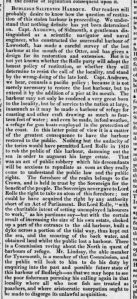
Clinton Devon Estates: an early Lord Rolle’s interesting history in Budleigh
From Facebook’s ‘East Devon Past’:
“I found this report relating to the old harbour at Budleigh, I knew that boats used to navigate up the Otter estuary to the mills at Newton Poppleford. Anyway it seems that Lord Rolle was a bit of a rogue and dammed up the harbour to increase his expanse of land but put an end to the use of larger boats on the Otter. So not only did he remove the Sidmouth stones but he took away the harbour for his own gain.”😵
Western Times 1858:
Carillion accounts? Audit? Think of a number …!
“Carillion owed almost £7bn when it went bust at the start of the year, a far higher amount than had been previously thought.
The Official Receiver, a civil servant appointed by the courts to handle bankruptcies, estimated the construction giant had liabilities of £6.9bn when it entered liquidation three months ago. …
… While accounts had previously revealed liabilities of £2bn at the end of 2016, a letter from the Official Receiver, detailing reports for the 27 UK-based Carillion Construction companies in liquidation, estimated that total liabilities stand at £6,905,532,000.
A spokesman for the Official Receiver confirmed the figure, first reported by Construction News, but said that it was “expected to change significantly as assets and debts are fully identified”. …”
https://www.telegraph.co.uk/business/2018/04/14/7bn-carillion-debts-revealed/
DCC let down child with special needs – compensation and strengthening of procedures required
Unfortunately, DCC under pressure from government has had to cut back on alternative provision for children with special needs including those deemed medically unfit for mainstream school. They are meant to provide 25 hours alternative provision for such young people deemed medically unfit. A parent whose child did not receive alternative schooling took his case to the Local Government Ombudsman
The complaint x which is linked to below – illustrates that DCC has no central person dealing with this type of need, and also did not realise that it should be providing 25 hours of alternative provision.
There were multiple mistakes made in this sad case.
Actions required were:
“For the Council to:
Apologise for the fault identified in this statement. It should do this within a month of my decision.
Pay Mr E £300 to reflect the time and trouble he was put to identifying the central point of contact and in finding the Council’s policy on children out of school.
A further £100 for his distress in the Council failing to consider his wish for F to be educated outside the home and £200 for the uncertainty of not knowing whether F could have had more contact with his peers.
I note the Council has not yet made the payment of £400 to reflect the delay in its complaints handling; it should make this a payment of £500 to reflect its delay in dealing with the third complaint. These payments should be made within three months of my decision.
Pay F £1,600 to reflect him receiving insufficient amounts of education until he was electively home educated. This payment should also be made within three months of my decision.
For the Council to consider amending its procedures to:
Check with schools that the people employed to support individual children with special educational needs, are appropriately trained;
Consider recommendations made in statutory guidance are acted upon as soon as possible or to explain why practice is not being changed;
Receive reports about children educated out of school to check they are receiving the full amount of education to which they are entitled.
Consider parental wishes when arranging alternative provision. Even if those wishes cannot be met, the Council should explain why.
Ensure procedures are robust enough to ensure the Council obtains documents promptly and sends out decision letters and drafts as soon as possible.
Ensure LADOs are appropriately trained to enable them to fulfil this role.
Ensure its complaints procedure is robust enough so that deadlines are adhered to.
These aspects should be considered within four months of the date of my decision. …
https://www.lgo.org.uk/decisions/education/alternative-provision/16-011-798#point1
Telegraph: Why is the NHS under so much pressure? Their answer: its our fault for getting older and fatter!
“An ageing population. There are one million more people over the age of 65 than five years ago. This has caused a surge in demand for medical care.
[Owl: this has been known for DECADES and should have been built-in to spending forecasts]
Cuts to budgets for social care. While the NHS budget has been protected, social services for home helps and other care have fallen by 11 per cent in five years. This has caused record levels of “bedblocking”; people with no medical need to be in hospital are stuck there because they can’t be supported at home.
[Owl: the NHS budget has NOT been protected! In real terms, funding has fallen enormously]
Staff shortages. While hospital doctor and nurse numbers have risen over the last decade, they have not kept pace with the rise in demand. Meanwhile 2016 saw record numbers of GP practices close, displacing patients on to A&E departments as they seek medical advice.
[Staff shortages are due to austerity cuts and an exodus of EU workers, who are not replaced. Changing nursing bursaries to loans had exacerbated this serious problem]
Lifestyle factors. Drinking too much alcohol, smoking, a poor diet with not enough fruit and vegetables and not doing enough exercise are all major reasons for becoming unwell and needing to rely on our health services. Growing numbers of overweight children show this problem is currently set to continue.
[Many lifestyle problems are due to the government’s policies: allowing food and drink lobbies to dictate the sugar problem until it is too late, and not putting greater taxes on cigarettes and alcohol as this would reduce government income, shutting Sure Start services that promoted better parenting].
“
https://www.telegraph.co.uk/money/consumer-affairs/chances-getting-nhs-funded-care-depends-live/
“Families seeking care funding from the NHS face a “postcode lottery” as to whether they will be accepted.”
“Under “continuing healthcare” (CHC) rules, those with complicated medical conditions can apply for full funding from the health service. Families are not means tested and the decision is supposed to be made solely on the person’s medical situation.
But, despite the criteria being clearly set out in a national framework, differing interpretations of the rules mean your chances of being deemed eligible depend on where you live.
Telegraph Money is aware of hundreds of cases where regional health authorities have applied the rules differently – including some where patients have been approved by one authority and rejected by another just days later.
Ron Laycock, 87, was admitted to Cheltenham General Hospital earlier this year with a vascular condition. Despite living in Wiltshire, he was taken to a specialist unit in Cheltenham, in neighbouring Gloucestershire.
After he was deemed to be “rapidly deteriorating”, medical staff at the hospital approved him for “fast-track” funding under CHC, meaning his care at a nursing home would be paid for.
However, upon arriving at a home in Wiltshire, the county’s clinical commissioning group (CCG) – the NHS body responsible for determining eligibility – refused to recognise the hospital’s decision and rejected his application. This left Mr Laycock’s family having to find the £1,450 weekly cost of the nursing home themselves.
His daughter Becky Nicholls, 44, who works in human resources, said: “My father had Alzheimer’s as well as this condition and then caught pneumonia as well. He stopped eating and taking on fluids. A specialist at the hospital said he was clearly rapidly declining as he had stopped eating but Wiltshire flatly refused to accept that.”
She was refused an explanation from the CCG and said an administrator was rude over the phone. “I was just shocked after that phone call,” she said. “I hadn’t slept for weeks and that night I lay there just hearing her words in my head. My father couldn’t have been released without a care home to go to, so how can he not be eligible?”
She added: “I felt my dad was going to pass away before they took the time to respond.”
The family paid around £5,800 to the care home and Mr Laycock lived there for two weeks before he died. Further to this newspaper’s involvement, Wiltshire CCG acknowledged it had made a mistake and agreed to refund the money backdated to when Mr Laycock was discharged from hospital.
A spokesman said: “Wiltshire CCG takes all patient complaints and concerns seriously and can confirm that appropriate funding is being put in place for the care Mr Laycock received.
“We acknowledge the upset that Mr Laycock’s daughter has experienced and the director of nursing has spoken to her directly to apologise for any distress caused, as well as offering to meet with her in person in order to better understand the issues raised and ensure we learn from this.”
Andrew Farley, from Farley Dwek Solicitors, a firm specialising in CHC disputes, said his company is dealing with around 500 such disputes, many of which are related to cross-border discrepancies. “It’s clear from the national framework that if fast-track is granted, it should only be withdrawn in exceptional circumstances,” he said.
“The decisions should be the same wherever you are in the country, but they aren’t. There appears to be a postcode lottery as to whether you’ll get funding or not.”
CHC funding is available to anyone with “unpredictable” healthcare needs that go “over and above” what a local authority would be expected to provide, Mr Farley said. It is available for everyone, regardless of wealth.
He said families are often bamboozled by the complex nature of the system and suggested that the cash-strapped NHS may be encouraging assessors to deny funding.
“I think there is possibly a hidden agenda; that’s the impression I get having spoken to many families who have been through this process,” he added.
A spokesman for NHS England said: “Spending on CHC is going up as ever more people are being supported, but it’s CCGs that undertake eligibility assessments, using the national framework, based on each individual person’s specific circumstances.
“While recent improvements in practice mean variation in access to CHC has reduced, there is potential to make the process more efficient and effective for patients as the majority of people put through a CHC assessment turn out not to need it.”
https://www.telegraph.co.uk/money/consumer-affairs/chances-getting-nhs-funded-care-depends-live/
How much do EDDC and DCC councillors get paid?
In answer to a query”
EDDC:
Click to access members-allowance-scheme-current.pdf
DCC:
Owl cannot find an up-to-date page showing DCC allowances – this one from 2014/15 is the most recent found:
Swire adds £30,000 a year job to his income portfolio
£90,000 per year in addition to his MP salary, allowances and expenses.
Register of interests:
“Employment and earnings
From 9 November 2016, Adviser to KIS France, a manufacturer of photo booths and mini labs. Address: 7 Rue Jean Pierre Timbaud, 38130 Echirolles, France. I expect to be paid £3,000 every month until further notice. Hours: 8 hrs per month. I consulted ACoBA about this appointment. (Registered 16 November 2016)
From 15 November 2016, Deputy Chairman of the Commonwealth Enterprise and Investment Council. Address: Marlborough House, Pall Mall, London SW1Y 5HX. I expect to be paid £2,000 every month until further notice. Hours: 10 hrs per month. I consulted ACoBA about this appointment. (Registered 16 November 2016)
16 November 2017, received £25,000 for acting as adviser to Apiro Real Estate Fund 1 Limited Partnership, 1 Connaught House, Mount Row, London SW1K 3RA. Hours: 10 hrs. I consulted ACoBA about this appointment. (Registered 22 November 2017)
From 18 June 2017, non-executive director of ATG Airports, Newton Road, Lowton St Mary’s, Warrington WA3 2AP. From 5 February 2018 until further notice, I will receive £30,000 per annum. Hours: 50 hrs a year. Any additional payments are listed below. I consulted ACoBA about his appointment.
(Registered 05 December 2017; updated 06 February 2018)
24 November 2017, received £10,086.72. Hours: 15 hrs. (Registered 05 December 2017)”
https://publications.parliament.uk/pa/cm/cmregmem/180319/swire_hugo.htm
He also employs his wife as a “Senior Researcher/Parliamentary Assistant”
Being a councillor: a public service or a feather-bedded job?
“The ceremonial head of a cash-strapped council is set to be given a £2,500 pay rise just weeks after a decision to shut the county’s youth clubs.
A meeting of Gwynedd council’s democratic services committee today recommended that the council chair should see their pay upgraded to “band 1” status.
The role – known in some areas as the county mayor – changes hands every 12 months and involves presiding over full council meetings and representing the authority at various functions in a civic capacity.
At present, the holder is afforded “band 2” status, meaning they would receive £21,800 in 2018/19.
But, if Gwynedd’s full council accepts the committee’s recommendation when it meets on May 3, the chair’s pay will increase to £24,300.
The committee’s findings come just a month after the authority decided to introduce a new youth service model, which will see all 39 existing youth clubs replaced by a single county-wide offering in a bid to save £270,000.
Cllr Charles Wyn Jones, who proposed the pay rise during this morning’s meeting, said: “Having fulfilled the role myself, I know that the council chair usually has to attend at least 40 functions a year, many of which take place in the daytime.
“I feel the title holder should be paid more than the committee chairs, simply due to the number of hours they have to put into the role.
“I know the role only lasts a year, but it involves putting in many hours.”
Cllr Dewi Owen, also a former council chair, echoed his sentiments: “Living in Aberdyfi and having to travel to functions in places such as Bangor, it meant having to stay over in bed and breakfasts and many hours of travel time in order to do the job properly.”
The new council chair, succeeding Cllr Annwen Daniels, will be selected by county councillors next month.
Meanwhile, all 75 Gwynedd councillors will receive a £200 pay rise to £13,600 a year, in line with the Independent Remuneration Panel for Wales’ (IRPW) findings for the 22 Welsh authorities.
Questioning the panel’s findings, Menai Bangor councillor Catrin Wager said: “I do feel that at a time when cuts are being made, an extra £200 for every member is questionable.
“Is there anything we can do apart from accept this?”
In response, democratic services manager Vera Jones confirmed that members could choose to waive the automatic pay rise by informing the authority in writing.
There will be no change in the salaries of the council leader and deputy, which will remain at £48,300 and £33,800 respectively.
Members of the cabinet will be paid £29,300 a year, and £22,300 for committee chairs.
The final decision on member salaries will be formally rubber stamped during Gwynedd’s full council meeting on May 3.”
https://www.dailypost.co.uk/news/gwynedd-council-pay-rise-chair-14524343
 East Devon Watch