“Crest Nicholson to close London office and build more ‘flat pack’ houses as costs bite”

So sad that their profit margin has dropped from 20.3% to 18%! In 2017 Crest Nicholson’s chief executive, Stephen Stone, was set to receive a share bonus worth almost £812,000, on top of a salary of £541,158, while chief operating officer Patrick Bergin was set to net £562,500, in addition to pay of £375,000.

Maybe that’s where their profits are going … just a thought …

And better not anticipate any affordable housing in their “flat pack” developments!

“Housebuilder Crest Nicholson is feeling the pinch of rising construction costs and a slower housing market, prompting it to close its Central London office and expand production of so-called “flatpack” housing structures.

In its half-year results, Crest Nicholson said that it expects its margins to be around 18pc for the full year compared with 20.3pc last year – and at the lower end of its 18pc to 20pc range – due to the “generally flat” pricing environment.

Shares in the FTSE 250 housebuilder fell more than 7pc in morning trade. …”

https://www.telegraph.co.uk/business/2018/06/12/crest-nicholsons-margins-squeezed-rising-costs/

“Pensioner households paying out nearly £9bn in income tax per year”

“Households with one or more people who are past state pension age are paying out nearly £9bn in income tax a year, analysis has found.

Of the 8.7m so called pensioner households in the UK, 1.4m of them contain a worker generating taxable income.

The research by pension and investment provider Aegon found that the number of people still working past state pension age had increased from 12 per cent in 1997/98 to 17 per cent today.

A growth in people working past pension age was accompanied by a rise in average earnings, as pensioner couples saw their weekly wages after inflation increase 30 per cent from £410 to £534 today.

Steven Cameron, pensions director at Aegon said:

“Gone are the days when reaching state pension age meant a total end to work. Many people are choosing to keep working and earning, perhaps by cutting back gradually on the amount of work they do, even once they’ve started taking their pension.

These people are contributing significant amounts to the nation’s finances through the tax they generate while also helping the broader economy through their work.”

Cameron also said that despite the current climate being favourable for pensioners, with many living on decent incomes, this “golden era for pensioners” could not last forever.

“Both final salary pensions and inflation busting increases to the state pension are unlikely to continue indefinitely so it’s important that society is changing with more people able to choose to work past traditional retirement ages,” he added.”

http://www.cityam.com/287427/pensioner-households-paying-out-nearly-gbp9bn-income-tax

“Bank Closures Can Be Devastating For Disabled Customers – Where Is Their Support?”

Dr Lisa Cameron SNP MP for East Kilbride, Strathaven and Lesmahagow:

“… Whilst it is true that online banking has opened the doors for many, it has also shut the door to others. The All-Party Parliamentary Group for Disability, which I chair, has recently published research revealing the devastating impact bank closures have on disabled customers, for whom the alternate services are found to be both inaccessible and inadequate.

The banking industry must stop leaving disabled people behind as they move forward with their plans. This is a customer-led industry, and this industry is simply failing a sector of society. I’m inclined to point out that if this group of customers were perhaps, wealthy business owners, the service they offer would improve remarkably quicker.

90% of disabled people surveyed in the Disability APPG’s inquiry reported that their use of bank services had already suffered due to the branch closures. Some now have to travel for up to three hours to be able to do their banking at an accessible branch, and others reported being forced to be more reliant on family and friends, losing a sense of their independence. One even said: “My wife has to find time off work to take me [to the bank]”.

These problems are only going to increase as branch closures continue to roll out. While online banking may be presented as a solution for those with mobility disabilities, it is not a complete solution by itself. 93% of respondents to the APPG’s survey felt that online banking services are not a “sufficiently accessible and a satisfactory alternative”. For those with visual, cognitive, memory and learning disabilities, the complexity of online banking and the need to remember passwords and “memorable information” make it overwhelming and difficult to navigate. Many elderly disabled people also lack the necessary internet connection and technical skills. And, of course, doing something like paying in cash to your account still requires an actual branch anyway.

The overall image is that the move to online banking cannot be made in its entirety. Accordingly, some banks have also started to offer mobile bank replacement services – vans that travel around local areas providing a temporary replacement for areas without a permanent branch. According to the inquiry, however, only 12% of survey respondents who had experience with the mobile replacements found them to be an appropriate replacement.

Firstly, the vans used for this mobile service were frequently described as inaccessible, having large stairs that require individuals to climb into. Secondly, many respondees reported that the services offered by these mobile replacements are “extremely limited”, and that the vans did not stay long enough in each place.

All in all, the inquiry indicates that disabled people are significantly and disproportionately disadvantaged by the closure of physical bank branches. For some disabled people, anything other than face-to-face banking is an impracticable and stressful experience, and the only real solution is to retain access to physical bank branches or provide, well-located alternatives with the full range of services.

This failure to account for disabled people is not only a disservice to valuable customers, but may also breach the law. The Equality Act 2010 requires public bodies not to put disabled people at a “significant disadvantage” if they can avoid this by taking “reasonable” steps. The closures, for many respondents, cause extensive difficulties and have left them isolated and dependent, unable to access vital services that are important to everybody, and the alternatives provided are clearly insufficient.

Disability groups have done the job of the UK Government once again and proposed solutions to this problem; community banks. These accessible and well-located buildings can house a number of different banks under one roof, reducing the costs to the banks to keep branches open. Whilst banks in competition with one another might resist such plans, perhaps the needs of the customer for once could take precedent.”

https://www.huffingtonpost.co.uk/entry/bank-closures_uk_5b1ff1e9e4b09d7a3d7797b5

“Just look at housing to see the true cost of privatisation”

“Council homes are being sold off far more quickly than new social homes are being built, a new report has warned. The research into the government’s right-to-buy scheme, by the Local Government Association, finds that this has been the case since 2012: at no point has the social housebuilding rate matched, or come close to matching, the rate at which homes are being sold.

Right to buy was given a boost by the Conservatives after the 2010 election in an attempt to sell even more homes, since traditionally homeowners tend to vote Tory. In 2013, the then chancellor, George Osborne, announced the maximum discount available for those renting a council home in London would rise to £100,000. In effect he’d approved the asset-stripping of some of our most-needed council stock.

But right to buy needs to be viewed for its long-term effects, and not just with regard to how it helped those families who bought their council homes in the 1980s and 90s. Today, 40% of the homes sold under the scheme are rented privately at far higher rents than local authorities would ever charge. Right to buy has become right to buy to let.

Across the country, home ownership is in crisis, with renting exorbitantly expensive and young people especially – even those in professional jobs – being priced out of the market. Their earnings disappear into the pockets of private landlords, while the finances of local government are given a kicking.

Council housing works because it pays for itself relatively quickly: the rent paid by tenants covers the building costs in the long term, and eventually makes a profit for the local authority, which continues to invest in the local area. The money continues to circulate within the community rather than simply boosting the profits of landlords.

But with councils forced to sell to tenants through right to buy, then being obliged to give a chunk of the receipts straight to Whitehall, building becomes ever more difficult. And the property shortfall is expensive, as authorities struggle to house their homeless residents. Last year £8.4m was spent by 23 councils to rent 725 flats as temporary accommodation, the magazine Inside Housing found. A vast transfer of wealth has taken place from the public to the private sector, under the guise of helping the aspirational working class. Instead, we’ve just made it harder to provide housing for those most in need.

The folly of right to buy echoes the mess that is Britain’s rail system. In the mid-90s, John Major – echoing Margaret Thatcher’s disdain for the state a decade earlier – believed that breaking up British Rail would create competition, and that competition would ensure greater services and be far more efficient than control by the bloated state. Instead, the cost of train travel has become exorbitant, the service appalling almost everywhere you attempt to travel, and the state is constantly required to intervene – either because a franchise has collapsed, in the case of the east coast mainline, or because the rail service has become chaotic, witness recent weeks in the north and the south-east.

The long-term effects of privatising both rail and housing, aside from ensuring we live in a country of crumbling infrastructure (in contrast to mainland Europe), is one of diminished social and personal opportunities. Many people are unable to see friends and family as often as they’d like due to the cost of rail travel. Others are delaying having children, or wondering if they can afford them at all, since they cannot afford to buy a home and landlords can be hostile to children. Those with children are in no better position: well oOverMore than 100,000 children are living in temporary accommodation, usually due to eviction.

Right to buy was popular, but with 1.8m council homes having been sold off, there are now about 750,000 households paying far more than a local authority rent. Housing, not buying, should be a right – and available and affordable for all. Right to buy is devastating our housing system, just as rail privatisation has devastated our transport infrastructure.

Privatisation rarely works: we need new ideas, and far more public ownership of housing, infrastructure and utilities, if we wish to provide for our citizens.”

https://www.theguardian.com/commentisfree/2018/jun/12/housing-true-cost-privatisation-right-to-buy-landlords

Adult social care on its last wobbly, fragile knees

“Social care services for vulnerable adults are on the verge of collapse in some areas of England, despite the provision of extra government funding, senior council officials have warned.

The fragile state of many council social care budgets – coupled with growing demand for services, increasing NHS pressure, and spiralling staff costs – is highlighted in research by the Association of Directors of Adult Social Services(Adass).

It says councils “cannot go on” without a sustainable long-term funding strategy to underpin social care and warns that continuing cuts to budgets risk leaving thousands of people who need care being left without services.

“The overall picture is of a sector struggling to meet need and maintain quality in the context of rising costs, increasingly complex care needs, a fragile provider market and pressures from an NHS which itself is in critical need of more funding,” the annual “state of the nation” survey says.

It reveals English councils plan to push through social care cuts of £700m in 2018-19, equivalent to nearly 5% of the total £14.5bn budget. Since 2010, social care spending in England has shrunk by £7bn.

A government green paper on adult social care funding is expected in the next few weeks, and while councils are hopeful this could put budgets on a firmer footing over time, they warn that extra funding is needed to shore up services in the short term.

“Social care is essentially about making sure we not only look after people with profound and increasingly complex needs, but also help many transform their lives. Sadly, however, this budget survey reveals, once again this essential care and support is just not being given the resources it needs,” said the president of Adass, Glen Garrod.

He added: “We cannot go on like this. How we help people live the life they want, how we care and support people in our families and communities, and how we ensure carers get the support they need is at stake – it’s time for us to deliver the secure future that so very many people in need of social care urgently need.”

A government spokesperson said: “We know the social care system is under pressure — that’s why we’ve provided an extra £9.4bn over three years. We will shortly set out our plans to reform the system, which will include the workforce and a sustainable funding model supported by a diverse, vibrant and stable market.”

The Adass survey says the social care market is “increasingly fragile and failing” in some parts of the country, with almost a third of councils reporting that residential and nursing home care providers have closed down or handed back contracts.

Although councils are spending an increasing proportion of their total budget on adult social care – almost 38p in every pound in 2018-19, compared with 34p in 2010 – social care directors admit they will have to continue to reduce the number of people in receipt of care packages.

The survey reveals councils are increasingly reliant on so-called “self help” or “asset-based” approaches to care – in effect using networks of family and neighbourhood groups to provide volunteer support for some social care recipients.

Half of local authorities overspent on adult social care budgets in 2017-18, the survey finds, with half of these drawing on council reserves to meet the overspend.

The National Audit Office has warned that about 10% of councils will exhaust reserves in three years at current rates of deployment, putting them at risk of insolvency.

Ministers acknowledged the financial crisis facing council adult social care services last year, when they provided £2.6 billion, enabling councils to raise extra social care funds locally through a council tax precept.

Adass says this injection of cash helped stave off financial collapse in some council areas. But it warns that the additional funding has “temporarily relieved, rather than resolved” the long-term funding needs of the sector and there is a danger council services could collapse before any new arrangements are in place.

Although councils have a legal duty to ensure there is a functioning care market in their area, nearly four in five say they are concerned that they are unable to guarantee this because of the fragility of many care firm balance sheets and rising care staff wage bills.

Councillor Izzi Seccombe, the chair of the Local Government Association’s community wellbeing board, said: “Councils and providers are doing all they can to help ensure older and disabled people receive high quality care, but unless immediate action is taken to tackle increasingly overstretched council budgets, the adult social care tipping point, which we have long warned about, will be breached and councils risk not being able to fulfil their statutory duty under the Care Act.”

Richard Murray, the director of policy at The King’s Fund, said: “This latest evidence, from every council in England, lays bare once again the need for, as the prime minister put it herself, a proper plan to pay for and provide social care.

“Older and disabled people and their families and carers continue to be let down by a system that is on its knees.”

https://www.theguardian.com/society/2018/jun/12/adult-social-care-services-collapse-survey-england-council

“Downing Street Accused Of Burying Electoral Commission Investigation Into Theresa May’s Advisors”

“Downing Street has been accused of pushing through key Brexit votes before MPs know the result of an investigation into whether Theresa May’s advisors broke the law during the EU Referendum

Stephen Parkinson, the PM’s political secretary, and Cleo Watson – also a Downing Street staffer – are both being investigated by the Electoral Commission as part of an inquiry into whether the official Brexit campaign broke spending limits.

The investigation was launched in November, but the Electoral Commission has now presented its findings to those under investigation. They have 28 days to provide a response to the conclusion before the report is made public.

Labour’s Deputy Leader Tom Watson is questioning if the votes on the EU Withdrawal Bill – planned for Tuesday and Wednesday – are being rushed through before MPs have the chance to consider the results of the investigation.

He said: “Each day the plot thickens about the murky dealings of the various Brexit campaigns.

“Now it seems senior figures at the heart of Number 10 who were involved in Vote Leave could have been informed about the contents of this important Electoral Commission investigation long before anyone else.

“If that’s true Number 10 would have had time to plan and even ensure key Brexit votes like the ones this week could happen before the investigation
should really still be shaping and taking decisions at the heart of Government.”

The investigation centres around payments made by Vote Leave to clear debts of £625,000 run up by university student Darren Grimes with the digital campaign company AggregateIQ Data.

Grimes – who ran the BeLeave group – was allowed by electoral law to spend £700,000 in the campaign.

As the official campaign group, Vote Leave could spend £7million, and if it had commissioned and spent that £625,000 itself it would have breached the spending limits.

The Electoral Commission initially accepted the Vote Leave argument that it had donated the money to Grimes, despite settling the bill with AggregateIQ directly.

A separate group, Veterans for Britain, also received £100,000 from Vote Leave.

But in November it reopened its investigation, claiming new information had come to light.

Downing Street is drawn into the investigation as Stephen Parkinson – the PM’s Political Secretary – was National Organiser for Vote Leave during the referendum campaign.

He is accused by former Vote Leave volunteer Shahmir Sanni of directing how BeLeave should spend money – something which would be a breach of electoral law.

In March, Parkinson revealed he and Sanni had been in a relationship as part of his denial, prompting Sanni to claim his family in Pakistan – who did not know he was gay – were forced to take “urgent protective measures” for their own safety.”

https://www.huffingtonpost.co.uk/entry/downing-street-brexit-electoral-commission_uk_5b1e58a0e4b0adfb826bbe6e?guccounter=1

Drive-in McDonalds outlet for A30 Daisymount

“A new drive-thru McDonalds is set to be built in East Devon.

Plans have been submitted to bring the fast food giant to the region as part of a scheme that would also see a roadside service and petrol station built next to the A30.

The site at Straightway Head Junction, next to the Daisymount roundabout, near Ottery St Mary, would see the proposed McDonalds restaurant include seating for customers and 47 car parking spaces, involves HGV and coach parking, and the petrol filing station would contain five pumps and a forecourt with 34 car parking spaces.

Access to the site will be from the B3174 London Road which runs between Ottery St Mary and Rockbeare.

The application says that the amount of development proposed for the site is appropriate and that the McDonalds offer is entirely consistent with many food offers up at down the country. …”

https://www.devonlive.com/news/devon-news/new-drive-thru-mcdonalds-going-1661934

Auditers: can they understand mathematics let alone accounting?

KPMG audited EDDC accounts until recently.

“Accounting watchdog fined KPMG 3.2 million pounds on Monday for failings in its audit of Quindell Plc, after the legal services firm twice restated its accounts leading to heavy losses. …

The fine in Britain comes as the global network of accounting firms that make up KPMG is under pressure. It is facing an inquiry in Britain over its audit of failed outsourcer Carillion and scrutiny of its South African arm’s work for a company owned by the Gupta family.

The ‘big four’ accounting firms, including KPMG, are facing calls to break up into smaller parts from lawmakers in Britain who allege their dominance of the market means they do not sufficiently challenge clients’ claims about their accounts.

THe FRC is also investigating KPMG’s auditing of the collapsed construction and outsourcing firm Carillion.

Once close to being one of Britain’s blue chip financial firms, the AIM-listed Quindell saw its market value collapse in 2015 after regulators launched probes into its financial accounts.

Quindell, which has since been rebranded as Watchstone, is still being probed by Britain’s Serious Fraud Office and the FRC over its business and accounting practises.

KPMG’s fine was discounted from an original 4.5 million pounds and Smith’s from 120,000 pounds because they chose to settle the case, the FRC said.”

http://flip.it/K0.u3P
Source: Reuters

No to Sidford Business Park update 2

From:
nosidfordbusinesspark@yahoo.co.uk

Campaign update no. 2

We are now able to provide the link to Marianne Rixson’s powerpoint presentation – .

http://futuresforumvgs.blogspot.com/2018/06/sidford-business-park-how-to-comment-on.html

At the public meeting we raffled an unframed painting of the proposed business park site, showing how it is today. Thank you to everyone who bought raffle tickets. It helped raise much needed funds for the campaign. The winning raffle ticket number was 61. If that ticket was yours then please contact us and we will arrange for you to receive the painting.

So many of you who attended the meeting were generous and we were able to raise the magnificent sum of £523.17 towards the campaign’s costs! Whilst this is very helpful, it may be that we have to ask for further donations, particularly if we need to undertake a professional traffic survey to submit to East Devon District Council as part of its consideration of the planning application.

A number of you offered to get involved with the Steering Group. Unfortunately, we won’t be able to contact you until early next week. It’s not because we don’t want your help; but rather there just isn’t enough time to do this over the weekend!

Someone at the public meeting left behind a pair of black framed spectacles! If they are yours then contact us and we will reunite you with them!

Please show your opposition to the planning application by displaying a poster in your window. We have attached two versions of a poster. One is in colour and one is black and white. Please print one (or more) and display it. If you can, please also print one (or more) and offer it to a friend or neighbour.

The campaign now has a Twitter account – SayNOtoSidfordBusiness Park. If you are on Twitter please follow this and retweet its tweets. This is another way that we can reach the widest possible audience.

We understand that not everyone uses email, Facebook or Twitter and so one of the early discussions that the Steering Group will need to have is how best to engage with people locally who use none of these mediums. Already one suggestion has been to get up a petition and to go directly door to door obtaining signatures. Watch this space!

If you want to look at the full details of the planning application for the business park this link will take you directly to it – https://planning.eastdevon.gov.uk/online-applications/simpleSearchResults.do?action=firstPage

“Say NO to Sidford Business Park” campaign gets off toflying start

From:
nosidfordbusinesspark@yahoo.co.uk

Campaign update no. 1

“Welcome to emails from the Say NO to Sidford Business Park campaign. If you don’t wish to receive these emails then please respond saying so and your details will be deleted from the mailing list.

Thank you to the 150 concerned people who attended the campaign’s public meeting on Tuesday evening. Now we have updated the campaign mailing list you will now receive information about the campaign, its activities and what is happening with the planning application.

If you are on Facebook please go to the campaign’s page – Say NO to Sidford Business Park – which you can find by typing that into the search bar in your Facebook page. Please follow the campaign page, like the page, invite your Facebook friends to like the page and share the postings that are on the page. You might even decide to post your own thoughts and to share photos and videos of the traffic difficulties in and around Sidford and Sidbury. Those photos can also be sent to this email account.

For those of you on Twitter; watch out as the campaign’s new Twitter account is about to hit social media! We will let you have its details shortly.

It was pleasing to see that today’s Sidmouth Herald, which had a reporter at the meeting on Tuesday evening, has placed its report of the meeting on page 5, and there is also a related letter on page 18. This link takes you to the Herald’s story as posted on Twitter today:

The campaign needs to maintain public interest and so please consider drafting a letter about your concerns about the business park and sending them to the Herald. Ideally, any letters seeking publication should be sent by the Tuesday of the week of publication. The Herald’s letter’s page email address is sidmouth.letters@archant.co.uk or they can be posted to Sidmouth Herald, Newbery House, Fair Oak Close, Exeter Business Park, Exeter EX5 2UL.

If you would like a copy of Marianne Rixson’s illuminating powerpoint presentation that she gave at the meeting let us know and it will be emailed to you. We would point out that it is a large document, but you are most welcome to receive it nonetheless.

A reminder that your objections to the business park planning application have to be received by next Friday, 15 June. The key information regarding that is –

WRITE TO: Planning Central, East Devon District Council, Knowle, Sidmouth, EX10 8HL or
email: PlanningCentral@eastdevon.gov.uk

QUOTE PLANNING REFERENCE: 18/1094/MOUT: Outline Application for the development of Employment Facilities on Land Adjacent to Two Bridges, Two Bridges Road Sidford

Please do not copy/paste comments from others, as identical responses do not count! If you have a personal story, or photos to back up what you say, then please include them.

ENSURE THAT YOU INCLUDE THESE MAIN AREAS OF CONCERN which are:

● Traffic size/volume and its consequences
● Flood mitigation and overflow
● Visibility from surrounding area
● Impact on Area of Outstanding Natural Beauty (AONB)
● Light & noise pollution
● Unsupported need

Best wishes

Campaign Team”

Tourism – where would you go …?

A correspondent writes:

Nice to see EDDC is doing all in its power to attract tourist into the area.

To park in a nearly deserted Lime Kiln car park in Budliegh at 6.00 pm cost £1 per hour (maximum £6)

To park in Lyme Legis long stay £2 …… all day

To park at an almost full West Bay, Bridport, car park 8.00 am to 10.00 pm £2.

So it cost 3 times as much to park in East Devon seaside resorts than it does to park on the coast in Dorset.

Where would you go?

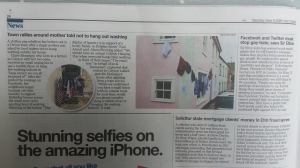
Colyton “businesses” tell Mum not to hang out washing – Colyton residents react by hanging theirs out!

Owl says: “local businesses” rely on families with young children for their livlihood. Just as well “they” didn’t identify themselves – the cowards. What nicer sight than washing drying naturally in a country village?

Oh, and it has hit the national press, with comment from East Devon Alliance and Colyton resident Paul Arnott chipping in – obviously in his personal capacity, though Owl would vote for anyone who had hanging out washing in their manifesto!

“Claire Mountjoy received an anonymous note which claimed to be ‘on behalf of local businesses and your neighbourhood’, asking her not to hang her washing out the front of her house.

The note said: “We all try hard to keep our lovely town thriving and looking good.

“The visitors walk up Dolphin Street from the tram and your terrace is a prime location.

“While we understand you have a small house with no outside room… would you please consider using a tumble dryer or hanging the washing indoors.”

Claire posted the note to Facebook earlier this week, sparking uproar from outraged community members.

Residents have since replied by hanging their washing outside their homes, a move Claire’s children have coined the ‘laundry revolution’.

Claire said: “I think it is so lovely that I live in a community that’s so supportive of me and doing something that people have done for generations.

“The community response has been amazing – the rebellious nature of Colyton has come to the fore and the laundry revolution has begun!”

Claire, who is an education officer for Devon Wildlife Trust, said she was initially sad when she read the note, but decided she would not continue to be affected by it.

She added: “I want to say to whoever wrote the note that they really should be doing their washing in a more environmentally friendly way and putting it outside.

“It would have been better to have had a nice chat.”

More support has come flooding in from Claire, with Dunkeswell-based Skydive Buzz offering her a £100 voucher for a full-height skydive.

Ruth Fouracre, of Skydive Buzz, said: “We think it’s a great thing that Claire is standing up for, and it’s a bit of fun.

“I am originally from Colyton – the town has a brilliant community and the support is great!”

Tomorrow (Saturday), the Nunsford Nutters Carnival Club will stage a children’s pram and bed race in Colyton from 1pm.

A washing line, with pyjamas pegged to it, will also be strung up between the town hall and the Colcombe Castle pub in support of Claire.

Gail Jarman, one of the race organisers, said: “The reaction for Claire has been fantastic – the amount of people who have got behind it is absolutely brilliant.

“The note is ridiculous – none of us are supporting the person who wrote it.

“You have got to dry your washing somewhere.”

http://www.midweekherald.co.uk/news/it-s-the-laundry-revolution-residents-support-colyton-mum-who-was-criticised-for-drying-washing-outside-1-5553455

“Retail space returned to landlords in high street crisis, Colliers International reveals”

Owl says: would Tesco be calling for a “level playing field” between high street and online shopping if they had not just closed Tesco Direct – their online retailer!

“Retail space equivalent to about 180 football pitches has been handed back to landlords this year, in a stark sign of the challenges facing the high street.

A day after House of Fraser announced that it would be closing more than half of its stores, an analysis by Colliers International shows that 11.6 million sq ft of retail has been “lost” to administrations, company voluntary arrangements and planned store closures this year.

The property consultancy said that this included the two million sq ft of retail space that Marks & Spencer planned to offload by closing 100 stores.

Fears are growing for the future of high streets as more retailers struggle and try to close stores through CVAs — the contentious insolvency process that allows retailers to shut shops and cut rents at landlords’ expense. New Look, Carpetright and Mothercare are among those that have entered into CVAs this year and House of Fraser’s proposed CVA has infuriated many in the property industry. The British Property Federation, which lobbies for landlords, has called for an urgent inquiry into the practice.

However, retailers say that they are facing a toxic mix of high rents, rising wages and costs and a structural shift in the industry as more people shop online. Yesterday, Dave Lewis, chief executive of Tesco, told the BBC that the burden of business rates, which hits retailers with large store estates hard, was to blame for many of the present woes.

He said that Tesco paid more than £700 million a year in business rates and that “you need a level playing field . . . between an online digital world and a traditional retail store base model”.

Dan Simms, co-head of retail agency at Colliers, said that the retail space at risk of closure this year was already more than the 10.7 million sq ft handed back in 2016, the year BHS collapsed.

“What we are seeing now are a lot more retailers closing stores,” he said. “It is much more broadly based so it feels like things are markedly worse.”

Analysis by Harper Dennis Hobbs shows that about 25 million sq ft of retail space was lost between 2008 and 2010 …”

Bovis Homes buyers complaints aren’t reducing …

… if statistics on the closed Facebook Group are anything to go by:

3,063 current members
added 119 members in the last 30 days
8 new posts today
263 posts in the last 30 days

https://www.facebook.com/groups/BovisVictimsGroup/

“Ageism widespread in UK, study finds”

“Ageism is rife in Britain, with millennials holding the most negative attitudes to ageing, according to a study.

A quarter of millennials believe it is normal for older people to be unhappy and depressed, while 40% believe there is no way to escape dementia as you get older, research from the Royal Society for Public Health (RSPH) shows.

Across all age groups, almost a third of people surveyed agreed with the statement “being lonely is just something that happens when people get old”, while two thirds had no friends with an age gap of 30 years or more.

“Ageist attitudes abound in society and have a major impact on the public’s health, and yet they are rarely treated with the seriousness they deserve,” the RSPH chief executive, Shirley Cramer, said.

“Too often ageist behaviour and language is trivialised, overlooked, or even served up as the punchline to a joke – something we would rightly not tolerate with other forms of prejudice.” …

The RSPH also called for the Independent Press Standards Organisation to include age in the editors’ code of practice to prevent discrimination.

“[T]he common media portrayal of older people blocking beds could be framed instead as ‘older people trapped in hospital because they can’t afford the care they need when they go home’, states the report, About That Age Old Question, which surveyed 2,000 adults in the UK.

“[W]e need realistic portrayals of ageing that overall reflect both the challenges and opportunities in later life.”

The report recommends housing nurseries and care homes under the same roof.

“Intergenerational contact and care offer huge benefits for the groups involved, but also to the facilities operators,” it says, adding that it was an opportunity for local authorities and private providers to save costs “as well as offering genuine wellbeing benefits to ‘young’ and ‘old’ customers alike”.”

https://www.theguardian.com/society/2018/jun/08/ageism-widespread-in-uk-study-finds

Hunt – boasts he is longest serving health secretary

“As one of my dear doctor friends said earlier on Jeremy Hunt’s “legacy” as longest-serving health secretary:

Robert Mugabe was the longest-serving President of Zimbabwe – doesn’t necessarily mean it’s a good thing.”

Facebook post.

Devon CCG refuses to reveal crucial figures to independent county councillor

“Beds, beds, beds – Devon’s NHS couldn’t or wouldn’t give me their overall occupancy figure for the recent winter: but they were forced to buy in more capacity and there were ’12-hour trolley breaches’

Devon NHS’s Sustainability and Transformation Partnership (STP) admitted in a report to Health Scrutiny yesterday that they had been desperately short of beds during the recent winter. They had to buy in extra beds to keep up with more patients staying longer, because of complex conditions. There were ’12-hour trolley breaches’, where patients had to wait more than 12 hours to be seen.

Despite my asking them directly, they did not give a figure for overall occupancy levels, although they did not deny my suggestion that they had been as bad as or worse than the nationally reported level of 95 per cent. (The nationally recommended safe level is 85 per cent.)

Jo Tearle, Deputy Chief Operating Officer for the Devon CCGs, rebutted my suggestion that cutting community beds had contributed to this crisis, saying that these were not the kind of beds they had needed, and that there had been capacity in community hospitals most of the time. However this suggests that there was no capacity some of the time. It is difficult not to believe that extra community beds wouldn’t have given them more leeway.

Meanwhile, Kerry Storey of Devon County Council indicated the strains that the ‘new model of care’ at home had been under. She said that maintaining personal care at home during the winter had been ‘a real challenge’, requiring ‘creativity and innovation’ – you don’t need much imagination to see that it will have been a real crisis time with frail people at home in isolated areas, care workers and nurses struggling to get through the snow, and staff themselves suffering higher levels of illness.

I and others predicted that because of the closure of community beds, there would be severe pressure on beds in a bad winter or a flu epidemic (and actually, this was not overall a bad winter and the snow episodes were late and short; despite higher levels of flu, there was no epidemic this winter).”

Beds, beds, beds – Devon’s NHS couldn’t or wouldn’t give me their overall occupancy figure for the recent winter: but they were forced to buy in more capacity and there were ’12-hour trolley breaches’

“Free speech” at Devon County Council – only for Tory councillors?

From Martin Shaw, East Devon Alliance for Seaton and Colyton councillor at Devon County Council:

“Conservative Councillor Richard Scott from Exmouth – where the hospital is safe because it’s kept its beds – accused me of ‘abusing the procedure’ when I went along and argued why Seaton and Honiton hospitals, which my constituents use, need to stay open with all the services and clinics currently provided – and more.

Seaton and Honiton were named by Dr Simon Kerr of NEW Devon CCG as being ‘at risk’ in the CCGs’ forthcoming Local Estates Strategy. Although the CCG has denied it has plans to close the hospitals, all local hospitals which have lost their beds – including Axminster, Ottery St Mary and Okehampton – could still be closed.

I was fully within my rights to speak up for my constituents and this was an unworthy personal attack. ClaireWright and deputy chair Nick Way (Lib Dem) both defended me.

When Claire Wright put her motion for the Committee to protect ALL community hospitals, all the Conservative members voted against this and it was defeated.

Martin Shaw
Independent East Devon Alliance County Councillor for Seaton & Colyton

Shock revelation suggests the NHS’s ‘new model of care’ is more about switching intermediate care from community hospitals to ‘block bookings’ in private nursing homes – saving costs and freeing up assets

Martin Shaw, East Devon Alliance councillor for Seaton and Colyton, Devon County Council:

Press release:

“There was a staggering revelation yesterday at Health Scrutiny from Liz Davenport, Chief Executive of South Devon and Torbay NHS Foundation Trust, that they had made ‘block bookings of intermediate care beds in nursing homes’ when they introduced the ‘new model of care’. South Devon has closed community hospitals in Ashburton, Bovey Tracey, Paignton and Dartmouth and is currently consulting on the closure of Teignmouth – where I spoke at a rally last Saturday.

The ‘new model of care’ is supposed to mean more patients treated in their own homes, and there does seem to have been an increase in the numbers of patients sent straight home from the main hospitals.

But the idea that all patients can be transferred directly from acute hospitals to home is untrue. There is still a need for the stepping-down ‘intermediate care’ traditionally provided by community hospitals – the only difference is that now it’s being provided in private nursing homes instead.

It’s likely to be cheaper to use private homes, because staff don’t get NHS conditions, and crucially it frees up space in the hospitals so that the CCGs can declare buildings ‘surplus to requirements’ and claim the Government’s ‘double your money’ bonus for asset sales. It seems NEW Devon CCG has also made extensive use of nursing home beds, but we don’t yet know if there were ‘block bookings’.

However the private nursing home solution may not last – DCC’s chief social care officer, Tim Golby, reported that nursing homes are finding it difficult to keep the registered nurses they need to operate, and some are considering reversion to residential care homes.

This may be where the South Devon trust’s long term solution comes in – it had already been reported that it is looking to partner with a private company in a potential £100m dealwhich will include creating community hubs that contain inpatient beds.

The new model of care is also about privatisation.”

Devon County Council Tories kill off community hospitals

From the blog of Claire Wright:

“Seven Conservative councillors today block voted down my proposal to “strongly support” retaining all Devon community hospital buildings and to “strongly oppose” any potential plans to declare them surplus to requirements.

And in what became a rather heated debate, one conservative, Cllr Richard Scott, disgracefully accused the assiduous and polite Independent Seaton councillor, Martin Shaw of abusing his right to address councillors.

I had requested an item on community hospital buildings at today’s Health and Adult Care Scrutiny Committee meeting, as there is a continual threat in the air of the possibility that the buildings may be declared surplus to requirements and be sold off. There remains anxiety and concern in local communities as a result.

Last month, NEW Devon Clinical Commissioning Group was forced to deny they had “any plans” to declare Honiton and Seaton Hospitals surplus to requirements, following comments made at a campaign meeting.

Dr Simon Kerr, the GP who was quoted in the notes published, later said his comments had been misinterpreted.

The Estates Strategy, which will set out what is proposed to be done with the buildings owned by the local NHS, is due out soon, possibly as early as next month.

In presenting my case I set out how the committee had been unable to secure assurances from health service managers for a long time that buildings were safe, that Dartmouth Hospital is being sold off and that the ownership of 12 community hospitals in Eastern Devon was in the hands of NHS Property Services which was charging over £3m rents for the upkeep of the buildings.

I believe these rents are still being met by NHS England, but this is only a temporary measure and soon the bill will fall on the doormat of the deeply in deficit NEW Devon Clinical Commissioning Group.

Cllr Brian Greenslade seconded my proposal.

Speaking in support were also Cllr Carol Whitton (Labour) and Cllr Nick Way (Libdem).

For some reason the conservative councillors were all opposed to my proposal. Several said there was no evidence, that it was just speculation that there was even a risk to the buildings.

Conservative councillor, Jeff Trail, didn’t appear to like my proposal but said he thoroughly supported Cllr Carol Whitton’s position, which was rather confusing as she had just said she backed me!

Cllr John Berry didn’t like my recommendation because the committee didn’t own the buildings. He wanted us to write to the CCG to ask what the status of the buildings was instead.

Cllr Sylvia Russell thought she had heard an NHS manager say at some point at today’s meeting that the buildings were safe so there was nothing to worry about. No one else seemed to recall this.

Cllr Richard Scott dismissed my proposal as “speculation” and claimed there was “no evidence” to back up my concerns.

Referring to Cllr Martin Shaw, who had just set out calmly and eloquently the concerns of his own community of Seaton, Cllr Scott added: “In some respects this is an abuse of a right to speak at this committee. There’s nothing here to consider.”

Chair, Sara Randall Johnson, wanted to take account of Paul Crabb’s view, which was that some hospitals might be old and in a poor state of repair, but I said we should have a simple and clear proposal or the CCG would drive a coach and horses through it.

I reminded the committee (yet again) that our committee was the only legally constituted check on health services in the county and it is our job to act on issues of public concern, which this very much was.

I added that it was important to take a position now and before the Estates Strategy was published so our views could inform the strategy.

My words fell on deaf ears. I had genuinely thought, that despite all the past political shenanigans on that committee – and there have been many – that the Conservatives might have backed this one, as not a single member of their own communities would have surely wanted them to vote a different way.

There was every reason for the entire committee to be unanimously in favour of my proposal.

What a huge shame.

Voting in favour: Me, Brian Greenslade (LibDem – Barnstaple North), Nick Way (LibDem – Crediton), Carol Whitton (Labour – St David’s and Haven Banks).

Voting against: (All Conservative): John Berry (Cullompton and Bradninch), John Peart (Kingsteignton and Teign Estuary) Sylvia Russell (Teignmouth) Richard Scott (Lympstone and Woodbury), Paul Crabb (Ilfracombe), Andrew Saywell (Torrington Rural), Jeff Trail (Lympstone and Woodbury)

The debate is available to view at item 10 from this link – https://devoncc.public-i.tv/core/portal/webcast_interactive/325480

http://www.claire-wright.org/index.php/post/health_scrutiny_conservative_councillors_block_vote_down_proposal_to_protec