Claire Wright concerned about unpaid carers – asks for them to contact her

Could you imagine Swire being concerned about this – concerned, not just anodyne words.

“Some of Devon County Council’s Health and Adult Care Scrutiny Committee will visit Westbank League of Friends to hear from staff who support unpaid carers, later this month, following my proposal for a spotlight review into how unpaid carers who look after friends and family members are faring.

I have seen a confidential report of a focus group meeting that took place last year, which indicates that the 24 people in Devon who took part, are suffering from a lack of support, a lack of money and a lack of respite care….. many reported that their mental and physical health was suffering as a result.

I asked for the (anonymised) report to be published with the June health scrutiny papers, but this was refused as the focus group report was not ever intended to be made public and consent had not been given. Instead a rather more neutral version of the report was published, but as I told the committee, this did not reflect the original report and I don’t believe people’s voices have been heard.

The media reports today that unpaid carers save the economy a massive £60bn a year – https://www.bbc.co.uk/news/uk-40560827 – here’s the BBC story on the subject.

Anecdotally, my conversations with local people 100 per cent support the findings from Devon County Council’s focus group. Many unpaid carers are at their wits end.

I did propose a spotlight review into how unpaid carers are faring but this was not voted on unfortunately. There didn’t seem support from around the room. However, the issue will return to the agenda in September and I will pursue it then.

If you are an unpaid carer and wish to get in touch I would be very pleased to hear from you.

Email me at claire@claire-wright.org

http://www.claire-wright.org/index.php/post/unpaid_carers_are_they_getting_the_support_they_need

Local government in crisis – chilling figures

“Hundreds of councillors and council leaders gathered in Birmingham last week to discuss the big issues facing local government. But while the sun was shining bright there was a destiny dark cloud over head.

We’ve become used to hearing of the dramatic and disproportionate cuts affecting local government. We’ve seen in every community — though some much more than others — the real impact as basic services have been reduced, facilities lost and a fire sale on land and property.

Income from the disposal of assets jumped from £1.2 billion in 2008/09 to £3.2 billion by 2016/17. In fact, almost as much was raised in the final quarter of that year than the whole of 2008.

Local government has also seen a staggering 811,000 jobs lost while at the same time central government has seen an increased workforce.

Whatever has gone might fill local government leaders with sadness, but what is coming down the line is enough to fill them, and all of us with any understanding of public services, with fear.

The Local Government Association issued a stark warning in its usually measured way, underpinned by facts and critical analysis. They highlight a breath-taking jump in the current funding gap of £2.6 billion to £7.8 billion by 2025.

This doesn’t include any rebuilding of frontline services lost as a result of the £16 billion cut in funding; that would be an eye-watering £23.8 billion — much more than the £20 billion announced to “save the NHS”.

Demand on children’s services has been hit hard with 500 child protection investigations every day. Although local government have much less to spend, overall children’s service spending has increased from £5.9 billion in 2008/09 to a forecast £15.4 billion by 2025, already running at £11.6 billion.

Adult social care spend, despite an estimated 1.5 million older people not receiving the care they would have previously been entitled to, has jumped from £14 billion a decade ago to a forecast £22.2 billion by 2025.

In the last six months alone over 8,000 people have been affected by carehome providers collapsing or withdrawing from contracts because of the squeeze.

That’s before the 77,000 families stuck in temporary accommodation including 120,000 children.

This paints a picture of a system ready to fall over. Not just individual councils failing to balance the books, but a whole system failure where a legal challenge to entitlement or new pressure such as the recent increase in National Minimum Wage and National Insurance will be the final straw.

At that point questions will be asked as to who was to blame? That is clear. Local government has done everything asked of it and more. It has taken on a disproportionate burden of cuts through austerity and every year it has highlighted the crisis coming down the line.

It has been central government with a string of toothless secretaries of state and a treasury indifferent to the human disaster developing where blame is due.

They ignore what could be a final warning at their peril.

Jim McMahon is shadow local government minister”

Source: The Red Box (podcast)

So many problems, so little attention being paid to them

Underfunding to blame for child protection ”crisis”, says report
The Local Government Association has a newsletter of articles from the press that might interest councillors amd council officers. This is today’s. Owl couldn’t reduce the list so here are ALL the topics. SO, SO worrying – all of them.

Underfunding to blame for child protection ”crisis”, says report

Pressure on councils’ safeguarding services in some areas is so severe that often the only way to guarantee safety for children is to take them into care, MPs have said. The report by the All-Party Parliamentary Group for Children, said children and young people in serious need got varying levels of help, or no help at all, depending on where they lived, with budgets influencing interventions. Cllr Roy Perry, Vice Chairman of the LGA’s Children and Young People Board, said: “This report is yet further evidence that children’s services are being pushed to the brink.”
Guardian p16, Times p16

Government needs to learn from academy failures that damaged children’s education, MPs say

The Government needs to learn the lessons from high-profile academy failures that have been damaging to children’s education and costly to the taxpayer, MPs have said. The Department for Education did not pay enough attention to scrutiny checks in a rush to convert large numbers of schools into academies, according to a Public Accounts Committee report, which also expressed concern about the levels of support available to struggling schools. Recent LGA analysis revealed that councils are better at turning around failing schools than academy chains. Cllr Roy Perry, Vice Chairman of the LGA’s Children and Young People Board, said: “It is only by working with councils and giving them the necessary powers, rather than shutting them out, that we can meet the challenges currently facing the education system.”
Independent Online, Telegraph p2

The end of the road for vital bus services?

An article on bus services highlights the case of a cancer patient’s struggle to get to hospital for treatment and the challenge of councils battling over-stretched budgets to maintain bus routes. A recent LGA report warned that nearly half of all bus routes in England are fully or partially subsidised by councils and were therefore under threat due to austerity measures. Cllr Martin Tett, the LGA’s Transport spokesman, previously said: “Councils know how important buses are for their residents and local economies and are desperate to protect them.”
Guardian p34

Opinion: Matt Hancock’s new role as Health and Social Care Secretary

An editorial in the Times argues that new Health and Social Care Secretary Matt Hancock’s priorities should include “an urgent need to resolve the question of how to fund and organise social care in Britain” and addressing “an enormous amount still to be done in the areas of preventative medicine and lifestyle improvements”.
Times p27

Bosses who revive high street properties are punished with soaring business rate hikes

Thousands of business owners and entrepreneurs are being hit with higher business rates once they renovate dilapidated or rundown stores. Business rates are calculated on the rental value of a property so renovating a run-down site inevitably comes with a rates increase. The Daily Mail is running a campaign ‘save our high streets’ and is calling for a reform of business rates, cuts to parking charges and a fair tax for big internet shopping businesses.
Mail p19

Poor air quality linked to spikes in GP visits

Air pollution leads to spikes in health problems and drives up hospital admissions and visits to the GP, according to a study. The Dundee University report proves an “absolutely clear” link between poor air quality and health problems and researchers said it should serve as a warning to politicians about the serious effects of toxic air pollution on public health.
Guardian p8

New test woe for under 11s

Official figures show that a third of primary school children aren’t achieving higher standards in reading, writing and maths tests, however performance in the SATs exams have improved, with two-thirds reaching the more rigorous requirements, up from just over a half a year ago. Some teachers believe the key stage two tests put too much pressure on young children and does not accurately reflect performance.
Sun p2, Telegraph p2, Guardian Online, i p13, Mail p29

Energy drinks consumption

Public Health Minister, Steve Brine, has warned that children in the UK consume a worryingly high level of energy drinks and is way above the European average. According to Government figures, nearly 70 per cent of ten to 17 year olds consume energy drinks. The Government plans to consult on a ban on children buying the drinks as part of its childhood obesity plan.
Sun p18, Times p4, Telegraph p10, ITV Online, i p21, Express p21

Emerging sex disease MG ‘could become next superbug’

Health experts are warning that a little known sexually transmitted infection could become the next superbug unless people become more vigilant. The British Association of Sexual Health and HIV is launching new advice about MG, which has no symptoms but can cause pelvic inflammatory disease, which can leave some women infertile.
BBC Online, Times p4

C of E to create 100 new churches as number of Anglicans hits new low

The Church of England will create more than 100 new churches to “revive the Christian faith in coastal areas, market towns and outer urban housing estates” in the face of a record low number of people identifying as Anglicans. Up to 50 new churches will be established in the diocese of Leicester and 16 in the diocese of Manchester.
Guardian p9, Telegraph p8″

Education – what is it for? The perils of a target/tick box culture – children as “collateral damage”

“An independent inquiry into a top grammar school, which was revealed by a Guardian investigation to be forcing out pupils who were unlikely to get top grades at A-level, has delivered a damning report accusing the school of illegally treating its students as “collateral damage” in the pursuit of its own interests.

The 150-page report into events last summer at St Olave’s, a selective boys school in Orpington, south-east London, called for a root and branch makeover at the school after a council investigation exposed multiple cases of maladministration and scenes of distressed pupils contemplating suicide after being pushed out of the school midway through the sixth form.

One member of staff told the inquiry that a student was so fearful of telling his parents that he could not continue at St Olave’s “that he might as well kill himself” while another on the phone to his parents said “they just want to be rid of me, they just want me gone”.

Other pupils in extremely vulnerable situations were told no exceptions could be made to the strict academic requirement of three Bs to progress into the final year of sixth form.

In one case a student who scored all As and A*s at GCSEs and was heading for medical school was refused any leniency despite being diagnosed with depression triggered by a family suicide.

The report, commissioned by Bromley council, challenged the pursuit of academic excellence at all costs. “A school has the responsibility to do its best by all of the pupils,” the report said, adding that by excluding students, the school had put the institution above the pupils.

“Parents of the pupils affected were right to say their children were being treated as collateral damage. It should not have happened.” …..

The investigation also criticised the school’s leadership for the claims of financial “doom and gloom” to justify cutting staff, cancelling courses and putting off urgent repairs. In fact, the school recorded annual surpluses and built up £2m in unrestricted funds in its bank accounts.

Parents were urged to donate £50 a month to the school by direct debit. The school also raised £35,000 a year in selling mock entrance tests to the families of applicants to the grammar school, and retained hardship funds for disadvantaged pupils, worth more than £50,000 that went unspent.”

https://www.theguardian.com/education/2018/jul/10/london-grammar-school-st-olavest-eated-students-like-collateral-damage

“The national calamity we don’t hear about – the death of local democracy”

‘We cannot survive as we are beyond this next financial year. There is no money. I am not crying wolf. I never cry wolf.” So says the Conservative leader of Torbay council, in Devon: a local authority that delivers the full range of services but can no longer function at even the most basic level.

After years of bone-crunching austerity, by 2020 it will be faced with another £12m of cuts – so the most obvious option is to downgrade itself to a district council, hand over its most essential work to the bigger Devon county council, and hope for the best. Whether this will improve anything is an interesting question: since 2010, in real terms, Devon’s funding from government has been cut by 76%.

Northamptonshire’s council has already effectively gone bankrupt. Somerset, Norfolk and Lancashire are reportedly faced with comparable problems. And in our big cities, similar stories have been unfolding for years, as the great cuts machine set in motion by George Osborne in 2010 continues to grind away, while both costs and demand for basic services increase.

Bristol faces a £108m funding gap by 2023, and is cutting services accordingly. Having already hacked well over £200m from its budgets, Leeds is in the midst of making £38m of savings in a single year. In Newcastle, by 2020, insiders reckon that over half the city council’s spending will in effect have been slashed within a decade. Many authorities are putting up council tax, but that doesn’t come close to easing the economies they have to make. And the results are obvious: less comprehensive child protection, less dependable care for older people, fewer children’s centres, more rubbish in the streets – and yet more dire damage to a social fabric that has been pulled apart for nearly a decade.

Why is this national calamity so under-reported?

Some of the answer is about the continuing tragedy of Brexit. Political journalists who work themselves into a lather about this or that item of Westminster gossip hear the dread phrase “local government” and glaze over. It is some token of Whitehall neglect that confusion still surrounds the Tory plan to abolish the core grant given from central government to local authorities and make them completely dependent on business rates and council tax. All told, senior politicians routinely treat non-Westminster people as a mere annoyance: last week, for instance, it was revealed that though the government has commissioned an updated official assessment of the likely effects of Brexit on Greater Manchester, it will not let the people who run that part of the country see it.

There have been times when the UK’s deep tendency to centralise has been momentarily held back, as evidenced by the devolution to Scotland, Wales and London, and Osborne’s encouragement of the rebirth of city regions and the arrival of elected “metro mayors”. But even in those cases – let alone when it comes to the counties, boroughs and districts where devolution remains off-limits – Whitehall’s habit of clinging to power and the effects of austerity have got in the way. Moreover, as evidenced by the calamities that have befallen health and education, particularly in England, politics has tended to revolve around grand schemes authored by politicians who have Bonapartist ideas of controlling everything from the centre – which, in the midst of a society growing more complex and unpredictable by the day, are usually bound to fail.

Yet here is a remarkable thing. For all their travails, some people in charge of councils are among the most inventive, energetic politicians I have ever met. Figures such as Manchester’s Richard Leese, Newcastle’s Nick Forbes, Leeds’s Judith Blake and Plymouth’s recently re-elected Tudor Evans – all Labour people – are located where their policies play out, deeply familiar with local nuances and complexities, and able to move fast. (Weirdly, they are now under attack from their own side: the people at the top of Labour have plans to end the system whereby council leaders are elected by other councillors, and impose one in which their selection would be in the hands of the party’s newly expanded membership – a brazenly factional move that may well be illegal, misunderstands how councils are deeply collective bodies, and threatens constant tension and disruption, just when the people concerned are in the midst of their most difficult era in living memory.)

Meanwhile, at the other end of the local government hierarchy, an experiment in participatory, non-party “flatpack democracy” in my adopted hometown of Frome, Somerset, highlights the revived belief in the power of truly local government, as does the related rebirth of town and parish councils in other parts of the country.

How would such examples of energy and creativity become the norm? Everything ought to start with an acknowledgment that the system is now an incomprehensible mess. It amounts to a random archipelago of town, parish, district, county, city and borough councils, new city regions, police forces and elected commissioners often based on completely different geographies, local enterprise partnerships and an array of other bodies – not to mention an increasingly centralised education system, and a health service now so complicated that very few people understand it. All this feeds into the sense of popular bafflement that defines a country that is simultaneously the UK’s most populous component but also its most powerless: this, it seems to me, is the essence of the modern English condition.

Any political project with radical intentions ought to consider the contrastingly clear, comparatively simple models in most of western Europe: the Spanish structure of municipalities, provinces and regional “autonomous communities” isn’t a bad place to begin. Learning from such examples should lead on to genuine financial independence for councils, based on a decent share of income tax and the ability to raise funds for big projects through bond issues, and a drastic redrawing of the responsibilities of national and local government – not least in the area of basic public services.

Council cuts are putting the vulnerable at risk, Tory peer says
If the NHS is to survive, it is going to have to decisively shift from treatment towards prevention, something that can only be organised at the social grassroots. It is high time we broke up the dysfunctional Department for Work and Pensions, and handed the administration of most benefits and the jobcentre system to local actors who know what actually works. Education urgently needs to be re-localised. If our troubled high streets are to find a new role, it will be people living next to them who will have to be given the power to find it. To even begin to solve the national housing crisis, we will also have to allow local, city and regional politicians to take the initiative. So, we should pay them properly, and allow them the parental leave, holidays, pensions and sick pay that most of them currently do without.

Across the board, we need to leave behind the lingering fantasy that our fate is wholly in the hands of national politicians who can somehow blow the dust off the failed institutional machinery of the 20th century and save us. That world is gone, and its passing ought to be marked with a collective recognition that at the point when councils ought to be in the midst of revival and reinvention, they are actually being killed. God knows, Britain is now well used to the politics of self-harm, but how amazingly stupid is that?”

https://www.theguardian.com/commentisfree/2018/jul/10/death-local-democracy-cuts-closures-westminster

Will EDDC’s new open-plan HQ improve productivity? Probably not!

“In the cartoon strip Dilbert, the boss starts a meeting by pondering a classic dilemma of modern working life. “We’re trying to decide if it’s better to have an open-plan office with too many distractions to be productive,” he says, “or soul-crushing cubicles that will make every employee envy the dead.”

There is important new evidence that could help him in his decision. While cubicles might still be soul-crushing, it turns out that open-plan offices do not — as many advocates argue — actually increase human contact. Instead, a study has found that in an open-plan office, far from being distracted by each other, we create virtual walls. We meet each other far less and communicate by email far more.

This is bad news for one of the most popular fads in office design. One of the chief arguments in favour of open-plan offices has always been that they increase “collective intelligence” by forcing people to meet each other.

When two large companies, which have been kept anonymous, made the shift from cubicles to open plan, researchers took the opportunity to test the theory. For a study in the journal Philosophical Transactions of the Royal Society B, they placed devices on employees that measured where they were standing, whether they were talking and who they were talking to. They also recorded their volume of email and instant messaging use. The results were unambiguous. By looking at a three-week period before the change, and comparing it with a three-week period three months after, they found that face-to-face interaction in the open-plan offices plummeted by 70 per cent.

There was a corresponding rise in email and instant messaging communication. Ethan Bernstein, from Harvard Business School, said that he did not know what to expect when he began the study. “On the one hand, it is hard to believe that people would not have a more vibrant and interactive experience when they work in an open office,” he said. “The sociology of it is clear: ‘proximity breeds interaction’.

“On the other hand, I’ve spent enough time on the Tube at rush hour to see that being packed together doesn’t necessarily lead to interaction.”

He said that the research seemed to show that precisely this paradigm was at play — that when people had too little privacy they were more likely to try to compensate in other ways.

“Look around open-plan offices and you can see why this might be,” he said. “People put on huge headphones to avoid distraction. They stare intently at their screens because they know people are watching and want to look busy. Then people looking at them from across the room see someone working intently and don’t want to interrupt. So they send an email instead.”

Source:The Times (pay wall)

“How to maintain high ethical standards in local government: a perspective on the Committee on Standards in Public Life’s review so far”

Professor Colin Copus is a specialist advisor to the Committee on Standards in Public Life’s review into local government ethical standards. He writes here in a personal capacity:

“As academic advisor to the Committee on Standards in Public Life’s review into ethical standards in local government, I’ve been reflecting on the evidence I’ve heard so far.

The aim of the review is to test the robustness of the current system for maintaining high standards of public behaviour in local government. It is not a hatchet-job on councillors or intended to identify a problem where there is not one. Rather, the review will assess evidence to enable a judgement to be made about what, if any, changes are required to the current regime to ensure the maintenance of the highest ethical standards in local government.

My impression so far is that there are two competing themes emerging that pose a challenge to anyone considering how best to create the environment for strong ethical behaviour in local government. Those themes result in the question: do we nationalise or do we localise ethical standards in local government?

The danger in any review in local government is for rose-coloured spectacles to temper one’s view of past systems. It is nowhere more the case than in the ethical standards debate.

The evidence received by the Committee so far has highlighted some difficulties with the effectiveness of localising standards that came with the abolition of the standards board and the past regime associated with the board by the Localism Act 2011.

Concern has also been expressed about placing control over the ethical regime (and code of conduct) with councils themselves and about the apparent weaknesses in the sanctions available to councils when dealing with ethical and behavioural issues.

Moreover, the review has heard that local codes of conduct can result in councillors who sit on county, district and parish councils at the same time potentially being subject to three different codes. We do not yet know how widespread this issue is or if it generates regular and intractable problems for councillors and officers.

But the review has also heard that there is a recognition that centralising and nationalising ethical standards can result in a system that is remote, anonymous, lacking in appreciation of local differences of culture, tradition and behaviour.

Nationalising the system also prevents flexibility and responsiveness to specific local issues and at worse can result in councillors feeling on ‘trial’ and subject to a remote and bureaucratic system, which in itself can damage local democracy.

The issue of sanctions also looms large as does the role of independent input or oversight of the local process of assessing standards issues.

Sanctions pose a particular problem, not least because under the current arrangements, a party in power may be tempted to misuse their majority when imposing sanctions, but also because there is a line between what is appropriate for councils to be able to require and impose as sanctions and what is appropriate that the electorate themselves have at their disposal.

The question of sanctions is closely tied to that of oversight: even the power to suspend councillors from committees, council meetings or council premises and restrict resources for a short while may be subject to misuse. Robust safeguards and rights of appeal must, therefore, be available to councillors whose behaviour is not the real problem – but instead find themselves the subject of a complaint when they are an effective and vocal opponent of the ruling administration.

We also do not yet know how widespread such a problem may be. It is clear that the issue of sanctions, the system by which they are imposed and independent oversight and involvement, will be a key theme of the Committee’s assessment of the evidence in this review.

The hazard with any ethical regime – local or national – is how the political parties in local government respond to that regime.

Given that over 90 per cent of all councillors in England are from the Conservative and Labour parties and the Liberal Democrats, the temptation to use a set of rules and regulations designed to control councillors’ behaviour for party political advantage or to silence councillors from other parties, is considerable.

Any ethical regime must not provide a system that can be misused for party advantage or by officers to restrain troublesome councillors as both can damage free speech within local democracy.

It must also be remembered that ethical standards in English local government are among the highest across Europe and that results in a commitment by the overwhelming majority of councillors to public service and the public wellbeing.

The Committee has a difficult tightrope to walk to make observations and recommendations that provide an opportunity for all local authorities and the central government to finesse and reform the current system, to ensure the highest standards of ethical behaviour are maintained and strengthened in local government. It is well worth the walk.”

http://www.democraticaudit.com/2018/07/10/how-to-maintain-high-ethical-standards-in-local-government-a-perspective-on-the-committee-on-standards-in-public-lifes-review-so-far/

“Cool down nuclear plan because renewables are better bet, ministers told”

“Government advisers have told ministers to back only a single new nuclear power station after Hinkley Point C in the next few years, because renewable energy sources could prove a safer investment.

The National Infrastructure Commission (NIC) said the government should cool down plans for a nuclear new build programme that envisage as many as six plants being built.

The commission, launched by George Osborne in 2015, said that a decade ago it would have been unthinkable that renewables could be affordable and play a major role in electricity generation. But the sector had undergone a “quiet revolution” as costs fell, it said.

Sir John Armitt, the NIC’s chairman, said: “They [the government] say full speed. We’re suggesting it’s not necessary to rush ahead with nuclear. Because during the next 10 years we should get a lot more certainty about just how far we can rely on renewables.”

He argued that wind and solar could deliver the same generating capacity as nuclear for the same price, and would be a better choice because there was less risk. “One thing we’ve all learnt is these big nuclear programmes can be pretty challenging, quite risky – they will be to some degree on the government’s balance sheet,” he said.

“I don’t think anybody’s pretending you can take forward a new nuclear power station without some form of government underwriting or support. Whereas the amount required to subsidise renewables is continually coming down.”

Renewables were a “golden opportunity” to make the UK greener and make energy affordable, he added.

https://www.theguardian.com/uk-news/2018/jul/10/nuclear-renewables-are-better-bet-ministers-told

NHS bed blocking costs £550 per MINUTE says charity

“Bed blocking because of a lack of social care availability is costing the NHS an “eye-watering” £550 per minute, according to research by a charity released today. This equates to £290m a year, Age UK has estimated.

Analysis by the charity also showed that in just two years, the number of older people in England living with an unmet care need has risen by 19%, which translates to 1.4 million over 65s living with unmet care needs

More than 300,000 need help with three or more essential daily tasks like getting out of bed, going to the toilet or getting dressed, the charity found, and of this 165,000 receive no help whatsoever from paid carers, family members or friends.

Caroline Abrahams, Age UK’s charity director, said: “The numbers of delayed discharges to a lack of social care are actually going down, but a lack of social care still costs the NHS an eye-watering £500 every minute – not to mention undermining the chances of older people making a full recovery if they are unnecessarily stuck in hospital for weeks or longer.”

Izzi Seccombe, chair of the Local Government Association’s community wellbeing board, said: “People’s unmet care needs will continue to increase and deepen the crisis in adult social care unless the sector receives a long-term funding settlement, like the NHS, and further funding is made available for council’s public health and prevention services.

“To prevent crises in the NHS, government needs to plug the £3.5bn funding gap facing adult social care by 2025 and reverse the £600m in reductions to councils’ public health grants between 2015-16 and 2019-20.”

Age UK noted that between 2009-10 and 2016-17 spending on adult social care in England fell by 8% in real terms. As a result, in the same period, the average spend per adult on social care fell by 13%, from £430 to £379.

Alex Khaldi, head of social care insights at Grant Thornton, said: “Funding is not the only answer, councils need to focus on monitoring the level of unmet need in their areas more effectively. “If we are to exercise place-based leadership in social care, better data insight that allows councils to identify where and why people have fallen between the cracks is urgently needed.”

The LGA has announced that it would be publishing its own adult social care green paper, after Jeremy Hunt announced the government green paper would be delayed until autumn.

A Department of Health and Social Care spokesperson said: “We expect the NHS to work closely with local authorities to ensure people are treated in the most suitable setting and when they are discharged from hospital they have a care plan in place.”

https://www.publicfinance.co.uk/news/2018/07/bed-blocking-costing-nhs-ps550-minute

New housing minister was Deputy Leader of Westminster council – wanted police to hose homeless off wealthy streets

“Theresa May’s new Housing Minister boasted how he pioneered council policy to make life “more uncomfortable” for rough sleepers.

Kit Malthouse, a key Boris Johnson ally, was moved into the frontbench role after the Foreign Secretary followed Brexit Secretary David Davis in resigning over May’s EU exit strategy on Monday.

Key parts of Malthouse’s role will be to grapple with the country’s housing crisis and to cut homelessness, which has doubled since the Conservatives came to power in 2010.

But, as deputy leader of Westminster Council in 2004, he operated a hostile “zero tolerance” drive by the local authority to move homeless people on from the wealthy area’s streets.

One particular tactic saw police officers ask rough sleepers to shift their beds so street cleaners could hose the area. …”

Source: Huffington Post:
https://www.huffingtonpost.co.uk/entry/new-housing-minister-kit-malthouse-operated-callous-policy-to-make-life-more-uncomfortable-for-rough-sleepers_uk_5b43895fe4b07aea7542aa1a?guccounter=

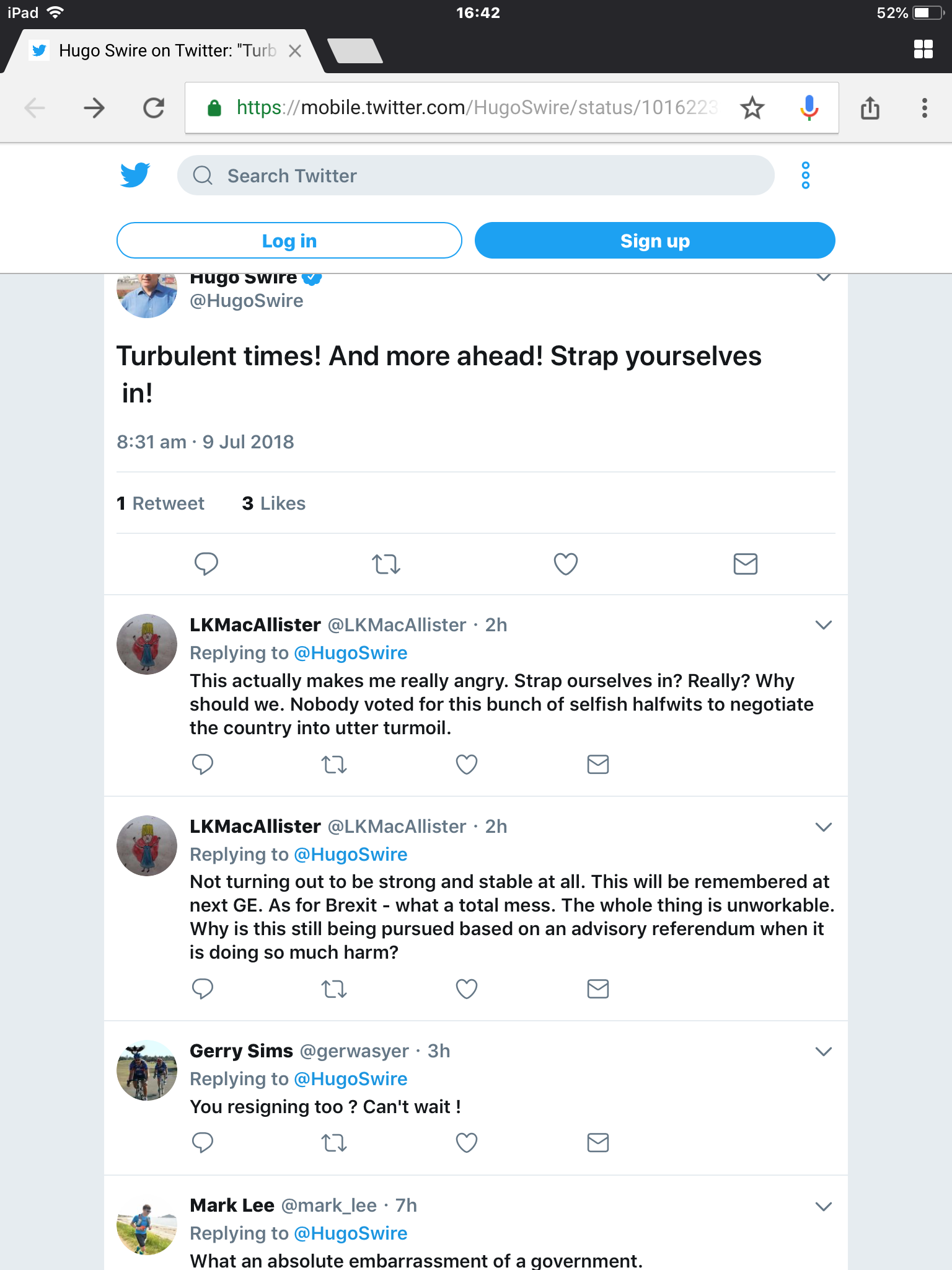
Swire tells us to “strap ourselves in” …

Swire’s advice to us in his Twitter post?

“Turbulent times! And more ahead! Strap yourselves in!”

Unfortunately it was followed by several replies on the lines of:

  • your lot caused it so why crow about it;
  • not a good example if “strong and stable”; and
  • when can we look forward to your resignation

Rather backfired …. seems to be catching.

With Raab’s promotion to Brexit Minister housing will get its eighth minister in 8 years

“Theresa May’s pledge to “fix the broken housing market” lies in tatters after she left herself scrambling to find the eighth Tory housing minister in eight years.

The Prime Minister promoted Dominic Raab to be Brexit Secretary after he spent just six months in the job.

The vacancy means the government is having to find its third housing minister since the Grenfell Tower disaster only 13 months ago.

Mr Raab’s replacement will be fifth person to hold the role since 2015 and the eighth since 2010.

Shadow Housing Secretary John Healey slammed Tory ministers.

He said: “Dominic Raab’s move means that Theresa May is on her fourth housing minister in just two years as Prime Minister. …

… Mrs May declared it was her “personal mission” to fix the housing crisis and pledged to build 300,000 homes a year overall by the mid-2020s.

But just 39,350 homes started being built in the three months to March – a fall of 8% on a year earlier. …”

https://www.mirror.co.uk/news/politics/tory-pledge-fix-broken-housing-12883036

New all-party push for proportional representation

This week is the first National Democracy Week – a rare moment to put the ‘nuts and bolts’ of democracy on the agenda.

The elections of the past year have shown that Westminster’s First Past the Post system is failing at the lowest democratic hurdle – allowing everyone to participate equally in our politics.

One in five people felt forced to ‘hold their nose’ and opt for a lesser evil rather than their preferred candidate in 2017’s General Election.

68% of votes had no impact on the result – going to either unsuccessful candidates or being ‘surplus to requirements’. Under the Westminster’s system, all that is required for victory is a majority of one.

And the system is exaggerating divisions in the UK – Labour secured 29% of the vote in the South East but got just 10% of seats, while the Conservatives won 34% of the North East vote but got just 9% of seats.

This isn’t some anomaly – this is built into a stone-age system where having one more cross in the box than the rest is all that counts: every other vote goes to waste.

But Westminster’s system can’t even do what it says on the tin – produce ‘strong’ single-party government. The Conservatives were required to make an agreement with the Democratic Unionist Party (DUP) to ensure it could govern with any degree of reliability.

These serious flaws in the Westminster system are why today, during the first National Democracy Week, we are marking the relaunch of the All Party Parliamentary Group for Proportional Representation.

This will see MPs from across the political spectrum meet to support a change in the voting system – to one which better matches seats in the House of Commons to how people actually voted.

It will be chaired by Labour MP Daniel Zeichner, joined by Martyn Day MP (SNP), Wera Hobhouse MP (Liberal Democrat), Jeremy Lefroy MP (Conservative), Caroline Lucas MP (Green), Lord Warner (Crossbench) and Hywel Williams MP (Plaid Cymru) as Vice-Chairs. This is a powerful cross-party coalition for change.

We know that while the existing Westminster system may be all that many voters in England have ever known, it is far from the only way. There are much better options.

Every new democratic institution created in the past two decades has, in fact, rejected First Past The Post. Voters in Wales, Scotland and Northern Ireland (and indeed, in most modern democracies) are all used to more proportional systems – seeing their voices properly and fairly reflected in the corridors of power, and with seats matching votes. (For more information on the alternatives see here)

Yet Westminster’s creaking voting system is stuck in the dark ages.

National Democracy Week has been launched with the noble intention that “regardless of who we are or where we are from, we must work together to ensure that every member of society has an equal chance to participate in our democracy and to have their say.”

Let us recognise that the ‘one-party-takes-all’ system does not achieve this. It was designed for another age – and doesn’t work today.

Let’s move towards a democratic system built for our time: where everyone’s voice is heard. That, surely, would be fitting progress to mark the first National Democracy Week.”

https://www.electoral-reform.org.uk/a-cross-party-group-of-mps-are-fighting-westminsters-broken-voting-system/

Carillion and outsourcing: Cost versus accountability and loyalty

“The collapse of Carillion has exposed “fundamental flaws” in government outsourcing, which is obsessed with costs and is damaging public services, a review by the Commons public administration committee has found.

Carillion, a private construction company, that was one of the government’s biggest contractors, collapsed in January, raising fears about the future of hundreds of its projects for HS2, schools, prisons, the NHS and the armed forces, and 20,000 UK jobs.

The government refused to bail out Carillion but said that it would provide the funding to maintain all of the company’s public services when it went into liquidation. Its failure revived a crisis of confidence in government’s reliance on the private sector to deliver public projects and shone a spotlight on the efficiency of government spending on private firms. The government spends £251.5 billion a year on outsourcing.

That spending has been criticised as unclear and ineffective by the public administration and constitutional affairs committee in a report into government outsourcing released today. “It is unclear how and why the government decides whether to outsource a particular service. The government needs to move quickly to improve public confidence in the competence of its commercial abilities,” the parliamentary report said.

The committee, which is chaired by Sir Bernard Jenkin, has called on government to provide greater transparency on how it awards public sector contracts after it discovered deals had been done based on incorrect data.

It found that the government has had to renegotiate more than £120 million of contracts since 2016 to ensure public services would continue after initially pushing providers to offer unsustainable prices.

Sir Bernard accused the government of using “thin or non-existent” evidence to support decisions to outsource contracts and said it did not understand the risks it was pushing on to contractors. “It has accepted bids below what it costs to provide the service, so the contract has had to be renegotiated,” he said. “The Carillion crisis was well-managed, but it could happen again unless lessons are learnt about risk and contract management.” In its report, the committee accused the government of prioritising spending as little money as possible while forcing contractors to take “unacceptable” levels of financial risk.

“Ultimately this has led to worse public services as companies have been sent a clear signal that cost, rather than quality of services, is the government’s consistent priority,” it said.

The report questioned the rationale behind the belief that outsourcing provides a better service for less public money and said that ministers could not provide evidence that this was true.

A Cabinet Office spokesman said that the government had announced a wide package of measures to further improve how it works with its vendors.

“This includes extending the requirements of the Social Value Act in central government to ensure all major procurements explicitly evaluate social value where appropriate, consulting on improvements to the prompt payment code, as well as measures to make the outsourcing process more robust and the results more transparent.

“We will respond formally to this report in due course.”

Source: Times (pay wall)

Sunday smile: Donald Trump, Elton John … and an organ

This is a verbatim transcript of part of a speech President Trump made in Montana last Thursday. He was (Owl thinks) attempting to say …. well, judge for yourself:

“While speaking to a crowd in Montana Thursday night, Trump abruptly brought up the singer in the middle of tangent about how no one gives him credit for being a great speaker. He said ( and what follows below is a true transcript and can be verified all over news sites:

… “I have broken more Elton John records. He seems to have a lot of records. And I, by the way, I don’t have a musical instrument. I don’t have a guitar or an organ. No organ. Elton has an organ. And lots of other people helping. No, we’ve broken a lot of records. We’ve broken virtually every record. Because you know, look, I only need this space. They need much more room. For basketball, for hockey and all of the sports, they need a lot of room. We don’t need it. We have people in that space. So we break all of these records. Really, we do it without, like, the musical instruments. This is the only musical – the mouth. And hopefully the brain attached to the mouth, right? The brain. More important than the mouth is the brain. The brain is much more important.”

https://www.rollingstone.com/politics/politics-news/trump-elton-john-696490/

“China looking to buy stake in UK nuclear plants, say reports”

No problem, our Local Enterprise Partnership members with vested interests in nuclear power will ensure that all their workforce take Mandarin lessons.

“The Chinese government has emerged as a potential buyer of a multibillion-pound stake in Britain’s nuclear power plants.

The talks will reignite debate about China’s involvement in the UK nuclear power industry. Two years ago, the government paused approval for the £18bn Hinkley Point C project because of security concerns over China’s stake.

China General Nuclear Power Group (CGN), a state-run corporation, is said to be interested in buying a major stake in eight power stations, including Sizewell in Suffolk and Dungeness in Kent.

The power stations are operated by EDF Energy, a subsidiary of the French company EDF, but earlier this year, the British Gas owner, Centrica, put its 20% stake up for sale. The Sunday Times suggested CGN hoped to acquire a 49% stake, which indicates EDF could be looking to offload some of its shareholding.

The proposed deal would be a headache for Theresa May, who is concerned about giving China greater access to critical infrastructure projects and has initiated a new national security test for foreign takeovers.

CGN is becoming an increasingly important player in Britain’s atomic plans, and is working with EDF Energy on plans to develop a new nuclear power station at Bradwell-on-Sea in Essex.

The sale could attract interest from pension and insurance funds, but analysts say the pool of bidders is small because the reactors have a limited shelf live.

Paul Dorfman, a senior researcher at University College London’s Energy Institute, said Britain was an outlier in its openness to Chinese investment.

“It’s entirely credible [that China would be allowed to buy the stake] in the context of what the British government is doing,” he said. “There is no other OECD country that would allow China to own any of its critical infrastructure, let alone its nuclear infrastructure.”

Dorfman said EDF, with €33bn (£29bn) of debt, was eager to raise funds from asset sales. “EDF is in financial difficulties and has been for some time. It’s looking to sell off whatever it can sell off. It’s worried about debt, its credit rating … plus its waste and decommissioning liabilities,” he said.

The eight nuclear power stations, which used to be grouped under British Energy, generate 8.9 gigawatts of electricity and supply about 20% of Britain’s electricity needs. They were bought by EDF for £12.5bn in 2008. The following year, Centrica took a 20% stake, which it values at £1.7bn.”

https://www.theguardian.com/environment/2018/jul/08/china-interested-majority-stake-uk-nuclear-power-stations-reports?CMP=Share_iOSApp_Other

“Fears of future strain on NHS as councils slash health programmes”

Hospitals will bear the brunt of “incredibly shortsighted” cuts to public health initiatives that will lead to more people having a heart attack or getting cancer, experts are warning.

New research reveals that, by next year, spending per head in England on programmes to tackle smoking, poor diet and alcohol abuse will have fallen by 23.5% over five years.

Key services, including those to help people quit smoking, manage their sexual health or stay off drugs, are among those being subjected to the deepest cuts, according to analysis by the Health Foundation thinktank.

The public health grant that the Department of Health and Social Care (DHSC) gives to local councils in England, which is not covered by the cash injection, is due to fall from £2.44bn this year to £2.27bn in 2019-20. It will be the fifth year in a row it has been cut since its peak of £2.86bn in 2014-15.

By next year, councils will be spending £95m on smoking and tobacco-control services, 45% less than they were in 2014-15. The next biggest cuts over that period will have occurred in drug and alcohol services for under-18s, down by 41% to £40m, and the equivalent services for adults, which will have fallen by 26% over those five years. Sexual health services will also be getting 25% less.

“There’s a massive gap between the government’s rhetoric on public health and prevention and the reality,” said Tim Elwell-Sutton of the Health Foundation. “NHS England’s Five Year Forward View talked about ‘a radical upgrade in prevention’ while in her recent speech about the NHS the prime minister said ministers would support public health. But we are seeing significant cuts to public health budgets. It is incredibly shortsighted not to invest in keeping people well. We are storing up problems for our health and also for the NHS, which is already under huge pressure. It could become increasingly unsustainable as more and more people with preventable illnesses will need long-term healthcare.

“We’re crazy if we’re not taking seriously the underlying cause of one of the most harmful illnesses – cancer – which is also one of the most expensive to treat,” said Elwell-Sutton. Although smoking rates are falling, the habit leads to almost 500,000 hospitalisations a year and is a major cause of strokes, heart problems and life-threatening respiratory conditions.

Shirley Cramer, chief executive of the Royal Society for Public Health, accused ministers of “confused thinking” over health. “These figures demonstrate a frustrating contradiction from the government, whereby welcome extra money is given to the NHS with one hand, while the other generates more strain on NHS services by draining public health and prevention.”

Conservative-controlled Warwickshire county council is the local authority where the public health grant has been cut the most – by 39%, or £40 a head – since 2014-15. Other councils which have seen their budgets shrink by substantial amounts include Knowsley in Merseyside (38%) and Wokingham in Berkshire (38%). Five councils have seen their budget rise, including Shropshire (up 17.4%) and Warrington (up 11%).

Cramer voiced concern that two of the councils which have seen their public health grant cut the most, Knowsley and Tameside in Manchester, are also among the 10 areas with the highest rate of people being admitted to hospital because of poisoning by drugs, and three others are in the top 40.

The Department of Health and Social Care said: “We have a strong track record on public health – smoking levels are at an all-time low, rates of drug misuse are lower than 10 years ago, and drug addiction treatment services remain free for all with minimal waiting times. Local authorities are best placed to make choices for their community, which is why we are investing more than £16bn in local government public health services over the current spending period.””

https://www.theguardian.com/society/2018/jul/08/fears-of-future-strain-on-nhs-as-councils-slash-health-programmes

Another (lack of) productivity headache for our Local Enterprise Partnership

How fortunate that ex-EDDC Leader Paul Diviani and current DCC Leader John Hart have managed to pass on responsibility for DOUBLING growth in Devon and Somerset by 2030 (not forecast for any other part of the UK economy) to our Local Enterprise Partnership – of which their councils are now very minor members!!! The parcel passed.

The tragedy being that this spurious forecast is now indelibly integrated into “unicorn under magic money tree” thinking at all levels.

Productivity went into reverse in the first quarter of the year, raising questions over why Britain is no longer churning out the efficiency gains of the past.
Output per hour worked fell by 0.4 per cent in the three months to March compared with the previous quarter, the Office for National Statistics said.
Compared with the first quarter of last year, productivity was 0.9 per cent higher, but this was still very sluggish against the trend rate of growth of almost 2 per cent a year that was routinely chalked up before the financial crisis.
The ONS said that the productivity puzzle remained unsolved and raised possible concerns about inflationary pressures building. Earnings and other labour costs grew by 3.1 per cent over the year, up from 2.9 per cent in the previous quarter.
With wages growing faster than productivity, firms face potential profit constraints in the short run and longer-term pressure to raise prices.
Over the past ten years, productivity growth has been the weakest since modern records began and appears to be the slowest since the early 1820s, when Britain was emerging from the Napoleonic wars.
After previous downturns, productivity has initially stalled but subsequently recovered to trend rates of growth. Productivity is the key factor for a lasting rise in living standards.
Economists have proffered a number of possible explanations for the productivity freeze, including the relatively low level of business capital investment and the reluctance of banks to lend since the crisis.
Others believe the productivity number is understated because of the difficulty of measuring intangible output benefits from the digital economy.
In the ten years since the last productivity peak in the fourth quarter of 2007, output per hour worked is only 1.5 per cent higher. It would have been 20 per cent higher by now if pre-crisis trends had continued.
The Chartered Institute of Personnel and Development said the latest figures were “disappointing but not surprising” given the strong job creation numbers in the quarter and weak economic growth.
Other analysts said that wintry weather in the first quarter would have hit productivity levels in some industries.
The ONS next week reveals the first of its estimates for monthly GDP as well as a rolling three-month figure. Previously it had stuck to quarterly numbers. Britain will be the first advanced economy to try to estimate total national output every month.
One drawback, however, is that it will delay publication of the traditional calendar quarterly number. The Bank of England will not have the benefit of the full second-quarter GDP number when it decides whether to raise base rate early next month.”

Source: http://www.thetimes.co.uk
2 mins read
Patrick Hosking, Financial Editor
July 7 2018, 12:01am, The Times

What Shakespeare knew about Integrated Care Organisations and Local Enterprise Partnerships!

Reposting a comment by “The Bard” with apologies to Shakespeare!

“Meantime we shall express our darker purpose.
Give me the map there. Know that we have divided
Our kingdom divers ways: and ’tis our fast intent
To shake all cares and business from our age;
Conferring them on LEPs, they so enriched,
While we, unburthen’d crawl toward electoral death.

………………….Tell me, my Councillors,–
Since now we will divest us both of rule,
Interest of territory, cares of state,–
Which of you shall we say doth owe us most?
That we our largest bounty may extend
Where nature doth with merit challenge. Greg Clark,
Our business secretary, speak first.

King Lear: Act 1, Scene 1 (updated a tad)

“Companies got just £21million relief from business rates this year as councils are urged to do more to help ailing high streets”

Owl says: You want to see a conflict of interest in action? Here’s one. Should a council agree to business rate reductions to save their high streets and see their own revenue fall – or should they let the shops die to preserve their income? (Empty shops usually get 3 months free of business rates then have to recommence them even if the shop remains empty).

“Councils are failing to use their powers to cut business rates and help struggling local shops survive.

Local authorities can reduce rates if it is felt necessary to rejuvenate town centres, using rules under the 2011 Localism Act.

But analysis by the Altus Group consultancy reveals that this almost never happens. There were only £21million of reductions in this financial year – or 0.08 per cent of the predicted total £24.8billlion rates bill in England.

Although business rates are set by an independent government body, half the tax raised goes to councils.

Critics warned that their short-term focus on raking in money could end up destroying town centres weighed down by huge tax burdens.

The 50 per cent of rates that councils keep is meant to come with a more responsible attitude to businesses, with authorities cutting taxes where necessary to help firms.

But instead of going down, rates are constantly ratcheted up. Department stores have been hit with an average increase of nearly £151,000, or 27 per cent, in the past two years, while small shops have seen average rates climb 9 per cent to £9,623.

Sam Dumitriu, of the Adam Smith Institute, a think-tank, said: ‘Councils would rather prioritise their chief executives’ salaries over lessening the burden on businesses. There needs to be quite radical reform of rates to support businesses.’

Mike Cherry, chairman of the Federation of Small Businesses, said: ‘Local authorities must get to grips with the dire situation currently sweeping the high street and start backing hard-working retailers being hit hard by crippling rates bills.’

Robert Hayton, head of business rates at Altus, said: ‘Despite the ongoing crisis engulfing our high streets, this year councils in England are planning just £21million in additional help.

‘Given the stream of collapses across the retail and hospitality sectors since the turn of the year – and with many others teetering on the brink – councils could take decisive action now.’

The Daily Mail’s Save Our High Streets campaign is calling for business rates to be reformed, car parking charges to be slashed and huge foreign technology companies such as Amazon to be fairly taxed.

Around 50,000 retail staff have lost their jobs this year and almost 61,000 stores closed between 2012 and 2017 as internet retailers ruthlessly out-compete traditional bricks and mortar companies.

The Local Government Association, which represents councils, said: ‘Councils do what they can to help small businesses and local economies.

‘This is increasingly difficult, with local government in England facing an overall funding gap that will reach almost £8billion by 2025 and growing demand for services.’ “

http://www.dailymail.co.uk/news/article-5927309/Companies-got-just-21million-relief-business-rates-year.html